SPECIAL ADVERTISING SECTION
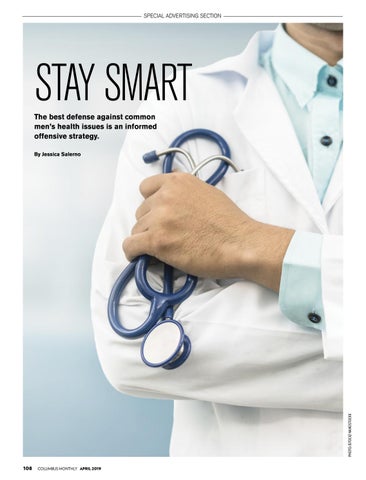
STAY SMART The best defense against common men’s health issues is an informed offensive strategy.
PHOTO: ISTOCK/ NANOSTOCKK
By Jessica Salerno
108
COLUMBUS MONTHLY APRIL 2019
SPECIAL ADVERTISING SECTION
Claiming ignorance about your health no longer works in a world where there is endless information available on how to take care of your body, be more active and live longer. But taking ownership of your health goes beyond trying to eat a balanced diet and going to the gym occasionally. For men, issues like cardiovascular and prostate health are particularly important, and the more you know and understand what signs and symptoms to look for—and the preventative actions to take—the better off you’ll be. •••
HEART HEALTHY
TICK
ON SA ETS LE NO W!
Flyover MAY 8-11
Presented by
2019
Broncho MICHAEL CHRISTMAS
BONNY DOON DANEZ SMITH Winter TIN ARMOR BARRIE Sammus PENNY LANE PAUL CHERRY Franny Choi ELANA K. ARNOLD ERIKA L. SANCHEZ
{
Two Dollar Radio | Don Giovanni | Kenyon Review | Button Poetry | Cbus Libraries Sarabande | Bookspace | Ohio University Press | The Journal | BELT | PM Press Nix Comics | sunnyoutside | Dr. Doctor | New American Press | Igloo Letterpress Open Letter | Anyway Records | Dorothy, a publishing project | Story Magazine
Columbus
OHIO
MAY 8 - 11
LITERATURE
@TheFlyoverFest @TheFlyoverFest /TheFlyoverFest
Music
{
Brought to you by
Bookfair
Jeni’s Splendid
According to the Centers for Disease Control and Prevention, more than half the deaths due to heart disease in 2009 were men, and it’s the cause of about 1 in 4 deaths every year in the United States. When it comes to taking control of your cardiovascular health, start by talking to your physician. “I think men should be proactive in asking questions; the more questions, the better,” says Dr. Essa Essa, a cardiologist with Mount Carmel Health System. “It’s very important for men to understand the concept of risk factors … [meaning] any attributes or exposures or pre-existing conditions that increase the likelihood of developing a disease.” Essa says those questions can include: • If I’m at risk, what can I do to lower that risk? • While I’m working on lowering that risk, what symptoms should I be watching for? • When do I seek medical attention? If you’ve already had a cardiac event, ask what you can do to lower the risk of it happening again. Risk factors for heart disease include high blood pressure, high LDL cholesterol, diabetes, smoking, obesity, poor diet and physical inactivity. Essa says it’s not unusual for men to know about those general risk factors, but they’re more interested in their individual risk. With the technology available, he’s able to calculate individualized risk of cardiovascular disease for patients and help identify those who would benefit from early testing or prevention strategies. “I think there’s never too early of a time to be evaluated for risk factors that lead to cardiovascular disease,” says Dr. M. Wesley Milks, assistant professor of clinical medicine at Ohio State University and cardiologist at OSU’s Wexner Medical Center. Milks says all adults should have regular cholesterol screenings. His patients often
FILM
TWO DOLLAR RADIO
BOOKFAIR
APRIL 2019 COLUMBUS MONTHLY
109
SPECIAL ADVERTISING SECTION
COSMETIC PROCEDURES FOR MEN
question how much lowering cholesterol truly impacts cardiac health, and they wonder if they’re taking a pill without any real benefit. “We know from a large conglomerate of studies that every 40 percent we lower the cholesterol, we lower the incidence of heart attack or stroke in the upcoming five-year period by 20 percent,” Milks says. “So it is a very considerable benefit.” Milks also hears patients question the benefits of exercise. The CDC recommends getting 200–300 minutes of moderate physical activity each week.
110
COLUMBUS MONTHLY APRIL 2019
“I would define [moderate] as the amount of exertion to produce some shortness of breath, but enough to speak in full sentences; enough to break a sweat,” Milks says. For your heart, cardio exercises are more beneficial than strength training, Milks adds, although some strength training can be complementary. He also says men don’t need to consider themselves gymgoers to do this type of exercise; everyday activities such as carrying groceries, lifting laundry and other housework can provide good cardiovascular exercise.
If a cardiac event does happen, recent medical advancements have made many treatments less invasive over the years, Essa says. “We can treat most blockages in the heart or coronary arteries through the access of the right radial artery in the wrist, instead of going through the groin, these days,” Essa says. “And we can repair or replace heart valves using catheters that access the heart through the groin without opening the chest with open-heart surgery.” Intracoronary stents are another development to deal with coronary artery disease;
PHOTO: ©2019 THINKSTOCK
Gone are the days when it was only socially acceptable for women to seek out cosmetic surgeons, as more and more men are looking for ways to improve their appearance. Some of the more popular procedures for men include body contouring, eyelid surgery and Botox, says Dr. Michael Sullivan of The Sullivan Centre. Body contouring procedures are requested regularly, as they’re done under local anesthesia and have short recovery times. One popular treatment, called BodyTite, uses radio frequencies to melt fat below the skin’s surface before suctioning it out via a small, inconspicuous incision. “BodyTite not only suctions away melted fat; it melts the fat and tightens skin at the same time,” Sullivan says. “As opposed to liposuction where you’re just removing fat, this way you’re actually melting that fat and then removing it and then tightening the skin.” Men who have who gynecomastia, or enlarged breast tissue, are taking advantage of BodyTite instead of more invasive surgical options. Sullivan says it takes about an hour, and there is swelling for three to four days. Patients wear a garment post-procedure to compress the skin and aid recovery for a week to 10 days. “I’m reminded about how many options we have available these days,” says Sullivan. “Back when I started my practice, we didn’t have anything nonsurgical at all—and now there are so many options people can pick and choose from.”
SPECIAL ADVERTISING SECTION
the stents are deployed in the midst of blood vessel-blocking plaque to keep the vessel open when someone has experienced angina or a heart attack. “The technology in these stents is improving considerably, year by year, and the reliability of the stents continues to improve,” Milks says. •••
IMPROVING YOUR PROSTATE Prostate cancer is the leading non-skin cancer among men, according to the CDC, but Dr. Rashmi (Rash) Patel, a Mount Carmel urologist, says many of his patients come in not understanding why they’re having urinary issues. “I do a lot of education as far as what the problems are and what kind of testing we need to do to get their prostate feeling better,” he says. A man’s prostate grows as he ages, which can cause the urethra to narrow and decrease urine flow. Symptoms include a decreased force of stream, pain with ejaculation and sexual discomfort. When this starts to happen, Patel says men should seek out a specialist.
He begins to screen men—especially those with a family history of prostate issues—for prostate concerns at age 40; most men will probably begin to notice symptoms around 50. In addition to prostate cancer, men should also be aware of chronic prostatitis, also called prostate inflammation, causing pain or discomfort in the groin area. He says some men will have problems that progress more quickly than others and may even need medication to manage them. “As you get older you will probably have issues, and it’s important to be regularly checked to maintain a healthy prostate,” Patel says. Those looking to maintain a healthy prostate should be health-conscious, eat a good diet of fruits and vegetables with less red meat, exercise, avoid smoking, manage stress, hydrate daily and have an active sex life. •••
PUTTING THE RIGHT FOOT FORWARD Although exercise is a common form of preventative treatment for many health issues, overdoing it can also be problematic for your body. Dr. Trevor Davy, a podiatry
surgeon with Mount Carmel, says he sees many male patients come in with Achilles tendon and ankle issues from overexertion. “When joint flexibility and muscle strength has decreased over time and someone plays too hard during a weekend softball game, the next thing they know, they’ve injured their Achilles or had a bad ankle sprain,” Davy says. “It’s because their body wasn’t physically prepared to do that activity.” Many men, young and old alike, are surprised to learn they have arthritis, Davy adds, which can especially affect those who have physical careers or do intense, high-impact exercises on a regular basis. Depending on the injury, there are a variety of ways to manage the pain. Davy says many issues are fixable with anti-inflammation medicine or physical therapy; surgery can help when less-invasive measures aren’t enough. Preventative action can be as simple as knowing your limits, Davy says. For example, if you have a history of ankle problems, it’s wise to wear ankle support when engaging in physical activity. And he says routine stretching and strength training are crucial for preventing further injuries as you continue to exercise.
APRIL 2019 COLUMBUS MONTHLY
111
ADVERTISEMENT
Nerve endings from amputated limbs can cause excruciating pain for years. We’ve pioneered a solution. Nearly 75 percent of people who have lost an arm or leg from trauma, cancer or poor circulation will eventually suffer from debilitating pain. Doctors at The Ohio State University Wexner Medical Center and College of Medicine have pioneered the use of primary targeted muscle reinnervation (TMR) for pain prevention. The procedure reroutes the nerves cut during amputation into motor nerves in nearby muscle. Ian Valerio, MD, division chief of Burn, Wound and Trauma in Ohio State’s Department of Plastic and Reconstructive Surgery, recently worked with former Ohio State resident J. Byers Bowen, MD, to publish instructions for this
method and to document the technique’s ability to prevent pain. “A significant amount of pain in amputees is caused by disorganized nerve endings, called symptomatic neuromas, in the residual limb,” says Valerio, who gained expertise as a military surgeon, treating wounded warriors with limb loss. “Think of it like a live wire – if you cut a live wire, you have electrical shocks continuing to go through the severed wire. Neuromas form when nerves are severed and not addressed, thus the signals have nowhere to go.” Attaching those cut nerve endings to motor nerves in nearby muscle lets the body re-establish its neural circuitry and avoid the burning pain of neuromas as well as residual limb pain and/or phantom limb pain.
The surgeons performed 22 TMR surgeries in belowthe-knee amputations over the course of three years and found that none of those patients developed symptomatic neuromas. Six months after surgery, just 13 percent of the patients reported any pain at all.
If performed at the time of the initial amputation, patients have minimal health risks, and their recovery is similar to that of traditional amputation surgery. TMR can also be performed years after amputation to reduce pain and improve quality of life.
“TMR alleviates phantom and residual limb pain by giving those severed nerves somewhere to go and something to do,� Valerio says.
The research lays out a blueprint for surgeons to provide more successful outcomes and greater quality of life for patients following amputation.
The reduction in pain means that patients potentially will experience reduced dependence on pain medication over time, and they may be able to wear a prosthetic limb more effectively. TMR surgery also is able to help those with upperextremity amputations improve control of their prosthetics. The surgery allows for more individual muscle unit firings, so these patients can make more refined movements and have a greater range of motion. Because of their groundbreaking findings, Ohio State researchers believe primary TMR is a reliable technique for preventing pain in all types of amputations.
Ohio State currently performs TMR routinely, with primary TMR being the standard of care for most traumatic and oncologic amputations. Valerio travels the world training surgeons on the technique to help ensure that amputees everywhere experience its benefits. Ohio State’s commitment to pioneering life-changing biomedical discoveries is driving treatment advancements across Ohio and in hospitals around the globe. To learn more about TMR, call 614-634-9696.
wexnermedical.osu.edu/leadingtheway