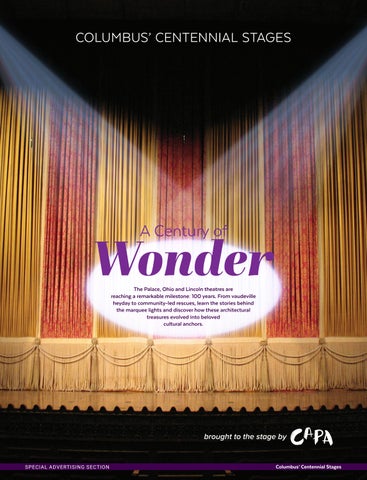
COLUMBUS’ CENTENNIAL STAGES
A Century of
Wonder The Palace, Ohio and Lincoln theatres are reaching a remarkable milestone: 100 years. From vaudeville heyday to community-led rescues, learn the stories behind the marquee lights and discover how these architectural treasures evolved into beloved cultural anchors.
SPECIAL ADVERTISING SECTION
ColumbusMonthly_51016_09_18_2026_B_029_675881 (2).indd 1
Columbus’ Centennial Stages 9/3/26 3:37 PM
2 Columbus’ Centennial Stages ColumbusMonthly_51016_09_18_2026_B_030_675882.indd 1
SPECIAL ADVERTISING SECTION
9/3/26 12:49 PM
Table of Contents 4
From Vaudeville to Vital How Columbus’ historic theatres evolved from profit houses to cultural anchors. EDITOR AND GENERAL MANAGER, DISPATCH MAGAZINES Katy Smith
ADVERTISING MULTIMEDIA SALES MANAGERS Heather Kritter, Adam Trabitz
EDITORIAL COLUMBUS’ CENTENNIAL STAGES WRITER Jill Moorhead
PRODUCTION DESIGNER Rebecca Zimmer
ASSOCIATE EDITOR Lucy Clark DIGITAL EDITOR Julanne Hohbach PHOTO EDITOR Tim Johnson DESIGN & PRODUCTION PAGE DESIGNERS Kathryn Biek, Kelly Hignite, Kaity Athialy, Hannah Patton
MARKETING MARKETING MANAGER Lauren Reinhard LETTERS: letters@columbusmonthly.com ADVERTISING: advertise@ columbusmonthly.com EDITORIAL/ADVERTISING OFFICES 605 S. Front St., Ste. 300 Columbus, OH 43215 614-888-4567
8-13
The Theatres Spotlight on three icons as they turn 100—the Palace, the Lincoln and the Ohio—their history, their impact and their beloved architecture.
CAPA/Theatre Timeline The history of the theatres, CAPA and the community.
14
The Artists The magnetic singers, dancers, actors, musicians and more who have brought the theatres alive and delighted audiences for 100 years.
16
The Volunteers Stories of the people from our community who have spent their free time contributing to the theatres’ operations and their memories of what these places mean to them.
17
The Backstage Crews The talented individuals who have kept our theatres running smoothly— the unseen stagehands in black who make fantastic productions happen.
18
CAPA at the Center Tracing the evolution of the Columbus Association for the Performing Arts (CAPA) from its origins as a steward of historic theatres into a dynamic, multifaceted cultural leader.
Share Your Memories
Get Involved
You’re part of the story. Share your memories of Columbus’ historic theatres.
See what’s happening during the 100th anniversary and find ways to participate.
ON THE COVER: The curtain at the Ohio Theatre (Photo courtesy CAPA) ON OPPOSITE PAGE: Joe Worman, past stage manager, works the rigging at the Ohio Theatre. (Dispatch archival photo courtesy Columbus Metropolitan Library)
SPECIAL ADVERTISING SECTION
ColumbusMonthly_51016_09_18_2026_B_031_675883 (7).indd 1
Columbus’ Centennial Stages 3 9/9/26 8:19 AM
From Vaudeville to Vital
The Ohio Theatre was called Loew’s United Artists Ohio Theatre in 1934
How Columbus’ Historic Theatres Evolved from Profit Houses to Cultural Anchors In the late 1920s, Downtown Columbus was rich with entertainment. More than 20 theatres competed for audiences, offering movies, vaudeville, music and comedy. The Southern had opened in 1896. Three decades later, three more grand theatres opened in quick succession: the Palace in 1926, followed by the Ohio and Lincoln in 1928. They were built in the same city and for the same booming entertainment age, but they inhabited different worlds. “The Palace, in those days, was magic,” wrote the late Phil Sheridan, a theatre historian and former Palace general manager. He remembered skipping school and catching a trolley Downtown—with a White Castle stop— to see big-band matinees. On any given bill, singers and dancers might share the stage with comedians, magicians, acrobats, jugglers, strongmen and performing animals. The Ohio was built around movies. A night there included uniformed ushers, newsreels and shorts, a live orchestra and a Robert Morton organ. Its architect envisioned it a “palace for the average man.” On the Near East Side, the Ogden Theatre and Ballroom (now the Lincoln) stood amid the “Million Dollar Mile,” where a dollar, the story went, could change hands a million times among
1896 The Southern Theatre opens with the Broadway touring production In Gay New York. Today, it is the oldest surviving theatre in the Columbus region.
the neighborhood’s Black-owned businesses. Inside, audiences came for movies and vaudeville downstairs, while dances and jazz filled the ballroom above. When the Crowds Left Movies replaced vaudeville. Television replaced movies. The suburbs replaced downtowns. Neighborhoods became freeways. And the functional replaced the grand. The 1948 Paramount antitrust decision forced major studios to divest their theatre chains, too. These beauties had been built for crowds who now loved Lucy more than movie palaces. The ornamental became maintenance, and maintenance became expensive. Todd Bemis, who spent 41 years at the Columbus Association for the Performing Arts before retiring as vice president of operations, saw the evi-
1926 The Palace Theatre opens as a vaudeville house and movie palace, with Thomas Lamb’s design inspired by France’s Palace of Versailles.
4 Columbus’ Centennial Stages ColumbusMonthly_51016_09_18_2026_B_032_675884 (3).indd 1
1928 The Ohio Theatre opens as a Loew’s movie and vaudeville house. Opening night features the silent film The Divine Woman, starring Greta Garbo.
dence throughout the Palace. “All the crystal was stripped out of the Palace during that period because they didn’t want to keep it clean,” he said. Even the theatre’s brass doors were painted rather than polished. “There were seven coats of paint on those doors.” Their enormous footprints only made theatres more attractive for redevelopment: Demolish one, and a developer had a ready-made site for a downtown tower, says Doreen Uhas Sauer, a Columbus historian and longtime historic-preservation advocate. By the late 1960s, buildings designed to entertain and delight had become difficult to operate and easier to demolish than save. Second Acts The Ohio “Why would you ever tear down this theatre?” One of CAPA’s founders, Larry Fisher, demonstrates the same
1928 The Ogden Theatre and Ballroom, now the Lincoln Theatre, opens on Thanksgiving Day. Soon after, 3-yearold Sammy Davis Jr. makes his first stage appearance there.
PHOTO COURTESY COLUMBUS METROPOLITAN LIBRARY
By Jill Moorhead
1969 CAPA is found-
ed to save the Ohio Theatre from demolition, launching a community campaign that raises more than $2 million to purchase and preserve the theatre.
SPECIAL ADVERTISING SECTION
9/3/26 12:51 PM
The Palace “No one would have expected that the Palace would have survived,” says Uhas Sauer. While saving the Ohio had required a community campaign, the Palace’s survival hinged on the vision of Katherine LeVeque, its owner. In Sheridan’s telling, the two stood ankle-deep in fallen plaster as he shared stories of the Palace’s vaudeville past. LeVeque looked around the
1970 CAPA launch-
es the Summer Movie Series at the Ohio Theatre. More than 50 years later, it remains the nation’s longest-running classic film series.
Scott Whitlock, left, and Larry Fisher were part of the group that saved the Ohio Theatre and created CAPA.
deteriorating theatre and said, “I never realized, until this moment, what a beautiful theatre the Palace really is.” She had seen the magic. LeVeque was an unlikely preservationist. Uhas Sauer recalls her coming Downtown from Galena, largely unfamiliar with the city she would help preserve. LeVeque commissioned a
1970 CAPA reopens the Ohio Theatre as a pe rforming arts center and new home of the Columbus Symphony. Today, it also hosts BalletMet, Broadway in Columbus and CAPA’s own yearly production of A Christmas Carol.
SPECIAL ADVERTISING SECTION
ColumbusMonthly_51016_09_18_2026_B_033_675885 (4).indd 1
PHOTO BY TIM JOHNSON
incredulity he felt in 1969, when the then-young lawyer learned of plans to redevelop the site. Architect Robert Karlsberger led a study to determine whether the Ohio could host live performance, and a Columbus Symphony concert put it to the test. Some 2,000 people came. But by May that year, the effort had fallen short. “Many of the people who were trying to save the Ohio were theatre organ enthusiasts,” Sheridan wrote. “Most had neither money nor influence.” Fisher and law partner Scott Whitlock joined Karlsberger and Jean Whallon, musician and wife of Symphony conductor Evan Whallon, in the fight. When the owners said demolition was contracted and the theatre’s contents sold, Whallon called developer John Galbreath. Fisher remembers Galbreath walking to his office window and looking down at the Ohio for a minute or two. “But it seemed longer.” Galbreath returned offering financing and more time. Long story short: Columbus rallied, the money was raised and the Ohio was saved. It also was put back to work. Today, the Columbus Symphony and PNC Broadway in Columbus call the Ohio home, while the Summer Movie Series, launched in 1970, still puts movies on its screen. In 1977, the Ohio was designated a National Historic Landmark and became the Official Theatre of the State of Ohio.
1977 The Ohio Theatre is designated a National Historic Landmark, recognizing its national significance.
feasibility study and joined workers stripping paint. Restoration and performances followed, often simultaneously. For roughly a decade, she tried to make the Palace work financially. But in 1989, she donated it to CAPA, solidifying the organization’s evolution from savior of one theatre to steward of historic stages.
1978 Former President
Gerald R. Ford and Ohio Gov. James A. Rhodes unveil plaques recognizing the Ohio Theatre as a National Historic Landmark and the Official Theatre for the State of Ohio.
1989 Katherine LeVeque gifts the Palace Theatre to CAPA, expanding the organization’s stewardship of Columbus’ historic theatres beyond the Ohio Theatre.
Columbus’ Centennial Stages 5 9/2/26 12:47 PM
PHOTOS FROM TOP: SHARI LEWIS/THE COLUMBUS DISPATCH,
Todd Bemis oversaw renovations of the Palace Theatre in 2005.
The Lincoln “The Lincoln, how do we forget about a theatre as bad as we forgot about the Lincoln Theatre? How do we let that theatre rot? How do we let that community be forgotten?” Bemis is close to tears as he recalls the city’s most recent historic theatre reclamation. By the time the Lincoln was remembered, it was almost too late. I-71 and urban renewal divided the thriving Black neighborhood on Columbus’ Near East Side, displacing more than 10,000 residents. The Million Dollar Mile went quiet. The Lincoln closed and was left to deteriorate. Slated for demolition in 1991, mandatory exterior repairs spared it. Mayor Michael Coleman saw the theatre as a cornerstone of King-Lincoln’s revitalization. The city acquired it, community leaders including Larry James built support, and CAPA brought its restoration expertise. When Bemis first walked inside, there were no seats. The stage floor was so rotted he couldn’t walk on it.
1994 CAPA begins
managing the Riffe Center Theatre Complex. The four-theatre complex is now home to CAPA resident group Contemporary Theatre of Ohio (formerly CATCO)
Water ran down the walls through holes in the roof. After an 18 month, $13.5 million renovation, the Lincoln reopened in 2009. As the Lincoln came back to life, so did the neighborhood. Angela Pace, a longtime Columbus TV anchor and board member for CAPA, watched restaurants and cafes open, properties restored and people return to Long Street. The theatre, she says, helped “jump-start” its rebirth. Bemis remembers hopes that the Lincoln could revitalize a place that had been “forgotten about for so many years.” “And it did,” he says. “It absolutely did.”
ColumbusMonthly_51016_09_18_2026_B_034_675886 (5).indd 1
The Lincoln
Still on Stage The stories are still being written: Rain falling on the Ohio stage during an epic dance-fight in The Outsiders; opera, musical theatre and jazz colliding at the Palace in Pirates! The Penzance Musical; and Columbus-based Such Sweet Thunder performing Duke Ellington’s Nutcracker Suite at the Lincoln, nearly a
1998–2003 CAPA manages the historic Chicago Theatre, taking its theatre-management expertise beyond Columbus to one of the nation’s best-known historic venues.
6 Columbus’ Centennial Stages
century after jazz first filled the theatre. And every audience sends another ripple beyond the stage. Dinner at Tip Top. Drinks at The Keep. Parking, hotels, a pre-gala manicure, new shoes for a first Nutcracker. Fisher has called saving the Ohio “the match that lit the fire” for the preservation of American movie palaces. Uhas Sauer sees the result as exceptional: “I don’t know of another city that has that unless it was New York. Certainly not a Midwest city of a rather moderate size doing something like this.” Columbus Jazz artistic director Byron Stripling has performed at Carnegie Hall and Lincoln Center. But the Southern is different. “When I come to the Southern,” he says, “I’m home.” Together, the four historic theatres hold nearly 7,000 people. Sheridan came to understand the distinction between the building and the life inside it. “Until 1969, when efforts to save Loew’s Ohio from demolition began, I regarded theatres as most people do. They were places to go to watch a movie or stage show— nothing more.” Years later, he wrote of the Palace, “As a theatre, it has my love. As a building, it has my respect.” The buildings survived. But the people onstage, in the seats and behind the scenes, keep them alive.
1998 CAPA reopens the Southern Theatre after a 14-month, $10 million restoration. Today, it’s home to Opera Columbus, Columbus Jazz, Chamber Music Columbus and ProMusica.
2001 CAPA begins management of New Haven, Connecticut’s historic Shubert Theatre. CAPA acquires the theatre in 2013.
2002 A critical $3 million modernization expands the Ohio Theatre’s stage, replaces its undersized 1920s dressing rooms and adds its first loading dock.
SPECIAL ADVERTISING SECTION
9/4/26 12:44 PM
INTERIOR PHOTO COURTESY MITCHELL MULTIMEDIA AND EXTERIOR LYDIA MILLER
CAPA is transforming the historic Central Presbyterian Church at 132 S. 3rd St. into Wrightsel Music Hall.
7 Columbus’ Centennial Stages ColumbusMonthly_51016_09_18_2026_B_035_675887 (2).indd 1
SPECIAL ADVERTISING SECTION
9/4/26 11:02 AM
Shining a Spotlight on 3 Storied Theatres Scenes from the Palace, the Ohio and the Lincoln as they reach the century mark. By Jill Moorhead
The Palace: A Home Away from Home The Palace was built with performers in mind. Vaudeville mogul Edward Albee personally supervised construction, including acoustics designed for performers working without amplification. Backstage, the dressing-room tower
2003 An agreement is
formed between CAPA and CATCO to launch CAPA’s local shared services model, the beginning of the resident arts partners program.
functioned like a small hotel. Performers could pick up their keys and mail at a front desk, prepare meals in the kitchen and bring their children to a designated playroom. Even animal acts were accommodated, with a porcelain bath below the stage and a ramp because
2009 After nearly 40
years of closure, the Lincoln Theatre reopens following an 18-month, $13.5 million CAPA-led renovation as a state-ofthe-art performing arts and education center.
8 Columbus’ Centennial Stages ColumbusMonthly_51016_09_18_2026_B_036_675888 (4).indd 1
2009 CAPA takes over
production of Festival Latino from the city of Columbus, marking its first venture into outdoor festival management. Today, the free, family-friendly festival is a summer mainstay.
Katherine LeVeque with Donny and Marie Osmond
2011 CAPA begins managing the Drexel Theatre for Friends of the Drexel. The 1937 art deco/art moderne landmark is a rare surviving neighborhood movie theatre.
PHOTOS FROM TOP: COURTESY PHOTOGRAPHY©️BRAD FEINKNOPF; DISPATCH PHOTO
The Palace Theatre
2013 CAPA assumes
management of New Albany’s McCoy Center for the Arts, expanding its administrative-services model to the 786-seat New Albany performing arts venue.
SPECIAL ADVERTISING SECTION
9/2/26 9:33 AM
animals would walk upstairs, but not down. A century later, the variety continues. Todd Bemis, CAPA’s former vice president of operations, calls the Palace CAPA’s “workhorse,” welcoming an ever-changing lineup of acts.
Palace Theatre 34 W. Broad St. Built: 1926 Seats: 2,695 Original name: Keith-Albee Palace Theatre Architect: Thomas W. Lamb Style: French-inspired design modeled after the Palace of Versailles, with ornate plasterwork, balconies and elaborate decorative details Built for: Vaudeville on a grand scale, with extensive backstage facilities designed for performers and even ramps capable of bringing elephants to the stage
From left, the grand staircase at the Palace; the theatre shines along West Broad Street at night; and Brit Floyd plays the Palace.
2018 CAPA launches
the Marquee Awards as part of its 50th anniversary, bringing the national Jimmy Awards® program to local high schools.
2018 The Palace Theatre reopens after a six-month auditorium restoration, part of a $6.5 million renovation that also included a new roof and heating system.
SPECIAL ADVERTISING SECTION
ColumbusMonthly_51016_09_18_2026_B_037_675889 (3).indd 1
2023 Short North Stage
joins CAPA’s resident groups, following their collaboration on A Christmas Carol. CAPA provides ticketing and operational support at the historic Garden Theater.
Saved: After years of decline, owner Katherine LeVeque began restoring the Palace while returning performances to its stage. After nearly a decade of investment, she donated the theatre to CAPA in 1989.
2026 CAPA assumes operational leadership of the Idea Foundry through a lease with the city of Columbus, adding the 100-plus-year-old Franklinton creative hub to its portfolio.
PHOTOS COURTESY CAPA BY ERIC PAUL OWENS (LEFT TO RIGHT STARTING AT TOP) RANDALL L. SCHIEBER AND MITCHELL MULTIMEDIA
The Palace Theatre
2026 CAPA names its future Downtown venue Wrightsel Music Hall, as construction begins to transform the historic 1859 Central Presbyterian Church into a performance space.
Columbus’ Centennial Stages 9 9/3/26 3:35 PM
The Ohio Theatre
The Ohio: A Grand Theatre for All The Ohio may have begun as part of a national theatre chain, but Columbus audiences have made it distinctly their own. Through CAPA’s youth programming, generations of schoolchildren have heard the Mighty Morton, the
10 Columbus’ Centennial Stages ColumbusMonthly_51016_09_18_2026_B_038_675890 (2).indd 1
only one of four identical Loew’s theatre organs still in its original home. Families return each year for BalletMet’s The Nutcracker, and wide eyes aren’t limited to the audience—even the artists who take its stage still marvel at the place.
PHOTOS CLOCKWISE: DORAL CHENOWETH/COLUMBUS DISPATCH (2), DISPATCH PHOTOS COURTESY COLUMBUS METROPOLITAN LIBRARY (3)
Clockwise: Ohio Theatre staff members onstage in 2026; a detail on the east side of The Ohio; the Ohio during renovations; Ohio Theatre interior in 1972; and Don Streibig, director of the Ohio Theatre in 1982, proudly displays donations slipped into the door of the theatre after John Galbreath had pledged to give $1 for every $2 raised for the Ohio’s expansion.
SPECIAL ADVERTISING SECTION
9/2/26 9:55 AM
Ohio Theatre 39 E. State St. Built: 1928 Seats: 2,791 Original name: Loew’s Ohio Theatre Architect: Thomas W. Lamb; interior designer Anne Dornan Style: Spanish Baroque movie palace featuring a grand lobby and iconic 21-foot chandelier Built for: Movies as spectacle, with uniformed ushers, a live orchestra and the Mighty Morton organ accompanying films
PHOTOS CLOCKWISE COURTESY PHOTOGRAPHY©️BRAD FEINKNOPF; COURTESY CAPA (2) ; KYLE ROBERTSON/THE COLUMBUS DISPATCH
Saved: Closed in 1969 and slated for demolition, the Ohio inspired the creation of CAPA. After an earlier preservation effort fell short, CAPA rallied Columbus in a successful campaign to purchase and restore the theatre.
Photos at left: The Ohio Theatre set for piano solo; the Mighty Morton organ; CAPA’s production of A Christmas Carol in 2025; and above, the theatre’s ornate chandelier.
SPECIAL ADVERTISING SECTION
ColumbusMonthly_51016_09_18_2026_B_039_675891 (4).indd 1
Columbus’ Centennial Stages 11 9/2/26 9:56 AM
The Lincoln Theatre PHOTO AT TOP COURTESY PHOTOGRAPHY©BRAD FEINKNOPF; BELOW BY TERRY GILLIAM
The Lincoln: A Place to See and Be Seen The Lincoln was at the heart of its neighborhood. Audiences came for movies, vaudeville, dancing and jazz. Because Black performers could play in Downtown Columbus but couldn’t stay in its hotels, touring musicians lodged nearby. After their Downtown engagements, jazz greats sometimes made their way to the Lincoln’s upstairs ballroom for impromptu second shows. The Lincoln became a nationally known jazz destination, welcoming Count Basie, Miles Davis, Duke Ellington, Etta James and Columbus native Nancy Wilson. Today, that history remains part of its identity, while its stages welcome everything from jazz and theatre to comedy, dance and community events. The Lincoln Theatre following full renovations, top, is set in the bustling King LincolnBronzeville neighborhood, home to many Black-owned businesses.
12 Columbus’ Centennial Stages ColumbusMonthly_51016_09_18_2026_B_040_675892 (3).indd 1
SPECIAL ADVERTISING SECTION
9/4/26 11:00 AM
CLOCKWISE: COURTESY PHOTOGRAPHY©BRAD FEINKNOPF; CAPA; JOENATHAN BANKS BLACK BOLD AND BEAUTIFUL PRODUCTIONS; BARBARA J. PERENIC/THE COLUMBUS DISPATCH
Clockwise: View of the Lincoln’s ornate columns; Former CAPA CEO Bill Conner, Franklin County Commissioner Marilyn Brown and Columbus Mayor Michael B. Coleman celebrate the completion of the theatre’s restoration in 2010; the staff of the Lincoln in 2026; Hank Marr High School Jazz Award recipient Mason Bryant with his Fender Stratocaster guitar in 2021; and Jay Robinson and the Supremes.
Lincoln Theatre 769 E. Long St. Built: 1928 Seats: 582 Original name: Ogden Theatre and Ballroom Developed by: African-American entrepreneurs James Albert “Al” Jackson and James “Ernie” Williams Style: Egyptian Revival, with details inspired by the Temple of Karnak Built for: Movies and vaudeville downstairs and dancing and jazz in the ballroom above, serving Columbus’ Black community during segregation and beyond Saved: Slated for demolition in 1991, the Lincoln was saved the following year and later restored as a cornerstone of the King-Lincoln District’s revitalization. The theatre reopened in 2009, with CAPA managing it for the City of Columbus.
SPECIAL ADVERTISING SECTION
ColumbusMonthly_51016_09_18_2026_B_041_675893 (5).indd 1
Columbus’ Centennial Stages 13 9/4/26 11:03 AM
Byron Stripling in the jazz record room at the Lincoln Theatre
The Artists Meet some of the artists who brought Columbus’ theatres alive and delighted audiences for 100 years. By Jill Moorhead
Byron Stripling Byron Stripling has performed at Carnegie Hall and Lincoln Center and on stages throughout Europe and Japan. But after more than two decades leading Columbus Jazz, he has found a home on Columbus’ historic stages. That includes the Lincoln Theatre, where Columbus Jazz began performing soon after its restoration. For Stripling, the Lincoln carries a history that extends beyond the performances onstage. He thinks about its place in a historically Black neighborhood and the generations of Black artists, including Sammy Davis Jr., who performed there. “It gave us a sense of pride and a sense of feeling like, yes, we’re part of
14 Columbus’ Centennial Stages ColumbusMonthly_51016_09_18_2026_B_042_675894.indd 1
this musical thing, too,” he says. Stripling believes historic theatres also ask something increasingly rare of audiences: their attention. Phones go silent. Distractions fall away. People lean in and listen. That, he says, puts a responsibility on the performers, too. “If we’re going to deliver on the music, it’s got to be worth being quiet for,” he says. When asked what he hopes audiences will appreciate about the city’s centennial theatres and the artists who perform in them as they enter their second century, Stripling’s answer was as punchy as he is. “Well, see, I’m a jazz guy,” he says. “Pat your foot.” Andrew Levitt For Andrew Levitt, better known as Nina West, performing on the Ohio Theatre stage was a long-held dream that came true in 2022, when he played Edna Turnblad on the national tour of Hairspray. By then, Levitt had built a career as
Nina West on stages large and small, from Columbus nightclubs to venues across the country. But the Ohio was different.
PHOTOS FROM TOP: TIM JOHNSON, COURTESY LYDIA MILLER/CAPA
Columbus’ centennial stages have welcomed generations of legendary artists, but these living theatres continue to welcome remarkable talent of all kinds. Here are four performers whose careers—and dreams—have been shaped by the opportunity to take their place on these historic stages.
Andrew Levitt ahead of his performance in Hairspray at the Ohio Theatre in 2022 SPECIAL ADVERTISING SECTION
9/1/26 1:24 PM
“It was epic,” Levitt says, remembering the view from the stage: the balconies, the red and gold of the theatre and the chandelier sparkling overhead. Levitt says performing in historic theatres carries the weight of knowing who came before: Liza Minnelli, Aretha Franklin and Diana Ross. “It’s humbling.” For Levitt, the power of live performance is ultimately the connection it creates. He describes it as a “direct human-to-human connection point,” one that can build empathy, spark conversation and remind people to consider what they value. “Having access [to live art] is a really important thing,” Levitt says. “It gives permission for people to dream.” Zeke Moses Zeke Moses, a rising junior at Bexley High School, remembers his first musical. He was 3 years old, sitting in the audience of the Ohio Theatre for The Lion King. Thirteen years later, in May 2026, he was back in the same theatre, but this time, onstage, accepting the 2026 CAPA Marquee Award for Best Lead Actor for his performance as Bobby Strong in Bexley High School’s Urinetown. He genuinely did not expect to win. “I still can’t believe that when they
Bexley High School student Zeke Moses performs during the CAPA Marquee Awards.
announced the best actor award, my name was called,” he remembers. The award immediately opened another door. The win sent him to the Jimmy Awards in New York City, the national high school musical theatre competition. Now, Moses dreams of returning to the Ohio Theatre someday as a professional performer on a national tour. He hopes he’ll also have the chance to work with area students through CAPA’s Marquee Awards program, passing along the kind of experience
PHOTOS FROM TOP: COURTESY MITCHELL MULTIMEDIA/CAPA; TIM JOHNSON
Krista Lively Stauffer is an actress, coach and longtime member of the Columbus theatre scene.
SPECIAL ADVERTISING SECTION
ColumbusMonthly_51016_09_18_2026_B_043_675895 (3).indd 1
that helped him find his own place on the stage. Krista Lively Stauffer Krista Lively Stauffer has spent a lifetime on the stages of Columbus’ historic theatres. As a child, she performed at the Palace Theatre with the Columbus Children’s Choir, and at 14, she joined the national tour of Joseph and the Amazing Technicolor Dreamcoat during its Columbus stop. It was on the Palace stage that she knew theatre would remain part of her life. Her relationship with Columbus’ historic theatres continued into adulthood with Opera Columbus. In Eugene Onegin, she spent nearly the entire two-anda-half-hour opera onstage at the Ohio Theatre as an older version of the main character, without speaking or singing. Now, she runs KLS Studios, helping other actors find their footing onstage. For Stauffer, performing in a historic theatre brings a different kind of weight. There’s the sheer scale of looking out at thousands of seats, but also the knowledge of who has stood on the stage before. “You just feel like you’re something greater than you,” she says. And for all their grandeur and history, Stauffer says what ultimately matters is what happens when people gather inside the theatres. “There’s nothing like being in a live theatrical performing arts space with other people knowing that in that moment in time, you’re sharing something together.”
Columbus’ Centennial Stages 15 9/4/26 11:44 AM
The Volunteers
CAPA ushers, from left, Jordan Radunz, Spencer Quattlebaum and Clement Thurn at the Ohio Theatre
Meet the heart of the house—CAPA volunteers who bring Columbus theatres to life. By Jill Moorhead
Jordan Radunz Jordan Radunz, an accountant for AEP, began volunteering with CAPA in December 2024 to reconnect with people after working from home. She quickly realized the organization was much more than Broadway. “They have so many events at so many theatres,” she says, “Movies. Comedians. Podcasters. High school dance recitals.” She ushers at the McCoy Community Center for the Arts and the Hinson Amphitheater in New Albany because of their proximity to home, but her favorite place to volunteer is the Ohio. She loves the hidden doors and pockets behind the scenes, and the look in peoples’ eyes when they walk in for the first time. “Their eyes just light up,” she says. “I can tell with shows like the Nutcracker that some families have been coming for years. First they brought their kids, and now they’re bringing their grandkids,” she says, adding, “I think that’s really special.” Clement Thurn “I’m one of the first people you see.” Clement Thurn started ushering for CAPA in November 2013, and he’s worked through every role, including training new ushers.
16 Columbus’ Centennial Stages ColumbusMonthly_51016_09_18_2026_B_044_675896 (2).indd 1
His favorite? The Ohio. “She’s such a grand old lady,” he says. He relishes how history comes alive when the theatre hosts performances, and he often offers patrons a little snippet of history to take home. “She’s got the original organ,” he says, referring to the “Mighty Morton,” the only one of four identical Loew’s theatre organs still in its original home. “The theatres have personalities,” he says, “I know it sounds corny, but they do. I like the personality of the Ohio the best.” His advice to prospective volunteers: “You can have a little tiny part in our history.” Spencer Quattlebaum Spencer Quattlebaum primarily ushers at the Ohio and Palace theatres, but he has volunteered at nearly every CAPA
venue. As an aisle captain, he ensures guests have reached the correct section before directing them to ushers who escort them to their seats. An IT consultant, Quattlebaum has volunteered as a CAPA usher for about five years. Quattlebaum’s favorite theatre is the Ohio, where he enjoys watching firsttime visitors marvel at the chandelier and the building’s grandeur. He also enjoys seeing audiences embrace the performances. During Hadestown, he remembers patrons arriving in costume, their excitement setting the tone. One winter evening, Quattlebaum spent extra time helping a patron who couldn’t remember where they had parked. Together, they wandered Downtown until they found a familiar parking lot. “It was a fun moment,” he says. “I’m here... doing my part to make the theatre and community a better place.”
PHOTO BY TIM JOHNSON
Ninety minutes before the curtain rises, CAPA’s volunteer ushers are already at work. They contribute more than 54,000 volunteer hours each year, welcoming audiences to the organization’s theatres and performance venues, scanning tickets, answering questions and helping thousands of patrons find their seats. A team of roughly 550 ushers commits to helping out at least twice a month. They love the people they meet almost as much as they love telling the stories of the historic theatres that attracted them to their roles.
SPECIAL ADVERTISING SECTION
9/2/26 10:06 AM
The Backstage Crews
Carla Risch Chaffin has been involved with painting and set design for CAPA for many years.
Meet the CAPA stagehands who make productions work on century-old stages. By Jill Moorhead
Bringing today’s touring productions to 100-year-old stages takes a particular kind of expertise. Meet two of the stagehands who know these historic theatres—and what it takes to make a show work inside them—better than almost anyone. When a new touring crew arrives at the Palace Theatre, head carpenter Rex Buckingham stages the house lights so they can take in the view from the stage. That’s when the phones come out, for crew and performers alike. Buckingham’s career has included backstage work at Juilliard, the Metropolitan Opera and New York Shakespeare Festival, as well as on Broadway productions. He began working at CAPA venues in 1988. Today, he is the bridge between touring productions and the Palace, figuring out how each show and everything it brings with it will function inside a 100-year-old theatre. Because many Palace engagements last only a night or two, Buckingham is planning several shows at once. That work can begin a year before the trucks arrive and intensifies as technical details come into focus. He coordinates the local crews and logistics needed to bring each production to the stage. The Palace presents its own challenges. There’s no traditional loading dock or backstage elevator. Equipment comes through the alley, and some must be carried or moved by chain motor between levels. After nearly four decades of CAPA shows, Buckingham is still awed by the talent of the crews around him. “They pay me to see these people do SPECIAL ADVERTISING SECTION
ColumbusMonthly_51016_09_18_2026_B_045_675897 (3).indd 1
what they do,” he says. But the less an audience notices his own work, the better. “If I do everything right, you think I’m doing nothing at all.”
Carla Risch Chaffin For Carla Risch Chaffin, a day on the job can mean painting a 30-by-65-foot backdrop for Swan Lake, unloading 20 semis or standing in the wings waiting to catch a book an actor is about to throw offstage. “Everything is choreographed backstage, just like it is on stage,” she says. Chaffin has been a union stagehand since 1989 and today serves as Head Props Person at the Ohio Theatre. She is also a scenic designer and painter for BalletMet, where she has painted seven full-length ballets. Over the years, she has worked on nearly every backstage crew except rigging, including
running a spotlight for Hamilton. “You’re part of the show,” she says. In some cases, literally. Chaffin has had a close-up view of how stagehands create magic onstage. In Harry Potter and the Cursed Child, crew members worked their own magic to help Harry appear to fly. In Cinderella, it was a stagehand who helped transform the character’s rags into a beautiful ball gown. Then there are the less glamorous jobs. For a large Broadway production, Chaffin might shop for breaks for a crew of 70. She tries to bring fruit and vegetables, but she’s learned what really disappears. “The younger stagehands just love it when I buy Uncrustables,” she says. “They go nuts over them.” Chaffin turns 69 this year and has little interest in walking away. “The only reason I’m still doing it is because I love it so much,” she says.
PHOTO BY TIM JOHNSON
Rex Buckingham
Columbus’ Centennial Stages 17 9/4/26 11:05 AM
Eastmoor’s performance at the 2026 CAPA Marquee Awards
CAPA at the Center By Jill Moorhead
Heartbeat. Catalyst. Conduit. Powerhouse. These are words used to describe the Columbus Association for the Performing Arts by those who know it best: board members, customers, community leaders and arts partners. But to an audience member, CAPA might simply mean a performance of Hamilton or a night beneath the Ohio Theatre’s grand chandelier. The organization itself can be surprisingly difficult to define. There is one thing we know for sure: It began 57 years ago with a singular mission—save the Ohio Theatre. What grew from that effort is an organization whose role now extends far beyond the building it was created to preserve. A Name for the Future CAPA began in 1969 with a crisis. The Ohio Theatre had been sold to devel-
18 Columbus’ Centennial Stages ColumbusMonthly_51016_09_18_2026_B_046_675898 (2).indd 1
opers, demolition was imminent and a committee trying to save it had given up. Attorneys Larry Fisher and Scott Whitlock and others decided to continue the fight to save it. Developer John Galbreath helped buy the group time to assemble a deal. But
when an attorney asked for the name of the organization that would hold an option to purchase the theatre, there was a problem: No organization existed yet. CAPA was created. It’s one of Columbus’ most iconic building preservation stories, but an equally consequential outcome was the organization created in the process. “One of the things I’m most proud of is that in that crisis, when we were so focused on the theatre, we had the foresight to not call it the Ohio Theatre Association or something,” Fisher says. That distinction proved prescient. The name Columbus Association for the Performing Arts gave CAPA room to become something larger than the building it was created to save. “Right from the beginning, the permission was given to those running the organization to be something more than just a steward for the Ohio Theatre
PHOTOS COURTESY CARRIE O’BRIEN/CAROLINE ROSE PHOTOGRAPHY AND TERRY GILLIAM (BOTTOM)
In making itself vital to the Columbus arts scene, the organization is both a historic steward and modern cultural engine.
SPECIAL ADVERTISING SECTION
9/3/26 3:45 PM
or more than just a steward for historic buildings,” says CAPA President and CEO Chad Whittington.
PHOTO BY TIM JOHNSON
Creating Conditions for Artistic Ambition Today, that broader role includes serving as a back office for Columbus’ arts community. Through its shared-services model, CAPA provides partner organizations with expertise ranging from finance and human resources to ticketing, development and venue operations. For Julia Noulin-Mérat, general director and CEO of Opera Columbus, the value is simple: “I feel like I can sleep at night because of CAPA.” “We need them because we need to focus on the art making,” she says. Whittington says the model gives arts organizations access to specialized expertise they might struggle to build independently, while freeing their staff to “push the creative envelope.” Opera Columbus has done just that through increasingly ambitious collaborations with CAPA and other arts organizations. This fall, the company will join CAPA for Pirates! The Penzance Musical, becoming the first city outside Broadway to secure rights to the new adaptation. For Noulin-Mérat, projects like it demonstrate what becomes possible when organizations “lean on the strength of the partners.” Noulin-Mérat, who previously worked in Boston, sees that willingness to collaborate as a defining strength of Columbus’ arts community. “Of all the arts organizations I see thriving, collaboration is at their core,” she says. For all the ways CAPA supports the arts, its financial model is unusual: More than 85 percent of its revenue is typically earned through ticket sales, concessions and other operations. That financial strength allows CAPA to reinvest in the community. In 2024-25, it invested $1.8 million in much-needed theatre maintenance, reached 73,000 people through education and engagement and expanded accessibility across its venues. A Broader Stage CAPA’s commitment to the arts extends well beyond the walls of its theatres. Festival Latino is one example. When the city of Columbus needed a partner to continue the event, CAPA stepped in. Producing an outdoor festival meant SPECIAL ADVERTISING SECTION
ColumbusMonthly_51016_09_18_2026_B_047_675899 (1).indd 1
learning to transform a park into a temporary performance venue—adding another capability to an organization that began by saving a single theatre. Education has become central to CAPA’s role in the community. Board Member Emeritus Angela Pace points to the Marquee Awards—a version of the Tony Awards for area high school musical theatre—which culminate with students performing on the Ohio Theatre stage. “The energy in the room is absolutely amazing,” Pace says. “You can see the looks on these kids’ faces.” For students, CAPA’s impact can begin long before they step onto that stage. Seth Harms, Eastmoor Academy’s longtime theatre director, took his students to see Hadestown through CAPA’s Applause program in 2021. Four years later, Eastmoor staged the musical itself and won the Marquee Award for Best Musical. “You can watch a YouTube video of a Broadway show and you might see or hear things you like,” Harms says. But live theatre is different: “You don’t get that on your phone or on your computer.” Last year, CAPA’s education programs reached 38 school districts across 17 counties. At the Center CAPA’s impact also ripples through the economy. Former Greater Columbus Arts Council President and CEO Tom Katzenmeyer points to the spending generated by performances—from restaurants and bars to parking, payroll and taxes—as well as the less tangible value of giving people reasons to be Downtown. “The impact on the well-being of the community is enormous,” Katzenmeyer says. “It goes far beyond the creative economy.” (His word for CAPA’s role in Columbus? “Essential.”) That influence increasingly extends statewide. CreativeOhio President and CEO Sarah Sisser says CAPA invests its “expertise, relationships and credibility” in strengthening the broader cultural community. That includes advocacy on issues such as fraudulent and predatory ticket reselling, where CAPA has helped shape policy aimed at protecting consumers and Ohio’s live entertainment industry. From preserving cultural infrastructure, CAPA has increasingly become part of the civic infrastructure itself.
What’s Next CAPA is not sitting idly by, Katzenmeyer says. Neither is the city it serves. Whittington, who began working at CAPA in maintenance in 1998 and has spent nearly his entire career with the organization, is now helping lead its next evolution. That includes the Idea Foundry in Franklinton, which CAPA now manages for the City of Columbus, and Wrightsel Music Hall at 132 S. Third St., where public and private investment are transforming the former Central Presbyterian Church into a new performance venue. For Whittington, projects like Wrightsel Music Hall are part of ensuring CAPA can serve audiences looking for different kinds of experiences, even as the ways people engage with the performing arts continue to evolve. Rather than preserve the former church simply as a piece of history, CAPA is giving it a new life as a place for performance and gathering. In that way, its newest project echoes the one that started it all 57 years ago: keeping a building alive by filling it with people, performance and purpose. Chad Whittington
Columbus’ Centennial Stages 19 9/2/26 10:12 AM
We saved you a seat. Learn more
ColumbusMonthly_51016_09_18_2026_B_048_675900 (1).indd 1 ColMon_CAPA100th_FPbleed.indd 1
CAPA.com
9/3/26 3:41 PM 9/2/26 3:55 PM