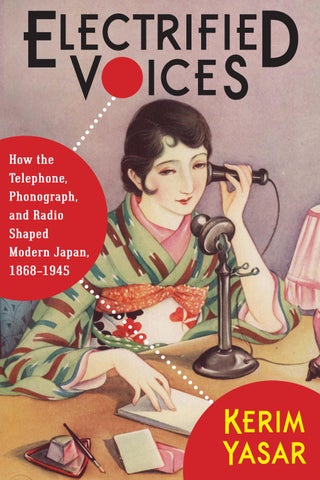
LECTRIFIE EVOICES D How the Telephone, Phonograph, and Radio Shaped Modern Japan, 1868–1945
KERIM YASAR
Copyrighted Material
INTRODUCTION All That Is Solid Melts Into Sound
I
n 1876 Isawa Shūji (1851–1917), who was then studying at the Bridgewater Normal School in Massachusetts, visited the Centennial Exhibition at Philadelphia’s Fairmount Park. He sought out the display of one Alexander Graham Bell (1847–1922). Isawa knew about Bell because in Massachusetts he had encountered a special alphabet, “Visible Speech,” that Bell’s father, Melvin, had devised to help mute persons learn how to speak. Isawa was curious about this alphabet because he was still struggling with English and believed that it might also help him with his English pronunciation. Although Bell’s new device for transmitting the human voice across a distance had become the talk of the exhibition, Isawa was more interested in Visible Speech, which included a series of diagrams of the mouth showing how to produce sound physically with one’s lips, tongue, and teeth. Isawa’s interest in pronunciation was especially strong because musical education, including singing, was an important part of the curriculum at Bridgewater, and Isawa was having trouble both with Western musical scales and the pronunciation of the English words he had to master in order to excel in these classes. When he returned to Boston from the Centennial Exhibition, Isawa visited Alexander Graham Bell and asked him for lessons in proper pronunciation. At that time Bell was a professor of vocal physiology and elocution in Boston University’s School of Oratory. He took Isawa on as a
Copyrighted Material
2 I ntroduction
student and assistant, even though the sensation caused by his new device had made him a very busy man. One day that same year—it is not recorded exactly when—Isawa invited his friends and fellow exchange students Kaneko Kentarō (1853– 1942) and Komura Jutarō (1855–1911), both of whom were studying law at Harvard University, to visit Bell’s laboratory to see Bell’s invention. Many people, not having seen the invention or perhaps suspecting trickery, were still skeptical that the voice could really be transmitted from one place to another. Isawa had yet to try the device for himself, and Kaneko found the entire idea preposterous. After a thorough presentation of the principles of telephony, Bell invited two of the young Japanese students to try the device for themselves. Bell handed Kaneko the receiver and then spoke into the other end: “Hello! Hello!” Kaneko was astounded. Bell gave the handset to Isawa, who then proceeded to speak to Kaneko in English. Shocked that it was working, Isawa began to mumble to himself in Japanese. “Isawa!” Kaneko cried. “This machine is incredible! It works in Japanese too!” Japanese thus became the second language, after English, to be transmitted across a telephone line.1
R The study of modernity has long favored the visual, which is understandable as so many of the representative forms of modern cultural production—photography, cinema, architecture—are largely, if not exclusively, visual in their appeal. Yet modernity was no less transformative of auditory culture than of visual culture, and arguably even more so. The reproduction and transmission of sound was phenomenologically unprecedented in human history—unlike, say, photography, which was new only in the sense that it was indexical; it could inscribe the physical reality of light in a form that could address our organs of perception in a way not all that different from light itself (making allowances, of course, for the lack of color, three-dimensionality, actual size, etc.). But photography was not new as a frozen visible representation of the visible. Representations of the audible had existed before sound recording, in the
Copyrighted Material
I ntroduction 3
form of visual notations and oral mimicry, but both differed from sound reproduction in crucial ways: Whereas a painting or drawing is a visual representation of visual stimuli, written notation is a visual representation of audible stimuli. It is a translation across a sensory modality and not at all indexical. Oral mimicry, in contrast, is of a piece with the auditory phenomena it purports to represent, but it is a performance, not a reproduction, and is subject to the vagaries of the performer’s memory, skill, and physical characteristics such as vocal cords, mouth, and chest cavity. For the first time, sound recording and transmission allowed human beings to capture sound, reproduce it, replay it, and archive it. This was a transformative cultural and technological innovation of modernity, one whose importance has until recently been overlooked or downplayed, even by scholars of sound. Rather than thinking of sound as sound, a subtle yet persistent imperative, influenced perhaps by Derridean critiques of phonocentrism, is to look at sound recordings as inscriptions (which they are) rather than as reproductions (which they also are), as if the entire phenomenological dimension of sound must be disavowed lest it seduce us into the cardinal philosophical sin of phonocentrism. There have also been, to be sure, ocularphobic and antivisual counternarratives, both ancient and modern. Martin Jay’s magisterial Downcast Eyes: The Denigration of Vision in Twentieth-Century French Thought 2 charts the course of these counternarratives in a context that might be surprising given France’s Cartesian legacy. That said, ocularphobic discourses are not the same as discourses that take auditory culture as their subject and describe its history and workings. Moreover, as sensitive and nuanced as Jay’s readings are, he also cannot resist the temptation to privilege the visual, not only by providing the astronomical number of rods in each eye (120 million)3 as proof of their unparalleled sensitivity to fine gradations, but also by pointing out that the eye “is also the most expressive of the sense organs, with the only competitor being touch.”4 Without denying the eyes’ and hands’ profound capacities for expression, surely the most expressive organ of all is the mouth, which besides being the sense organ for taste addresses the organ of hearing. The deeper problem, I submit, is a reflexive tendency toward hierarchical organization, which elicits the kind of one-upmanship I attempted in the last sentence to perform ironically.
Copyrighted Material
4 I ntroduction
I base my study on the postulate that sound occupies an important place in the economy of the human sensorium, one worthy of focused and sustained examination, nothing more or less. In making this assertion, I hope not to recapitulate, simply with another sense, the mistakes of traditions old and new that have placed vision at the apex of a hierarchy of the senses. It is also not my intention to privilege spoken language over written discourses on religious, philosophical, linguistic, or any other grounds. Written discourse is capable of forms of thought and expression that elude spoken language, just as spoken language and physical paralanguage are capable of forms of expression that elude writing. None of the senses is any more “base” or “noble” than another, and none is more “important” than another in any absolute sense, regardless of the number of fine gradations of which the sense is capable. To disabuse themselves of any such notions of hierarchy, those who prize vision or hearing above the other senses might want to have their sense of touch shut down pharmacologically for a time or, even worse, lose their sense of smell when somebody leaves the gas turned on. Nonetheless, the tasks of culture have been parceled out among the senses in ways that address the particular textures, tonalities, and modalities that each affords. Because sound is so ephemeral and exists in a state of decay if it is to exist at all, it is particularly effective at pacing our sense of lived time and shaping our sense of time as a whole. Sound is movement by definition, and movement is time. It is this power to sculpt time that makes sound (chant, music, rhythm, sonic punctuation) so integral to ritual practices across human societies. Even a sound as brief and seemingly unmusical as the pounding of a magistrate’s gavel serves a ritual function. Among the infinite sounds that constitute human social and sonic environments, of special interest for the human subject is the human voice. The ability to reproduce and transmit not just any sounds, but the human voice in particular, is what rendered the nascent auditory technologies so transformative of the practice of culture. As Mladen Dolar argues, the voice is both the bearer of utterance and a material (non)residue that does not itself signify: If we speak in order to “make sense,” to signify, to convey something, then the voice is the material support of bringing about meaning, yet it
Copyrighted Material
I ntroduction 5
does not contribute to it itself. It is, rather, something like the vanishing mediator (to use the term made famous by Fredric Jameson for a different purpose)—it makes the utterance possible, but it disappears in it, it goes up in smoke in the meaning being produced.5
Far from being a liability, this transience endows the voice with an auratic charge. Because the voice is always vanishing, because it cannot be stopped, fixed, and scrutinized, it always occupies a liminal, indeed ghostly, space of absent presence. Paradoxically, this auratic charge is often heightened by its mechanical reproduction. The acousmatic or disembodied voice is doubly absent, a vanishing mediator produced by an absent body. More than a century of ubiquitous sound reproduction has normalized this auratic charge, rendered it quotidian, but even today one can get a taste of it by listening to the radio at night with the lights turned off, or by listening to an audiophile stereo system with uncanny fidelity. Even the ubiquity of the technology cannot completely erase the eeriness of hearing voices that can’t be traced back to bodies. One of the recurring themes of my study is how these acousmatic voices render their effects in the spectral economy of modernity where “all that is solid melts into air”—where all that is solid, in other words, becomes like the voice. To reverse order, then, my study is rooted in the following axioms: Sound is central to social and ritual life, and the ability to reproduce and transmit sound has radically altered human beings’ relationship to sound and thus to social life, including economic and political life. The roles that sound is expected to play, the uses to which it is put, are also historically and culturally conditioned. Both church bells and the call of the Muslim muezzin employ sound, widely dispersed, for ritual religious purposes, but both vastly differ in the temporal regimes they follow (and enforce), as well as in their phenomenological textures and semiotic and semantic logic. Every culture (and every sub-and microculture) has its own relationship to sound and the sonic environment (witness the dramatic diversity of musical cultures around the world), and another of this work’s premises is that Japan is no exception to this rule. In other words, Japan’s auditory culture(s) during the period I cover here are distinctive and deserving of sustained consideration. This first assertion is uncomplicated, but
Copyrighted Material
6 I ntroduction
the question becomes more fraught when it comes to why this history would be of interest to non-Japanese. The centrifugal motion of the study of modernity away from the usual Euro-A merican suspects over the past two decades has revealed that modernity takes many forms, that modernities are plural. These differences are not merely superficial. Japan presents an interesting test case for a number of reasons: a product of the greater Sinitic cultural realm, a civilization that (unlike Islam, for example) developed independently of Greco-Roman and Judeo-Christian currents, Japan furthermore is an island nation that, with some exceptions, lived up to the epithet “insular” until it was forced to open, at which point it became eager to absorb and assimilate everything that modernity’s easily confused twin, technology, had to offer. Japan’s leaders in the Meiji era (1868–1912) decided not just to emulate the West but to outdo it. They rushed to absorb technologies and institutions from the outside while simultaneously holding fast to cultural traditions that had endured for centuries and inventing others to construct a past that would underwrite a distinctive identity in modernity’s catalog of nations.6 Whereas the cultural practices that come under the sign of modernism were, in the West, a product of historical-dialectical motions that emerged in the wake of Romanticism and various forms of classicism, Japan in the late nineteenth century was jolted from the multifarious (indeed, proto-postmodern) popular urban culture of the Tokugawa period (1603–1868) into the material and environmental realities of modern capitalism, industrialization, and proselytizing Christianity. It was jolted as well by the cultural forms that were transforming, before everybody’s eyes, into the practices of modernism. Thus the cultural logic of Japanese modernity was the product of three contributing streams: a rapid immersion in the cultural history of the West stretching all the way back to antiquity but favoring the latest and newest; domestic cultural forms that were strategically repressed for the sake of modernization but that, with a millennium and a half of their own history, continually reasserted themselves, sometimes violently; and, finally, material and economic changes that were rooted in technologies and institutions imported from abroad but that could be deployed instrumentally without having to assent to all the cultural assumptions of the societies in which they developed.7
Copyrighted Material
Introduction 7
Although sound reproduction and transmission were symbols of the modern, their place in Japan’s modernity was marked by a parallel and countervailing continuity with a traditional past. As I will show, premodern and early modern Japanese performing arts reserved a special place for storytelling and the narrative voice. Donald Richie termed this emphasis “presentational,”8 in contrast to what he saw as the “representational” assumptions of theater in the West. I argue that this “residual orality” offered a fertile substrate in which the seeds of “technologized orality” (as Walter Ong called it) occasioned by auditory media could grow. Residual orality certainly wasn’t unique to Japan, but it was distinctive for the role it played in folk and popular culture and in institutionalized and canonized cultural forms as well. It also had a special importance in Japan because of arguably unique tensions between the written and spoken languages of Japan well into the twentieth century. Auditory technologies in Japan thus exemplify a modernity that is at once a sharp technological rupture with the past and a reformulation of the past’s practices. Japan’s oral performance traditions were not vanquished by modernity—on the contrary, they experienced a renaissance while concurrently metamorphosing into new genres across new media and distribution platforms. Japan’s residual orality provided a climate receptive to the introduction of auditory technologies. Once those technologies had been introduced, residual orality became deeply imbricated in, and largely indistinguishable from, technologized orality. The recognition that modernity and modernism are indebted to traditional forms is not new.9 Rather, what I wish to emphasize is how modern technologies, which have often been thought to go hand in hand with modern forms, became vectors for traditional arts and even for traditional lifeways and reactionary ideologies.10 What I hope becomes clear by the end of this book is that different media condition expression and communication in specific ways. Even a term like “technologized orality” is too broad, an umbrella for the very specific types of orality conditioned by the phonograph and telephone, and then later by radio, sound cinema, and the many different types of orality delimited by each at different moments in their technological development and reception (say, the difference between early radio and postwar stereophonic FM radio). My primary concern here is not with
Copyrighted Material
8 I ntroduction
orality per se as a cultural or historical phenomenon. Instead, I hope to tease out the ways in which materiality matters, the ways in which the medium structures and textures the message while not really being the message itself (I would say Marshall McLuhan went too far). Languages, both spoken and written, are themselves media that limit and establish possibilities for communication and expression. When the medium of language is doubly mediated—when the media are thereby layered—those limits and potentials are subtly altered, and neither medium—neither language nor its material vector—is left unchanged by the encounter. Furthermore, because each language is a distinctive medium, each negotiates that encounter in a distinctive way.
R The history I present here predates the rise to global prominence of Japanese audio electronics manufacturers such as Sony, Denon, JVC, Onkyo, and Pioneer, but it does show how the audiophile culture that helped set the stage for these later industrial achievements took root in Japan in the late nineteenth and early twentieth centuries. Needless to say, these industrial achievements were not limited to sound equipment, and they arose out of a confluence of historical conditions and capital flows that were determined both inside and outside the Japanese state, as well as by a culture of craftsmanship with antecedents in Japan’s early modern period. Nonetheless, Japan’s role in global auditory culture in the second half of the twentieth and the beginning of the twenty-first centuries, which included providing one of the largest markets in the world for recorded music (as of this writing, second only to the United States), cannot be denied. Like so much else in postwar Japanese history, this phenomenon had its roots in the prewar period. The field I survey is broad, as it includes the major auditory technologies that were adopted in Japan between 1868 and 1945. I can therefore make no claims to comprehensiveness, as that would demand multiple volumes by multiple authors devoting lifetimes of study. My aim is, first, to provide an overview of this field, which has been sorely lacking in English-language scholarship, and to focus on specific episodes, historical actors, and texts that illustrate larger, recurrent issues.
Copyrighted Material
I ntroduction 9
Some of these issues have been objects of inquiry for interdisciplinary formations such as media studies and science, technology, and society (STS), which in turn draw from established disciplines ranging from history to sociology to literature. My own academic training began with the study of ethnomusicology and electronic/experimental music, transitioned to graduate work in literature and film studies, and then took a turn toward cultural history and media studies more broadly as the contours of this book took shape over a period of years. As a work of history, its orientation is primarily descriptive, but my interpretations of this history do carry theoretical implications. One of the clearest of these is that media and materiality do matter, that the materialities of media transform people, institutions, and societies. In its most simplistic forms, this argument is often pejoratively dismissed as technological determinism, a naive belief in technological teleology and technology’s capacity to override human autonomy. The original corrective to naive technological determinism was a rigorous study of the ways in which technological developments and deployments were socially negotiated and mediated. The findings from this line of inquiry were tremendously valuable and put agency back where it belongs, in human subjects acting in social formations. And yet, it is difficult to dispute that human agency operates within constraints. Physical and biological constraints are the most obvious of these, but equally important are the ways in which social life is composed of games (in the game-t heoretical sense) that are both cooperative and competitive. The problem with the idea that social processes are “negotiated” is that this presumes a relatively consistent cooperative framework in social decision-making. In reality, many games are competitive and involve asymmetries of power and information that render decisionmaking exceedingly difficult and give some actors much greater say than others. At the same time, powerful actors are also constrained by the constantly shifting constellation of other actors and material realities that can defy their plans and intentions. The result is that although human intelligence is at work in these social processes, human intelligences do not in fact guide them, because actors and subjectivities are multiple. The processes are emergent properties of the games and relationships themselves, and change along with them. If human history seems like a continual parade of folly, one reason (along with actual folly) might be that we have
Copyrighted Material
10 I ntroduction
yet to figure out how to be truly cooperative social actors. Another word for this phenomenon, of course, is politics. One example that illustrates the constrained agency (and, therefore, folly) of human subjects in games is the Cold War arms race. The proliferation of nuclear weaponry during the postwar period, especially in the arsenals of the two superpowers, was not the product of negotiation or purely rational decision-making between the major actors but resembled, rather, two of the simplest of all games: Chicken and Prisoner’s Dilemma. The best—certainly the most reasonable—possible course of action would have been for both sides to disarm; that would have been the safest and the least expensive option for both. But because both sides were locked in competitive antagonism, such negotiation was precluded in the absence of a spontaneous transition to a cooperative game. Both sides had to consider the possibility that the other side would continue to arm, which would in turn render vulnerable the side that chose to disarm. Neither side designed or negotiated this state of affairs alone or together; it was an emergent property of the course of events up to that point. In turn, those events were the product of other, prior games in which the choices of actors had been similarly constrained. The game transitioned to a more cooperative orientation (it has never actually “ended”)11 only when one side was forced by material circumstances (themselves the products of countless constrained decisions) to take the chance of making concessions that were potentially unfavorable to itself. The sobering upshot of these dynamics is that technological development usually follows a logic of competitive escalation and almost mindless deployment. Nation-states and smaller social formations may elect not to use certain technologies or to use them in ways that deviate from evolving normative expectations, but such choices inevitably come with costs that a predictable majority of state and nonstate actors will elect to avoid. A measure of resistance and deviation will be observed and will in turn diminish as the costs of resistance and deviation grow with the calcification of norms. This nonhuman logic is enabled and conditioned by the economic and social practices that we group under the sign of capitalism, but it is not necessarily confined to them, as the case of the Cold War implies. We could argue that the Soviet Union and the Eastern Bloc were exemplars of state capitalism rather than communism proper (and I agree with that
Copyrighted Material
Introduction 11
characterization), but barring a return to a preindustrial economy and a unified world government, it is difficult to imagine all human groups electing together never to try to attain technological superiority over one another. The moment that one did attempt to secure that technological edge, the others would feel compelled to follow, and the competitive game would begin anew. Media are an especially volatile component of material reality because they shape representation and constitute large stretches of lived experience. Mass media, in particular, give powerful actors a potent means of influencing the symbolic representations of less powerful actors. The materiality of the media shapes both the attentive strategies and the capacities of human subjects, whose neuroplasticity allows lived experience (which includes the experience of media) to refashion the brain’s neural organization.12 Because these changes occur slowly, often imperceptibly, across long stretches of time and because both the creators and consumers of media are usually unaware of the changes of subjectivity effected by those media, it is difficult, if not nonsensical, to speak of social negotiation in such cases. One cannot have “negotiation” in any meaningful sense without consent, and one cannot give informed consent to a consequence of which one is initially unaware. Media are thus doubly potent, medium and message working sometimes in tandem, sometimes at cross-purposes, in ways that consuming and mediated subjects cannot always perceive or untangle. This is not to say that the consuming subjects are entirely passive. As Michel de Certeau made clear, subjects confront, evade, reject, and play with the cascading stimuli with which media inundate them.13 Even the best surfers, however, eventually find themselves underwater because the initial costs of nonparticipation in the game are generally higher than the initial costs of participation. What I propose, however, should not be construed as a form of hard technological determinism or an object-oriented ontology that assigns these technologies, much less sound itself, objecthood outside human social formations and human perceptions. To the extent that these technologies are not entirely subject to unilateral and willful human control and, furthermore, create their own constraints and incentives to some human actions and not others, they are not totally within the matrix of the social. At the same time, they cannot exist, or make any meaning at
Copyrighted Material
12 I ntroduction
all, outside the social, outside what is made possible by human subjectivity, which is profoundly socially conditioned. Sound is a particularly ineffable vector of the kaleidoscopic confusions of modernity. Its origins, contours, and next moves are marked by an indefinability and an unpredictability that leave us relatively defenseless. We can track the visual like hunters, but sounds leave us feeling like prey. While game-t heoretical concepts provide useful reference points with which to understand how technological development and deployment unfold in modern nation-states, they are of little use in understanding how the materialities and modalities of audition function and feel. They also tell us little about how auditory technologies function ideologically. To address these latter questions, I have relied to a large extent on the body of thought produced by the scholars of the Ljubljana school, most conspicuously Slavoj Žižek and Mladen Dolar. In the modern philosophical and theoretical canon, only two major approaches address sound and the voice with any sustained theoretical rigor: phenomenology, and psychoanalytical thought influenced by the work of Jacques Lacan (1900–1981). While the work of phenomenologists is rich, variegated, and valuable in its own right, phenomenological approaches tend to be ahistorical and largely indifferent to cultural differences. The same could probably be said of Lacanian psychoanalysis in its purest form, but Žižek and his colleagues combine Lacan with Hegel and Marx in ways that illuminate vast stretches of history and its attendant ideological engines. Dolar’s pioneering work, A Voice and Nothing More, is, in my opinion, the most important and interesting work on the ideological and psychoanalytical dynamics of the voice yet published. That said, Žižek, Dolar, and other theorists influenced by Lacan arguably overstate the case for the immateriality of the voice. This is not to suggest that they deny vocal materiality altogether, simply that sonority per se—and its intimate connections with embodiment and other kinds of materiality—often get short shrift in favor of mapping psychoanalytical dynamics. For example, Dolar writes, “Is not the mother’s voice the first problematic connection to the other, the immaterial tie that comes to replace the umbilical cord, and shapes much of the fate of the earliest stages of life?”14 The casual reference to the mother’s voice as “immaterial” (which, intentionally or not, activates secondary meanings like “trivial” and “unimportant”) bespeaks a Lacanian indifference to materiality (which the Ljubljana school has balanced with Marxist materialism, and
Copyrighted Material
I ntroduction 13
which they might in any case dispute with an appeal to Lacan’s late meditations on the Real) and also reminds us of Lacan’s “detethering”15 of sexuality from the body of the mother. For all their startling and provocatively dialectical psychoanalytical insights, the Ljubljana theorists have less purchase, in my mind, when it comes to questions of materiality, embodiment, and gender. As we shall see, the uses and understanding of the voice have culturally and historically specific dimensions that are not captured by the often Eurocentric focus of European and American theorists. The emerging field of sound studies has also provided a fertile field of inspiration, for obvious reasons. If I were to name the three works that cast the longest shadows over this book, they would be Koe no shihonshugi (Capitalism of the voice) by Yoshimi Shun’ya,16 The Audible Past by Jonathan Sterne,17 and Noise: The Political Economy of Music by Jacques Attali.18 In sum, insofar as labels mean anything, I would describe my approach as an impure deployment of the tactical and the dialectical, raiding the cabinets of Marxism and psychoanalysis, media and sound studies, actor- network and game theory, and historicisms old and new, in order to arrive at provisional and evolving understandings of specific and contingent phenomena in particular times and places. This is not a grand theory, just a collection of theoretical contraptions and an occasional insight out of the blue. I have gone to some lengths to announce my theoretical and methodological coordinates here because I do not believe that there is a way to “do history,” or “media studies,” or any other form of inquiry that is normative, universally applicable, or free of philosophical assumptions. Some practitioners are aware of their models and articulate them clearly, and others are not or do not, accepting as normative approaches that are the products of historical, cultural, and institutional contingencies. While I anticipate that some readers will disagree with my choices of methodology, I hope that nobody can accuse me of being unaware of the assumptions and values that guide this inquiry.
R In this book, I look at the beginnings of the telegraph, telephone, phonograph, radio, and sound film in Japan. I present a brief history of each
Copyrighted Material
14 I ntroduction
technology’s arrival and some of the representative popular and elite discourses that were generated during the process of adoption and assimilation. I then offer a theoretically inflected consideration of the nexus of cultural, social, and political practices into which the new technology was integrated, considering, for example, the roles that they played in language reform, literary and cinematic practice, subject formation, cultural memory, and nationalism. This focus on “beginnings,” on originary moments, is useful because it poses some of the most potent challenges to technological determinism and to what might be called technological universalism, the idea that technologies have a set of normative uses that will prevail everywhere in the same way. If there was a time when social negotiation was possible, it was during these early days when everything was provisional and tentative, before the interests of capital and political power had figured out exactly how to appropriate new technologies. As I suggest however, those interests eventually did figure out how to appropriate those technologies and did so in remarkably similar ways across national boundaries, largely because they mimicked one another along the lines of the competitive games just described. In addition to these overarching arguments—namely, that sound reproduction and transmission were radically new material and technological arrivals that also, paradoxically, reanimated the oldest of oral performance traditions—I will try to show how these technologies became integrated with the larger media ecology. Whereas in chapters 1, 2, and 3 my emphasis falls more heavily on sound and orality per se, in chapters 4 and 5 I concentrate on describing how sound technologies partnered with other media (particularly print media) and how the innovations of radio, especially voice acting and sound effects, contributed to Japan’s newly emergent sound cinema. The contribution of radio drama to one of Japan’s most popular cultural exports—animated film—a lso demands greater recognition. The explicit focus of the final chapter is sound cinema and comes full circle by calling back the concerns of the first two chapters, language and music. In chapter 1, I examine the ways in which two new technologies, the telegraph and telephone, reconfigured the relationship between orality and writing in Meiji Japan. For example, the telegraph was used to transmit a written language that until then had been written in a mixture of Chinese characters and syllabaries. The limits of the new technology
Copyrighted Material
I ntroduction 15
dictated that the phonetic syllabary be used exclusively because this was much easier, and cheaper, than using Chinese characters. This material contingency reinforced a resurgent phonocentrism that arose from multiple sources, including Western conceptions of writing. I argue that these material constraints bolstered discourses of phonocentrism that guided efforts at language reform during the Meiji era; at the same time, I present evidence that a different phonocentric bias was in fact present in Japanese discourses of language dating far back into the early modern and premodern periods. In Origins of Modern Japanese Literature, Karatani Kōjin,19 following Jacques Derrida’s critique of phonocentrism, argues that the genbun itchi (unification of speech and writing) movement was the product of a distinctly Western phonocentrism. I maintain, in contrast, that the telegraph and telephone became vectors for the resurgence of a residual orality that was operative in Japanese culture long before any encounter with the technologies of the West. In other words, residual orality and technologized orality converged. I show how the telegraph conferred a new utility and, indeed, technological glamour upon the indigenous phonetic kana syllabaries. Later, the telephone and phonograph allowed the voice and spoken language to be transmitted and, perhaps more important, inscribed and archived, thus freeing spoken language from the dual constraints of spatial locality and temporal ephemerality, which in turn transformed the voice into a cultural- material artifact in its own right. In this chapter I also explore some of the ways in which the telephone altered the social landscape of Meiji Japan. I identify an inversion of the common narrative of new technologies as labor-and time-saving devices and demonstrate that the telephone was a source of distraction, inefficiency, and annoyance when compared with other, cheaper and faster, means of communication. This inefficiency was exemplified by the practice of yobidashi denwa, a popular means of communicating by telephone even when one or both parties didn’t own phones at home. The system involved summoning one’s interlocutor to the post office with a telegraph in order to carry out a telephone conversation. I argue that despite the time and expense involved, the popularity of this service suggests that the telephone was appreciated less for its efficiency than for the pleasures of hearing another’s voice, as well as for the opportunity to participate in prestigious forms of modernity even when these forms were economically out of reach and took more time than sending letters by post, as was the
Copyrighted Material
16 I ntroduction
case in Tokyo, where intracity mail was at one point delivered ten times per day. In chapter 2, I consider the urban soundscapes of the Meiji and early Taishō (1912–1926) periods, which were transformed not only by the telephone and the phonograph, but also by the sounds of industrialization and the importation of Western music. Music of all kinds took on new social and cultural roles when it became mechanically reproducible, and I reconstruct the transformation from a premodern soundscape of fulling blocks, geta, and shamisen music to a modern soundscape of machines, mechanically reproduced sounds, and Western and Westernized music. It was at this time that musical education in Japan’s public schools became exclusively centered on Western-style music while traditional Japanese music was quarantined to the realms of hereditary profession or amateur pursuit. Government bureaucrats at the time believed that Western musical forms (particularly songs and marches) were more appropriate to the creation of a national subject identity. Drawing on the pioneering theoretical formulations of Jacques Attali as well as on the “earwitness” testimony of both Japanese and Western auditors, I outline the transitional period from Japanese music and preindustrial soundscapes to Western and Westernized music and modern urban soundscapes, and in the process examine what it means for an indigenous musical tradition to be made foreign on its own soil. Chapter 3 turns to the history of the sonic archive. The introduction of the phonograph transformed sound into a preservable and archivable artifact. This carried considerable cultural significance in a culture that had inherited from China powerful assumptions about inscription and preservation as sources of value and prestige. Recorded sound could now become an object of study and preservation in its own right. I pay special attention to the intersection of recording history with the histories of two genres that illuminate different facets of the technology’s cultural meaning and ramifications: kabuki and naniwabushi (also known as rōkyoku, storytelling accompanied by a shamisen). Kabuki helped demonstrate and, in a sense, legitimate the new technology by offering the voices of its most famous actors as the content for the earliest phonograph recordings, which were played publicly in Japan’s urban centers around 1890. I also show how the gramophone returned the favor in the 1920s when kabuki faced its own period of testing.
Copyrighted Material
I ntroduction 17
Naniwabushi’s role in the story of recording came later, and it was a very large role indeed because it launched the new technology into commercial viability. Naniwabushi performers in the 1910s such as Tōchūken Kumoemon and Yoshida Naramaru II became the first recording superstars, and they held that position until the advent of ryūkōka, popular songs and singers, in the 1920s. Although the story of ryūkōka is crucial, I will not discuss it here, both because it is in the able hands of others20 and because it is the product of a relatively mature industry and not of the transitional and experimental periods that are the primary focus of this book. Instead, I consider the role of recordings in changing ideas of authorship and copyright, changes that had a profound effect on the subsequent production and commodification of reproductive cultural artifacts into the present day. In the late Taishō and early Shōwa (1926–1989) periods, radio and sound film were added to the mix. The human voice, furthermore, assumed a new materiality and cultural role as it came to be more widely recorded and transmitted. Chapter 4 describes the first decade or so of radio broadcasting in Japan, with an emphasis on the political and ideological uses of the new medium and on the meetings of disembodied voices and actual bodies. I look specifically at the new narrative art of sports broadcasting, which codified group identification in novel ways and gained special importance with NHK broadcasts from the 1932 Olympic Games in Los Angeles and the 1936 games in Berlin. I also explore the public ritual of rajio taisō (radio exercise), which inaugurated a nationwide regime of bodies moving in sync with the directions of an acousmatic voice, consolidating a mechanism of command and control that reached its apotheosis with Emperor Hirohito’s declaration of surrender in the Pacific War. Chapter 5 is an extended consideration of an entirely new literary genre made possible by a new medium: radio drama. Not long after the first radio broadcasts began in Japan in 1925, a group of writers, actors, and broadcasting professionals came together to form the Rajio Dorama Kenkyūkai (Radio Drama Research Association) to introduce and develop this novel genre of dramatic art. The members of the group included prominent literary figures of the time, such as Nagata Mikihiko, Kume Masao, Osanai Kaoru, Kikuchi Kan, Kubota Mantarō, and Satomi Ton. The group put out five volumes of radio plays in 1925, the Rajio dorama sōsho (The radio drama library, published by Shunyōdō), which became
Copyrighted Material
18 I ntroduction
the founding documents of radio drama practice in Japan. I discuss the circumstances around the formation of the Radio Drama Research Association, the plays published in the series, and the earliest radio drama broadcasts in Japan. The chapter’s theoretical focus is on the possibilities of radio drama as a narrative genre, one that has long been neglected by scholars in the English-speaking world but that enjoyed worldwide popularity until the advent of television (and even beyond, in countries like Germany and Japan). As alluded to earlier, I also describe radio drama’s role in the genesis of two creative professions that became increasingly important to cinema, television, and anime during the twentieth century: sound effects and voice acting. Chapter 6 centers on early theoretical discussions of sound film in Japan. Based on the work of Japanese critics such as Nakane Hiroshi and Yasuda Kiyoo, as well as on the critical writings of the director Mizoguchi Kenji, I explore emerging debates about the uses and functions of film dialogue and soundtrack music. I pay special attention to the writings of Nakane, who has been relatively neglected. Nakane’s 1932 Tōkī ongakuron (Theory of Music for the Talkies, a book-length collection of essays and analyses) was one of the first extended engagements with film music theory in Japanese. He had previously been a musician and member of the Ongaku to bungaku (Music and literature) coterie magazine. Although writing from a musician’s perspective, he had an acute sense of the need for music especially composed to accompany the moving image. I also devote a portion of this chapter to the development of dialogue for jidaigeki (period dramas), which in a real sense had to be invented for the genre by drawing on actual historical usage, traditional theater, and the affiliated genre of period fiction. As with the creation of a written vernacular, new forms of technologized cultural production demanded the invention of a new language, except this time one that was retrospective of an imagined past.
VO I C E A S CO M M O D I T Y, VO I C E A S AU R A
The development and introduction of these technologies of sound reproduction and transmission had a number of varied and often countervailing
Copyrighted Material
Introduction 19
effects, in every instance a dialectical relationship at work. On the one hand, by extending the reach of the voice across time and space, they conferred on it a new textual and historical weight. The voice could now become a historical record in its own right, as well as a commodifiable entity. At the same time, however, these technologies stripped the human voice of its aura (a notion articulated in Walter Benjamin’s 1936 essay “The Work of Art in the Age of Mechanical Reproduction”) by abstracting from the voice only what could be reduced to sound. The voice was relieved of its “presence,” its ontological weight, which, if we follow the Benjaminian logic, was rooted precisely in its nonreproducibility and, in the case of the voice and other sonic phenomena, in its ephemerality. This is surely one reason why the emperor’s voice was not allowed to be recorded until the declaration of surrender, as doing so would have stripped it of its numinous power. Even though most of the listeners to the emperor’s broadcast could barely make out the specific words he was saying, both because of the poor quality of the recording and transmission and because of the emperor’s opaque idiolect, that didn’t matter: The simple fact that his voice had been recorded and broadcast at all signified the end of his deification, an event that could have been occasioned only by a catastrophic compromise of the integrity of the nation-space and its semiotic universe—that is, unambiguous defeat in war and the impending occupation promised by that defeat. Yet as in every truly dialectical relationship, a countervailing phenomenon existed alongside this one: The reproduction of the voice made it more spectral and imbued it with an aura of a different cast. An early user of the telephone who blurted out that the voice on the other end sounded “just like a ghost” was not alone in his reaction to the eerie nature of the disembodied voice. As Michel Chion suggests, such a voice, the voice whose source is never seen, the acousmêtre, exercises the following four powers in the subject’s psychic economy: “the ability to be everywhere, to see all, to know all, and to have complete power. In other words: ubiquity, panopticism, omniscience, and omnipotence.”21 Why all these powers in a voice? Maybe because this voice without a place that belongs to the acousmêtre takes us back to an archaic, original stage: of the first months of life or even before birth, during which the voice
Copyrighted Material
20 I ntroduction
was everything and it was everywhere (but bear in mind that this “everywhere” quality is nameable only retrospectively—the concept can arise for the subject who no longer occupies the undifferentiated everywhere).22
This acousmatic orality, made possible by technology, was a novelty in the Japanese context as well; the traditional oral narratives had always involved a visible speaker or narrator. The power of the disembodied voice was put to work in modern Japan in the project of state formation and social control soon after the technology became available and long before the Shōwa emperor made his historic broadcast. The broadcast of his voice triggered two turns of the dialectical screw: the first demoted him from god to human being, stripping him of his aura, and the second made him the phantom emperor of a phantom realm. In terms of literary discourse, the (re)turn to a phonocentric conception of language in both Japan and the West coincided with another parallel movement toward “faithful transcription,” literary naturalism itself. Although literary naturalism in the Japanese context paradoxically had a cast of extreme, almost hermetic, subjectivity, the late nineteenth-century discourses of naturalism in Europe and America promoted a stripping away of subjectivity for objective and photographic description and heralded an even further stripped-down praxis of existence that Friedrich Kittler termed “psychophysics.” In 1900 speaking and hearing, writing and reading were put to the test as isolated functions, without any subject or thought as their shadowy supports. “Between finitude and infinity the word has ample room to be able to do without any help from thought.” Rather than the long genetic path of the word from its beginning in nature to its end in culture, what counts is the signifier’s mechanism and how it runs under either normal or pathological circumstances. . . . The victory of psychophysics is a paradigm shift. Instead of the classical question of what people would be capable of if they were adequately and affectionately “cultivated,” one asks what people have always been capable of when autonomic functions are singly and thoroughly tested. . . . There is no universal norm (inwardness, creative imagination, high idiom, Poetry) transcending the particular functions. Each has a standard only in relation to defined experimental subjects and conditions.23
Copyrighted Material
I ntroduction 21
This dissolution of the subject in favor of the isolated functions of speaking and hearing, writing and reading, in time became manifest in Japanese literary practice, although not under the banner of naturalism (shizenshugi) but rather under the auspices of the New Perception school (shinkankakuha). In the meantime, however, shizenshugi and the shishōsetsu (I-novel) in Japan remained faithful to the idea of another sort of transcription: that of interiority, of the inner voice. As Karatani’s work suggests, there are intimate relationships among phonocentrism, the voice, and narrative interiority. The phonocentric turn inaugurated the twin movements that literary historians have long considered the foundations of the imagined entity of “modern Japanese literature”: writing in the vernacular and writing interiority. At the same time, this phonocentric turn ensured the eventual demise of “modern Japanese literature” by displacing writing from its position of centrality in cultural discourse and thereby setting the stage for writing to be replaced by other media (first film, then television) as the primary loci of narrative energy. As the title of this introduction is meant to suggest, the experience of sound and the experience of modernity are analogous in both concrete and poetically suggestive ways. Japanese modernity, heard from a distance, resonates with the babble of voices performed, transcribed, recorded, broadcast, and amplified: the voices of young Meiji exchange students traveling across a primitive phone wire in Bell’s lab; the voice of a Meiji ambassador emerging from a tinfoil cylinder thousands of miles away from the place where it was recorded; and, most momentously, the voice of the Shōwa emperor telling his subjects, although not in so many words, that modernity could not be overcome.