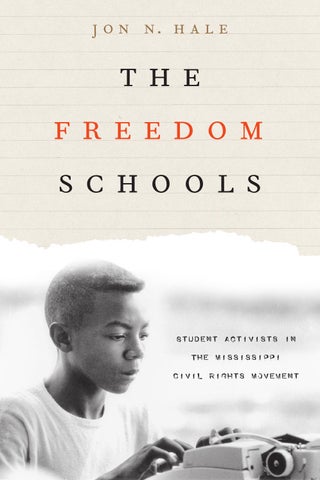
j o n n. h a l e
the freedom schools
Student Activists in The Mississippi Civil Rights Movement
INTRODUCTION The Mississippi Freedom Schools
The Freedom Schools shaped my future, my thinking, my outlook on life, they challenged me to do the things I’ve done and to the have the mindset that I have. If I had to attribute anything to my community involvement, I would attribute it to my attending the Freedom School. E dd ie James Carthan, Freedom Sc ho o l s tu d en t in Mileston, Mississippi
E
ddie James Carthan was born in the Mississippi Delta on October 18, 1949. Many of his memories are set in the small community of Mileston in Holmes County, whose history and collective memory extends into the antebellum era when white aristocratic planters reaped the rewards of “King Cotton.” The strain of cotton production still rested upon the backs of entire communities, like Mileston, Tchula, and other towns across Holmes County. Especially in the Delta, an area internationally known for its cotton production, white segregationist landholders after the Civil War maintained their commitment to an economic order that exploited black labor. Whites sustained a system of total segregation by race, oppressive race relations, and the complete political disenfranchisement of the local African American population through strictly enforced racial codes. However, such oppressive race relations were always sites
I N T RODUC T ION
of resistance, and supremacy never existed free of challenge. Carthan inherited some of these traditions of resistance. His family owned and farmed its own land since the 1930s through a federal New Deal program that spawned a small community of independent black landowners who developed cooperatives, shared decision-making, and laid the foundations for the civil rights movement. As cracks in the overarching racial structure became more visible to those who toiled in the freedom struggles across the state during the 1960s, Carthan and his community connected to a larger statewide and national movement. At the age of fourteen, Carthan and two thousand other students attended Freedom Schools and joined the marches, boycotts, protests, and the front lines of the civil rights movement. As the American public and an international audience commemorates and remembers the milestones of the civil rights movement, the story of students like Carthan and the Freedom Schools he attended are often lost or marginalized. Yet understanding the significance of Carthan’s work and the history of the Freedom Schools fundamentally challenges and necessarily reframes how we understand the history of the nation’s greatest social, political, and economic movement for equality. A history of the students who enrolled in Freedom Schools highlights overlooked yet profound truths of the civil rights movement. A history of the Freedom Schools reveals that young people still in middle and high school were on the front lines of the civil rights movement, and in many instances it was the young people—not rebellious college students or established National Association for the Advancement of Colored People (NAACP) card-carrying members—who inspired local movements in their own community. A study of the Freedom Schools illustrates how central education was to the local grassroots civil rights movement. The Freedom School idea started small and was secondary to the voter registration projects that consumed organizers in Mississippi. This civil rights educational project grew in strength because the Freedom Schools organized entrée for thousands of young people into the civil rights movement, and middle and high school students served as both the leaders and foot soldiers at the local level. Examining the Freedom Schools also illustrates the dialectical relationship between the local and national context. Though marginalized within contemporary discourse and typically overlooked by civil rights movement scholars, the local
t î t
The Mississippi Freedom Schools
development of the Freedom Schools enabled the growth of federal educational initiatives that transformed public education by the mid-1960s. A history of the Freedom Schools, and the civil rights educational programs these schools exemplify, demonstrates that the civil rights movement was more comprehensive in its reach, more dynamic in its interaction with a larger national context, and much more nuanced in its historic development than popular understandings and public commemorations suggest. How Carthan and his cohort of students arrived at the front doors of the Freedom Schools, what they experienced inside the schools, and the ways in which the civil rights education they received defined the contours of the civil rights movement is the subject of this book. The processes that led young students to the Freedom Schools reveals much about the nature of the civil rights movement and the capacity of education to affect social change. Children in the Delta and elsewhere across the Deep South experienced the frighteningly efficient system of Jim Crow entrenched within the segregated public schools they attended. As schools are an important battleground of political, economic, and social ideology, it should be no surprise that the dual system of education in this area was governed by hegemonic racial sensibilities and, as such, was a microcosm of the larger segregated society. Simply stated, schooling was used to maintain the social, political, and economic status quo that always worked in favor of white segregationist land and business owners. Many in the state of Mississippi believed the state could only function properly if African Americans generally were laborers and second-class citizens. The segregated system of schooling functioned as it almost always had, reinforcing a tragic truth that historian James D. Anderson once summarized eloquently by stating that “both schooling for democratic citizenship and schooling for second-class citizenship have been basic traditions in American education.”1 While white students received the lion’s share of funding and resources, acquired highly valued skills, and enjoyed preferential treatment in the job market after graduation, African American students in Mississippi received far less funding and resources, and a racial code rooted in the days of slavery subverted any aspirations of social mobility. By the time Carthan and his peers came of age in the 1960s, they felt the residual if not quantifiable effects of the Jim Crow system in multifaceted and profound ways.
t ï t
I N T RODUC T ION
The Freedom Schools of 1964 were the most recent manifestation of a tradition of education for empowerment, politicization, resistance, and organization that perennially challenged segregationist policy. Such a perspective is clear from Eddie James Carthan’s vantage point. When he looked back on the Freedom School experience during the summer of 1964, he connected it to his conceptualization of social relations, his constructed self-identity, and his worldview. Looking back as a local Mississippian, a youth and civic leader, a community businessperson, and an embattled elected politician, Carthan traced his success and, more importantly, his lasting impact on his community to a form of education that was built upon a long tradition of resistance grounded in the principles of the civil rights movement. While the Freedom Schools extended important traditions of education for democratic and participatory citizenship, the schools are also indicative of the rich ideological debate and deep-seated tension that defined the civil rights movement. Civil rights organizers and community members established Freedom Schools across the state of Mississippi while white legislators, school boards, and administrators maintained a segregated system of education ten years after the monumental Brown v. Board of Education (1954) decision. Within the Freedom Schools, students, educators, and organizers debated whether to desegregate the public school system, studied the political means to demand greater resources, and protested for more humane treatment in their own schools. Integration, in other words, was not the be-all and end-all of the black community in 1964. The emergence of the Freedom Schools illustrates the diversity of ideology, thought, and opinion about how schools should operate, how the curriculum should be organized, and what paths educational reform should follow during the era of desegregation. In order to examine the overlooked yet generative role of grassroots education during the civil rights movement, this book reconstructs the history of the Freedom Schools from the perspective of students who attended them. The lived experiences of Eddie James Carthan, Hymethia Washington Lofton Thompson, Homer Hill, Brenda Travis, Arelya Mitchell, Hezekiah Watkins, and other young activists illustrate just how significant education was in the history of the civil rights movement. Freedom Schools continued a long tradition of a revolutionary ideology that stated education was an irrevocable pathway to freedom—a sentiment long embedded in Mississippi communities. But by
t Ă° t
The Mississippi Freedom Schools
their very nature the Freedom Schools also stood in stark contrast to the dual system of education provided by the state of Mississippi. Freedom School was physically held outside that system, in church sanctuaries and basements, in local community homes, in storefronts, and in “Freedom Houses” built by civil rights activists (figure I.1). Students studied a humanities-based curriculum that taught political efficacy, social critique, and the organizing strategies employed in the civil rights movement. They discussed the U.S. Constitution and questioned why their parents were not allowed to vote. Students worked in the community, marched on the picket lines, organized boycotts, and desegregated libraries, parks, and schools for the first time in the history of their home communities. Young people were not marginal players in the civil rights struggle. They played an instrumental role during that era and in post-segregated society. Attending Freedom School translated into protest and community-organizing skills; which students applied in the fall of 1964 to demand better resources in their own schools, to protest unjust expulsions, suspensions, and other racially motivated disciplinary actions; and to organize long-term school boycotts. The legacy of the Freedom Schools suggests that despite the best efforts of the architects of the Jim Crow system, community-based efforts taught students to act as historic change agents. Moreover, an analysis of the Freedom Schools reveals how young the activists were when they were politicized during the civil rights movement.2 One of the most distinguishing aspects of the Freedom Schools is the fact that they TFSWFE B ,oíî QPQVMBUJPO B HSPVQ UIBU HFOFSBMMZ GBMMT CFUXFFO UIF BHFT PG TJY and eighteen, though it was not uncommon for younger students and older adults to attend Freedom Schools as well. But the Freedom Schools generally educated young people in elementary, middle, and high school, and this cohort of students constituted a politically and socially constructed category. By the 1960s educators and activists affirmed G. Stanley Hall and an earlier generation’s construction of adolescence as a separate category that was physiologically and cognitively distinct from both childhood and adulthood.3 Civil rights activists targeted this cohort while building a wider base for the civil rights movement through the Freedom Schools. Charlie Cobb, the Student Nonviolent Coordinating Committee (SNCC) member who first proposed the idea of forming Freedom Schools in Mississippi, and others who organized the 1964
t ñ t
Holly Springs
Clarksdale
Ruleville Greenwood Shaw
Columbus
Greenville Holmes County
Rural Madison County Carthage Jackson Meridian
Vicksburg
Laurel Hattiesburg McComb
Biloxi Moss Point Gulfport
Figure I.1 Locations of Mississippi Freedom Schools during the summer of 1964.
The Mississippi Freedom Schools
summer campaign saw a distinct opportunity and need to reach young people enrolled in elementary, middle, and high school. Students not yet in college or the workforce offered something more appealing to organizers than older adults. Young people were more likely to stay in the state, at least until completing high school, which provided an opportunity to create a more stable and long-term network of activists. Young people were in a formative stage of their lives, and their political consciousness was malleable and could be shaped by the principles of nonviolence and justice. Young people were old enough to understand the injustices embedded within the system of Jim Crow and were fearless enough in their desire to challenge it. The category of youth, however, has been usurped by collegiate and postsecondary activists, which is evident in the metanarrative and historiography of the civil rights movement. College students and the institutions they attended were indeed central battlegrounds of the movement. The University of California, Berkeley; Northwestern University; the University of Illinois; Columbia University; and southern campuses, including the University of Mississippi, Tougaloo College, and South Carolina State University, to name but a few national exemplars, encapsulated the most defining moments of the civil rights movement for both black and white students across the country. These campuses encompassed a wide spectrum of organization to desegregate public spaces, secure voting rights, protect academic freedom, and reform curricula throughout the 1960s. Protest often evolved from the radical work of college students who comprised SNCC, the Congress of Racial Equality (CORE), the Southern Student Organizing Committee (SSOC), and other organizations at the grassroots level. Focal points that define traditional civil rights narratives and college students’ place in it are the sit-ins of 1960, the Freedom Rides in íõòí UIF JOUFHSBUJPO PG UIF 6OJWFSTJUZ PG .JTTJTTJQQJ JO íõòî BOE UIF 'SFFEPN Summer campaign of 1964, all of which involved college-aged students or college campuses.4 Yet focusing on the college campus limits the categorization of youth activism to the ages of eighteen or older, which fails to attend to the nuances of activism in the Freedom Schools. To focus solely on the college campus is in effect to overlook educational programs of the civil rights movements where many activists learned and practiced the art of resistance.
t ó t
I N T RODUC T ION
This history reminds us that the civil rights movement unfolded at all levels of education. Tragically, it also reminds us that young people who elected to join the front lines were not spared the violence associated with challenging social norms. Hardly one year after the monumental Brown decision struck down segregation by race, these schoolchildren learned a powerful lesson in the dangers associated with challenging the white establishment. The lesson in subservience came when Emmett Till, a fourteen-year-old African American youth visiting from Chicago, allegedly whistled at a white woman in a store in Money, Mississippi, in 1955. Local whites Roy Bryant and J. W. Milam kidnapped the boy from his uncle’s home, brutally beat him to a point of disfiguration, shot him in the head, and threw him into the Tallahatchie River with a cotton-gin fan tied around his neck. The slaying of Emmett Till was extreme even by Mississippi standards. Violent acts such as the murder of Till were sanctioned by and acceptable to whites because an all-white jury acquitted Bryant and Milam in the small Delta town of Sumner, Mississippi.5 The Till case resonated with those who eventually worked in the Mississippi civil rights movement. “I was shaken to the core by the killing of Emmett Till,” said John Lewis, SNCC chairperson and later a U.S. congressman from Georgia, “I was fifteen, black, at the edge of my own manhood just like him. He could have been me. That could have been me, beaten, tortured, dead at the bottom of a river.”6 A history of the Freedom Schools and the young students who attended them is a testament to the courage and conviction needed to join the front lines of the civil rights movement. It is also a testament to the important role education played in the long struggle for freedom in the state of Mississippi. Although activists often sidelined civil rights educational programs to focus on other efforts such as registering voters, the Freedom Schools provided an education that facilitated entrée for thousands of young people into the civil rights movement. In the process, educators and student activists outlined a model of civil rights education that restored American schooling to the ideal of providing an education for democratic, active, and participatory citizenship. The local context of the Freedom Schools facilitated a connection to a larger national context. Head Start, a federally funded early-childhood program that sought to alleviate poverty, was implemented across the Mississippi in 1965. The rapid development of this federal program illustrates how the organic growth of a local
t ô t
The Mississippi Freedom Schools
movement enabled a national program to develop in a short period of time and appropriate the ideological and political network of the grassroots movement. Although the numbers of schools precipitously declined by 1966, Freedom School teachers and students served on the front lines of other struggles that emerged in the late 1960s such as the black power, antiwar, and women’s liberation movements. This dynamic interplay between the local and national context illustrates a dialectical relationship that is often overlooked yet enriches our understanding of the role of civil rights educational projects at the grassroots level. By providing a comprehensive history of the Freedom Schools, this book reinserts education into the civil rights lexicon of American history. This is not the first study to notice the importance of the Freedom Schools. Educators, activists, and scholars began discussing the Freedom Schools during and immediately following the movement of the 1960s. Howard Zinn, Sally Belfrage, Florence Howe, Sandra Adickes, Staughton Lynd, and Liz Fusco—all white volunteers who volunteered to work with the Freedom Schools during the summer of 1964—expressed a passionate faith in the pedagogy, curriculum, and goals of education that advanced the goals of the freedom movement.7 These teacher activists dedicated themselves to Freedom School education with the zeal and ardent devotion to social justice that became associated with the youthful activism of the 1960s. Their energetic and idealistic commitment also presents another layer to understand the development of the Freedom Schools. The volunteer teacher corps was mostly white, politically and economically affluent, and from the North or at least outside the state of Mississippi. The white volunteers continued traditions, sometimes problematic, of white benevolence devoted to assisting the South in achieving the ideal of freedom. These activists and scholars since the summer of 1964 have shaped a larger narrative of the civil rights movement that eclipsed the role of educational programs like the Freedom Schools. As activists began to ask why the revolution never happened, or, rather, why their revolution never happened, scholars began to privilege other aspects of the civil rights movement such as voter registration and school desegregation but not the grassroots educational programs that trained a generation of activists. The Freedom Schools have been unjustly overlooked as a result. Today the American public has commemorated the anniversary of the civil rights movement’s major milestones and in the process has
t õ t
I N T RODUC T ION
captured our collective imagination. Popular major motion pictures like Mississippi Burning, The Great Debaters, The Help, Freedom Writers, Remember the Titans, 42, The Butler, and Selma have dramatized, oftentimes inaccurately, this historic movement toward equality. Public television documentaries like Eyes on the Prize, Freedom Riders, and Freedom Summer have replayed footage of protests that questioned a nation’s commitment to democratic ideals. Remembering events of the 1960s shape the way we think about the civil rights movement without incorporating the legacy of the Mississippi Freedom Schools. Some revisionist academic analyses have begun to document overlooked grassroots organizations like those that spawned the Freedom Schools. These interpretations offer competing versions of the national metanarratives of the civil rights movement. Historians and sociologists such as Clayborne Carson, Charles Payne, John Dittmer, and Neil McMillen, among others, analyze the long-organized struggle for equal opportunity among local people in Mississippi.8 Emilye Crosby, François N. Hamlin, Constance Curry, and Chris Myers Asch examine rural counties and towns within Mississippi that offer a localized perspective to illustrate the complexity, continuity, and differences among various locales across the state.9 Doug McAdam, Mary Aickin Rothschild, and Bruce Watson examine the Freedom Summer campaign, a highly publicized effort during the summer of 1964 to register voters and focus attention on civil rights violations in Mississippi, thereby dispelling the myth that African Americans would not vote if provided the opportunity.10 Daniel Perlstein examines the connection between the grassroots organization of SNCC and the Freedom Schools.11 The Freedom Schools, as these and many other scholars, teachers, students, and activists have noted, played an important yet secondary role within the Freedom Summer campaign and the Mississippi civil rights movement. When thousands of people organized to dismantle Jim Crow in Mississippi in 1964, entrenched racism became visible across the world and the participants learned how to carry forth the struggle for equality. Examined in terms of the organizers’ experience, the literature historicizes the legacy of grassroots organization, but it does not comprehensively examine the role and impact of educational programs within the movement. A number of historians, educators, practitioners, and other scholars of education more extensively develop and elaborate upon the promise of a Freedom
t íì t
The Mississippi Freedom Schools
School education and curriculum. These scholars examine the pedagogy and curriculum these schools embraced, a unique feature that also helps explain the significance of the schools. Curriculum theorists George Chilcoat and Jerry Ligon examine the curriculum and modes of instruction in the schools and relate their significance to contemporary educational practice. Sandra Adickes’s memoir focuses on her time teaching in a Freedom School and organizing her students during the summer of 1964. John Rachal examines the role of adult education during the Freedom Summer campaign. William Sturkey examines the role of the press and newspaper development in the Freedom Schools to motivate, activate, and connect students as participants in the movement. Kristal Clemons examines the role of black women who taught in the Freedom Schools. These scholars, among others, examine the contributions and attributes of the Freedom Schools and reinforce their importance within the civil rights movement.12 While noted in the fields of history, sociology, and education, the Freedom Schools are not the subject of extensive analysis or research, nor is their contribution seriously considered within the larger context of the civil rights movement. Education during the freedom movement is marginalized at the expense of covering the more visible aspects of the struggle that captured national headlines. This book builds upon and further develops the existing literature by providing a comprehensive historical account of the Mississippi Freedom Schools, which, from the perspective of those who participated in the schools, were a phenomenal and inspirational success. This study also builds upon this historiography by closely examining another overlooked though insightful perspective: the experiences of the Freedom School students. This book follows a number of Freedom School students and their families in several towns and counties across Mississippi to provide a history of the Freedom Schools from various locations across the state. It also follows the teachers and shows how their lives briefly though very profoundly intersected with young people during the civil rights movement. Each of the Freedom School locations in Mississippi covered in this book—Jackson, Clarksdale, Tchula, McComb, Meridian, Holly Springs, Hattiesburg—illustrates a very different and localized movement, but together they represent a statewide movement of education for freedom. Even though communities across the state supported the
t íí t
I N T RODUC T ION
Freedom Schools and over two thousand students attended that summer, this book focuses on the history, experience, and legacy of just some of the locations. Not all of the participants were identified for this study, nor did all choose to participate. The students, teachers and locations examined in this book are representative of the Freedom School population in that they represent the age range of the students who attended, they are representative of the four different geographical and congressional divisions of Mississippi, they had similar familial support for their involvement in the movement, and they all remained committed to the principles of the movement in one way or another after the summer of 1964. The student experiences and histories examined in this book demonstrate the commonalities shared among Freedom School participants. At the same time, the participants identified throughout this study illustrate the distinct and unique experiences of the Freedom School population. Students entered the movement at different ages, through different networks, and for different reasons. All participants remained committed to movement principles, yet their activism after 1964 varied widely in scope and content. Moreover, each participant remembers different aspects of the Freedom Schools, which highlights the diversity of thought and curriculum of this civil rights educational program. While many traits are shared across the state, each locale and every student point toward distinguishing aspects that make this history truly unique. In reconstructing this history, this book builds on three themes that emerge from what has been written about the schools. First, this history begins with the vantage point of the students who attended schools and of the communities in which they lived. This history makes the case that elementary, middle, and high school students have been overlooked, though they are very important historical actors. This perspective also reveals that the students who attended the schools occupied important spaces on the front lines of the civil rights movement prior to the historic Freedom Summer campaign of 1964, thereby challenging a history that emphasizes the role of white organizers or the teachers in the movement. Second, this book is grounded in the fact that the field of education emerged as a crucial battleground of the civil rights movement. The state of Mississippi legally disenfranchised nearly half of its total population, from slavery through the era of Jim Crow. In the years before and during the civil rights movement, activists used education as a way to challenge and
t ĂĂŽ t
The Mississippi Freedom Schools
finally dismantle Jim Crow. Through legal challenges to equalize teacher salaries and resource allocation and to acquire the right to attend all-white schools, activists used the schoolhouse as a front to fight a larger war that eventually become memorialized as the civil rights movement. Third, this book incorporates the pedagogically distinct aspect of the Freedom Schools and the notion of civil rights movement education in general into this historical analysis. The Freedom Schools developed a unique, politically oriented curriculum through a progressive student-centered pedagogy that differed sharply from education typically offered to students in Mississippi and across the country. This form of education and the political activity it engendered revolutionized how students learned to become active citizens in a changing democracy. By looking at this history through a normative, organizational, and pedagogical analytical lens, the history of the Freedom Schools emerges as a unique and profound moment in the history of the civil rights movement and American education. This analysis is structured in such a way that these themes are incorporated throughout the book in order to generate a greater historical understanding of the Freedom Schools. The history of the Freedom Schools, as noted, is part of a longer tradition of community and regional organization that equated education with freedom. Chapter 1 briefly examines the history of education throughout the American South and the way it was viewed both by southern landowners, who sought to maintain firm control over a labor force they depended upon, and enslaved communities, who desired to supplant an entrenched system of oppression, exploitation, and disenfranchisement through schooling. Education was therefore contested terrain as communities who were enslaved implemented a form of education within a context of freedom as they transitioned into citizenship in the United States. The ongoing and historic struggles over the aims and methods of education since Reconstruction provides the backdrop to better understanding the nuances and historic import of the Mississippi Freedom Schools. The history of the Freedom Schools ultimately originates with the students. $IBQUFS î GPMMPXT TFWFO TUVEFOUT JO +BDLTPO $MBSLTEBMF 5DIVMB .D$PNC Meridian, Holly Springs, and Hattiesburg as they come of age and observe iterations of the national civil rights movement as they materialize in their hometowns. Students study and discuss the sit-ins, the Freedom Rides, and other
t íï t
I N T RODUC T ION
protests that occurred in their home communities while they were growing up. Observing the civil rights movement as it unfolded around them at a formative age constituted a form of education that served as an important precursor to the Freedom Schools. The local civil rights organization enabled the larger national movement to take root in Mississippi and, subsequently, motivated youth to become active at a grassroots level within the larger national context. Students shaped by this history were primed to use the Freedom Schools as a space through which to participate actively in the civil rights movement. Chapter 3 examines how civil rights activists organized the Freedom Schools as part of a larger effort to register disenfranchised black voters. Most histories have focused on the fact that the Freedom Summer campaign of 1964 was the single largest voter registration project in history. The organization of the schools rested on contentious notions of race and gender as well. Civil rights activists relied upon white volunteers to teach in the Freedom Schools, which challenged local leadership, and they also framed teaching as “women’s work,” which reflected gendered notions of femininity that dictated who could teach. Looking closely at the pedagogical and curricular organization of the schools reveals idealistic intentions, however, which indicates that organizers also saw the schools as a way to build a stronger movement in Mississippi. The organization of the Freedom Schools reflected a commitment to actively inculcate youth with a participatory notion of American citizenship. Organizers accordingly developed a curriculum that focused on developing critical thinking, African American history, leadership skills, and political organizing. Chapter 4 examines the day-to-day experiences in the Freedom Schools and the pedagogy and curriculum that translated into student protest. Although the Freedom Schools received less publicity from the press and fewer resources from the organizers, the schools were by far the most successful initiative of the Freedom Summer campaign. Teachers implemented a Freedom School curriculum that focused on African American history and culture, local and civil rights movement history, and American government and citizenship. Teachers employed a pedagogy that focused on facilitating critical thinking, engaging the students through discussion, and making the civil rights movement directly relevant to the lives of the students. Additionally, the mostly white teaching force presented an opportunity for interracial dialogue that espoused the values of
t íð t
The Mississippi Freedom Schools
integration. Students and teachers, often for the first time in their lives, were able to interact openly, honestly, and safely with the racialized “other.â€? Quite remarkably, the pedagogy and curriculum cultivated forms of protest among students in elementary, middle, and high school. Freedom School students used the schools as a way to connect with the marches, protests, and demonstrations of the 1960s. Already exposed to the principles, rhetoric, and strategies of the civil rights movement through lived experiences, the students participated actively in protests, staged demonstrations, and organized their peers to join the front lines of the civil rights movement during the summer of 1964. Chapter 5 examines how students participated in the movement immediately after the Freedom Summer campaign. Freedom School students organized on their own and in connection with the short-lived Mississippi Student Union. This cohort sustained the struggle by organizing school boycotts, protesting discriminatory policies in their communities, participating in mass demonstrations, and, during the fall of 1964, attempting to desegregate Mississippi public schools for the first time. In short, the students lived up to the intended objective of the Freedom School architects—to develop a student-led network committed to the civil rights movement. The teachers were similarly politicized and they, too, applied the knowledge, networks, and skills developed during the summer. After their work in the Freedom Schools, teachers participated and became key leaders in other social movements of the late 1960s, including the antiwar and feminist movements. For those returning to classrooms in the North, Freedom School teachers sought to improve their own teaching practice and actively worked to provide a quality education to all students. While the Freedom School infrastructure slowly faded during the 1964/1965 school year, the curricular, pedagogical, and political aims of the schools influenced the development of other education programs. Black Panther Liberation Schools exhibited a similar commitment to providing an education for liberation and educated young people to become actors in the ongoing movement throughPVU UIF MBUF ĂþòÏT BOE ĂþóÏT 5IF MPDBMMZ PSHBOJD JOGSBTUSVDUVSF UIBU GBDJMJUBUFE the Freedom Schools enabled the rapid growth of the Head Start program, an early-childhood education program that was part of Lyndon B. Johnson’s “War on Poverty.â€?
t ĂĂą t
I N T RODUC T ION
Chapter 6 examines the legacy of the Freedom Schools by following the students and teachers after the 1960s and the influence of the schools on contemporary policy and educational discourse. The students who attended Freedom School were often politicized and carried forth the lessons they had learned into their careers in education, local politics, and community organizing. Fifty years after the inception of the Freedom Schools and despite the struggles of desegregation, resegregation, and the privatization of American public education, educators and reformers continue to use the Freedom School model and to debate its merits in a context of contemporary reform efforts. Direct contemporary implications of this history are found in the Children’s Defense Fund’s nationwide after-school program the Algebra Project, a mathematics- and humanitiesbased curriculum reform initiative founded by Freedom Summer organizers Bob Moses and Dave Dennis, and the individual actions of those who attended the Freedom Schools. The legacy is also embodied within numerous school districts that embraced the Freedom School model. Although the context of reform has shifted dramatically in the past half century, the Freedom Schools provide a civil rights model by which to evaluate the progress of educational reform initiatives implemented to provide a quality education for all students. This book provides a comprehensive history of the Mississippi Freedom Schools. This history is viewed from perspectives that have been overlooked since scholars, educators, and the American public have begun to commemorate the milestones of the civil rights movement. Focusing exclusively on the Freedom Schools corrects a historical record that typically focuses on the direct action protests, boycotts, and the white resistance this inspired. Focusing on the Freedom Schools and the role of education in the civil rights movement demonstrates just how comprehensive, complex, and far-reaching the movement was. The movement sought to register voters and desegregate public spaces as much as civil rights leaders sought to implement quality educational programs that sustained the movement at a local level and challenged statewide systems of public education that disenfranchised students of color. Additionally, this book tells the story of young students who cast aside youthful innocence to join the front lines of the civil rights movement. By looking at different perspectives, a new understanding of the civil rights movement emerges that enriches the historiography of the greatest social,
t íò t
The Mississippi Freedom Schools
political, economic, and educational movement of the twentieth century. A history of the Freedom Schools deepens our understanding by looking at the role of young people and the concerted effort among organizers to implement educational programs that looked beyond registering voters and desegregating public spaces. The history of the Freedom Schools, though, is still incomplete. As the teachers and students continue to carry forth this struggle in individualized and nuanced ways, we are reminded that the historical quest for full inclusion, access, and opportunity remains elusive. But we are also reminded that within this history lies a roadmap, a coherent set of historical markers that point toward the potential of civil rights educational reform initiatives in addressing the needs of a rapidly changing and multiracial democracy.
t ĂĂł t
praise for
the freedom schools “Jon N. Hale’s work hits the mark! The Freedom Schools is accurate and timely in refocusing our attention on the profound power of African American youth and education. The activists and young learners who made the Freedom Schools possible have gone greatly unsung. In the midst of imminent danger, they learned and experienced democracy while illustrating the efficacy of community participation in education. Hale rightly places them at the forefront of the struggle for freedom. His book reminds us of those who saved the nation’s soul.”
— s t e fa n m . b r a d l e y, author of Harlem vs. Columbia University: Black Student Power in the Late 1960s “Hale’s groundbreaking examination of the Student Nonviolent Coordinating Committee’s tireless efforts to provide free educational opportunities for Mississippi’s African American children is an often overlooked yet instrumental component of the Mississippi Freedom Summer. The Freedom Schools offers a greater understanding of the schools’ lasting legacy and profound impact on Mississippi’s black students as they later engaged in boycotts and school walkouts, influencing public school desegregation efforts and the civil rights movement.”
— s o n ya r a m s e y, author of Reading, Writing, and Segregation: A Century of Black Women Teachers in Nashville
c o l u m b i a u n i v e r s i t y p r e s s | n e w y o r k | c u p. c o l u m b i a . e d u
p r i n t e d i n t h e u. s . a .