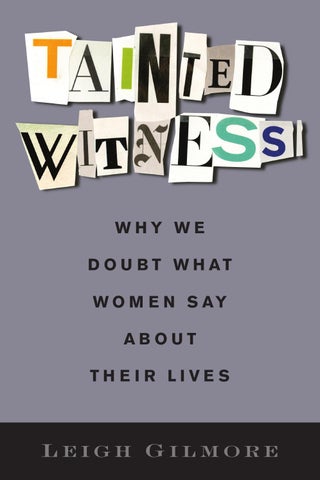
WHY WE D O U B T W H AT W O M E N S AY ABOUT THEIR LIVES
L E I GH G I LM ORE
1 4 0 TAINTE D W ITNE SS IN LAW AND LI TER ATUR E
reading the dense textuality of harm before coming to judgment. There is more here than whether a reviewer or a reader can relate to Xuela. It is that she can be described as “inhuman” because she is “pitiless,” as many readers would agree. Yet why ought the one who does not feel pity, and fails to engender it in others, be cast outside the bounds of the human? Such judgments happen quickly, mobilize into doubt, obscure the colonial history of slavery in which such judgment is bound up, and swiftly produce the conclusion that this particular subject is a bad witness, a tainted witness, one whose account it is too difficult to read.
LEARNING TO DOUBT
The figure of the woman witness in first-person narratives is an example of superposition with respect to truth; that is, at any point in her testimony, she is present as both reliable and unreliable witness.12 It is impossible to know whether a woman will ultimately emerge as a reliable witness because the standard of truthfulness exists not simply in relation to her experience but also within the testimonial limits circumscribing gendered speech about trauma. Formulations such as “nobody really knows what happened” in the cases of sexual assault and rape, for example, work to discredit victims before they speak. They represent a free-floating form of collective judgment that attaches to testimony in the form of doubt. Instead of applying a meaningful brake on wrongful accusations, such skepticism tends to foster underreporting of sexual assault. Moreover, it is part of a pattern of response woven through institutions and bolstered by training and habit that diminishes our capacity (and the capacity of institutions) to engage meaningfully and justly with the prevalence of gendered violence. As soon as Nafissatou Diallo reported the alleged rape, Dominique Strauss-Kahn was detained at JFK Airport as he was boarding a flight to France and charged in Manhattan with sexual assault. He hired a cadre of attorneys and private investigators who immediately went to work attacking Diallo’s reputation. Diallo, too, had legal counsel, but
TA INTED W ITNE SS IN LAW AND LI TER ATUR E 1 41
immediately after the police questioned her, information regarding the contents of that deposition was leaked to the press. As it turned out, Strauss-Kahn’s team was feeding false information about her immigration application to the press and bloggers. In all these storytelling processes, stories of sexual violence were central. Yet the rules governing the elicitation and circulation of Diallo’s multiple testimonies were blurred. For example, during her interview with detectives, Diallo was asked questions that would be inadmissible in a rape trial in criminal court. Namely, she was asked if she had previously been a victim of sexual assault. Because this question sought information about “sexual history,” it is likely to have been ruled out of order and never answered in criminal court. Yet, in a surprising twist that remains unexplained, Diallo answered in the affirmative. She narrated a vivid scene in which she claimed soldiers had broken into her home in Guinea and raped her in front of her two-year-old daughter. Detectives initially believed this story, which turned out to be false. It did not happen, nor did she ever say it did in her immigration application. It was, however, widely reported she had told this story as part of her immigration application and prompted many to call for her to be deported. Whose testimony was this, or, how was this Diallo’s testimony? Why did she tell it in the police station, and why was it so easy to believe she lied in her immigration application? The distance between what happened and the narratives Diallo offered, all of which circulate in a testimonial network with incommensurable standards of evidence, further highlights the problem with tying such narratives to truth. This is a difficult point because truth has the capacity to unmake complexity and reduce judgment to the discovery of error. Testimonial narratives, as I have shown, are produced strategically, can be taken up capriciously, are sometimes persuasive but subject to doubt and discrediting, and do the work of permitting persons to pass through checkpoints of many kinds. To say that Diallo’s narrative in any of the contexts that reward persuasive speech is not true when it is placed in a different context deceptively ties truth to narrative instead of the authorities, often multiple, within a jurisdiction. To insinuate doubt about truth is to amplify the asymmetries that structure how testimonial narratives circulate and persuade.
1 4 2 TAINTE D W ITNE SS IN LAW AND LI TER ATUR E
Doubt is a commonsense word for a gendered formation that is produced over time. Doubt is also a legal term entwined with burdens of proof and rules of evidence. It may be initially withheld as one hears an account of sexual harassment, for example, but creep in as evidence is presented. Although it is a public feeling that readily and demonstrably attaches to speech by women about harm, it feels personal. It is my doubt. Yet in cases of rape and sexual assault, the benefit of the doubt often migrates to the accused when the accuser is female. Doubt represents the limit of basing an ethical response on feelings. When doubting women is constructed as a commonsense and rational response, doubt feels righteous. These political feelings, including sympathy and doubt, do not offer an unproblematic ethical basis for attending to suffering, even if they can be elicited to do good. The locution “no one knows what really happened” is less a position of reasoned and reasonable skepticism than an active, reflexive, and ultimately political feeling that women cannot be trusted to say what harm has befallen them. All too often, a short-circuiting of credibility appears as the unique fault of specific women rather than a predictable product of rape discourse; that is, of many cultural mechanisms working together to produce doubt. Thus the Diallo “story” is not only one she herself told multiple times but one that we must retell in order to disentangle the canny construction of shifting credibility created by the interactions of life narrative and rape discourse. The theme of her unreliability rapidly became “the” Diallo story. Reporters in a range of media claim that the gang rape story was one she was coached to perform by someone she paid to prepare her for her asylum hearing. Gang rape in Guinea is one of the crimes that Immigration and Naturalization Services officials recognize as grounds for asylum. Knowledge of which stories succeed circulates in immigrant communities, and there is a business in coaching applicants in how to tell these stories. Diallo had a tape of a gang rape narrative and memorized it. This is the story she told detectives. She did not, as reported, use it in her asylum application. The district attorney declined to press criminal charges against Strauss-Kahn because he found Diallo unreliable, ironically, because she had been so persuasive about something that did not happen.
TA INTE D W ITNE SS IN LAW AND LIT ER ATUR E 1 43
Patricia Williams, the author of The Alchemy of Race and Rights, wrote in the Nation that Diallo’s allegedly conflicting accounts of past violence were not, on their own, enough to derail prosecution: “The fact that she falsely claimed to have been gang-raped in Guinea probably wasn’t enough to doom the case—she might still have presented herself quite sympathetically as a desperate refugee fleeing a war zone.”13 Williams recognized that the problem lay in the proliferation of speech: the more Diallo talked, the more she exposed gaps in the sequence of her account of the hotel room attack. Through exposure and repetition, Diallo was rendered an insufficiently pure victim for criminal proceedings despite the physical evidence, despite Strauss-Kahn’s lengthy history of what he preferred to call “rough sex,” which would find its way into court in another, unrelated trial.14 Narrative inconsistency stuck to Diallo in ways that made the crime of rape slide off Strauss-Kahn and into undecidability. At that moment, it appeared Diallo would not have her day in court. Yet Diallo’s testimony continued to seek a hearing: in the court of public opinion, and in civil court. Diallo pleaded her case on television, on the steps of the courthouse, on behalf of women hotel workers, and, as she said, for her daughter so she would not learn to be afraid. Finally her moving testimony came to rest within a jurisdiction in which it could be heard: Diallo sued Strauss-Kahn in her home borough of the Bronx. This change in jurisdiction meant that the burden of proof would shift from “beyond a reasonable doubt” to “by a preponderance of the evidence.” When this case succeeded, it also exposed the extent to which the “rational doubt” embedded in the phrase “nobody knows what happened” in cases of rape is catalyzed by the standard of evidence in criminal cases. When the burden of proof is “beyond a reasonable doubt,” and doubt is the reasonable judgment for accounts of rape and sexual assault, then “nobody knows what really happened” is produced as a rhetorical gesture in relation to rationality and law. It is not, nor need it be, a response to the facts in a case, or to any specific woman’s testimony about rape as much as it is part of legal rhetoric: “nobody knows what really happened” emerges in relation to the standard of evidence required in criminal court. It represents political rhetoric masking as common sense and crystallizes in everyday language the
1 4 4 TAINTE D W ITNE SS IN LAW AND LI TER ATUR E
claim that women cannot tell the truth about sexual assault. Because civil courts have a different standard of evidence, Diallo’s testimony did not automatically catalyze doubt. Interestingly, a changed Diallo emerged in this jurisdiction. Justice Douglas McKeon of the Bronx County Supreme Court heard the case and ruled in Diallo’s favor. Strauss-Kahn did not attend the final court date. There were no tense scenes on courthouse steps with attorney and client fielding a barrage of questions from the press, few cameras, and no spectacle. Diallo, who settled for an undisclosed amount, simply left the courtroom smiling and said: “I thank everyone who supported me all over the world. I want to thank everybody, thank God. God bless you all.” Her attorney lauded his client: “Ms. Diallo is a strong and courageous woman who has never lost faith in our system of justice. With this resolution behind her she can now move on with her life.” The judge issued a statement in which he praised her courage. Recalling Wai Chee Dimock’s observation that “no mileage can tell us how far authors are from each other,”15 I would observe that in a story that featured a Muslim woman from the former French colony of Guinea in West Africa currently living in New York and the former head of the International Monetary Fund Frenchman Dominique Strauss-Kahn, the greatest distance was not between his status and hers, or the geographical locations of their homes of origin, but between the criminal court in Manhattan and the civil court in the Bronx. In these two venues, Nafissatou Diallo’s testimony, which came to stand in for what had transpired between her and Strauss-Kahn, produced very different outcomes. Her story told through the Manhattan criminal court repeats the violations of the hotel room in eerie ways. Her testimony in civil court in the Bronx offers an example of justice served. In the context of a criminal charge of rape, the standard of proof animated the “no one knows what happened” judgment, mooting Diallo’s ability to present a story of enduring and rising. Neither sympathetic nor credible, freighted with stories, she sank, the transit of her testimony at an end in the jurisdiction of criminal court and the court of public opinion. Yet testimony seeks a witness, and she found hers in civil court where she proved her claim by a preponderance of the evidence. No new story
TA INTED W ITNE SS IN LAW AND LIT ER ATUR E 1 45
rose from this outcome. She did not lie on her asylum application, as alleged, thus calls for her to be deported were not based in facts and ceased. Nor did she ever explain why she referred to the rape story in her interview with police investigators. We step outside this moment to observe the seeming agency of rape discourse itself, its perplexing and disturbing animacy, how it was the “right story” for the moment and venue for Diallo, and yet was not her story. She spoke the story convincingly with the perverse effect that the attorney general concluded she would be unconvincing before a jury telling her own story. Stories have achieved a kind of disembodied agency. They speak through us even when they are not ours, they conjure events that happened somewhere to persons not present, they record harms in the voices of those who cannot properly witness. Patricia Williams returns to provide crucial insight. When faced with the case of Tawana Brawley, a young African American woman who emerged after a brief absence with the letters KKK scratched into her skin, smeared in feces, falsely claiming an attack by three white men, Williams refused to dismiss even this obdurate an example of unreadable testimony: Brawley “has been the victim of some unspeakable crime. No matter how she got there. No matter who did it to her and even if she did it to herself.”16 Williams holds open the possibility in the face of rape discourse and racism that we must do something other than discredit this testimony, which was never able to move to another public location for a hearing. Williams’s capacity to attend to the ruptures in testimony performs a way of transforming silence into listening and hence into meaning, even if that meaning lies in challenging the general condition of doubt that greets women who bring forward accounts of rape.
LITERARY WITNESS: JAMAICA KINCAID
Legal witnesses, humanitarian storytelling, and literary testimony travel together. Their copresence shapes how audiences respond to the ethical claims in each. As I have shown, first-person accounts are a central feature
2018 CHOICE OUTSTANDING ACADEMIC TITLE hy are women so often considered unreliable witnesses to their own experiences? Bringing together feminist, literary, and legal frameworks, Tainted Witness provides provocative readings of what happens when women’s testimony is discredited. Leigh Gilmore examines the long association of gender and race with lying that persists to this day within legal systems and everyday practices of judgment. She demonstrates how tesWLPRQ\ FURVVHV MXULVGLFWLRQV SXEOLFV DQG WKH XQVWHDG\ OLQH EHWZHHQ WUXWK DQG ¿FWLRQ LQ search of justice. In a new preface, Gilmore addresses how the #MeToo movement centers the experiences of survivors and forges a new jurisdiction for their testimony.
W
“A timely and necessary defense of the women whose voices are so often drowned out or shouted down.� WASHINGTON POST
“Essential reading for women living under a president who publicly professed sexual assault and faced no consequences.� THE RUMPUS
“Rarely does an academic book address its moment so precisely as Tainted Witness. . . . If ever we needed evidence that the work of feminism is not yet done, this is it.� TIMES HIGHER EDUCATION
Leigh Gilmore is Distinguished Visiting Professor of Women’s and Gender Studies at Wellesley College. She is the author of The Limits of Autobiography: Trauma and Testimony (2001) and Autobiographics: A Feminist Theory of Women’s Self-Representation (1994). Gender and Culture Series Cover design: Mary Ann Smith
PRINTED IN THE U.S.A.
Columbia University Press | New York | cup.columbia.edu