Introduction
At a time of burgeoning interest in the history of global human rights politics, recent works have argued variously that Americans turned their attention to human rights as a result of Jimmy Carter’s 1976 election, guilt over the war in Vietnam, or failed political utopias.1 In contrast, From Selma to Moscow: How Human Rights Activists Transformed U.S. Foreign Policy identifies transnational connections and social movements during the “long 1960s” as the foundation for human rights activism. It offers in-depth analyses of the most significant debates about the role of human rights in U.S. foreign policy during these years, examining how Americans responded to human rights violations in the Soviet Union, in Southern Rhodesia after the 1965 unilateral declaration of independence, in Greece after the 1967 coup, in authoritarian South Korea, and in Chile after the 1973 coup. The focus on these sites of human rights abuse is based on an extensive examination of records from the relevant presidential administrations, the State Department, Congress, the United Nations (UN), and nongovernmental organizations (NGOs). The five countries chosen for this study had human rights records of significant interest to all these constituencies; they also represent geographic diversity, ideological diversity, and diversity in terms of human rights violations.2 Taken together, this book shows that Americans were engaged with a wide range of human rights issues across the long 1960s. People who had transnational connections—ties to
2 I ntroduction
foreign people and places forged through travel or other border-crossing interactions—united with other Americans who were motivated by broader international and domestic movements; the activism they produced ushered in the institutionalization of human rights in U.S. foreign policy and the expansion of human rights activism in the United States during the late 1970s, the 1980s, and beyond. I define the “long 1960s” as the years between John F. Kennedy’s inauguration in 1961 and Jimmy Carter’s in 1977.3 Like a number of other scholars, I have found the term “long 1960s” useful in explaining the years between the early and late periods of the Cold War.4 Domestically, the long 1960s was a distinctive period characterized by the height of the civil rights movement, other rights-based movements, and the movement to end U.S. involvement in Vietnam, all of which collectively reshaped American politics and society. In terms of foreign policy, the long 1960s were marked not only by the war in Vietnam but also by increasing challenges to U.S. power in the Third World and by efforts to reduce tension with the Soviet Union amid unrelenting Cold War competition. This book will employ the term “human rights” as activists at the time most often did—to signal support for the rights to due process, to the practice of one’s religion, to freedom of movement, and to participation in one’s own government, as well as freedom from racial discrimination and torture. To use shorthand, activists were attentive largely to civil and political rights, not to the fuller list of human rights outlined in the UN Universal Declaration of Human Rights (UDHR).5 Although many activists and policymakers were concerned about what might be labeled “social and economic rights,” they rarely used the language of human rights in that respect during those years. Exceptions include Martin Luther King Jr. and some activists who focused on human rights violations in Chile, who were attentive to the intersection among political, civil, social, and economic rights.6 In the years after the adoption of the UDHR, a small number of American NGOs focused on domestic and international human rights. During the Eisenhower years, however, human rights was characterized by critics as a project of the UN that threatened American sovereignty; this sentiment hung over all activism by groups such as Freedom House, the International League for the Rights of Man (ILRM), and the National Association for the Advancement of Colored People (NAACP). These organizations were largely headquartered in New York City, where beginning in the late
3 I ntroduction
1940s they could direct attention toward UN bodies and diplomats. There was considerable overlap in the personnel of these organizations, and many even set up their offices in the same building—the Wendell Willkie Building in midtown Manhattan.7 Rather than being based on mass membership or engaged in political mobilization, as would be experienced in later years, human rights work in these decades was largely a privileged affair.8 Observers have described the ILRM as an example of an “elite organization” with a membership made up of an “ ‘old boy’ network.”9 Similarly, Freedom House’s board meetings were often held at the 21 Club in Manhattan, a restaurant known for its extensive Prohibition-era secret wine cellar.10 WHAT WAS NEW IN THE LONG 1960S?
The long 1960s marked both a transformation and an expansion of American human rights activism, shaped by transnational connections and reflected by a focus on Washington rather than New York, which led to new approaches to U.S. foreign policy. One signal of this shift is the increased use of the term “human rights.” Using the New York Times as an example, the term “human rights” was used on average 2.4 times more per year during the long 1960s than during the eight years of the Eisenhower administration. Furthermore, incidence of “human rights” more than doubled between 1961 and 1976, albeit with fluctuations along the way (figure 0.1). Occurrence of the term “human rights” is only one measure of the growing salience of human rights terminology in the 1960s. As this book shows, the usage of related terminology, including “torture,” “dissidents,” “political prisoners,” and “racial discrimination” also increased meaningfully during these years—which is evidence of, and potentially a cause of, increasing attention to human rights.11 What led Americans to care about international violations of human rights during the long 1960s? The reasons for increased and innovative activism were diverse. Many were primed to care about human rights violations due to broader changes taking place both internationally and within the United States during the long 1960s, such as decolonization, the establishment of NGOs devoted to human rights, the achievements of the civil rights movement, attempts to address poverty in the United States, distress about the direction of U.S. foreign policy, and greater congressional activism in foreign affairs. In this context, activists’ transnational connections,
4 I ntroduction
1,000 900 Times mentioned
800 700 600 500 400 300 200 100 1953 1954 1955 1956 1957 1958 1959 1960 1961 1962 1963 1964 1965 1966 1967 1968 1969 1970 1971 1972 1973 1974 1975 1976
0
Year FIGURE 0.1. Usage of the term “human rights” in the New York Times, 1953–1976
which were facilitated by decreasing costs for international travel and increasing advances in television and satellite communication during these years, activated or spurred their efforts on behalf of human rights.12 The 1960s offered new opportunities for Americans to travel and work abroad, and returning Peace Corps volunteers, missionaries, and academics were often attracted to human rights activism by their international experiences.13 In his work, historian Patrick Kelly cites Herbert Clemens, a former Peace Corps volunteer who participated in protests for civil rights and against Vietnam and later turned to human rights work, as characteristic of the personal paths of those who became active on human rights during the mid-1970s.14 In another case, Peace Corps volunteers taught English to Kim Dae Jung, a prominent opposition politician in South Korea. According to Russell Sveda, a Peace Corps volunteer in South Korea in the late 1960s, Kim’s Peace Corps connections “gave a certain amount of U.S. government attention to Kim Dae Jung’s plight because [Peace Corps] volunteers were visiting him on a daily basis.”15 Sveda’s account of how he and his fellow volunteers kept Kim visible to U.S. policymakers demonstrates that Americans overseas can also meaningfully influence U.S. foreign policy. Travel shaped the activism of a wide range of Americans, not only Peace Corps volunteers.16 For example, James Becket, one of the two authors of
5 I ntroduction
Amnesty International’s first report on torture in Greece, had traveled there with his family and met his future wife during their trip.17 When University of California–Berkeley law professor Frank Newman began writing about human rights in 1967, he saw the subject as connected with his professional interest in civil rights and civil liberties. But Newman also knew Andreas Papandreou, who was imprisoned in Greece, so he undertook a trip to Athens. This visit further enmeshed him in human rights advocacy, leading to later work with Amnesty International and the International Commission of Jurists.18 Americans such as David Wiley, Marylee Crofts, and Linda Jones, who were missionaries in Southern Rhodesia and South Korea, became active on human rights based on their intimate connections with violations in the communities they served.19 Additional Americans came to feel deep transnational connections to political prisoners and others suffering human rights abuses without ever leaving the United States; they were drawn to human rights based on identity or personal experience.20 Rita Hauser, who served as the United States’ representative to the UN Human Rights Commission, argued that connections forged through immigration fueled American attention to human rights, noting that it was “understandable that many Americans remained concerned over the fate of minorities close to them whose rights were threatened elsewhere in the world.”21 Roberta Cohen, who was the executive director of the ILRM from 1971 to 1977, had a personal family connection to the issue of Soviet discrimination against Jews, as some of her family members had emigrated from Russia due to anti-Semitism.22 Ginetta Sagan, who was active in Amnesty International USA, had suffered torture in fascist Italy.23 Motivations for other individuals’ attention to human rights were moral, political, and religious.24 Andrew Marwick points to a “revived emphasis on the liberal principles of democratic rights and due process” in the 1960s.25 Furthermore, historian Petra Goedde sees 1970s-era youth as motivated to find “local and personal solutions to global problems.”26 Liisa Malkki depicts Finnish Red Cross workers as being motivated both by their own neediness and by a desire to be connected to something larger than themselves. At a time of domestic and international foment, Americans active on human rights may have similarly been seeking connections to something “greater than themselves.”27 Interestingly, Secretary of State Henry Kissinger, speaking in July 1975 on “The Moral Foundations of
6 I ntroduction
Foreign Policy,” made a similar diagnosis, declaring that Americans wanted to think of U.S. policy as representing “something beyond ourselves.”28 Finally, the Catholic Church’s commitment to “human dignity” and “religious freedom” in the documents from the Second Vatican Council also likely influenced Americans’ thinking about human rights. Specifically, in Vatican II, Pope Paul VI wrote, “With respect to the fundamental rights of the person, every type of discrimination, whether social or cultural, whether based on sex, race, color, social condition, language or religion, is to be overcome and eradicated as contrary to God’s intent.”29 A CHANGING WORLD
Broad developments at the international and domestic levels precipitated and reinforced Americans’ individual motivations. Internationally, decolonization increased demands on the United States to take greater account of racial discrimination in its own practices and in its foreign policy. Both abroad and at home, the increasing influence of NGOs, some of which focused on human rights, shaped growing American activism. Domestically, the movements for African American freedom and against the war in Vietnam shaped Americans’ thinking about their government’s policies and led many to push for new approaches to human rights in U.S. policy. The Cold War consensus that had privileged containment and anticommunism over other priorities was corroded by displeasure with the conduct of the United States, including not only the war in Vietnam but also the 1965 intervention in the Dominican Republic as well as support for military dictatorships and covert intelligence operations abroad. As this consensus weakened, members of Congress asserted themselves more forcefully in the policymaking process and at times used their control of the appropriations process to wield influence.30 An analysis of the reasons that prompted greater attention to human rights during the long 1960s must include the role of the UN, which was dramatically transformed in the wake of decolonization.31 In the words of historian Roland Burke, “Decolonization initiated a global human rights debate.”32 In 1960 alone, seventeen new countries joined the UN. New member states brought with them specific concerns that were often tied to their colonial experiences. Many of these newly independent states bonded together in order to exert greater influence within an organization that was
7 I ntroduction
formally managed by the permanent members of the UN Security Council. The “Afro-Asian Group,” as these states were often called collectively, focused on racial discrimination, which led the situations in South Africa and eventually Southern Rhodesia to consume a considerable amount of attention and debate at the UN. In addition, these new states targeted European powers, Portugal in particular, that would not relinquish their colonies. UN dynamics fundamentally shaped U.S. policy toward Southern Rhodesia, and in the Chilean case, UN condemnation and pressure heightened American interest in violations there. But for a range of reasons, human rights violations in South Korea, Greece, and the Soviet Union inspired less debate at the UN. At the same time that some human rights violations garnered greater attention at the UN, American activists increasingly focused on U.S. policymakers in Washington as the most effective avenue for effecting change. In the early 1960s, New York–based Freedom House, the NAACP, and the ILRM remained the most prominent NGOs focused on human rights. Yet they were increasingly frustrated by the UN. Roger Baldwin, the former executive director of the ILRM, repeatedly expressed disillusionment with the UN, writing, “We work against a difficult background—a dis-United Nations too preoccupied with nationalism and colonialism to consider international enforcement of human rights.”33 Arguing that the ILRM needed to intervene in instances of human rights violations abroad, its staff wrote, “As long as international machinery remains rather impotent in confronting human rights violations, the [ILRM] and other such groups must accept a major responsibility for doing so.”34 The rise of new NGOs as well as the shifting attention of established groups offered outlets for people who were increasingly attuned to human rights and the innovations they brought to human rights activism.35 The most significant NGO to form during these years was Amnesty International; it would ultimately transform human rights activism into a mass movement. Established in London in 1961, it initially faced challenges as it sought to expand to the United States.36 In 1965, however, some 750 people responded to a Reader’s Digest article about its work, which prompted efforts to establish a section of Amnesty International in the United States.37 Eventually Amnesty International USA (AIUSA) offered a meaningful outlet for the rising number of Americans who wanted to get involved in human rights advocacy.38
8 I ntroduction
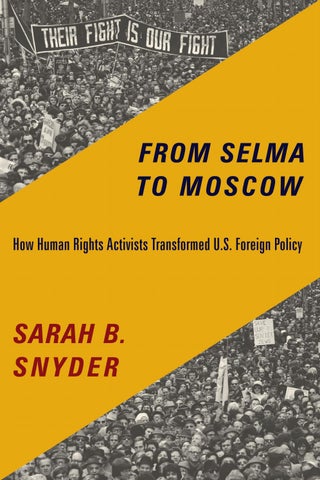
Other groups that were organized around religion, nationality, or profession also played key parts. For example, the American Association for the International Commission of Jurists saw its mission to be the “protection and independence of foreign lawyers who have been either arrested, incarcerated or intimidated by their governments solely because they are rendering professional services to dissident or unpopular defendants.”39 Similarly, lawyers in the international law section of the American Bar Association expressed concern about human rights violations, particularly of lawyers’ rights, in South Korea and Greece.40 Support for human rights internationally was closely linked with domestic concerns about civil, political, economic, and social rights as Americans became progressively worried about consistency in the domestic and foreign policies of the United States and the degree to which U.S. leaders championed human rights internationally. During the Eisenhower years, Americans were aware that the country’s record on race relations left it open to considerable criticism. As Morris Abram, who was active in the civil rights movement and who served as the U.S. representative to the UN Human Rights Commission, said, “Unless we succeed in solving our own racial and other human rights problems, we may find we are forfeiting our position of leadership and the respect of those many new States to whom questions of racism and exploitation are paramount.” 41 As the United States made strides through court decisions such as Brown v. Board of Education, protests to end segregation, legislation such as the 1964 Civil Rights Act and the 1965 Voting Rights Act, and greater visibility of African Americans in public life, criticism of the American race record at the UN declined, and U.S. policymakers gained greater confidence in talking about human rights violations abroad.42 In many ways, human rights activists were building on the successes of the civil rights movement in that white and black liberals sought to export the movement’s victories abroad. This book’s title, From Selma to Moscow, evokes that impulse.43 Writing in 1965, the National Citizens’ Commission on International Cooperation’s Committee on Human Rights argued that as the United States made more progress on the fulfillment of civil rights domestically, it was better situated to contribute internationally regarding human rights. The committee wrote, “We have removed finally most of the domestic obstacles which have in the past prevented our active participation in international efforts to project ‘human rights and fundamental
9 I ntroduction
freedoms for all without distinction as to race, sex, language, or religion.’ ” 44 Fundamentally, the civil rights movement wanted the federal government to protect Americans from violations of their rights; that thinking led, by extension, to a belief that the United States could play a role in protecting people from violations abroad in Southern Rhodesia, South Africa, Greece, and elsewhere.45 The movement for greater protection of African Americans’ rights generally heightened Americans’ attention to human rights language, to the plight of those oppressed by illiberal leaders, and specifically to the oppression of black Africans who suffered under colonialism or white minority regimes.46 Freedom House worked for racial equality in the United States in part because, as Freedom House official Leo Cherne said, “We could not inconveniently, no matter what our inclination, ignore the fact that for a portion of this society, this society was not that much more free than others we were opposing.” 47 After Johnson signed the 1964 Civil Rights Act, Secretary of State Dean Rusk wrote to a member of Congress that he was “deeply impressed by the connection between this problem here at home and the great struggle for freedom which is being waged throughout the world. . . . This country is looked upon as a leader of those who wish to be free, and what we do here has an importance far beyond our borders.” 48 Other U.S. officials echoed Rusk’s perspective, including Harris L. Wofford Jr., a special assistant to the president, when he spoke to the Annual Conference of the National Civil Liberties Clearing House: “If American rights are all that we see at stake, we will lose the perspective that shows this as a world-wide human problem.” Wofford also outlined the need to “move this country ahead on the new frontiers at home and abroad, in civil rights here and in human rights everywhere.” 49 From Selma to Moscow recalls the slogan on a banner at a March 1965 rally for Soviet Jewry—“Selma or Moscow: Human Liberty is Indivisible. End Soviet Anti-Semitism”— which highlighted the historic links between liberal American Jews and the civil rights movement as well as the connections between those engaged in activism on behalf of civil rights and on behalf of human rights (figure 0.2).50 Although rights have been significant to the United States since the country’s founding, it was the 1960s that produced “an explosion of demands for new rights.”51 According to Risa Goluboff, in the 1960s “reform movements were claiming, and courts were increasingly offering, constitutional protection for new people and new rights.”52 Historian Brian
10 I ntroduction
FIGURE 0.2. Americans protesting the treatment of Soviet Jews in front of Independence Hall in Philadelphia drew an explicit link to the march for voting rights earlier that month. Courtesy of the Jewish Exponent.
Balogh suggests, “The civil rights movement provided the ‘how-to’ guide to would-be organizers, as activists from civil rights moved on to the New Left, feminist, and even the environmental movements.”53 Human rights activists were also inspired by, were students of, and in some cases were participants in the civil rights movements. One notable example of the shift from civil rights work to human rights activism is the Lawyers’ Committee for Civil Rights Under Law, which began in response to Kennedy’s call to bring a legal approach to the civil rights movement and later defended South Africans who were charged under apartheid legislation.54 Similarly, James Green, who has written about human rights activism that targeted the Brazilian military government in the 1960s, sees veterans of the civil rights and antiwar movements as drawn to activism regarding Brazil and Chile in particular.55 Human rights and intellectual historian Samuel Moyn does not see a strong connection between American attention to human rights internationally and the domestic civil rights movement, writing, “It is tempting to believe that the civil rights movement that had transformed American race relations prompted the new invocations of human rights, but the evidence is thin. Though some participants in the civil rights movement later joined the American human rights movement, the timing of the latter is too late for any truly powerful connection to be made.”56 Moyn’s argument is based, to some degree, on the existence of a gap between the dissipation of the
11 I ntroduction
freedom movement, to use a broader term, and the development of a mass human rights movement in the late 1970s. Looking at elite-level attention to human rights in the long 1960s, however, suggests a closer relationship between the movements.57 The two most persuasive links are the overlap of personnel—for example the involvement in human rights debates of prominent freedom leaders such as NAACP executive director Roy Wilkins and executive director of the National Urban League Whitney Young—as well as the claims of many involved—such as Rusk, Abram, and United States ambassador to the UN Arthur J. Goldberg—about the links between U.S. foreign and domestic policies regarding racial discrimination. The long 1960s were also a period during which American policymakers increasingly tackled Americans’ social and economic rights through programs like the Great Society and the War on Poverty.58 Sending a report to the White House, law professor Louis Sohn echoed the language of many in urging that the Johnson administration pay greater attention to human rights: “As a supporter of the President in his many efforts to create the Great Society at home and to bring peace, justice and economic development to the strife-torn world, I am certain that the new initiatives in the field of human rights suggested in our report are close to the president’s heart and are worthy of his attention.”59 Abram declared: My country recognizes, certainly today, that while man does not live by bread alone, he does not live without bread, and that economic, social and cultural rights are part and parcel of the fabric of American civilization. We are also perfectly aware of the fact that it is not enough simply to open the doors of opportunity, that when the doors are open it frequently is a fact that men do not have the resources, and the society may not have the resources, to permit men to walk through the gates of opportunity to achievement.60
Abram sought deliberately to echo Johnson’s address at Howard University, where the president had declared: “It is not enough to open the gates of opportunity. All our citizens must have the ability to walk through those gates. This is the next and most profound stage of the battle for civil rights.”61 Historian Ryan Irwin argues that we must see Johnson’s policy toward South Africa in the context of his War on Poverty, which was, after all, a war on social injustice and racial discrimination or, as Johnson put it, an effort
12 I ntroduction
to “end poverty and racial injustice” in that generation.62 We can apply this insight to understanding the Johnson administration’s approach to Southern Rhodesia as well. Americans and, importantly, members of Congress viewed U.S. policies as increasingly at odds with American values.63 Representative Donald Fraser (D-MN), who led a series of highly influential hearings on human rights during these years, later said, “I think American foreign policy has to reflect basic American values. The United States has historically stood as a beacon of hope for oppressed persons around the world, as an example of a free people running their government in a reasonably sensible and civilized way. If our foreign policy fails to reflect our domestic values it loses much of its force.”64 Put another way, they feared that U.S. foreign policy was immoral. Vietnam loomed as the most significant overseas intervention, but United States actions in the Dominican Republic, Chile, and elsewhere also played a role.65 Criticism of the war in Vietnam by Senator Frank Church (D-ID) during February 1966 hearings set a precedent for condemnation of U.S. foreign policy. As David Schmitz and Natalie Fousekis have noted, in the hearings’ aftermath, “the postwar consensus on containment and presidential domination of foreign policy now began to crack.”66 Similarly, Tom Harkin, as a congressional aide in 1970, discovered and publicized the existence of “tiger cages” in an inhumane detention facility on Con Son Island in South Vietnam, raising questions about the record of the South Vietnamese government and American conduct there.67 Later, as a member of Congress, Representative Harkin (D-IA) was an active proponent of limiting U.S. support to governments that violated human rights. Congressional skepticism was echoed by NGOs. The ILRM repeatedly expressed its concern over human rights violations in Vietnam.68 In one statement, it asserted, “Prisoners and civilians have been inhumanely treated, tortured and killed. Wounded have gone uncared for. Dead have been mutilated. Hostages have been taken and in some cases used as human shields. Systematic terror and assassination have been employed as weapons.”69 Later it protested South Vietnam’s detention and poor treatment of a hundred thousand political prisoners.70 Similarly, the U.S. Study Team on Religious and Political Freedom in Vietnam, largely made up of religious leaders, shared with Nixon and members of Congress its concerns about
13 I ntroduction
the “suppression of political opposition, using tactics of arrest, harassment, and imprisonment.”71 As the decade progressed, U.S. support for military dictatorships in Brazil, Greece, and Chile prompted further questions about the wisdom of U.S. policy.72 Historian Thomas Field has argued that militarization was a “hallmark” of the global 1960s; with military regimes often came repression, which helps explain why there was increasing attention to human rights during that decade.73 At issue for many was the extent to which Cold War priorities, which were manifested in support for repressive leaders, were diminishing America’s image abroad and undermining the morality of U.S. foreign policy. Or, as Daniel Sargent has characterized it, when human rights emerged as an issue in U.S. policy, it “was not just a breakthrough; it was also a backlash.”74 Connected with growing unease over U.S. foreign policy was “the breakdown of Congressional respect for Executive Branch leadership,” as one former diplomat described it.75 Critics charged that the presidency had become “isolated, autocratic, and imperial,” and by 1974 Americans’ confidence in their government had fallen to 41 percent, down from 77 percent in 1964.76 As their faith in the executive branch eroded due to what were seen as ill-advised foreign policy decisions and abuses of presidential power, members of Congress increasingly asserted themselves in policymaking.77 Donald Fraser was among the most assertive, and he explained his focus by recalling, “Some years ago, I was in Athens and I was shown a picture of some tanks which were rumbling down the streets. They were tanks made in the United States, and they were being used to suppress students who were protesting against the military junta’s destruction of democracy in Greece.”78 As Harry Frankfurt has written, “There are occasions when a person realises that what he cares about matters to him not merely so much, but in such a way, that it is impossible for him to forbear from a certain course of action.”79 Americans such as Fraser came to care about human rights abuses so strongly that they were compelled to reshape U.S. foreign policy. Frustration with the executive branch and the rise of congressional activism, of course, was heightened by domestic developments, the most prominent of which was Watergate—first, because it accelerated the
14 I ntroduction
erosion of trust of the White House, and second, because in the scandal’s wake, more liberal elected officials arrived in Washington, leading some to call them “Watergate babies.”80 Kissinger expressed frustration with the impact of Watergate on U.S. foreign policy, saying, “Watergate was circumscribing our freedom of action. We were losing the ability to make credible commitments.”81 Furthermore, members of Congress were drawn into greater activism by the lack of respect shown to them by the White House; as one member of Congress later said, congressional human rights activism developed because “we in Congress were very, very annoyed at the administration.”82 In particular, the congressional hearings held by Frank Church and his United States Senate Select Committee to Study Governmental Operations with Respect to Intelligence Activities further undermined Americans’ faith in the executive branch.83 The collapse of the Cold War consensus, prodded in part by greater congressional activism in foreign affairs, also produced a degree of democratization in foreign-policy making.84 Nonstate actors have always played influential roles in shaping U.S. foreign relations, but changes during the 1960s opened up space for them to have an enhanced role in policymaking, which for some time had been dominated by a closed, elite group who subscribed to a consensus view of U.S. policy.85 The chapters that follow will show how activists, lawyers, and religious leaders who were involved in human rights work seized new opportunities to shape U.S. foreign policy. As Michael Nelson points out, narratives about the 1960s have often emphasized turbulence, division, and potential crisis.86 These ruptures offered opportunities. Many accounts chronicling the 1960s focus on protests on college campuses, the radical politics of the left, and the youth counterculture; however, Americans active on human rights were beyond university age, liberal rather than radical, and elite actors rather than participants in a mass movement.87 Debates at universities were essential to the political climate in which human rights activism transformed, but the figures at the center of From Selma to Moscow were motivated by experiences in their professional lives, or at least after their university years. Additionally, while many on the radical left may have sympathized with human rights activism— particularly with respect to Chile—they were more focused on domestic politics and opposing the war in Vietnam, and it was elite liberals like Fraser who spearheaded the international human rights agenda.
15 I ntroduction
The Americans motivated by transnational connections or other personal, political, moral, and religious motivations were political entrepreneurs in the growing movement for human rights during these years. According to sociologist Charles Tilly, “Social movements depend heavily on political entrepreneurs for their scale, durability, and effectiveness.”88 Political entrepreneurs in 1960s-era human rights activism such as James Becket, Joseph Eldridge, and Donald Fraser galvanized other Americans to work alongside them in pressing for greater attention to human rights in U.S. foreign policy. These activists engaged in “contentious politics,” which Charles Tilly and Sidney Tarrow define as “interactions in which actors make claims bearing on someone else’s interests, leading to coordinated efforts on behalf of shared interests or programs, in which governments are involved as targets, initiators of claims, or third parties.”89 American human rights activists determined their tactics—namely an unrelenting focus on Washington—based on their diagnosis that U.S. foreign policy was complicit in human rights abuses. The human rights violations at the center of this account—torture, racial discrimination, and religious persecution—drove American citizens and nongovernmental organizations to exert pressure through letter writing, testifying before Congress, and participating in demonstrations among other activities.90 Members of Congress held hearings to investigate human rights violations, published reports highlighting abuses, and when their concerns were largely dismissed by the executive branch, utilized the “power of the purse”—congressional control over the appropriations process.91 Their activism led to legislation that limited military and economic assistance to abusive governments, created institutions to monitor human rights internationally, and reshaped U.S. foreign policymaking going forward. Specifically, these activists and their accomplishments imbued the issue of human rights with such salience that it could not be ignored in the subsequent years. THE WHITE HOUSE RESPONSE
The presidential administrations during the long 1960s responded in a range of ways to external pressure and internal concerns about human rights violations. There were regular in-house debates about the proper course for U.S. policy, with lower-level State Department officials often
16 I ntroduction
arguing for more action in the face of resistance at the highest levels. When there was action, frequently it was American diplomats or midlevel officials expressing unease about human rights violations to foreign governments. Despite the reputation of human rights work as a dead end for ambitious foreign service officers, my research shows that many were engaged with dissidents and human rights violations while serving abroad. Occasionally, such as with Rhodesia and Greece, the United States pursued sanctions or implemented an arms embargo. At times, U.S. policymakers— even Henry Kissinger during the 1976 campaign—denounced human rights abuses publicly in what we might think of as “symbolic form[s] of action,” but overall, U.S. leaders exercised considerable restraint during these years.92 Nevertheless, each administration was careful to assert publicly that its commitment to human rights shaped U.S. policy, often to a greater degree than was suggested by its actions. Kissinger was the driving force of U.S. foreign policy during the Nixon and Ford years, and his long-held perspective, which was shared by many policymakers during the long 1960s, was that protecting human rights was not central to U.S. foreign policy priorities. This dynamic meant that supporters of human rights had a challenging task when it came to shaping U.S. policy—yet they succeeded during the long 1960s in many ways. Importantly, they heightened awareness of human rights violations such that decisions to support repressive regimes led to congressional hearings, front-page news, and some successes in reducing the flow of U.S. dollars to the abusers’ coffers. In addition, the country overall became increasingly attuned to the consequences of U.S. foreign policy for human rights abroad. In the chapters that follow, I demonstrate the range and impact of American human rights activism during the long 1960s. Chapter one highlights growing American attention to and activism on behalf of repressed Soviet citizens during these years. The second chapter demonstrates how Southern Rhodesia’s unilateral declaration of independence in 1965 spurred civil rights leaders in the United States and others concerned with racial discrimination to urge Lyndon Johnson’s administration to undermine the white regime there. The next three chapters show that Americans became less willing to indulge repressive allies as the Cold War consensus eroded. In the case of Greece, in the wake of the 1967 coup, the junta’s harsh treatment of its perceived enemies—arresting them, subjecting them to torture, and imprisoning them in island concentration camps—galvanized many
17 I ntroduction
in the United States. Chapter three reveals the varied efforts of academics, members of Congress, and prominent liberals to encourage the United States to moderate its support for the military regime in Greece. Next, in chapter four, I explore activists’ frustrations with U.S. policy toward South Korea and analyze the tool increasingly utilized to signal dissatisfaction with that policy—legislation curbing military and economic assistance to human rights violators. Chapter five examines how the military coup in Chile and the subsequent human rights violations there motivated nongovernmental activists and members of Congress to press for greater distance from the repressive government. In addition to analyzing the influence of nonstate actors, this chapter will demonstrate how Kissinger’s intransigence as secretary of state inspired greater congressional activism on human rights. Across the period of the long 1960s, and reflected in each chapter, activists and members of Congress attempted to utilize available tools but were often stymied by the White House. Their growing frustration produced a congressional revolution led by Donald Fraser. Chapter six explores how, partially motivated by limited executive branch attention, Fraser and his House Subcommittee on International Organizations and Movements held hearings on human rights in 1973 that fundamentally recalibrated U.S. foreign policy formulation. The subcommittee’s hearings precipitated a wave of legislation that reshaped the State Department’s bureaucracy and formalized human rights as a factor in U.S. policy. These efforts laid the foundation for the institutionalization of human rights as a priority in U.S. foreign policy and assured its continuing significance in the years that followed.