Pentecostals in America TEACHER’S GUIDE
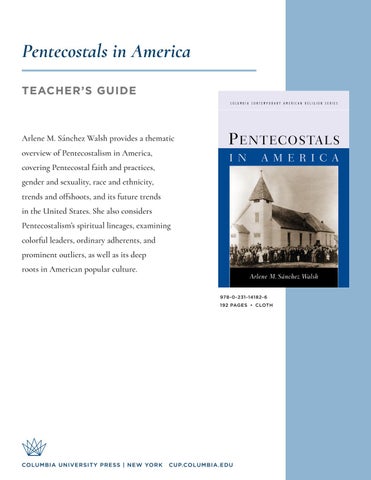
Arlene M. Sánchez Walsh provides a thematic overview of Pentecostalism in America, covering Pentecostal faith and practices, gender and sexuality, race and ethnicity, trends and offshoots, and its future trends in the United States. She also considers Pentecostalism’s spiritual lineages, examining colorful leaders, ordinary adherents, and prominent outliers, as well as its deep roots in American popular culture. 978-0-231-14182-6 192 PAGES • CLOTH
COLUMBIA UNIVERSITY PRESS | NEW YORK CUP.COLUMBIA.EDU
Teaching Guide to Pentacostals in America SUMMARY
Pentecostals tell great stories: resurrections, healings, prophecies, people brought back from the edge of despair, children lost and found, and more. This book aims to examine Pentecostalism in America as a narrative performance and seeks to explain what Pentecostalism is through the experiences and stories of its adherents. It does not privilege the “great people” of Pentecostal history, nor treat any of the figures it does include with a hagiographic gloss. Regarding this global Christian movement with a critical eye, this book takes its claims seriously not by asserting validity of these claims, but rather by placing the claims in context within the larger narrative of American religious history.
COLUMBIA UNIVERSITY PRESS TEACHER’S GUIDE • 2
Notes:
INTRODUCTION
Pages ix–xxix QUESTIONS FOR DISCUSSION
1. Pentecostal history has many “origins” stories. Discuss this idea of a multicentered origin of American Pentecostalism. 2. Using the case study of Florence Crawford, how can and does Pentecostalism remake itself for different audiences? 3. How did G. T. Haywood contribute to the the early years of African American Pentecostalism?
COLUMBIA UNIVERSITY PRESS TEACHER’S GUIDE • 3
Notes:
CHAPTER 1 Pentecostal Faith and Practice.
Pages 1–13 QUESTIONS FOR DISCUSSION
1. How do spirit baptism narratives help “sacralize” the process of becoming Pentecostal? 2. After reading about the spiritual gift of prophecy, do you find parallels of this practice in other religious traditions? 3. Watch this YouTube video of Jack Coe on the subject of healing and medicine. Jack Coe Practicing Medicine Without A License https://www.youtube.com/watch?v=Bns70sifxao How does Coe construct a narrative of healing?
COLUMBIA UNIVERSITY PRESS TEACHER’S GUIDE • 4
Notes:
CHAPTER 2 Pentecostal Innovators.
Pages 14–33 QUESTIONS FOR DISCUSSION
1. How did Pentecostals use “populism” as a way to reach their audiences? 2. Aimee McPherson’s significance as the founder of the Foursquare denomination is marred by a controversial private life. What, if anything, does her controversial life tell us about how Pentecostals create and recreate narrative histories? 3. A. A. Allen was a pioneer of the “prosperity gospel.” What ideas and influences did Allen contribute to what is today the most popular aspect of global Pentecostalism?
COLUMBIA UNIVERSITY PRESS TEACHER’S GUIDE • 5
Notes:
CHAPTER 3 Gender, Sexualities, and Pentecostalism.
Pages 34–51 QUESTIONS FOR DISCUSSION
1. How do Pentecostal institutions like bible schools and universities support and reify gender roles? 2. Comment on the role of women in American Pentecostalism. 3. What is the Pentecostal notion of marriage? How does it affect ideas of gender and sexuality, and vice versa? What is its importance for Pentecostals?
COLUMBIA UNIVERSITY PRESS TEACHER’S GUIDE • 6
Notes:
CHAPTER 4 Pentecostalism and Popular Culture.
Pages 52–68 QUESTIONS FOR DISCUSSION
1. Discuss the sacred/secular divide among the musicians featured in this chapter. 2. Listen to samples of music from Marvin Gaye and Elvis Presley. Can you can identify specific religious themes in these songs? 3. Compare Agnes Sanford’s and Joel Osteen’s views of how positive thinking leads to success.
COLUMBIA UNIVERSITY PRESS TEACHER’S GUIDE • 7
Notes:
CHAPTER 5 Race, Ethnicity, and the Construction of an American
Pentecostal Identity. Pages 69–86 QUESTIONS FOR DISCUSSION
1.
How did the Assemblies of God mission to Mexicans during the early twentieth century attempt to assimilate Mexicans into an Americanization project?
2. The shoot-out at Miracle Valley directly countered the reputation A. A. Allen carefully crafted as a supporter of African Americans. Listen to A. A. Allen speak on the subject of racism (One Body Racism), and compare his woreds and ideas to the incident that occurred on his compound in the 1980s. 3. While nearly all American Pentecostal denominations have seen a diverse demographic growth, why is the Foursquare denmonation an exception?
COLUMBIA UNIVERSITY PRESS TEACHER’S GUIDE • 8
Notes:
CHAPTER 6 Outliers in American Pentecostalism.
Pages 87–102 QUESTIONS FOR DISCUSSION
1. Compare and contrast the types of “heterodoxy” in the cases of Carlton Pearson and Jay Bakker. 2. Kathryn Kuhlman and Joyce Meyer seemed to divorce their “problems,” namely the men in their lives who did not support their ministerial ambitions. In doing so, they restored their religious authority. Comment on this in relation to how Pentecostals typically define marriage. 3. There seems to be a difference between Pentecostal belief and Pentecostal behavior when it comes to who is rewarded and who is punished for heresy. Can you think of other public figures who have undergone the kinds of rejection and redemption narratives described in this chapter?
COLUMBIA UNIVERSITY PRESS TEACHER’S GUIDE • 9
Notes:
EPILOGUE A Whole New Thing—The Future of Pentecolstalism
in America. Pages 103–112 QUESTIONS FOR DISCUSSION
1. The story of Sly Stone helps situate African American Pentecostalism in its historical, geographical, and social contexts. Given the sheer number of artists who have come from Pentecostal backgrounds, can it be said that Pentecostalism has its roots in the African American musical traditions of blues, rock’n’ roll, and soul? 2. Speculate on why Pentecostalism continues to grow globally despite overall trends that show a decline of religious belief. 3. After reading this text, what is your overall opinion of Pentecostalism? Does the idea of that narratives create “spiritual life stories” help explain the movement’s extraordinary claims?
COLUMBIA UNIVERSITY PRESS TEACHER’S GUIDE • 10
Notes:
Notes:
COLUMBIA UNIVERSITY PRESS TEACHER’S GUIDE • 11
Columbia Contemporary American Religion Series The spiritual landscape of contemporary America is as varied and complex as that of any country in the world. The books in this series, written by leading scholars for students and general readers alike, fall into two categories: Some titles are portraits of the country’s major religious groups. They describe and explain particular religious practices and rituals, beliefs, and major challenges facing a given community today. Others explore current themes and topics in American religion that cut across denominational lines. The texts are supplemented with carefully selected photographs and artwork, and annotated bibliographies. Roman Catholicism in America by Chester Gillis Islam in America by Jane I. Smith Buddhism in America by Richard Hughes Seager Protestantism in America by Randall Balmer and Lauren F. Winner Judaism in America by Marc Lee Raphael The Quakers in America by Thomas D. Hamm New Age and Neopagan Religions in America by Sarah Pike Baptists in America by Bill J. Leonard Islam in America, Second Edition by Jane I. Smith Buddhism in America, Revised and Expanded Edition by Richard Hughes Seager Pentacostals in America by Arlene M. Sånchez Walsh