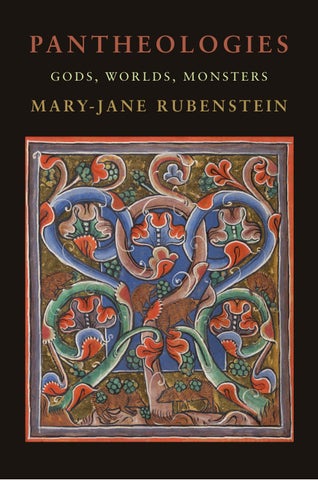
PA N T H E O L O G I E S GODS, WORLDS, MONSTERS
M A R Y- J A N E R U B E N S T E I N
PREFACE
The project at hand grew out of my earlier work on multiverse cosmologies, which concluded on a somewhat frustrated note regarding the so-called public conversation between science and religion. In fact, I came to realize, the ongoing debate over the existence of the multiverse provides a clear picture of the grim state of this conversation. Despite the decades of scholarship illuminating the historical identity, persistent entanglement, and productive crossings of the regimes we now call “science” and “religion,” the default assumption among scientists, theists, and their audiences remains that these categories are self-identical and starkly opposed. The “conversation,” then, amounts either to replacing a given thing called “religion” with another given thing called “science”; to rejecting the latter by appealing to a particularly uninteresting form of the former; to supplementing one of them with a strong dose of the other; or, God help us, to “reconciling” them—a task that almost always amounts to orthodox theology’s contorting itself around any given scientific discovery so as to hold open an increasingly small space for itself without appearing too backward. As it turns out, we can see all of these strategies at work in the positing, defense, and critique of the multiverse—that hypothetical compendium of an infinite number of universes apart from our own.
preface
xviii
The question to which the multiverse provides an answer is why the universe seems so finely tuned. Why, physicists ask, do gravity, the cosmological constant, the nuclear forces, and the mass of the electron all happen to have the values they have—especially when it seems that any other values would have prevented the emergence of stars, planets, organic life, and in some cases, the universe itself? What these physicists fear—and with good reason, considering this particular theological strategy’s stubborn refusal to die—is the perennial classical theistic answer to this question. The scientist asks: why is the universe so perfect? And the theist predictably responds: because an intelligent, benevolent, anthropomorphic Creator outside the universe set the controls just right, launching the universe on a course “he” knew would produce beings to resemble and worship him. Strictly speaking, such theological concerns cannot be said to have generated the idea of the multiverse in the first place. Nevertheless, the reason an increasing number of theoretical physicists find it so compelling is that the multiverse provides a metaphysical solution that finally rivals the undead Creator. After all, if there is just one universe, then it is very difficult to explain how the cosmos manages to be so bio-friendly without appealing to some kind of force beyond it. If, however, there are an infinite number of universes, all taking on different parameters throughout infinite time, then once in a while, one of them is bound to turn out right, and we just happen to be in one of those. In short, the infinite multiverse is the only answer big enough to stand up to the infinite God of classical theism, with his omni-attributes and his ex nihilic creative powers. Once again, then, the “conversation” between religion and science amounts to an either/or, metonymically encapsulated in the figures of God and the multiverse, respectively. And once again, popular science books and their recapitulations in social, journalistic, and televised media subject the public to a familiar cadre of (remarkably all male) scientists proclaiming the final death of the old father-God. Just to keep things fair and balanced, such media will also trudge out a familiar counter-cadre of (remarkably all-male) religious leaders and theologians decrying the willful ignorance of secular scientists, whom they accuse of being so desperate to avoid God that they will take refuge in the outright absurdity of an infinite number of worlds. This whole fruitless exchange has led me to believe that the least interesting question one can ask with respect to any given phenomenon (evolution, the big bang, the creation of beetles or mountains, last year’s World Series victory) is whether or not God did it. The reason it is so uninteresting to ask this question is that one can always say God did X, whatever X might be. And if one’s
preface
xix
opponent makes the counterclaim that, not God, but Y accomplished X, one can always make the counter-counterclaim that God made the Y that went on to do X. These are moves that theists and atheists can always make in antagonistic relation to one another. For the theist, there is always a way to insert a “God of the Gaps” back behind any given physical process, if that is what he is hoping to do. Conversely, the atheist can always find a way to call that God a needless or intellectually dishonest addition to an otherwise elegant, scientific hypothesis. This “debate,” I would submit, has always been a dead-end game. It has never gone anywhere and will never go anywhere, in saecula seculorum. After all, if it were possible to prove or disprove the existence of a humanoid, extra-cosmic creator, someone would have done it by now. Apart from being tiresome and unproductive, this deadly back and forth over the existence or nonexistence of an extra-cosmic humanoid misses all the constructive theological work the natural sciences themselves are producing. Those theists and atheists who fret endlessly over their perennial superman tend to miss the new and recycled mythologies pouring out of the scientific sphere. To remain with the example of modern cosmology, they miss the way that some physicists tend to encode dark energy as a malicious demiurge at war with the forces of gravity and light. Or the way that others place mathematics in the position of Plato’s Forms, rendering the physical world an imperfect copy of an eternal, unchanging, immaterial realm. Or the way that simulation theorists are trying to ingratiate themselves to the highly advanced scientists whom they believe created humanity out of the more sophisticated equivalent of PlayStations. “How did our simulators make us,” they ask, “and why? And how do we get them to love us enough to keep us alive?” These ruminations amount to speculative and practical theological inquiries in their own right, such that attending to them changes the terms of the science-and-religion game. Rather than asking what sort of God a given scientific discovery still allows room for a theist to believe in, religious studies scholars can turn the critical tables around to ask what sort of gods and monsters such scientific theories are producing, and what sorts of ethical values and social formations they reflect and reinforce. And overwhelmingly, the natural and social sciences are currently producing a slew of what I have provisionally called pantheologies. Despite their steadily secular self-identification, these sciences are generating rigorous, awestruck, and even reverential accounts of creation, sustenance, and transformation—processes that are wholly immanent to the universe itself. The plan for this book, then, was to account for the flurry of purportedly secular cosmogonies pouring out of astrophysics, nonlinear biology, chaos and
preface
xx
complexity theories, new materialisms, new animisms, post-humanisms, and nonhumanisms as overlapping, nonidentical assemblages of that old philotheological category of “pantheism.” To accomplish this, I thought, I would need first to determine what pantheism is. I would then trace a quick, historical topography of the concept in order to locate the more modern theories of immanence within its multifarious terrain. The moment I set out to do so, however, I discovered that there is no real conceptual history of pantheism. What there is instead is a tangle of relentless demonization and name-calling. In short, “pantheism” is primarily a polemical term, used most often to dismiss or even ridicule a position one determines to be distasteful. It is almost never a term of positive identification; rather, it marks a cliff off which a derisive speaker can claim that the position in question threatens to throw thinking— and all existence itself—if it is entertained too seriously. “We cannot possibly affirm X,” the rhetoric goes, “because X would lead to pantheism” . . . and such a consequence is thought to suffice as an adequate repudiation of the proposal under consideration. Having hit this particular wall, the project at hand needed to take a few steps back. Rather than beginning with a genealogy that might be extended to the modern natural sciences, the book begins by examining the perennial disgust with pantheism and asking why it continues to be so repugnant. To be sure, there are plenty of reasons one might decide not to affirm pantheism as one’s favorite theoretical framework, or as one’s go-to devotional stance. But why, this study asks, does it so rarely get the opportunity to be a stance in the first place? Whence the vitriolic, visceral, automatic, and nearly universal denunciation of pantheism? As the reader will see momentarily, I have addressed this question by locating in anti-pantheist literature some recurring themes—most notably, those of monstrosity, undifferentiation, (specifically maternal) femininity, dark primitivity, and dreamlike Orientalism. The problem, it seems, is that pantheism not only unsettles, and not only entangles, but demolishes the raced and gendered ontic distinctions that Western metaphysics (with some crucial exceptions) insists on drawing between activity and passivity, spirit and matter, and animacy and inanimacy—distinctions that are rooted theologically in the GrecoRoman-Abrahamic distinction between creator and created, or God and world. Insofar as pantheism rejects this fundamental distinction, it threatens all the other privileges that map onto it: male versus female, light versus darkness, good versus evil, and humans over every other organism. At this point, the broader project shifts from the diagnostic to the prescriptive. If the panic over pantheism has to do with a fear of crossed boundaries,
preface
xxi
queer mixtures, and miscellaneous miscegenations, and if these monstrosities are said to threaten the carefully erected structures of Western metaphysics, then—at least for those of us who seek a creative destruction of such structures— the question becomes how pantheism, in its most transformative sense, might actually take shape. The whole book, then, has become a prelude to what I had thought would be its opening question, which is to say, what is pantheism?
p r a i s e f o r Pantheologies “Pantheologies is an elegant and lively tour of pantheism and of the racialized gender panics it has prompted in Euro-American thought. I leave the book with the sense that the goat-god Pan is still roaming around, disrupting the either/ors of Western metaphysics and presenting a cosmos both more amazing and more discomfiting. MaryJane Rubenstein has written an excellent book.” —Jane Bennett, author of Vibrant Matter: A Political Ecology of Things “In Pantheologies, Rubenstein answers the old problem of the One and the Many by offering a resolute triumph of the Many over the One. Give Rubenstein a One—any one—and she will make a Many out of it. I applaud this temperament, as William James called it, and the intuition that it generates and reflects. Multiplicity, thy name is woman. Rubenstein will save us every time from the totalitarian tendencies of certain regions of process philosophy, from the Teutonic idealisms of post-Hegelian theologies, even from the totalizing forms of monistic pantheisms.” —Nancy Frankenberry, editor of The Faith of Scientists: In Their Own Words “It is not out of charity or historicism that Rubenstein channels this maligned, misunderstood, and mangled legacy. No, there is something in the pan of theism that our Anthropocene mess of a species (its atheists and its theologians included) needs. Now. Mesmerized by the brilliant weave of Pantheologies’ irresistible irony, gorgeous prose, and holographic erudition, readers will be hooked by a mystery too suspenseful in its plotline and too urgent in its intersections to set aside.” —Catherine Keller, author of Political Theology of the Earth: Our Planetary Emergency and the Struggle for a New Public
COLUMBIA UNIVERSITY PRESS NEW YORK cup.columbia.edu PRINTED IN THE U.S.A.