Religious and Social Foundations
SIX
Muslim Environmentalism as Religious Practice Accounts of the Unseen
WHEN ENVIRONMENTALISM IS integral to religious piety, it draws on tradition differently than when religion is enrolled secondarily for environmental projects. This is no more or less religiously or environmentally authentic than is instrumental programming, and, as examples throughout this book have shown, such modes do readily overlap. However, when Muslim commitments of environmentalism are primarily for the sake of religious goals and not the reverse, teachings that are not part of a standard interfaith menu, such as apocalypticism or the exemplary model of the Prophet Muhammad, emerge as central. They may express unseen dimensions (such as the afterlife itself), for which Anglophone environmental humanities may not have a cognate vocabulary. Finally, these practices constitute communities as movements that can otherwise remain socially illegible to standard social analysis of globally mainstream environmentalism. Part of the problem of erasure relates to the understanding of Sufism. Pious patterns, named or unnamed, are at the core of Muslim environmentalisms I studied in fieldwork. This very characteristic, however, renders them relatively unseen in academic analysis due to persistent orientalist structures in approaching Islam. In order to conceptualize and describe these qualities and their manifestations in the past and the present, the term Sufism is used here as in the perspective of the academic study of religion. In Islamic studies, Sufism refers not just to the esoteric philosophy and [ 199 ]
Muslim Environmentalism as Religious Practice elite “path” to apprehending divine unity that carries the formal Arabic designation tasawwuf but also to the more general, and far more widespread, notions of doctrine, devotional practice, and social and political structure shared by the communities that form around such authority, hidden and manifest. Over the past decade or two, in Islamic studies and religious studies, many structures have come to be analyzed through the academic framework of Sufism besides theosophy. For example, this engages local and transregional saints and social histories of named lineages or Sufi orders. It also includes traditions, such as veneration of the Prophet Muhammad, that are not explicitly labeled Sufi in context but that are nevertheless integral to such systems. The Euro-American genealogy of the study of Sufism, until not so very long ago, was marked by orientalist tendencies that formerly would have set apart Sufism, as a perennial or transcendental philosophy, from Islam, the religious lifeways of Muslims. This is despite the fact that Sufism, as referred to academically today, and its structures were a dominant strain of Sunni Islam for a millennium, certainly up to the reformist movements of the colonial era. As understood academically, the separation of Sufism from what Sunni Muslims do in everyday religious practice is now discredited in foundational academic presentations of the past decade or more, which emphasize continuities of Sufism with normative traditions such as Qur’anic study and practice.1 A leading Muslim environmental activist, prominent scholar of both European and Islamic humanities, and expert in medieval Muslim sources on philosophy, Seyyed Hossein Nasr, broke ground half a century ago with a foundational theory for environmental humanities. For this, as in his prolific scholarship overall, he drew on an esoteric and elite intellectual tradition that was already quite legible within Eurocentric frameworks. Nasr’s model of perennial truths aligned with academic humanities in its self- conscious identification with European and American romantic imagination. Its orientalist mode of understanding of Sufism also has the tendency to detach a universalized aspect of Islam, spirituality, from a Muslim- specific identity. Nasr’s approach does not easily accommodate Muslim ritual practices or readings of the Qur’an. This does not make Nasr’s writings on environmentalism (or Islam) any less valid, and certainly in no way diminishes their significance—acknowledged or not—to English-language environmental [ 200 ]
Muslim Environmentalism as Religious Practice philosophy and ethics of the past fifty years. Throughout this chapter, starting first with Nasr and moving to other field-based examples that also connect with Sufism, layerings of Muslim environmentalism draw on esotericism in philosophy as well as devotional piety for powerful teaching and potential mobilization. Nevertheless, these also remain overlooked and “unseen,” at times even to one another, across modern academic perspectives on Muslim religious tradition and still within the Eurocentric legacy of environmental humanities as a whole. Shaped by fieldwork data that draw on a decade of work on Muslim environmentalism in Southeast Asia, examples in this chapter present devotional expression in the form of globally widespread Islamic rituals like salawat nabi and dhikr. This was what I saw observed, expressed, performed, and theorized repeatedly by religiously Muslim environmental activists. It constituted religious Muslim communities of environmental commitment in modes like those I documented in previous work on mainstream networks of Qur’anic education and practice. Those familiar with the study of Islam and Sufism in the past as well as the postcolonial period will recognize that such practices do not necessarily conform to named tariqahs (Sufi orders, tariqat or turuq). They also represent trends of normative piety that are ever more popular in Muslim Indonesia in the twenty-first century. In postcolonial societies like Indonesia, pesantren-based authority and popular media are modes of transmission of these structures (for example, through networks of Nadlatul Ulama). The cosmologically framed treatments that are typical of Islam and the environment, as in Seyyed Hossein Nasr’s formulation, also do not incorporate these common practices, ubiquitous though they may be and as much as they connect philosophical— and environmental—interpretation to activism and communities of piety. Whether discussing the writings of Nasr or field-based cases in Indonesian Islam, differing environmentalisms have aligned with regimes of authority—for example, Euro-American nature philosophy in one case and Muslim ritual traditions in another—to reproduce particularized and even privileged notions of environment. Regimes of power over what is “the environment,” including that which could erase struggles for environmental equity and justice, control what its terms are globally. This may render voiceless a subaltern who of the environment in colonizers’ terms, possibly compounded all the more by historical realities such as European subjugation across insular Southeast Asia, to extend an idea originally [ 201 ]
Muslim Environmentalism as Religious Practice suggested by Timothy Mitchell’s study of colonial Egypt.2 This environmental agent, possessing neither mimetic nor political agency, may be viewed as the relational who of the biosphere itself, or it may be colonized or otherwise marginalized persons (to follow more closely Gayatri Spivak’s use of the subaltern, a concept limited to human beings as persons) as they are affected by colonial and environmental conditions such as exploitation and erasure. Underlying postcolonial critique, Islamic religious systems express these environmental whos, such as according to the Qur’an itself in its calls to justice. Even the nonsentient phenomenal world, seen and unseen, is a “creature” (makhluq) whose experience is structured in relation to controlling and uncontrollable powers in the Qur’an. In the text, apocalyptic scenarios confer on the marginalized, and even the nonhuman, a voice, as landscapes themselves transform according to moral truths. Activism directed toward or directed by this piety keeps proximate the awareness of environmental consequence. A healthy biosphere is a precondition to a human existence that is dependent on divine command in Muslim environmentalisms, whether they are inflected as legal or spiritual; and, as in the Qur’an, the nonspeaking subject, the environment, serves as a continual reminder of the responsibilities and limits of human capacity in relation to God the Creator. This fundamental rendering of Muslim environmental commitments does not rest on a principle of nature or any experience of the sacred, nor even environmentalism defined in relation to an idealized ethical pragmatism like sustainability or conservation. It is, in the worlds of interlocutors I heard over years of fieldwork, merely the practice of Islam following the best model of the Prophet Muhammad (sunnat Nabi Muhammad), striving with divine “sunnat Allah.” In accord with the Qur’an, from religious cosmogony to eschatology, and filtering through everyday moral conduct, the environment may be cast as “Muslim” in terms of a natural and original state (Ar. fitrah) and includes humans within it as among creation’s active participants. To study this from a secular perspective as in the history of religions or environmental humanities hones an analytic approach of the unseen and illustrates ways to extend the environmentally symbolic across ethical dimensions. Now, in the book’s final chapter, documentation from fieldwork research renders real people and their stories into the picture, with community practices that embody environmentalist theory [ 202 ]
Muslim Environmentalism as Religious Practice and activism in the service of religious goals, rather than the reverse. A final reflection back on environmental humanities is then to ask, what structures of power would prevent these voices from otherwise being seen and heard?
Islam and the Environment: Sufism Many authors who write on Islam and the environment do concentrate on the Sufi tradition, but through an exclusively textual mode and without considering any social or ethnographic dimensions, as is characteristic of a certain European academic style with respect to Islam.3 Seyyed Hossein Nasr’s writings are emblematic of two signature aspects of such an approach: first, he emphasizes Sufi doctrine that is cosmological,4 his area of scholarly expertise, employing a language of Islamic science, spirituality, and “nature”; second, Nasr draws on a tradition of experiential and symbolic contemplation of creation as Sufi expression (such as Persian- language verse like that of Rumi), much like the romantics. These tendencies in representing Muslim environmentalisms reflect aspects of both the tradition of European study of Sufism and American nature thinking, especially in the New England tradition. Emphasis in other work that intentionally follows or complements Seyyed Hossein Nasr’s approach to “nature” and “spirituality” also fit in well with the heritage of Anglophone nature writing in environmental humanities.5 Some other prominent authors in Islamic studies besides Nasr, such as William Chittick, have tried to adapt the difficult doctrine of Ibn Al-`Arabi (d. ca. 1240) to take the form of a kind of nature theory of wujudiyyah, and similarly casting Islamic cosmological doctrine as the basis of an Islamic notion of environment and even environmentalism.6 These primary sources from Islamic humanities usually develop the kind of microcosmic-to-macrocosmic correspondences that typify the later Neoplatonic tradition, and, as has been detailed in the previous chapter, these have historically tended to come with a reputation for both monism and magic. As environmental humanities, however, this scholarship resonates with cosmological tendencies in European approaches to nature, which persist in the academic field of religion and ecology today. [ 203 ]
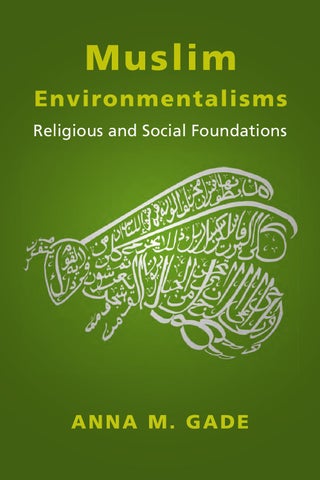
How might understandings of environmentalism and the environmental humanities shift by incorporating Islamic perspectives? Anna M. Gade explores the religious and cultural foundations of Islamic environmentalisms, blending textual and ethnographic study to offer a comprehensive and interdisciplinary account of the legal, ethical, social, and empirical principles underlying Muslim commitments to the earth. “Gade places her arguments within a rich exploration of historical and modern theoretical approaches to the environment and environmentalism. This book is theoretically sophisticated, lively, and interesting.” MARION KATZ, author of Women in the Mosque: A History of Legal Thought and Social Practice “Muslim Environmentalisms is an instant classic. It is inspired and inspiring, a work that deserves to be read and internalized in scholarly communities, activist movements, and policy circles. Muslim Environmentalisms is more than simply a work that sums up or even challenges existing fields. It shines a light on the terrain that must be followed to save our only home.” OMID SAFI, author of Progressive Muslims: On Justice, Gender, and Pluralism “Gade’s original book pushes environmental humanities to open up to concepts and insights from Islamic thought. Muslim Environmentalisms is a much-needed addition to environmental thinking.” ANNA TSING, author of Friction: An Ethnography of Global Connection “A must-read for anyone interested in religion and the environment, and the environmental humanities generally. Gade offers a nuanced and grounded portrait of Muslim environmentalisms that advances the project of the environmental humanities beyond romantic, colonial, and Eurocentric frames and inheritances while staking an original claim for ‘the environment’ as an inherently ethical category.” LISA SIDERIS, author of Consecrating Science: Wonder, Knowledge, and the Natural World ANNA M. GADE is a Vilas Distinguished Achievement Professor in the Gaylord Nelson Institute for Environmental Studies at the University of Wisconsin–Madison. She is the author of Perfection Makes Practice: Learning, Emotion, and the Recited Qur’an in Indonesia (2004) and The Qur’an: An Introduction (2010). About the cover image: This representation of a honey bee is original calligraphy by Thoufeek Zakriya, an artist from Kerala, India (http://thoufeekzak.blogspot.com/). It depicts two verses from the Qur’an’s sixteenth chapter, Al-Nahl (“The Bee”). Cover design: Chang Jae Lee
COLUMBIA UNIVERSITY PRESS
NEW YORK cup.columbia.edu
PRINTED IN THE U.S.A.