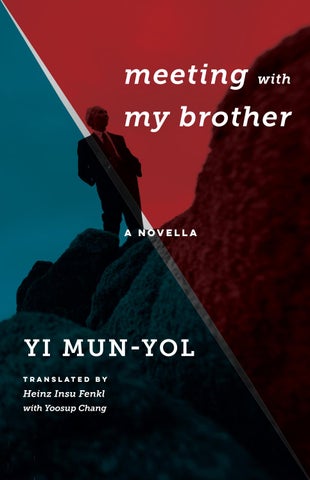
meeting with my brother
A NOVELLA
YI MUN-YOL T r a n s l at e d by
Heinz Insu Fenkl with Yoosup Chang
introduction
When I was a reader, a novel was like a haven where I could escape from reality. After I became a novelist, I began to think about what role my novels should serve . . . I thought about a writer’s sense of mission or redemption. —Yi Mun-yol
1 Yi Mun-yol was born in Seoul in 1948, two years before the outbreak of the Korean War. His father, Yi Weon-cheol, an intellectual who had been jailed for anticolonial activities against the Japanese, was a member of the Korean Worker’s Party. He abandoned his family and defected to the North during the war, leaving them forever branded as the family of a traitor. And yet, despite this terrible stigma of being the son of a communist—or perhaps, ironically, because of it— Yi Mun-yol was to become the most prominent and most socially significant literary figure of post-1980s Korea. There is vii
no other writer whose work addresses such a broad spectrum of psychological, cultural, political, and historical themes, and no other writer whose work offers a stylistic range that encompasses much of the history of modern Korean literature following the end of the Japanese colonial era. The Korean War displaced and fragmented more than ten million families because the unusually rapid pace of the military activity required multiple evacuations. Those who were known to have family members who were communist were often killed by the military, the police, or vengeful civilians. For the safety of the family, Yi’s mother kept herself and her five children constantly moving, often late at night when neighbors would not see them, and this continued every two or three years until the South Korean government made a fixed address mandatory. So, after the country’s ultimate division in 1953, Yi spent most of his childhood living with one relative then another, in various cities like Yeongcheon, Yeongyang, and Andong, finally settling in Miryang in 1959. There, he enrolled in middle school but dropped out after only six months. Later, he also dropped out of high school after attending only one year and then spent the next three years moving from one odd job to the next in the Busan area along the eastern coast. That he was able to pass the diploma test and enter the Seoul National University School of Education after his troubled childhood and disrupted education is a testament to his determination and hard work. By American standards, Yi’s is a kind of Horatio Alger story, an autodidact pulling himself up by his bootstraps after enduring the school of hard knocks. And yet in 1970 Yi would even drop out of prestigious Seoul National University (the epitome of success viii
introduction
and status by Korean standards) before he had completed his degree. In Korea, Yi’s life has a heroic and nearly mythic quality, as he was able to overcome terrible disadvantages and repeated setbacks to achieve literary fame. Yi married in 1973 and completed his mandatory military service in 1976. In interviews, he mentions that he had considered becoming a lawyer while he was at Seoul National, a career move that would have redeemed his family to some degree and helped with their finances. But he dreamed of being a writer and devoted much of his energy to being an active member of a literary club. In 1978 he won the Maeil News Spring Literary Contest, and the prize helped land him a job as a journalist. Then, in 1979, he won the Dong A Daily Spring Literary Contest with his story “Saehagok,” which brought him national attention. Later that year, he won the Today’s Writer Award, given by one of Korea’s major publishers, Minumsa, for his first novel, Son of Man, securing his position as a national literary star. Since then Yi has won just about every major literary award Korea has to offer: the Dongin Literary Prize for “Golden Phoenix” (also translated as “Garuda”) in 1982, the Korean Literature Prize for his magnum opus Hail to the Emperor in 1983, the Jungang Culture Grand Prize for Age of Heroes in 1984, and the much-coveted Yi Sang Literary prize for his novella Our Twisted Hero in 1987. He also won the Hyundae Award in 1992, the Twenty-First-Century Literature Prize in 1998, the Ho-Am Prize in 1999, the National Academy of Arts Award in 2009, and the Dongni Literature Prize in 2012. One quality that made Yi worthy of so many literary awards is his unflinching ability to confront thematic, formal, introduction
ix
and political challenges in his writing. Korean readers—both the general reading public and the literary intelligentsia known as the mundan —are partial to debate and controversy. Since modern Korean literature was born out of the Japanese colonial era and developed through the oppressive administrations of military dictators, the role of the writer has always been one fraught with a high degree of moral and ethical responsibility (it is only in relatively recent times that the kind of commercial publishing familiar in the West has become the dominant system). In this climate, in which a literary work can serve as a seed crystal for instigating social and political dialogue, Yi has consistently confronted difficult and charged themes. For example, his first novel, Son of Man, could pass for a mystery, since it is about a police detective investigating a murder, but it is also imbued with deep and—for Korea in the late 1970s—controversial ideas about the role of religion, particularly that of Protestant Christianity. Through the ruminations found in the journal of the murder victim and the slowly evolving consciousness of the detective who reads it, Yi presents an implicit but penetrating critique of blind or (perhaps more accurately) ignorant and uninformed faith. The murder mystery in Son of Man becomes ultimately secondary to what the reader learns about religion, and for a Korean public engaged with the volatile religious politics of the late 1970s, it was shocking and also disillusioning. Yi provides readers with an education on the evolution of Christianity, including a long discourse on Zoroastrianism, which made many of them reexamine the imported traditions of Christianity in a new light. For Western readers familiar with relix
introduction
gion in Korea, his reinterpretation of the figure of Ahasuerus the Wandering Jew, whose curse resonates so much with Yi’s own life, is especially fraught with political meaning. Likewise, Yi’s twist on the tradition of hagiography, Hail to the Emperor, presents a poignant allegory of Korean history, addressing its transition from the Joseon-era worldview to modernity through the epic tale of a deluded “emperor,” the leader of a nationalist cult hidden in the mountains. Hail to the Emperor produces the effect one might achieve by applying the narrative structure of The Great Gatsby to convey the theme of illuminated madness in King Lear. In the surface narrative, set in the present, a jaded journalist is sent into the remote mountains to write an investigative human interest piece, but in the process of interviewing an old man—the surviving keeper of rituals for the strange cult—he becomes a convert, and to his own surprise he ends up writing a traditional-style hagiographical “history.” Through this unusual structure, which appears to be a bracketed story missing its closing bracket, Yi provides a unique commentary on the dynamics of Korea’s social, cultural, political, and religious transformations in the modern era. Hail to the Emperor is often considered a difficult novel for contemporary readers. Its erudition is profound, and it exemplifies Yi’s command of Korea’s classical literature as it alludes to central texts in the Confucian, Taoist, and shamanic folk traditions, making reference to Chinese classics with the same ease as it portrays commonplace beliefs from indigenous folk religion. Because of his deep engagement with tradition, even while he problematizes it, Korean critics have tended to label Yi introduction
xi
as a conservative writer, and it is probably the influence of these critics that caused the current younger readership, with their progressive politics and demands for liberalization, to regard Yi as a conservative. Some academics are of the opinion that the new conservatism of the current Park administration (a legacy and reminder of Park Chung-hee’s military dictatorship, as it is headed by his daughter) may create a resurgence in Yi’s popularity because his work is constantly measuring the pulse of national sentiment. According to Lee Tao-dong, a prominent literary critic, “behind Korean literature’s transition from the oppressed 1980s to the exploration of new horizons in the 1990s is the invisible hand of Yi Mun-yol” (Yi, 77). But at a time when younger and more popular Korean writers are going out of their way to present themselves as “international” or “nationless” writers, Yi is probably the one Korean writer whose work is read most clearly from outside the constraints of Korean national and literary politics— precisely because his work represents Koreans in all of their political and psychological complexity. It is an irony befitting his novels that his own outsiderhood makes his work so resonant. Shin Dong-uk, another prominent critic, classifies the characters in Yi’s work as being socially and intellectually alienated men “driven by the desire for self-realization, which is inexorably linked to the ever-changing society” (Yi, 79). One sees the theme of outsiderhood play out to a significant degree in nearly all of Yi’s works. Four of his novels provide particular insight into that condition: Age of Heroes, with a great deal of background about Yi’s childhood, particularly the xii
introduction
multigenerational stigma of his father’s betrayal of the South; Periphery, which he wrote in response to criticism and which depicts the autobiographical main character as a maladjusted and deeply reflective outsider; Everyone Who Falls Has Wings, a confessional murder mystery that slowly becomes a psychological tour de force—an incisive depiction and indictment of the postcolonial Korean male psyche; and The Poet, one of his most important works, a historical novel that can be read as a kind of allegorical intellectual autobiography. In the tradition of much Korean literature, The Poet, though fiction, is deeply rooted in personal experience, blending the notion of fiction and nonfiction in a way similar to the old histories, which merge historical fact, folklore, and mythology. One of the qualities that makes The Poet so resonant is that the story of its main character, based on the nineteenthcentury historical figure Kim Byeong-yeon (better known as Kim Sakkat the “Rainhat” poet), seems to have its thematic parallels nearly tailored to Yi’s own life. In a 2014 interview, Yi said: I started writing this book in my mid-forties, reflecting on my life up to then. I was able to tell in one volume all the disparately expressed aspects of my life in different novels. My family was subject to much suffering for the longest time as a result of my father’s defection to North Korea. And because of a guilt-by-association system, we were restricted from being part of mainstream society. Consequently, the resulting fright led me to remain mute or compliant to the political circumstances of the early 1980s—that has been a big burden on me. At the same introduction
xiii
time, as I got older and acquired a political consciousness, I began to ask myself what was the best position for me to take about that time period. The Poet was a book in which I tried to resolve all these issues. (Hye, n.p.)
In his literary work, and in his private life, Yi not only responds to themes directly relevant to himself; he is also profoundly aware of the contemporary predicament of Korea— currently ranked the sixth most “wired” nation on the planet according to Bloomberg—in the age of the Internet and media manipulation. It is not only the younger generation of Koreans that is ruled by consumerism, narcissism, and hunger for fame and fortune. Yi’s work seems to be designed precisely to be disillusioning, and perhaps even traumatic, to such a readership because it dares to go against the grain of both popular and normative thinking. His novels cannot be engaged superficially for the sake of entertainment or distraction, nor do they take on the Murakami-esque tone of melancholic alienation regarded as a symptom of contemporary society and so popular with younger writers. In the current literary landscape of Korea, Yi may be seen as a throwback to older times, but actually he is a breath of fresh air—or perhaps more like a blast of cold air. The critic Lee Nam-ho succinctly characterized Yi’s writings as “an exceptionally useful guide for young intellectuals trying to attain a deeper understanding of the world than what they were taught in school, and to proactively encounter reality and the incongruities of the world” (Yi, 83). It is no surprise, then, that Yi is one of South Korea’s repeat nominees for the Nobel Prize in Literature. xiv
introduction
2 I met Yi Mun-yol for the first time in 2001, long before I began translating his work. I was on a panel to discuss the screening of the 1992 movie based on Our Twisted Hero (1987; English translation, 2001) at the New School’s Tishman Auditorium in New York City. The film played to a packed audience, and it was in comparing the film adaptation to the text that I first began to appreciate Yi’s unusual use of language, particularly his method of layering thematic and psychological qualities under what appeared, on the surface, to be a rather straightforward and expository style. While the film’s director, Park Chong-won, had used overt symbolism, such as the image of an American silver dollar in flames to represent both the destruction of liberty and the power of the paper dollar in Korea, Yi had already charged the text with a range of allegorical resonances with simple touches like the use of character names that had multiple homophonic readings. Until that time, I had believed the general sentiment that Yi’s writing tended to be expository, abstract, and political. My second meeting with Yi Mun-yol happened while he was a fellow at Harvard University’s Korea Institute in 2007. He was lecturing on Korean Literature along with David McCann, who was discussing sijo poetry. I was introduced to Yi by Lee Young-Jun, managing editor of Azalea: Journal of Korean Literature & Culture, published by Harvard’s Korea Institute. Lee, who had been one of Korea’s most important literary editors before coming to the United States for his PhD, told me that Yi was supposed to be studying English as part of his residency at Harvard but that, in his characteristic introduction
xv
way, he tended to spend more time on impromptu teaching and lecturing. I don’t know if Yi’s command of the English language improved all that much during that year, but his residency at Harvard had a significant impact on the study of Korean literature in the United States. Because of my own status as a writer and literary scholar, and because I had copyedited some of his other works that had been translated into English, Yi asked me for suggestions on how his work should best be translated. He regretted that his own English was not good enough for him to assess the literary quality of his novels in English, and he invited me to try my hand at translating some of his stories to re-create the layered effects he worked so hard to produce in Korean. His ideal model, he said, was the way Edward Seidensticker had worked with Kawabata Yasunari on Snow Country, and he generously offered to make himself available at any time to answer questions or even to make revisions for the sake of accessibility in English. Later that year, as I was editing the special North Korea section of the next issue of Azalea, which attracted a great deal of attention because Kim Jong-il was prominently in the news at the time, I asked Lee Young-Jun if Yi had written anything on North Korea. That is how I was first introduced to Meeting with My Brother. I began translating Meeting with My Brother with Yoosup Chang, a former student of mine who provided valuable insight into contemporary colloquialisms and narrative tone, but while we were still in the middle of the novella, Lee Young-Jun approached me with the idea of translating one of Yi’s controversial short stories. He recommended a story
xvi
introduction
in which Yi exposes the hypocrisy of the Confucian preoccupation with patrilineage under the guise of a female schoolteacher’s confessional memoir. This was “An Anonymous Island,” which eventually appeared in the special 9/11 commemorative issue of the New Yorker in 2011—the magazine’s first piece of fiction by a Korean writer. After my own close reading of the Korean edition and reviewing responses to Suh Ji-moon’s earlier translation, which she had called An Appointment with My Brother (2002), I pointed out to Yi that many of the matter-of-fact allusions to Korean history and culture would be opaque to American readers. In response, he added a few small glosses, and where there was a significant need for a concrete dramatic evocation of the Korean War narrative, he provided an additional scene that is absent in the original Korean edition and Suh’s translation. It is the narrator’s memory of his father’s departure, a scene that many Korean readers might have been able to infer from their knowledge of Yi’s past—an essential element of the story to be made vivid to the English readership. Yi is meticulous about his use of Korean (down to the etymological roots of words), and he was interested in the idea of translation as a re-creation of associations in the target language. He was happy to see that I understood his use of character names in his novels as a kind of physiognomy; he glossed his own given name, Mun-yol—文烈 —for me as “Literary Fire” and jokingly suggested I keep that in mind as a standard for the new translation. Yi understood the limitations of a lexically based translation and was open to the restructuring of sentences as often being a necessity to
introduction
xvii
preserve the original sequence of images and associations. For me, this made the task of translating Meeting with My Brother less constrained but at the same time more challenging. Meeting with My Brother is an unusual novella—at first glance it appears to be a rather journalistic version of the well-understood post–Korean War metaphor of separated brothers as divided nation, but it does not participate comfortably in this literary trope. Philip Gourevitch, writing in the New Yorker in 2003, noted, “There is no moral to Yi’s story, only the awareness that this is what Korea has come to: half brothers, living in their respective half countries, who have inherited a situation that neither one wants and that weakens them both, and binds them by keeping them apart.” In a world that seems to be terrified by the constantly escalating threats posed by the North Korean regime and yet is also curiously riveted by the most current antics of the hermit nation’s idiosyncratic lineage of Kims, Yi Mun-yol’s Meeting with My Brother offers a sobering, disillusioning, and yet poignant and hopeful perspective on the volatile relationship between the divided Koreas. The novella, like many of Yi’s works, is highly autobiographical. Yi told me that although his mother clung to the unrealistic hope that the family might someday be reunited, he himself had decided that his father was mostly likely dead once he heard that the elder Yi had been purged sometime in the mid-1950s. It wasn’t until the mid-1980s that Yi’s family received a letter from his father and learned that he had survived for thirty years in various prison camps and now had a new wife and five other children. It went without saying that his father would never return to the South, nor—given the xviii
introduction
laws of the time—was it possible to correspond with him. Meeting with My Brother is the product of Yi’s decades of imagining his father’s circumstances combined with the story of a fictional narrator’s trip to Yanji, a Chinese city just north of the northern tip of North Korea, where it was possible to arrange for a meeting with someone smuggled across the border. The plot of Meeting with My Brother is straightforward, and most of it parallels his own life. The fictionalized Yi, the main character and narrator, is a middle-aged South Korean university professor whose father had abandoned his family at the outbreak of the Korean War and defected to the North. Yi has lived with this stigma all his life, and when he learns that his father is still alive after more than forty years of no contact, he engages in a long and risky process of setting up a meeting in China. Unfortunately, his intermediary takes so long with the arrangements that his father passes away in the interim, and the novella opens with Professor Yi agreeing to meet with his younger half-brother instead. As one might predict from such a situation, the meeting is initially charged with bitterness and recrimination, and since we come to the meeting ourselves with a Western bias, we tend to be on the side of Professor Yi. But what we learn from Yi’s half-brother is a surprise. What Yi and the reader might want to dismiss, at first, as the product of North Korean brainwashing, is shocking for its matter-of-factness. It is not the story we would expect to hear from a man whose family did well for themselves in the most repressive regime on earth. Yi maintains a veneer of anonymity to protect the identities of the central characters in Meeting with My Brother, since introduction
xix
the novella includes politically charged conversations with the likes of “Mr. Reunification,” “the businessman,” and a madam who once tried to find work in the South. Although it was first published in Korea in 1994, nearly everything in it still has immediate relevance twenty-five years later. There is nothing else like it currently available in English—even in Korean there are no literary works that approach this theme with Yi’s combination of a dispassionate political and economic perspective along with a poignant personal and cultural insight. Meeting with My Brother reads like it could be a piece of undercover investigative journalism, but it is also, importantly, an allegorical autobiography. An antidote, a counterpoint, and an expansion of everything we have come to associate with North Korea from Western media coverage, Meeting with My Brother is bound to be both controversial and illuminating for readers with an interest in the divided Koreas.
R ef er ences Gourevitch, Philip. “Alone in the Dark.” The New Yorker, August 8, 2003. Hye Yisoo. “Tumultuous Era, Songs of Violent Passions: The World of Yi Mun-yol in His Own Words” (LTI Korea interview #1 with Yi Mun-yol). _list Books from Korea 26 (winter 2014). Yi Mun-yol. Pilon’s Pig. Trans. Jamie Chang. Seoul: Asia Publishers, 2013.
xx
introduction
“Yi Mun-yol is one of South Korea’s most gifted writers, and this translation gives his simple style all of the elegant force it can bring to bear. This story of two brothers who find each other only after their defector father has died balances the weight of the country’s history on their meeting as effortlessly as only a master could achieve. Compelling and essential reading.” Alexander Chee, author of
the novels The Queen of the Night and Edinburgh
“Meeting with My Brother is renowned writer Yi Mun-yol’s fictional account of the different politics and desires coalescing along the Chinese side of the North Korean border, where people are both dreading and ardently wishing for national reunification between the two Koreas. The reunion of two brothers in Yi’s story is deeply moving. Yi refuses to romanticize blood ties or to take recourse to melodrama. Instead, nuance and sensitivity color this story, which should be read by all those interested in a possible reunification.” Janet Poole, translator of Eastern Sentiments by T’aejun Yi “I’ve always wondered why more Korean literature in translation isn’t available in the United States. Heinz Insu Fenkl’s stylish translation of beloved Korean author Yi Mun-yol’s complexly layered novella might change that. Meeting with My Brother trenchantly explores the ruptures of Korea’s partition and hopes of reunification.” Marie Myung-Ok Lee, author of the novel Somebody’s Daughter “A haunting, powerful story about a divided family and country by one of South Korea’s most important writers.” Krys Lee, author of the novel How I Became a North Korean W E AT H E R H E A D B O O K S O N A S I A PRINTED IN THE U.S.A.
COLUMBIA UNIVERSITY PRESS cup.columbia.edu
NEW YORK