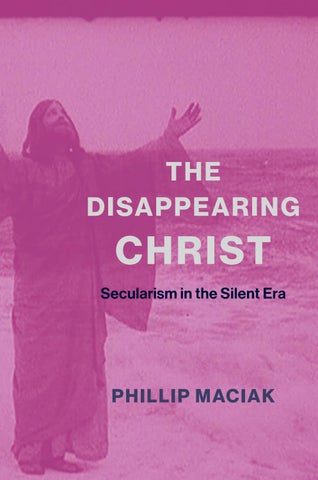
THE DISAPPEARING
CHRIST Secularism in the Silent Era
PHILLIP MACIAK
Copyrighted Material
Introduction The Disappearing Christ and Other Stories
OVERTURE: ANNO DOMINI 1959
It seems safe to say that most people, if they think of it at all, don’t think of BenHur: A Tale of the Christ as primarily a story about Jesus Christ. Brave twentyfirst-century readers of Lew Wallace’s best-selling 1880 novel who take in hundreds of pages of earnest amateur scholarship about first-century Palestine could be forgiven for not imagining that the tale of the Christ that weaves throughout the narrative is the most important part of the text. Indeed, a vast majority of the novel’s pages are devoted to the chariot races, Roman orgies, and sea battles that made Ben-Hur such a popular yarn in the late nineteenth century and would make it such an eminently adaptable tale. But whether or not we perceive him to be the novel’s main focus, Christ is hard to miss within the text. For after having shadowed Christ’s life at each step—like Waverley to Bonnie Prince Charlie, or, alternatively, like Brian to Christ in Monty Python’s treatment of the material— our protagonist Judah Ben-Hur witnesses some of the miracles as well as the crucifixion and finally becomes a founding figure in the early Christian church. So, although the bulk of the text deals with Ben-Hur’s exploits, Christ anchors the narrative and lends it significance. Seemingly embarked upon an endless, chaotic series of mishaps for much of the story, Ben-Hur is always compelled back to Christ, regardless of whether or not he knows why. The story of Judah Ben-Hur, in other words, is the content of Ben-Hur: A Tale of the Christ, but the gospel narrative is its underlying form. Jesus is the sun around which Ben-Hur orbits. Wallace’s narrative voice frequently breaks from Ben-Hur’s story to offer a kind of historical bookmark as to where on the Christ timeline our protagonist finds himself, and he even goes so far as to say
Copyrighted Material
2
l I n t rodu ct i o n
that every word of the novel is written in “anticipation” of the crucifixion. When Christ does appear, Wallace offers dense passages of description about the figure’s appearance, and those characters lucky enough to behold him throughout the narrative are inevitably awestruck. Indeed, anybody confused or uncertain as to whether Ben-Hur is a story of the misadventures of a falsely accused Jewish nobleman named Ben-Hur or of the miraculous foundation of Christianity need only look to the novel’s subtitle. Revenge, the quest for glory, and the revolution of the oppressed are all motives that appear in Ben-Hur at different points, but the gospel narrative is its telos. Christ is a minimal, but by no means marginal, element in this tale. Yet the afterlife of Ben-Hur in pictures—an illustrated novel, a nineteenthcentury theatrical production, a series of epic motion pictures, and all manner of ephemera from board games to comic books—is the tale of a disappearing Christ. Despite the fact that the plots of these adaptations are structured in ways that directly echo the construction of the novel, Jesus Christ barely, if ever, appears in them. The best-selling 1890 “Garfield Edition” of the novel, for instance, features hundreds of illustrations over two volumes—but not one of Christ’s otherwise copiously described face. While this reticence about the image of Jesus is out of sync with the novel’s text, it is in part a legacy of the novel’s author. Wallace, a bold novelist but only a tentative sort of Christian, wary of the tenuous line he was already treading by writing a novel that described the face of Christ in such detail, refused to allow any actor to portray the character in late-nineteenth-century theatrical productions. Christ’s lines were declaimed offstage, and his presence was denoted by a bright white spotlight in an empty area of the stage. This prohibition had calcified into a convention by the time of Sidney Olcott’s 1907 film in which Christ’s narrative does not figure at all. (The film is entirely focused on the climactic chariot race which, to be perfectly honest, doesn’t even really need Ben-Hur in order to work.) The narrative is restored in Fred Niblo’s 1925 silent epic, but Christ is portrayed exclusively by a gloriously lit hand reaching from offscreen (figure i.1). The figure is represented, in a similarly incomplete yet reverent fashion, by the rear end of an unfortunate actor in William Wyler’s 1959 film.1 Indeed, this disappearance of Christ has become such a part of Ben-Hur’s legacy that a 2016 adaptation, directed by the Russian action auteur Timur Bekmambetov and produced by evangelical moguls Mark Burnett and Roma Downey, was trumpeted as making “the tale more Biblical than ever before” by including the Christ story.2 Such is the cultural reception of Ben-Hur that 127 years after the publication of the original novel, it’s possible for MGM to advertise that they’ve turned a story about the life and death of Jesus Christ into
Copyrighted Material
I n t rodu ct i o n m 3
F i gu r e 1. 1 Ben-Hur: A Tale of the Christ (Fred Niblo, 1925)
a story about the Bible. Wallace’s vexing regulation notwithstanding, it remains surprisingly easy, from the perspective of the ordinary reader and spectator, to excise Christ from Ben-Hur: A Tale of the Christ. This book is a pre-history of that disappearance. Or, perhaps, it is a story of how that disappearance—and its wobbling between reverence and erasure, invisibility and hypervisibility—is itself an illusion. The disappearance of Christ from the story of Ben-Hur is strange, but it is not surprising. Indeed, the narrative of secularization that has undergirded the field of American cultural study until nearly the turn of the twenty-first century is based in the same kind of perceptual vanishing. A reader or spectator encountering each of these visualizations in turn—from the excessively described Jesus of the postbellum novel to the carefully concealed carpenter of the Cold War—might perceive a narrative of loss, a figure whose fortunes are in decline. Ben-Hur’s disappearing Christ, in other words, would be a stark illustration of Christianity’s exile from the public sphere, a disenchantment mirrored in the literal marginalization of the Son of God even within the frames of his own “tale.” Another spectator,
Copyrighted Material
4
l I n t rodu ct i o n
however, might perceive the way these images use Christ’s absence to all the more strongly reinscribe his importance: the way that his presence still gives structure, purpose, even a politics to these pictures. This obscured figure, in other words, does not represent the loss of religion; it represents the reconfiguration of religion around divine absence. Jesus can vanish from our sight, but he is always in the frame—and paying attention to that frame can give us a sense of the rhythms and structures of secularism. There is in fact no such thing as the disappearing Christ. This book endeavors to register the progress of secularization by paying attention to films and works of visual culture about the Son of God. This may seem like a counterintuitive project, but by the late nineteenth century, the figure of Jesus had become a convergence point for prophets of religion and rationalism alike. The early nineteenth century had already seen European “higher criticism” establish Jesus as a historical figure, and everything from American evidential theology to the transnational Spiritualist movement made claims based on the sudden empirical knowability of Christ. To represent Jesus at all—whether in paintings, photographs, slide lectures, biographies, novels, or films—was to take a stand in an ongoing debate about the status of religious belief in modern life. Hence, the visualization of Jesus Christ, as a practice, forced filmmakers, writers, and artists to show their work by locating their representation on a spectrum between what was historically verifiable and what was simply an article of faith. The Disappearing Christ argues that these multimedia meta-commentaries, inasmuch as they literally concern the balancing of religion and culture within the text, themselves constitute found theories of secularism. In 2014, Peter Coviello and Jared Hickman stated plainly: “The secularization thesis is dead.”3 This thesis, a clear narrative of secular progress from “superstition to rationality, credulity to skepticism, eschatological fanaticism to liberal tolerance,” had buttressed nearly a century of work in the humanities and social sciences, subtly (or not so subtly) giving shape to the stories we tell about the evolution of theology, literary history, and the mythology of U.S. democracy. But Coviello and Hickman are right to pronounce it dead—this is avowedly the era of the “postsecular.” What that ultimately means, however, is an open question. Tracy Fessenden, in an essay aptly titled “The Problem of the Postsecular,” writes that, in its broadest terms, the postsecular denotes “an environment in which the categories of the religious and the secular no longer divide the world cleanly between them, and signals the need for new ones.”4 The titular “problem,” however, is that these “new” categories have not been forthcoming. In other words, the problem of the postsecular is that even scholars eagerly eschewing the secularization thesis are inevitably held captive
Copyrighted Material
I n t rodu ct i o n m 5
to its terms. Postsecular scholarship, then, runs the risk of either recapitulating the very narrative it rejects or moving so far away from thorny questions of theology, belief, and spiritual practice that both the religious and the secular are flattened, rendered indistinct. The promise of such scholarship is that it might find insight in that tension without allowing it to ever fully, or at least uncritically, resolve. This book, admittedly, does not offer a solution to this problem. Rather, The Disappearing Christ seeks to turn the gaze of the postsecular toward texts that have so far escaped its notice. In order to excavate the aforementioned found theories of secularism, this book focuses on a broad archive of popular texts— nearly forgotten bestsellers, popular magazines, widely viewed early films now preserved only in archives—alongside more canonical works and figures. What the demise of the secularization thesis has meant, in terms of methodology, is a move away from deference to established cultural metanarratives or strong theories of social change. It’s thus not surprising that scholars working in this postsecular moment have often turned to the popular, to texts that might be seen to fall outside and challenge the established narratives of literary and cultural history. Determining whether and how they do is the occupation of much of this work. Popular culture can provide a unique window into the actual lived experience of the secular age with all of its eccentricities and even contradictions. Not discounting the theorizations of brilliant minds whose writings often circulated in limited networks or works of philosophy and theology that were read primarily by those predisposed to share the same metaphysical assumptions, the new study of secularism requires a perspective that moves easily from low to high, popular to boutique audiences. By applying close visual and textual analysis to the ways in which popular works anticipate, cater to, or even condescend to popular audiences, we can begin to trace the actual contours of a world that was perhaps never “cleanly” divided between the religious and the secular in the first place. The Disappearing Christ’s primary intervention in this field is the introduction of early cinema to questions of the postsecular. Although the past several decades have seen a boom in scholarship on secularism in the nineteenthcentury United States, few of those works have broached the period between Reconstruction and the first World War, and even fewer have addressed the paradigm-shifting media event that occurs squarely in the middle of that period. Very simply, this book argues that early cinema—and the literary and visual cultures that anticipated and eventually surrounded it—is a reflection, an index, and even a mechanism of the process of secularization as it occurred in the United States at the turn of the twentieth century. Negotiating between the
Copyrighted Material
6
l I n t rodu ct i o n
trick and the actuality, the dueling impulses of belief and skepticism, early film affords us the unique opportunity to see the life of secularism in the West. This is both a historical and a formal task. Cinema, from its very beginnings, has been a medium to which even the most dispassionate critics and scholars have afforded a kind of “magic” power. To tell the story of the emergence of such a miraculous apparatus put so vigorously in service of a kind of scientific realism, as we see in film’s earliest years—at precisely the moment when historians tell us secularism is entering the era of its hegemony in U.S. culture—is to tell a story of secularism itself, or at least a microcosm of it. Film—its aesthetic, its reception, the debates over its true purpose—is a laboratory for identifying, with great specificity, the crossed lines, contradictory imperatives, and ambivalent feelings that characterize the secular. The medium’s messy emergence is a testament to just how indistinct the divide between sacred and secular was, is now, and, perhaps, ever shall be. Although the emergence of cinema is, indeed, the structuring event of this book, our narrative does not begin with the first film screening in 1895. The Disappearing Christ follows historicist accounts of early cinema by considering it a “screen practice” that evolved alongside and even in tension with other screen practices (slide lectures, panoramas, optical toys) as well as works of literature, photography, and visual art throughout the nineteenth century. The roots of “cinema,” as a discourse, began long before moving images were projected on a screen, and, while this book does not suggest a teleological narrative of the medium—discovery, rather than emergence—it does argue that theorizations of the visual in written works of literature and even theology contributed to the conditions from which film would eventually emerge. It is not controversial, for instance, to suggest that films in the silent era were formally indebted to the Victorian theater or that cinematic realism significantly echoes works of American literary naturalism. This book further argues that theological and popular debates about Christianity and visual representation in the late nineteenth century might have had their own influence on cinema’s evolving aesthetic. Although we may figuratively refer to literary prose as “visual,” of course, the written word cannot and should not be assumed to have any sensory aspect. Writing can be evocative and rich in imagery, but it can only ever contain what Elaine Scarry, for instance, calls “mimetic content,” or something like “instructions” to aid the reader’s imaginative visualization of objects or people or places.5 Even so, such instructions have always had an ambivalent relationship to the visual. Furthermore, cinema emerged in dynamic tension with works of literature and theology that were virtually obsessed with the evidence of things not seen.
Copyrighted Material
I n t rodu ct i o n m 7
THE HISTORICAL JESUS IN BROAD DAYLIGHT
The arrival of what is now known as the “historical Jesus” on American shores was an event as scandalous as it was productive. Beginning in the 1830s, and centered primarily in Germany, scholars of what is called “higher criticism” utilized the tools of nineteenth-century scholarly historiography and philology to portray Jesus Christ as a historical figure, rather than a strictly divine character, and cast light on the fallibility of the source texts that had been used for centuries to bolster Christian theology.6 The ur-text of this movement was David Friedrich Strauss’s 1835 The Life of Jesus, Critically Examined, which made the then-daring suggestion that the gospel stories (particularly the miracles) were primarily myths designed to correspond to and confirm a broad variety of ancient prophecies. The revolution unleashed by Strauss and his peers unsettled some of the fundamental assumptions about the authority of the gospel accounts, and it sent shock waves throughout Europe.7 In large part as a result of this, the nineteenth century saw the emergence of Jesus Christ as a character that could be interpreted and reinterpreted, and whose identity, no longer solely identified with the supernatural salvation of the human race, was often perceived to be most readily available through the act of imaginative adaptation. As Warren Susman noted in 1964: “For once the chief mythic character of the Christian religion, the man-god who died and was reborn, became a figure within the limits of rational historical inquiry; he became subject to special interpretations and uses.”8 This book is not a study of the historical Jesus in America, nor is it a study of iconography. Unlike Richard Wightman Fox’s Jesus in America and Stephen Prothero’s American Jesus—excellent, encyclopedic catalogues of the hundreds of ways Christ was adapted and appropriated during this period and beyond—my focus is not on Christ as a character, but on the media used to represent him and the theories of history and visuality brought to bear on that act of representation.9 All the same, the story of The Disappearing Christ begins with the historical Jesus. The 1848 publication of George Eliot’s English translation of Strauss’s The Life of Jesus, Critically Examined in America was not greeted with much warm feeling by U.S. theologians. Horace Bushnell, for one, was scandalized. Claiming that the text represented the “new infidelity,” and that its “bondage under the method of science” promised the “virtual annihilation of the gospels,” Bushnell denounced the work and its supporters.10 Ralph Waldo Emerson was not so shocked as Bushnell, and, indeed, did not object in fact to the conclusions of Strauss—though he was in accord with Bushnell in objecting to the scientific study of scripture
Copyrighted Material
8
l I n t rodu ct i o n
in principle—but reacted rather more dismissively. Referring implicitly to controversies around Strauss and others in his “Divinity School Address,” Emerson took issue with the higher critics’ materialism. “The person of Jesus,” he declares, “is unimportant”11 (emphasis mine). Imagining that belief in the truth of Christian revelation might be contingent upon the occurrence of Christ’s miracles or anything so grossly material, to Emerson, was to miss the point. Andrews Norton, the Unitarian dean of Harvard Divinity School, offered some variations on these critiques, defending the eyewitnesses. “The Gospels,” he wrote in a rebuttal to Strauss appended to his volume titled Internal Evidences, “are the history of a miraculous communication from God to men. . . . If God has thus revealed his existence and his purposes toward us, the truths of religion rest on an immovable basis—the witness of God himself.”12 By 1871, the liberal Protestant minister Henry Ward Beecher could write, in the preface to his Life of Jesus, the Christ, of the scourge of an intellectual problem then at least two decades old in America: The Lives of Christ which have appeared of late years have naturally partaken largely of the dialectic and critical spirit. They have either attacked or defended. The Gospel, like a city of four gates, has been taken and retaken by alternate parties, or held in part by opposing hosts, while on every side the marks of siege and defence cover the ground. . . . As long as great learning and acute criticism are brought to assail the text of the Gospels, their historic authenticity, the truth of their contents, and the ethical nature of their teachings, so long must great learning be brought to the defence of those precious documents. . . . But such controversial Lives of Christ are not the best for general reading.13
In Beecher’s figuration, the faith of American Christians was under attack from the atheist hordes of Germany and France. Beecher, who rose to fame as an abolitionist in the 1850s, invokes this martial imagery to cast the situation of American theologians like himself as its own civil war. Intellectual resistance to the historical Jesus in the United States, however, quickly morphed into zealous and inventive appropriation. There were Christs who preached the righteousness of slavery and ones who preached abolitionism; Jesus figures feminist and feminized; and, by the early twentieth century, there were books about Jesus Christ’s teachings on the topics of business administration and physical fitness.14 Beecher’s own blockbuster biography of Christ in 1871 used the water-into-wine miracle at Cana to boost interest in the temperance movement. As a result of the popularity of this genre of writing, a whole satellite industry of “harmonies”—texts that streamlined the events of the four gospels into one continuous narrative—emerged to aid in the task of adaptation.
Copyrighted Material
I n t rodu ct i o n m 9
In 1900, Ernest DeWitt Burton and Shailer Mathews even published a book of New Testament source criticism—The Life of Christ: An Aid to Historical Study and a Condensed Commentary on the Gospels15—designed explicitly to serve as an outline for amateur lives of Christ written by Sunday school students. Thus, after a fraught debut in America, the back half of the nineteenth century crystallized Christ’s omnipresence as an opinionated citizen, an unceasingly concerned party in the debate over the welfare of his chosen nation and its denizens. Imagining how Jesus would react in the face of late-nineteenth-century social dilemmas in the way that these authors did cleared the way to imagine a Christ who was himself contemporary. Charles Sheldon famously coined the phrase “What Would Jesus Do?” in this period, and, in 1894, William T. Stead imagined Jesus literally stepping onto the streets of Chicago to demonstrate “the reality of the Citizen Christ.”16 At the start of the entry on “The Bible and Social Reform” in the Encyclopedia of Social Reform—a mammoth 1897 volume edited by W. D. P. Bliss, a U.S. Christian Socialist writer and cofounder of Boston’s “Church of the Carpenter”—we find a remarkable scene of reading in this vein. “Whoever would understand the social question and contribute to its solution,” the entry says, “must have on his right hand the works on political economy and on his left the literature of scientific socialism, and must keep the New Testament open before him.”17 This is a representative image of the broader Social Gospel movement as it had developed after the Civil War. Enlivened in part by the new applicability and accessibility of Christ in this period, the Social Gospel endeavored to fashion a progressive theology capable of contending with and even appropriating secular challenges to religious faith.18 The Social Gospel turned the Victorian crisis of belief into a craze for reinvention—and Christ was often its bellwether. By creating a compelling character that spoke the words of Christ, walked the streets of Chicago, and consorted with union members and immigrants, the purveyors of Social Gospel theology enabled their followers to imagine themselves as part of a community with Christ, enfranchised through historical kinship. Although scholars have pointed out the limitations and blindnesses—especially in terms of race, gender, and sexuality—of these liberal theologies, their initial impulses were rooted in social justice. As W. E. B. Du Bois—whose own social gospel would provide one of the sharpest challenges to secularism in the early twentieth century—wrote, Jesus Christ was a laborer and black men are laborers; He was poor and we are poor; He was despised of his fellow men and we are despised; He was persecuted and crucified, and we are mobbed and lynched. If Jesus Christ came to America He would associate with Negroes and Italians and working people.19
Copyrighted Material
10 l I n t rodu ct i o n
This renewable, reusable counterfactual experiment (If Jesus Came to ______) structured the imaginations of generations of writers and provided the context for the literary and visual works at the center of this book. These developments in biblical historiography and their popular appropriations coincided with an increased attention to the visual in both Protestant theology and popular culture. What Jenny Franchot has called the “Catholicization” of American Protestantism in the nineteenth century partly took the form of a growing comfort with graven images, and the thousands of prints, postcards, and reproductions of religious art that circulated in this period overwhelmingly bear out this observation.20 Even aside from this growing comfort with iconography, as Gregory Jackson has shown, since at least Jonathan Edwards, Protestant ministers and theologians had been deploying vision-oriented homiletics to evoke participatory, virtual experience for congregants.21 The twin emergence of higher criticism and new visual media at midcentury, however, catalyzed a new anxiety (and sense of possibility) about seeing. In 1855, Andrews Norton—quoted earlier in opposition to higher criticism—wrote, “We do not care to have the sun admitted to us through an opening into a darkened room. We desire to see the objects exhibited by it in broad daylight.”22 Here Norton is expressing a sentiment common to American writers of his time. With new science and technology both revealing the limitations of the senses and offering solutions to those limitations, it makes sense that Norton would yearn for this fantasy of direct experience in contrast to the mediated experience of the camera obscura he describes. Norton was an advocate of what E. Brooks Holifield has called Evidential or Baconian Realist Christianity: an American mode of theology that attempted, in the context of that era’s frenzy for the visible, to reconcile Christian history with modernity. Evidential Christianity—theology based on the claim that Christ’s miracles provided proof of the authenticity of Christian revelation—had descended from European Protestant scholasticism and Scottish Common Sense Realism to form the core of New England Protestant theology in the antebellum period. Citing texts like Hebrews 2:4—“God . . . [bore] them witness, both with signs and wonders, and with divers miracles, and gifts of the Holy Ghost, according to his own will”—these rationalists sought a foundation for faith in empirical reason. Moreover, they sought this foundation through the very sight of the evangelists. It was they who saw the miracles, and thus their eyewitness testimony that provided the basis for a rational faith.23 For many Americans in the nineteenth century, you could neither believe your own eyes nor let go of the illusion that they were telling you the truth. The resultant flattening of rationalism and mysticism—which finds its most flamboyant evidence in the perennially resurrectable Christ—was at the heart of an emergent, hegemonic secularism in the United States. Whether
Copyrighted Material
I n t rodu ct i o n m 11
in the realm of theology, science, or popular culture, nineteenth-century Americans famously questioned their own vision; the disciplinary regime of liberal secularism in this period insisted upon a very particular answer.24 Historians have long projected this period of popular religious imagination onto the secularization thesis’s narrative of decline. The instrumentalization of Christ, his transubstantiation into an element of what Van Wyck Brooks called a “usable past,” and this new figure’s re-entry into theological discourse is a signal that formerly rich traditions had gone to seed. This view was advanced in the 1980s and 1990s by many scholars in American Studies who pushed back against accounts that described the disappearance of religion in modernity only to advance an amended vision of religion’s “declension.” Jackson Lears claimed that the “weightlessness” and “evasive banality” of turn-of-the-century Christianity were the downside of the democratization of religion, and R. Laurence Moore argued that cultural and commercial appropriations of Christian imagery “contributed to a process of democratization that did not yield impressive enlightenment.” Perhaps most famously, Ann Douglas schematized this corrosion, calling it the “feminization of American culture.”25 The Christ reborn as a contemporary citizen thus plays a heroic, if largely symptomatic, role in the secularization narrative that has structured decades of scholarship on American Christianity.
UNSEEN SOMETHINGS: AMERICAN STUDIES AND POSTSECULAR CRITIQUE
The secularization thesis is, fundamentally, a narrative. It is, in Charles Taylor’s words, a “story of loss” or “subtraction” of religion from the public.26 It is, in Talal Asad’s words, “a triumphalist history” of the secular values of rationalism and universalism.27 It is a narrative of progress, a narrative in which, as Janet Jakobsen and Ann Pellegrini put it, “each step forward in time also marks a moral advance: a move away from religious authority and toward greater intellectual freedom and more knowledge, leading eventually to governance by reasoned debate and ultimately to democracy and peace.”28 It is a narrative in which the liberal democratic subject, simply by putting one foot in front of the other in a secular age, becomes the hero. In some important ways, then, the question of secularism is a question of narrative, of the management of form and content. Taylor frames the thesis as a subtraction story, but, in literary terms, we might rather say it is a plot. The events, religious and cultural, that fall under the purview of a historian of modernity constitute an undifferentiated archive, a story awaiting emplotment. For much
Copyrighted Material
12 l I n t rodu ct i o n
of the twentieth century, that plot followed the outline described earlier herein. But, after the late-twentieth-century flashpoints of the Iranian Revolution of 1979, the terrorist attacks of 9/11/2001, and the ensuing rise in Islamophobia in the United States—events that troubled neat progress narratives and revealed the violent labor of secularization rather than its natural and inexorable pull— scholars have sought a different approach. The varied works we might describe as postsecular thus form a collective, contentious narratology of the secular age.29 To say that the secularization thesis is a narrative and that its critics are, in some manner, operating in a mode of narrative critique might read to some as a way of diminishing its importance or condescending to the stakes of postsecular criticism. To be clear, it is precisely because the secularization thesis is a narrative that it is so difficult to pin down, contest, or indeed ever fully extinguish. As Jakobsen and Pellegrini note, “despite [its] incoherence and despite the factual swerve, the narrative continues to exert great political force.”30 The secularization thesis lives, neither solely in the institutions it supports nor in the reputations of the scholars who have upheld it, but rather in the social and political imagination that sustains and renews it. It is, quite literally, a part of the way Americans see the world around them, whether they perceive themselves inside or outside its influence. It is both the subject of argument and the ground upon which that argument is fought. Thus, the project of the postsecular is currently occupied as much with blazing a new path beyond this master narrative as it is with looking inward in order to identify the ways the secularization thesis might still structure even the premises of its own critiques. Even after the “death” of the secularization thesis, “the work of deterritorializing criticism in this way, endeavoring to unwrite secularist presumption,” write Coviello and Hickman, “is just getting underway.”31 So, having thus unsettled this faulty narrative of progress, how do we move forward in earnest? A key starting point is sorting out the relationship between the religious and the secular. It would be easy, for instance, to replace the secularization thesis with its opposite. Rather than witnessing the decline of religion, in a shocking plot twist, it is revealed that secularism has been religion all along. Religion thrives by using the secular as its avatar. Instead of figuring the secular as a “mask” or a “disguise” for religion—a way nominally secular institutions and practices simply rebrand essentially religious ideals—postsecular scholarship looks to tease out the ways in which, as Asad suggests, “the sacred and the secular depend on each other,” or, as Charles Taylor frames it, “the immanent frame” of the secular influences the expression of everything on the spectrum from belief to unbelief.32 Taylor himself has suggested an alternative to the plot of the secularization thesis. In his view, modern history is not a story of religion’s irrevocable decline, but rather a story of a move from “a society whose belief in God is unchallenged,
Copyrighted Material
I n t rodu ct i o n m 13
unproblematic, to one in which it is understood as one option among others.”33 As a result of this, modern believers, even those most devout, must be constantly self-conscious about their faith—this is a shift from the “porous” self of the premodern era to the “buffered” self of modernity. The modern believer, then, in the midst of such a wild variety of ways of explaining the world, “cannot help looking over [his or her] shoulder from time to time, looking sideways, living [his or her] faith also in a condition of doubt and uncertainty.”34 Looking sideways, for Taylor, is the state of secularism: a confident, unbridled vision always leavened with the possibility of doubt. For Taylor, secularization is a story of diversity, not declension. In the nineteenth century, he contends, the explosion of new theologies, denominations, and modes of belief created a “nova effect,” or “multiplication of new options around the polemic between belief and unbelief.”35 Religion does not disappear, but instead becomes part of this diversity of ways of being. What proponents of the secularization thesis might perceive as a period of decline and fall, Taylor figures as a period, a space, of free association and theoretically limitless recombination between sacred and secular forms. This is what he calls the “middle realm”: The salient feature of the modern cosmic imaginary is not that it has fostered materialism, or enabled people to recover a spiritual outlook beyond materialism, to return as it were to religion, though it has done both these things. But the most important fact about it . . . is that it has opened a space in which people can wander between and around all these options without having to land clearly and definitively in any one.36
Taylor thus endeavors to replace the plot of the secularization thesis with a kind of utopian plotlessness, the wandering of the middle realm. The nova effect replaces the simplistic directionality of the secularization thesis with the idealized multidirectionality of religious pluralism. For scholars of nineteenth-century cultures—especially in the United States— this is a move as appealing as it is ultimately problematic. Religion has long had a vexed relationship with American Studies, either surfacing in the antagonistic role afforded it by the secularization thesis or being overlooked entirely.37 To imagine its return to the forefront as a prime mover in the improvisatory ferment Taylor describes is an attractive proposition. But this part of Taylor’s story has been subject to sustained critique, and at the root of these critiques—beyond a discomfort with the way porous and buffered describe a similar transition to the enchantment/disenchantment dyad of the secularization thesis—has been the question of agency or choice. Taylor’s narrative of secularism suggests that
Copyrighted Material
14 l I n t roduct i o n
the nineteenth century saw a democratization of American faith, a profusion of choices for where one might place oneself on a spectrum between belief and unbelief. This is the nova effect of religious pluralism, which, apart from Taylor’s conceptualization, has been rigorously excavated from antebellum Christian theology by scholars such as Mark Noll and Nathan O. Hatch.38 Yet, scholars of the postsecular turn in American Studies have cast a skeptical eye on this enshrinement of “choice” as a defining characteristic of the secular age. As John Lardas Modern writes, For those living within the secular imaginary, decisions about religion were often one’s own, yet the range of available choices had been patterned and often shaped by circumstance. Institutions making their invisible demands. Media generating models of particular choices. Machines enabling you to interact with your decisions and those of others. A choice being made before it presents itself as such. Unseen somethings haunting the day.39
The postsecular critique of Taylor’s nova effect narrative, as presented by Modern, is that the choices that have come to define American secularism were never really choices at all. In other words, to live within the “secular imaginary” is to feel one’s own agency even as the spectrum of choices is limited, conditioned, and shaped by forces so distant from one’s daily experience that one may not even realize they are there. The “unseen somethings” Modern invokes here might otherwise be described as norms. The reason that Modern’s somethings can remain unseen within secular culture is that they are naturalized: they do not appear to be coercive or compulsory, and indeed, these norms fly under the cover of a broad notion of tolerance. “The political solution that secularism offers,” writes Saba Mahmood, lies not so much in tolerating difference and diversity but in remaking certain kinds of religious subjectivities (even if this requires the use of violence) so as to render them compliant with liberal political rule. Critics who want to make secularism’s claim to tolerance more robust must deal with this normative impulse internal to secularism.40
In a nineteenth-century American context, Mahmood’s “normative impulse internal to secularism” has been narrated as the emergence of what Tracy Fessenden calls a “nonspecific Protestantism” in historical writing of the time and what Modern refers to as the “normative sociality” of true religion.41 Secularism, as it flourished after the enshrinement of disestablishment in the U.S. Constitution
Copyrighted Material
I n t rodu ct i o n m 15
and evolved in the aftermath of the second great awakening—the so-called “democratization of American Christianity”—rather than leading to diffusion and diversification, cohered into a discourse that resembled and reified many attributes of Christianity. Religion did not decline, but certain styles of religious expression and thought became “good” while others became “bad”; within a secularization narrative based on religion’s decline, Protestant Christianity became the default, “unmarked” definition of religion itself.42 It is as much a mistake to perceive secularization as a process of religious decline as it is a mistake to see it as a period in which religion and the secular freely intermixed and improvised with each other. Rather, secularization was a process by which the relationship between reason and the sacred became scripted, formalized, and disciplined. To be secular was never to be without religion, but rather to be religious in a particular way, to adhere to a set of liberal Christian conventions, and to have those conventions rigorously policed by a social world trained to anticipate them. This process of secularization, as Mahmood’s invocation of “violence” suggests, was not an innocuous one. In fact, in the turn-of-the-century American milieu that is the subject of this book, the violence enforcing secularism’s “normative sociality” took very particular forms. As Molly McGarry suggests about the post-Reconstruction United States, “the imagination of this era as one of liberal rationality and national unification”—the rhetorical hallmarks of secularism as they were of post-Reconstruction national politics and historiography— deliberately papers over what she calls the “counter-cultural” religious movements that came into being outside the “nonspecific Protestantism” of secular culture. Outside the norms of secularism, one could easily be deemed too superstitious, too atheistic, too conspicuously religious or not. In the service of this unification, the U.S. Supreme Court justified laws designed to oppress the new nineteenth-century religion of Mormonism, and popular occult movements like Spiritualism and Theosophy have been erased from the historical record for their perceived anachronism, eccentricity, and insistence on defining sexuality and gender on their own terms.43 The “incorporation of America,” as it has been called, was a process as based in exclusion as inclusion. Of course, race, in the period after the Civil War, was a particularly fraught example of secularism’s “unmarked” categories. As Vincent Lloyd frames it: Race and secularism are intertwined. Put more starkly, whiteness is secular, and the secular is white. The unmarked racial category and the unmarked religious category jointly mark their others. Or, put another way, the desire to stand outside religion and the desire to stand outside race are complementary delusions, for the seemingly outside is in fact hegemonic.44
Copyrighted Material
16 l I n t rodu ct i o n
In the post-Reconstruction era, the lynch mobs of Jim Crow were militias designed for the regulation and policing of such unmarked categories. White supremacist violence—always shot through with the language of religious ritual and Christian messianism—was the catalyst and mechanism of the “unification” that characterizes this period in histories of postbellum America. The number of twenty-first century Americans—even those who self-identify as left-leaning— who perceive monuments to the Confederacy erected during the Jim Crow era as elements of “history” to be protected rather than vestiges of this terroristic mythologization of unity serve as a reminder of how fully and well secularism’s “unseen somethings” have structured America’s present and past. (As Tracy Fessenden has shown, even liberal progressive theologies centered around women’s rights in this period leveraged themselves against the racial other.) Although the imaginative literature of the liberal Protestant social gospel might seem to bear out the idea of a “middle realm” of theosocial innovation, the thousands of black Americans “crucified”—as W. E. B. Du Bois and many other African American writers would figure it—on the lynching tree serve as undeniable evidence of the costs of this fiction. The example of the intertwined nature of race and secularism—especially in the current political moment when the normally unseen separations between “us” and “them” that structure American culture are being rendered so flamboyantly visible by a nativist president seemingly unaware that those somethings were meant to be unseen—reminds scholars of the urgent stakes of postsecular critique. The Disappearing Christ extends this work at the level of form. Part of the methodological task of this turn is not only to name the unnamed assumptions of the secular but also to track the way they are strengthened—the way secularism becomes hegemonic—through particular cultural objects and formal conventions. The processes by which secularism emerges are inseparable from secularism itself; describing the workings of national media and education on the construction of citizenship, Talal Asad contends, “this transcendent mediation is secularism.”45 Narrative, form, aesthetics—this is where secularism’s often cruel magic happens. With this in mind, The Disappearing Christ tracks a particular aesthetic across media during this period that developed in response to these crises of vision, knowledge, and faith and came to define American secularism at the beginning of the twentieth century. I call this aesthetic spectacular realism.46 To square objectivity and faith, to cite evidences both spiritual and material, to read with the works of political economy, scientific socialism, and the New Testament all open before you—this was the seemingly impossible task of popular art and culture in this period. How does one produce a credible vision for the spectator who is
Copyrighted Material
I n t rodu ct i o n m 17
looking sideways? Although its conventions vary depending on the medium, the priorities of spectacular realism remain the same. It insists on loud declarations of historical objectivity, the citing of sources, the verisimilitude of multimedia realisms, and yet its subjects are miracles, hauntings, the acts of apostles, scientists, and magicians. It is the aesthetic of the contact zone between realism and fantasy, the uncanny superimposition of disbelief and its suspension, the seamless balancing of the naïve pleasure of credulity with the smug pleasure of incredulity. Spectacular realism is the aesthetic of secularism just as it is the aesthetic of cinema, the media form at the center of this book. Cinema, a medium whose power has long been defined as its ability to reveal things normally unseen, is also a medium that draws power from its ability to quietly construct and police the very invisible boundary we praise it for transcending. Cinema, the medium of unseen somethings, is secular.
THINGS NORMALLY UNSEEN: FILM STUDIES AND POSTSECULAR CRITIQUE
If the story of secularization is, to some extent or another, a narrative of the contemporary world, then cinema must be a part of that story.47 As yet, though, film studies scholars have been slow to turn to secularism as an analytic category. The study of religion and film has long been an element of academic scholarship, but the study of secularization as a process has mostly been studiously avoided. I suspect that part of this disinterest is a result of the fact that the field of early cinema studies—a subfield methodologically close to recent formal-historical work in postsecular American Studies—rejected its master narrative almost wholesale in the 1990s. With the rise of historicism in film studies, and the turn to the archival in the study of early cinema, many prominent scholars—Charles Musser, Tom Gunning, André Gaudreault, Miriam Hansen—publicly refuted the widespread teleological view of film studies (photography leads to primitive cinema, and primitive cinema leads to cinema proper). Widely used phrases such as “screen practice”—which refers to everything from optical toys to slide lectures to projected moving images—and influential theorizations such as the “cinema of attractions” and the “cinematic public sphere” that emerged from this era now allow critics to discuss the emergence of cinema as an evolving and incomplete conversation between visual media rather than the fated convergence of technology and aesthetics.48 In other words, it has been a while since film studies— particularly the somewhat specialized field of early cinema studies—has been
Copyrighted Material
18 l I n t roduct i o n
gripped by anything so monolithic as the secularization thesis, and so much of the angst driving scholars of the postsecular in literary studies, for instance, is simply missing. Nevertheless, the relative absence of this discourse in film studies cannot be attributed solely to film scholars’ preternatural cool about the sacred/secular anxieties that have gripped other disciplines in the humanities from anthropology to English. Indeed, looking back to that moment of the historicization and recuperation of early cinema in the late 1980s and early 1990s, we find a treatise on the topic hidden in plain sight. A seminal essay in the development of “the cinema of attractions” as a concept, Tom Gunning’s 1989 “An Aesthetic of Astonishment: Early Film and the (In)credulous Spectator,” is one of the most-cited essays on film’s belief-function. It is also, not incidentally, an essay about film’s unbelief-function. Without necessarily naming itself as such, “An Aesthetic of Astonishment” is perhaps the foundational essay on secularization in early cinema studies.49 Gunning’s essay begins with the familiar, imagined scene of those very first filmgoers at the Salon Indien of the Grand Café in Paris seeing the program of short films shot by the Lumière brothers in 1895. The lore had long held that those lucky spectators sat rapt at this marvelous new invention until the Lumière brothers showed them a train arriving at a station. Perhaps this particular moving image was a stop too far for this audience, already stretched to wit’s end by the shock of cinema, but, so the story goes, the audience gasped and shrieked in fear. Snookered by the film medium’s realism, the spectators at the Salon Indien briefly feared for their lives as the train hurtled toward them. It is the “primal scene” of the emergence of cinema, rendered all the more so, as Rachel Moore has noticed, by the way it deliberately evokes turn-of-the-century anthropological narrations of “first encounter” with supposedly primitive tribes.50 This origin story of the early cinematic spectator not only is factually wrong, the essay argues, but also leads us to a fundamental misunderstanding of what film is. For Gunning, the “naïve spectator” is the founding myth of an early cinema studies that sees spectators as passive, captivated, willingly or unwillingly surrendered to the all-powerful realism of the motion picture. And that spectator implies a cinema to match. “Thus conceived,” he writes, “the myth of initial terror defines film’s power as its unprecedented realism, its ability to convince spectators that the moving image was in fact palpable and dangerous, bearing toward them with physical impact. The image had taken life, swallowing, in its relentless force, any consideration of representation—the imaginary perceived as real.”51 This is a dramatization of the secularization thesis, set in Paris in 1895, and cinema is the engine of disenchantment.
Copyrighted Material
I n t rodu ct i o n m 19
Gunning turns to history in order to complicate this understanding, replacing the rube with a rationalist. Discussing the magic theater of Méliès as a relevant intertext, he writes: The audience this theatre addressed was not primarily country bumpkins, but sophisticated urban pleasure seekers, well aware that they were seeing the most modern techniques in stagecraft. Méliès’s theatre is inconceivable without a widespread decline in belief in the marvelous, providing a fundamentally rationalist context.52
To some extent, then, the myth of the naïve spectator is precisely incorrect because it overlooks the complex process of secularization in favor of a simplistic model of progress. Just as scholars had imagined cinema’s “invention,” as opposed to its messy becoming alongside other screen practices and visual ephemera, so too did such scholars imagine a process of secularization that could turn on a pin. Gunning’s evocation of the “decline in belief in the marvelous” might echo Taylor’s subtraction story of secularization, and the “sophisticated urban pleasure seekers” might seem to bear a passing resemblance to the “triumphalists” critiqued by Asad (at least in contrast to the “country bumpkins” afraid of modern life) but in this framework, the disavowal of magic requires the specter of belief to become pleasurable. The train produces a fleeting temporality animated by something like rationalist belief. If the myth of the credulous spectator is cinema’s version of the secularization thesis, the historicized retelling in this essay is a more credible account of the secular. Indeed, from here, Gunning moves into something resembling a postsecular critical ambivalence toward the relationship between religion and culture in this and earlier periods. Rather than swapping out the naïve spectator for a selfcongratulatory, disenchanted liberal, Gunning zeroes in on film’s unique capacity to render visible—or at least experiential—the kind of “looking sideways” that Taylor describes. He writes that “far from being placed outside a suspension of disbelief, the presentation acts out the contradictory stages of involvement with the image, unfolding, like other nineteenth-century visual entertainments, a vacillation between belief and incredulity.”53 This is the seed of a postsecular understanding of cinema, a spectator located between the reviled state of bumpkinhood and the idealized, aspirational sophistication of the rationalist, and a medium invisibly appropriating and playing upon the most desirable impulses of each state. Such an idealized, impossible middle is a significant part of early writing on the medium. As late as 1916, well after the initial shock of cinema that Gunning
Copyrighted Material
20 l I n t rodu ct i o n
describes, the most influential theorists of the medium conventionally utilized the vocabulary of the miraculous to describe cinema’s realist possibilities. Indeed, these early works of film theory often operate in a stylistic mode that one might call prophetic. Foremost among these prophets of cinematic realism is Vachel Lindsay, whose The Art of the Moving Picture (1915) is a wild, quasi-theological ode to cinema’s power. With the dawn of film technology, Lindsay tells us, “miracles in a Biblical sense have occurred”54—and that miraculousness is tied up with film’s ability to reveal or discover hidden elements of reality: By faith and a study of the signs we proclaim that this lantern of wizard-drama is going to give us in time the visible things in the fullness of their primeval force, and some that have been for a long time invisible.55
The motion picture camera is thus a miraculous machine, able to see through visible objects to their origins and able, moreover, to unearth and capture that which has faded from view. Hugo Münsterberg, one year later, wrote in his seminal volume, The Photoplay, “By the miracles of the camera we may trace the life of nature even in forms which no human observer finds in the outer world.”56 The realist camera must, if it is to fulfill its role, record more than objectively observable reality. It must tease spiritual and temporal transcendence even as it reminds spectators of the materiality and grit of the contemporary moment. Indeed, early cinema’s pleasure, Gunning argues—here and elsewhere—is rooted in the “ambivalence of shock”: the spectator’s affective, in-the-moment management of film’s aesthetic provocations.57 Rather than “detached contemplation,” early cinema spectators encountered film with their impulses of credulity and incredulity triggered in equal measure. Rachel Moore, writing about this same “primal scene” in order to ask why it had such staying power in film theory throughout the century, figures this spectatorial “involvement” in somewhat different, but resonant, terms. “Within the isolation and secrecy of the cinema,” she writes, “a new intimacy was established with a world that was, in many ways, its double and, in other ways as well, its negation.”58 By appearing as an image born of modern technology that, all the same, activates the feeling of some premodern, perhaps “porous,” encounter, cinema ritually reproduces the shock of modernity for spectators otherwise detached from it. Every screening is a progress narrative in miniature. This “involvement” or “new intimacy” with the moving image not only suggests film as a training ground for belief in a secular age, but also positions its processes and mediations as the very labor of secularism itself. As Miriam Hansen wrote, “in the effort to re-align itself with the culture standards of the bourgeois public sphere, the cinema implicitly adapted the
Copyrighted Material
I n t rodu ct i o n m 21
mechanisms of exclusion and abstract identity characteristic of the paradigm.”59 To the extent that cinema, in Gunning’s words, “acts out” a complex negotiation between reason and belief, it does so as a form of instruction. Spectators may not be naïve dupes, but neither are spectators liberated by the cinema experience. This medium is magic because it so seamlessly leads its spectators into imagining themselves as both rational and open to the transcendence of reason: it is one of secularism’s most effective disciplinary technologies. Animated by the convergence between reason and the supernatural, it is also productive and protective of that convergence. Hansen rightly notes that cinema not only “adapts” but also reproduces the modes of inclusion, exclusion, and even violence that characterize secularism. Cinema and secularism have nearly always been inseparable in this way; cinema makes secularism happen. Gunning’s essay and others at the time laid the groundwork for a robust study of the way film and secularism are intertwined: the way film’s quick evolution into the narratively integrated form we recognize today mirrors the simultaneous hegemonization of secularism, the theories of cinematic realism that double as theories of secular belief, the way the cinematic experience does not replace but rather surrogates the experience of communal worship. The path was set, to borrow a deliberately “estranging” formulation from Wendy Hui Kyong Chun, for a study of cinema and/as secularism. In other words, film studies could both explore cinema and secularism, and also catalogue and deconstruct the ways the two are intertwined and even expressive of each other.60 Indeed, in 1990 in Quebec, the first conference of DOMITOR, the international organization for the study of early cinema—co-founded by Gunning—focused on the theme of religion and early cinema and featured screenings of many rare early Passion Play films like those I will discuss in chapter 3 of this book. Its proceedings were even collected into a bilingual, now regrettably out-of-print, 1992 collection entitled An Invention of the Devil?61 The emergence of DOMITOR, and the rise in prominence of scholars such as Gunning, Hansen, Musser, and Gaudreault, brought historicist early film studies into the scholarly mainstream. Still, though the years since this first conference have blossomed with scholarship on the intersection of early cinematic form with race, urbanization, feminism, and even the tradition of magical theater itself, religion and secularism represent something of a lost thread. That early work on religion and cinema ought to mesh methodologically with the work currently being done in postsecular studies. The attention to technology, social crises, and form that scholars such as Modern, McGarry, and Fessenden have brought to nineteenth-century literature and popular culture is similar to the approach Gunning and the scholars of DOMITOR endeavored to bring to nineteenth-century cinema and the
Copyrighted Material
22
l I n t rodu ct i o n
era of attractions. However, very few scholars have picked up where the aesthetic of astonishment and the invention of the devil left off. A promising version of a postsecular approach to film is emerging simultaneous with this book. The idea of postsecular cinema, as described by Mark Cauchi and John Caruana, “captures the work of those filmmakers whose films explicitly hover over that grey zone that dissolves the strict boundaries that are often established between belief and unbelief.”62 Whereas this book focuses on the historical convergence of early cinema and secularization, the work of Cauchi and Caruana focuses on the historical convergence of postsecular critique and a twenty-first-century international art cinema increasingly invested in matters of faith and materiality in the secular age. In their reading, postsecular cinema studies implies not only a methodological approach but also a fairly specific archive of texts and artists, anchored, in particular, by the work of Terrence Malick, Lars Von Trier, and their stylistic influences. This work builds on the popular disciplinary subfield of “religion and film,” largely rooted in religious studies and practiced by scholars of religion and philosophy. This field has produced invaluable work in film studies, especially within film history and historiography, though it has not taken up the question of secularism in those terms until very recently. Recent work by Judith Weisenfeld, Terry Lindvall, and Cara Caddoo has done much to flesh out the industrial and cultural context within which Christianity intersected with film in its early period. And Priya Kumar’s work on the nationalist-secular construction of the “normative spectator of popular Hindi cinema” outlines a useful model for the study of secularism and spectatorship. S. Brent Plate’s short Religion and Film: Cinema and the Re-creation of the World, for its part, constitutes one of the best and most usable arguments for the convergence between film theory and theology as parallel narratives of world “creation” and re-creation. But, as Plate himself points out, much of the scholarship in religion and film utilizes what he calls a “spot-the-Christ-figure” approach to analysis, harvesting films for moral or theological content, but neglecting the complex relationship between medium, faith, and culture.63 The Disappearing Christ seeks to bring film studies into conversation with postsecular work at the level of form. Early cinema, as we now understand it historically, is a period during which social, technological, even phenomenological shifts in understanding were registered visually. Part of the argument of this book is that secularism itself can be a visible phenomenon. The postsecular historicism of Coviello, Hickman, Modern, McGarry, Fessenden, and the others I have cited in this introduction is a practice of excavating and revealing the intricate mediations of secularism at work in visual, literary, and material texts: the graphic diagrams of a phrenology manual, the spirit photography of William
Copyrighted Material
I n t rodu ct i o n m 23
Mumler, the poetry of Walt Whitman, or the novels of Harriet Beecher Stowe. The normative sociality of secularism becomes legible when scholars like these read it in these archives. This book contends that the shape of secularism is likewise visible in the formal negotiations of the silent era, and that film theories— whether the ecstatic primitivism of Vachel Lindsay, the historical formalism of Tom Gunning, or the phenomenology of Vivian Sobchack—have always been theories of the secular. That being said, I realize, of course, that the largely Christian archive I read here is a limited one. This book focuses on visualizations of Jesus because these portrayals are a kind of aesthetic limit case, uniquely exposing the connective tissue of the secular age onscreen. I do not believe that the Christological texts I engage here are representative of secularism writ large—nor that American Christianity is representative of secularism writ large—but I do believe they can be revelatory indices of it. This book argues that the process of secularization becomes visible through the formal negotiations of early cinema, and I have provided a curated set of case studies as evidence. Moreover, in insisting on some common cause among film studies, visual culture studies, and postsecular critique, I am insisting on future possibilities beyond the small archive I trace here. This methodology, in other words, ought to be portable. In identifying—seeing—these mediations in film’s earliest years, the ambition of this book is that it might unlock a way to read for the secular in film—not just in films about Jesus, and not just in films that discursively tackle the questions of the postsecular. I argue, for instance, that the balance and intermingling of trick and actuality aesthetics in early Passion Play films shed light on the way that film evolves as a disciplinary technology for what Tracy Fessenden calls the “nonspecific Protestantism” that underlies secularism in the United States. However, a similar methodology could easily be applied to early Hindi devotional films of this same period, likely with different implications for the life of secularism in turn-of-the-century India.64 In a U.S. context, there is a great deal of work to be done on the way that the hegemonic Protestant optic I trace here shaped the early cinematic portrayal of Judaism, Islam, and Buddhism. It’s no secret that representations of these faith traditions and their practitioners were tied to discourses of xenophobia and nativism in this period, demeaned and exoticized by the nominally secular eye of film. What might a postsecular approach to early U.S. cinema’s orientalisms look like? Outside the period of early cinema and the daunting specter of American Christianity, possibilities like these multiply. Works by Bliss Cua Lim on temporality and haunting in pan-Asian cinema, Arnika Fuhrmann on queerness and Buddhism in contemporary Thai film, Jane Iwamura on virtual orientalism, and Birgit Meyer on Ghanaian Pentecostal video films have all recently demonstrated the usefulness
Copyrighted Material
24 l I n t rodu ct i o n
of understanding cinema’s mediating role between religion and culture outside an American Christian context, even if they do not specifically deploy the vocabulary of the postsecular. Part of the argument of The Disappearing Christ is that the very form of film itself necessarily conceals an illuminating conversation about culture and belief. We need only look for it.
OUTLINE OF THE BOOK
I began this introduction with the tale of Christ’s disappearance from the afterlives of Ben-Hur, and so the book begins in earnest by returning to the form and fortunes of Ben-Hur: A Tale of the Christ. The first chapter, “A Rare and Wonderful Sight: Ben-Hur’s Historicism,” examines the collision and cooperation among scientific historiography, theology, and historical romance in the wake of the nineteenth-century American obsession with Palestine as the Holy Land. The chapter focuses on Lew Wallace’s wildly popular novel, an audacious literary experiment in applying the precision of empiricist practice to the telling of a life of Christ. Reading the novel alongside both the romantic historiography of W. H. Prescott and what I call the “Holy Land Disappointment” genre of literary travelogue exemplified by John Lloyd Stephens, I argue that Wallace conceived Ben-Hur as work of visual historiography. In a culture explicitly at war over the sacred and the secular, Ben-Hur emerges as a high-wire synthesis, a modern gospel written for a skeptical American readership. Despite, or perhaps because of, the way Wallace constantly flags and fetishizes the dual work of rationalist inquiry and faithful devotion, Ben-Hur models a reproducible script for liberal secular belief. The second chapter—“Looking Sideways: Media Theories of Jesus Christ”— moves from Lew Wallace’s wide-angle historical fantasy and its proscriptions for secular subjectivity to the close-up Christs of Elizabeth Stuart Phelps’s 1897 The Story of Jesus Christ and F. Holland Day’s 1898 Seven Last Words of Christ. I consider the way both of these artists conceived of themselves as mediums for the life of Christ. In these works, we see two artists striving to reveal the mediations of secularism that Wallace sought to naturalize in his novel. Phelps, whose visual imagination established an elaborate and popular material eschatology in her earlier “Spiritualist Novels,” produces an intimate Jesus, free of nearly all the scholarly trappings of Wallace, and argues that it is precisely her gender that allows for such immediacy with the figure. Day, for his part, engages the camera in close-up in order to channel something like a subjective vision of Christ’s
Copyrighted Material
I n t rodu ct i o n m 25
suffering. The mediations of these artists—through feminist and queer lenses, respectively—polemically set up alternate paths outside of the normative sociality of secularism. Though neither can fully imagine a formal or social escape from the mediations that exclude them, they acknowledge this embeddedness with rare precision. In Day and Phelps, we begin to see a vision of secular optimism rooted not in the improvisatory freedom of the middle realm but in the impulse to look critically, look sideways, at the mediations that constitute the immanent frame itself. But to imagine a visual culture rooted in this sort of critical distance is to imagine an alternate history in which cinema did not evolve as it did. My third chapter, “Tricks and Actualities: The Passion Play Film and the Cinema of Attractions,” reads the emergence of cinema as the emergence of a truly secular medium. In particular, I examine the appropriation of the emerging tropes of cinematic realism in extremely popular early films of the life of Christ from the United States to Europe. The Passion Play films, especially in their representations of Christ’s miracles, freely superimposed signifiers of realism and fantasy, modeling and containing the impulses of skepticism and belief by scripting their opposition. As Wallace’s readers negotiated faith and reason, these early film spectators negotiated reality and its filmic representation through the miraculous visuals of the Passion Play film. In this early genre—and its tension between narrative and spectacle—we see the establishment of spectacular realism, the new media aesthetic of a secular age. My fourth chapter, “The Double Life of Superimposition: W. E. B. Du Bois’s Black Christ Cycle,” juxtaposes W. E. B. Du Bois’s multiple stories and illustrations of a “Black Christ” against the spectral white savior that appears at the end of D. W. Griffith’s Birth of a Nation. Du Bois, I argue, mobilizes something like an aesthetic of attractions drawn from early cinema in order to disrupt the seamless narrative logic of white supremacy that Griffith conjures in his film. Griffith represents narrative cinema’s original sin, the yoking of aesthetic innovation with the corrosive racial politics of the Jim Crow era; Du Bois represents the transcendent resistance to those racial logics, the formation of an African American modernism rooted in the mobilization and redeployment of volatile cultural forms. Between 1911 and 1933, Du Bois produced an illustrated, multiperspectival story cycle about Christ’s presence in which an appearing and disappearing black Christ is positioned to critique the ambivalent relationship among violence, spectatorship, and Christian ethics in the Jim Crow South. Although Du Bois is already well known as a leader of the NAACP’s social and political fight against The Birth of a Nation, I argue that the Black Christ Cycle’s aesthetic resistance illuminates the way that Griffith’s
Copyrighted Material
26 l I n t roduct i o n
vision of white supremacy—inherited from the Dunning school—is rooted in the violence of secularism. Du Bois imagines a postsecular aesthetic politics superimposed upon the birth of narrative cinema. The book closes with a coda that considers the dynamic of appearance and disappearance that we see in this period as it reappears in our contemporary digital age. “Resurrectionists: Toward a Post-Cinematic Postsecular,” tracks the use of spectacular special effects to represent the resurrection in Cecil B. DeMille’s 1927 The King of Kings and Mel Gibson’s 2004 Passion of the Christ. Seamless triumphs of narrative cinema, these films nevertheless hearken back to the cinema of attractions by staging resurrections that call attention to the technical possibilities of the film apparatus. I then turn to the question of whether the emerging discourse of “post-cinema”—which accounts for the spread of “cinematic” content across various digital platforms—can offer any ideas about the development of a postsecular cinema. If close attention to the spectacular aesthetics of early cinema can help us to theorize the secularism that evolved at that time, this last chapter suggests that contemporary narratives of the “death of film” can shed light on the current state of secularism in American culture. The Disappearing Christ contends that the labor of visualizing a modern gospel was—and is—the labor of secularism itself. This book focuses on a transitional moment in U.S. culture. If the discourse of the postsecular has largely neglected the emergence of film as a medium, it has done so in part by also neglecting the period of American history after the Civil War and before World War I. Tracy Fessenden, Molly McGarry, and especially Lindsay Vail Reckson have paid useful attention to this period, but a vast majority of the monographs and articles associated with this postsecular gold rush in American Studies focuses either on the antebellum period or the years after the emergence of High Modernism. This was the time of Reconstruction and the Great Sioux War, the time of Jim Crow, the time of the professionalization of history writing and the intensification of feminist and labor movements, the time of X-rays, airplanes, and Kinetoscopes: it was a time defined as much by its traumatic crises as it was by the ways in which popular culture, Christianity, and the state collaborated to contain those crises by prioritizing order and unity over justice, reparation, and difference. Needless to say, the normalizing mechanics of secularism had a significant role to play in all of these movements. A broader consideration of this period’s religious and secular scripts—Secularism in Postbellum America, perhaps?—has yet to be written. This book is a case study within that larger history. By focusing on the secular dynamics that can be found within the emergence of cinema, I do not argue that every writer or filmmaker studied here held the question of religious faith in the forefront of their minds. Nor do I
Copyrighted Material
I n t rodu ct i o n m  27
proffer a modified version of the modernity thesis, suggesting that the emergence of cinema is merely a result of secularism’s growing hegemony. I do not imagine my subjects as either evangelists or unwitting accomplices.65 Rather, I argue that, because cinema as a discourse has always been occupied with the management of skepticism and belief, the liberatory potential and integrative reality of cultural production, it is impossible that the medium itself does not carry the traces of secularism’s norms and visions in its very bones. Cinema was born secular, and The Disappearing Christ is its nativity story.
American media at the turn of the twentieth century—especially in the new medium of film. But why were so many artists rushing to film Christ’s miracles in this seemingly secular age? Phillip Maciak examines filmic depictions of Jesus to argue that cinema itself developed as a model technology of secularism. Studying these films alongside literature, photographs, illustrations, and works of theology, travel writing, and historiography, The Disappearing Christ offers a new narrative of American cultural history at the intersection of cinema studies and religious studies. “Clearly written and carefully argued, The Disappearing Christ offers an insightful reading of secularism—and rightly of both religion and race—in American film and visual culture. In doing so, Maciak opens up exciting new space in the study of the secular.” —JOSEF SORETT, author of Spirit in the Dark: A Religious History of Racial Aesthetics “Maciak offers an indispensable account of early cinema’s imbrication with secularization in the United States. With keen attention to matters of form and sensitivity to historical discourses of faith, spectatorship, and modernity, The Disappearing Christ changes our understanding of film history and theory by excavating the forgotten yet crucial dynamic of religion and secularism so central to early cinema and its world.” —ALLYSON NADIA FIELD, author of Uplift Cinema: The Emergence of African American Film and the Possibility of Black Modernity “With great agility and persuasive writerly verve, Maciak brings the conceptual idioms of postsecular critique to bear on the aesthetics of early cinema. In its attention to cinematic form, to aesthetic and intellectual history, and to the shifting terrains of religiosity, The Disappearing Christ is a fine achievement.” —PETER COVIELLO, author of Make Yourselves Gods: Mormons and the Unfinished Business of American Secularism “The Disappearing Christ retells the story of secularization, firmly placing visual media within that narrative. Maciak alters the ongoing conversation on secularization for the present day.” —S. BRENT PLATE, author of Religion and Film: Cinema and the Re-Creation of the World PHILLIP MACIAK teaches English and American culture studies at Washington Univer-
MACIAK THE DISAPPEARING CHRIST Secularism in the Silent Era
THE FIGURE OF JES U S CHRIST was constantly and inventively visualized across
sity in St. Louis. He is an editor at the Los Angeles Review of Books. PRINTED IN THE U.S.A.
NEW YORK cup.columbia.edu
COVER DESIGN: CHANG JAE LEE COVER IMAGE: THE LIFE AND PASSION OF JESUS CHRIST (FERDINAND ZECCA, 1907). COURTESY OF THE LIBRARY OF CONGRESS
COLUMBIA
COLUMBIA UNIVERSITY PRESS
THE DISAPPEARING
CHRIST Secularism in the Silent Era
PHILLIP MACIAK