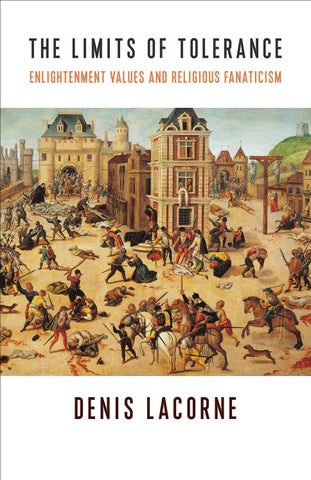
THE LIMITS OF TOLERANCE ENLIGHTENMENT VALUES AND RELIGIOUS FANATICISM
DENIS LACORNE
THE LIMITS OF TOLER A NCE EN LI G H T EN M EN T VA LU E S A N D R ELI G I O U S FA NAT I C I S M
DENIS LACORNE TRANSLATED BY
C. JON DELOGU AND ROBIN EMLEIN
Columbia University Press New York
NEW INTRODUCTION FOR THE AMERICAN EDITION
T
here are numerous historical examples of religious tolerance, from ancient Greece to the Roman Empire, medieval Spain to the Ottoman Empire and the Venetian Republic. But, generally speaking, these are not examples of tolerance in the modern sense of the term. They are rather examples of “toleration”: systems in which diverse religions are “suffered” for the sake of keeping the peace. The Latin root for toleration, tolerantia, is derived from the verb tolerare: to accept, endure, put up with, support with courage a burden or a difficult condition of life.1 Tolerance in this sense is commonly associated with a political act, something that is within the power of a ruler to impose or refuse to allow, such as the coexistence of established and minority religions.2 Today, however, tolerance is more often understood as the welcoming acceptance of a wide variety of beliefs and viewpoints where diverse communities respect one another and act collectively for the common good. This modern concept of tolerance began to emerge in the Age of Enlightenment and is closely associated with Enlightenment values, in particular, freedom of speech, free exercise of religion, separation of church and state, and the principle of equality. These values were not readily
2 Y New Introduction for the American Edition
accepted. It was only through the pervasive and growing influence of philosophers such as John Locke and Voltaire; the efforts of political activists such as Thomas Paine, Thomas Jefferson, and Mirabeau; and the acquiescence of modern rulers that these conceptions eventually prevailed and were enshrined in written constitutions and bills of rights at the very end of the eighteenth century. The elaboration of the modern concept of tolerance took place against a backdrop of religious wars and difficult attempts to put an end to these wars. Treaties, for example the Peace of Augsburg (1555), the French Edict of Nantes (1598), and the Peace of Westphalia (1648), brought periods of truce that were rarely definitive. Princes and their subjects were unable to conceive of tolerance as the peaceful coexistence of religious communities separated by strong doctrinal differences. Tolerance was a “burden” that would only last until the next clash of religions. It took only a local revolt or the intervention of some foreign power in favor of a dissident community for the hard-won civil peace to dissolve into open violence. During the same period, however, a more positive conception of tolerance was gradually developed by thinkers such as Michel de l’Hôpital and Sebastian Castellio in the sixteenth century; John Locke and Pierre Bayle in the seventeenth century; and Montesquieu, Voltaire, and Kant in the eighteenth century. They all denounced the use of force to convert dissidents and insisted that only persuasion could change a person’s faith, provided that her conversion was authentic and sincere. They also emphasized the advantages of religious pluralism to overcome the most dangerous religious passions. Voltaire insisted, “If there were only one religion in England there would be danger of despotism, if there were two they would cut each other’s throats, but there are thirty, and they live in peace and happiness.”3 Other
New Introduction for the American Edition Z 3
writers went further in linking the virtues of pluralism to direct economic benefits. Montesquieu, for instance, observed that a multiplicity of religions strengthened the state because the members of tolerated religions were more likely to be hardworking than those of the dominant religions, who would only be eager to collect the benefits of unproductive, honorific functions.4 Kant’s moral philosophy expanded the meaning of tolerance further in calling for the full respect of human beings as moral persons, detached from narrowly defined religious passions. What was needed, in an Age of Enlightenment, was “a prince . . . who considers it his duty, in religious matters, not to prescribe anything to his people but to allow them complete freedom.”5 Enlightened tolerance was thus conceived as an instrument of liberation not just from religious fanaticism but from outmoded religious dogmas and scriptural precepts. And its best safeguard was to be found in the “freedom of the pen,” the only way to protect the rights of the people in a constitutional monarchy or a republican commonwealth.6 Certain thinkers at the end of the eighteenth century even believed that new republican political norms would render tolerance unnecessary. In a key speech before the French National Assembly, on August 22, 1789, Mirabeau rejected the concept of tolerance because he perceived it as exclusively dependent on the will of a sovereign: “I do not come here to preach tolerance— the most unlimited freedom of religion is, in my view, a right so sacred that the word ‘tolerance’ used to express it strikes me as itself tyrannical since the authority that tolerates can just as well not tolerate.”7 In the same vein, George Washington, in a famous letter to the Hebrew Congregation of Newport, Rhode Island, written on August 18, 1790, explained that Jews no longer had to be tolerated since they possessed full “liberty of conscience and immunities of citizenship.”8 Thomas Paine, one year later in the
4 Y New Introduction for the American Edition
Rights of Man (1791), thought it was time to move beyond “toleration,” understood as a concession granted by a prince or priest to his subjects: “Toleration is not the opposite of Intolerance, but is the counterfeit of it. Both are despotisms. The one assumes to itself the right of withholding Liberty of Conscience, and the other of granting it. The one is the Pope armed with fire and faggot, and the other is the Pope selling or granting indulgences.”9 Despite these critiques of the very notion of tolerance, the concept did not disappear. Indeed, the use of the term “tolerance”—in the positive sense—continued to grow. Critiques of the notion of tolerance were without exception based on the assumption that tolerance was a favor granted by an all-powerful sovereign, and that is the particular notion of tolerance that was rejected. Tolerance as such was not abolished; it remained a fundamental operating principle for a well-functioning republic (or constitutional monarchy), open to a plurality of competing religious communities. In the twentieth century, the concept of tolerance was gradually expanded to apply to groups that have been marginalized on the basis of race, ethnicity, cultural identity, and gender. Indeed, by the end of the century, debates about tolerance most often referred to racial, ethnic, and gender issues and not to religion.10 These debates raised important political questions about power relations, social hierarchies, and systems of domination. For critics such as Wendy Brown, tolerance—or, more accurately, the discourse of tolerance—is used as a smokescreen by Western liberals to reinforce the oppression of ethnic minorities and nontraditional gender groups. Borrowing loosely from Foucault, Brown views tolerance as a form of “governmentality” designed to affirm the superiority of Western values against less tolerant, “primitive,” or “barbarian” societies.11 In fact, if one substitutes
New Introduction for the American Edition Z 5
“governmentality” for “absolute Monarch,” Brown’s critique of the notion of tolerance is very much like that of Mirabeau, Paine, and Washington. Admittedly, Brown is very effective in exposing the hypocrisy of Western political and cultural elites who attack the intolerance of Islam and its related cultural traditions while at the same time attempting to regulate or even prohibit the wearing of headscarves on the grounds that this practice reflects a lack of choice or a submission to authoritarian religious leaders. “Choice,” as she rightly points out, is indeed a relative concept, and Western women who claim their superiority in being free to dress as they wish are in fact equally constrained by social and cultural norms but in a different way, determined by the market forces of a consumer society.12 The problem with Brown’s analysis is that—again like Mirabeau and Paine—she views tolerance only in a negative light, as an act that, in an ideal world, would have no reason to exist. At the same time, by limiting the scope of her argument to the twentieth century, Brown ignores the complex and changing modes of tolerance that evolved over time and tends to exaggerate the Manichean dimension of a conflict opposing a supposedly tolerant and “civilized” West to a supposedly intolerant and “barbaric” non-West.13 The fact that Western elites have used the concept of tolerance as a mask for intolerance is no reason to throw out the concept. Tolerance properly understood requires the open acceptance of diverse religious communities that are not treated as “superior” or “inferior.” They all possess equal rights and benefit from constitutional guarantees enforced by the courts and state authorities. In such a context, members of minority or dissident religions are respected, even though their beliefs or religious practices may not be necessarily approved.14 For instance, I may object to the wearing of a niqab (a full-face veil) in the public
6 Y New Introduction for the American Edition
space because it seems to imply the subordination of women. But should it be completely banned as it is today in France and in Denmark? There is no easy answer, particularly if wearing a hijab (a headscarf) or a niqab has been chosen by a free autonomous subject for religious reasons.15 In fact, the debate about the Islamic veil exists only because Western secular elites are reluctant to admit that religious beliefs cannot really be separated from cultural practices. The question, again, is not whether wearing the veil expresses a religious obligation (it may not be the case) but whether it is experienced, rightly or wrongly, as a religious obligation by the faithful.16 But this does not imply that all religious practices should be blindly accepted by state authorities. Parliamentary leaders may choose to limit or ban certain religious practices in the name of public order. But such a ban should be carefully designed and balanced against preexisting fundamental rights, such as the free exercise of religion. In the end, restrictive measures limiting the rights of a particular religious group should only be accepted if they do not impose an excessive burden on the members of the group. The different regimes of tolerance examined in this book do not offer a single universal model of toleration. Each regime, in its own way, draws boundaries between the tolerable and the intolerable, the permitted and the prohibited, the religious and the political. Moreover, these borders fluctuate as a result of wars and political revolutions. Public order, political survival, dynastic succession, established religions, and population migration may all impose limitations to existing regimes.17 These constraints vary over time as attitudes and customs change. Dissident religions that were hardly tolerated in France, England, and Italy in the sixteenth and seventeenth centuries are today perfectly accepted without any restrictions. However, recent religions, such as Mormonism or Jehovah’s Witnesses, and older religions
New Introduction for the American Edition Z 7
in new settings, such as Islam and Sikhism in Europe and North America, may cause alarm because they are poorly understood and seem to challenge local customs and habits. This, in turn, may facilitate the rise of intolerant, xenophobic movements and present a difficult challenge to the advocates of modern tolerance. The history of tolerance, examined over a long historical period, is a complex story of breaks and continuities, advances and regressions.18 That history cannot be a simplistic narrative opposing a “tolerant West” to an “intolerant non-West,” nor can it be reduced to a linear progression from an ancient age of persecution to a modern age of tolerance and peaceful accommodation.19 Indeed, the “tolerant” West has regularly experienced periods of extreme intolerance and episodes of extreme brutality: the Thirty Years’ War, the St. Bartholomew’s Day massacre, the execution of Michel Servet in Geneva, the execution of Chevalier de La Barre for blasphemy in the France of Louis XV, the revocation of the Edict of Nantes, and the persecution of Quakers, Baptists, and “witches” in North America. In fact, the same country could be tolerant, then intolerant, in a recurring cycle. Consider, for example, the curious treatment of French Huguenots: the first Edict of Tolerance—the Edict of Nantes— reconciled Catholics and Protestants in 1598; it was later revoked with the Edict of Fontainebleau in 1685, which was in turn superseded by a new Edict of Tolerance—the Edict of Versailles—in 1787. Given such recurrent cycles of tolerance and intolerance, the fear of intolerance, real or imagined, is always with us, and it is reinforced by a new postrevolutionary cycle of tolerance and intolerance opposing, both in France and the United States, secular forces to committed believers. At the same time, there are numerous examples of tolerant regimes in non-Western societies, in Indonesia, for instance,
8 Y New Introduction for the American Edition
with the coexistence of Buddhism, Hinduism, and Islam; in the Indian subcontinent, both before and after the intrusion of Islamic conquerors; and in Turkey, after the conquest of Constantinople.20 To illustrate this phenomenon and challenge, in my own way, the much abused notion of a “clash of civilizations,” I will examine the rise of a unique form of Islamic tolerance, better defined as “bureaucratic and imperial,” which emerged in the Ottoman Empire and survived for nearly four hundred years at a time when Europe was experiencing violent and devastating religious wars.21 The concept of religious tolerance, if it is of any use today, makes sense only if it denotes a right that exists independently of any political or religious authority—a right that does not derive from the arbitrary will of a political ruler, a principle as fundamental as the “Universal Right of Conscience” defended by Thomas Paine. But this right is workable only if people (and their rulers) can detach themselves from their own religious (or secular) conceptions of the good and agree to cooperate in the public sphere. In this context, the concept of tolerance, as applied to religion, can be conceived of as a consensual system of harmonious coexistence between a multiplicity of comprehensive religious doctrines and a secular political order. The difficulty, of course, is to find a proper balance between the uniformity of the rule of law and a variety of religious beliefs and nonbeliefs.22 Why write a book about religious tolerance? By the 1980s, religion no longer was a fashionable topic. And why should it be? The globalization of the world and the rising secularism of modern societies seemed to suggest that religious tolerance had finally become a universal norm accepted by all without much resistance. The antidiscrimination policies implemented in the United States, France, Canada, and Great Britain paved the way
New Introduction for the American Edition Z 9
for a new form of “multicultural tolerance” that emphasized diversity rather than religion.23 The religious question, partially eclipsed by new and vigorous debates on gay marriage, gender, and ethno-racial diversity, regained the center stage when extreme forms of intolerance challenged the very notion of free speech— one of the major achievements of the Enlightenment. A new spiritual despotism reintroduced the long-forgotten notion of “blasphemy.” Ayatollah Khomeini’s unexpected and brutal fatwa calling for the death of Salman Rushdie, the author of a controversial novel—The Satanic Verses—reactivated the old debate on the limits of tolerance.24 A new form of religious fanaticism, fueled by Islamist passions, led to outbreaks of violence that reached a climax with the denunciations of cartoons mocking revered scriptures and religious figures such as Muhammad. Terrorist attacks targeting writers, journalists, and cartoonists in Denmark, France, Pakistan, and other countries raised new, difficult questions. Should we tolerate the intolerant? Should we appease the fanatics in forbidding certain forms of artistic expressions perceived as offensive by true believers? Is censorship or self-censorship a valid strategy to calm the anger of the faithful? Is the risk of a “clear and present danger” the ultimate limit to tolerance? I attempt to address these fundamental questions in the last two chapters of the book and in the epilogue to the American edition.
praise for
THE LIMITS OF TOLERANCE “I simply don’t know a book on toleration that compares to this one. Denis Lacorne has managed to weave together both an intellectual history of ideas about toleration and a wide-ranging international survey of policies related to it. Theory and practice come together in a very illuminating way and will expand the American reader’s horizon beyond our borders.” —Mark Lilla, author of The Once and Future Liberal: After Identity Politics “Living in a religiously tolerant society, Americans no longer understand what the challenge of achieving religious toleration originally meant: learning to coexist with beliefs and practices that one detested. Lacorne begins this critical survey by recalling the great Enlightenment voices for toleration: Locke, Voltaire, and the American founders. But he then examines modern European and American disputes to demonstrate why the struggle for toleration and free exercise remains so problematic—a fight that never quite ends but that we grasp much better after reading Lacorne’s crisp and incisive chapters.” —Jack N. Rakove, author of Original Meanings: Politics and Ideas in the Making of the Constitution “A timely, erudite, and insightful book that sheds light on issues concerning whether and when contemporary democracies should restrict the practices and beliefs of nonmainstream religious and political groups. It is the best book written on this subject to date.” —Bruce Cain, author of Democracy More or Less: America’s Political Reform Quandary
RELIGION, CULTURE, AND PUBLIC LIFE PRINTED IN THE U.S.A.
C O L U M B I A U N I V E R S I T Y P R E S S N E W YO R K C U P. C O L U M B I A . E D U