Yoshikuni Igarashi
HOMECOMINGS T H E B E L AT E D R E T U R N O F JA PA N ’ S LO S T S O L D I E R S
INTRODUCTION
GOING HOME
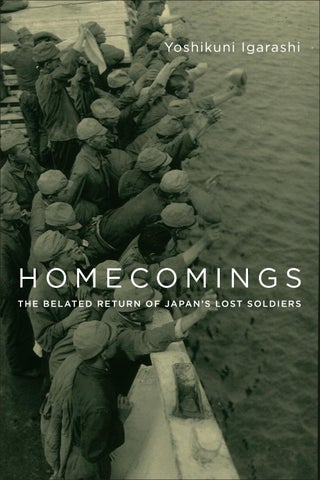
On December 1, 1953, 811 former Japanese internees from the Soviet Union arrived in the port city of Maizuru, the site of the Japanese government’s repatriation center. Of the 811, 420 were former military men, and 391 were private citizens, including 9 women and 2 toddlers. After the war, most of the civilian returnees had been detained by the Soviets in Sakhalin, the formerly Japanese northern territory that the Soviet army occupied just before Japan’s surrender.1 At the same time, hundreds of thousands of Japanese servicemen and civilians had been interned in Siberian labor camps as POWs or for various alleged crimes; more than 100,000 perished during their internment. Because their homecoming was the first repatriation from the Communist regime since April 1950, the return of these 811 internees offered hope to the families of several thousand Japanese who remained in the Soviet Union. A photo in the Yomiuri newspaper’s evening edition captures the arrival scene at the wharf. In the photo, the returnees are wearing heavy Russian winter coats and fur caps as they walk through the welcoming crowd of family members and relatives, some of whom are carrying Japanese flags or banners bearing the returnees’ names. Even in this grainy black-and-white photo, the belated repatriates’ obviously Russian appearance stands out. The accompanying article assures readers that this
2 INTRODUCTION
landing was free of the turmoil that had plagued some of the other recent returns. There were no “die-hard” Communists on board this repatriation ship as there had been when supporters of Mao Zedong were found among recent returnees from the People’s Republic of China. Despite their Russian outward appearance, the 1953 returnees seemed genuinely happy to be home. The December 1 photo and article thus sent a hopeful message that notwithstanding their foreign clothing, the returnees had maintained a connection with their Japanese homeland.2 Of the major dailies that reported on the returnees’ repatriation, the Yomiuri ’s coverage offers perhaps the best example of the popular sentiment that awaited the returnees: while the paper acknowledged the hardships of the Soviet camps, the coverage also sought to contain the painful, lingering memories of the war. By 1953, the extreme suffering experienced by the Siberian detainees was common knowledge. As the daily noted with sensitivity in its front-page column, “These are people who lived lives of imprisonment, blindfolded to reality and separated not only from Japan but also from any ‘humane life.’ ”3 The Yomiuri nonetheless made sure to maintain an optimistic tone in discussing the returnees’ reentry into Japanese society. For example, an article on December 2 reported that some of them still felt as anxious as they had in the labor camps, even as the article suggested that reentry into Japanese society would be as straightforward as changing outfits: The 811 returnees who spent their first night at the repatriation assistance center have been busy since the morning of December 2 resuming life as Japanese living in Japan proper [naichijin]. The returnees have shed the Soviet-made winter gear, heavy and [blue-]black, to change into the suits or kimono their families brought, apparently wiping off the “stains of a foreign country” to become Japanese again overnight.4
The article thus makes an almost desperate attempt to convince the readers that the returnees’ Russian experiences were only superficial. The article’s subtext insists that beneath their layers of dark Russian clothing, the returnees nevertheless remained purely Japanese, unstained by foreign hardships. The use of the geographically defined term naichijin also hints at the belief that the returnees left behind the trauma of war once they
3 INTRODUCTION
crossed the border into Japan. Now that they were back in Japan proper, these returnees were expected to shed their connections with their Siberian internment in particular and with wartime violence in general “to become Japanese again overnight.” Three days after this article appeared, the Yomiuri ’s evening edition reported that 244 of the original 811 returnees had arrived in Tokyo, as either their final destination or a relay point for further travel. The later coverage, containing a tone of relief, characterized their arrival as uneventful. The main article begins with “There were neither red flags welcoming them nor labor union members.”5 Unlike those who had returned from China several years earlier, these returnees showed no signs of feverish devotion to Communist propaganda. The returnees of 1953 were reunited only with their family members, a final, rehabilitative step toward normalcy, according to the newspaper coverage. For example, one article featured former army lance corporal Takei Takeo, whose wife and son welcomed him to their one-room home in Tokyo following his return. Noting that Takei’s family could not afford to meet him in Maizuru, the article intimated that their life without him had been challenging. Almost immediately, however, Takei relaxed, and the article observes that he “began cracking jokes” while “the relatives and neighbors who surrounded the family burst into laughter.” The article optimistically declares that “spring has come to the family for the first time.”6 The dark winter years that the returnee and his family had endured were finally over. The Yomiuri expresses the popular sentiment that just coming home was a panacea for any problems caused by the wartime separation.7 Yet the newspaper acknowledges that reintegration into postwar society required some effort. The future poet laureate, Ishihara Yoshirō— one of the returnees to the Tokyo area—expressed his sense of bewilderment to the Yomiuri reporter upon noticing how drastically the commercial district of Ginza had changed during his absence. Still wearing heavy Russian winter clothing, Ishihara stood out in the crowded shopping district. His visible difference from those around him echoed the symbolic distance that existed between him and postwar Japan. As he was getting into a taxi to return to his brother’s house, Ishihara stated: “I have no idea what is going on. I will stay home quietly for a while and think about my future.”8 The Yomiuri article thus portrays Ishihara as a man who belonged to the past and had much to learn. But at least,
4 INTRODUCTION
according to the article, Ishihara had a secure home to which he could retreat.9 The title of the short article about Ishihara, “A Modern-Day Urashima Tarō’s Ginza Stroll” (Ima Urashima no Ginbura), indicates the sympathetic yet patronizing attitude of contemporary society toward the returnees. In the Japanese folktale to which the title refers, Urashima Tarō returns from his pleasurable life in the palace under the sea to his home on land. Although he thinks that he has been away only a few days, it turns out that he has actually been gone for several hundred years. His village has become a completely unfamiliar place, and the people there do not recognize him. Unlike Urashima, though, Ishihara’s time in Siberia was far from pleasurable. The article nevertheless transforms Ishihara into a modern-day Urashima, observing that he (Ishihara) was confused by the changes that had occurred in his absence. Th is cultural reference immediately rendered the strange figure of the Siberian internee into something both familiar and nonthreatening in postwar society. It also shifted the focus from what happened in Siberia to the challenge of making one’s “homecoming” to a land that has become strange. By including a brief account of the meeting between the returnees’ five representatives and the minister of health and welfare, the newspaper did acknowledge that issues related to Japanese returnees had not been completely solved; the returnees’ representatives urged the government to continue its efforts to bring home the Japanese who remained in the Soviet Union. Ishihara’s bafflement regarding postwar society and the shadow of unresolved tension with the Soviet Union, however, only highlighted the fact that it was a privilege to be living in postwar Japan. The Yomiuri coverage framed the internees’ belated homecoming as an occasion to celebrate their return to normal life, not as an opportunity to seriously contemplate the long, arduous years that they had survived or the difficulties that they might yet face in readjusting to postwar society. Of the major dailies, the Yomiuri offered the most extensive reporting on the returnees who arrived in Maizuru on December 1, 1953, although its tone catered to the strong popular desire to downplay the internees’ conflicts with postwar society. When the Empire of Great Japan collapsed, 6.88 million Japanese were living in the Japanese colonies and war fronts (equal to 9.6 percent of the population on the Japanese mainland). Of these, 3.67 million were
5 INTRODUCTION
soldiers and officers of the Japanese navy and army. It was not an easy task to move and resettle more than 6 million people in such a short span of time. The Japanese government originally contemplated having the settlers remain abroad indefinitely in order to avoid food shortages and social confusion at home. But as the former settlers’ safety in Manchuria became a source of serious concern, the government soon reconsidered. Priority was given to the repatriation from Manchuria and China, and the United States’ material assistance helped expedite the repatriation of 2.5 million Japanese from these regions.10 For other areas—most notably those controlled by the Soviets—immediate repatriation was not a priority. In any event, the vast majority returned to the homeland within a few years of Japan’s defeat. A total of some 6.3 million Japanese were repatriated from overseas, 97.5 percent of them (6.14 million) by the end of 1948.11 The early returnees came home to a war-torn nation where survival was the most pressing concern. They nevertheless had opportunities to restore their own identities as postwar citizens by participating in a process of national reconstruction.12 However, for those who came home late—whether because they were interned in Siberia or stranded in the jungle—there were no such opportunities. When these Japanese finally returned, their country’s reconstruction was well under way, and they returned to clearly crafted and well-accepted media narratives about the war and repatriation. As we have already seen in the Yomiuri coverage, their return home was supposed to bring closure to their long suffering. Yet as Ishihara Yoshirō later explained, homecoming turned out to be not an end but the beginning of the returnees’ struggle with their past experiences. For example, many people who returned from Communist countries had difficulty finding a job because employers feared that the returnees might have become Communists during their absence and therefore would cause trouble in the workplace. In general, postwar Japanese society showed little appetite for stories that extended beyond the days immediately before and after the returnees’ homecoming. Repatriation was relegated to the past, as Japan committed itself instead to its social and cultural postwar narratives. These narratives did, however, make space for Japanese society to offer warm acceptance to those who returned home with the burdens of war. While imbued with goodwill, the project of “helping” returnees adjust to the
6 INTRODUCTION
new culture also fulfilled an ideological function: to preserve the fictional narrative that Japan, as a rescuer, was no longer afflicted by defeat. In December 1953, by the very extension of their sympathy, Yomiuri readers reaffirmed their good fortune at being securely ensconced in postwar Japanese society. By contrast, when the returnees emerged from their very different experience of the war, they faced a set of expectations that had already been prescribed by postwar narratives; the Japanese public expected the returnees to be the helpless yet admirable victims of circumstance.13 OVERVIEW OF THE PROJECT
Homecomings: The Belated Return of Japan’s Lost Soldiers examines the tensions that shaped the postwar return of the “lost soldiers” of the Asia Pacific War. In particular, the book considers the return of both Japanese internees who had been detained in Siberian labor camps and soldiers who survived in the jungles of the South Pacific for more than a quarter century. These homecomings, which began in the late 1940s and continued into the 1970s, are marked by significant cultural gaps. Accordingly, I explore the cultural distance between the returnees, who bear memories of traumatic loss, and a Japanese society that assiduously sought for years to separate itself from the war. That is, I examine the struggles of these returnees to articulate “war” experiences that had the potential to disrupt Japan’s carefully crafted postwar narratives. Th is book was conceived as a companion to my fi rst book, Bodies of Memory: Narratives of War in Postwar Japanese Culture, 1945–1970.14 Bodies of Memory is a macrolevel study that generally traces collective narratives of war through postwar Japan’s cultural representations. By contrast, Homecomings addresses the experiences of specific individuals in the postwar period, as well as these homecomings’ tangled relations with larger historical narratives. I investigate here the cases of former servicemen burdened by war experiences that refused to fit neatly into the postwar narrative of Japan’s war, defeat, and recovery. I focus on particular cases in which key individuals’ lives received media attention not to set up a rigid binary between micro- and macrohistories that privileges the former but to investigate the tensions and interactions between these two levels of history. My goal is to illuminate the ways in which
7 INTRODUCTION
returnees negotiated such different and difficult registers of history in postwar Japan. A basic premise of the book is that individual experiences and memories do not exist in a social vacuum. In order to make their internal struggles understandable to others, individuals must resort to socially shared images and narratives, particularly those that the media circulate in contemporary society. Because the postwar Japanese media had become entrenched as an integral part of everyday life, the process of absorbing shared images was tantamount to accepting the media’s images and narratives as one’s own. Anything that did not fit the modes of the mass media’s representation was often disregarded as incomprehensible excess. Meanwhile, for the belated returnees abandoned after their original homecomings, the absence of in-depth media attention made it difficult for them to share their personal experiences with others or even to claim ownership of their own stories. These returnees had to contend with media-supplied narratives, whether or not they liked them, in shaping their pasts. Even though I focus on various personal experiences and memories, I believe that one can access them only by exploring their relations with media representations. While acknowledging the importance of mass media to Japan’s postwar history, I am also mindful of the limitations of those media. In disavowing the multiethnic colonial project of wartime Japan, the postwar Japanese media replicated in many ways the official discourse of repatriation based exclusively on the return of Japanese nationals to Japan proper.15 Colonial subjects who had been mobilized for Imperial Japan’s war effort completely fell out of the postwar government’s scope of concern. These colonial subjects were also rendered invisible in the Japanese media discourse on repatriation. Indeed, when reporting on the 811 returnees from the Soviet Union in December 1953, the Yomiuri and other dailies completely omitted the fact that there were nine foreign nationals among them.16 They supplied no information about the circumstances that brought them to Japan, much less what happened to them after they reached Japanese shores. Historian Ōkado Masakatsu offers another example of skewed representational practices: when searching through the numerous photos of Japanese repatriates archived at the Asahi newspaper’s Osaka office, he located only one photo of a Korean repatriate, who had been called up for military service toward the end of the war and
8 INTRODUCTION
returned to Japan around 1955. Ōkado sees this dearth of representations of former colonial subjects’ movements as an indictment of the media’s exclusive focus on Japanese repatriation to Japan.17 Notwithstanding the media’s complicity with official discourse, we should not underestimate their ability to produce and proliferate images beyond official prescriptions. The government’s efforts to incorporate repatriates into Japanese society largely consisted of these people’s physical return to the homeland; the media filled postwar society with powerful, albeit selective, images of returnees and their lives afterward. Upon arriving in Japan, the returnees encountered both official and mass media discourses about their experiences. Meanwhile, the Japanese postwar media intensified their efforts, inundating the public with more images, most of which had further incorporated the official discourse. The mirror of media representation consequently forced the belated returnees to examine themselves and also supplied a framework in which they could reconstitute their postwar selves. In focusing on the tangled relations between individual returnees and their media images, this book is concerned with military returnees rather than their civilian counterparts. Although civilian returnees, especially women and children, initially received considerable media attention, they soon disappeared from postwar cultural representations. Their brief symbolic value seemed to end with their act of coming home. Once they had arrived, they were allowed to quietly move out of the public’s view and into their domestic spaces. Even though defeat troubled the concepts of “Japan” and “the Japanese,” the repatriates’ strong desire to return home reconfirmed the desirability of Japan and of being Japanese. In reality, however, not everyone wanted to return to Japan. For example, manga artist Mizuki Shigeru (1922–2015) heard the news of Japan’s defeat in Rabaul, Papua New Guinea, and hoped to settle among the local people. But on an army doctor’s advice, he eventually decided to repatriate to Japan for the time being. Although he promised his local friends that he would be back in seven years, it actually took him twenty-six years to fulfill his promise. Mizuki arrived in Japan in March 1946.18 This ideological configuration of the returnees’ images paved the way for Fujiwara Tei’s memoir Shooting Stars Are Alive (Nagareru hoshi wa ikiteiru, 1949) to become a best seller in postwar Japan.19 Fujiwara and her three children escaped Xinjing (present-day Changchun), the capital of Manchukuo, shortly after Japan’s defeat, and they arrived in Japan
9 INTRODUCTION
in September 1946.20 As historian Narita Ryūichi explains, the book’s narrative of her “experiences in refugee camps and escape journey” emphasizes how Fujiwara yearns for her ‘family,’ how she strives to reach her ‘homeland,’ and how she reaffi rms her identity as ‘Japanese.’ ”21 For example, Fujiwara offers an account of her determined effort to keep walking down the Korean Peninsula with her three young children. This characterization portrays Japan as a natural “home,” and Fujiwara’s testimony casts her as a heroine who struggled to protect her Japanese identity under excruciating circumstances. But as survival ceased to be a primary concern for postwar society, the civilian returnees largely disappeared from literary and cinematic representations. Furthermore, in what little was written about them, their life after return was rarely discussed, and there was a clear gender division at work. In the popular media, the difficulties faced by the women and children who repatriated from Japan’s colonies initially stood in for the entirety of the civilian returnees’ experiences. These difficulties were then soon displaced in the cultural imagination by the stories of war widows and women who patiently waited for their men to return. The film version of Shooting Stars Are Alive (directed by Koishi Ei’ichi, 1949) illustrates this displacement. The original narrative, which ends with Fujiwara and her children arriving home, extends beyond the protagonist’s and her children’s homecoming to show them then waiting patiently for the return of their husband/father from the continent.22 In the fi lm, although their postwar life is difficult, they enjoy the security of being at home, and the heroic figure of the female returnee is reduced to a domestic figure whose hopes hinge on her man’s return.23 In contrast, the numerous repatriated soldiers who appeared in print and visual texts represented a state of homelessness, an anxious transitional status in the postwar period. Their images were not as easily domesticated as those of the civilian repatriates because of the active role they had played in Japan’s imperialism and war. The soldiers drew more media attention because they invoked the haunting presence of the past, thereby not fitting neatly into the cultural narrative of war and defeat.
My choice of former servicemen as the main subject of this book is therefore both pragmatic and strategic. While recognizing the need to recover the voices of civilian returnees, I have concentrated on those returnees
10 INTRODUCTION
who garnered the most media attention: the former soldiers. Discussion of how the returnees lived their lives after their return while burdened with their war memories—a central theme of this book—is mostly absent in what little was written at the time by and about the civilians. Rather than attempting to fill the representational void by uncovering new materials about the civilian returnees, I instead treat this lack as an important feature of postwar Japan’s historical terrain, though I remain attentive to the forces that produced this terrain. I focus on what has been represented, albeit imperfectly and ideologically, about the former soldiers. Those problematic representations became part of the historical reality. In response to these representations, the former soldiers tried to articulate their sense of lateness, of having missed out on the postwar process of normalization. By reconfiguring the images of repatriated soldiers, the postwar Japanese media tamed the legacies of war and colonialism. In reality, however, some returnees were so consumed by the past that they could not or did not wish to make the transition into postwar society. This book retraces their struggles in postwar Japan, examining which parts of the returnees’ experiences were accepted and which were rejected and revealing that the “postwar” was not actually the period that naturally followed the war but was instead a condition that required careful inspection and maintenance. Media Representations of War Veterans
The optimistic outlook on postwar Japan’s economic prospects that characterized the nation’s high-growth era from the mid-1950s to the early 1970s greatly affected media representations of the wartime past. Bodies of Memory argued for the intimate relations between the war memory in postwar Japanese society and the radically changing material conditions stemming from Japan’s economic recovery and growth. This book continues to emphasize the impact of Japan’s economic conditions on its relationship to its history. In particular, the development of consumer society during those years greatly affected the ways in which war memories were articulated in Japanese society. Consumerism—what was once the privilege of the urban upper and middle classes in prewar Japan—engulfed the nation by the early 1970s. Appliances and cars were not the only objects produced and consumed
11 INTRODUCTION
Total Number of Publications and Newspaper Circulation Year
Books
Magazines
Newspapers
Total Population
1947
53,560 (0.69)
74,870 (0.96)
19,994 (0.26)
78,101
1955
100,380 (1.12)
280,800 (3.15)
32,914 (0.37)
89,276
1973
444,436 (4.07)
1,730,560 (15.86)
39,847 (0.37)
109,104
Note: Figures are in thousands, with per capita figures in parentheses. Source: Ministry of Internal Affairs and Communications, Statistics Bureau, Director-General for Policy Planning (Statistical Standards) & Statistical Research and Training Institute, Historical Statistics of Japan, chap. 26 (http://www.stat.go.jp/english /data/chouki/26.htm).
at a furious pace: Japan’s media industry kept pace with the growth in other sectors of the economy. In 1973, for example, the residents of Japan purchased, on average, three and half times as many books and five times as many magazines as they had eighteen years earlier (see table). While newspapers maintained almost identical per capita circulation figures during those years, they also resumed printing evening editions, and each issue became three times as thick.24 By the mid-1960s, more than 90 percent of households in Japan owned one or more television sets, with individuals watching, on average, more than 1,000 hours of television each year. Meanwhile, fi lm attendance reached more than 1 billion from 1957 to 1960, although it fell rapidly in subsequent years as movies lost their audiences to television.25 War proved to be an attractive theme for the rapidly expanding media. Numerous war tales and images were packaged as consumable content, creating a major boom in the second half of the 1950s. No account of Japan’s war efforts, regardless of political stance, could skirt the fact that Japan had been defeated. Nevertheless, within a decade of this defeat, Japan hit important benchmarks in reestablishing itself in the international community. It regained its independence in 1952 and acquired a seat in the United Nations four years later. Its economy reached its prewar high in 1955. Yet these gains did not nullify the new political and military arrangements that perpetuated the hierarchal relation of the vanquished to the victor. To the contrary, acceptance of the United States’ hegemony in East Asia was a sine qua non for the nation’s reconstruction and growth, and the former imperial power itself became subject to semicolonial conditions. Although war stories and accounts
12 INTRODUCTION
proliferated in print and film during this period, they did not necessarily indicate that postwar Japanese society had fully embraced its wartime past. Each work had to negotiate the tension between historical fact— Japan’s defeat—and ideological imperative—Japan’s national pride. In the first part of this book, I explore visual and literary texts mainly from the late 1940s and 1950s in order to document ways in which popular media represented demobilized soldiers. These works reveal confl icting desires, on the one hand, to assimilate the men back into society and, on the other hand, to symbolically reject the men from social spaces. As Japan’s economic success began to boost its national confidence, the menacing figures of former servicemen were replaced with generally more benign images. This discussion of cultural representations of former soldiers serves as the backdrop to my subsequent analyses of how former internees in the Siberian labor camps struggled to articulate their haunting memories in the media environment of the 1950s and 1960s. The relations with the Japanese media for those men who returned from the South Pacific in the 1970s, particularly Yokoi Shōichi and Onoda Hiro’o, were radically different from those of earlier returnees. Yokoi and Onoda became media sensations the moment they left the jungle, with almost their every move and utterance under public scrutiny. The media were not willing to relinquish their celebrity status even after they returned to Japan, thereby turning them into consumable symbols of Japan’s war. For Yokoi and Onoda, “home” was ironically transformed into the extremely public and unsettling state of being constantly in the spotlight. Whereas the earlier returnees had to struggle to reclaim their own voices against media representations, the 1970s returnees found that any attempt to speak about their past or current state created numerous responses in the media environment, further fueling the obsessive media coverage of their “return.” The Dangers of Turning History into a Lesson
Before turning to the individuals who belatedly returned to Japan after the war’s end, I would like to explain my stance toward the subject of history and memory as it defines this book’s larger framework. I have often felt uncomfortable with the moral imperative that I have heard on numerous occasions in Japan: “Do not let the war experiences [or memo-
13 INTRODUCTION
ries] erode [ fūka saseruna].” While sympathetic to the slogan’s underlying antiwar sentiment, I am troubled by its all-knowing quality. It treats personal experiences and memories as transparent and self-explanatory, obscuring the arduous efforts required to make them one’s own. Whoever voices such a call seems to treat memory as a fossilized substance to be preserved as is. To counter such a static image of history, I insist that if experience has social meaning, it must be in a constant process of transformation. It is never the case that one immediately understands a historical event’s ramifications, regardless of one’s proximity to it. Rather, memories are transmitted and transformed as the event acquires various meanings in society. My point is not to insist that experiences and memories are arbitrary or untrustworthy but to underscore the need to understand them as part of a living process: their meanings are far from self-evident or easily transmittable. Even when a person survives a traumatic event, she or he cannot completely understand her or his own experience of it, let alone communicate it. The very effort to grasp the meaning of the experience in turn transforms the survivor. This complex process is well illustrated in a case that psychiatrist Nakazawa Masao discusses in Tracing the Psychological Wounds of Hibakusha (Hibakusha no kokoro no kizu o otte, 2007). Nakao Tatsuo survived the atomic bombing in Hiroshima and subsequently led a life relatively free from traumatic memories. But once he agreed to help establish an association of hibakusha (atomic bomb survivors) in 2005 and began meeting other survivors, he found his psychological state becoming increasingly unstable. He lost confidence in his career, was unable to sleep, and began drinking heavily. Nakazawa explains Nakao’s shaken state of mind: Various memories came back in fragmentary form. While listening to the survivors’ tales, his “framed” and unshakable still images [of the event] began to look questionable and were in some cases corrected. Mr. Nakao, whose identity grew shaky, began probing his own memories. He learned on the Internet that the account he had written long ago about his atomic bomb experiences had been filed as a public document at the Hiroshima City Office. He obtained a copy and read it, finding that it was a great deal different from his own “framed memories.”26
14 INTRODUCTION
Sixty years after the event, Nakao began to retrace his footsteps, and the process was so disturbing that he sought relief with alcohol. The part of himself that he had repressed returned to the present moment, and Nakao was forced to restructure his whole being in order to accommodate the undesirable past. The passing of time did not mean that Nakao had gained distance from the original event but that he had different relations with it in his subsequent life. His account is merely a document of how he understood his experiences at a particular point in the postwar period. It is noteworthy that this document from earlier postwar days, found on the Internet, mediated his efforts to return to the past: his arrested memories gained a new life in cyberspace. In recalibrating his relationship to the past, Nakao finally let himself feel the psychological effects of the horrid event, arriving at a far more disturbing understanding of what he had experienced. This understanding, however, seems to have remained fractured and fragmented for the moment (at the time the book was written), and he lacks the means to articulate it effectively.27 The imperative to prohibit erosion of the past further presumes an asymmetric and hierarchical relation between those who experienced the event (the war generation) and those who did not (the postwar generations). War experiences and memories are often treated as equivalent to lessons found in history. Those who did not directly experience the war are expected to accept such lessons graciously and unquestioningly. Their charge is to receive a completed picture and pass it on to the next generation without damaging it. Meanwhile, those who personally experienced the war are given a secure position as teachers who speak the truth.28 This notion of survivor as teacher is closely tied to another imperative, that one must learn from history so as not to repeat the same mistakes. According to this argument, in order to prevent a future war, we must learn from a past war. By being subsumed under a future goal, personal experiences and memories are refashioned as lessons of history. But what kind of lessons can one find in the explosive power that annihilated entire communities in Hiroshima and Nagasaki? Do the humiliating experiences of the Siberian internment offer any clues to how to avoid future war?29 What wisdom is to be found in the stragglers’ prolonged struggle for survival in the South Pacific? In postwar Japan, complex historical reality and pain-
15 INTRODUCTION
ful memories have too often been reduced to the simple and obvious mantra that we should not repeat the same miserable experiences by starting new wars. That sentiment erases the individuality of the survivors’ experiences and the details of their memories. Conversely, when one refuses to examine the details, one clings to dogmatism. Survivors who do not wish to recall their difficult experiences can also block off their inward thinking by concentrating on broad lessons. However, a sensitive exploration of war experiences and memories requires avoiding such generalizations as much as possible in order to remain open to the complex and provisional status of their microlevel personal histories. These histories are too messy and unresolved to be reduced to didactic slogans. I have no intention of abandoning a macrolevel history in this project, even though I emphasize the importance of microhistories. Jorge Luis Borges’s one-paragraph story about the overzealous “Colleges of Cartographers” that made a life-size map of the unnamed “Empire” illustrates an inherent problem with microlevel descriptions. Succeeding generations deemed this map “cumbersome” and abandoned it because it offered nothing extra to their experiential knowledge.30 In a similar vein, a life-size history that captures individual experiences in their entirety (if such an ideal were even attainable) would be useless and incomprehensible. Just as in the case of a map, history becomes readable only through the imposition of selection and reconstruction. Microhistories must also be subject to this processing in order to be intelligible. Those who explore history inevitably need a map to make sense of their segment of the world. But what if one’s findings do not fit the descriptions on the popular maps? Especially when one has no power or authority to redraw them? There is yet another factor to consider in the case of postwar Japanese history: even if the returnees tried to withdraw into a private space, the media constantly bombarded them with popular versions of history. My goal is to investigate the tensions and interactions between micro- and macrohistories. I want to look at not only how several returnees experienced the war and postwar but also the ways in which they negotiated the different and difficult strata of history in postwar Japan. My approach to the subject reflects my membership in the postwar Japanese generations that did not personally experience the Asia Pacific War (I was born in 1960). The inquiries of those in postwar generations
16 INTRODUCTION
can—and should—be more than mere copies of what the war generations already have articulated. For that reason, I believe that war experiences need to be open to all generations. My argument is, of course, not limited to those who were born in Japan after the war; it extends to those who were raised in other regions. Postwar generations should not simply adopt the same positions as those who survived the war. Rather, those determined to pass on their experience of Japan’s war must recognize not only that postwar generations both inside and outside of Japan should participate in the process of understanding war experiences, but also that they have already been doing so. Areas of Exploration and Chapter Outline
To extend my cartographical metaphor, some parts of the historical terrain that I explore in this book have been well traversed by other researchers. On the topic of the Siberian internment of Japanese POWs, for example, there is a sizable literature: first-person narratives, journalistic accounts, and academic histories. Camp survivors have written thousands of books and essays about their experiences, while journalists and academics have highlighted particular individuals’ internment experiences and postrepatriation life. In addition, the opening of the Russian archives after the Cold War has led to new research on the Japanese internment in Soviet camps.31 The most recent English publication on the subject, Andrew Barshay’s The Gods Left First, synthesizes these approaches in its examination of the lives and writings of three prominent former Siberian internees: artist Kazuki Yoshio, writer Takasugi Ichirō, and poet Ishihara Yoshirō.32 By contrast, other areas of my inquiry have received far less critical attention. For example, despite recent efforts to reevaluate the historical impact of Japanese soldiers’ belated homecomings, their stories remain largely at the margins of scholarly discourse. Through her comprehensive study of Imperial Japanese Army stragglers in Southeast Asia and the Pacific and their subsequent journeys home, Beatrice Trefalt helps re-situate these men in postwar Japanese history by examining the contemporary responses to their uncanny returns and excavating their connections with Japan’s colonial legacies.33 In Japan, journalist Kawasaki Masumi’s biography of Nakamura Teruo—a former Imperial Japanese
17 INTRODUCTION
soldier from Taiwan who was “captured” on an Indonesian island in December 1974—discusses the historical ramifications of Nakamura’s homecoming in relation to the geopolitical conditions that surrounded post–World War II Taiwan.34 Notwithstanding these publications’ analytical power, these texts seem to have had little effect on subsequent discussions about the soldier returnees, as only a few essays on the topic have appeared since the early 2000s.35 Even less scholarly attention has been paid to the fictional versions of these histories. Gomikawa Junpei’s best-selling novel The Human Condition (1956–1958) has rarely been read as a historical text that resonates with its contemporary socioeconomic conditions. Indeed, the novel’s very popularity seems to have discouraged scholars from discussing this text, which grapples with Japan’s imperial war. The film version of the book has met a similar fate. While touted by film critics as powerful cinema, it is rarely analyzed in terms of its cultural moment. Similarly, Yellow Crow (1957), a fi lm about a man who belatedly returns to Japan from the People’s Republic of China, which in 1958 won the Golden Globe Award for best foreign-language film, has been mostly forgotten in Japan and the United States.36 The absence of scholarly interest in these works does not necessarily signal their lack of historical importance. Rather, it may attest to their ability to bring closure to the historical issues that they portray.
This book traces a rough chronology from the late 1940s to the 1970s and is divided into three parts. The fi rst part examines mass media representations of former soldiers in postwar Japan, along with one soldier’s literary efforts to revise them. The middle two chapters portray individuals who returned from Soviet internment camps and their lives after their return. In the final three chapters, I describe three soldiers who returned from the South Pacific extremely late. The book’s unconventional structure—it opens with the cinematic treatment of former servicemen—underscores the claim that media representations are not mere shadows of the actual events but are part and parcel of the historical process that produced the postwar conditions, the conditions to which the veterans returned. The first chapter, “Life After the War: Former Servicemen in Postwar Japanese Film,” explores media images of repatriated soldiers through
18 INTRODUCTION
two films that portray their postwar lives: Stray Dog (directed by Kurosawa Akira) and Yellow Crow (directed by Gosho Heinosuke). By exploring these two works’ narrative strategies, I trace how returnees were transformed in popular imagination. Through the figures of former soldiers, the films normalized the war into quotidian human dramas. Moreover, as postwar Japanese society began to enjoy a high-growth economy, it further distanced itself from the legacies of war and its reminders: on the screen, the war veterans were transformed into law-abiding citizens, who would then be welcomed back in middle-class families. The second chapter, “The Story of a Man Who Was Not Allowed to Come Home: Gomikawa Junpei and The Human Condition (Ningen no jōken),” examines Gomikawa Junpei’s novel The Human Condition (1956– 1958), whose six volumes sold 20 million copies combined. I show how Gomikawa’s story operated in the popular imagination. He rewrote his personal experiences—he survived a battle against the Soviet army at the end of the war and returned to Japan in 1947—as a tale of heroic struggle within Japan’s military regime and, in so doing, rehabilitated the images of the vanquished. In his novel, by forbidding his protagonist, Kaji, to return to postwar Japan, Gomikawa refused to replicate his culture’s narrative of repatriation and Japan’s normalization. Yet Kaji’s absence also signaled the author’s desire to erect a boundary between the war and the postwar. Gomikawa was an exceptional case among the returnees in that while he conflicted with the media’s images of war, he gained the power to modify them. The third chapter, “Longing for Home: Japanese POWs in Soviet Captivity and Their Repatriation,” discusses the POWs’ Siberian experiences and postwar Japan’s muted response to their return. Because they lacked control over their own destiny, these soldiers did not fit the profile of tragic war heroes who willingly sacrificed their lives for the sake of nation. Whatever hardships they suffered in Siberia, they worked for the Soviet Union’s—not Japan’s—reconstruction efforts. Furthermore, the widespread postwar fear of the Soviet Union turned, by association, these former detainees into unmentionable beings. The fourth chapter, “ ‘No Denunciation’: Ishihara Yoshirō’s Soviet Internment Experiences,” focuses on the poet Ishihara Yoshirō, who struggled to articulate his experiences through his writing. For him, poetry was the form through which he could express the whirlwind of emotions
19 INTRODUCTION
he experienced once he returned to Japan in 1953. As traumatic as his Siberian experiences were, he tried to embrace them as the basis of his postwar self. His series of highly abstract poems became the site of his struggle to bridge the past and the present. It took him more than a decade to gain enough distance from his memories of Siberia to articulate what compelled him to write these poems. Reexperiencing the past through writing was never an easy task for Ishihara, and he was condemned to live in the chasm between a successful literary career and the trauma that compelled him to write in the first place. The final three chapters highlight former Japanese army soldiers who were “discovered” on small South Pacific islands more than a quarter century after the war’s end. Chapter 5, “Lost and Found in the South Pacific: Postwar Japan’s Mania Over Yokoi Shōichi’s Return,” and chapter 6, “Rescued from the Past: Onoda Hiro’o’s Endless War,” discuss Yokoi Shōichi and Onoda Hiro’o, who returned, respectively, from Guam and Lubang, in the Philippines, in the early 1970s. Their dramatic reentries into the contemporary world stirred up memories of war, revealing it to be unfinished business. The Japanese media went into representational overdrive, generating excessive coverage of their return to Japan and their subsequent lives. Yokoi and Onoda were treated as the last missing pieces of a jigsaw puzzle. With them, the process of reassembling a Japan shattered by war and defeat supposedly came to an end. The final chapter, “The Homecoming of the ‘Last Japanese Soldier’: Nakamura Teruo / Shiniyuwu / Li Guanghui’s Postwar,” describes the chasm between Japan’s national narrative of war and the lived experiences of the belated returnees, which had grown to be unbridgeable in the thirty years since defeat. This chasm was most vividly demonstrated by the case of Nakamura Teruo, an indigenous Taiwanese. His homecoming, to Taiwan, gained only modest media attention in Japan. Nakamura’s multiple identities embodied in his three names—former Japanese, indigenous Taiwanese, and citizen of the Republic of China—and his return to Taiwan made it difficult to embrace his experiences as a Japanese story. Moreover, the timing of his return was unfortunate: the Japanese media were not willing to revise the formula that they had devised for covering Yokoi’s and Onoda’s cases. Within the narrative of Japanese repatriation that the media had forcefully brought to a close, Nakamura’s case was largely disregarded as incomprehensible excess.
20 INTRODUCTION
These chapters thus offer records of the belated returnees’ difficult journeys into the uncharted territory of postwar Japan rather than heroic tales of their recovery of ownership of their own histories. These men were strangers in their homeland searching for a place they could genuinely call home. Some were more successful than others in their quests, but they all walked a common cultural terrain, one profoundly shaped by the media’s representations of the earlier returnees. Finally, the epilogue shows how the narrative of lost soldiers undermined the rigid boundaries between war and postwar. While acknowledging the power of the cultural images, this book concludes by insisting that it did not subsume the lost soldiers’ entire experiences.