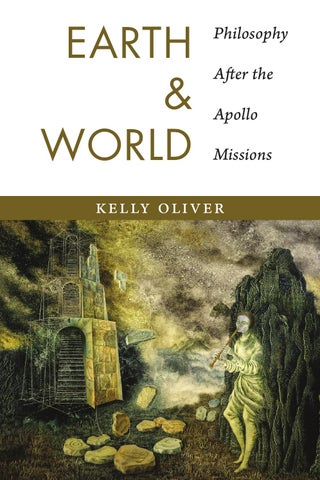
EARTH & WORLD
Philosophy After the Apollo Missions
Kelly Oliver
1 THE BIG PICTURE Philosophy After the Apollo Missions
Men’s conception of themselves and of each other has always depended on their notion of the earth. — A R C H I B A L D M AC L E I S H , “ R I D E R S O N E A RT H TO G E T H E R , B R OT H E R S I N E T E R N A L CO L D ”
T
he spectacular images from the 1968 and 1972 Apollo missions to the moon, Earthrise and Blue Marble, are the most disseminated photographs in history.1 Indeed, Blue Marble, the most requested photograph from NASA, is the last photograph of the planet taken from outside Earth’s atmosphere.2 Whereas Earthrise shows the earth rising over the moon, with elliptical fragments of each (the moon is in the foreground, a stark contrast from the blue and white earth in the background), the later image, Blue Marble, is the first photograph of the “whole” earth, round with intense blues and swirling white clouds so textured and rich that it conjures the three-dimensional sphere. Even more than previous photographs of Earth, the high definition of Blue Marble and the quality of the photograph make it spellbinding. Set against the pitch-black darkness of space that surrounds it, the earth takes up almost the entire frame. Unlike in Earthrise, in Blue Marble the earth does not look tiny or partial, but whole and grand. Both of these photos from Apollo missions (8 and 17) were immediately met by surprise, along
2
FIGURE 1.2.
THE BIG PICTURE
Earthrise. Image Credit: NASA
with excited exclamations about the silent beauty of this “blue marble,” this “pale blue dot,” this “island earth.”3 In the frozen depths of the cold war, and over a decade after the Soviets launched the first satellite to orbit Earth, Sputnik, these images were framed by rhetoric about the “unity of mankind” floating together on a “lonely” planet. At the same time as vowing to win the space race with the Soviet Union, the United States wrapped the Apollo missions in transnational discourse of representing all of “mankind.” Indeed, these now iconic images ignited an array of seemingly contradictory reactions. Seeing Earth from space generated new discussions of the fragile planet, lonely and unique, in need of protection. These tendencies gave birth to the environmental movement. At the same time, the Apollo missions spawned movements to unite the planet through technology. Heralded as man’s greatest triumph, the moon missions lead to a flurry of speculation on not just the technological
THE BIG PICTURE
3
mastery of the world, or of the planet, but also of the universe. While seeing Earth from space caused some to wax poetic about Earth as our only home, it led others to imagine life off-world on other planets. While aimed at the moon, these missions brought the Earth into focus as never before. The photographs of Earth from space sparked movements aimed at “conquering” our home planet just as we had now “conquered” space. Indeed, critics of these early ventures into space asked why we were concentrating so many resources on the moon when we had plenty of problems here on Earth, not the least of which was the threat of nuclear war (Time 1969). The Apollo missions were a direct outgrowth of this threat in terms not only of the significance of the race to space but also rocket technologies, which originated with military developments in World War II. The atom bombs dropped in Japan in 1945 heralded the nuclear age with the threat of total annihilation. And the development of rockets by both the United States and Germany as part of military strategies in WWII gave rise to rockets launched into space by the USSR and USA in decades that followed. Indeed, the U.S. recruited German scientists to work with NASA. Within a decade, we had gone from world war and the threat of genocide of an entire people, to the possibility of nuclear war and the threat of annihilation of the entire human race. And, within another decade or two (with Sputnik and then the Lunar Orbiter and Apollo missions and photographs of Earth from space), the world gave way to the planetary and the global. Following Heidegger, we might call this “the globalization of the world picture.”4 Indeed, upon seeing the Earth from space, Astronaut Frank Borman exclaimed, “Oh my God! Look at that picture over there! Here’s the Earth coming up. Wow, that is pretty! You got a colour film, Jim?” And William Anders responded, “Hand me that roll of colour quick.”5 The Earth had become a picture even before the photo was taken. Within a few short decades, the rocket science used by the military in WWII had given rise to the globalism that we have inherited today. From global telecommunications such as cell phones and Internet to global environmental movements, the Apollo missions moved us from thinking about a world at war to thinking about the unification of the entire globe. If, after seeing Earthrise, as Archibald MacLeish claims, “Men’s conception of themselves and of each other has always depended on their notion of the earth,” then, in order to understand ourselves and our interactions with other earthlings we need to ponder the meaning of earth and globe and the place of human and nonhuman worlds in relation to them.
4
THE BIG PICTURE
FROM GLOBALIZATION TO EARTH ETHICS In this book, we explore some philosophical reflections on earth and world, particularly insofar as they relate to the globe, and thereby to globalization, to begin to develop an ethics of earth, or earth ethics. Starting with Immanuel Kant, we follow a path of thinking our relations to each other through our relation to the earth. We move from Kant’s politics based on the fact that we share the limited surface of the earth, through Hannah Arendt’s and Martin Heidegger’s warnings that by leaving the surface of the earth we endanger not only politics but also our very being as human beings, to Jacques Derrida’s last meditations on the singular world of each human being. This trajectory leads us from Kant’s universal laws, which apply to every human being equally because we share the surface of the earth, through Arendt’s insistence on a plurality of worlds constituted through relationships between people and cultures, and Heidegger’s thoroughly relational account of world and earth as native ground, to Derrida’s radical claim that each singular human being—perhaps each singular living being—constitutes not only a world but also the world. In all of these thinkers we find a resistance to world citizenship and to globalization, even as some of them embrace different forms of cosmopolitanism. And yet, in their work we also find the resources to think the earth against the global in the hope of returning ethics to the earth. The very meaning of earth and world hang in the balance. So too does our relationship to earth, world, and to other earthlings. The guiding question that motivates this book is: How can we share the earth with those with whom we do not even share a world? The answer to this question is crucial in terms of figuring out whether there is any chance for cosmopolitan peace through, rather than against, both cultural diversity and the biodiversity of the planet. Can we imagine an ethics and politics of the earth that is not totalizing and homogenizing? Can we develop earth ethics and politics that embrace otherness and difference rather than co-opting them to take advantage of a global market? How can we avoid the dangers of globalization while continuing to value cosmopolitanism? Following the trajectory from Kant’s universalism to Derrida’s radical singularity, we explore different conceptions of earth and world in order to develop an ethics grounded on the earth. Inspired by Kant’s suggestion that
THE BIG PICTURE
5
political right is founded on the limited surface of the earth, and Derrida’s suggestion that each singular being is not only a world but also the world, we can articulate an ethics of sharing the earth even when we do not share a world. This earth ethics is based on our shared cohabitation of our earthly home. Building on insights from Kant, Arendt, Heidegger, and Derrida, we conclude with an ethics of earth that is formed through tensions between politics as the sphere of universals and ethics as the sphere of the singular, tensions between world and earth, or what Heidegger calls “strife” between the two. Our ambivalent place on earth is signaled in that tension. The tension between politics and ethics, world and earth, resonates with the contradictory reactions to the first images of earth from space, urges to master along with humility, urges to flee along with the urgent desire for home. Acknowledging our ambivalence toward earth and world may be the first step in accepting that, in spite of the fact that we cannot predict or control either of them, we are responsible for both. What we learn from Kant is that public right demands a universal principle of hospitality based on the limited surface of the earth. Although Kant limits hospitality to the right of visitation, still the “original common possession” of the earth’s surface becomes the basis for all political rights. Taken to its logical limits, Kant’s suggestion that political right is grounded on the earth as common possession undermines private property. In addition, the clear limit that Kant delineates between politics and morals begins to blur. What happens, then, when we start with Kant’s insights into the connection between politics and the earth and extend them to ethics? Here, Kant’s remarks on hospitality become the basis for an ethics of the inhospitable hospitality of the earth. Derrida famously extends Kant’s hospitality to its limit in unconditional hospitality to the point that we can no longer defend individualism or nationalism—indeed, to the point where we can no longer distinguish between host and guest, hospitality and hostility.6 Arendt too extends Kant’s notion of cosmopolitan hospitality to ground the always shifting “right to have rights,” which takes us beyond nationalism and toward our shared coexistence and cohabitation of both earth and world.7 Although Kant is clear that cosmopolitanism is a public or political right and not a moral one, he also insists on harmony between morals and politics.8 Contemporary criticisms of Enlightenment universalism, however, have reopened the split between morals and politics. Or, perhaps more to the point, both morals and politics are seen as at odds with ethics. If morality and political
6
THE BIG PICTURE
rights are necessarily universal, how can they account for singularity and the uniqueness of each individual? Derrida, among others, has tried to reformulate Kant’s principles of hospitality and cosmopolitanism in order to take into consideration the singularity of each person, even of each living being.9 The question, then, is: Can we negotiate between moral universalism and ethical particularism? Following Kant, Arendt, and Derrida, we must grapple with this tension between universal and particular, which sometimes shows up as a tension between nationalism and cosmopolitanism. In this vein, Arendt struggles with the tension between national rights and human rights. While she embraces the plurality and unpredictability of the human condition, she insists on the necessity and priority of state rights over generic human rights. She argues that the notion of human rights reduces the human being to its species, like an animal, and does not have the force of any law behind it. Unlike rights guaranteed by sovereign states, human rights come with no such guarantee. While she allows for international laws that might provide such protection for stateless peoples, she also argues in favor of state citizenship and reminds us of the importance of membership in nation states, at least in a world where international law does not provide adequate protections for stateless peoples.10 The Apollo missions with their America First rhetoric of winning the cold war along side their transnational rhetoric of goodwill to all mankind are emblematic of this tension between nationalism and cosmopolitanism. What we learn from Arendt is that politics is not primarily a matter of law, nor of hospitality per se, but rather it is based on the plurality of our cohabitation of both earth and world, a plurality through which we can and must create equality in the face of nearly infinite diversity. Arendt’s distinction between earth and world provides important resources for rethinking Kant’s notions of public and private right, the tension between morals and politics, and the notions of common possession and private property, especially in relation to war. For Kant, war is the result of the fact that we share the limited surface of the earth, and yet this same fact can and should eventually lead to perpetual peace. For Arendt, the plurality and diversity of our coexistence on earth leads to war; yet for the sake of politics, and ultimately for the sake of the endurance of human worlds, war must be limited. Arendt imagines a plurality of worlds formed through human interaction and relationships. While in some sense these worlds are of our choosing, in another sense they are radically unchosen. We are born into a world, worlds, and the
THE BIG PICTURE
7
world. Moreover, as she tells Eichmann, none of us has the right to choose with whom to share the surface of the earth. The unchosen nature of our earthly cohabitation gives rise not only to political obligations but also to ethical ones. And yet, as we learn from Heidegger, the givenness of our inheritance must be continually taken up as an issue for the sake of the future of each individual and each people. While it is true that we are born into a world that we do not choose and that the unchosen character of our earthly cohabitation brings with it plurality, diversity, unpredictability, and promise, in order to become properly thought it must be interpreted and reinterpreted. Going beyond Heidegger, we could say that the unchosen nature of our earthly habitation and cohabitation must be taken up in order to become properly political and ethical. In other words, the givenness of inhabitation and cohabitation is not enough in itself to ensure that we act ethically or extend political rights toward other earthlings or the earth. Going beyond merely sharing the earth’s limited surface or the plurality of cohabitation, Heidegger adds profound relationality that makes every inhabitant fundamentally constituted through its relation to its environment. This interrelationality is not just the result of earthly ecosystems that sustain the life of each individual and each species. Rather, for Heidegger, this interrelationality operates at the ontological level whereby the very being of each individual and each species comes into being through relationships and relationality. With Heidegger, we get a sense of what it means to cohabit the earth as a dynamic of buzzing, flowing, raging, blowing, thanking, thinking, dwelling, and warring. If for Kant and Arendt our relations to the earth and to the world ground political right and politics itself, for Heidegger our relations to earth and world are not only constitutive of our very being but also of the ethos in which we live, all of us together in strife and wonder, cohabitants of earth. Following Heidegger, we can begin to imagine sharing the earth, even if we do not share a world. But, moving beyond Heidegger, we can begin to articulate an ethics of earth based on this sharing and not sharing. What we learn from Derrida’s last seminar is that we both do and do not share the world. Emphasizing the profound singularity of each being—not just human beings—Derrida claims that with each one’s death the world is destroyed. This radical claim evokes a sense of urgency in relation to ethics and politics. Reformulating the tension between ethics and politics supposedly resolved by Kant, Derrida embraces the impossible intersection of
8
THE BIG PICTURE
ethics and politics, of the demand to respond to the singularity of each and the demand for justice for all. Derrida takes us beyond Kant’s notion of universal conditional hospitality to singular unconditional hospitality in the face of the absence of the world, particularly the world of moral calculation. This incalculable obligation to others—even the ones whom we may not recognize—challenges all political pluralities and notions of “peoples” in whose names “we” act. Derrida’s analysis brings to the fore the tension between ethical obligations that take us beyond calculation or universal principles and political obligations that necessitate calculation and universal principles. Emphasizing the radical singularity of each living being, in his last seminar Derrida employs the figure of an island. The island connotes isolation, even loneliness, cut off from civilization. Each singular life is an island cut off from all others. But even Robinson Crusoe on his desert island is not alone. The desert or deserted island is an illusion, a fantasy of autonomy and self-sufficiency. The ethical obligation that stems from the singularity of each living being is not Robinson Crusoe’s solipsistic delusion of mastery or control over himself or the plants, animals, and, ultimately, other humans that both share and do not share that island. On the one hand, Derrida insists that we do not share the world and that each singular being is a world unto itself, not just a world, but the world. On the other hand, and at the same time, we are radically dependent on others for our sense of ourselves as autonomous and self-sufficient, illusions that come to us through worldly apparatuses. We both do and do not share the world. With Derrida we get a sense of ethical urgency that we must return from the world to the earth. Even when the world is gone, the earth remains. Even if we do not share a world, we do share the earth. Moving from Kant’s political right founded on the limited surface of the earth, through Arendt’s plurality of worlds, and Heidegger’s profoundly relational account of earth and world, to Derrida’s ethics that begins when the world is gone, these chapters return earth to world and thereby ground ethics on the earth. This book brings the urgency and responsibility of ethical obligation together with a sense of home or habitat as belonging to a community conceived as ecosystem and ultimately as belonging to the earth. By emphasizing the radical relationality of each living being, together with our shared but singular bond to the earth, the island no longer appears deserted or isolated, but rather inhabited by immense biodiversity and surrounded by oceans teaming with life that we risk discounting at our peril.11 Indeed, the
THE BIG PICTURE
9
island is the meeting of land and sea, an in-between space, which provokes uncanny ambivalence. When we disavow the uncanny strangeness and our own ambivalence toward it, we then risk reducing the island to the fantasy of barren isolation or exotic paradise, neither of which is sustainable. The danger of the island metaphor is that it becomes a figure for isolation rather than a figure for the in-between, the meeting of land and sea. Even Derrida’s invocation of the island as a figure for singularity risks overshadowing the necessary interconnections and interrelationality through which, and in which, habitation happens. The island metaphor when extended to the earth itself discounts the very features that make the earth unique, namely the dynamic relationships between land and sea, globe and atmosphere, planet and solar system. Moving from Kant to Derrida, can we begin to articulate an ethics and politics grounded on the earth, not as isolated island or totalizing globe, but rather as the unknown and unpredictable source of diverse life on our uncanny earthly home. Earth ethics is grounded on the earth as the home to cultural diversity and biodiversity and a plurality of worlds.
WORLD WAR, EARTH ANNIHILATION Obviously, Kant never saw the Earth from space. But that didn’t stop him from imagining how it might look to alien space travelers. Kant’s appeals to extraterrestrials to make various points throughout his work are infamous.12 And, his philosophy of public right is based on thinking of the earth as a whole. Hannah Arendt was fifty-one years old when Sputnik sent photographs back to Earth, and she died three years after Apollo 17 sent back the now famous Blue Marble photograph. Martin Heidegger was sixty-eight when Sputnik circled the Earth, and he died one year after Arendt in 1976. News of Sputnik and photographs of Earth from space profoundly affected both Arendt and Heidegger. And both warned of the dangers of severing our connection to Earth in favor of interplanetary thinking. Jacques Derrida, who died in 2004, was only twenty-seven when Sputnik made its appearance. He gave his last seminars in Paris in 2002 just as the United States went after Al Qaeda in Afghanistan and waged war against Saddam Hussein for a second time, using the most technologically advanced military arsenal on the planet. One of Derrida’s last texts published before his death was Philosophy in a Time of Terror, his response to the attacks on the
Critically engaging the work of Immanuel Kant, Hannah Arendt, Martin Heidegger, and Jacques Derrida together with her own observations on contemporary politics, environmental degradation, and the pursuit of a just and sustainable world, Kelly Oliver lays the groundwork for a politics and ethics that embraces otherness without exploiting difference. Rooted firmly in human beings’ relationship to the planet and to each other, Oliver shows peace is possible only if we maintain our ties to earth and world. “In her brilliant new book, Oliver demonstrates precisely why philosophy could never be the same ‘after the Apollo Missions.’ She explores in an absolutely lucid and compelling way the ethical challenges and opportunities that emerged at the moment our planet—our environment, our home—was seen from outer space as that ‘blue marble.’” Michael Naas, DePaul University “Earth and World will make a superb contribution to environmental and continental ethics and will be widely read and taught in continental philosophy as an anchor text for growing interest in rethinking response ethics in the context of environmental and interspecies ethics.” Cynthia Willett, Emory University “Oliver connects Heidegger’s pivotal distinction between Earth and World to deliberations on cosmopolitanism from Kant to Arendt and Derrida and to thinking earth as the sustaining ground of not-just-human life. Drawing effortlessly on film and popular culture, this is a brilliant, lucid, and highly readable companion to the End Times.” David Wood, Vanderbilt University “An excellent book, well-composed, provocative at times, farreaching in its implications, and enduringly relevant to current issues and concerns.” Brian Schroeder, Rochester Institute of Technology K E L LY O L I V E R is W. Alton Jones Professor of Philosophy at Vanderbilt University. Her books include Technologies of Life and Death: From Cloning to Capital Punishment; Animal Lessons: How They Teach Us to Be Human; and Women as Weapons of War: Iraq, Sex, and the Media.
Columbia University Press New York cup.columbia.edu
Printed in the U.S.A. ISBN: 978-0-231-17087-1
9 780231 170871