FOR EWOR D The Eve Effect Wayne Koestenbaum
T
HE remarkable book you are now holding in your hands, Between Men: English Literature and Male Homosocial Desire, fi rst came out in 1985, one hundred years after the notorious Labouchere Amendment criminalized sexual relations (“gross indecency”) between men in the United Kingdom. (This legislation destroyed Oscar Wilde.) In 1985, five years into the disastrous reign of Ronald Reagan, the world discovered that Rock Hudson had AIDS. One year earlier, the retrovirus later designated as HIV had been isolated; two years after Between Men, ACT-UP (AIDS Coalition to Unleash Power) was founded. Between Men might not seem to you a book concerned with catastrophe, but it gained heat from its tragic context. The book spoke to the hunger for health, the craving to figure out history, the urge for accurate, sensitive, radically informed threshings of prior time. Looking backward to the ambiguous treasures of English literature, Eve Kosofsky Sedgwick sought to illuminate the revolutionary present and to shatter the binary fortresses that delimited contemporary bodies. Walter Benjamin’s name never appears in Between Men, but his dialectical spirit is latent in its pages: as critics, readers, gleaners, recollectors, we look backward because we want to march forward. In 1985, a reader interested in the history of male homosexual desire, especially as reflected in literature, had relatively few places to turn for guidance. I entered graduate school one year before Between Men came out; I remember longingly cruising the stacks of the university library in search of books that might point the way to the kind of antihomophobic critique that Sedgwick would pioneer. The landscape was
x
Foreword
parched, and we worshipped any oasis that appeared on the horizon. Alan Bray’s Homosexuality in Renaissance England (1985) and Jeffrey Weeks’s Coming Out: Homosexual Politics in Britain from the Nineteenth Century to the Present (1977) provided groundwork for what was not yet considered a field. Michel Foucault’s History of Sexuality: An Introduction (1978) sowed seeds, though not enough to make a meal. Also from France, with more punchiness and glistering eroticism than Foucault, came gorgeous Guy Hocquenghem’s Homosexual Desire (1978). From Italy came Mario Mieli’s manifesto, Homosexuality and Liberation: Elements of a Gay Critique (1977). In North America, John Boswell made a splash in 1980 with his Christianity, Social Tolerance, and Homosexuality: Gay People in Western Europe from the Beginning of the Christian Era to the Fourteenth Century ; a cognate splash—instructive, like an almanac—was Jonathan Ned Katz’s Gay American History (1976). Robert K. Martin’s valiantly exegetical The Homosexual Tradition in American Poetry (1979) exposed fertile terrain. There were other kindlings, momentary fl ashes: I felt lucky to sunbathe in the luster of Salmagundi’s special issue, “Homosexuality: Sacrilege, Vision, Politics” (1983), and in the claustral tanning booth of the hot but not thoroughly gay “Polysexuality” issue of Semiotext(e) (1981). These burnt offerings were the landmarks; they provided the overture. With Between Men, the curtain rose. And once the act began, two crucial differences in the framing of male homosexuality as academic subject immediately became apparent. Sedgwick introduces women into the equation, and she introduces the word “homosocial.” In fact, male homosexuals are not her subject at all. Her subject is men’s use of women as mediators; her subject is triangulation, and the erasure (or displacement) of sexuality through the transitive mechanisms of what she called “homosocial bonds.” The obdurate talisman “homosocial” opened doors. This word made it possible to be pruriently inquisitive about the business-as-usual arrangements of patriarchy. Between Men was published in a feminist series, Gender and Culture, edited by Carolyn G. Heilbrun and Nancy K. Miller. The fi rst two books in the series, In Dora’s Case: Freud—Hysteria—Feminism (1985) edited by Charles Bernheimer and Claire Kahane, and Breaking the Chain: Women, Theory, and French Realist Fiction (1985) by Naomi Schor, pursue feminist analysis through discussion of texts by men, thus establishing a context for Sedgwick’s work, which scrutinizes male– male relations through the zoom lens of feminism. Sedgwick was a
Foreword
xi
woman; wedging herself boldly into the male–male buddy huddle, she incarnates her argument by making clear that the fraternizing of men is a traffic that passes through and over her body, and that she, as woman, is uniquely qualified to comment on the traffic jam. This mélee, she also makes clear, need not recognize itself as sexual; she brilliantly changes the focus of the discussion from sexual behavior to sexual structure. Desire, as Sedgwick frames it, has an algebraic clarity and impersonality. Later in her career she would devote herself to affect theory, and would move away from an emphasis on (to put it reductively) structure as opposed to feeling, but at the time of Between Men, Sedgwick freed up the discussion of sexuality by not talking about it as sensation. Instead, she mapped human relations with the abstract and paradigm-happy clarity of an anthropological semiologist, in a language of vectors, angles, equations, additions, cancellations, and other chiasmatic patternings. Her academic background in French critical theory as it was then practiced (including the two Jacques—Derrida and Lacan—and the disreputable but indispensable Paul De Man) gave her a comfort with thinking big, thinking structurally, thinking rhetorically, and moving with Einsteinian freedom across the chalkboard, on which she could scrawl counterintuitive and doxa- destroying hieroglyphs. Her subject may have been English literature, but her style was polyglot, her vantage-point audaciously French, with Proust a haunting and largely unspoken terminus to the long tunnel she was driving through, a passage stretching from Shakespeare all the way to the buttressed promontories of D. H. Lawrence. For all the power of Sedgwick’s paradigms, and for all her fi nesse as theoretician, her greatest gift was language itself, which she worked like a baroque, recalcitrant instrument, a bellows she forced to make unaccustomed sounds, pushing critical idioms (the received postures of literary-critical academic writing) into unfamiliar torsions. Stylistically, her strongest influence was Henry James. She learned from his later manner—the baffl ing cantabile of The Ambassadors and The Golden Bowl —how to squeeze innuendo out of obscurity, how to take abstract words and put them to work as active agents, how to establish a knowing tone that casts fierce shadow, how to slip between chilly and torrid climes of diction, and how to maintain a pleasurably punitive atmosphere of harness and hairshirt while loosening every inherited stricture to make the vehicle glide. Some of the pleasures she tasted—and offered—came from adjectives. She favored adjectives like
xii
Foreword
“lambent” and “suasive” and “dilative” and “fi liated.” She instructed us on how to develop warmhearted attitudes toward words that might not have been part of our pleasure kit. She did not treat these words as poor parishioners or haughty sovereigns; she taught us how to love oddballs. Listen, for example, to how Sedgwick uses the word “crazing”: “If nowhere else—if not in thematics, if not in subject matter—then the electrified barrier of homophobia will do its crazing work on genre itself, on the bond between the man who writes the book and the man who officiates it” (133). She takes a verb, “to craze,” and, sliding past its more obvious connotations of madness, she backtracks into the word’s etymologically prior meaning. “Crazing,” in her hands, means to shatter with fine cracks. And the agent, in her sentence, that produces these estimable fissures on genre’s surface is homophobia, here described as an “electrified barrier.” Follow the beauty of her metaphoric drama: an electrified barrier named homophobia produces a fi ne (and aesthetically riveting) network of fissures on genre’s surface. Who knew that genre could be imagined as a ceramic vessel, and that homophobia could be portrayed as a craftsman-thug, turning the urn’s surface into a cracked and lunatic object? Thus Sedgwick manages to animate literary criticism and to three-dimensionalize our understanding of how sex-gender ideologies rupture and generate aesthetic forms. Her prose demands careful and imaginative reading; her sentences can excite a reader willing to think through the metaphors she lodges in surprising places and in words urged to assume unusual postures. She changed our ideas about matters that formerly provoked derisive laughter or shaming silence. About anality—a subject upon which she would continue, in her later books, to expatiate, with increasingly florid and gratifying results—Sedgwick issued stirring bulletins in Between Men, bulletins that were comic, clear, affi rmative, and egalitarian. She brought up the anus not to disparage it but to let it thrive. About Charles Dickens’s Our Mutual Friend, for example, Sedgwick writes: “Sphincter domination is Bradley Headstone’s only mode of grappling for power. . . . Unfortunately for him, sphincter control can’t give him any leverage at all with women” (169). Indeed, Bradley Headstone is “the most wrackingly anal of the characters” (170). Sedgwick’s contributions to her generation’s project of thinking through the body (which happens to be the title of a book by feminist critic Jane Gallop, also in Columbia University Press’s Gender and Culture
Foreword
xiii
series) rests on subtle tonal modifications: an adverb, wrackingly, when placed side by side with “anal,” turns the Freudianized abstraction “anality” into a visceral and tragic phenomenon of tortured pains (stretched out on the rack) and marine isolations (“shipwreck,” “seawrack”). Ideologies besiege—or craze—the body; the affective dimensions of ideology’s incursions are always present in Sedgwick’s writing and are always handled with an empathy spiked by wit. Look for the meanings in Between Men not merely in its clearest statements of program and purpose, but in the adverbs, adjectives, and other subordinate particles that cling to the argument and give it shape and individuality. Anyone today can talk about anality in Dickens (although, until Between Men, few if any critics had). But only Sedgwick could sound that Jamesian note of “wrackingly”; only she, through that extreme adverb, could guide our attention toward buried “fi liations,” toward lambencies that might, to lift one of her phrases, be “just the right lubricant for an adjustment of differentials of power” (79). Surprising locutions were to Sedgwick the lubricant permitting condensed illumination to flood the sensitive reader, who functioned as sister, ephebe, student, hermeneut, novitiate, ideology-wracked body, fellow sufferer. Sedgwick was thirty-five years old when this epochal book was first published. I don’t know how young thirty-five seems to you, reader, but thirty-five seems young to me, particularly given the grueling apprenticeship Sedgwick needed to serve before she could arrive at a summit like Between Men. She needed to absorb Marxism and psychoanalysis; she needed to be steeped in the history of feminist thought and the present reality of feminist action. She needed, before launching into an ambitious study spanning English literature from Shakespeare through Wilde, to write a more temporally modest dissertation. (Titled The Coherence of Gothic Conventions and published as a book in 1980, it predicted the contours of Between Men.) She needed to form herself into a discerning aesthete and a devoted poet. She needed to undergo the ritual presentation of her work-in-progress through conferences, lectures, and colloquia. She needed to expose her work to the possibly sadistic treatment it would receive at these events. She needed to endure getting “trashed.” “Trashed” didn’t mean getting drunk; it meant getting reviled. Much of the material in Between Men must have been presented, prior to publication, in public forums. In response to the book’s huge success and notoriety, Sedgwick began lecturing all over the country (and eventually, the world), and though
xiv
Foreword
she had legions of fervent admirers, she also had detractors, who could be spectacularly unkind. Some people objected to the abstraction and density of her language, and to her noninclusion of lesbian experiences and history. (Later, she would acknowledge and defend, with humility, that omission: “the absence of lesbianism from the book was an early and, I think, necessary decision” [18]. Notice the tentativeness, the honesty, of that simple phrase, “I think.”) Neoconservatives trashed Sedgwick for her radical sexual material; old-school men, both straight and gay, trashed Sedgwick for her up-to-the-minute modes. In the 1980s and 1990s, “trashing” was an accepted mode of academic critical encounter, and Eve, I remember, felt its bruises. Her prose’s authority, wit, and complexity—and its armored habitation of a scholarly apparatus and an esteemed academic publisher—belied her vulnerability. But the rewards were many—most of all, I suspect, the reward of knowing that she had altered an entire intellectual ecosystem, in which we are now gratefully living. I fi rst heard Sedgwick speak in the mid-1980s, when she gave a lecture, “Privilege of Unknowing,” about Denis Diderot’s La Religieuse. Between Men was already a sensation; she was riding its fi rst wave. Her public manner then (and, I surmise, for much of her professional life) was nervous, flushed, shy, animated, demure, candid—and impatient with those people who just didn’t “get it” and who used their incomprehension as a bludgeon. She wasn’t loud; she seemed to surround (and, as it were, to annotate) the delivery of her lecture with a sly, gratified atmosphere of quasi-erotic elation, a signal that she relished the provocations and complicities that she was bestowing on her audience. Aware that she was making an impression on people, she seemed to savor the seismic wave. This wave—the Eve effect?—made her listeners more curious, more intelligent, more consecrated to the vocation of being thrilled. The Eve effect animates and underlies her books: this force—her writing’s impetus—wishes to inspire, transform, transmit, and liberate. And Sedgwick, in Between Men, is a virtuoso. Conscious of her gift, she anxiously tends it, while delighting in its unforecasted explosiveness. Yet beneath her virtuosity there lies an ethical core—an empathic willingness to think about other people, about historical predicaments, and about how we can write our way into a world with less suffering, however minor our mitigations, however infi nitesimal our ability to assuage. Sedgwick used her virtuosity, throughout her career, in the service of opening up intellectual and emotional opportunities
Foreword
xv
for other people. The weft—or is it the warp?—of Between Men is this unsentimental and effortless generosity of impulse, this wish to license all varieties of pleasure, genital and not-genital, same-sex or not-samesex. This generosity allows her to reconstruct, for example, how a Shakespeare sonnet fleetingly gives women permission to enjoy autoerotic pleasure: “To attribute masturbatory pleasure to the woman is unusual in these poems—unusually benign and empathetic, I would say” (39). Virtuosity lies in highlighting the sonnet’s autoerotic innuendo; generosity lies in making the extra leap, attributing benignity to Shakespeare for granting his blessing to a woman’s sexual sensation. In this tiny moment of interpretive fi nesse, Sedgwick demonstrates that a good reason for a critic to be clever and to identify buried erotic metaphors in canonical poetry is to figure forth a society in which people are encouraged to take an empathetic and benign attitude toward sodomitical behaviors. In one quick critical aside, Sedgwick makes clear that she wants help us dream up a culture that gives ample acreage for unaccustomed pleasure, without shame. This small word, “pleasure,” also appears earlier in Between Men, when Sedgwick takes a moment to justify her choice of which texts to analyze. She justifies by not justifying. She confesses that she chose the texts at whim: “I have simply chosen texts at pleasure from within or alongside the English canon” (17). That brief phrase, “at pleasure,” has volcanic potential: she defends choices made from delight, not from reason, prudence, consensus, or capitulation. Pleasure is whimsical; sometimes pleasure can boil down to the privilege of using a strange word, like “wrackingly,” when there is no good reason to use it, no reason except that it gave pleasure to the writer to imagine a world in which “wrackingly” could precede the noun “anal,” a world governed by gratitude to other human beings for their differences, both stylistic and substantial. In 1985, the same year Sedgwick published Between Men, Susan Howe published her own revolutionary book of literary criticism, My Emily Dickinson. Its effect on literary communities had something in common with the effect of Between Men on its readers, although, at the time, no one (to my knowledge) remarked on how “fi liations” of queerness—errant and fugitive stylistics?—link the two books. (Incidentally, by this point in her career, Sedgwick had relocated from Boston University to the Dickinson-steeped Amherst College.) Howe broke the form of literary criticism through fragmentation, atopicality,
xvi
Foreword
autobiography, archival ingenuity, and other modes of refusal— including the refusal to take refuge in false authority. Sedgwick’s radicalism, stylistically, comes not from bricolage but from a parallel refusal to play by the rules. Nine years earlier, in 1976, Adrienne Rich published a landmark essay on Emily Dickinson, “Vesuvius at Home,” in Parnassus: Poetry in Review; this essay’s freedoms—its amalgamation of personal voice and critical commentary—align it with Howe’s treatise and with Sedgwick’s later work, in which autobiography would figure largely. I bring up Howe, Rich, and Dickinson here to place Sedgwick in a different lineage than the one she avows in Between Men. Although Between Men is not overtly a work of poetry or a work about poetry, I want to speculate that as much as it did to advance the progress of what became known, for a moment, as queer theory, it also encouraged—within critical work undertaken by scholars roused to emulation—the poetic freedom to choose at pleasure, with the understanding that pleasure is never a simple matter, never a rudimentary case of hydraulic release or frothy jouissance. I meant to end this foreword with a salute to Sedgwick’s Dickinsonian moltenness, but I’ve changed my mind. I want to end with a minor detail I’ve chosen at pleasure. That detail is a feather duster, which appears in Sedgwick’s analysis of George Eliot’s Adam Bede: “The change in Dinah as she ‘falls in love’ with the impervious Adam begins with the emergence of a new, silent, doglike eros whose only expressive faculty is through the eyes, and whose main erogenous zone is the feather-duster.” Sedgwick then quotes Eliot: “how the duster behaved in Dinah’s hand—how it went into every small corner” (142). I can sense Sedgwick’s eye pursuing the exigent path of the duster in Dinah’s hand. The glee—the inadmissible giggle—that Sedgwick produces in the reader, at the mention of Dinah’s feather duster, signals a rezoning of pleasure, a movement away from joy’s usual jurisdictions. Follow the feather duster. I can’t say that this detail will lead you to Dickinson, but it will lead you away from duty. It will lead you into small corners where vast plains open up—the perspective-defying, vertiginous angles that Sedgwick reveals with a density and graciousness that permit exaltation and inaugurate utopia.
P R EFACE
I
TO THE
1993 E DITION
WONDER if it’s obvious, reading Between Men now, what reckless pleasure went into its writing: The Osborne computer (“portable” at thirty-five pounds), whose tiny screen evoked the undefrostable windshield of a Volkswagen Beetle; the waxy takeout cartons of doublecooked pork that, far into the night, nourished me in my lit-up cell in the humming beehive of the Bunting Institute. My mantra was “I could be bagging groceries”— inexplicably cheering at a time when jobs were scarce, feminist criticism the most embattled of enterprises, and tenure nowhere on the horizon. I felt confident of nothing, nothing at all, but there was not a day when it didn’t seem an adventure and privilege to be writing this par ticular book. Between Men intended two main interventions. The most immediate audience I had in mind was other feminist scholars. I started work on the book at a moment when feminist scholarship seemed like a single project: little enough of it was being done then that it seemed possible, as well as urgent, to undertake feminist restructuring of a whole range of disciplines according to a relatively small number of powerful axioms. As a deconstructive and very writerly close reader, I was surprised, exultant, grateful to be lifted into the whirlwind of that moment of activist grand theory. I was, as well, acutely responsive to the empowering utopian intimations and the sustaining day-to-day excitements of working with communities of women thinkers. At the same time, like many other feminists, I also wanted—needed—feminist scholarship to be different. In particular, I found oppressive the hygienic way in which a variety of different institutional, conceptual, po-
xviii
Preface to the 1993 Edition
litical, ethical, and emotional contingencies promised (threatened?) to line up together so neatly in the development of a feminocentric field of women’s studies in which the subjects, paradigms, and political thrust of research, as well as the researchers themselves, might all be indentified with the female. Participating in each of these contingencies, I still needed to keep faith, as best I could, with an obstinate intuition that the loose ends and crossed ends of identity are more fecund than the places where identity, desire, analysis, and need can all be aligned and centered. I intended Between Men very pointedly as a complicating, antiseparatist, and antihomophobic contribution to a feminist movement with which, nonetheless, I identified fairly unproblematically. Not that I think the transferential poetics of identification and address are ever simple; they aren’t. But the undertows and opacities that perturbed the address of this book to a variety of women readers seemed, at the time, less weird than its phantasmic relation to a potential readership of gay men. Michael Lynch, a long-time pioneer of gay studies whom I met a few years later, told me his fi rst response to Between Men was “this woman has a lot of ideas about a lot of things, but she doesn’t know much about gay men!” He was so right. During the writing of Between Men, I was very involved with lesbian-inflected feminist culture and critique, but I actually knew only one openly gay man. From the 1990s vantage of an elaborated and activist gay/lesbian studies scene in academia, a vocal and visible national gay/lesbian movement, and (for me and many other women and men of various dissident sexualities) an emerging, highly productive queer community whose explicit basis is the criss-crossing of the lines of identification and desire among genders, races, and sexual defi nitions, it’s hard to remember what that distant country felt like. Rereading the book now, I’m brought up short, often, with dismay at the thinness of the experience on which many of its analyses and generalizations are based. Yet I’m also relieved, and proud, that its main motives and imperatives still seem so recognizable. A growing gay and lesbian studies movement already existed in American academia at the time (a look back at the Gay Studies Newsletter, under Lynch’s editorship, shows how active, as well as how precarious it was); an intensely vital gay liberation culture was also being created in any number of urban spaces. So I don’t know how to account for the dependence of this book on much more distant traditions of gay thought, mostly British or European: the work of Jeffrey
Preface to the 1993 Edition
xix
Weeks, Guy Hocquenghem, Paul Hoch, Mario Mieli, Alan Bray. Already published in books and translated into if not written in English, these texts appear in Between Men as canonical or established secondary sources by authors who might—for any sense Between Men gives of their contemporaneity—have been dead for a century. They function in the book as objects of an almost theologically speculative meditation, rather than as evidence of lives and communities actually, presently inhabited. That there was something (in this sense) irrepressibly provincial about the young author of this book is manifest. But will it make sense if I describe that provinciality as not only a measure of her distance from the scenes of gay male creativity, whose utopian invocation tacitly motivates the book, but also a ground of her passionate, queer, and fairly uncanny identification with it? The more than Balzacian founding narrative of a certain modern identity for Euro-American gay men, after all, vibrates along a chord that stretches from provincial origins to metropolitan destinies. As each individual story begins in the isolation of queer childhood, we compulsorily and excruciatingly misrecognize ourselves in the available mirror of the atomized, procreative, so-called heterosexual pre- or ex-urban nuclear family of origin, whose bruisingly inappropriate interpellations may wound us—those resilient or lucky enough to survive them—into life, life of a different kind. The site of that second and belated life, those newly constituted and denaturalized “families,” those tardy, wondering chances at transformed and transforming self- and other-recognition, is the metropolis. But a metropolis continually recruited and reconstituted by having folded into it the incredulous energies of the provincial. Or—I might better say—the provincial energies of incredulity itself. There’s a way in which the author of this book seems not quite to have been able to believe in the reality of the gay male communities toward whose readership the book so palpably yearns. The yearning makes the incredulity. It makes, too, however, the force of a bond with at least some readers equally incredulous (in that distant moment) at the encounter with the book’s own intimate, desiring, direct address, emanating from an unaccustomed and, to some degree, unspecified place on the map of cultural authority, of gender/sexuality, of disciplinarity. Obsessions are the most durable form of intellectual capital. So perhaps it’s folly to second-guess them, even though it seems patent that the intellectual enablements of this obsessionally motivated project were also interlined with profound blockages. Blockage and frozenness have seemed
xx
Preface to the 1993 Edition
to characterize its address, in particular, to many of the women queer readers whose incredulous desire it has also solicited. In fact Between Men has evoked rage (perhaps among other responses) on a continuing basis from many readers. For that matter, virtually all the readers who have forcefully used it have drawn, I believe, on a hardly less heterogeneous and conflictual spectrum of responses to it. The proliferation, the remarkable creativity of so much subsequent work in the field may say something—I hope it does—for the direct or oblique energizing powers of an unconventional literary intervention like Between Men. But it has vastly more to say for the inveterate, gorgeous generativity, the speculative generosity, the daring, the permeability, and the activism that have long been lodged in the multiple histories of queer reading. November 1992
“Between Men will lead you into the small corners where vast plains open up— the perspective-defying, vertiginous angles that Sedgwick has the power to reveal with a density and graciousness that permit exaltation and inaugurate utopia.”
First published in 1985, Between Men was a decisive intervention in gender studies, a book that all but singlehandedly dislodged a tradition of literary critique that suppressed queer subjects and subjectivities. With stunning foresight and conceptual power, Eve Kosofsky Sedgwick’s work opened not only literature but also politics, society, and culture to broader investigations of power, sex, and desire, and to new possibilities of critical agency. Illuminating with uncanny prescience Western society’s evolving debates on gender and sexuality, Between Men still has much to teach us. With a new foreword by Wayne Koestenbaum emphasizing the work’s ongoing relevance, Between Men engages with Shakespeare’s Sonnets, Hogg’s The Private Memoirs and Confessions of a Justified Sinner, Tennyson’s The Princess, Eliot’s Adam Bede, Thackeray’s The History of Henry Esmond, Esq., and Dickens’s Our Mutual Friend and The Mystery of Edwin Drood, among many other texts. Its pathbreaking analysis of homosocial desire in Western literature remains vital to the future of queer studies and to explorations of the social transformations in which it participates.
MEN
Wycherley’s The Country Wife, Sterne’s A Sentimental Journey Through France and Italy,
BET W EEN
—From the foreword by Wayne Koestenbaum
BET W EEN
MEN E V E KO S O F S K Y S E D G W I C K F O R E WO R D BY WAY N E KO E S T E N B AU M
“One of the most influential texts in gender studies, men’s studies, and gay studies.” —Catharine R. Stimpson, New York Times Book Review
“Universally cited as the text that ignited gay studies.” “Clever, shocking, and probably irrefutable, Between Men is wonderfully readable.” —Carolyn G. Heilbrun
EVE KOSOFSKY SEDGWICK (1950–2009) was Distinguished Professor of English at the Graduate Center, City University of New York. Her books include Tendencies; A Dialogue on Love; Touching Feeling: Affect, Pedagogy, Performativity; The Coherence of Gothic Conventions; and Epistemology of the Closet.
SEDGWICK
—Rolling Stone
English Literature and Male Homosocial Desire
WAYNE KOESTENBAUM is Distinguished Professor of English at the Graduate Center, City University of New York.
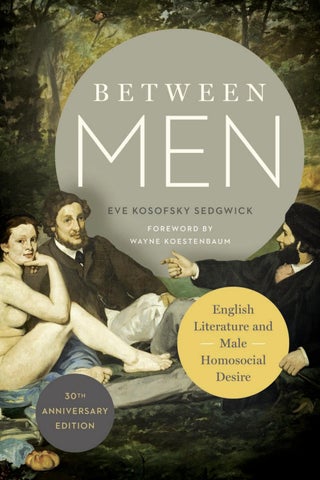
C OV E R D E S I G N : FAC E O U T ST U D I O, K A R A DAV I S O N C OV E R I M AG E : É D O UA R D M A N E T, T H E LU N C H EO N O N T H E G R A S S , 1 8 6 3 © H E R I TAG E I M AG E S /C O N T R I B U TO R /G E T T Y
COLUMBIA UNIVERSITY PRESS N E W YO R K cup.columbia.edu
Between-Men-TP-MECH.indd 1
3 0 TH AN N IVERSARY
G E N D E R A N D C U LT U R E ISBN: 978-0-231-17629-3
ED ITI O N
9 780231 176293 P R I N T E D I N T H E U. S . A .
COLUMBIA
10/5/15 2:11 PM