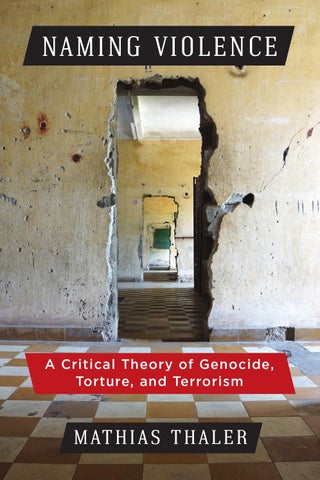
NAM I N G VI O LE N CE
A Critical Theory of Genocide, Torture, and Terrorism
M AT H I A S T H A L E R
2 TELLING STORIES On Art’s Role in Dispelling Genocide Blindness
I
f there is one common denominator in global politics today, it appears to be the universal abhorrence and condemnation of genocide. No matter where their political allegiances or ideological commitments lie, politicians and citizens around the world will concur that genocide is among the worst crimes human beings can commit. Indeed, some commentators have suggested we should consider it the “crime of crimes,” setting it apart from other horrific acts committed during war or in peacetime. If the twentieth century has taught us anything, it is surely that states whose sovereignty remains unchecked tend to engage in unspeakable atrocities. Genocide, as one prominent author intimates, is a “problem from hell,”1 not only for those directly affected by it, but also for the wider public witnessing these atrocities from afar. What needs to be done when genocides occur has become increasingly evident: simply standing by is not an option anymore. With the establishment of the International Criminal Court in 2002, and the emerging doctrine of a “Responsibility to Protect,” it now seems clearer than ever that perpetrators of genocide will have to face prosecution for their deeds. Impunity for mass violence can nowadays be countered in many different ways. A closer look, however, reveals that the condemnation of genocide is occasionally accompanied by a lingering suspicion about the ways in which the word genocide is abused in public discourse. It is often maintained that
46 TE LLING STO RIES
invoking genocide serves political purposes that are drowned out by the high pitch of public outrage: genocide figures, in Mahmood Mamdani’s words, as the “antithesis of the Nobel Prize, part of a rhetorical arsenal that helps you vilify your adversaries while ensuring impunity for your allies.”2 Critics point out that geostrategic interests explain the depiction of one conflict as genocide and another one as civil war. It matters enormously, on this perspective, whether states manage to attach specific labels to remain in control of the politics of naming—a genocide calls for a different kind of response than a civil war. How should political theorists react to the fact that notions like genocide are vulnerable to manipulation? Should we resign ourselves and conclude, “Well, so be it—politics is inherently messy, and political theory’s goal is not to take this messiness at face value, but rather to abstract from it so as to sketch a clearer picture of what makes ‘genocide’ special”? Earlier I stated that I find this rejoinder unsatisfactory for a variety of reasons: first, it betrays an understanding of how political theorists stand vis-à-vis their audience that seems undemocratic and monological. Political theory ought to talk to and in dialogue with the public, not speak at it. Withdrawal from the messiness of politics is a form of escapism that should be resisted. Second, even if withdrawal were an option, it misconstrues the role normative arguments play in public discourse. Although I reject the generalized suspicion of authors like Mamdani, I agree with their basic claim that definitions of political violence cannot simply be extracted from their everyday usages, lest we violate the democratic and dialogical premises on which political theory should rest. Third, the aforementioned attitude of shrugging off the messiness of “genocide” in public discourse fails to appreciate the dynamic forces driving conceptual transformations in light of changing social facts. Political theorists should, in the spirit of amelioration, try to redescribe terms so that they capture more appropriately the character of violence permanently in flux. But in these attempts at redescriptions, they are not isolated actors—writers as well as filmmakers and other artists offer rich resources too. In this chapter, I therefore hope to widen political theory’s horizon of engagements: from the conceptual to the aesthetic realm.
TE LLING STO RIES 47
2 .1 . A S H O RT H I S TO RY O F G E N O C I D E : CO N C E P T UA L I N N OVAT I O N
The concept of genocide has a peculiar history, which includes conceptual innovation, legal codification, political contestation, and theoretical redescription of the sort that we have called “amelioration.” In order to unravel how these distinct elements—innovation, codification, contestation, and ameliorative redescription—have been evolving, let us begin with the initial step in this history. How and when did the word genocide become part of our social and political vocabulary? Where did it originate? It was the Polish-American jurist Raphael Lemkin who first linked the Greek word for race or kind (genos) to the Latin root for murder (-cide).3 In Axis Rule in Occupied Europe, originally published in 1944, Lemkin dealt with various instances of mass violence that took on a characteristic form, which he argued was hitherto unknown to human societies.4 As a student at the University of Lvov in the 1920s, Lemkin learnt about the pogroms of Jews in Ukraine after the Russian Revolution and about the massacres of Anatolian Armenians at the hands of the Ottoman Empire.5 The knowledge of these extermination campaigns exerted a massive influence on the young scholar: since the perpetrators enjoyed absolute impunity from prosecution, Lemkin felt the urge to devise legal mechanisms to account for their crimes. During World War II, by now a refugee living and working in the United States, Lemkin started to examine historical as well as contemporary mass violence with increasing rigor. It is crucial to remember that Lemkin himself was a victim of the very phenomenon he set out to explore: almost his entire family was murdered in the Treblinka concentration camp. While the “industrial” killing of Jews—what we today call the “Holocaust” 6—provided an important impetus for Lemkin’s research, his engagement with mass violence was equally shaped by a deep interest in early modern as well as more recent colonial conflicts.7 What is it that makes genocide special, on Lemkin’s view? In what ways is it different from other murderous activities? Lemkin had a definite answer to these questions. For him, genocide
48 TELLING STO RIES
does not necessarily mean the immediate destruction of a nation, except when accomplished by mass killings of all members of a nation. It is intended rather to signify a coordinated plan of different actions aiming at the destruction of essential foundations of the life of national groups, with the aim of annihilating the groups themselves. The objectives of such a plan would be disintegration of the political and social institutions, of culture, language, national feelings, religion, and the economic existence of national groups, and the destruction of the personal security, liberty, health, dignity, and even the lives of the individuals belonging to such groups.8
Note here the contrast between “immediate destruction” and the “destruction of essential foundations of the life of national groups”: Lemkin claimed that the latter was characteristic of all genocides, whereas the former applied only to some genocides.9 Contrary to later legal interpretations, Lemkin thus believed that mass killings were not intrinsic to genocide. Although some commentators now insist that there can be no genocide without mass killings, this was evidently not Lemkin’s position. Consider further that the paragraph speaks of “national groups” without specifying what constitutes such groups. Lemkin adhered to what we might now call a “communitarian” view of groups: as his autobiographical writings reveal, he averred that national groups possess intrinsic qualities that set them apart from looser voluntary associations.10 Due to their permanence, they provide the material and ideological basis for cultural development and human flourishing, and must therefore be protected in their own right, not only because these national groups are composed of individuals. Lemkin also thought that protecting national cultures in this broad sense was a precondition for the promulgation of “high culture” in a much narrower sense: the world’s cultural heritage would have been massively impoverished “if the so-called inferior peoples doomed by Germany, such as the Jews, had not been permitted to create the Bible or to give birth to an Einstein, a Spinosa; if the Poles had not had the opportunity to give to the world a Copernicus, a Chopin, a Curie, the Czechs a Huss, and a Dvorak; the Greeks a Plato and a Socrates; the Russians, a Tolstoy and a Shostakovich.”11
TELLING STO RIES 49
We can, then, read his reference to groups in light of their significance for a diverse and multifaceted world, imbued with various cultural traditions and rich resources of collective meaning. If groups contain entire ways of life, the elimination of a group would not only eradicate the constituent members of that group, but diminish the potential of all of humanity. It is in this sense that Lemkin can be described as a “deep pluralist” about groups: an attack on one of them is effectively an attack on all of humankind.12 Lemkin stated that genocide always comprises two stages: a first phase during which the national characteristics of the oppressed group are being eradicated; and a second phase during which the oppressor group imposes its own cultural, social, and political identity on the oppressed group.13 This pattern of extreme domination can go hand in hand with attempts to completely eviscerate a people by killing all of its members. As Lemkin observed with regard to Nazi Germany, some national groups, which were deemed related by blood, such as the Dutch and the Norwegians, were targeted for “Germanization” measures, whereas others—the Jews of Eastern Europe in particular—were sent directly to the extermination camps.14 In creating the neologism genocide, Lemkin thus issued a distinct judgment about the specific kind of violence that he saw materializing, characterized by the targeted destruction of entire peoples. Even though his research reached back to early modern colonial enterprises, Lemkin also thought that the late nineteenth and early twentieth centuries brought with them radically new forms of violence that were the result of imperial power politics. The inherited terms—mass violence or Germanization— were simply not suitable for describing the complex phenomenon he intended to capture. While the historical emergence of the concept of genocide has by now been thoroughly examined, foregrounding in particular Lemkin’s own research and activism,15 the legal codification of genocide in international law is also worthy of sustained attention. The backbone of this story can be reconstructed as follows. Before the end of World War II, the Allied Forces were already reflecting on how to hold the Nazi leadership to account. Various options were considered, but ultimately the idea was formed to prosecute and try them by an international tribunal. This plan
5 0 TE LLING STO RIES
was realized through the establishment of the International Military Tribunal (IMT), which operated in the German city of Nuremberg from 1945 to 1946. When speaking of the “Nuremberg trials” generically, we today refer to thirteen distinct trials that dealt with Nazis from different social and political spheres, ranging from the SS to the industry.16 The most prominent of these trials has been the so-called Trial of the Major War Criminals. Twenty-four Nazi leaders were indicted, among them Hermann Göring, in a highly publicized manner. Twelve cases ended in death sentences. Although it would take many years of scholarship to reveal the true extent of the Nazi atrocities, Nuremberg was indeed a “turning point”17 in our grasp of the Holocaust: it did not primarily concentrate on the extermination of the Jews, but still brought Nazi crimes to the fore that had hitherto been considered unthinkable. It is thus appropriate to interpret the Nuremberg trials as “collective pedagogy and as a salve to traumatic history.”18 How did the charge of genocide figure in these trials? In Article 6, the IMT’s Charter stipulated three crimes of which the defendants would ultimately be accused: crimes against peace, war crimes, and crimes against humanity. The fact that the IMT’s Charter referred to crimes against humanity, and not genocide, has been a source of perplexity. As we shall see shortly, in later days the two crimes became more disambiguated, but this was not yet the case during the Nuremberg trials, where the prosecutors “employed the word genocide as if it was more or less synonymous”19 with crimes against humanity. For example, the defendants in the Trial of the Major War Criminals were indicted with “deliberate and systematic genocide, viz., the extermination of racial and national groups, against the civilian populations of certain occupied territories in order to destroy particular races and classes of people, and national, racial or religious groups.”20 Even though genocide itself was not mentioned at all in the judgments of the Nazi criminals, the concept had gained increasing currency among lawyers and diplomats.21 Lemkin’s magnum opus, Axis Rule in Occupied Europe, was extensively consulted by the delegation members in Nuremberg. But since it was not yet legally codified, the term genocide carried various meanings that roughly cohered around the charge of crimes against humanity, without really consolidating into a more definite concept. In line with the author’s original intent, Lemkin’s neologism therefore served the purpose
TE LLING STO RIES 51
of covering a “broad policy program, composed of a set of crimes, and of various ‘techniques’ directed against several victim groups, and with the broad aim of gaining new ‘living space’ for the purpose of colonization rather than being exclusively defined as a deliberate crime targeting an entire extermination of one single ethnic group.”22 This account testifies to the ambiguous reception of the concept of genocide in the immediate aftermath of World War II. While it was acknowledged by the Allied Forces that the Nazi’s crimes called for novel types of prosecution, the political as well as legal language with which to describe these crimes had not yet been fully developed. Although several postwar trials included prosecutions for genocide, these were not always motivated by a clear sense of what distinguished it from such crimes as denationalization, a war crime that had been recognized in international law since the end of World War I.23
2 . 2 . L EG A L CO D I FI C AT I O N : CO N S O L I DAT I N G M E A N I N G
The semantic openness of the term would eventually come to an end with the codification of genocide in international law. As the postwar world order began to take shape, the new United Nations Organization set itself the immediate task of creating a novel set of principles that would govern global politics without the resort to violence, while allowing for the possibility of collective and individual self-defense. The most prominent result of this process was the creation of the Universal Declaration of Human Rights (UDHR) in 1948.24 It was clear from the outset that the UDHR would serve primarily as an aspirational document, whose full realization depended on the cooperation of actors that had, at the outset of the Cold War, become sworn enemies. The hope was that a prohibition of specific atrocities might hold a more realistic chance of implementation. To this effect, the UN General Assembly tasked the Economic and Social Council with devising a first draft of a convention on genocide. Lemkin was one of three scholars and jurists who served as experts to the committee.25 In the autumn of 1948, the Sixth Committee of the General Assembly analyzed the draft of the
52 TELLING STO RIES
convention and finally submitted it to the General Assembly for adoption in December. Three years later, in 1951, the Convention on the Prevention and Punishment of the Crime of Genocide became international law, as enough states had ratified it.26 With Lemkin as a legal consultant, the discussions during the drafting phase were naturally influenced by his conception of genocide. However, Lemkin’s impact was not always straightforward. Consider, for example, the way Article 1 of the draft defined the Convention’s purpose as preventing “the destruction of racial, national, linguistic, religious or political groups of human beings.”27 The groups protected by the draft Convention clearly go beyond the national communities envisaged by Lemkin. What is more, by including political groups, the draft covered collectives that were held together solely on the basis of voluntary association—a view not shared by Lemkin’s original conceptualization.28 This is why Lemkin opposed the subsumption of political groups under the Convention’s protective umbrella—they “lacked the required permanence.”29 Lemkin also observed that including “political groups” would be highly controversial, and risked dividing world opinion. Another expert advising the drafters, however, retorted that excluding “political groups” might have the effect of “justifying genocide in the case of such groups.”30 Although it has frequently been suggested that the Soviet Union alone opposed the inclusion of “political groups,” William Schabas has demonstrated that, in fact, a great variety of states rejected the initial draft. Stalin’s extermination campaign against “class enemies” and “enemies of the people” on the home front certainly influenced the Soviet Union’s reluctance to include “political groups,” but other states—and indeed Lemkin himself—rejected the draft’s position in this respect as well.31 A long-winded process of negotiations, both politically motivated and intellectually driven, thus propelled the Convention’s drafting process forward. While some elements of Lemkin’s original conception were readily absorbed into the agreed-on text, others were substantially modified or relinquished altogether. The controversy around “political groups” is just one episode among many testifying to these contested dynamics of legal codification. Focusing now on the final result, the Convention defines genocide in Article II as
TELLING STORIES 53
any of the following acts committed with intent to destroy, in whole or in part, a national, ethnical, racial or religious group, as such: (a) Killing members of the group; (b) Causing serious bodily or mental harm to members of the group; (c) Deliberately inflicting on the group conditions of life calculated to bring about its physical destruction in whole or in part; (d) Imposing measures intended to prevent births within the group; (e) Forcibly transferring children of the group to another group.32
This is not the place to add to the jurisprudential hermeneutics of each element of this definition. Needless to say, ever since the Convention came into force, interpreting the definition has become an enormous challenge for scholars and practitioners searching for “legal certainty.”33 What counts as a stable group, for example, is inherently underdetermined by the Convention, and was contentious even during the drafting phase, as we have already seen. A few comments will still be necessary to help us understand later attempts to theoretically redescribe genocide. The Convention remains the main anchor point for all the contemporary discussions around genocide, no matter whether they are purely interpretive or revisionist in nature. Within a few decades, the Convention has become a document with real institutional power: the ad hoc tribunals for the former Yugoslavia and Rwanda as well as the Rome Statute of the International Criminal Court simply adopted the Convention’s definition of genocide without modification. That the Rome Statute basically copied a fifty-year-old definition underlines that prosecuting perpetrators of genocide has now become a “customary international norm.”34 With regard to the definition in the Convention, let us merely highlight two aspects, which have triggered much controversy: (1) the idea that genocide must be committed with “intent” and (2) the idea that groups may be targeted “in whole or in part.” “Intent” on the part of the perpetrators is a necessary condition for the occurrence of genocide. That means that a genocidal act (actus reus) must be based on a volitional set of beliefs (mens rea). To be more precise, legal scholars speak of a “double mental element” when characterizing the intent condition of genocide.35 This means that the “intent to destroy” a particular group in whole or in
5 4 TE LLING STO RIES
part is judged independently from the volitional set of beliefs, the expression of which is the actus reus. To clarify this double mental element, consider the following: trying someone for genocide requires the court to establish both the perpetrator’s “general intent” to engage in a genocidal act and the “special intent” (dolus specialis) to will the destruction of a group, as defined by the Convention. The ultimate goal of the acts prohibited under the Convention must thus be shown to entail this destructive element. The intent condition with its double mental element can create significant hurdles for prosecuting génocidaires. While some perpetrators are reckless enough to openly announce their plans to engage in violence by directly threatening their enemies—as has been the case during the Rwandan genocide, which was incited by radio shows and other media outlets—the vast majority of perpetrators refrains from explicitly mentioning their “intent to destroy” a particular group. This has the obvious consequence that prosecutors usually attempt to examine the “general context” within which genocide takes place.36 In the absence of an openly available pronouncement on behalf of génocidaires, proving intent thus depends on the ability to systematically infer from their deeds that the perpetrators in fact pursued a premeditated plan when engaging in separate genocidal acts. Such techniques of reconstructing the “special intent” of perpetrators highlight a broader concern with international criminal law: the evidentiary basis on which these trials rest is more often than not rather thin. Given that “today’s international criminals no longer leave a clear paper trail of their offenses,”37 much of the forensic verification of genocide might amount to “factfinding without facts,” to borrow the title of a recent book on this topic. The second element of the definition of genocide I wish to highlight concerns the parenthesis “in whole or in part.” Recall that Lemkin described genocide simply as “the destruction of a nation or of an ethnic group.”38 Lemkin did not specify whether a certain number of people would have to be killed for acts of atrocity to qualify as genocide. On this view, there is no threshold above which mass killings turn into genocide; what matters is the kind of destruction waged against the group as such. However, the Convention’s use of “in whole or in part” complicates matters significantly as it remains difficult to establish with certainty that the special intent to destroy a group can be deduced from a génocidaire’s
TELLING STO RIES 55
actions, who has only succeeded in targeting a few victims. How many people need to be attacked for a court to deduce that the “double mental element” is indeed present? Samantha Powers calls this the “numbers problem.”39 In light of this challenge, international tribunals have begun to apply a “quantitative criterion” so as to render the inference of intent more workable. This move has raised concerns about the effect such a criterion might have for the overall goal of protecting groups—if only a sufficiently high number of victims ensures that intent can be inferred, this might undermine the very “object and purpose of the Genocide convention.” 40 Although there is a lot of confusion around the exact meaning of the phrase, “in whole or in part” applies to the perpetrator’s intent, and not to the result of his or her actions: it is about what génocidaires seek to achieve, not what they actually achieve. So how can, then, the “in whole or in part” clause be interpreted more specifically? With Schabas,41 we may distinguish between four hermeneutic strategies: The first interpretation is that the outcome of a génocidaire’s actions might be limited, but their intent must have been the destruction of an entire group. The second interpretation reads the qualification in terms of a substantial part of the targeted population. On this account, it is not necessary for a génocidaire to will the destruction of an entire group, but he still has to have the intention to target a substantial part of that group. The third interpretation emphasizes the character of the subgroup: if the perpetrator directly attacks a significant subgroup—usually a social, economic, or political elite—then it can be deduced that he or she has genocidal intent. The idea behind this understanding is that a group, as defined by the Convention, cannot survive without its leaders, who are involved in the management and promotion of the group’s affairs. The fourth interpretation focuses on the area in which the genocidal acts occur. For genocide to occur, it is not indispensable that the perpetrators hunt down a group around the globe. Here, “in part” means that the génocidaires restrict their actions to a geographically delimited zone. These observations on two prominent issues arising from the consolidation of the meaning of “genocide” shall serve as the background against which I explore how debates outside of the legal realm have unfolded. For, as I have suggested earlier, the genocide debate naturally exceeds the sphere of legal reasoning. The next section will therefore examine
5 6 TELLING STO RIES
attempts at theoretical redescription: how political theorists have sought to grapple with the vulnerability of genocide to manipulation and abuse.
2 . 3 . T H EO R E T I C A L R E D E S C R I P T I O N S : T WO WAYS O F D ECO N T E S T I N G G E N O C I D E
Ever since Raphael Lemkin coined the term genocide to capture the horrors of collective violence targeted at groups as such, legal theorists, practical philosophers, and social scientists have been struggling over the exact meaning of the term. One reason for this struggle, as we have remarked, is the inherent indeterminacy of the definition, which has been causing significant challenges for lawyers and practitioners alike. Another reason, however, is independent of the indeterminacy of the definition. Due to its institutional power, raising the accusation of genocide bears some real weight in terms of exerting political pressure on perpetrating states. The ongoing controversies around genocide can thus be explained by an obvious fact: states accused of planning to commit, or of committing, or of having committed genocide are de facto outcasts of the international society, on whom economic, diplomatic, and even military sanctions might be imposed.42 In reaction to this, many perpetrators disguise their genocidal acts once they are met with allegations. This strategy extends to both past and ongoing genocides. For a recent example, consider the statement of Serbia’s former president Tomislav Nikoliʉ that there “was no genocide in Srebrenica”43—a proclamation that contradicts all the available evidence, twenty years after the massacres occurred. Recall also Turkey’s ongoing denial of what has become one of the most researched cases of genocide—the mass atrocities directed at Anatolian Armenians.44 People often vehemently clash over the question of whether a concrete outbreak of violence should be named genocide. As we can witness, for example, in the case of Darfur, the public debate usually goes through cycles of contestation, where the past, the present, and the future are turned into battlefields. These engagements with the social reality of violence can be summed up as the “genocide debate” in the widest sense,
TELLING STO RIES 57
bringing together a multitude of actors, from academics, to political stakeholders, to affected victims.45 Given the confounding uses of the word genocide, several authors46 have intimated that the term might be considered, using W. B. Gallie’s terminology, an “essentially contested concept,” whose meaning cannot be settled through conceptual analysis alone.47 There is some confusion in the literature about what specifically constitutes a concept, so suffice it here to say that certain words in political discourse—such as genocide— have over time become “characteristically contested, but this is often because . . . they have historically accrued a great deal of either approbation or disapprobation.” 48 So, how ought one to react when faced with a word, like genocide, that has indeed accrued a great deal of disapprobation? The problem is not only that lawyers find it difficult to impute unequivocal meaning to the Convention’s definition, or that political actors do everything in their power to deflect charges of genocide, by claiming that actions performed under their control have not amounted to genocide. The challenge is also that the academic discussion has become gradually disconnected from public discourse. The legal definition of genocide is increasingly at odds with the ways in which ordinary citizens understand and make use of the word. One might, of course, retort that this is true for law’s vocabulary in general. After all, legal reasoning operates with a technical apparatus that is accessible only to those who have learnt to consistently apply it in concrete situations. But offenses in international law, such as genocide or crimes against humanity, reveal a deep rift between what the law prescribes and what the public discusses. Accordingly, David Luban asserts that the jurisprudential argument around the distinction between genocide and crimes against humanity is going into the opposite direction from media controversies. Examining the Darfur debate in 2007, he points out that the requirement to establish the perpetrators’ intent to commit genocide might run counter to everyday discourse, where “we think of genocide as deliberate annihilation of masses of civilians, regardless of the specific intention. That means that for non-lawyers . . . the crime against humanity of exterminating civilian populations is genocide.” 49
5 8 TELLING STO RIES
One possible rejoinder to this conundrum would be to abandon the notion of genocide altogether. David Scheffer, for example, proposes to replace the legal term genocide with the concept of atrocity crimes, which would encompass crimes against humanity, the worst kinds of war crimes, and violations of humanitarian law.50 On this account, it might perhaps be more auspicious to start with a clean slate to remedy the shortcomings of the Convention. The so-called Albright-Cohen Report, a policy document to guide US lawmakers, suggests a similar route to circumvent “definitional traps” into which legal theorists frequently fall. Since the UN Convention proposes a narrow definition of genocide, which is hard to operationalize through legal proceedings, the “dilemma is how to harness the power of the word to motivate and mobilize while not allowing debates about its definition or application to constrain or distract policymakers from addressing the core problems it describes.”51 As we can see, the report’s proposal is somewhat ambiguous: to stick with the word genocide, yet to expand its remit such that it also covers mass atrocities and crimes against humanity, which would all qualify as “largescale and deliberate attacks on civilians.”52 The idea to relinquish the notion of genocide altogether, or to transform its definition to encompass various forms of mass atrocity, has been met with serious objections. In particular, the Albright-Cohen Report was criticized for lending legitimacy to unilateral military action on the part of the United States. The criticism went that a broader definition might allow for more responsive action as it would apply to a larger number of cases, but the worry remained that it would unleash unilateral adventurism in a way that was not intended by the UN Convention.53 The majority of theorists and practitioners envisage the task of sorting out the problems with the Convention differently from both Schaffer and the Albright-Cohen Report. While almost everybody recognizes the existing definition’s shortcomings, few would go so far as to abandon the concept of genocide. There is, then, a need to engage in conceptual redescription, or what I called “amelioration” earlier, if we acknowledge that such a category is needed to respond to mass violence. I shall now suggest that a useful way to approach attempts to reform the definition of genocide would be to envisage them as practices of decontestation. What does it mean to decontest a concept? Decontesting involves regulating and normalizing the various, often conflicting semantic layers of
TELLING STORIES 59
a specific word.54 For political discourse in general to function on a steady basis, it is vital that the meaning of the words is controlled. To illustrate this thought, take, for example, a word like justice, which is obviously very contestable. Decontesting justice implies that the meaning of the word is separated from concrete struggle over just or unjust policies. Michael Freeden emphasizes that decontestation is a vital element of our language use and proposes to understand it as an ideological mechanism to obtain control over the meaning of politically charged words.55 The two most common ways to engage in decontestation are (1) “the attempt to attach very precise allocations of meanings to indeterminate concepts” and (2) the “stipulative ascription of meaning to a term.”56 With regard to genocide, these two strategies translate into the following routes toward decontestation: many (analytical) philosophers grappling with the notion of genocide interpret their role as one of settling conclusively the dispute over its ambiguity and indeterminacy. In other words, these philosophers do not only believe that decontestation can be fully achieved; for them, the assumption that genocide might be characteristically contested proves to be fallacious. The goal, then, is to purify the word from its confusing elements such that an incontestable core can finally materialize. Consider briefly the following two strategies: (1) Paul Boghossian, for instance, engages with the UN Convention by distinguishing between the concept of genocide as defined therein and its normative purpose.57 The purpose of the concept of genocide is threefold: to denote a specific phenomenon that is different from other crimes (such as crimes against humanity, for example), to signify a moral wrong, and to highlight the distinctively evil character of certain actions. These are, for Boghossian, the constitutive elements of genocide. Through an in-depth analysis of the elements of the UN definition, he concludes, however, with a “very serious critique of the UN’s genocide concept, showing that it hasn’t succeeded in satisfying the aims that underlie its introduction.”58 Although Boghossian does not attempt to deliver an improved definition of genocide, which would remedy the shortcomings of the UN Convention, he expresses doubts about the ability of any single word to satisfy these three objectives. So, the supposition here is that the concept of genocide cannot but fail to realize its inherent purpose—the moral core of genocide simply is too expansive to be united under one concept. Replacing genocide
6 0 TELLING STO RIES
with another concept, such as atrocity more generically, would not help us either. (2) Contrast this approach with Claudia Card’s, which goes beyond mere critique and tries to salvage the codification of “genocide.”59 She takes the UN Convention as a starting point for reflecting further on what is distinctively evil about genocide. Card’s argument is that genocide causes “social death”: “Specific to genocide is the harm inflicted on its victims’ social vitality. It is not just that one’s group membership is the occasion for harms that are definable independently of one’s identity as a member of the group. When a group with its own cultural identity is destroyed, its survivors lose their cultural heritage and may even lose their intergenerational connections.” 60 On this account, it is possible to recover the meaning of genocide by outlining why social death is even more heinous than physical death. Genocide denotes a crime that differs from war crimes and crimes against humanity. By focusing on the vitality of a group as such, Card revives a theme that we have discovered in Lemkin, namely, groups provide the cultural setting in which individuals can strive for a dignified life. This is why they need protection, and this is also why not all groups are the same. Harking back to Lemkin’s earlier assessment, Card points out that the central criterion for deciding which kinds of group deserve protection under a reworked Genocide Convention must be their capacity to create a safe and stable context in which its members can flourish. What unites these two proposals? We have observed that Boghossian and Card reach different conclusions as to how the UN Convention may be dealt with. But both approaches are similar insofar as they strive to give an account of what genocide really is, independently from what the law prescribes. The search for a moral core of genocide, its distinctively evil dimension, is clearly a strategy of decontestation, which we may call foundationalism.61 I employ this term in the sense of grounding the obligation to prevent and punish genocide in a feature that makes genocide uniquely relevant. How this feature is characterized differs from one foundationalist account to another, but they are all comparable insofar as they necessarily appeal to one such feature, or several such features. This philosophical approach can be juxtaposed with one that decontests the term by referring to existing instruments in international law. In today’s debate, lawyers and legal theorists often pursue this route. While
TE LLING STO RIES 61
acknowledging the need to revise the UN definition in light of new forms of violence, they deem the existing instruments as largely sufficient for the purpose of preventing and punishing genocide. I shall call this strategy legalism,62 wielding again a broad brush to paint a picture of rather diverse approaches. Legalism about genocide implies that international law serves as a barrier to the politics of naming. To conceive of the law as a bulwark against the manipulability of the word genocide is a characteristic feature of legalism. Legalists argue that, while the word genocide can be abused for political purposes, it is the very objective of legal definitions to facilitate the prosecution and prevention of atrocities. Legalism insists on law’s neutrality when it is needed most: namely, when it comes to attaching highly contentious labels to an invariably messy reality. Typically, legalists express an “excessive faith” 63 in the rather weak institutions of international law.64 If we look at both foundationalism and legalism, we see more clearly which unifying thread runs through their attempts to come to terms with genocide. They strive to decontest the word such that a stable core meaning emerges. Whether they do so by referring to the concept’s ultimate aims or to its legal codification matters less than the shared hope that one might be able to protect the word genocide from the politics of naming. The foundationalist and legalist attempts to decontest genocide are understandable as endeavors to defuse its internal tensions, but they are also, to various degrees, misguided in their overall aspirations. Given the unavoidably polemical character of the term, its radical openness to abuse, and its persistent exposure to cycles of contestation, it would be overly optimistic to ascribe the role of the final arbiter to either philosophical or legal discourse. This does not, of course, imply that there is no role at all to play for either philosophical or legal discourse in the wider genocide debate. We saw earlier that defining social facts can be fruitfully envisaged as an ameliorative project. Boghossian’s and Card’s interventions involve attempts at revising the legal meaning of genocide in precisely the spirit that I have celebrated in the introduction, even though Boghossian appears to believe that the internal problems of the concept are so great that it might be better to abandon the search for a unifying term. My proposal in the following is therefore to go beyond the foundationalist search for a core meaning of genocide. As the next section
6 2 TE LLING STO RIES
demonstrates, amelioration must reach further than merely examining the conceptual dimension, if it is to address the peculiar challenge of genocide blindness. Hence, the positive role (analytical) philosophers and legal theorists can play in tackling the politics of naming is rather less comprehensive than they tend to think. Focusing on the role of the imagination instead will help us reveal a counterperspective from which we may gain a better understanding of definitions of genocide.
2 . 4 . F R O M D E N I A L TO B L I N D N E S S : N EG AT I V E R E AC T I O N S TO G E N O C I D E
Why do these strategies of decontestation fall short, or rather, why should we abandon the hope, nurtured by both foundationalists and legalists, that the politics of naming can be completely overcome? A good point of departure for answering this question would be to examine negative reactions to genocide. The most prominent negative reaction is, naturally, to deny that a genocide has occurred or is occurring. Genocide denial can be described as the willful negation or misrepresentation of intersubjectively redeemable facts that prove the occurrence, in the past or in the present, of genocidal activities in a given territory. Hence, deniers proffer claims that reveal a sharp conflict with historical scholarship, even if they often mimic scholarly practices by purporting to put forward “revisionist” accounts of past events.65 In order to understand the complexity of denial, we need to realize that it is highly pervasive in contemporary politics. Many aspects of a shared past can be denied. Moreover, denial is not only a phenomenon that occurs at the fringes of society. Despite the persistence of anti-Semitism, Holocaust denial is today a rather marginal practice in the Western hemisphere, but other forms of denial sit right at the center of the societal mainstream. This seems to be especially true for racism.66 Consider what Charles W. Mills calls “white ignorance.” 67 Mills argues that we need a social epistemology that both explains and corrects the beliefs that uphold white supremacy. On his account, whiteness, understood not as a “colour at all, but a set of power relations,” 68 radically distorts reality by making aspects of past and present oppression invisible and thus uncriticizable.
“All naming of extreme violence—genocide, torture, terrorism—conveys a political judgment. Exploring the politics of naming, Mathias Thaler brilliantly shows how storytelling, thought experiments, and genealogies nourish our imagination and thereby contribute to better orient our reflective judgments. A remarkably original contribution to a judgment-based approach to politics.”
ALESSANDRO FERRARA, AUTHOR OF THE FORCE OF THE EXAMPLE: EXPLORATIONS IN THE PARADIGM OF JUDGMENT “Naming Violence asks how we can get beyond a stalemate between moralist and realist approaches in the political theory of violence, arguing that the imagination is key to an alternative way of approaching violence. This book makes both a very strong contribution to the literature within political theory on political violence and a broader contribution to metatheoretical debates about how to do political theory.”
KIMBERLY HUTCHINGS, AUTHOR OF INTERNATIONAL POLITICAL THEORY: RETHINKING ETHICS IN A GLOBAL ERA “Forcefully arguing against realists and moralists, Thaler rescues the category of imagination as a way of providing critical tools to show us how things could have been different and develops a new understanding of how cruelty and suffering have to be redescribed to meet each historical moment. This is, indeed, a brave way to face the urgent problem of the violence of our times.”
MARÍA PÍA LARA, AUTHOR OF THE DISCLOSURE OF POLITICS: STRUGGLES OVER THE SEMANTICS OF SECULARIZATION “Thaler’s impressive and insightful book sheds light not just on the problem of violence but also on fundamental issues such as the role that imagination plays in reasoning and the nature of political judgment. This is a brilliant, thought-provoking, and timely study and a much-needed exemplar of engaged political theorizing.”
LOIS MCNAY, AUTHOR OF THE MISGUIDED SEARCH FOR THE POLITICAL “Naming Violence proposes a form of political theorizing that acknowledges the messiness and complexity of our judgments alongside a defense of the need to judge. Avoiding moralism and unreflective realism, Thaler’s writing exemplifies the power of imaginative judgment with exceptional clarity and provides us with a powerful toolbox to support thinking and theorizing as democratic practice.”
ALETTA NORVAL, AUTHOR OF AVERSIVE DEMOCRACY: INHERITANCE AND ORIGINALITY IN THE DEMOCRATIC TRADITION NEW DIRECTIONS IN CRITICAL THEORY
C OL UM BI A U N I V E RS ITY PR ES S / N EW YORK cup.columbia.edu Printed in the U.S.A.