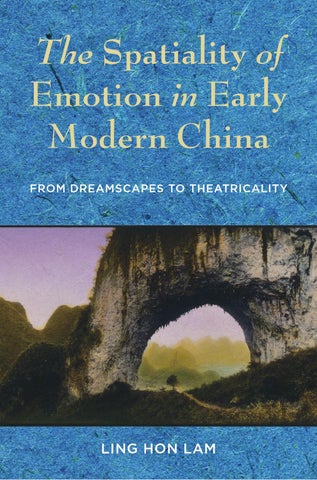
The Spatiality of Emotion in Early Modern China FROM DREAMSCAPES TO THEATRICALITY
LING HON LAM
Prologue Weather and Landscape “The state of the weather soon becomes a state of mind.” WA L L AC E S T E V E N S
“Actually, all language of landscape is just the language of emotion.” WA N G G U O W E I
. E M OT I O N R E A L M S
On a gloomy, rainy day in Chicago, phone calls were made as part of a psychological study. Researchers asked those who answered to describe their mood at the moment and rate their overall well-being—their sense of happiness and satisfaction with their lives. As expected, the poor weather put respondents in bad moods, which in turn induced them to give their well-being lower ratings. But if the caller, pretending to be out of town, started with a casual question—“how is the weather?”— the respondent tended to describe herself as less unhappy and dissatisfied. The researchers conducting the study argue that this is because we tend to explain away our bad moods by attributing them to impersonal factors such as the weather. A parallel experiment from the same research reinforces this theory: participants were put in an odd-looking room and asked to recall an unpleasant life event, and this combination would sour their mood and lower their sense of well-being. And yet, when participants were told beforehand that the room where the survey would take place was supposed to make them feel bad, their well-being ratings were more positive. Here again, bad moods were
“discounted” through attribution to something impersonal—in this case, the surrounding space.1 Tearing down the wall between feeling and thinking, recent cognitive studies emphasize the way judgment underlies emotions, and emotions in turn perpetuate themselves by shaping judgment in a closed circuit.2 The weather survey, however, discloses a less cohesive picture: a momentary foul mood negatively affects my appraisal of overall wellbeing, but the fact that the mood colors judgment can itself be subject to another level of judgment, eventually giving my overall well-being a more positive reappraisal. This paradox arises from two conflicting premises about emotion’s relationship to space, whether space is tangible (as with a room) or pervasive (as with the meteorological ambient). On one hand, the notion of attribution, insofar as it involves ascribing bad moods to the weather or the room one is in, assumes the entanglement of emotion with the “outside world.” On the other hand, the “discounting” effect of attribution—the dismissal of bad moods as irrelevant once they have been tied to external factors—re-establishes the hierarchical division between inner and outer, personal and impersonal.3 The cognitive process boils down to an incongruous formulation: “I feel bad because of the weather, so I feel better about myself.” Underneath the swing between feeling good and bad is a deeply rooted ambivalence toward space, which feels both removed from and initially proximate to our emotional life.4 We come across similar incongruities in traditional Chinese discourse about emotion and space, which goes back to the ancient notion of xing 興, or “poetic incitement.” An ambiguous term closely associated since Confucius (551–479 bce) with the Book of Songs (Shijing 詩經), xing initially designated a rhetorical device of introducing a human theme through natural imagery. By extension, as Cai Yingjun 蔡英俊 notes, it refers to the “ ‘direct arousal’ of emotion . . . by stimuli from the external world.” This early concern with emotional responses to outside stimuli foreshadowed fourth- and fifth-century discussions of natural scenery (wuse 物色) and ultimately coalesced in the discourse of “emotion-landscape mingling” (qing jing1 jiao rong 情景交融), which proliferated from the late Southern Song (mid-thirteenth century) through the end of imperial history.5
2
P rol og u e
Some believe that this aesthetic tradition runs counter to the Cartesian divide between the human mind and the external world. According to François Jullien, the subject-object split is overridden and rendered “nominal” in China by the “interaction” between “interior emotion” (qing 情) and “exterior landscape” (jing1 景), which “cooperate in a single process.” But Jullien reconfirms this split by using terminology that separates “interior” and “exterior” before calling out their interactions.6 Moreover, in his account, what happens in such interactions is less a reciprocal exchange than the indelible privileging of the interior. Insofar as landscape plays a role, it either does so internally (by “impregnating interiority”) or in facilitating “both a borrowing and a detour for the interiority expressing itself.” For poetic incitement to work, Jullien argues, it must go “beyond the landscape”: “whereas its expression remains within the tangible, its emotion projects beyond this world.” Emotion always transcends landscape.7 At the turn of the twentieth century, critic Wang Guowei 王國維 (1877–1927) made the subservience of landscape to emotions in traditional aesthetics crystal clear in his seminal Treatise on Song Lyrics of the Human Realm (Renjian cihua 人間詞話): “In the past, people distinguished between the language of landscape (jing1yu 景語) and the language of emotion (qingyu 情語) when they discussed poetry and song lyrics. Actually, all language of landscape is no more than the language of emotion.” The collapse of landscape into emotion renders landscape dispensable: “Most lyricists convey emotion through landscape. Excellent verses exclusively put in the language of emotion (zhuan zuo qingyu 專作情語) . . . have been rare and precious, then and now.”8 No matter how balanced it may seem, the tradition of discussing emotion-landscape relationships inadvertently affirms the superiority of the emotive interior. It has been under the spell of the first-century “Great Preface” to the Book of Songs, the locus classicus of poetics and aesthetics: “Poetry is that to which the intent goes. Inside the heart is the intent; when expressed it becomes poetry. Affections are stirred within and take on form in words.”9 Thus we can see the same paradox in cognitive studies and in Chinese literary thought: emotion is prioritized as “personal” and “interior” even when it is attributed to impersonal surroundings or said to mingle
P r olog u e
3
with landscape “out there.” To say that “the state of the weather soon becomes a state of mind,”10 or that “a diffuse and overwhelming emotion like a state of mind . . . unfolds as an aura of senses, as an atmosphere,”11 is to maintain interiority as the site from which emotive feedback arises. As long as we psychologize emotion as a state of mind, the spatiality of emotion remains elided. I propose a radical rethinking of emotion in terms of space, namely, that before any projection, association, correspondence, and causality, emotion is a spatial structure of which the atmospheric is just one kind among others.12 In this book I argue that, rather than a state of mind being imprinted by, overflowing onto, or mingling with things in external space, emotion per se is spatial. To fully explore the spatiality of emotion, one needs to go beyond the schema of “emotion-landscape mingling.”13 Intriguingly, this may be what Wang Guowei attempted to do in the Treatise on Song Lyrics, which brings out the hidden agenda of that schema—apparently approvingly, only to abandon it immediately. These passages, which expose the primacy of “emotion” over “landscape” in the traditional discourse, were removed from the published versions of the treatise during Wang’s lifetime.14 Such terms as “emotion” and “landscape” appear in other entries but are subsumed under the overarching term “realm” (jing2 境 or jing2 jie 境界): A realm (jing2) does not only refer to landscape. Delight, anger, sadness, and joy—each is also a realm in the human heart. A work that depicts genuine feeling or genuine landscape is said to constitute a realm (jing2 jie); otherwise, there is no realm.15
Yet doesn’t the “realm” (now standing for either the interior or the exterior) seem to fit into the timeworn discourse of “emotion-landscape mingling”? Scholars generally believe so,16 especially since, as Xu Fuguan 徐復觀 observes, the term jing2 jie itself came to signify “various levels of spiritual cultivation” in Tang-dynasty Chan Buddhism and then, by extension, “the status of a writer’s spiritual (or emotive and sentimental) activities” expressed in the form of landscape in Song-dynasty poetics.17 But to Xu’s dismay, Wang Guowei actually turns his back on the entire tradition by “concentrating his discussion
4
P rol og ue
of realms one-sidedly on landscape per se throughout the treatise without closely knitting landscape and emotion together.”18 In other words, against expectations, Wang’s take on the “realm” reverses the primacy of emotion over landscape by going back to jing2’s initially spatial connotations, which are preserved in its homophonic relationship to “landscape” (jing1).19 Instead of assuming emotion as the foundation of landscape, Wang tries to reestablish landscape as the model for emotion. More precisely, by transplanting the term “realm” from landscape to emotion, Wang demonstrates a way to approach emotion in terms of spatiality. But Wang Guowei’s spatial turn falls short of unraveling the interior when he reduces emotion to just “a realm of the human heart” and therefore risks dissolving the spatiality of emotion into an inner state of mind. To pursue Wang’s approach from the point at which he turned away from it, we need to wrestle tropes and expressions from the received tradition, uncovering the spatiality of emotion that has been obscured by the conventional notion of qing jing1 jiao rong. One such expression is qingjing2 情境, which I literally translate as “emotion-realm.”20 The hyphen here should not be taken as an articulation between two separate entities. Despite the disyllabic structure, the Chinese phrase qingjing2 simply means a certain state of affairs, a “situation,” which can variably be expressed as qingxing 情形, qingkuang 情況, qingshi 情勢, and so on.21 In none of these compounds does qing ever refer to a mental state, and that is the point: emotion per se is a situation we find ourselves involved in, delivered through, and coming upon. Still used frequently in colloquial Chinese, such expressions clarify the spatiality of emotion as external. This does not mean that emotion is stirred by, responsive to, embodied in, or diffused across things in external reality, or that emotion is induced, suppressed, or liberated spatially, as some readings of Chinese domestic novels would suggest. Instead, in its exteriority, emotion is the structure of space as an ontological condition without which we cannot even be outside in the world getting along with one another. Esoteric as it sounds, the emotion-realm is intimately experienced in daily life when we intuitively sense the atmosphere upon stepping into a room, or when we greet a neighbor by saying, “What a sunny day!”
P r olog u e
5
. F R O M D R E A M S C A P E S TO T H E AT R I C A L I T Y
Often hidden by such mundane experiences is the way this spatiality of emotion undergoes and indexes significant historical changes. Instead of abstracting from the emotion-realm a universal blueprint, this study traces major historical modes of spatiality, each built on a distinctive organization of the emotion-realm. In this long and complex history, I focus on one pivotal episode that remains profoundly relevant today: the emergence of theatricality from the long-dominant regime of the dreamscape in sixteenth- to eighteenth-century China. The term “theatricality” refers to an early modern mode of spatiality in which emotion is not interior to oneself but performed by others and, conversely, it is conceivable in oneself only as enacted on behalf of others or as exhibited to an audience without oneself seeing it. In theatricality, a new sense of self-displacement informs the formation of individuals and communities by alienating subjects from their feelings, producers from products, writers from readers, and spectators from spectacles, under the combined sway of commerce, print, and theater. Theatricality, therefore, signifies not the essential origin of theater but, ironically, a historical deviation from theater, at the moment when drama became increasingly consumed through printed texts. The maturation of theater in China dates back to the twelfth century, but at that time theatrical performance depended less on role-playing in front of spectators than on a vastly different spatial operation: conjuring a character across the threshold between this world and another. Early theater grew out of a medieval spatiality of emotion that was akin to the Buddhist-Daoist “dreamscape,” through which the dreamer moved from one ephemeral mood to another, only to realize in each instance that she had “woken” to another illusion. With the rise of theatricality, the dreamer becomes an onlooker who approaches the dream from an indelible distance, feeling puzzled by and yet strongly attached to its mirage. The “spectator” comes into being when the dreamer stops moving through endless layers of the dream and pauses in front of the dream, trying to sympathetically identify with it. Sympathy, as will be seen throughout this book, is the most distinctive symptom of theatricality. It signals a peculiar spatial problematic: the spectator/subject is 6
P rol og u e
not quite in a position where she can feel, or she feels only by moving away from where she is standing. Theatricality in early modern China emerged in fleeting interruptions of the otherwise incessant process of deliverance into one dream after another, from the interstices between the oneiric layers. For that reason, both contemporaries and modern scholars have described the phenomena of theatricality in terms borrowed from the regime of dreamscapes. This anachronistic tendency is not a dismissible mistake but instead a significant part of the historical dynamic through which theatricality unfolded from the dreamscape in a nonlinear fashion. The nonlinear unfolding is shaped by two kinds of interaction, together forming the full picture: on one hand, an earlier regime of spatiality shaped the context in which the new mode was ushered in, perceived, and misrecognized; on the other hand, the prior regime endured in juxtaposition with a newly emerging mode, under which its components were modified, re-contextualized, and bestowed with new meanings. The first half of the picture is demonstrated by Goyama Kiwamu 合山究, who points out that the late Ming and early Qing (from the late sixteenth to the seventeenth century) witnessed the proliferation of the life-theater analogy. To Goyama, however, the analogy only extends such Daoist and Buddhist notions as “life resembles a dream” or “life is like an illusion.”22 In that regard, the early modern understanding of theater seems still conditioned by the medieval themes of impermanence and delusion associated with dreams. Also focusing on the problematic of illusion, Wai-yee Li’s seminal work on love in traditional Chinese literature more perceptively captures the second half of the picture. She uncovers a new cultural phenomenon around the same historical periods surveyed before by Goyama: emotion took a spectacular form—a “theatrical illusion”—which both predicated itself on an “observer” and turned him into a spectacle being observed, as exemplified by Zhang Dai’s 張岱 (1597–1684) fabled night “raid” of a Buddhist temple in front of which he suddenly staged a play unannounced, awakening the dazzled monks and whipping them up with light and sound before swiftly leaving them behind in the dark again.23 This episode, which dramatizes the emergence of spectatorship in the midst of its mutual superimposition with ephemerality, raises a double question: how to understand the
P r olog u e
7
historical specificity of spectatorship per se and at the same time explain why it seems to be inseparable from the old regime of the dreamscape. In her monograph on theatricality in seventeenth-century China, Sophie Volpp gives the most sophisticated account to date of related historical developments. She argues that although the notion of “the world as stage” in late Ming drama continued the Yuan legacy of using theater as a trope for “the evanescence of the affairs of this world,” what it signified had shifted from the issue of ephemerality to the new problem of “social imposture” intensified by “the increasing permeability of social hierarchies and the fluidity of emblems of status” characteristic of the burgeoning mercantile economy. Stage acting, as a cunning model of “self-fashioning” in society, hurled authenticity into crisis. As Volpp notes, “If performance was the problem, discerning spectatorship was the solution. The notion of social spectatorship became a vehicle for coming to terms with the mercantile appropriation of literati cultivation.”24 Not only could an experienced viewer see through the imposture of the nouveau riche, but the grading of spectatorial sensibilities provided a new ground on which to redraw the disappearing social distinction. At the top of the ladder was the most refined spectator, who could rejoin the enchantment and “maintain illusion and disillusion in tension.” A case in point is again Zhang Dai, who could at one moment play a dispassionate observer of the other five kinds of spectators at an early autumn night’s West Lake and at another moment move toward and mingle with them, erasing the hierarchy he had just established.25 It is in this more complex type of spectatorship that Volpp sees echoes of “the older phrasing of the world as stage, which concerned the vanity of human achievement.”26 In short, social spectatorship addressed the crisis of authenticity pertinent to a new socioeconomic era, which bestows a token of historicity on the nascent regime of theatricality in seventeenth-century China; but the response to the crisis remained in the coordinates of illusion and disillusion already laid out in the regime of dreamscapes. This accounts for the nonlinear superimposition from which theatricality, in an unmarked fashion, always emerged in the disguise of dreamscapes in the Chinese context. Yet “disguise” suggests that theatricality is not a dreamscape, even in the Chinese context, where it has been so frequently identified as one that the mixed identification has become part of its history. 8
P rol og ue
Dreamscapes would linger on into the seventeenth century and beyond, but theatricality itself is more than a redeployment of dreamscapes in a new historical context, just as spectatorship—the distinct feature of theatricality—cannot be fully exhausted in terms of illusion and disillusion, even though those terms might inform the spectator’s general experience. The spatial operation underlying the oscillation between enchantment and disenchantment—that is, the delivering of a dreamer into and out of an illusion—had been modified into a spatial problematic of distance. The haunting question of every dreamer—“Having wakened up from a dream, am I in still another one?”—was rearticulated as a question typical for a spectator facing a spectacle: “Should I get closer or farther away?” What makes Zhang Dai a spectator par excellence is not just his return to the age-old paradox of illusion and disillusion in tension, but also his shrewd manipulation of distance as a new technique for maintaining that tension. Historicizing spectatorship as a unique component that distinguishes theatricality from the dreamscape has further implications for understanding the history of theater. We need to understand forms of theater preceding theatricality in terms other than that of spectatorship; only in so doing can we see how theatricality emerged through restructuring the dreamscape in the Chinese context. Interest in alternative historical forms of theater has often been motivated by an aversion to the silenced, passive audience segregated from the nineteenth-century proscenium stage,27 but archaeological attempts to redeem spectatorship by stressing its “participatory” nature in older theatrical forms miss the point that both separation and participation are parameters of the problematic of distance that defines spectatorship. To call the SongYuan (twelfth to fourteenth century) audience more “interactive” thanks to the absence of the “fourth wall,”28 for instance, ultimately obscures the genuine differences between theatricality and its predecessor, the dreamscape, because by resorting to the degree of distance, we fall back on the yardstick provided by theatricality. By contrast, to understand the Song-Yuan theater in its own terms is to see a theater without a spectator. This seemingly bizarre notion has only recently been hinted at in Jeehee Hong’s rereading of the stage figurines on an elevated stage carved on the relief wall of excavated twelfthcentury tomb chambers in Shanxi. Against the usual interpretation that P r olog u e
9
they are performing for the tomb occupants, usually a deceased couple, Hong argues that both the relief figurines and the elevated stage sit on the threshold between outside and inside, underlying a process of transformation and demarcating a liminal gateway through which the deceased move from this world to the netherworld. It is in such border-crossing movements that the deceased are transported into a “fictional space” where they “impersonate themselves as if they were alive,” so that “the architecture housing them is presented as if it were their house.” Instead of having the player figurines perform for the tomb occupants, it is the tomb occupants who perform as their living selves. This discussion of the miniature theater as “a realm midway between two worlds” in the Jin tombs points toward a kind of performance that “required no spectatorship.” According to Hong, the reason the player figurines require no spectator is that they “yield the actual performance to the virtual actors, i.e., the tomb occupants,” who are still in need of some sort of spectators. She concludes: “By making their tombs, it is likely that some future tomb occupants imagined their descendants worshipping them in front of their images. By extension, these worshippers viewing their ancestor’s image would have been assumed to be spectators of the virtual performance.”29 To take Hong’s argument further, I would argue that performance in the dreamscape is predicated not on playacting in front of the spectator but on transformation upon crossing boundaries. Even the “imagined” worshippers, therefore, are not really spectators; before they are constituted as worshippers, they have to cross the same threshold marked by the miniature theater, just as their ancestors were transformed into tomb occupants when they crossed the “realm midway between two worlds.” The being who undergoes metamorphosis when delivered from one realm to another is not the spectator, but the dreamer. “Social spectatorship” was therefore an early modern phenomenon in China not in the sense that it was modeled on theatrical spectatorship and applied what had always been essential to theater to the broader issue of social pretense in an extra-theatrical context, but in the sense that we actually witness the naissance of the “spectator” when the dreamscape was restructured into theatricality between the late sixteenth and early seventeenth centuries. In other words, theatrical spectatorship is never applied to an extra-theatrical context; rather, spectatorship per 10
P rol og u e
se is quintessentially extra-theatrical because, as I have already mentioned, theatricality arises from the intersection between theater and print. Theatricality is not the essence of the theatrical medium but a notion of intermediation that is beside and beyond theater. Intermediation, however, is more than a matter of technology; it comes along with the historical modifications of the emotion-realm. Tracing the transfiguration of the subject position from dreamerhood to spectatorship, this genealogical investigation of the spatiality of emotion establishes the fundamental stratum in what Michel Foucault calls “historical ontology,” an umbrella term with which he sums up his study of “how we are constituted as subjects” in “three broad areas”: the knowledge of things, power relations with others, and the ethical relationship to the self. For Foucault, this “historical ontology of ourselves” aims not to justify the present way we turn into “subjects” but to expose its historical contingency and buried possibilities.30 Though not thematized explicitly in his brief overview of the three “broad areas,” “the ‘schema’ of time and space” as a historical variable underlies Foucault’s early “archaeological” works.31 The fundamental status of spatiality is further highlighted if we acknowledge that, almost point by point, the Foucauldian historical ontology corresponds to the late Heidegger’s “history of being” in terms of periodization, style of reasoning, and critique of the present,32 and that the late Heideggerian discussion of time-space relationships is re-centered on a revamped notion of spatiality.33 Furthermore, against the consensus that the early Heidegger’s existential ontology—the structural dissection of human existence (Da-sein) in terms of spatiality and temporality—is “ahistorical,” the Chinese theorist Li Zehou 李澤厚 proposes a culturalist version of historical ontology (lishi benti lun 歷史本體論) through a rereading of Being and Time as a theory of practice maintaining that “experience constitutes what is a priori” (jingyan bian xianyan 經驗變先驗). Unfortunately, Li’s culturalist drive essentializes the historical practices in Chinese context as a matter of “cultural psychology” (wenhua xinli 文化心理) and as a result psychologizes Da-sein (xinli cheng benti 心理成本體) by uncritically invoking the notion of qing.34 Opening up qing as qingjing2 or emotion-realm, my book works toward a historical ontology explicitly and primarily as the genealogy of the spatiality of P r olog u e
11
emotion, on the basis of which we can then reexamine subjectivization in histories of knowledge, power, and ethics. Separating discussions of power and ethics has unfortunately led to a misperception that the latter is depoliticized in late Foucauldian works,35 while the constant entanglement of knowledge and power throughout Foucault’s oeuvres makes it unnecessary to single out power as a separate area.36 In place of power, therefore, I put forth the history of theater as one of the subfields of historical ontology: after all, can we talk about the contingency of subjectification without examining how a culture experiments with the way personhood is assumed onstage? In this book, I investigate the trajectory from dreamscapes to theatricality by tracing four overlapping genealogies from the perspectives of historical ontology, moral philosophy, theater archaeology, and epistemology, respectively. Chapter 1 introduces a “genealogy of emotionrealms,” dissecting the 1598 dramatic masterpiece The Peony Pavilion not as a celebration of the interior subject as people believe, but as a sedimentation of various historical modes of spatiality of emotion. I focus in particular on the transition from the “shared dream” where the lovers meet to “the front of the dream” as a mediating surface onto which lovers’ detached images are projected. In this light, chapter 2 reinterprets the “genealogy of morals”—a long history of philosophical discussions of emotion—less as didactics against material desire than as responses to various regimes of spatiality. We see how a new moral problematic emerged in connection to spectatorship—the subject position pertaining to theatricality—as dramatized in the sixteenth- to eighteenth-century fictional and theatrical forms of the religious allegory The Journey to the West. This brings us to chapter 3, where I deal with a “genealogy of playgrounds,” tracing the advent of spectatorship (or the lack thereof ) through examining dramatic performance (from the early plays Top Graduate Zhang Xie and The Wrong Career to later ones The Mad Drummer and The Sole Mates) and theater architecture (from roofless stages to dancing pavilions, to passage stages, to teahouse theaters). This analysis highlights the turn of the seventeenth century as a watershed marked by the discursive explosion of sympathy. In chapter 4, I pursue a genealogy of knowledge by examining the Japanese and European readings of the early eighteenth-century Chinese 12
P rol og ue
novel The Fortunate Union (a.k.a. The Pleasing History), in which we can detect two competing modes of knowledge production in the era of theatricality and sympathy—anthropology and case history—in contrast to traditional Chinese casuistry. Chapter 5 concludes this study by advancing a critical vocabulary for a discussion of time-space as emotion that can transform our understanding of theatricality and sympathy in China and beyond. The Chinese genealogy of the spatiality of emotion from dreamscapes to theatricality unfolds with twists and reversals. A comparison to a different sort of dynamic in the Western context will be doubly illuminating when we see the two trajectories collide at the turn of the twentieth century on the issue of sympathy. . F E E L I N G I N TO / F E E L I N G W I T H
Chinese and Western paths converged earlier than is often presumed. It is just that the convergence became more obvious in the early twentieth century, as we can see in the aesthetician Zhu Guangqian’s 朱光 潛 (1897–1986) rereading of Wang Guowei. What draws Zhu’s attention is Wang’s distinction between two kinds of “realms”: “the realm with me” (you wo zhi jing2 有我之境), within which “I observe things from my perspective (yi wo guan wu 以我觀物) so that things are all marked with my hues”; and “the realm without me (wu wo zhi jing2 無我之境),” within which “I observe things from things’ perspective (yi wu guan wu 以物觀物) so that it is no longer known which is me and which are things.”37 Zhu Guangqian agrees on the distinction but contends that we should put it the other way around by borrowing the German notion Einfühlung (empathy or yiqing zuoyong 移情作用): The distinction here [between “the realm with me” and “the realm without me”] is remarkably made, but from recent aesthetics’ perspective, Wang’s vocabulary has to be reconsidered. What he says about “observing things from my perspective so that things are all marked with my hues” is actually “empathy,” as attested by the verse he cites: “With tearing eyes I enquire the flower but the flower speaks not.” Empathy results from attentively gazing at a thing to the extent that both the thing and I are forgotten, which is P r olog u e
13
what Schopenhauer calls “self-effacement.” Therefore, Wang’s socalled “realm with me” is actually “the realm without me” (that is, the realm of self-forgetting). As for the examples he cites to illustrate his “realm without me” . . . all actually are wonderful realms attained by poets in calm reminiscence (the so-called “attaining them in tranquility”) without undergoing empathy, and therefore should have been called “the realm with me.”38
Originally part of Zhu’s Psychology of Literature (Wenyi xinli xue 文藝 心理學), this bold interpretation instantly drew the attention of an early reader of the book manuscript, which remained unpublished in 1931.39 The passage was published in Zhu’s On Poetry (Shilun 詩論, 1943), and since then many have taken issue with it. Gong Pengcheng contends that the traditional Chinese ideal of self-negation (wu wo 無我) transcends the senses and cognition through the cultivation of the subject and is therefore incompatible with the Western idea of empathy, which still attaches to sensational intuition.40 Avoiding such a problematic East-West opposition, Yeh Chia-ying 葉嘉瑩 more convincingly points out that Zhu Guangqian’s reversal makes sense only as a distortion of Wang Guowei’s Kanto-Schopenhauerian aesthetics of the sublime and beauty through the lens of Theodor Lipps’s (1851–1914) theory of empathy.41 But Zhu Guangqian’s “misapplication” of empathy to Wang Guowei turns out to be conceptually productive and—I would venture to say— historically more than “accurate.” If we recast it in light of the spatiality of emotion, its pitfalls and merits can balance out. Compared to the sublime and beauty, the late nineteenth-century German discourse of Einfühlung was more directly grafted on the issues of space; the term was first invoked to characterize a viewer’s feeling and movement provoked by the shapes and patterns of inanimate objects, typically in architecture and sculpture.42 Susan Lanzoni has recently examined the kinesthetic dimension of Einfühlung when the term was translated by British psychologist Edward B. Titchener in 1909 and applied in the laboratory he directed at Cornell. There was no unified theory of empathy at this experimental stage, but most understandings orbited around the notion of inner feeling/motion projected onto an object. The anthropocentric tendency of empathy as the projection of human feelings onto 14
P rol og ue
things was driven home by James Ward, who translated Einfühlung as empathy around the same time as Titchener did but described it as “personification.”43 Ironically, the invocation of spatiality at the onset of the discussion of empathy led to a reassertion of the interior locus of emotion in opposition to the external world. These early twentieth-century tropes of kinesthetics, inner feeling, outward projection, and anthropocentric personification of things found their way into Zhu Guangqian’s Psychology of Literature, the original context in which Zhu rereads Wang Guowei’s “realms” through the lens of empathy.44 Besides alluding to Lipps, Zhu cites a slew of examples from European literature to show how “empathy has huge impacts on literary creation,” but from here he slips into something with different historical origins and resonance: The French novelist Flaubert once described the process of writing Madam Bovary in the following passage from a letter: “It is a delicious thing to write, to be no longer yourself but to move in an entire universe of your own creating. Today, for instance, as man and woman, both lover and mistress, I rode in a forest on an autumn afternoon under the yellow leaves, and I was also the horses, the leaves, the wind, the words my people uttered, even the red sun that made them almost close their love-drowned eyes.”45 Similar confessions from other writers are numerous. Flaubert has been widely regarded as a master in realism. But even when he depicted the most objective situation, he was still putting his body in the other’s situation (she shen chu di 設身處地), sharing characters’ lives therein in a manner of experiencing them firsthand by himself. We can see how forced the distinction between objective and subjective is in literature.46
Amid the talk about the projection of inner feeling onto objects and the kinesthetic identification with their movements—two distinct takes on nineteenth-century empathy—what sticks out is the Chinese phrase she shen chu di, which first appeared in the sixteenth century and has become ubiquitous since then, especially in the field of drama criticism. P r olog u e
15
Zhu Guangqian may have been motivated to slip in the Chinese phrase to reframe Flaubert’s words by something a seventeenth-century Chinese dramatist once said about playwriting: Of all literary endeavors playwrighting is the most heroic, elegant, and sanitary. . . . If I fancy being a mandarin, I am gloriously promoted to the top at once. If I desire to leave office and live like a recluse, in a wink I am transported to a wooded hill. . . . If you are to construct what a character says on his behalf, you must construct the person’s heart on his behalf as well first. How can one put oneself in the other’s position (she shen chu di) if not by dream travel and spirit roaming”?47
Like Flaubert, Li Yu 李漁 (1611–1680) celebrates the magic of playwriting that turns the playwright into any personae he creates, as if he were simply projecting his desire onto whatever characters and stories he likes. But the parallels end right here: rather than projecting one’s feeling onto others and reconfirming the interior locus of emotion, she shen chu di requires the playwright to imaginatively put himself in the situation of the other in order to feel what the other feels; hence the acknowledgment that the locus of emotion is somewhere else rather than the self. Saying what I want to say depends on imagining what the other would have to say in a different situation than mine, not the other way around. By invoking she shen chu di in the context of empathy, Zhu Guangqian is not so much committing mistranslation or cultural misunderstanding as reactivating the translingual complexity of the Western term Einfühlung throughout its history. As Lanzoni notes, before Titchener and Ward coined “empathy” to translate Einfühlung, the most commonly used word for the term in the English world was “sympathy,” which has a much longer history. Hence, when Titchener was constructing empathy as a new object of psychological science at the turn of the twentieth century, he could not help but compare it to “sympathy”: We have a natural tendency to feel ourselves into what we perceive or imagine. As we read about the forest, we may, as it were, become the explorer . . . This tendency to feel oneself into a situation is called 16
P rol og u e
EMPATHY;—on the analogy of sympathy, which is feeling together with another; and empathic ideas are psychologically interesting because they are the converse of perceptions; their core is imaginal, and their context is made up of sensations, the kinesthetic and organic sensations that carry the empathic meaning. Like the feeling of strangeness, they are characteristic of imagination.48
Titchener here establishes a pair of dichotomies that have since been reiterated by many: whereas sympathy involves “feeling together with another,” keeping my feeling separate from the other’s feeling, empathy obliterates that separation by “feeling into” the other. By extension, whereas the former entails judgmental attitude (pity or compassion) from an outside position, the latter nonjudgmentally eliminates the distance by taking the other’s position. Ironically, the problem across the various accounts of the sympathy-empathy opposition—which boil down to “your pain”/“my pain” and judgmental/nonjudgmental dichotomies—is that empathy and sympathy are constantly trading places.49 In fact, Titchener’s definition of empathy—to feel oneself into a situation by imagination—was once the definition of sympathy. As David Marshall reminds us: “In the eighteenth century, the word [sympathy] suggests putting oneself in the place of someone else, taking someone else’s part—a general condition or act, related to the modern word ‘empathy,’ of which pity, compassion, and commiseration are only specific examples.”50 Zhu Guangqian’s nearly involuntary invocation of she shen chu di serves as a “wormhole” traversing the artificial barrier between sympathy and empathy because it is the closest we can get in Chinese to the eighteenth-century definition of sympathy. It allows us to trace the convergence of the Chinese and Western genealogies of emotion-realms in the early modern emergence of the global regime of theatricality. On the Western side, the apparent opposition between feeling with and feeling into does not really delineate the chronological progression from sympathy to empathy that has been hailed as the watershed of the modernist era.51 Rather, the opposition between sympathy and empathy circumscribes the whole dynamic by which theatricality in the Western context is generated and strengthened through its apparent negation— that is, through a momentary return to a pre-theatricalist dream in P r olog u e
17
which one could enter another’s feeling.52 On the Chinese side, she shen chu di as a symptom of theatricality has been (mis)understood in terms of the dreamscape—“How can one put oneself in the other’s position if not by dream travel and spirit roaming?” This suggests the Chinese genealogy of emotion-realms follows a different trajectory determined by a different dynamic. Between dreamscapes and theatricality, it is never a one-way street, and never just one street only. It is a complicated journey, one that we will be taking throughout the rest of this book.
18
P rol og u e
PRAISE FOR
The Spatiality of Emotion in Early Modern China “Brilliantly written and boldly conceptualized.” WEI SHANG, COLUMBIA UNIVERSITY
“A daring rethinking of emotion as it was conceptualized in early modern China. Upending the dominant characterization of emotions, Ling Hon Lam shows that emotions were implicitly situations of space, conceived of and perceived in spatial terms. Challenging expectations and rectifying suppositions about the most basic level of human interaction with the environment and culture, Lam elucidates questions central to the philosophy of affect and to ontology from an unprecedented comparative perspective.” WILLIAM EGGINTON, JOHNS HOPKINS UNIVERSITY
“Lam argues with verve that the vocabulary of spatiality and theatricality is crucial for understanding emotions in the Chinese tradition. From the earliest formulations of the functions of poetic articulation as a space of social, political, and cosmic resonance to the logic of selfdivision and of being a spectator to one’s emotions in Ming fiction, Lam offers new and interesting perspectives on Chinese literature.” WAI-YEE LI, HARVARD UNIVERSITY
“Sounds, including words, reverberate in spaces, including the ‘inch-space’ of the heart. Framing the history of the emotions in original and surprising ways and undoing traditional oppositions between ‘inside’ and ‘outside’ through attention to the spaces that nurture or limit feeling, Lam puts Chinese vernacular literature in a new place and gives us the sensation of belonging to a continuous, centuries-long community of spectators. This is cultural history of astonishing scope and imagination.” HAUN SAUSSY, UNIVERSITY OF CHICAGO
“A provocative, profound, and profoundly original rethinking of the history of Chinese literary thought and its literary manifestations in imperial and modern China, whose repercussions will be felt within Chinese studies and within world literary circles for a long time to come.” PATRICIA SIEBER, OHIO STATE UNIVERSITY ISBN: 978-0-231-18794-7
9 780231 187947
COLUMBIA UNIVERSITY PRESS
NEW YORK
CUP.COLUMBIA.EDU