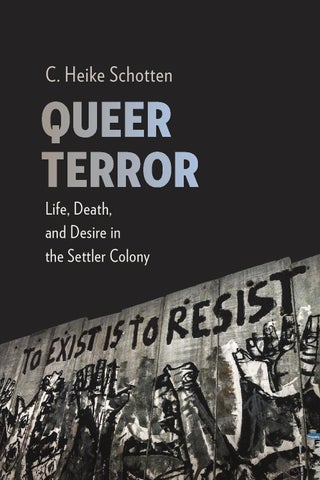
C. Heike Schotten
Life, Death, and Desire in the Settler Colony
INTRODUCTION
We value life; the terrorists ruthlessly destroy it. —President George W. Bush, November 8, 20011
Judgments, judgments of value, concerning life, for it or against it, can, in the end, never be true: they have value only as symptoms, they are worthy of consideration only as symptoms; in themselves such judgments are stupidities. —Friedrich Nietzsche2
Critique doesn’t have to be the premise of a deduction that concludes, “this, then, is what needs to be done.” It should be an instrument for those who fight, those who resist and refuse what is. Its use should be in processes of conflict and confrontation, essays in refusal. It doesn’t have to lay down the law for the law. It isn’t a stage in programming. It is a challenge directed to what is. —Michel Foucault 3
A
lthough the bleak days of the George W. Bush era are by now well behind us, the War on Terror he notoriously inaugurated nevertheless continues apace. It survived the two consecutive terms of his immediate presidential successor, who, despite inaugural promises to close the prison at Guantánamo Bay, actually expanded the agenda and reach of Bush’s signature war through, among other things, open and hidden drone wars, extrajudicial assassinations of US citizens,
xii
INTRODUCTION
elaborate FBI entrapments of Arab and Muslim people in so-called terrorism plots, the unprecedented expansion of the surveillance of journalists, everyday citizens, and, in particular, Arab and Muslim communities, and vicious crackdowns on military and security system whistle-blowers (while simultaneously sheltering the CIA and its former directors from punishment for similar crimes as well as for ongoing torture at prisons and “black sites” around the world). The seeming nonpolicy of President Donald Trump appears to be no less malevolent on this front, as exemplified by, for example, his nakedly Islamophobic refugee/Muslim bans, indiscriminate bombings of Syria and Afghanistan, and forthright commitment to US exceptionalism. Beyond the quagmire of US presidential policy, however, the War on Terror also endures in the copious aftermath of Bush’s other signature war, the Iraq invasion in 2003, an aftermath frequently abbreviated by “terrorism”-obsessed Western media into the short-form “ISIS,” but whose reach and complexity far exceed this crude discourse and continue to wreak untold havoc on the everyday lives of millions of people throughout West Asia. This suggests, among other things, that the War on Terror, the Islamophobic security culture it has engendered, and the distinctive discourse of “terrorism” that underpins and anchors it are noteworthy features of recent decades that demarcate not any particular conflict so much as a distinct political era, one with no clear end in sight. As with the detention of “enemy combatants” at the still-operational Guantánamo Bay “gulag,” 4 the historical and cultural moment of the War on Terror has become, for all practical purposes, indefinite. Queer Terror takes its impetus from the seeming endlessness and gratuitous vileness of the War on Terror to argue that the “terrorism” that serves as its ostensible justification has little to do with the material realities of either political violence or the actual events of September 11, 2001. Rather, the War on Terror and the “terrorism” that is its pretext owe their political and cultural recalcitrance to a civilizationalist moralism of life and death that underpins, motivates, and defines the US imperial project, a moralism that has been in place since the settler establishment of the nation and in fact emerges from it. The purpose of this moralism is, ultimately, to sanctify both settlement and empire as noble and worthy endeavors, while vilifying any resistance to them as nihilism or evil. The War on Terror, then, does not actually pivot around or emerge from the events of 9/11, however concretized that origin story may have become; nor is its
INTRODUCTION
xiii
culprit, “terrorism,” best understood as a problem of political violence. Rather, “terrorism”—whether considered as a political category, cultural discourse, or defining contour of US culture and politics after 9/11—is an ideological determination used moralizingly to insulate US settler-empire from critique, render its victims deserving of its abuses, and delegitimize any resistance to it as unthinkable and perverse. Queer Terror offers an anatomy of this moralism, provided simultaneously in service to a rethinking of biopolitics, on the one hand, and critical resistance to US settler-empire, on the other. This is a necessary intervention insofar as biopolitics, itself a privileged site for theorizing the War on Terror and an obvious place to turn for any critical analysis of “life” and “death,” by and large neglects the widespread moralization of these categories that otherwise pervades US imperial culture and is particularly acute when it comes to “terrorism.” This oversight is due to the seemingly selfevident, perhaps even tautological construal of life or “bare life” within biopolitical theory as primarily a biological phenomenon. A central aim of Queer Terror, however, is to extract biopolitics and biopolitical analysis from the exclusive domain of biology, since life “itself” is never reducible to biology alone. Rather, Queer Terror will argue that life “itself” is as much an ideological as biological determination, the result of a wholly political imperative that constitutes “life” (and “death”) as such. “Life” and “death,” in other words, are not prepolitical givens (whether biological or otherwise) that are only retroactively politicized (however properly or improperly). Rather, they are political categories through and through, ideological from the outset. As such, they are symptomatic of larger power structures that must themselves be interrogated if critique is to have any political purchase. Queer Terror argues that these larger power structures are, on the one hand, a modern European sovereignty that must be recognized as fundamentally settler colonial and, on the other, a reactionary privileging of settler life as the highest value and the basis of rationality in an otherwise nihilist and “savage” world. These underlying and mutually imbricated structures of power—settler colonialism and civilizationalist moralism— suggest the first of Queer Terror’s interdisciplinary interventions, which is to link biopolitical studies of US empire and the War on Terror with inquiry in the fields of native studies and settler colonial studies. Native studies scholars have repeatedly emphasized that US empire and the War on Terror
xiv
INTRODUCTION
are intimately connected to settler colonialism. In a crucial interrogation, for example, Andrea Smith and J. Kʑhaulani Kauanui ask: What happens to studies of American empire if we focus on empire from the context of the United States as a settler colonial country? Many American studies keynote speakers at the past several ASA [American Studies Association] conferences have critiqued the seeming erosion of civil liberties and democracy under the Bush regime. How is this critique affected if we understand the Bush regime not as the erosion of U.S. democracy but as its fulfillment? If we understand American democracy as predicated on the genocide of indigenous peoples? And finally, when we look toward building an alternative future, what if we do not presume that future forms of governance have to be based on nationstate models? How can we re-envision “nationalist” struggles that are beyond a heteronormative nation-state framework?5
Queer Terror attempts to concretize these links between biopolitics, US empire, and the settler colonial project that founded and continues daily to establish the United States, in order to generate a more satisfying and substantial critique of these interrelated phenomena. In addition, this critique is located specifically within the field of queer theory so as to analyze and resist, as Smith and Kauanui entreat, “the heteronormative nation-state framework.” This suggests the second of Queer Terror’s interdisciplinary interventions, which is to link biopolitics, US empire, native studies, and settler colonial studies with queer theory, on the one hand, and canonical political theory, on the other. Using Lee Edelman’s No Future: Queer Theory and the Death Drive as a point of departure to offer an unconventional reading of Thomas Hobbes’s Leviathan, Queer Terror explains the biopolitics of settler sovereignty as operating primarily at the level of desire, not biology, which establishes the distinction between life and death via the institution of temporality, not (only) security. In other words, conquest brings a settler nation into being simultaneously as and through the constitution of life “itself” as future-oriented desire. Queer Terror holds that, just as the meaning, coherence, and legitimacy of modern settler sovereignty is established materially through violence, these are established ideologically through the futurist temporalization of desire. This futurist temporalization of desire is, in fact, the “meaning of life” within settler sovereignty. Because of it, “life itself” is vested with a
INTRODUCTION
xv
specifically moral content that goes unaccounted for when considered solely as a biological phenomenon. That moral content is the propriety of futurist desire, the possession of which marks one not simply as alive but also, simultaneously, as valuable life, as life worthy of the name and therefore worthy of security and protection. The name for the improperly desirous, the name of all those who refuse or fail the futurist temporalization of desire and its imposition of settler sovereignty, is “death.” “Death” here designates not biological death but rather a hostile antagonism to life “itself” that threatens the disarticulation and destruction of the living through its mere existence and (thus dissident) perseverance. This “death” implies natives’ externality to the rationality and goodness of settler sovereignty, their endurance as a continuing threat to that settler sovereignty, and, perhaps unsurprisingly, also names and justifies native elimination by that settler sovereignty. The biopolitics of (proper) desire, in other words, is simultaneously a necropolitics of (improper) desire. In short, sovereignty constitutes the full “value of life” in this scenario, and it does so through the moralization of ideological notions of life and death as determinations of absolute, irrefutable value and worth, thereby rationalizing—in an extrapolitical display of sanctimony and self-righteousness—genocide and dispossession. Of course, if queer theory has taught us anything, it is that “proper desire” is a contradiction in terms, an impossible-to-achieve coercive ideal and inevitably political determination that queers the “improperly desirous” as anathema to the social order. For Lee Edelman, this is how reproductive futurism works. In Queer Terror, this is how moralism works, specified as the futurist, settler colonial operation of European sovereignty. That Thomas Hobbes’s Leviathan is a blueprint for this moralized settler colonial sovereignty is elided in the canonization of this text as part of the broader history of liberalism, just as its highly rational theorization of sovereignty would seem to many political theorists to have nothing to do with sex/uality. However, a major methodological commitment of Queer Terror is to demonstrate the usefulness of a historicized queer theory not only for biopolitics, but also for political theory, traditionally understood. The widespread view in political theory that sex/uality is not political actually mirrors the relative absence of political-theoretic inquiry within queer theory, suggesting that neither field finds its concerns to overlap much, if at all, with the other. However, a relatively conventional definition of both political theory and queer theory is required to maintain these twin aporias,
xvi
INTRODUCTION
a conventionalism rooted in liberal presuppositions regarding the privacy of sex/uality and the publicity of power, with the latter limited to the state and its institutions. If, however, the problem of “life itself” cannot be separated from the problem of desire, and the problem of desire entails reckoning with fundamentally political matters such as sovereignty, temporality, and (settler) colonialism, then it is clear that political theory and queer theory cannot be disentangled from each other, and that to pursue one is and requires pursuit of the other. Finally, Queer Terror offers these interdisciplinary interventions from an avowedly left perspective, as a critique of US empire as much as the canon of political theory that erases or colludes with it. In this sense, it is inspired by the antiracist, anti-imperial, radical critical queer theory unfolding under the rubric of “queer necropolitics.”6 Drawing on Achille Mbembe’s influential formulation of “necropolitics” and/as the postcolonial critique of Giorgio Agamben and Michel Foucault,7 queer necropolitics thinkers use radical and liberatory critical theory to analyze the ways that queerness functions as a lever of classed, racialized, and nationalized exclusion, with the result that some populations, whether “queer” or “queered,” become either dead or disposable, either killable or eligible for targeted killing.8 Queer Terror relies on a canonical archive, by contrast, not only in its reliance on Hobbes but also in foregrounding the work of Edelman, a queer theorist whose early work was crucial in establishing the field itself 9 and whose current work is considered definitive of an entire line of inquiry within queer theory, “the antisocial thesis.”10 I do this not to further entrench the power of already-established work, but rather to read this work as a valuable storehouse of information regarding the power formations both I and queer necropolitics thinkers seek to undermine and critique. Not only does Queer Terror suggest that the “life” of settler colonial sovereignty is best understood through the frame of desire (albeit divorced from the encumbrances of any particular psychoanalytic theory). But, via closer examination of a canonical text of settler colonial sovereignty, it also helpfully specifies the “death” of bio/necropolitics, which has been alternatively theorized not simply as biological death, of course, but also as social death,11 slow death,12 and overkill.13 The editors of Queer Necropolitics characterize each of these as forms of “living death,”14 suggesting in their introduction that part of the usefulness of “queer necropolitics” is “its ability to capture seemingly unrelated phenomena simultaneously, and to bring
INTRODUCTION
xvii
back into a shared plane of intelligibility struggles that we are often told are mutually exclusive,”15 for example, “the ‘welfare queen,’ the ‘monsterterrorist fag,’ the ‘black rioter,’ and the ‘hateful Muslim youth’ as well as “the ‘queer lover.’ ”16 Useful and important as this collaborative theorizing indeed is, Queer Terror seeks also to clarify the specific differences among these forms of abjection—or, in other words, among these different types of “death.” This specification is undertaken not in order to isolate movements from one another, but rather to clarify the stakes and contours of specific struggles so as to better tailor our resistances (when necessary) and to constitute truly genuine, shared grounds for struggle (when possible). Specifying the kind of “death” inaugurated by settler colonial biopolitics also has the additional benefit of clarifying queer theory’s distinct contribution to left politics, a question that is too often ignored, taken for granted, or dismissed as irrelevant and uninteresting, but that is a central motivation of this book to explain. If “life,” in the settler sovereign scheme, is moralized as proper desire, and that propriety is what must be cherished and preserved and defended against “death” at all costs, then queer theory, or queerness, as both advocate and exemplar of improper desire, is simultaneously a principled position of antimoralism and an unapologetic advocacy of “death.” Queer theory’s contribution, in other words, to both the biopolitical theory of settler colonialism and the project of left politics is its opposition to the punitive moralism that props up the one and castigates the other. Its contribution to a broader theory of liberation is its proposal of a world without morality, revelry in impropriety, and, indeed, a veritable celebration of “death.” As this book will explore, such a view suggests important revisions to the revolutionary project that characterizes radical political thought; in particular, it suggests that the meaning of “death” and the meaning of “revolution” are one and the same.17 This is simultaneously a contribution to the queer necropolitics project in its specification of the mechanism, medium, and character of the “life” and “death” that are so crucial to biopolitical theory, as well as a contribution to queer theory insofar as it lays out, in explicit detail, the meaning and content of queerness as dissidence or radical politics and argues for a rejuvenation of this meaning and commitment, albeit in an entirely mortal (not moral) form. Queer Terror brings together the fields of settler colonial studies, native studies, queer theory, and canonical political theory in order to effect a
xviii
INTRODUCTION
reconceptualization of biopolitics that can account for US empire’s origins in settler colonialism as well as its ideological veiling of those origins via a punishing moralism of life and death that unfolds, in at least one prominent site, in the discourse of “terrorism.” The three epigraphs appended to this introduction, taken from three disparate if nevertheless influential commentators on modernity and the conditions of modern power, outline its agenda and scope. First, Queer Terror attempts to unravel the largely unremarked moralization of life and death that underlies Bush’s juxtaposition between “us” and “the terrorists,” a moralization that pervades US imperial culture and is particularly acute when it comes to “terrorism.” Second, Queer Terror examines this moralism from a critical Nietzschean perspective that repudiates morality as such and is acutely attuned to its consistent camouflaging of its own will to power as sanctimony and righteousness. Third, Queer Terror seeks to account for this unremarked moralism of life and death in the form of a critique of US settler-empire. Queer Terror is intended, as Foucault puts it here, as an essay in refusal, an instrument for those who fight, a challenge directed to the US war machine. Importantly, it is a critique deliberately located within the field of queer theory because of its radical dissidence that also goes to some lengths to specify queer theory’s specific contribution to left politics and radical criticism. I do this both to concretize the meaning and content of liberation and, perhaps, to reinvigorate queer theory’s commitment to liberatory politics. Queer Terror suggests that resistance to US empire, indigenous liberation, and queer theory alike are practices of Foucauldian criticism and/as refusal, and that they share the same overall goal of what we might, in another context, call the decolonization of desire. The tarnished name for this criticism and this goal in the current moment of US domination is “terrorism,” and Queer Terror will therefore argue that, whether as identification or cause, it is “terrorism” that demands our utmost, critical solidarity.
OUTLINE OF THE ARGUMENT Chapter 1 examines the widespread academic uptake of Agamben’s Homo Sacer: Sovereign Power and Bare Life to theorize and critique the War on Terror. This is both a specific argument about Agamben and a larger
INTRODUCTION
xix
reckoning with the field of biopolitics, which has come to take Agamben’s work as foundational. Whether it is Agamben or biopolitics, however, the towering influence of Hannah Arendt on both has been neglected, much to the detriment of the field. Agamben’s critique of sovereignty relies on a striated understanding of “life” that he actually takes directly from Arendt: “bare life” in the form of zoʳ, on the one hand, and proper or political life, in the form of bios, on the other. Careful examination of Arendt, however, reveals not simply a profoundly racist and civilizationalist (not to mention misogynist and classist) denigration of zoʳ but, more broadly, an essentialist understanding of “bare life” as inherently abject, as that which must be fled or transcended if human freedom is to be realized. By adopting these same premises, Agamben imports their essentialist and hierarchical evaluative implications into his own work. Thus his analysis effectively duplicates Arendt’s civilizationalist principle, whereby some (forms of) lives are higher, better, or more valuable than others, a principle that Arendt is clear is natural to human existence and constitutive of it. More importantly, it means that the field of biopolitics is itself indebted to these claims insofar as it draws on Agamben for any analysis of US empire. Consequently, I argue that both Agamben and Arendt must be abandoned if biopolitics is to be adequate to the analysis and critique of US empire. Recalling Smith’s and Kauanui’s set of critical questions, in chapter 2 I propose a twofold resituation of biopolitics and biopolitical analysis: first, I suggest that the focus on “life” as biology be replaced by a focus on “life” as desire; second, I suggest that the focus on racism in biopolitical analysis be augmented by a focus on sovereignty. I demonstrate the relevance, importance, and usefulness of these suggestions by offering a rereading of Thomas Hobbes, that classic thinker of European sovereignty, on the basis of an appropriation of Lee Edelman’s No Future: Queer Theory and the Death Drive. Using Edelman to read Hobbes foregrounds the role of (a decisively nonpsychoanalytic notion of) desire in constituting the category of life, thereby specifying and concretizing the link between queer theory and political theory. More profoundly, however, it suggests that the futurism Edelman outlines in No Future is a signal determinant of modern European sovereignty, indeed of modernity itself. The problem with sovereignty, then, is not its exceptionalizing of “bare life,” as Agamben suggests, but rather its ideological construal of “life” as the highest value via a futurist temporalization of desire that, in Edelman’s language, “queers” all those
xx
INTRODUCTION
who think or act otherwise. In this sense, biopolitics is always already necropolitics, since the sovereign’s seemingly self-evident insistence on the “value of life” is, in fact, a settler insistence on the value of settler lives at the expense, transfer, removal, and destruction of native peoples, who are not actually alive at all in this schema but rather emissaries and instantiations of “death,” mortal threats to settler sovereignty that portend its destruction and the disarticulation of its claims to legitimacy. This moralizing “value of life” discourse is flexible—it applies to the contemporary War on Terror as much as to the formation of US settler sovereignty. But this is no accident, since the War on Terror is a contemporary manifestation of the United States’ unresolved settler status, whereby refusal to recognize native existence is simultaneous with its refusal to acknowledge the conquest that founded its own sovereignty. In other words, today’s emissaries of death to the social order are so-called terrorists, not native peoples, who, in the confused logic of US settler colonialism, no longer exist, never existed in the first place, and are simultaneously no different from any other “minority” racial group capable of assimilation into the multicultural American dream. The obviously contradictory character of these fantastical ideological operations is muted or sidestepped by the frenzied obsession with “terrorism” as the latest and greatest threat to America, American freedoms, and the American way of life. But that, I will argue, is precisely its purpose and one of its most important functions. The undeniable significance and importance of the so-called value of life itself that anchors terrorism discourse, in other words, are its function as an essentially settler colonial value turned outward and used to serve imperial expansionist purposes. If queer theory is relevant to theorizing modern biopolitical sovereignty, it is likewise essential to formulating a resistant, liberatory politics that opposes it. Chapters 3 and 4 thus substantiate the claim that queer theory is a specifically left project of radical dissidence—both in general, as a field, and specifically, with regard to No Future in particular. With respect to the field, I offer a rereading of Foucauldian genealogy as the basis for the kind of dissident and liberatory form of critique that “queer” was considered to herald in the heyday of that field’s founding in the early 1990s. With regard to Edelman specifically, I suggest that he continues this radical tradition of liberatory queer dissidence by reading No Future as a manifesto. Putting these two unlikely readings together, of Foucault on the one hand and
INTRODUCTION
xxi
Edelman on the other, I suggest that queer theory’s specific contribution to radical/left politics is its antimoralism, whether that moralism takes the form of bourgeois repronormativity, as Edelman contends, or modernity’s biopolitical civilizationalism, as I suggest. In short, however, insofar as “the value of life” is the moralization of an ideologically determined category that recognizes only itself as possible, thinkable, tolerable, and worthy of protection, queer theory is fundamentally antimoral, anti-“life,” and, indeed, a representative and champion of “death.” Finally, in the last chapter, I discuss the adoption and adaptation of the “value of life” framework for the War on Terror and “terrorism” discourse. If, as suggested in chapter 2, the War on Terror is a continuation of the settler conquest that established the United States, then “terrorism” becomes legible not as an ostensibly objective classification of a specific type of political violence, but rather as the ideological name for any resistance to colonization or refusal to acknowledge its goodness, rightness, morality, or legitimacy. From the futurist perspective of the settler state, of course, the “terrorist” is the unthinkable assassin, the defender of death, the annihilator of civilization, freedom, and democracy. From the point of view of an antimoral, liberatory queer theory, however, the “terrorist” as emissary of “death” is a figure of radical resistance whose commitment to decolonization—not implication in any sort of violence, however real or imagined—renders them a mortal threat to the settler social order. This is true not only at the rhetorical and ideological level but also, as I will additionally show, historically, through an examination of the international development of “terrorism” as a specific category of political violence in the latter half of the twentieth century. The upshot of this analysis, however, is that when it comes to the question of dissent and dissident praxis, the only proper response to George W. Bush’s famous dictum that “Either you are with us, or you are with the terrorists” is affirmation of solidarity with the “terrorists,” who portend the death and destruction of “life” as “we” know it in the hegemonic form otherwise known as “civilization”— that is, empire, settler colonialism, and the American way.
■■■ Substantiating the claims made in Queer Terror will require challenging established consensuses in queer theory, political theory, and radical and
xxii
INTRODUCTION
critical theory, and thus entails the traversal of exceedingly important, if difficult and fraught, terrain. I therefore request the reader’s patience with this endeavor and the presumption of goodwill, integrity, and emancipatory commitment on the part of its author. The claims made here are rooted in my own deep commitment to liberatory politics, my earnest attempts to understand just what, exactly, liberation might consist of or look like, and the very beginnings of what I presume will be a lifelong project of thinking about decolonization. In addition, these arguments are undeniably rooted in my own experience and positioning as someone trained, for better or for worse, in the canonical history of European political thought. As such, my political commitments and academic training are somewhat at odds with each other; this book can therefore also be read as an autobiographical attempt to reconcile two seemingly disparate yet deeply entrenched pieces of my character and subjective experience. As a student of Nietzsche, however (yet another academic hat that I wear, albeit increasingly infrequently), I am quite aware of the fact that my work, like all philosophy, is “the personal confession of its author and a kind of involuntary and unconscious memoir.”18 This fact is not a failing of theory but rather an inevitability of its production. Acknowledging as much does not dilute the force of its argument so much as give it greater depth, texture, and meaning regarding both its stakes and its origins. I offer this book, then, as part of a larger, liberatory project I imagine as the decolonization of desire, a project to be brought about via a practice of queer terror. I bring to it what I can given my particular subjective experiences and intellectual training, and offer it as one contribution to a much larger conversation about decolonization that I am only beginning to broach, a conversation I expect to (continue to) learn much more from than to which I can possibly contribute. More than “taking sides” in any particular academic or field-specific dispute, then, I hope that this book will be read as making some contribution, however modest, to the thinking through and enactment of liberation for all people(s). This would be the real meaning and best measure of its success.
C. Heike Schotten offers a critique of U.S. settler-colonial empire that draws on political, queer, and critical indigenous theory to reframe the concept of terrorism. She provides an anatomy of the War on Terror’s moralism, arguing for a new interpretation of biopolitics that is focused on sovereignty and desire rather than racism and biology.
“In this brilliantly iconoclastic tractate, Schotten returns, spectacularly, to Hobbes to disclose what we can no longer ignore: the settler colony has a moralizing hold on life itself, on time, and on desire. Throughout, she demonstrates, indeed, heightens, the urgency and significance of a queer political theory. This is a striking and original book, a stirring and energizing call for dissidence and liberation.” G IL A NIDJA R , Columbia University
“Queer Terror provides one of the best genealogies of the War on Terror I have ever read. By reconceptualizing biopower, Schotten insightfully reveals how Zionism, Islamophobia, and the War on Terror have their origins in settler-colonial hatred of the ‘savage.’ Scholars and activists urgently need this book for its bold and brilliant map of U.S./Israeli empire as well as the radical queer possibilities for decolonization it inspires.” N A D INE S ULEIM A N NA BER , University of Illinois at Chicago
“Queer Terror defends an original and distinctive position that will be of interest to a wide range of radical scholars. The juxtaposition of political theory, queer theory, and decolonial theory is something we’ve been waiting for.” C R E S S I DA H E Y E S , former Canada Research Chair in Philosophy of Gender and Sexuality, University of Alberta
“Queer Terror masterfully synthesizes queer theory, political theory, settler-colonial studies, and native studies to explore the connection between the production of the ‘savage’ and ‘terrorist’ in settler-colonial and imperial logics. Through sophisticated readings of such thinkers as Foucault, Hobbes, and Lee Edelman, Schotten makes the case that in this biopolitical context the radical, queer imperative is to refuse settler moralism by refusing the notion that the settler polity must survive.” K EVIN BRUYNEEL , Babson College
C. H E I K E SCHOT T EN is associate professor of political science at the University of Massachusetts Boston. She is the author of Nietzsche’s Revolution: Décadence, Politics, and Sexuality (2009).
New Directions in Critical Theory ISBN: 978-0-231-18747-3
Columbia University Press / New York cup.columbia.edu Cover design: Lisa Hamm Cover image: ©MAYSUN
Printed in the U.S.A.