INTRODUCTION Blackness Without Analog
I
grew up biracial in a racially homogeneous white town near Paris. Négresse and noiraude, the usual racial slurs, were nothing next to the exaggerated, so-called African accent that boys enjoyed emulating when addressing me. This mimetic trend was initiated by Michel Leeb, a French stand-up comedian from the 1980s famous for his impression of a grotesque gorilla-like African man. Today, the in-your-face conjoined racism in Leeb’s skit would not make the French laugh the way it did so shamelessly and painfully then. Its censorship, however, would only camouflage lingering traces of intersectional fantasies of racialization and animalization that have sporadically come back to the surface, such as when a politician in 2013 compared black Christiane Taubira, French minister of justice, with a monkey,1 echoing the depiction of Barack Obama as Curious George the monkey during the 2008 presidential campaign.2 The black-animal subtext is deeply ingrained in the cultural genetics of the global north, an inherited condition informed by a shared history of slavery and colonization. The long and twisting arms of the gorilla stretch from the French empire to the New World, as King Kong’s roar on top of the Empire State Building still resounds.
x Y Introduction
The idea for this book was partially prompted by author Marjorie Spiegel’s recent dispute over her 1988 book, The Dreaded Comparison: Human and Animal Slavery.3 In the book, the author compares modern animal cruelty with black slavery, a type of comparison that the animal rights organization People for the Ethical Treatment of Animals (PETA) would also use in its 2005 fund-raising exhibit “Are Animals the New Slaves?” Though Spiegel’s book was highly praised by scholars and writers upon its release, the general public and civil rights activists widely contested PETA’s exhibit. Very soon after the exhibit was launched, Spiegel and her organization, Institute for the Development of Earth Awareness (IDEA), filed a complaint against PETA for copyright infringement, arguing that the exhibit would negatively taint the perception of her own book. Undoubtedly, both the book and the exhibit had used a similar approach aimed at associating the predicament of blacks in the past with the mistreatment of animals in the present, but the book had been spared the criticisms that the exhibit received. In 2011, the court ruled in favor of PETA, stating that the idea of comparing slavery to the treatment of animals, “regardless of its validity” (direct quote from Judge Castel in IDEA v. PETA), was neither entitled to copyright protection nor unprecedented.4 The wellknown Australian philosopher Peter Singer had already made a similar comparison with his use of the word “speciesism” (first coined by Richard D. Ryder in 1970), a neologism referring to the prejudice against animals similar to racism and sexism.5 In his ruling, Judge Castel conceded to having no say in the validity of the comparison, a validity that still remains to be addressed outside of a court of law. And indeed, under which—if any— circumstances is the comparison between blacks and animals valid and acceptable? In the last decade, the academic field of critical animal studies has grown exponentially, in both French- and English-speaking
Introduction Z xi
contexts. Concomitantly, political concerns over animal rights have forced the passage of new animal protection laws in various Western countries (e.g., the 2002 German Animal Welfare Act, 2005 Treaty of Lisbon, 2014 French Civil Code). In animal rights discourse, slaves and animal victims have repeatedly been perceived as sharing a common battle, so much so that abolitionism, once restricted to slavery, is now a word applied to animal welfare. Well-known legal scholar Gary Francione contests the property status of animals in a theory identified as the Abolitionist Approach, in reference to the movement to end black slavery.6 The comparison between slavery and animals has so far mainly been used as a tool to serve animal rights, regardless of its impact on African Americans and the Afro-Caribbean community. The race-animal comparison is a rarely addressed topic in black diasporic studies. One reason for this neglect, as Philip Armstrong argues in “The Postcolonial Animal,”7 is that comparing human and animal suffering carries the risk of trivializing the human condition. Another reason, as the NAACP has argued about PETA’s exhibit, is that comparing animals to blacks demonstrates racial insensitivity. Valid or not, however, the slave-animal comparison cannot be ignored, if only because it reveals a long-standing trend in American and transatlantic consciousness to associate blackness with animality. As author Claire Jean Kim admits in Dangerous Crossings, after initially feeling that PETA’s “We Are All Animals” and “The Animal Is the New Slave” campaigns were important reminders of “the arbitrariness of the animal-human divide,” she has come to realize that the analogy is unsound because the message “attempts to ground the argument for the moral considerability and grievability of animals upon the elision of race.”8 While questioning the animal-human divide is essential to animal rights activism, contesting the divide with a racial paradigm indeed carries the potential effect of reinscribing a discriminative
xii Y Introduction
approach that one had sought to reject in the first place. On the other hand, there is no denying that there are important parallels to be drawn between the rationale behind opposing animal oppression and that behind condemning discrimination against minorities. In both cases, it is a question of arbitrary divides. Kari Weil points out in Thinking Animals that animal studies follows after women’s studies and ethnic studies, two fields that have sought to establish their voices and reject the white patriarchal hegemonic lenses through which minorities have been represented.9 Like the animal rights discourse today, the primary goal of (broadly defined) subaltern studies was to denounce the arbitrariness of the ethnically— or racially—based divide that fueled the “us” versus “them” colonial rhetoric. The work of Edward Said is one example. In Orientalism, Said uses the concept of “Orientalism” to underscore the fabrication of the “Other” by a Western “Us.” Said exposes the fallacy of a nongeographical dividing line that separates the West from a so-called Orient as an object of European fantasy: “In short, from its earliest modern history to the present, Orientalism as a form of thought for dealing with the foreign has typically shown the altogether regrettable tendency of any knowledge based on such hard-and-fast distinctions as ‘East’ and ‘West’ to channel thought into a West or an East compartment.”10 Said’s idea of “a West or an East compartment” itself descends from Frantz Fanon’s representation, in Les Damnés de la terre (The Wretched of the Earth),11 of the colonial superstructure in French-owned Algeria as what he calls a “compartmentalized society.” Likewise, V. Y. Mudimbe in The Idea of Africa presents Africa as a Western creation essentially based on the notion of difference. As he explains, with the Enlightenment came “the science of difference: anthropology,” which “ ‘invents’ an idea of Africa.”12 In other words, be it Orientalist, Africanist, or colonial, those
Introduction Z xiii
representations are based on a putative divide between “us” and “them,” or as Stuart Hall calls it, “the West and the rest.”13 Exposing the arbitrariness of divides—whether based on race, gender, or species—is the root of any resistance against discrimination and oppression. The compartmentalization of sentient beings in terms of human hegemony and animal subordination is undoubtedly caused by our global economy and politics of animal exploitation. Yet replacing the human-animal divide with a debate about a race-animal divide that frames animal subjugation as analogous to black slavery is a perverted form of recompartmentalization where the black is once again removed from the human species. The main argument here is that, though one should not ignore entangled forms of oppression, analogizing can be harmful when it is meant to serve one cause over the other; when its sole function is, for example, to serve the animal cause by instrumentalizing the black cause. But as Kim also argues, the same holds true when the analogy is put in the service of the black cause. The author uses the example of those who pitted the rescue of pets by the Humane Society against the failed rescue of black residents in the aftermath of Hurricane Katrina in August 2005. The conclusion drawn was that America cares more about animals than blacks. This kind of rhetoric, Kim posits, rests upon the elision of species, as it “reduces nonhuman animals to instruments for measuring degrees of anti-Blackness.”14 Kim’s ultimate argument is that one should not have to resubordinate the animal in order to defend blackness, and vice versa. The analogy’s inherent vice lies in its propensity to give the upper hand to one entity over the other, bringing us back to the common ethical conundrum of whether to rescue the (good) dog or the (bad) man on a quickly sinking ship, except that, in this case, the two to be rescued are innocent victims.
xiv Y Introduction
The animal cause and subaltern studies differ in that animals cannot gain agency through their voice, or “at least not in the languages we recognize,” as Weil puts it.15 Women’s and ethnic studies, as Weil also explains, were built upon the pressing need to bring “women’s and minorities’ voices into the academy to write and represent themselves,”16 a claim to agency that the animal obviously cannot achieve within the field of animal studies. Because there is no possibility for self-representation, as we know it, the animal remains the silent one, bound to be represented by “us” humans. Through the human prism, the animal is tied irrevocably to what Jacques Derrida describes as the animot 17—a human word and a human representation. The fact that animals cannot, semantically, “talk back with a vengeance” to their oppressors makes the work of counterbalancing the elision of race in the animal discourse all the more challenging since the animal discourse is just that, a discourse, a mot, an animot in the midst of resounding animal silence.18 Because our perception of the animal is saturated with words, adding more words to the black-animal question may, instead of counterbalancing a skewed analogy, only make the absence of animal repartee even more salient. Afro-Dog is a book that engages in a corrective tactic, as it seeks to counterbalance a recent discourse that has served the animal cause by utilizing race as a leverage point. The challenge, however, is to be mindful of not overcorrecting this imbalance by emphasizing black suffering to the detriment of animal suffering, and thus re-inscribing the contention. The “America-likes-pets-more-than-blacks” attitude that Kim deplores is symptomatic of a system that convulsively pits blackness against animality, forcing blacks themselves to engage in a battle over spared likability. The answer is not to try to change this attitude but rather to bring attention to the system
Introduction Z x v
that created it in the first place. The preference of pets over blacks needs to be understood in the context of rapper Kanye West’s comment that “Bush doesn’t care about black people,” made at an NBC charity telethon for Hurricane Katrina’s victims, a visionary comment that preceded the Black Lives Matter movement by almost a decade. Images on television covering not only the direct impact of the disaster but also the living conditions of blacks in New Orleans before the hurricane brutally exposed the systemic precarity of black life in the American South.19 West’s impromptu comment on live television added words to the images on the screen that flaunted the triviality of black existence, a condition reminiscent of that of the slave deemed to be chattel/cattle—fungible and disposable, unlike a pet. “America cares more about pets than blacks” adds an animal dimension to Kanye West’s “black life does not matter” message, recalling the slavery era measurement of subordinate existence in an equation of life where the black and the animal have to battle in order not to be last. The black-animal analogy inherently and inevitably reenacts this interspecies battle, as it perpetuates a rivalry that traps the contenders in a paradigm that precludes any chance for the escape of either from this hierarchical measuring system. Within this context, the Black Lives Matter phrase is based on an elliptically suppressed yet recurrently present comparison between blacks and animals. When talking about the value of black existence, the animal comparison is intrinsically part of our culture, so much so that there is no longer a need to mention it. Thus, when the “America likes pets more than blacks” phrase is spoken, it feels like an overstatement, something that should not be said. Since Singer and Spiegel, the animal rights discourse has shown even more interest in the dreaded analogy, as it is manifested with the frequent use of the buzzword “speciesism”
x vi Y Introduction
(analogous to racism) in Francione’s Abolitionist Approach and PETA’s exhibits. This interest coincides, but also clashes with, an equally fast-growing school of thought in black studies that insists that the black condition cannot be analogized. This movement, referred to as Afro-Pessimism, argues that the Middle Passage created the unprecedented phenomenon known as “Blackness,” which is a condition like no other in our modern history. The pessimistic nature of this movement is due to the essential idea that the black condition created by the slave trade is permanent and irreversible. “I, too, live in the time of slavery, by which I mean I am living in the future created by it,”20 Saidiya Hartman wrote in her memoir. Some young influential writers may not self-identify as Afro-Pessimists, but they contribute to this ever-more-visible school currently mapping the durability of the black slavery superstructure in our modern culture. Michelle Alexander is one obvious example, 21 but Ta-Nehisi Coates and Teju Cole—both inspired by Africa American novelist and essayist James Baldwin, who paved the way for the enduring inquiry into the immutable black condition in America—are strong black voices that bring attention to the fact that “this fantasy about the disposability of black life is a constant in American history. It takes a while to understand that this disposability continues.”22 This school also aligns with the Francophone tradition—Frantz Fanon, Achille Mbembé—that addresses the endurance in our modern era of the 1685 Code Noir (in the French context), the slavery-era legal document that regarded the black as a thing (meuble). “I found that I was an object in the midst of other objects,”23 Fanon famously says in his 1952 Peau noire, masques blancs (Black Skin, White Masks). The reification of the black is unique in our modern history. As Mbembé writes in Critique de la raison nègre (Critique of Black Reason), “the Negro [Nègre] is, in terms of modernity, the only
Introduction Z x vii
human being whose flesh was made to be a thing and his mind a merchandise.”24 What is interesting in Critique of Black Reason is that the author sees the fungibility of the black as a condition which, instead of disappearing, has now exceeded race to apply more generally to our neoliberal Euro-American culture, a culture that substituted humanity with marketability. We have all become “man-thing, man-machine, man-code, man-flux,”25 hence what Mbembé calls the devenir-nègre du monde, “the becoming black of the world.” Mbembé’s view, however, might not fit completely with that of the Afro-Pessimist Frank B. Wilderson, who sees in black fungibility a unique condition, exclusively born out of the violence of slavery. Wilderson argues that black positionality is uncommunicable because it has no referent and no analog: “The violence that turns the African into a thing is without analog. . . . This is why it makes little sense to attempt analogy.”26 The idea of blackness as nonanalogizable is recurrent in Wilderson’s work. The important idea in AfroPessimism is that the black, though sentient, is the only human being in modern times defined as a disposable thing.27 For Wilderson, all positionalities, no matter how extreme the degree of suffering, are part of our archaeology of humanity— except black positionality. Wilderson even argues that the Holocaust is different from slavery in that this tragedy was a historical perversion that brought about a hiatus in the otherwise historical humanity of the Jew. “The Muselmann, then, can be seen as a provisional moment within existential Whiteness, when Jews were subjected to Blackness and Redness— and the explanatory power of the Muselmann can find its way back to sociology, history, or political science, where it more rightfully belongs.”28 For Wilderson, even Native Americans are not “off the map,” the way blacks are.29 As he says, “even Native Americans provide categories for the record when one thinks of how the Iroquois
x viii Y Introduction
constitution, for example, becomes the U.S. constitution.” 30 Wilderson goes to great length to single out the black condition from other modern tragedies. His main point is that analogizing the black condition with other ones is a trompe l’œil and a “ruse” that disavows the incommensurability of black (non-)existence. Staying clear of analogizing the black condition is something that Wilderson successfully accomplishes—except when it comes to the animal. “But still we must ask, what about the cows?,”31 Wilderson ponders. The author uses the example of the emergence of Taylorism in Chicago’s meatpacking industry during the turn of the century to show the difference between the worker’s exploitation and the black’s fungibility. The worker from the slaughterhouse—though exploited—is still part of civil society, while the black is associated with the cow to be slaughtered for consumption. The author writes, “the cows are not being exploited, they are being accumulated and, if need be, killed,”32 a phenomenon similar to what black bodies endured during slavery and endure today in America’s industrial prison systems. As Wilderson argues, “the chief difference today, compared to several hundred years ago, is that today our bodies are desired, accumulated, and warehoused—like the cows.”33 Ironically, The Jungle, Upton Sinclair’s 1906 novel depicting the same labor conditions of immigrants in the meatpacking industry in Chicago’s Packingtown,34 is famous for having drawn parallels between the exploited workers and the slaughtered animals. Following in Sinclair’s footsteps, Wilderson reclaims the analogy for the exclusive use of the black condition. In so doing, Wilderson recalls the elliptical nature of the animal presence in the black narrative: The black condition is without analog, except for the animal. “Black Lives Matter,” “Bush doesn’t care about black people,” “America likes pets more than blacks,” it seems that the
Introduction Z xi x
black condition, even when said to be nonanalogizable, implicitly and ineluctably brings us back to the animal comparison. Looking at connections between racism and speciesism reveals the inextricable entanglement of the black and the animal. But, even though the two may mutually—or alternately— elide each other, they can empower each other as well by turning this intersectional bond into defiance. In Citizen, a lyrical meditation on race and racism in American everyday life, poet and essayist Claudia Rankine writes, “they achieve themselves to death by trying to dodge the buildup of erasure,”35 hereby suggesting the counterproductivity of fighting against erasure. Since preventing racial or species elision by overdetermining race or animality may ultimately lead to the erasure of both, the alternative is to reclaim their addressable condition instead. Why should the black become so blatantly visible against the animal rights discourse backdrop? And why should a monkey have to take part in a racist language that targets black politicians (Taubira and Obama)? Judith Butler was once asked what makes language hurtful. It is the exposure, the fact of being addressable, that is hurtful, she answered. Rankine says in Citizen that she always thought that racist language erases you, but, through Butler, she now understands that it makes you exposed and hypervisible. The racist language takes the measure of your addressability. Likewise, the animal-black analogy is not only a question of racial or species elision, but also one of (hyper-) visibility and addressability. The addressability of both in a malapropos context makes them as visible as an uninvited guest at an intimate dinner party. One may then argue that this uninvited guest should not shy away from her hypervisibility and should not let the other guests give her the cold shoulder, but rather, she should disrupt the dinner party by making the others
x x Y Introduction
feel ill at ease in her inopportune presence. If the analogy makes you awkwardly addressable, then you should be addressed, fully, and in plain sight. Instead of ignoring the monkey standing awkwardly next to the black politicians or the black slave yanked to the table of animal rights activists, the goal is precisely to bring attention to their mutual addressability and expose a system that compulsively conjures up blackness and animality together to measure the value of existence. To not shy away, to talk back, is what this book intends to do by looking at various instances, in the cross-Atlantic history of the black diaspora, of intersectional encounters, analogies, and battles, that reveal the inextricability of the animal and the black. Looking at the black Atlantic (mainly colonial France, the Caribbean, and North America), Afro-Dog examines understandings of race in a way that brings together animal and black studies, while rejecting the instrumentalization of the comparison between racialized human beings and animals. I intend, in this book, to offer an alternative to the self-serving comparative approach through a focus on interspecies connectedness, the main goal being to determine how the history of the animal and the black in the black Atlantic is connected, rather than simply comparable, in order to reorient the discussion on black-animal relations toward an empowering frame of reference. To do so, I address instances in which blacks and animals—in real or imagined contexts—have fought alongside, against, or with each other as they assert their dignity. With its focus on defiance, this book seeks to defy the construction of blacks and animals as exclusively connected through their comparable state of subjection and humiliation, and instead focus on interspecies alliances. With the exception of Derrida’s pussycat in the last chapter, the image of the dog is the running metaphor tying the book
Introduction Z x xi
together. The neologistic term “Afro-Dog” adds a layer to W. E. B. Du Bois’s double-consciousness: “It is a peculiar sensation, this double-consciousness. . . . One never feels his two-ness,—an American, a Negro; two souls, two thoughts, two unreconciled strivings.”36 The hyphen in “Afro-Dog” refers to this double-consciousness, “an American, a Negro,” the modern African American, while the animal component of the hyphenated word conveys the as-of-yet-unaccounted-for animal analog intrinsic to the black identity. The opening chapter of Afro-Dog, “Is the Animal the New Black?,” addresses the intersections between animal studies and black studies and their limitations. The chapter identifies the recent animal turn in academia as—chronologically and ideologically—a follow-up to the postcolonial turn initiated in the 1980s. By relying on the legacy of movements that traditionally fought against black oppression and de-personhood, including the abolitionist and civil rights movements, animal rights advocacy has sought to emphasize the overlap between forms of domination. Through this lens, animal rights advocacy has been able to look at chattel slavery and lynching as essentially tied to industrialized farming. But the risk of this approach is to think of the animal as “the new black,” as Che Gossett puts it,37 which presupposes that we are past blackness in our considerations of de-personhood. This type of animal rights discourse forces us to think about and reassess the question of the permanence of black subordination in our society, a question that is central to this chapter, particularly in its critique of the sequential nature (first race, then the animal) of the new—animal rights–related— abolitionist discourse. There is no doubt that relying on intersectionality, as a theoretical tool, is instrumental in exposing embedded patterns of oppression, but the challenge of this tool lies in, as this chapter shows, the risk of addressing the entanglement
x xii Y Introduction
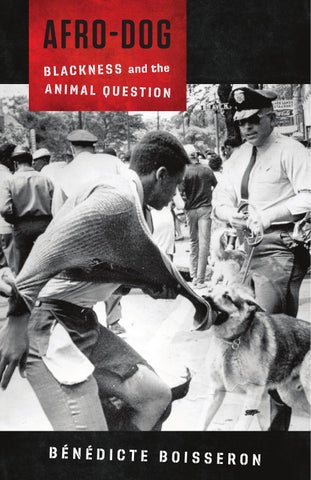
of all forms of oppression by obstructing the idiosyncrasies of each. The second chapter of the book traces back the genesis of the (canine) animalization of the black concomitant with the racialization of the dog in the Americas. This chapter, entitled “Blacks and Dogs in the Americas,” is motivated by the oft-overlooked historical fact that not only humans but also animals were transplanted into the New World during the slave trade. In plantation societies, dogs were brought over from Europe or Cuba to be used as watchdogs, tracking and terrorizing fugitive slaves. The chapter investigates the lingering effects, postslavery, of the association between race and dogs in America. Harriet Beecher Stowe’s novel Uncle Tom’s Cabin greatly contributed to making the image of the “mean dog” running after the “bad,” disobedient slave iconic.38 Since then, specific instances in media, literature, and the arts have compulsively recreated, and continually reignited, the association of the vicious dog with the bad black. Central to this argument is the historical attack of black protesters by police dogs during the 1963 civil rights riots in Birmingham, Alabama. More recently, police dogs have also been used against rioters in Ferguson, Missouri, which further prompts us to revisit the ever-present association between black civil disobedience and canine repression in America. As a result of the slave trade, the transplanted peoples initially from Africa and Europe acclimated to the new location, gradually becoming what one refers to as “Creole.” After having been brought to the Americas, animals followed a comparable Creolization process. So far, only the human Creole population has attracted scholarly attention; scholars have yet to address the ramifications of the animal diaspora. Chapter 3 focuses on the Creole dog, the ancestor of the master’s watchdog shipped to the Americas to chase and attack slaves. This chapter, titled
Introduction Z x xiii
“The Commensal Dog in a Creole Context,” looks at the Creole dog as a prototype of a third category of animals, one that does not fit in the “domesticated” or “wild” categories. In Zoopolis,39 Sue Donaldson and Will Kymlicka call “liminal” those animals that are neither domesticated nor feral, such as urban deer, rats, and squirrels. As we know, however, in the Western world liminal animals are commonly considered to be pests and thus excluded from the house, backyard, and even front yard, while what I call the “commensal” animal does not abide by a dichotomy of private-public space. In ecological terminology, commensalism refers to a class of relationship in which two organisms mutually benefit without adversely affecting each other. This chapter analyzes instances in the Caribbean, as portrayed in Truman Capote’s “Music for Chameleons,” where commensal animals live openly with human beings in a windowless, doorless, nonexclusive space, typical of the Creole house and garden.40 Following Michel Serres’s The Parasite,41 the chapter ultimately argues that commensalism is a poetics of postcolonial resistance that, though modeled after the Creole dog, also applies to the human Creole culture. Afro-Dog seeks to bring attention to how much the dog has been atavistically conditioned, throughout history, to engage with the black as a racialized being. The animal has watched the black negotiate the historical spectrum, ranging from property status to full legal personhood. The dog has undergone some status variations as well, as a watchdog, pet, and Creole stray dog. The question of ownership, or the lack thereof, has been an important factor in the relationship between the dog and the black, and it continues to be so. Chapter 4, “Dog Ownership in the Diaspora,” uses the recent controversy over the 1685 French Slave Code in the French Caribbean as a platform to address the question of ownership in a racial and animal context. French
x xiv Y Introduction
historian Jean-François Niort controversially argues in his 2015 book, Le Code Noir, that the Slave Code is not about the dehumanization of the slave but rather, and only, de-personhood.42 Though legally defined as personal property like a chair or an animal, the chattel slave would, according to Niort, still be viewed as human. The question remains, however, to what extent is dehumanization precisely, and inextricably, tied to the question of ownership—not only being owned as an animal but also owning an animal? This chapter examines the relationship between dehumanization and property in historical contexts that have challenged minorities’ right to pet ownership, including the 1942 decree banning Jewish ownership of pets, the ban on dog ownership for slaves, and the modern breed-specific legislation banning the ownership of pit bulls— dogs that have been predominantly viewed as urban and black. As this chapter argues, the right to own is as much part of the question of personhood as the right not to be owned. The last chapter takes a different angle, as it focuses on— animal and black—silences. This chapter, entitled “The Naked Truth About Cats and Blacks,” revisits French philosopher Jacques Derrida’s seminal work, “The Animal That Therefore I Am,” within a slavery and racial context. Derrida famously describes the existential shame at the sudden awareness of being seen naked by the house pet (a cat), the invisible and silent observer. This chapter compares this ontological experience with the master’s shame of becoming aware, through slave narratives, of having been observed and judged all along by the seemingly invisible and silent slave. The same is true for Négritude, a pan-African movement from the 1930s that suddenly made the French colonizer aware, as French philosopher JeanPaul Sartre argues in “Black Orpheus,” 43 of the shame of being regarded by the Other. This chapter examines the extent to
Introduction Z x x v
which the moment when the black, in an abolitionist, anticolonial, or postcolonial context, starts talking back, is similar to what the emerging field of animal studies currently attempts to do by speaking vicariously on behalf of the animal. Does animal studies contribute to another eye-opening moment in the history of the oppression and exploitation of sentient beings, or is it just another form of speaking for the animal? This chapter does not seek to offer a race-animal comparison that serves and hence instrumentalizes one cause over the other. Its goal is, rather, to show how those two subjectivities, the animal and the black, and those two fields, animal studies and black studies, can defiantly come together to form an interspecies alliance against the hegemonic (white, human, patriarchal), dominating voice. I wrote this book in the midst of the 2015 Ferguson and 2016 Standing Rock demonstrations. The demonstrations against the Dakota Access Pipeline project in North Dakota turned violent in September 2016, as bulldozers were brought in to start construction. Security officers (contracted by the construction company) were filmed using dogs against the demonstrators guarding the Standing Rock Sioux tribe’s sacred land.44 Native American activist Winona LaDuke told a journalist on location, “This is not Alabama. You know? This is 2016.” The images of security dogs attacking Native American protesters prompted a déjà vu experience arching back to the 1963 civil rights riots in Birmingham, Alabama, where German shepherd police dogs, under the command of Commissioner of Public Safety Bull Connor, were photographed attacking black rioters. Since the 2015 report about the investigation of the Ferguson Police Department that uncovered a blatant correlation between race and the use of attack dogs by the police in the city of Ferguson, it has become evident that old habits die hard. The habit of launching dogs on the racialized Other started, however, much before Bull Connor,
x x vi Y Introduction
even before the slavery era. Spanish conquistadors were the first to use attack dogs in the island of Hispaniola, as they launched canines on natives as a retaliative and offensive technique to control the land. In his 1552 Short Account of the Destruction of the Indies, Spanish friar and historian Bartolomé de Las Casas documents at length the extremely cruel and inhumane use of dogs against the so-called Indians in the West Indies.45 French writer Guillaume Raynal would draw a similar conclusion in his 1798 monumental account of the history of the Indies, positing that Indians at the time were worth less than the dogs launched against them.46 Raynal depicts a dreadful scene involving native rebels devoured by dogs and conquistadors vowing to kill twelve Indians a day in honor of the twelve Apostles. As canine attacks against Native Americans have abruptly resurfaced in Standing Rock, it spurs a need to understand how history has come full circle. Why the recent use of dogs against specific groups of “rebels” but not against those who occupied Wall Street or against the armed militia that took over a federal building in Oregon? French historian Phillipe Girard posits that the idea of using dogs against slave rebels during the famous 1803 slave rebellion in Saint-Domingue may have originated in the books, among them those by Casas and Raynal, that General Leclerc brought along with him during his cross-Atlantic expedition to Saint-Domingue.47 Leclerc would have picked up the idea of using canine attacks against black leader Toussaint Louverture’s army in historical books. But when it comes to Ferguson and North Dakota, how did the police and security officers come to the idea of using canine weaponry against, respectively, African Americans and Native Americans? The security guards and the Ferguson police have probably never come across Bartolomé de Las Casas’s account. To what extent, therefore, is the intersection of racialization and animalization atavistically ingrained in
Introduction Z x x vii
our collective memory, and to what extent is it simply an idea picked up somewhere, randomly, like Leclerc on his boat?
AU THOR’S NOTE All English translations are mine unless otherwise noted. In many cases I have provided the original French text in the notes.
Bénédicte Boisseron investigates the relationship between race and the animal in the history and culture of the Americas and the black Atlantic, exposing a hegemonic system that compulsively links and opposes blackness and animality to measure the value of life. By positioning blackness as a focus of animal inquiry, Afro-Dog opens new possibilities for animal studies and black studies to think side by side. “Dazzling in its reach and groundbreaking in its methodology, Afro-Dog redraws the contours of intellectual inquiry with dogs at the lead. Boisseron aims to rethink the hyper-legality of racism and the practice of inequality in ways that are radical and far-reaching.” —Colin Dayan, author of With Dogs at the Edge of Life “Brilliantly enlisting theoretical and critical voices in critical race studies, animal studies, Afropessimism, ecofeminism, and more, Boisseron brings a crucial black Atlantic and diasporic perspective to bear on blackness and the question of the animal to show, not that blackness and animality are comparable, but that black people and animals have been and are historically and concretely connected—most often in the form of ‘man’ and ‘dog.’ ” —Carla Freccero, University of California, Santa Cruz “Afro-Dog is a timely effort to tackle the fraught relations between posthumanism and postcolonialism and between animal studies and African American studies. Boisseron’s readings follow a historical trail of dogs from the Middle Passage to the Ferguson unrest in order to theorize a legacy of connections between racism and speciesism, without posing a false analogy between the two.” —Kari Weil, author of Thinking Animals: Why Animal Studies Now? “Afro-Dog is an amazing book! The animal is not ‘the new black’; instead, racialization, specifically New World blackness, is now present in all things animal. A must-read for anyone interested in the study of animals, enslavement, and race.” —Jane Gordon, University of Connecticut “Boisseron brilliantly demonstrates how the relationship between race and personhood has been missing entirely from the current human/animal rights debate. In doing so she offers a long overdue exploration of the larger and more extended links in American and French culture where blackness and animality have become almost interchangeable in popular discourse.” —Sandra Gunning, University of Michigan BÉNÉDICTE BOISSERON is associate professor of Afroamerican and African studies at the University of Michigan, Ann Arbor. She is the author of Creole Renegades: Rhetoric of Betrayal and Guilt in the Caribbean Diaspora (2014).
Jacket design: Julia Kushnirsky Jacket photo: Afro American Newspapers/Gado/Getty Images COLUMBIA UNIVERSITY PRESS | NEW YORK C U P. C O L U M B I A . E D U
Printed in the U.S.A.
ISBN: 978-0-231-18665-0
9 780231 186650