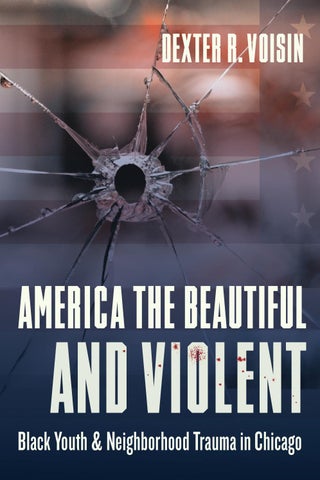
DEXTER R. VOISIn
aMERICa THE BEaUTIFUL e
e
eb
ee
e
e
c
e
e
e
anD VIOLEnT bp
Black Youth & Neighborhood Trauma in Chicago
CONTENTS
1. The Beginning
1
2. The Tale of Two Americas 14 3. Not All Violence Is the Same: Race- and Place-Based Violence 50 4. The Road to Concentrated Poverty and Neighborhood Violence 73 5. The Scars of Violence 113 6. When Violence and Sex Are Entangled 155 7. Living and Parenting in the Presence of Everyday Dangers 169 8. Joining the Broken Pieces: Practice and Policy Solutions and Systems Integration 200 9. Making a Difference: Rebuilding the Village 222 Notes 257 Index 291
1
THE BEGINNING
Until lions write their own history, the tale of the hunt will always glorify the hunter. —AFRI CAN PROVERB
I
never intended to write a book, just as I never intended to become an academic. As a clinical social worker in the early 1990s, I worked mostly in cities, counseling clients struggling with mental illness and substance abuse. Their stories were profound, sometimes tragic, with many moments of courage, compassion, sacrifice, and pride—all deeply affecting tales about the resiliency of the human spirit. One in particular changed the path of my life’s work. In Atlanta during the winter of 1994, I was assigned a new client, a twenty-three-year-old black man, whom I will call Tim, who was just a few years younger than I. He had a slight frame, a warm complexion, and eyes that were bright and alert. His intake form noted a diagnosis of major depression and substance use, with a history of sexual abuse and trauma starting at age ten. He was now hospitalized with AIDS. In 1992, at the height of the epidemic, HIV-infected people had to take first-generation drugs, often as many as thirty pills per day. They were forced to hide their diagnosis to avoid being fired by their employers, ostracized by entire communities, or even killed. An AIDS diagnosis was often
The Beginning associated with increased mortality, especially for those who avoided treatment out of fear or who were in denial about their diagnosis. The time from receiving an AIDS diagnosis to rapid physical decline was often devastatingly swift. While I was with Tim, we discussed the lack of support he received from his family owing to his diagnosis and the fact that he was gay. The following week, when I returned for my second session with Tim, the nurses informed me that he had been moved to a private room. I entered the dimly lit room and thought I had mistakenly walked in on the wrong client. Tim was now barely recognizable, a mere shadow of the man I had visited just seven days before. He had lost about fifteen pounds from his already tiny frame, his body swallowed up by the white bed sheets. His face was gaunt, his eyes protruding and his complexion darkened. It was the first time I had encountered a hospitalized person facing death from AIDS. I was not afraid of Tim’s diagnosis but was startled by the presence of death, which seemed to cast a shadow around his bed. I had experienced death up close only once before, and I was taken aback by its brazen claim on someone so young. He was afraid, and I was afraid for him. “I don’t want to die alone,” he said. I sat next to him and held his hand. This violated my training not to touch clients, but in that moment, I followed my instinct to reassure and comfort him. The following week, when I returned for our third session, Tim had passed away. I made several calls to his mother, but my messages were never returned. The county buried his remains. Although Tim was my first client hospitalized with AIDS, over the years I came to understand what might lie behind his story and those of others. I heard hundreds of horrendous stories told by clients who, as children, had been physically abused, sexually violated, or both. Many began using alcohol and other drugs to treat their deep emotional pain. For some of them, self-medicating with drugs and/or having unsafe sex resulted in their contracting HIV. After hearing many such stories, I recognized the repeated connections among personal trauma, substance use, and HIV acquisition. As my clinical and intellectual curiosity about these connections grew,
2 |
The Beginning I decided to enroll in a doctoral program at Columbia University to study them in more depth. Over the course of this new academic journey, I came to realize that the scholarly literature had much to say about the connections among childhood sexual abuse, drug use, and unsafe sexual practices; however, most of this knowledge centered on white females. I stumbled across statistics documenting that urban youth, especially blacks and males, experienced homicide rates that were up to eight times higher than those of their white and Latino peers. I began wondering whether witnessing neighborhood violence might be related to the higher reported rates of drug use and risky sexual behaviors. This became my dissertation topic. I planned to return to Atlanta after graduation to pursue counseling focused on trauma and mental health. However, several distinguished universities came knocking, and I was offered six tenure-track positions. I accepted a job offer from the University of Chicago, packed up my life, and moved, thinking that I would try academia for one year. Now, after twenty years in the academy, I am still researching the psychological and behavioral effects of exposure to neighborhood violence and how youth and families cope with such trauma. Most of my work has focused on black youth living in U.S. cities. I have published more than 125 peer-reviewed articles on exposure to neighborhood violence and related topics, but I never intended to write a book. However, after years of work through which I came to be considered an expert on the topic of neighborhood violence, I have grown increasingly tired of giving countless interviews on gun violence, mass murder, and senseless killings taking place in Chicago and elsewhere. While many conversations with reporters last more than an hour, the final print or television interviews are whittled down to two-minute clips to fit an American news format characterized by sound bites. I am frustrated that the complexities driving such uneven exposure to violence and its developmental consequences are diluted in this way. These stories often refer to “the plight of black youth, especially males, with their high unemployment, poor high school graduation rates, rap sheets
| 3
The Beginning by age eighteen, gang involvement, teen parenthood,” and so forth. These accounts, while pointing to real disparities, are grievously incomplete and often stigmatizing, especially because they are not scripted by these youth, their families, or their communities. Nor do these stories explicate the structural factors and uneven policies that uphold and fuel these disparities, although black public intellectuals, activists, and thought leaders have long attempted to broaden public awareness of these issues. Violent neighborhood enclaves grew out of decades of societal disinvestment, structural and economic violence, and inequality in U.S. social policy—including systematic residential segregation on explicitly racial grounds. Furthermore, many of these news stories do not tell the many narratives of resiliency and fortitude: stories of personal triumph, family support, neighborhood activism, and social movements, such as the globally influential Movement for Black Lives (also known by the popular slogan “Black Lives Matter”). I have often heard this quote, attributed simply as an African proverb: “Until lions write their own history, the tale of the hunt will always glorify the hunter.” This maxim has been quoted by the author Chinua Achebe, the abolitionist Wendell Phillips, and many others to point to problems with colonial knowledge production. Youth and their communities lament the woefully incomplete and pathologizing narratives that often mark discourse concerning neighborhood violence and race. This book represents my attempt to elevate marginalized voices and to provide an understanding of public-space violence, often called “neighborhood violence,” within the complex social context of marginalization, poverty, criminalization, institutionalized racism and sexism, commodification, invisibility and hypervisibility, and other forces that contribute to the precariousness of black life in the United States. I will discuss these concepts in fuller detail in the pages that follow. One of the first steps in decolonizing knowledge production and bias is interrogating its terms. Therefore, while this book takes on the topic of violence, specifically neighborhood violence, I must acknowledge the assumptions embedded in those words. As many scholars and activists have reminded us, violence is a “slippery concept.”1 While the answer to the question, “What do we mean by violence?” may at first seem obvious, our
4 |
The Beginning notions of what constitutes violence are often governed more by linguistic convention than by conceptual rigor. The editors of one book on violence wrote in their introduction, Violence can never be understood in terms of its physicality—force, assault, or the infliction of pain—alone. Violence also includes assaults on the personhood, dignity, sense of worth or value of the victim. The social and cultural dimensions of violence are what gives violence its power and meaning.2
While most of us may agree that violence is defined in part as an assault to the bodily integrity or psychosocial well-being of a person or neighborhood, some such assaults are more likely to be classified as violence than others. Few would hesitate to call a mugging violent. However, we might find more dissent over whether welfare state cutbacks, incarceration, underfunding of schools in black neighborhoods, economic restructuring, or overpolicing and excessive arrests constitute violent acts. Yet these are all dimensions of structural violence that erode America’s progress toward a more equitable and just society. The World Health Organization’s World Report on Violence and Health defines violence as “the intentional use of physical force or power, threatened or actual, against oneself, another person, or against a group or neighborhood that either results in or has a high likelihood of resulting in injury, death, psychological harm, maldevelopment or deprivation.”3 This definition raises the complicated question of whether intent to harm is necessary for violence to occur. For instance, in a 2009 essay on structural violence, medical anthropologist Paul Farmer shares stories of some of the mechanisms through which large-scale social forces crystallize into the sharp, hard surfaces of individual suffering. Such suffering is structured by historically given (and often economically driven) processes and forces that conspire . . . to constrain agency. For many . . . life choices are structured by racism, sexism, political violence, and grinding poverty.4
| 5
The Beginning Farmer shares harrowing accounts from his fieldwork in Haiti of young women and girls driven by poverty into precarious employment, risky nonvoluntary sexual relationships, and deadly disease and stories of men— disproportionately poor—who were blacklisted, tormented, and tortured by military forces after the 1991 coup. Reflecting on intent, Farmer writes that “these afflictions were not the result of accident or of force majeure; they were the consequence, direct or indirect, of human agency.”5 Nevertheless, the human agency that produces this violence is spread among many people and institutions, and those who may seem most directly involved in inflicting bodily injury on others often have highly constrained individual agency, as they are themselves caught up in powerful political, economic, and historical processes and forces. Indeed, these so-called perpetrators of interpersonal violence often have far less power to produce or prevent structural violence than others—foreign investors, say, or members of international political institutions—who, paradoxically, may not even be aware of particular incidents of harm. Some have described these processes or forces of structural violence, which often produce more intimate, proximate incidents of harm, as cycles, chains, or a “continuum of violence.”6 It is therefore essential that my treatment of violence in this book not elide the structural processes within which individual incidents of interpersonal violence are embedded. As the sociologist Sudhir Venkatesh states, “good [research] is always a mixture of close focus and long shot.”7 At the same time, I wish to be as clear as possible when defining neighborhood violence within the scope of this book. Like violence, the terms black violence and neighborhood violence are complicated. As many—such as the gender and race theorist Linda Alcoff 8—have noted, writing or speaking about a neighborhood often involves the speaker taking an outside position, resulting in an “us-versus-them” dichotomy. This raises the question, What is the neighborhood being referred to in the phrase neighborhood violence? How is the neighborhood being defined, and how is the violence being measured? How do we define what neighborhood violence is, and how is this definition biased? All assumptions are value laden, never neutral or bias free.
6 |
The Beginning The aforementioned World Health Organization report defines neighborhood violence as “violence between individuals who are unrelated, and who may or may not know each other, generally taking place outside the home.”9 In other words, the report defines neighborhood violence as interpersonal and proximate. It includes, but is not limited to, incidents of public-space violence. Yet, while by definition neighborhood violence could apply to a broad range of behaviors and contexts, it is most frequently used in practice to describe perceived patterns of violence in particular locations. Usually, analysts describe neighborhood violence as taking place in lowerincome urban (and, increasingly, suburban) neighborhoods and highly racially segregated ones. Acts often categorized as neighborhood violence include hearing about, witnessing, or being a victim of gang- and gunrelated incidents, muggings, robberies, and rapes. I aim to draw attention to the ways in which systemic factors and forces conspire to concentrate the burden of violence on marginalized communities—after all, that is the topic of this book. I also acknowledge the sociological and political construction of neighborhood violence, which is sometimes accompanied by biased and charged public rhetoric. I offer two timely examples, both related to my adopted hometown Chicago. First, whenever the Blackhawks (the city’s professional hockey team) or the Cubs (one of the city’s professional baseball team) celebrate a big victory, many of the city’s wealthy, predominately white neighborhoods (especially Wrigleyville, home of the Cubs) erupt in violence, including fights, destruction of property, arson, and other acts of disorderly conduct. However, these behaviors are not considered violent acts but are seen instead as celebratory or revelatory. While arrests do occur, many residents speculate that the public rhetoric and the media and police responses surrounding the violence would be markedly different if the disorderly conduct happened in a predominately poor, nonwhite neighborhood. For example, if similar celebratory expressions occurred among black youth in Chicago’s impoverished Englewood neighborhood on the South Side, the police response would likely be more muscular, and the media rhetoric more marginalizing. The second example pertains to the “dog-whistle politics” of President Donald Trump, specifically his frequent invocations of Chicago gun violence
| 7
The Beginning during the 2016 presidential election and in his first year in office. Four days after his inauguration, he even tweeted that “if Chicago doesn’t fix the horrible ‘carnage’ going on, 228 shootings in 2017 with 42 killings (up 24 percent from 2016), I will send in the Feds!”10 Many commentators remarked on his decision to highlight Chicago—the hometown of former president Barack Obama, a frequent target of Trump’s rhetoric. As the author and journalist Ta-Nehisi Coates articulated in a 2017 visit to the city, conservative politicians like Trump frequently “use Chicago as a tool—‘Chicago’ has become code for ‘black people.’ ”11 This racially coded language appeals to the antiblack attitudes and law-and-order politics of many in their voting base. And, as many have noted, although gun deaths in Chicago are a serious public health concern, data collected between 2011 and 2016 reveal that Chicago is not even among the top ten most dangerous large cities in terms of homicide rates, adjusted for population, as I discuss further in chapter 2. Later in the book, I discuss gun violence specifically, as well as the problems with analyzing gun violence at the city level and looking at short-term trends. For now, I wish simply to highlight that public rhetoric about violence is often political on many levels, frequently resulting in the detriment and further marginalization of those most burdened by neighborhood violence and the larger forces that sustain it. In Chicago and many other large American cities, the narratives around violence are primarily crafted and owned by law enforcement officers. The perspectives of public health, mental health, education scholars, community providers and activists are largely absent. Unsurprisingly, these narratives often glorify the politics, policies, and practices of law enforcement. Look at who appears on the evening news after a tragic public shooting in a lower-income neighborhood, and note how the story begins to be framed. The public rhetoric that accompanies incidents of neighborhood violence often includes words such as “gang bangers, monsters, unintended victims, civilian casualties, war zone, criminals, illegal guns, perpetrators, violated probation, communities lacking morality or a respect for life, and criminal record.” Commentators often call for stiffer sentences, additional policing, increased funding for law enforcement, and more heavily militarized forces. All too often, the narratives foreground race, drawing violent caricatures
8 |
The Beginning of the accused and frequently assuming guilt before due process. In short, these storytellers dehumanize the suspects—and often the victims—of neighborhood violence, and they voice the need to “arrest” or “police” the problem away. While I decidedly disagree with the myopic perspective that social problems are best fixed through the criminal justice system, it is said that “to a hammer, everything looks like a nail.” I understand how police training, professional culture, and other socialization processes (including the militarization of American policing, which entrenches an “us-versusthem” mentality) have led many law enforcement officials to conceptualize and narrate neighborhood violence in these ways. The parochial nature of these messages, which often demonize the communities besieged by tragedy and dole out simplistic labels of “perpetrators” or “victims,” was driven home when a Chicago reporter contacted me after a three-year-old child became a bystander victim of gun violence in 2017. The journalist’s first question was “As an expert on neighborhood violence, do you have any insights into the psyche of gang members who would kill a three-year-old child?” A veteran of such interviews, I could tell that the reporter was angling for a catchy sound bite. For almost forty-five minutes, I engaged him in a complex conversation about the structural drivers and policy inequalities underlying not only that particular shooting but also thousands of others. I shared my view that both “victims” and “perpetrators,” broadly speaking, are casualties of well-documented historical processes and public policy decisions that have resulted in failing schools, scant job opportunities, racial and neighborhood segregation, and the hopelessness and anger prevailing among many youth growing up in an unequal America. Our nation is, quite literally, killing and incarcerating marginalized citizens at staggering rates, with a dangerous toll for all America. I also reminded the reporter that while large-scale social forces affect youth who find themselves entangled in violence, the tendency to generalize about the “psyche of gang members” occurs far more often when the accused and the victims are not white. As many commentators and social media activists have highlighted in recent years, too often the actions of nonwhite shooters are described as symptoms of cultural pathology (e.g., the racist “black-onblack crime” rhetoric and mischaracterizations of Islamic doctrine), whereas
| 9
The Beginning the actions of white shooters, including Dylann Roof, Stephen Paddock, and many others, are referred to as acts of mentally deranged “lone wolves.” This time, when my thorough interview was reduced to shallow, twominute news clips, I realized the topic merited a book-length discussion. At its core, this book is designed to be an alternative to the sound bites, ahistorical “common sense” narratives, and detached scholarly analyses that fail to get to the heart of the matter. In it, I share the powerful stories and insights of black youth and elevate their voices, weaving their narratives through data, research findings, and historical accounts that provide further context for their experiences. In each chapter, I aim to celebrate their survival and, through their experiences, illuminate the lives of many others who have grown up in communities in which neighborhood violence is a part of daily life. At times, I draw the lens back to highlight the broad historical, political, economic, and racial factors that shape the construction, concentration, and narrative of violence in black neighborhoods. I invite readers to embrace these young people’s stories and the lessons they teach us within the important context of the larger, violent social structures that influence the day-to-day experiences of these black youth, their families, and their neighborhoods. In the first section of the book, I place neighborhood violence in the United States in context relative to other high-income countries. In chapter 4, coauthored with my longtime collaborator, professor Jason Bird, we highlight historical trends that have led to racially segregated urban neighborhoods and concentrations of poverty and violence. In chapter 5, I examine the psychological and behavioral health characteristics that researchers and practitioners have found to be associated with exposure to neighborhood violence. In the following chapters, I offer a possible conceptual model to explain how child and adolescent development may be influenced by exposure to neighborhood violence. Throughout the discussion, I draw on my interviews with black youth to illustrate the broader themes. In the second part of the book, I use interview and survey data to show how violence influences risky sexual behaviors among black youth in lowresourced neighborhoods. I devote some attention to this connection because higher rates of both neighborhood violence and HIV infection are concentrated in poorer communities. However, the existing literature has
10 |
The Beginning not sufficiently highlighted possible reasons for such a connection. Equally true, living in poverty and experiencing neighborhood violence are associated with lower academic achievement. I also devote some attention to this connection to illustrate that several problems experienced by youth, such as low academic achievement, involvement with “gang peers,” risky sex, and illicit drug use can be linked to neighborhood trauma. I look in particular at Woodlawn, a historic neighborhood on Chicago’s South Side. Illustrations of the ongoing threat of violence in impoverished communities are balanced with interviews showing caregivers’ resiliency and the variety of strategies they use to protect their youth. I expand the scope of discussion of neighborhood violence to examine how positive factors, such as parental monitoring, high self-efficacy, and hopes for the future, can help protect youth living in impoverished neighborhoods. In the final part of the book, I lay out sensible practice and policy recommendations based on the insights from the first two parts. Building on the argument that neighborhood violence results from multiple complex forces, I make the case for an integrated, multisystem approach to addressing violence in low-resourced urban communities. To illustrate this approach, I introduce the reader to several community and university partnerships working to curtail exposure to neighborhood violence and its damaging effects on youth. When I was in the early stages of conceptualizing this book, I talked about it with a twenty-six-year-old, whom I’ll call Jamal, at a Starbucks in Chicago’s Hyde Park neighborhood. I told him I was interested in telling the stories of young people exposed to neighborhood violence. He asked me many questions: “Why do you want to write this book?” “Will I, and the others, be identified in it by name?” “Who are you writing it for, and will people read it or actually care?” I could tell he was wondering whether to trust me. Would I accurately convey his story and those of other people to whom he might introduce me, thereby entrusting them to my care? Would I misrepresent their stories, decontextualize them, or reduce them to stereotypes or statistics? “You know,” he said, “with social media, we tell and control our own stories. Mainstream media . . . well, they tell you their version of our story.”
| 11
The Beginning I have invited these young people, their families, and their communities to share their own stories here. Yet ultimately, I am aware that I control how their stories are summarized, contextualized, transcribed, arranged, and interpreted. My own summaries of their accounts are not value free or neutral. I choose which parts to share, which details are relevant, which other texts to add to the conversation. And, admittedly, to a large extent, I do not have the power to choose at all, because of the limitations of my own perspective and my own conceptual frameworks and biases. How do I come to observe what I observe about a participant? Why do I fail to see some things while noticing others? What are my assumptions, my values, my frameworks for knowing or believing? Without question, I will misinterpret some of the meaning of my informants’ messages, simply because we are different people, with different relationships to words, gestures, and ideas; different histories and experiences to draw upon; different bodies of expertise. What is more, we are dynamic: Our insights into our own experiences are ever shifting, ever incomplete. We must narrate our own pasts, which grow increasingly distant from us in time—though with passing time, we gain new insights that help us see our experiences in new ways. History is never stationary; we recast our histories by retelling them. In other words, while I aspire to convey the participants’ stories in ways they would find respectful, accurate, and satisfying, this book is not “objective,” nor could it ever be. It is shaped by many of the same processes and forces underlying neighborhood violence: inequality, racism, patriarchy, heteronormativity, capitalism, and many others that so powerfully pattern our society. On top of all this is the violent, ongoing history of colonial representation: the ways that knowledge production, in the hands of powerful actors, has been used to marginalize, stereotype, silence, pathologize, commodify, and kill. As an academician, social science researcher, psychotherapist, and social worker, I take seriously my responsibility to reflect on the histories of colonial knowledge production in my own fields of expertise and to interrogate my own role in reproducing oppressive systems and structures. No matter how sincerely I wish for the lions’ histories to be in the lions’ hands, rather than the hunters’, the histories of the young people in this book are not ultimately
12 |
The Beginning in their hands, but in mine, which themselves have been shaped by the systems that I critique and of which I am a part. Therefore, this book is personal. It collects the insights and lessons I have learned over the past twenty years, in conversing with and reflecting deeply on the testimonies of youth and parents I have encountered in my research and practice, including hundreds of survey interviews and dozens of focus groups. The book is especially informed by the many hours I spent with young black youth and their guardians, who generously shared their stories with me to pass along to you. All participant names and some identifying information have been changed to protect their identities. These are actual, not fictional, people and places. Dialogue has been reconstructed from transcripts, field notes, and, in some cases, their memories and my own. I have tried to reproduce the conversations as accurately as possible. I am indebted to the youth with whom I spoke and their families for taking the time, having the courage to tell their stories, sharing their wisdom, and being willing to recall and relive the pain associated with their experiences. Moreover, I am struck by their insight and resiliency. But these stories do not start or end with me, nor with these young “lions� and their families. Their stories are a part of our larger story: of America the beautiful and violent.
| 13
b
n
p
Dexter R. Voisin provides a compelling and social-justice-oriented analysis of current trends in neighborhood violence in light of the historical and structural factors that have reproduced entrenched patterns of racial and economic inequality. America the Beautiful and Violent is built around the powerful voices and insights of black youth in Chicago and their parents and communities. Voisin interweaves their narratives with data, research findings, and historical accounts that provide context for their experiences. He offers a set of practice and policy recommendations to address the patchwork inequality that leads to concentrated violence and to support children and adolescents struggling with the precarious conditions and threat of violence in their daily lives.
p
“Based on years of study, Voisin has written an unusually thoughtful, sensitive, and astute meditation on violence—what it means, how it comes about, how it affects people, and how the media choose to write about it. The book’s critical yet sober stance means the author’s clear and unmistakable sense of urgency is coupled with a subtle, sophisticated sense of the multifaceted consequences of violence. A consistently enlightening work.”
—Mario L. Small , author of Someone to Talk To
“Voisin powerfully shows that the violence that Chicago’s black youth experience is rooted in the nation as a whole. He untangles these complex systems and offers clear and effective solutions. This book will be illuminating for scholars, policy makers, and practitioners alike.” —Mary Pattillo , author of Black on the Block: The Politics of Race and Class in the City
“Voisin writes with conviction, clarity, and conscience in connecting the dots between big ideas (racism, violence, resilience) and daily life through his personal story and those of the folks he has interviewed. America the Beautiful and Violent will help you understand how African American youth can not only survive, but thrive.” —Lois Takahashi, University of Southern California
“Most discussions of violence focus on its horrors and portray perpetrators in a stereotypical manner. This book, on the other hand, deepens our understanding of violence and sheds light on solutions.” —Pedro Noguera, University of California, Los Angeles
Dexter R. Voisin is a professor in the School of Social Service Administration; a faculty affiliate at the Center for the Study of Race, Culture, and Politics; and a fellow at the Center for Health and the Social Sciences at the University of Chicago. He is also director of the STI/HIV Intervention Network and a psychotherapist and social worker. Cover design: Lisa Hamm Cover image: Digital composite. © Yasser Chalid/Getty Images
Columbia University Press / New York
ISBN: 978-0-231-18440-3
cup.columbia.edu P R I N T E D I N T H E U. S . A