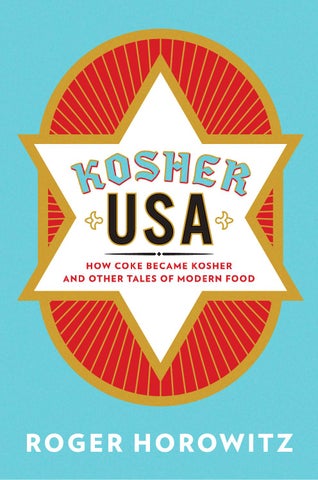
USA HOW H OW C COKE OKE B BECAME EC A M E K KOSHER OSHER AND AND O OTHER THER T TALES ALES O OF FM MODERN ODERN F FOOD OOD
ROG E R H O ROW IT Z
PROLOGUE UNCLE STU’S QUESTION
UNCLE STUART,
my mother’s oldest brother, religiously attended the holiday parties at her Manhattan apartment with his wife, Doris—on Christmas Day (brisket, not ham, was on the table) and for the Passover Seder. As they aged, it became harder and harder for them to participate, but, because of Stu’s stubborn perseverance, they came nonetheless. Aunt Doris went through a long struggle with Parkinson’s disease that progressively deprived her of control over her body—and eventually the ability to speak. Stu went to great lengths to bring her, even after he developed incurable bone cancer, and could no longer lift Doris into a taxi as he once had. The last time I saw Stu, at the 2005 Christmas Day party to which my mother invited friends, business associates, and family, the visit was especially difficult. Without the aide who was spending the day with her family, Stu had pushed Doris’s wheel chair a mile in a bone-chilling December rain (draping it with clothes and large garbage bags to protect her) from his Upper West Side apartment to my mother’s place on 72nd Street. When they arrived, Stu was only good cheer—not a word of complaint. We pulled out my mother’s slivovitz (a powerful plum liquor popular among our Romanian ancestors) and drank several shots; he asked after my son and talked about the Spanish lessons he was taking. I told stories and didn’t ask after his health or Doris, knowing the answers already and not wanting to dent his upbeat mood. It got late, and Stu’s younger brother Ernest offered to drive him and Doris home; Stu tried to demur, but, we insisted, the rain had not stopped. As Doris could not stand, and
·
2 PROLOGUE
Stu no longer could lift her, I was enlisted to help. So we went downstairs, and I carried Doris from her wheelchair into Ernie’s SUV and then helped Stuart get in before returning upstairs to collect the raingear he had used earlier. On an impulse, I grabbed the one advance copy I had received of my new book, Putting Meat on the American Table and gave it to Stu in the car. I rode back to his apartment so I could help move Doris inside; we had a chance to talk about the book for a short time before I walked back to my mother’s place. I think we both sensed that this might be the last time we would see each other. A day or two later, he called my mother about the book; she rang a few days later to relate the conversation. He had read it, said he liked it, but wanted to know why I didn’t write about kosher meat. After all, it was part of our heritage and should have been part of the story that I was seeking to tell—and he would like to talk with me about it. We never had that conversation—Stu died a few days later. But his question stayed in my mind, even if the opportunity to talk with him again was gone. It was a profound question (befitting a person whom my father once called “the smartest man he ever knew”) that stirred my mental energies— Stu was asking, in essence, was it possible to write about the modern food system and ignore kosher food? Did kosher food fit into the industrial methods that now delivered so much food to our society? Or was it in some way marginal, excluded, unimportant in modern secular society? What did that answer say about the place of Jewish traditions in American culture? His question also pointed to how I might bring something unusual to an answer—personal experience growing up in a kosher household, and the scholarship to conduct the necessary research. Much as this Christmas evening left a riveting impression on me, it was Stu’s intellect and insight that put me on to this project for almost a decade—not sentimental obligation; and I think that was what Stu would have wanted. Shortly afterward, I related these thoughts to my colleague and friend Arwen Mohun, who caught the edge of the issue when she blurted out that Stu’s question fundamentally was about religion and modernity. How could a set of practices and beliefs rooted in antiquity persist, and in some ways flourish, but at the same time also struggle to survive in a society ineluctably shaped by different religions and belief systems? Her insight only reinforced to me the value of answering Stu’s question.
·
PROLOGUE 3
FIGURE 0.1 Stuart Schwartz and the author, Passover 2005. Personal collection of Roger Horowitz.
But as I started my research, I found a simple, uplifting narrative largely in place, a celebration of kosher food’s increasing acceptance among food manufacturers and appeal to a largely non-Jewish population. Relentlessly promoted by Lubicom, the public relations firm behind the Kosherfest food trade show, and then given extended form in several books and articles in major media outlets, the story was that of kosher food’s success and incorporation into the American supermarket. And, indeed, there was a great deal of truth to this narrative, as the first half of Kosher USA will detail. Yet as a historian I was suspicious of just how tightly this success story worked, how all roads seemed to lead to its fulfillment. By their
·
4 PROLOGUE
nature, historians are wary of Whiggish stories in which events of the past inevitably lead to a singular outcome. And quiet alarm bells start to go off when the sources used to document these processes had a stake in the conclusions of the books and articles that relied on their recollections. I began to suspect that rather than the previous histories of kosher food discovering an outcome, they had been guided to one that was only partially true. To more fully answer’s Uncle Stu’s question, then, I had to take readers into unfamiliar territory by closely exploring key historical episodes in the intersections of kosher law and modern food production in the twentieth-century United States, the technology and business arrangements so entailed, and the accommodation—if at all—of kosher requirements with the methods used to make conventional food. The story that emerges in this book therefore focuses on kosher food and its place in the American food system in the industrial era of mass production and distribution; its encroachment, conquests, and exclusions. It explores how in many places kosher requirements could be internalized by food manufacturers, especially after post-1980 regulatory requirements and production control technologies increased incentives and reduced costs for doing so. But it also traces the regions where kosher food could not be assimilated into mainstream food production, instead relegated to its margins and rendered virtually invisible to non-Jewish consumers. Chapter 1 draws out the implications of a family argument over sturgeon to explain the development of Jewish law as it pertained to food, and defining what was “fit and proper”—the proper translation for kosher— for Jews to eat. Chapters 2 through 5 chart the expansion of kosher food in twentieth-century America, and with that the remarkable success of the Orthodox (a small minority among Jews) to insert a particular interpretation of kosher requirements into the practices of a secular food system. Chapters 6 through 8 strike a more troubling tone, containing as they do tales of turbulence and decline with the far more attenuated relationship between our food system and the kosher requirements for wine and meat, especially the controversies over shechita, the Jewish requirements for slaughter of animals. The conclusion details the countervailing pressures on kosher food by modernist notions of ethics—and, correspondingly, Jewish practices—as we head into the twenty-first century.
·
Prologue 5
Creating this account required a research strategy that departed from the focus of previous books on a set of usual suspects, largely contemporary kosher food industry leaders and insiders. Instead I went looking for the silences and the stories that the kosher food’s “success” narrative squelched by its very cohesiveness. I found pieces of a fuller, more complex, and at times more disturbing history by combing through archival collections, reading obscure trade journals, interviewing people once influential but now forgotten—and through the memories of my family. Historians usually abjure their personal family history as a source; in my case such an approach simply was not possible. Inspired by Uncle Stu’s question, family memories bubbled out of conversations with my mother and father as my research proceeded. Stories of their own experiences, their parents, and even grandparents surfaced as I recounted to them what I had found in the archives. These conversations deepened in intensity as my parents’ health began to fail, and, much as in my last encounter with Stu, the charged question “how are you feeling” unleashed unpleasant emotions. We knew what was happening; so, rather than dwell on that pain, my mother and father talked about the past and encounters with kosher food in their younger days in that process of life review so common among the elderly coming to the end of their lives. My grandparents, many years gone, came alive again in those stories; and I had to think of them in a different light than I had as a child, seeing them instead as subjects in the historical account that I was writing. And, of course, we talked about my book, which gave them so much pride, especially after Columbia University Press offered a publishing contract in September 2010. Shortly afterward the end finally came. A month after I signed the contract, my father informed me that cancer had spread into his lymph nodes; two months later he was dead. At the same time, my mother began to lose her long fight with chronic obstructive pulmonary disease; she died exactly a month after my father. It was uncanny that my parents, divorced for forty years and living two thousand miles apart, came to their ends so close together. They also each made me executor of their complex estates, duties for which I put aside this book for over two years. My parents’ deaths in the middle of writing this book did not change it into a personal account; it remains a work of history. But it was impossible for the searing experiences of our conversations amidst their decline
·
6 PROLOGUE
to not affect my writing profoundly. The many stories that passed between us conveyed so much and allowed me to bring in the experiences of my family at many points. Told often over meals, and later sitting next to a sick bed, these family stories forced themselves into my research and then into this account by their very relevance. Most of these experiences were prosaic, unexceptional, if not “typical,” certainly representative of some sections of the Jewish population. Indeed, their mundane features were their great value: everyday experiences of some Jews with kosher food. And, as I reflected on my parents in the aftermath of their passing, many of my own childhood memories of our kosher home seemed more vibrant, more pointed, and, as Stu so keenly realized, assets that I could draw on to write this book. The very differences among my family—some Orthodox, some Conservative, some nondenominational—taught me something essential about kosher food and modern Jewish history. My family often did not agree about kosher food; their experiences with it differed markedly, and their stories showed how kosher food could be a source of conflict as well as community. While kosher food may be central to Jewish experience, disagreement over what it was and what it meant is vital to its history. Arguments mattered as much as shared meals. But still, much as my family squabbled about what was kosher (and if keeping kosher mattered), kosher food nonetheless remained at the center of our identity as Jews, a touchstone of our relationship to Judaism, an indelible marker of the space between our pasts and our futures.
Praise for Kosher USA “You don’t have to be Jewish to love Roger Horowitz’s Kosher USA! It is three stories in one: a family narrative within a history of ‘ kosher’ within the industrialization of the American food system. Well researched, insightful, and delightful—even for goyim.” —Andrew Smith, editor in chief, Savoring Gotham: A Food Lover’s Companion to New York City
“Roger Horowitz’s Kosher USA is a window into the world of the Jewish dietary laws and the conflict between being American and being kosher. The fascinating narrative tells the story of sturgeon, Coca-Cola, and Jello, as well as the intricate process of koshering meat in the modern world with the pivotal role of Temple Grandin and the large meat processors.” —Joan Nathan, author of Jewish Cooking in America
“Kosher USA introduces us to a remarkable cast of characters: the rabbis, scientists, home cooks, food companies, and activists who spent decades wrestling with the term kosher in a passionate effort to tame it. This is an exhilarating study of how an ancient religious scruple became a modern American empire. —Laura Shapiro, author of Perfection Salad: Women and Cooking at the Turn of the Century
“An informative and endlessly fascinating account of how Jewish law, modern food production, government regulation, business acumen, and religious politics have shaped the American kosher food industry.” —Jonathan D. Sarna, author of American Judaism: A History
“Set in the context of Jewish ascendancy into the middle class, Kosher USA traces the way in which changes in modes of production and the lure of consumption battered, challenged, and sustained an ancient Jewish practice. There is no other book like it.” —Hasia Diner, director, Goldstein-Goren Center for American Jewish History, New York University
“A thoughtful look at the convergence of faith, ethnicity, and the business of food.” —Kirkus Reviews
A RTS A N D T R A D I T I O N S O F T H E TA B L E
ISBN: 978-0-231-15832-9
P E R S P E C T I V E S O N C U L I N A RY H I S TO RY
CO LU M B I A U N I V E R S I T Y P R E S S / N E W YO R K C U P.CO LU M B I A . E D U
9 780231 158329