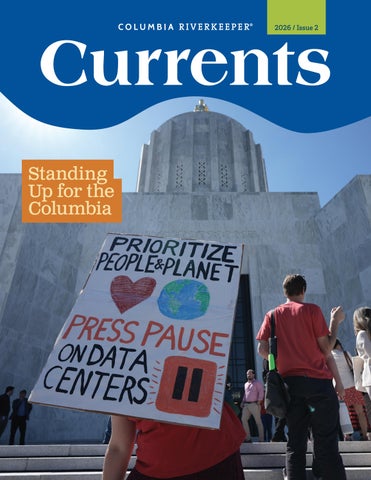
2026 / Issue 2
Standing Up for the Columbia
Director’s Letter
For the River
L
et’s cut to the chase. The Trump administration is gutting the environmental laws and funds that protect the Columbia River and the people who rely on it. We are not backing down. Now is a critical time to activate community members and demand leaders to stand up for clean water, abundant salmon, and climate action. And to enforce the law! When the government violates bedrock laws that protect the water we drink, the air we breathe, and the fish and other wildlife that call the Northwest home, we must fight for justice.
You inspire kids to love and use the river, because jumping into a cold river on a hot day and landing a Chinook salmon should be a possibility, not a tale from the olden days. Columbia Riverkeeper protects and restores the water quality of the Columbia River and all life connected to it, from the headwaters to the Pacific Ocean.
Front cover: Salem Lobby Day Against Data Centers, photo by Alex Milan Tracy. This page: James Lavadour, THE EARTH IS ONE COUNTRY VI, 2023, oil on wood panel, courtesy of the artist and PDX CONTEMPORARY ART. Graphic design by Melissa Delzio.
2
What’s possible when people join together for the river? You prevent the Columbia from turning into a fossil-fuel refinery hub and transport highway. You convince Oregon and Washington to adopt some of the nation’s most protective public health laws for people who eat fish from the Columbia and other rivers. You stop illegal air and water pollution. You inspire kids to love and use the river, because jumping into a cold river on a hot day and landing a Chinook salmon should be a possibility, not a tale from the olden days. Columbia Riverkeeper’s team of attorneys, community organizers, and policy advocates are gearing up to take on some of the biggest threats facing the Columbia. Your donation will power:
•
• •
•
•
•
Lawsuits to protect clean water and stop dangerous plans to increase our region’s reliance on dirty fossil fuels.
Community organizing and legal strategies to stop Big Tech’s unchecked data center expansion. Creative policy solutions and community organizing to secure laws and government actions that protect everyone who relies on the Columbia and locally caught fish. Strategic litigation, advocacy, and public engagement in solidarity with Tribes to fight for salmon recovery and protect sacred places.
Advocacy to stop new nuclear reactors, advance Hanford Nuclear Site cleanup, and engage people whose future rests on effective cleanup. Water-quality monitoring, research, and free, bilingual (Spanish/English) environmental education to inspire the next generation of river advocates.
In this issue of Currents, dive into the incredible advocacy, science, and educational opportunities you made possible. Learn how we are taking momentum from 2026 into the new year: From tenacious litigation to creative community organizing to kids experiencing the wonder that is the Columbia, we are charging forward with hope and passion for the river and the people who rely on it. Together, we will keep fighting for a river that unites and sustains us. Onward,
Lauren Goldberg, Executive Director
3
Impact Report
Mission
Your Impact in 2026 Columbia Riverkeeper is powered by more than 25,000 members and supporters. Together, you advocate for the lifeblood of the Pacific Northwest and the people and cultures who rely on it.
Victory for Water, Public Lands You spoke and Senator Wyden listened, declaring his opposition to HR 655, a bill that would have given away public land in the Mount Hood National Forest. The alleged reason: expanding demand in the City of The Dalles. The real reason: The Dalles has already given gobs of water to Big Tech for Google’s massive data center complex, with additional data center construction already underway. Thanks to all of you who signed our petition, sent postcards, spoke up in town halls, attended rallies, and shared the message with friends and family.
75+
Community events Columbia Riverkeeper hosted or spoke at to share information about pressing river issues and how to make a difference Top Left: No Underwater Power Line Community Info Session in Cascade Locks (left to right Renée Tkach Conservation Director, Friends of the Columbia Gorge; and Teryn Yazdani, Staff Attorney, Columbia Riverkeeper). Right: Activist holds a sign at Salem Lobby Day Against Data Centers. Photo by Alex Milan Tracy. Above right: Lorri Epstein, Science & Education Director testing E. coli. Photo by Michael Hanson.
4
To protect and restore the water quality of the Columbia River and all life connected to it, from the headwaters to the Pacific Ocean.
Vision A Columbia River that unites people to fight for clean water, abundant fish and wildlife, and our climate.
2,000+ 15,000+ People signed petitions urging action for the Columbia and our climate
Data Centers = Time Out At a rally in Salem, Columbia Riverkeeper partnered with community members and nonprofits from across the state to call for a 3-year statewide moratorium on data centers. During the rally, Governor Kotek announced her support for a moratorium; her competitor Christine Drazan echoed a similar message later that day. We met with dozens of legislators to encourage their support for the 3-year statewide data center moratorium, and will keep up the momentum in 2027.
Kids received free environmental education through Columbia Riverkeeper’s work in rural and urban school districts
Progress for Cold Water and Salmon Reservoirs on the Lower Snake and Columbia rivers trap the sun’s heat, making the water too hot for salmon. For over a decade, Columbia Riverkeeper and our allies have been using science and the Clean Water Act to ratchet up pressure on the federal government to reduce heat pollution caused by its dams. The Washington Department of Ecology rejected—again—the Army Corps and Bureau of Reclamation’s proposed Water Quality Attainment Plans for Columbia and Lower Snake river reservoirs, and committed to conducting a system-wide analysis of temperature to achieve the best outcomes for fish and river health.
Win: Controversial Power Plant for Data Centers Canceled A contentious proposal to build 14 methane gas generators to power data centers in Quincy, WA, was canceled this summer thanks to opposition from Columbia Riverkeeper and our partners.
Values Care: We care for ourselves, others, and the world around us. Relationship building: Victories are built on strong, lasting, and reciprocal relationships with colleagues, partners, members, and decision-makers. Equity and inclusion: We respect all people, regardless of color, ethnicity, place of origin, culture, language, age, sexuality, or gender. Hope: We work and celebrate with creativity and optimism. Honesty and integrity: We operate with honesty and integrity, balanced with compassion.
Columbia Riverkeeper earns the highest ratings from top charity guides. Four stars: Exceptional. Exceeds industry standards and outperforms most charities in its cause Platinum = Highest Seal of Transparency.
5
Top: Hanford, photo by Sky Bear Media. Bottom: Left to right Kelly Campbell, Policy Director, Columbia Riverkeeper; Guillermo Rogel Jr., Political Manager, Front and Centered; and Gail Cabahug, Policy & Advocacy Manager, Puget Soundkeeper at the Washington Water Lobby Day in Olympia, Washington. Photo by Barry Amundson.
350
Youth learned about the Hanford Nuclear Site and how to speak up for cleanup during events organized by Columbia Riverkeeper’s Clean Up Hanford program and Yakama Nation
20 Years of Water Quality Monitoring According to the U.S. Environmental Protection Agency, an estimated 3.5 million Americans get sick every year from swimming or splashing in water containing harmful bacteria. While many states test beaches, Oregon and Washington do not monitor the Columbia River for bacterial contamination. Riverkeeper fills this void by training paid interns to sample the water and posts real-time results on the Swim Guide app. The app uses E.coli data to flag beaches that are safe or unsafe for swimming. This year marks 20 years of collecting data and sharing it with state agencies and the public.
13
Lawsuits advanced to protect clean water, support salmon recovery, and curb climate pollution
Clean Water Win The Clean Water Act is one of the strongest legal tools we have to support our mission and keep pollution out of the river. When we go to court and win, we make polluters pay serious penalties for violating the Clean Water Act. This spring, we secured a major victory for clean water and salmon recovery in our lawsuit against Darigold Inc.’s Sunnyside, WA, facility. Darigold agreed to comply with the law and pay $2 million to Yakama Nation to restore water quality in the Yakima River.
“The Columbia connects us. It sustains salmon, provides water that nourishes us, and is central to the cultures, economies, and communities of the Northwest. Donors like you power the movement to protect the lifeways of the Pacific Northwest, today and for future generations not yet born.” — Emily Washines, Board President
8
In-depth research reports and fact sheets released by Columbia Riverkeeper on topics ranging from Hanford cleanup, data centers on the Columbia, and the impact of dam operations on salmon
Revenue & Expenses October 2025-September 2026 Operating Revenue Total: ................................................ $ 3,521,694
Community Advocacy for Clean Air, River After sustained community advocacy and support from nonprofits including Columbia Riverkeeper, Drax Group has announced it is pausing plans to develop a large-scale wood pellet facility in Longview, WA. Industrial burning of wood pellets leads to deforestation, releases dangerous air pollution, and worsens climate change.
In-kind 10%
Program Service 5% Interest 4%
Individuals 52%
Expenses Total: ...................................................$3,737,061
Fundraising 7% Administrative 16%
Fiscally Sponsored Projects* 3%
Program 74%
Court Rules for Salmon In response to a request by Columbia Riverkeeper and our partners, a court ordered additional protections for Columbia River salmon. As a result, baby salmon will travel downstream faster and more safely.
6
Grants 29%
*Columbia Riverkeeper fiscally sponsors the Stop NW Gas Expansion Coalition.
7
Our Agenda
Rivers, Not Energy Corridors
Big Plans for 2027!
Stand Up to Data Centers By Miles Johnson, Legal Director
Columbia Riverkeeper is excited to grow our impact in 2027, with your help and support. Here is a snapshot of the pressing issues you will tackle as a Columbia Riverkeeper supporter.
8
In 2027, we will work to halt the growth of data centers in Oregon and Washington to protect our air, water, and energy resources. Columbia Riverkeeper’s research helped expose the data center boom in the Columbia River Basin and the alarming connection between data centers, methane gas use and more pipeline construction. Now people all over the Northwest are speaking out against data centers in their communities—and politicians in Oregon and Washington are beginning to listen. We will capitalize on the momentum we have created together to push for moratoriums on new data centers in the 2027 Oregon and Washington legislative sessions, advocate for stronger laws to protect the Columbia, and engage people impacted by data centers to fight specific proposals.
Columbia Riverkeeper has long fought to keep the river from becoming a superhighway for fossil fuels and energy projects. We will continue standing strong in 2027, leading the fight against a high-voltage power line on the bottom of the Columbia River by asking Washington Governor Bob Ferguson and other decisionmakers to reject this shortsighted, risky proposal. We’ll also tackle a plan to build a large new methane gas pipeline through the Columbia River Gorge; more fossil fuel infrastructure is the last thing our river, communities, and climate needs. Together, we can move toward a vision of the Columbia that centers on river restoration and natural abundance, not an energy superhighway.
Enforce the Law (Because the Feds Sure Won’t) Polluters beware. The Trump administration is gutting enforcement agencies like the Environmental Protection Agency, but that doesn’t mean illegal pollution in the Columbia River Basin will go unchallenged. Columbia Riverkeeper is proud of our strong work holding polluters accountable in recent years, and we will expand those efforts in 2027. This means making sure that corporations treat their industrial runoff in accordance with the Clean Water Act, holding federal agencies accountable to cleanup standards that protect river communities, and mounting legal challenges against projects like NEXT Renewable Fuels and Goldendale Pumped Storage that violate federal environmental rules. Our team of lawyers is vigilant about enforcing the laws that protect the Columbia River and its people—especially when the federal government looks the other way.
Finding Solutions to Heat Pollution Dams on the Columbia and Lower Snake rivers make the water too warm for salmon and encourage toxic algae blooms. Columbia Riverkeeper has been a leader in using the Clean Water Act and other approaches to call attention to the hot water crisis for over a decade. In 2027, that work will enter an exciting new phase: Washington and Oregon will use their authority under the Clean Water Act to model a wide range of potential changes to the dams and their operations. The goal will be to identify a suite of actions that would significantly reduce the temperature of the rivers. This important interim step will give the entire region a common understanding of what it would take to keep the rivers cool. The Bonneville Power Administration and the U.S. Army Corps of Engineers (and their allies in the public power industry) will keep trying to derail efforts to understand this problem. To counteract those voices, we’ll be asking you to show your support in 2027 for Oregon’s and Washington's efforts to identify real solutions to a challenging, complex problem.
New Approach to Hexavalent Chromium at Hanford Hexavalent chromium is a cancer-causing chemical found in many areas of Hanford and the subject of many cleanup plans throughout the site. Disturbingly, the U.S. Environmental Protection Agency recently found that hexavalent chromium is actually even more toxic and harmful than we thought. In 2027, Columbia Riverkeeper will pressure the responsible agencies to use the new information and safety standards for hexavalent chromium to update old cleanup plans and re-assess the need for cleanup at other areas of Hanford. As always, we will strive to ensure that Hanford cleanup is protective of human health and the environment. 9
Cleanup
9 Nuclear Reactors
An Excerpt From Our New Report: “Hanford Nuclear Site Cleanup in the Age of Nuclear Uncertainty.”
Read the Full Report:
10
Today, Hanford cleanup is at a crossroads, with increased pressure for nuclear development threatening to derail a thorough and protective cleanup. Under the Trump administration, government restraint around nuclear energy and weapons has rapidly dissolved, raising new threats to Hanford cleanup and the possibility of more nuclear energy facilities along the Columbia River. Currently, there is an acceleration of federal deregulation around safety and oversight of nuclear energy, from lowering radiation standards to exempting advanced nuclear reactors from federal environmental review. In regard to nuclear weapons, the U.S. has pulled out of key nuclear-weapons treaties and joined the only nuclear-armed country in the Middle East to wage another dangerous war, threatening to drop nuclear bombs on civilian populations. Federally managed U.S. Dept. of Energy sites like Hanford
100-N 100-F
100-K 100-B/C
177 Underground Tanks 200 West
Hanford Reach National Monument
have been caught in the crosshairs, as developers and Big Tech seek to develop nuclear energy and other AI infrastructure to support both the energy and war pursuits of the Trump administration. Are current decisions regarding Hanford cleanup truly an effort to achieve a long-term safe and effective cleanup, or instead to demonstrate short-term progress to sooner invite nuclear and other development on site? Our analysis begins where plutonium production began: the Hanford Site’s 300 Area, located less than two miles north of the city of Richland and adjacent to the Columbia River.
Down by the River, Hanford Impacts the Water Assembling fuel and experiments with material from highly radioactive fuel left an indelible mark
200 East
ERDF Landfill
r ve Ri bia
The Most Toxic Place in America
T
he future of the Columbia River and the people who rely on it depends in large part on the success of the Hanford cleanup. Maintaining a long-term and safe cleanup is essential to protecting clean, cold water and all who depend on it—even more pressing in an era where water scarcity is a reality rather than an existential threat.
100-H
um Col
By Simone Anter, Senior Attorney & Clean Up Hanford Program Director
100-D
Hanford Site Nuclear Fuel Test Facility
Rat tles na ke Hi lls
400 Area
Fuel Fabrication & Uranium 300 Area Processing Richland
on groundwater, soil, and hardto-address cleanup sites. Close to Richland, the 300 Area remains one of the most important areas for focused cleanup along the entire Hanford Reach. During operations, engineers used the 300 Area to prepare nuclear fuel for reactors, and manufacture the precise graphite shapes required to construct and operate the reactors. Years later, high-level materials derived from irradiated and processed nuclear fuel came back to the 300 Area in the form of fission products, where experiments to condense and solidify contaminants like cesium and strontium released astounding amounts of radioactive material into the ground very close to the Columbia River. Even today steam often rises from the Columbia Generating Station (Washington’s only producing nuclear power plant), which is adjacent to the 618-11 Burial 11
Uranium Plumes in Relation to the Columbia River
Uranium Levels
300 AREA
Columbia River
Hanford Site
≥ 30 and < 300 μg/L ≥ 300 μg/L
The figure depicts uranium concentrations above drinking water standards (in orange & red) close to the Columbia River shoreline.
Hanford Site
bia
lum Co r ve Ri 300 Area
2023 Sitewide Groundwater Contaminant Plumes
Ground, one of Hanford’s most polluted burial grounds. Below, groundwater is contaminated with uranium, tritium, nitrate, and other pollutants that have the potential to cause cancer, immune disorders, and kidney disease. The stretch of the Columbia River flowing by the 300 Area is abundant in sturgeon, bass, salmon, and pikeminnow (a bounty fish), and frequented by fisher folk.
Trichloroethene (1 μg/L Central Plateau) or (4 1 μg/L River Corridor) Carbon-14 (2,000 pCi/L) Carbon Tetrachloride (3.4 μg/L) Hexavalent Chromium (10 μg/L) RUM-2 Hexavalent Chromium (10 μg/L) Hexavalent Chromium (48 μg/L) Total Cyanide (200 μg/L) Iodine-129 (1 pCi/L) Nitrate (45 mg/L) Strontium-90 (8 pCi/L) Technetium-99 (900 pCi/L) Tritium (20,000 pCi/L) Uranium (30 μg/L)
2023 DOE Groundwater Monitoring Report
12
Key Cleanup Challenge in the 300 Area: Groundwater A zone of groundwater pollution at Hanford is referred to as a “plume.” Unlike their one-dimensional depiction in flat maps, plumes at Hanford are both broad and deep, moving downward toward groundwater and horizontally, sometimes toward the Columbia River. During production years, more than 400
billion gallons of contaminated water were discharged directly into soils and groundwater at Hanford, resulting in a plume that stretches almost 60 square miles. Close to the shoreline of the Columbia River, uranium levels in the 300 Area groundwater still approach or exceed drinking water standards. From the original production of plutonium to the contamination and cleanup challenges it left behind, Hanford reminds us that every curie of radioactivity created is here to stay. Observing the Hanford cleanup from this perspective puts the priority on a safe, effective, and long-term cleanup in order to protect the people and a place that matters. A cleanup that veers from this grounding principle could have dire implications for generations to come. Columbia Riverkeeper’s report was funded in part by a public participation grant from the Washington State Department of Ecology.
13
Organize
Gathering in Support of Bonneville Dam Cleanup
Senior Community Organizer Kate Murphy points out an area of contamination.
Uniting River Communities Columbia Riverkeeper works across the region to unite people to fight for clean water, abundant fish and wildlife, and our climate. From Salem to Sunnyside and beyond, our efforts in 2026 spanned advocacy to activism. People whose lives might not otherwise intersect came together with a shared passion and hope for the future of the mighty Columbia.
In the tranquil waters upriver from Bonneville Dam, something unexpectedly sinister lies beneath. For years, Columbia Riverkeeper worked in solidarity with Yakama Nation to convince the U.S. government to prioritize Bradford Island and surrounding waters as a Superfund Site. Cleaning up the Army Corps’ mess is complex, but it is possible. This summer, the Army Corps began cleanup, an important milestone. Our work is not done. In 2026, our team connected with people who care about and rely on the Columbia. From developing a creative online fish game about the local fish advisory to conversations at dozens of community events, we worked to get the word out while holding the government accountable.
14
Photo by Evan Benally Atwood. The Hanford Journey offered a unique opportunity to experience the Hanford Reach’s natural beauty and learn about the religious and cultural significance of the area now known as the Hanford Nuclear Site.
Columbia Riverkeeper partnered with Yakama Nation’s Environmental Restoration Waste Management Program to bring hundreds of people together in October for a day of experiential learning and knowledge sharing at the Hanford Nuclear Site, the most contaminated place in the Western Hemisphere. Boat tours glided past reactors while looking for salmon spawning activities, as guides provided updates on cleanup. Speakers discussed salmon, cleanup, and the future of the site, and a hike at White Bluffs reminded participants that Hanford has a future worth fighting for.
Honoring Pushpum
Rallying State Legislatures We fought hard this year for clean water and against the unchecked proliferation of data centers along the Columbia. In February, we enjoyed a productive lobby day in Olympia with other Waterkeepers of Washington, connecting over our shared values of clean and abundant water. In a September rally and lobby day in Salem, Columbia Riverkeeper partnered with community members and nonprofits from across Oregon to call for a 3-year statewide moratorium on data centers.
Learning About Hanford Nuclear Site
A scene from the crowd at the Oregon rally in September. Photo by Alex Milan Tracy.
Hundreds of people gathered in May at Pushpum, the site of the proposed Goldendale Pumped Storage development. The Confederated Tribes and Bands of the Yakama Nation and the Ḱamíłpa (kah-MILT-pah) (Rock Creek) Band of Yakama Nation hosted a day-long event featuring speakers, dancers, and ceremonies. Columbia Riverkeeper supported the event and is honored to stand in solidarity with Tribal Nations to advocate for Indigenous cultures, natural resources, and Treaty rights. Pushpum is a sacred site for ceremonies, legends, and gathering of traditional roots and medicines. As a natural seed bank, this landscape contains rich biodiversity in plant and animal life that, once removed, can never be fully restored.
More than 300 people rallied against the proposed Goldendale Pumped Storage project. Photo by Paloma Ayala.
15
Non Profit Org US Postage Paid Permit No. 2777 Portland, OR
P.O. Box 950 Hood River, OR 97031
Join the Movement.
When we unite and fight together, we win.
Donate today to team up with our environmental lawyers, community organizers, and scientists, and help power victories for the lifeblood of the Pacific Northwest. ColumbiaRiverkeeper.org/Donate "The River" illustration by Alexandria Frady.