Columbia KNIGHTS OF COLUMBUS
JA N UA RY/ F E B R UA RY 2026
COLUMBIA JAN FEB 26 ENG COVERS 12_15 FINAL.indd 1
12/15/25 9:27 PM
Because
LIFE changes Your Knights of Columbus insurance agent is ready to help you identify the best strategy for your family and ensure that your coverage keeps pace with life’s changes. Book a complimentary financial needs analysis today.
KEY BENEFITS: • Maximize your protection • Identify gaps or opportunities • Stay aligned with your goals • Take advantage of your fraternal benefits
GET STARTED TODAY. kofc.org/findagent
Life insurance, annuities, long term care insurance, and disability income insurance are offered through Knights of Columbus, One Columbus Plaza, New Haven CT 06510. Knights of Columbus and its agents do not provide financial planning, legal or tax advice.
20501 1/26
CONTENTS
Columbia J A N U A R Y/ F E B R U A R Y 2 0 2 6 B VOLUME 106 B N U M B E R 1
Departments 3 For the greater glory of God Young men won’t find fulfillment in digital distraction, but in a life shaped by faith, fraternity and self-gift. By Supreme Knight Patrick E. Kelly
ON THE COVER: Photo by Giovanni Bruner/Courtesy of Canossian Daughters of Charity — ABOVE: The Baptism of Christ, c.1589 (oil on canvas) by Tintoretto, Jacopo Robusti (1518-94); S. Silvestro, Venice, Italy / Bridgeman Images
4 Learning the faith, A detail of a painting by 16th-century Italian artist Jacopo Robusti, known as Tintoretto, depicts the baptism of Christ in the Jordan River by St. John the Baptist. The Holy Spirit is shown “descending like a dove” (Mt 3:16). The feast of the Baptism of the Lord is celebrated on the first Sunday after Epiphany — this year, Jan. 11.
living the faith Interior renewal begins when we surrender our attachments and receive the transforming gifts of the Holy Spirit.
By Supreme Chaplain Archbishop William E. Lori
6 Knights of Columbus News Silver Rose Border Exchange Honors Our Lady of Guadalupe • Supreme Officers, College Knights Lead Halftime Rosary • Exhibit Spotlights Christian Persecution in Iraq and Nigeria • New Film Profiles Founder of Religious Order • K of C Coats for Kids Has Another Banner Year 8 Building the Domestic
10 Breaking the Chains
The Order joins global efforts to combat human trafficking and bring safety, healing and hope to survivors and those at risk. By Columbia staff
16 A Space To Grow and Flourish
Church A series of columns on family life, leadership and financial stewardship
26 Knights in Action Reports from councils and assemblies, representing Faith in Action ON THE COVER
Knights in Maryland help expand a maternity home to support mothers and their babies.
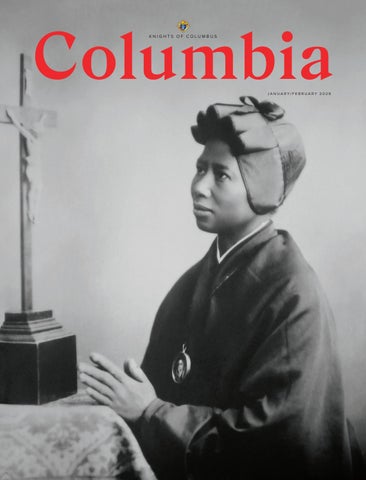
St. Josephine Bakhita prays before a crucifix in Venice, Italy, circa 1933.
By Katie Yoder
PLUS: Rising to the Challenge – Knights ramp up pro-life support as pregnancy resource centers face unprecedented demand.
20 People, Not Products
In severing the communion of persons from the gift of life, IVF reduces the child to something made, not someone received. By Stephanie Gray Connors
23 Not MAiD for This
As euthanasia expands in Canada, Catholic groups offer hope, care and advocacy for those vulnerable to despair. By Nicholas Elbers
Membership in the Knights of Columbus is open to men 18 years of age or older who are practical (that is, practicing) Catholics in union with the Holy See. This means that an applicant or member accepts the teaching authority of the Catholic Church on matters of faith and morals, aspires to live in accord with the precepts of the Catholic Church, and is in good standing in the Catholic Church.
kofc.org/join Copyright © 2026 All rights reserved
JANUARY/FEBRUARY 2026 B C O L U M B I A
COLUMBIA JAN FEB 26 ENG 12_15 FINALr2.indd 1
1
12/16/25 4:25 PM
EDITORIAL
Columbia
A Vision for Life WHILE WRITER-DIRECTOR Andrew Niccol is known for perceptive work, such as The Truman Show (1998), his first produced feature arguably remains his most prescient. The 1997 film Gattaca is set in the “not-too-distant future,” within a dystopian eugenic society where dignity is determined by biological fitness. The protagonist, Vincent, explains in a voiceover that he was naturally conceived — unlike his younger brother and so many other children selectively chosen or engineered for desirable traits. “They used to say that a child conceived in love has a greater chance at happiness,” Vincent says. “They don’t say that anymore.” As his mother is shown clutching her rosary during childbirth, he adds: “I will never understand what possessed my mother to put her faith in God’s hands rather than those of her local geneticist.” Vincent, portrayed by Ethan Hawke, conceals his identity as a “God-child” and “de-gene-erate,” finding an ally in a co-worker named Irene, portrayed by Uma Thurman. The film ultimately points to lessons about the gift of life, the virtue of charity and the resilience of the human spirit. In an early draft of the script, it was set to conclude with an epilogue showing portraits of renowned historical figures — Homer, Lou Gehrig, Helen Keller and Stephen Hawking among them — identified by “their affliction rather than their accomplishments.” Considering these themes and the film’s prolife subtext, one wonders whether Niccol was inspired in part by Evangelium Vitae (1995), St. John Paul II’s landmark encyclical on the Gospel of life. “A person who, because of illness, handicap or, more simply, just by existing, compromises the well-being or lifestyle of
those who are more favored tends to be looked upon as an enemy to be resisted or eliminated,” John Paul II wrote, laying bare the logic of the modern throwaway culture. “In this way, a kind of ‘conspiracy against life’ is unleashed” (12). Months after Gattaca’s release, Hawke and Thurman married, and Thurman later gave birth to their daughter, Maya — now a successful actress best known for her role on Netflix’s Stranger Things. During a Tonight Show appearance in June 2022, Maya addressed the U.S. Supreme Court’s decision overturning Roe v. Wade, praising an op-ed her mother had written about having an abortion as a young woman. In that article, Thurman acknowledged, “I wanted to keep the baby,” writing that her heart was broken by the abortion but nonetheless maintaining that “termination was the right choice.” Maya asserted that “if she hadn’t had it, she wouldn’t have become the person that she’s become, and I wouldn’t exist.” The logic of the culture of death is indeed twisted and “upside down” — not unlike the dark parallel dimension in Stranger Things. In response to this darkness, John Paul II called for “the implementation of long-term practical projects and initiatives inspired by the Gospel” (Evangelium Vitae, 90). Thirty years on, such initiatives accompany human life at every stage: from ethical approaches to treating infertility, to practical support for pregnant women and young mothers, to outreach for those at risk of exploitation, and to compassionate care for the sick and the dying. In these works of charity, the Gospel of life is lived — offering tangible signs of hope in a culture too often turned upside down. B Alton J. Pelowski, Editor
Featured Resource: The Gospel of Life A new small group study guide to St. John Paul II’s 1995 encyclical Evangelium Vitae (The Gospel of Life) is the third title in the Cor Ecclesiae Series published by the Order’s Catholic Information Service. The 140-page booklet — which includes excerpts, commentary, discussion questions and prayers — is an ideal resource for Cor and for anyone seeking to build a culture of life. It is also available in French and Spanish. For more information and to order, visit kofc.org/shopcis. 2
PUBLISHER Knights of Columbus SUPREME OFFICERS Patrick E. Kelly Supreme Knight Most Rev. William E. Lori, S.T.D. Supreme Chaplain Arthur L. Peters Deputy Supreme Knight John A. Marrella Supreme Secretary Ronald F. Schwarz Supreme Treasurer Anthony R. Picarello Jr. Supreme Advocate EDITORIAL Alton J. Pelowski Editor Matthew Kirby Editorial Director Andrew J. Matt Managing Editor Elisha Valladares-Cormier Senior Editor Megan Stibley Associate Editor Paul Haring Manager of Photography Cecilia Engbert Content Producer
Blessed Michael McGivney (1852-90) – Apostle to the Young, Protector of Christian Family Life and Founder of the Knights of Columbus, Intercede for Us.
HOW TO REACH US COLUMBIA 1 Columbus Plaza New Haven, CT 06510-3326 columbia@kofc.org kofc.org/columbia Address changes 203-752-4210, option #3 addresschange@kofc.org Columbia inquiries 203-752-4398 K of C Customer Service 1-800-380-9995
C O L U M B I A B JANUARY/FEBRUARY 2026
COLUMBIA JAN FEB 26 ENG 12_15 FINALr1.indd 2
12/16/25 9:00 AM
F O R T H E G R E AT E R G LO R Y O F G O D
Hardwired for Communion Young men won’t find fulfillment in digital distraction, but in a life shaped by faith, fraternity and self-gift By Supreme Knight Patrick E. Kelly
Photo by Michael Collopy
LAST NOVEMBER, I participated in the inau-
gural Symposium on Young American Men in Washington, D.C. Convened to address the growing crisis of isolation and disconnectedness among young men, it brought together experts and scholars to discuss the reasons behind the crisis — and to offer solutions. Polling data presented at the symposium by the research firm Cygnal was startling. Nearly 70% of Gen Z men (born between 1997 and 2012) spend one to six hours a day online, and 27% spend six hours or more — browsing, gaming or scrolling through their social media feeds. More than 44% spend between three and six hours per day on YouTube alone, and 11% spend even more time on the site than that. Internet gaming — which researchers link to increased exposure to pornography — is rampant among Gen Z. More than half play video games daily, and nearly 36% play for more than two hours a day. The data shows that heavy digital usage has a clear link with poor levels of happiness and mental health among young men. Brad Wilcox, a professor of sociology at the University of Virginia, says the addictive nature of gaming, social media and pornography is causing men “to lose their drive and ability to socialize, learn, date, work and form a family.” He notes that many of his college-age female students lament that they have never been asked out on a date. Amid the discouraging findings, there were some rays of hope. The polling showed that other behaviors correlate with positive outcomes. Young men who practice their faith, exercise regularly, have male mentors, and spend minimal time online report significantly higher levels of happiness and better mental health. Isolation and disconnectedness are nothing new. What is new is the way today’s technologies are designed to be immersive and addictive, which makes it so easy to fall into
isolating patterns. The men of Blessed Michael McGivney’s time were not drowning in internet addiction, but they were struggling with a host of other challenges: low wages, domestic hardship, alcoholism and rejection by mainstream society. These realities shaped Father McGivney’s response — and our current realities must shape our own. The Knights of Columbus can make a real difference in the lives of young men by showing them a path to greater fulfillment and connection. Young men need to know that there is a Christian vision for their purpose and destiny. They need brother Knights to serve as mentors and friends — men who can inspire them to get offline and connect with that vision. They need to understand that they are hardwired for connection and communion — with one another and with God. And they need to know that the Church respects their inherent dignity as men and offers them a compelling vision of authentic masculinity. It’s a vision that calls them to make a gift of themselves to others — and through that sacrifice, they find authentic flourishing. Men deserve better than a life of mediocrity spent online and without a Christian vision of their purpose. St. Pier Giorgio Frassati, canonized this past September, put it this way a century ago in a letter to a friend: “To live without Faith, without a patrimony to defend, without steady struggle for Truth, that is not living but existing.” At their core, all men have a deep desire to be challenged with a vision of life that calls them to sacrifice for a higher purpose. And in today’s society, there is no greater challenge for any man than to fully embrace a Christian life. This is a life of real heroism. It is a life of consequence that our times demand. Is it easy? No. Is it worth it? Yes. And it is a life that will make all the difference — in this world and the next. Vivat Jesus!
At their core, all men have a deep desire to be challenged with a vision of life that calls them to sacrifice for a higher purpose.
JANUARY/FEBRUARY 2026 B C O L U M B I A
COLUMBIA JAN FEB 26 ENG 12_15 FINALr1.indd 3
3
12/16/25 1:18 PM
LEARNING THE FAITH, LIVING THE FAITH
The Bucket List Interior renewal begins when we surrender our attachments and receive the transforming gifts of the Holy Spirit By Supreme Chaplain Archbishop William E. Lori
4
co-workers, friends and acquaintances. It expresses itself in lashing out, pouting or behaving in a passive-aggressive fashion. There is such a thing as just anger (recall Jesus cleansing the Temple), but more often than not, anger has little or no basis in fact. Feeling anxious and angry is a shortcut to self-pity. Bad things do happen to good people, and we may truly need compassion. But self-pity is different. Even without succumbing to paranoia, we start thinking people are against us — even when they’re not. We feel sorry for ourselves and believe we can do nothing right. What we touch turns, not to gold, but to dross. Self-pity becomes a form of self-inf licted punishment, often followed by self-medication — through overeating, excessive drinking or other false comforts. The beginning of a new year, soon to be followed by Lent, is a good time for us to empty our interior buckets and fill them anew — not with mere thoughts and feelings, but with qualities that spring from the heart of the Gospel. So, in place of anxiety, let us fill our inner bucket with the peace of Christ. In place of anger, forgiveness. In place of self-pity, thankfulness. Just as anxiety, anger and self-pity reinforce one another, so too do peace, forgiveness and gratitude. Emptying and filling our interior buckets is hard work. In fact, it can’t be done apart from the grace of the Holy Spirit, who enables us to heed Jesus’ invitation: “Come to me, all you who labor and are burdened, and I will give you rest” (Mt 11:28). Jesus invites us to exchange our heavy yoke for his lighter burden. We accept that invitation when we make an unburdening confession of our sins, devoutly participate in the Eucharist, read Scripture prayerfully, fast from food, drink or technology, and go out of our way to serve those in need of our love. This is the path to inner peace and joy — during Lent and throughout the new year. B
The beginning of a new year is a good time for us to empty our interior buckets and fill them anew — not with mere thoughts and feelings, but with qualities that spring from the heart of the Gospel.
Photo by Paul Haring
ALL OF US HAVE a bucket list — things we want to do, achieve or own. For some, it may be a dream vacation. For others, to run a marathon. For still others, a new car or a bigger house. Yes, we all have a list of things we’d like to do, achieve or own. But deep within us, there is another kind of bucket we fill. I’m referring to our interior buckets — the emotional and spiritual spaces within us that hold our thoughts, daydreams and feelings. At times, we strive to fill these buckets with ennobling aspirations, making resolutions to think kindly of others or to forgive someone who has done us harm. But often, we allow them to collect harmful thoughts and emotions instead. Among the most common of these are anxiety, anger and self-pity — emotions that travel together and feed on one another, clouding the interior life. Without dwelling too long on any of them, let us nonetheless take a closer look at each one. First, who is a stranger to anxiety? It is more than fretting about a specific problem or loss. Anxiety is a foreboding feeling about life itself — a generalized, acrossthe-board fear that makes us think the sky is falling, even when it’s not. We can feel anxious when we’re overworked, when our plans fall through, when relationships falter, or simply when troubles pile up, seemingly beyond our ability to manage them in an orderly way. For many, anxiety thrives at night, just before bedtime. In the busyness of the day, we can sublimate our anxious feelings. But at night, when all is quiet and the room is dark, it strikes. A first cousin to anxiety is anger. When anxiety gets the better of us — especially over time — we start looking for culprits. “Who did this to me?” “Who makes me feel this way?” Often, our anger turns toward those nearest us — spouses, children, C O L U M B I A B JANUARY/FEBRUARY 2026
COLUMBIA JAN FEB 26 ENG 12_15 H.indd 4
12/15/25 10:40 PM
Supreme Chaplain’s Challenge A monthly reflection and practical challenge from Supreme Chaplain Archbishop William E. Lori
“[T]he people who sit in darkness have seen a great light, on those dwelling in a land overshadowed by death light has arisen.” (Gospel for Jan. 25, Mt 4:16)
FROM TOP: Photo courtesy of the Archives of the Archdiocese of Białystok — MickeyCZ / iStock via Getty Images — OSV News photo/Remo Casilli, via Reuters
Why would anyone sit in darkness? When it is dark, we ordinarily seek a source of light so that we may see — and be seen. Unless asleep, one who remains in the dark typically wishes not to be noticed. When we immerse ourselves in unrepented sin, we effectively enter into darkness. Like Adam and Eve after the fall, we hide from God. But Jesus calls us forth into the light, inviting us to repent of our sins, so that we might embrace Christ, the light of the world, who leads us to everlasting life.
Catholic Man of the Month Blessed Michał Sopoćko (1888-1975) ON APRIL 26, 1935 — just months before Nazi Germany enacted the Nuremberg Laws — a priest-theologian in Vilnius preached a message of Divine Mercy. It was inspired by the private revelations of Sister Faustina Kowalska, who was present at the Mass and under his spiritual guidance. Christ had told her, “He will help you carry out My will on earth.” Born to Polish parents in Nowosady, in present-day Belarus, Michał Sopoćko entered the major seminary in Vilnius in 1910 and was ordained in 1914. Amid czarist suppression of Catholicism, his faith deepened. He served first as a parish vicar, then as a military chaplain starting in 1919. He later earned a doctorate in moral theology and, in 1927, was appointed spiritual director at the Vilnius seminary. Father Sopoćko met Sister Faustina in 1933. “She immediately told me that she knew me,” he later wrote, “and that I was to be her spiritual director.” Moved by her mystical experiences, he urged her to record them in a diary. He became the
Liturgical Calendar Jan. 1
Challenge: This month, I challenge you to make an examination of conscience every day — perhaps using A Guide to Confession, published by the Order’s Catholic Information Service (kofc.org/cis) — and to make a good confession at least once. To view future challenges, visit kofc.org/monthlychallenge
Solemnity of Mary, the Holy Mother of God Jan. 2 Sts. Basil the Great and Gregory Nazianzen Jan. 4 The Epiphany of the Lord Jan. 5 St. John Neumann Jan. 6 St. André Bessette (Jan. 7 in Canada) Jan. 11 The Baptism of the Lord Jan. 12 St. Marguerite Bourgeoys (Canada) Jan. 17 St. Anthony, Abbot Jan. 21 St. Agnes Jan. 22 Day of Prayer for the Legal Protection of Unborn Children (USA) Jan. 24 St. Francis de Sales Jan. 26 Sts. Timothy and Titus Jan. 28 St. Thomas Aquinas Jan. 31 St. John Bosco
message’s greatest proponent, commissioning the first Divine Mercy image and publishing pamphlets about the chaplet. Shortly before her death in 1938, Faustina told Father Sopoćko that Christ desired a new religious congregation devoted to Divine Mercy. Several women began formation in his home, but Gestapo raids forced him into hiding. Working as a carpenter, he corresponded secretly with the sisters by letter. In 1942, under Nazi occupation, the Congregation of the Sisters of the Divine Mercy was established. After the war, Father Sopoćko resumed teaching in Białystok and continued to promote the Divine Mercy message. He died Feb. 15, 1975, at age 86 and was beatified by Pope Benedict XVI in 2008. B
Holy Father’s Monthly Prayer Intention
Let us pray that praying with the Word of God be nourishment for our lives and a source of hope in our communities, helping us build a more fraternal and missionary Church. JANUARY/FEBRUARY 2026 B C O L U M B I A
COLUMBIA JAN FEB 26 ENG 12_15 FINALr1.indd 5
5
12/16/25 1:25 PM
KNIGHTS OF COLUMBUS NEWS
Silver Rose Border Exchange Honors Our Lady of Guadalupe KNIGHTS FROM the United States and Mexico met at the Gateway to the Americas International Bridge in Laredo, Texas, to exchange Knights of Columbus Silver Roses on Dec. 10. Two days later, on the feast of Our Lady of Guadalupe, the roses were brought to the Basilica of Our Lady of Guadalupe in Mexico City, where they were placed on the altar during Mass. “This exchange is a sign of our unity as brother Knights throughout the world, and a reminder of our commitment to defend life in all its stages, from conception to natural death,” said Supreme Master Michael McCusker, who handed over a Silver Rose to Father Jesús Alberto Tijerina Bernal, vicar general of the Diocese of Nuevo Laredo, Mexico. Hundreds of people participated in the joyful event, including several supreme directors and state deputies representing both countries and Knights from many local councils.
Supreme Master Michael McCusker carries a Knights of Columbus Silver Rose to the midway point of the Gateway to the Americas International Bridge in Laredo, Texas.
The exchange marked the 65th anniversary of the Silver Rose program, which began in 1960 and now includes eight roses that travel along different routes through Canada and the United States from March through December before being transferred to Mexico. B
Supreme Officers, College Knights Lead Halftime Rosary AT HALFTIME of the 126th annual Ar-
6
Cadets from the U.S. Military Academy and midshipmen from the U.S. Naval Academy gather with Archbishop Timothy Broglio of the Archdiocese for the Military Services, USA; Supreme Knight Patrick Kelly; and Supreme Chaplain Archbishop William Lori of Baltimore during halftime at the 126th Army-Navy football game in Baltimore on Dec. 13.
Chaplain Corps. “We live in a great country where we can do this — practice our faith in public. And we can do it because we have the armed forces to protect these freedoms.” The supreme knight, a former Navy officer, ended his remarks with a bit of humor, which proved prophetic.
“We all know that God is a just judge, and sometimes he sends rain on the Navy, and sometimes on the Army,” he said. “The only thing I can leave you with is this: Go Navy, beat Army.” Navy rallied to defeat Army 17-16. B * The halftime rosary event was organized by the Knights of Columbus and was not officially sanctioned or endorsed by either service academy, or by the Army-Navy Game.
FROM TOP: Photo by Michael Gonzalez — Photo by Paul Haring
my-Navy Game on Dec. 13, Supreme Knight Patrick Kelly and Supreme Chaplain Archbishop William Lori joined college Knights from the U.S. Military Academy and the U.S. Naval Academy in praying a rosary. Despite their rivalry on the field, cadets from Msgr. Cornelius George O’Keefe Council 8250 in West Point, New York, and midshipmen from Commodore Barry Council 14534 in Annapolis, Maryland, gathered in the stadium concourse for the second year in a row, uniting in a public display of faith and fraternity. Also joining the rosary event were Archbishop Timothy Broglio of the Archdiocese for the Military Services, USA; Supreme Master Michael McCusker, a retired Army major; and Catholic leaders from both academies. An estimated 250 people participated overall. “It is so wonderful that you are here — Pro Deo et Patria, for God and country,” said Supreme Knight Kelly, referencing the motto of the Army C O L U M B I A B JANUARY/FEBRUARY 2026
COLUMBIA JAN FEB 26 ENG 12_15 FINALr1.indd 6
12/16/25 1:28 PM
Exhibit Spotlights Christian Persecution in Iraq and Nigeria
A NEW EXHIBIT at the Saint John Paul II
National Shrine in Washington, D.C., raises awareness of the state of Christianity among the persecuted and marginalized faithful in Nigeria and Iraq. Titled “Among the Persecuted and Displaced: The Christian Experience in Iraq and Nigeria,” the exhibit features nearly 100 black-and-white photos taken by Stephen Rasche (shown speaking above), a senior fellow at the Religious Freedom Institute, during his time serving as a missionary in both countries. The exhibit is open through Feb. 8. For more than a decade, Rasche, a member of Bishop John King Mussio Council 9804 in Steubenville, Ohio, has collaborated with the Knights to
aid persecuted Christians and other religious minorities, including in Iraq, Syria and Nigeria. “I hope that you’ll find within all of these faces a spark of human dignity,” Rasche said during a Dec. 2 panel that launched the exhibit. “And in that spark of human dignity, that you will see some commonality of the human experience — of the solidarity that we as Catholics, as human beings, believe is so important.” Joining Rasche for the panel were Father Athanasius Barkindo, executive director of the National Peace Committee in Abuja, Nigeria, and Father Karam Shamasha, provost of the Catholic University in Erbil, Iraq. B
New Film Profiles Founder of Religious Order
A K OF C-PRODUCED documentary
will begin airing on ABC-affiliated stations across the United States in February, through a partnership with the Interfaith Broadcasting Commission. God Above All: The Life of Mother María Félix Torres tells the inspiring story of a woman of deep faith and powerful intellect whose “yes” to God opened her heart to a special mission. From defending the faith during the Spanish Civil War to founding the Company of the Savior, Mother María Félix Torres (1907-2001) dedicated her life to educating young women and fostering holiness. Visit motherfelixfilm.com. B
Knights of Columbus Coats for Kids Has Another Banner Year
TOP LEFT: Photo by Avi Gerver — BELOW: Photo by Mellisa Morgan
THIS WINTER, the Order is on track to
give away more than 300,000 jackets through the Knights of Columbus Coats for Kids program, thanks to the work of councils in North America, as well as in Poland and Ukraine. In the United States, more than 10,000 coats were distributed to children in 45 states over Thanksgiving weekend, traditionally one of the most
active times for Knights’ charitable efforts. Knights in Canada, numbering 180,000 members across 2,000 councils, have distributed more than 40,000 coats over the course of the season. The latest distributions bring the total number of donated coats to 1.9 million since the program began in 2009. About 1,200 councils participate each year. B
District Deputy Brock Lohr helps a girl into a winter jacket during a Knights of Columbus Coats for Kids event hosted by Beatrice (Neb.) Council 1723 this past October. JANUARY/FEBRUARY 2026 B C O L U M B I A
COLUMBIA JAN FEB 26 ENG 12_15 H.indd 7
7
12/15/25 10:40 PM
BUILDING THE DOMESTIC CHURCH
LEAD WITH FAITH
MISSION OF THE FAMILY
Baptized To Lead
At Home With Jesus
By Cristofer Pereyra
Like so many in the Gospels, Catholic families today are invited to open wide their doors to Christ’s presence By Allan Wright
The Oxford English Dictionary defines “leadership” as “the dignity, office or position of a leader,” and a “leader” as “one who guides others in action or opinion.” Like many dictionary definitions, these tell us little about the deeper meaning of the words. Applied to business, this neutral concept of leadership often equates to mere management or effective administration. But authentic leadership is something more. In my work, people often tell me they don’t believe they have what it takes to be leaders. Lay Catholics in particular struggle to see themselves in this way — and not without reason. Our faith calls us to humility, and we rightly understand ourselves first and foremost as followers of Christ. Yet this is precisely why we are also called to lead: All the baptized are called to lead others to him. At its root, leadership is service. Christ, the perfect leader, offers the perfect example — he “did not come to be served but to serve and to give his life as a ransom for many” (Mt 20:28). If you can serve others, you can lead. In fact, you must. In the Christian vocation, serving and leading are inseparable. Leadership is not a title, a position or a role; it is a responsibility — a call to holiness lived out by guiding others to Christ. B — Cristofer Pereyra is the founder and CEO of Tepeyac Leadership Inc., a Catholic apostolate dedicated to civic leadership development for lay professionals. A member of Holy Family Council 11675 in Avondale, Ariz., he lives with his family in nearby Goodyear. 8
more than pondering what it must have been like to walk with Jesus along the bustling streets of Jerusalem or on the shore of the Sea of Galilee. Yet, upon reading the Gospels we discover that much of his ministry takes place in homes. In fact, the word “home” is used 30 times in the Gospels and “house” 99 times. Consider a few stories that take place in simple Middle Eastern homes: Mary sings her Magnificat in the home of Zechariah and Elizabeth (Lk 1:46-55). The Wise Men find the child Jesus with Mary and Joseph in a house (Mt 2:11). Jesus dines with tax collectors and sinners at Matthew’s home (Mt 9:9-13) and institutes the Eucharist in a borrowed house (Mt 26:17-30). After the Resurrection, the disciples’ eyes are opened in a house in the village of Emmaus (Lk 24:13-35). Just as Jesus spent much of his time teaching, healing, forgiving and sharing meals in the home, so too can our “domestic church” become a central place where our family experiences the person and love of Christ. The Church teaches that “parents have the first responsibility for the education of their children” (Catechism of the Catholic Church, 2223). More specifically, mothers and fathers must be recognized as their children’s “primary and principal educators,” with a duty to “create a family atmosphere animated by love and respect for God and man” (Gravissimum Educationis, 3). Parents are not only called to teach the faith, but to embody it —
in part by affirming acts of service and charity, and by making prayer a priority and a visible part of daily life. Set aside a regular time to pray with your spouse and children. Practical aids might include creating a “prayer corner” or dedicating a “prayer bowl,” inviting family members to add intentions that can be prayed together at bedtime. Celebrate baptismal anniversaries and feast days of favorite saints with a special dinner and dessert. When grocery shopping, let your children help pick out items for the parish food pantry. Offer a blessing with holy water before your kids head out the door. Don’t wait for perfect conditions to begin. Start with one small act of love, prayer or service. God will use it all. B ALLAN WRIGHT serves as executive director of the New Jersey Family Policy Center and is the author of Parenting Day by Day (Catholic Book Publishing, 2025). A member of St. Damien Council 6575 in Stirling, N.J., he lives with his family in nearby Basking Ridge.
FROM LEFT: FG Trade / iStock via Getty Images — Supper at Emmaus (oil on canvas) by Rembrandt (1606-1669), Photo Josse / Bridgeman Images
FEW THINGS STIR the imagination
C O L U M B I A B JANUARY/FEBRUARY 2026
COLUMBIA JAN FEB 26 ENG 12_15 H.indd 8
12/15/25 10:40 PM
FAMILY FINANCE
How can I build daily habits to improve my financial health? By Joseph Monestere
The key to improving financial health is to remember that small changes can have a significant impact over time. Each day is a new opportunity to manage your money better, reduce stress, and prepare for both short- and long-term goals. Here are some habits to help you build fiscal fitness: Know your numbers. Create a budget and establish a baseline. Identify how much you earn, save, spend, invest, and charge to credit cards each month. Make mindful purchases. Ask yourself whether you’re buying what you truly
need — or if impulse spending is putting you over budget. Automate your savings. Pay yourself first by setting up recurring transfers to an emergency fund, education savings account and retirement plan. Scheduling bill payments can also help you stay on track and avoid late fees. Get creative with social plans. Spending time with others doesn’t have to be expensive. Host a game night, go for a hike, or find other low-cost ways to connect. Clean up subscriptions. Cancel or renegotiate services you no longer use or overpay for — they can quietly drain your budget. Take care of the big stuff. Once a year, review your insurance coverage, update your beneficiaries, and assess your retirement accounts. Make sure
your family is protected from both the unexpected and the inevitable. Even modest steps can lead to meaningful improvement. The Knights of Columbus can help you take the next step with confidence. Learn more at kofc.org/familyfinance. B — Joseph Monestere is chief distribution officer for the Knights of Columbus and a member of Father William J. Fenerty Council 7208 in Downingtown, Pa. * Knights of Columbus representatives are not financial planners and do not provide tax or legal advice. Investments are offered through KoCAA.
FOR YOUR MARRIAGE
The Seasons of Marriage Couples can weather any storm through dedication to prayer and trust in God’s providence By Kathleen and Troy Billings
FROM TOP: aphrodite74 / E+ via Getty Images — Alexandre Patchine / iStock via Getty Images
IN THE FALL OF 2024, Hurricane Helene raged through
Greenville, South Carolina, causing widespread damage that many are still dealing with to this day. Personally, we were without power and water for 11 days, but thankfully experienced minimal property damage compared to so many who lost their homes, vehicles — and even their lives. Like Hurricane Helene, which arrived as the weather patterns began to change from summer to fall, the shift from one season in marriage to the next can be unforeseen and feel like a raging storm. Whether a new season is a welcome change or an undesired and difficult one, varying degrees of stress accompany the transition from one marital season to the next. God permits such inevitable change in our marriages for the same reason that he allows the natural change of seasons — as opportunities for growth. Although a season may initially appear negative, perhaps marked by a cancer diagnosis
or a job loss, there is always a greater good that God desires to bring from it — and will bring from it — if we cooperate with his grace. Facing such difficulties together with faith and patience can ultimately strengthen marital unity. Like a tree in winter, a marriage in a difficult season may appear bare — but growth is still possible beneath the surface. If we trust that God is at work, even in what seems lifeless or uncertain, we can allow him to form us through suffering and sacrifice. These seasons call us to die to ourselves in new ways — and in doing so, to deepen the love that both sustains and enriches our marital vocation. B KATHLEEN AND TROY BILLINGS are co-authors of Simply Love: Catholic Marriage Day by Day (Our Sunday Visitor, 2023). Kathleen and Troy, a Knight since 2011, live in Simpsonville, S.C., with their five children. JANUARY/FEBRUARY 2026 B C O L U M B I A
COLUMBIA JAN FEB 26 ENG 12_15 H.indd 9
9
12/15/25 10:40 PM
10
C O L U M B I A B JANUARY/FEBRUARY 2026
COLUMBIA JAN FEB 26 ENG 12_15 H.indd 10
12/15/25 10:40 PM
BREAKING the Chains
The Order joins global efforts to combat human trafficking and bring safety, healing and hope to survivors and those at risk By Columbia staff
St. Josephine Bakhita by Tianna Williams, © 2022 Ascension Press. All rights reserved. Visit ascensionpress.com
I
n 1877, a young Sudanese girl was kidnapped by Arab traders — the same group that had taken her sister just two years earlier. The girl, about 8 years old, was so traumatized by her abduction that she could not remember her birth name. She spent the next decade in slavery. Frequently beaten and abused by each successive owner, she eventually came to live with a family that did not hurt her physically or mentally. They brought her to Italy, where she was introduced to Christianity. She was soon baptized — taking the name Josephine — and later gained her freedom. For years afterward, Josephine would return to kiss the same baptismal font, exclaiming, “Here, I became a daughter of God!” She joined the Canossian Daughters of Charity and, for more than 50 years, joyfully served in humble roles at a convent in northern Italy, beloved by her fellow sisters and the local community. She died Feb. 8, 1947, and was canonized in 2000, becoming the first Black woman recognized as a saint in the modern era. St. Josephine Bakhita is now the patron saint of those impacted by the sin of human trafficking and remains a source of inspiration around the world. Her feast day, Feb. 8, coincides with the Church’s International Day of Prayer and Awareness Against Human Trafficking, which closely follows the United States’ observance of National Human Trafficking Prevention Month in January. Today, modern slavery — including forced labor, sexual exploitation and forced marriage — affects an estimated 50 million people, according to the United Nations’ International Labor Organization. While
the COVID-19 pandemic led to a temporary dip in trafficking worldwide, the number of victims has now surpassed pre-pandemic levels. Pope Leo XIV, in his first apostolic exhortation, Dilexi Te (I Have Loved You), noted the efforts of the Church — and especially religious orders — to combat these modern forms of slavery. “Christian charity,” he said, “is liberating when it becomes incarnate. … When the Church bends down to break the new chains that bind the poor, she becomes a paschal sign” (61). In that same spirit, the Knights of Columbus has in recent years committed itself to fighting this crime against humanity. The Order has partnered with religious communities, the Arise Foundation and other organizations to support anti-trafficking programs in places like the Philippines, Nigeria and Ukraine. In August 2024, a Supreme Council delegation led by Supreme Knight Patrick Kelly and Supreme Chaplain Archbishop William Lori of Baltimore made a pilgrimage of solidarity to the Philippines. There, they met with local Knights, partner organizations, and several young people who had survived human trafficking. “Their stories broke our hearts — but nothing could break their spirits,” Supreme Knight Kelly recounted in his 2025 Annual Report. “Their courage strengthened our resolve. These women and children deserve our help. And the Knights of Columbus will be there for them.” The following pages describe how the Order’s partnerships — and the efforts of Knights on the ground — are helping to heal, protect and transform lives affected by trafficking.
Opposite page: An oil painting depicts St. Josephine Bakhita, a Canossian religious sister who was kidnapped and enslaved as a child in Sudan. Canonized in 2000, she is the patron saint of human trafficking survivors. JANUARY/FEBRUARY 2026 B C O L U M B I A
COLUMBIA JAN FEB 26 ENG 12_15 H.indd 11
11
12/15/25 10:40 PM
12
From top: Knights of Columbus leaders and Arise staff members join in a symbolic gesture of solidarity during a capacity-building seminar in Davao City, Mindanao, in March 2024.• Supreme Knight Patrick Kelly and his wife, Vanessa, pray with Supreme Chaplain Archbishop William Lori as he blesses survivors of human trafficking during a visit to the Bidlisiw Foundation office — a partner of the Arise Foundation — in Mandaue City, Cebu, Philippines.
Visayas and Mindanao. For many Knights, these sessions provided a deeper understanding of the scale of the crisis. “I was a little bit aware but had no real knowledge of cases of human trafficking,” said Mindanao Deputy Rogelio Tedura after a training seminar in March 2024. “I want to implement this at the council level and then collaborate with the community, especially at the barangay (village) level.” Roseller Bantugan, a district deputy in Davao City who took part in the same workshop, shared a similar response. “The level of my awareness before the workshop was relatively modest, but it’s now very high,” said Bantugan, who also serves as an elected barangay official. “I learned that there is an interagency task force to combat human
FROM TOP: Knights of Columbus Supreme Council — Photo by Tamino Petelinšek
GUARDIANS OF DIGNITY In 2021, the Knights of Columbus established a partnership with the Arise Foundation to combat human trafficking in the Philippines — a country that has become a global hub for the online sexual exploitation of children, labor trafficking and sex trafficking. In some cases, impoverished parents are even persuaded to sell their children to fake labor agencies or trafficking rings, making it extremely difficult to protect vulnerable families. “Human trafficking is a scourge that afflicts the country,” said Supreme Director Rene Sarmiento, who served as Luzon North deputy from 2019 to 2023. “Caused principally by poverty, [which is] exploited by criminal elements, this human calamity devalues dignity, toxifies family relationships and weakens the fabric of society.” Inspired by Father Michael McGivney’s care for widows and orphans, Filipino Knights have embraced the partnership with Arise and see it as an opportunity to practice a charity that evangelizes. The foundation’s mission is to equip frontline groups with essential information, training and communication tools to build local networks that can prevent trafficking and support the reintegration of survivors. Reflecting the Order’s shared commitment to defend and promote human dignity, Filipino Knights have named the national initiative “Guardians of Dignity.” “The K of C-Arise partnership is the embodiment of strategic alliance and faith-based charity,” said Chloie Angela Marie Isler, Arise’s coordinator in the Philippines. “This partnership moves us into the realm of systemic resilience-building, rooting the fight against human trafficking firmly within the Catholic moral tradition and establishing a shared platform for national and local advocacy.” In November 2023, Arise began offering a series of training and capacity-building seminars for K of C leaders across the four Philippine jurisdictions: Luzon North and South, C O L U M B I A B JANUARY/FEBRUARY 2026
COLUMBIA JAN FEB 26 ENG 12_15 H.indd 12
12/15/25 10:40 PM
trafficking, and I want to make sure it is properly implemented in our barangay.” More recently, Knights have helped expand awareness by circulating Arise-produced videos and a range of printed materials. For example, in November, Knights in Luzon North visited vulnerable communities throughout the jurisdiction, handing out anti-trafficking resources. “Thousands of campaign posters, bookmarks and brochures were printed and distributed,” said Supreme Director Sarmiento. “As Guardians of Dignity, Knights have undertaken modest steps to wage this campaign, and we hope to make big strides in the coming months.” In Luzon South, a dedicated team of Knights is preparing strategic programs to improve identification and reporting of trafficking incidents. In Visayas, meanwhile, Knights are using an innovative “brown-bag” approach to foster informal but meaningful conversations about trafficking. The approach — referring to the practice of bringing lunch in a brown bag — overcomes common barriers to participation. “Picture this: A small group of Knights gather in a relaxed setting, perhaps during a shared meal such as lunch or a coffee break, creating a space characterized by trust, fraternity and mutual respect,” explained Isler. “This atmosphere sidesteps the formality of traditional training and seminars, allowing for a voluntary exchange of insights and experiences. By encouraging candid discussion, such meetings equip participants not just with knowledge, but with the moral clarity and practical understanding necessary to protect the most vulnerable.” As the Guardians of Dignity campaign gains momentum, Isler said she is encouraged by the Knights’ dedication and creativity. “The potential for the Knights to serve as highly effective anti-trafficking ambassadors is profound and uniquely suited to the cultural landscape here in the Philippines,” she said. “Since Knights are trusted fathers, community leaders and businessmen, their message carries a weight of community credibility. Indeed, the Knights of Columbus is perhaps the most underutilized, yet powerful, asset in the national anti-trafficking movement.”
“Their stories broke our hearts — but nothing could break their spirits. Their Photo by Tamino Petelinšek
courage strengthened our resolve. These women and children deserve our help.”
Ukrainian women and children rest, warm up and call loved ones at a K of C tent in Hrebenne, Poland, after crossing the border March 5, 2022 — less than two weeks after the Russian invasion of Ukraine.
PREVENTING EXPLOITATION IN WARTIME The risk of trafficking was clear from the outset of Russia’s full-scale invasion of Ukraine, which began in February 2022 and has displaced millions of Ukrainians. According to research conducted by the Arise Foundation, trafficking occurs in 90% of wars and armed conflicts. When the first wave of Ukrainian refugee families reached the Polish border in early March 2022, the scene was marked by disorder, exhaustion and fear. “People were driving up in cars and taking women with children — and really, the service providers were not controlling it,” said Marcin Wojciechowski, who serves as program director of the Poland State Council. From the first days of the crisis, Wojciechowski — then grand knight of St. Wojcieh Patron of Poland Council 15267 in Tomaszów Lubelski — led relief efforts in nearby Hrebenne, a village on the Poland-Ukraine border. The council set up tents at the crossing and helped volunteers provide basic services to dissuade women and children from accepting rides from unknown individuals. The tents offered warmth, privacy, and basic care: hot tea, food, a place to change infants. A volunteer paramedic was also always present. “At each entrance, we put two male volunteers who let in only women with children,” Wojciechowski said. With support from the Supreme Council’s Ukraine Solidarity Fund, a larger tent was soon erected and dubbed a Knights of Columbus Mercy Center, giving volunteers a space to assist up to 20,000 refugees a day. Protocols were also put in place requiring drivers to register with the police before taking refugees from the border. Between March 1 and May 31, volunteers registered more than 290,000 Ukrainians fleeing the war. About 50 Knights from across Poland served in Hrebenne, and another JANUARY/FEBRUARY 2026 B C O L U M B I A
COLUMBIA JAN FEB 26 ENG 12_15 FINALr2.indd 13
13
12/16/25 4:25 PM
14
A police officer leads a safety lesson for children at the House of Happiness in Velyka Oleksandrivka, Ukraine, in September 2025.
JOURNEY TO HEALING In Nigeria, ongoing violence and the persecution of religious minorities — carried out by Boko Haram and other jihadist groups since 2012 — have fueled a growing crisis. Some humanitarian groups estimate the number of internally displaced persons (IDPs) at more than 3 million, creating circumstances ripe for trafficking. “Large-scale displacement resulting from violent attacks on communities has significantly heightened vulnerability,” said Chinomso Osuji, Arise’s coordinator in Nigeria. “Trafficking networks exploit the same instability that makes persecution possible.” Through its partnership with the Order, Arise works with three organizations to combat trafficking in 12 camps for displaced Nigerians throughout the country. In one such collaboration, the Community Links and Human Empowerment Initiative (CLHEI) is training 500 residents in five IDP camps to identify and report trafficking attempts. The organization also works with camp officials to coordinate responses with government agencies and community leaders. The training has already proven effective, said Helen Teghtegh, CLHEI’s national coordinator. She recalled a recent incident in which traffickers tried to lure children and teenagers from a camp in Benue State with false promises of jobs and education. Thanks to CLHEI’s workshops, residents recognized the danger and reported it, resulting in tighter security and limits on unauthorized visitors. In an earlier case, however, residents were not as well prepared. A Lagos-based group posing as an aid organization took more than 400 children some 500 miles from the camp under similar pretenses. Parents were able to speak with the children by phone for about a year, but the calls eventually stopped, and efforts to contact the group have since failed. The children’s status remains unknown. “Investing in these efforts not only reduces exploitation but also promotes safer, more resilient camp environments
Courtesy of the House of Happiness
20 supported operations at the border crossing in Budomierz, 40 kilometers south. Through its partnership with the Arise Foundation, the Order helped ensure that Ukrainian refugees — especially women and children — had access to assistance beyond the border, reducing their reliance on potentially exploitative networks. The partnership supported groups in Poland, Hungary and Romania that assisted thousands of refugees. Arise reports that 10,534 Ukrainian refugees received direct aid through these regional efforts. To support the long-term well-being of Ukrainian women and children at risk, the Order also partnered with organizations such as the Pontes Association, a Polish nonprofit dedicated to creating safe spaces for refugees. Since December 2022, Pontes has offered vocational training and mentoring to help prevent economic exploitation. As Natalia Wróblewska, strategy manager at Pontes, noted, without such help, “neither we nor they will learn anything — only the devastation of war will remain.” Collaborating with trusted groups like Pontes allows the Knights to help refugees find not only safety, but stability and community. Within Ukraine, the destruction of educational infrastructure has left many children unsupervised — prime targets for abduction and exploitation. One of the most disturbing aspects of the conflict is the forced transfer of Ukrainian children to Russian-controlled areas. Yale University’s Humanitarian Research Lab estimates that as many as 35,000 Ukrainian children have been taken to Russian-occupied territories. Ukrainian authorities have verified the identities of more than 19,000 abducted children. To date, they report that only 1,898 children have returned. In response, the Knights of Columbus partnered with Martyrs of the Maccabees Ukrainian Greek Catholic Church in Beryslav, a city on the Dnieper River, to support safe havens such as the House of Happiness in Velyka Oleksandrivka and the Beryslav Hive in Kryvyi Rih. These centers provide anti-trafficking training for children and parents. Staff conduct regular safety workshops to prepare children for the deceptive tactics used by traffickers and scammers. “We talk a lot about abuse, about not falling for scams through phones,” explained Father Oleksandr Bilskyi, parochial administrator of Martyrs of the Maccabees Church and chaplain of a local Knights of Columbus roundtable. The curriculum also covers more immediate dangers such as landmines and prepares children for the “terrible, unpredictable circumstances” of war, Father Bilskyi said. The centers work closely with local authorities, inviting experts to lead training sessions on safety and trafficking prevention. By funding rent, utilities, and renovations for these spaces, the Knights ensure that Ukrainian children have a refuge where they can learn, heal and remain safely in their homeland. “Without the Knights,” Father Bilskyi said, “it would be like missing a hand or a leg — an incomplete body cannot function properly.” C O L U M B I A B JANUARY/FEBRUARY 2026
COLUMBIA JAN FEB 26 ENG 12_15 FINALr1.indd 14
12/16/25 9:00 AM
FROM TOP: Courtesy of the Community Links and Human Empowerment Initiative — Courtesy of the Arise Foundation
Above: Residents of an IDP camp in Benue State, Nigeria, listen to an awareness presentation by a representative of the National Agency for the Prohibition of Trafficking in Persons. • Left: Religious sisters from across Nigeria participate in a training workshop on trauma-informed care last summer. The five-day training seminar was funded by the Knights of Columbus.
where individuals are better protected from traffickers,” Teghtegh said. The Knights’ support also helps CLHEI provide life skills training and small grants to 150 displaced people to help them rebuild their livelihoods. And through another of Arise’s partnerships, some 1,000 women of childbearing age in the camps have received “dignity kits” that include sanitary pads, underwear and toiletries — meeting basic needs while affirming their worth. According to Osuji, this work offers displaced Nigerians — many of whom were previously self-sufficient farmers — not only protection, but also a renewed sense of agency and hope. As one woman told her, leadership opportunities offer a boost in confidence. “When you asked us what would work for us and what would protect our children,” the woman said, “that was the first time since we arrived here that I felt like a human being again.” “For years, [IDPs] have felt spoken for, rather than spoken with,” Osuji reflected. “Being invited to shape the system
themselves restores a sense of dignity and ownership — that they are not just beneficiaries, but leaders capable of protecting their community.” Arise is also working with the Nigerian Conference of Women Religious Against Human Trafficking to support victims and their families. With the Knights’ backing, 20 religious sisters from across the country received training last summer in trauma-informed care and returned to their communities to share what they learned. “It is easier for survivors to confide in sisters,” said Carmelite Missionaries Sister Theresa Ani, Arise’s liaison in Nigeria. “Their level of trust in the sisters is higher than the level of trust in other lay counselors and therapists.” In addition to coordinating the training, Sister Theresa also ministers in Edo State, long considered the epicenter of trafficking activity in Nigeria. She recently began counseling a young man there — a trafficking survivor who told her he had never spoken about his experience “because nobody can be trusted, and I am ashamed. But because you are a sister, I feel strongly that I can share with you.” Sister Theresa noted, “I am journeying with that young man, and I can see him healing by the day.” That journey of healing, she added, remains long and difficult — but with trusted partners and the continued support of the Knights of Columbus, it is not walked alone. B JANUARY/FEBRUARY 2026 B C O L U M B I A
COLUMBIA JAN FEB 26 ENG 12_15 FINALr1.indd 15
15
12/16/25 9:00 AM
A Space To Grow
AND FLOURISH
Knights in Maryland help expand a maternity home to support mothers and their babies
C
hana Gaskins still remembers how a maternity home supported by the Knights of Columbus changed her life — and her baby boy’s. “I had the space to be with my child in a really good environment, in a really good neighborhood, and in my own space,” recalled Gaskins, who lived at a Gabriel Network maternity home in Ellicott City, Maryland. “That part was everything I needed at the time.” Women like Gaskins are the reason why the Gabriel Network — a Maryland-based nonprofit offering free housing and support to pregnant and parenting mothers — partnered
16
with Knights of Columbus councils across the state to renovate and expand a maternity home outside the nation’s capital. Their message to women in crisis: You are not alone. On a crisp afternoon last November, more than 50 people — young families, retirees, and longtime supporters — gathered to celebrate the reopening of a Gabriel Network maternity home in Bowie. Each had played a role in turning the 1960s cream-colored rambler into a welcoming refuge. Applause broke out as Mary Ann McCaffrey, who donated the house with her late husband, Mac, in 1998, cut a ribbon at the front door. The crowd cheered again when Pat Brady,
Photo by Michael Connor
By Katie Yoder
C O L U M B I A B JANUARY/FEBRUARY 2026
COLUMBIA JAN FEB 26 ENG 12_15 H.indd 16
12/15/25 10:49 PM
Right: Supreme Chaplain Archbishop William Lori offers a blessing of the Gabriel Network’s expanded maternity home in May 2025. • Opposite page: Chana Gaskins and her three children enjoy some time playing together in November. As a young mother, Gaskins received support as a resident of a Gabriel Network maternity home in Ellicott City, Md.
Spirit Juice Studios
past grand knight of William E. Baldwin Sr. Council 17990 in nearby Millersville, snipped a second ribbon at the entrance to the newly completed addition. “This is such a gift — to be standing here today, thanking God for all the gifts through all of you, and to be able to support the pregnant women who come to us alone and afraid,” said Tiffany Farley, executive director of Gabriel Network. “Look at the group of people we have — and to be able to show women God’s love through all of us.” Farley commended the ongoing support of the Knights, who have walked with Gabriel Network since the beginning. The recent expansion brought together Knights at every level — from the Supreme Council, through the ASAP (Aid and Support After Pregnancy) program, to the Maryland State Council, which spearheaded the funding effort, to Brady’s council and numerous others that helped make the project a reality. “I told the guys, this one’s not optional,” said Brady, who oversaw the construction. “We’ve got to help, whatever it takes.” BUILT BY MANY HANDS The home’s new addition, named “The McCaffrey House” in honor of Mac and Mary Ann McCaffrey, began with a storm-damaged fence. Members of Sacred Heart Council 2577 in Bowie and Council 17990 — including Brady — replaced the fence two years ago on a sweltering, 100-degree day. That’s when Farley shared her long-held dream: to expand the home to include an apartment where a family could live alongside and accompany residents. Brady had previously repaired a shattered window after the house was vandalized following the U.S. Supreme Court’s 2022 decision overturning Roe v. Wade. He didn’t forget Farley’s proposal — and a few months later, he offered to help bring the idea to life. “We have a very long history with the Knights,” said Farley. “We would not have been able to put this addition on without their support.” Founded in 1995, Gabriel Network empowers women in Maryland and the Washington, D.C., area through practical, emotional and spiritual support. Its range of free services includes a bilingual helpline, church-based mentoring, scholarships, transitional housing and transportation. The network’s maternity homes in Bowie and Gaithersburg offer women a safe, stable place to live during pregnancy and for the first six months after their babies are born. Local Knights have long supported the ministry with baby bottle campaigns, donations and volunteer assistance. The Bowie home, donated in 1998, opened in 2000 after
a renovation effort led by Anthony Salvemini, then grand knight of Council 2577. Now Maryland state deputy, Salvemini once again played a key role in the latest project. The expansion and renovation were completed in two phases: the addition of an on-site apartment (May 2024 – January 2025), followed by renovation of the original home (March – September 2025). Salvemini coordinated statewide fundraising and secured additional support through the Order’s ASAP program. Under the program, the Supreme Council agreed to match 20% of qualifying donations — up to $50,000 — if at least 25 councils participated. The Maryland Knights surpassed the goal. By March 2025, 33 councils and two assemblies had contributed, along with three local chapters and several individual Knights. Together, they raised nearly $60,000 — with an additional $10,000 provided through the ASAP match. “When I first was approached about coming up with $50,000 in a short period of time,” Salvemini said, “I figured we’d do our best but didn’t think we’re going to get to $50,000. We ended up with over $70,000.” Brady, a licensed general contractor, also played a lead role, donating his time and expertise to oversee the construction. During the renovation phase, he and other members of Council 17990 managed the project and provided much of the labor and funding. Additional donations — $6,500 from local councils and $1,200 through the ASAP program — helped cover materials such as paint and flooring. College Knights from St. José Luis Sánchez del Río Council 18656 at the University of Maryland, Baltimore County, also volunteered their time, while others supported an Amazon wish list to furnish the new space. Supreme Chaplain Archbishop William E. Lori of Baltimore visited the home in May 2025 to offer a blessing of the expanded home. “At the core of the Knights of Columbus — as our first principle — is charity,” he said. “What we are doing here is loving women who are in their most vulnerable state and showing them that someone cares about them.” JANUARY/FEBRUARY 2026 B C O L U M B I A
COLUMBIA JAN FEB 26 ENG 12_15 FINALr2.indd 17
17
12/16/25 4:25 PM
A FAMILY ENVIRONMENT Thanks in part to the Knights’ efforts, Brie Babatope — the Bowie home’s new “house mom” — and her family can now live with the pregnant and parenting women they serve. “I’m looking forward to living alongside them through this process of welcoming new life into the world,” said Babatope, who previously served as a live-in resident assistant for Gabriel Network. “Prayerfully, I can be an example of Christ and impact them in a way where they’re more drawn to him.” Brie, her husband, and their two young daughters moved into the new apartment in January 2025. During the reopening of the home on Nov. 15, they welcomed visitors into their space. Dubbed “The Brady Suite,” the apartment features a private entrance, living and dining areas, a kitchen, two bedrooms, a full bath, a walk-in closet and laundry facilities. “Any small family would really be able to function and flourish very well in this space,” Babatope affirmed. The apartment opens to a shared patio and backyard that connect to the larger maternity home, located in a walkable neighborhood near churches, public transit, a grocery store 18
and childcare. The home accommodates up to four pregnant or parenting women, each with her own bedroom. Shared areas include a kitchen, dining and living rooms, bathrooms, laundry space, and a computer room. Within a few weeks of the November reopening, one woman had already moved in, and another was interviewing to become a resident. Finishing touches turn the house into a home. A cheerful doormat greets visitors with a “Hello,” while a sign in the
Photos by Daniel Kucin Jr.
Above: Tiffany Farley, executive director of Gabriel Network, joins Pat Brady in cutting the ribbon on the new maternity home addition in Bowie, Md., named in Brady’s honor. A past grand knight of William E. Baldwin Sr. Council 17990 in Millersville, Md., Brady oversaw the construction project. • Right: Brie Babatope beams with joy as she greets visitors to the “Brady Suite,” where she now resides with her family while serving “house mom” of the maternity home.
C O L U M B I A B JANUARY/FEBRUARY 2026
COLUMBIA JAN FEB 26 ENG 12_15 H.indd 18
12/15/25 10:41 PM
OSV News photo/courtesy JPII Life Center and Vitae Clinic
entryway — quoting Deuteronomy 28:6 — reads: “You will be blessed when you come in and blessed when you go out.” Every room was prayed over and decorated with intention, explained Alexandra Fabian, the home’s director. Each of the four bedrooms is painted and furnished in a distinct color — blue, yellow, green or pink — and accented with area rugs, rocking chairs, curtain lights, diffusers and mini succulents. Hanging from the walls are framed Bible verses, pictures of flowers, and an image of Jesus washing the feet of a pregnant woman. “The whole goal is that every mom feels as though she’s a daughter of the King, a princess of God, and that she’s loved — not just her, but her baby as well,” said Fabian. For years to come, the home will serve women like Chana Gaskins, who came to Gabriel Network 10 years ago when she had nowhere else to turn. At the time, she was living in a two-bedroom home with two other families — feeling overwhelmed, shocked, and alone. The now-closed Ellicott City home, which had received financial and volunteer support from Father Joseph J. Comyns Council 9638, changed that. It gave Gaskins not only a place to live, but also a sense of stability and belonging. Today, Gaskins is the mother of three. She owns her own home and recently earned a master’s degree in strategic communications from the University of Maryland. Her son Ki, the baby she carried then, is now an energetic 9-year-old. As for Farley, she continues to see the Knights not just as partners, but as family. “They’re like brothers; they’re friends; they’re companions who are just able to help us, to protect us, and to honor what we do,” she said. “And they honor the lives of the women and children who come through this home.” KATIE YODER is a freelance writer based in the Washington, D.C., area.
Rising to the Challenge Knights ramp up pro-life support as pregnancy resource centers face unprecedented demand WITH THE COSTS of health care, housing and basic necessities on the rise, pregnancy resource centers and maternity homes play an increasingly vital role in supporting mothers during and after pregnancy. According to a recent study by the Charlotte Lozier Institute, pregnancy resource centers in the United States served over one million clients in 2024, a nearly 15% increase over 2017. The same study reported a 59% increase in ultrasounds provided by pregnancy resource centers during the same time period, as women seek more information about their pregnancies. Fortunately, Knights of Columbus councils have responded to the growing need through financial and material support and by strengthening their commitment to life. Since January 2009, the Knights of Columbus Ultrasound Initiative has helped equip qualifying pregnancy resource centers and pro-life medical clinics with life-saving ultrasound machines. And shortly before the U.S. Supreme Court overturned Roe v. Wade in 2022, the Order launched the ASAP (Aid and Support After
Pregnancy) program. Through ASAP, every $500 a council or assembly donates to a qualifying pregnancy resource center or maternity home — up to $2,000 — is matched with a $100 grant from the Supreme Council. Assistance can be both financial and material, including diapers, baby formula and other essentials. Since 2022, more than 3,200 councils and assemblies have supported ASAP, providing over $19 million (including Supreme Council grants) to more than 2,000 pregnancy resource centers and 126 maternity homes. Meanwhile, the Ultrasound Initiative enables councils and assemblies to raise money to cover half the cost of an ultrasound machine, which is then matched by the Culture of Life Fund. When local Knights raise 100% of the cost of a mobile ultrasound vehicle, the Supreme Council will cover 100% of the cost of the machine inside. Over the past 17 years, Knights have placed 2,054 ultrasound machines, valued at more than $97 million. Learn more at kofc.org/asap and kofc.org/ultrasound. B
Top: A sonographer at the St. John Paul II Life Center and Vitae Clinic in Austin, Texas, shows a couple their unborn child. The clinic uses multiple ultrasound machines donated through the Knights of Columbus Ultrasound Initiative. JANUARY/FEBRUARY 2026 B C O L U M B I A
COLUMBIA JAN FEB 26 ENG 12_15 H.indd 19
19
12/15/25 10:41 PM
PEOPLE,
NOT PRODUCTS In severing the communion of persons from the gift of life, IVF reduces the child to something made, not someone received By Stephanie Gray Connors
20
because it makes a baby? If abortion is disordered because it rejects one’s fertility and maternity, wouldn’t IVF be rightly ordered because it aims to bring about fertility and maternity? And yet, the Church teaches that IVF is immoral. To understand why, it can be helpful to consider several questions, beginning with: Does the end justify the means? THE MEANS MATTER First, it must be affirmed: Children are good. Regardless of how someone was conceived, a human person is always made in God’s image; that is why we must never call into question the dignity of a child conceived through IVF. And yet, what we can question is the means used to achieve the good end of a child. By way of analogy, my friend and fellow pro-life speaker Ryan Bomberger is a wonderful human being who was conceived as a result of rape. We can rightly recognize that the circumstances of his conception were not good — even though he is. Similarly, if a child is conceived through a onenight stand or by way of reproductive technologies such as IVF, we can value who was created without validating how he or she was conceived.
yacobchuk / iStockphoto via Getty Images
I
n vitro fertilization is increasingly in the news. Sometimes, the headlines are shocking: registered sex offenders becoming fathers through IVF and surrogacy, or fertility clinic mix-ups in which a baby is implanted in the wrong woman. But for the average couple who considers IVF, their story isn’t a sensational one. It is about a deep-seated desire for a child, coupled with profound heartache when that longing is unmet. Such stories weigh heavily on the hearts of people we may know — family members, friends or colleagues. These are often the stories of devoted married couples who love each other and God, and who want to fulfill the first command God gave man: “Be fruitful and multiply” (Gn 1:28). IVF is commonly presented as a hopeful solution. President Trump framed it that way in October 2025, when he announced new policies to lower costs and expand access to IVF. “We want to make it easier for all couples to have babies, raise children, and have the families they have always dreamed about,” he said. On the surface, it can appear that IVF is good. If abortion is anti-life because it destroys a baby, wouldn’t IVF be pro-life C O L U M B I A B JANUARY/FEBRUARY 2026
COLUMBIA JAN FEB 26 ENG 12_15 H.indd 20
12/15/25 11:30 PM
Photo by Sid Hastings
Some may ask, “But why is using technology an immoral way to conceive? If IVF uses a husband’s sperm and wife’s egg, and does not involve hiring a surrogate, aren’t you just using modern medicine to help a married couple have children their bodies can’t produce on their own? After all, we consider pacemakers and kidney dialysis ethical.” The answer leads to the next question: Is it ethical to manufacture humans? There is a difference between human parts and a whole human. It can be very good to use technology to aid a person’s ability to live or live well. We rightly celebrate pacemakers, kidney dialysis and other instances in which medical technology helps to repair a person’s body so it can work as it is supposed to. But IVF isn’t repairing a body part that is broken or working to restore health and proper functioning to a body that is failing. IVF isn’t about correcting a pathology in someone’s body. Instead, it is about making a whole new body — a whole human person. It mimics in a lab what happens through sexual intimacy, attempting to manufacture someone. Of course, IVF does not truly create life; it only makes fertilization more probable. But in mechanizing human reproduction, it fosters the illusion that the child is a manufactured product — the result of a technical process. Human persons, however, are subjects and not objects. Objects — like television sets, toasters or cars — are
manufactured. They are made by trained people who put parts together. Subjects are very different and, as such, ought to be treated differently. Subjects are body and soul. Subjects are made in God’s image, and there should be a profound posture of reverence regarding how the sacred comes into being. We ought not come into being the way objects do. As the Church teaches in Donum Vitae (The Gift of Life), “Human procreation requires on the part of the spouses responsible collaboration with the fruitful love of God; the gift of human life must be actualized in marriage through the specific and exclusive acts of husband and wife, in accordance with the laws inscribed in their persons and in their union” (21-22). This leads to another question: What happens when these laws of life and love are broken? THE COST OF CONTROL More than four decades of IVF have revealed the tragic harm that manufacturing persons brings about. When objects are manufactured, they are subject to quality control, and buyers can typically return them for refund or exchange. This thinking has crept into the IVF industry: The rate of pre-implantation genetic testing, sometimes done in order to reject genetically unfit embryos, has significantly increased in
Above: Dr. Patrick Yeung — a leading surgeon specializing in the excision of endometriosis and a member of Divine Mercy Council 13823 in Sunset Hills, Mo. — stands before photos of children conceived thanks to restorative reproductive medicine. Among the patients whose fertility he has helped restore is his wife, Dorothy, who, after several years of infertility, gave birth to four children. • Opposite page: In vitro fertilization — the combination of a woman’s eggs and a man’s sperm in a laboratory — is performed to produce human embryos. JANUARY/FEBRUARY 2026 B C O L U M B I A
COLUMBIA JAN FEB 26 ENG 12_15 H.indd 21
21
12/15/25 10:41 PM
recent years. And there have been cases in which people have aborted their IVF-made children when they found out, later in pregnancy, that the child had Down syndrome. Moreover, IVF typically involves making 10, 15 or even 20 embryos — unique, unrepeatable human persons equal in dignity to all of us. But they aren’t treated equally, because many are either destroyed in the lab or subjected to a freezer, killing or jeopardizing the lives of the youngest of our kind. For example, if 15 embryos are created, and two are implanted while six are frozen, nearly half will be destroyed outright. Even the six who are frozen may not survive the freezing and thawing process — if their parents return for them at all. The sad reality is that a couple who pursues IVF can be responsible for the deaths of more children than a woman who has had multiple abortions. Beyond the physical consequences, a growing body of research testifies to the emotional toll that being technologically conceived can have on children. The work of nonprofit initiatives such as Them Before Us and the Anonymous Us Project reveals the stories of people who were conceived through means such as IVF, artificial insemination and surrogacy. These stories bring us to a deeper and more fundamental question: What is God’s design for human reproduction? In Dignitas Personae (The Dignity of a Person), a 2008 Vatican instruction on bioethics, the Church teaches: “The origin of human life has its authentic context in marriage and in the family, where it is generated through an act which expresses the reciprocal love between a man and a woman” (6). IVF violates that expression because the marital act is no longer necessary; instead, the creation of a child is contracted out to a third party. Whereas sexual intimacy involves a communion of persons — the coming together of husband and wife and, subsequently, the being together of the child beneath her mother’s heart — IVF doesn’t require any of the parties to be physically present to one another. The man typically produces sperm through an act of masturbation — itself a sin — while the woman’s eggs may be retrieved with or without her husband present. Neither parent needs to be there when a technician combines their gametes in a laboratory.
We must never call into question the dignity of a child conceived through IVF. And yet, what we can question is the means used to achieve the good end of a child. 22
In sum, IVF is a disunion of persons, whereas the one-flesh union is a communion of persons. And God designed man to be fruitful and multiply through a communion of persons that is a sacred and private act reserved exclusively for the spouses. RESTORING REPRODUCTIVE HOPE What hope is there for couples experiencing infertility who desire that their union produce children? Or, to put it another way: Are there ethical alternatives to IVF? The answer is a resounding yes. A growing number of physicians and medical professionals seek to identify and correct underlying pathologies that may impact a couple’s ability to achieve and maintain a pregnancy. Using Restorative Reproductive Medicine (RRM), they treat parts in the body that aren’t functioning optimally so that when a couple comes together in a communion of persons, they are more likely to achieve pregnancy. For example, for women who have polycystic ovary syndrome (PCOS), ovarian wedge resection surgery can lead to successful pregnancies; a friend of mine with that very condition had the surgery and has since given birth to four children. For those who have endometriosis, surgery can also increase the chance of conception, as my friend who had Stage 4 endometriosis knows well; after years of infertility, a miscarriage, and multiple endometriosis surgeries, she recently gave birth to a baby girl. Even something as noninvasive as taking hormones under the guidance of an RRM doctor before and during pregnancy can help lead to a live birth. I know this firsthand because I have lost four babies to miscarriage, and yet I also have a 1-year-old and a 4-year-old whose lives were saved because my RRM physician monitored my blood and prescribed supplements to increase progesterone — a necessary pregnancy hormone that occurs naturally in a woman’s body. All too often, IVF is presented as a solution to infertility, when it doesn’t even address the underlying problems the way RRM does. Whereas IVF replaces the sexual act, RRM aids the sexual act, bringing the body to optimal health while still respecting the sacred, one-flesh union. Many RRM practitioners in the United States and Canada are associated with the Creighton Model FertilityCare System and NaProTechnology, which works cooperatively with a woman’s fertility cycles to treat a range of underlying health issues. (Learn more at fertilitycare.org.) Finally, it is worth remembering that, ultimately, no one has a right to a child. Rather, the human person is a gift to be received as the fruit of a communion of persons, not forced into existence through a technological process. Whether or not one’s understandable desire for a child is met in this broken world, the call to be mother or father can always be lived fruitfully in a spiritual way — as the witness of countless priests and religious sisters shows us. B STEPHANIE GRAY CONNORS is an international pro-life speaker and author of On IVF (Word on Fire, 2025). Learn more at loveunleasheslife.com.
C O L U M B I A B JANUARY/FEBRUARY 2026
COLUMBIA JAN FEB 26 ENG 12_15 H.indd 22
12/15/25 10:41 PM
NOT MAiD FOR THIS As euthanasia expands in Canada, Catholic groups offer hope, care and advocacy for those vulnerable to despair by Nicholas Elbers
Photo by Lino DeFacendis
T
16,499 people died by MAiD in 2024. Now surpassing 5% hat Roger Foley would consider suicide, given his of all deaths in the country, the annual count has steadily circumstances, is perhaps understandable: He has increased more than 16-fold over the past decade. spent the last decade in a hospital bed with chronic This outcome was inevitable, said Euthanasia Prevention pain. That his doctor would recommend it, however, is the Coalition co-founder and executive director Alex Schadenstuff of nightmares. Yet such is the reality of Canadian health berg, a member of Father John McMaster Council 6495 in care nearly 10 years after the legalization of euthanasia, now West Lorne, Ontario. known by the government’s “From the very beginning, the Orwellian moniker Medical law was passed with no definition Assistance in Dying (MAiD). in its law,” said Schadenberg, who Foley, a 49-year-old Ottawa also serves as life director for the native, lives with spinocerebellar Ontario State Council. “It was inataxia type 14, a rare neurologtentionally vague … which caused ical disease that causes a lack of serious problems from the begincoordinated muscle movement, ning, but also has led to where and other severe disabilities. we’re at today.” After confiding in his doctor The modern history of euthathat he’d considered suicide and nasia in Canada began in 2009, self-harm due to the apparent when Québec’s National Assembly hopelessness of his situation, launched hearings through its Select the doctor’s response was that Roger Foley (right), a man with an acute neurological Committee on Dying With Dignity. MAiD might be something to disease who was offered “medical assistance in dying” Dr. Catherine Ferrier, a family consider. Suicide, he was effecinstead of adequate care, has received moral and physician and assistant professor of tively told, was not the problem financial support from Lino DeFacendis (left) and others. family medicine at McGill Uni— but the answer. Amber Scharf (center) is a personal support worker for versity in Montréal, recalled how “It’s completely traumatized Foley made possible by a fundraising campaign. abruptly the issue surfaced. me,” Foley said in an interview “In 2009, all of a sudden the with Amanda Achtman, founder College of Physicians of Québec of anti-euthanasia organization started talking about whether euthanasia should be legal,” Dying To Meet You. “There is not going to be a second withexplained Ferrier, who serves as president of Physicians’ in the rest of my life that I’m not going to have flashbacks to Alliance Against Euthanasia and is a board member of Livit: the devaluing of me, and all that I am.” Foley’s story reflects broader patterns that have emerged as ing with Dignity. “Then it became clear that work had been done in many different levels for a while — kind of undera result of Canada’s rapid expansion of MAiD. The growing ground work.” number of Canadians offered death alongside — or even The Select Committee’s 2012 report strongly recommendinstead of — treatment has raised urgent questions about ed the creation of “medical aid in dying,” and in 2014, Québec medical culture, suicide prevention, and the duty of providbecame the first province to legalize euthanasia. Although the ing care. Across the country, ethicists, physicians, faith leadcommittee claimed to be examining end-of-life issues, Ferrier ers, and advocates — many of them Knights of Columbus said, its focus was clearly on legalizing euthanasia. — warn that MAiD is reshaping how society understands “Two-thirds of the presentations were opposed to euthasuffering by withholding hope from those who need it most. nasia, but the final report does not say that,” Ferrier noted. “The final report recommended that it become legal.” A SLIPPERY LEGISLATIVE SLOPE Québec’s decision set the stage for the 2015 Supreme According to Canada’s Sixth Annual Report on Medical Court of Canada ruling in Carter v. Canada, which struck Assistance in Dying that was released this past November, JANUARY/FEBRUARY 2026 B C O L U M B I A
COLUMBIA JAN FEB 26 ENG 12_15 H.indd 23
23
12/15/25 10:41 PM
CANADIAN CATHOLIC RESPONSE As soon as assisted suicide was legalized, the Canadian Conference of Catholic Bishops denounced the bill as “an affront to human dignity, an erosion of human solidarity, and a danger to all vulnerable persons — particularly the aged, disabled, infirm and sick who so often find themselves isolated and marginalized.” The statement continued: “Moreover, it is a violation of the sacrosanct duty of health care providers to heal, and the responsibility of legislators and citizens to assure and provide protection for all.” This theme was recently addressed by Dr. Yuriko Ryan, a Vancouver-based Catholic ethicist and gerontologist, in a Catholic Medical Association essay titled “Built to Coerce: Canada’s Living Laboratory of Euthanasia and the Call to Catholic Witness.” Ryan recounted a visit to St. Paul’s Hospital in Vancouver with her husband, Dr. Christopher Ryan, a member of St. Patrick’s (Vancouver) Council 11748 who practiced as a family physician for 35 years in the Catholic-run hospital. Stepping through a main entrance, the Ryans encountered a disturbing sight: a set of doors leading to a new MAiD facility the hospital had been compelled to allow by the provincial government. “When healing and killing share a wall, corridor, and a roof … the very meaning of health care space is at stake,” Dr. Ryan wrote. “This forced presence demands collective moral reflection and renewed missional rigor — not only for 24
Deaths by euthanasia, as reported by Canada Health, have increased in Canada every year since medical assistance in dying was legalized in 2016. MAiD now accounts for over 5% of all annual deaths nationwide.
Catholic health care organizations but for any organization striving to remain a witness to the dignity of life.” She argued that the facility’s presence undermined patient well-being and the hospital’s identity by suggesting to vulnerable patients that their lives are burdensome. “Naming this problem is only the beginning,” she said. “Silence would betray the witness to life that St. Paul’s demands.” Dr. Ferrier expressed similar concerns. Simply hearing a doctor mention MAiD as an option, she said, can cause patients to lose hope. “Even for a patient who is fairly stable and comfortable, a doctor’s mention of MAiD could give the impression it is the reasonable thing to do.” She also warned of a chilling effect on pro-life medical professionals. “For young Catholic doctors who are opposed to MAiD to go into palliative care or other specialties where this is going to come up often, it’s a huge act of courage,” Ferrier said. “So they’ll go into something safe, and then those specialties will be dominated by people who are pro-MAiD.” CREATING A CULTURE OF CARE Anti-euthanasia advocates know it will take more than political action to counter MAiD’s expansion and influence in Canada. Schadenberg emphasizes building a “culture of care” — one rooted in compassion and presence — as the most effective response to the fear and despair that often precede a MAiD request. “If you want to create a culture of caring, it requires commitment to visiting people rather than letting them feel abandoned to death at their time of need,” he said. “It really does take a Christian community that cares and gives them hope.” One group answering this call is the Catholic Health Association of Saskatchewan (CHAS). Peter Oliver, CHAS’s executive director and a member of St. Philip Neri Council 9539 in Saskatoon, explained that the organization is grounded in Christ’s healing ministry.
Emily Gedge / Euthanasia Prevention Coalition and Knights of Columbus Graphics Department
down the federal ban on physician-assisted suicide as unconstitutional. In 2016, Parliament passed Bill C-14, legalizing what it called “medical assistance in dying.” The new law restricted eligibility to competent adults who had a “grievous and irremediable medical condition” and whose natural death was “reasonably foreseeable.” The government’s website adds, “The request cannot be the result of outside pressure or influence.” Whether these criteria have been consistently followed remains a matter of debate. For example, reports have surfaced of veterans with PTSD being offered MAiD, raising concerns about coercion. In 2020, Bill C-7 amended the criminal code, removing the requirement that a person’s death be reasonably foreseeable — meaning one no longer had to be dying to qualify. Initially, people with mental illness were excluded, but that exemption, too, proved short-lived. Just a year later, Parliament extended MAiD to individuals whose sole condition is mental illness, with implementation delayed by two years. The rollout has since been postponed twice more and is now set for 2027. Schadenberg sees the incremental expansion as the predictable result of the original law’s lack of clarity. “From 2016 to now, we went pretty quickly from [MAiD] being only for terminally ill people to people with disabilities of all types,” he said. “These are conscience questions that are seriously at risk here.”
C O L U M B I A B JANUARY/FEBRUARY 2026
COLUMBIA JAN FEB 26 ENG 12_15 FINALr1.indd 24
12/16/25 9:00 AM
Courtesy of Campaign Life Coalition
Pro-life advocates display signs defending life and opposing medical assistance in dying, or MAiD, during the National March for Life in Ottawa, Ontario, on May 8, 2025.
“The Eucharist is the source and summit of who we are,” Oliver said, “and so Catholic health care … arises out of the Church’s Eucharistic faith.” CHAS provides leadership, education, and resources in ethics, mission, spiritual care, and social justice for health care professionals and others involved in “the healing ministry of Christ.” “It’s not simply what happens in hospitals or in long-term care facilities,” Oliver said. “It’s what you do with prisoners and people on the street … what you do with your family.” The Life Care Network, based in Ontario, likewise advocates for vulnerable Canadians, including Roger Foley. Its founder, Lino DeFacendis — a member of St. Joseph the Worker Council 10531 in Thornhill — was inspired to start the organization after caring for his dying parents. In Foley’s case, help came through a three-month LifeFunder campaign that launched Sept. 30 with a goal of $40,000. “Mentally, he’s one of the sharpest people I’ve ever met,” DeFacendis said. “Yet it was painful to see that, despite a lot of reporting about him, no one was really helping him … How could you not help this guy?” Life Care Network has also advocated for Foley with the hospital where he has received treatment for nearly a decade. Kathy Matusiak Costa, who first brought Foley’s plight to DeFacendis’ attention, is executive director of Compassionate Community Care, which supports people affected by MAiD. The group runs a 24-7 hotline and offers counseling to those considering MAiD — and to families grieving a loved one lost to it.
“By speaking to someone, you fill that gap left by loneliness or lack of community,” she said. “You speak life into them, and you speak hope, and when a person feels that they are a part of a significant community, the need for euthanasia ultimately disappears.” Such community doesn’t just help the person at risk, Costa said. It also brings meaning to the lives of those who surround them. She shared the story of a young woman who called about her grandmother, who was choosing MAiD to avoid an amputation and who, like many in that situation, feared being a burden. After some help from Costa, the young woman was able to rally the family to support their grandmother. She died shortly after the date she had originally scheduled MAiD — surrounded by loved ones. “This will be a lasting memory,” Costa said. “It will have an impact on the family for the rest of their lives.” Schadenberg offers a final challenge to Catholics: “You can make a difference,” he recently told a group of parishioners in Langley, British Columbia. “You can be the person who helps someone find meaning and value in their lives.” He added: “There is nothing easy about this situation, but the answer to this evil of killing is to love each other.” NICHOLAS ELBERS is the staff writer and photographer for The B.C. Catholic, the official newspaper of the Archdiocese of Vancouver. He is a member of Catholic Pacific College Council 15574 in Langley, British Columbia, where he lives with his wife and three children. JANUARY/FEBRUARY 2026 B C O L U M B I A
COLUMBIA JAN FEB 26 ENG 12_15 H.indd 25
25
12/15/25 10:41 PM
K N I G H T S I N AC T I O N ✢ F A I T H I N A C T I O N
Faith
A KNIGHT IS HANDY Members of St. Ann Byzantine Council 15107 in Harrisburg, Pa., led parishioners of St. Ann Byzantine Catholic Church and other volunteers in a spring cleanup at Holy Annunciation Monastery in Sugarloaf, home to Ruthenian Carmelite nuns. Volunteers spent eight hours repairing, cleaning and installing structures throughout the monastery. FRIAR AND HIS FIDDLE Father Alpha LaHaie Council 7255 in Lexington, Mich., hosted Franciscan Brother Al Mascia for his one-friar musical performance titled More Love Than Skill: A Saint and His Fiddle, a biographical depiction of Blessed Solanus Casey, at the Greenbush Event Center. About 100 guests attended and later submitted prayer intentions to friars at the National Shrine of St. Anthony in Cincinnati. KNIGHTS OF THE ALTAR For the past three decades, Knights from St. Martin de Porres Council 7551 in Poughkeepsie, N.Y., have
assisted as altar servers for funeral Masses at St. Martin de Porres Parish. Currently, more than 20 Knights volunteer for the liturgies. IRON SHARPENS IRON St. Margaret Council 3208 in Lake Charles, La., helped sponsor a men’s conference at St. Margaret of Scotland Church themed “Iron Sharpens Iron.” The event drew 160 men from throughout the Diocese of Lake Charles and included three speakers, Mass celebrated by Bishop Glen Provost, communal prayer of the rosary and Divine Mercy chaplet, and Eucharistic adoration. MARTYRS’ RELICS VENERATED Father Kelly Council 2888 in Sandpoint, Idaho, hosted a silver, cruciform reliquary containing relics of six Mexican priest-martyrs from the 1920s and 1930s — all members of the Knights of Columbus — for veneration at St. Joseph Church. More than 50 people venerated the relics throughout the day, including after Mass and during evening confessions.
SUPPORTING SEMINARIANS St. Anne’s Council 8709 in Lodi, Calif., raised more than $5,000 for the Diocese of Stockton’s Seminarian Education Program during its annual dinner fundraiser.
Deputy Grand Knight Steve Gertel of Father Hugon Council 3521 in Tallahassee, Fla., presents Father Semanhyia Boateng-Mensah, a brother Knight, with a stole depicting Blessed Michael McGivney as a retirement gift.
TOP: Photo by Mahaba Canada
Fourth Degree Knights extend a sword arch as Past Grand Knight Tarek Marroushi of Jesus the King Arab Christian Council 15045 and his wife, Mirai, process out of Dormition of the Mother of God Ukrainian Catholic Church in Mississauga after their nuptial Mass. The honor guard, made up of Knights from St. John Paul II Assembly 3325 and All Saints of China Assembly 3484 in Markham, Ontario, was a special request from Marroushi, who is a member of Assembly 3325.
TUNE IN TO FAITH Msgr. Anton Link Council 1861 in Sidney, Neb., donated $1,000 to Catholic radio station KJTJ-FM — about 40% of the station’s annual operating budget. Council 1861 has also supported KJTJ’s other financial needs, including helping to replace equipment.
2 6 C O L U M B I A ✢ JANUARY/FEBRUARY 2026
COLUMBIA JAN FEB 26 ENG KIA 12_15 FINAL.indd 26
12/15/25 5:08 PM
Family
FUELING MENTORSHIP St. Thomas More Council 8488 in Manhattan, Kan., organized a Thanksgiving dinner for about 50 mentors and children from the Big Brothers Big Sisters program. The council also donated $1,500 to the program last year, and several members have served as mentors. STUDENTS OF THE MONTH Each month during the school year, St. Anthony Council 2439 in Sublimity, Ore., partners with staff at Regis St. Mary Catholic School in Stayton to select two high school students — one male and one female — as students of the month for their excellence in faith, service and leadership.
BOTTOM: Photo by Matthew Barrick
Deputy Grand Knight Ed Mattern of St. Francis of Assisi Council 12422 in West Des Moines, Iowa, prepares cinnamon rolls for the council’s chili dinner fundraiser. The event raised about $1,600 to support holiday care packages prepared by Blue Star Mothers of America for active-duty U.S. military personnel.
LEARNING WITHOUT BORDERS Father Alfred Saylor Council 3774 in Allen Park, Mich., and Father Patrick O’Kelley Council 3860 in Dearborn organized their 25th annual dinner fundraiser to support Anna Memorial School in Choutuppal, India. The event raised over $4,400 for the school, which was founded by a married couple from Sacred Heart Parish in Dearborn.
A LESSON IN CARING Eugene M. Dunn Council 8321 in Lacon, Ill., helped organize a breakfast that raised more than $22,000 to assist a Midland Elementary School teacher with medical expenses following brain surgery for an aneurysm.
FOOD BY THE TON Since 2022, Wilmington (N.C.) Council 1074 has collected more than 32,600 pounds of food and raised nearly $14,000 through monthly food drives. The donations are given to the Sister Isaac Center in Wilmington for distribution. 29 DREAMS FUNDED Bishop Charles Francis Buddy Council 6031 in Poway, Calif., awarded scholarships totaling nearly $38,000 — ranging in value from $800 to $3,000 — to 29 high school seniors, college students and trade school students who attend St. Gabriel Parish. KNIGHTS MAKE GOOD NEIGHBORS Father John F. Murphy Council 1943 in Mystic, Conn., has long supported the Pawcatuck Neighborhood Center, a local social services agency. Since 2016, the council has donated nearly 16,000 pounds of food and winter coats valued at more than $5,300.
Rudy Flores (right) and Rob McNamee of St. Louis Martin Council 15256 in Ashburn, Va., deliver food donations from the council’s monthly food drive to Loudoun Regional Food Pantry. The council has held monthly food drives for more than 10 years and collected a record 8,700 pounds of food in November. JANUARY/FEBRUARY 2026 ✢ C O L U M B I A
COLUMBIA JAN FEB 26 ENG KIA 12_15 FINAL.indd 27
27
12/15/25 5:08 PM
K N I G H T S I N AC T I O N ✢ F A I T H I N A C T I O N
Community
José Silva of St. Margaret of Scotland Council 17202 in Foley, Ala., scores participants during the Knights of Columbus Soccer Challenge that the council organized at St. Benedict Catholic School in Elberta. Students from several area schools participated in the event.
HIGH SCHOOL SPEAKING COMPETITION Dalton Assembly 1645 in Harbour Grace, Newfoundland and Labrador, organized its 40th annual High School Speaking Competition. Students from local schools competed in the event, addressing issues related to Canada and answering follow-up questions.
PARISH FESTIVAL St. Vincent de Paul Council 3451 in Mays Landing, N.J., worked with St. Vincent de Paul Parish to organize an outdoor celebration for their patronal feast. The council contributed more than $3,000 and volunteer support. About 1,500 parishioners enjoyed a day of free food, activities, and entertainment during the event.
TO SAVE A LIFE St. Gabriel the Archangel Council 12153 in McKinney, Texas, formed a suicide awareness and prevention committee two years ago that works to promote awareness and support for parishioners and community members whose lives have been affected by suicide.
FRAMING NEW BEGINNINGS For nearly two years, members of Our Lady of Fatima Council 3118 in Fergus Falls, Minn., have volunteered with Habitat for Humanity, helping to build three homes for local families in that time.
RAMP OF HONOR Members of Our Lady of Grace Council 12948 in Thomaston, Ga., helped build a ramp at the home of a U.S. Marine Corps veteran who recently had a stroke. The ramp cost $3,000, with Council 12948 covering half the cost.
MISSION BARBECUE Knights from St. Pius X Council 9976 in Billings, Mont., served meals to about 200 people experiencing homelessness during an event with the Society of St. Vincent de Paul. The council prepares similar barbecue dinners several times a year for people in need.
LEFT: Photo by Dan Anderson
CLEANUP CREW Holy Martyrs Council 4733 and Msgr. Ed P. Graham Assembly 828 in Canton, Ohio, recently organized a road cleanup in downtown Canton, collecting enough trash and debris to fill six large garbage bags. The Knights have organized two cleanups each month for the past four years.
Faithful Captain Neal Potts of Bishop Thomas J. Mardaga Assembly 2014 in Claymont, Del., and Sonya Thomas, a staff member at the Wilmington VA Medical Center, display donations to the assembly’s annual clothing drive. The assembly distributed more than 2,000 items — including clothing and toiletries — to local VA medical centers and other organizations that support veterans.
2 8 C O L U M B I A ✢ JANUARY/FEBRUARY 2026
COLUMBIA JAN FEB 26 ENG KIA 12_15 FINAL.indd 28
12/15/25 5:08 PM
Life
TOP: Photo by Julie Verlinden
GENEROSITY SPANS DECADES St. Matthew Council 10852 in Charlotte, N.C., raised more than $50,000 during its annual fund drive for people with disabilities. Proceeds benefited the LAMB Foundation of NC — a Knights of Columbus-sponsored initiative founded in 1960. Over more than two decades, the council has donated more than $1.3 million to the foundation.
Past Grand Knight Alvin Destreza of St. Francis Xavier Council 5937 in Nasugbu, Luzon South, donates blood during the council’s quarterly blood drive last fall. Held in partnership with the Philippine Red Cross, the drive yielded more than 50 units of blood, bringing the council’s annual total to 328.
Grand Knight Cliff Bigner (left) and other members of Archbishop Joseph F. Rummel Council 5747 in Chalmette, La., deliver $300 worth of diapers to Woman’s New Life Clinic in New Orleans. The council also donated $1,000 — a portion of the proceeds from its annual Louisiana Crawfish Festival — to the clinic.
RIDE FOR LIFE Knights from several Illinois councils participated in a rosary motorcycle ride, stopping at five different churches northwest of Chicago to pray a decade of the rosary for an end to abortion. The rosary ride has been held annually since 2010. HOME REPAIRS Each month, Knights from St. Isidore the Farmer Council 13860 in Orange, Va., organized a service day to assist with repairs at the Paul Stefan Home, a maternity home in Locust Grove. The council also gave $1,000 to the home through the ASAP (Aid and Support After Pregnancy) program, with an additional $200 from the Supreme Council. PUTTING KIDS FIRST Coeur de Leon Council 87 in Framingham, Mass., organized its annual fund drive for people with disabilities, collecting more than $5,000 over six weeks. The funds were given to the Massachusetts State Council to support children with disabilities.
ONE PINT AT A TIME Father Patrick McAlpine Council 9094 in Biloxi, Miss., and Sacred Heart Parish in D’Iberville partnered with the American Red Cross for a blood drive that collected more than 35 pints of blood, some of which was used immediately to help a child at a local hospital. Council 9094’s drives have produced more than 650 pints since 2010. ULTRASOUND CHIP-IN Christ the King Council 12165 in Tampa, Fla., donated more than $19,000 — proceeds from its annual charity golf outing — to Knights Women’s Center, a local pregnancy resource center. The gift was matched through the Knights of Columbus Ultrasound Initiative to purchase a new ultrasound machine for the center.
See more at www.kofc.org/knightsinaction Please submit your council activities to knightsinaction@kofc.org JANUARY/FEBRUARY 2026 ✢ C O L U M B I A
COLUMBIA JAN FEB 26 ENG KIA 12_15 FINAL.indd 29
29
12/15/25 5:08 PM
K N I G H T S I N AC T I O N B G L O B A L I M P A C T
Mexico
More than 300 Knights from Mexico and Puerto Rico, along with their families, arrive at the Basilica of Our Lady of Guadalupe in Mexico City. The national pilgrimage, organized by Knights in Mexico, has taken place annually for more than 40 years. This year, a delegation of Puerto Rican Knights joined Mexico’s five jurisdictions for the event.
Knights from St. Agnes Council 16817 in Halifax, Nova Scotia, prepare dinner plates for people in need at Hope Cottage, a local soup kitchen. Council members cook and serve meals there four times a year, providing food for about 70 people during their most recent visit.
Poland
Members of Servant of God Father Roman Kotlarz Council 18556 in Pelagów stand with parishioners during the council’s Men’s Rosary event. Knights prayed the rosary for the beatification of their patron, Father Roman Kotlarz — a priest of the Diocese of Radom and champion of workers’ rights — who died in 1976 following repeated beatings by the Communist secret police.
FROM TOP: Photo by Ana Paola Castillo — Photo by Aaron McKenzie Fraser — Photo by Damian Pałgan
Canada
3 0 C O L U M B I A ✢ JANUARY/FEBRUARY 2026
COLUMBIA JAN FEB 26 ENG KIA 12_15 FINAL.indd 30
12/15/25 5:08 PM
Philippines
Ukraine
Nazar Bachynskyi of Patriarch Josyf Slipyj Council 18687 in Velyka Berezovytsia assists a young boy with an art activity during a Kinder Mobile event. The Knights of Columbus has partnered with the Knights of Malta to support Kinder Mobile, which travels throughout Ukraine to offer psychological and emotional support to children in war-torn areas through art and games.
Knights from St. Matthias Council 8111 in Tumauini, Luzon North, gather by a new cross the council installed at Camp Samal, a local park. The project, completed in partnership with the local government and St. Matthias Parish, features the inscription “Cruz de Cristo, Rey del Mundo” (“Cross of Christ, King of the World”). The site will be further developed as a pilgrimage destination.
United States
TOP LEFT: Photo by Andrii Gorb
France
Members of St. Vincent Ferrer Council 16505 in Vannes gather at the Basilica of Sainte-Anne d’Auray before a Mass celebrating the 400th anniversary of the apparition of St. Anne. The Knights, including Territorial Deputy Arnaud Bouthéon (right), served as marshals for the "Grand Pardon" — an annual pilgrimage and procession that draws some 20,000 people on St. Anne’s feast day.
Matt Sennett (left) and Connor Graff of Bel Air Council 4714 in Forest Hill, Md., lead a K of C float during the annual Christmas parade in Bel Air. Knights from Council 4714 and Havre de Grace Council 2002 in Aberdeen participated in the event, which drew more than 20,000 attendees. Knights also distributed recruitment materials at a tree lighting in Shamrock Park following the parade. JANUARY/FEBRUARY 2026 ✢ C O L U M B I A
COLUMBIA JAN FEB 26 ENG KIA 12_15 FINAL.indd 31
31
12/15/25 5:08 PM
Knights Gear Knights of Columbus
ESSENTIALS COLLECTION Long-sleeved T-shirts, polos, quarter-zips and hoodies. Quality and value in every piece.
1/26
✃
The offical trusted partner of the Knights of Columbus
Join the Father McGivney Guild Please enroll me in the Father Michael J. McGivney Guild:
NAME ADDRESS CITY STATE/PROVINCE ZIP/POSTAL CODE Complete this coupon and mail to: The Father McGivney Guild, 1 Columbus Plaza, New Haven, CT 06510-3326 or enroll online at: fathermcgivney.org
K OF C OFFICIAL SUPPLIERS www.KnightsGear.com www.KnightsGear.ca IN THE UNITED STATES AND CANADA
THE ENGLISH COMPANY INC. www.kofcsupplies.com 1-800-444-5632
FOR UNIFORMS IN THE UNITED STATES
THE SUPPLY ROOM, INC. www.kofcuniform.com 1-833-562-4327
FOR UNIFORMS IN CANADA
MOORES Visit a Moores store to purchase stores.mooresclothing.ca/search/
OFFICIAL JANUARY 1, 2026:
of $125 or more* *while supplies last
Shop Knights Gear,
Give Back
A portion of online purchases are contributed to Knights of Columbus Charities, Inc., which makes your purchase even more meaningful.
Enjoy 10% OFF your order* at KnightsGear.com *When you subscribe to knightsgear.com. First time subscribers only.
COLUMBIA (ISSN 0010-1869/USPS #123-740) IS PUBLISHED 10 TIMES A YEAR BY THE KNIGHTS OF COLUMBUS, 1 COLUMBUS PLAZA, NEW HAVEN, CT 06510-3326. PHONE: 203-752-4000, kofc.org. PRODUCED IN USA. COPYRIGHT © 2026 BY KNIGHTS OF COLUMBUS. ALL RIGHTS RESERVED. REPRODUCTION IN WHOLE OR IN PART WITHOUT PERMISSION IS PROHIBITED. PERIODICALS POSTAGE PAID AT NEW HAVEN, CT AND ADDITIONAL MAILING OFFICES. POSTMASTER: SEND ADDRESS CHANGES TO COLUMBIA, MEMBERSHIP DEPARTMENT, P.O. BOX 554, ELMSFORD, NY 10523. CANADIAN POSTMASTER — PUBLICATIONS MAIL AGREEMENT NO. 1473549. RETURN UNDELIVERABLE CANADIAN ADDRESSES TO: KNIGHTS OF COLUMBUS, 50 MACINTOSH BOULEVARD, CONCORD, ONTARIO L4K 4P3. PHILIPPINES — FOR PHILIPPINES SECOND-CLASS MAIL AT THE MANILA CENTRAL POST OFFICE. SEND RETURN COPIES TO KCFAPI, FRATERNAL SERVICES DEPARTMENT, PO BOX 1511, MANILA.
LEFT: Photo by Matthew Barrick
FREE HAT with purchase
To owners of Knights of Columbus insurance policies and persons responsible for payment of premiums on such policies: Notice is hereby given that in accordance with the provisions of Section 84 of the Laws of the Order, payment of insurance premiums due on a monthly basis to the Knights of Columbus by check made payable to Knights of Columbus and mailed to same at PO Box 1492, NEW HAVEN, CT 06506-1492, before the expiration of the grace period set forth in the policy. In Canada: Knights of Columbus, Place d’Armes Station, P.O. Box 220, Montreal, QC H2Y 3G7 ALL MANUSCRIPTS, PHOTOS, ARTWORK, EDITORIAL MATTER, AND ADVERTISING INQUIRIES SHOULD BE MAILED TO: COLUMBIA, PO BOX 1670, NEW HAVEN, CT 06507-9982. REJECTED MATERIAL WILL BE RETURNED IF ACCOMPANIED BY A SELF-ADDRESSED ENVELOPE AND RETURN POSTAGE. PURCHASED MATERIAL WILL NOT BE RETURNED. OPINIONS BY WRITERS ARE THEIR OWN AND DO NOT NECESSARILY REPRESENT THE VIEWS OF THE KNIGHTS OF COLUMBUS. SUBSCRIPTION RATES — IN THE U.S.: 1 YEAR, $6; 2 YEARS, $11; 3 YEARS, $15. FOR OTHER COUNTRIES ADD $2 PER YEAR. EXCEPT FOR CANADIAN SUBSCRIPTIONS, PAYMENT IN U.S. CURRENCY ONLY. SEND ORDERS AND CHECKS TO: ACCOUNTING DEPARTMENT, PO BOX 1670, NEW HAVEN, CT 06507-9982.
3 2 C O L U M B I A ✢ JANUARY/FEBRUARY 2026
COLUMBIA JAN FEB 26 ENG KIA 12_15 FINAL.indd 32
12/15/25 5:08 PM
KNIGHTS OF CHARITY
Photo by Bryce Vickmark
Knights of Charity Every day, Knights all over the world are given opportunities to make a difference — whether through community service, raising money or prayer. We celebrate each and every Knight for his strength, his compassion and his dedication to building a better world.
A member of Woonsocket (R.I.) Council 113 helps two officers unload toy donations during the joint Christmas toy drive hosted by the council and the Woonsocket Police Department. Organized since 2009, the drive honors Ron Auger, a police dispatcher and son of a Knight, who died that year. The 2025 campaign collected 1,500 toys for 300 local children.
To be featured here, send your council’s “Knights in Action” photo as well as its description to: Columbia, 1 Columbus Plaza, New Haven, CT 06510-3326 or e-mail: knightsinaction@kofc.org COLUMBIA JAN FEB 26 ENG COVERS 12_15 FINALr1.indd 3
12/16/25 9:13 AM
KOC PLEASE, DO ALL YOU CAN TO ENCOURAGE PRIESTLY AND RELIGIOUS VOCATIONS. YOUR PRAYERS AND SUPPORT MAKE A DIFFERENCE.
‘A vocation is discovered within community.’
Father Christopher Murphy Diocese of Providence East Providence Council 1528 Riverside, Rhode Island
COLUMBIA JAN FEB 26 ENG COVERS 12_15 FINAL.indd 4
Photo by Stefano Dal Pozzolo
I have a vivid childhood memory of my mom and dad kneeling to pray after receiving Communion. They first taught me how to pray, and their marital witness continues to teach me about fidelity to one’s vocation. Years later, at my first Mass, I told my father that I hoped my spiritual fatherhood would reflect his fatherhood — and I still hope for that. I wouldn’t be a priest without my parents. Likewise, I wouldn’t be a priest without the good men who witnessed to the joy of the priesthood, or the parishioners whose ceaseless prayers and encouragement sustained me. There was also the religious sister who taught me not just calculus, but what it means to leave home and everything behind to follow Jesus. And it was a close friend’s offhand remark — “You’d make a good priest” — that sparked a period of serious self-reflection and prayer that led me to the seminary. The Church teaches that a vocation is discovered, nourished and accepted within one’s community. Truly, I would not be a priest today without the grace of Jesus Christ and the family of faith he gave me.
12/15/25 8:10 PM