Columbia
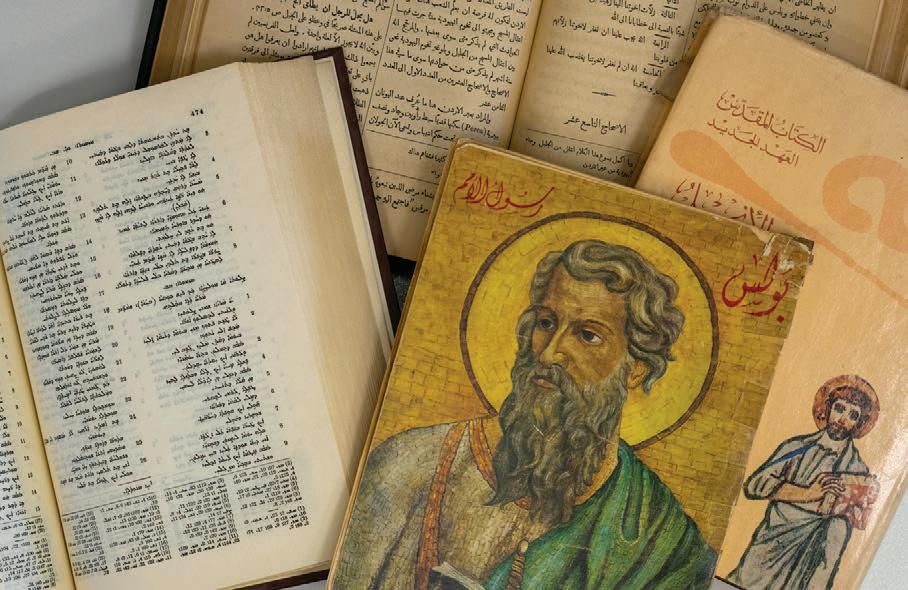
Christian books written in Arabic and a Bible in Syriac (left) are pictured in the library of Mar Qardakh International School in Erbil, Iraq. The K-12 school and the Catholic University in Erbil nearby have received support from the Knights of Columbus since 2015 (see page 10).
Hope Blooms in the Desert
The 10th anniversary of the Catholic University in Erbil marks over a decade of K of C efforts to rebuild the Church in Iraq.
By Elisha Valladares-Cormier
‘God,
Give Me the Strength’
Guided by faith and presence of mind, a Knight rescues a man from a burning vehicle.
By Michael Stechschulte
The ‘Kindly Light’ of Catholic Education
Drawing on the wisdom of St. John Henry Newman, Pope Leo XIV illuminates the way forward for Catholic schools in the AI era.
By Leonard J. DeLorenzo
All Aboard for Charity
A New York council’s custom train car initiative raises funds while promoting faith, patriotism and the true meaning of Christmas.
By Cecilia Engbert
3 For the greater glory of God
Christ’s humble birth in Bethlehem draws our attention to those most in need of love.
By Supreme Knight Patrick E. Kelly
4 Learning the faith, living the faith
The light of the Word incarnate scatters the darkness and fills our hearts with wonder, joy and hope.
By Supreme Chaplain Archbishop William E. Lori
6 Knights of Columbus News
Midyear Meeting Focuses on Mission and Momentum • Order Commended for Support of U.S. Military Archdiocese • Symposium Addresses Crisis of Isolation Facing Young Men • Memorial Dedicated to Young K of C Hero
8 Building the Domestic Church
A series of columns on family life, leadership and financial stewardship
26 Knights in Action
Reports from councils and assemblies, representing Faith in Action ON THE COVER
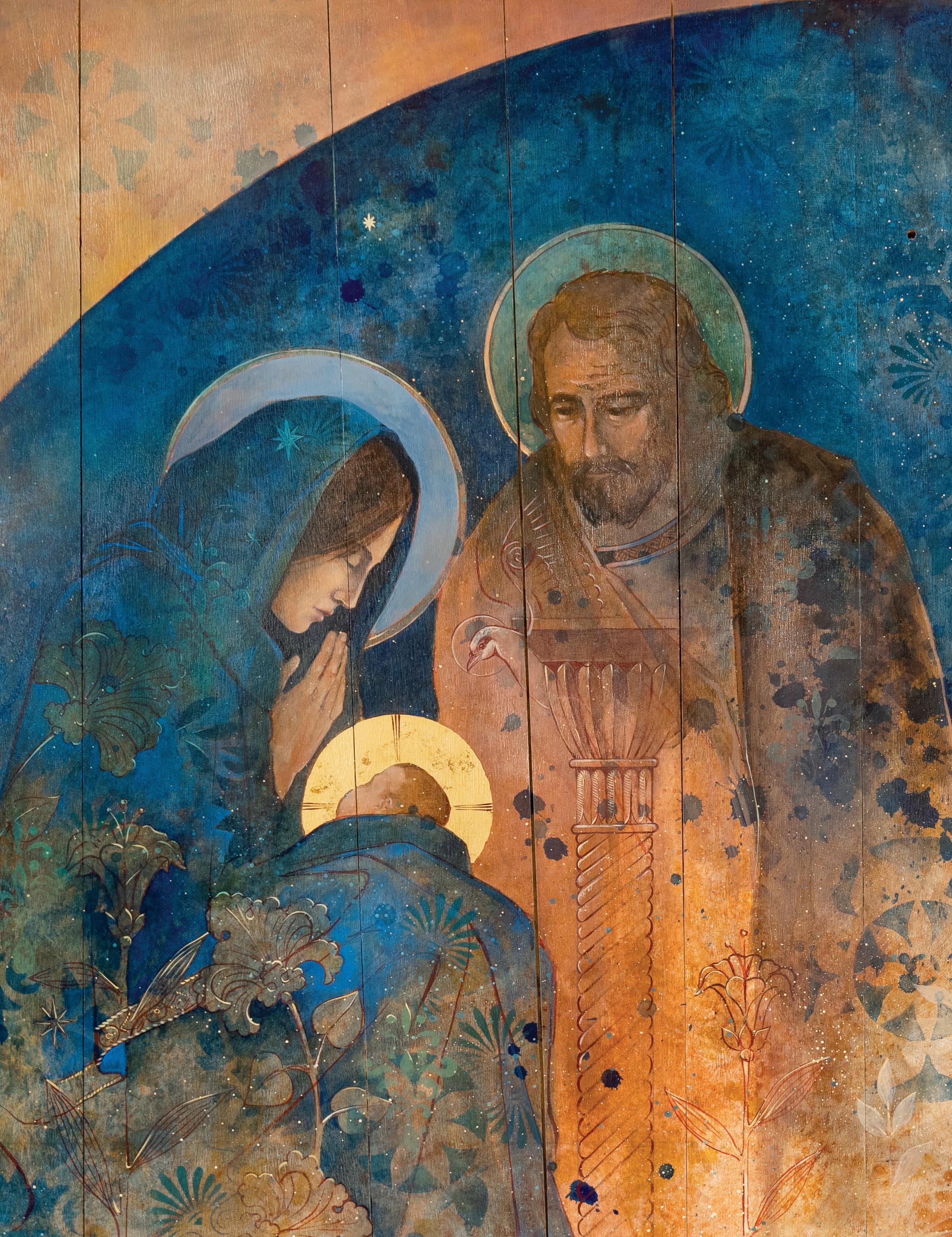
The Holy Family is depicted in a detail of a painting that adorns St. Vincent Cathedral in Saint-Malo, France.
Membership in the Knights of Columbus is open to men 18 years of age or older who are practical (that is, practicing) Catholics in union with the Holy See. This means that an applicant or member accepts the teaching authority of the Catholic Church on matters of faith and morals, aspires to live in accord with the precepts of the Catholic Church, and is in good standing in the Catholic Church. kofc.org/join
Copyright © 2025 All rights reserved
Columbia
Hope Made Flesh
TERRENCE MALICK’S FILM The Tree of Life (2011) opens simply with a passage from the Book of Job: “Where were you when I laid the foundations of the earth … when the morning stars sang together?” (38:4,7). It’s followed by a small flame flickering in darkness and a mother’s quiet reflection that “there are two ways through life: the way of nature and the way of grace.” In her telling, nature centers on itself and seeks control, while grace opens outward in self-gift. Malick uses this contrast to frame the deeper questions that emerge within an ordinary family: What gives meaning to life, and how do we learn to recognize it?
Earlier this year, Pope Leo XIV addressed similar questions in a message to a Vatican seminar titled “Evangelizing with the Families of Today and Tomorrow,” held June 2-3 during the Jubilee of Families, Children, Grandparents and the Elderly. He noted that it is in Christian families — “the primary nucleus of the Church”— that faith is first transmitted and this search for meaning becomes intelligible. “The profound thirst for the infinite present in the heart of every human being,” he said, “means that parents have the duty to make their children aware of the fatherhood of God. In the words of St. Augustine: ‘As we have the source of life in you, O Lord, in your light we shall see light’” (Confessions, XIII, 16).
But what happens when children are raised outside the Church, or the light Augustine describes is never encountered at home?
Pope Leo observed that in our day there is “a growing search for spirituality, particularly evident in young people, who are longing for authentic relationships and guides in life.” The challenge and tragedy, he noted, is that without
an invitation to divine encounter “many end up relying on false footholds that are unable to support the weight of their deepest needs.” Instead of finding direction and purpose, they are often drawn away from God, “shipwrecked on a sea of worldly concerns” or “alienated by illusory lifestyles that leave no room for faith.”
In this context, Pope Leo warned of a widespread “privatization” of faith and stressed the missionary dimension of the Church. Not only the clergy but also the laity, he said, are called to be “‘fishers of families’ … ‘fishers’ of couples, young people, children, women and men of all ages and circumstances, so that all may encounter the one Savior.” This is especially true of the Christian family, which St. John Paul II described as “an evangelized and evangelizing community” (Familiaris Consortio, 53), and of the parish, which he often called a “family of families.” It is likewise true of the Knights of Columbus, whose mission is to form Catholic men in discipleship, strengthen parishes and families in faith, and make the light of Christ visible through the daily witness of charity.
Pope Leo, again quoting St. Augustine, cautioned against the “claim that Christ’s grace consists in his example and not in the gift of his person.” The Christian life, he concluded, is not a set of rules, but an encounter with Jesus — “God who gives himself to us” — and faith itself is “primarily a response to God’s love.” As the Jubilee Year of Hope draws to its close and the Church turns again to Bethlehem, the Holy Family reveals to us the way of grace, for at its heart is Christ — our hope, the source of life and light. B
Alton J. Pelowski, Editor
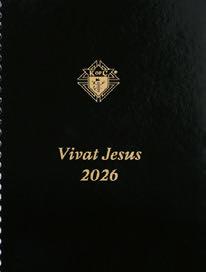
Featured Resource: Vivat Jesus 2026
The 2026 edition of the Vivat Jesus Spiritual Planner is now available in English, Spanish and French through the Order’s Catholic Information Service. Updated this year to a 5-by-7-inch spiral-bound format, Vivat Jesus is designed to help men develop a personalized daily prayer plan. It includes liturgical feast days, the supreme chaplain’s monthly challenge, traditional Catholic prayers and devotions, spiritual reflections, beautiful artwork and more. To purchase, visit kofc.org/shopcis .
PUBLISHER
Knights of Columbus
SUPREME OFFICERS
Patrick E. Kelly
Supreme Knight
Most Rev. William E. Lori, S.T.D.
Supreme Chaplain
Arthur L. Peters
Deputy Supreme Knight
John A. Marrella
Supreme Secretary
Ronald F. Schwarz
Supreme Treasurer
Anthony R. Picarello Jr. Supreme Advocate
EDITORIAL
Alton J. Pelowski
Editor
Matthew Kirby
Editorial Director
Andrew J. Matt
Managing Editor
Elisha Valladares-Cormier
Senior Editor
Megan Stibley
Associate Editor
Paul Haring Manager of Photography
Cecilia Engbert Content Producer
HOW TO REACH US
COLUMBIA
1 Columbus Plaza
New Haven, CT 06510-3326
columbia@kofc.org kofc.org/columbia
Address changes
203-752-4210, option #3 addresschange@kofc.org
Columbia inquiries
203-752-4398
K of C Customer Service
1-800-380-9995
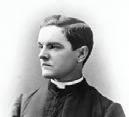
Blessed Michael McGivney (1852-90) – Apostle to the Young, Protector of Christian Family Life and Founder of the Knights of Columbus, Intercede for Us.
‘Witnesses of God’s Tenderness’
Christ’s
humble birth in Bethlehem draws our attention to those most in need of love
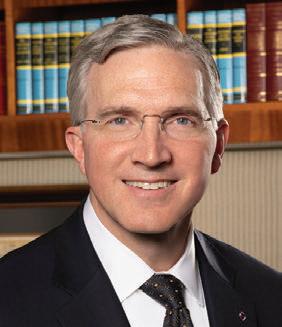
By Supreme Knight Patrick E. Kelly
AS WE APPROACH Christmas, my thoughts naturally turn to my visit to the Holy Land this fall with our supreme chaplain, Archbishop William Lori, and Supreme Secretary John Marrella. We were joined by Msgr. Peter Vaccari, president of the Catholic Near East Welfare Association–Pontifical Mission. During this Jubilee Year of Hope, our purpose was to bring a message of hope and solidarity to those suffering Christian communities deeply impacted by the conflict in Gaza and the West Bank.
One of our most memorable stops was the Holy Family Children’s Home in Bethlehem. Operated by the Daughters of Charity of St. Vincent de Paul, the home provides a loving atmosphere for about 50 abandoned children. These children come from a variety of difficult circumstances. Some are newborns dropped off anonymously on the doorstep. Others have parents who are unable to care for them. Still others are victims of abuse and have been placed in the home by local authorities. Regardless of their background, the sisters provide what the children need the most: the healing that comes from a loving home and a genuine sense of belonging.
The sisters’ work is difficult. I could see it on their faces. No one is poorer or more vulnerable than an abandoned child — especially in a land torn apart by social and political conflict. Yet the sisters give the children a new life and the sense of security every child needs. And perhaps for the first time in their lives, the children have hope. This was evident to me in the joyful sounds of laughter and play echoing through the courtyard.
In his homily during Mass for the Jubilee of the Poor last month, Pope Leo reflected on the many forms of poverty that plague our world — material, moral and spiritual. He observed that they all share a common
thread, a tragedy that cuts through all of them — the experience of loneliness. To break down the “walls of loneliness,” the Holy Father said, we must foster a “culture of attention.” That is, we must “be attentive to others, to each person, wherever we are, wherever we live, transmitting this attitude within our families, living it out in the workplace … in different communities, in the digital world, everywhere, reaching out to the marginalized and becoming the witnesses of God’s tenderness.”
This is the heart of what it means to be a Knight of Columbus — to be attentive to the needs of others and never closed in on ourselves. The Order was founded precisely to look outward — to care for widows, orphans, the vulnerable and the marginalized. Just as God does not abandon us in our hardships, we must never abandon others in theirs. Christ implores us: “Love one another as I have loved you” (Jn 15:12).
As we journey through the Advent season and draw closer to Christmas and the conclusion of this great Jubilee Year of Hope, let us remember that Jesus Christ himself is the true author of our hope. He can break down the walls of our loneliness and give us the grace to be attentive to the real needs of others. He does not abandon us. He came as one of us to save us — poor and vulnerable, born in a Bethlehem manger in a time of great turmoil.
St. Paul writes, “For your sake he became poor although he was rich, so that by his poverty you might become rich” (2 Cor 8:9). Christ came to offer us a new way — the Good News, which has the power to heal us and free us from the power of sin and death. May we open our hearts wide to the riches of his grace, attentive to ways we can generously share this wealth with our neighbors in need.
Vivat Jesus!
This is the heart of what it means to be a Knight of Columbus — to be attentive to the needs of others and never closed in on ourselves.
Beyond Fear
The light of the Word incarnate scatters the darkness and fills our hearts with wonder, joy and hope
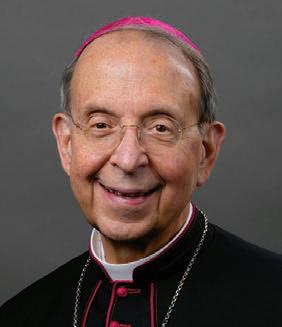
By Supreme Chaplain Archbishop William E. Lori
THE LITURGY OF CHRISTMAS takes us back to that starlit night in Bethlehem when Christ was born. By all accounts, the night was especially dark and the weather especially cold, as Mary and Joseph huddled in a cave — for there was no room for them in the inn. It was there that Mary gave birth to Jesus, the incarnate Son of God, the Word made flesh. His birth brought great rejoicing. Angels descended from the heavens, announcing glad tidings: “Glory to God in the highest and on earth peace to people of good will!” (Lk 2:14). The poverty of the cave held the greatest of all treasures. The silence was pierced by the song of angels, and the darkness of night was flooded with light.
The first to witness this manifestation of God’s glory and to hear the glad tidings were shepherds tending their flocks during the watches of the night. Scripture tells us: “And in that region there were shepherds out in the field, keeping watch over their flock by night. And an angel of the Lord appeared to them, and the glory of the Lord shone around them, and they were filled with fear. And the angel said to them, ‘Be not afraid; for behold, I bring you good news of a great joy which will come to all the people; for to you is born this day in the city of David a Savior, who is Christ the Lord’” (Lk 2:8-11).
Like the shepherds, we can be filled by the Holy Spirit with a holy fear — with wonder and awe at the greatness and glory of our God and of his only-begotten Son. Such fear is akin to love. It is wonderment at the depth of God’s care for us. It is wonderment that God would go to such great lengths to save us. It is the wonderment of the Psalms: “Lord, what is man that you are mindful of him, and a son of man that you care for him?” (Ps 8:5). Holy fear fills us with joyful praise and thanksgiving for the God who is love.
But there is another kind of fear — a fear that clouds our hope or borders on despair. It may be prompted by illness, financial hardship, the loss of loved ones, or mounting problems at work. We may also absorb the fears of the world around us — a world often on the brink of conflict or collapse. Pope Francis reflected on this reality in a 2016 address: “The world has great fear — and spreads it. Often it makes this the key for interpreting history and not infrequently adopts it as a strategy to build a world based on walls and trenches. We too can understand the reasons for fear, but we cannot embrace it.” The Holy Father added, “Fear inhabits the dark of the past, but it has a weakness: it is temporary. The future belongs to the light! The future belongs to Christ!”
The Jubilee of Hope, begun by Pope Francis and continued by Pope Leo XIV, reaches its pinnacle as we make our way through Advent toward the dazzling light of Christmas. It is a sacred moment to gather up our fears and anxieties — including those absorbed from the world — and entrust them to the Lord of History, the Redeemer of the World. It is he who consigns our fears to the past. It is this Savior who is our future.
Our founder, Blessed Michael McGivney, stood among his people as a witness to hope. Amid their very real fears and anxieties, he helped them to focus their eyes on Christ. By his sacrificial ministry and his closeness to the people of his parish, he led them to Christ, in whom he placed all his trust. Christ is born for us. God is with us. May the birth of Christ, the light of the world, bring hope in the midst of our fears, peace in the midst of our strife, and light in the midst of our darkness. To Christ, indeed, belongs the future — a future full of hope — “and hope does not disappoint” (Rom 5:5). B
Like the shepherds, we can be filled by the Holy Spirit with a holy fear — with wonder and awe at the greatness and glory of our God and of his onlybegotten Son.
by Paul Haring
Photo
Supreme Chaplain’s Challenge
A monthly reflection and practical challenge from Supreme Chaplain Archbishop William E. Lori
“Even now the ax lies at the root of the trees. Therefore every tree that does not bear good fruit will be cut down and thrown into the fire.” (Gospel for Dec. 7, Mt 3:10)
In these reflections over the past year, we have meditated on the importance of our faith bearing fruit in good works. In a way, this Gospel passage, quoting St. John the Baptist, might seem out of place during Advent. But throughout this season, we reflect not only on Christ’s coming in the incarnation, but also his second coming in judgment at the end of the world. Let us pray and work to ensure we lead truly faithful and fruitful lives as disciples of Jesus.
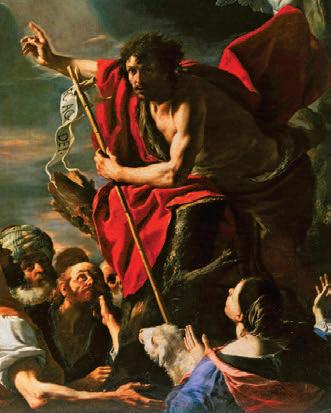
Challenge: This month, I challenge you to spend some time reflecting on the four last things — death, judgment, heaven and hell — to better prepare yourself for eternity.
To view future challenges, visit kofc.org/monthlychallenge
Catholic Man of the Month
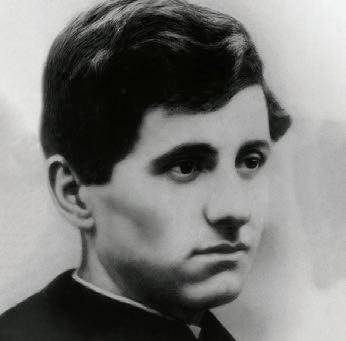
Father Louis Doumain (1920-1944)
THE GESTAPO OFFERED Father Louis Doumain freedom on one condition — that he stop saying Mass. “Anything you want, but not that,” he replied. “That’s why I became a priest.” The 24-year-old abbé had been conscripted as a laborer and sent to a German town near Leipzig. Shortly after celebrating a clandestine Mass in the woods, he was placed under arrest.
Born in Morinville, Alberta, to French immigrants, Doumain returned to France with his parents as a young boy. He later entered the major seminary at Viviers, in southwest France, and was ordained a priest in 1942, at age 22.
The next year, Doumain was conscripted into the Service du Travail Obligatoire — a Vichy work program that supplied French laborers to Nazi Germany — and sent to an aluminum factory in Bitterfeld. There he was identified as a priest and assigned to the smelting furnace, one of the most arduous jobs.
At first, Father Doumain carried out a public ministry among the workers,
celebrating Mass in the parish church and hearing confessions. But on Dec. 3, 1943, the Kaltenbrunner Ordinance made pastoral care for French laborers a punishable offense.
On Sept. 19, 1944, after celebrating Mass in the woods outside Bitterfeld for 40 “Jocists” — members of the Young Christian Workers — Father Doumain was arrested by the Gestapo.
Upon refusing to abnegate his priestly duties, Father Doumain was sent to a labor camp at Spergau and later Zöschen, where he fell ill, underwent throat surgery, and lost the ability to speak. He died at Zöschen on Dec. 20, 1944. He is one of 50 French martyrs of Nazi persecution who will be beatified at Notre-Dame Cathedral in Paris on Dec. 13. B
Liturgical Calendar Holy Father’s Monthly Prayer Intention
Dec. 3 St. Francis Xavier, Priest
Dec. 4 St. John Damascene, Priest and Doctor of the Church
Dec. 6 St. Nicholas, Bishop
Dec. 8 The Immaculate Conception of the Blessed Virgin Mary
Dec. 9 St. Juan Diego Cuauhtlatoatzin
Dec. 12 Our Lady of Guadalupe
Dec. 13 St. Lucy, Virgin and Martyr
Dec. 25 The Nativity of the Lord (Christmas)
Dec. 26 St. Stephen, the First Martyr
Dec. 27 St. John, Apostle and Evangelist
Dec. 28 The Holy Family of Jesus, Mary and Joseph
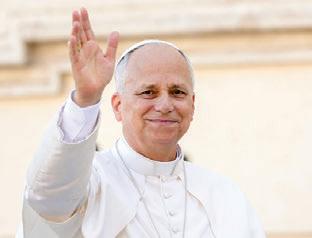
Let us pray that Christians living in areas of war or conflict, especially in the Middle East, might be seeds of peace, reconciliation and hope.
Midyear Meeting Focuses on Mission and Momentum
AS THE KNIGHTS of Columbus approaches historic levels of growth, Supreme Knight Patrick Kelly has urged fraternal leaders to maintain the momentum. Knights of Columbus leaders representing nearly 70 jurisdictions gathered in Denver Nov. 14-16 for the Midyear Membership Meeting of State Deputies, participating in Mass, workshops and other opportunities for prayer and fraternity.
In remarks during the opening business session Nov. 15, the supreme knight announced the Order is on pace to welcome more than 100,000 new members by the end of the calendar year — even as the fraternal year carries on.
“There’s no silver bullet for bringing men into the Knights of Columbus,” he acknowledged. “We bring men in one man, one Knight at a time, and it takes a lot of hard work, and it takes a lot of grit.”
Growth stems from fidelity to the vision of Blessed Michael McGivney, who “built the Knights to strengthen the faith of Catholic men and to help them put that faith into action,” Supreme Knight Kelly said.
The Knights of Columbus, he added, offers an answer to a dominant culture in which many young men suffer from a crisis of isolation abetted by artificial intelligence.
“We connect our brother Knights with God and with the Church — and, importantly, with a group of other like-minded men who share that mission,” he said. “And that’s why we’re growing in this day and age.”
The Order’s Cor initiative, he said, is helping to draw men to the Knights by fostering male friendships rooted in faith.
“We built Cor for men of all ages, but Cor is especially powerful in attracting young men,” he explained. “It’s a gateway to those genuine friendships and those real encounters that the pope is talking about.”
The supreme knight also affirmed
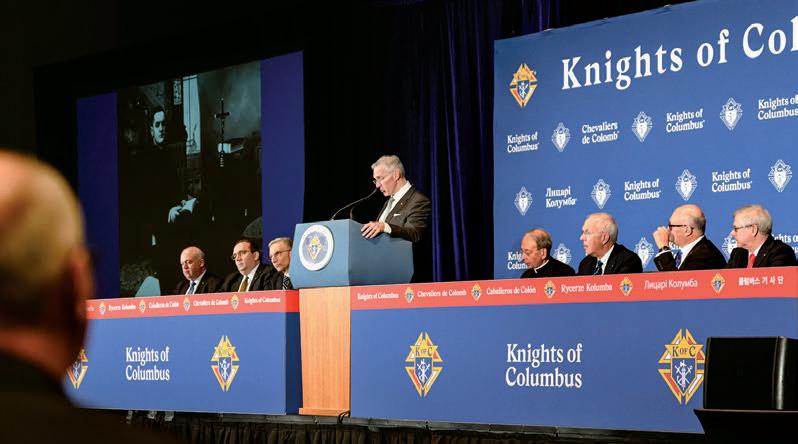
that Father McGivney’s mission to protect the financial security of Catholic families is inextricably tied to the Order’s charitable and fraternal mission as well.
“Our charitable reputation,” he explained, “is grounded in the strength of our insurance program, and our insurance program is grounded in the strength of our fraternal organization and its ability to bring in new members. We need both lungs — fraternal and insurance — to breathe together, so that we can best fulfill our mission.”
Also delivering remarks on Nov. 15, Supreme Chaplain Archbishop William Lori noted a climate of political polarization, yet observed a hopeful increase in conversions to Catholicism
during the opening business session of
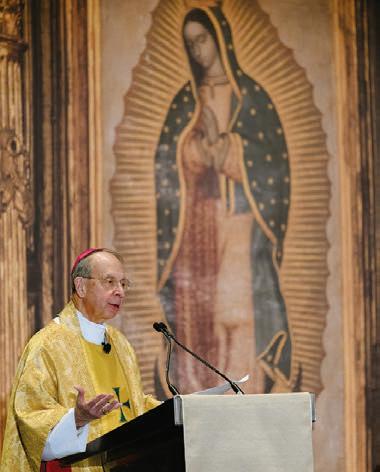
Membership Meeting on Nov. 15. • Left: Supreme Chaplain Archbishop William Lori of Baltimore preaches the homily during the meeting’s opening Mass on Nov. 15, the feast of St. Albert the Great. An image of Our Lady of Guadalupe, patroness of the Order, is visible in the background.
among younger generations.
“Many dioceses report an increase of young people, especially young men, coming back to the Church or entering the Church for the first time,” Archbishop Lori said. “As the spiritual sons of Blessed Michael McGivney, this is our moment to shine — this is our moment to attract to our ranks the young men … who are seeking a relationship with God and healthy friendships.”
The supreme chaplain noted that July 4, 2026, will mark the 250th anniversary of the signing of the Declaration of Independence, adding that the Order’s founding principles are themselves powerful sources of civil renewal.
“Blessed Michael McGivney has placed in our hands the keys to the renewal of our wounded political culture,” Archbishop Lori said. “Those keys are charity, unity, fraternity and patriotism — our time-honored principles.” B
Photos by Ryan Dearth
Above: Supreme Knight Patrick Kelly delivers remarks
the Midyear
Order Commended for Support of U.S. Military Archdiocese
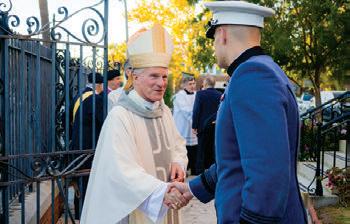
Archbishop Timothy Broglio of the Archdiocese for the Military Services, USA, greets cadet Thomas Gehrke, a member of Citadel Council 6900, following Mass in Charleston, S.C., on Oct. 23.
THE SAINT JOHN XXIII Foundation, which contributes to the pastoral support of Catholics in the armed services, named Supreme Knight Patrick Kelly its 2025 Honorary Patron during a reception in Charleston, South Carolina, on Oct. 23. The foundation’s board of directors thanked the Knights of Columbus for helping the mission of the Archdiocese for the Military Services, USA, since its creation in 1985.
The Order has strongly supported the military archdiocese’s Co-Sponsored Seminarian Program, which aids seminarians preparing to become Catholic chaplains in the U.S. armed forces. The Knights and the archdiocese have also co-sponsored an annual Warriors to Lourdes pilgrimage since 2013, among other initiatives.
“It is only fitting that Supreme Knight Patrick Kelly and the Knights of Columbus be honored with this award,” said Archbishop Timothy Broglio, who has led the military archdiocese since 2008.
“The Knights have continued to be supportive of our military and the archdiocese, including catechesis, vocations programs and so many other ways.” B
Symposium Addresses Crisis of Isolation Facing Young Men
SUPREME KNIGHT Patrick Kelly delivered opening remarks and participated in a panel discussion at the inaugural Symposium on Young American Men, held Nov. 3 at the National Press Club in Washington, D.C. Organized by the Lafayette Company, the event was a bipartisan gathering of lawmakers, researchers and leaders of men’s organizations that met to address the crisis of isolation among young men in the United States.
“It’s no secret that many young men in America today are struggling,” Supreme Knight Kelly said in his remarks, noting that the Knights of Columbus has offered a way forward through faith-based
fraternity and charitable service.
“We are hardwired, as men, for purpose and mission, he said. “By serving shoulder to shoulder and making sacrifices to help those in need, men find the meaning they’re looking for.”
In an afternoon panel discussion titled “The Role of Faith and Civic Institutions in Restoring Male Community,” the supreme knight emphasized that many young men are seeking an antidote to relativism and finding it in organizations such as the Knights.
“A lot of young men are coming out of their parents’ relativistic view of life,” he said. “It’s those men who are yearning for moorings.” B
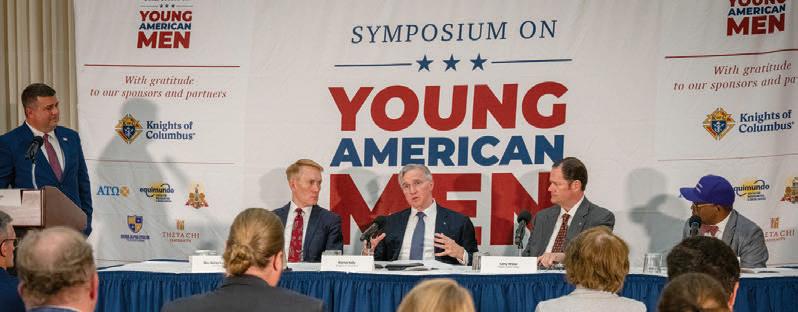
Supreme Knight Patrick Kelly participates in a panel discussion at the Symposium on Young American Men on Nov. 3. Also pictured (from left) are Michael Mayer (moderator), chief executive of Theta Chi Fraternity and a brother Knight; U.S. Sen. James Lankford of Oklahoma; Larry Wiese, executive director of Kappa Alpha Order; and Michael DeVaul, national director of the YMCA’s Boys and Young Men of Color program.
Memorial Dedicated to Young K of C Hero
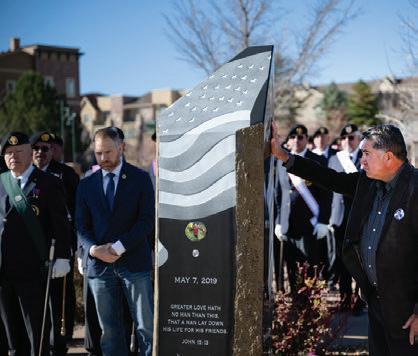
John Castillo, a member of Southwest Denver Council 4844, places his hand on the newly unveiled Kendrick Castillo Memorial Monument at Civic Green Park in Highlands Ranch, Colo., Nov. 14. His son, Kendrick, 18, was killed while heroically protecting his classmates from a gunman at STEM School Highlands Ranch on May 7, 2019. Kendrick, who intended to join the Order, was posthumously named a Knight at the 137th Supreme Convention in 2019.
By David Kimbell LEAD
WITH FAITH
Bear One Another’s Burdens

Leaders often feel pressured to present a public image of perfection, which can foster self-reliance rather than trust in God. Leaders in the Church, whether clergy or laity, are not immune to this temptation. Yet they are called to emulate Christ’s humble witness of self-sacrifice.
In my experience, honesty about my brokenness has been deeply formative in my roles as husband, father, parishioner and diocesan leader. Admitting my need for salvation creates a humble vulnerability before God and neighbor that opens the way to leading with compassion, a listening heart and a willingness to share vision and responsibility.
Sharing responsibility with others does not simply mean delegating or motivating a team; it requires a trust born of discipleship. For laypeople, this discipleship also means taking co-responsibility for the Church’s mission in the world, in collaboration with the clergy.
This vision was central to the foundation of the Knights of Columbus in 1882, and it reflects the faith I learned from my own father and have witnessed in so many of my brother Knights. Inspired by their example, I continue to ask God for the grace to transform impulses for control — at home, at work and in my community — into habits of service and sacrificial love. B
— David Kimbell is the chief financial officer for the Diocese of Pensacola-Tallahassee. A member of Cathedral of the Sacred Heart Council 11125 in Pensacola, Fla., he and his wife, Erin, are expecting their seventh child.
MISSION OF THE FAMILY
Game Day Formation
Watching sports as a family can become an arena where we bring faith into play for our children
By Jason Godin
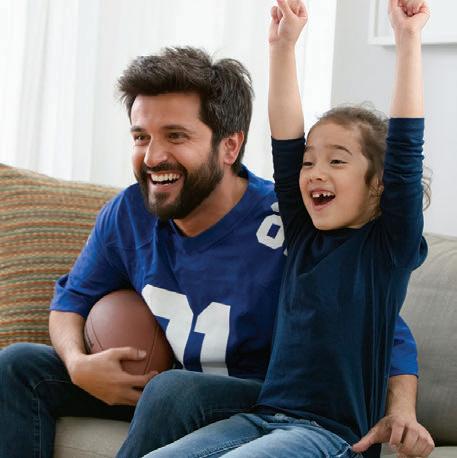
NETWORKS HAVE BEEN airing NFL and college football games since early September. For months now, games have kicked off from Thursday through Monday nights. As the push for the playoffs reaches its peak this month, here’s a family playbook for football fans — turning ordinary game time into an opportunity to reinforce your family’s Catholic faith and values.
Begin Sunday mornings with Mass. Countless studies confirm the claim that when both parents — especially fathers — are present in the pews, faith is much more likely to be “caught,” as well as taught, for future generations. Since 2007, an increasing number of NFL games have been played at international sites on Sunday mornings. For nearly 20 years, then, we’ve had the chance to show our children that their relationship with God should take priority over any game.
Let them know you value time together. For many families, a typical week includes shuttling kids to all manner of practices, lessons, play dates and extracurricular activities. The pace can be frenetic. Spending time together to watch the game can serve as a welcome pause — a chance to simply be together. Let your children know how much such time matters to you — and how you hope it matters to them, too.
Be honest about the ads. When the game cuts to break, help your kids think critically. It’s fine to laugh when a one-liner scores — but don’t hesitate to “throw a flag” when a commercial crosses the line
or sends the wrong message about human life or love. These conversations help bring the wisdom of the faith beyond the Sunday homily and into your home. Bow out of blowouts. Only three teams in NFL history have come back to win a game after trailing by 25 points or more at halftime. When a game is clearly out of reach, turn it off. Use that extra time to wash the dishes, go on a walk, or toss the football around with your kids.
The Catechism of the Catholic Church teaches that family life is where we typically “learn moral values, begin to honor God, and make good use of freedom” (2207). Simply watching a football game can become a forum for engaging the culture through the eyes of faith. We just have to take the opportunity — and snap to it. B
JASON GODIN is a married father of two and a member of Archbishop John Roach Council 10031 in Chanhassen, Minn.
FAMILY FINANCE
Why should I involve my family in charitable giving?
By Dennis J. Gerber Jr.
Advent invites us to prepare not only our homes, but also our hearts. It is a season of waiting, a holy pause to reflect on the promise of Christ. We celebrate that “God so loved the world that he gave his only Son” (Jn 3:16). This immeasurable gift reveals the heart of divine love and generosity. We are called to reflect this love in how we live and give in our own families and communities.
In my family’s home, one of our favorite traditions is gathering around the dinner table to talk about giving. Each
FOR YOUR MARRIAGE
Advent Pilgrims
child shares which causes matter most to them and why. Their answers — feeding the hungry, supporting our parish, helping those in need — are humbling in their simplicity. These conversations remind us that generosity is not just about money; it is about forming hearts to see others with compassion.
Intentional charitable planning, rooted in faith, helps turn these moments into lasting impact. For brother Knights, this is a way to pass on our Catholic values and legacy of generosity. Involving our children teaches them that giving is not just a seasonal act, but a lifelong habit of discipleship. It helps them discover, as Scripture reminds us, “It is more blessed to give than to receive” (Acts 20:35).
This Christmas season, let generosity become a tradition in your

family. Through the Knights of Columbus Charitable Fund, you can establish a donor-advised fund that can grow over time and streamline the process of giving. Learn more at kofc.org/familyfinance B
— Dennis J. Gerber Jr. is president of Knights of Columbus Charitable Fund and a member of Father Patrick F. Pinder Council 3962 in Ramsey, N.J.
During this holy season, Mary and Joseph invite us to follow God with open-hearted trust
By Soren and Ever Johnson
IT’S ADVENT AGAIN. Another year when we could easily remain in Nazareth — our default life, filled with lists, projects and ideas of what Christmas “should” look like. Alas, we know that rhythm all too well — how it can warp this sacred season, leading to a Christmas morning of exhausted hearts wrapped in festive paper.
What if, this year, we accept the invitation to truly make the journey, to leave Nazareth behind and walk with Mary and Joseph toward a humbler home? So often, we’ve rushed — or skipped — this journey, fast-forwarding to Christmas morning in Bethlehem. But what if we set out on that road with them and shared in their anticipation of the Christ Child?
We picture Mary, alternating between joyful prayer and deep exhaustion, and Joseph, tender, attentive and protective. They must have stopped and rested often. And when they finally arrived, they found only closed doors. Yet here’s what strikes us: Because their hearts were open — to God
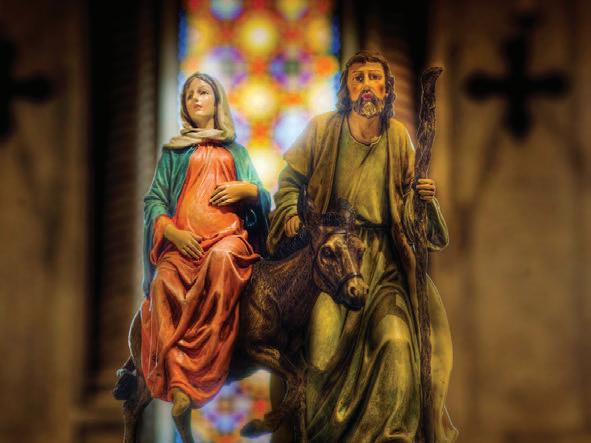
and to each other — the rejection didn’t discourage them. Their confidence in God’s promise remained unshaken. This is the Advent decision we face as spouses. We can stay in Nazareth with our self-reliance, convinced it’s up to us to fix whatever is frayed in our family with a “perfect” holiday. Or we can risk everything and join the Holy Family on the road — trusting that when we arrive at a new home on Christmas, one transformed by Christ’s presence, the Lord will provide. B
SOREN AND EVER JOHNSON have five children and are co-founders of Trinity House Community. Soren is a member of Holy Family Council 6831 in Leesburg, Va.
Hope Blooms in the Desert
The 10th anniversary of the Catholic University in Erbil marks over a decade of K of C efforts to rebuild the Church in Iraq
By Elisha Valladares-Cormier
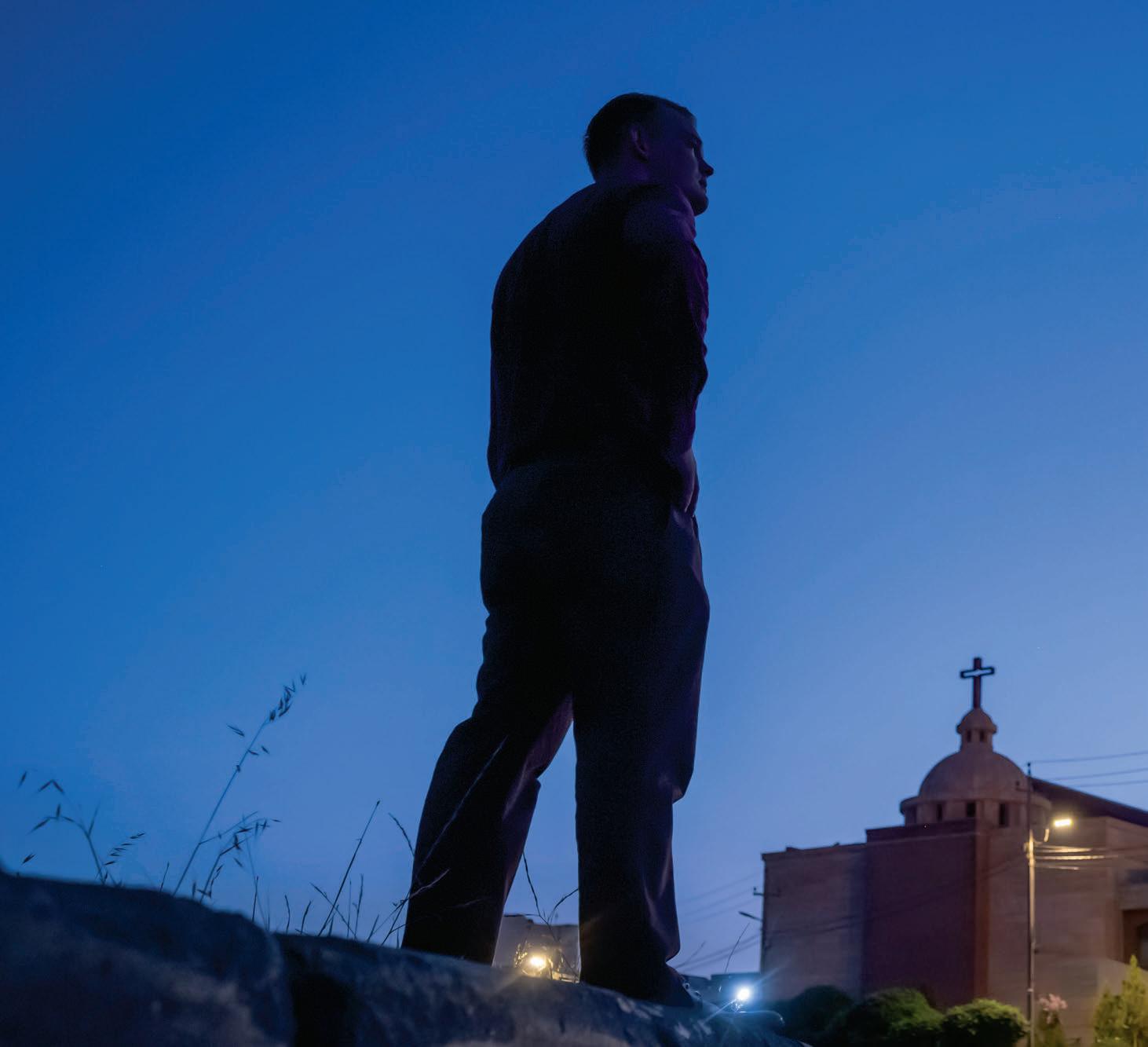
Alex McKenna, a member of St. John Neumann Council 11828 in Steubenville, Ohio, stands outside Sts. Peter and Paul the Apostles Church in Erbil, Iraq.
As a traveler steps off a plane in Erbil, Iraq, the smell of the arid plain fills the air. It’s inescapable — the dust is ever-present. Entering the city, he is surrounded by the sights, sounds and aromas of Middle Eastern culture. Merchants cry out from their bazaar booths as the scent of perfumed incense mingles with that of a multitude of spices. Music rings through the streets, periodically interrupted by calls to prayer.
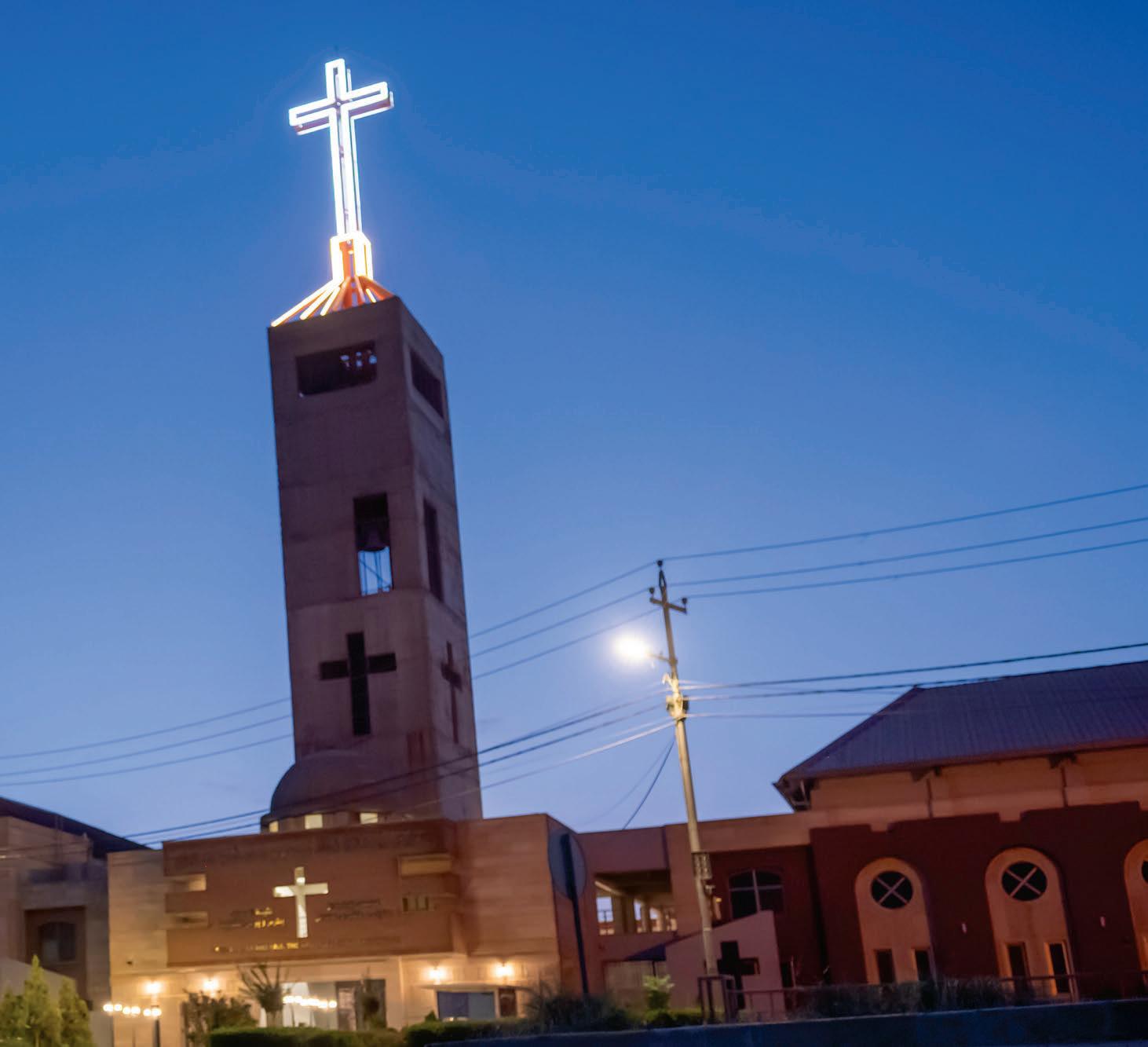
But something else stands out — something that begins as a glimmer and grows more visible during the drive to the city: a large illuminated cross atop Sts. Peter and Paul the Apostles Church, a Chaldean Catholic parish near the airport. It serves as a welcome sign to visitors and local Christians alike.
Just over a decade ago, in the fall of 2014, Christianity in Iraq was on the brink of extinction. Islamic State militants had systematically wiped out Christian communities across swaths of Syria and northern Iraq — the land of Abraham’s birth, where St. Thomas the Apostle once spread the Gospel en route to India.
More than a million Iraqis were displaced, with 125,000 Christians and other religious minorities fleeing to Erbil, the capital of the Kurdistan Region in northern Iraq.
Amid the violence and displacement, however, Archbishop Bashar Matti Warda of Erbil — who leads the local Chaldean Catholic community — was convinced that fleeing was not the answer.
Photo by Tamino Petelinšek
“Look, we’re among the oldest Christians on earth,” Archbishop Warda told his advisers at the time. “We received the Gospel in the first century from the Apostle Thomas and his disciples. This can’t be how our story ends.”
Part of the solution, he resolved, would be to establish a new Catholic university in Erbil, given the huge influx of refugees — including many young people. Educating the next generation of Iraqi Christian leaders was key to a better tomorrow, he reasoned.
With assistance from the Knights of Columbus and its Christian Refugee Relief Fund, the Catholic University in Erbil (CUE) opened its doors in time for the 2015-2016 academic year. A formal grand opening took place Dec. 8, 2015 — the feast of the Immaculate Conception.
Ten years later, the university remains a beacon of hope to the Catholic Church in Iraq. Supported by the Knights from its inception, CUE has also spurred the success of several archdiocesan education initiatives, all of which help Iraqi Christians overcome the effects of religious persecution — past and present.
“Hope is not a wish; hope is a commitment,” Archbishop Warda said in a recent interview. “My hope is to see Christians as an influential community in the history of Iraq. How to do that is by building committed Christian leaders for the future of our country.”
REBUILDING BY TEXTBOOK
Iraq’s Christian population approached 1.5 million in the early 2000s but plummeted to about 300,000 when the 2014 offensive began. Approximately 125,000 Christians fled to Erbil from Mosul and the Nineveh Plains after the Islamic State’s onslaught of terror.
Churches were bombed and burned, crosses and other religious symbols desecrated. Christian homes were plundered and marked with the Arabic letter nun — ن — the first letter of Nasara (meaning “Nazarenes”), identifying their inhabitants for extermination or exile.
There was an immediate need to provide displaced Iraqis with food and shelter. But from the start, it was clear that a greater response would be necessary to ensure the longterm survival — and flourishing — of the Church in its ancestral homeland.
Where persecution persists, religious minorities often face barriers to employment, health care, education and more. Archbishop Warda saw higher education as a critical tool to break that cycle. The idea of establishing a Catholic university had been on his mind for two years. Now, with thousands of college-aged Christians lacking the resources and opportunity to continue their studies, the Church needed to act.
To this end, Archbishop Warda enlisted the help of Stephen Rasche, a U.S.-based lawyer who had provided pro bono work to the archdiocese and had spent time in the country for more than a decade. When Rasche arrived in Erbil that fall, he was surprised to learn of the archbishop’s plan to establish a university.
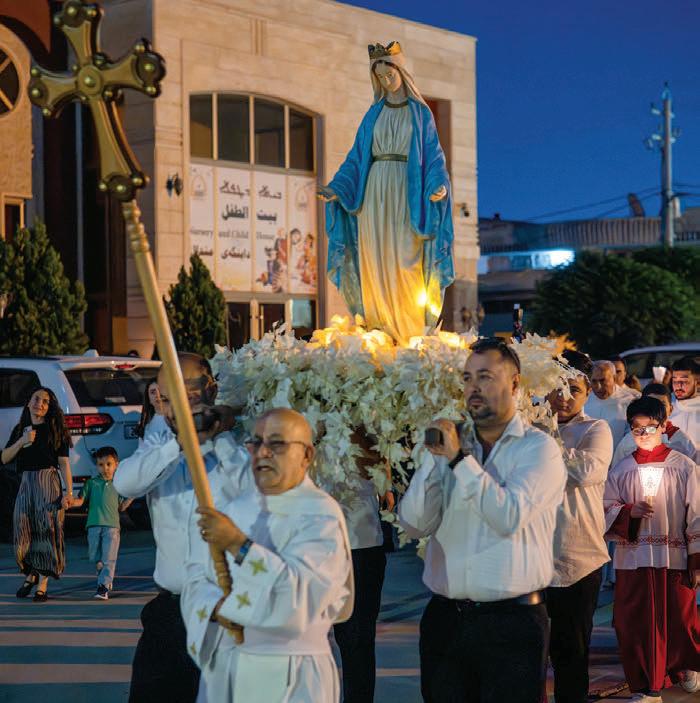
A statue of Mary is carried in procession through the streets of Erbil, accompanied by hundreds of faithful, following the Catholic community’s annual crowning of Mary as Queen of Heaven and Earth on May 31.
“I thought I was there to help with evacuations, because it just seemed there was no future for the Christians there,” said Rasche, a member of Bishop John King Mussio Council 9804 in Steubenville, Ohio. “The people were just terrified. But I asked the archbishop what I could do, and he said, ‘Well, I’m going to build a university, and you can help me.’”
Within six months, Rasche ended his private practice and moved to Iraq full time. He began coordinating housing solutions for displaced people, distributing food and supplies, and laying the groundwork for CUE.
The Knights of Columbus provided critical support, as Rasche served as a liaison between the Order and the archdiocese. The Supreme Council launched the Christian Refugee Relief Fund in August 2014 and made an initial donation of $2 million to the Chaldean archdiocese that November. Since then, Knights’ support for Iraqi Christians has surpassed $20 million.
Archbishop Warda was a special guest at the 133rd Supreme Convention, held in Philadelphia in August 2015. In his States Dinner keynote address, he shared his conviction that “ignorance and illiteracy are the most dangerous longterm enemy that we face here in the Middle East.” He then announced that, thanks to a donation from the Italian Bishops’ Conference and support from the Knights, the Catholic University in Erbil would open its doors later that year.
Photo by Tamino Petelinšek
The university began humbly, with just 11 students enrolled when it formally opened in December 2015. Since then, it has grown steadily each year. Today, nearly 1,000 students fill its classrooms, and some 260 have graduated — including 114 in 2025.
“This was not only an educational project but a living answer to challenges that once sought to uproot Christians from their land,” Archbishop Warda said in his remarks at the Sept. 30 graduation, which also celebrated CUE’s 10th anniversary. “Our response was to plant a tree of knowledge in our beloved city of Erbil. We were, we are, and we will remain active citizens of this country.”
Staying true to Archbishop Warda’s founding vision and mission, most graduates remain in Iraq and use their education to serve their communities of origin.
“I will never forget the first time I came to CUE; it triggered a sense of belonging that has continued during my years here because it corresponded with my faith,” said Raaed Asaad Kamil, 28, who graduated from CUE in 2025 with a bachelor’s in international relations. “I want to contribute what I have learned to my community, especially in Kirkuk, where we need peace, … positive peace.”
CUE also welcomes students of other faiths, including Jasim Hasan Ilyas, a 24-year-old Yazidi from Sinjar — where 2,000
Yazidis were massacred by Islamic State militants in 2014.
“As a survivor of genocide, I can make an impact when I return to my community,” said Hasan, an accounting student. “I’m trying to get experience, skills and relationships that help me become a better person in order to help them.”
Since 2020, the Supreme Council has contributed more than $1.3 million to CUE, funding the construction of academic buildings, staff training, and scholarships for local students. The Order’s solidarity and moral support have also encouraged perseverance.
“The Knights of Columbus was one of our first and most important supporters during the time of the ISIS war, and they remain so today,” said Archbishop Warda. “The continued existence and successful growth of CUE serves as a clear statement to the Christian community that the Church in Iraq is committed to maintaining its presence here.”
MISSIONARIES IN THE CLASSROOM
The focus on Christian education in Iraq extends far beyond the university, which remains the only Catholic university in Iraq. The archdiocese operates several schools that serve students of all ages. Some are interfaith, welcoming children from Christian, Muslim and other backgrounds. Others are traditional parochial schools, including Mar Qardakh
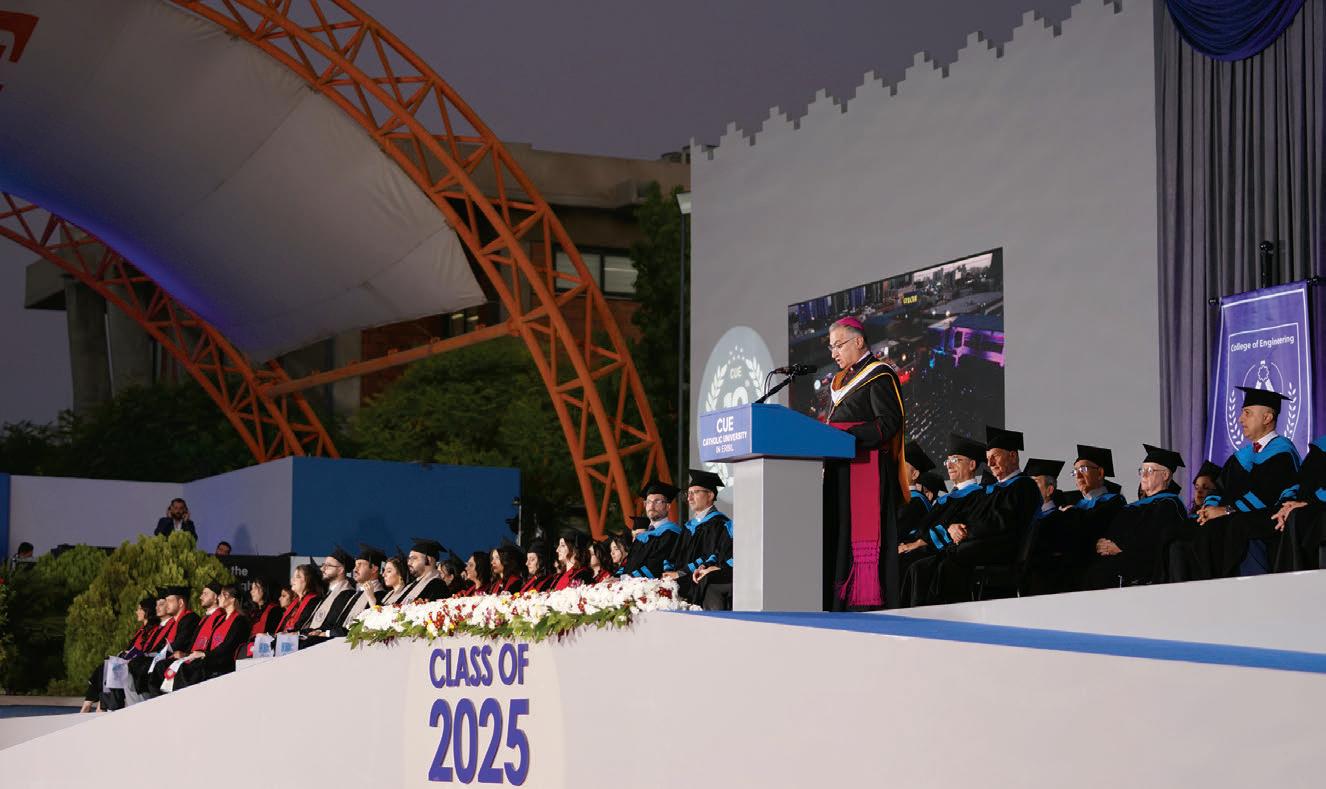
Photo courtesy of the Catholic University in Erbil
Archbishop Bashar Matti Warda of Erbil delivers remarks to the Catholic University in Erbil’s graduating class of 2025 on Sept. 30. The event also marked the 10th anniversary of the university, which was established with support from the Knights of Columbus in 2015.
International School in Erbil — the archdiocese’s flagship K-12 institution.
Established in 2011, Mar Qardakh had just 230 students in 2020. Today, that number has more than doubled to 580.
“Our part is to help families stay [in Iraq], to help them raise their children to be great leaders,” said Hala Warda, Mar Qardakh’s chief administrator. “The school is not just about academics. It’s about how we can create leaders that stay here and fight for the country and be part of the solution — never part of the problem.”
One reason for the school’s growth is the presence of young adult missionaries serving with the St. Thomas Mission. First launched in 2021 through a partnership with Franciscan University of Steubenville, the initiative sends seven to nine recent college graduates to Iraq each year to teach English, theology and other subjects, and to assist the archdiocese with youth formation and other projects. For some, it’s their first time traveling abroad — and for nearly all, their first time in Iraq.
Among the first missionaries was Alex McKenna, a native of Steubenville and a 2022 graduate of Franciscan University. In the spring of 2021, soon after a professor shared his experience attending Pope Francis’ apostolic visit to Iraq, McKenna felt called to commit to a six-week mission — effective immediately. He would complete the final exams for his junior year while adjusting to life in a country he had never set foot in before.
McKenna braced himself for a bleak and dangerous environment, calling to mind years of media portrayals of war and destruction. “Once I arrived,” he said, “I quickly found that was not going to be my day-to-day life.”
Those six weeks proved transformative. During a walk one day, a student asked if McKenna would return the next year.
“If I can, I will,” he replied.
“That’s what they all say,” the girl responded.
“Immediately, it tugs at your heartstrings,” said McKenna. “But for me, it was more than that. It was the Holy Spirit coming in and saying, ‘These people need you, and I want you to be with them more.’”
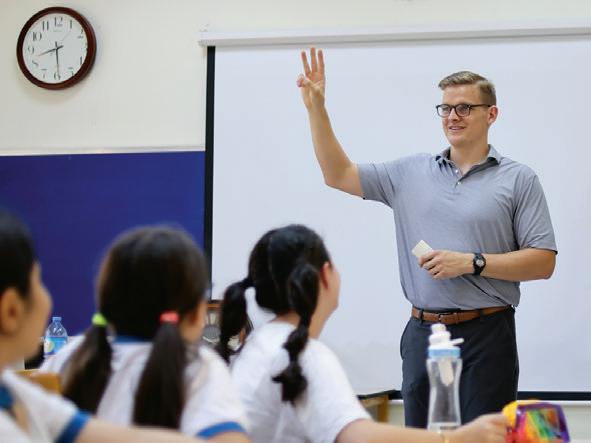
Paul Laubenthal, a member of Blessed Pier Giorgio Frassati Council 18673 in Platteville, Wis., teaches children at Mar Qardakh International School, the flagship K-12 institution of the Archdiocese of Erbil.
McKenna, who is a member of St. John Neumann Council 11828 in Steubenville, would go on to serve with the mission for three years and continues to advise the archdiocese and university. He lived at McGivney House, a 140-unit apartment complex in Erbil built in 2019 with help from the Knights of Columbus, primarily to house displaced Christian families.
Today, many of McKenna’s former students attend CUE on K of C-funded scholarships.
“Being here for three years, I came to experience the Knights in a way most people don’t,” he said. “Seeing the personnel support, resources and the advocacy that the Knights provide to support Iraqi Christians encouraged me to be a part of that.”
Now in its fifth year, the St. Thomas Mission includes missionaries from a growing number of U.S. colleges. One of this year’s participants is Peter Laubenthal, a native of Davenport, Iowa, and former missionary with the Fellowship of Catholic University Students (FOCUS).
“We’re here as Iraqi Christians, and with God’s help, he will keep us here. And if we can be a light, as long as he wants us to be a light, we will be.”
“In America, we don’t suffer a lot for our faith,” said Laubenthal, a member of Blessed Pier Giorgio Frassati Council 18673 in Platteville, Wisconsin. “To be with people who have suffered, who have watched family members suffer and die for the faith, is very humbling.”
Missionaries immerse themselves in Iraqi culture, attend the Chaldean Divine Liturgy — celebrated in Sureth (Syriac), a dialect of Aramaic — and regularly visit historic and religious sites near Erbil to better understand the ancient Christian heritage of the region.
“It’s not just about the classroom,” Laubenthal added. “It’s about showing what it’s like to truly live as a Catholic — not just culturally. We’re obviously not any better Christians than anybody here, but we are, hopefully, helping to give the children a good education and provide a good example of what it means to live out a life of faith here.”
Photo courtesy of Mar Qardakh International School
A LIGHT TO THE NATION
All involved recognize that the mission to preserve the faith and presence of Christians in Iraq is far from over. Christians now make up less than 1% of the population, and those who remain are recovering from the generational wounds left by ISIS. Though the terrorist group ceased to exist as a military force in 2019, the ideology behind it remains a threat.
“The world has shifted its gaze to other places, but those people in Iraq are still trying to recover, and in some sense, we’ve forgotten them,” Rasche explained. “Christians of Iraq could disappear in our lifetime, and if we don’t shift our gaze back to them … it could all be for naught.”
McKenna, currently back in the United States, still carries that responsibility with him. He recently began studying law at The Catholic University of America in Washington, D.C., so that he can return to Erbil and support the archdiocese in a new capacity. Even from afar, he is helping with CUE’s pursuit of full accreditation and assists students and faculty of Mar Qardakh in navigating visa challenges.
“I truly believe that the students I’m teaching will be the next generation of Iraqi Christian leaders,” he said. “As Archbishop Warda says, ‘We’re here as Iraqi Christians, and with God’s help, he will keep us here. And if we can be a light, as long as he wants us to be a light, we will be.’”
That light shines in the kindergartners whose voices reverberate through the halls as they sing the Our Father to begin each day. It shines in university students preparing to lead their wounded communities into a future of peace. And it shines in the illuminated cross atop Sts. Peter and Paul the Apostles Church, bearing quiet witness to Christ’s enduring presence in the land where St. Thomas the Apostle once preached and Abraham once walked.
It is the light that “shines in the darkness” (Jn 1:5) — and the darkness, despite its many efforts, has not overcome it. B
ELISHA VALLADARES-CORMIER is senior editor of Columbia and a member of Sandusky (Ohio) Council 546.
Photo by Tamino Petelinšek
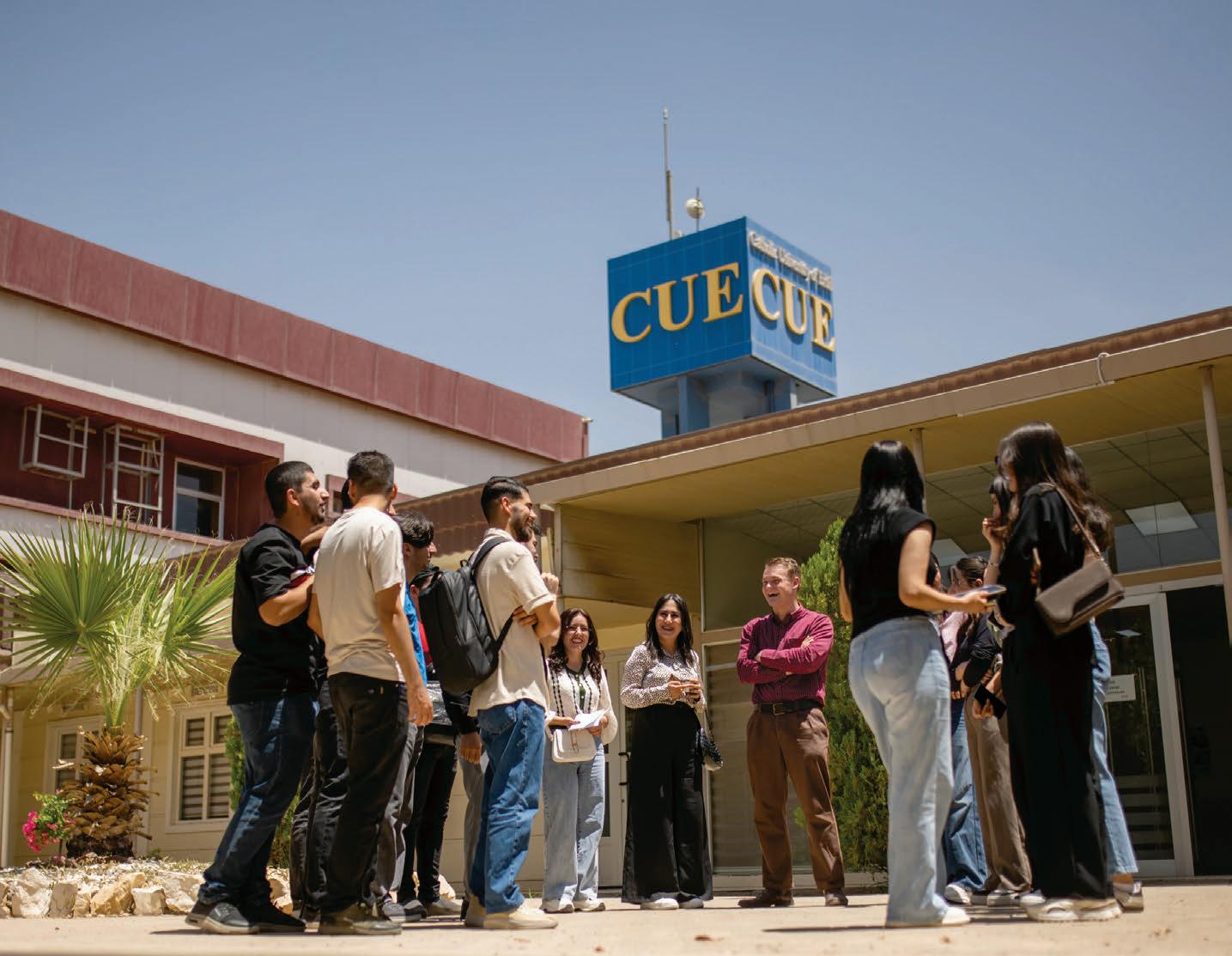
Alex McKenna shares a laugh with students on the campus of the Catholic University in Erbil, the only Catholic university in Iraq.
‘GOD,
GIVE ME THE STRENGTH’
Guided by faith and presence of mind, a Knight rescues a man from a burning vehicle
By Michael Stechschulte
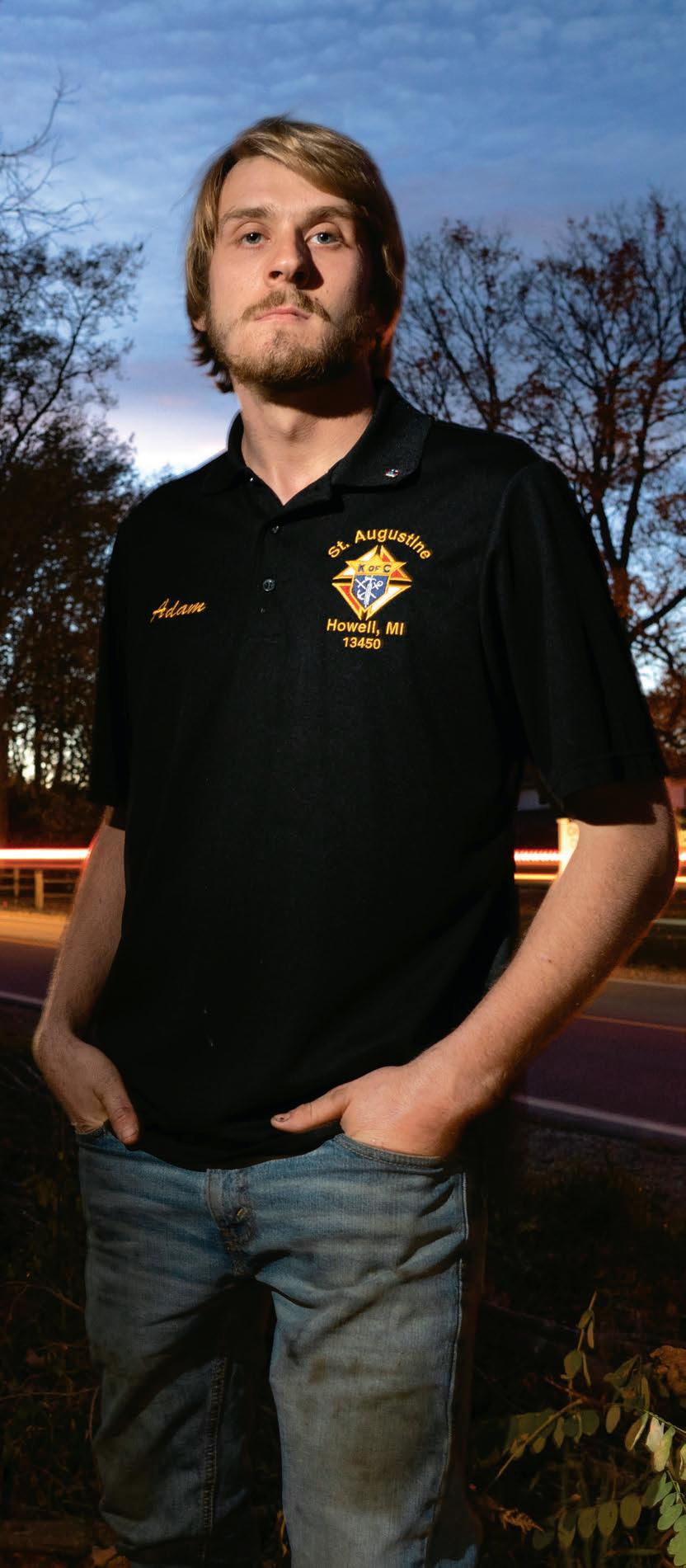
As he headed to work in the early morning hours of Sunday, June 22, outside Howell, Michigan, Adam Parzuchowski had no idea he was about to become someone’s “angel.”
But after the 21-year-old Knight from Deerfield Township pulled an unconscious young man from a burning truck moments before it was engulfed in flames, the timing seemed nothing short of divine intervention.
“If it had been another 30 to 60 seconds, this would have been a very sad story and a tragic situation,” said Adam’s father, John Parzuchowski, reflecting on his son’s heroic rescue of a mid-Michigan man whose truck had crashed into a tree that day.
John, who along with Adam and his two other sons is a member of St. Augustine Council 13450 in Deerfield Township, added, “The fact that Adam happened to be going to work and running a few minutes late … I believe God had a hand, and some angel was watching out for that young man.”
The dramatic rescue didn’t make national news — it was shared only on a local radio station — but John believes his son’s bravery is a testament to both Christian duty and divine providence.
After all, one could argue that Adam, an Eagle Scout and a member of the Knights of Columbus since the week of his 18th birthday, was uniquely prepared to save the life of a driver trapped behind the wheel of a burning pickup.
“In the Boy Scouts, you’re taught leadership and how to take care of what needs to be done,” John said. “With the Knights, he’s seen examples time and time again: Serve without looking for anything in return. I believe Adam simply did what needed to be done.”
Equipped with the right knowledge, tools and temperament — and a prayer for protection — Adam sprang into action and today credits God’s grace for the fact that both he and the man whose life he saved were unharmed.
QUICK THINKING
He almost didn’t notice the truck.
Driving eastbound on Clyde Road near Howell — a rural community northwest of Detroit — just after 5:15 a.m., Adam Parzuchowski slowed down when he came upon a large fallen tree on the road. A strong windstorm had kicked up the night before, so
Adam Parzuchowski, 21, stands at the site where he rescued a man from a burning vehicle in June.
Photo by Justin Wan
Adam didn’t think much of it and swerved to go around the obstacle.
As he began driving away, something caught the corner of his eye in the rearview mirror: taillights — and smoke.
“And then I realized it wasn’t just a tree that fell,” Adam recalled. “It was someone who had crashed.”
He rolled down his window and tried calling for the driver, but received no reply. Getting out of his vehicle, he quickly discovered the man — a 21-year-old who had been returning from a late-night work shift — unconscious and slumped into his deployed airbag. The door was locked.
As smoke began to rise in the early dawn light, Adam noticed an orange glow flickering beneath the white pickup’s engine bay. He knew he had only moments to act.
“I prayed in the beginning for God to give me the strength to know what to do — and the time,” Adam said. “I prayed through the entire event.”
Leaping into action, he quickly called 911 and tried unsuccessfully to open the man’s door. Suddenly, he remembered a tool in his own vehicle — one he kept specifically for just such an emergency.
“Everything was getting brighter and brighter,” Adam said. “So I ran back to my truck for a glass breaker that my mom had given all of us when we turned 16. I grabbed that and ran back to the vehicle, and then I broke his window, reached in and unlocked the door.”
Using the same tool, Adam cut the man from his seatbelt and pulled him from the truck — just in the nick of time.
“He was in and out of consciousness. I dragged him backward, and by about the time I did that, the flames were over the fenders,” Adam recalled. “I dragged him back to my truck, and by that point he had started to wake up.”
Adam remained with the man until emergency responders arrived, and then left to resume his commute to work.
ROOTED IN BROTHERHOOD
In the weeks and months after the rescue, Adam has shied from any implication that he’s a hero. But that doesn’t stop his friends and family from beaming with pride.
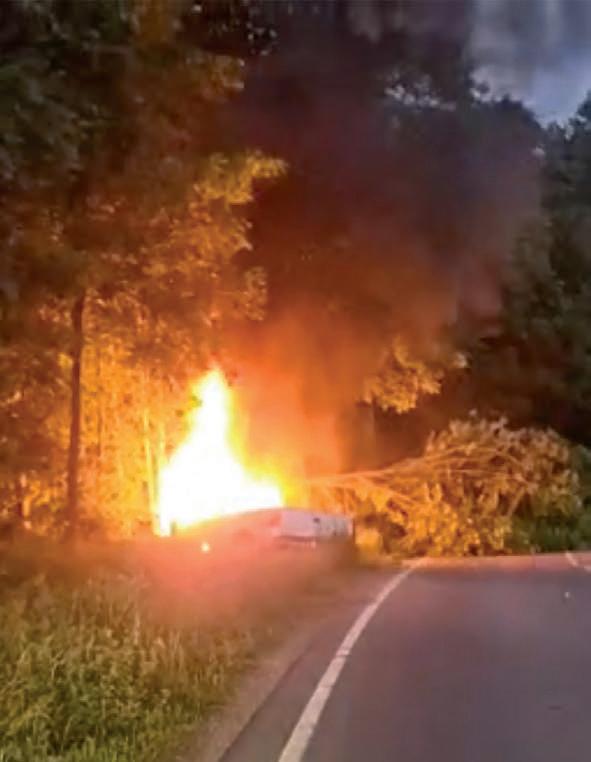
A cellphone image shows the scene of the accident outside Howell, Mich., after Adam Parzuchowski pulled the driver to safety and the truck burst into flames.
“When I heard about his courageous actions, I was speechless,” said David Parzuchowski, Adam’s oldest brother and deputy grand knight of Council 13450. “Pulling that man from the vehicle was heroic, and I’m extremely proud to be his brother.”
After his original shock wore off, however, David said he’s not at all surprised that Adam remained calm and composed under pressure.
“I don’t think Adam thought he was putting his life on the line … That’s just what we do in the Knights and in our Church. Somebody was in need — and he took care of it.”
“I just remembered all the training we did when we were growing up as Boy Scouts, and this is what the Boy Scouts and the Knights are all about,” David said. Still, he admitted, “I don’t know if I would have been able to do what Adam did in that situation.”
Growing up, Adam, David and their two other siblings — a brother, Jack, and sister, Sally — were always active outdoors.
“It was a ruckus at times,” David said with a laugh. “Going on campouts up north, hiking, canoe trips — it was all of these things that culminated in this bravery and gave him all the tools he needed.”
John Parzuchowski, who has been a Knight since 2010, agreed that his son’s heroism was not out of character.
“Adam is the fourth of my four children, and his brothers are both Eagle Scouts with him,” he said. “He has always been adventurous, and he’s got the biggest heart — he’s the
by
one who would always come up quietly and give you a hug when you needed one the most.”
The attention his son has received since the incident, John added, has been a bit overwhelming for the normally quiet young man.
“People were sending him messages of congratulations, but he was very reserved about it. He didn’t want the publicity,” he said. “I don’t think Adam thought he was putting his life on the line … That’s just what we do in the Knights and in our Church. Somebody was in need — and he took care of it.”
WHAT A KNIGHT SHOULD DO
The Parzuchowskis can often be found volunteering at St. Augustine Parish events and around the community.
According to Grand Knight Paul Bokuniewicz, the family is a fixture at barbecues, Polish dinners and fish fries, and the younger men recently helped organize a hayride for children and families.
“They’re very involved in our church,” Bokuniewicz said. “It’s good to have an injection of young energy, young men in our council — especially because when you have a hayride, you need to move 100 bales of hay!”
Giving one’s time at a barbecue or hayride is one thing, Bokuniewicz said. Rescuing a man from a burning vehicle is another.
“What Adam did, that’s walking the walk, putting his faith into action,” he said. “We were all deeply moved, humbled
and very proud.”
Adam’s actions, Bokuniewicz added, showcase the best of what it means to be a member of the Knights of Columbus.
“Saving another man’s life, reaching out to a brother — it’s all part of the main principles of what the Order is all about,” Bokuniewicz said. “Charity in offering and putting his life in front of another; unity in recognizing the shared dignity of each other’s lives; and the fraternity of reaching out to a brother in need. He was the Good Samaritan that day.”
For his part, Adam insists he was simply doing what any Christian man — especially a Knight — would do. And he firmly believes it was God who put him in a position to help when someone needed it most.
“I do believe God put me there that morning, at that time, because normally we don’t work a lot of Sundays,” Adam said. “If we did, we’d usually start later in the day. I started earlier that day, and that put me there to save his life.”
After the paramedics arrived and Adam drove away, he tried to call his boss to explain why he’d be late — but accidentally dialed his father instead. When the initial shock and relief subsided, John Parzuchowski hung up the phone, overwhelmed with pride.
“I actually started to cry,” he recalled, “because I realized what my son had done.” B
MICHAEL STECHSCHULTE is editor-in-chief of Detroit Catholic, the digital news service of the Archdiocese of Detroit.
Photo
Emily Elconin
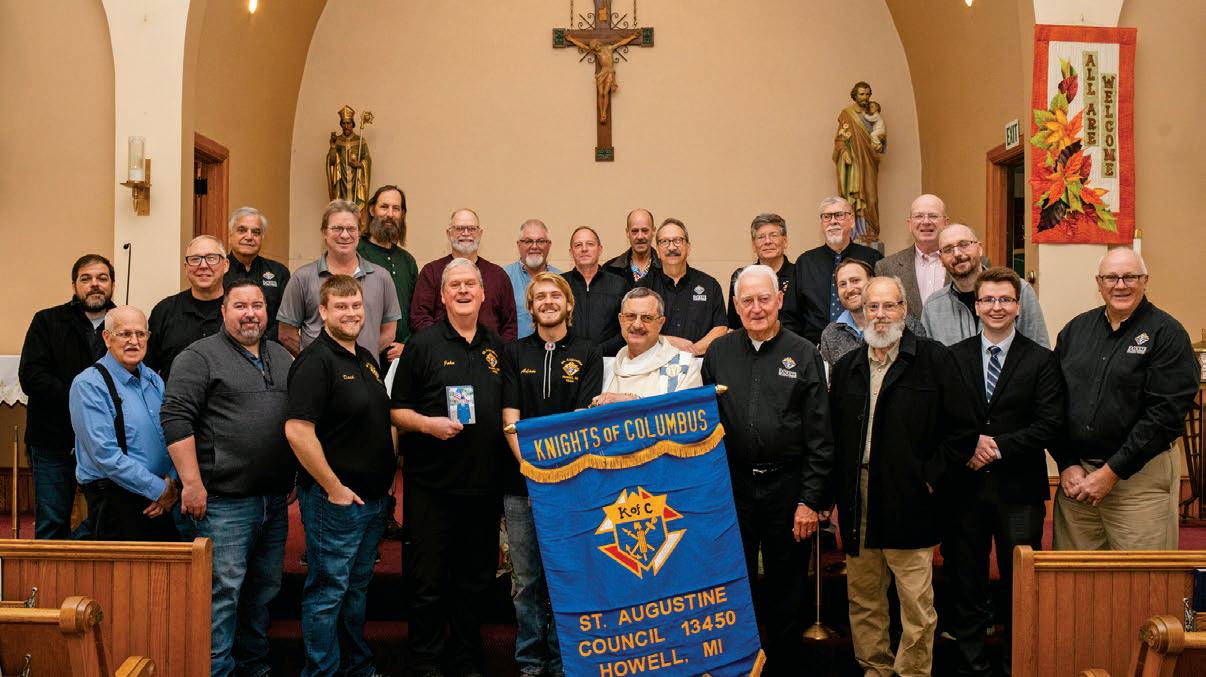
Members of St. Augustine Council 13450 gather in their parish church. Adam Parzuchowski stands to the right of his father, John, and his brother David, the council’s deputy grand knight, as John holds a photo of his son Jack, who is also a member of the council and currently serving in the U.S. Air Force.
THE ‘KINDLY LIGHT’ of Catholic Education
Drawing on the wisdom of St. John Henry Newman, Pope Leo XIV illuminates the way forward for Catholic schools in the AI era
By Leonard J. DeLorenzo
The algorithm knows what you want before you do. It serves up the next video and keeps you scrolling — all calibrated for engagement, not wisdom. For millions of students, this has become their experience of education: frictionless, individualized, profoundly lonely. We drown in information while starving for meaning.
Sixty years ago, with the declaration Gravissimum Educationis (On Christian Education), the Second Vatican Council proclaimed education a universal human right and called Catholic schools to be communities where truth, freedom and friendship could flourish. Today, when artificial intelligence can write essays, generate art and teach classes, we are again faced with the question: What is education really for? Our answer matters because it reveals what we think a human person is.
On Oct. 28, the 60th anniversary of Gravissimum Educationis, Pope Leo XIV released the apostolic letter Drawing New Maps of Hope. In this document, the Holy Father cuts through the fog of trendy educational discourse: We are not “skills profiles” to be optimized by algorithms but human beings with faces, stories and vocations (4.1).
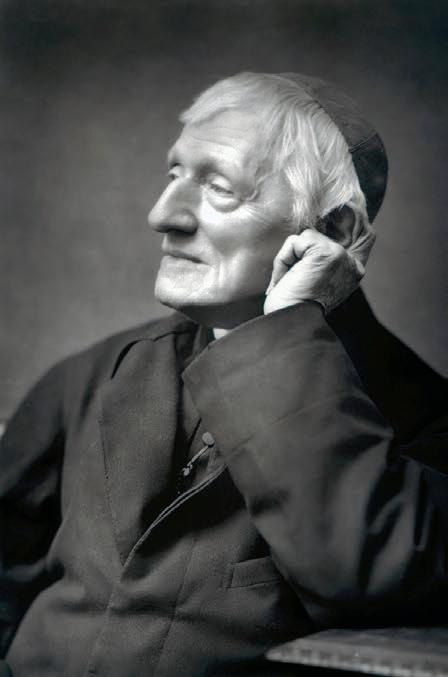
St. John Henry Newman — recently declared by Pope Leo XIV a doctor of the Church and co-patron, with St. Thomas Aquinas, of Catholic education — is pictured in 1887, near the end of his life.
Four days later, on All Saints’ Day, the pope proclaimed St. John Henry Newman — who was canonized in 2019 — a doctor of the Church and named him co-patron of Catholic education alongside St. Thomas Aquinas. Newman, the 19th-century Anglican who became Catholic at significant personal cost, understood that the quest for wisdom is always
tied to vocation — to the universal call to holiness. As Catholic education confronts the digital revolution, Newman’s vision offers a strategy for engagement rather than retreat.
‘A LABORATORY OF DISCERNMENT’
When Gravissimum Educationis appeared in 1965, it heralded what Pope Leo calls “a season of trust.” Today’s digital environment has put that trust to the test. Technologies were supposed to democratize knowledge. Instead, they have fragmented attention and impoverished relationships. Even Catholic schools risk “soulless efficiency, the standardization of knowledge, which then becomes spiritual impoverishment” (9.1).
Yet the pope refuses pessimism. Precisely here, Catholic education can become “not a nostalgic refuge, but a laboratory of discernment, pedagogical innovation and prophetic witness” (11.1). The decisive point is not the technology itself but the use we make of it (9.3). The temptation for misuse runs deep — to reduce learning to skills, students to data, success to employment. Although heightened by new technologies, the problem is an old one: reducing the faith to one subject among others. On this point, the Holy Father quotes Newman’s The Idea of a University, first published in 1852: “Religious Truth is not only a portion, but a condition of general knowledge” (3.1). Newman isn’t saying biology classes should stop for catechism. He’s making a more radical claim: The deepest questions about meaning and purpose aren’t additions to real
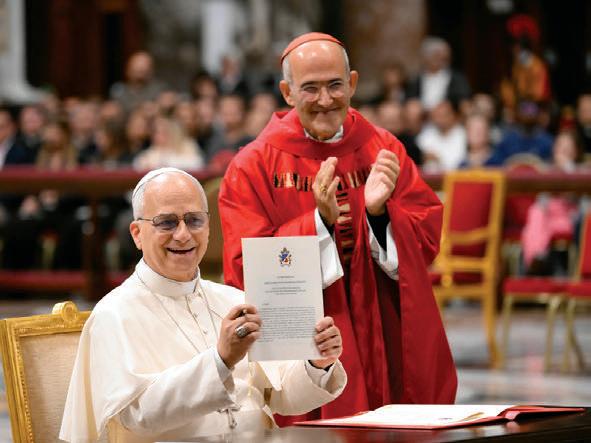
Pope Leo XIV displays his apostolic letter Drawing New Maps of Hope, marking the 60th anniversary of the Vatican II declaration on Catholic education. With Cardinal José Tolentino de Mendonça, prefect of the Dicastery for Culture and Education, looking on, the pope signed the letter before Mass with students from the pontifical universities of Rome at St. Peter’s Basilica on Oct. 27.
knowledge — they’re the framework that makes knowledge possible. What does it mean to be human? What deserves our love? Why does truth matter? These questions are the horizon against which every other question finds its place.
An education that brackets ultimate questions becomes shallow. Newman’s story embodies the alternative. Born in 1801, he became an intellectual star at Oxford, an Anglican priest whose sermons drew crowds. Then, in 1845, he converted to Catholicism. It cost him the support of his family and friends, as well as his professional position as a fellow at Oxford. But Newman had learned to distinguish comfort from truth. He followed where his conscience led him, even into exile.
Naming St. John Henry Newman co-patron of education alongside St. Thomas Aquinas is not replacement but development — exactly what Newman taught about doctrine. Aquinas gives us architecture: the synthesis showing that grace perfects nature and faith harmonizes with reason. Newman gives us history: how truth grows in the Church’s life and how authentic development differs from corruption. Together they model what Catholic education must be — rooted yet growing, faithful yet creative.
‘SOME DEFINITE SERVICE’
In his homily for the feast of All Saints, Nov. 1, the Holy Father quoted Newman’s well-known meditation: “God has created me to do Him some definite service; He has committed some work to me which He has not committed to another. I have my mission.” Here’s the antidote to the algorithmic reduction of education: Your life shines because you discover you’re called — that your existence is marked by God’s personal love.
This is what Pope Leo offers through his apostolic letter
and Newman’s elevation: an education that forms whole persons for lives of meaning, and a conviction that every human being carries irreducible dignity and a calling that deserves to be honored, nurtured and sent forth into the world.
The Holy Father identifies three priorities for Catholic education as formation rather than optimization:
First, develop the interior life of students. Young people live immersed in noise. Silence has become almost impossible — and with it, the capacity for discernment. In his All Saints’ Day homily, the pope invoked Newman’s hymn “Lead, Kindly Light,” written in 1833 during a moment of personal darkness and uncertainty. The hymn proclaims, “The night is dark, and I am far from home; lead Thou me on!” Education’s task is to offer this kindly light “to those who might otherwise remain imprisoned by the particularly insidious shadows of pessimism and fear.” The algorithm can predict what you’ll click next — often feeding your worst inclinations — but only God’s wisdom reveals who you’re called to become.
Second, place technology at the service of humanity. Technologies should enrich learning, not replace human encounter. What Pope Leo challenges is educational reform driven merely by workforce development. Skills matter, but when education becomes nothing more than skills acquisition, we’ve betrayed the human person. No algorithm can replace poetry, irony, love, art, imagination, discovery — even learning through mistakes.
Third, restore education as an expression of charity. Education can either build bridges or walls. In his homily, the pope quoted his apostolic exhortation Dilexi Te (I Have Loved You): “Does this mean that the less gifted are not human beings? Or that the weak do not have the same dignity as ourselves? Are those born with fewer opportunities of lesser value as human beings? Should they limit themselves merely to surviving? The worth of our societies, and our own future, depends on the answers we give to these questions” (95). In other words, where education remains the privilege of a few, Catholic education fails its mission.
What is the ultimate aim of these priorities? Nothing less than the universal call to holiness. The Holy Father recalled
Here’s the antidote to the algorithmic reduction of education: Your life shines because you discover you’re called — that your existence is marked by God’s personal love.
the words spoken by Pope Benedict XVI at Newman’s beatification in 2010: “What God wants most of all for each one of you is that you should become holy.”
‘SHINE LIKE STARS’
Pope Leo’s vision for Catholic education relies largely on the men and women who do the work of teaching. In his homily, he addressed educators directly, calling them to “shine like stars in the world” (Phil 2:15) — not by spectacular achievement, but through authentic commitment to truth-seeking and truth-sharing; not by dominating, but by serving, especially the young and the poor.
The Gospel for All Saints’ Day, on which Pope Leo preached, presents the Beatitudes — those seemingly paradoxical declarations that the poor, the persecuted, the peacemakers are blessed. What sounds absurd by worldly logic reveals a new interpretation when brought into contact with God’s kingdom. Jesus isn’t just another teacher. He’s the Master and Educator par excellence, the one whose life and teaching become the light by which we see everything else. Educators shine not by their own brilliance, but by reflecting his light.
This is where Newman’s hymn takes on new depth. When Newman wrote “Lead, Kindly Light” amid darkness and confusion, he wasn’t asking for multiple lights or general
illumination. He was seeking the Light — Christ himself, the only sure guide when our feet are unsteady and the path unclear. The Holy Father recalled Pope Francis’ repeated warning that nihilism is one of contemporary culture’s most dangerous maladies, threatening to cancel hope. Against this encircling gloom, education must offer not generic optimism but what Newman sought: Christ, the kindly light who leads through darkness.
This work requires identifying what Pope Leo calls “constellations” — patterns of Christ’s light already shining in dark times. Every educational context can become a gateway to dialogue and peace because Christ is present there, working through those who serve him. Schools and teachers don’t solve problems by their own power; they point to the Light who illuminates, who transforms, who gives meaning to our seeking and finding. Without Christ at the center, we offer nothing more than better techniques for navigating the darkness. With him, even our failures become occasions for encountering the One who is the way, the truth and the life. B
LEONARD J. DELORENZO, a Knight since 2023, is a professor of the practice in the McGrath Institute for Church Life (mcgrath.nd.edu) and concurrent professor in the Department of Theology at the University of Notre Dame.
by Gina Allen
Photo
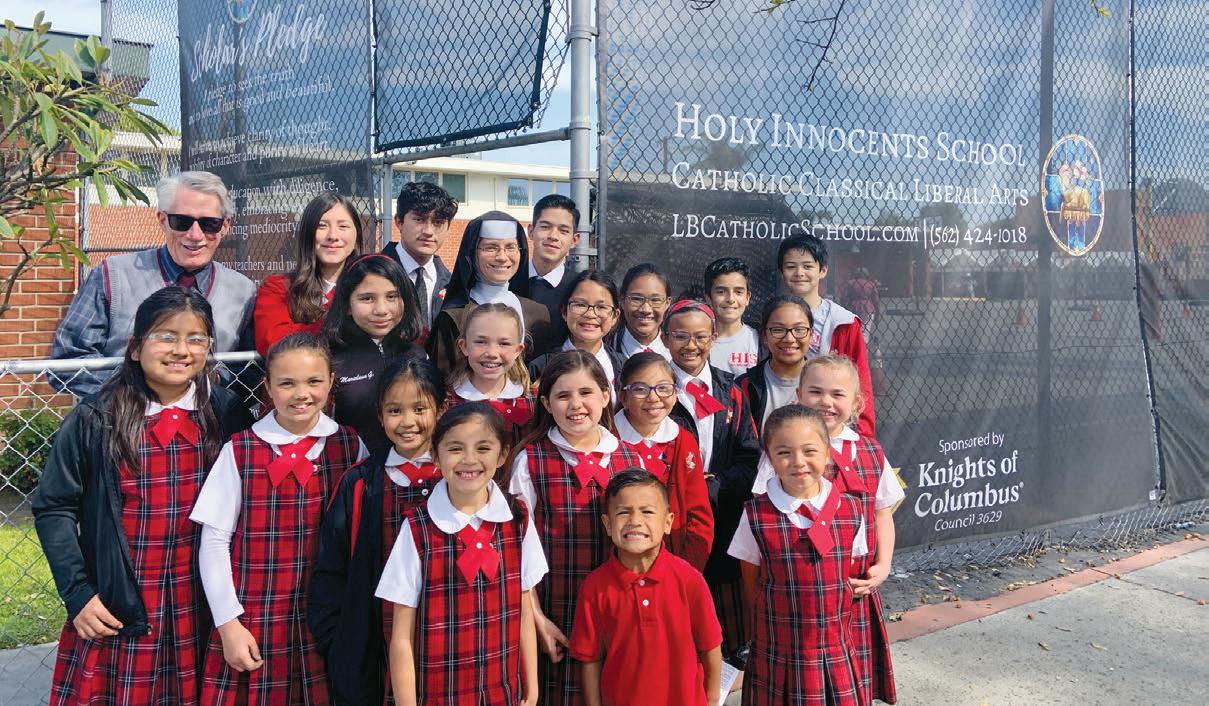
Students and staff members of Holy Innocents School stand before custom-printed fencing screens donated by Msgr. John Cawley Council 3629 in Lakewood, Calif., in 2022. The screens provide much-needed privacy to the playground of the school, which is located in a busy urban neighborhood in Long Beach. Last year, K of C councils provided more than $10 million and volunteered more than 1 million hours in support of Catholic schools and seminaries.
ALL ABOARD FOR CHARITY
A New York council’s custom train car initiative raises funds while promoting faith, patriotism and the true meaning of Christmas
By Cecilia Engbert
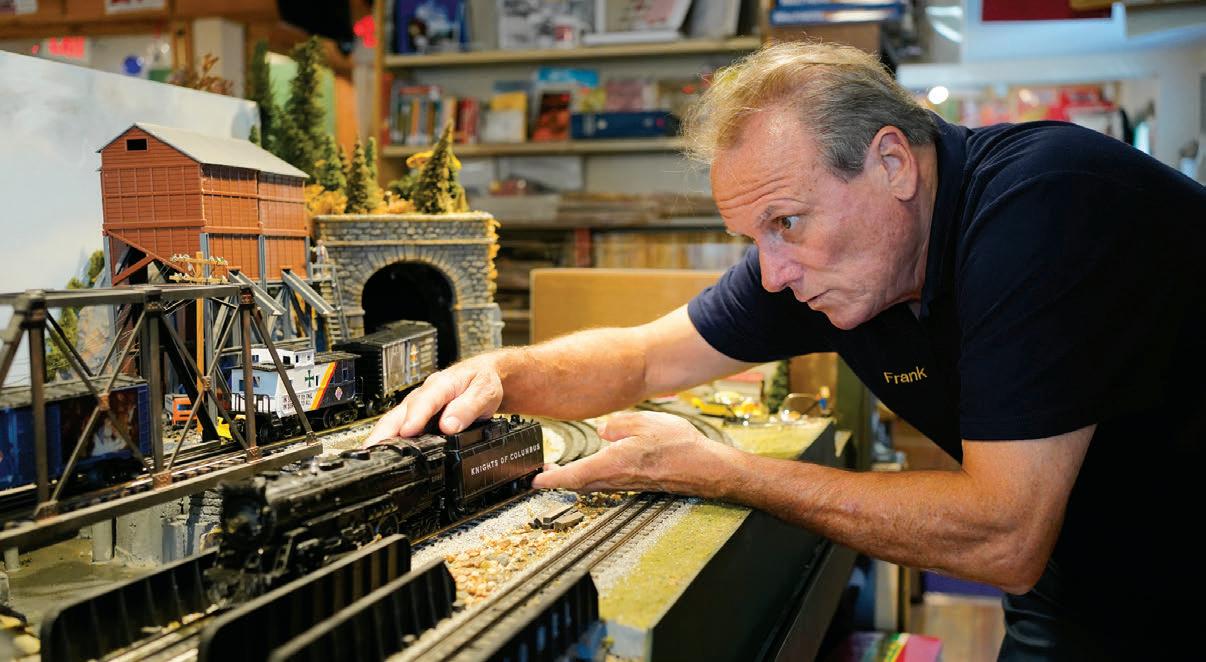
As K of C-branded model trains wend their way through the colorful layout in the Railroad Museum of Long Island, Frank Kotnik checks the controls and straightens a car on the track. In that moment, he’s transported back to Christmases from his childhood in the 1960s, when he and his father created similar displays in his family’s basement.
Nearly 60 years after receiving his first Lionel train set as a child, Kotnik, a member of Msgr. Sherman Council 5103 in Glendale, Queens, remains an avid model train enthusiast — a passion he shares with brother Knights through the
council’s annual boxcar fundraiser.
The idea took shape a decade ago during a visit to the same Long Island museum, where Kotnik was struck by a display of commemorative train cars produced for various organizations. As he spoke with the museum director, a crossing light of inspiration switched on.
“The Keep Christ in Christmas campaign was always very important to me,” Kotnik said. “And as I was talking to the museum director, I thought, ‘This would be a great idea to create a Christmas fundraiser.’”
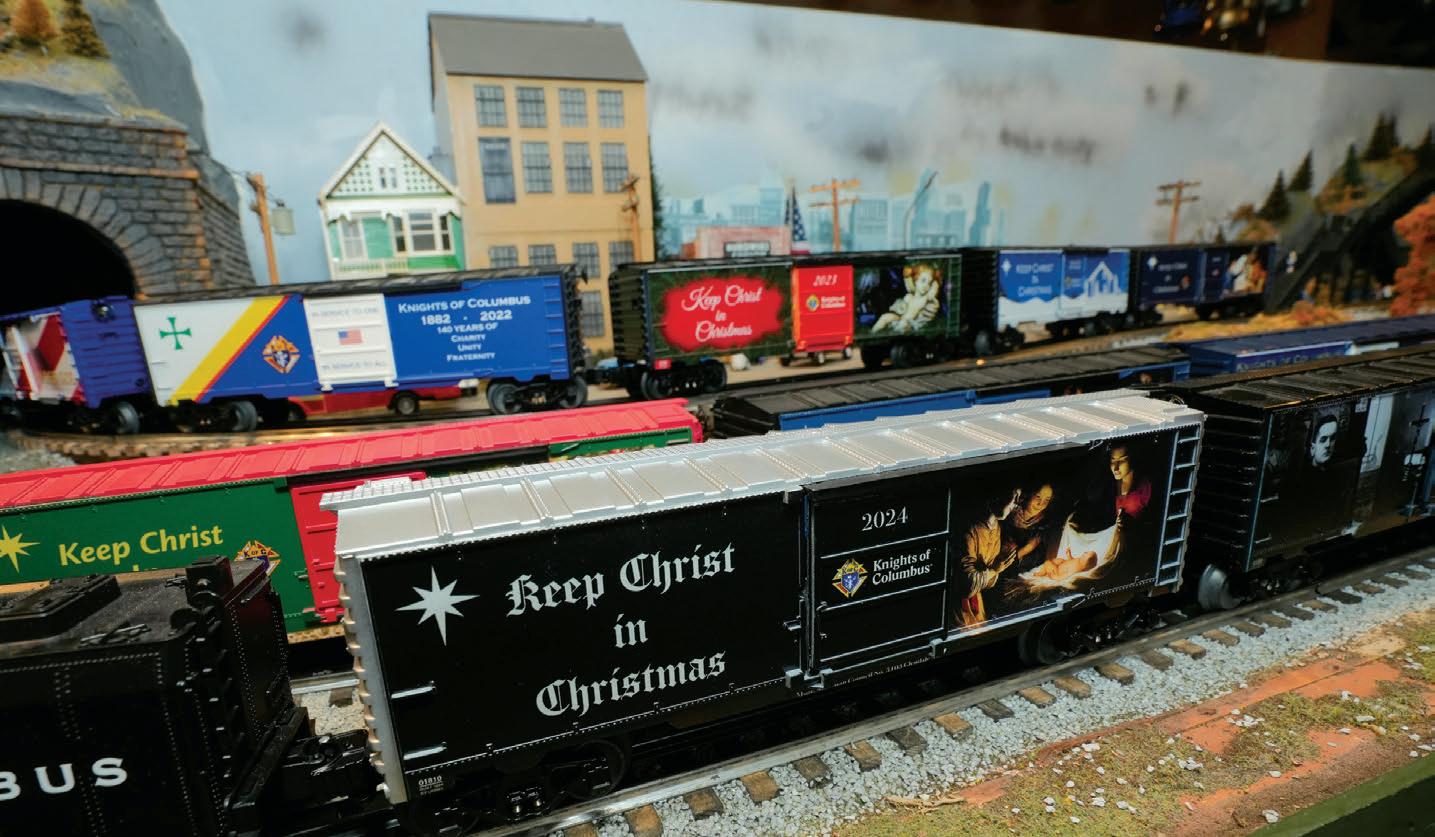
Top: Keep Christ in Christmas-themed model boxcars roll along the O-gauge track layout at the Railroad Museum of Long Island.
Since Council 5103 already promoted the Order’s Keep Christ in Christmas program every year, Kotnik saw it as a perfect opportunity to enhance the council’s charitable activity during the Christmas season. After gaining the support of his brother Knights, Kotnik designed the first boxcar with the assistance of Don Fisher, the railroad museum director, and produced the first Keep Christ in Christmas-themed boxcar in 2018.
Bearing a striking Nativity scene on its side, the deep blue Lionel O-scale boxcar was an immediate hit with Knights, parishioners and train collectors of all backgrounds. Since then, the boxcars have become a cherished tradition for Council 5103, which has earned a reputation as “the train council.”
“All I wanted was to produce one, but since 2018, we’ve produced 12 designs,” Kotnik said. “These are the same Lionel trains that kids got back in the ’50s, the ’60s and the ’70s, and they’re manufactured exclusively for the Knights of Columbus.”
MISSION ON TRACK
Every penny that Council 5103 raises from the boxcars is donated to Knights of Columbus Charities Inc. or directed to other causes supported by the Order. The council has sold nearly 2,200 cars to date, raising more than $37,000 for a range of initiatives — including the Order’s Christian Refugee Relief Fund, Ukraine Solidarity Fund, disaster relief efforts and Special Olympics. Most recently, proceeds were used to assist victims of Hurricane Melissa in Jamaica and to aid a brother Knight from another council who was paralyzed in a skiing accident.
“Over half the money has gone to Christian Refugee Relief,” said Ken Engesser, council treasurer. “That was always the vision of this project — that our primary function would be to sell trains throughout the United States to give back to a global need supported by the Order.”
Not only are the boxcars unique collectibles, but they also serve as tools for evangelization, since many buyers are non-Catholic or even non-Christian. The Knights hope that these religiously themed boxcars will remind all who see them that Christmas is more than just another holiday.
“This train program has allowed us to focus and take a pause each year, to be reminded that Christmas is really not a one-day event. It’s a daily reality.”
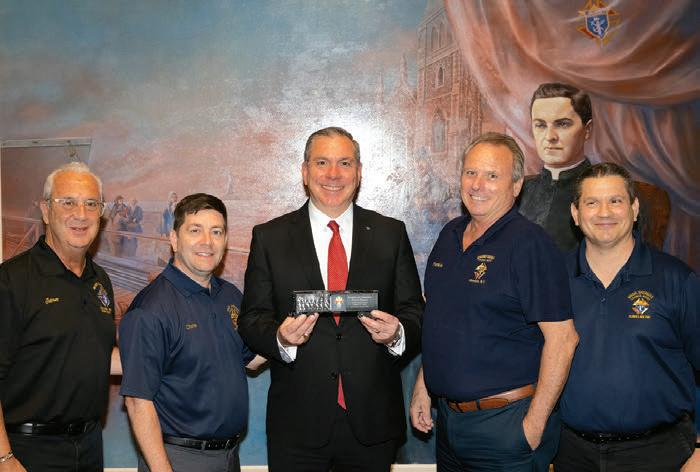
Above: Supreme Master Michael McCusker is pictured with members of Msgr. Sherman Council 5103 at the Blessed Michael McGivney Pilgrimage Center in New Haven, Conn., June 25. He holds a collectible boxcar commemorating the 125th anniversary of the Fourth Degree. • Opposite page: Frank Kotnik adjusts one of the K of C-themed engines used to pull the many festive boxcars he and his brother Knights have designed.
“Christmas isn’t just the presents — it’s about the presence of Christ in our lives,” Kotnik said. “We lost the meaning of Christmas at one time, and it’s coming back again.”
While Council 5103 strives to promote and live that message year-round — not just in December — Grand Knight Chris Russo noted that the initiative invites reflection and renewal.
“This train program has allowed us to focus and take a pause each year, to be reminded that Christmas is really not a one-day event,” he said. “It’s a daily reality that Christ has come into the world to call us to live in a deeper relationship.”
The project also illustrates how Knights can bring their personal talents into the mission of the Order. Engesser pointed to the boxcar initiative as an example of creativity put in service of others.
“It’s unique, and it’s outside of what you might normally see the Knights of Columbus doing,” he said. “It’s a message to other councils, who can ask their members, ‘What are your hobbies? What do you like and enjoy?’ Maybe there are other people out there of a similar mind, and you could tap into that.”
Kotnik is an innovator by nature. During his career as a blacksmith for the New York City Department of Transportation, he designed and manufactured sign brackets and fencing for use throughout the city, including more than 100 brackets along Sixth Avenue in Manhattan that hold the iconic national medallions lining “The Avenue of the Americas.”
In the aftermath of the attacks on the World Trade Center on Sept. 11, 2001, he not only worked overtime to build and install signs rerouting traffic around the destruction, but also
Photo by Mike Ross
volunteered at Ground Zero, working through the night to cut steel for removal.
While Christmas has been the primary focus of the council’s boxcar initiative, Kotnik has also designed cars commemorating significant milestones of faith and patriotism. These include a boxcar marking the beatification of Blessed Michael McGivney in 2020; another celebrating the Knights’ support for the 1954 addition of “under God” to the Pledge of Allegiance; and one honoring the Order’s 140th anniversary in 2022.
FAITH IN MOTION
In 2024, Kotnik was invited to design a boxcar commemorating the 125th anniversary of the Order’s Fourth Degree.
When the original edition quickly sold out, Council 5103 commissioned a second design to mark the anniversary celebration held on Feb. 22, 2025, at St. Patrick’s Cathedral in New York City.
“After I got the call to design the Fourth Degree edition, in less than two hours I had the rough draft ready,” said Kotnik, who is also a member of Gunnery Sgt. John Basilone USMC Assembly 4020 in Glendale.
The limited-edition car featured images from the first Patriotic Degree on Feb. 22, 1900, as well as from the 2025 exemplification at St. Patrick’s.
In June, Kotnik and fellow council members visited New Haven, Connecticut, and presented a prototype of the boxcar to Supreme Master Michael McCusker, a train enthusiast whose family worked for generations on the Pennsylvania Railroad. Council 5103 then promoted the train and collected orders for a shipment to be delivered in time for Christmas.
“What is exceptional about these boxcars is that they speak to our history as Knights of Columbus,” Supreme Master McCusker said. “They continue to promote the importance of the Keep Christ in Christmas program but have also provided opportunities to both celebrate Blessed Michael McGivney’s beatification and promote the Fourth Degree’s 125th anniversary.”
He added: “Trains built this great nation just as the Knights of Columbus built inroads for many who were once disenfranchised. The boxcars are a reminder of how the Knights have kept men on the rails for nearly 150 years in their lives of faith and fraternity.”
Because of the time and resources required to produce the Fourth Degree anniversary boxcars, Council 5103 had to forgo a Christmas boxcar for 2025. Yet, plans are underway for next year’s Christmas car, along with potential designs for one or more cars celebrating Holy Week and Easter in April 2026.
“I’m always looking to go onward and upward,” Kotnik said, sharing that he has already prepared designs which feature Leonardo da Vinci’s famous Last Supper painting and Michaelangelo’s Pietà. “It all depends on what kind of response we get, but I’m very optimistic.”
Kotnik has one other design on deck that anticipates the hope and prayer of Knights worldwide — the canonization of Blessed Michael McGivney.
“I already have that boxcar designed,” he said. “So, if and when that happens, I’ll be ready.”
For more information visit kofc5103.org/trains. B
CECILIA ENGBERT is a content producer for the Knights of Columbus Communications Department.
Photo by Gregory A. Shemitz
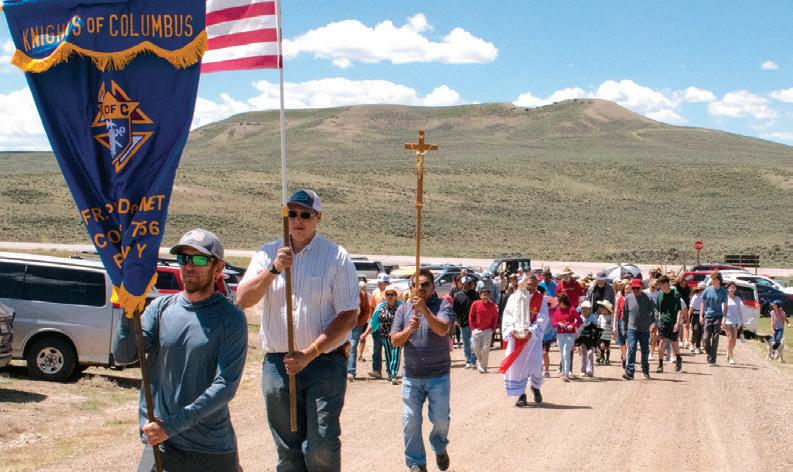
Knights from Father Pierre De Smet Council 9756 in Pinedale, Wyo., carry their council banner, a U.S. flag and a crucifix as they lead 150 parishioners of Our Lady of Peace Church on a 2.5-mile pilgrimage to the site where Jesuit missionary Father Pierre De Smet celebrated the first Mass in Wyoming in 1840. The pilgrims prayed a rosary at the original stone altar, which is now enclosed by a small chapel.
CELEBRATING THE SACRED HEART
St. Joseph the Worker Council 10200 in Ozark, Mo., and St. Francis of Assisi Council 13748 in Nixa jointly hosted a Sacred Heart Holy Hour at St. Joseph the Worker Church in Ozark. Father Timothy Tran, pastor and Council 10200 chaplain, led the pilgrim icon prayer service.
GUARDIANS OF THE GRAVES
Members of St. Patrick Council 8178 in Monona, Iowa, cleaned up debris at St. Mary’s Catholic Cemetery after high winds knocked over a tree onto surrounding headstones. After Grand Knight Lester Lang called for help, 15 members responded and spent several hours removing the tree and repairing the damage.
PADRE APPRECIATION
Several councils in the Calgary, Alberta, area collaborated to organize the annual Padre Night, an event honoring priests and religious of the Diocese of Calgary. Approximately 325 people — including Knights, priests, deacons and religious — attended.
A CRUCIFIX RESTORED
Grand Mesa Council 2731 in Delta, Colo., hosted a breakfast at St. Michael Church to raise funds to replace the corpus on the church’s crucifix, which had developed multiple cracks. Around 110 parishioners attended, and the event raised $2,000 toward the $6,000 project.
JOURNEY OF THE SACRED HEART
Knights of Our Lady of Peace Council 17081 in Lubang, Visayas, led parishioners of Our Lady of Peace Quasi-Parish in a nearly 10-mile procession to carry the Order’s icon of the Sacred Heart of Jesus to Sto. Niño Chapel. The stop was part of the icon’s pilgrimage to 50 councils in the Diocese of Talibon.
IN HONOR OF OUR FOUNDER
Members of Adelphi Council 4181 and Bishop O’Reilly Assembly 399 in Shrewsbury, Mass., traveled with local parishioners to New Haven, Conn., where they attended Mass at St. Mary’s Church, the birthplace of the Order, and toured the Blessed Michael McGivney Pilgrimage Center.
Faith
NEW PRIEST RECEIVES SACRED VESSELS
Our Lady of the Americas Assembly 3123 in Bothell, Wash., gifted a travel Mass kit to Father Joseph Tapia-Beeman, a newly ordained priest for the Archdiocese of Seattle and a brother Knight. The assembly has donated more than 10 Mass kits — including a chalice, paten, host box, crucifix, stole and more — to new priests in recent years.
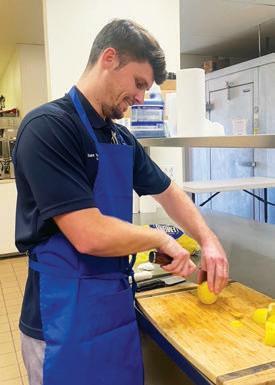
Steven Koenig of St. Teresa of Calcutta Council 2384 in Merced, Calif., slices lemons for the council’s fish fry at St. Patrick Parish. More than 260 meals were served, raising over $3,000 toward the construction of a parish rectory. Council 2384 has contributed approximately $30,000 in support of the project.
Family
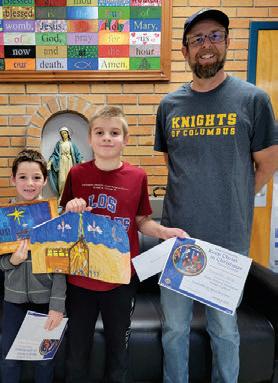
Grand Knight Will Huys of Father John McMaster Council 6495 in West Lorne, Ontario, stands with last year’s winners of the council’s Keep Christ in Christmas poster contest. Nearly 50 students from three grades participated.
TOYS FOR TOTS
St. Matthew Council 14360 in Norwalk, Conn., transported toys from 80 locations for the local Marine Toys for Tots program. The Knights then helped distribute more than 9,000 toys to children in need.
SUPPORTING THE NEXT STEP
Father John J. Wenzel, S.J. Council 10003 in Milford, Ohio, awarded two $1,000 scholarships to support incoming freshmen attending Catholic high school.
PANTRY PARTNERS
Our Lady of the Mountains Council 7575 in North Conway, N.H., donated $1,000 to the Vaughan Food Pantry and $500 in materials for an accessibility ramp at the Madison Food Pantry. The council has supported both organizations for more than five years.
SUPPLIES FOR SUCCESS
Danny McMichael Council 12984 in Jackson, Ga., donated 40 backpacks filled with more than $4,000 worth of school supplies to the Georgia Division of Family and Children Services. The council has supported the agency’s service to students in need for more than a decade.
ROLLING OUT MEALS
Members of Harry “Hap” Hansen III Council 12281 in Hampstead, N.C., prepare approximately 40 meals a month for homebound adults in partnership with Pender Adult Services through the Meals on Wheels program. The Knights have delivered more than 500 meals since 2024.
GIVING FAMILIES HOPE
St. Clare of Assisi Council 12851 in Surprise, Ariz., launched a widows
and orphans assistance project in collaboration with the local chapter of the Society of St. Vincent de Paul. The project, named in honor of Father Michael McGivney, recently provided four $500 gift cards to widows and single mothers in need.
BACKYARD BROTHERHOOD
Twelve Knights from Our Lady of Mount Carmel Council 9665 in San Diego spent three hours cleaning the backyard of a brother Knight who has been bedridden for two years.
MOBILITY ASSISTANCE
Our Lady of Fatima Council 9636 in Las Piñas City, Luzon South, donated a wheelchair to a volunteer sacristan at Christ the King Parish. The sacristan had sustained a serious injury during a fall while preparing for Mass.
A BROTHERLY VISIT
Members of Trinity Council 5825 in Monaca, Pa., visited longtime Knight James George, who recently turned 90, and helped with home repairs. Since 2018, the council has made similar visits to older and homebound brother Knights, often with a cake and offers of assistance.
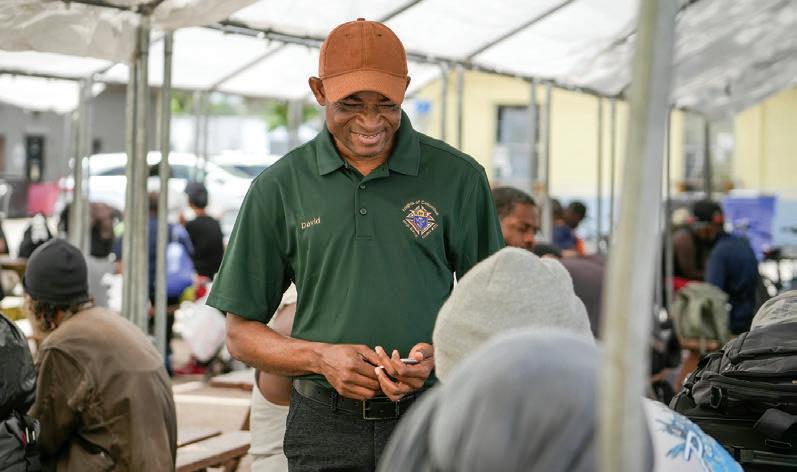
David Green, a member of Msgr. Bishop Council 2112 in Orlando, Fla., greets guests during a free meal at the Christian Service Center. Council 2112 helps fund the weekly meals, and Knights volunteer monthly, serving more than 100 people experiencing homelessness.
BOTTOM:
Photo by Jacob Langston
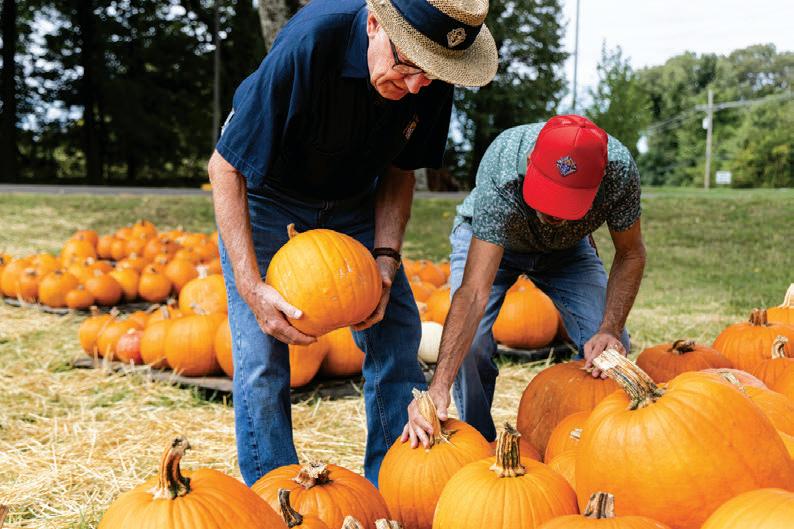
Knights from Hernando de Soto Council 7120 in Southaven, Miss., tend to the council’s pumpkin patch, which raises approximately $3,000 annually. The funds support local charities such as Sacred Heart Southern Missions, which provides winter clothing for children in need.
NEVER ALONE
Father Vincent R. Capodanno Assembly 2413 in Georgetown, Del., partnered with 22aday.org to set up a display of white crosses at St. Jude the Apostle Catholic Church. Over 30 days, 22 crosses were added daily to raise awareness of the high suicide rate and mental health crisis facing veterans.
FROM ASHES TO AID
Charlebois Council 2704 in The Pas, Manitoba, donated CA$500 to the Rural Municipality of Kelsey to help cover food costs for residents evacuated due to wildfires this past summer. Approximately 1,000 people were displaced, and more than 200 sheltered in The Pas.
LIFTING GROCERIES AND SPIRITS
When members of Our Lady of the Cedars Council 5260 in Manchester, N.H., learned the elevator at a local apartment complex was out of service, they volunteered for nearly 12 weeks to carry groceries for elderly and disabled residents affected by the outage.
MATTHEW 25 PROJECT
Father John J. McCarthy Council 12472 in Charleston, S.C., hosted a cookout for 120 participants of the Matthew 25 Project — a weeklong camp for high school students — at Bishop England High School. The camp engages teens in community service projects, faith formation, worship and fellowship.
PAJAMAS FOR VETS
St. Isaac Jogues Assembly 649 in Fairfield, N.J., and the youth group at St. Peter Church in Belleville organized their third annual pajama drive for patients at the East Orange and Lyons VA medical centers. The effort collected over $4,000 to purchase 400 pairs of pajamas for veterans.
A GREENER FUTURE
Zambales Council 3694 and Bishop Henry Byrne Assembly 3637 in Iba, Luzon North, organized a tree-planting event across several villages in Zambales province. More than 20 Knights planted 200 seedlings during the day of service.
Community
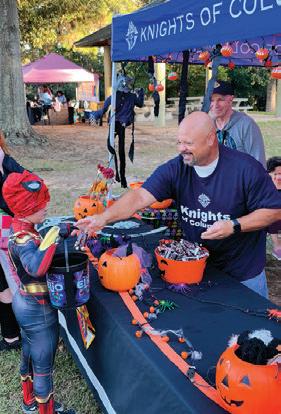
Eric Long of Archbishop John L. May Council 11480 in Enterprise, Ala., hands out candy during the Enterprise Parks and Recreation Department’s annual Spooky in the Park event. The council participated in this event for the second year in a row, giving K of C Tootsie Rolls to more than 3,000 attendees.
TEEING OFF FOR CHARITY
St. Mary’s Council 14224 in Holliston, Mass., hosted its fourth annual Swing for Charity golf tournament at Pinecrest Golf Club. More than 90 people participated, and the winners of the council’s 17th annual charity raffle were announced afterward. Together, the events raised $30,000 for several local charities.
Photo by Brad Vest
LEFT:

Life
CLEAN WATER FOR ALL
Immaculate Conception Council 8159 in Mechanicsville, Md., funded the construction of a 100-meter-deep well with a solar-powered pump at the Siuyu Children’s Rehabilitation Centre in Singida, Tanzania. The $12,000 project now provides clean water to more than 100 children with disabilities and their families, as well as more than 1,000 residents in the surrounding community.
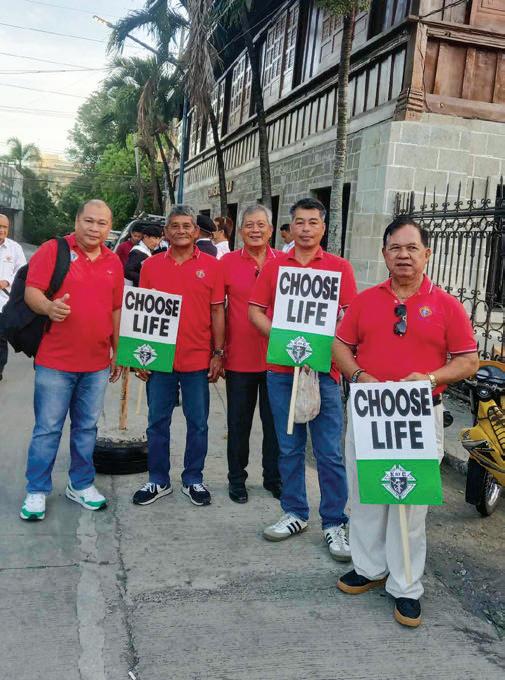
Members of Our Lady of Montserrat Council 10101 in Iloilo City, Visayas, assemble before a March for Life organized by Molo (Visayas) Council 5028. More than 800 people marched three miles to Santa Ana Church, where Mass was celebrated and Dominican Sister Serafica Tolentino spoke about the sanctity of human life.
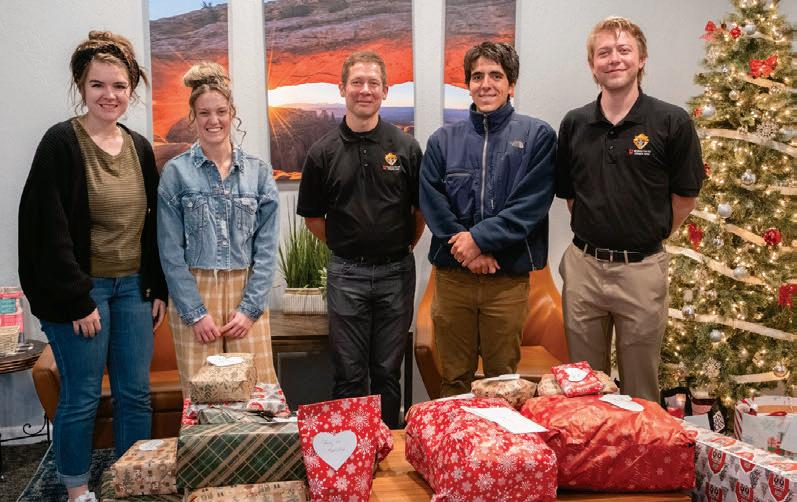
Knights from Father Thomas D. Kraft, O.P. Council 14764 in Salt Lake City present wrapped presents to staff at the Pregnancy Resource Center of Salt Lake City. The college Knights also donated over $800 — supplemented by $100 from the ASAP (Aid and Support After Pregnancy) program — and offered a spiritual bouquet of 115 rosaries prayed for the families.
INVESTING IN LIFE’S FIRST LOOK
Edwardsville (Ill.) Council 1143 donated $15,000 to Mosaic Health, which operates two local pregnancy resource centers, to purchase a new ultrasound machine through the Order’s Ultrasound Initiative. The Supreme Council matched the donation for the new machine for Mosaic’s Granite City location.
‘BUCKLE UP!’
Blessed Stanley Rother Council 17013 in Miesville, Minn., organized a donation drive that collected baby strollers and car seats for clients of Options for Women East, a pregnancy resource center in St. Paul. The drive helped the center meet its goal of 25 items amid shortfalls caused by a 2023 law that restricted state support of pro-life centers and maternity homes.
SPECIAL SCHOLARS
Msgr. J.B. Gleissner Council 1834 in Bryan, Texas, awarded four $750 scholarships to graduating high school seniors in special education classes. The
scholarship program was established in 2011 in honor of a member’s son who was enrolled in special education classes throughout high school. Since then, the council has awarded more than $58,000 to approximately 80 students.
PRO-LIFE PRAYER SERVICE
Glens Falls (N.Y.) Council 194 hosted a pro-life prayer service with a Silver Rose at Our Lady of the Annunciation Church. The service was led by Father Joseph Manerowski, a retired priest and longtime council chaplain.
SUPPORT FOR EVERY ABILITY
Santa Maria Council 195 in Wilmington, Del., raised $7,000 in its annual fund drive to support Special Olympics Delaware and two nonprofits serving people with intellectual disabilities.
See more at www.kofc.org/knightsinaction
Please submit your council activities to knightsinaction@kofc.org
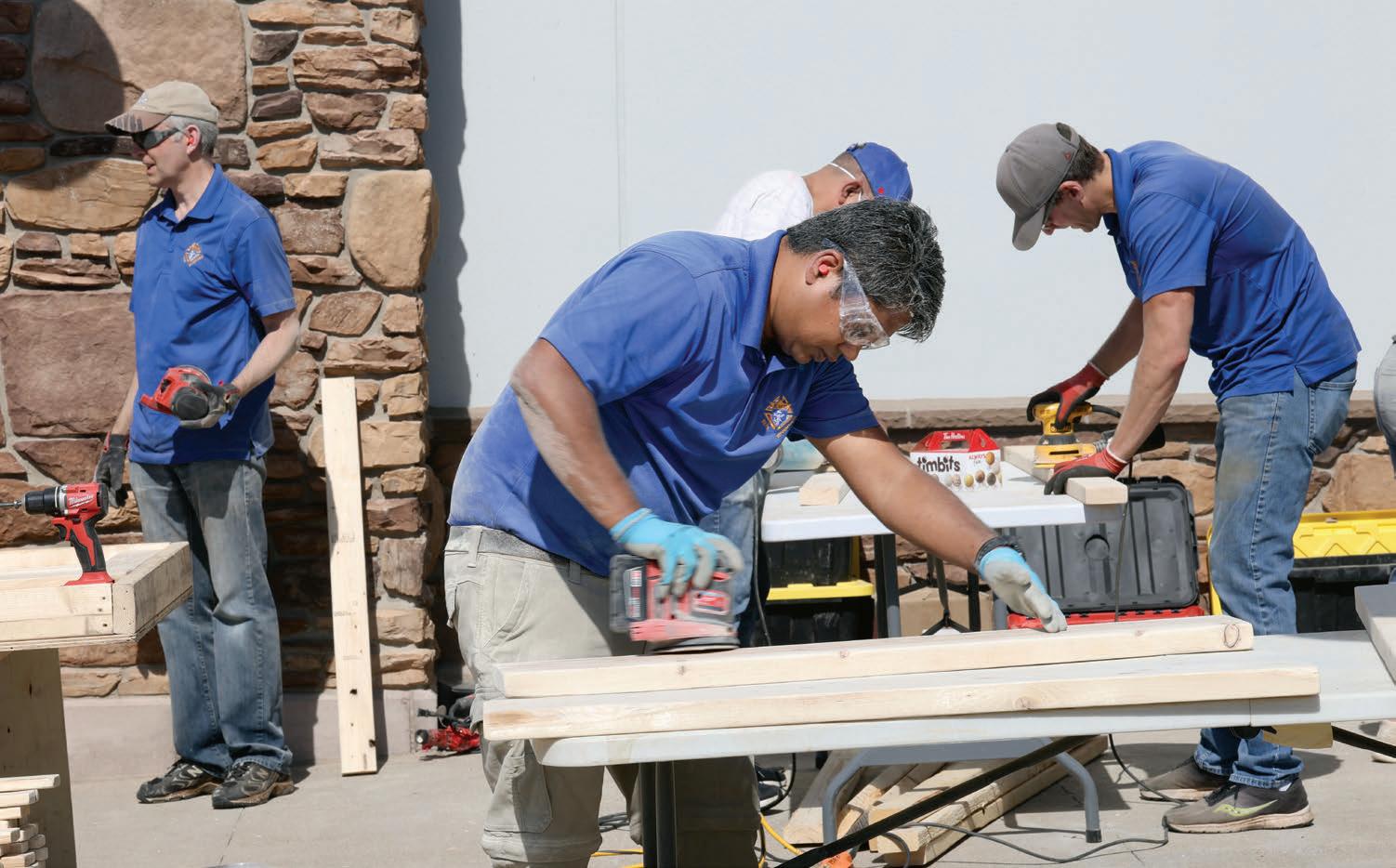
Members of Immaculate Heart of Mary Council 9270 in Riverview, New Brunswick, prepare wood for a Sleep in Heavenly Peace build event in Moncton. More than 30 Knights and family members helped construct 15 beds that were distributed to local families in need.
Knights from St. Andrzej Bobola Council 18652 in Gdynia and their family members assemble with Jesuit Father Krzysztof Łaszcz, chaplain and pastor of St. Stanisław Kostka Parish, to bless the parish’s playground named after Blessed Michael McGivney. Knights completed the project over several months, and the completed playground was dedicated during the parish’s festival.
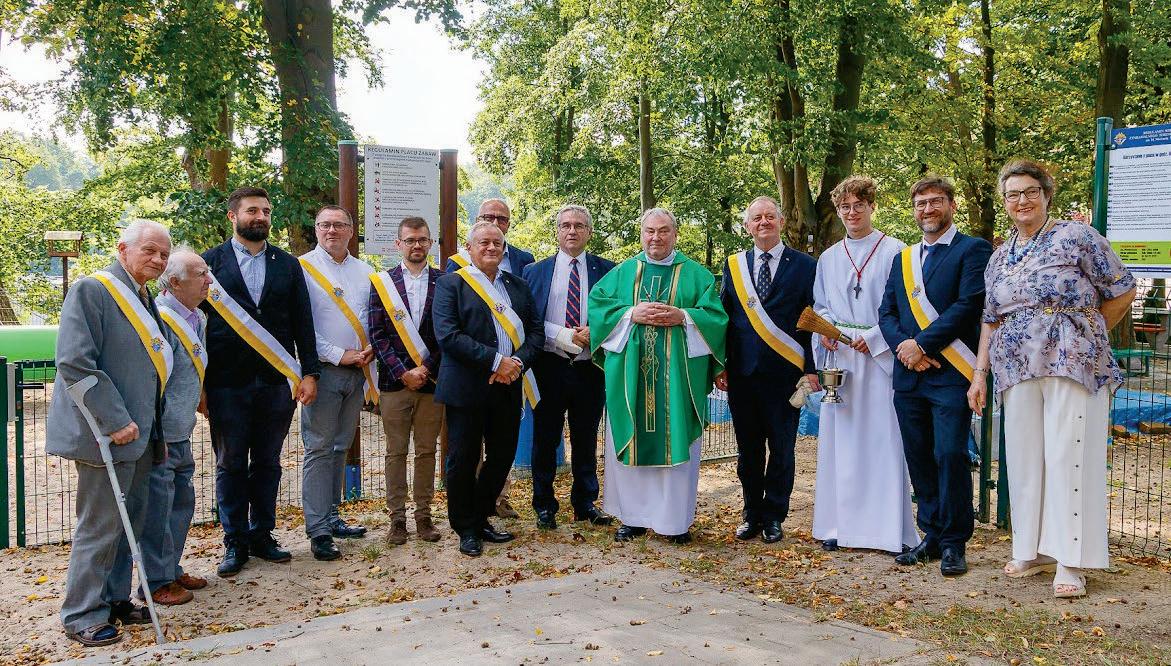

Members of Holy Spirit Council 8157 in Duncanville, Texas, replace shingles on a roof that was damaged by wind. Since 2010, the council has completed more than 500 Knights Hands projects for community members in need, ranging from plumbing repairs to building wheelchair ramps and more.
FROM TOP:
Photo by Dale Preston —
Photo by Sławomir Maj —
Photo by Anton Schlesinger
Canada
Poland
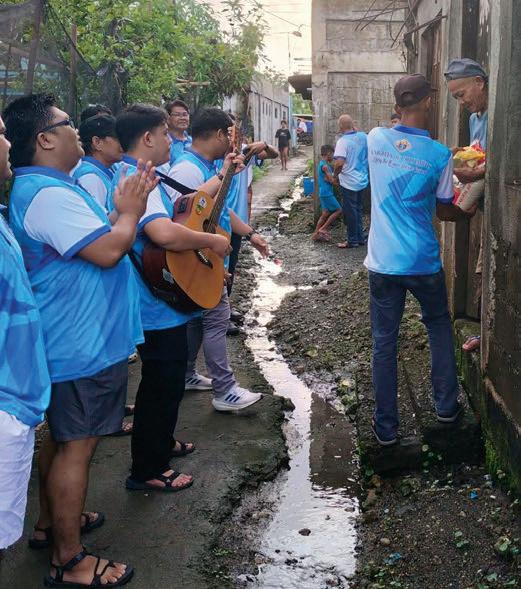
Members of Mary the Queen Council 18617 in Virac, Luzon South, present food to a community member while serenading her with Christmas carols. The Knights visited 140 homes during their door-to-door Christmas distribution last year.
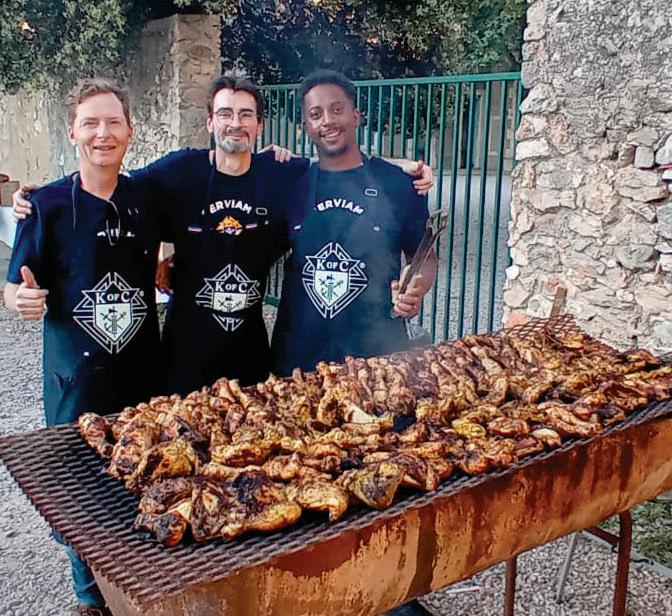
Knights from St. Louis, Roi de France Council 16501 in Saint-Cyrsur-Mer, prepare some 350 chicken legs and 700 sausages for more than 370 seminarians and guests at the annual seminarian soccer tournament at St. Maximin Stadium in Saint-Maximin-laSainte-Baume. Several councils throughout the Diocese of FréjusToulon donated 2,000 euros for food for the tournament, which brings together seminarians from across the country.
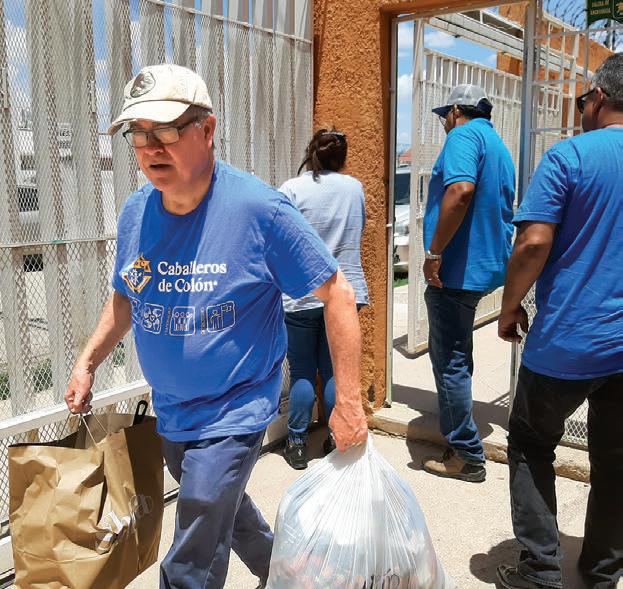
Knights from Fray Alonso Briones Council 2419 in Chihuahua, Mexico Northwest, deliver food, clothing and supplies to Edyfica, a nonprofit that provides education, skills training, and other support to people in need. The council’s donations were distributed to families affected by rains in Vistas Cerro Grande and nearby areas.
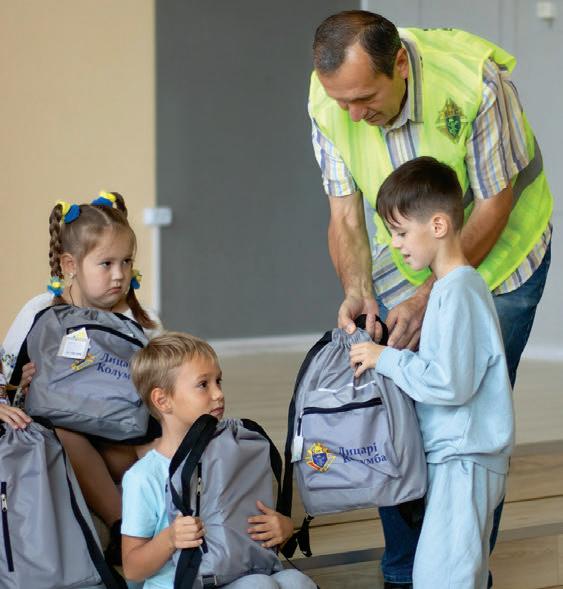
A member of Blessed Hryhorij Lakota Council 17652 in Lviv presents students with K of C-branded backpacks filled with school supplies. The distribution was part of the state council’s Back to School initiative, aided by the Ukraine Solidarity Fund, to assist children affected by the war.
Mexico Philippines
France
Ukraine
Boxing Joy to the World
Scores of K of C councils prepare Christmas care packages for children in need across the globe
By Megan Stibley
SANTA HAS EXTRA helpers this Christmas season — thanks to more than 130 councils across the United States that have partnered with Cross Catholic Outreach. For nearly a decade, Knights have transformed parish halls into holiday workshops where they prepare Boxes of Joy for children around the world.
Volunteers fill boxes with toys, clothing, school supplies, a rosary and more, which Cross Catholic Outreach then distributes in eight developing countries, including Haiti, Guatemala and the Dominican Republic.
“In many cases, this is the only thing these children are going to get for Christmas,” said Ashley Stinnett, deputy grand knight of Bishop Joseph H. Hodges Council 9483 in Hurricane, W.Va., who serves as Cross Catholic Outreach’s K of C liaison. “They’re getting the fun things, but they’re also getting the meaningful impact of the Gospel.”
The Knights of Columbus began partnering with Cross Catholic Outreach in 2017, three years after the Florida-based nonprofit launched the Boxes of Joy initiative. This past year, the partnership yielded more than 327,000 meals
during K of C-hosted food packing events. Now, 132 councils are helping provide nearly 25,000 Boxes of Joy — about 15% of all pledged packages before Christmas.
Among the participating jurisdictions this year is Pennsylvania, where St. Philip the Apostle Council 17028 and St. Philip the Apostle Parish in Lancaster have assembled Boxes of Joy for the past five years, contributing about 1,100 boxes and counting.
“After Mass, the kids run up to get boxes and are excited to help their parents fill them up,” said Brian Smith, Pennsylvania state treasurer and a member of Council 17028. “It’s a whole parish effort, and it’s really neat to see.”
This year, councils also included a Sacred Heart of Jesus prayer card in each Box of Joy as an extension of the Order’s current Pilgrim Icon Program.
“The Knights and Cross Catholic Outreach share the same mission to help those in need through charity,” Smith said. “These Boxes of Joy are meant to remind the children that the heart of Jesus and Christ’s love is always with them.” ✢
— Megan Stibley is associate editor of Columbia.
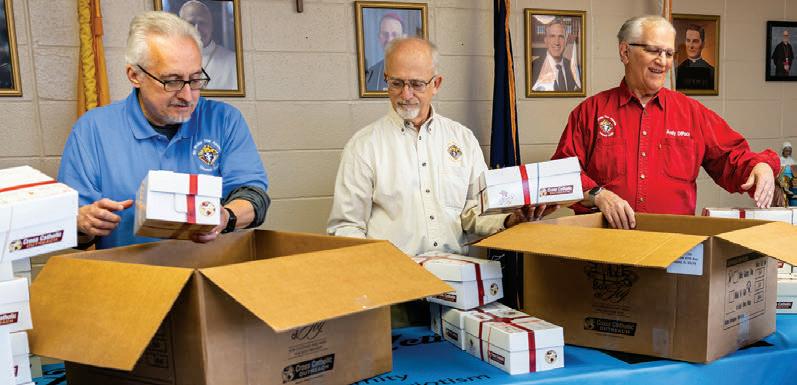
Complete this coupon and mail to: The Father McGivney Guild, 1 Columbus Plaza, New Haven, CT 06510-3326 or enroll online at:
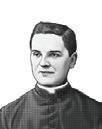
OFFICIAL DECEMBER 1, 2025:
To owners of Knights of Columbus insurance policies and persons responsible for payment of premiums on such policies: Notice is hereby given that in accordance with the provisions of Section 84 of the Laws of the Order, payment of insurance premiums due on a monthly basis to the Knights of Columbus by check made payable to Knights of Columbus and mailed to same at PO Box 1492, NEW HAVEN, CT 06506-1492, before the expiration of the grace period set forth in the policy. In Canada: Knights of Columbus, Place d’Armes Station, P.O. Box 220, Montreal, QC H2Y 3G7 ALL MANUSCRIPTS, PHOTOS, ARTWORK, EDITORIAL MATTER, AND ADVERTISING INQUIRIES SHOULD BE MAILED TO: COLUMBIA, PO BOX 1670, NEW HAVEN, CT 06507-9982. REJECTED MATERIAL WILL BE RETURNED IF ACCOMPANIED BY A SELF-ADDRESSED ENVELOPE AND RETURN POSTAGE. PURCHASED MATERIAL WILL NOT BE RETURNED. OPINIONS BY WRITERS ARE THEIR OWN AND DO NOT NECESSARILY REPRESENT THE VIEWS OF THE KNIGHTS OF COLUMBUS.
SUBSCRIPTION RATES IN THE U.S.: 1 YEAR, $6; 2 YEARS, $11; 3 YEARS, $15. FOR OTHER COUNTRIES ADD $2 PER YEAR. EXCEPT FOR CANADIAN SUBSCRIPTIONS, PAYMENT IN U.S. CURRENCY ONLY. SEND ORDERS AND CHECKS TO: ACCOUNTING DEPARTMENT, PO BOX 1670, NEW HAVEN, CT 06507-9982.
COLUMBIA (ISSN 0010-1869/USPS #123-740) IS PUBLISHED 10 TIMES A YEAR BY THE KNIGHTS OF COLUMBUS, 1 COLUMBUS PLAZA, NEW HAVEN, CT 06510-3326. PHONE: 203-752-4000, kofc.org. PRODUCED IN USA. COPYRIGHT © 2025 BY KNIGHTS OF COLUMBUS. ALL RIGHTS RESERVED. REPRODUCTION IN WHOLE OR IN PART WITHOUT PERMISSION IS PROHIBITED. PERIODICALS POSTAGE PAID AT NEW HAVEN, CT AND ADDITIONAL MAILING OFFICES. POSTMASTER: SEND ADDRESS CHANGES TO COLUMBIA, MEMBERSHIP DEPARTMENT, P.O. BOX 554, ELMSFORD, NY 10523. CANADIAN POSTMASTER PUBLICATIONS MAIL AGREEMENT NO. 1473549. RETURN UNDELIVERABLE CANADIAN ADDRESSES TO: KNIGHTS OF COLUMBUS, 50 MACINTOSH BOULEVARD, CONCORD, ONTARIO L4K 4P3.
Photo by Matthew Barrick
Photo by Michael Miville
Members of St. Philip the Apostle Council 17028 pack some of the 250 Boxes of Joy collected from the council and parishioners of St. Philip the Apostle Parish in Lancaster, Pa.
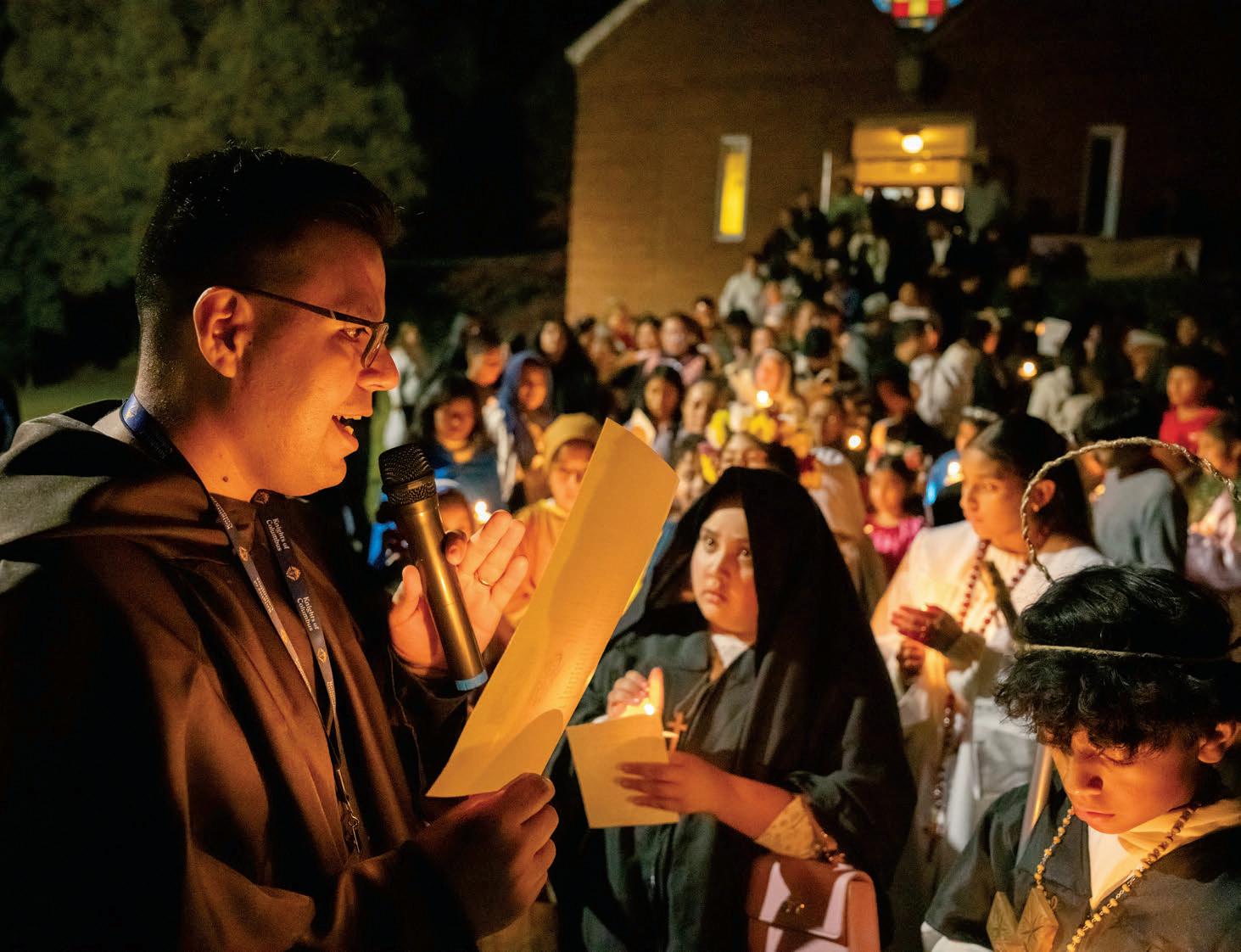
Knights of Charity
Every day, Knights all over the world are given opportunities to make a difference — whether through community service, raising money or prayer. We celebrate each and every Knight for his strength, his compassion and his dedication to building a better world.
Miguel Flores, a field agent based in Winston-Salem, N.C., leads parishioners from St. Benedict the Moor Parish, including children dressed as saints and blesseds, in an All Saints’ Day candlelight procession on Oct. 31. The event, organized by Santa Maria Council 2829, also included Mass, followed by food and games.
Photo by Brent Clark
‘I invited him into every aspect of my life.’
In early 2020, I returned to the United States from a visit to Ghana. My family stayed behind, and I expected them to follow a week later. But the next day, the airports closed due to the onset of COVID-19.
As I prayed for their safe and swift return, I grappled with the fear of the unknown in my work as a registered nurse. Amid daily silence at home, I turned to Jesus, whom I knew had the answers. My relationship with him deepened, and I invited him into every aspect of my life.
I will always cherish my first “date” with Jesus — setting the table for two and sharing a delightful supper. That evening, the Holy Spirit led me to watch a film about Venerable Henriette Delille, who founded the Sisters of the Holy Family. Moved by her courage and perseverance, I discerned a call to religious life and entered the community in 2021.
I now serve at the oldest Catholic nursing home in the country. I find fulfillment in caring for the infirm and encourage young people discerning a vocation to give Jesus a chance. He will surpass your expectations.
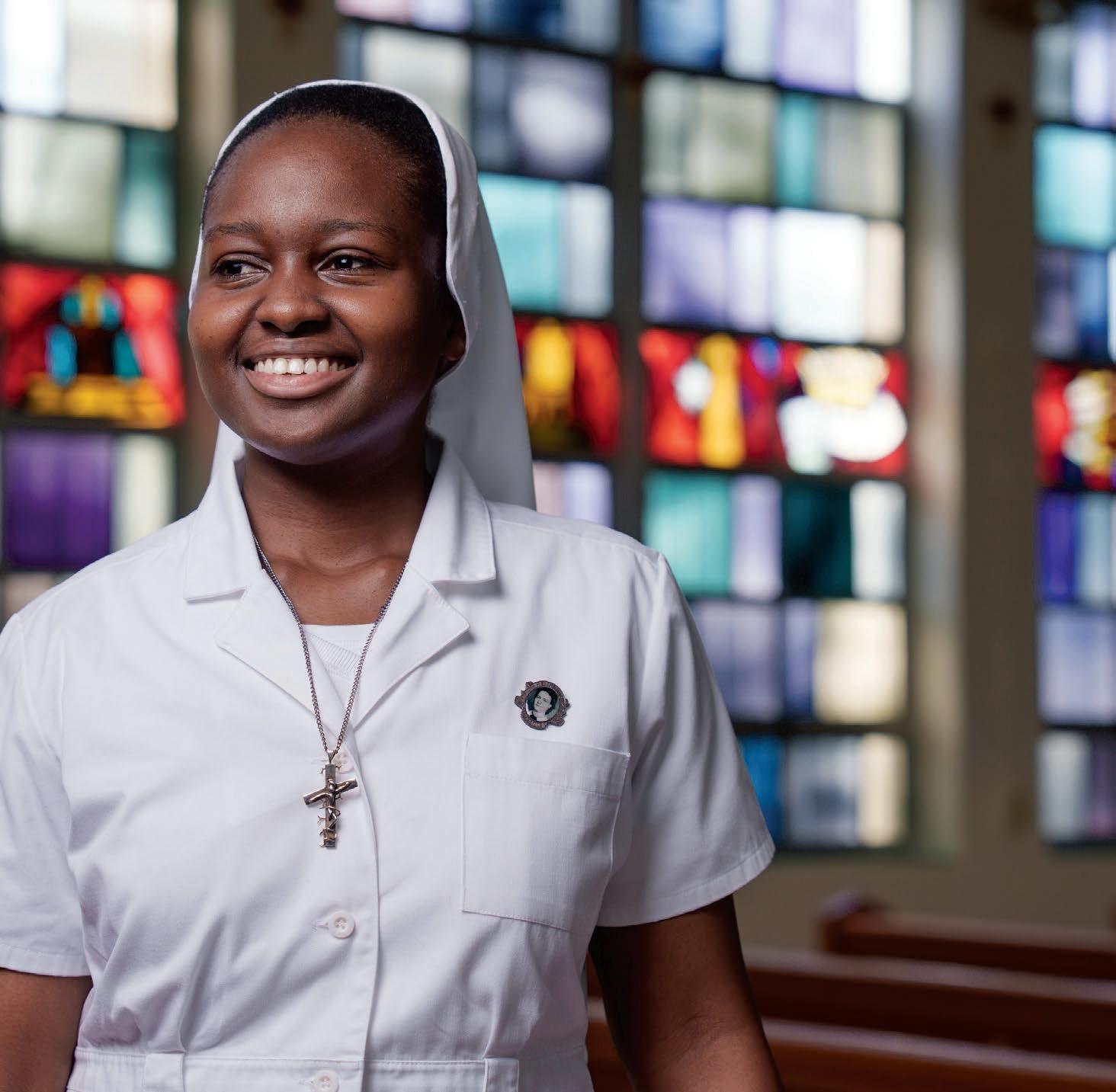
by Zack Smith
Photo
Sister Seyram Mary Adzokpa Sisters of the Holy Family New Orleans