SEPTEMBRE 2021
Association professionnelle pour tous les kinésithérapeutes
Exclusif
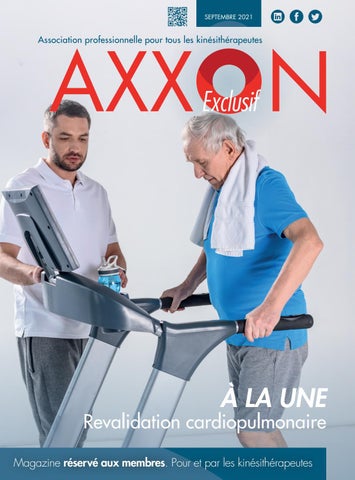
À LA UNE
Revalidation cardiopulmonaire Magazine réservé aux membres. Pour et par les kinésithérapeutes AXXON_exclusief_51_SEPT21_FR.indd 1
20/08/2021 12:13
SOMMAIRE
EXXTRA
EXXTRA
02
Littérature spécialisée
LITTÉRATURE SPÉCIALISÉE Le Manuel Merck – Diagnostic et Thérapeutique, Symptômes + Gériatrie
AXXON EN ACTION
04
INAMI : un plan opérationnel pluriannuel pour la kinésithérapie
06
Quel est le coût de la kinésithérapie (2e partie) ?
EXXPERT
08
Réadaptation cardiovasculaire : nouvelles recommandations européennes
18
Télérevalidation de la personne atteinte d’une maladie respiratoire chronique
AXXON EXCLUSIF
PUBLICATION DE L’ASBL AXXON
SEPTEMBRE 2021 TRIMESTRIEL – ANNÉE 12 – N° 51 – IMPERIASTRAAT 16 – 1930 ZAVENTEM BUREAU DE DÉPÔT: BRUXELLES X NUMÉRO D’AGRÉMENT: P910666 ÉDITEUR RESPONSABLE: PETER BRUYNOOGHE – IMPERIASTRAAT 16 – 1930 ZAVENTEM RÉDACTION & COPYWRITING: SÉBASTIEN KOSZULAP & HELENA D.MILONAS – REDACTION@AXXON.BE TRADUCTION: EMILY VAN COOLPUT
CONCEPT ET RÉALISATION: C3CREATIES IMPRESSION: SYMETA ADRESSE DE CORRESPONDANCE AXXON: IMPERIASTRAAT 16 – 1930 ZAVENTEM – TÉL : 02 709 70 80 – WWW.AXXON.BE NUMÉRO DE COMPTE POUR LES COTISATIONS: BE18 3631 0868 1365 Vous recevez cette revue en fonction du nom et de l’adresse qui se trouvent dans notre base de données. Suite à la mise en application de la loi du 8 décembre 1992 sur la protection de la vie privée, vous avez la possibilité et le droit de modifier vos données. Les articles/publicités paraissent sous la responsabilité des auteurs/firmes. AXXON se réserve le droit de refuser des textes et/ou publicités qui pourraient nuire à la profession. © Tout texte ou partie de texte ne peut être copié/photocopié sans l’autorisation écrite de l’éditeur, quelle qu’en soit l’utilisation.
02
PROMOTION MEMBRES
D’AXXON :
UTILISANT RÉDUCTION DE 10 % EN MM LE CODE AXXON10CG
(Prix normal : 99,00 €) Plus de 4.000 pages qui rassemblent l’essentiel des connaissances médicales dans une édition profondément remaniée, qui propose un contenu encore plus riche et une utilisation plus pratique. Un livre qui regroupe pour la première fois 3 ouvrages en 1 : Le Manuel Merck de Diagnostic et Thérapeutique, celui des Symptômes et celui de Gériatrie.
Son format compact, de nombreuses sections indexées, un système d’onglets, de nombreux tableaux et illustrations en font un ouvrage de consultation facile et rapide. Editeur : Lavoisier Msp Date de publication : Juin 2020
Nombre de pages : 300 experts de toutes les spécialités 4.200 médicales ont contribué à ce manuel qui concerne plus de 2.000 ISBN : maladies et troubles détaillés : 9782954848310 le mécanisme et la cause, les symptômes, le diagnostic, le traitement et la prévention.
COMMANDEZ CE LIVRE EN LIGNE DIRECTEMENT SUR WWW.ACCO.BE. RÉDUCTION VALABLE JUSQU’AU 1ER DÉCEMBRE 2021.
SEPTEMBRE 2021
AXXON_exclusief_51_SEPT21_FR.indd 2
20/08/2021 12:13
BERNARD LAPLANCHE PRÉSIDENT AXXON QUALITÉ EN KINÉSITHÉRAPIE
ÉDITO
Prévention : quelle est la place du kinésithérapeute ? Bien que la prévention fasse partie des compétences du kinésithérapeute, notre rôle dans ce domaine particulier est à ce jour bien trop limité. C’est d’ailleurs le thème qu’AXXON a choisi de mettre à l’honneur à l’occasion de la Journée mondiale de la Kinésithérapie : chaque jour de la semaine, du 6 au 10 septembre, nous vous invitons à participer à un webinaire en lien avec ce sujet. Retrouvez toutes les informations concernant notre Semaine de la Prévention en consultant notre site web. La prévention est une matière qui a été confiée aux Régions, lors du transfert de compétences amené par la 6ème réforme de l’État. Or, le kinésithérapeute belge, agissant aussi bien pour le compte des Régions que pour celui du fédéral, se trouve, une fois de plus, assis entre deux chaises quant aux financements possibles de ses actes de prévention. Pour autant, la Région wallonne a décidé d’inclure dans ses travaux – via les assises de la première ligne wallonne – des discussions qui touchent à la prévention et à la promotion de la santé, domaines où le kinésithérapeute doit certainement avoir son mot à dire. Tous les professionnels de la santé wallons recevront, pendant l’été, un questionnaire qui leur permettra de donner leur avis. Il est donc primordial que les kinésithérapeutes s’impliquent et fassent entendre leurs opinions. La Plateforme Première Ligne Wallonne, où nous sommes très bien représentés, est partenaire de ces assises et nous ne manquerons
pas de vous tenir au courant des travaux qui seront réalisés. Le constat actuel est que, comme trop souvent, les discussions sont effectuées « en silo », sans concertation et partage. Nous sommes encore bien loin d’une interdisciplinarité efficace.
À l’heure d’écrire ces lignes, nous venons de recevoir les résultats de l’étude menée par « Sciensano » à propos du taux de vaccination des prestataires de soins. Même si les
chiffres peuvent toujours être remis en question, force est de constater que les kinésithérapeutes wallons restent quelque peu frileux face à la vaccination. En France, le Président Macron est en passe de prendre des sanctions et de rentre obligatoire la vaccination pour tout le personnel soignant, mais aussi pour l’ensemble des secteurs en contact avec la population, comme le secteur Horeca par exemple. Nous ne pouvons clairement pas nous positionner et prendre un parti quelconque quant à une éventuelle obligation de vaccination : ce n’est pas notre rôle. Nous pouvons par contre conseiller les kinésithérapeutes d’assumer leur responsabilité déontologique de protéger au mieux leurs patients et l’ensemble de la population. Notre campagne doit rester et restera une incitation à se faire vacciner, aussi bien pour les kinésithérapeutes que pour l’ensemble de la population. Personnellement, je suis vacciné. Et vous ?
JE SUIS VACCINÉ.E ET VOUS?
PLUS D’INFORMATIONS SUR WWW.INFO-CORONAVIRUS.BE
SEPTEMBRE 2021 AXXON_exclusief_51_SEPT21_FR.indd 3
03 20/08/2021 12:13
AXXON EN ACTION
LUK DIELEMAN, PETER BRUYNOOGHE
Plan pluriannuel pour la kinésithérapie : la vision d’AXXON diffère de celle des organismes assureurs (2ème partie)
Suite et fin de l’article que vous avez pu consulter dans l’AXXON Magazine qui accompagne cette édition de votre AXXON Exclusif, la revue réservée aux membres de l’association professionnelle.
En soutien aux deux premiers aspects développés précédemment que sont l’accroissement de l’accessibilité et la qualité, l’informatisation constitue également un objectif essentiel à l’intérieur de cette trajectoire pluriannuelle (ce qui est également vrai pour d’autres secteurs). Le partage électronique des données médicales (dossier patient intégré) entre tous les secteurs de la santé est une nécessité absolue à court terme. Les informations et les données sont les vecteurs transversaux les plus importants pour rendre l’avenir du système de santé plus performant. L’accessibilité des soins sera favorisée par les consultations à distance (par téléphone ou vidéoconférence), les applications de santé mobile (mHealth) et diverses autres techniques innovantes. La prescription électronique, le dossier de kinésithérapie électronique et la communication électronique entre le kinésithérapeute et les organismes assureurs permettront notamment
04
de soutenir la modernisation de la nomenclature, tout en rendant possible un enregistrement des pathologies, une collecte d’informations stratégiques et un partage des données, bien que les organismes assureurs restent réticents vis-à-vis de ce dernier. Le plan opérationnel pluriannuel pour la kinésithérapie est étroitement lié à la trajectoire financière et budgétaire pluriannuelle mise en avant par l’INAMI ; un principe qui cadre dans cette trajectoire financière et budgétaire aura des bases plus solides pour être réalisé. En plus de la transversalité, il doit cependant également y avoir selon AXXON une place pour les besoins spécifiques au secteur qui ne sont pas directement reconnus par les organismes assureurs. Concrètement, de nouveaux efforts devront être fournis pour aligner les honoraires du kinésithérapeute sur celui de groupes professionnels
comparables. L’étude réalisée par Mind over Matter Consulting (voir p.14 de l’AXXON Magazine et p.06 de cet AXXON Exclusif) a clairement démontré que l’honoraire actuel n’est pas rentable. La priorité doit être donnée à une rémunération correcte des visites à domicile, à un honoraire par minute identique quel que soit le cadre où les soins sont dispensés, à une révision du système des calculs techniques au sein de l’INAMI – afin qu’une marge soit réservée aux Commissions de convention qui ont déjà mis des gains d’efficience sur la table pour les besoins sectoriels précités – et finalement, à la possibilité de glissements budgétaires entre secteurs (ex. : lorsque la kinésithérapie remplace une opération en cas de lésion du ménisque). Il serait indiqué dans ce cadre de développer de nouveaux outils tels qu’un cadastre dynamique des kinésithérapeutes et une méthodologie pour objectiver les gains d’efficience.
SEPTEMBRE 2021
AXXON_exclusief_51_SEPT21_FR.indd 4
20/08/2021 12:13
Quelques considérations d’AXXON Le plan pluriannuel de notre Commission de convention présente l’accessibilité des soins de kinésithérapie comme une priorité majeure. À l’heure d’écrire ces lignes, il n’y a toutefois toujours aucune volonté de mettre fin aux discriminations existantes en remboursement (règle des -25 %). La trajectoire pluriannuelle prévoit un élargissement du tiers-payant pour mieux inclure les groupes vulnérables. Cependant, il reste encore beaucoup de travail à faire pour les organismes assureurs afin de garantir que le kinésithérapeute voie rapidement apparaître sur son compte le remboursement des soins prodigués. L’introduction de la facturation électronique peut certainement accélérer ce processus. Il était également difficile de s’aligner avec les mutuelles concernant l’accès direct à la kinésithérapie, avec un Dossier e-Kinésithérapie partagé ainsi qu’une bonne communication avec le responsable du dossier médical partagé du patient. AXXON a de nouveau signalé aux caisses d’assurance maladie une importante disposition de santé de l’art. 43 de la loi du 10 mai 2015 qui précise : « le Roi peut déterminer la liste des raisons et des situations dans lesquelles les kinésithérapeutes peuvent effectuer des traitements sans ordonnance ». Le principe de l’accès direct à la kinésithérapie est ainsi approuvé ! Le cadre légal existe, un décret d’application est le seul élément qui manque encore !
Bien que de petits pas aient été posés dans le sens d’une approche plus préventive, le trajet pluriannuel de l’INAMI comporte fort peu d’objectifs concrets dans ce domaine. AXXON aurait souhaité que la prévention bénéficie d’un ancrage financier structurel à l’échelon fédéral. Tous les intervenants impliqués au sein de la Commission de convention sont d’accord sur le fait que les honoraires des kinésithérapeutes devraient être réévalués. Lors de la Taskforce en 2017, tout le monde était convaincu d’une mise à niveau, qui n’a conduit ces dernières années qu’à une revalorisation mineure des frais. Pour 2022 donc, ceci doit être mis en pratique ! Sans quoi nous risquons de nous retrouver dans un cercle vicieux, si les mutuelles associent la revalorisation des honoraires à une augmentation du grade de conventionnement… car c’est ainsi qu’elles inversent le raisonnement. Quoi qu’il en soit, les compétences de la Commission de convention devront être respectées. Si des mesures pour plus d’efficience sont prises en son sein, en plus de la partie pour une ligne de dépenses transversale (à travers les secteurs), un budget suffisant doit être laissé pour la poursuite des négociations, car un certain nombre de projets sont encore nécessaires dans les années à venir.
SEPTEMBRE 2021 AXXON_exclusief_51_SEPT21_FR.indd 5
05 20/08/2021 12:13
AXXON EN ACTION
MARC ET STEFAAN DECRAMER MIND OVER MATTER CONSULTING
Quel est le coût de la e kinésithérapie (2 partie) ?
Dans un premier article présent dans l’AXXON Magazine, nous avons exposé les grandes lignes d’une étude réalisée par Mind over Matter Consulting concernant les honoraires de kinésithérapie. Retrouvez ci-dessous plus d’informations à ce sujet. Dans ce second article, nous nous arrêterons plus en détail sur les calculs et présupposés qui soustendent leurs conclusions. Comme nous avons déjà eu l’occasion de l’expliquer par ailleurs, l’analyse visait à établir le montant de la rémunération horaire nécessaire pour couvrir adéquatement les coûts, par le biais d’une évaluation des frais annuels du kinésithérapeute et du nombre d’heures de traitement effectivement prestées. Une série de postes de coûts ont été pris en compte – salaire, frais d’exploitation, loyer, frais d’aménagement, frais de matériel et intérêts – et ont été chiffrés sur la base de différentes sources, dont notamment une enquête réalisée par AXXON, des interviews avec des spécialistes, des
estimations provenant de sources publiques et des données de firmes spécialisées comme Gymna (pour les frais de matériel) et Architime (pour les frais d’aménagement).
d’aménagement du cabinet 7 % (gros équipement et sols adaptés, aménagement sur mesure, peinture), le petit matériel 1 % et les intérêts 0,5 %.
Pour éviter de donner l’impression que ces frais étaient artificiellement gonflés, nous sommes toujours partis d’une estimation extrêmement prudente (conservatrice). Nous sommes ainsi parvenus à un total annuel de 94.934€, dont la ventilation sur les différents postes de dépenses est exposée à la figure 1. Le salaire représente environ 70 % du total, les frais d’exploitation 14 % (énergie, téléphonie, internet, bureau, assurances, déplacements, publications, cotisation aux associations professionnelles, comptabilité), le loyer 8 %, les frais
La figure 2 illustre l’évolution des coûts dans les diverses études réalisées de 1990 à aujourd’hui.
Coût annuel 7.800 €
8%
12.857 € 66.183 €
6.501 €
1.139 €
454 €
7%
1%
0%
94.934 €
14%
100% 70%
Salaire
Exploitation
Location cabinet
Aménagement & matériel
Figure 1. Ventilation des coûts annuels.
06
Petit matériel
Intérêts
Total
Il ressort de ce graphique que l’augmentation des coûts par rapport aux études précédentes est principalement la conséquence de la progression des coûts salariaux. Il ne faut toutefois pas en conclure que les salaires aient augmenté de façon excessive. La nouvelle étude s’est en effet basée pour ce poste sur le barème de référence actuel d’un kinésithérapeute hospitalier en milieu de carrière (catégorie 15 du barème IF-IC) qui, soit dit en passant, est déjà très discutable pour ce groupe de professionnels, dont la formation académique (master) et le statut « médical » justifieraient plutôt les barèmes des catégories 16 ou 17 (voir plus loin), mais dont le choix a été motivé par l’approche prudente adoptée tout au long de l’étude. Un autre élément qui a contribué à ces coûts salariaux plus élevés est la prise en compte d’un certain nombre d’assurances nécessaires pour assurer au kinésithérapeute une protection sociale acceptable. Exemples : assurance revenu garanti, assurance-vie, assurance-pension
SEPTEMBRE 2021
AXXON_exclusief_51_SEPT21_FR.indd 6
20/08/2021 12:13
Coût annuel
94.934 € 28.751 €
79.057 € 33.020 €
72.737 € 33.110 €
20.087 €
66.183 € 46.037 €
Autres frais Salaire
Coût horaire
48.504 €
42.627 €
28.418 €
2021
2014
2008
1990
72 €
58 €
50,5 €
33 €
Figure 2. Évolution des coûts (salariaux et autres) au fil des études réalisées de 1990 à 2021.
(pension libre complémentaire pour indépendants ou PLCI, engagement individuel de pension ou EIP), assurance hospitalisation et assurance accidents. Nous avons aussi tenu compte de la compensation prévue dans les barèmes pour les horaires irréguliers et qui s’élève typiquement à 5 % pour les kinésithérapeutes travaillant à l’hôpital sous statut salarié.
Un second scénario moins conservateur s’est basé sur des coûts salariaux correspondant aux barèmes de catégorie 16 (comme pour un master en psychologie) pour les kinésithérapeutes « ordinaires » et 17 (celui d’un membre du staff médical) pour les prestataires porteurs d’une qualification professionnelle particulière, avec 10 % de compensation pour les horaires irréguliers, le nettoyage du cabinet deux fois par semaine plutôt qu’une seule fois, un comptable plus cher, un loyer supérieur de 10 %, l’amortissement des frais d’aménagement sur 15 ans plutôt que 20 et des intérêts de 2 % plutôt que de 0,75 %. Quoique moins prudent, ce scénario semble encore tout à fait réaliste ; pour que la pratique soit rentable, l’honoraire devrait s’élever ici à 88 €/h. De façon générale, il semble très important d’adapter la rémunération du kinésithérapeute aux frais tels qu’ils se présentent à l’heure actuelle, sous peine de voir la qualité des traitements évoluer dans un sens qui ne serait bénéfique ni pour le patient, ni pour l’assurance maladie. Ce que les kinésithérapeutes eux-mêmes veulent à tout prix éviter.
Notez également que les frais annuels divers ont diminué, passant de 33.020 € en 2014 à 28.751 € en 2021. Ceci s’explique par le fait que, d’après l’enquête réalisée en 2021 auprès des kinésithérapeutes par AXXON, la taille d’un cabinet moyen a diminué ces dernières années, passant de 78-100 m2 à 65 m2 (une évolution qui reflète probablement la tendance sociétale à des espaces plus petits dans les logements), tandis que le nombre de kilomètres parcourus en voiture a reculé de 20.000 à 9.061 km. Ceci montre une nouvelle fois que nous nous sommes efforcés de parvenir à une estimation correcte des coûts réels, ce qui s’est soldé par des changements positifs, mais parfois aussi négatifs. Les autres coûts – frais d’exploitation, loyer, frais d’aménagement, frais de matériel, intérêts – ont également fait l’objet d’estimations prudentes. Malgré tout, le coût horaire s’élève déjà dans ce scénario à environ 72 €, soit bien plus que la rémunération actuelle de 50 €/h, qui n’est donc clairement plus du tout conforme aux frais de la pratique actuelle. Observons par ailleurs que l’étude de 2014 arrivait déjà à un coût d’environ 58 € et que l’honoraire actuel était donc déjà insuffisant il y a 7 ans. Enfin, une étude réalisée en 2013 aux Pays-Bas par la KNGF (Koninklijk Nederlands Genootschap voor Fysiotherapie) était arrivée à un coût horaire de 79 €.
SEPTEMBRE 2021 AXXON_exclusief_51_SEPT21_FR.indd 7
07 20/08/2021 12:13
EXXPERT
DOMINIQUE HANSEN – PHD FESC1,2
Réadaptation cardio-vasculaire : nouvelles recommandations européennes
Dominique Hansen a résumé pour AXXON la publication de très haute qualité qu’il a dirigée au sein de l’European Society of Cardiology, intitulée “Exercise intensity assessment and prescription in cardiovascular rehabilitation and beyond: why and how”. Celle-ci présente les nouvelles recommandations européennes en réadaptation cardio-vasculaire et illustre à merveille les spécificités de l’ABSG CAPURE. Outre le fait que ce genre de parution montre l’étendue et la complexité des éléments qui constituent une prescription de qualité en réadaptation, le fait qu’elle soit l’œuvre d’un kinésithérapeute de formation – belge de surcroît et internationalement reconnu comme l’est Dominique Hansen – mérite d’être souligné. Déjà auteur de très nombreux articles, ce travail représente certainement l’un de ses écrits majeurs. Je vous en souhaite une bonne lecture et une application « au plus juste » des recommandations qui y sont détaillées. Michel Lamotte, PhD, membre de l’ABSG CAPURE 08
SEPTEMBRE 2021
AXXON_exclusief_51_SEPT21_FR.indd 8
20/08/2021 12:13
Exercise intensity assessment and prescription in cardiovascular rehabilitation and beyond: why and how. A position statement from the Secondary Prevention and Rehabilitation Section of the European Association of Preventive Cardiology Introduction Multidisciplinary/comprehensive CR leads to significant reductions in hospitalizations, adverse cardiovascular nonfatal events, and mortality rates, as well as improvements in the CVD risk profile and exercise capacity, in patients with CVD. Multidisciplinary CR should be offered to every patient with CVD, with specific core components, including exercise. As a general advice, for aerobic training, an exercise frequency of at least three days/week, preferably 6-7 days/week, at moderate or moderate-to-high intensity is promoted. In addition, the prescription of resistance training twice a week, at 30-70% of one-repetition maximum (1RM) for the upper body and 40-80% of 1RM for the lower body, with 12-15 repetitions/set, is supported. Exercise training should be arranged in order to provide an energy expenditure of 1000-2000 kcal/week. In CR a proper determination of the exercise intensity is key. Therefore, in 2013 the European Association of Preventive Cardiology (EAPC) together with the American Association of Cardiovascular and Pulmonary Rehabilitation and the Canadian Association of Cardiac Rehabilitation, published a position statement on the determination of the exercise intensity in patients with CVD. However, it has been shown recently that the currently applied objective exercise intensity determination techniques in CR should be revised considerably, as internal inconsistencies were discovered. In addition, a personalized approach based on the patient’s preferences and abilities should be followed, particularly in the context of long-term adherence. Moreover, how to achieve permanent progression in exercise intensities during prolonged CR programs, and how to determine the exercise intensity during resistance training, is not yet explained, next to which exercise intensities should be selected during resistance training. Finally, new data have emerged considering the validity and reliability of subjective exercise intensity determination techniques in CVD patients. As a result, because of these reasons, a new EAPC position statement has now been published, with concrete conclusions (Table 1).3
TABLE 1 TAKE HOME MESSAGES FOR AEROBIC EXERCISES The design of the exercise program should primarily be aimed at optimising total energy expenditure rather than on one specific training characteristic (e.g. exercise intensity). A correct determination of the exercise intensity in CVD patients is important as this leads to exercise programs that are more time-efficient to induce short-term clinical benefits. In CAD and HF patients, higher exercise intensities are related to relatively greater risks for adverse cardiovascular events, but absolute risk remains low. The selection of the aerobic exercise intensity should be done in dialogue with the patient in a shared-decision making process. The commonly used peak indices such as VO2peak, HRpeak, HRR, and Wpeak should be applied with great caution for the prescription of the aerobic exercise training intensity in CVD patients. The assessment of VT1 and VT2 during CPET, preferably by the nadir of the VE/ VO2 and VE/VCO2 to WR relationships, provides reliable effort-independent parameters that should be used for the determination of the aerobic exercise intensity in the majority of CVD patients. The talk test and Borg RPE scale should only be considered as an adjunct to an objective aerobic exercise intensity determination method in CVD patients. Progression should be made during CR, in which first the desired duration of the exercise session should be achieved before increasing the exercise intensity. When changes in physical fitness occur as result of CR, the VT1 and VT2 should be re-assessed to re-establish a proper aerobic exercise intensity, if feasible.
FOR RESISTANCE EXERCISES High-intense dynamic resistance training leads to greater improvements in muscle strength in patients with elevated CVD risk, as opposed to low-intense dynamic resistance training. When executed properly, high-intense dynamic resistance training is equally safe as low-intense dynamic resistance training, in patients with CVD. The selection of the resistance exercise intensity should be done in dialogue with the patient in a shared-decision making process. To properly determine the exercise intensity during resistance training, a <10RM test can be used to set the initial weight, while the OMNI-RES can be used to track the perceived intensity during the exercise sessions. To allow further improvements in muscle strength, progressive resistance training is promoted in CR, in which the repetitions, intensity and resting periods can be adjusted in such chronological order.
SEPTEMBRE 2021 AXXON_exclusief_51_SEPT21_FR.indd 9
09 20/08/2021 12:13
EXXPERT
Exercise intensity in aerobic training: does it matter? Impact on health outcomes
In patients with coronary artery disease (CAD) or heart failure (HF) higher exercise intensities are independently associated with a greater exercise capacity at CR completion, next to a lower age, male sex and lower baseline peak oxygen uptake (VO2peak). For each 10% increase in the applied exercise intensity (%VO2peak or % peak heart rate (HRpeak)), a greater mean increase in VO2peak by 1.0 ml/kg/min is found. However, it is questionable whether these differences between exercise intensities are clinically meaningful at an individual level. Whether or not a different continuous exercise intensity is of paramount importance to affect CVD risk factors in patients with CVD, remains to be studied in greater detail, although improvements in the components of the metabolic syndrome are not driven by exercise intensity, but by exercise volume. Although the beneficial effects of aerobic training at a higher continuous intensity are not always obvious, it still is important to set the intensity correct, and make significant progression in this intensity during CR, as will be explained later.
High-intensity interval training vs. moderateintense continuous training There is a fundamental physiological difference between exercising at a continuous moderate intensity (MICT) vs. high-intensity interval training (HIIT). During HIIT, the calcium release, ATP turnover and carbohydrate use is significantly greater, when compared to MICT, which leads to a greater accumulation of metabolites, ions and free radicals. This accumulation is key to the gene expression of PGC-1α, leading to a greater increase in mitochondrial content of the skeletal muscles. As a result, in particular the skeletal muscles will be exposed to intense exercise training. Because respiratory distress/ symptoms are prevented to (fully) emerge because of the short duration of the high-intense exercise, and great changes in cardiac output are not mandatory to be able to execute HIIT, this type of exercise training is also feasible for patients with respiratory or cardiac limitations. To date, two large multicentre studies have compared HIIT vs. MICT, one in CAD patients (SAINTEX-CAD, n=200), and one in HF patients (SMARTEX-HF, n=261). In both studies HIIT was not superior to MICT for improving VO2peak. Therefore, it seems that HIIT could be a more timeefficient manner to improve VO2peak, as the total exercise duration was significantly shorter, when compared with MICT. Moreover, one key element in a valid comparison between HIIT and MICT is the total energy expenditure of the exercise intervention. HIIT is indeed not superior to MICT when isocaloric exercise training programs (i.e.
10
with the same total energy expenditure) are compared in meta-analyses. Thus, it is the total volume of exercise that elevates the likelihood to respond sufficiently to the exercise intervention (including VO2peak). The total energy expenditure of an exercise program is determined by the product of session frequency and duration, program length, but also training intensity. Hence, also in CAD patients, the design of the exercise program should be primarily aimed at optimising total energy expenditure as it predicts greater beneficial changes in fat mass, blood HDL cholesterol concentrations and glycaemic control as well.
Long-term adherence to exercise training The success of CR is highly dependent on long-term adherence. According to a meta-regression analysis no single exercise component is a significant predictor of mortality outcomes, but the greatest reductions in total and cardiovascular mortality are observed in CR programs with the highest participant exercise adherence levels. As a result, it is important to decide together with the patient what exercise intensities will be applied in a shared-decision making process, and to avoid too high exercise intensities. This will assist in long-term adherence to the prescribed exercises.
Impact on medical safety The adverse event rate is 1 per ±8,500 exercise stress tests and 1 per ±50,000 patient-hours of exercise training, and the cardiac arrest rate is ±1.3 per 1,000,000 patient training hours. These data clearly indicate that current CR is very safe. While HIIT precipitates acute cardiac events at a rate that is six times higher than MICT, comparisons of HIIT vs. MICT indicate that the absolute risk for adverse cardiovascular events and musculoskeletal injury remains however low. However, in most randomized trials, low-risk and/ or clinically stable patients are examined, the exercise interventions are of a relatively short duration, studies are not powered for safety outcomes and exercise training is supervised: this all mitigates the actual risks of HIIT. Moreover, for some indications (e.g. valve disease, electrophysiological heart diseases, congenital heart disease, etc.) the medical safety of HIIT is not known. In final, safety precautions should also be taken into account during exercise training in the case of nephropathy and retinopathy (e.g. avoid exercise hypertension), peripheral and autonomic neuropathy (e.g. be aware of balance disorders or disturbed BP/HR response to exercise) and foot deformations/wounds (e.g. be aware of orthopaedic symptoms or bacterial infections), thus potentially contra-indicating HIIT. These arguments may also explain why HIIT is a potential alternative to MICT to allow variation in exercise training, but is not formally promoted to all CVD patients.
SEPTEMBRE 2021
AXXON_exclusief_51_SEPT21_FR.indd 10
20/08/2021 12:13
As a result, to the best and updated knowledge, MICT is the most feasible and cost-effective aerobic training modality for current CR activities in all referred populations. HIIT could be prescribed in selected patients (such as stable CAD or HF patients) for specific targets of intervention (e.g. to increase VO2peak).
Exercise intensity determination in aerobic training: methodology. Objective methods
Indices of peak exercise capacity The vast majority of CR guidelines recommend that aerobic exercise training intensity is based on indices of peak effort, including % of VO2peak, % of peak workload (Wpeak), % of peak HR (HRpeak) and % of HR reserve (HRR) (Table 2), where peak values are usually defined as the highest average value of the last 20-30 sec of an incremental symptom-limited cardiopulmonary exercise test (CPET). An important problem associated with using these indices of peak exercise capacity for exercise prescription is that not all CVD patients achieve a maximal effort during CPET. Moreover, the different peak indices cannot be used interchangeably for exercise training prescription. In fact, at the same level of physiological effort, different exercise intensity domains are elicited. For example, the first ventilatory threshold (VT1) occurs at the low-intensity domain (3.7% of cases), moderate-intensity domain (34.9% of cases), high-intensity domain (59.6% of cases), or very hard domain (1.8% of cases), and similar variances are noticed at the second ventilatory threshold (VT2). Also, it must be emphasized that these exercise intensity domains also have been criticized recently in healthy individuals as well. These findings thus indicate that when a certain percentage of the VO2peak, HRpeak, HRR or Wpeak is selected, it is not sure whether this would be physiologically intense enough, or too
vigorous, for a significant proportion of CVD patients. Clinicians should also decide whether they base the aerobic exercise intensity on HR or WR (workloadbased rehabilitation). The first approach sometimes has the disadvantage that the HR zone between VT1 and VT2 can be very small (e.g. a few beats/min), making it difficult to properly set the target HR during exercise training. Moreover, changes in beta-blocker therapy could further complicate the determination of the target HR during exercise training. Whenever such change in beta-blocker dose has occurred, the new target HR should be set by applying the workload from the last few exercise sessions on the different exercise modes (e.g. bike, treadmill), and note the new elicited HR after >5 min of exercise. The workload-based approach in exercise intensity determination has the disadvantage that it does not automatically change in accordance to changes in exercise capacity, so arbitrary increments in the workload must be foreseen during CR to elicit sufficiently effective exercise intensities.
Ventilatory threshold An approach to avoid using the above-mentioned indices of peak exercise intensity for exercise training prescription is to relate the training intensity to VT1 and VT2. VT1 and VT2 are effort-independent and can be achieved by the vast majority of the general CVD population. Moreover, exercise intensity prescription, based on VT1 and VT2, is more effective to improve VO2peak, as opposed to applying exercise intensities based on %VO2peak or %HRpeak, at least in healthy individuals. The VT1 represents the exercise intensity corresponding to the transition from purely aerobic metabolism to a point where blood lactate begins to rise in the blood but reaches equilibrium (as a result of progressive activation of anaerobic glycolysis, with stable lactate levels of 1,5-2 mmol/L). To counteract this metabolic acidosis, ventilation (VE) starts to increase
TABLE 2 CLASSIFICATION OF AEROBIC EXERCISE INTENSITY VO2MAX (%)
HRMAX (%)
HRR (%)
RPE SCALE
LOW INTENSITY, LIGHT EXERCISEA
<40
<55
<40
10-11
Aerobic
MODERATE INTENSITY EXERCISEA
40-69
55-74
40-69
12-13
Aerobic
HIGH INTENSITYA
70-85
75-90
70-85
14-16
Aerobic + lactate
VERY HIGH INTENSE EXERCISEA
>85
>90
>85
17-19
Aerobic + lactate + anaerobic
INTENSITY
TRAINING ZONE
Abbreviations: VO2peak, peak oxygen uptake; HRmax, maximal heart rate; HRR, heart rate reserve; RPE, ratings of perceived exertion
AXXON_exclusief_51_SEPT21_FR.indd 11
20/08/2021 12:13
EXXPERT
at a faster rate than VO2 until an equilibrium is reached. The VT2, also called the respiratory compensation point, represents the exercise intensity at which blood lactate starts to increase rapidly, and could further accumulate by prolonged exercise above this intensity, due to tissue anaerobiosis, resulting in a disproportionate increase in VE relative to CO2 production (VCO2) (with lactate levels 3-5 mmol/L and potentially increasing further). The most commonly used methods to assess VT1 include the nadir of the VE/VO2 to work rate (WR) relationship (i.e. the lowest point in the curve before VE/VO2 starts to increase), and the V-slope method in which the slope of the linear relation between VO2 and VCO2 increases (i.e. the increase in VCO2 becomes faster than the VO2 increase). VT2 corresponds to the nadir of the VE/ VCO2 to WR relationship (i.e. the lowest point in the curve before VE/ VCO2 starts to increase) and the VE/ VCO2-slope method in which the slope of the linear relation between VE and VCO2 increases (i.e. the increase in VE becomes faster than the VCO2 increase). These thresholds could then be extrapolated to the
12
corresponding WR or HR. Typically, from those extrapolations the ‘exercise training zones’ could then be determined: low-intense (at a HR or WR below VT1), moderate-intense (at a HR of WR between VT1 and VT2), and high-intense (at a HR or WR above VT2). Yet, several difficulties may hamper the reliability of the determination of these thresholds, such as the absence of VT1 or VT2, and a high inter-observer variability. When comparing the V-slope method and the assessment of the nadir of the VE/VO2 to WR relationship, the last method shows a slightly lower success rate of determination, but a higher inter-observer agreement, making it more suitable for exercise prescription in HF and CAD patients. The reliability and reproducibility of the assessment of VT2 by the nadir of the VE/VCO2 to WR relationship is not well established in CVD patients: this method provides however acceptable limits of agreement and a high success rate of determination, making this method suitable for the follow-up of individual patients in everyday clinical practice.
A major limitation, however, is the fact that many clinicians do not have (access to) CPET and (data). As a result, following the EAPC position statement on quality standards in CR, the minimal requirement would then be to execute a cycle ergometry test, with determination of the exercise intensity based on %Wpeak or HRpeak (though with known limitations), while the ultimate requirement would be to execute a CPET with exercise intensity determination based on VT.
Anaerobic threshold To determine the onset of anaerobic metabolism during exercise, blood lactate concentrations may also be assessed. The first lactate threshold (LT1, also known as aerobic threshold) represents the first rise in blood lactate above baseline (often noticed around 1,5-2 mmol/l). The second lactate threshold, (LT2, also known as anaerobic threshold) represents a sudden greater increase in blood lactate (often noticed around 3-5 mmol/l). Some major shortcomings or difficulties prevent the widespread use of this method in many CR centres. There is no consensus what would be the ideal exercise test protocol to determine
SEPTEMBRE 2021
AXXON_exclusief_51_SEPT21_FR.indd 12
20/08/2021 12:13
LT1 and LT2, and there are more than 30 methods described on how to determine LT1 and/or LT2, without internationally supported consensus which method would be most valid. In addition, at least 3-min step protocols should be used to determine LT1 and LT2 to allow full changes in VO2 and blood lactate concentrations, while in CVD patients ramp protocols or 1-min protocols are preferred as they are more sensitive to detect changes in VO2peak in CVD patients. As a result, in CVD patients the determination of LT1 and LT2 does not seem to offer crucial or even valid information.
Myocardial ischemia threshold It is generally conceived that patients with residual myocardial ischemia should confine to exercise training at a HR or WR which is below the myocardial ischemic threshold (MIT). The most common definition of the MIT used in clinical studies is the HR or WR at which a 1mm horizontal or down-sloping ST segment depression starts to appear during incremental exercise testing. However, in some individuals the ECG is not sensitive enough to detect myocardial ischemia, but
rather a decline in the O2 pulse trajectory is noticed. Studies show that repeated myocardial ischaemic training sessions (up to 60 min with tolerable ischemia symptoms) do not induce myocardial injury, significant arrhythmias, or left ventricular dysfunction, and may even be more beneficial in a controlled setting for improving the myocardial blood flow. To further explore the safety and effectiveness of exercise training above the MIT, standardization of its assessment is needed. When using the MIT for exercise training prescription, it is higher during cycling compared to walking/running, while the exercise protocol (ramp or Bruce protocol) does not influence these results. To conclude, this position paper suggests to determine the exercise intensity by assessing VT1 and VT2 during CPET, preferably by the nadir of the VE/VO2 and VE/VCO2 to WR relationships, and to allow a training range between these thresholds. If VT cannot be determined due to logistic limitations, clinicians could determine the exercise intensity based on %Wpeak or %HRpeak.
Subjective methods When it is impossible to determine a patient’s exercise intensity based on a standard exercise test or CPET, the exercise prescription can be guided by using Borg scales and/or subjective tools such as the ‘talk test’. The most commonly used subjective methods for the determination of aerobic exercise intensity in CVD patients are the Borg ratings of perceived exertion and the talk test.
Ratings of perceived exertion The most widely used instrument to measure perceived exertion or exercise intensity is the Borg’s RPE scale. The RPE scale is a subjective means to gauge an individual’s aerobic training intensity on the basis of the physical sensations a person experiences during physical activity including HR, respiratory rate, sweating and fatigue. It is proposed to supplement a standard CPET with subjective determination of exercise intensity levels, such as RPE. The RPE can be evaluated by the patient at each stage of the CPET on a linear scale with 15 points (6-20). A 0 to 10 scale for rating exercise intensity may be more intuitive for comprehension by the patient than the 6-20 scale.
SEPTEMBRE 2021 AXXON_exclusief_51_SEPT21_FR.indd 13
13 20/08/2021 12:13
EXXPERT
Although it is assumed that RPE scores correlate relatively well with both physiological measures of stress and arousal (e.g. HR, VT, and blood lactate) as well as psychological measures of exhaustion, studies in CVD patients reveal inconsistencies about the strength of the relationship between RPE and various physiological criterion measures, such as HR, blood lactate concentration, (%) VO2peak, VE and respiratory rate. The highest correlations between RPE and the physiological criterion measures have been found among male participants and during highintense exercise. RPE is thus less valid at low-intense exercises, and can be affected by factors other than the physical effort of the exercise, including psychological factors and environmental conditions, unfamiliarity with exercise training (modes/equipment), low education level and the use of beta-blockers. As a result, the validity of the Borg’s RPE scale may not be as high as previously thought. However, despite its variability, the RPE Borg
scale can be a valid surrogate when peak exercise data are lacking or when HR is not available or usable (e.g. atrial fibrillation, pacemaker, chronotropic incompetence).
Talk test From a physiological point of view, the talk test is based on the swift increase in breathing rate above VT2 that causes difficulty in talking during exercise. For exercise training, patients are instructed to maintain a certain level of exercise while still being able to talk comfortably in full sentences. The self-regulatory nature of the talk test can empower patients for self-management. An important advantage of the talk test is that it does not require any expense and expertise, which further enhances its utility in home-based CR. The test is suitable in patients with CAD and shows quite good intra-class correlations, when comparing self-ratings with external observations. However, when comparing with VT1 and/or VT2, the level of agreement demonstrates
wide ranges, suggesting poor individual correspondence. Like Borg RPE, the talk test thus can be used as an adjunct practical way to guide exercise intensity in daily activities of CVD patients, but it cannot replace objective methods to determine the exercise intensity. Another potential limitation is that the talk test is not a practical tool for customizing high-intensity exercise.
How to determine the exercise intensity during progressive CR (including phase III)? To achieve the weekly energy expenditure needed to elicit cardiovascular benefits, a steady progression in exercise dose is usually necessary. Patients should progress from moderate- to vigorousintensity aerobic exercise over the course of a CR program. As a result, it is proposed to start at VT1 (lower limit of exercise intensity) and progress towards VT2. This approach likely incrementally improves the total increase in exercise capacity obtained by the training program. Also for HIIT, a gradual increase in intensity has been described in trials, by starting to exercise at the lower end of the prescribed intensities and gradually increasing to the higher end of the prescribed intensities. Specifically for the high-intense bouts in HIIT, it can then be decided to go above VT2. The exercise progression needs to be individualized for each patient. Factors influencing such exercise progression include patient-related factors (e.g. subjective exertion, physical fitness, comorbidities, age, frailty, CV risk, patient preference), CR team-related factors (e.g. experience, program policy) and equipmentrelated factors (e.g. availability of CPET, exercise equipment with automated intensity adjustment based on HR), among others. Ultimately, shared-decision making should be applied in this process.
14
SEPTEMBRE 2021
AXXON_exclusief_51_SEPT21_FR.indd 14
20/08/2021 12:13
Increases in intensity and duration of 5-10% per week are generally well tolerated. As a result, this increase in exercise intensity is very often foreseen between VT1 and VT2, based on objective indicators but also on the patient’s willingness and capacity. The exercise duration should first be increased, until the desired session length is attained, before increasing the exercise intensity. Although this is general advice, it remains however to be validated whether such approach is feasible is very weak or deconditioned patients as well. Some clinicians habitually include a repeat CPET after several weeks of training to guide the intensity progression. This approach takes into account that changes in aerobic capacity can already occur very early in the program, with studies showing improvements in VO2peak after only 2-4 weeks of exercise training. It is well established that CR leads to improvements in VO2peak, but also to increments in VT1 and VT2. Moreover, it has been observed that also HRpeak can increase and resting HR can decrease, both in CAD as well as HF patients, and that the HR curve during exercise (testing) changes as well. These data thus indicate that when the physical fitness of the patient changes during CR, the exercise training intensity should be carefully re-assessed. Even more importantly, the training status significantly affects the relation between VT1 or VT2 and the corresponding exercise intensity domains. Therefore, during prolonged CR (including phase III), it remains important to reassess VT1 and VT2 to properly determine the exercise intensity, although with a lower frequency (for example, once a year). The talk test or RPE Borg scale can also be used to direct progression of exercise intensity in MICT programs, especially in home-based settings.
Exercise intensity in resistance training: does it matter? Impact on health outcomes
Given that muscle weakness is a strong predictor of premature death in CVD patients, it is obvious that maximizing muscle strength is of paramount importance. Moreover, following cardiac surgery, significant muscle wasting is observed, and also HF patients experience weakened peripheral muscles. The addition of resistance training on top of aerobic training leads to greater increments in physical fitness and muscle strength in CVD patients, and favourably affects bone health, glycaemic control, blood pressure and lipid profile, at least in the elderly and patients with elevated CVD risk. The volume of resistance training is determined by the number of sets, multiplied by the number of repetitions in these sets, and the weight lifted during the muscle contraction. The intensity of a muscle contraction is typically expressed as a percentage of one repetition
maximum (%1RM), in which <50% of 1RM is considered as low-intense and >70% of 1RM as high-intense. Between a set, it is important to allow a sufficient rest interval (usually 1-2 min). In CR, typically dynamic concentric resistance training is applied, while eccentric, isometric and isokinetic resistance training are less frequently applied. During concentric resistance training, a contraction and relaxation (going back to start position to initiate a new contraction) duration of 2-4 sec is usually proposed, and the number of repetitions per set can vary from 6 up to 25. To maximise muscle mass and strength gains, dynamic high-intense resistance training (D-HIST) should be preferred above dynamic low-intense resistance training (D-LIST). D-HIST led to significantly greater improvements in muscle strength, as opposed to D-LIST. Changes in the myofibrillar protein synthesis rate are dependent on the contractile intensity of the muscular exercises, revealing only an improvement following a single bout of D-HIST. When D-HIST contractions are executed, the mitogen-activated protein kinase and mammalian target of rapamycin complex 1-dependent pathways are activated to a significantly greater amount, compared to D-LIST. Such enhanced myofibrillar protein synthesis may lead to greater muscle mass gains, explaining why greater increments in muscle mass are sometimes noted after D-HIST vs. D-LIST. Even if muscle mass gains are comparable after a D-LIST vs. D-HIST, the neurological adaptations are distinct. When comparing a long-term D-HIST intervention (at 80% of 1RM) against a longterm D-LIST intervention (at 30% of 1RM), greater neural adaptations occur after D-HIST, which may explain the disparate increases in muscle strength, despite similar muscle hypertrophy, following D-HIST vs. D-LIST. However, in CVD patients it remains to be established what would be the effects of D-HIST vs. D-LIST (in combination with aerobic training) on changes in muscle mass and strength.
Impact on medical safety The rates of adverse cardiovascular events during dynamic resistance training are very low in CR, or at least not greater as opposed to aerobic training. In addition, there is no established relation between the applied dynamic resistance training intensity and the incidence of adverse cardiovascular events during CR in stable and well-screened patients. On the other hand, intensive heavy weightlifting, especially when this includes substantial isometric (static) muscle work, can induce the Valsalva manoeuvre. This thus occurs when holding the breath during muscular contraction. After the termination of this compressed breathing, a large increase in venous return may be
SEPTEMBRE 2021 AXXON_exclusief_51_SEPT21_FR.indd 15
15 20/08/2021 12:13
EXXPERT
provoked and thus an increase in cardiac output. This may lead to sharp increments in BP and myocardial oxygen demand. The Valsalva manoeuvre can thus be avoided by teaching patients a proper breathing technique, which includes exhaling during muscular contraction and inhaling when returning to the starting position. Actually, the volume of resistance training (in particular the number of repetitions) relates to changes in BP. In older adults, a greater acute BP and HR response after high-repetition resistance training is present, as opposed to low-repetition resistance training.
Exercise intensity determination in resistance training: methodology.
1RM= applied weight/(1.0278 - 0.0278 * repetitions) or 1RM = (1 + 0.0333 * repetitions) * applied weight However, to obtain a good estimation of 1RM, no more than 10 repetitions are allowed during the strength testing (thus leading to a <10RM test).
Objective methods
Subjective methods
In the rehabilitation setting, dynamometry could be proposed to set the training load during resistance training. However, this methodology is less attractive because of the high cost of a dynamometer, the technical complexity of executing a strength test, and the difficulty of translating the outcome of dynamometry (expressed as Nm) towards a load during resistance training (kg). Alternatively, a % of 1RM or RM can be used to objectively prescribe the intensity for dynamic resistance training. 1RM is a measure of the maximum weight a patient can lift in one complete repetition for a given exercise in a controlled way through a full range of motion with good posture, whereas RM is the maximum weight that the person can lift for a given number of repetitions of an exercise. The 1RM is obtained through trial and error by means of free weights or machines, and should ideally be performed for each targeted muscle group.
In the context of dynamic resistance training, it is important to be aware that the same resistance exercise prescribed at a specific % of 1RM may lead to different perceptions of exercise in different patients. Factors such as body weight, coordination, intention and previous experience with resistance training play a role. Ratings of perceived exertion are therefore being used to monitor the intensity in a variety of exercise modalities, including dynamic resistance exercise. The RPE can be used effectively to gauge resistance exercise intensity in older adults by the adult Omnibus Resistance Exercise Scale (OMNI-RES).
As many patients do not have any previous experience with dynamic resistance training before enrolling in CR, patients should first engage in at least one, but preferably more, practice sessions in which they are acquainted with the test equipment and familiarized with a proper and safe execution of the exercise, in order to obtain a reliable score that can be used to prescribe the dynamic resistance exercise, and to track progress over time. In this regard, also here it is important to decide together with the patient, in a shared-decision making process, which resistance exercise intensities will be applied to maximize adherence to these prescriptions. In patients in which a 1RM test is not suitable or preferred, the load-repetition relationship for resistance training, such as a 10RM, may be more appropriate
16
to assess muscular strength. Subsequently, prediction equations are available to estimate the 1RM from these multiple RM tests:
How to determine the exercise intensity during progressive CR (including phase III)? Generally initial loads should be light at initiation of CR, with patients completing 12-15 repetitions at 30% of 1RM and 40% of 1RM for the upper and lower body, respectively. Exercise pace should be slow, allowing at least twice the time for rest/recovery phases as compared to work/contraction phases. Beginning with unilateral exercises can increase strength exercise tolerance. The intensity of the resistance exercises should then be increase up to 70% of 1RM and 80% of 1RM for the upper and lower body, respectively. Consequently, for optimal training prescription of the muscle groups involved, a periodic evaluation, to accurately adjust the program, is mandatory. In this respect, the <10RM test can be used once every few weeks. There seems to be consensus that such build-up can only be allowed when it is medically safe (no orthopaedic symptoms, cardiac arrhythmias, or episodes of syncope or dizziness) and patients are able to execute the exercises with proper technique. Respecting the
SEPTEMBRE 2021
AXXON_exclusief_51_SEPT21_FR.indd 16
20/08/2021 12:13
biological principles of exercise training and considering the need to apply progressive overload so that training adaptations are constantly stimulated, a well-supported approach in the scientific literature is the progression of loads. This progression involves the increase or variation of the external loads, thus generating larger internal loads (muscle forces or torques) and increasing adaptations over time. In this regard, three strategies are often used to increase the external load:1 volume (i.e., number of sets or repetitions),2 intensity (amount of resistive load lifted), and3 density (i.e., alter rest periods, keeping volume and intensity unchanged). How to progress in resistance training, depends on the ultimate goal of the intervention (e.g. increase muscle strength), as well as the acceptance and feasibility (as assessed by the OMNI-RES). In CR, first the desired number of resistance training sets should be achieved, after which the intensity can then be gradually increased, finally followed by adaptations in rest periods. During prolonged CR (phase III),
however, resistance training should be implemented with more focus on functional resistance training targeting those muscle groups needed for facilitating daily life activities. A large body of evidence, at least from healthy (older) individuals, is in support of this concept.
Conclusion From this position statement, it is concluded that: The assessment of VT1 and VT2 during CPET, preferably by the nadir of the VE/VO2 and VE/VCO2 to WR relationships, should be used for the determination of the aerobic exercise intensity in the majority of CVD patients. The talk test and Borg RPE scale should only be considered as an adjunct to an objective aerobic exercise intensity determination method in CVD patients. To properly determine the exercise intensity during resistance training, a <10RM test can be used to set the initial weight, while the OMNI-RES can be used to track the perceived intensity during the exercise sessions.
Retrouvez le texte complet de cette étude sur le site web d’AXXON : Publications > Exclusif
References 1. Heart Centre Hasselt, Jessa Hospital, Hasselt, Belgium 2. UHasselt, Faculty of Rehabilitation Sciences, BIOMED-REVAL-Rehabilitation Research Centre, Hasselt University, Belgium
Qui est Dominique Hansen ? Né en 1980 à Bilzen, Dominique Hansen est professeur en rééducation et physiologie de l’effort dans les maladies internes et vice-doyen de la faculté des sciences de la rééducation de l’université d’Hasselt. Il est également chercheur au Hartcentrum et à l’hôpital Jessa d’Hasselt.
3. Hansen D, Abreu A, Ambrosetti M, et al. Exercise intensity assessment and prescription in cardiovascular rehabilitation and beyond: why and how: a position statement from the Secondary Prevention and Rehabilitation Section of the European Association of Preventive Cardiology. Eur J Prev Cardiol 2021 Jun 2:zwab007. doi: 10.1093/eurjpc/ zwab007. Epub ahead of print.
SEPTEMBRE 2021 AXXON_exclusief_51_SEPT21_FR.indd 17
17 20/08/2021 12:13
EXXPERT
TRUDY BEKKERING1, EMMANUEL SIMONS1,2, MARTINE GOOSSENS1
Télérevalidation de la personne atteinte d’une maladie respiratoire chronique Quels sont les effets (souhaités et secondaires) de la télérevalidation des personnes atteintes d’une maladie respiratoire chronique ? C’est la question développée dans cette revue. Contexte
Résumé des résultats
La revalidation pulmonaire s’est avérée efficace chez les personnes atteintes d’une maladie respiratoire chronique, telle que la bronchopneumopathie chronique obstructive (BPCO), la maladie pulmonaire interstitielle ou les bronchectasies. La revalidation pulmonaire traditionnelle se déroule dans un hôpital ou un centre de revalidation. Relativement peu de personnes suivent un programme de revalidation pulmonaire parce qu’il n’en existe pas dans leur région, parce qu’elles ont des difficultés à se déplacer vers le centre et parfois parce qu’elles ont d’autres problèmes de santé qui les empêchent de participer. C’est la raison pour laquelle des formes alternatives de revalidation sont à l’étude. La télérevalidation est la revalidation à distance à l’aide des technologies de l’information et de la communication.
La revue a inclus 15 études avec 1.904 participants. Les études ont utilisé différentes formes de télérevalidation telles que la revalidation par appels vidéo, via un site Internet avec ou sans assistance téléphonique, par GSM avec retour d’information via SMS ou par le biais d’une application mobile. Presque tous les participants (99 %) souffraient de BPCO.
Critères de sélection des études Cette revue Cochrane a inclus des essais randomisés ou contrôlés qui ont examiné l’effet de la télérevalidation pour les maladies pulmonaires. L’intervention devait comprendre une thérapie par l’exercice et au moins 50 % de l’intervention devait être réalisée à distance (via la télérevalidation). La dernière recherche a eu lieu en novembre 2020.
18
En comparant la télérevalidation à la revalidation traditionnelle, il y a probablement peu ou pas de différence au niveau de l’endurance (test de marche de 6 minutes, différence moyenne 0,06 mètre ; IC à 95 % -10,8 à 10,9 mètres ; 4 études ; 556 participants ; niveau de certitude modéré). Il peut également y avoir peu ou pas de différence au niveau de la qualité de vie (questionnaire de St George, score moyen -1,26 ; IC à 95 % -3,97 à 1,45 ; 2 études ; 274 participants ; faible niveau de certitude) ou au niveau de la dyspnée (« Chronic Respiratory Questionnaire », score moyen du domaine de la dyspnée 0,13 ; IC à 95 % -0,13 à 0,40 ; 426 participants ; 3 études ; faible niveau de certitude). Les personnes ayant suivi la télérevalidation étaient plus susceptibles de terminer le programme, c’est-à-dire 93 % par rapport à 70 % en cas de revalidation traditionnelle.
SEPTEMBRE 2021
AXXON_exclusief_51_SEPT21_FR.indd 18
20/08/2021 12:13
Comparée à l’absence de revalidation, la télérevalidation est susceptible d’améliorer l’endurance (différence moyenne sur le test de marche de 6 minutes 22,2 mètres ; IC à 95 % -38,9 à 83,2 mètres ; 94 participants ; 2 études ; faible niveau de certitude), tandis qu’aucune différence n’a été observée au niveau de la qualité de vie et du sentiment d’oppression (faible niveau de certitude). La télérevalidation comme composante d’un programme de rééducation d’entretien est également susceptible d’augmenter l’endurance, mais il existe une incertitude quant à l’effet sur la dyspnée et sur la qualité de vie. Le nombre d’effets secondaires de la télérevalidation semble comparable à celui de la revalidation traditionnelle ou de l’absence de revalidation, mais il n’est pas certain qu’il y ait des différences car il n’était pas possible de combiner les données.
Conclusion
Références
Les effets de la revalidation pulmonaire ou de la rééducation d’entretien réalisée par le biais de la télérevalidation pour les personnes atteintes d’une maladie pulmonaire chronique sont probablement comparables à ceux de la revalidation traditionnelle, sans risques particuliers. Le niveau de certitude des preuves pour la télérevalidation est faible à modéré en raison du nombre limité d’études portant sur différents modèles de télérevalidation, avec relativement peu de participants.
1. Centre Belge pour l’Evidence Based Medicine (Cebam), Cochrane Belgique
Implications pour la pratique La télérevalidation pour les personnes atteintes d’une maladie pulmonaire chronique semble utile lorsque la revalidation traditionnelle échoue ou n’est pas réalisable.
2. CHU Brugmann Cox NS, Dal Corso S, Hansen H, McDonald CF, Hill CJ, Zanaboni P, Alison JA, O’Halloran P, Macdonald H, Holland AE. Telerehabilitation for chronic respiratory disease. Cochrane Database of Systematic Reviews 2021, Issue 1. Art. No. : CD013040. DOI : 10.1002/14651858.CD013040.pub2. Consulté le 14 juin 2021. Consultez le texte intégral de cette revue Cochrane via la Cebam Digital Library for Health : www.cebam.be/fr/cdlh. Cochrane Corner En collaboration avec le CEBAM, Cochrane Belgique (www.cebam.be)
SEPTEMBRE 2021 AXXON_exclusief_51_SEPT21_FR.indd 19
19 20/08/2021 12:13
ing Concepts
Pour un air plus sain !
La Boîte à Malice vous propose une gamme de produits permettant d’améliorer votre bien-être et celui de vos patients : Aera Max, une solution innovante pour purifier l’air de votre cabinet de manière autonome !
Les membres d’AXXON bénéficient de 10 % de réduction ! Passez commande avant le 1er décembre 2021 et utilisez le code « AXXON + votre numéro de membre »
WWW.BOITEAMALICE.BE AXXON_exclusief_51_SEPT21_FR.indd 20
EC@LABOITEAMALICE.BE 20/08/2021 12:13