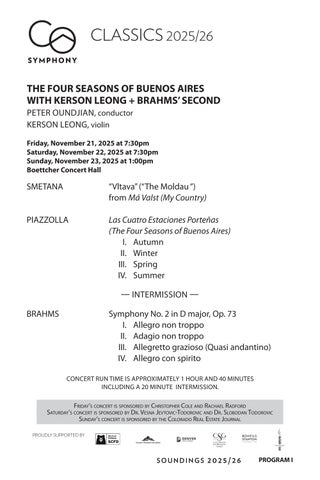
CLASSICS 2025/26 THE FOUR SEASONS OF BUENOS AIRES WITH KERSON LEONG + BRAHMS’ SECOND PETER OUNDJIAN, conductor KERSON LEONG, violin Friday, November 21, 2025 at 7:30pm Saturday, November 22, 2025 at 7:30pm Sunday, November 23, 2025 at 1:00pm Boettcher Concert Hall
SMETANA
“Vltava” (“The Moldau “) from Má Valst (My Country)
PIAZZOLLA
Las Cuatro Estaciones Porteñas (The Four Seasons of Buenos Aires) I. Autumn II. Winter III. Spring IV. Summer — INTERMISSION — BRAHMS Symphony No. 2 in D major, Op. 73 I. Allegro non troppo II. Adagio non troppo III. Allegretto grazioso (Quasi andantino) IV. Allegro con spirito CONCERT RUN TIME IS APPROXIMATELY 1 HOUR AND 40 MINUTES INCLUDING A 20 MINUTE INTERMISSION. Friday’s concert is sponsored by Christopher Cole and Rachael Radford Saturday’s concert is sponsored by Dr. Vesna Jevtovic-Todorovic and Dr. Slobodan Todorovic Sunday’s concert is sponsored by the Colorado Real Estate Journal PROUDLY SUPPORTED BY
SOUNDINGS 2 0 2 5/ 2 6
PROGRAM I
BIOGRAPHIES
PETER OUNDJIAN, conductor Peter Oundjian is a dynamic presence in the conducting world with an international career leading preeminent orchestras in many of the world’s major musical centers, from New York and Seattle to Amsterdam and Berlin. He is currently Music Director of the Colorado Symphony, where he served previously as Principal Conductor. He is also Music Director of the Colorado Music Festival (CMF), where he has continued to program and conduct concerts that delight audiences with beloved masterpieces alongside music written by living composers. Over the course of his 14-year tenure as Music Director of the Toronto Symphony Orchestra, which concluded in 2018, he reinvigorated the orchestra with acclaimed innovative programming, artistic collaborations, extensive audience growth, national and international tours and several outstanding recordings, including Vaughan Williams’ Orchestral Works, which garnered a Grammy nomination and a Juno Award. Under his leadership, the Symphony underwent a transformation that significantly strengthened its presence in the world. From 2012-2018, Oundjian served as Music Director of the Royal Scottish National Orchestra, where he led the RSNO on several international tours, including North America, China, and a European festival tour with performances at the Bregenz Festival, the Dresden Festival as well as in Innsbruck, Bergamo, Ljubljana, and others. His final appearance with the orchestra as their Music Director was at the 2018 BBC Proms where he conducted Britten’s epic War Requiem. Oundjian was Principal Guest Conductor and Artistic Advisor of the Detroit Symphony Orchestra from 2005 to 2008 and Artistic Director of the Caramoor International Music Festival in New York from 1997 to 2007. He was also the Music Director of the Amsterdam Sinfonietta from 1998-2002. Throughout his conducting career, Oundjian has appeared as guest conductor with the country’s leading orchestras, including Philadelphia Orchestra, Boston, Chicago, Pittsburgh, Atlanta and San Francisco Symphonies, among others. In addition to his conducting duties in Colorado, during the 2024/25 season Oundjian leads subscription weeks with the Sarasota Orchestra, the Rochester Philharmonic Orchestra, the Seattle Symphony, and the Atlanta Symphony Orchestra. Oundjian has been a visiting professor at Yale University’s School of Music since 1981, and has received honorary doctorates from the San Francisco Conservatory of Music and The Royal Conservatory of Music in Toronto.
PROGRAM II
C O LO R A D O S Y M P H O N Y.O R G
BIOGRAPHIES
KERSON LEONG, VIOLIN Kerson Leong has been described as “not just one of Canada’s greatest violinists but one of the greatest violinists, period” (Toronto Star). Forging a unique path since his First Prize win at the International Yehudi Menuhin Violin Competition in 2010, he continues to win over colleagues and audiences alike with “a mixture of spontaneity and mastery, elegance, fantasy, intensity that makes his sound recognizable from the first notes” (Le Monde). His latest album release of ‘Britten & Bruch’, recorded with the Philharmonia Orchestra and Patrick Hahn for Alpha Classics, was awarded Gramophone Editor’s Choice, Choc de Classica, and ‘The Strad Recommends’ by The Strad, as well as five-star recommendations from The Sunday Times and The Diapason among others. As a sought-after soloist, he was hand-picked by Yannick Nézet-Séguin to be artist-in-residence with the Orchestre Métropolitain during the 2018/19 season and has recently performed as soloist with such ensembles as the Royal, Oslo, Brussels, Kansai, and Liège Royal Philharmonic Orchestras, and the Seattle, Singapore, Toronto, Istanbul, Toledo, Montreal, Stavanger, and Wuppertal Symphony Orchestras. Kerson performs on the ‘ex Bohrer, Baumgartner’ Guarneri del Gesu violin courtesy of Canimex Inc, Drummondville (Quebec), Canada.
SOUNDINGS 2 0 2 5/ 2 6
PROGRAM III
PROGRAM NOTES
BEDŘICH SMETANA (1824 – 1884) “Vltava” (“The Moldau”) from Má Vlast (My Country)
COMPOSITION & PREMIERE OF WORK: Wolfgang Amadeus Mozart composed the D major Violin Concerto in October 1775, the fourth of five such works dating from that year, and was probably soloist with the Salzburg court orchestra in a performance soon thereafter.
CSA LAST PERFORMANCE: February 6-7, 2009 with violinist Cho-Liang Lin and conducted by Giancarlo Guerrero. INSTRUMENTATION: Two oboes, two horns, and strings. DURATION: About 26 minutes.
Early in 1874, Smetana began to suffer from severe headaches. That symptom came and went, and he noted no other physical problems until October. “One night I listened with great pleasure to Leo Delibes’ Le Roi l’a dit,” he recalled. “When I returned home after the last act, I sat at the piano and improvised for an hour on whatever came into my head. The following morning I was stone deaf.” It is one of the most painful ironies of 19th-century music that Smetana conceived the first melody for Má Vlast (“My Country”), the splendid cycle of six tone poems inspired by the land and lore of his native Bohemia, at the same time that he lost his hearing. Had he not been able to look to the example of the deaf Beethoven, he might well have abandoned this work, but he pressed on and finished the complete cycle in 1879. The Moldau (“Vltava” in Czech) is the principal river of Bohemia, rising in the hills in the south and flowing north through Prague to join with the Elbe. Smetana’s tone poem seems to trace its inspiration to a country trip he took along the river in 1870, a junket that included an exhilarating boat ride through the churning waters of the St. John Rapids. The Moldau is disposed in several sections intended to convey both the sense of a journey down the river and some of the sights seen along the way, as Smetana noted in his preface to the score: “Two springs pour forth in the shade of the Bohemian Forest, one warm and gushing, the other cold and peaceful. Their waves, gaily flowing over rocky beds, join and glisten in the rays of the morning sun. The forest brook, hastening on, becomes the river Moldau. Coursing through Bohemia’s valleys, it grows into a mighty stream. Through thick woods it flows, as the gay sounds of the hunt and the notes of the hunter’s horn are heard ever nearer. It flows through grass-grown pastures and lowlands where a wedding feast is being celebrated with song and dance. At night, wood and water nymphs revel in its sparkling waves. Reflected on its surface are fortresses and castles — witnesses of bygone days of knightly splendor and the vanished glory of fighting times. At the St. John Rapids, the stream races ahead, winding through the cataracts, hewing out a path with its foaming waves through the rocky chasm into the broad river bed — finally, flowing on in majestic peace toward Prague and welcomed by the time-honored castle Vysehrad. [At this point, Smetana recalled the main theme of the complete cycle’s preceding tone poem, entirely devoted to depicting that ruined castle and its aura of ancient battles and forgotten bards.] Then it vanishes far beyond the poet’s gaze.” PROGRAM IV
C O LO R A D O S Y M P H O N Y.O R G
PROGRAM NOTES
ASTOR PIAZZOLLA (1921 – 1992)
Las Cuatro Estaciones Porteñas (The Four Seasons of Buenos Aires) for Violin and Orchestra
COMPOSITION & PREMIERE OF WORK: Astor Piazzolla was born on March 11, 1921 in Mar Del Plata, Argentina, and died on July 5, 1992 in Buenos Aires. The Four Seasons of Buenos Aires was composed in 1968, and premiered on May 19, 1970 at the Teatro Regina in Buenos Aires by Piazzolla and his Quinteto. CSA LAST PERFORMANCES: Red Rocks: July 24, 2016 with conductor Mazin Eshkenazy and violinist Joshua Bell.
Boettcher Concert Hall: April 26 – 28, 2013 with conductor Scott O’Neil and violinist Nadja Salerno-Sonnenberg. INSTRUMENTATION: The score calls for strings. DURATION: About 25 minutes.
The Argentinean tango, like American ragtime and jazz, is music with a shady past. Its deepest roots extend to Africa and the fiery dances of Spain, but it seems to have evolved most directly from a slower Cuban dance, the habanera (whose name honors that nation’s capital), and a faster native Argentinean song form, the milonga, both in duple meter and both sensuously syncopated in rhythm. These influences met at the end of the 19th century in the docklands and seamier neighborhoods of Buenos Aires, where they found fertile ground for gestation as the influx of workers streaming in from Europe to seek their fortunes in the pampas and cities of South America came into contact with the exotic Latin cultures. The tango — its name may have been derived from a word of African origin meaning simply “dance,” or from the old Castilian taño (to play an instrument), or from a type of drum used by black slaves, or from none of these — came to embody the longing and hard lives of the lower classes of Buenos Aires, where it was chiefly fostered in bawdy houses and back-alley bars by usually untutored musicians. The texts, where they existed, dealt with such forlorn urban topics as faithless women, social injustice and broken dreams. In the years around World War I, the tango migrated out of the seedier neighborhoods of Argentina, leaped across the Atlantic to be discovered by the French, and then went on to invade the rest of Europe and North America. International repute elevated its social status, and, spurred by the glamorous images of Rudolph Valentino and Vernon and Irene Castle, the tango became the dance craze of the 1930s. Tango bands, comprising four to six players (usually piano, accordion, guitar and strings) with or without a vocalist, flourished during the years between the wars, and influenced not just the world’s popular music but also that of serious composers: one of Isaac Albéniz’s most famous works is his Tango in D; William Walton inserted a tango into his “Entertainment with Poems” for speaker and instruments, Façade; and Igor Stravinsky had the Devil in The Soldier’s Tale dance a tango and composed a Tango for Piano, which he also arranged for full orchestra and for winds with guitar and bass. The greatest master of the modern tango was Astor Piazzolla, born in Mar Del Plata, Argentina, a resort town south of Buenos Aires, on March 11, 1921, and raised in New York City, where he lived with his father from 1924 to 1937. Before Astor was ten years old, his musical talents had been discovered by Carlos Gardel, then the most famous of all performers and composers of tangos and a cultural hero in Argentina. At Gardel’s urging, the young Astor moved to SOUNDINGS 2 0 2 5/ 2 6
PROGRAM V
PROGRAM NOTES Buenos Aires in 1937, and joined the popular tango orchestra of Anibal Troilo as arranger and bandoneón player. Piazzolla studied classical composition with Alberto Ginastera in Buenos Aires, and in 1954, he wrote a symphony for the Buenos Aires Philharmonic that earned him a scholarship to study in Paris with Nadia Boulanger, the renowned teacher of Copland, Thomson, Carter and many other of the best American composers. Boulanger, as was her method, grounded Piazzolla in the classical European repertory, but then encouraged him to follow his genius for the tango rather than write in the traditional concert genres. When Piazzolla returned to Buenos Aires in 1956, he founded his own performing group, and began to create a modern style for the tango that combined elements of traditional tango, Argentinean folk music and contemporary classical, jazz and popular techniques into a “Nuevo Tango” that was as suitable for the concert hall as for the dance floor. He was sharply criticized at first by government officials and advocates of the traditional tango alike for his path-breaking creations. “Traditional tango listeners hated me,” he recalled. “I introduced fugues, counterpoint and other irreverences: people thought I was crazy. All the tango critics and radio stations of Buenos Aires called me a clown, they said my music was ‘paranoiac.’ And they made me popular. The young people who had lost interest in the tango started listening to me. It was a war of one against all, but in ten years, the war was won.” In 1974, Piazzolla settled again in Paris, winning innumerable enthusiasts for both his Nuevo Tango and for the traditional tango with his many appearances, recordings and compositions. By the time he returned to Buenos Aires in 1985, he was regarded as the musician who had revitalized one of the quintessential genres of Latin music, and he received awards from Down Beat and other international music magazines and from the city of Buenos Aires, as well as a Grammy nomination for his composition Oblivion. Piazzolla continued to tour widely, record frequently, and compose incessantly until he suffered a stroke in Paris in August 1990. He died in Buenos Aires on July 5, 1992. Piazzolla realized his electrifying blend of the fire and passion of the traditional tango with the vast expressive resources of modern harmony, texture and sonority in some 750 widely varied works that explore the genre’s remarkable expressive range, from violent to sensual, from witty to melancholy, from intimate to theatrical. Among his most ambitious concert works is Las Cuatro Estaciones Porteñas (“The Four Seasons of Buenos Aires”), published originally for piano solo in 1968 and later arranged for his own ensemble (he often used one of the movements to open his concerts) and for strings and piano, as well as for solo violin and strings. The four movements, beginning with Spring, are not specifically pictorial, as are Vivaldi’s well-known precedents, but are instead general evocations of the changing seasons in Piazzolla’s native Argentina.
PROGRAM VI
C O LO R A D O S Y M P H O N Y.O R G
PROGRAM NOTES
JOHANNES BRAHMS (1833 – 1897) Symphony No. 2 in D major, Op. 73
COMPOSITION & PREMIERE OF WORK: Johannes Brahms was born on May 7, 1833 in Hamburg, and died on April 3, 1897 in Vienna. He composed his Second Symphony during the summer of 1877 at Pörtschach on Lake Worth in Carinthia, southern Austria. Hans Richter conducted the Vienna Philharmonic in the work’s premiere on December 30, 1877.
CSA LAST PERFORMANCES: April 6 – 8, 2018 with conductor Andrew Litton. INSTRUMENTATION: The score calls for woodwinds in pairs, four horns, two trumpets, three trombones and tuba, timpani and strings. DURATION: About 43 minutes.
In the summer of 1877, Brahms repaired to the village of Pörtschach in the Carinthian hills of southern Austria. He wrote to a Viennese friend, “Pörtschach is an exquisite spot, and I have found a lovely and apparently pleasant abode in the Castle! The place is replete with Austrian coziness and kindheartedness.” The lovely country surroundings inspired Brahms’ creativity to such a degree that he wrote to the critic Eduard Hanslick, “So many melodies fly about, one must be careful not to tread on them.” Brahms plucked from the gentle Pörtschach breezes a surfeit of beautiful music for his Second Symphony, which was written quickly during that summer. The Symphony opens with a three-note motive, presented softly by the low strings, which is the germ seed from which much of the thematic material of the movement grows. The horns sing the principal theme, which includes, in its third measure, the three-note motive. The sweet second theme is given in duet by the cellos and violas. The development begins with the horn’s main theme but is mostly concerned with permutations of the three-note motive around which some stormy emotional sentences accumulate. The placid mood of the opening returns with the recapitulation and remains largely undisturbed until the end of the movement. The second movement plumbs the deepest emotions in the Symphony. Many of its early listeners found it difficult to understand because they failed to perceive that, in constructing the four broad paragraphs comprising the Second Symphony, Brahms deemed it necessary to balance the radiant first movement with music of thoughtfulness and introspection in the second. This movement covers a wide range of sentiments, shifting, as it does, between light and shade — major and minor. Its form is sonata-allegro, whose second theme is a gently syncopated strain intoned by the woodwinds above the cellos’ pizzicato notes. The Allegretto is a delightful musical sleight-of-hand. The oboe presents a naive, folk-like tune in moderate triple meter as the movement’s principal theme. The strings take over the
SOUNDINGS 2 0 2 5/ 2 6
PROGRAM VII
PROGRAM NOTES melody in the first intervening trio but play it in an energetic duple-meter transformation. The return of the sedate original theme is interrupted by another quick-tempo variation, this one a further development of motives from the first trio. A final traversal of the main theme closes this delectable movement. The finale bubbles with rhythmic energy and high spirits. The main theme starts with a unison gesture in the strings but soon becomes harmonically active and spreads through the orchestra; the second theme is a broad, hymnal melody. The development begins with a statement of the main theme in the tonic before branching into discussion of the movement’s motives. The recapitulation recalls the earlier themes and leads through the triumphant coda to the brazen glow of the closing trombone chord. ©2025 Dr. Richard E. Rodda
PROGRAM VIII
C O LO R A D O S Y M P H O N Y.O R G