CLASSICS 2026/27
PRESENTED BY
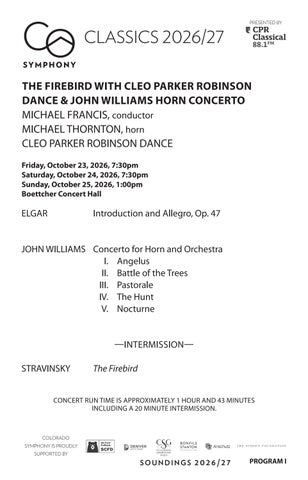
THE FIREBIRD WITH CLEO PARKER ROBINSON DANCE & JOHN WILLIAMS HORN CONCERTO MICHAEL FRANCIS, conductor MICHAEL THORNTON, horn CLEO PARKER ROBINSON DANCE Friday, October 23, 2026, 7:30pm Saturday, October 24, 2026, 7:30pm Sunday, October 25, 2026, 1:00pm Boettcher Concert Hall
ELGAR
Introduction and Allegro, Op. 47
JOHN WILLIAMS Concerto for Horn and Orchestra I. Angelus II. Battle of the Trees III. Pastorale IV. The Hunt V. Nocturne
—INTERMISSION— STRAVINSKY
The Firebird
CONCERT RUN TIME IS APPROXIMATELY 1 HOUR AND 43 MINUTES INCLUDING A 20 MINUTE INTERMISSION.
COLORADO SYMPHONY IS PROUDLY SUPPORTED BY
SOUNDINGS 2 0 2 6/ 2 7
PROGRAM I
BIOGRAPHIES
MICHAEL FRANCIS, conductor Michael Francis has developed an international reputation for sharing the power of music through dynamic conducting and engaging communication. He serves as Music Director of The Florida Orchestra and Mainly Mozart Festival and as Chief Conductor of the Deutsche Staatsphilharmonie Rheinland-Pfalz. Francis has conducted many of the world’s leading ensembles, including The Cleveland Orchestra, London Symphony Orchestra, Royal Philharmonic, Philharmonia, Berlin Radio Symphony Orchestra, Dresden Philharmonic, NHK Symphony, and the symphony orchestras of St. Louis, Houston, Atlanta, Pittsburgh, Toronto, and Montreal. He has collaborated with renowned artists including Yo-Yo Ma, Lang Lang, Itzhak Perlman, Anne-Sophie Mutter, Emanuel Ax, James Ehnes, Sting, Cynthia Erivo, and Josh Groban. A passionate advocate for music education and audience engagement, Francis is known for his acclaimed podium talks and “Inside the Music” series. His extensive discography includes recordings on Capriccio, CPO, Decca, and Deutsche Grammophon. A former double-bass player with the London Symphony Orchestra, Francis came to prominence as a conductor in 2007 when he stepped in for Valery Gergiev and John Adams with the LSO. In 2026, the Michael Francis Foundation for Music and Meaning was established in his honor to advance understanding of classical music’s impact.
MICHAEL THORNTON, principal horn Michael Thornton has served as Principal Horn of the Colorado Symphony since 1997 and is Professor of Horn at the University of Michigan. He is also Principal Horn of the Los Angeles Chamber Orchestra, and teaches at Tanglewood and other festivals each summer. An internationally recognized soloist and chamber musician, Mr. Thornton has performed on six continents, and his students can be found in orchestras around the world. Mr. Thornton enjoys a distinguished and varied career as an orchestral performer, chamber musician, soloist, and pedagogue, and has presented numerous master classes at numerous prestigious musical institutions in the United States and abroad. Before joining the Colorado Symphony, Mr. Thornton left his studies at The Juilliard School to become the Principal Horn of the Honolulu Symphony. He has also performed as a guest Principal Horn with the St. Paul Chamber Orchestra and the Toronto Symphony, and as guest Associate Principal Horn with the Philadelphia Orchestra.
PROGRAM II
C O LO R A D O S Y M P H O N Y.O R G
BIOGRAPHIES
CLEO PARKER ROBINSON DANCE CLEO PARKER ROBINSON is founder and artistic director of the 56-year-old Denver-based artistic institution, CLEO PARKER ROBINSON DANCE (CPRD), leading a professional Ensemble (CPRDE), Cleo II (her second company), two training-track Youth/Junior Youth Ensembles, an Academy of Dance with a BA affiliation, an International Summer Dance Institute, a 240-seat theatre, and numerous community outreach programs nationally and internationally. CPRD’s current home in the 100-year-old Shorter Building in Denver’s Historic Five Points District recently expanded with an expanded adjacent 25,000 square foot state-of-the-art extension. The Grand Opening ribbon cutting January 17, 2026 was part of a week of events launching a multi-level ADA-accessible facility with four new studios, an underground Flex Space theatre with 240 retractable seats, meeting spaces, and administrative facilities. A master teacher/choreographer and cultural ambassador, she and CPRDE have performed nationwide and internationally in 40 countries throughout North/South America, Europe, the Caribbean, Asia, and Africa. Ms. Robinson’s lifetime of work in dance, evidence-based somatic movement therapy, education, and community outreach includes nearly 30 choreographed works. CPRD holds the greatest number of works/performance rights by American Dance Master Donald McKayle. Throughout the 56 years of Cleo Parker Robinson Dance, she has collaborated with Mr. McKayle, Professor Maya Angelou (Lush Life, 1983), mentor and Cultural Anthropologist Katherine Dunham (who bequeathed her own role in Barrel House Blues to Ms. Parker Robinson), Talley Beatty, Eleo Pomare, danced with Eartha Kitt, and was featured in a film Run Sister Run (1974/84, about activist Angela Davis) by photographer/director Gordon Parks. In 2012 with dancer and choreographer Julie Belafonte, she staged the first U.S. performance of Southland, a Civil Rights piece by Ms. Dunham banned by the U.S. government after its premiere in Santiago, Chile in 1952. She recently collaborated with fellow Denver native and renowned Grammy-Award winning jazz artist Dianne Reeves on Freedom Dance. Each holiday season since 1991, CPRD’s Denver-developed Granny Dances To A Holiday Drum has delighted audiences near and far with live and virtual performances featuring a dozen global seasonal holiday traditions. Cleo Parker Robinson remains dedicated to celebrating the human experience and potential through the Arts and Education. Her life-long vision of “Inspiring Movement” with “One Spirit, Many Voices” remains strong and steadfast, expanding to welcome, embrace, and sustain all people. Each performance she attends invokes a participatory gesture and blessing of “Peace/Love/Respect…For EVERYBODY!” SCAN HERE TO LEARN MORE
SOUNDINGS 2 0 2 6/ 2 7
PROGRAM III
PROGRAM NOTES
EDWARD ELGAR (1857-1934) Introduction and Allegro for Strings, Op. 47
COMPOSITION & PREMIERE OF WORK: Edward Elgar was born on June 2, 1857 in Broadheath, England, and died on February 23, 1934 in Worcester. He composed the Introduction and Allegro in 1905, and conducted its premiere on March 8, 1905 in London.
CSA LAST PERFORMANCE: January 8 and 10, 1987, Raymond Leppard cond. INSTRUMENTATION: The score calls for string orchestra. DURATION: Duration is about 14 minutes.
When the London Symphony Orchestra was formed in 1904 by a band of disgruntled musicians who quit Henry Woods’ popular Promenade Concerts Orchestra, A.J. Jaeger of the music publisher Novello and Company asked his friend Edward Elgar to contribute a piece for the ensemble’s inaugural season. In October 1904, Jaeger inquired, “I hope you can write the Symphony Orchestra a short new work. Why not a brilliant quick String Scherzo, or something for those fine strings only? a real bring-down-the-house torrent of a thing as Bach could write…. It wouldn’t take away from your big work for long. You might even write a modern Fugue….” Elgar was riding the greatest wave of success of his life at the time, not only receiving a cartful of honorary doctorates from universities on both sides of the Atlantic, but also having his name appear on the Queen’s List for knighthood that year. He decided to tackle the work for the new orchestra, and started it right after the Christmas holidays. On January 26, 1905 he wrote to Jaeger, “I’m doing that string thing in time for the Symphony Orchestra concert. Intro: & Allegro — no working-out part but a devil of a fugue instead. G major and the second divvel [section] in G minor with all sorts of japes and counterpoint.” Elgar completed the work on February 13, 1905, and conducted the premiere only three weeks later (March 8th) with the fledgling LSO. The exceptionally fine quality of the Introduction and Allegro was not immediately recognized by the audience, but Alice, the composer’s wife and one of his shrewdest critics, said, “Many people think it is the finest thing he has written.” Time has proven her correct. The Introduction and Allegro resembles the opening movement of a symphony in form, but instead of a development section (Elgar’s “working-out” mentioned above) there is an elaborate fugue. The slow introduction opens with a short, bold statement for the full ensemble. After the quartet presents a quicker motive that becomes the main theme of the Allegro, the solo viola sings a folkish tune, which is then taken up by the entire orchestra. Another hearing of the bold opening gesture and a quiet recall of the folkish tune leads to the Allegro. There are three large theme groups in its expository section: a flowing melody that describes a perfect arch shape; a skittering succession of 16th notes traded between quartet and orchestra; and a grand tune (marked “nobilmente” in the score) based on the work’s opening measures. In place of a development is a sturdy fugue, a contrapuntal tourde-force that is one of the great achievements in Elgar’s music. A recapitulation of the three theme groups from the exposition occupies much of the remainder of the work, with a coda built on a grand statement of the folkish tune and the main theme of the Allegro. PROGRAM IV C O LO R A D O S Y M P H O N Y.O R G
PROGRAM NOTES
JOHN WILLIAMS (BORN IN 1932) Concerto for Horn and Orchestra
COMPOSITION & PREMIERE OF WORK: John Williams was born on February 8, 1932 in Flushing, New York. He composed the Horn Concerto in 2003, and conducted its premiere on November 29, 2003 with the Chicago Symphony Orchestra and Dale Clevenger as soloist.
INSTRUMENTATION: The score calls for piccolo, three flutes, three oboes, English horn, three clarinets, bass clarinet, three bassoons, contrabassoon, four horns, three trumpets, three trombones, tuba, timpani, percussion, piano, celesta, harp and strings.
CSA LAST PERFORMANCE: CSA Premiere
DURATION: Duration is about 24 minutes.
John Williams is one of America’s most widely known composers. Born in New York in 1932, he moved with his family when he was sixteen to Los Angeles, where his father was active as a studio musician. After serving in the Air Force, Williams returned to New York in 1954, working there as a jazz pianist in clubs and on recordings while attending the Juilliard School. He subsequently moved back to Los Angeles to enroll at UCLA and study privately with Mario Castelnuovo-Tedesco. By the early 1960s, he was composing music for feature films and television, as well as working as a pianist, arranger and conductor for Columbia Records. His music began to receive wide recognition during the 1960s, when he won Emmys for his scores for the television movies Heidi and Jane Eyre. Williams has since composed music and served as music director for more than 300 movies and television shows, including all of the Star Wars and Indiana Jones films, Jaws, E.T. (The Extra-Terrestrial), Close Encounters of the Third Kind, Superman, Home Alone, The Witches of Eastwick, Schindler’s List and Saving Private Ryan. His additional projects include the Harry Potter movies, Memoirs of a Geisha, Munich, War of the Worlds, Minority Report, Catch Me If You Can, The Adventures of Tin-Tin and Lincoln. Williams has received 56 Academy Award nominations (the most of any living person and second only to Walt Disney) and won five Oscars, twenty Grammys, four Golden Globes and three Emmys, as well as numerous gold and platinum records. The original soundtrack album from Star Wars is one of the best-selling non-pop albums in recording history, and in 2005 was selected by the American Film Institute as the “Greatest American Film Score of All Time.” In addition to his film music, Williams has written many concert pieces, including two symphonies as well as concertos for violin, cello, flute, clarinet, bassoon, tuba, horn and trumpet. For the 350th anniversary of the city of Boston, he composed the Jubilee 350 Fanfare; for the Boston Pops, he wrote the Esplanade Overture and Pops on the March. In 1986, he wrote the Statue of Liberty March for the celebrations marking the centenary of that national monument. His additional concert works include the Essay for Strings, the official themes of the 1996 Summer Olympics (Summon the Heroes) and the 2002 Winter Olympics (Call of the Champions), and numerous chamber pieces. Williams also composed SOUNDINGS 2 0 2 6/ 2 7
PROGRAM V
PROGRAM NOTES Air and Simple Gifts for Clarinet, Cello and Piano for the inauguration ceremony of Barack Obama as President of the United States on January 20, 2009. From 1980 to 1993, Williams served as conductor of the Boston Pops. In addition to leading that orchestra in Boston, on tours across the country and abroad, and in many recordings, he has also appeared as guest conductor with major orchestras in America and Europe. Williams holds twenty honorary degrees, and on June 23, 2000, he was the first person inducted into the Hollywood Bowl Hall of Fame. On New Year’s Day 2004, he served as the Grand Marshal of the Rose Parade in Pasadena, and the following December he was awarded a Kennedy Center Honor, America’s highest award for artistic achievement. In June 2006, Williams received the prestigious Golden Baton Award for Lifetime Achievement from the League of American Orchestras; in 2010, he received the National Medal of Arts at the White House and in 2016 was honored with a Lifetime Achievement Award from the American Film Institute. Williams composed his Horn Concerto in 2003 for the Chicago Symphony Orchestra’s celebrated Principal Horn, Dale Clevenger, and conducted the premiere with him and the CSO on November 29, 2003. “When I’ve tried to analyze my life-long love of the French horn,” Williams wrote, “I’ve had to conclude that it’s mainly because of the horn’s capacity to stir memories of antiquity. The very sound conjures images stored in the collective psyche. It’s an instrument that invites us to ‘dream backward to the ancient time.’ “Most cultures have had some form of horn in their histories. We remember the ram’s horn or Shofar, calling us to battle or prayer … or the conch, ‘fabled shell instrument of the Titans.’ One can also imagine the huge Viking horns that must have struck terror in the hamlets of northern Europe as the great ships were brought into the estuaries to begin their attacks. The horn stirs memories of fearful things, of powerful things, of noble and beautiful things. “In the first section of my Concerto, I begin with the distant pealing of the Angelus bell, while the horn joins in, sending calls and signals to complete the picture. “This is followed by The Battle of the Trees, suggested by the famous Celtic poem of that name, which describes groves of trees transforming themselves into warriors and led in battle by the brave oak. The horn enters the fray, as the percussion section creates sounds of trunks, branches and twigs all colliding in the struggle. “Nostalgia has been described as ‘laundered memory,’ but our modern horn and oboe possess the power to produce it truly. They conjoin to ‘dream backward’ of a pristine glen in the third movement, Pastorale. “In The Hunt, the horn plays its traditional role, getting the blood up, exhilarating the spirit and animating the chase. “Finally, in Nocturne, the day’s end grants repose, and a simple song is offered.”
PROGRAM VI
C O LO R A D O S Y M P H O N Y.O R G
PROGRAM NOTES
IGOR STRAVINSKY (1882-1971) The Firebird, Complete Ballet in Two Scenes
COMPOSITION & PREMIERE OF WORK: Igor Stravinsky was born on June 17, 1882 in Oranienbaum, near St. Petersburg, and died on April 6, 1971 in New York City. He composed The Firebird between November 1909 and May 1910. The premiere was given at the Paris Opéra by Diaghilev’s Ballet Russe on June 25, 1910; Gabriel Pierné conducted.
CSA LAST PERFORMANCE: 1910 Ballet: Colorado Symphony Premiere 1919 Suite (Complete): January 18, 2025: Peter Oundjian, conductor INSTRUMENTATION: The score calls for quadruple woodwinds, four horns, three trumpets, three trombones, tuba, timpani, percussion, celesta, piano, three harps and strings. DURATION: Duration is about 45 minutes.
THE FIREBIRD — Cleo Parker Robinson Dance World Premiere 1997 This interpretation of the classic ballet was originally presented as a collaboration between Cleo Parker Robinson Dance Ensemble and the Colorado Symphony, under the direction of renowned conductor, Marin Alsop. This unique retelling of the story of the Firebird is reflective of a deep pride in the royal heritage of all peoples. In this production, the Firebird is represented by Pele, the Hawaiian goddess of the volcano. Composer..............................................................................................................................Igor Stravinski Choreographer..................................................................................................... Cleo Parker Robinson Associate Choreographer.........................................................................................................Barbara Gardner Restaging........................................................................................................................Winifred R. Harris Original Scenic Design................................................................................................. Rodney J. Smith Scenic Adaptation............................................................................................................ Conor Morford Original Lighting Design.....................................................................................................Keith W. Rice Lighting Adaptation.....................................................................................................Anastazia Coney Costume Design............................................................................................. Michael Sullivan (HAUS) Assistants to the Choreographer........................Jasmine Francisco & John Lambert-Roberts ACT I – The Rainforest (Earth) As the Goddess of Sorcery awakens the forest, the King and the Prince discover the mythical Firebird who embodies the forces of both Good and Evil which are inherent in fire. She is protected by the various gods and goddesses of the Island who also dwell in the forest. With the blessing of the King, the Prince captures the Firebird. The King and Prince share a vision with her about the way their world was long ago, when the ancient deities were strong and beautiful. The Firebird is intrigued but still wishes to escape. She trades a magical feather with the Prince in order to gain her freedom. If he ever has need of her, this feather will summon her to him. SOUNDINGS 2 0 2 6/ 2 7
PROGRAM VII
PROGRAM NOTES ACT II – The Volcano (Inferno) The Queen and the Princess are being held captive in the volcano by an Ogre who has invaded the Firebird’s realm. As they dance, the prince approaches and enters the volcano. He expresses his passion for the Princess, and they discover their new-found love. They share their joy and sorrow with the King and Queen, gods and goddesses who have also fallen under the spell of the Ogre. The prince realizes that his holy deities have been transformed into evil forces and that he must fight for the freedom of his beloved princess and the restoration of his ancestral heritage. As the prince is overwhelmed in battle by the Ogre, the magical feather summons the Firebird. Furious that her sacred volcano has been desecrated, she causes an eruption that destroys everything in its path. In remorse, she bestows the gift of life’s renewal on all humanity. Confronting the Ogre, she banishes him to the depths of the volcano for all eternity. ACT III – The Shoreline (Paradise) The Prince and Princess are united in a Paradise of the gods and goddesses. Their ceremony is a testimony to the living royal heritage of all people. They dance for the preservation of beauty and dignity while The Firebird celebrates the triumph of Good over Evil. THE CLEO PARKER ROBINSON DANCE ENSEMBLE Michael Battle, Caeli Blake, Tori Carter, Adrian Dominguez, Jasmine Francisco, Kabria Holland*, Corey Jamel, Gabriela Maduro, Max Nelson Steinhoff, Lamar D. Rogers, Lauren Slaughter *Apprentice to the Ensemble
CLEO II Santos Garcia, India Johnson, Kyndall Taraji Johnson, Jada M. Nutall, Sheamar Williams-Robinson, Tripp Starr, Khiana Carpenter**, Ethan Telfort**, Nia Bellinger + **Apprentice to Cleo II +Cleo II Trainee
THE CHARACTERS The Firebird (Pele, the Volcano Goddess) Tori Carter The King Michael Battle The Queen Lauren Slaughter The Prince Lamar D. Rogers The Princess Caeli Blake The Orge Corey Jamel God of the Sea (Kanaloa) Max Nelson Steinhoff Goddess of the Sea (Namakaokaha’I) Gabriela Maduro God of the Forest (Ku) Sheamar Willams-Robinson Goddess of Healing (Ki’iaka)/ Forest Spirit India Johnson Goddess of Snow (Poli’ahu) / Forest Spirit Kabria Holland Goddess of Sorcery (Uli) Jasmine Francisco Shape Shifter (Kupua) Adrian Dominguez God of Growing Things (Lono) Tripp Starr Pele Women Nia Bellinger, Khiana Carpenter, Kyndall Taraji Johnson, Jaida M. Nutall Kabria Holland, India Johnson Forest Spirits Santos Garcia , Ethan Telfort
PROGRAM VIII
C O LO R A D O S Y M P H O N Y.O R G