CLASSICS 2025/26
SHOSTAKOVICH PIANO CONCERTO NO. 1 WITH OLGA KERN + RACHMANINOFF’S SECOND CHRISTOPHER DRAGON, conductor
OLGA KERN, piano JUSTIN BARTELS, trumpet
Friday, February 20, 2026 at 7:30pm
Saturday, February 21, 2026 at 7:30pm
Sunday, February 22, 2026 at 1:00pm
Boettcher Concert Hall
MUSSORGSKY
SHOSTAKOVICH
RACHMANINOFF
The Fair at Sorochinski: Gopak
Piano Concerto No. 1 in C minor, Op. 35
I. Allegro moderato
II. Lento
III. Moderato
IV. Allegro brio
-INTERMISSION-
Symphony No. 2 in E minor, Op. 27
I. Largo - Allegro moderato
II. Allegro molto
III. Adagio
IV. Allegro vivace
CONCERT RUN TIME IS APPROXIMATELY 1 HOUR AND 42 MINUTES INCLUDING A 20 MINUTE INTERMISSION.
PROUDLY SUPPORTED BY
Saturday’S concert iS SponSored by daviS Graham & StubbS llp
Sunday’S concert iS SponSored by hal nelSon





CHRISTOPHER DRAGON, conductor
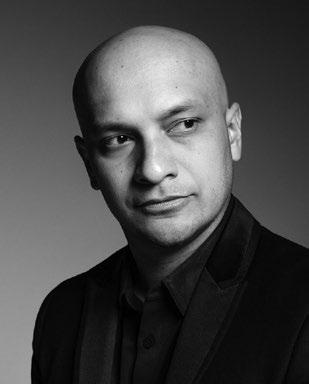
Australian conductor Christopher Dragon is the Music Director of Greensboro Symphony Orchestra, newly appointed Music Director of the Philly Pops, former Music Director of the Wyoming Symphony Orchestra and is the Resident Conductor of the Colorado Symphony. He joined the Colorado Symphony in the 2015/2016 Season as Associate Conductor – a position he held for four years. For three years prior, Dragon held the inaugural position of Assistant Conductor with the West Australian Symphony Orchestra, which gave him the opportunity to work closely with Principal Conductor Asher Fisch.
Dragon has a versatile portfolio ranging from live-to-picture performances including Nightmare Before Christmas, Toy Story and Star Wars: Return of the Jedi, a wide variety of collaborations with artists such as the Wu-Tang Clan, Cynthia Erivo and Joshua Bell, to standard and contemporary orchestral repertoire such as Danny Elfman’s Percussion Concerto; all areas of which he has become highly sought after. Christopher has become known for his charisma, high energy and affinity for a good costume, consistently delivering unforgettable performances that has made him an audience favourite.
Recent highlights include his sold-out symphony tour with Gregory Alan Isakov, which included debuts with the Los Angeles Philharmonic and Nashville Symphony, a new orchestral collaboration with Nathaniel Rateliff and his successful German debut with the WDR Funkhausorchester.
Christopher is highly sought after as a guest conductor and has worked with the Los Angeles Philharmonic, San Francisco Symphony, National Symphony Orchestra, Nashville Symphony, Atlanta Symphony, Utah Symphony, Cincinnati Pops Orchestra, San Diego Symphony, Pacific Symphony, Omaha Symphony, Louisiana Philharmonic Orchestra, Rochester Philharmonic Orchestra, Chicago Philharmonic, Singapore Symphony Orchestra, Orquestra Sinfônica de Porto Alegre and the New Zealand Symphony Orchestra. In Australia, he has guest conducted the Sydney, Melbourne, Adelaide and West Australian Symphony Orchestras. His 2015 debut performance at the Sydney Opera House with John Pyke and the Sydney Symphony Orchestra was released on album by ABC Music and won an ARIA the following year.
He has also conducted at numerous festivals including the Breckenridge and Bangalow Music Festivals, with both resulting in immediate re-invitations. At the beginning of 2016 Dragon conducted Wynton Marsalis’ Swing Symphony as part of the Perth International Art Festival alongside Wynton Marsalis and the Jazz at Lincoln Center Orchestra.
Christopher began his conducting studies in 2011 and was a member of the prestigious Symphony Services International Conductor Development Program in Australia under the guidance of course director Christopher Seaman. He has also studied with numerous distinguished conductors including Leonid Grin, Paavo and Neeme Jarvi at the Jarvi Summer Festival, Fabio Luisi at the Pacific Music Festival and conducting pedagogue Jorma Panula.
BIOGRAPHIES
OLGA KERN, piano
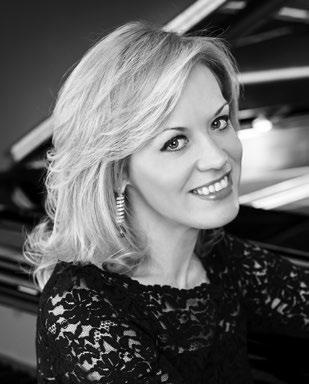
With a vivid stage presence, dazzling technique, and passionate musicality, pianist Olga Kern captivates audiences around the globe. Born into a family of musicians, she began piano studies at the age of five and, at seventeen, won First Prize at the Rachmaninoff International Piano Competition. Her historic 2001 Gold Medal win at the Van Cliburn International Piano Competition was a careerdefining triumph that launched her international reputation. She is the only woman in more than fifty years to claim the honor.
Her 2025–2026 season features a return to Carnegie Hall with a solo recital. She joins the Hawai’i Symphony Orchestra in Honolulu; appears at the Sun Valley Music Festival; and will appear at venues throughout Europe, Asia, and North America. She will perform both Shostakovich piano concertos with the Orchestra dell’Accademia Teatro alla Scala, and she will also appear with Illes Balears Symphonic Orchestra and the Polish National Radio Symphony Orchestra in Katowice.
Kern has performed with major orchestras including the St. Louis Symphony, Pacific Symphony, Detroit Symphony, National Symphony Orchestra (Washington, D.C.), Czech Philharmonic, Filarmonica della Scala, Tokyo NHK Symphony, and Cape Town Philharmonic, and has toured with the Royal Philharmonic Orchestra, Royal Scottish National Orchestra, and National Symphony Orchestra of Ukraine. Highlights of recent seasons include performances of all four Rachmaninoff piano concertos and Rhapsody on a Theme of Paganini, a nationwide telecast with the Czech Philharmonic, and engagements with the Colorado, Dallas, Minnesota, and Baltimore symphonies; Orquesta Filarmónica de Gran Canaria; Ireland’s National Symphony; Prague Symphony; Taipei Symphony; Tokyo Symphony; and a tour of South Africa.
In addition to her performing career, Kern is deeply committed to fostering the next generation of musicians. She is Artistic Director of the Olga Kern International Piano Competition and has served as Jury Chairman for the Cliburn International Amateur Piano Competition and the Chopin Animato International Piano Competition in Paris. Since 2017, she has been on the piano faculty of the Manhattan School of Music and is Connie & Marc Jacobson Director of Chamber Music at the Virginia Arts Festival. In recognition of her artistic contributions and cultural leadership, she received the Ellis Island Medal of Honor in 2017. She will be on the jury for the Paderewski Competition in Poland in 2025 and president of the jury of the Cleveland International Youth Piano Competition in 2026.
Kern’s acclaimed discography (olgakern.com/recordings/) includes a Grammy-nominated recording of Rachmaninoff’s Corelli Variations and transcriptions, Tchaikovsky’s Piano Concerto No. 1 with the Rochester Philharmonic (Harmonia Mundi), Chopin’s Piano Concerto No. 1 with the Warsaw Philharmonic, Chopin’s Sonatas Nos. 2 and 3, Rachmaninoff’s Sonata for Cello and Piano with Sol Gabetta (Sony), and Brahms and Shostakovich quintets with the Dalí Quartet (Delos). She is also featured in award-winning documentaries including The Cliburn: Playing on the Edge, They Came to Play, and Olga’s Journey. She is a Steinway Artist and an ambassador for Spirio R Steinway pianos as well as a laureate of numerous international competitions.
In 2012, she founded the Kern Foundation “Aspiration,” dedicated to supporting talented young musicians worldwide. Known for her elegance onstage, she collaborates with designer Alex Teih and jeweler Alex Soldier, whose creations complement the artistry and charisma she brings to every performance.
JUSTIN BARTELS, trumpet
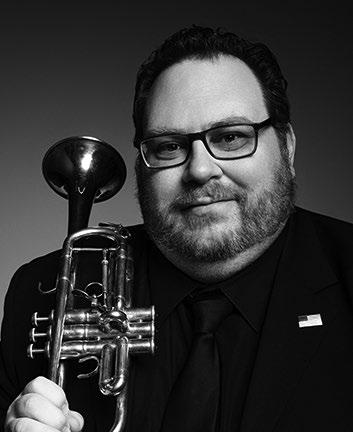
Justin Bartels was appointed Principal Trumpet of the Colorado Symphony in 2008, a position he continues to hold with distinction. He also serves on the faculty of Colorado State University with Professor Stan Curtis as an Instructor of Trumpet, where he teaches applied lessons and mentors the next generation of performers.
Before joining the Colorado Symphony, Justin was Principal Trumpet of the Columbus Symphony in Ohio (2007–2008) and spent three seasons as a fellow with the New World Symphony in Miami Beach, Florida (2003–2006). He also served as Principal Trumpet of Central City Opera for five seasons (2006–2012).
Justin has appeared as Guest Principal Trumpet with the San Francisco Symphony, New York City Ballet, and St. Louis Symphony, and has performed with ensembles including the New York Philharmonic, Dallas Symphony, Alabama Symphony, Milwaukee Symphony, Los Angeles Philharmonic, Virginia Symphony, and Houston Symphony.
A graduate of the Indiana University Jacobs School of Music, Justin earned his Bachelor of Music degree in Trumpet Performance in 2003. His earlier studies included coursework at the University of Cincinnati College-Conservatory of Music (1997–2000) and the University of Alabama (1996–1997).
Justin’s principal teachers include Marie Speziale, John Rommel, Ed Cord, Alan Siebert, Michael B. Johnson, and Joe Ardovino. He grew up in Birmingham, Alabama, where he was a member of the Pelham High School music program under the direction of the late James H. Duren.
In addition to his work at Colorado State University, Justin has served on the faculties of the University of Colorado and the University of Denver. His students have gone on to perform in the United States Armed Services, hold positions in professional orchestras, teach on the faculties of respected music schools, and contribute to the field through leadership roles in arts administration.
Justin is married to Colorado Symphony violinist Myroslava Ivanchenko (Bartels), with whom he has performed since she joined the orchestra in 2010. Together they are raising two wonderful children and have two curious Siberian forest cats. Outside of his musical life, Justin enjoys Colorado’s outdoors, follows Alabama football with unwavering enthusiasm, and is a devoted Colorado Avalanche season ticket holder.
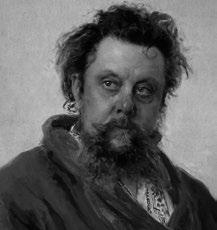
MODEST MUSSORGSKY (1839-1881)
“Gopak”
from The Fair at Sorochinski Orchestrated by Anatoly Liadov (1855-1914)
COMPOSITION & PREMIERE OF WORK:
Modest Mussorgsky was born on March 21, 1839 in Karevo, Pskov District, Russia, and died on March 28, 1881 in St. Petersburg. He composed the comic opera The Fair at Sorochinski in 1874-1881, but it was not premiered until October 13, 1917 in St. Petersburg, conducted by Grzegorz Fitelberg.
CSA LAST PERFORMANCES: October 24-25, 1986 with James Setapen, conductor.
INSTRUMENTATION:
The score calls for woodwinds in pairs plus piccolo, four horns, two trumpets, three trombones, tuba, timpani, percussion and strings.
DURATION:
About 2 minutes.
Nikolai Gogol’s short story The Fair at Sorochinski (1831) recounts how Parasya attends a Ukrainian country fair with her father, the farmer Cherevik, and mother, Khivrya. Parasya falls in love in Sorochinski with the peasant Gritsko and wants to marry him. Her father agrees to the union when he learns that Gritsko is the son of a friend, but Khivrya forbids it. Gritsko, disconsolate, consults a Gypsy, who reveals that Khivrya has planned an assignation with the local priest’s son while Cherevik is out of the house. Complications inevitably ensue, but the objections of Khivrya, now compromised, to the marriage of Parasya and Gritsko are eventually overcome and the young lovers are allowed to wed.
Modest Mussorgsky began an opera based on Gogol’s tale in 1874 but left it in unfinished disarray when he died seven years later. Anatoly Liadov orchestrated three numbers from the score, César Cui, Nikolai Tcherepnin and Vyacheslav Karatigin all attempted completions of the work, and performances of those versions were presented, but The Fair at Sorochinski did not reach a settled state until it was finished by Vissarion Shebalin in 1931 as part of Pavel Lamm’s complete edition of Mussorgsky’s compositions. The marriage celebration in the opera’s closing scene features a vigorous Gopak (orchestrated by Liadov), the national dance of Ukraine, which originated with the Cossacks in the 16th century.