CLASSICS 2026/27
PRESENTED BY
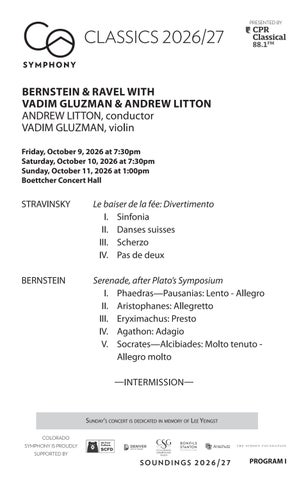
BERNSTEIN & RAVEL WITH VADIM GLUZMAN & ANDREW LITTON ANDREW LITTON, conductor VADIM GLUZMAN, violin Friday, October 9, 2026 at 7:30pm Saturday, October 10, 2026 at 7:30pm Sunday, October 11, 2026 at 1:00pm Boettcher Concert Hall
STRAVINSKY Le baiser de la fée: Divertimento I. Sinfonia II. Danses suisses III. Scherzo IV. Pas de deux BERNSTEIN Serenade, after Plato’s Symposium I. Phaedras—Pausanias: Lento - Allegro II. Aristophanes: Allegretto III. Eryximachus: Presto IV. Agathon: Adagio V. Socrates—Alcibiades: Molto tenuto Allegro molto —INTERMISSION—
Sunday’s concert is dedicated in memory of Lee Yeingst COLORADO SYMPHONY IS PROUDLY SUPPORTED BY
SOUNDINGS 2 0 2 6/ 2 7
PROGRAM I
CLASSICS 2026/27
PRESENTED BY
RAVEL Valses Nobles et sentimentales I. Modéré II. Assez lent III. Modéré IV. Assez animé V. Presque lent VI. Assez vif VII. Moins vif VIII. Epilogue RAVEL
La Valse, poème chorégraphique THE TWO RAVEL WORKS WILL BE PERFORMED WITHOUT PAUSE.
CONCERT RUN TIME IS APPROXIMATELY 1 HOUR AND 43 MINUTES INCLUDING A 20 MINUTE INTERMISSION.
PROGRAM II
C O LO R A D O S Y M P H O N Y.O R G
BIOGRAPHIES
PHOTO: DANNY TURNER
ANDREW LITTON, conductor Andrew Litton is Music Director of New York City Ballet and Conductor Laureate of the Bournemouth Symphony Orchestra. He previously served as Music Director of Norway’s Bergen Philharmonic, leading international tours and acclaimed recordings, and was awarded the Norwegian Royal Order of Merit by King Harald V. Litton served as Principal Conductor of the Bournemouth Symphony Orchestra and Music Director of the Dallas Symphony Orchestra, where he led international tours, appeared regularly at Carnegie Hall, and produced numerous recordings. He continues to guest conduct internationally with leading orchestras and has appeared at the Metropolitan Opera, Royal Opera House Covent Garden, Australian Opera, and Deutsche Oper Berlin. His work with New York City Ballet has brought renewed prominence to the company’s orchestra. Litton began his ballet career as an onstage pianist at Juilliard and has since conducted the Royal Ballet and Bayerisches Staatsballett. An accomplished pianist and Gershwin expert, Litton frequently conducts from the keyboard. His discography includes more than 140 recordings and numerous honors. A New York native, he earned bachelor’s and master’s degrees in Piano and Conducting from The Juilliard School and later served as assistant conductor at La Scala.
VADIM GLUZMAN, violin Universally recognized among today’s top performing artists, Israeli violinist Vadim Gluzman is acclaimed for his appearances with the Berlin Philharmonic, Boston Symphony, London Symphony, Royal Concertgebouw under Riccardo Chailly, Christoph von Dohnányi, Tugan Sokhiev, Santtu-Matias Rouvali and other leading conductors. Mr. Gluzman has introduced audiences to new works by Sofia Gubaidulina, Erkki-Sven Tüür, Sally Beamish, Pēteris Vasks, Giya Kancheli, Moritz Eggert, and Lera Auerbach, and currently serves as Artistic Director of both – the Music in the Mountains Festival and the North Shore Chamber Music Festival. Accolades for Gluzman’s striking catalogue of recordings on BIS, ONYX, Platoon and EuroArts labels include the Diapason d’Or of the Year, Gramophone’s Editor’s Choice, Classica magazine’s Choc de Classica award, and Disc of the Month by The Strad, BBC Music Magazine, and ClassicFM. Distinguished Artist in Residence at The Peabody Conservatory, where he teaches a selected group of young violinists, Gluzman performs on the extraordinary 1690 ‘ex Leopold Auer’ Stradivari, on loan through the Stradivari Society of Chicago. SOUNDINGS 2 0 2 6/ 2 7
PROGRAM III
BIOGRAPHIES
IGOR STRAVINSKY (1882-1971) Divertimento, Suite from The Fairy’s Kiss
COMPOSITION & PREMIERE OF WORK: Igor Stravinsky was born on June 17, 1882 in Oranienbaum, near St. Petersburg, and died April 6, 1971 in New York City. The ballet The Fairy’s Kiss was composed between April and October 30, 1928 and Stravinsky conducted its premiere at the Paris Opéra on November 28, 1928. In 1934, he extracted a suite from the score, which he titled Divertimento.
CSA LAST PERFORMANCE: October 8-10, 1993: Jorge Mester, conductor INSTRUMENTATION: The score calls for piccolo, two flutes, two oboes, English horn, two clarinets, bass clarinet, two bassoons, four horns, three trumpets, three trombones, tuba, timpani, bass drum, harp and strings. DURATION: Duration is about 22 minutes.
The Fairy’s Kiss originated in a commission in 1927 from the wealthy actress and dancer Ida Rubinstein, who wanted to establish a ballet company in Paris but was having difficulty assembling a suitable repertory because of the exclusive rights that Diaghilev held to so many recent works for his Ballet Russe. Taking the bull by the horns, she sent the artist Alexandre Benois to Stravinsky (in essence, Diaghilev’s resident composer) with his idea for a ballet based on the music of Peter Tchaikovsky for the new company. Stravinsky, who admired Tchaikovsky as the greatest of all Russian composers, was responsive to the Rubinstein–Benois proposal and he accepted the commission. He set to work as soon as possible so that the production could be ready to commemorate the 35th anniversary of Tchaikovsky’s death, in November 1928. For the music of The Fairy’s Kiss, Stravinsky adapted several of Tchaikovsky’s little-known songs and piano pieces, requiring only that they be things which had never been orchestrated. For the scenario, he turned to a tale of Hans Christian Andersen, The Ice Maiden, which tells of a fairy’s magic kiss bestowed upon an infant on the day of his birth. Twenty years later, on his wedding day, the day of the young man’s greatest happiness, the fairy returns with a second kiss and bears the young man off to eternity to preserve his joy forever. Stravinsky identified the young man with Tchaikovsky and the fairy with the Muse of music, so The Fairy’s Kiss became an allegory, he wrote, of “a mystic influence that bespeaks the whole world of this great artist.” Stravinsky chose about half of the complete ballet for inclusion in the Divertimento, which exists in versions for orchestra and for violin and piano. Its four movements correspond to the following incidents in the plot: I. Sinfonia: The fairy kisses the child and disappears; II. Swiss Dances and Waltz: A village fair; betrothal of the young man; III. Scherzo: The fairy leads the young man to a well where his betrothed is playing round games with her
PROGRAM IV
C O LO R A D O S Y M P H O N Y.O R G
PROGRAM NOTES friends; IV. Pas de deux: The young man and his betrothed; Variation: The betrothed alone; Coda: The young man left alone as his betrothed leaves to try on her wedding veil. By 1954, when the Serenade was written, Leonard Bernstein had firmly established himself on the American musical scene as both conductor and composer. He had served as assistant conductor of the New York Philharmonic, Music Director of the New York City Symphony, and Musical Advisor to the Israel Philharmonic. As a composer, he had won the New York Music Critics Circle Award for his “Jeremiah” Symphony and had completed his Second Symphony (The Age of Anxiety), the ballets Fancy Free and Facsimile, and the scores for two Broadway shows (On the Town and Wonderful Town). During the mid1950s, he was on the staffs of Brandeis University and the Tanglewood Music Festival, and much in demand as a guest conductor in Europe and America, having created a sensation in December 1953 when he became the first American to conduct at La Scala.
LEONARD BERNSTEIN (1918-1990) Serenade (after Plato’s “Symposium”) for Violin, String Orchestra, Harp and Percussion COMPOSITION & PREMIERE OF WORK: Leonard Bernstein was born on August 25, 1918 in Lawrence, Massachusetts, and died on October 14, 1990 in New York City. He completed his Serenade on August 8, 1954 and conducted the premiere at the Teatro La Fenice in Venice on September 12th with Isaac Stern as soloist.
CSA LAST PERFORMANCE: May 25-27, 2018: Brett Mitchell, conductor; Yumi Hwang, violin INSTRUMENTATION: The score calls for strings, harp and percussion to accompany the solo violin. DURATION: Duration is about 31 minutes.
Bernstein’s Serenade, commissioned by the Koussevitzky Foundation, was dedicated “To the Beloved Memory of Serge and Natalie Koussevitzky.” On August 8, 1954, the day after he completed the score, Bernstein wrote the following description of its literary origin: “There is no literal program for this Serenade, despite the fact that it resulted from a re-reading of Plato’s charming dialogue, The Symposium. The music, like the dialogue, is a series of related statements in praise of love, and generally follows the Platonic form through the succession of speakers at the banquet. The ‘relatedness’ of the movements does not depend on common thematic material, but rather on a system whereby each movement evolves out of elements in the preceding one.
SOUNDINGS 2 0 2 6/ 2 7
PROGRAM V
PROGRAM NOTES “I. Phaedrus — Pausanias (Lento — Allegro). Phaedrus opens the symposium with a lyrical oration in praise of Eros, the god of love. (Fugato, begun by the solo violin.) Pausanias continues by describing the duality of lover and beloved. This is expressed in a classical sonata form, based on material of the opening fugato. “II. Aristophanes (Allegretto). Aristophanes does not play the role of clown in this dialogue, but instead that of bedtime storyteller, invoking the fairytale mythology of love. “III. Erixymathus (Presto). The physician speaks of bodily harmony as a scientific model for the workings of love-patterns. This is an extremely short fugato scherzo, born of a blend of mystery and humor. “IV. Agathon (Adagio). Perhaps the most moving speech of the dialogue, Agathon’s panegyric embraces all aspects of love’s powers, charms and functions. This movement is a simple three-part song. “V. Socrates — Alcibiades (Molto tenuto — Allegro molto vivace). Socrates describes his visit to the seer Diotima, quoting her speech on the demonology of love. This is a slow introduction of greater weight than any of the preceding movements; and serves as a highly developed reprise of the middle section of the Agathon movement, thus suggesting a hidden sonata-form. The famous interruption by Alcibiades and his band of drunken revelers ushers in the Allegro, which is an extended Rondo ranging in spirit from agitation through jig-like dance music to joyful celebration. If there is a hint of jazz in the celebration, I hope it will not be taken as anachronistic Greek party-music, but rather the natural expression of a contemporary American composer imbued with the spirit of that timeless dinner-party.” The musical processes of the Serenade seem a bit abstruse in Bernstein’s above description, but are really a logical counterpart to the spoken conversation they represent. An initial theme is given out, just as an idea, spoken, opens a conversation. The first speaker pursues his thought until another converser puts forth his own idea engendered by what he has heard. The conversation goes on, unwinding, fueled by the interchange and development of its basic ideas — in the case of Plato’s Symposium, the aspects of love. In Bernstein’s Serenade, one theme gives rise to another, to which the first may, for example, then become an accompaniment. Each musical idea, like each conversational statement, leads logically to another, related to it, yet different according to the thought and the speaker. Bernstein’s “conversational” composition is brought round full circle when the opening theme from the first movement reappears in the closing pages.
PROGRAM VI
C O LO R A D O S Y M P H O N Y.O R G
PROGRAM NOTES
MAURICE RAVEL (1875-1937) Valses nobles et sentimentales (composed for piano in 1911, orchestrated in 1912)
COMPOSITION & PREMIERE OF WORK: Maurice Ravel was born on March 7, 1875 in Ciboure, Basses-Pyrénées, France, and died on December 28, 1937 in Paris. He composed the Valses nobles et sentimentales for solo piano in 1911 and orchestrated the work in March 1912. Ravel conducted its first performance on April 22, 1912 at the Châtelet Theater in Paris as accompaniment for a ballet titled Adélaïde.
INSTRUMENTATION: The score calls for pairs of flutes, oboes, clarinets and bassoons, English horn, four horns, two trumpets, three trombones, tuba, timpani, percussion, celesta, “Jeu de timbres” (keyed glockenspiel), two harps and strings. DURATION: Duration is about 17 minutes.
CSA LAST PERFORMANCE: February 15-17, 1991: Kenneth Jean, conductor
Ravel wrote, “The title of Valses Nobles et Sentimentales shows clearly enough my intention to compose a chain of waltzes in the style of Schubert. In place of the virtuosity that characterized [his piano suite] Gaspard de la Nuit, there was a style cleaner, clearer, which emphasized the harmonies and brought them to life.” The specific works for piano by Schubert that influenced Ravel were the Valses nobles, Op. 77 and Valses sentimentales, Op. 50. The musical style, however, is French rather than Viennese, with the spirit of Satie hovering above much of Ravel’s music. The title page even bears a cryptic, Satie-esque inscription that Ravel drew from the writings of Henri de Régnier: “The delicious pleasure, always new, of a useless occupation.” This work of highly refined sensibility and sophistication comprises seven continuous miniature waltzes followed by an epilogue that provide a variety of contrasting moods, keys and tempos encompassing more emotional states than the title implies. The hushed epilogue recalls disembodied wisps from most of the preceding waltzes. As regards this closing portion of the Valses, a comparison with La Valse of 1920 shows an interesting difference in their structural techniques. Here, the fragments of melodies are used to close the work, as a sort of hazy remembrance of times past. In La Valse, the fragments occur as an introduction, a premonitory mist that is swept away by the vigor of the following dance. Because of the horrors of World War I that separate these two works, perhaps Ravel felt the sweet ending of Valses Nobles et Sentimentales was better replaced by the cataclysmic conclusion of the later La Valse.
SOUNDINGS 2 0 2 6/ 2 7
PROGRAM VII
PROGRAM NOTES
MAURICE RAVEL (1875-1937) La Valse, poème choréographique
COMPOSITION & PREMIERE OF WORK: Ravel composed La Valse, “poème choréographique pour orchestra,” between December 1919 and March 1920. The premiere was given by the Lamoureux Orchestra on December 12, 1920 conducted by Camille Chevillard. CSA LAST PERFORMANCE: May 2-4. 2025: Eric Jacobsen, conductor
INSTRUMENTATION: The score calls for piccolo, three flutes, two oboes, English horn, two clarinets, bass clarinet, two bassoons, contrabassoon, four horns, three trumpets, three trombones, tuba, timpani, percussion, two harps and strings. DURATION: Duration is about 13 minutes.
Ravel first considered composing a musical homage to Johann Strauss, “The Waltz King,” as early as 1906. The idea forced itself upon him again a decade later, but during the years of World War I, he could not bring himself to work on a score he had tentatively titled “Wien” (“Vienna”), and it was not until January 1919 that he was immersed in the composition of his tribute to Vienna — “waltzing frantically,” as he wrote to a friend. He saw La Valse both as “a kind of apotheosis of the Viennese waltz” and as a “fantastic and fatefully inescapable whirlpool.” The “inescapable whirlpool” was the First World War toward which Vienna marched in three-quarter time, salving its social and political conscience with the luscious strains of Johann Strauss. Ravel completed La Valse in piano score by the end of 1919, and then made a piano duet version and undertook the orchestration, which he finished in the spring of the following year. A surrealistic haze shrouds the opening of La Valse, a vague introduction from which fragments of themes gradually emerge. In the manner typical of the Viennese waltz, several continuous sections follow, each based on a different melody. At the half-way point of the score, however, the murmurs of the introduction return, and the melodies heard previously in clear and complete versions are now fragmented, played against each other, and are unable to regain the rhythmic flow of their initial appearances. The musical panacea of 1855 cannot smother the reality of 1915, however, and the music becomes consumed by the thrusting triple meter transformed from a seductive dance into a demonic juggernaut. At the almost unbearable peak of tension, the dance is torn apart by a violent five-note figure, a gesture so alien to the triple meter that it destroys the waltz and brings this brilliant, forceful and disturbing work to a shattering close. ©2026 Dr. Richard E. Rodda
PROGRAM VIII
C O LO R A D O S Y M P H O N Y.O R G