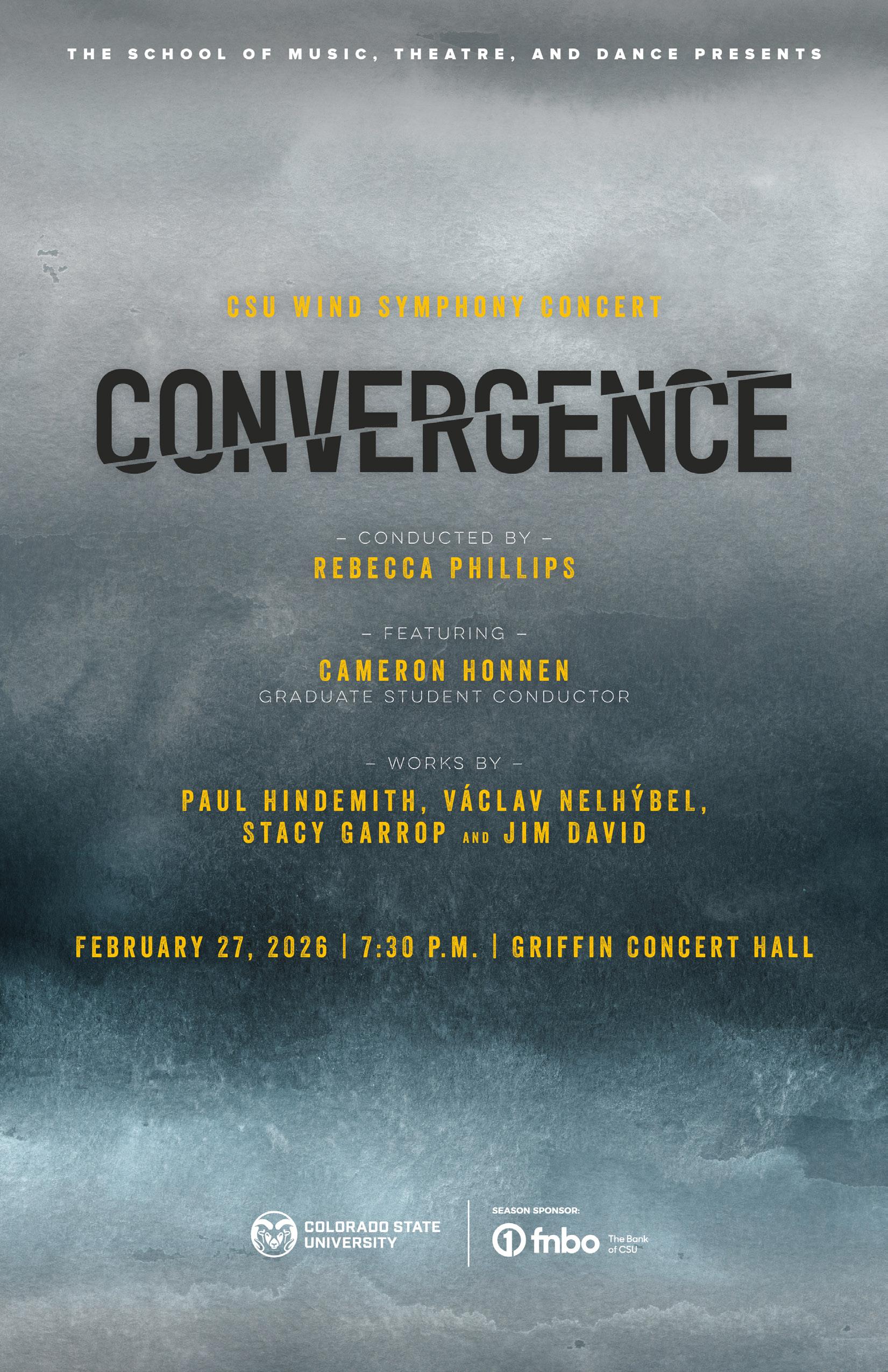
FRIDAY EVENING, FEBRUARY 27, 2026 AT 7:30
THE COLORADO STATE UNIVERSITY WIND SYMPHONY PRESENTS:
FRIDAY EVENING, FEBRUARY 27, 2026 AT 7:30
THE COLORADO STATE UNIVERSITY WIND SYMPHONY PRESENTS:
CAMERON HONNEN, GRADUATE STUDENT CONDUCTOR
Václav Nelhýbel
Trittico (1963)
I. Allegro maestoso
II. Adagio
III. Allegro marcato
Cameron Honnen, graduate student conductor
PAUL HINDEMITH
Symphony in Bb (1951)
I. Moderately fast, with vigor
II. Andante grazioso
III. Fugue: Rather broad
STACY GARROP
Forged By the Sea (2023)
I. From the depths below
II. To the skies above
JAMES M. DAVID
Sky Above Clouds (2025)
The Wind Symphony welcomes you to this evening’s concert, as converging storms abound in tonight’s selections. The Colorado State University Wind Symphony presents dark and tempestuous works from the wind band repertoire, including pieces by Hindemith, Nehlybel, Garrop, and David. In addition, we are delighted to feature graduate student conductor Cameron Honnen in his final performance with the CSU Wind Symphony.
Fascinated by mystery? Drawn to puzzles? Then the Wind Symphony April concert is for you! The Colorado State University Wind Symphony presents Enigma, featuring graduate student conductors David Davis and Amanda Manning along with guest soloists Dan Goble (alto saxophone), Joel Bacon (organ), and alumni guest soloist Andrew Rutten (bass clarinet). You will be intrigued as we explore musical conundrums in our final performance of the season! We look forward to seeing you at the UCA on Friday, April 24th at 7:30pm.
Born: 24 September 1919, Polanka nad Odrou, Czechoslovakia
Died: 22 March 1996, Scranton, Pennsylvania
Duration: 11 minutes
Trittico is the Italian word for triptych, which traditionally refers to a set of three painted or carved panels, often hinged together for ease of display or transportation. This form of art was especially popular among Christian artists during the Middle Ages. The middle panel was typically the largest and most prominent, making it the focus of the piece. Some of the most famous examples of triptych artwork include Hugo van der Goes’s Portinari Altarpiece (1475), Hieronymus Bosch’s The Garden of Earthly Delights (1490–1510), and Matthias Grünewald’s Isenheim Altarpiece (1512–16). Though primarily a visual art form, the triptych concept has also been explored in the musical arts, with notable examples such as William Schumann’s New England Triptych (1956) and Giacomo Puccini’s set of three operas, Il trittico (1918). Václav Nelhýbel’s Trittico (1963) follows this tradition, with three distinct movements that form a unified and interconnected musical work.
Václav Nelhýbel was a Czech-American composer known for works that appealed to both young musicians and more advanced performers. Born in post-World War I Czechoslovakia, Nelhýbel spent much of his early life there, earning degrees in musicology from Prague
University and in conducting and composition from the Prague Conservatory. With the outbreak of World War II, Nelhýbel moved to Switzerland in 1942 to continue his studies at Fribourg University. There, he also became a professor of music theory and worked as a conductor with Radio Prague and the Stadt Theater (1939-42). He later held positions with the Czech Philharmonic Orchestra (1945-46), Swiss Radio (1946-50), and Radio Free Europe (1950-57). In 1957, Nelhýbel emigrated to the United States of America, becoming a citizen in 1962. His academic career continued in the United States, teaching at the University of Lowell, Massachusetts (1978-79), and the University of Scranton, Pennsylvania (1994-96), which now houses his complete collection of works.
Nelhýbel’s music reflects both his Czech heritage and the stylings of twentieth-century composition. His use of non-functional modal writing, blending Slavic melodies with modern harmonies, creates a distinctive pandiatonic musical language. Rhythmic patterns drawn from Eastern European dance music add layers of metric dissonance, hemiola, and forward momentum. Additionally, Nelhýbel’s use of contrapuntal techniques, fugue-like passages, and intricate formal structures demonstrates his training and experience as both a composer and educator. These elements are central to Trittico, which showcases his trademark linear writing and rich textures.
Trittico was written in 1963 and dedicated to Dr. William D. Revelli and the University of Michigan Symphonic Band. The work’s strong dynamics and dense orchestration reflect the power of Michigan’s bands during Dr. Revelli’s tenure, as well as his influence as a director. The first movement, “Allegro maestoso,” features modal variations of a C-minor scale, which form the foundation for the movement’s main theme. This theme is first introduced by the cornets and trumpets, then passed to the French horns, and finally to the low brass. Woodwinds provide virtuosic chromatic runs that help transition between the brass sections, leading into a fuguelike section where the brass engage in a musical dialogue. After a brief return of the main theme, the movement ends in a powerful cadential moment.
The second movement, “Adagio,” is both the longest and most dramatic, like the central panel of a triptych. It begins with a dark, murky motif in the low reeds, followed by a timpani duet that sounds like two storm clouds clashing in the distance. Woodwind solos and recitatives gradually emerge, leading into the brass section, which brings the movement to a conclusion. The final movement, like the outer panels of a triptych, mirrors the first movement in its drive and aggression. Similar in its style and propulsion, the third movement, “Allegro marcato,” differs because of its more victorious sound of the major modality of its theme. The primary theme from the first movement returns in the low brass, and the piece concludes
with a forceful and exciting finale. A standard of the wind band repertoire, Trittico expertly showcases the dynamic power, technical prowess, and musicality that is possible only from such an ensemble.
— program note by Cameron Honnen
PAUL HINDEMITH
Born: 16 November 1895, Hanau, Germany
Died: 28 December 1963, Frankfurt, Germany
Duration: 18 minutes
Paul Hindemith found equal success during his career as a composer, conductor, violinist, violist, teacher, and theorist. As a student at Dr. Hoch’s Conservatory in Frankfurt, Germany from 1908 to 1917, he supported himself by performing with dance bands and musical comedy orchestras. By 1915 Hindemith was principal violin of the Frankfurt Opera Orchestra but interrupted his tenure to serve in the German Army as a bass drummer and sentry. During that time, he also formed his own string quartet and managed to continue composing. From 1923 to 1930 he was a member of the selection committee and later the leader of the Donaueschingen Music Festival which featured new music for unlikely genres, to include several important compositions for military bands debuted during the 1926 festival.
His long career as a teacher also began during this time with his appointment to the faculty at the Academy of Music in Berlin in 1927, and throughout his life Hindemith remained active as a performer, often premièring his own works. For eight years, from 1921 to 1929, he was a member of the Amar Quartet, a group dedicated to performing new music. His early chamber music and operas earned him a reputation as an expressionist, and it was in the 1930s, when his compositions focused on the larger scale mediums of opera and orchestra, that he came under the scrutiny of the Nazi Party. Even though the prominent German conductors Wilhelm Furtwängler and Otto Klemperer championed his works, the Nazis officially disapproved of his music, and Hindemith decided to emigrate to the United States. He was offered a faculty position at Yale University in New Haven, Connecticut in 1940, where he remained for fifteen years while also teaching composition during summers at the Tanglewood Music Center in Lenox, Massachusetts. He later accepted a position at Zürich University and moved to Switzerland in 1953.
While in the United States, Hindemith was approached by the U.S. Army Band Commander Captain Hugh Curry to guest conduct the band. Hindemith not only accepted the invitation but also agreed to write something for the occasion. That “something” would turn out to
be one of the most important works written for concert band in the twentieth century. From the very opening moments of the Symphony in B-flat, which features a pervasive five-note motive first intoned by the bass instruments, the visceral shrill of twittering woodwinds, and a brash and intense fanfare in the trumpets and cornets, it is clear this work had no precedent in band music. While there are brief moments of respite in the first movement, there is a relentless sense of momentum and agitation that constantly pushes this music forward. The second movement provides a stark contrast to the first with a lyrical duet between cornet and alto saxophone plainly evocative of a 1920s cabaret in Berlin. The relative tranquility of this theme is disrupted by a frantic and, at times, humorous scherzo that is subsequently woven together with the opening cabaret melody in a brilliant illustration of the composer’s skill and affinity for counterpoint. It is Hindemith the academic who is firmly in control at the beginning of the third movement’s formal fugue, but Hindemith the dramatist who takes the reins to end the symphony in one of the most hair-raising conclusions in all band music.
The Symphony in B-flat was completed in 1951 and premièred by the U.S. Army Band on April 5, 1951, with the composer conducting.
— program note by “The President’s Own” United States Marine Band
Born: 5 December 1969, Columbus, Ohio
Currently resides in Chicago, Illinois
Duration: 11 minutes 30 seconds
Dr. Stacy Garrop, an award-winning, internationally recognized freelance composer and lecturer living in the Chicago area, centers her music on dramatic and lyrical storytelling. She states, “The sharing of stories is a defining element of our humanity; we strive to share with others the experiences and concepts that we find compelling. I share stories by taking audiences on sonic journeys – some simple and beautiful, while others are complicated and dark – depending on the needs and dramatic shape of the story.” Her catalog covers a wide range, with works for orchestra, opera, oratorio, wind ensemble, choir, art song, various sized chamber ensembles, and works for solo instruments.
She has received numerous awards and grants including an Arts and Letters Award in Music from the American Academy of Arts and Letters, Fromm Music Foundation Grant, Barlow Prize, and three Barlow Endowment commissions to name a few. Recent
commissions include Frederick and Susan B. for the Cabrillo Festival Orchestra, Forging Steel for the Pittsburgh Symphony Orchestra, and Forged by the Sea for the United States Navy Band. Of this piece the composer writes:
Part of the United States Navy’s mission is to send expeditionary forces to places that are unfriendly to human life, both below the sea and above. I was immediately drawn to the idea that Navy personnel do their utmost to keep the world’s oceans and skies safe in circumstances that can be challenging, dangerous, and constantly changing.
In Forged by the Sea, I chose to feature two areas in which expeditionary forces operate. The first movement, From the depths below, explores the secret and stealthy world under the ocean. The movement begins with a musical representation of a submarine sonar sweep. Technically speaking, submarines are “blind” as they have no windows to see what is in the ocean around their vessel. They use sonar sweeps, among other methods, to map out their location and to detect explosive mines and other submarines in the water. In my piece, the first sonar sweep we hear is played by solo piccolo, which is soon joined by additional sonar sweeps in the woodwind instruments. The sweeps fade away as the submarine dives down further into the far-reaching expanse of the sea, where the deep ocean sings around the craft. The sonar sweeps gain in strength once again as the submarine rises and crests at the ocean’s surface.
The second movement, To the skies above, celebrates the joy of flight. The movement begins as a jet rapidly takes off from an aircraft carrier at sea and soars into the sky. Running through a series of maneuvers, the jet glides over the ocean, performs barrel rolls, and surveys the grandeur below. As the jet climbs higher into the sky, the pilot looks wistfully at the heavens above before diving back to the earth. The jet continues soaring, gliding, and surveying, and the piece ends with the pilot looking to the heavens once more.
Forged by the Sea was commissioned by the United States Navy Band and premiered in 2024.
JAMES M. DAVID
Born: 1978, Cairo, Georgia
Currently resides in Fort Collins, Colorado
Duration: 7 minutes 30 seconds
Sky Above Clouds is a short symphonic poem for wind ensemble inspired by Georgia O’Keefe’s iconic painting Sky Above Clouds IV that has been exhibited at the Art Institute of Chicago since the 1970s. Her largest work ever created, it depicts repetitive cloud forms seen from an airplane that stretch towards an infinite horizon. Striking not only for its overwhelming size but also its bold and harmonious composition, my work seeks to capture these qualities as well as the dramatic and exciting Chicago skyline that the painting calls home. Utilizing a hybrid chaconne form, slowly evolving and repetitive harmonic progression is joined by the voice of the lonely traveler represented by soprano saxophone. This melody and harmony build towards a massive cadence only to suddenly transition to the angular rhythms of Chicago’s modernist architecture. An energetic finale blends both of these skyward views together as the brilliant orange hues of the horizon blaze in the distance.
This work is dedicated to the American Bandmasters Association, where the official world premiere will occur at the 91st ABA Convention, Chicago, Illinois. The work was written in memory of composer Ron Nelson (1929-2023).
— program note by the composer
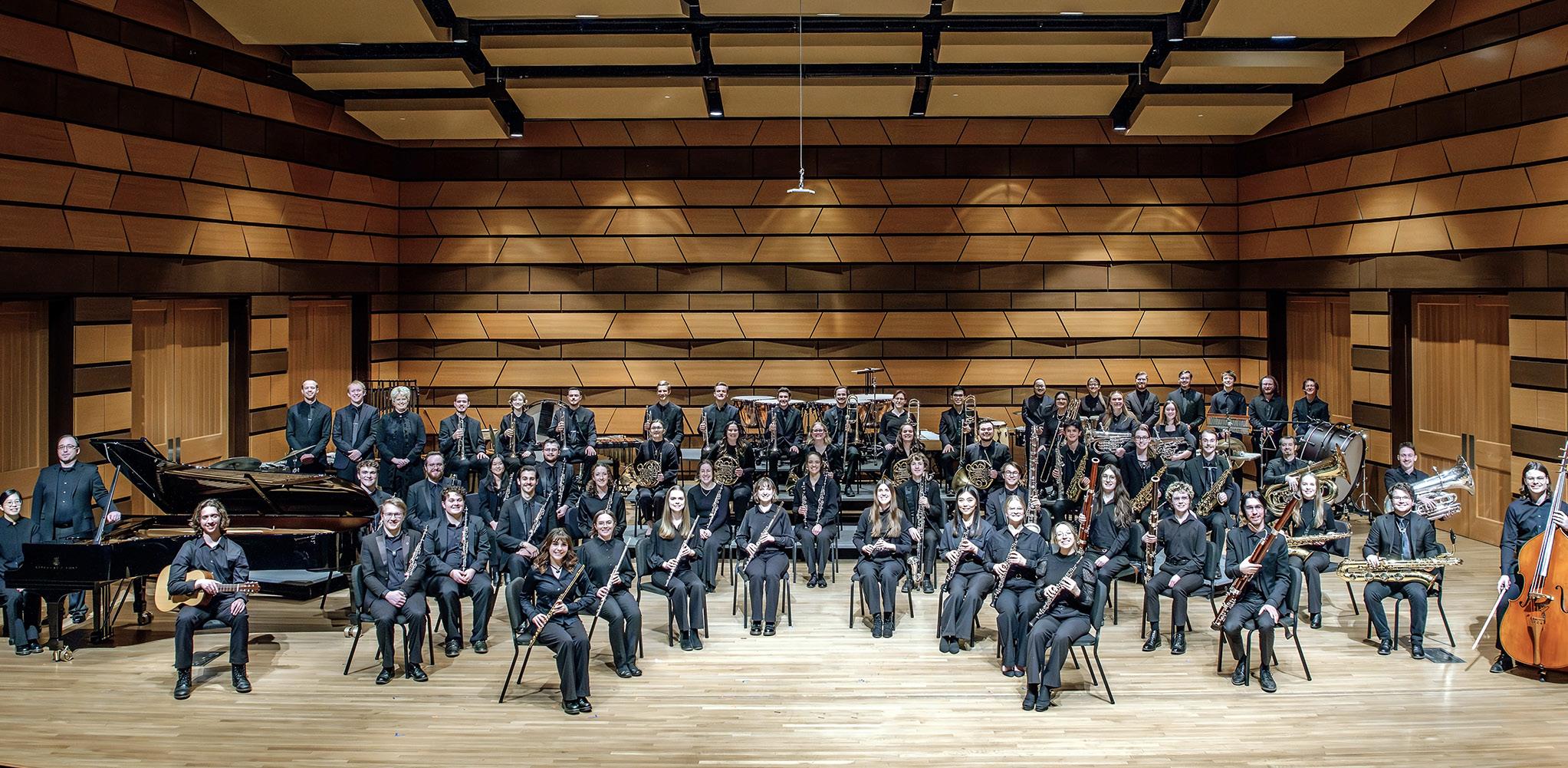
Piccolo/Flute
*Lydia Chinchilla Glen Ellyn, IL
Elizabeth Movinsky Lancaster, PA
Graduate Student
Graduate Student
Ella Patterson Longmont, CO Senior
Benjamin Rogers Aurora, CO Junior
Madison Tallman Colorado Springs, CO
Oboe
MM Performance
MM Performance
BM Performance
BM Performance
Graduate Student MM Performance
Amber Mills Pueblo, CO Sophomore
*Sarah Veldhuizen St. Louis, MO Senior
Olivia Zenzinger Arvada, CO Junior
Bb/Bass/Contra Bass Clarinet
CJ Ahlmann Broomfield, CO Freshman
Cole Boyd Fort Collins, CO Senior
Henry Buckley Loveland, CO Junior
William Edmundson Houston, TX Junior
Peter Hansen Elko, NV Graduate Student
Alex Hull Aurora, CO Sophomore
*Bradley Irwin Billings, MT
Graduate Student
Alex Pentlicki Rocky Ford, CO Junior
Orion Rayburn Fort Collins, CO Sophomore
Triston Told Fort Collins, CO Senior
Bassoon/Contra Bassoon
Charlie Beauregard Voorheesville, NY Senior
Ezekiel Graf Bemidji, MN Junior
*Evelyn Underwood Fort Collins, CO Senior
Alto/Tenor/Baritone Saxophone
Norah Artley Lakewood, CO Senior
*Sam Lumsden Memphis, TN Graduate Student
Amanda Manning Boise, ID
Graduate Student
Bailey Permenter Greeley, CO Sophomore
Horn
Zoe Huff Centennial, CO Senior
Colby Hutson Stillwater, OK Graduate Student
Jonah Loschky Shoreline, WA Sophomore
*Sophia Marino Boulder, CO Senior
Emma Tydeman Austin, TX Sophomore
Jenna Yonce Colorado Springs, CO Freshman
BM Music Education
BS Fish. & Aqu. Sci., Music Minor
BM Music Education
BM Perf./BS BioMed Sci.
BM Perf./BS Bus. Adm.
BM Perf./Comp.
BM Music Education
MM Performance
BM Music Education
MM Performance
BM Music Education
BM Perf./BS Mech Eng.
BM Performance
BM Performance
BM Music Education
BM Performance
BS Civil Engineering, Music Minor
MM Performance
MM Performance
BM Performance
BM Music Education
MM Performance
BM Performance
BM Perf./BS Zoology
BS An. Sci, Music/Chem. Minor
BM Music Education
Trumpet/Cornet
Lucy Bufton Fort Collins, CO Sophomore
Dylan Crabill Colorado Springs, CO Senior
Jaime Perez-Rosa Gunnison, CO Junior
*Adam Smith San Diego, CA Graduate Student
Lauren Smith Fruita, CO Sophomore
Bryce Wicks Fort Collins, CO Junior
Trombone/Bass Trombone
Elena Crooks Fort Collins, CO Junior
*Belle Hybertson Highlands Ranch, CO Junior
Carson Koch Colorado Springs, CO Sophomore
Andrew Zimbleman Arvada, CO Senior
Euphonium
Logan Amick Castle Pines, CO Freshman
*Isaac Schell Littleton, CO Freshman
Tuba
BM Music Education
BM Performance
BM Performance
MM Performance
BM Performance
BM Composition
BM Perf./BA Pol. Science
BM Perf./BA Pol. Science
BM Performance
BS Eco Sci & Sustain., Music Min.
BA Music/BS Bus. Adm.
BM Music Education
Arabella Dunnington Fort Collins, CO Junior Undecided
*Dr. Brian Sugrue Newtown, PA Guest Artist Faculty
String Bass
*Lucy McHugh Louisville, CO Sophomore
Piano
BM Performance
*Dr. Jooyeon Chang Seoul, South Korea Guest Artist Faculty
Celeste
Skyler Miller Fort Collins, CO Guest Artist Faculty
Percussion
*Cameron Becker Plano, TX Junior
Ellis Byrd Land O’Lakes, FL Graduate Student
Zayne Clappe Cortez, CO Senior
Dylan Ewing Longmont, CO Junior
Harrison Gelber Richmond, VA Graduate Student
Paige Lincoln-Rolfing Santa Barbara, CA Senior
Eddie Willett Windsor, CO Junior
Graduate Assistants
David Davis Gig Harbor, WA
Cameron Honnen Grand Junction, CO
Amanda Manning Boise, ID
Graduate Student
Graduate Student
Graduate Student
BM Music Education
MM Performance
BM Performance
BM Performance
MM Performance
BM Perf, BS Biomedical Science
BM Perf/Jazz, BS Business
MM Performance
MM Performance
MM Performance
*Principal
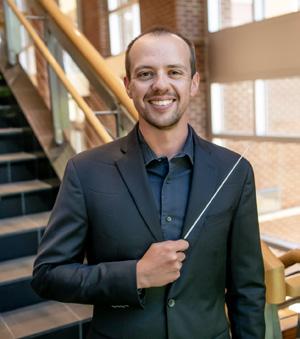
CAMERON HONNEN, a native of Grand Junction (Colorado), currently serves as a graduate teaching assistant for Colorado State University’s comprehensive band program. As part of his masters in music degree (conducting), Mr. Honnen is a guest conductor with the Wind Symphony, Symphonic Band, and Concert Band. His conducting teachers include Dr. Rebecca Phillips, Dr. Calvin Hofer, and Dr. Jonathan Hinkle. Other CSU GTA responsibilities include supporting the athletic bands, including the CSU Marching Band, Presidential Pep Band, and the Rampage Basketball Band, and managing the CSU Symphonic Band.
Mr. Honnen earned a Bachelor of Music Education degree from Colorado Mesa University (CMU) in 2017, graduating with honors. At CMU, he played bass trombone, tenor trombone, and euphonium in several ensembles, including the Wind Symphony, Jazz Ensemble, Symphony Orchestra, 12th Street Brass Quintet, and various jazz combos. He was also a founding member of the Maverick Stampede Marching Band and the Rowdy Brass Band, serving in leadership roles as visual captain, music captain, and drum major. In 2016, he received the Outstanding Leadership and Trailblazer awards.
Upon graduation, Mr. Honnen taught for seven years in western Colorado, first as Director of Bands at West Middle School (Grand Junction) for four years and then as Director of Bands (Fruita 8/9 Junior High School) and Assistant Director of Bands at Fruita Monument High School for three years. His programs included multiple concert bands, jazz ensembles, chamber groups, and marching bands. Under his leadership, groups consistently earned Superior ratings at festivals and twice received the “Exemplary Band” designation from the Colorado Bandmasters Association (CBA). In his first year of teaching, he was honored with the CBA Exceptional Young Educators Award and Scholarship.
A passionate marching band enthusiast, Mr. Honnen has been involved in the marching arts since the age of fifteen. He spent six years with the Troopers Drum & Bugle Corps, five as a euphonium player, section leader, and horn sergeant, and his final year as a drum major. In recognition of his leadership, he received the Jim Jones Leadership Award. Since 2017, Mr. Honnen has also taught and assisted with several high school marching bands and two world-class drum corps. His guidance helped the Fruita Monument High School Wildcat Band become a finalist for seven consecutive years, and his instruction contributed to the Troopers’ strong competitive showings in 2024 and 2025. As an adjudicator, Cameron has judged marching band competitions in the Rocky Mountain region, including competitions in Colorado, Wyoming, and Idaho.
Mr. Honnen is an accomplished bass trombonist. He has studied with Dr. Sean Flanigan and Dr. Drew Leslie. He performed with the Grand Junction Symphony Orchestra, Western Slope Jazz Orchestra, and Clark Gault’s Swing City Express. He also played on national tours for Felix Cavaliere’s Rascals and the Canadian Brass. As a CSU student, Mr. Honnen has been a performing member of the CSU Wind Symphony, the CSU Symphonic Band, the CSU Jazz Ensemble I, and the CSU Trombone Choir. Mr. Honnen is a member of the National Association for Music Education, the National Band Association, the College Band Directors National Association, Phi Beta Mu, and the Colorado Bandmasters Association.
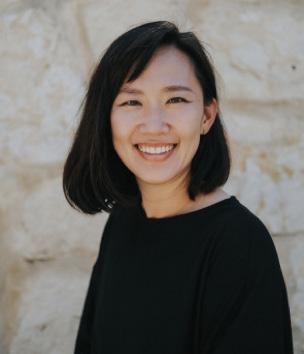
JOOYEON CHANG is a passionate and accomplished collaborative pianist who has actively performed across South Korea, France, the United Kingdom, Austria, Italy, Luxembourg, and the United States. Her extensive international experience has broadened her repertoire and deepened her artistry, allowing her to collaborate with a diverse range of soloists, chamber musicians, and ensembles.
Dr. Chang has appeared with world-renowned brass musicians, including tuba virtuosos Øystein Baadsvik and Roland Szentpali, as well as euphonium legend Steven Mead. Her collaborations also include performances with esteemed clarinetist Mark Nuccio and horn player Katy Woolley, showcasing her versatility and expressive range.
Dr. Chang has been a regular participant in the Jeju International Wind Ensemble Festival for over a decade and has performed at prestigious events such as the International Tuba Euphonium Conference (ITEC), ClarinetFest, and the International Horn Symposium. She is also a frequent performer at the Colorado Kodály Institute—where she serves as both a collaborative pianist and administrator—and the International Keyboard Odyssiad® & Festival (IKOF), where she has been invited as a performer and competition judge.
A dedicated educator, Dr. Chang is on the faculty of Colorado State University, where she teaches piano classes and coaches chamber music. Each semester, she collaborates on multiple faculty and guest artist recitals, numerous student recitals, and works closely with the University Chorus. She partners with 30 to 40 students per term, preparing them for juries and guiding their artistic growth through individualized coaching. She also engages CSU students by emphasizing the importance of ensemble collaboration, teaching them how to discover musical meaning within the score, and guiding them in crafting compelling musical narratives. Prior to CSU, she taught applied lessons to master’s students in Collaborative Piano at Chung-Ang University and Sungshin Women’s University in South Korea.
She actively performs with Hsin-Hsuan Lin as part of The Lin and Chang Piano Duo, presenting diverse and innovative programs to audiences worldwide. The duo has received enthusiastic support from the community each year, earning warm acclaim for their expressive performances. In recent seasons, they have appeared as invited artists at Jeju National University in South Korea.
Dr. Chang also collaborates with Sarah Hetrick as Duo Oenomel, with past performances at the University of Arkansas, University of Central Arkansas, Duquesne University, Sam Houston State University, and Texas A&M International University. In 2025, Duo Oenomel embarked on a Northern Colorado tour, including performances at CU Boulder, CSU, and the University of Wyoming, followed by a regional tour in Arkansas and Oklahoma.
Beyond her teaching and performing, Dr. Chang is deeply engaged in the musical community, organizing and participating in concerts and events that connect students, faculty, guest artists, and audiences. She is committed to fostering a dynamic and collaborative musical environment, delivering high-quality artistic experiences both on and off campus.
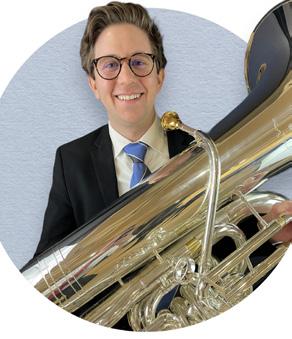
BRIAN SUGRUE currently serves as Instructor of Tuba and Euphonium at Colorado State University. A passionate educator and performer, he brings a broad range of musical experience to the CSU School of Music, Theatre, and Dance, with a background spanning solo, chamber, orchestral, wind band, and brass band performance.
Originally from Newtown, Pennsylvania, Dr. Sugrue holds a Doctor of Musical Arts in Brass Performance and Pedagogy from the University of Colorado Boulder, a Master of Music in Tuba Performance from the University of Miami Frost School of Music, and a Bachelor of Music Education from The Pennsylvania State University. His primary teachers include Ms. Velvet Brown, Dr. Aaron Tindall, and Mr. Michael Dunn.
As a performer, Dr. Sugrue has appeared both nationally and internationally, with performances across the United States, Spain, Austria, and the United Kingdom. He has performed with ensembles such as the Hartford Symphony Orchestra, Greeley Philharmonic, Arapahoe Philharmonic, and the Boca Raton Klezmer Company Orchestra. His appearances include major events such as the Fischoff International Chamber Music Competition, Music Teachers National Association (MTNA) competitions, the North American Brass Band Association (NABBA) Championships, International Tuba Euphonium Association (ITEA) regional and international conferences, the U.S. Army Band Tuba-Euphonium Workshop, and the Texas Music Educators Association (TMEA) Convention.
While attending Penn State, Dr. Sugrue was a founding member of the internationally recognized euphonium quartet FivE. Formed in 2012, the group gained sponsorship from Buffet Group USA and Besson USA, and became known for its innovative programming, original arrangements, and competition success — including being the first euphonium quartet invited to the Fischoff Competition. A strong advocate for the British brass band tradition, Dr. Sugrue has performed with notable ensembles including Colorado Brass and the Atlantic Brass Band, performing on euphonium, baritone, BBb bass, and currently Eb bass. Dr. Sugrue’s debut solo album, Songs of Travel, is available on Apple Music, Spotify, and YouTube. He performs on a Besson Prestige 2052 euphonium, Willson 3200S F tuba, and Yamaha YCB-632S CC tuba.
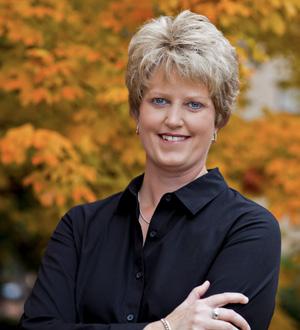
REBECCA L. PHILLIPS is Professor of Music and Director of Bands at Colorado State University where she conducts the CSU Wind Symphony and guides all aspects of the band and graduate wind conducting programs. She has served as guest-conductor, clinician, and performer throughout North America, Europe, and Asia. Highlights include conductor-in-residence with the United States Navy Band in Washington, D.C., the Department of Defense All-Europe High School Honor Band in Frankfurt, Germany, guest-conducting the “The President’s Own” United States Marine Band, and both professional and collegiate musicians in Prague (Czech Republic) for the “Prague Multicultural Music Project.” In addition, she has conducted members of the Prague National Symphony at the inaugural “2017 American Spring Festival” (Prague, Czech Republic). In 2018, she conducted members of the Des Moines Symphony in a chamber concert for the Iowa Bandmasters Association annual conference.
Dr. Phillips believes in treasuring the traditional wind music of the past as well as promoting cutting edge works of today’s finest composers. She has commissioned and conducted world and consortium premieres of works by several leading composers and her conducting performances have been featured on national and international recording labels. She regularly conducts intercollegiate and collegiate honor bands, all-state bands, and festival bands across the United States, Canada, and Europe and she has been a rehearsal clinician at the Midwest Clinic: An International Band and Orchestra Conference. In March 2025, her Colorado State University Wind Symphony traveled internationally on a performance tour of Spain (Madrid, Granada, Malaga) and ensembles under her direction have been featured at the 2020 Colorado Music Educators Association Convention, the 2019 American Bandmasters Association National Convention, the 2012 College Band Director’s National
Association Southern Division Conference, the 2010 Society of Composers International Conference, and the 2008 North American Saxophone Alliance International Convention.
As a trombonist, Dr. Phillips’ performances can be found on several internationally distributed recordings. She has performed with the National Symphony Orchestra, U.S. Army Band (Pershing’s Own), the Tallahassee Symphony, and the Tampa Bay Opera Orchestra. She has also performed internationally in England, Mexico, the Caribbean, Russia, and Sweden, and has toured as a trombonist with Johnny Mathis and Barry Manilow.
A native of the Washington, D.C. area, Dr. Phillips earned her Bachelor of Music Education degree from Florida State University, Master of Music degrees in conducting and trombone performance from the University of South Florida, and Doctor of Musical Arts in conducting at Louisiana State University. She served as a secondary school band director for seven years in Florida, including Director of Bands at Howard W. Blake Performing Arts High School in Tampa, Florida where she developed an award-winning concert band program. Prior to her appointment at CSU, she served as the Associate Director of Bands and Director of Athletic Bands at the University of South Carolina. She is a Past President of the National Band Association, serves on the Board of Directors for the American Bandmasters Association, served in various capacities with the College Band Directors National Association, and is on the college/university board for the Western International Band Clinic.
Violin
Ron Francois
Viola
Rose Wollman
Cello
Meredith Blecha-Wells
Bass Forest Greenough
Guitar
Jeff Laquatra
Flute
Ysmael Reyes
Michelle Stanley
Oboe
Galit Kaunitz
Clarinet
Wesley Ferreira
Saxophone
Peter Sommer
Dan Goble
Bassoon
Cayla Bellamy
Trumpet
Stanley Curtis
Horn
John McGuire
Trombone
Drew Leslie
Tuba/Euphonium
Brian Sugrue
Percussion
Eric Hollenbeck
Shilo Stroman
Harp
Kathryn Harms
Piano
Bryan Wallick
Tim Burns
Organ
Joel Bacon
Voice
Nicole Asel
Tiffany Blake
John Lindsey