
S c h o o l o f M u s i c , T h e a t e r , a n d D a n c e

C S U W i n d S y m p h o n y P r e s e n t s :


P r a y e r s a n d P o s t a g e
A G r a d u a t e C o n d u c t i n g C h a m b e r C o n c e r t b y D a v i d D a v i s

F e a t u r i n g m e m b e r s o f t h e
C o l o r a d o S t a t e U n i v e r s i t y W i n d S y m p h o n y

F r i d a y , M a r c h 1 3 , 2 0 2 6 2 : 3 0 P M
O r g a n R e c i t a l H a l l
C o l o r a d o S t a t e U n i v e r s i t y
I n c l u d i n g w o r k s b y :
D u k a s - M o z a r t - S t r a u s s - B i e d e n b e n d e r - T o r k e



PAUL DUKAS
Friday Afternoon, March 13, 2026 at 2:30pm
Organ Recital Hall, Colorado State University
The Colorado State University Wind Symphony Presents:
Prayers and Postage
A Chamber Concert
Featuring Members of the Colorado State University Wind Symphony
Conducted by David Davis Graduate Student Conductor
Fanfare from “La Péri” (1912)
WOLFGANG AMADEUS MOZART
Serenade No. 12 in C Minor, K. 388 (1782/83)
I. Allegro
II. Andante
RICHARD STRAUSS
Suite in Bb for Thirteen Instruments (1884)
I. Praeludium
DAVID BIEDENBENDER
Kyrie (for Machaut and Pärt) (2019)
MICHAEL TORKE
Overnight Mail (1997)
III. Saturday Delivery
This performance is given in partial fulfillment of the requirements of the degree, Master of Music in Instrumental Conducting
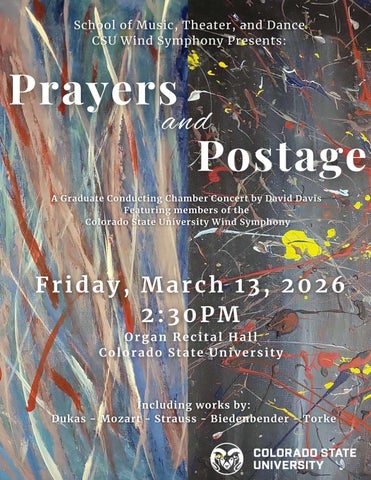
Cover artwork was gifted to me by two prior students, hung proudly in the Middleton High School band room for several years.
Fanfare from “La Péri”, (1912)
PAUL DUKAS
Born: 1 October 1865, Paris, France
Died: 17 May 1935, Paris, France
Duration: 2 minutes
Paul Dukas was a leading composer, critic, and scholar in fin de siècle France. While his mother was an experienced pianist, she died when Dukas was five, making her musical influence minimal. He eventually took up piano lessons, showing moderate talent, but few were convinced he had a future in music. His first attempt at composing came at fourteen, while he was home recovering from an illness. The effort proved promising, and his family permitted him to train as a musician. Dukas soon enrolled in the Paris Conservatory at sixteen, studying harmony with Théodore Dubois, piano with Georges Mathias, and composition with Ernest Guiraud. His first compositions were a pair of overtures based on Goethe's Götz von Berlichingen (1883) and Shakespeare's King Lear (1883). After several failed attempts to win the Prix de Rome, Dukas left the conservatory to spend a year in compulsory military service, during which he turned to music criticism. The years immediately following his return to civilian life held milestones in both areas of his career: His first premiere in Paris took place in 1891 with his overture, Polyeucte, followed shortly by his first performance review of Wagner’s Ring, published in the Revue hebdomadaire. As a composer, Dukas was harshly critical of his own work, publishing few of his works, abandoning many projects, and destroying nearly half of what he did complete. His reputation today rests on a few, well-received works, namely The Sorcerer’s Apprentice (orchestra), La Péri (ballet), Piano Sonata in E-flat minor, and Ariane et Barbe-bleue (opera). The last few decades of Dukas’ life were increasingly spent teaching; he taught orchestration at the conservatory, traveled to provincial schools as inspector of musical education, and eventually accepted a full-time position in 1928 as a professor of composition.
La Péri is a ballet, or Poème dansé, written in 1911 and dedicated to Natalia Trouhanova, a French dancer born in modern day Kiev. In this one-act work, Dukas tells the story of Iskender (Alexander the Great) and his quest for immortality. His search takes him to the ends of the earth, where he encounters a mythical Peri on the steps of a temple to Ormuzd, the Zoroastrian god of the sky. Iskender succeeds in stealing a Flower of Immortality from the Peri as it sleeps, but is foiled as Ormuzd transforms the flower, condemning Iskender to die. Dukas wrote the Fanfare pour précéder La Péri the following year in 1912, possibly in an effort to give the audience time to be seated. It was one of his last works to be published.
Serenade No. 12 in C Minor, K. 388, Mvt. 1–2 (1782/83)
WOLFGANG
AMADEUS MOZART
Born: 27 January 1756, Salzburg, Austria
Died: 5 December 1791, Vienna, Austria
Duration: 12 minutes
Few composers in his era were as prolific as Mozart, especially considering his early passing at thirty-five years of age. As a child he learned violin, keyboard, and composing from his father, Leopold, who was an established musician, theorist, and teacher Mozart flourished under his father’s instruction, writing his first symphony at age nine and his first opera at twelve. In 1762, Mozart toured Europe with his sister, Nannerl, as child prodigies, visiting Germany, France, England, Holland, and Italy. A true virtuoso, Mozart quickly acquired notoriety performing his own works, sightreading concertos, and improvising variations and fugues. These travels exposed
Mozart to a variety of prominent composers, musicians, and styles in a formative period of his life. From 1772-1780 he found employment under the patronage of Archbishop Colloredo, primarily composing sacred music. This position proved ill-fated; Mozart longed for more liberty to compose instrumental and operatic works and traveled often in search of employment elsewhere. Colloredo was displeased by Mozart’s meager output for the church and frequent attempts to resign. Tensions came to a head in 1781 when Mozart was summoned but not permitted to perform for the visiting Emperor Joseph II, treated as a servant rather than musician. Demanding discharge, Mozart was quite literally “kicked” out of service and began freelancing in Austria. He spent the next several years performing, teaching private students, and publishing music to support himself. In 1787, Mozart was appointed chamber music composer to Emperor Joseph II, providing a meager, but steady source of income. Mozart died in 1791 from a severe fever.
Mozart’s music is the quintessential example of a gallant, classical style, showing formal clarity, traditional use of key relationships, melodic repetition/sequencing, and regular phrase lengths. His treatment of melodies can be attributed to his inspiration from the Italian style he experienced in his travels, giving them a song-like aspect Mozart’s total output includes twenty operas, seventeen masses, fifty-five symphonies, twenty-three piano concertos, twenty-six string quartets, numerous chamber works and solo piano works.
Serenade No. 12 was composed during Mozart’s time as a freelance in Vienna. While other serenades often contained five or more movements, No. 12 has only four, resembling the structure of a classical symphony. Additionally, the use of a minor tonal center for three out of four movements is also unique for its time. Movement one (Cm) and movement two (Eb) both utilize sonata form with shortened development sections.
Suite in Bb for 13 Instruments, Op. 4, Mvt. 1 (1884)
RICHARD STRAUSS
Born: 11 June 1864, Munich, Germany
Died: 8 September 1949, Garmisch-Partenkirchen, Germany
Duration: 7 minutes
Richard Strauss grew up in a comfortable lifestyle with an early start to his musical training. His mother, Josephine Pschorr Strauss, was the daughter of a wealthy Munich brewer and his father, Franz Strauss, was principal horn in the Munich Court Orchestra. Richard began playing piano at age four and was writing music at six. His father was musically conservative-minded, bringing his son up on classical works like Beethoven and holding disdain for “music of the future,” like Wagner. Much of the young Strauss’s early compositions were lieder, piano pieces, and chamber works, such as his Serenade in Eb and his Violin Concerto in D minor. Hans von Bülow, director of the Meiningen Orchestra, was instrumental in programming and commissioning Strauss’ early works at a formative stage of the composer’s career.
Throughout his life, Strauss established himself as a conductor as well as composer. In 1885, von Bülow appointed Strauss as assistant conductor, soon promoting him to primary conductor. During his time with the Meiningen Orchestra, Strauss gravitated towards the music of Brahms and Wagner, much to his father’s disappointment Only five months later, Strauss left this role for a position as third conductor in the Munich Court Opera House. The reduced workload allowed Strauss to prioritize his music, resulting in Aus Italien and Macbeth, early tone poems inspired by the symphonic poems of Franz Liszt. Strauss first attempted opera in 1894 with Guntram, inspired by his studies of Nietzsche and Schopenhauer. It would not be until 1905 that Strauss found success
in the opera house with his scandalous production of Salome Elektra and Der Rosenkavalier soon followed, both in collaboration with playwright Hugo von Hofmannsthal.
The final twenty years of Strauss’s life are darkened by his involvement with the Nazi Party. Private communications indicate a clear disdain he had for the movement, but nevertheless Strauss was appointed as president to the Reichsmusikkammer (Reich Music Chamber), an arm of the government for regulating music within Nazi Germany. In 1933, Strauss replaced Arturo Toscanini as director of the Bayreuth Festival, after he resigned in protest. Strauss similarly stepped in to conduct the Berlin Philharmonic after Bruno Walters, a Jewish conductor, was removed from his position. Because of Strauss’s domestic and international acclaim, these public actions granted legitimacy to the Nazi Regime, in spite of his personal beliefs.
Strauss wrote his Suite in Bb for 13 Instruments, Op. 4 following the success of his earlier Serenade in Eb. Hans von Bülow was impressed by the young composer’s music and commissioned Strauss to write a second work with the same instrumentation. Strauss conducted the Meiningen Orchestra on premiere of the Suite, without rehearsal, on November 18, 1884. His successful conducting debut earned him an invitation from von Bülow to serve as assistant conductor, kickstarting Strauss’s career as a conductor.
Kyrie (for Machaut and Pärt) (2019)
DAVID
BIEDENBENDER
Born: 28 September 1984, Waukesha, Wisconsin
Duration: 5 minutes
David Biedenbender ’s first experiences in music originate in the Lutheran church, where he sang in the choir and watched his mother perform as an organist. He describes his high school years as “including lots of low end,” learning euphonium, bass trombone, tuba, and electric bass. In his junior year, Biedenbender met David Gillingham, then a professor of composition at Central Michigan University (CMU), who inspired him to attempt his first original composition. The result was a thirteen-minute work based on the liturgical Passion Week, which Biedenbender conducted with his own high school band. After graduating he accepted an invitation from Gillingham to study composition at CMU. Following his undergraduate studies, Biedenbender attended the University of Michigan for his graduate and doctoral degrees. As a teacher of theory and composition, Biedenbender has held positions at Oakland University, Madonna University, Boise State University, and currently, Michigan State University.
Biedenbender writes most frequently for wind band, chamber, and solo instrumental mediums. Other genres in his cumulative output include voice, choral, jazz, electroacoustic, and opera. His diversity in instrumental mediums is intentional, claiming his writing is stronger by living a “rich and varied artistic life.” He draws inspiration from a variety of sources, ranging from geographical locations, literature, his family, and pop culture. Biedenbender likens his works to conversation across time and discipline, calling them statements of “I love what you did, here is my response.” Biedenbender’s music has been recognized with many of the most prestigious awards for instrumental music, including the 2024 NBA William D. Revelli Memorial Award (Enigma), the 2024 and 2019 Sousa-ABA-Ostwald Award (River of Time/Unquiet Hours), and the 2018 ASCAP Foundation Rudolf Nissim Prize (Cyclotron).
Kyrie (for Machaut and Pärt) was originally composed in 2015 as the second movement to Biedenbender’s reed quintet, Refraction, in which he wrote three distinct movements inspired
by musical sources “bent by space and time ” The Kyrie was dually inspired by sources old and new: The polyphonic textures and chant-like phrases call back to the sacred music of medieval Europe. Biedenbender also imitates the the tintinnabuli style of writing made famous by twentieth century composer, Arvo Pärt, featuring arpeggiating soprano voices over stepwise bass melodies The chamber version for thirteen winds comes from Tyler Austin in 2019, arranged in four antiphonal groups to create stereo effects accentuating the echoing figures pervasive in this work.
Overnight Mail, Mvt. 3 (1997)
MICAEL TORKE
Born: 22 September 1961, Milwaukee, Wisconsin
Duration: 2 minutes
Michael Torke is an American composer known for blending jazz idioms and with minimalist textures. Torke studied at the Eastmen School of Music with Joseph Schwantner and Christopher Rouse. While enrolled at Yale, Torke cut his graduate studies short to pursue a professional career in New York. In the years following, he was signed by Boosey and Hawkes, became an exclusive recording artist with Argo/Decca Records, and collaborated with the New York City Ballet. Significant compositions by Torke include his nine “color pieces” for varying instrumental mediums, each of which explores a single, specific color, as well as his orchestral work, Javelin, which was featured in John Williams’ Summon the Heroes, the official album for the 1996 Olympics. In 1998, Torke was appointed Associate Composer of the Royal Scottish National Orchestra, leading to the commission and premiere of several works such as Book of Proverbs, Rapture, and An American Abroad. Additionally, Torke founded Ecstatic Records in 2003, acquiring the rights to re-issue his catalog of works previously released under Argo/Decca.
Torke writes for virtually every instrumental and vocal medium and has been commissioned by major ensembles around the world, including the Philadelphia Orchestra, New York Philharmonic, San Francisco Symphony, New York City Ballet, National Ballet of Canada, Metropolitan Opera, and London Sinfonietta Throughout his career, he has collaborated with several renowned conductors like Simon Rattle, Marin Alsop, and Edo de Waart.
Overnight Mail was commissioned in 1997 by Orkest de Volharding (Netherlands) for their twenty-fifth anniversary. Torke orchestrated the piece for the instrumentation of this group, featuring thirteen total players in a quasi-jazz ensemble including flute and French horn. Each movement is titled after a shipping expediency option, which Torke likens to his compositional dilemma of how to resolve dissonance. He expresses a desire to follow the voice-leading standards of classical music while avoiding an archaic-sounding result, an approach he believes somewhat radical in today’s music. The third movement, “Saturday Delivery,” features what he refers to as the “horn section,” a reoccurring trio of alto saxophone, trumpet, and trombone, frequently playing together in octaves