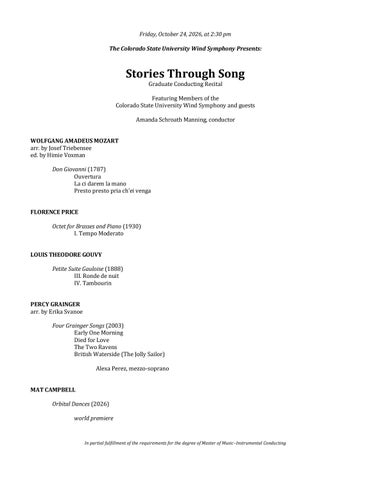
Friday, October 24, 2026, at 2:30 pm The Colorado State University Wind Symphony Presents:
Stories Through Song Graduate Conducting Recital
Featuring Members of the Colorado State University Wind Symphony and guests Amanda Schroath Manning, conductor WOLFGANG AMADEUS MOZART arr. by Josef Triebensee ed. by Himie Voxman Don Giovanni (1787) Ouvertura La ci darem la mano Presto presto pria ch’ei venga FLORENCE PRICE Octet for Brasses and Piano (1930) I. Tempo Moderato LOUIS THEODORE GOUVY Petite Suite Gauloise (1888) III. Ronde de nuit IV. Tambourin PERCY GRAINGER arr. by Erika Svanoe Four Grainger Songs (2003) Early One Morning Died for Love The Two Ravens British Waterside (The Jolly Sailor) Alexa Perez, mezzo-soprano MAT CAMPBELL Orbital Dances (2026) world premiere
In partial fulfillment of the requirements for the degree of Master of Music–Instrumental Conducting
NOTES ON THE PROGRAM Don Giovanni (1787) WOLFGANG AMADEUS MOZART arr. by Josef Triebensee ed. by Himie Voxman Born: 27 January 1756, Salzburg, Austria Died: 5 December 1791, Vienna, Austria Duration: 14 minutes During his time as Konzertmeister in Salzburg, Mozart went on three major tours to Italy. Throughout those tours, he was exposed to and heavily influenced by Italian opera, kindling his love for lyrical melodies and themes found therein. Don Giovanni was composed in the wake of the success of Mozart’s Le nozze di Figaro, composed the previous year (1786). Initially written as a one-act opera by Giuseppe Gazzaniga to a libretto by Giovanni Bertati in 1787, Mozart expanded on this version (likely at the request of Impresario Guardasoni), employing Lorenzo Da Ponte to improve upon Bertati’s libretto. The initial premiere date of this new version (14 October 1787) was postponed due to inadequate preparation of the production, and the true premiere was given on 29 October 1787 at the Prague National Theatre and was a success with audiences from the start, becoming the most popular Mozart opera. Josef Triebensee, son of distinguished oboist Johann Georg Triebensee, was born November 21, 1772. Josef learned the oboe from his father and played at the Karntnertortheater in Vienna from 1791-1794, then the National Theater from 1794-1796. He also took composition lessons with J. C. Albrechtsberger and began composing during his time as the leader of the octet of Prince Alois Liechtenstein (1796). Eventually he succeeded Carl Maria von Weber as director of the opera in Prague (1816) and stayed until his retirement in 1838. The date of his transcription of Mozart’s Don Giovanni for winds is unknown, but must have been completed after May 7, 1788 because of its inclusion of two additions Mozart made for the first Vienna performance on that date. Don Giovanni tells the story of Giovanni, the rapscallion who constantly seeks the attention and affections of any and every woman in his midst. The opera opens with a murder as the father of Donna Anna (one of Giovanni’s lustful victims) tries to intervene with Giovanni’s advances on his daughter. After the Commendatore’s death (her father), Donna Anna swears revenge on Giovanni. The next day, Giovanni meets the peasant bride Zerlina, who is soon to be wed to Masetto, and invites her and other peasants to his house, and offers to marry her. Donna Anna recognizes Giovanni (who was in disguise the previous night), unmasks him, and along with other jilted women, denounces him. However, he escapes along with henchman Leporello and they find refuge in a nearby cemetery, hiding from an armed and angry Masetto and his group of peasants. There in the cemetery they hear the ghostly voice of the Commendatore coming from the statue of his grave. As a joke, they invite him to dinner, and the ghostly statue accepts. Giovanni is called upon to repent of his sins, but he refuses, and the Commendatore engulfs him in flames and Giovanni is dragged down into the underworld. The three movements being performed today are the overture, or introduction to the opera, La ci darem la mano (“There we will hold hands”), and the finale to act one. La ci darem la mano is the duet between Giovanni and Zerlina when he tries to convince her of marriage (even though she loves Masetto). The bassoon begins with the melody and represents Giovanni’s voice in an attempt to seduce Zerlina, whose voice is represented by the oboe as she contemplates the offer and slowly gives in to his advances. The lyrics read as follows (translated into English): There we will hold hands, There you will say yes to me: You see, it’s not far, Let’s go, my dear, from here. I would like to and I would not like to, My heart trembles a little, It’s true that I would be happy, But he can mock me still! Come, my lovely delight! Masetto takes pity on me.
I will change your fate. Quickly… I cannot resist any longer. Let’s go! Let’s go! Let’s go, let’s go, my love, To redeem the sufferings Of an innocent love. The finale of act one depicts several scenes, including the ballroom at Giovanni’s house where Giovanni and Leporello entertain the peasants and dance, and when Zerlina and Donna Anna unmask Giovanni, condemn him, and he finally makes his escape. Octet for Brasses and Piano (1930) FLORENCE PRICE Born: 9 April 1887, Little Rock, Arkansas Died: 3 June 1953, Chicago, Illinois Duration: 4 minutes 30 seconds Initially learning piano from her mother, Florence Price’s first piano performance was at age 4, and she wrote her first composition when she turned 11. At age 14 she started at the New England Conservatory (Boston) where she learned composition, gained an Artist’s Diploma (organ) and a piano teacher’s certificate. She went on to teach at several colleges, including Clark College (Atalanta) where she became the head of the music department. In 1912, she married Thomas J. Price, and in 1927 they moved to Chicago to escape racial oppression in the South. In Chicago, she studied at the American Conservatory and the Chicago Musical College. After moving in with her friend (and student) Margaret Bonds, she became connected with writer Langston Hughes and contralto Marian Anderson, who both heavily influenced her compositions. In 1932, Price won 1st prize in the Wanamaker Competition for her Symphony in E minor, winning $500. Symphony in E minor was premiered in 1933 by the Chicago Symphony Orchestra, making Price the first African-American woman to have an orchestral work performed by a major American orchestra. Octet for Brasses and Piano, though composed in 1930, was only discovered in 2009 along with a substantial collection of Price’s works and papers in her abandoned summer home near St. Anne, Illinois. Because of this, little is known about the piece or its origins. It is, however, evident that Price’s music contains a lot of spirituals and dance music in combination with classical forms. Price’s musical career was filled with arranging popular music for commercial purposes, arranging spirituals, and incorporating her African-American heritage into her music. Octet for Brasses and Piano is no exception to these musical ideas—it contains blues-inspired characteristics, colorful harmonies, and syncopated gestures. Petite Suite Gauloise (1888) LOUIS THEODORE GOUVY Born: 5 July 1819, Goffontaine, Prussia Died: 21 April 1898, Leipzig, Germany Duration: 3 minutes Louis Theodore Gouvy had very little musical talent or training as a child and moved to Paris in 1836 to study law. While studying, he took piano lessons from Billard and decided he enjoyed music more than law school (which he failed anyway). In 1841 he began studying piano with Pierre Zimmerman, took theory lessons with Elwart, and spent several months in Berlin studying with composer-conductor C. F. Rungenhagen, where he published his first works. His first symphony was performed in Paris (1846) by an amateur orchestra, and he spent much of the beginning of his career having his works performed at his own expense. Gouvy began to frequent Germany upon discovering that audiences there enjoyed his music more than opera-crazed Paris. Much of Gouvy’s 90+ compositions were instrumental (including chamber works, and piano solos and duets), with a transition later in his life to choral music.
Gouvy’s Petite Suite Gauloise was composed three years after Gounod’s Petite Symphonie, which was commissioned by Paul Taffanel. It is assumed that Gouvy’s piece was likely also commissioned by Taffanel, since it utilizes the same instrumentation. The Petite Suite Gauloise contains four movements that are reminiscent of the baroque suites. Movement three begins with a signal call in the horn, then a minor, mischievous melody is brought to light. Known for his lively and attractive melodies, Gouvy’s fourth movement is an upbeat dance with playful emphasis on beat two throughout—most unusual for a dance movement, but nonetheless intriguing. Four Grainger Songs (2003) PERCY GRAINGER arr. Erika Svanoe Born: 8 July 1882, Brighton, Victoria Died: 20 February 1961, White Plains, New York Duration: 10 minutes Brought up in Melbourne, Australia, Grainger learned piano from his mom at an early age, making his debut as a pianist in 1894. Upon moving to Europe, he studied at the Hoch Conservatory (Frankfurt) with James Kwast (piano) and Iwan Knorr (composition and theory) from 1895-1901. In 1901 he moved to London, and spent many years collecting, transcribing, and arranging English folk songs with the use of the phonograph. He spent the remainder of his career in the United States, serving in the United States Army (playing oboe, soprano saxophone, and as a band instructor) and as an educator and performer, lecturing and performing in schools, colleges, and community ensembles. Erika Svanoe, born in 1976 in Whitewater, Wisconsin, is an educator, conductor, and composer for wind band. She holds a Bachelor of Music Education from the University of Wisconsin–Eau Claire, a Master of Music in Wind Conducting from Oklahoma State University, and a Doctor of Musical Arts in Conducting from The Ohio State University. Spending much of her early career arranging music for practical use as an educator, this arrangement of four of Grainger’s songs was completed as part of an independent creative project accomplished while attending her graduate studies at Oklahoma State University, and remains her earliest published work. Each song is arranged for mezzo-soprano voice and wind accompaniment. The songs move through themes of love, loss, music, and nature, each song with its own personality and story to tell. Early One Morning Early one morning, just as the sun was rising, I heard a maid sing in the valley below. "O don't deceive me! O never leave me! How could you use a poor maiden so?" Remember the vows that you made to your Mary, Remember the bow'r where you vow’d to be true. "O don't deceive me, O never leave me! How could you use a poor maiden so?" Died For Love I wish my baby it e was born, Lyin' smilin' on its father's knee, And I was dead and in my grave And green grass growin' all over me. Dig me my grave long, wide and deep, Put a marbil stone at my head and feet; But a turtle white dove put over above For to let the world know, that I died for love.
The Two Ravens As I was walking all alane, I heard two ravens making a mane; The tane unto the t’other say, “Where sall we gang and dine today?” In behint you auld fail dyke, I wot there lies a new slain knight; Naebody kens that he lies there, But his hawk, his hound, and lady fair. His hound is to the hunting gane, His hawk, to fetch the wild foul hame, His lady’s ta’en another mate, So we may make our dinner sweet. Ye’ll sit on his white hause bane, And I’ll pike out his bonny blue een; Wi’ ae lock o’ his gowden hair We’ll theek our nest when it grows bare. Mony a one for him makes mane, But nane sall ken whare he is gane: O’er his white banes, when they are bare, The wind sall blaw forever mair. British Waterside (The Jolly Sailor) Down beyond the British waterside, as I walked along, I overheard a fair maid, she was singing a song. The song that she did sing, and the words replied she: "Of all the lads in England is the sailor lad for me." You may know a jolly sailor lad as he walks down the street, He is so neat in his clothing, and so tight on his feet. His teeth are white as ivory and his eyes black as sloes; You may know a jolly sailor boy by the way that he goes. North Yarmouth is a pretty place, it shines where it stands; The more I look upon it the more my heart burns If I was at North Yarmouth I should think myself at home, For therе I have sweethearts and herе I have got none. I'll go down to yon British waterside and build my love a touwer Where the lords, dukes and skewiers may all it admire. The King can but love the Queen, and I can but do the same; But I shall be the shepherdess andell you will be my swain.
Orbital Dances (2026) MAT CAMPBELL Born: 1992, Harlingen, Texas Currently resides in Austin, Texas Duration: 3 minutes Mat Campbell earned his Bachelor of Music in Education degree from The University of Texas Rio Grande Valley, then subsequently taught as a percussion director in Texas. He earned a Master of Music in Music Composition and Conducting at Oklahoma City University and has been a part of the Juilliard Extension for film scoring program under Dr. Rick Baitz. In addition, he was selected for a Bluecoats Fellowship in 2025. Campbell has conducted his own works at The National Flute Convention, ClarinetFest, and the Texas Music Educators Conference. He has also had his music performed at the National Conference of Percussion Pedagogy, the inaugural Central Washington University New Music Festival, and The Midwest Clinic. His piece Into the Void: A Study in Disembodied Consciousness received first prize in the SATB Chorus and Percussion (3-5 Players) Category of the Percussive Arts Society Composition Contest (2015), and he is currently a member of the Percussive Arts Society Composition Committee. Campbell also serves the wider music industry as a voting member of the Recording Academy/GRAMMYs. His newest composition, Orbital Dances, was composed as a finale for tonight’s program, as commissioned by Amanda Schroath Manning (conductor). This composition is made up of two brass quintets (with percussion) representing two celestial bodies. In the words of the composer, “Orbital Dances paints a sonic landscape of celestial bodies dancing around one another in their respective orbits.” This elegant composition portrays how these two separate but similar beings interact with one another, mimic one another, and represent the curious parts of earth’s solar system. Campbell notes that “perhaps my favorite part of the piece is the spaced-out musicians (pun intended) “tugging” on the listener’s ears in various ways, representing the gravity of each celestial body as it moves through space and time.” All of this culminates in a bombastic, majestic ending comparable to the awe-inspiring glory of space and the celestial beings therein.
Colorado State University Wind Symphony Personnel Flute Benjamin Rogers Karin Sotillo
Aurora, CO Denver, CO
Senior Senior
BM Performance BM Performance
Oboe Lexi Miller Amber Mills Olivia Zenzinger
Manhattan, MT Pueblo, CO Arvada, CO
Graduate Student Junior Senior
MM Performance BM Music Education BM Music Education
Bb/Bass Clarinet Henry Buckley Peter Hansen Orion Rayburn Elizabeth Sapp
Loveland, CO Elko, NV Fort Collins, CO Monument, CO
Senior Graduate Student Junior Freshman
BM Perf./Comp. MM Performance BM Performance BM Performance
Bassoon Rachael McReynolds Brody Ramirez Evelyn Underwood
Loveland, CO Windsor, CO Fort Collins, CO
Freshman Sophomore Senior
BM Music Education BM Perf./BS Elec. Engin. BM Performance
Alto Saxophone Bailey Permenter
Greeley, CO
Junior
BM Performance
Horn Kaleb Harris Jonah Loschky Sophia Marino Emma Tydeman Jenna Yonce
Broomfield, CO Shoreline, WA Fort Collins, CO Austin, TX Colorado Springs, CO
Freshman Junior Senior Junior Sophomore
BM Performance BM Performance BM Perf./BS Zoology BS An. Sci, Music/Chem. Minor BM Music Education
Trumpet Lucy Bufton Adam Smith Lauren Smith Hannes Spiller
Fort Collins, CO San Diego, CA Fruita, CO Fort Collins, CO
Junior Graduate Student Junior Junior
BM Music Education MM Performance BM Performance BM Performance
Trombone Wyatt Bond Carson Koch Silas Riep
Houston, TX Colorado Springs, CO Fort Collins, CO
Graduate Student Junior Junior
MM Performance BM Performance BM Performance
Tuba Evan Allenson Arabella Dunnington
Louisville, CO Fort Collins, CO
Graduate Student Senior
MM Performance BM Performance
String Bass Lucy McHugh
Louisville, CO
Junior
BM Performance
Piano Reynaldi Raharja
Semarang, Indonesia
Graduate Student
MM Performance
Percussion Cameron Becker Sam Christensen Dylan Ewing Harrison Gelber Simon Nguyen
Plano, TX Golden, CO Longmont, CO Richmond, VA Grand Prairie, TX
Senior Sophomore Senior Graduate Student Graduate Student
BM Music Education BM Perf./BM Comp. BM Performance MM Performance MM Performance
Voice Alexa Perez
Pittsburgh, PA
Graduate Student
MM Performance
Alexa Perez is a mezzo-soprano pursuing a Master of Music in Voice Performance at Colorado
State University. She holds a bachelor's degree in Music Education and Vocal Performance from the University of Northern Colorado. Alexa feels comfortable on a variety of stages and has been heard performing opera, musical theatre, and choral music, with an appearance at Carnegie Hall. Alexa is a two-time first-place winner at the Colorado-Wyoming National Association of Teachers of Singing competition, earning honors in Musical Theatre and Classical Voice. Alongside her performing career, Alexa has been an elementary school music teacher and on the music staff in multiple churches across Colorado. She is grateful for the support of her teachers, family and fiancé, John, whose encouragement continues to inspire her musical journey.
Mathew “Mat” Aaron Campbell (b. 1992) originally hails from the La Hermosa barrio in San Benito, a small town in the Rio Grande Valley in Deep South Texas. After learning to make the most of his limited resources, he has turned to using his unique, speech-impeded voice to build a career of collaborative opportunities between the Rio Grande Valley and the rest of the world.
He earned his Bachelor of Music in Education from The University of Texas Rio Grande Valley, where he studied with multiple teachers, including percussion and composition with Dr. Joe W. Moore III. After teaching as a percussion director in Texas, Campbell attended Oklahoma City University and graduated with High Honors and induction into the Alpha Upsilon Chapter of the Pi Kappa Lambda Society. He earned a Master of Music in Music Composition and Conducting in two years under Dr. Edward Knight and Dr. Matthew Mailman, respectively. In his continued pursuit of knowledge and experience, Mat has continued his education through programs such as Juilliard Extension for film scoring with Dr. Rick Baitz and was selected to participate in the coveted Bluecoats Fellowship in 2025.
In addition to concentrating on sound design with Dr. Matt Jordan, he immersed himself in the drum corps activity as a whole through collaborating with and learning from the Bluecoats Drum and Bugle Corps, Directors, Design Team, Staff, and Cohort of Fellows. As a regularly commissioned composer, guest conductor, and adjudicator, Mat has collaborated with various educators and musicians throughout the United States. He has conducted his works at The National Flute Convention, ClarinetFest, and the Texas Music Educators Conference. His music has been programmed by conductors and ensembles in the United States, Australia, Canada, Europe, and Asia, and at events such as the National Conference of Percussion Pedagogy, New Music on the Bayou, the Inaugural Central Washington University New Music Festival, and various instrumental conferences such as The Midwest Band and Orchestra Clinic in Chicago. His music has been reviewed in publications such as Percussive Arts Society’s Percussive Notes and International Clarinet Association’s The Clarinet, included on the Bandworld Top 100 List, and received the J.W. Pepper Editor’s Choice moniker. His concert music is available for purchase through C. Alan Publications and for streaming on major platforms, alongside his music for film, video games, and more. His piece Into the Void: A Study in Disembodied Consciousness received first prize in the SATB Chorus and Percussion (3-5 Players) Category of the 2015 Percussive Arts Society Composition Contest. In his dedication to providing other composers this opportunity, he currently serves as a member of the PAS Composition Committee. In addition to his contributions to the percussion community, he serves the wider music industry as a voting member of the Recording Academy / GRAMMYs. While forming an ever-evolving freelance career as a creative, Mat uses his proficiency in notation and music production software to elevate his solo creative ambitions or projects with others in various capacities to the next level. Over time, this list has grown to include the roles of arranger, sound designer, engraver, and collaborator across stage, studio, field, and genre. Website: www.matcampbell.com
Amanda Manning, originally from Boise, Idaho, is in her second year as a Graduate
Teaching Assistant at Colorado State University, pursuing a Master’s degree in Instrumental Conducting. At CSU, she assists with the administration of a comprehensive band program, including teaching, recruiting, and operational activities. She has been a guest conductor with the CSU Concert Band, Symphonic Band, and Wind Symphony. In addition, she assists with the Colorado State University Marching Band, Presidential Pep Band, and the Rampage Basketball Band. From 2022–2025, she was the director of bands at Springville High School in Springville, Utah, where she led the Jazz Bands, Concert Bands, Percussion Ensemble, Pep Band, and Marching Band. During her time at Springville, she expanded the size of the band program and added a second Jazz Band. In addition, she co-directed the Symphony Orchestra and Pit Orchestra. Under her direction, the Wind Symphony was consistently selected to participate in the State Band Festival and performed at the BYU Music for All Concert Band Festival in 2024 and 2025. The Marching Band also took 3rd place at the Red Rocks State Marching Band Competition in 2024. Manning won Teacher of the Year from the American Legion at the district, region, and state levels in 2023. In 2025, she was asked to serve on a leadership discussion panel for the National Association for Music Education Sierra Summit Leadership Conference in Las Vegas, Nevada alongside the current NAfME President, Deborah Confredo. Manning is also a co-founder and former director of the Art City Community Band in Springville and served as the Utah Music Educators Association Social Media Manager and State Band Manager from 2024–2025. In 2021, Manning graduated with a Bachelor of Music in Music Education from Brigham Young University, where she was President of the BYU CNAfME chapter. As President of the BYU Wind Symphony, she won the BYU Robert Sauer award for performance, service, and esprit de corps. She also performed on tour with the Wind Symphony across the state of Texas, including performances in Dallas, San Antonio, Houston, and Austin. As a section leader in the marching band, she performed at the Las Vegas Bowl and Idaho Potato Bowl. She also was an on-call saxophonist for the Timpanogos Big Band. While attending BYU she was awarded several school of music scholarships, school of education scholarships, and academic scholarships.
Manning has studied conducting with Dr. Donald Peterson (BYU), Dr. Kirt Saville (BYU), and Dr. Rebecca Phillips (CSU). She has also worked with retired Colonel Jason Fettig, Alfred Dentino, Damon Talley, Michael Haithcock, Edward Cumming, Adam Lambert, Professor Jerry Junkin, Dr. Richard Floyd, and Dr. Mallory Thompson. She studied piano with Steven Slaughter from 2003 to 2015 and with Dr. Robin Hancock (BYU) in 2020. As a saxophonist, Manning has studied with Rodney Zuroeveste (BSU), Dr. Ray Smith (BYU), Daron Bradford (BYU), and Professor Peter Sommer (CSU). She won 3rd place and 1st place at the Idaho State Solo competition in 2014 and 2015, respectively. In addition, she was a member of the Idaho All State Band in 2014 and 2015. Manning has served as a Music Chair, pianist, and chorister in her church congregation, and served a full-time service mission for her church from 2016-2018. In her very rare spare time, she loves playing pickleball, riding rollercoasters, and spending time with her husband, Chad.
Thank you to Benjamin Corneliusen, Daniel Mielke, and event staff for making this production possible!