Denver, Colo.
VOTER GUIDE on Prop NN Bargaining
WINS
Fall 2026
Vol. 142, No. 1
Contents
CEA Vice President, Liz Waddick (far right) joins Summit County EA members during their 2026 New Employee Orientation event. Photo by Sydney Slifka
03
President’s Letter
04
Voter Guide
06
YES on Prop NN
08
Bargaining Wins
17
Retired Update
18
COpilot 10-Year Anniversary
PRESIDENT Kevin Vick VICE PRESIDENT Liz Waddick SECRETARY-TREASURER Amber Wilson NEA DIRECTORS Ang Anderson Dr. Timothy Brown INTERIM EXECUTIVE DIRECTOR Kris Gomez ASSISTANT EXECUTIVE DIRECTOR FOR PUBLIC AFFAIRS Erin Bennett CONTRIBUTING AUTHORS Jeffrey Gustaveson Director of Communications Sydney Slifka Director of Digital Communications Sydney Breakfield Communications Program Coordinator Phyllis Robinette CEA-Retired President
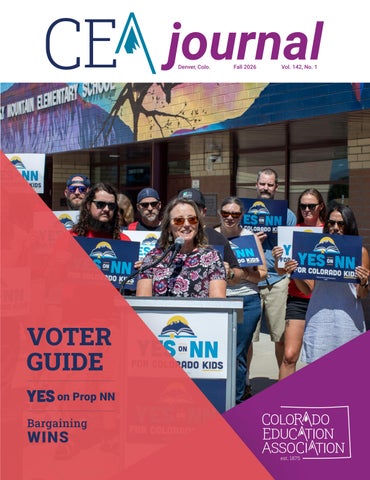
Follow CEA coloradoea.org @ColoradoEA Text “CEA” to 45955 to receive action alerts and updates On the Cover: Melissa Wright, high school teacher and Mesa Valley EA member, speaks during the Yes on Prop NN campaign kickoff in Grand Junction. Photo by Sydney Slifka
Stay, Thrive, and Live in Dignity Dear Members, Fall is underway, bringing with it the familiar mix of energy, stress, and excitement that marks the start of another school year. But this isn’t just any ordinary school year.
CEA President Kevin Vick
No, this year is different. In fact, this could prove to be one of the most consequential years in history for public education in Colorado. It could be the year we finally stop starving our schools, overcrowding our classrooms, and asking educators to do more with less. It could be the year we pass Proposition NN. Passing Proposition NN means increasing public education funding by a stunning 50% over the next decade, freeing up billions of dollars each year that go directly into classrooms in every corner of this state. It means higher pay that actually keeps up with the skyrocketing cost of living. It means smaller class sizes. It means more career and technical education courses. It means more students learning in fully-staffed, fully-resourced public schools, no matter their neighborhood. And, crucially, it means creating the conditions for more of us to stay in the profession we love. As a union, educator retention has long been our North Star: this should be a sustainable career where people can stay, thrive, and live in dignity. The long-term, predictable funding that Prop NN unlocks moves us much closer to making that vision a reality. We’re only standing on the cusp of such a transformational change because of our union’s collective hard work. Over the past year, CEA members relentlessly organized, lobbied, and shared stories with lawmakers. We fought hard and built power to get Prop NN on the ballot. I’m hopeful that we’ll win. My hope isn’t rooted in blind faith. It’s rooted in what I see every day, in the power you, our members, are building across the state, one conversation at a time. Over the coming weeks, thousands of CEA members will be out talking with neighbors, making calls, knocking doors, and doing the collective work it’ll take to win. I hope you’ll join us, because it’ll take all of us to get this measure across the finish line. Earlier this year, we celebrated our 100th Delegate Assembly, honoring the incredible legacy of the members over the decades who stood together to build our union and protect public education. We’re standing today on the power they built. Now it’s time for us to fight, win, and leave our own legacy for the generations of Coloradans to come. Can you imagine what CEA members will say about us during their 200th Delegate Assembly? In solidarity,
Kevin Vick, President of CEA CEA Journal • Fall 2026 • 3
2026
voter guide CANDIDATES Governor
State House
Phil Weiser
HD 1
Javier Mabrey
HD 30 Rebekah Stewart
HD 2
Scott Baldermann
HD 31 Gabriel Cervantes
Attorney General
HD 3
Gena Ozols
HD 32 Chris VanDijk
Jena Griswold
HD 5
Justine Sandoval
HD 33 Kenny Nguyen
HD 6
Iris Halpern
HD 34 Jenny Willford
HD 7
Jennifer Bacon
HD 37 Chad Clifford
HD 8
Lindsay Gilchrist
HD 38 Gretchen Rydin
HD 9
Monica VanBuskirk
HD 41 Jamie Jackson
Treasurer Jeff Bridges
Secretary of State Amanda Gonzalez
State Board of Education CD 1
Lisa Escárcega
CD 3
Barb Clementi*
CD 7
Karla Esser
CU Board of Regents CD 6
Ilana Spiegel
HD 10 Junie Joseph
HD 43 Bob Marshall
HD 12 Kyle Brown
HD 46 Tisha Mauro
HD 13 Consuelo Redhorse
HD 47 Vic Meyers
HD 15 Jeff Livingston
HD 49 Lesley Smith
HD 16 Stephanie Vigil
HD 50 Tommy Butler
HD 18 Amy Paschal
HD 51 Jackie Marsh
HD 19 Jillaire McMillan
HD 52 Yara Zokaie
HD 21 Michelle Tweed
HD 53 Andrew Boesenecker
HD 22 Michael Pierson
HD 54 Mallory Martin
HD 23 Alexis Hoffkling
HD 55 Rick Taggart
HD 24 Lisa Feret
HD 57 Elizabeth Velasco
HD 25 Tammy Story
HD 59 Katie Stewart
HD 26 Meghan Lukens*
HD 61 Eliza Hamrick*
HD 27 Danielle Varda
HD 62 Matthew Martinez
HD 28 Dave Rein HD 29 Lori Goldstein*
* CEA Member † Endorsed by NEA
4 • CEA Journal • Fall 2026
BALLOT MEASURES STATEWIDE YES
Proposition NN
YES
Amendment 87
NO
Proposition 132
NO
Proposition 134
State Senate SD 3
Aaron Gutierrez
SD 4
Justin Kurth
SD 8
Dylan Roberts
SD 11 Tony Exum SD 15 Janice Marchman*
NO
Keep and Spend Revenue for Education Establish a graduated income tax Penalties for Fentanyl Crimes Male and Female participation in School Sports
Proposition 135
SD 17 Katie Wallace
Prohibit certain surgeries on minors
SD 20 Sheila Lieder
Proposition 136 NO
SD 27 Tom Sullivan SD 29 Iman Jodeh SD 30 Kevin Leung SD 31 Matt Ball
YES
SD 34 Graciela Garcia Irlando
YES YES
US Congress
YES
CD 1
Melat Kiros†
YES
CD 2
Joe Neguse†
YES
CD 5
Jessica Killin†
CD 6
Jason Crow†
CD 7
Brittany Pettersen†
CD 8
Manny Rutinel†
John Hickenlooper†
NO
Amendment 83
NO
Amendment 84
NO
Amendment 85
Amendment 81
Law enforcement reporting requirements to Federal Authorities
NO
Amendment 86
Right to Natural Gas Right to Hunt/Fish Mail Ballot Voter Identification
Plain language ballot questions & prohibition on legislation requiring specific language Congressional Redistricting
LOCAL
SD 32 Emily Sirota
US Senate
Amendment 82
Income Tax Rate Cap
SD 24 Kyle Mullica SD 25 William Lindstedt
NO
YES YES YES
Roaring Fork Mill Levy Override Summit Mill Levy Override Eagle Mill Levy Override Cañon City Mill Levy Override Littleton Mill Levy Override Mesa Mill Levy Override JeffCo Mill Levy Override Denver Mill Levy Override West Garfield Mill Levy Override
YES
Ballot Issue 5A
Archuleta County School District Bond measure for a new K-8 school
CEA’S FULL 2026 VOTER GUIDE CAN BE FOUND AT COLORADOEA.ORG/ELECTIONS. Endorsements as of September 22, 2026. For list of current endoresements go to coloradoea.org/elections.
CEA Journal • Fall 2026 • 5
Colorado underfunds every student by
Support Prop NN for school funding Vote yes on Prop NN to raise Colorado’s outdated revenue cap and allow the state to invest the revenue it already collects in K–12 public education without raising taxes. For more than 30 years, this cap has limited how much Colorado can invest in public schools, contributing to larger class sizes, educator shortages, and fewer resources for students.
which creates an annual shortfall of
Voters will now decide in November 2026 whether to update the 1992 cap and unlock funding for Colorado kids.
Colorado ranks at the bottom nationally in teacher wage competitiveness.
in the nation
The Ballot Measure
The Impact on Schools » » » »
coloradoea.org/YESonPropNN 6 • CEA Journal • Fall 2026
» »
Free up funding to hire and keep highly qualified educators. Reduce class sizes. Increase access to professional development programs. Strengthen mental health supports and special ed services. Help stabilize teacher and ESP staffing. Support The Children’s Fund, which prioritizes child care, full-day preschool, and other programs that help children be ready to learn and successful in school.
CEA Journal • Fall 2026 • 7
Bargaining
WINS By Sydney Breakfield
JohnstownMilliken
Poudre Cañon City
8 • CEA Journal • Fall 2026
JohnstownMilliken SMALLER CLASSES, STRONGER SCHOOLS Collective bargaining is about more than just contracts. It is about creating safer working conditions, supporting educators, strengthening schools, and ultimately helping students succeed. And Megan Sanders, a Johnstown-Milliken Education Association (JMEA) member is a firm believer in this approach.
Megan Sanders stands in front of her classroom's instrument wall. Photo by Sydney Breakfield
During last year’s bargaining session, JMEA secured class-size protections for both elementary and secondary educators with language that continues to evolve as the district grows. At the secondary level, classrooms are capped at an average of 28 students per class, with administrators required to provide reports showing class sizes across the building. Elementary classrooms have an enrollment average of 24 students in kindergarten through third grade, and 26 students in fourth and fifth grade. The agreement also recognizes that not every classroom is the same. When elementary enrollment increases, educators and administrators have the ability to choose from a variety of options including: a prorated stipend, a halftime interventionist or a full-time paraprofessional. The approach gives schools flexibility while ensuring educators receive additional support when needed.
We as teachers always want to improve our conditions and our protections, but at the same time we want to continue to see our district be successful.
BIG WIN Class-size protections for both elementary and secondary educators.
For Megan, that balance is the foundation of successful bargaining. “We as teachers always want to improve our conditions and our protections, but at the same time we want to continue to see our district be successful,” she shared. CEA Journal • Fall 2026 • 9
Bargaining WINS
JohnstownMilliken Strong contracts do more than protect educators, they help create stable, supportive schools where educators can thrive and students can benefit.
JMEA members pose together. Photo by Sydney Breakfield
JMEA has also ensured that the agreement supports the growth of student programs. Band, choir, and orchestra classes do not fall within the secondary school class-size cap. Growth in these programs is encouraged and celebrated across schools. As a band and orchestra director, Megan sees firsthand how the language benefits both students and educators. “It’s made sure that we’ve been able to grow our programs,” Megan said. “Larger music classes can also help relieve enrollment issues in other classrooms.” The strength of JMEA’s agreement has also played a significant role in Megan’s career. When she joined the district six years ago, she was pregnant and at the time, did not qualify for federal FMLA protections. The master agreement guaranteed her at least eight weeks of leave, giving her security as a new educator and expecting parent. Experiencing this level of support impacted how Megan now talks with other educators who may be considering jobs in the district. She is always willing to share how the contract provides educators with
10 • CEA Journal • Fall 2026
protections, compensation, and a voice in decisions that affect themselves, and just as importantly, their students. JMEA has also moved to a two-year contract cycle, which creates greater consistency while preserving a process for addressing urgent needs and resolving issues. Megan shared that the change reflects JMEA’s commitment to finding the right balance between stability and flexibility. It is that commitment that has helped JMEA members maintain a positive relationship with district leadership, even after a difficult bargaining year. Rather than letting one challenging year define the relationship, both sides returned to the bargaining table with good intentions, communication, and willingness to learn. In Megan’s eyes, that is what collective bargaining can and should look like. “We like working here. We want more people to like working here. And we want to have the very best in Johnstown and Milliken,” she said. JMEA’s experience offers an encouraging reminder that meaningful change is possible when educators organize, focus on shared goals, and build relationships. Strong contracts do more than protect educators, they help create stable, supportive schools where educators can thrive and students can benefit.
Exclusive Auto, Home & Renters Insurance
“Fast, caring help when my family needed it most.”
We’ve Got Your Back When the unexpected happens, you need more than an insurance policy. It’s the care behind the coverage that makes California Casualty the trusted auto and home insurance choice for CEA members.
Endorsed by CEA for 30 years, we offer you educator-specific coverages and dedicated service through a team passionate about customer satisfaction. We work for you. Let us show you how.
Experience our S.T.A.R. Promise: Simple. Trusted. Affordable. Right for You.
Call: 1.866.268.1754 CalCas.com/ColoradoEA
CA Lic#0041343 ©2026 CCMC. Availability may vary by state. Coverages are subject to availability and eligibility.
Bargaining WINS
Cañon City FINDING POWER AND SOLIDARITY THROUGH COLLABORATION “Our working together is truly the biggest piece,” Annette Nimmo, Cañon City Education Association (CCEA) Vice President shared in discussion of how CCEA and Cañon City Education Support Professionals Association (CCESPA) members achieved their bargaining power. For these educators, bargaining is more than negotiating wages and contract language. It is about making sure they have a voice in the decisions that affect their work and students.
Annette Nimmo and Kyle Stevens. Photo by Annette Nimmo
That voice has become even stronger as CCEA and CCESPA have built a closer working relationship between certified and classified staff. By sharing information, supporting each other at the bargaining table and standing together when negotiations become difficult, educators have found that solidarity can make a difference. Our working
together is truly CCEA members secured several important gains through the biggest piece. bargaining, including a 1.42% increase for Licensed Step 1 and an average 1.00% cost-of-living adjustment (COLA) for licensed employees. The agreement also includes additional financial gains in the coming years, with Step 33 added in 2025, Step 34 added in 2026, and Step 35 added in 2027. Counselors with a master’s degree also moved to the MA+24 salary lane, providing another opportunity for increased compensation. CCESPA members also secured meaningful gains, including a 2.0% COLA increase for classified employees. In addition to the financial increase, the agreement gives Education Support Professionals (ESPs) a voice on the Professional Development Committee, ensuring classified employees have representation in decisions about professional development.
12 • CEA Journal • Fall 2026
BIG WIN CCEA and CCESPA coming together to secure wage increases and a voice at the table.
One reason the bargaining process has worked well in Both locals also work together to hear directly from members Cañon City is the relationship between educators and district about the issues affecting them. As part of their organizing leadership. While negotiations can become challenging efforts, members visited schools and talked with staff about when educators and the district have different priorities, the their concerns. The conversations showed that many of the relationship remains respectful. Annette said the district issues facing both certified and classified employees were uses interest-based bargaining, which gives both sides an similar. Pay was a major concern, along with safety and support opportunity to explain not only what they’re asking for, but for classified employees who work directly with students. Those why. That approach allows educators to share the real-life conversations helped inform bargaining priorities and gave experiences behind their proposals. For educators a stronger understanding of what example, some newer educators struggle their colleagues were experiencing. to afford basic living expenses and may need to take second jobs to make ends For Annette and Kyle, the lessons from the We both had each meet. “We get to share those stories,” most recent bargaining process are clear, Annette said. “And I do know that has educators are stronger when they work other’s backs which changed the mind of our board members.” together. The relationship between these I think made a huge two locals has created a sense of shared Annette has been involved in the bargaining purpose that goes beyond a single contract difference. process for several years. When she first or bargaining season. “The conclusion is joined the CCEA bargaining team, she that [with] us coming together that day, even admits she was nervous about the process, but she quickly though we’ve been collaborating all year, when we actually got found that she enjoyed being a part of the work. Now, after it, we had a good result,” Kyle reiterated. Both Kyle and Annette being well acquainted with the process, she truly enjoys it. agree: Educators do not have to face difficult negotiations alone. There shouldn’t be a divide. Kyle Stevens, CCESPA President is newer to bargaining. The most recent negotiations were only his second time at the By building solidarity between classified and certified staff, table, but he stepped into a larger leadership role during the Cañon City educators are showing what collective action process. Kyle shared that the experience came with difficult can accomplish. When educators share their experiences, conversations, but support from CCEA made a difference. “I support one another, and are willing to stand together at the still felt like we did a good job, especially with the help of the bargaining table, they have a stronger voice. And a greater certified association having our backs,” Kyle said. “We both had opportunity to create meaningful change for themselves, their each other’s backs which I think made a huge difference.” That colleagues, and their students. support became especially important during salary negotiations. CCESPA initially received an offer that the bargaining team felt was not enough. Rather than accept the proposal, Kyle and Vice President Kate Rogers stepped away from the bargaining table. The team then waited to see what would happen once CCEA’s negotiations began, choosing to sit in during the sessions to show their support. The decision showed how the two locals collaborated during bargaining. They stayed in communication, talked through their priorities, and looked for ways to support gains for both groups. That teamwork helped them find an agreement that made a meaningful difference, especially for the lowest-paid employees. For Kyle, the experience showed the value of working together. The communication between the locals helped them understand each other’s needs and make decisions that benefited both groups. “The day of bargaining solidified that conclusion. Coming together that day when we actually got to doing the business, it had a good result.” CCEA and CCESPA officers. Photo by Pikes Peak UniServ Unit
CEA Journal • Fall 2026 • 13
Bargaining WINS
Poudre MAKING TIME MATTER, ADVOCATING FOR INCREASED SUPPORT Special education and Integrated Services (IS) educators do a lot more than teach in a classroom. They plan lessons for each student's needs, run small groups, give tests, fill out paperwork, attend meetings, manage cases, and talk with families. On top of that, their schedules can change at any moment.
Shannon Wick
Poudre Education Association (PEA) members Jessica Peacock, and Shannon Wick, and Nikki Earnshaw know this firsthand. Their stories show why educators need more time, support, and recognition to do their jobs well. Those concerns led to a recent bargaining win: a stipend for special education and IS educators worth five extra days Special education of planning time.
is above and
Jessica, an elementary special beyond what a education teacher, faces multiple struggles. She manages cases, typical school role supervises paraprofessionals, should be. and communicates with families. She says this goes beyond what most school jobs require. "I do think that special education is above and beyond what a typical school role should be. It just feels like so much more," Jessica said. Shannon Wick works in an Affective Needs center-based program, where every day looks different. "There really is no 'average' week," she explained. Student needs can shift in an instant, so she has to adjust her plans constantly. Staffing shortages and safety concerns can also force her to give up her planning period or lunch to help students directly. Nikki is an IS educator who works across three grade levels at her school. Her school uses an open floor plan for grades 1-5, which lets her move around and help students where they need it. But she still has to balance her students' service time with testing, paperwork, and
14 • CEA Journal • Fall 2026
BIG WIN A stipend recognizing the extra workload special educators carry.
takes ItIttakes 5 minutes to 5 minutes to secure your secure your no-cost life no-cost life insurance. insurance.
It’s easy to access this It’s easy to access this member-only benefit!
member-only benefit!
STEP 1: STEP 1:at Register Register at neamb.com/register
neamb.com/register
STEP 2: Follow STEP the 2: QR code and complete theQR simple Follow the codesteps and to assign your the beneficiary complete simple steps to
assign your beneficiary That’s it!
Get Started Today! Get
Started
That’s it!
Bargaining WINS
Poudre meetings. "Being able to serve my students is a bit easier. However, I am still juggling meeting their minutes and also completing all the necessary testing and paperwork," Nikki said. The work gets even harder at the start of each term, when extra testing and paperwork pile up and make it tough to finish everything during contract hours. For all three educators, the problem isn't just a busy schedule. Special education schedules are built around each student's Individualized Education Program (IEP), but students’ needs don't always follow that plan. Unexpected situations can eat into planning and lunch time, leaving less time to prepare lessons, review student needs, talk to families, and finish other required work. When schedules get chaotic, it also gets harder to give students the steady, focused, one-on-one attention they need. These challenges led Shannon to propose a stipend that would recognize the extra workload special educators carry. She played a big role in shaping and negotiating the idea, and she first brought it straight to the superintendent. Eventually, the proposal reached the bargaining table, where Shannon kept pushing for it. Looking back, Shannon said she'd do things differently today. She believes the proposal should have gone straight to the negotiating team from the start, so everyone could understand the issue clearly from the beginning. Once it did reach the table, she worked to explain what special education really looks like and why educators deserved more pay for it. The effort paid off. In the first year, educators received pay equal to three extra contract days. The next year, that grew to five extra contract days. For Shannon, the win meant more than money, it meant educators felt seen. "The stipend has had a significant impact on morale within our special education department," she said. Special educators often work past their contract hours to finish IEPs, paperwork, and family communication. The stipend doesn't cover all of that extra time, but Shannon said the recognition itself still matters. Jessica agreed. "It feels good to me to be acknowledged for the extra work that IS teachers need to do," she said. Nikki feels the same way, though she's honest about the stipend's limits: "It still does not quite cover all the extra time and non-contract time lost to work." 16 • CEA Journal • Fall 2026
Nikki reviews an ELA lesson with students. Photo by Sydney Breakfield
For all three, recognition matters, but so does real change. Educators need enough time, staff, and support to meet their students' needs without giving up their planning time or personal life. Shannon hopes future bargaining will go even further. She'd like to see extra pay and recognition for special educators who train and supervise paraprofessionals. She also hopes the Access Committee keeps bringing specific concerns from special education staff to the bargaining table. Nikki wants people to see IS educators' work as valuable, especially since their workloads are already stretched thin. "The bargaining committee has been working hard to have IS teachers' time seen as valuable and very overextended," she said. "This is the time and space for our voices and concerns to be heard. The louder we are, the more likely they are to hear us, and that requires all of us to be speaking up." Jessica also wants to make it easier for educators to speak up. She hopes the Access Committee can offer regular meetings, childcare for members during meetings, and simple ways for people to share feedback without having to attend in person. Shannon believes that member involvement is key. "If we want something to change, we have to be willing to participate in the process," she said. Educators understand their own working conditions best, and their input helps identify what needs to change. These members’ stories all point to the same idea: working conditions for educators and learning conditions for students are connected. When teachers have enough time to plan, enough staff, and enough support, they can teach more consistently and respond better to each student's needs. By speaking up, sharing their stories, and staying engaged in bargaining, educators like Nikki, Jessica, and Shannon are helping build better working conditions, for themselves, and for the students they serve.
CEA Retired Update By Phyllis Robinette
CEA Retired has spent the summer volunteering and supporting the 2026 NEA Representative Assembly held in Denver this past July. Our volunteers hosted the NEA Retired meeting for the first three days, followed by hosting over 8000 educators from across the country. We are most proud of our CEA-R VP/ Treasurer, Ann Franco, being the Chair of the Event. She did us proud! CEA Retired is now working hard to prepare for November elections and the passing of Proposition NN! We have volunteers engaged across the state working hard for pro-public education candidates and securing funding for our schools.
STAY CONNECTED! Follow our CEA Retired Facebook page for up to date information about ways to get involved, events, and updates about what our members are doing around the state. Find us at facebook.com/CEARetired22. Not getting CEA and CEA-R emails? Resubscribe to our email list at coloradoea.org/resubscribe to ensure you are receiving important updates, the CEA-R Communicator, and other emails. Already a NEA-R/CEA-R member and want to join your local? Visit coloea.org/CEARetiredLocalForm to join a retired local.
CEA Journal • Fall 2026 • 17
COpilot: 10 Years in the Making By Sydney Breakfield
As COpilot celebrates 10 years of educator-led professional learning, meet the instructors teaching courses that will be part of the new Adams State University master’s program. What started as a simple idea has grown into a professional learning program that connects educators across Colorado. Over the past 10 years, COpilot has offered 3,731 class sections representing 620 unique courses. Through these courses, educators can build new skills, earn credits and learn from other educators. The idea for COpilot began about 12 years ago. CEA staff were looking for new ways to connect with members and provide professional development that could fit into educators’ busy lives. Instead of relying only on training provided by their districts, educators could choose courses based on their interests and professional needs. The first version of COpilot was built using WordPress. However, the technology could not provide everything the program needed. With support from the NEA Foundation, COpilot was rebuilt to better manage courses and confirm CEA membership. Once the technology was ready, educators began creating courses and sharing their knowledge with colleagues. Cassie Harrelson was there from the beginning. Ten years ago, she taught COpilot’s first live course. As an instructional coach who had worked in rural and metro-area school districts, Cassie saw how COpilot could bring educators together. “There’s just so much that we could learn from each other,” Cassie said. Her first course focused on mathematical mindsets. In those early years, COpilot was still growing, and a decade later, the program offers a wide range of professional learning opportunities. As COpilot has grown, one idea has remained at the center of the program: educators learning from other educators. Edmond Bedu-Annan brought his interest in artificial intelligence to COpilot. After discovering AI tools that helped him in his own work, he wanted to share what he was learning with others. “If I’m starting to discover these AI tools and
18 • CEA Journal • Fall 2026
it’s really helping me significantly in my own practice, I think it’d be awesome to share that with other educators as well,” Edmond shared. Instructors Elissa Brost and Cammaron Sanders both started as COpilot learners. Elissa took about 50 courses before becoming an instructor. During the COVID-19 shutdown, she created a Google Classroom course to help educators use technology. She later developed additional courses based on educators’ needs. After taking courses for several years, Cammaron realized she could use her special education experience to help other educators. She created a course about the IEP process to help general education teachers better understand how they can support students with disabilities. Catherine Lee’s journey began with something she was already doing in her classroom: creating educational videos. Another educator encouraged her to turn that experience into a COpilot course. “With COpilot, you get to choose what will help you the most,” Catherine said. From there, Catherine continued creating courses based on her knowledge and interests. Other instructors have followed similar paths. Elizabeth Sedalnick uses her counseling experience to teach courses on topics like stress management and bullying. Erin Grodeska uses her special education background to teach educators about high-leverage practices for students with disabilities. Sarah Adams began creating courses after a colleague encouraged her to share the special education knowledge and resources she was already sharing at her school. Together, these instructors show what makes COpilot different. Educators can learn from those who understand the challenges they face because many instructors are doing the same work in Colorado schools.
COPILOT’S NEXT CHAPTER Now, COpilot is taking another step forward through a new collaboration with Adams State University. Select COpilot courses can count toward elective requirements in Adams State’s fully online Master’s in Curriculum and Instruction program. CEA members who complete eligible courses through COpilot can save more than $2,000 on the cost of earning the degree. The courses in this program will continue COpilot’s tradition of giving educators practical learning opportunities while also helping members work toward an advanced degree. COpilot has changed greatly since its first course 10 years ago, but its purpose has stayed the same. It gives educators more choices, makes professional learning easier to access and creates a space where educators can learn from one another.
Elizabeth Sedalnick
Erin Grodeska
MASTER’S FROM ADAMS STATE UNIVERSITY Check out the courses taught by CEA members that will go towards a Master’s in Curriculum and Instruction from Adam State University: » »
» »
» » » » »
»
AI in Education Edmond Bedu-Annan (Douglas County EA) Best Practices for Inclusion in the General Education Setting Margaret Stockfish (Cherry Creek EA) Building Relationships with Students Elizabeth Sedalnick (District Twelve EA) Classroom Management with Culture and Brain Science Catherine Lee (District Twelve EA) Everyday Classroom Management Principles Elissa Brost (Colorado Springs EA) Executive Function & the Science of Motivation Heather Jung (Denver Classroom Teachers’ Association) High Leverage Practices for Students with Disabilities Erin Grodeska (Aurora EA) How the Special Needs Brain Learns Sarah Adams (Jefferson County EA) Special Education and You: Your Part in the IEP Process Cammaron Sanders (Greeley EA) Understanding Special Education in Your Classroom Sarah Adams (Jefferson County EA)
TO LEARN MORE ABOUT THIS PROGRAM, VISIT CEACOPILOT.ORG/ADAMS-STATE
Sarah Adams
CEA Journal • Fall 2026 • 19
Members gather to show support for the Yes on Prop NN campaign in Denver. Photo by Sydney Slifka
coloradoea.org @ColoradoEA
The Colorado School Journal is the official member publication of the Colorado Education Association (CEA), an affiliate of the National Education Association. The Journal (ISSN-0079-3326) is published by CEA throughout the school year. Digital issues are posted on CEA’s website. Acceptance of advertising does not necessarily imply CEA endorsement.