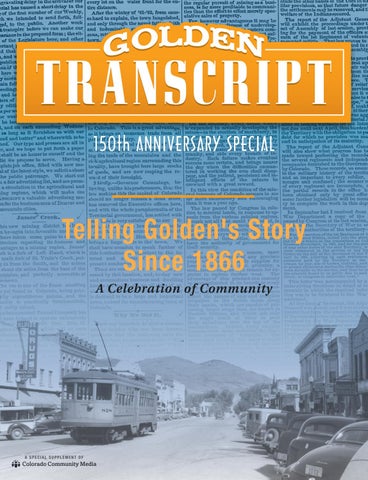
150th ANNIVERSARY SPECIAL
Telling Golden's Story Since 1866 A Celebration of Community
A SPECIAL SUPPLEMENT OF
2
GOLDEN TRANSCRIPT ANNIVERSARY SPECIAL
CONTENTS
Anniversary Special PRESIDENT/PUBLISHER: EXECUTIVE EDITOR: WEST METRO EDITOR: GOLDEN COMMUNITY EDITOR: ADVERTISING SALES:
PRODUCTION MANAGER: ADVERTISING DESIGN:
PHOTOGRAPHER:
Jerry Healey Ann Macari Healey Glenn Wallace Christy Steadman Erin Addenbrooke Marcia Gresty Mindy Nelon Erin Franks Brandon Eaker Tina Meltzer Lisa Allison Shanna Fortier
5
A FAMILY AFFAIR
7
ALICE DEMPSEY: GOLDEN STORYTELLER
17
LIFE IN GOLDEN
24
CITY OF IDEAS
31
AVENUE FLASHES
32
PORTRAITS OF GOLDEN 722 Washington Ave., Unit 210, Golden, CO 80401 | 303-566-4100 GoldenTranscript.net | ColoradoCommunityMedia.com
The Golden Transcript 150th Anniversary Special is a supplement of the Golden Transcript, a publication of Colorado Community Media, publisher of 17 weekly community papers and websites reaching over 152,000 households.
1299 WASHINGTON AVE. STE 170 URBANESCAPESPA.COM 303-278-1709
ONE OF DENVER’S
“15 CALMEST, QUIETEST, COOLEST, (AND MOST DECADENTLY WONDERFUL)
URBAN SPAS”
VOTED TOP 5 “BEST SPA” -The Denver Channel
Advanced Aesthetics, Botox, and Fillers Available
-5280 Magazine Editors
SCHEDULE YOUR ESCAPE WITH US TODAY! Golden's Premier Full Service Day Spa Family owned and operated since 2007
Take a Tour Visit a working brewery with tours offered continuously throughout the day including stops in the sampling area and the Coors & Co. gift shop. • Open 10:00 a.m. - 4:00 p.m. Thursday - Monday. • Sunday 12:00 - 4:00 p.m. • Closed for tours on Tuesday, Wednesday and major holidays. • Must be at least 21 to enjoy beer samples. • Visitors under 18 must be accompanied by an adult. * Call for extended Summer hours. TOUR INFORMATION
303-277-BEER
W W W. M I L L E R C O O R S . C O M
GIFT SHOP
800-443-8242 W W W. C O O R S A N D C O . C O M
®
© 2016 MILLERCOORS LLC, GOLDEN, CO AND MILWAUKEE, WI • BEER • SD169599
4
GOLDEN TRANSCRIPT ANNIVERSARY SPECIAL
A WORD FROM THE EDITOR All community papers like to say that they are connected to the people and places they cover, but here in Golden, we've got one of the strongest claims imaginable. The founder of this paper, George West, is also a charter member of the city itself. West came to Golden along with a group from Boston, looking to start a new life in the Colorado Territory. The Boston Company building, constructed on what is now the corner of Washington Avenue and 10th Street, was Golden's first permanent structure. The second floor served as the Transcript's first office. West would later write that he liked how he could hear the approach of anyone off the street through the floorboards, giving him ample time to prepare if they happened to be an irate reader capable of violence. In those days, having a newspaper or two was a mark of pride for a community, and a sign that there were enough area businesses to advertise, and folks to subscribe to keep such a business afloat. "We are flattered by the interest that has been manifested by a large number of the people of the immediate vicinity," West wrote on the front page of that first edition.
Our story together That feeling of being flattered by a community's continued support carries through to the Transcript's modern staff. Those early papers looked much different than modern papers. The newsprint is cramped — paper not always being readily available — and there were no pictures or bylines. Wire news of the 1860s highlights just how long ago the paper started. That first edition includes an article about "the Negro Suffrage question." But as out of date as some of the paper seems, other portions seem timeless, like the ads for local businesses— some of which could run virtually unchanged today. The paper's pledge to accurately report the words and deeds of local politicians also stands the test of time. In fact, those early "Colorado Transcript" editions served an important role for the Colorado Territory, providing transcripts and reports from those early territorial legislature meetings that were held down the street from the Boston Company building.
West also used a portion of that front page to explain why he chose to start his paper here. He called Golden "a lively, growing place full of healthy enterprise" and a place with citizens who would take interest and give "hearty support" to local journalism. "We hope to put forth a paper that shall be an honor to ourself and the public we propose to serve," he wrote. Throughout Golden's history, the ups and the downs, the Transcript has followed along. On the following pages are many stories that trace that 150-year path of a paper, and the community it covers. Inside are stories about the remarkable life of West and his family, remembrances of some of the more interesting (or infamous) of the city's residents, as well as a look at what life in Golden looks like nowadays. The current staff of the Transcript, tasked with continuing West's mission, do indeed hope that this, and future editions of the Transcript, shall honor us, and you, the people of Golden. Glenn Wallace Golden Transcript Editor
Each Office Independently Owned and Operated
5
COLORADO'S OLDEST CONTINUALLY PUBLISHED NEWSPAPER
A Family Affair
George West and his journalistic legacy
By Rick Gardner Special to the Transcript George West, founder of the Golden Transcript, frequently said he wished the newspaper to be “a family affair," a dream he would come to realize. He wrote in newsprint of his own future wife, in the Western Mountaineer piece he called “A Dream And Its Speedy Fulfillment.” West wrote how he had worked to convince himself he could just as well enjoy a Christmas dinner of baked beans and bacon in this gold rush land as he could a roast turkey back home. Falling asleep, he dreamed of his old landlady with a Christmas feast, alongside whom stood a little angel who invited him to partake. Upon waking, West saw "the little angel of our dream" in person when he met the "bright-eyed" daughter of his friend T.P. Boyd of the Golden City House. "‘Pa and ma want to see you,’ said she, and her voice sounded to us as pleasant as the babbling brook to the ears of a weary traveler over the scorched prairie,'" he wrote. West danced with young Eliza Maria Boyd at Golden’s first Christmas Ball, and when she grew older, the two were married in Golden during the Civil War. On May 19, 1869, Eliza West made her own journalistic debut in the Transcript, writing the column "Home Department" for the paper each week. Her column was for female readers.She secretly wrote under the pen name of Kate Warrenton. She wrote in her debut column “I am in favor of womens’ rights – their right to
love and be loved, their right to make their homes happy by cultivating those womanly virtues that are always loveable.” In time, her column was published in more newspapers and magazines. By 1888, son Leslie B. West, who had worked on the Fort Collins Courier while in college, was working for the Transcript. In 1891, George West presented him with half ownership, and the publisher became Geo. West & Son. Younger son Harley Dean West made his debut writing in 1898 as a war correspondent from the front during the Spanish-American War. He fought with the Colorado Volunteers in the Philippines and was among the forces that captured the capital of Manila. About his fellow troops, young West wrote: “The love among the members of this company was marked and in many instances touching. I remember when poor Pinchon received his death wound fully half the company jumped from their concealment behind the rice ridge to go to his aid, although the Mauser balls were flying about them as thick as mosquitos on Louzon, and until he was safely in the ambulance at the rear it was almost impossible to get the boys down to business again.” In December 1898, George West resumed full proprietorship, and on Feb. 1, 1899 took leave from the paper, leasing it to Leslie West and a new addition to the family. Marguerite West, George and Eliza’s only daughter, was an aspiring actress, and one day while watching a play at the Golden Opera House performed by the traveling King-Kimball
A portrait of Golden Transcript founder Gen. George West. Photo courtesy the Golden History Museums Komedy Kompany she met the love of her life, actor George M. Kimball. They were married and traveled with little son Neil in tow, performing with the “4 Ks” in such places as Aspen, Salida, Cañon City, Florence and Pueblo. George West worked to switch his fellow George to the publishing business, giving him the job of local editor, aiming that he might one day succeed him as editor of the Transcript. Kimball also wrote a column in the Transcript, called "Svenska Tala," sharing amusing anecdotes about
town, writing in a pronounced Swedish accent. It became so popular among both Swedish immigrants and other Goldenites that readers were known to threaten to cancel subscriptions if the column missed a week, and it was soon published in other papers. Within a decade, Kimball became editor of the Craig Empire. In 1902, George West resumed full control over the newspaper, and in 1903 the family formed the Transcript Printing Company. It was a family corporation, led by Continues on page 6
6
GOLDEN TRANSCRIPT ANNIVERSARY SPECIAL
WEST from page 5 president and treasurer George West and stockholders Eliza M. West, Marguerite L. Kimball and Harley D. West. However, two of the West family were no longer present by then. Eldest son George Leslie West died as an infant in 1868, and Leslie B. West died tragically in Salt Lake City in 1902 when he slipped from a telephone pole he was wiring. George West, after 40 years as one of the longest newspaper proprietors in Colorado history, died on Nov. 15, 1906. His later years had seen him come full circle in life. In 1887, he resumed running ads for William L. Douglas, now a nationally prominent shoe proprietor and a strong believer in advertising in lean times. That year, West also became adjutant general of the same Colorado National Guard that his first Transcript compositor, Roger Williams Woodbury, was now brigadier general of, with a successful career at The Denver Tribune. On Nov. 11, 1905, the future Veterans Day, in a widely anticipated ceremony in Denver, the onetime Capt. George West returned to Maj. W.L. Kuykendall the battle flag he captured in the Civil War, as part of the return of wartime trophies mandated by Congress to promote national healing
and unity, sparking a rousing ovation of veterans of both sides in the war. To succeed him at the Transcript, Eliza West became president and Harley Dean West the new editor. Quickly, Harley saw the need to modernize the newspaper when it became apparent hand-setting type and printing it on the hand press would be too tedious to continue. On March 23, 1911, he converted it to linotype, purchasing the new equipmen from the Mergenthaler Linotype factory of Brooklyn, New York, beginning a business relationship that would one day benefit the Transcript in ways West could never imagine. When Harley West passed away in 1927, the Transcript passed to his wife Vera, and for the first time a woman became editor of a Golden newspaper. The former Vera E. Parshall was Harley’s childhood sweetheart whom he married in the West family home on April 10, 1902. Nephew Neil West Kimball joined her as co-editor and the reins were taken by a third generation of the West family. Kimball ascended to the same adjutant general office his grandfather held, and on his watch the Colorado National Guard’s encampment was named Camp George West. Vera remarried to
Occasions
l
Birthdays
l
Work Parties
editor Horace Fleet Parsons, and while she continued as the Transcript’s second longest proprietor over 25 years, he became its new editor. The night of March 4, 1934, Parsons witnessed a major windstorm hit Golden, which at 12th and Washington tore the roof off the Everett Block and slammed it into the Rubey Block across Washington Avenue. Its steel tangled in the trolley wires, causing great flashing arcs lighting up downtown Golden. Inspired by the sight, Parsons began writing the column "Avenue Flashes," giving community events and tidbits from around town. He continued until passing it to Virginia Miller Weigand in 1947, the second of now four writers of one of Colorado’s longestrunning columns. Vera West Parsons passed away in 1952, after which H. Fleet Parsons continued the Transcript himself. When he passed away in 1959, the family heirs sold the newspaper to Denverites John Jamison, William Koska and William Long, completing 93 years of family proprietorship. Today, the mark and influence of the West family still remains with the Transcript over half a century later.
l
Catering
Cupcakes at your holiday get together... What could be sweeter?
Now is the time to plan your party We’d be glad to help
Buy one Regular Cupcake and get a small Cupcake
Now taking holiday orders
700 12th Street, Ste130, Golden, CO 80401 (Just east of Washington, near the Buffalo Rose)
720.328.9531
l
www.goldminecupcakes.com
FREE
(not to be combined with any other offers or specials)
7
COLORADO'S OLDEST CONTINUALLY PUBLISHED NEWSPAPER
Alice Dempsey: By Shanna Fortier sfortier@coloradocommunitymedia.com Alice Dempsey rode her bicycle to work during her 20 years at the Golden Transcript newspaper and became known as "the bicycle lady" around town. “It made me feel like I was really close to people in town,” said Dempsey, 94, who still lives in Golden. Dempsey moved to Golden with her husband Ed and seven children in 1968 after having worked for The Chicago Tribune as a columnist and assistant editor of the Travel Department. Two years later, she began working for the Transcript, where she wrote feature stories about interesting people in the Golden area from 1970 to 1990. “Just to meet these people and to share a bit of their lives was a wonderful thing. The people were wonderful to talk with and they loved sharing their stories with the rest of the people in town.” For her work throughout town, Dempsey received the Living Landmark Award in 2003. A few years after receiving the award, she published her book, “Their Heritage and Hope: Five Generations of the Life and Times of an Oglala-Lakota Sioux Family.” “Every day is special,” Dempsey said. “And I always loved writing.”
From Alice Dempsey's profiles • In her early days at Guy Hill School at Golden Gate Canyon, Vina Ramstetter was not only the sole teacher, but the janitor, disciplinarian and principal as well. She began her teaching career in the little one-room school house in 1909. Her retirement years found her involved in another rewarding pastime — making dolls out of apples. “Her latest project,” Alice Dempsey wrote in a 1976 article about Ramstetter, “is completing a replica of the old Guy Hill School …” • “G.H. Stuart has the kind of job most little boys dream of — collecting all kinds of junk, from nuts and bolts to antique birdies,” Dempsey wrote in a 1976 article. In 1950 he bought a shop for his growing collections. It was located at what was the corner of the Safeway parking lot, in the space which was originally the wood and coal yard for Golden. For seven years, Stuart baled aluminum for Coors for recycling. Some of the most popular items in his store were kerosene lamps and burners of all kinds.
• Paul Hopkins was a 1939 Colorado School of Mines graduate whose mining engineering career took him all over the world. His home was Golden, but told Dempsey in 1976 that he was at home wherever he hung his hat. “His old gray Stetson, which he says is the 'mark of a miner,' had hung on hooks or bedposts on four continents,” Dempsey wrote. • James O. Milmoe was recognized internationally for his photography, which appeared in 23 books and more than 200 magazines including Fortune, Time, National Geographic, Scientific American and Reader's Digest at the time Dempsey wrote about him in 1977. He appeared in the 1976-77 edition of "Who's Who in the West" and received the Governor's Award from the Colorado Council on the Arts and Humanities in 1973. • Mary K. Nixon was Golden's first female full-time officer on the police force. “Her scariest day on the job came early in her career after she had trained just one day with her gun,” Alice Dempsey wrote in a 1978 article
Alice Dempsey, looking dapper in front of the former Golden Transcript offices. Photo courtesy the Golden History Museums
celebrating Nixon's first year on the job. “I do want to be a lady when out of uniform, and treated like a woman,” Nixon told Dempsey. “But on the job I want to receive the same treatment as a male officer.” • Franz Scholz not only made a name for himself at Coors in Golden, but his face became familiar from coast to coast when he was featured standing in front of a brew kettle holding a hydrometer in a Coors advertisement running in national and local publications in 1987. When Dempsey wrote about him that year, Scholz had been working for Coors for 33 years and was in charge of malting and brewing.
8
GOLDEN TRANSCRIPT ANNIVERSARY SPECIAL
Heroes and scoundrels of the city Golden's past filled with colorful characters
of note, who at one time or another, graced the pages of the Transcript. Edward Berthoud - SwissThe history of Golden born and said to have had an includes quite a few interestexquisite goatee, Berthoud ing figures, notable for their came to America when he accomplishments or, occasion- was 2 years old. He was a ally, their misdeeds. Here are rennaisance man who taught but a few of these individuals courses in civil engineering, geology and botany at what would become TIMELINE: the Colorado School of Disasters in Golden Mines. He studied local weather, and surveyed December 4, 1870 several of the major An earthquake hits Golden railroad lines that would at about 5a.m. No fatalities usher in a new age of are reported. economic development for the state. While he often would 1878 Jarvis and Mathews halls, on the Mines campus, burn to the ground.
September 9, 1889 The White Ash coal mine disaster near present day Marv Kay field kills 10 miners, trapping them hundreds of feet underground. July 24, 1896 Major thunderstorms cause The Tucker Gulch flood in Jefferson County. Twentynine people die, including three in Golden. December 4-5, 1913 The Blizzard of 1913 strikes hard, dropping 5 feet of snow in a 24-hour period, an all-time record for snowfall.
June 7, 1948 The second Tucker Gulch flood in hits Golden, causing major damage.
Source: GoldenHistory.org
jot down information for the Transcript, West is rumored to have often asked that his submissions often be conveniently placed near an open window so they might be blown away. Helen Berthoud - Like many wives of the era, including Eliza West, Helen followed her husband into the conflict of the Civil War. There she worked in the women's relief corps, helping the sick and the wounded. WAH Loveland - A businessman, miner, railroad tychoon, politician and newspaperman, Berthoud got up to quite a bit of things in his time on this earth. Not the least of which was helping to found Golden.
He once held the office of county commissioner for five different counties — at the same time. There is a folk legend that Loveland actually beat the Boston Company in completing the city's first building. According to the story, both buildings were neck-and-neck to finish construction, but only the Boston Company boys had shingles. The next morning however, Loveland miraculously had all the shingles he needed to finish his store's roof, while the Boston Company suddenly found itself short. As a consolation prize, LoveContinues on page 15
Golden’s top 10 events and more! For 150 years, the Golden Transcript has provided a record of the many events that have shaped the city we live in today. To help chronicle those years and those events, the Golden History Center is opening a new exhibit this month. Epic Events, a timeline experience spanning all of Golden's history. Our lives are filled with events — big and small, happy and sad, some memorable and some best forgotten. Over the course of days and years, the events of a lifetime tell a story — and the same is true for a community.
CHECK IT OUT The online version of the Golden History Museums' timeline is available here: www.goldenhistory.org/wp-content/ uploads/2016/08/EpicEventsTimelineGuide_web.pdf Epic Events showcases over three dozen events. From the founding of Golden to the discovery of the world’s first Tyrannosaurus rex tooth, we cover a huge spectrum of material. Visitors will also discover Colorado Prohibition, William “Buffalo Bill” Cody’s burial, and a blizzard that dumped five feet of snow on the town, all of which are paired with some amazing artifacts. Perhaps the largest and showiest artifact is a recently acquired 1910 ore car used for local clay mining. There is also a 1920s Coors milk can used by local families to transport
milk for malted milk production, and Norton Brown’s 1892 Engineer of Mines degree from the Colorado School of Mines. Hear Golden author and historian Mary Ramstetter narrate a video introduction, titled "Golden Was Born a Handmaiden to the Miners." Her colorful narrative is supported with new footage from four of Golden’s historical murals, most notably two by Hal Shelton. And that’s not all. For the first time ever, a 1972 industry film on the Jolly Rancher plant, titled "Candy Country USA," will show continuously. The entire family will want to take a selfie in front of a huge photo backdrop depicting tourists with donkeys — once a common sight in Golden. As early as July 1, 1906, Clyde Ashworth had erected a pavilion at the summit of Castle Rock and tourists used burros as a novel means of transportation to and from the rock. Finally, the Epic Events timeline gallery guide will be on hand to help you peruse hundreds of other epic events from the past century and a half. An epic accomplishment on its own, the timeline was developed in conjunction with a team of respected local historians. Epic Events is a permanent installation and the first new exhibit outlined in a new master plan for the Golden History Center. The Golden History Center, 923 10th Street, is open six days per week from 10 a.m. to 4:30 p.m. Admission is $3; kids 6 and younger are admitted free.
9
COLORADO'S OLDEST CONTINUALLY PUBLISHED NEWSPAPER
Unbroken publishing record had some close calls By Rick Gardner For the Golden Transcript On Jan. 5, 2017 the Golden Transcript will publish its 11,200th edition, never having missed an edition in over 150 years, an unparalleled achievement in the history of Colorado journalism. It is a record that is hard earned, for twice in its history the newspaper came perilously close to losing it. Of course, these two incidents do not count the number of times the staff got too drunk to crank out the issue. There was a gentleman's agreement between the Transcript and rival city paper "Golden Globe" that if one's staff was too drunk, the other's would come over and crank out their issue for them. Apparently this happened a few times!
Papers, please In 1869 the Transcript came very near to missing an edition for the first time. Due to a severe paper shortage it was forced to resort to printing on “half-sheets of complex colors and quality,” with newsprint so crowded and microscopic it was a challenge to read. This was a regional paper shortage, the culmination of events beginning with the Plum Creek Railroad Attack on Aug. 7, 1867. Near Lexington, Nebraska, Cheyenne warriors derailed, captured and burned a freight train. The train carried the print paper machinery destined for the Golden Paper Mills, under construction as the only paper mill west of Missouri. Meanwhile, paper shipments from the east to such a western outpost as Colorado Territory proved unreliable, erratic or
Did you know that the following public spaces are smoke and vapor-free in the City of Golden? • City-owned parks, trails, biking/walking paths and open space • Downtown zone including Washington Street between 10th and 14th Streets and on 12th and 13th Streets between Arapahoe and Ford Streets • All public transit waiting areas • Within 25 feet of primary entryways of all buildings and facilities
Visit bit.ly/GoldenSHS to view the City of Golden’s complete list of smoke and vapor-free public spaces. Jefferson County Public Health
subject to embargo, making all area newspapers scramble to find something to print on. The Transcript did patronize the Golden Paper Mill beginning April 8, 1868, making emergency prints on yellow wrapping paper, which was the only type it then produced. At last, on April 12, 1871, new printing paper machinery came online and the Colorado Transcript became the first Colorado publication to print on locally manufactured newsprint. Feeling the heat A century later when the Transcript published as a daily, disaster struck on Nov. 4, 1978. Fire hit the Transcript building at 1000 10th St., gutting the composing room and destroying its typesetting and layout equipment — $100,000 in damage. Ironically,
further damage was avoided when the heat of the blaze burst a copper water pipe, extinguishing the flames, sparing the camera, press and mailing rooms. Fortunately, the blaze happened on a Friday night and the newspaper did not publish on weekends. The damage was discovered shortly before 8 a.m. Saturday morning. General Manager Denver Dixon called John D. Montgomery, president and publisher of Montgomery Publications of Colorado, the Transcript's owner in Junction City, Kansas, to inform him of the calamity. A quick call to printing company Mergenthaler Liontype found that new press equipment could be transported from Pennsylvania to Denver, but wouldn't make it soon enough for the Transcript Continues on page 28
10
GOLDEN TRANSCRIPT ANNIVERSARY SPECIAL
Washington Avenue Over the Years
Jefferson County Providing quality services for residents and businesses to thrive since 1861. Jefferson County has a history rich in people, resources and progress. The county was formally organized in 1861 by the Colorado Territorial Legislature. The Jeffco Board of County Commissioners created the Jefferson County Archives in 1991 and 2016 marks the 25th anniversary. The Jefferson County Archives maintains records dating back to the mid-1800s. Citizens can access census data, ledgers, photos, maps, and many other historic records. All you need to do is contact the Jefferson County Archives and make an appointment.
The current Jefferson County Administration and Courts Facility opened in 1993 and is located at 100 Jefferson County Parkway.
For more information about the Jefferson County Archives, visit jeffco.us/archives.
The original Jefferson County Courthouse opened on February 15, 1878 at 1501 Washington Ave. in Golden.
2016 Board of County Commissioners Donald Rosier, Libby Szabo and Casey Tighe
jeffco.us (303) 279-6511 @JeffcoColorado
12
GOLDEN TRANSCRIPT ANNIVERSARY SPECIAL
Wing Jin’s Golden Story Music and community mend a soul By Glenn Wallace gwallace@coloradocommunitymedia.com Editor's Note: This story was first published in the Jan. 14 edition of the Transcript. Audio and video of Wing Jin performing is available at Goldentranscript.net/transcript150. He calls himself a Chinaman and stands on a Golden street corner with a guitar on his shoulder. We meet and head to a nearby coffee shop to escape the cold. His name is Wing Jin, and he has something to say about Golden — namely that it saved his life. Jin is charming and engaging as we grab warm drinks and tuck into a corner of the coffee shop. He is small of frame, with a long mustache. He is energet-
ic, especially when discussing one of his great loves, music. Jin is trying to promote a system of guitar instruction that begins with tuning a guitar to more easily play open chords. “I decided to create this, because my hands couldn’t play the traditional way anymore,” he said, calling the new technique a miracle for him, something that helped inspire him and keep him going even at his lowest points. And there have been some pretty low points. In 2010 after losing his job, wife and house, Jin found himself wandering the state, homeless and suicidal, he said. In his wanderings, a park ranger suggested that Golden might be a nice place to live, so he drove into town, eventually finding an apartment owner kind enough to give him a month to come up with the Continues on page 15
Wing Jin performing at Cafe 13 in Golden last fall. Photo by Glenn Wallace
WING JIN UPDATE Wing Jin is still strumming along, eight months after we first talked. He recently celebrated his 66th birthday, and has been playing a lot more electric guitar recently, thanks to a friend who was kind enough to gift him one. He still has his battles with depression, but he also has
maintained dreams of a brighter future. "The will to live has gotten stronger for me," he says. Wing Jin adds that his dream would be to play a "healing concert" in Red Rocks that would use humor and curiosity about music to overcome depression and suicide.
13
COLORADO'S OLDEST CONTINUALLY PUBLISHED NEWSPAPER
A true transcript
Why Golden’s community newspaper continues to matter
By Glenn Wallace gwallace@coloradocommunitymedia.com Do newspapers still matter? I certainly hope so, and not just because that’s how I draw a paycheck. Journalism is something of a calling. Folks in the business use words like “duty” and “responsibility” without irony. Of course, war journalists, or those reporting in countries without free speech protections, are worthy of praise for literally putting their lives on the line. However, we humble few in community newsrooms everywhere have our own idealistic pride. We matter. Or, more precisely, we know that our communities matter. Little cities like Golden matter. The triumphs and tragedies of the people that live here matter. The score of this week’s Demons football game matters. The outcome of that new city ordinance matters. The 20th anniversary of that business on the corner matters. All of it matters, because it is all about you, the reader. It matters because each of those little stories is a part of the ongoing story of the community. It matters to local journalists because we are often the only ones watching, the only ones recording all of it for posterity. Major events in the life of the community are dutifully chronicled on the page, serving as guideposts, illuminating for future scholars and students just how Golden became Golden. And when we do our jobs well, when we’re really paying attention, we can take big regional/statewide/nationwide/global stories and show
how they look at the local level. We can shed light on unseen connections and hidden deals. We can give voice to the voiceless. In short, we can make a difference. Below are just a few examples of times that the Transcript lived up to its journalistic ideal over the past 150 years, truly capturing the big moments, or making a difference in the community.
ing for starting the paper. He called Golden "a lively, growing place, full of healthy enterprise." West was an unabashed supporter of keeping the Colorado Territory capital in Golden. Those early editions are filled with news from the territorial assembly meetings in Golden, which were held just down the street from the Transcript’s office, until the assembly voted to move the capital to Denver. West did more than write in support of Golden’s political and economic future though. He also helped mend fences damaged in the war. In 1868 he wrote of George A. Jackson returning to town. Jackson – who made an important gold find in 1859 — had been a good friend to
Post-Civil War rebuilding The Civil War embroiled a number of the men of Golden on both sides, including George West — who fought for the Union. He returned to a town in decline. The war had drawn many men back east, where some remained and others died. The boom of the 1859 gold rush had worn out, with most miners headed back east with empty pockets. West worked to revitalize the city the best way he knew how, by giving it a newspaper, the Golden Transcript. In the first edition, on Dec. 19, 1866, West explained some of his Coors Malted Milk sign from the prohibition era. reaPhoto courtesy the Golden History Museums son-
West and an important early resident of the city, even having a street named after him. The two had been on opposite sides during the Civil War, however, even coming close to meeting face to face on the field of battle. “But now that ‘the cruel war is over,’ we are glad to take him by the hand as in auld lang syne,” West wrote. Statehood On Colorado’s statehood, the Aug. 2, 1876 edition mentions that Golden luminary and former mayor William Loveland could be considered as the Democratic nominee, to go up against eventual winner Gov. John Routt. Continues on page 14
14
GOLDEN TRANSCRIPT ANNIVERSARY SPECIAL
TRANSCRIPT from page 13 Prohibition Seeing as the Coors Brewery has been the city’s most famous and visible of businesses, it is not surprising that Prohibition hit Golden hard economically. Colorado’s statewide temperance laws began in 1916. The night before, the Transcript reported a drunken brawl broke out. The Coors family was forced to get creative during the Prohibition years, including becoming a prolific manufacturer of malted milk. In 1925 Mars Candy Co. named Coors its number one malted milk supplier, which helped to keep the factory afloat. Ads asking for any and all local milk supplies fill the Transcript during that period, as the brewery tried to meet the new demand for 600 gallons of raw milk a day. The day Prohibition ended, the Transcript reported the Coors Brewery jumped into operation 24 hours a day to meet the sudden demand. An estimated 5,000 area jobs were created overnight. The Transcript quoted Golden's Mayor A. E. Jones as saying, "There are no idle men left in the city.” Advances Reading through the back issues of the Transcript, readers can see, one by one, modern advances come to town, including rail lines, motion pictures and television delivered through antennas atop Lookout Mountain. The arrival of the first Colo-
rado Central railroad car in 1870 marked the start of a resurgence for the city. Narrow gauge tracks would connect Golden in 1873, ensuring the city would continue to benefit from the continued mining of gold and silver in the mining communities in Clear Creek and Gilpin counties. In 1879, Golden could enjoy telephone switchboard service. An 1887 edition of the paper mentioned Golden rejoicing over the beginning of electrical lighting, "and it is beginning to put on metropolitan airs." Nowadays, the Transcript has the opportunity to report on new and emerging technologies being developed at the Colorado School of Mines or at the nearby National Renewable Energy Laboratory. Tragedies Alongside the good news items are also the tragedies, like the 1889 White Ash coal mine disaster. Near the current Colorado School of Mines athletic field, 10 coal miners lost their lives when the mine flooded. Their bodies were never recovered. The area’s penchant for deadly flooding is also chronicled in the Transcript. Of the flood of 1896, the newspaper recounts how that evening seemed to be the closing of “a perfect Colorado July day.” But then the wind picked up: “There were whisperings in the air, and a dread and awful wail-
Volume 1, Issue 1. December 19, 1866 ing, as if lost souls were sweeping by with dire lament.” “The storm kings were abroad, and soon it was certain that vast squadrons of storm clouds were marching from the southwest, from the southeast, and from the north,” wrote the Transcript. The storm fronts seemed to meet directly above Golden, with devastating results. “Imagine a volume of water perhaps 20 feet high, hundreds of feet long and wide suddenly emptied on a mountain slope.” The writer describes the floodwaters “rolling boulders that weighed tons, as if they were spools of thread.” In more recent decades, the Transcript has served witness to stories of war dead, the occasional murder and more. On the first anniversary of 9/11, the paper recounted the many small ways area residents marked the anniversary — the Kiwanis Club putting up a flag display along South Golden Road, a bell choir and small ceremony at the Colorado School of Mines, a video presentation by the Pioneer Museum, and special as-
sembly at Ralston Elementary among them. Presidential stops President Ulysses S. Grant, a Republican, visited Golden in April 1873. He did not receive a warm welcome in the Transcript’s pages, where West, a strident Democrat, wrote an editorial entitled “Who is Satisfied?” In it, he writes of a lack of enthusiasm throughout the Colorado Territory for the president’s visit. The reason? “President Grant cares little or nothing for the people, and they, by way of accommodation, care little or nothing for President Grant.” In 2012, President Barack Obama became just the second sitting president to make an official stop in Golden. “This is just too pretty. I just don’t know how you get any work done around here,” Obama said at the start of his speech in Lions Park on a sunny morning, as part of his re-election campaign. With Colorado now considered a battleground state, might more presidential visits be in its future?
Timeline: Golden Landmarks
1859
Conerstone is laid for The Boston Company Building, the first building in Golden.
1878
The original Jefferson County Courthouse opens at 1501 Washington Ave.
1879
The Golden Opera House opens on Washington Avenue.
1893
Brooks Field, home of the Colorado School of Mines football team, opens.
1906
Guggenheim Hall on the CSM campus opens.
1908
The “M” on Mt. Zion , designed by Joe O’Byrne, is installed.
1859-1914
1913
Lariat Trail ascending Lookout Mountain is completed.
1914
The Armory Building, constructed to house The National Guard, is built.
15
COLORADO'S OLDEST CONTINUALLY PUBLISHED NEWSPAPER
SCOUNDRELS from page 8
Spirits in the Wind Gallery
land sent the Bostonians a jug of whiskey. George Jackson - The man credited with one of the most important gold finds in Colorado history also happens to have called Golden home for much of his time in Colorado. Historian Denman Galbrath described Jackson as "a lanky, easy-going Misfor the Sophisticated Lifestyle sourian," who was rarely seen without his two loyal dogs Kit and National and Local Artists... Drum. Exceptional jewelry and unique gifts for the discriminating for thebuyer... Sophisticated Lifestyle including pottery, sculpture, home decor and glass art A good griend of George West, Jackson actually served as National and Local Artists... Exceptional jewelry and unique gifts for the discriminating buyer... West's "second" in a duel after anSpirits angry, and drunk, reader in the Wind Gallery including pottery, sculpture, home decor and glass art demanded satisfaction over a critical article. Luckily the man Spirits in the Wind Gallery Premier Art of the New West sobered up and made up with West before blood was drawn. Premier Art of the New West In the Civil War Jackson fought for the Confederacy, and came quite close to meeting the Union commander West face-to-face RETURN THIS AD in battle. Years after the war, West welcomed hisRECEIVE old friend back RETURN THIS AD AND AND RECEIVE to town. Edgar Vanover - A 1973 article in the Transcript about the history of Golden, tells that "he was considered a dangerous character when under the influence, and he seldom got out from under the influence." Vanover was know to threaten even friends ONE ITEM ONE ITEM shooting and partners when drunk. He went too far one night, ONLY up the bottles behind a bar, and sending a fewONLY additional shots in the general direction of other residents. He was taken into custody by a group of concerned citizens, who debated whether to exile or hang the man. When the majorwww.spiritsinthewindgallery.com ity chose hanging, Vanover apparently agreed with the wisdom of 1211 Washington Avenue www.spiritsinthewindgallery.com Expires the verdict. He was hanged near the Fords Street Bridge, where a Golden, Colorado 8040110/30/2016 1211 Washington Avenue 303-279-1192 (excludes special orders) Golden, Colorado 80401 park now bears his name. 303-279-1192 William "Cement Bill" Williams - The man who cut Lookout www.spiritsinthewindgallery.com • 303-279-1192 Mountain Road into the hillsides above Golden earned quite a reputation for himself. Born in New Jersey, he made his way to 1211 Washington Ave. Golden, CO 80401 Golden by 1901, and quickly earned his nickname by establishing a cement company that would pour many of the city's first sidewalks. Despite lacking any formal engineering training, he earned a reputaton as quite the road builder. After finishing the Lookout Mountain road, Jefferson County paid its promised amount to reimburse Bill, but Denver did not. In retaliation, he created a toll gate at the bottom of the road, stopping anyone with Denver license plates, until the city paid up. What does Carie Critchfield - Arriving about 1911, Critchfield would work 48 hours a week at the Coors brewer, at 13 years old. She had brains to match her work ethic, helping to writhe the home rule charter which still governs Golden local government to this day, and was the first woman elected to the city council, in 1968.
Touchesr of Colorado West” ew N e th of rt A ie m re “P Touches of Colorado CELEBRATING 25 YEARS
10% OFF
10% RETURN THIS AD OFF AND RECEIVE
15% OFF one item
financial security
WING JIN from page 12 rent. “Golden itself, the community, really came through to me,” he said. Open mic nights at Buffalo Rose and friendly faces around town eventually helped Jin open up after years of isolation and depression. He says the smallest tokens of kindness helped him along the way, “like the smiles that came when I thought there’d be frowns, the pat on the back after a good mic night.” Jin says it took him until just recently, at the age of 65, to accept “the truth of now” and get on with living. In his case, that has meant enjoying the many special events in the city, and working on his music, to both keep performing for himself and to find a new way to teach the next generation of musicians. Through his music and his story, Jin also hopes to prevent suicide. He sums up his anti-suicide ministry like this: “Regardless of how hard life gets, we never know the miracle of the next moment.” And in that next moment, he breaks into song.
mean to you? Financial security is having the money you need at all stages of life. With Modern Woodmen of America, I can provide financial solutions to help you achieve it. Call me – let’s talk about your plan for life.
Lori Bush-Engel, FIC, CFFM Suite 200 1111 Washington Avenue Golden, CO 80401 B 303-862-9616 lori.bush-engel@mwarep.org
MEAG0312 Registered representative. Securities offered through MWA Financial Services Inc., a wholly owned subsidiary of Modern Woodmen of America. Member: FINRA, SIPC.
16
GOLDEN TRANSCRIPT ANNIVERSARY SPECIAL
‘Small but mighty’ burro loved by all School of Mines’ Blaster reflects tradition of mining school
By Christy Steadman csteadman@coloradocommunitymedia.com There are a lot of Oredigger fans in the Golden community, but probably the biggest one is a miniature burro named Blaster. Blaster travels from his home at Laughing Valley Ranch in Idaho Springs to attend every Colorado School of Mines home football game at Marv Kay Stadium, participate in each year’s homecoming parade in Golden and accompany students in some of the school’s annual Engineer Days events, like the annual hike down Colfax Avenue. “He’s kind of an iconic symbol and
everyone loves him,” said Matthew Balderston, president of the Blue Key Honor Society that takes care of and a petroleum engineering student. “He’s a part of Mines.” The story goes that years ago, a Goldenite — the late Heinie Foss — had a little female donkey he kept as a pet. She would eventually become the first Blaster, which is estimated to have happened sometime in the 1960s. Today, Blaster has nearly 1,500 likes on Facebook, plus his own Twitter, Pinterest, Flickr and YouTube accounts. “Everyone loves having a profile picture with Blaster,” Balderston said. “And he’s always the most important one in the photo.”
• Blaster, an oversized miniature burro, first became a symbol of the Colorado School of Mines sometime in the 1960s.
Photo by Christy Steadman
• While on campus, he is tended to by members of the Blue Key Honor Society, and when not on campus for football games or various student activities, Blaster stays with a herd of other burros at Laughing Valley Ranch in Idaho Springs. • It’s important to the ranch’s owner, Bill Lee, that his burros lead a productive life and that Blaster carries on the mining tradition of the school. “Mines is a small but mighty school,” he said, “and Blaster is a small but mighty burro.”
Colorado School of Mines students guide school mascot Blaster the Burro from Golden down Colfax Avenue to the state Capitol back in 2013. Photo by Glenn Wallace
COLORADO'S OLDEST CONTINUALLY PUBLISHED NEWSPAPER
Life in Golden Beautiful scenery. Vibrant schools. A beer town obsessed with sports and fitness. A leader in environmental protection and conservation. And good food. That — and much more — is Golden. The Transcript captures a few moments in time, recording the snapshots for posterity and proof of the diverse community that calls this place home.
Patrick Maxcy watches the sun rise over the city from atop North Table Mountain in Golden. “I love being close to nature,” he said, adding that having short hikes with amazing views in town is one of the reasons he loves living in Golden. Photo by Shanna Fortier
17
18
Colorado School of Mines students from the class of 2019 make the traditional climb up Mt. Zion to add their rock to the famous “M.” The mountainside “M” was constructed in 1908 when 250 Mines students and 20 faculty members loaded a supply train of burros and packed their way up. Each fall, incoming freshmen carry a 10-pound rock from campus to the “M” and coat the symbol with fresh whitewash. Graduating seniors are invited to return to the “M” and retrieve their rocks. Photo by Thomas Cooper
A Colorado School of Mines student teaches Jefferson High School students about earth sciences through a handson lab demonstration. Mines is a public research university in Golden devoted to engineering and applied science. It has the highest admissions standards of any public university in Colorado and among the highest of any public university in the U.S. Photo by Kathleen Morton
GOLDEN TRANSCRIPT ANNIVERSARY SPECIAL
19
COLORADO'S OLDEST CONTINUALLY PUBLISHED NEWSPAPER
Katy Wilcox travels from Denver to Golden to train with her kayak at Clear Creek. “It’s a beautiful spot to be and to train,” she said. Photo by Shanna Fortier
Chris Ammons, of Denver, practices kayak skills in Clear Creek. Clear Creek runs through the heart of Golden, offering scenic beauty, recreation, and a valuable natural resource. Photo by Shanna Fortier
20 Kurt Miller preps his fishing line along Clear Creek. “Fishing out here is great,” he said. It had been 35 years since he visited Golden last, but since he was visiting Colorado from Pennsylvania for his niece’s wedding, he had to come back to the fishing spot. Photo by Shanna Fortier
Golden High School sophomore Leslie Lara cheers on her teammates during a JV softball game at the school’s home field. GHS, founded in 1873, is the oldest school in Colorado with more than 125 years of history. The new state-of-theart Golden High School opened in August 2008. Photos by Shanna Fortier
GOLDEN TRANSCRIPT ANNIVERSARY SPECIAL
21
COLORADO'S OLDEST CONTINUALLY PUBLISHED NEWSPAPER
Logan Frank and Doyle Vulcani are regulars at Mountain Toad Brewery in downtown Golden. The two have been enjoying craft beer there since it opened three years ago. They said they love the dual inside-outside atmosphere and that it’s a chill environment unlike the loud and crowded bars in Denver. Bob’ Atomic Burgers is a locally owned and operated hamburger joint in Golden owned by Robert “Bob” Toohill. One of the eatery’s missions is to support the community and keep it's carbon footprint as small as possible. Photos by Shanna Fortier
Historic downtown Golden includes the historic 12th Street Neighborhood and more than 50 historic buildings along Washington Avenue, including where the first Colorado legislators met when Golden was the territorial capital. The downtown continues to be a
center of activity with shops, restaurants, craft breweries, outdoor recreation and community events. It is home to the “Welcome to Golden” Arch – one of the most photographed landmarks in Colorado. Photo by Shanna Fortier
22
GOLDEN TRANSCRIPT ANNIVERSARY SPECIAL
The colorful history of Golden’s post office By Christy Steadman csteadman@coloradocommunitymedia.com
operated out of the Belle Vista Hotel, which stood at the northwest corner of 12th and Jackson streets. The hotel was torn down The rich 156-year history of the Golden on May 27, 1920. In 1902, the post office post office includes a postmaster who was moved back to Washington Avenue, to the descendant of a famous Colorado explorer, southern storefront of Rubey Block, what is a 3,800-pound safe that sits today at the now The Clothes Mine consignment shop. While there, the post office’s original safe back of a local jewelry store, and one of the city’s most catastrophic construction acci- was purchased. It cost $350 and weighed 3,800 pounds. The post office moved two dents. “There’s a lot of interesting and color- more times after the purchase, but the safe ful history to it,” Golden historian Richard didn’t go very far — it’s still in the back of Gardner said, “and there’s some tragic, too. Creekside Jewelers at 1206 Washington Ave. For 26 years, beginning in 1914, the post It’s a communication to the outside world. office operated out of the Armory building Originally, it was the way.” Among Golden’s past postmasters was at 1301 Arapahoe St., but moved to its perZebulon Montgomery Pike, who served the manent location, at 619 12th St., in 1940. Golden’s downtown post office buildpost office from 1935 to 1963 and was a descendant of the famous explorer for whom ing was designed by a man named Lewis Pikes Peak is named. And, yes, the post- Simon, built with funds from the Public master’s name is the same as the explorer Works Administration and modeled after other post office buildings from that era. because of family tradition. But the post office outgrew its size just Many also had other jobs as Jefferson County sheriffs, store owners, army cap- about as soon as it was built. It was expanded in 1958. Although it was the 10th tains, doctors, politicians and actors. A U.S. post office was established in largest post office in Colorado at the time, Golden on April 6, 1860. But it spent 80 it was still too small to meet the growing years in five different locations before find- need, and some years later, a decision was ing a permanent home near 12th and Jack- made to build a new one between 17th and 18th streets on Jackson Street. son streets in 1940. However, when the building was about Original service was done by stagecoach, and mail was delivered once a week half completed, one of the most cataon either Friday or Saturday. The post of- strophic construction accidents in Goldfice first operated out of the Boston Com- en’s history occurred — the building colpany building on the corner of Washington lapsed on Sept. 4, 1969. A witness said “it Avenue and 10th Street, now the location of went down like dominos.” Four people Parfet Park. The first postmaster was a man were badly injured, and Michael Dossie, named Dr. Isaac E. Hardy — a physician 19, the son of the foreman, was killed. Construction never resumed. You can also famous as the first master of Golden’s Masonic lodge. And the one employee still see remains of the building at the site raised the flag every morning in front of the — nothing was ever built on it. Some quick expansions building. were done to the downtown Today, Golden has two location, and by 1975, it was post offices and 95 employhandling one-fifth of all mail ees. Jose Perez, 50, is a fullshipped by the Postal Sertime postmaster. He’s had vice in Colorado. But the city the job for three years. had to make due until 1998, “I love Golden,” Perez when a second post office to said. “They are very appreserve Goldenites was built at ciative of the Postal Service 1100 Johnson Road. and always very kind to our Today, the two Golden employees.” post offices handle 100,000 In 1873, the post office moved to 1200 Washington Golden’s first postmaster, Dr. pieces of mail and 2,000 parcels each day. Yearly, that Ave., currently Goozell Yo- Isaac E. Hardy, circa 1860. means 30 million pieces of gurt & Coffee. Then, from Photo courtesy of the Golden City Lodge #1, A.F. & A.M 1884 to 1901, the post office mail and 600,000 parcels.
They make 28,000 deliveries daily, serving Goldenites on 52 routes. “This is a good community to work in,” Perez said. “I have great employees and great customers.” Information provided by Golden historian Richard Gardner and the U.S. Postal Service.
Photo courtesy of the Gardner Family Collection
Photo courtesy the Golden History Museums
Photo by Christy Steadman Golden boasts two U.S. Post Office buildings today. Pictured is the downtown location, 619 12th St., when it first began operation in the 1940s (top), the 1970s (center) and today (bottom). For 80 years, the post office operated out of five different locations before finding its permanent home. A second post office, which was built in 1998, is located at 1100 Johnson Road.
r.i.p.
Golden’s Most Famous Resident Since 1917. r.i.p.
1846-1917
1846-1917
Centennial
Centennial
BUFFALO BILL MUSEUM AND GRAVE DENVER, COLORADO
BUFFALO BILL MUSEUM AND GRAVE DENVER, COLORADO
William F. “Buffalo Bill” Cody traveled the world as a showman in Buffalo Bill’s Wild West. In his final days, he requested to be buried on Lookout Mountain because of its breathtaking views of the Great Plains and the Rocky Mountains. Buffalo Bill died January 10, 1917. Six months later nearly 20,000 people gathered on Lookout Mountain for his burial on June 3. In the 100 years since, millions of people have been attracted to Denver and Golden to visit his grave and learn more about this legendary man.
Join us at the Buffalo Bill Museum and Grave for these events, as we celebrate Cody’s life and observe the centennial year of his death. Candlelight Vigil at Buffalo Bill’s grave – January 10 Buffalo Bill Birthday Party– February 26 Buffalo Bill Burial Re-creation– June 3 Buffalo Bill Fall Roundup– September 17 Christmas with Cody – December 3 Visit www.buffalobill.org to learn about other events and special exhibits in Golden and the Denver metro area.
Buffalo Bill Museum & Grave 987 Lookout Mountain Road Golden, Colorado 80401 303.526.0744 • www.buffalobill.org
24
GOLDEN TRANSCRIPT ANNIVERSARY SPECIAL
Golden a city of ideas More than 150 years of invention, innovation and imagination
The Boston Building, Golden's first building, in 1860. Photo courtesy the Colorado Historical Society By Christy Steadman csteadman@coloradocommunitymedia.com Golden is a place for movers and shakers, dreamers, thinkers and doers. From Epilog Lasers to Spyderco knives, and Coors’ aluminum cans to the Mountainsmith and Kifaru brands of outdoor gear, world-renowned inventions have come from Golden. This city is a place for learning. The first school in the county, only the second in the state, was opened here in 1860. The Colorado School of Mines came later, as did the National Renewable Energy Laboratory, the Golden Library and the American Alpine Club Library. This is also a place that values the environment. Beginning with homesteaders seeking prosperity, to recently formed organizations such as PLAN Jeffco and Clear Creek Land
Conservancy advocating for nature conservation, Goldenites love the quality of life and will fight to protect it. Golden is a place with a real sense of identity, which seems to generate real appreciation from its residents. That appreciation can be seen in the city's multitude of community events, festivals and gatherings — high school and college athletic events, Buffalo Bill Days, the Golden Fine Arts Festival, the Candlelight Walk and the UllerGrass music festival. Goldenites cheer on competitors in the USA Pro Challenge cycling race, the Golden Schools Foundation’s Golden Gallop running race and the Golden Games, a watersports competition. A place for thriving businesses Area historian Denman Galbraith wrote in the June 4, 1973 Transcript that Golden was different from the start from most area settlements, writing "Gold never really meant that
much; it served only as a catalyst." He wrote that the first resident was farmer David Wall, the second a bridge and road builder. As Golden grew, the water power from Clear Creek, and the nearby routes into the foothills, kept the city in a natural position to flourish in industry and commerce. Generations later, Golden can boast quite a business pedigree. Foss Drugs became a cornerstone of the community, and a tourist attraction in its own right. Family businesses like Meyer Hardware and the Columbine Cafe have been handed down through generations and still flourish today. Times are good for the local business scene, with unique opportunities for the artists, yoga instructors, chefs, kayakers and brewers — to name a few — arising regularly. People around the world know where
Continues on page 25
25
COLORADO'S OLDEST CONTINUALLY PUBLISHED NEWSPAPER
CITY OF IDEAS from page 24 Golden is, thanks to Coors’ classic slogan, “Brewed with Pure Rocky Mountain Water,” which was adopted by the company in 1937. Coors got its start when Adolph Coors opened his first brewery in Golden in 1873. Today, the company, now called MillerCoors because of a joint partnership of the two breweries, produces 138 kinds of beers worldwide. Sustainability is important to the company. Its first recycling effort began in 1885, when people received 45 cents when they returned a dozen empty quart bottles. In 2014, the Colorado Association for Recycling awarded the MillerCoors Golden Brewery the Colorado Recycler of the Year. And in 2015, the plant recycled 82 percent of its total waste. “MillerCoors has a long heritage that is built on a foundation of sustainable brewing,” said Phil Savastano, vice president of the MillerCoors Golden Brewery. “Our commitment to reusing and recycling dates back to Bill Coors, who believed that ‘waste is a resource out of place.’ It’s a principle that guides our operations to this day.” Longtime Golden resident Jack Brunel said the community holds the Coors family in high regard for their economic and philan-
thropic contributions to the community. “When I came here, they were back to making beer,” Jack Brunel said. But during the days of Prohibition, he added, Coors made malted milk. And the milk was purchased from farmers all around Golden. “They helped so many families in the area,” Brunel said. But while Coors might be the most famous business to call Golden home, it is far from the only one. Anyone who has ever ridden a Yeti mountain bike, shopped at a Natural Grocers, used a Boppy nursing pillow or tossed a Kong dog toy can give Golden a nod of thanks. The sweetest of "Made in Golden" stories though, begins with a 10-acre ranch in nearby Golden Gate Canyon. Bill and Dorothy Harmsen originally came to the area in 1942 with the intention to grow fruits and vegetables. However, after several seasons of lackluster farming, on June 3, 1949, they opened the Jolly Rancher Ice Cream store on Washington Avenue in Golden. The couple went on to develop a line of chocolates, but it was in 1950 when the Harmsens created their breakout confection — a spicy, cinnamon-flavored taffy called Fire Stix, and eventually the world-famous hard
Try our award winning Jalapeño margarita!
$5.00 OFF
Total Ticket of $30 or More
(Pre-tax) Valid Monday thru Thursday only.
Expires 12/31/2016 with coupon only. Total is pre tax, can't be used to purchase gift cards, no separate checks, cannot be combined with any other offer. Some restrictions apply. Management reserves all rights. Not valid on to-go orders. Dine in only.
NAMING A GOLDEN STREET In the early 1900s, the Brunels had to come up with a name for the street on which they homesteaded. The family’s story goes that Rene Louis Brunel emigrated from France with all of his belongings in a single copper bucket, which the family still keeps to this day. So in honor of the family heirloom, a Golden street was named Copper Bucket Lane. candies. Because of demand for the hard candies, now called Jolly Ranchers with the name intended to evoke Western hospitality, the Harmsens outgrew the ice cream shop. They began to produce the candies, by this time also available in fruit flavors, at the farm. The Associated Press reports “the barn became a tourist attraction, drawing two million visitors a year. The couple liberally handed out samples to schoolchildren on tours. Traffic jams formed on Halloween when workers
Continues on page 26
26
GOLDEN TRANSCRIPT ANNIVERSARY SPECIAL
CITY OF IDEAS from page 25 gave away candy.” The Harmsens sold the Jolly Rancher to Beatrice Foods in 1967 and in 1983, it was sold to Leaf Inc. Hershey Foods bought it in 1997. In late 2002, after 53 years, Hershey closed the Jolly Rancher Wheat Ridge plant, 5060 Ward Road, and moved production to Pennsylvania. Donating the land in the 1960s, Harmsen Ranch, 92 Crawford Gulch Road, is now a part of Golden Gate Canyon State Park. Bill Harmsen died on April 10, 2002, at 89 years old, and Dorothy Harmsen died at age 91 on Aug. 29, 2006. A place for big ideas Researchers at the Colorado School of Mines have been developing something called geothermic fuel cell technology. According to their tests, the fuel cell system could help extract natural gas from shale deposits in a very efficient manner, producing 22 times the energy it takes to extract. The only waste product? Clean water. That is just one example of the kinds of amazing ideas that are coming out of this area's best and brightest. Just south of the city is another bastion of scientific innovation, the National Renewable Energy Laboratory (NREL).
“Golden is definitely a great place for us to live and work,” said Heather Lammers, the lab’s media relations lead. NREL is the U.S. Department of Energy’s primary national laboratory for renewable energy and energy efficiency research. From the campus’s eco-friendly and sustainable buildings to being an internationally known and well-awarded facility for discovery, NREL prides itself on never ceasing innovation. Located on 327 acres off Denver West Parkway in Golden, NREL was established in 1974 as the Solar Energy Research Institute. President Jimmy Carter visited Golden to dedicate the facility in 1977. It acquired its modern name in 1991. Today, the lab employs nearly 1,700 people for full- and part-time positions, and regularly hosts about 700 visiting researchers. NREL also welcomes recent graduates, employing about 80 post-doctoral students, and provides opportunities for a couple hundred student interns. NREL is an advocate of learning. A number of the employees volunteer in the community, specifically at schools, Lammers said. Also, NREL's Education Center offers free learning programs for adults, such as regular lecture series, and for students from elementary to college level.
It is not uncommon to see a group of local middle-schoolers touring the facility learning about solar and wind power, Lammers said. NREL strives to be a good neighbor to the Golden community, she said. “We are a part of the community,” Lammers said. “There is a two-way street of support for each other.” Private industry can achieve wonderful results too, as Klein Buendel Inc. shows. The small woman-owned business on the Golden/Lakewood border is doing big things in the field of cancer research. Klein Buendel is a communication research and multimedia technology firm that designs, develops and evaluates targeted public health interventions in collaboration with academic, public and private partners. “We develop programs and evaluate them to help people reduce chronic disease or live a healthier lifestyle,” said the company’s owner and co-founder, Mary Buller of Golden. School districts and employers across Colorado have participated in the company’s smoking prevention, sun safety education and healthy diet and exercise research projects, Buller said.
See Us for All Your Banking Needs: • Checking Accounts • Mortgages • Business Services
• Savings Accounts • Mobile App • And Much More!
Visit us online or at any of these convenient locations: 3190 Youngfield Street Wheat Ridge, CO 80215
701 12th Street (Opening in 2017) Golden, CO 80401
17171 South Golden Road Golden, CO 80401
14185 West Colfax Drive Golden, CO 80401
efirstbank.com Member FDIC
Continues on page 27
27
COLORADO'S OLDEST CONTINUALLY PUBLISHED NEWSPAPER
CITY OF IDEAS from page 26 Klein Buendel was founded in 2002, and since then, more than 200 employers and private companies have benefited from the research efforts, Buller said. Research and programs related to skin cancer prevention have been particularly useful for Colorado’s ski industry, she added. Buller said she is proud to call Golden home to her company’s research efforts. “Golden’s vision and investment in a healthy community … complements Klein Buendel’s mission to create programs and products that improve the health and wellbeing of individuals and communities,” Buller said. A place where people value quality of life Nowadays, long after the railroad and flour mills have faded into history, Golden still attracts brilliant researchers, innovative business people and energetic dreamers, except now it is the majestic surroundings, nearby recreation and high quality of life that bring them here. “Any good community has a good park system,” said Rod Tarullo, the City of Golden’s director of parks, recreation and golf. “Golden is unique and enriched because of what’s in the city, and just outside the city limits.” Within the city there are 253 acres of
parkland, plus 402 acres of city open space land, and 24 miles of trails. Add to that the extensive Jeffco Open Space parkland that surrounds the city. “People live here and move here because of the abundance of nature and outdoor recreation,” Tarullo said. In recent history, Golden has been a leader in parks and recreation management. On Oct. 13, 2009, the City of Golden’s Parks and Recreation Department became the first in the state to receive national accreditation for excellence in managing its parks and recreation. A year later the city’s parks and rec department was the grand plaque recipient of the National Gold Medal Award for Excellence in Park and Recreation Management, given by the National Recreation and Park Association. It took the work of passionate area residents, but nowadays, nature and outdoor recreation are high priorities for the city. A place of learning Even back in the 1800s, people recognized that education is important, said Golden High School Principal Brian Conroy. “Schools are a central part of any community,” he said. And since the beginning, Golden High School has served as a hub for
the community. Established in October 1873, Golden High School is Colorado's oldest continuing high school. When it opened, the entire school consisted of 195 students with Professor George W. Wilcox as principal. Today, just under 1,300 students are enrolled at the school for the 2016-17 academic year. Golden High School is an institution to be proud of, Conroy said. There are Demons across the nation accomplishing great things, he added. Students are stretched to achieve more than they thought they could, Conroy said, and each one of them gains a sense of pride and accomplishment. “We’ve been doing that since 1873, and will continue to do so through the foreseeable future,” he said. But perhaps just as important as earning that diploma, Conroy said, are the relationships and mutual support among peers, teachers and staff and the greater community. “Once a Demon, always a Demon,” Conroy said. Even with Golden's rich history of educating its youths, perhaps the more important
Continues on page 28
Leadingclean clean Leading energyinnovation. innovation. energy
NREL is dedicated to clean, NRELefficient is dedicated to clean, solutions for today’s sefficient n o i solutions for today’s t a energy challenges. From l u energy challenges. From rat g advances in fundamental science n o C advances in fundamental scienceto and integrated technologies and analysis integrated to andtechnologies product validation, analysis product validation, NRELand transforms the way the NRELnation transforms the way and world usethe energy. nation and world use energy.
en d l o G ipt! cr
s Tran
www.nrel.gov
NREL is a national laboratory of the U.S. NREL isDepartment a national laboratory the U.S. of Energy,ofOffice of Energy Efficiency Department of Energy, Energy, Office ofoperated Energy Efficiency and Renewable by the Alliance and Renewable Energy,Energy, operated for Sustainable LLC.by the Alliance for Sustainable Energy, LLC.
Judy Farley 303-273-9708
28
GOLDEN TRANSCRIPT ANNIVERSARY SPECIAL
CITY OF IDEAS from page 27 educational legacy of the city belongs less to Demons, than to Tommyknockers. In 1866, Bishop George M. Randall, having already helped establish a church, began planning for a university that would include a school of mining. The idea was endorsed by the Transcript. George West wrote in the Jan. 21, 1869 edition in support of "a school of mines" for the community. In 1870, Randall opened the Jarvis Hall Collegiate School in a building just south of town. Later called the School of Mines, in 1874 it became a territorial institution. It officially became the Colorado School of Mines in 1876 following statehood. Courses offered to students during the early years of the school included chemistry, metallurgy, mineralogy, mining engineering, geology, botany, math and drawing. The focus of the early academic programs was on gold and silver, and the assaying of those minerals. As the institution grew, its mission expanded to focus on understanding the Earth, harnessing energy and sustaining the environment. Nowadays, Mines routinely makes the list in "best value" school surveys and is considered one of the nation's top-tier engineering schools. And it is still growing. The campus has seen several new additions in recent years, including more student dorms. In 2014, CoorsTek and the Coors family announced a $27 million commitment to fund a research partnership and the construction of the CoorsTek Center for Applied Science and Engineering, an interdisciplinary academic and research facility. The place to be Native Americans were the first people to call the Golden area home. Signs of regular settlement have been found in the Fairmount and Apex areas. Shoshone, Arapahoe, Ute, Comanche and Kiowa all moved throughout the Front Range before the white man followed their trails west. The gold miners came next, followed closely by the suppliers and casino and saloon owners looking to "mine the min-
ers." Farmers and settlers arrived, and found Golden to their liking, and a community was born. George West and his fellow Boston Company companions decided to call the valley community home shortly after arriving. So did Edward L. Berthoud. Adolph Coors saw the fresh supply of water from Clear Creek, and liked the area enough to turn an old tannery into a brewery. In the year 1900, a French immigrant by the name of Rene Louis Brunel built a house at the mouth of Golden Gate Canyon. And now, the homestead has been the residence of five generations of Brunels. Rene Brunel had two sons, Frank and Jack. Jack Brunel was born in Arizona, but came to live with his Aunt Lettie and Uncle Noel Brunel on the Golden Gate Canyon homestead in 1936 when he was 12 years old. Golden is “not so little anymore,” Jack Brunel said, “but it’s still a great little town.” Jack Brunel graduated from Golden High School and earned a degree in geological engineering from the Colorado School of Mines. He has worked in the oil industry since 1948, and still today, at 92 years old, he’ll go to his office across the street from the Clear Creek History Park to report to work at the family business, LCB LTD. He met his wife, the late Catherine Kasper of Wyoming, in 1949. They raised eight children on the Brunel property. “We have a lot of roots here,” said Jack and Catherine’s son Kenny Brunel, who is raising four children of his own on the Brunel homestead. Through the years, the Brunels have sold some land — partially to Jeffco Open Space — but the homestead still sits on 105 acres. Goldenites truly care about their community, Kenny Brunel said. “Golden is a great place to raise a family,” he said. “There are good schools. The economy is booming, and it’s a very fun town.” Jack Brunel agreed. “All you have to do is look at it,” he said. “Golden is so unique. People love to live here — and stay.”
GOLDEN PARKS THROUGH TIME 1860-1870s — City Park was a fourblock area between 16th and 18th streets and Arapahoe and Illiniois streets. The land was donated by William and Miranda Loveland, who also planted and watered trees on the land. Today, Kafadar Commons on the Colorado School of Mines campus stands as a remnant of the city's early park space. 1927 — Parfet Park was built adjacent to the historic downtown area at 10th Street and Washington Avenue. 1973 — The Golden Lions Club breaks ground on its new park at 10th and Maple streets. For 45 years, the Golden Lions Club has hosted a community Fourth of July celebration attended by hundreds. 1977 — Jeffco Open Space initially purchases 84 acres on South Table Mountain. Today, the park consists of 1,472 acres including 4.3 miles of trails, and another 1,997 acres including 17.2 trail miles at sister mesa North Table Mountain, also an Open Space park. 1998 — Clear Creek Whitewater Park was dedicated, providing seven city blocks for water sports such as kayaking, tubing, stand-up paddleboarding and swimming. People from all over the metro area enjoy the whitewater park, and it has attracted major events with statewide and national appeal in watersports. 2016 — On May 9, Team Pain Skateparks began construction on a state-of-the-art skatepark at Ulysses Skatepark.
CLOSE CALLS from page 9 to make its next edition. Mergenthaler's Denver sales engineer David Seals, who just happened to be in the middle of a meeting of local clients, was contacted. Returning to the meeting room, he explained what had happened, and everyone volunteered to help. Continental Typographics in Boulder agreed to exchange the phototypesetting printer, just sold to him, to the Transcript. Seals rented a truck and helped deliver the
machine to Golden by 7 p.m. Saturday. Emergency printing space in the basement of the Hesteds Department Store was acquired — ironically the very same spot of the paper’s second home where it published from 1867-1870. More equipment was flown into Stapleton airport Saturday evening, while employees raced to set up the new printing system. By 2 a.m. Sunday, the new facility was up
and running. Sunday morning Transcript employees received a crash course on how to use the new equipment, and then got to work. The next edition of the Transcript rolled off the press that Monday, only a few hours late. The front page told the stories of what had happened — with a heartfelt thanks for all who had helped.
29
COLORADO'S OLDEST CONTINUALLY PUBLISHED NEWSPAPER
The folks that make the Transcript This year, dozens of people have come together to help make this 150th year of publication one to remember for the Golden Transcript. It has been a delightful year for the paper. As part of the 150-year celebration, our reporters have been hitting the streets and talking to locals, both new and old, to capture all sorts of stories about Golden. We've shared many of these stories in print, and online, in the written word and in videos. This week we are releasing a new video about what Golden means to its residents. You can watch it at GoldenTranscript.net/transcript150. Beginning in January, the paper began devoting the back page of everyother issue to a special remembrance of the history of the Transcript and the city. In May, the Golden Landmarks Association honored the paper with a Living Landmark award, along with fel-
low 2016 recipients Jerry Hodgden and Ed Dorsey. The Transcript also partnered with the Golden Chamber of Commerce to throw three Golden Street Fairs this summer, serving as an opportunity for us to party a bit, in celebration of our 150-year run. Employees like John Tracy have been a part of the Transcript family for many, many years. Others grew up in or around Golden with fond childhood memories of the city. But even for the newest of our newspaper family, the charm and sense of community here quickly makes them all big fans. As our anniversary year continues, the staff of the Transcript will continue to celebrate the community we cover. We hope you will join us! If you have a story to share about your experience with Golden, email Transcript150@ coloradocommunitymedia.com.
Golden Transcript staffers at the June 3 Summer Street Fair, which the newspaper co-sponsored with the Golden Chamber of Commerce. From left, sales representative Mindy Nelon, production manager Erin Franks and operations manager Lindsay Nicoletti show off the paper’s new commemorative T-shirt. Photo by Jerry Healey
Congratulations to the Golden Transcript on 150 years in our community!! CASA Jeffco/Gilpin is celebrating our 15th year serving our most vulnerable children through awareness, advocacy and support. If you would like more information on how to become a CASA volunteer please contact Tiffany Schlag at 303-271-6537 or tiffanyschlag@casajeffcogilpin.com.
Olde Towne Golden Realty, LLC Real Estate, Property Management and HOA Services 908 Washington Avenue Golden CO 80401
303-278-2400 www.oldetownegoldenrealty.com
100 Jefferson County Parkway #1536, Golden CO 80401 303-271-6535 info@casajeffcogilpin.com www.casajeffcogilpin.com
30
GOLDEN TRANSCRIPT ANNIVERSARY SPECIAL
Thanks for the memories, Golden Transcript production manager remembers growing up in Golden
While some memories fade, lasting childhood remembrances still paint a picture of my life growing up in Golden. This town was the entire universe to the kids who lived here in the 1970s and early 1980s. The influx of non-natives had yet to create some of the metropolitan sprawl of today. We roamed from the east end near Wide Acres Road, which is now the Colorado Mills Mall, to the west side from downtown to out near the old Foss Ranch. My youth had a small-town flavor that is all but gone these days.
my hat. I was terrified. Seeing as how I was only 8, Foss did the admirable thing and scared me straight, calling in my mother and one of Golden’s finest to seal the deal. Thanks, Foss. Pleasant View circa 1978 My great-grandmother lived in the trailer park located on Old Golden Road near The Rock Rest. I attended Pleasant View Elementary and lived at the nearby trailer park for a time. At some point we had moved to an apartment nearby, but I would often make visits to Grandma Bennett’s place. I would walk to her house, and as kids are apt to do, I frequently had ulterior motives: Comic books, candy and Slurpees. Once upon a time, there was a 7-11 located just down from The Rock Rest, near Golden Road and Mt. Vernon. Grandma always “needed” something, like ice cream. I would go see her, enduring endless grandma kisses until I was off to get her muchneeded item. My reward from the store was something wonderful. Maybe it was a new comic book or a pack of stickers or Star Wars trading cards. Other times it was penny candy (ask your parents, it was a thing) or an awesome super-hero Slurpee cup. Thanks, Grandma.
Foss Drug circa 1977 To a kid in Golden, Foss Drug was a mecca, on par with the Ben Franklin 5 & 10 that stood on Washington Avenue. But Foss had more than penny candy. It sold comic books and toys and so many other items that a kid’s mind would boggle walking down the tiled stairs at the entrance. And if you headed upstairs, you could get a bite to eat at the old restaurant. One Sunday, my mother was doing laundry at the mat just down the street, which is still in the same location, and she allowed 8-yearold me to visit Foss Drug on my own. In the 1970s fashion was, shall we say, eclectic. That day I wore a giant straw cowboy hat with a silky blue-and-black feathered band. I am sure Pleasant View circa 1979 it was something to beAt Pleasant View Elhold. Unfortunately, I had ementary, there was a boy an idea involving this hat we all feared. He was reand its ability to hold conally strong because he ate traband under that giant glue, Elmer’s school glue straw lid. to be precise. We all knew Some classic Hot it made him stronger than Wheels were pulled skilleveryone else. It never fully from their packaging dawned on us that his and hidden under the hat. strength came from the I figured I had it made as fact that he was two years I strolled towards the exit with my carefully con- Erin Franks, production manager older than anyone else in our grade. cealed score. at the Golden Transcript, circa I used to walk home But alas, the Foss secu- 1977. Courtesy photo from school up Mt. Verrity team, which as far as I non Road, toward the could tell consisted of one large fellow with longish blonde hair, had cemetery. One day I was walking alone spotted me. This giant deftly stopped me in when he appeared, and he liked to pick on my tracks by placing his hand on the top of everyone. As I walked along, essentially helpless,
he bopped along behind me — cartoonishly (in my memory) — jumping up and down, hitting me on the head like Little Bunny Foo Foo. Luckily, I had a secret weapon — Joe M., my best friend off and on for several years, the only kid around who wasn’t scared of a glue-eating bully. Joe happened to come along and chased Mike off that day and I never forgot it. I remember it every time I choose to stick up for someone that needs it. Thanks, Joe. The pool circa 1980 When my daughter was younger, we had great fun swimming at the new Golden rec center. But when I was a kiddo, there was another swimming pool in Golden. The old Golden pool was located on the site of the current library, near the creek. I can recall hopping the 16 bus on Golden Road and riding it downtown to swim. The pool was an old-school outdoors number with sketchy locker rooms, slippery floors and ice cream at the concession stand. Every one of us was convinced if someone peed in the pool the secret chemical additive would instantly give them away by turning it blue. Probably not. Thanks, secret chemical additive. Downtown circa 1983 My mom, Janice, worked in the old armory building for a time. I was always gung-ho to come down after school or during the summer so I could visit Foss (no hat) or the five and dime. Stephen King said it best when he wrote: “You never forget the first time you see a dead body.” That is exactly what happened to me one day as I cut through the alley to access more penny candy. Some poor departed soul was being taken into Wood’s Mortuary from the back, and I caught my first glimpse of someone no longer with us. I have, indeed, never forgotten. Thanks, Stephen. Colfax circa 1985 I was almost 16. Almost. I had met a girl at the old Elitch Gardens. Sue was a little older and had a job at Dino’s on West Colfax. Although I had my learner's permit to drive, I did not yet have my license. But I Continues on page 31
31
COLORADO'S OLDEST CONTINUALLY PUBLISHED NEWSPAPER
Decades of Avenue Flashes In 1859, folks from back east flocked here in droves hoping to strike it rich in the gold rush. One of those fellows was a newspaperman from Boston named George West. Although he came out here with mining in mind, he ended up starting a newspaper, which became the Transcript in 1866. It’s now Colorado’s oldest continually published newspaper. His daughter Vera married a man named H. Fleet Parsons and eventually they took over ownership of the Transcript. Fleet became editor in 1931, and it was about that time that he started the Avenue Flashes column. Back in those days, Golden was a typical small town and pretty much everything centered around its main street, Washington Avenue. The original column was just what the name implied, one- or two-line flashes of what was happening that week in Golden. It also included personal tidbits like someone’s birthday or an anniversary. In a small town, people wanted to know things like that. The column was written in a format without paragraphs. Everything just ran together in a single column. There could be 20 little things mentioned. It wasn’t particularly organized. Just a quick snapshot of daily life here in Golden. In 1946, the column was turned over to a new colum-
By John Akal
nist. Her name was Virginia The town was much larger Weigand. She came to the Tran- and considered a suburb of script with quite a journalism Denver. Residents didn’t know background. She had written everyone like they did years for other newspapers and had ago, so the column shifted to just moved back to Golden. being about things that would The first thing she did was be of more interest to a greater organize the column. It would number of people. It became usually start with something more of an event column, feaabout the weather, move on turing concerts, art shows, muto club and organization news seum exhibits, events in which and then include items like why the “M” on the mountain hadn't been lit the previous week or special occasions in the lives of Golden residents. But she kept Avenue Flashes the place for hometown news. Virginia Weigand wrote that column for more than 40 years. That’s a lot of deadlines to meet. In October 1987, she turned over the reins of Avenue Flashes. Her parting words to the new author were well wishes and hopes that the new column would be something a little different Dorothy Akal, longtime author of the than what she had written Avenue Flashes column poses with her beloved dog Muggsy. Courtesy photo for so many years. That person was Dorothy Akal — my mother — and the general public could parher approach was quite a ticipate. Dorothy picked out a change. Dorothy came from a few events and focused a little different background. She had deeper on them, writing a few worked on the other side of the paragraphs and including compress equation, as a publicist ments about each. Her writing for organizations, writing press style was more like a conversareleases that would be submit- tion with her readers. ted to newspapers. She was also Gone were most of the pera graduate of the Art Institute sonal tidbits. She would only of Chicago, part of the artist mention private club news if community in Denver and had it was something the general hosted her own radio program. public could participate in. Of A lot had changed in Golden course, this met with a bit of by then. resistance from some of the
old-timers excited about their neighbor’s 80th birthday, only to be disappointed that she didn’t include it in her column anymore. But the majority of readers took well to the format and read her column to find great things to do. Dorothy Akal wrote Avenue Flashes for 25 years, up until her last column a week before she passed away in September 2012. She was 89. I started writing Avenue Flashes a week later. Things have changed even more since she started writing the column. Nowadays, most events are listed on the internet and things happen at a lightning pace. Just listing events is redundant, so I select something to highlight and try to give a little more insight. I draw from my experience as a columnist for music publications and connections to the arts and entertainment industries, and combine it with a lifetime of living in Golden to bring my readers a little bit of history or background that is also entertaining. Something fun to read besides just the facts of the matter. It’s an honor to be writing the oldest column in Colorado newspapers. Eighty-five years and counting. I look forward to writing that 100th anniversary column in 2031. John Akal is a jazz artist/ drummer and leader of the 20-piece Ultraphonic Jazz Orchestra. He also is president of John Akal Imaging.
MEMORIES from page 30 wanted to visit Sue at work. My opportunity arose in the form of the piano bar at the old Holiday Inn at Colfax and Indiana. My grandmother Dorothy wanted my mom to join her for a drink, but her being a bit of a homebody — as well as the best single mother in the world — she hesitated. I implored her to go, because clearly, she didn’t get out enough and I
would be fine at home by myself. In the end she chose to go. Upon their departure I hopped in the old pea-green Pinto hatchback and rolled on over to see Sue. The trip went off without a hitch. The charade was successful and uneventful, unless you count the fact that my mother met my stepfather Robert that night,
changing all our lives for the better. I am not sure Mom knows about this, even after all these years. Thanks, Dad. One last thought: Who remembers eating at The Olde Heidelburg Inn before it burned to the ground in the early 1980s? Thanks for the memories, Golden.
32
Looking Back:
GOLDEN TRANSCRIPT ANNIVERSARY SPECIAL
Jesse Crock, 33, a Golden native, paints at the 2015 Fine Arts Festival, which has grown into one of the country's premier arts events. Photo by Christy Steadman
Ting Li, holding the camera, Na Wei Na, to his right, and Mandy Meixing, to his left — all from China — film teacher Melissa Lozano’s first-grade students, from left, Ebrahim Abdalla, Ali Gulley and Sarah Yang at Shelton Elementary School in January. The crew of “Kids’ English” came to Golden from China to film a program that will teach viewers about the American school experience. Photo by Christy Steadman
The bridge over Washington Avenue lights up with strings of white lights, along with the candles of the gathered crowd, for the 2015 Golden Candlelight Walk in December. Photo by Tim McClanahan
From left, Beckett Lafrinere, 3, Reid Mullinex, 3, Ellie Lafrinere, 3, and Corine Mullinex, 5, show off the goodies they received at the Downtown Merchants’ trick-or-treat event in Golden during Halloween 2015. Photo by Christy Steadman
33
COLORADO'S OLDEST CONTINUALLY PUBLISHED NEWSPAPER
Our masthead over the years That big portion at the top of each newspaper that lets you know the publication’s name can say a lot about a newspaper. Sure, the date’s up there, but often so is the issue and volume number, displaying just how long a given publication has been in business. In the Golden Transcript’s case, our masthead reflects that we’ve just begun our 150th year of publication. Mastheads can change over time, reflecting shifts in focus, city names and even ownership. Even the New York Times, famous for changing very little of its masthead after all these years, called itself the New York Daily Times in those first editions, though that iconic font was already evident. The Transcript has not been so static, having gone through many changes in name and artistic representation of our masthead. Over the course of our 150th anniversary year, the Transcript has been publishing a bi-monthly special page commemorating the paper’s long run in the community. And as part of that celebration, we are reprinting different mastheads from throughout our history on top of these special pages. Take a look at how our masthead has evolved over the years.
VOLUME 1.
GOLDEN CITY, COLORADO, THURSDAY, JANUARY 14, 2016
ONE HUNDRED FIFTIETH YEAR--NO. 5
SINGLE COPY PRICE PHONE 279-5541 FOR HOME DELIVERY
GOLDEN, COLORADO, FEBRUARY 25, 2016
NUMBER 1.
FOUNDED IN 1866 BY GEORGE WEST
Golden Daily Transcript Vol. 1-No. 13
The Only Daily Newspaper Published In Jefferson County
1000 10th ST., GOLDEN COLORADO
34
GOLDEN TRANSCRIPT ANNIVERSARY SPECIAL
A WORD FROM THE PUBLISHER
W
hen George West started the Golden Transcript in 1866, he could never have imagined me — as its latest owner and publisher — writing this column with such technical ease. But today I am struggling for the right words, just as I am sure he did when he tried to write about why he was launching this newspaper for the good people of Golden. Words about the newspaper industry don’t come easy to me — or most any publisher today. The challenges to keep up with rapid technological and societal change are constant. But the other constant is the mission of why we fight to endure: Because newspapers build community. They bring us together. They create conversation. They watch for injustice and wrongdoing. They tell our stories — good and bad, happy and sad. They cover life. And that’s what the Transcript has done for 150 years, to reach a landmark moment as the oldest continuously published newspaper in Colorado. Three things I know: First, my tenure as owner and publisher of this fine newspaper is only a blink of eye in its history. Second, the Transcript has to evolve to maintain its viability today and for the future. And finally, our overall mission — to serve the public good — hasn’t changed in 150 years. But let’s get back to George West. To put it in perspective, when he started the newspaper, Colorado was still a territory and would not become a state for 10 more years. The Colorado War, a difficult time in our Colorado history which included the Sand Creek Massacre, had ended only a year earlier. Several years later, in 1869, the paper almost didn’t get printed because the trains, loaded with needed newsprint were being blockaded and robbed before they could get to Denver. So, why would George West start the Transcript during such a tumultuous and burgeoning time? Because he saw the need for news coverage of the community, and he knew a newspaper could help build it. That’s still our mission today. To provide you, our readers, with quality, unbiased, fact-based journalism about your neighbors, schools, businesses and government. To honor the legacy of the newspaper and its former publishers and staff, we are leading the Transcript into the future with continued excellence in journalistic reporting; new, integrated and state-of-the art print and digital advertising; and an expanding and improving online website. We hope you enjoy this 150th anniversary section. Special thanks goes to the following Transcript employees who worked many hours to produce this: Editor Glenn Wallace, Production Manager Erin Franks, Reporter Christy Steadman and Engagement and Marketing Specialist Mindy Nelon. And thank you — the community of Golden — for reading us these past 150 years. Jerry Healey, Publisher of the Golden Transcript
FLOURISH THRIVE LOVE Did you know that Taylor FLOURISH ENJOY FLOURISH Morrison has been helping THRIVE families create memories for THRIVE FLOURISH more than a century? LOVE THRIVE LOVE ENJOY Did you know that Taylor LOVE ENJOY Morrison has been helping ENJOY Taylor Morrison has Move-In Ready Homes!
Denver Communities 1
CASTLE PINES VILLAGE - CASTLE PINES
6802 NORTHSTAR CIRCLE | CASTLE PINES, CO 80108 | 303.325.2454 From the $600’s
2
Did you know that Taylor
LEYDEN RANCH - ARVADA
16209 W. 84TH DRIVE | ARVADA, CO 80007 | 303.325.2442 From the $400’s to the $600’s
3
THE VILLAGE AT PALISADE PARK - BROOMFIELD
617 W. 69TH PLACE | BROOMFIELD, CO 80023 | 303.325.2445 From the upper $300’s
Denver Communities
4
SKYESTONE - BROOMFIELD CASTLE PINES VILLAGE - CASTLE PINES
1
12091 RED FOX WAY | BROOMFIELD, COPINES, 80021 | CO 303.325.2444 6802 NORTHSTAR CIRCLE | CASTLE 80108 | 303.325.2454
From the the upper $300’s to the $500’s | 55+ Community From $600’s Denver Communities Denver Communities
1 CASTLE PINES VILLAGE - CASTLE PINES CASTLE PINES VILLAGE -AT CASTLE PINES LEYDEN RANCH ARVADA WILLOWCROFT MANOR COLUMBINE VALLEY 6802 NORTHSTAR CIRCLE | CASTLE PINES, CO 80108 | 303.325.2454
15
2
2
3
From the $600’s 6802 NORTHSTAR CIRCLE CASTLE PINES, CO 80108 | 303.325.2454 16209 W. 84THDRIVE DRIVE| |LITTLETON, ARVADA, CO | |303.325.2442 1 WILLOWCROFT CO80007 80123 303.225.2448 From $400’s to the $600’s From the $600’s From the the $600’s 2 LEYDEN RANCH - ARVADA
16209 W. 84TH DRIVE | ARVADA, CO 80007 | 303.325.2442
the $400’s to the $600’s THE VILLAGE PALISADE PARK - BROOMFIELD LEYDEN RANCHAT -From ARVADA
617 W. 69TH PLACE | BROOMFIELD, CO 80023 | 303.325.2445 16209 W. 84TH DRIVE | ARVADA, 80007 | 303.325.2442 3 THECO VILLAGE AT PALISADE PARK - BROOMFIELD From the upper $300’s
From the $400’s to the $600’s 617 W. 69TH PLACE | BROOMFIELD, CO 80023 | 303.325.2445 From the upper $300’s
3
4
4
SKYESTONE - BROOMFIELD
5
5 WILLOWCROFT MANOR AT COLUMBINE VALLEY WILLOWCROFT MANOR COLUMBINE 1 WILLOWCROFT DRIVEAT | LITTLETON, CO 80123 | 303.225.2448 VALLEY
THE VILLAGE AT4 PALISADE - BROOMFIELD SKYESTONE - PARK BROOMFIELD 12091 RED FOX WAY | BROOMFIELD, CO 80021 | 303.325.2444 12091 RED FOX WAY | BROOMFIELD, CO 80021 | 303.325.2444 617 W. 69THthe PLACE | BROOMFIELD, CO 80023 | 303.325.2445 From upper $300’s tothe the $500’s 55+ Community From upper $300’s|to the $500’s | 55+ Community From the upper $300’s SKYESTONE BROOMFIELD the $600’sCO 80123 | 303.225.2448 1 WILLOWCROFT -DRIVE |From LITTLETON,
From the WAY $600’s 12091 RED FOX | BROOMFIELD, CO 80021 | 303.325.2444 From the upper $300’s to the $500’s | 55+ Community
5
WILLOWCROFT MANOR AT COLUMBINE VALLEY 1 WILLOWCROFT DRIVE | LITTLETON, CO 80123 | 303.225.2448 From the $600’s
Morrison has been helping When you’ve been doing something that long,
Did you know that You Taylor you learn acreate few things. learn the right way families memories for Morrison haslearn been to build. You thathelping people matter. And you
more than families create memories for learn the real staying power isaincentury? giving people families create memories for a home they want.
more than than a century? more a century?
you’ve been in doing something that long, LifeWhen inspired homes Denver priced from When you’ve been doing something that long, you a few things. You learn right way the learn upper $300’s-$600’s. Comethe visit one you learn a few things. You learn the right way to build. Youbeen learn that people matter. And you you’ve doing something that long, of our 5 communities today! toWhen build. You learn that people matter. And you learn the staying power is in giving people learn the real staying power is in giving people you learn a real few things. You learn the right way a home they want. a home
they want.
to build. You learn that people matter. And you
Life inspired in Denverpower priced from learn the homes real staying is in giving people Life inspired homes Denver priced from the upper $300’s-$600’s. Comein visit one a home they want. of our 5 communities today! Come visit one the upper $300’s-$600’s.
of our 5 communities today!
Life inspired homes in Denver priced from the upper $300’s-$600’s. Come visit one of our 5 communities today!
Find your new home at TaylorMorrison.com Find your new home at TaylorMorrison.com
restrictions and limitations apply. Offer void where prohibited or otherwise restricted by law. buyerAll andbuyer broker incentives, Additional restrictions andAdditional limitations apply. Offer void where prohibited or otherwise restricted byAlllaw. and broker incentives, pricing, availability and plans are subject to change or delay without notice. For Skyestone only: At least one resident of house hold must pricing, availability and plans subject to change or delay notice. For Skyestone only: Atunder least one resident of house hold must be 55are or better, and additional restrictions apply. without Some residents may be younger than 55 and no one 19 in permanent residency. Please see a Taylor Morrison Denver associate for additional disclaimers and visit www.taylormorrison.com. © April, 2015,19 Taylor be 55 or better, and additional restrictions apply. Some residents may be younger than 55 and no one under in Morrison permanent residency. of Colorado, Inc. All rights reserved. Please see a Taylor Morrison Denver associate for additional disclaimers and visit www.taylormorrison.com. © April, 2015, Taylor Morrison of Colorado, Inc. All rights reserved.
Find your new home at TaylorMorrison.com