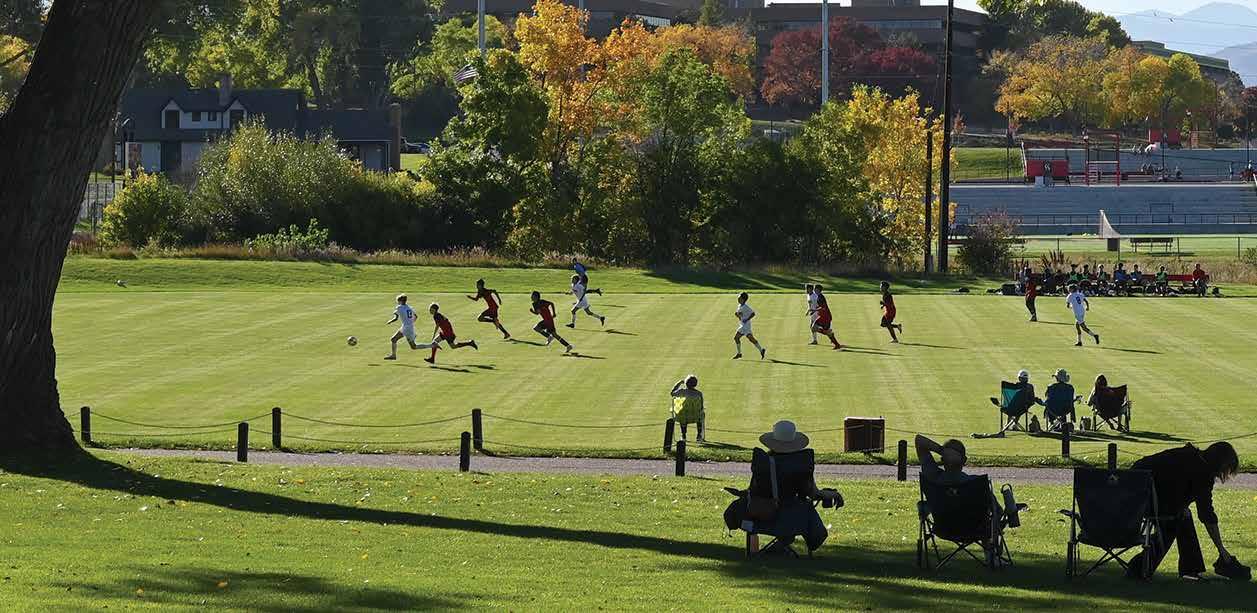
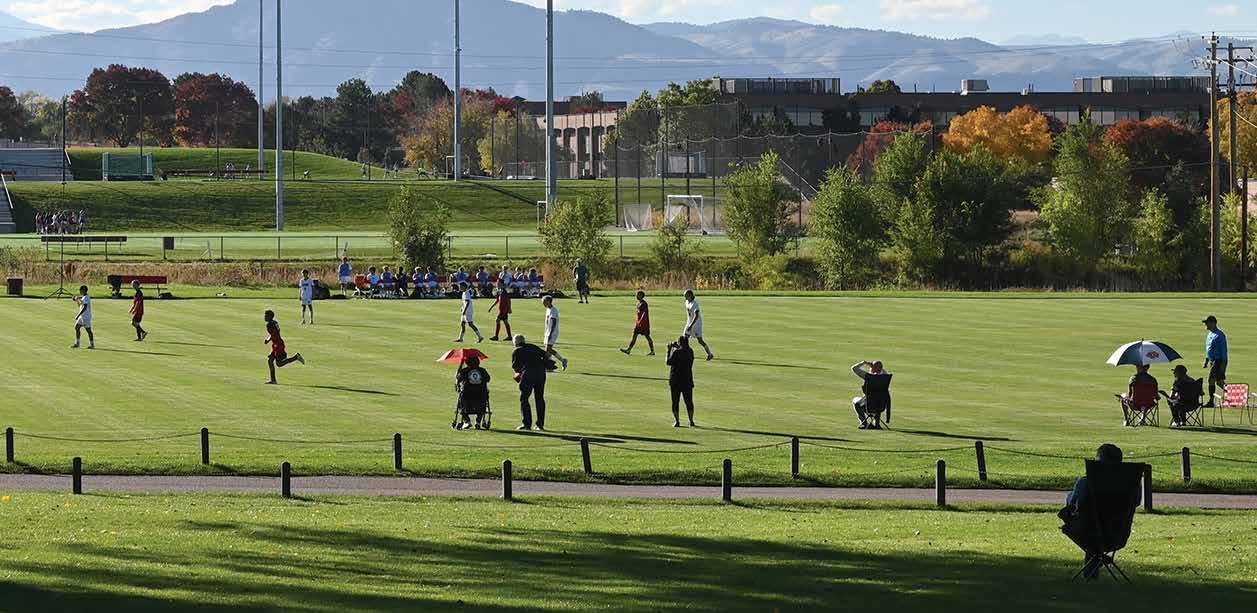
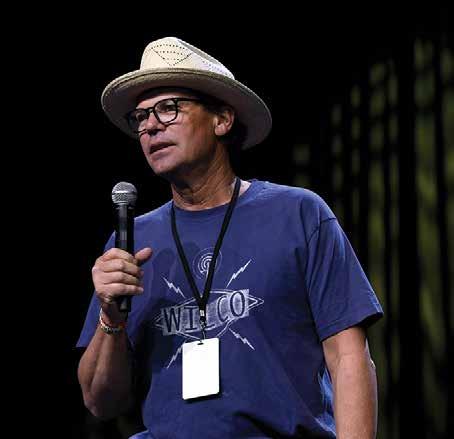
Thank you for investing in bringing the school’s mission to life in visible, immediate ways, inside classrooms, on stages, on elds, and across campus.
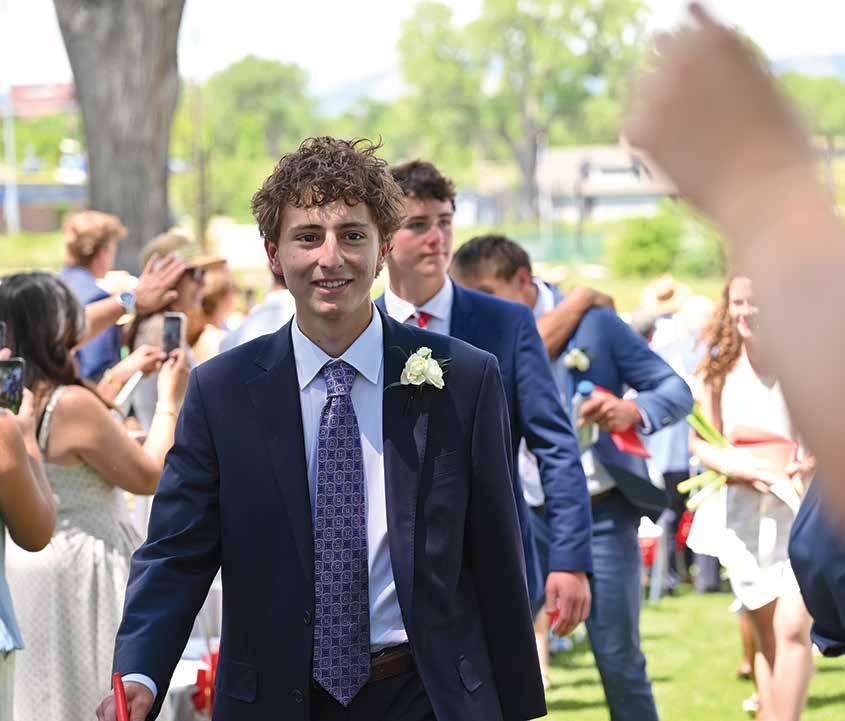
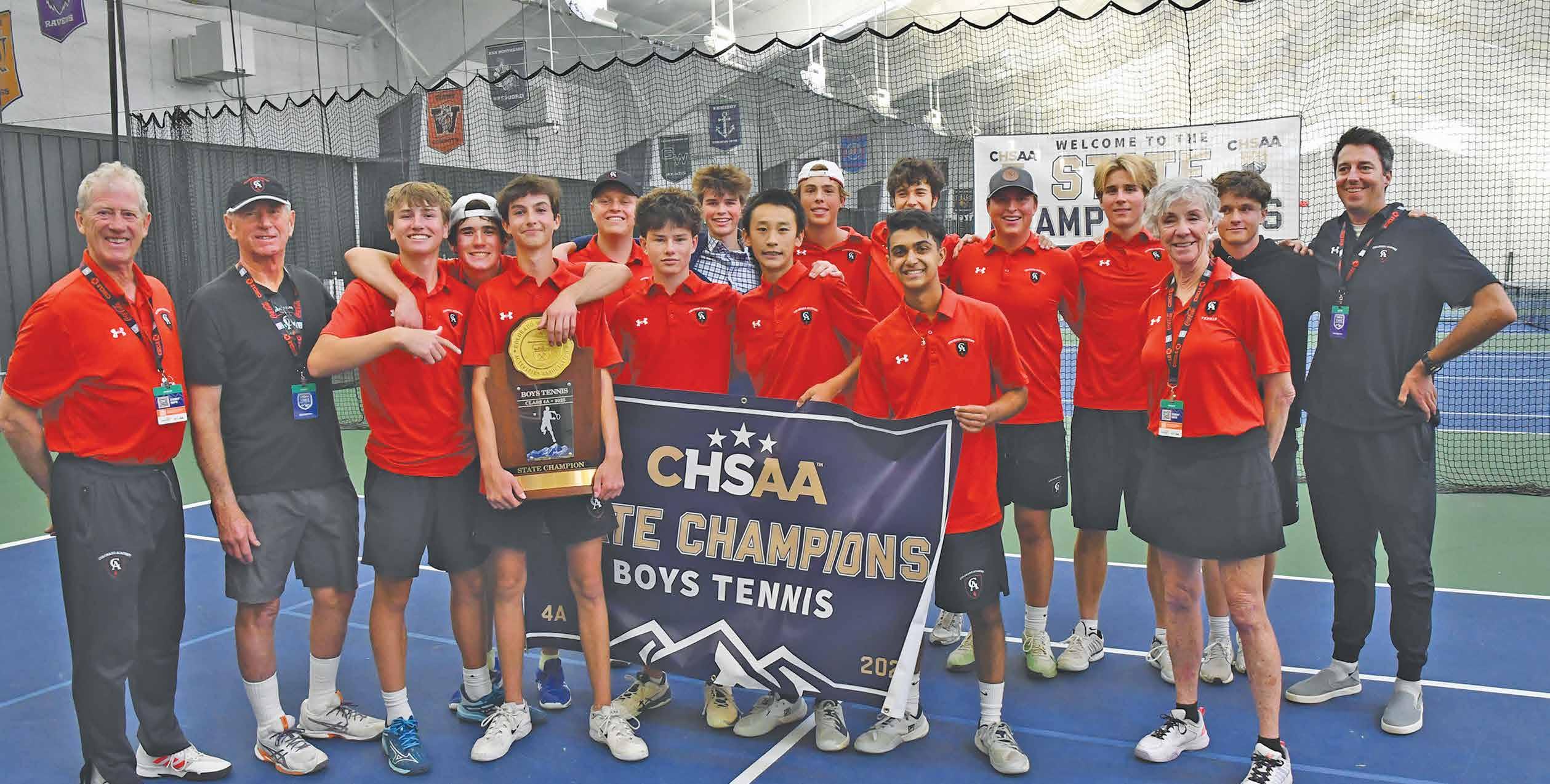
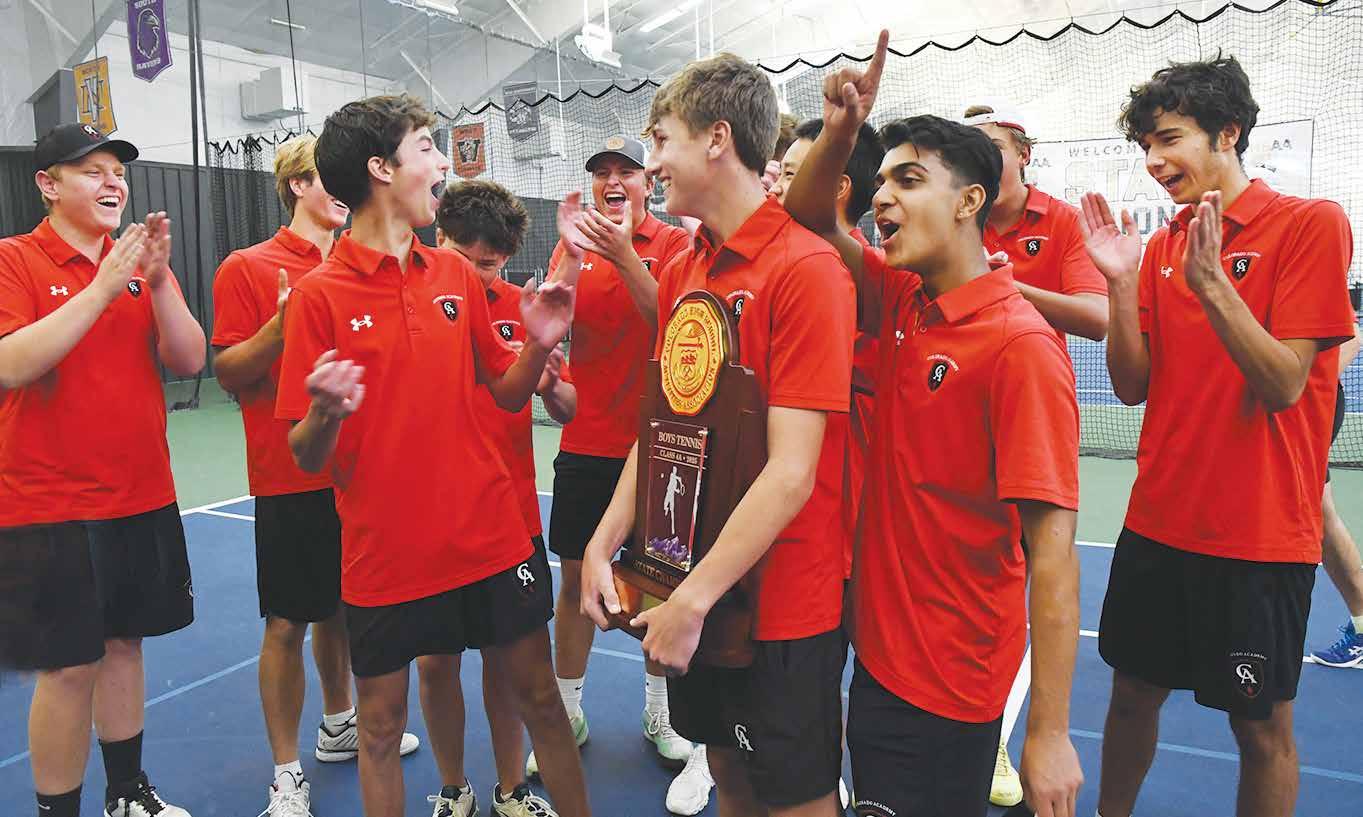
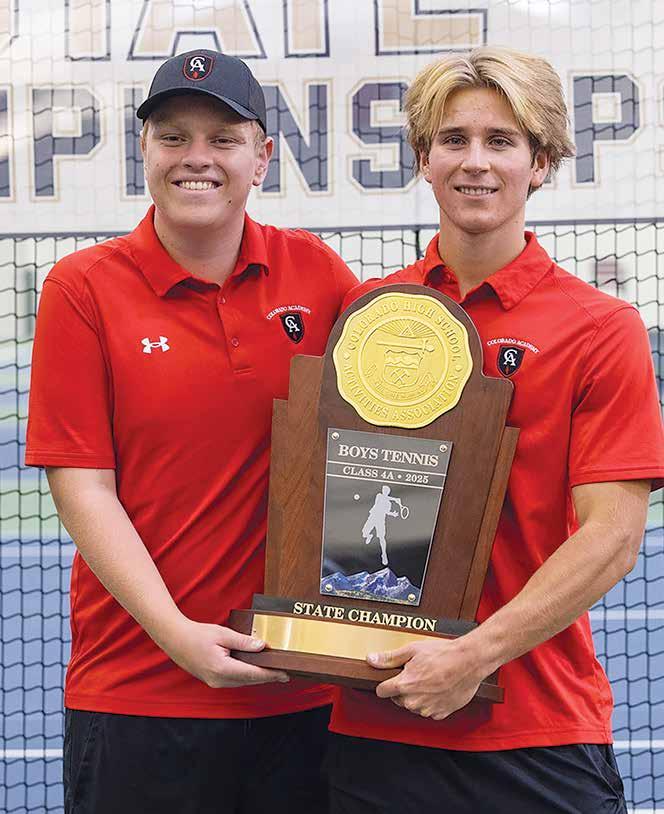
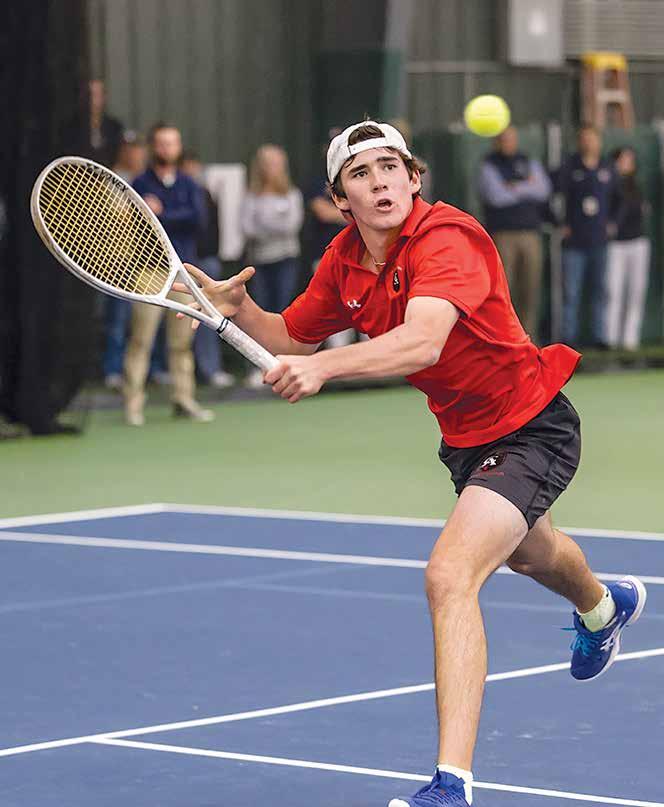
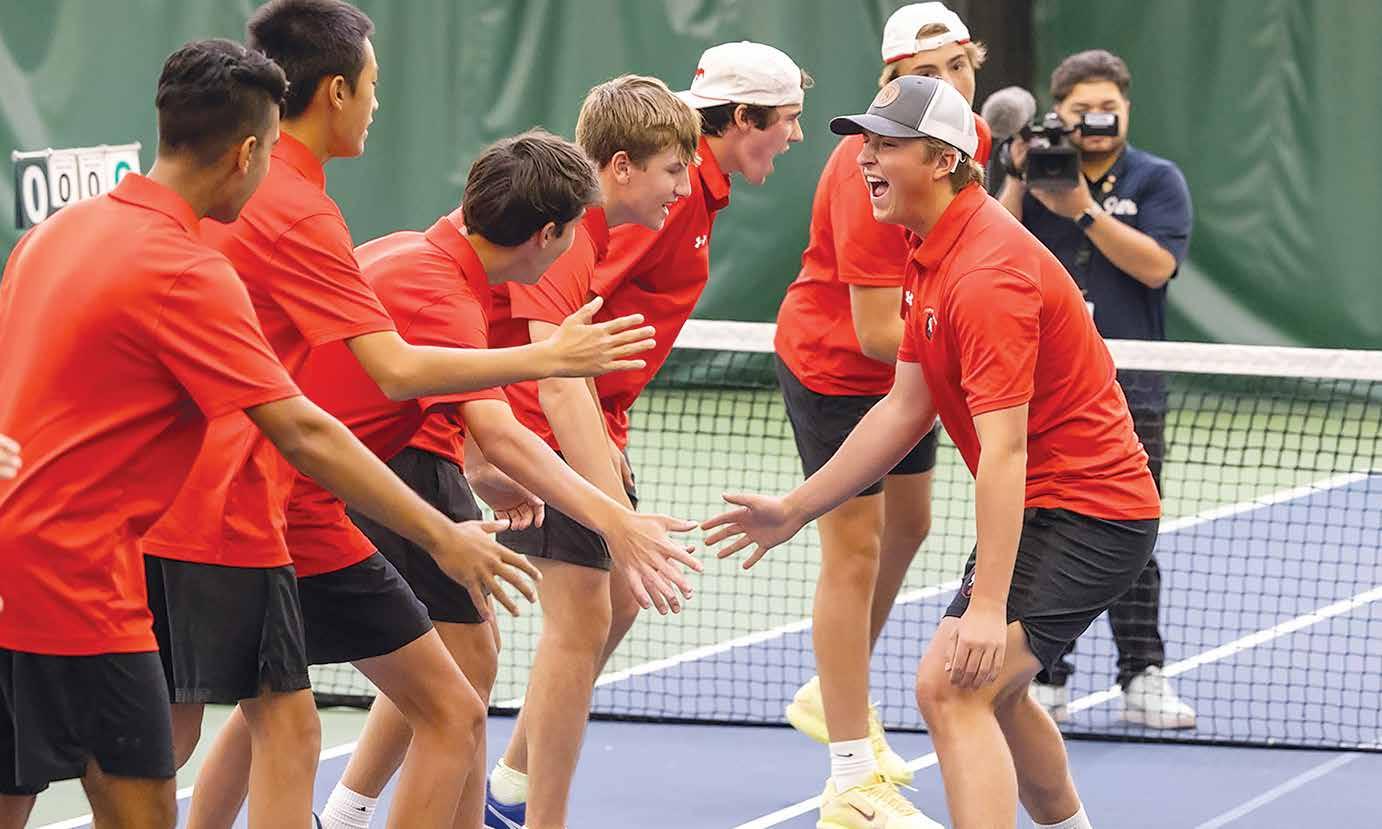
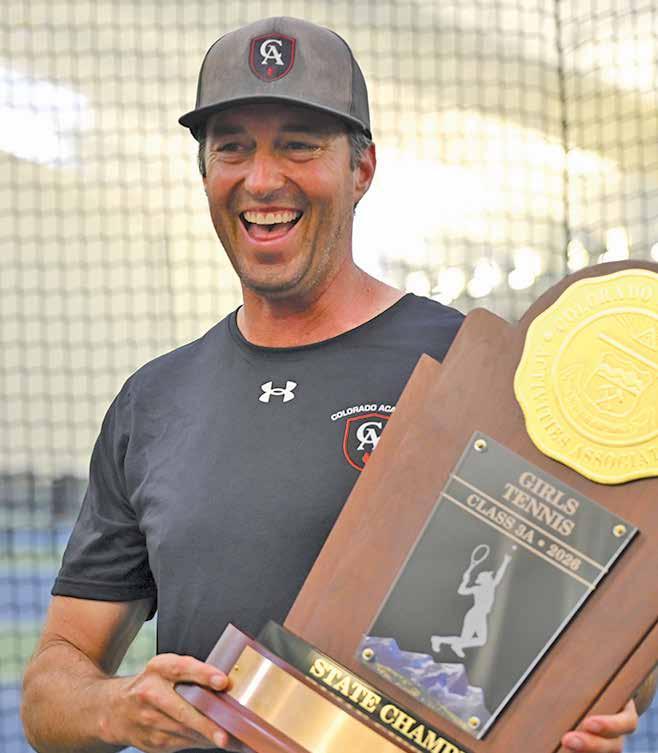
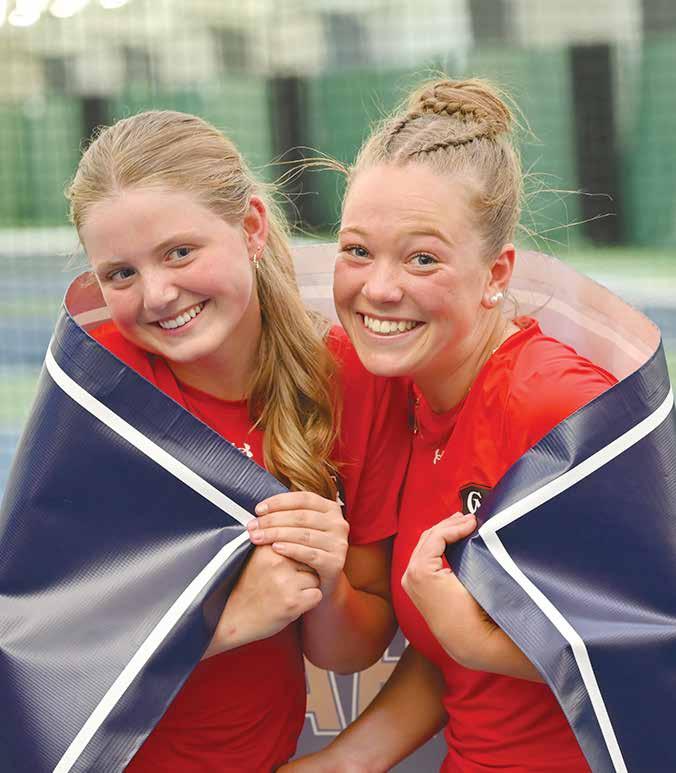
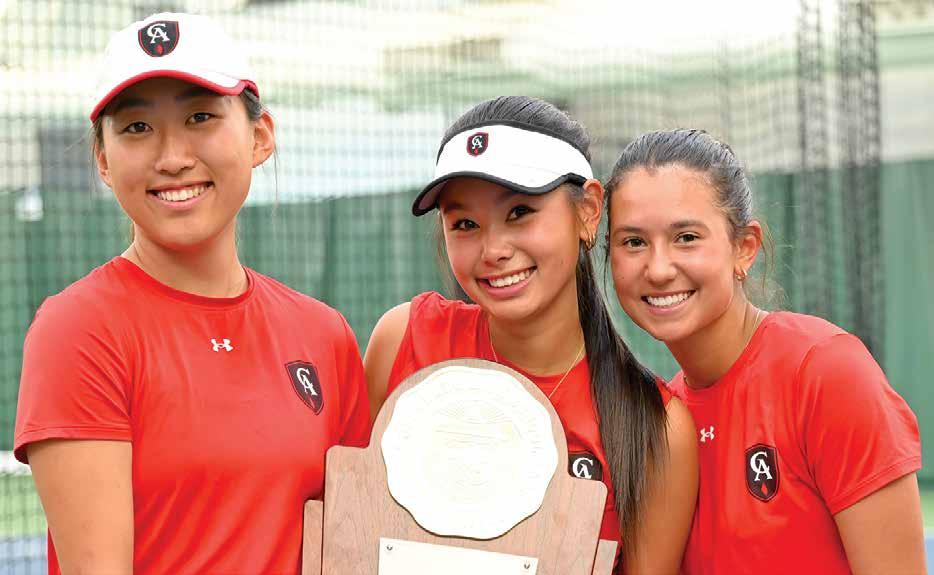
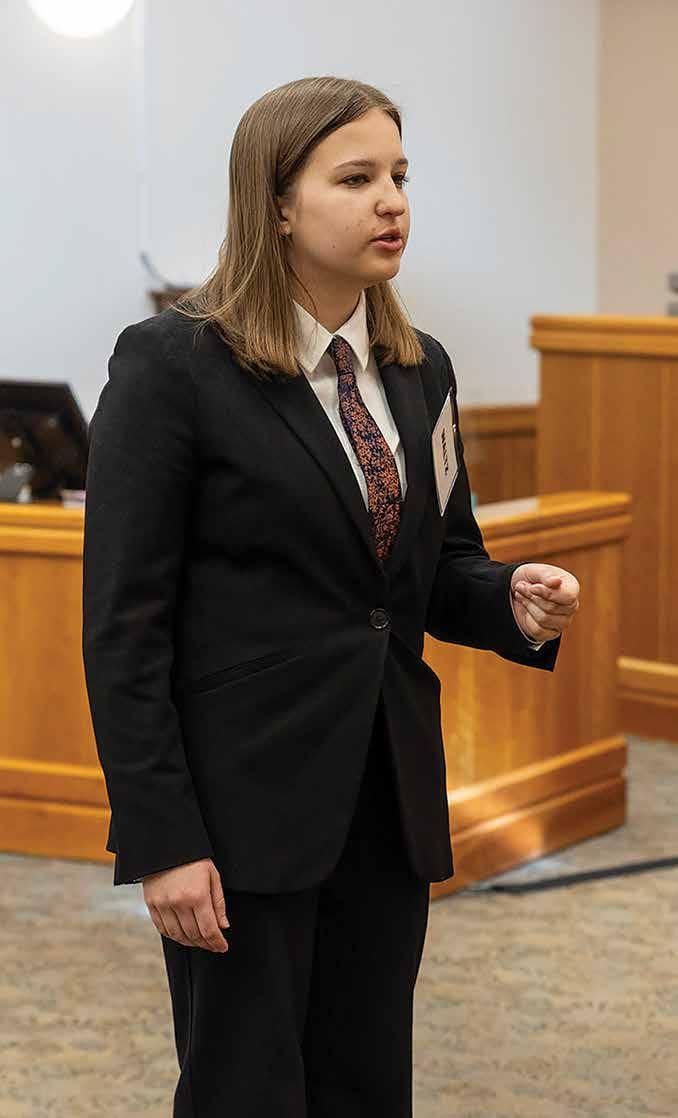
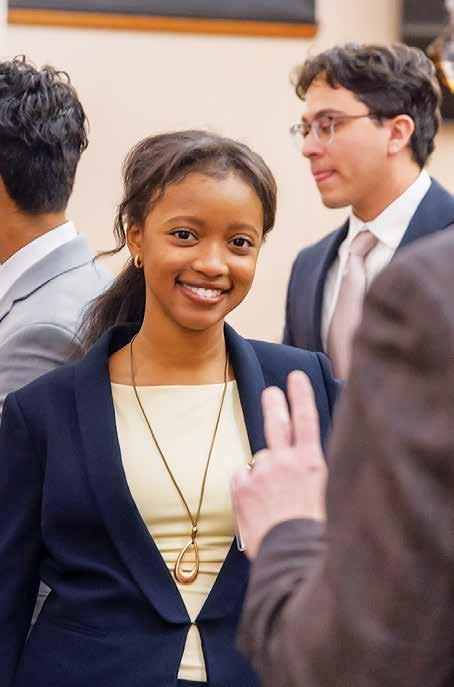
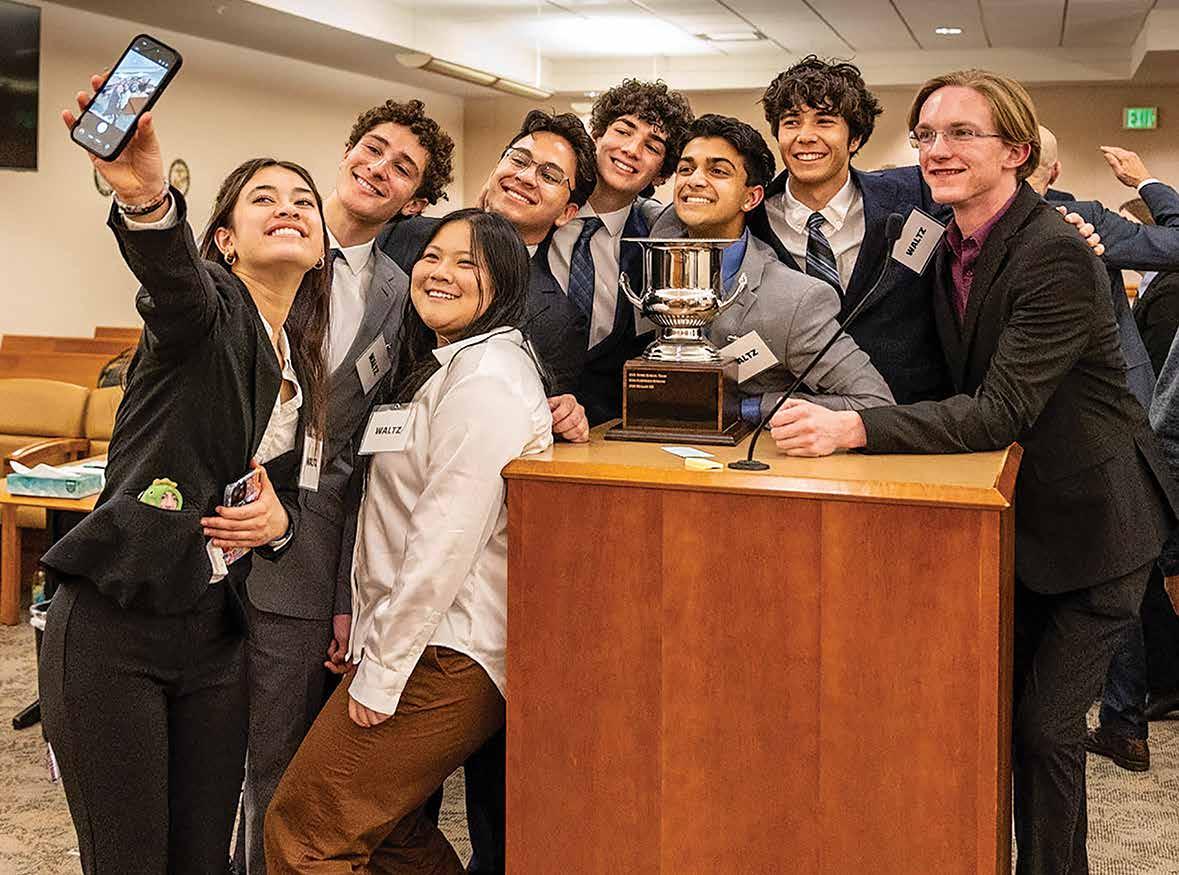
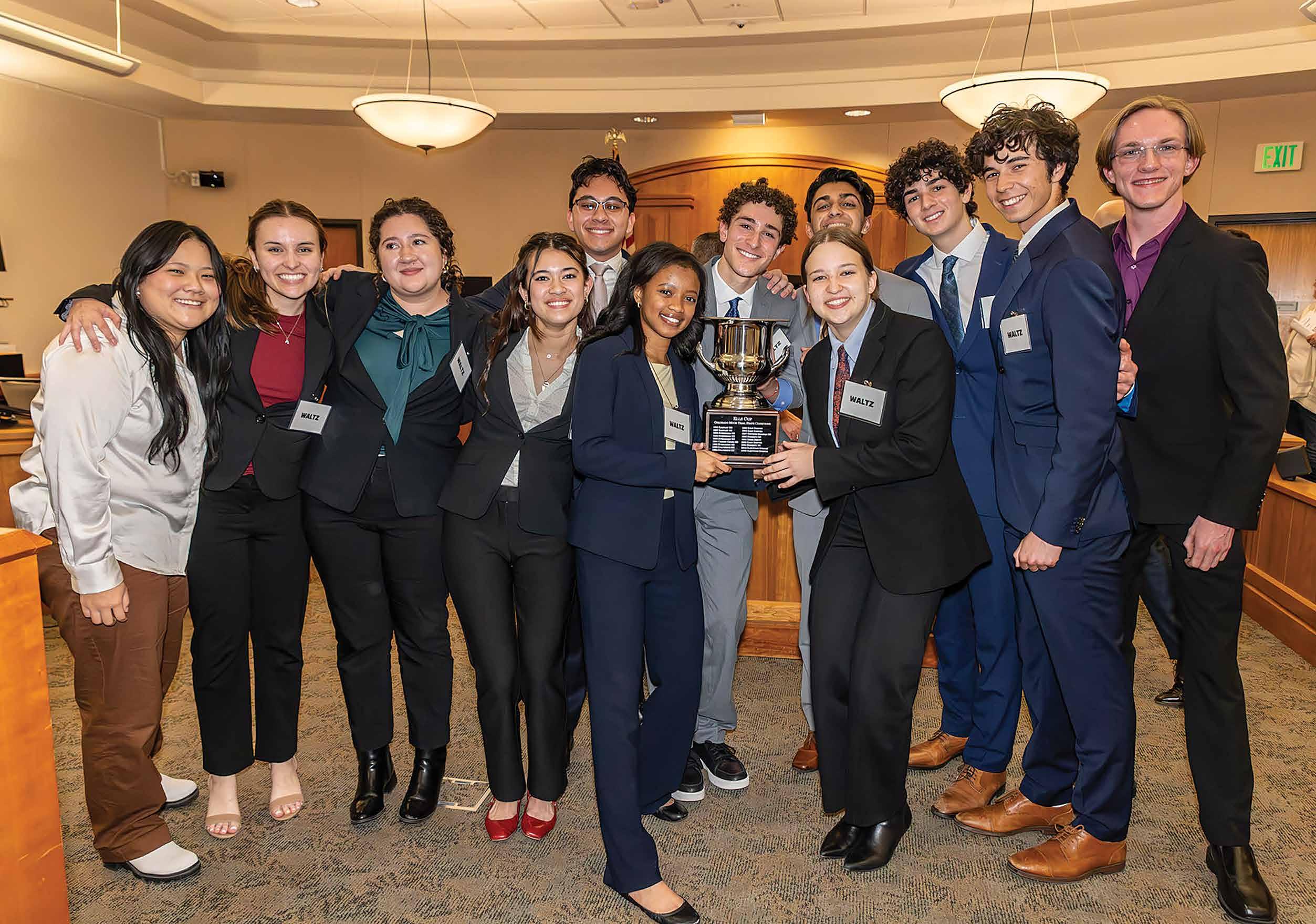
“I was on the Tennis Team and the Mock Trial Team—and both won State Championships. Being able to do a Video Portfolio alongside that, while serving on the Culture & Community Student Leadership team— it just feels like there’s so many different pathways at CA.”
Mitchell Sindler, Class of 2026
The CA Journal is published by the Colorado Academy O !ces of Advancement and Marketing & Communications. Every e ort has been made to ensure that the information included in this publication is accurate and complete. If you note any errors or omissions, please accept our apologies and notify the O !ce of Advancement at chris.barnard@coloradoacademy.org, or 303-914-2510.
PARENTS OF ALUMNI
If this publication is addressed to a child who no longer maintains a permanent address at your home, please send an updated mailing address to chris.barnard@coloradoacademy.org, or 303-914-2510.
CORRESPONDENCE
Colorado Academy, 3800 S. Pierce Street, Denver, CO 80235, 303-986-1501
WRITERS AND EDITORS
Chris Barnard
Jan Beattie
Bill Fisher
Emma Harrington Kane ’07
Becky Risch
Phil Smith
Gravely Wilson
Cindi Sherman
Sir Speedy Denver
Emily Doty
Bill Fisher
Cyrus McCrimmon
Becky Risch
Kathryn Scott
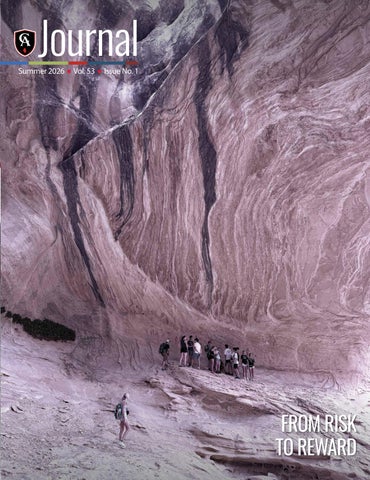
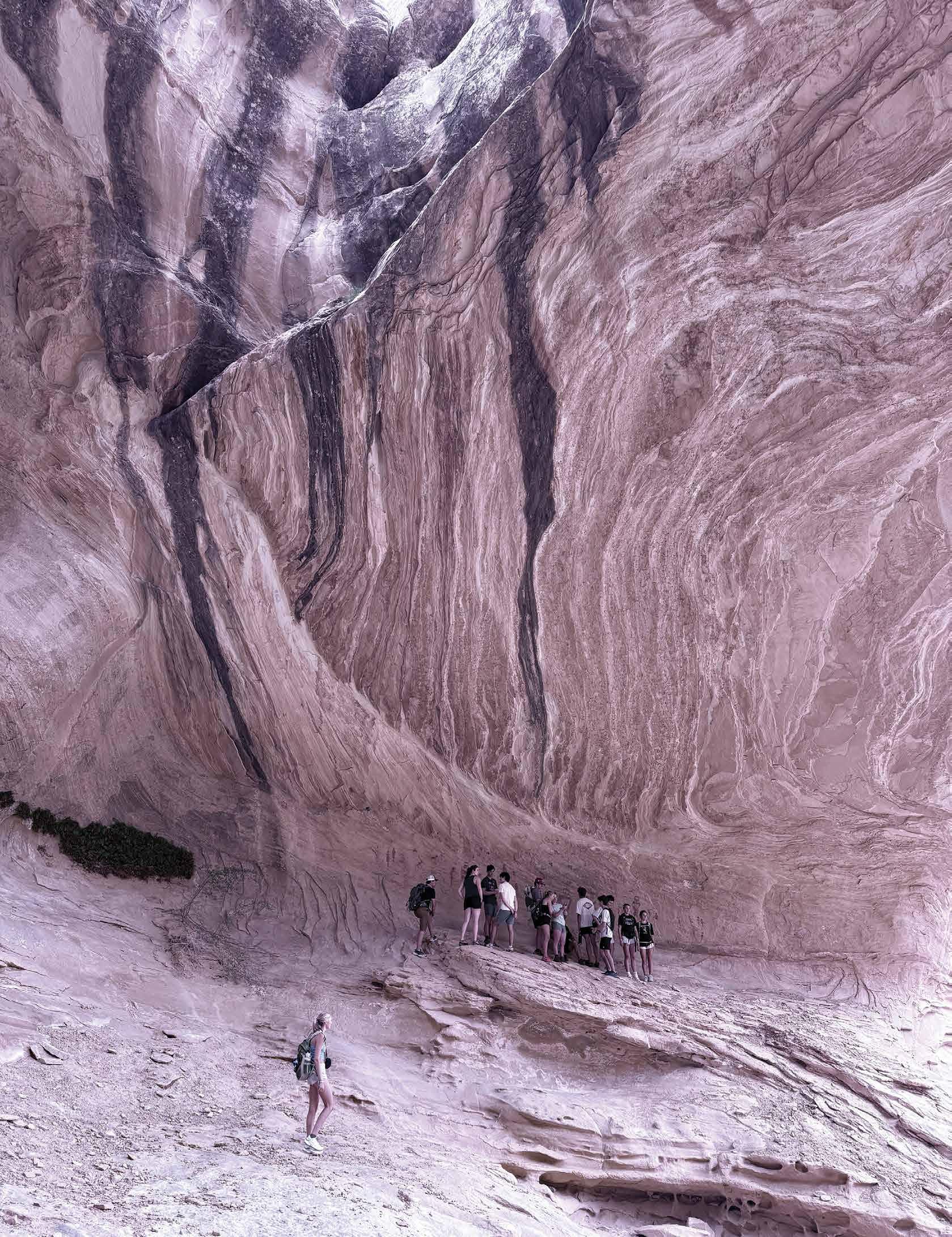
Adventure, Risk, and Discovery
By Dr. Mike Davis, Head of School
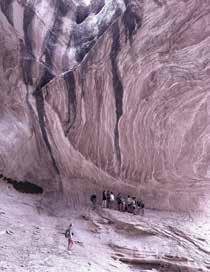
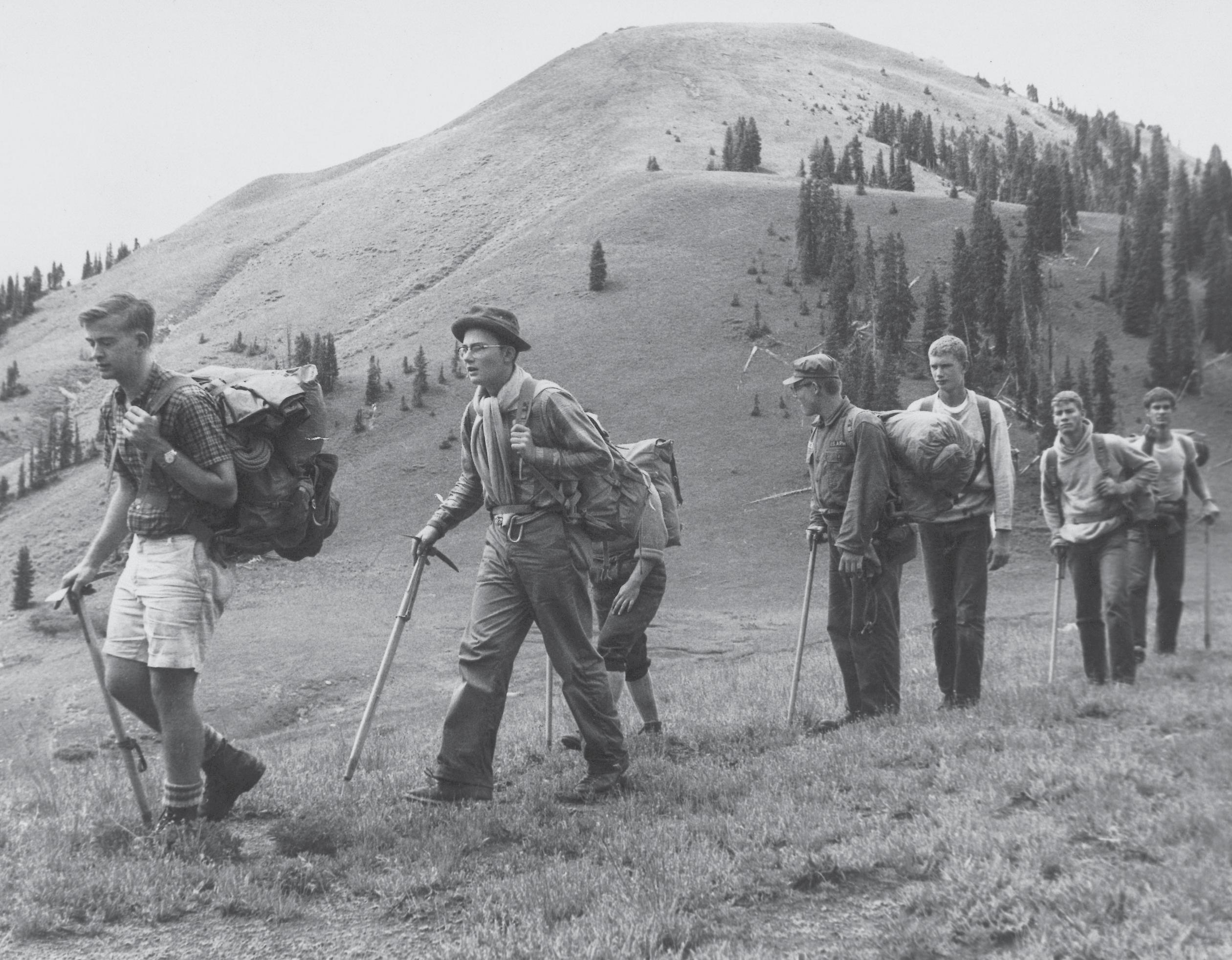
Iwas fortunate to grow up the son of a research geologist who worked in the eld. With his cowboy hat, Red Wing boots, holstered compass, blue jeans, and homemade leather satchel for rock samples, I felt like I was hiking through the deserts of our home state, Arizona, with Indiana Jones.
I would go on trips with his students who, in the 1970s and 80s, all looked like Neil Young. They would play guitar and even have wrestling matches by the re. We would run into real cowboys, who would tell us stories and talk about their lives. On one super hot day, when my dad pulled over to look at formations in a road cut, two guys ran out of the desert dying of thirst and jumped into the back of our pickup truck. (My dad drove them to a small town, bought them a six-pack of Coors Banquet, and drove them a little further from Tucson.) Another time, we were in a dry wash when we heard a roaring sound. My dad sprang into action, running to pick up my little brother before a massive ash ood enveloped the spot where we had been standing. When my dad was mapping, I would often explore the desert, discovering my love of rock climbing. This was all a true gift of my childhood.
After graduate school, I ended up teaching at a boarding school, where I took over running an outdoor education program that gave varsity sports credit to Caving and Rock Climbing. I led expeditions all over the Southwest and northern Mexico. I took students into a 500-meterdeep vertical cave that featured two 100-meter rappels. I led students up
2,000-foot multi-pitch climbs. During these experiences, I learned to confront fear. I learned about my potential, as well as my limitations. I learned risk management. I learned how to work with others. I learned the power of putting my anxious brain into a “Zen” zone in situations that many would freak out about. And I had a lot of fun.
We pride ourselves at Colorado Academy on our outdoor education opportunities and traditions of adventure. In fact, I believe my experience leading an outdoor program at that boarding school was a reason that I was hired at CA. During my interview, one trustee asked, “Do you trad climb or sport climb?” He smiled when I said, “Both.”
But going back to my dad, he taught me that one can and should integrate one’s love of the natural world with intellectual purpose. He wasn’t randomly going into the desert to nd beauty. Rather, he was pursuing deep academic rigor. On my own Interim trips, particularly the ones I have led to the archeologically rich Bears Ears National Monument, I try to bring my background as a historian to share with my students.
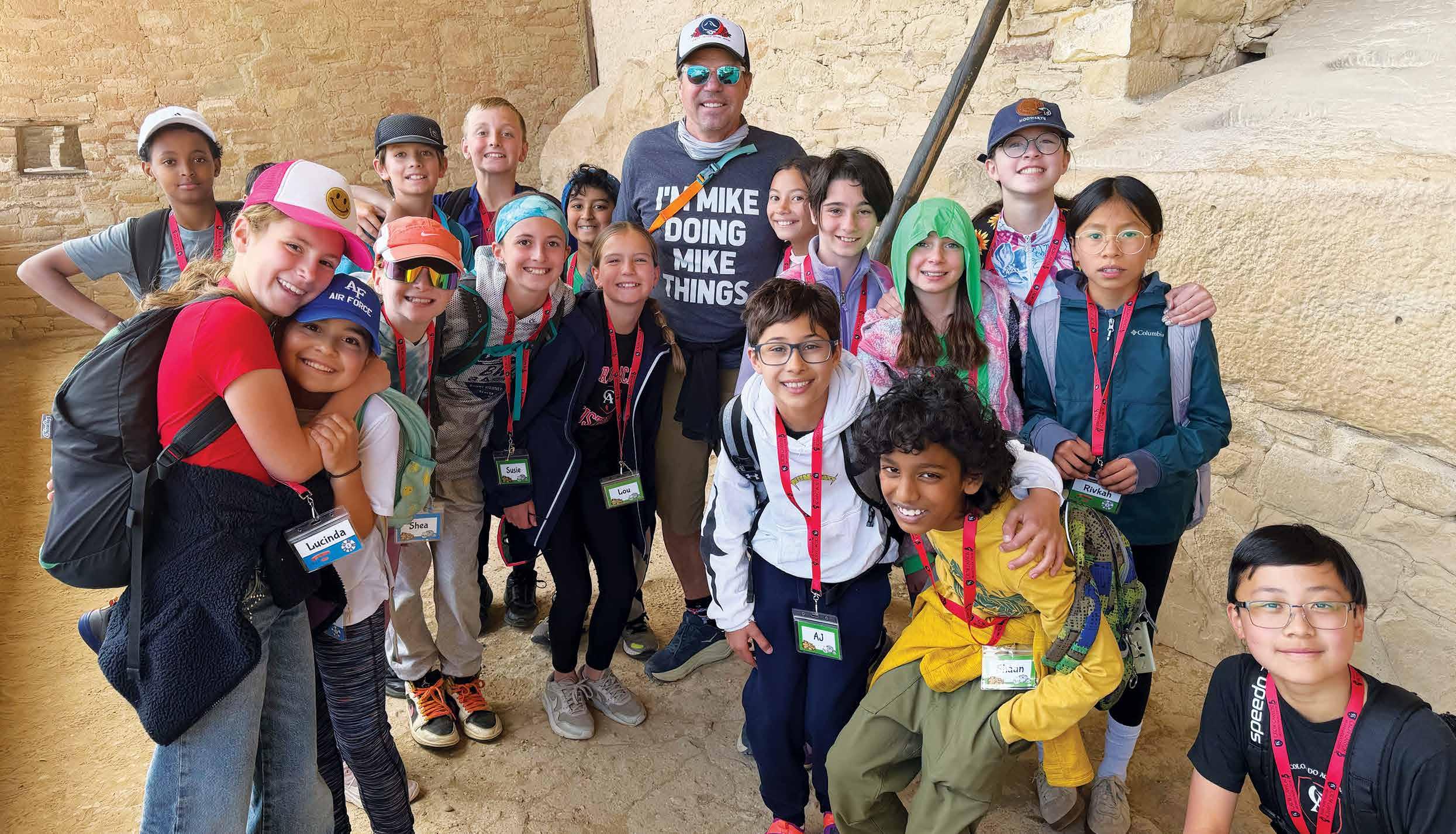
At CA, “adventure” is not limited to just the outdoors. Think about our Fifth Grade Crow Canyon trip. Our students head out to Mesa Verde and Hovenweep and learn all about the Ancestral Puebloan people. I went with them to Balcony House and loved hearing them talk and ask questions. And, I saw them climb the tower ladders and overcome their fear of heights.
Think about last year’s inaugural summer Experiential Academic Elective
course in New Mexico, where students stayed at Ghost Ranch and created art inspired by the same landscape that Georgia O’Kee e made famous. This summer, students are going to Iceland to study environmental science. We have teachers, funded by a Benson Summer Grant, going abroad to study how math is taught in Europe, as well as to Australia to study evolution. I could go on and on.
When I was writing my dissertation, an outside observer probably wouldn’t have called it anything adventurous. However, I would disagree. I often associate “adventure” with “discovery.” When writing on American immigration and refugee policy during the Cold War, my purpose was to discover a part of American history that hadn’t been fully explored. I went to four presidential libraries and the National Archives to nd documents that literally no one had seen in a long, long time. Some documents were purposely buried. I had to make sense of decades of policymaking. I had to gure out the deals and bargains that had been struck behind closed doors. I had to ascertain the implications of what I found.
When rock climbing, skiing, backpacking, or mountain biking, one is constantly having to think, make adjustments, and improvise. As scholars, we do the same. And when they do it well, academics do it fearlessly. Great thinkers in the historical past and even now have sometimes had to pay an enormous price for putting forth a truth, even when it is backed by evidence. Ideas can be dangerous and threatening. Academic institutions are crucial for creating spaces where we can grapple with ideas
and hard truths and become better versions of ourselves.
The skills I applied in graduate school while earning my doctorate are the same ones that we are teaching to CA students from Pre-K to Grade 12: how to write, how to analyze, how to think, how to problem-solve, and much more. Students are confronted with challenges and problems and have to struggle through them. Sometimes this can be just as scary and anxiety-producing as climbing a rock wall. But with practice, one builds that con dence.
Our recent graduates, the CA Class of 2026, are justi ably proud of all their accomplishments in academics, arts, and athletics. To learn more about the myriad ways they excelled and made an impact on CA, go to our website and read the individual tributes written by their teachers and Advisors. This class truly embodies the adventurous nature of Colorado Academy.
These Seniors have seen what happens
when you say yes to the unfamiliar— that the most rewarding experiences often start with some fear. When o ering advice for younger students, they emphasize that the risk is worth it. Their advice is consistent, hard-won, and worth reading:
“Do something that scares you. If there is a part of you that really wants to do something but you are nervous or unsure, take the leap—because it could turn into something really meaningful and special.”
— Emery Mikula
“Say yes to new conversations, to a new activity you’ve never tried, to a new class you haven’t taken yet. Although you feel certain that you know everything about yourself, you don’t.” — Quincy Coleman
“At CA, I’ve surprised myself with my willingness to explore new topics and interests that I’d never expected to enjoy. Courses and conversations pushed me beyond what felt familiar, teaching me to embrace uncertainty and take academic risks.” — Taylor Bezoza
As we confront how arti cial intelligence is going to shape our future, protecting and enhancing our spirit of adventure will be more important than ever. We need to maintain the capability and sense of urgency to think and to create. Some schools will adopt AI to enable individualized, screen-based learning; there will certainly be some adoption of AI at CA. But if we are going to help raise capable, con dent adults, what will be most critical for us is to embrace those things that are distinctly human.
Essential human characteristics have advanced knowledge throughout history: wisdom, ethics, creativity, critical thinking, communication, empathy, and collaboration, among many others. Schools like ours must hold these as central to their mission. This coming year, we will work across divisions to clarify our vision and philosophy as we enter this new age of knowledge. Adventure awaits. n
Dr. Mike Davis with Fifth Graders at the Crow Canyon Archaeological Center in April 2026
TAKING ON SEXUAL ASSAULT Good Kids and Good Kids
Maybe this is one we shouldn’t touch.”
That is what Katy Wood Hills, Colorado Academy’s Visual & Performing Arts Director, thought to herself when she heard about the drama the Upper School’s Advanced Acting class wanted to stage in November 2025.
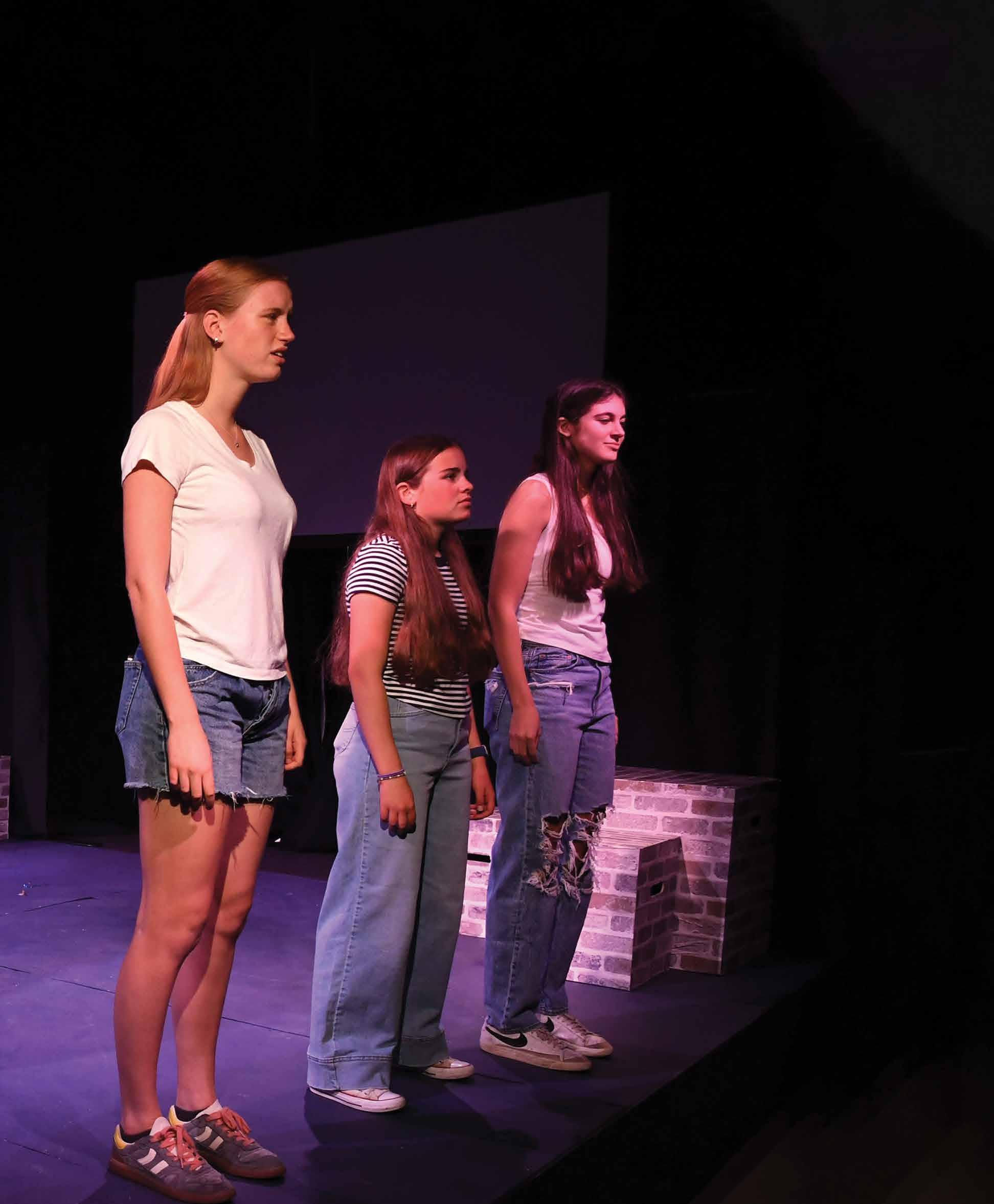
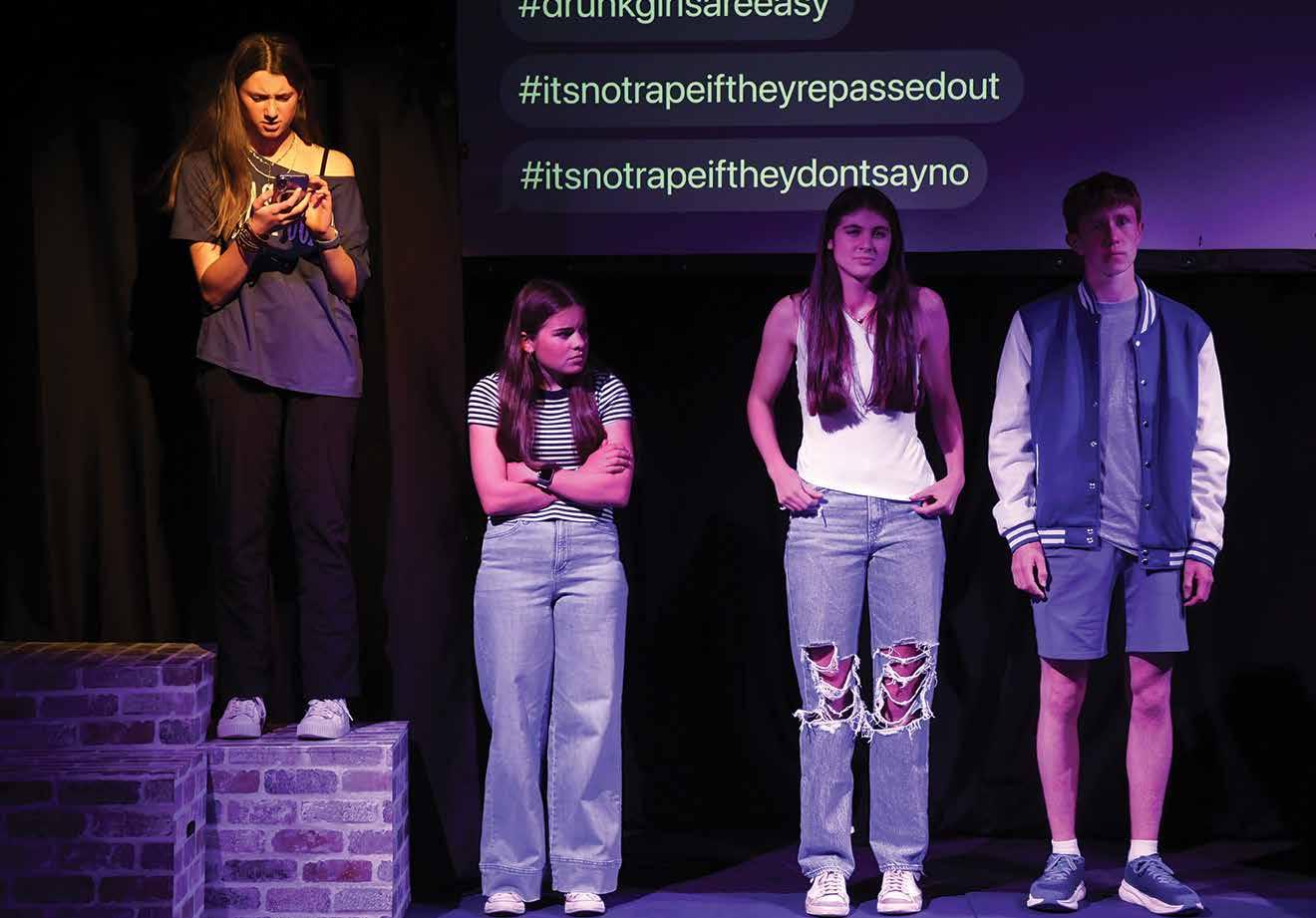
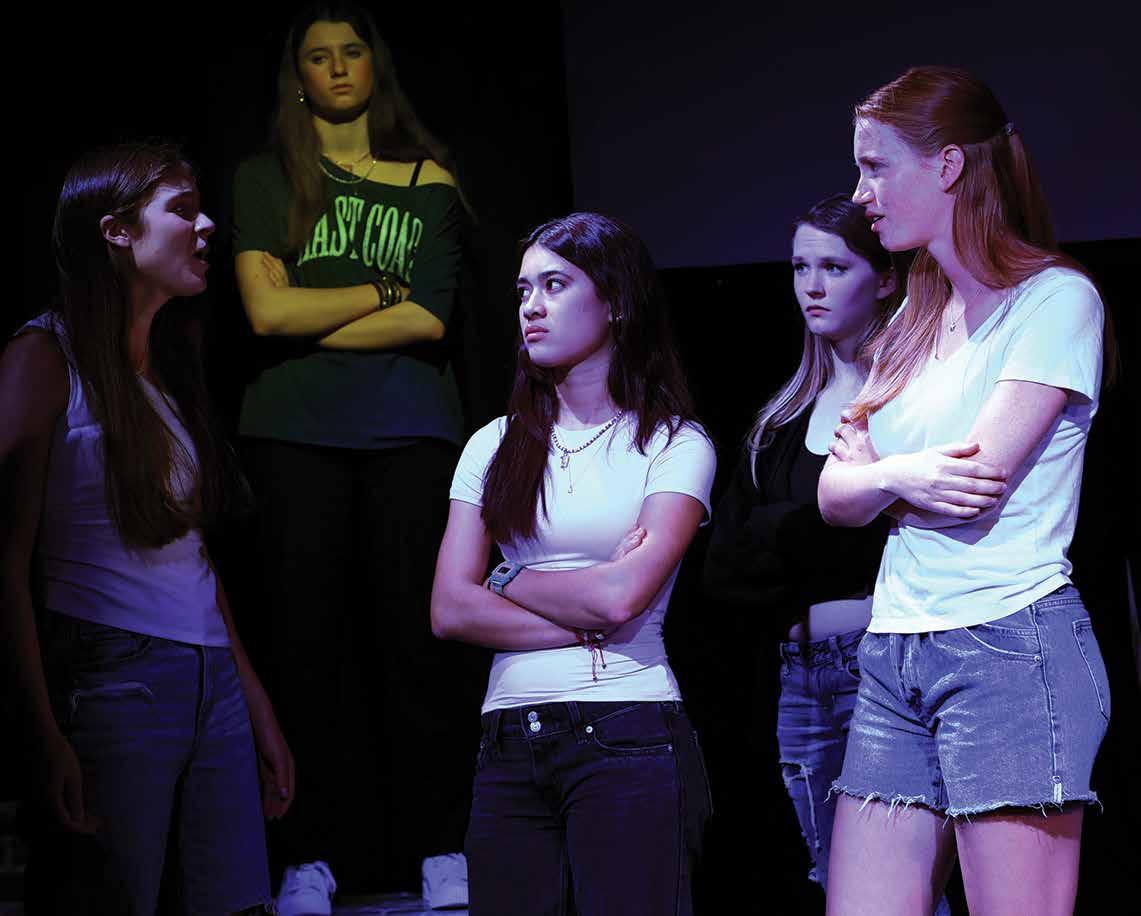
The play was Good Kids, Naomi Iizuka’s provocative retelling of a high school sexual assault case based loosely on the one that occurred in 2012 at Steubenville High School in Ohio. The crime and the yearslong legal proceedings that followed it divided a town and attracted national attention: Two of the victim’s peers were found guilty after the event was documented on social media, even though some students and adults in the community tried to shield the perpetrators. Exploring themes of rape culture, social media, and victim-blaming through the con icting stories of teenagers, Good Kids looks at the ways that digital platforms such as Instagram and YouTube warp the truth, harming young people.
It was indeed a potentially controversial work to consider bringing to CA’s Leach Center for the Performing Arts, even its Black Box Theater, a smaller and more intimate venue designed for just this kind of production. With adult language and
content throughout, Good Kids was the rst work produced through an initiative established by the Big Ten Theatre Consortium, a collaboration aimed at advancing the work of young female playwrights. Since its premiere in 2014, the play has been staged hundreds of times, mostly by college and university theater departments accustomed to dealing with mature themes.
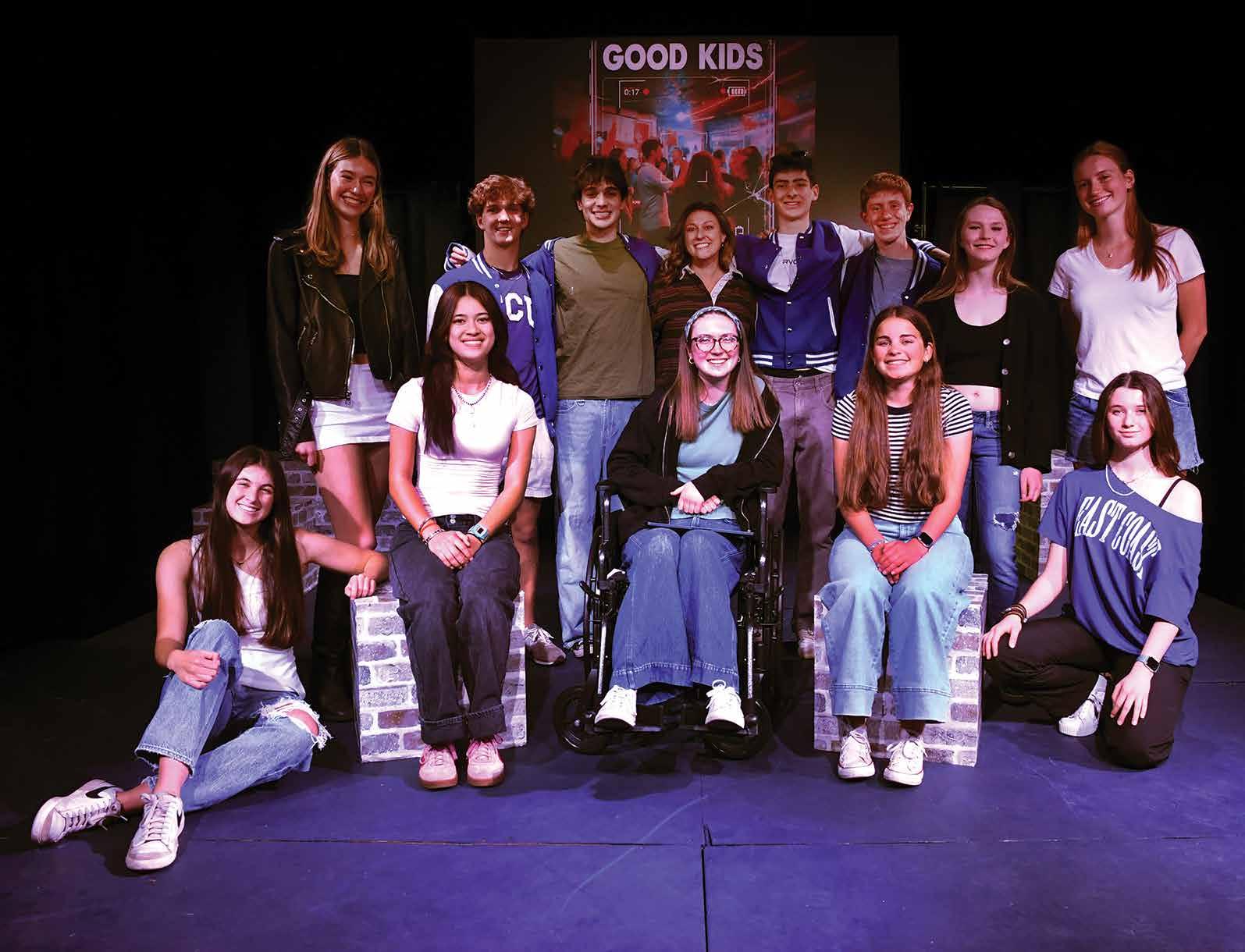
Yet Hills doesn’t believe in avoiding what she calls “di!cult conversations” in the arts; the trust she shares with faculty members and students across all three divisions of the school means that decisions about tough topics are made with input from all involved. And this year, it was the experienced Sophomore, Junior, and Senior actors enrolled in the course themselves, working with Theater and Dance Instructor Melissa Zaremba, who unanimously chose Good Kids after evaluating several scripts at the start of the fall trimester.
According to Zaremba, “When the students chose this play, I was surprised, concerned— and also very proud of their willingness to take on such a complex subject.”
Through conversations with her students as well as with faculty and sta members, she heard that sexual assault and toxic behavior on social media weren’t far-away problems that a ected only “other people”—they were real issues experienced by family
“You don’t solve a problem like sexual assault with anything other than a deep shift in attitude, and a deep shift in attitude happens conversation by conversation, in dorm rooms, parties, and rehearsal halls.”
Naomi Iizuka Author of Good Kids
members, friends, colleagues, and even CA students and teachers.
Upper School Principal Max Delgado, too, a!rmed why this kind of work is so relevant and important to students, and he o ered his full support.
As Senior cast member Caroline Haley, who played assault victim Chloe, explains, “Everyone found important meaning in this show, and the Black Box is the space
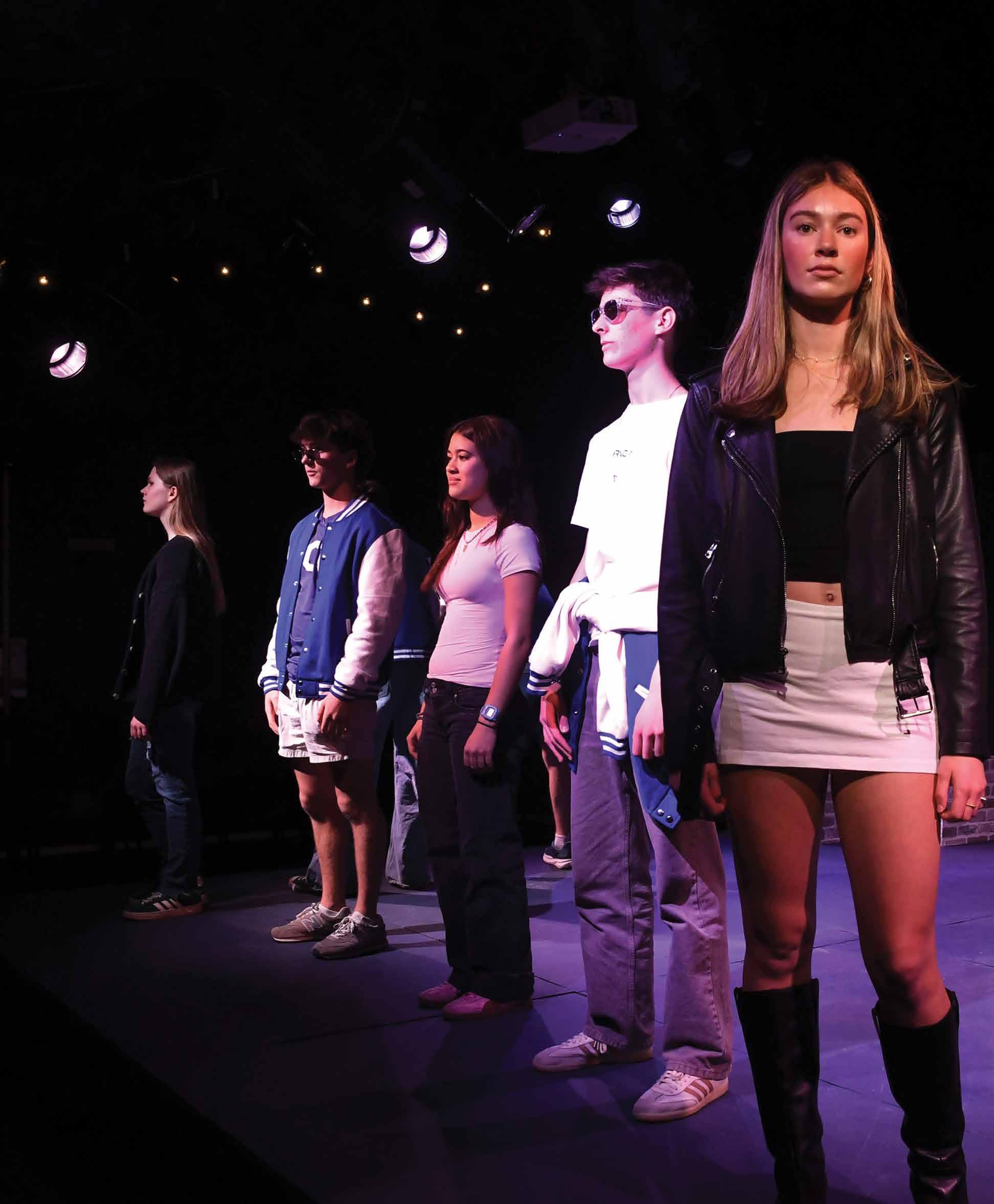
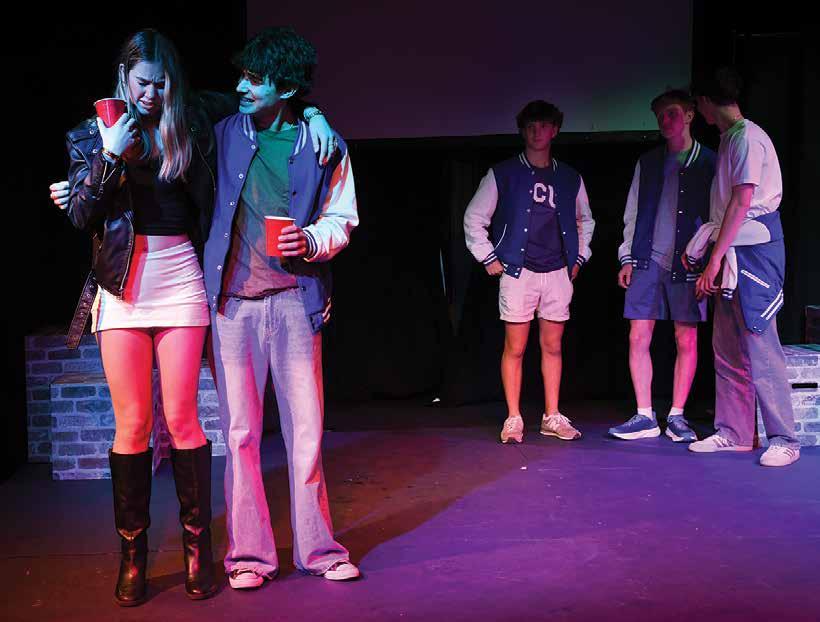
At left, Seniors Caroline Haley and Gideon Silverman-Joseph
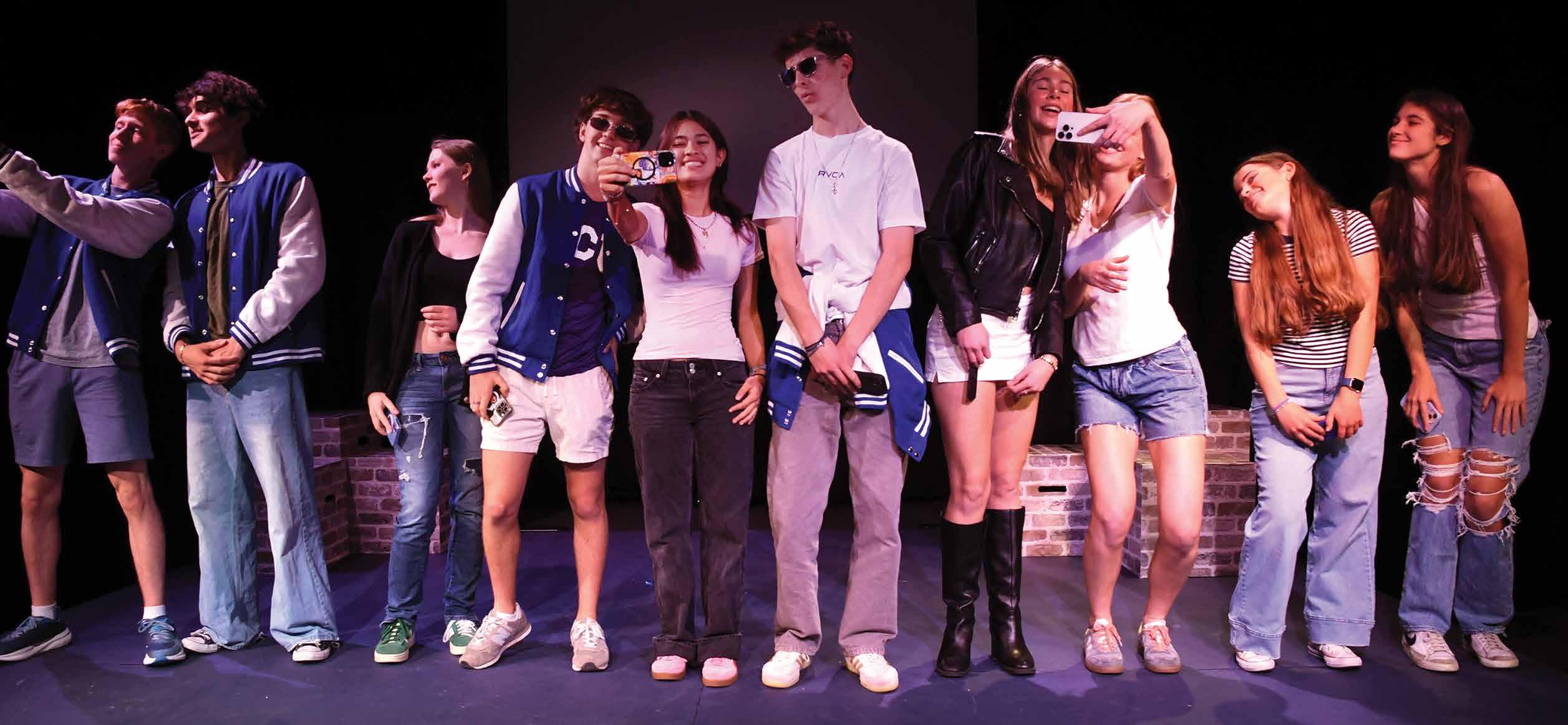
From left, Juniors Christian Aposporis and Jack Jordan, Sophomores Mika Chesnutt and Lorelei Abar, and Junior Gia Gile
to put on these kinds of intense works that can’t be seen on our Main Stage. You get a lot of laughs and a lot of love from those big shows, but we felt we almost had to portray these themes here, because it was an opportunity to do such a di erent kind of piece.”
Fellow Senior Gideon Silverman-Joseph, who played one of Chloe’s attackers, adds, “The play is all about kids in high school. It felt like we should take the bull by the horns and perform it from the perspective of high school.”
Con dent in both her colleagues’ and the actors’ decision, Hills realized this was a moment for CA to lean into its mission, “particularly the notion of courage,” she says. “It was a truly courageous decision by the class as a whole to engage with such challenging content.”
COURAGEOUS CONVERSATIONS
But Hills’ involvement with the production didn’t end there—it was only beginning.
She and Zaremba knew that staging Iizuka’s play would require extraordinary care and sensitivity, both to protect the student actors who’d play roles that were vulnerable or violent, and to ensure that the disturbing narrative—based on a reallife assault and focusing on themes that could feel painfully immediate for high
school-age viewers—didn’t result in harm for audiences.
“We embraced the idea of nurturing this courageous conversation, but at the same time were wary about forcing something that could be troubling or even traumatic for the participants and viewers,” explains Zaremba.
The two consulted with CA’s counseling team as well as Amy Wintermeyer, the Assistant Head of School, who helps lead e orts to bolster culture and community, to seek their guidance in wrapping safety and support around every aspect of the production. Their rst step, and probably the easiest, was crafting a warning that would accompany any promotion of the play; it noted, “This production contains material of a highly sensitive nature, including strong language and discussion of sexual assault that may be triggering for some individuals.” They also resolved to allow admission to performances only for students in Ninth Grade or above.
What was more challenging, however, was establishing the supportive rehearsal environment the 12 student actors would need if they were to succeed in portraying characters—all of them their own age— whose experiences and beliefs could be painful, o ensive, shocking, or cruel.
Good Kids takes place after a high school party, when a student, Chloe, is raped by a
gang of football players after passing out from alcohol consumption. Most of the play follows the repercussions and rumors that circulate afterwards among Chloe’s peers, some of whom blame her for causing the assault. If, as one of the female characters says, “We’re all good kids, every single one of us,” then the play asks what could lead so many “good kids” to collectively assault a classmate, fail to intervene while the act is happening, and then post and share the evidence on social media?
According to Iizuka, “You don’t solve a problem like sexual assault with anything other than a deep shift in attitude, and a deep shift in attitude happens conversation by conversation, in dorm rooms, parties, and rehearsal halls.”
Conversation, notes Zaremba, was the key to creating the safety net the performers needed.
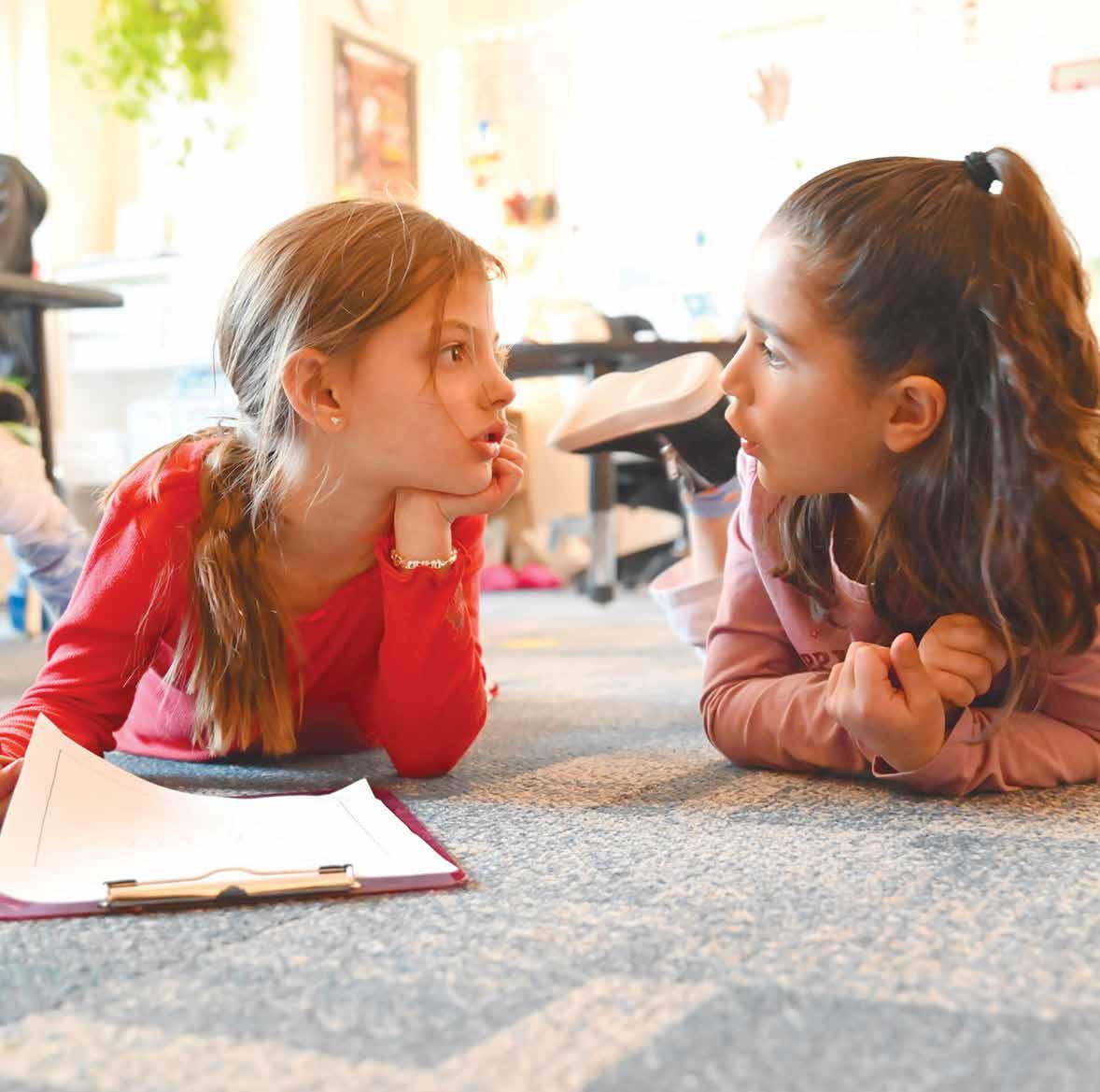
Early on, she gave the students a study guide used for college productions of the play. The questions in the guide—about topics like consent, peer pressure, and when to intervene—sparked valuable discussions that both built shared understanding among the cast and smoothed the way for their inhabiting roles and ideas so di erent from their own.
Worried what her students’ families might think when they heard from their children about the kind of material they were
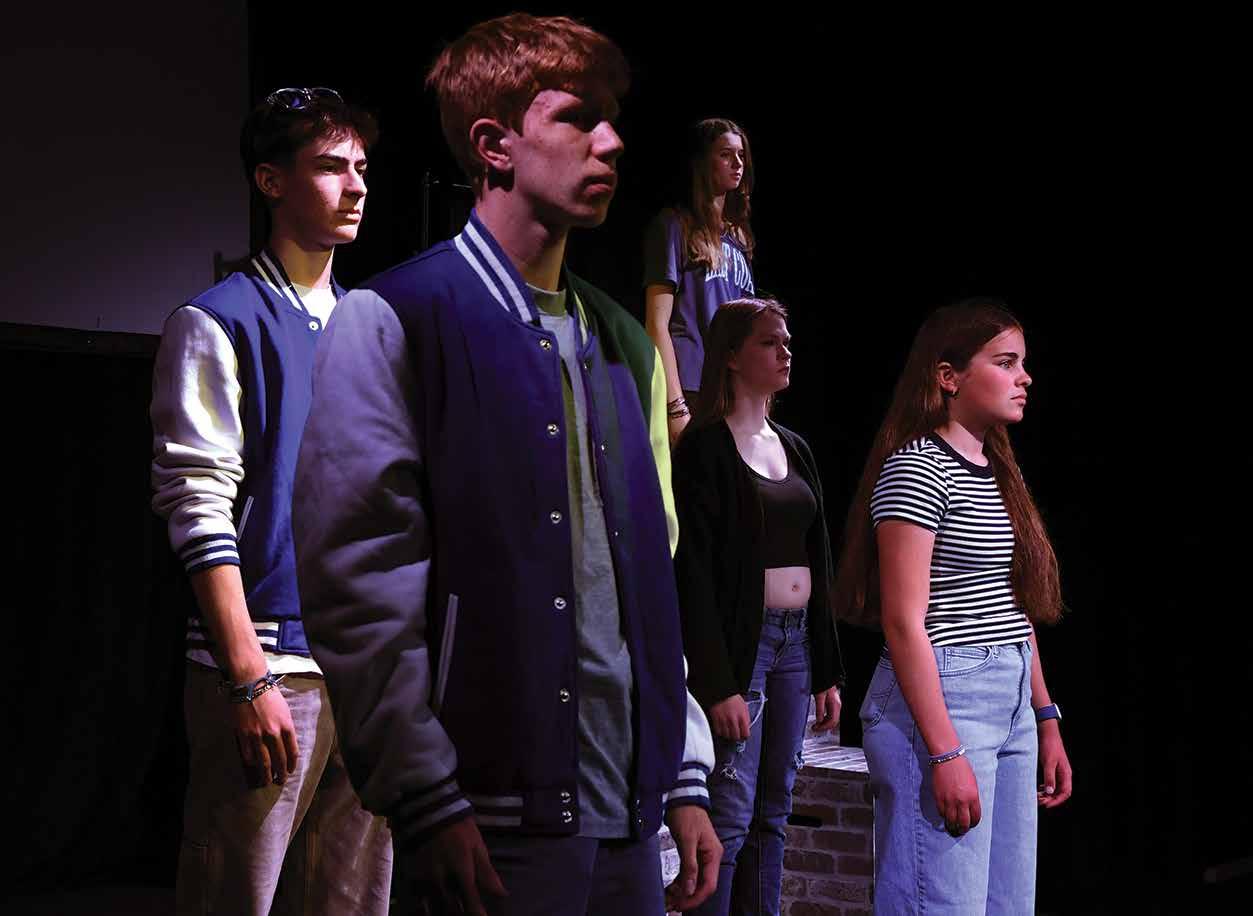
From left, Chesnutt, Gile, Junior Lauren Andringa, and Jordan
From left, Andringa, Chesnutt, Junior Sequoia Holzmann, Abar, and Senior Celia McCarty
discussing in class, Zaremba extended the conversation to parents and guardians through individual meetings. They were universally supportive, and the frank talks they were able to have with their students about di!cult topics turned them into some of the play’s earliest boosters.
“The biggest takeaway for me at this stage of the process was that our students are really thoughtful and smart,” Zaremba recounts. “Sometimes we may not give them the credit they deserve for it, but these are really good citizens in our community.”
TEACHING EMPATHY
As rehearsals began in earnest, Zaremba found herself pondering another question: What does a high school acting class look like when young actors are supposed to say and do unkind things to one another?
First things rst, she thought. “Students would arrive at class, and sometimes they hadn’t even seen each other that day yet. So we always got started with a game or a warmup,”—tossing around a stu ed animal was a favorite. “It was sort of a daily checkin that allowed us to be together before shifting gears to the script.”
Once they did shift, Zaremba and her cast were careful to keep in sight the clear line between what was real and what was acting.
Silverman-Joseph recalls, “The rst day of rehearsal, I felt so much anxiety—one of my lines to a female character was, ‘Shut your mouth!’ I was actually a little scared to say those words to my classmate, Mika [Chesnutt, a Sophomore], whom I hadn’t known at all before this.”
But then, he recounts, Chesnutt did something that would come to de ne the rehearsals from that point on. “She said, ‘It’s okay; just say it.’ And in that moment, I started to feel more comfortable showing the villainous side of my character. Our castmates knew we were acting; they knew our real selves weren’t like that.”
For Zaremba, the e ort to understand and portray people so unlike themselves— whether a hyper-aggressive member of the football team or judgmental social media bystander—was the central challenge for the students in the class.
“Advanced Acting isn’t the same as a professional theater company; it is a learning experience,” she explains. “So we choose material based on what it can teach.”
In this case, she goes on, the lesson was empathy. “Acting for theater is one of the most powerful ways to inspire appreciation for another’s perspective. Our class discussions revolved around questions like
whether Gideon’s character is pure evil, or why a female classmate of the victim would bully her. The answers weren’t black and white; they required us to imagine how good kids make bad decisions.”
According to Junior Christian Aposporis, who played a football teammate of Silverman-Joseph’s, the impact of the piece hangs on the actors’ willingness to empathize with the characters—not turn them into caricatures.
“The point of Good Kids is that this could literally happen to anyone,” Aposporis argues. “Throughout the play, there’s confusion about why people did what they did, and who is to blame; there’s no one with an evil laugh to point to—that would diminish the story.”
Agrees Senior Celia McCarty, who played one of those critical of Chloe’s actions, “There’s a duality to every role: Everybody has good in them, and everybody has bad in them. Part of your journey as an actor is trying to gure out whether they think that what happened is wrong or not.”
Still, after immersing the group in so much that was negative and con icted during rehearsals, Zaremba always guided the class back to “home” before dismissing her students, having them literally “shake o ”
their roles with a group exercise at the end of each day.
“It was time for us to separate from those characters and remember our real relationships with the people in the room.”
A NEW WORLD
By the week of the show, the Advanced Acting students felt closer than ever. How they felt about performing the intense drama in front of an audience of their peers and families, however, was less clear.
Just as with the teenagers in Good Kids, social media was top of mind for the 12 cast members: What if someone in the audience used their phone to record one of them, in character, saying something awful, and then shared it? Would it be taken out of context? Could it shatter a reputation, ruin friendships?
“It’s a whole new world—something could easily get misused,” Zaremba knew. She had to be able to reassure her students that performing for an audience would feel as safe as rehearsing in class, behind closed doors. So, partnering with colleagues like Hills, she decided to enact a strict “no phones” policy at every show; anyone who had a device out during a performance would be asked to leave.
Zaremba was certain these actors would run up against another phenomenon that’s all too common in high school theater: nervous laughter from peers in the audience, especially when a friend’s or classmate’s performance clashed with their day-to-day school persona. Aware that the show’s sensitive material would only feed the nervous energy, Zaremba and Hills also agreed to step in if giggling or comments became disruptive to the cast, which they never did.
But most important for the cast was knowing that, when the lights went up at the end of the show, they’d still be seen by friends and family members as themselves, not the violent or traumatized characters they played on stage. Zaremba suggested they hold a “talk-back,” a post-show Q&A session during which audience members could ask questions and the cast could respond in their own voices.
This addition turned out to be crucial. Each night during the show’s brief run, attendees were eager—and relieved—to get the chance to hear from the students, who were just as grateful.
“They immediately started asking us questions about how it felt to interact with each other as ourselves after being something completely di erent on stage,” recounts Junior Sequoia Holzmann, who played school bully Amber. “People told me, ‘We love you so much as a human, but we hated you so much as your character.’”
Haley’s grandmother was in the audience for one performance; instead of the shock Haley expected, her relative felt pride. “She said it really speaks to our courage to see us perform this kind of material on stage, in front of everyone.”
The talk-back, observes Hills, encapsulated so much of what makes theater at CA unique.
“This was such a diverse group of students— three grades, and none of them necessarily in friend groups together. But over and over again after the show, they talked about how close they had become, and how doing something so di!cult had made that connection even more meaningful.”
Adds Junior Gia Gile, “The proximity we have to the audience in the Black Box intensi es that experience. You’re surrounded by them, just a few feet away. It feels so much more personal, like you’re delivering your lines directly to the people in front of you. And knowing that CA can present this kind of piece means we can have other hard conversations with our audiences.”
For this group of good kids, staging Good Kids was a risk. But it was one that returned far more in rewards, states Zaremba.
“Students are learning, parents are learning, and we, as educators, are learning, too: that CA is a place where we can do something uncomfortable and challenging—we can even get it wrong at times—but in the end it will be okay, because we know we make the choices that help all of us grow.”
Would she do it again? Absolutely, says Zaremba—just maybe not too soon. As they struck the sparse Good Kids set, she and her students were already looking forward to singing and dancing on the Main Stage in something a little lighter, a musical about a young prince on a quest for happiness: the spring season’s Pippin. n
TEACHING THE GROWNUPS HOW TO COUNT
Lower School Math Reconsidered
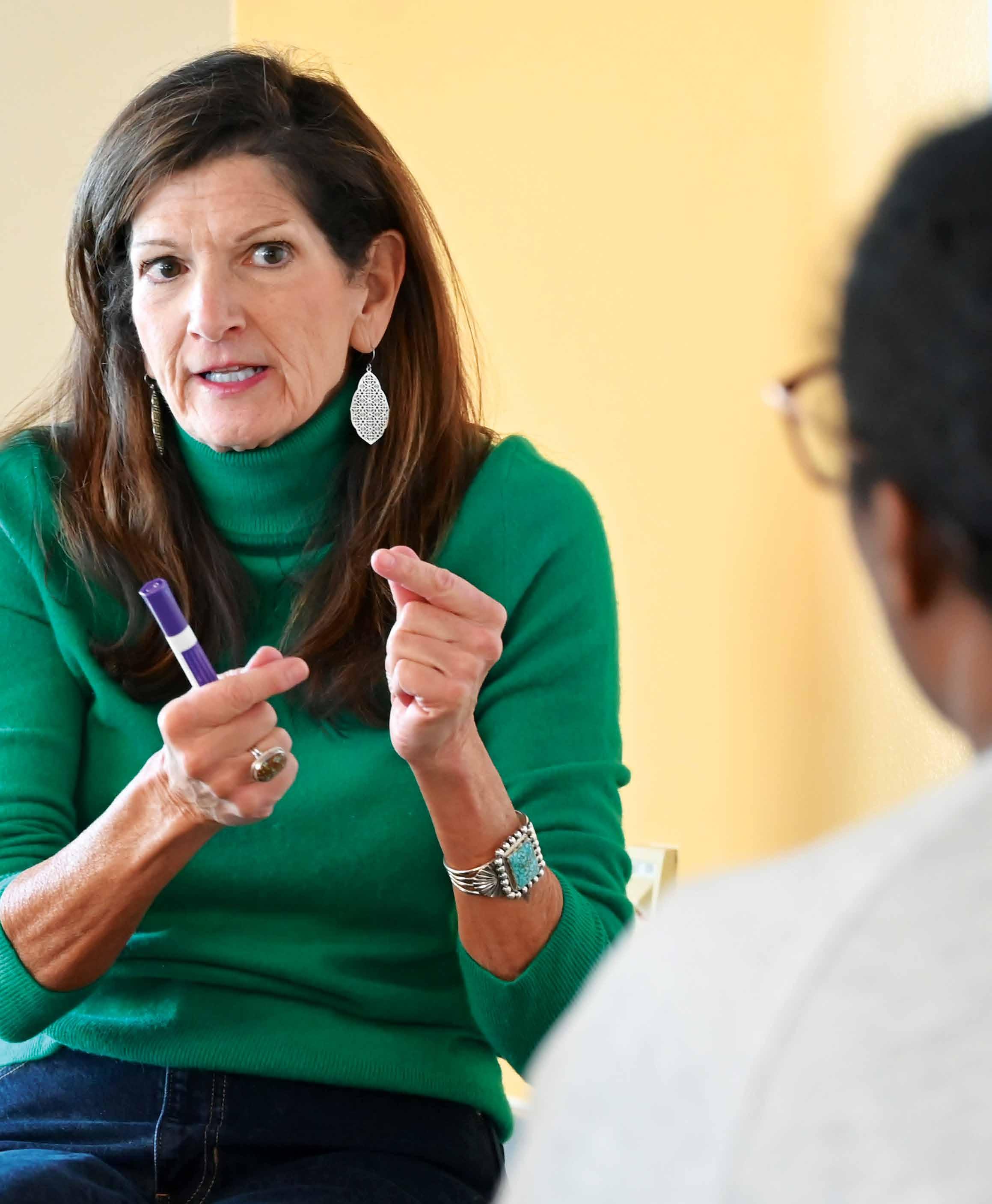
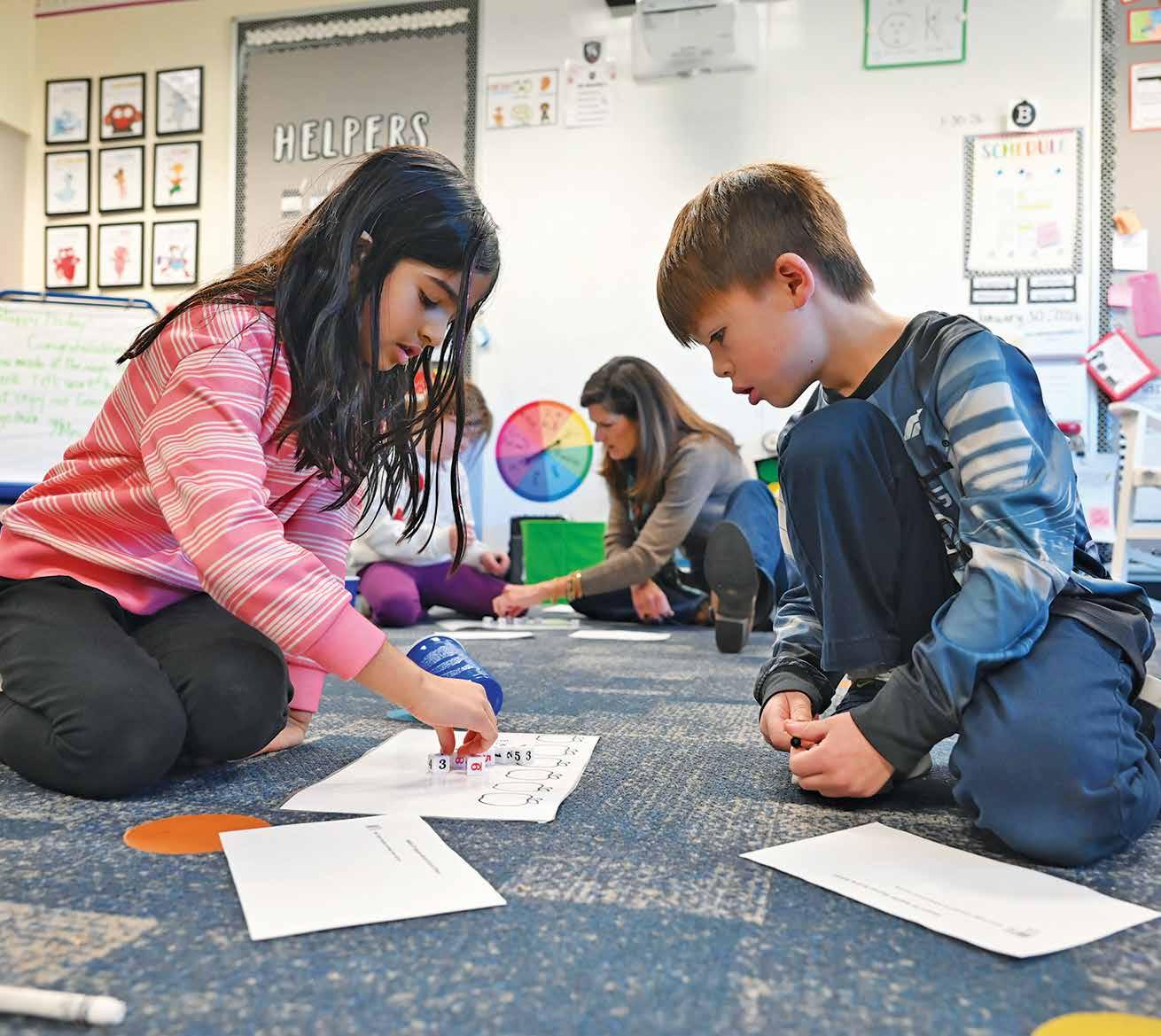
Lower School Math Specialist Mary Singer meets with families.
For at least the past three decades, children and mathematics and the question of who does well and why have fueled one of the great debates in education. While research suggests that some children may have a stronger innate “number sense”—an intuitive grasp of quantities which can predict early math skills—the most recent evidence also shows that no one is actually born “good at math.” Genetics play a role, yet depth and quality of early learning experiences are far more important than raw talent when it comes to developing high-level math ability that lasts a lifetime.
But what kind of learning gives elementary students that critical foundation—the kind that supports long-term success in math?
That’s the million-dollar question that Colorado Academy Lower School Math Specialist Mary Singer has spent much of her professional career examining, as she has sought to align the school’s classroom practices with a growing body of data that shows con dent, capable mathematicians are those who haven’t just memorized “math facts” and algorithms, but have also
dug deeply into numbers and their relationships to hone their ability to reason mathematically.
“We talk about teaching ‘math for understanding,’” Singer explains, “because what we are doing is training students to wonder, to notice, and ultimately to make meaning from numbers—even when there’s no clear path to an answer. Successful problem-solvers use what they know to help them gure out what they don’t know.”
Indeed, there is no single, wellmarked path to teaching math that works perfectly for all children and teachers, notes Singer; if there were, there’d be no debate, no need for constant reevaluation. “Good schools look at their elementary math curriculum at least every ve years,” she says. For someone as passionate about math as Singer, the cadence is even more frequent.
“In my eight years as Math Specialist, I’ve spent weeks at a time every year learning from the nation’s best math instructors and researchers—within educational leadership programs at schools like Harvard and Stanford— about how the acquisition of math
knowledge really happens in the brain. That’s just what we do at CA: We keep getting better for our students.”
Joined by many faculty members during those summer programs as well as in multi-week professional development sessions she has facilitated on campus, Singer attests, “I am constantly blown away at our teachers’ dedication.”
As a result, after a year’s worth of pilot testing and feedback from faculty, in fall 2025 the Lower School revamped its entire math curriculum from Kindergarten to Grade 5 to place even greater emphasis on the mathematical thinking and problemsolving skills that are ever-moreclearly seen as fundamental.
For Kindergarten and Grades 1 and 2, i-Ready Classroom Mathematics delivers an instructional design that allows students to take ownership of their learning, engages diverse learners, and builds con dence. From Grade 3 to Grade 5, the inquiry-based Bridges in Mathematics curriculum focuses on developing mathematical reasoning and nurturing a classroom learning community where students gather evidence, employ multiple
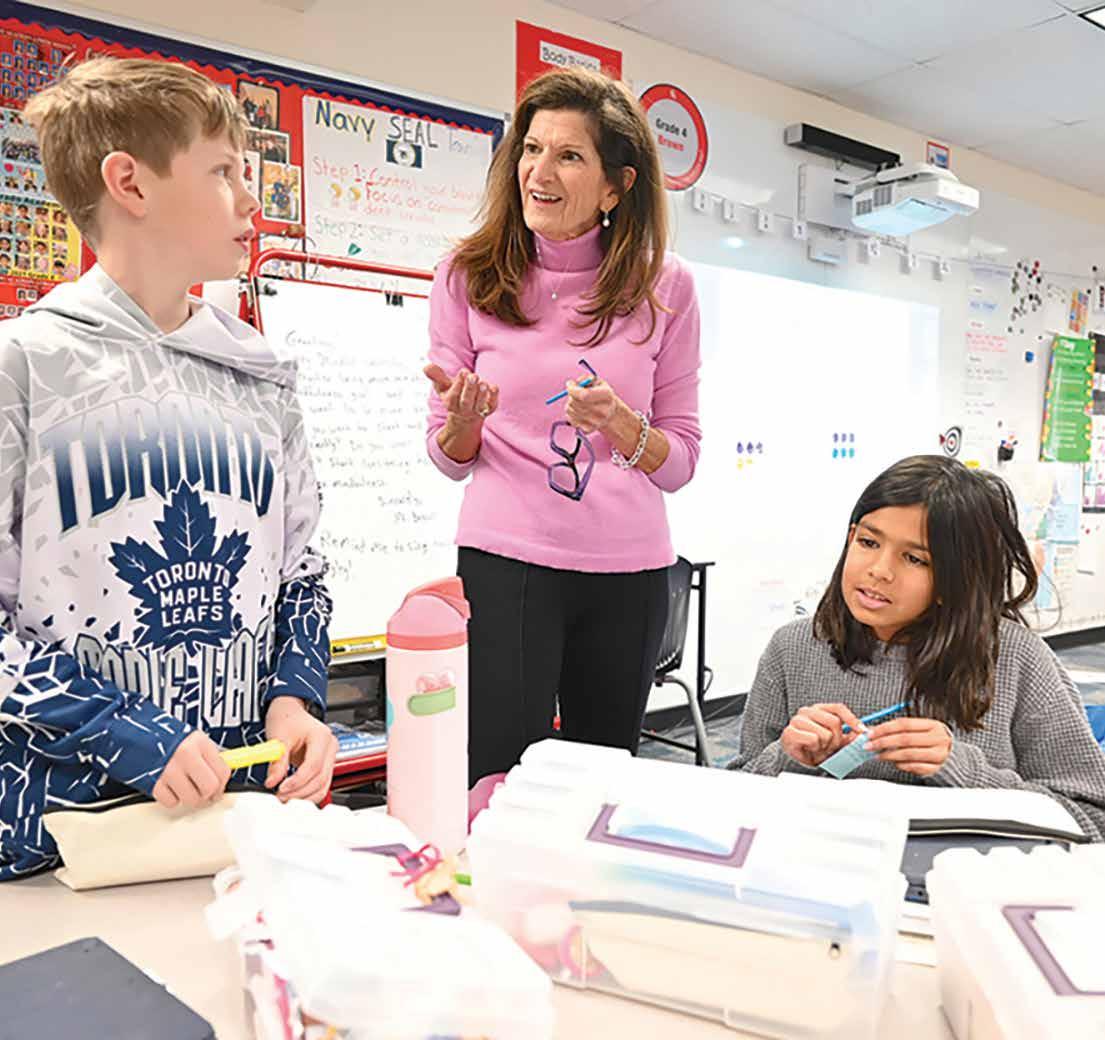
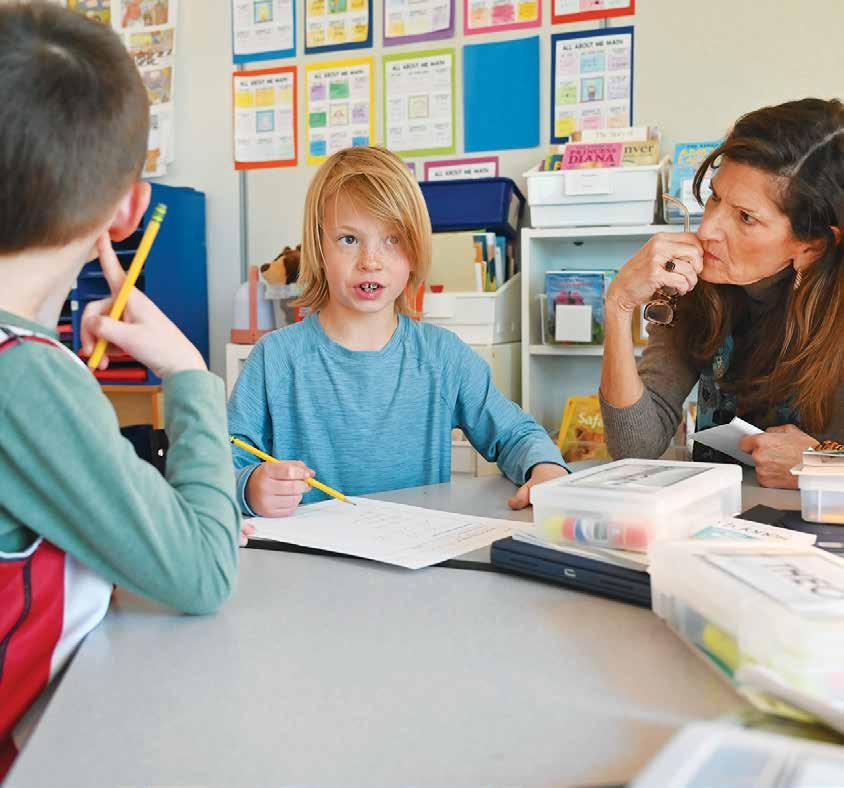
Singer working with First Graders
strategies, explain their results, and develop respect for others’ opinions and contributions.
Faculty and division leadership engaged in intensive evaluation and debate before settling on the new programs. That they chose two di erent curriculum models rather than a single “o -the-shelf” product, according to Singer, is a re ection of the fact that “Our teachers and administrators did a fabulous job digging into the programs and the research and asking, what best ts our students’ needs?”
MATHEMATICAL THINKERS
Still, it’s never simple to do something entirely novel; that’s as true for children learning to add and subtract as it is for faculty implementing a new curriculum. And that is why Singer spent last summer and this school year helping to support teachers and educate parents and guardians about the methodology and bene ts of the new programs.
“Not every teacher feels comfortable teaching math for understanding,” explains Singer, “but I’ve just seen this philosophy grow and thrive in our Lower School classrooms. The work all of our faculty has done over the past years to become strong math educators has just been amazing.”
Assuaging teachers’ math anxiety parallels the process of turning students who might fear they’re “not good at math” into con dent mathematical thinkers who truly understand the relationships between numbers.
“If you think about how math is typically assessed,” Singer relates, “it’s whether the answer is right or wrong; as children get older, it’s how fast they can get the right answer. So for a long time, teaching math essentially meant drilling students with ashcards and lengthy problem sets to give them that rapid recall.”
But what is missing from that traditional, anxiety-provoking approach, she continues, is the exibility and uency that come when
learners realize that while four plus four might equal eight, for example, it’s also possible to “decompose” the number eight into ve and three, or six and two. Math isn’t just about digits and operations; it is also intuiting the multiple patterns and connections that underlie them.
“As math gets more complicated,” says Singer, and students move from counting strategies in Pre-K and Kindergarten to additive, multiplicative, and proportional reasoning through the elementary grades into Middle School, “children cannot simply rely on memorization; understanding numerical relationships is key.”
But for parents who hear words like “mathematical reasoning,” it’s tempting to wonder: Does that mean memorization and mastery of foundations like the “stacking” algorithm for multiplication don’t matter anymore?
Not at all, according to Singer, who o ered a series of workshops throughout the fall and winter to give parents rsthand experience with the new curricula. The sessions allowed her to demonstrate how the programs carefully balance the acquisition of foundational math knowledge with the development of deeper reasoning skills required to solve novel problems—and the power of combining the two.
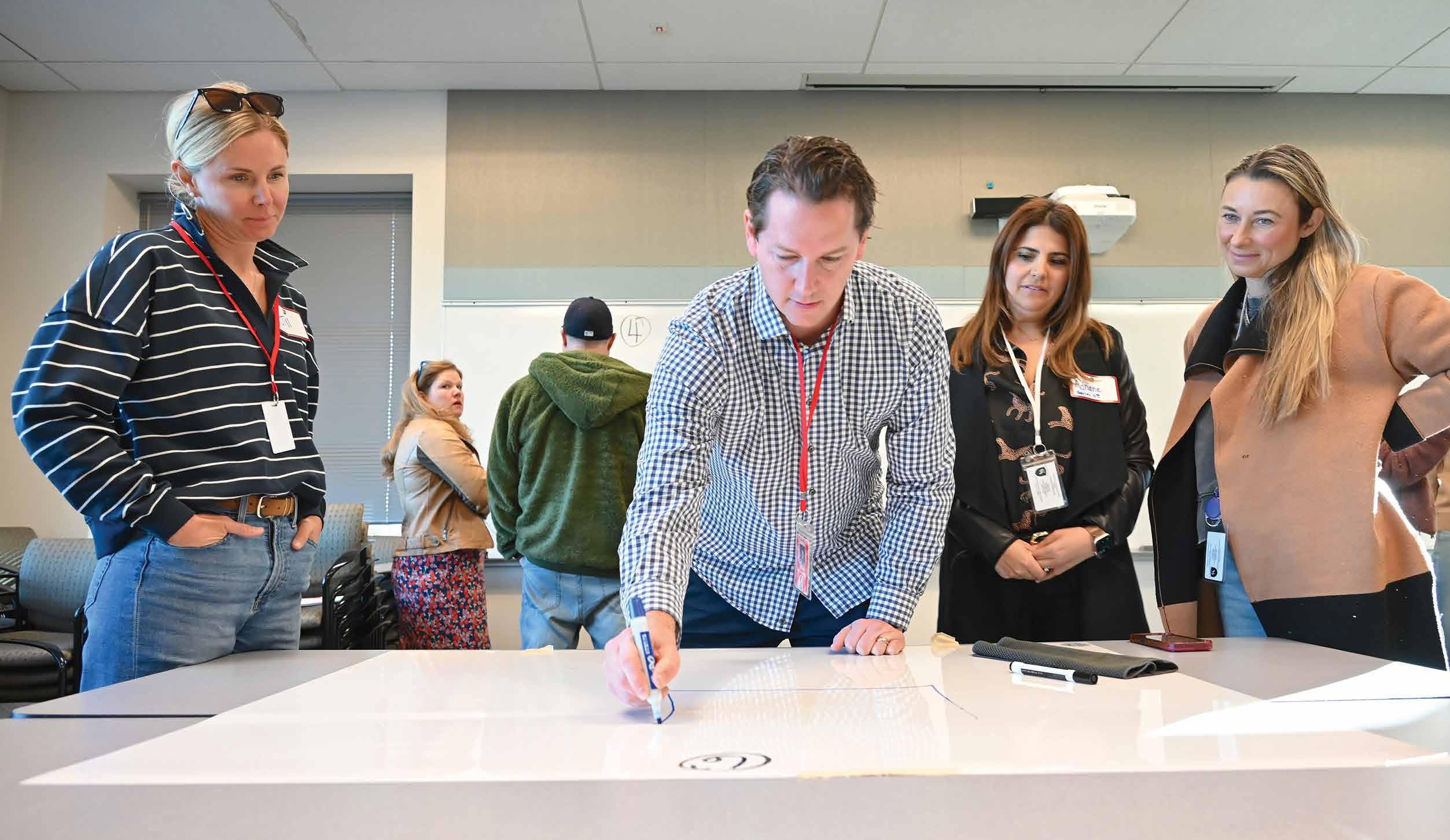
In one workshop on Third through Fifth Grade math, Singer had parents try to quickly multiply 99 by 5 without resorting to using the traditional stacking algorithm. They saw that while the two numbers could be challenging to handle as-is, it was much easier to think of multiplying 100 by 5 and then subtracting the di erence of ve.
“It can be hard for adults to try to ‘back out’ of their years of math knowledge and experience to put themselves in their kids’ shoes,” Singer emphasizes, “but when they do, they realize that understanding numbers empowers young learners.”
“We talk about teaching ‘math for understanding,’ because what we are doing is training students to wonder, to notice, and ultimately to make meaning from numbers—even when there’s no clear path to an answer. Successful problem-solvers use what they know to help them gure out what they don’t know.”
Mary Singer
CA
Lower School Math Specialist
In another workshop on very early elementary math, parents had to “learn” counting like a PreKindergartner. Instead of the numerals 1 through 10, Singer had them memorize a sequence of nonsense words and then try to solve problems like “nudge plus drift.”
The exercise, she says, forced them to relearn the three elements of a number—cardinality (how many), ordinality (place in a sequence), and nominal or symbolic use (name/ label)—and made clear “what a huge accomplishment number sense represents for a child.”
A MATH COMMUNITY
When Singer rst came to teach at CA 20 years ago—she had fallen in love with the school as the parent of two CA students and was invited to consider joining the school’s teacherinternship pathway after stints in
corporate nance and marketing— she had her own Fifth Grade homeroom. “As a teacher early in my career, I thought the way we taught math at that time—it was a version of math for understanding even then— was ridiculous. Why not just have kids memorize the facts and formulas and move on?”
But as she learned more about the way children acquire math knowledge— witnessing rsthand the lightbulbs go o as they perceived the deeper connections between numbers—and as the school tapped her to guide the evolution of the Lower School’s math program, she knew there must be a better way to teach math. She was inspired by the subject in the way others are moved by music.
“Everybody has that innate ability to make and appreciate music, just like everybody has the ability to ‘mathematize.’ And to be able to look at a student and see where they are in their journey and nudge them to the next stage and watch them grow— that’s fascinating.”
Working with students as Math Specialist for the past eight years— as well as nudging fellow teachers and the parents and guardians of her students along their own math journeys—Singer has seen plenty of evidence that math, like music, indeed has something for everyone.
Though COVID-19’s isolation, the ubiquitous nature of digital screens, anxiety, and ever-shorter attention spans have brought new challenges to the classroom, Singer says, CA students’ performance on standardized math testing has held strong. “We’re not teaching math in a vacuum—we’re very conscious of state and national standards. Just like every other school, by the end of Fifth Grade we expect our students to have mastered their math facts through twelve and the standard algorithm for multiplication.”
Beyond the data, though, is where Singer is tracking the biggest gains.
“When I interact with kids in my math lessons, I’m actually seeing a strong math community developing.
Especially when you get to Third, Fourth, and Fifth Grades, the classroom conversations about math are so much richer than they’ve ever been; our students’ ability to think and discuss di erent ways of solving problems is so much more nuanced.”
She’s noticed many other bene ts. Whereas in the past students who were well ahead of or well behind their peers might nd limited “entry points” into each day’s lessons, both of the new math programs o er many more ways to either scale up or scale down the depth and complexity of learning tasks.
“We can look at individual students and see where they need more support or more challenge, and we can now o er that across the board,” explains Singer. The result, she says, is deeper understanding for every learner.
“We want our mathematicians to own their knowledge and to think of themselves as a problem-solver. At CA, we don’t merely teach math; we teach people.” n
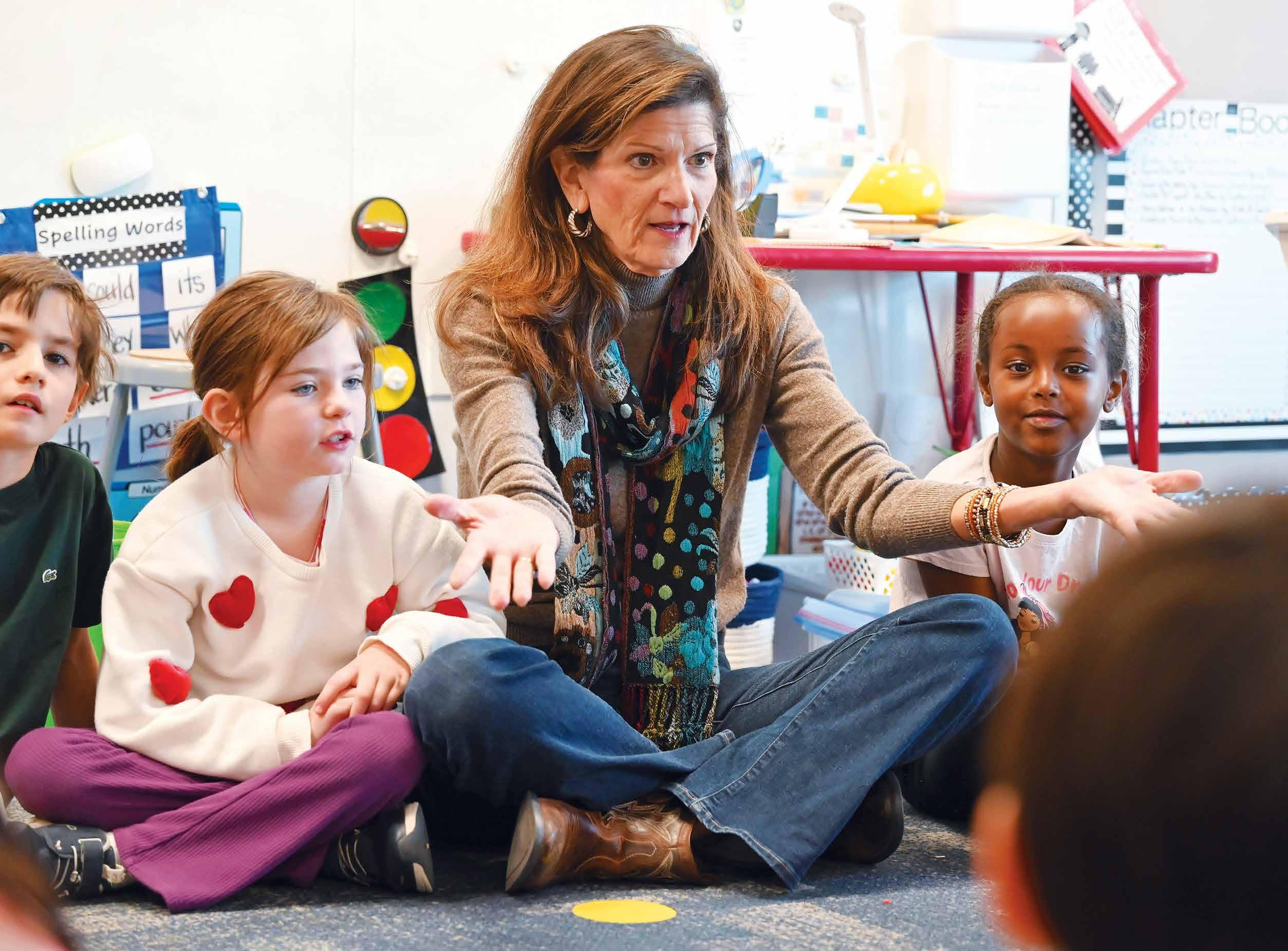
A math workshop for faculty and families
THE PATH OF GROWTH
ROMAIN VAKILITABAR ’10
AND PATHOS LABS
Romain Vakilitabar ’10 speaking at an AI-focused PopShift event in April 2026
PHOTO: SEBASTIAN CHIU
Romain Vakilitabar ’10 was never supposed to be a Colorado Academy student. The son of immigrant parents from France and Iran, both of them educators, this social impact entrepreneur grew up attending public school in Littleton, Colo. And, like many of his peers around the turn of the 21st century, witness to the explosive growth of technologies that would lay the foundations for a world more connected— yet more depleted, divided, and distracted—than ever before, he couldn’t imagine how ordinary individuals could do anything to shape this future, or where he might learn if that were even possible.
“What I would now call humanity’s capacity for destruction was growing faster than at any point in history,” he explains, “but I didn’t see anyone with con dence that our own power to create an antidote might be bigger than we thought.”
And then, arriving at CA in Middle School
as the recipient of a Malone Family Foundation Fund Scholarship, Vakilitabar encountered people like his classmate Ana Dodson ’10 and then-recent graduate Ashley Shuyler ’03, who as CA students had already begun to drive global change by founding their own nonpro ts. (Shuyler founded AfricAid to support girls’ education in Africa, and Dodson created Peruvian Hearts to empower women in Peru.) He saw CA initiatives like HOPE, the student-led organization that was then only a few years into its now three-decade track record of supporting thousands of local families in need through clothing and food donations.
“To have that modeled for you at such a young age,” he recalls, “it was so inspiring to see that people like me could be involved with something that felt so massive in the world.”
Now, Vakilitabar is Executive Director of Pathos Labs, a nonpro t he founded in 2020 that is focused on nding ways for storytellers in mass media forms such as
television and YouTube videos to help dismantle today’s ubiquitous narratives of division, techno-dystopia, and neverending political and military con ict.
As the organization’s “manifesto” argues, “Appealing to logic or ethics is no longer an e ective way to move society and its individuals toward a more pluralistic, tolerant, sustainable future. We live in a ‘post-truth’ world, where how we feel likely determines what we believe.”
POPSHIFT
Pathos Labs’ core initiative, PopShift, convenes in uential writers and content creators from across the worlds of television, lm, streaming, publishing, and social media to collaborate with scientists and other experts on topics ranging from empathy to immigration, in order to envision and disseminate new, emotionally resonant popular narratives— what Pathos Labs calls “playbooks”—that can in uence culture at scale.
At the Futures Basecamp for science ction authors in June 2025
PHOTO: MARY ROZZI
“When narratives are more representative, nuanced, and speci c,” says Vakilitabar, “we can help create a reality where all people—regardless of their identities—are embraced. We can build a kinder and more empathic world.”
Recently, for example, PopShift brought together nearly 100 television writers for an event that asked: What do TV writers need to understand about AI’s impact on the world and on their own lives? How can mass media acknowledge the challenges of AI while holding onto the idea that it can be a powerful tool with enormous potential bene t for humanity?
PopShift “convenings”—two dozen of them over the past ve years, embracing more than 500 content creators and 700-plus experts—have built creative connections between the writers and networks behind landmark programming such as Stranger Things, The Big Bang Theory, Succession, and The Walking Dead
According to Lynn Renee Maxcy, a futurist and screenwriter known for The Handmaid’s Tale, convenings “feel, in the best possible way, like drinking from a rehose.”
One of the attendees at PopShift’s 2025 Futures Basecamp—a convening to help science ction writers imagine “pro-topian,” rather than dystopian, worlds—Maxcy continues, “We are all bringing our work and the way that we see the world and deeply discussing it, and creating from that tension and that strangeness hopefully new, beautiful, speculative worlds that might actually be ours one day.”
“The media and information environment we live in today is so bifurcated,” explains Vakilitabar. “After the presidential election in 2016, I felt so saddened that people seemed to be living in two di erent worlds, consuming completely di erent narratives that only fueled polarization. How could we repair that?”
The answer, he says, was looking beyond politicized, tribal “echo chambers” to the mass media that people across divisions and across technologies consume in common.
“PopShift introduces TV writers, YouTubers, and TikTok creators to experts so they can develop ways to incorporate these big global
and social issues in their content,” Vakilitabar says. “We’re reaching millions of people— through some of the biggest shows and channels out there—with touchpoints that get them thinking about ideas they wouldn’t otherwise be considering.”
RISKY BY DESIGN
Pathos Labs and its “experiments,” like PopShift, are risky—which is by design, according to Vakilitabar. Taking on powerful narratives that valorize “toxic” forms of masculinity, uphold stereotypes of the disabled or incarcerated, or denigrate the importance of science, for example, is inherently controversial, even unpopular, meant to in uence and subvert with a vision that paints a future landscape we can all look forward to.
“When we don’t see pathways for the systems that we rely upon—government, society, family—to get better, then a sort of nihilism creeps in that manifests itself in a future that is negative, and moves us away from what is possible,” he explains.
At an upcoming Science Creator Camp convened by Pathos Labs and underwritten by the Alfred P. Sloan Foundation, the
PopShift team is inviting 25 YouTubers— with a collective reach of over 100 million subscribers—to gather with some of the world’s foremost scientists and reconnect with what is so beautiful about science, says Vakilitabar.
“Science today is under threat,” he explains, “and people are losing sight of the fact that science represents this shared world view that can unite across di erences. We felt there was a way for science creators to leverage that as a source of common ground—the excitement of discovering new things about our planet and ourselves.”
The precursor and model for much of Pathos Labs’ work—and its penchant for risk taking—was the groundbreaking 1983 ABC television lm The Day After, which envisions a ctional con ict between NATO and the Warsaw Pact that rapidly escalates into a full-scale nuclear exchange between the United States and the Soviet Union.
Focusing on the residents of Lawrence, Kansas, and Kansas City, Missouri, and several family farms near American missile silos, the ultra-realistic Cold War drama was dogged by industry opposition and delays during its production, yet reached nearly
PHOTO BY SEBASTIAN CHIU
FROM RISK TO REWARD
100 million viewers and stoked widespread public interest in and discussion about the true e ects of nuclear war on average American citizens. It also in uenced American and Soviet policymakers as they sought to contend with the Cold War threat of nuclear annihilation.
“Do I give this television movie credit for averting World War III?” asks Vakilitabar. “Maybe that’s a big leap; but it is part of the avalanche of media and information that began to change people’s attitudes and beliefs toward nuclear weapons around the world.”
For Pathos Labs, he adds, the question raised by The Day After is: “How do we a ect what’s perceived to be ‘normal’ or ‘true’ within di erent social groups or tribes that otherwise do not agree on the facts? Big-tent entertainment can play a role in that shift.”
Vakilitabar and his colleagues recognize that popular storytelling is shaped by a constellation of in uences, from cultural trends and political moments to personal experiences and creative collaboration. PopShift does not claim direct authorship of the stories that follow its convenings.
“What we o er is an intentional space: one that equips storytellers with new perspectives, deepens their relationships with lived-experience experts, and expands their narrative imagination,” he explains.
UNREASONABLE AMBITIONS
It wasn’t a straight line from CA to Pathos Labs for this thinker of big ideas. Inspired by his classmates as much as by his CA teachers, who gave students “the agency to explore one’s curiosity, to sort of ‘scratch the itch’ of whatever interested them intellectually,” Vakilitabar enrolled in the University of Colorado Boulder’s undergraduate Business Administration program.
But, he says, he quickly realized, as one college mentor advised him, “There are two paths that rarely converge, if ever: One is the path of safety, and the other is the path of growth.”
He dropped out of CU, devising his own course of study that would include traveling in Palestine and Israel, spending
weeks voluntarily homeless, hitchhiking thousands of miles, living with rural farmers in Oklahoma, and sailing alongside young founders and entrepreneurs aboard a ship chartered by Boulder’s Unreasonable Group, an impact venture accelerator.
“I’m grateful for the support and the privilege that gave me the gift of calibrating a bit and realizing that yes, this is what this period of my life is for: to explore, to try new things, and to fail.”
Invaluable life experience in hand, Vakilitabar returned to Boulder to nish his bachelor’s degree, then quickly found himself involved in a number of projects that meant his high school job as a weekend busboy at a breakfast restaurant would be the rst and last job he ever applied for.
He helped build Watson Institute, a new university model that partners with leading corporations and foundations to o er transformative fellowships for highly promising entrepreneurs and leaders, primarily from historically disenfranchised backgrounds. Next, he created his own virtual reality startup to experiment with the ways immersive audiovisual experiences could power an “empathy machine.”
“What would it look like if you could place a headset on your face and emerge in a very di erent context than your own,” he recounts, “engaging with a community that opened up the possibility of empathy and compassion and understanding?”
But scale was a sticking point with VR’s expensive hardware and linear user model. Vakilitabar wondered how he could reach many, many more people with the same invitation to interact with ideas far removed from their own experience—an opportunity that he thought might just have a chance to address a problem that felt like it was growing in the United States at an “exponential” rate.
Pathos Labs grew from a one-person operation—Vakilitabar, with intern help from Camille Doherty ’20, who is now working in impact investing in New York— to become a behind-the-scenes empathy machine, ready to catapult new narratives
into mainstream culture so they reach millions of people.
‘STORIES CAN BE REWRITTEN’
“The more I’ve done this work, the more I’ve realized that everything is a story: the systems we create, democracies, capitalism, religions. And stories can be rewritten; stories can change,” says Vakilitabar. “All it takes is a really good storyteller.”
When he was a student in CA’s Upper School, Vakilitabar took courses in lm and video under the former Chair of the Fine & Performing Arts Department, Angel Vigil. Learning from the legendary teacher, artist, and performer, he says, “I felt something in myself move when I was forced to think about a story I wanted to create. I was being asked to consider what the world that I wanted to create would actually look like. And I think we all need to sit with that same question.”
And if, like his college mentor once told him, the path of growth is the right one, then prepare for things to feel scary at rst.
“I consider myself really lucky to have had a community of teachers, mentors, and peers who held me accountable and sort of helped protect this courage that it takes to do things that are uncommon,” he says. “Feeling like I have to do something really important with those gifts I’ve been given—I think that’s what keeps me going.”
The hardest part of the journey in today’s media landscape, Vakilitabar continues, is convincing those who receive the story to start to believe it.
“Sometimes I feel like I’ve been doing this work in a way that is maybe a little sacri cial. There’s no safety net. Like a lot of people in the impact space, you can get exhausted.”
“And yet,” he goes on, “the opportunity I see with Pathos Labs, in convening hundreds of in uential content creators and storytellers—and soon, hopefully thousands—is the freedom to think hard about how we can collectively change some of the world’s stories together, in ways that aren’t just aspirational, but are like a seedling for something that one day could feel inevitable.” n
INTRODUCING CA PATHWAYS
Where curiosity meets community, and CA students explore what lies ahead
When choosing a path, a good guide can make all the di!erence.
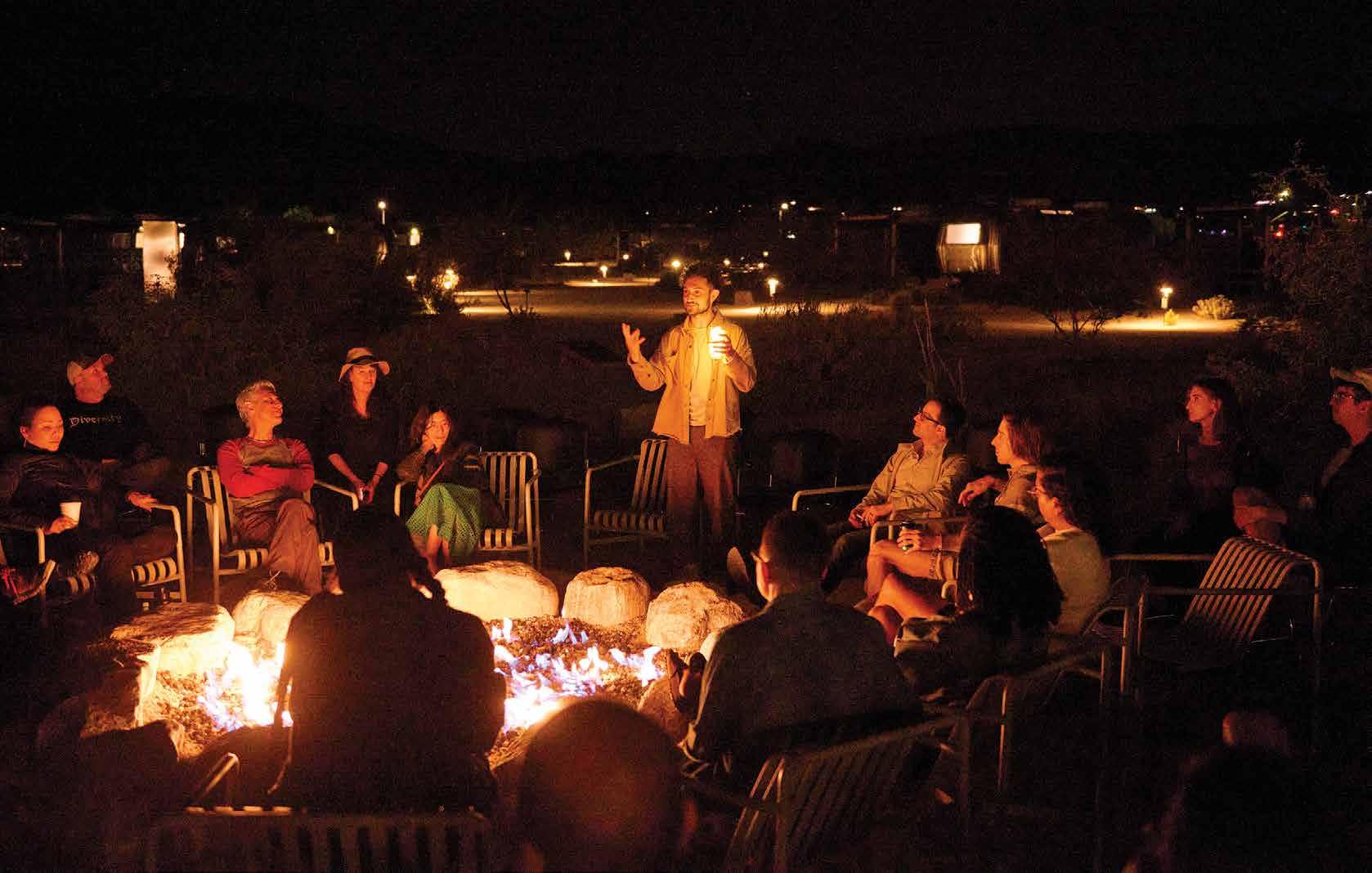
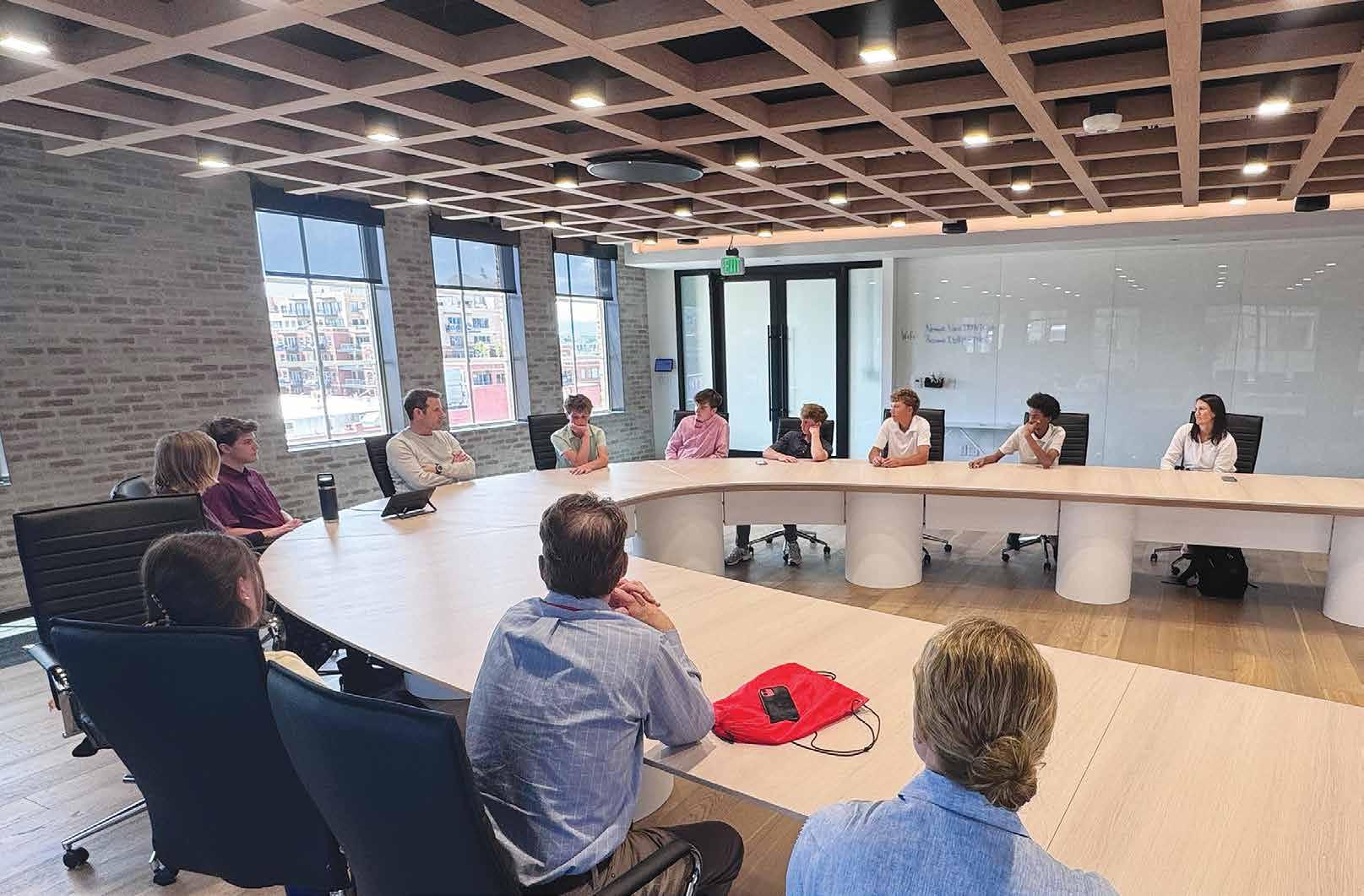
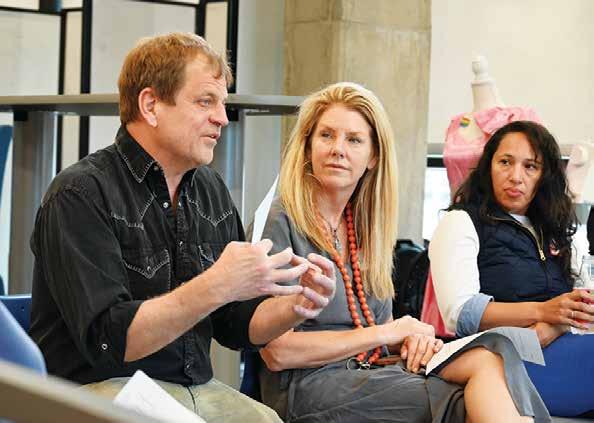
CA Pathways connects Upper School students with our parent and alumni community — sparking curiosity, building con dence, and helping students discover the world they’re stepping into.
2026 Pathways Launch:
n 72 Student Applications
n 30+ Mentor Moments & Summer Experiences
n Student Club Mentorship
n Career Discussions
n Pathways Interim
Share your story and experience with the next generation. Our growing community of mentors and hosts is proof that the CA spirit of learning lives on. Join us!
n Flexible — Speaking, connect over Zoom, or host experiences at your workplace
n Open to all CA parents, parents of alumni, and alumni
n Questions? Contact CA’s College Counseling & Alumni O !ces
Commencement for the Class of 2026
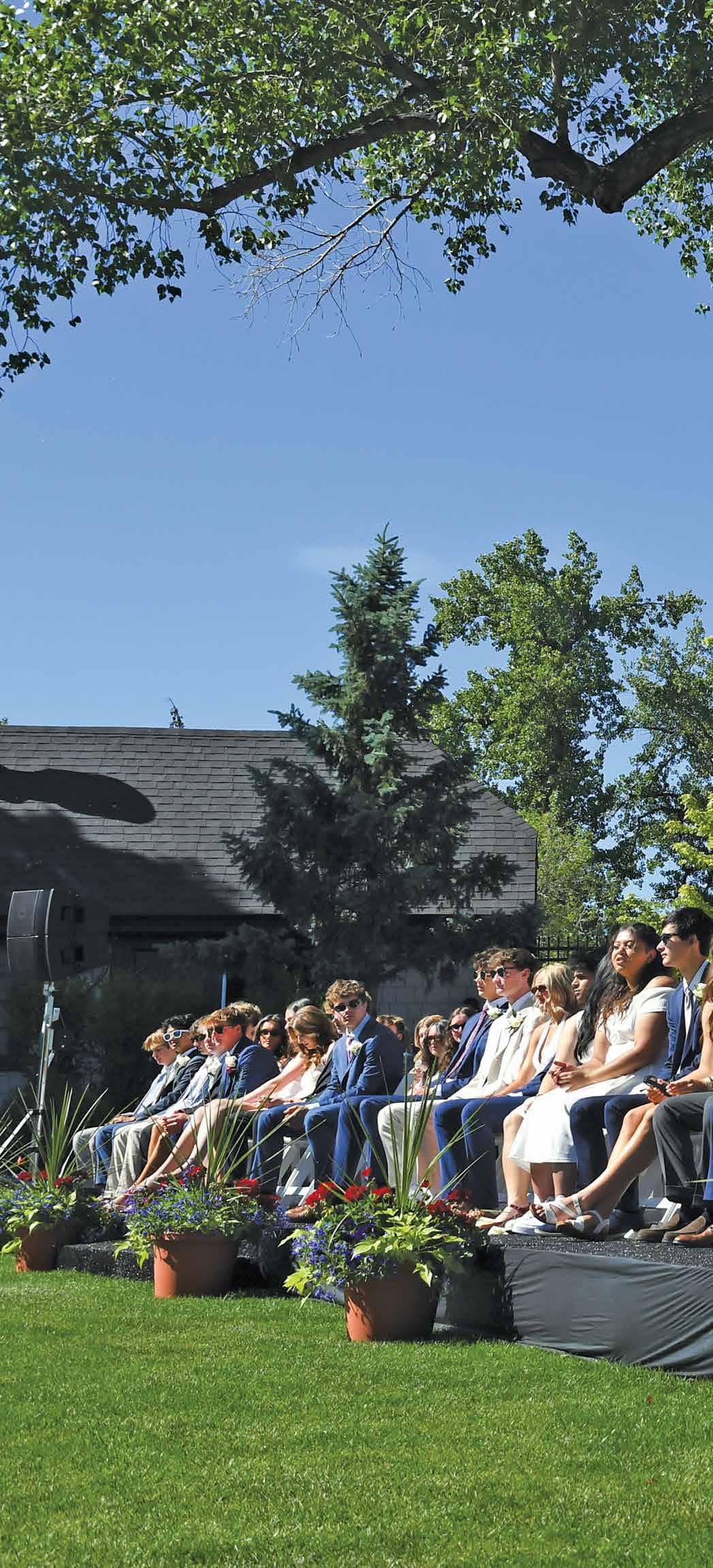
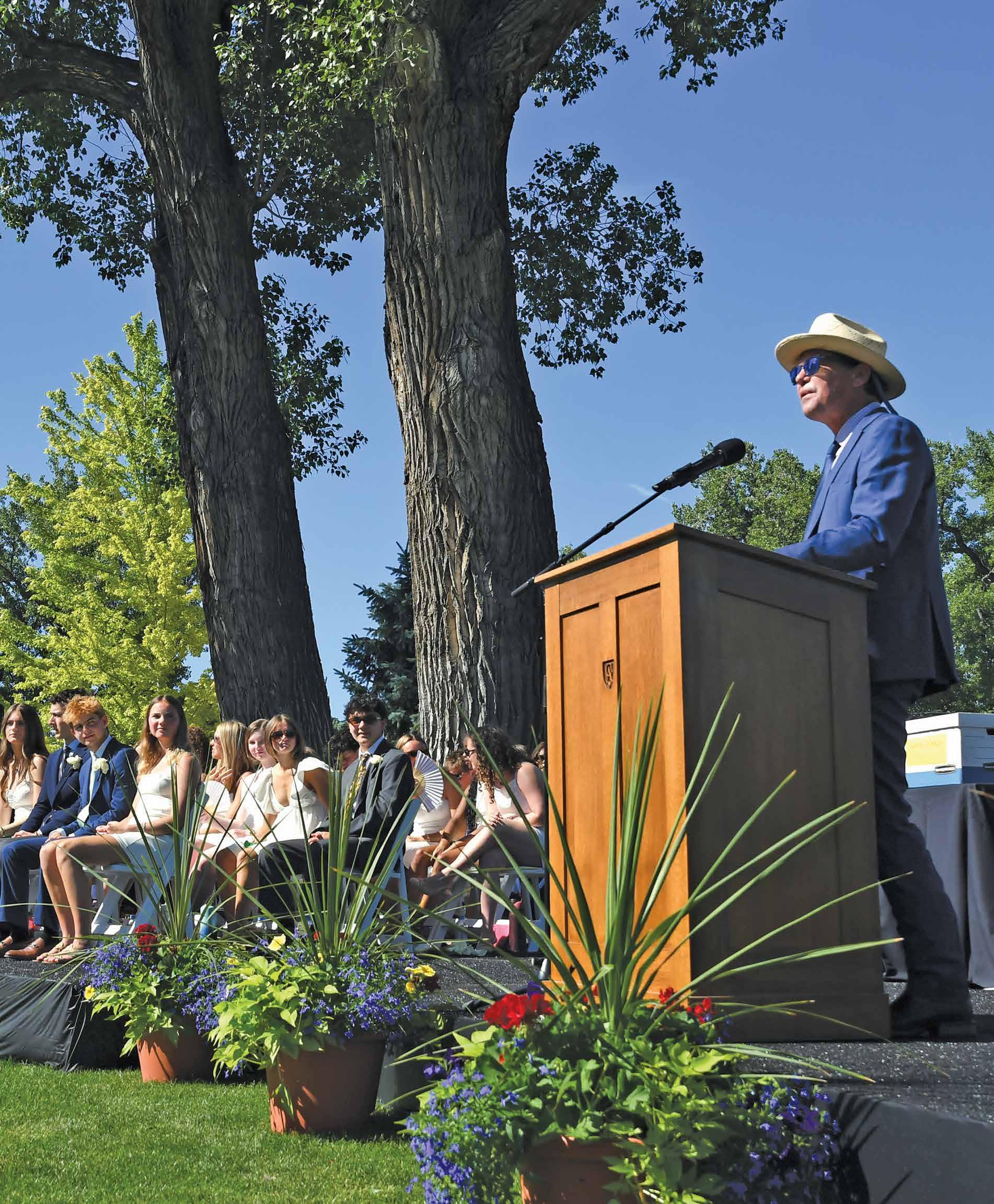
The Commencement ceremony for the Colorado Academy Class of 2026 drew what seemed to be a record number of families and guests to the West Lawn of the historic Welborn House to celebrate the 112 Seniors graduating on June 4, 2026.
As large as the audience of families and fans here to appreciate these students was, the graduating class’s impact upon the school community itself may have been even greater: Throughout the course of the event, every graduate would receive not just one, but two special tributes recognizing their individual contributions— one, by tradition, from Head of School Dr. Mike Davis, and a second, unique this year, by one of their classmates, elected Class Speaker Kit Freeman.
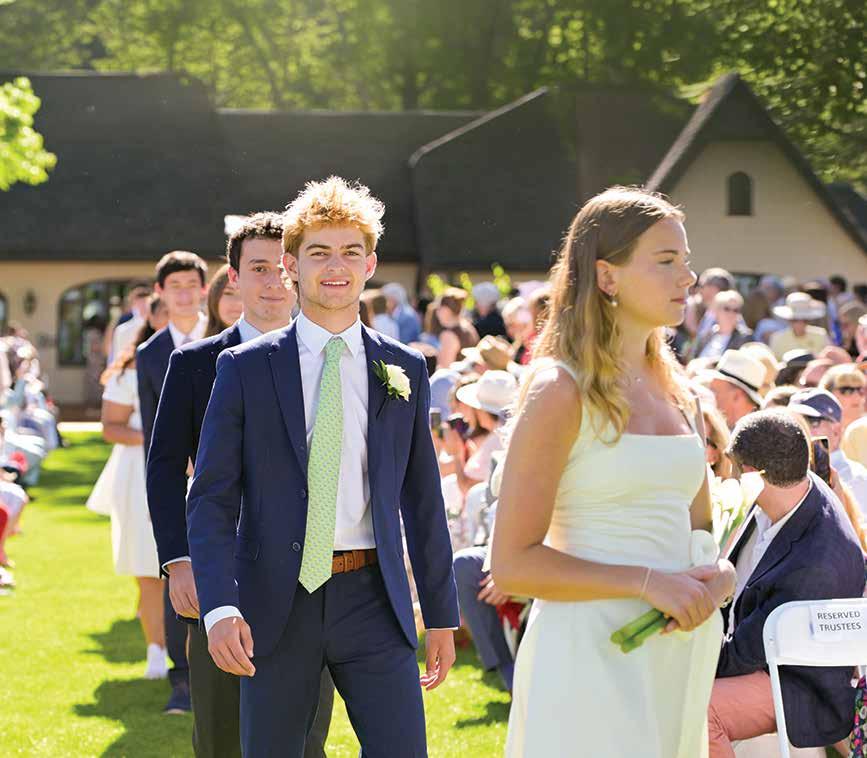
But rst, there was the much-anticipated Processional, which saw the Seniors walk one-by-one through Welborn’s front doors and across its tree-shaded lawn, where they were met with cheers from proud, camerawielding loved ones.
Once seated in the bright morning sun, the Front Range in the background, the graduates listened along with their families as the Chair of the Board of Trustees, Kevin Reidy, welcomed all to Commencement in what would be his nal address as Chair.
“I am grateful for what Colorado Academy has represented over time for my family and for yours: A Colorado Academy education is not simply about achievement. It is about formation.”
Educating young people who know not only how to think and lead, but also how to navigate complexity with con dence and humanity, is more important than ever, Reidy said.
“You are graduating into a world that is changing at an extraordinary speed. Technology will evolve. Entire industries will transform. Information will become even more abundant and even harder to trust. Many of the jobs you will eventually hold do not yet exist. Which means the most valuable skills you carry forward are
not temporary technical skills alone, but durable human ones.”
Reidy went on to list some of the skills that will matter most for these graduates: communicating, thinking critically, leading with empathy, tolerating risk, and staying curious. Most important of all, added Reidy, is the ability to remain fully human in a world increasingly shaped by the disruption of arti cial intelligence and global change.
“This durability,” he pointed out, “is what helps you endure, grow, and continue becoming who you are meant to be over decades—not just di!cult moments. It does not mean perfect people; it means grounded people. People with character. People with purpose. People who can handle success without arrogance and adversity without losing themselves.”
“This is what Colorado Academy strives to develop in every graduate.”
Reidy then addressed the Class of 2026 directly.
“You are leaving this place at a moment of real momentum and optimism for Colorado Academy. For 120 years, this institution has continued to evolve while remaining true to its mission. This happened because generations of leaders, faculty, trustees, parents, and students were willing to ask hard questions, embrace change, and imagine what education could become— not simply preserve what it once was.”
Like CA, Reidy went on, “You have already accomplished a great deal. And yet, what matters most is not the list of schools you will attend, the awards you have won, or the titles you may someday hold. What matters most is the kind of person you will become.”
As Reidy nished congratulating the 2026 graduates and their families, Dr. Davis came to the front of the stage to deliver his own remarks. As in years past, he drew on his love of music to fashion a parting message to this year’s Seniors.
“Today, I want to talk to you about the song that provided the theme for my senior prom—‘Ramble On,’ by Led
Zeppelin,” he began.
“In the spring of 1969, the year I was born, two young Englishmen named Jimmy Page and Robert Plant wrote a track for the second Led Zeppelin album. Three minutes and forty- ve seconds long. An acoustic guitar that walks like a hiker. A bass line that won’t sit still. And a refrain you can hear from across a parking lot, and that rang out in concert stadiums in the 1970s.”
Dr. Davis pointed out critical lines from the song’s lyrics:
“Thanks to you, I’m much obliged for such a pleasant stay. But, know it’s time for me to go….”
These words, he said, are more or less what was happening on the Welborn Lawn at that moment: “You are saying thank you for a place that has been good to you. We are also saying thanks to you for raising up this community and each other.”
But there is more to the song’s message, he argued. “All the great performances, stunning academic achievements, and State Championships and other honors—that was the ‘pleasant stay.’ That was the gift CA gave you, and it was the gift you gave each other. However, I am not going to stand here and pretend your time here was only that. These were, in many ways, hard years—for our country, for the world, and for some of you personally in ways the rest of us never saw.”
The lesson that “Ramble On” o ers, continued Dr. Davis, comes through in the perspective of its narrator, an exhausted traveler who is far from home. “It is a person with a worn-out pack and a long road ahead, insisting, anyway, that the journey is worth it, insisting that we all need to keep going, insisting, with a smile, I gotta ramble on.”
Joy, observed Dr. Davis, is not the absence of di!culty; nor is it the destination. “Joy is what you practice in the middle of di!culty. It is the choice to sing the chorus when the verse is heavy. To stand up after the story. To high- ve the Kindergartner. To make the art anyway. To love each other on purpose, and out loud, in times that did not always make it easy.”
Head of School Dr. Mike Davis addresses the Class of 2026, families, and guests.
“Class of 2026—it is time you were on your way,” the Head of School concluded. “You are obliged, as the song says, to a place that loved you. You will be obliged, soon enough, to places that don’t know you yet. Be the kind of person who sings the chorus when the verse is heavy. Be curious. Be kind. Be courageous. Be adventurous. You know the words; you have been saying them since Pre-K. And when in doubt—ramble on.”
The music continued following Dr. Davis’s remarks, as the Upper School Chanteurs, led by Choral Music Director Dr. Kevin Padworski, assembled on stage to perform the song “Where the Light Begins,” by Susan Labarr.
Perhaps it does not begin. Perhaps it is always. Perhaps it takes a lifetime to open our eyes, to learn to see what has forever shimmered in front of us… Perhaps this day the light begins in us.
As the Chanteurs returned to their seats, all settled in to listen to words of wisdom from Upper School Principal Max Delgado, who was delivering his nal Commencement address before he moves on from Colorado Academy. Again, the theme was music.
In his nal days on campus, Delgado began, it was tempting to try to answer the question that he had dodged throughout his ve years in the Upper School: What is your favorite part of your job?
“The answer might surprise you,” he said. “Now, I’m a trained English teacher, and I’ve spent almost as much time during my career in academic planning as in student life. But it isn’t when I’m teaching my favorite book or sitting in a budget meeting that I remember why I love schools. It’s watching you play music.”
Only a passable musician himself in his own high school days, Delgado related, his biggest challenges were sight reading and improvisation. Both were skills he never wanted to learn as a kid, but as an adult, he now understands their importance.
“The point of sight reading is not to play the music correctly; the point is responsiveness, the ability to encounter something unfamiliar and stay oriented long enough to make meaning from it. The discomfort is the instruction.”
“And then there’s improvisation,” Delgado continued, “which is often misunderstood as unlimited possibility. It’s actually built on something quite narrow: the study of constraint. Students will always learn to improvise within a tight musical structure. Great improvisers aren’t valued because they pluck from in nite options; they are valued because they make compelling choices within limited conditions and tight boxes.”
Like music, he went on, “Graduation is a season of expanse and possibility, of open elds and discovering what’s out there in all that tall grass. And that’s true and valuable. But throughout your time at CA your teachers have tried to o er you a quieter gift: limitation. When the discipline of constraint becomes genuinely internal, when it lives in you rather than being imposed on you, you’ll nd ways to exibly be inside of it that will ironically make your life more expansive.”
“Class of 2026,” he concluded, “your future will include many conditions that you didn’t choose. But you are so well prepared for this. There will be times, Seniors, when you don’t know what to do. Your faculty wants you to know that there is a voice inside of you worth hearing. If we’ve tried to teach you anything over these last four years at CA, it’s discernment—how to know what to do when you don’t know what to do. It’s the kind of decision making that holds discovery and planning in balance, that understands structure as the thing that makes freedom possible.”
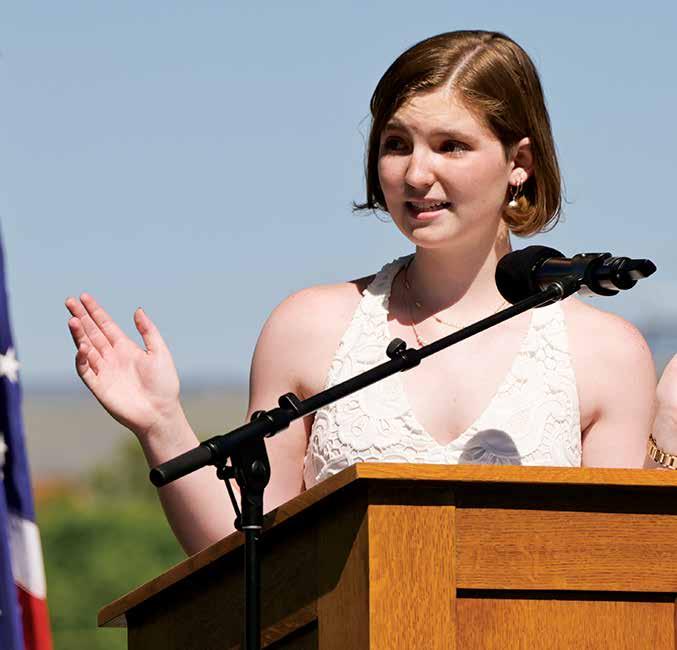
Freeman, elected Class Speaker, spoke next, saluting fellow Seniors as the ones who made possible her own growth as an individual.
“Over these past four years, and with some of you even more, I have become the sum of the 111 people surrounding me. I have learned something important from every single person on this stage today.”
Listing the names of every Senior classmate, Freeman described how some had impressed upon her the importance of being quick to respond when friends are in need; others had shown the value in o ering ideas that could change perspectives.
She named one group of classmates gifted with the energy to bring a roomful
of people together, and another with the ability to dispense honest advice. A di erent group consistently created welcoming and inviting spaces, while another fearlessly pursued their passions.
As Freeman named each and every member of the Class of 2026, every graduate heard their name and smiled with surprise, realizing that the impact they made on CA had been noted by one of their own.
“As we’re all moving forward into the next chapters of our lives,” Freeman said, “I urge you to learn something from everyone you meet. …There are a million things to learn, and a billion people to teach it to you.”
But, she added, that doesn’t mean forgetting where you’ve come from. “I’ll be carrying all the things I learned from each and every one of you forward alongside all that I’ve learned from everyone else in my life. I know that I still have so much to learn, but I know that I’m already so incredibly prepared to face any challenge that life might throw at me. So thank you all, for the lessons that you’ve taught me, the experiences we’ve had, and for the community that I know is going to last no matter where we all end up.”
With that, it was time for Dr. Davis to present diplomas to the graduates, from Gri!n Adams to Emily Wu. And as they recessed back across the Welborn Lawn to celebrate and take a multitude of photos with family and friends, it is certain that many were still thinking of Freeman’s nal words to the Class of 2026.
“Never stop learning, and never forget the people you learned from.” n
Senior Class Speaker Kit Freeman
The Class of 2026
Griffin Montgomery Adams
Purdue University
Alexander Kai Aleong
University of Washington
Luke William Allison
Dartmouth College
William Hudson Arney
Purdue University
Alexis Ayala Ramirez
Colorado College
Layne Anne Ballenger
Wake Forest University
Alexander Ray Bank
Lehigh University
Katherine Huilin Bergsieker
Princeton University
Taylor Paris Bezoza
University of Southern California
Jack William Braun
Lafayette College
Evan Douglas Brown
University of Virginia
Khloe Elizabeth Tschida Brown
California Polytechnic State University
Rex Roundtree Philip Burstein
Westminster School
Daniele Caffarelli
University of Miami
Grace Alexandra Carson University of Tennessee
Zander Makai Chao
Colorado School of Mines
Kaley Jaslene Chavez Garcia
Trinity College
Chloe Ruyan Chesley-Vogels
Loyola University Chicago
Ajay Sureel Choksi
University of Miami
Jules Isabella Cohn
University of Colorado Boulder
Quincy David Coleman
Wake Forest University
Henry Matthew Cowperthwaite
Auburn University
Sloan Michael Cummings
Tulane University
Ziyad Ahmed Dar
Texas Christian University
Abby Brooke Dawson
Middlebury College
Kieran Anvil Delaney
Trinity University
Tess Alexandra DeNezza
Boston College
Ruby Ren Dokken
Rhode Island School of Design
Aileen Regan Doniger
Stanford University
Hashem Mohamed Shereef Elprince
Northeastern University
Fletcher Finnley Emerson
University of Colorado Boulder
Mack Owen Emrich
Amherst College
Andrew Wallace Esposito
University of British Columbia
Marques Kato Esquibel
University of North Carolina at Charlotte
Harper Rose Ezrine
University of Michigan
Katherine Marie Freeman
Cornell University
Eva Adelaide Gifford
Boston University
Rory Elizabeth Goldstein
Chapman University
Sydney Evelyn Goodspeed
Babson College
Isabel Anne Gottlieb
Pomona College
Natalie Rose Gottlieb
Dartmouth College
Elle Theriault Guillot
Skidmore College
Georgia Iris Gutsch
Boston University
Caroline Grace Hagen
Colorado College
Caroline Abigail Haley
University of Notre Dame
Guimara Altidor Harris
University of British Columbia
Claire Brinkley Hawk
Bowdoin College
Erick Hernandez Morales
University of Denver
Molly Carroll Hills
University of Oregon
Annabelle Etta Iten
Marquette University
Asha Jazaeri
University of Wisconsin - Madison
Robert Stephen Kenney Jr.
Georgetown University
David Thomas Kimball
Texas Christian University
Lyla Jane Kocher
University of San Diego
Alexandra Elise Koren
University of San Diego
Tatum Milan Kreitler
University of Richmond
Keren Maglan Laizer
Princeton University
Alexandra Catharine Lane
University of Tennessee
Zack Oliver Lapidus
Princeton University
Pritika Shivani Lingam-Nattamai
Washington University in St. Louis
Chloe Brynn London
Syracuse University
Estevan Ubaldo Loya Jr.
Pitzer College
Keegan William Manzo
The American University of Paris
Cooper Finn Martin
University of Miami
Kellen Daniel Martin
University of Notre Dame
Adam Ahmed Marwan
Washington University in St. Louis
Johanna Jamilet Mata
Colorado College
Lucas Ronzani Mault
University of Utah
Lawrence Alexander Mays
Cornell University
William Shane McCandless Macalester College
Celia Long McCarty
University of St Andrews
Nicholas Ryan McCoy
University of Wisconsin - Madison
Macey Martin McKean
Colorado State University
Liam Kyle McKee
Virginia Polytechnic Institute
Emery Kathryn Mikula
Montana State University
Jacob Viggo Miller
Tulane University
Adrian Moreno Rosales University of Denver
Piper Jill Morris
University of Colorado Boulder
Oliver Joseph Neely
Emory University
Laura Christine Noyes
Wake Forest University
Marianna Marlene O’Connor Loyola University Chicago
John August Olmstead
University of Miami
Parker Nicholas Pryor University of Connecticut
August Lee Reichert
Georgia Institute of Technology
Ricardo Rios Rodriguez University of Colorado Boulder
Rosemary Graham Risch
University of Pennsylvania
William Jacob Robinson
Texas Christian University
Luis Diego Rodriguez
University of California Berkeley
Thomas Stephenson Rollhaus
Brown University
Elliott Lim Rydberg
University of Michigan
Hazel Marion Sankovitz
Carleton College
Braden Emory Schubert
United States Military Academy
Justin Colin Schwartzreich
Carnegie Mellon University
Reece Lane Scyphers
University of Miami
Conrad Sehl
University of Denver
Zachery David Shull
Northeastern University
Gideon Ray Silverman-Joseph Vassar College
Mitchell Gabriel Sindler
Washington University in St. Louis
Hannah Rose Smith
Villanova University
Evan Rachel Sorensen Ithaca College
Craig Roberts Stapleton II
Southern Methodist University
Pablo Dominic Stewart St. Olaf College
Augusta Hayes Thornton University of California Santa Barbara
Isabella Marie Vargas Tulane University
Sophia Elizabeth Varholak Colby College
Benjamin Eric Vath
Lehigh University
Asha Faith Wagner
University of Colorado Denver
George Kerr West
Indiana University
Jenna Lee Westfall
University of Tennessee
Catherine Cook Whalen
Elon University
Joshua Ross Wolff
University of Wisconsin - Madison
Emily Wu
Colorado College
Legacy Children 2025-2026
Colorado Academy is pleased to report that 84 students enrolled for the 2025-2026 academic year are the children, grandchildren, nieces, or nephews of alumni/alumnae. Current grade shown in parentheses.
Gri n Adams (12)
Steve Adams ’91, father
Chip Adams* ’89, uncle
Chloë Barton (7)
Alex Barton ’97, father
Henry Blue (10)
Sara Gans Blue ’96, mother
Mika Gans ’98, aunt
Max Gans ’07, uncle
Charlotte Braun (9)
Karsten Braun (11)
Alexa Hanke Braun ’95, mother
Cecilia Hanke Wolfson ’90, aunt
JB Breit (9)
David Wilhelm ’68, grandfather
Rex Burstein (12)
Tatum Burstein (9)
John Burstein ’89, father
Alli Burstein Kozlo ’94, aunt
Lachlan Campbell (3)
Maddie Campbell (1)
Kelly Young Campbell ’98, mother
Cole Chotin (7)
Ross Chotin ’99, father
Mauri Chotin Zemachson ’94, aunt
Whitney Chotin ’97, aunt
Sophie Collins (6)
Tim Collins ’87, father
Henry Cowperthwaite (12)
Kevin Cowperthwaite ’79, father
Tom Cowperthwaite ’81, uncle
Emily Coyle (1)
Matthew Coyle (5)
Martha Fulford ’01, mother
Scott Fulford ’98, uncle
*Deceased
Lilah Dennis (8)
Travis Dennis ’00, father
Kendall Dennis Slutzky ’97, aunt
Sammy DePetro (PK)
Nick DePetro ’04, father
Sam DePetro ’06, uncle
Oscar Dillon (3)
Samson Dillon (6)
Megan Young ’97, mother
Daren Young ’00, uncle
Charlotte Emerson (10)
Fletcher Emerson (12)
Remy Emerson (9)
Julia Völkel Emerson ’94, mother
Mark Völkel ’94, uncle
Brooks Firman (K)
Chris Firman ’93, father
Lyz Firman Olmstead ’95, aunt
Andrew Firman ’00, uncle
Matt Olmstead ’95, uncle
Elise Ford (7)
Jeska Horgan-Kobelski ’98, mother
Jeremy Horgan-Kobelski ’96, uncle
Tim Horgan-Kobelski ’05, uncle
Charlie Freyer (9)
Sophie Freyer (11)
John Freyer ’67, grandfather
Digby Gile (8)
Gia Gile (11)
Merritt Gile ’95, father
Caitlin Gile Morris ’96, aunt
Philippa Gile ’05, aunt
Noa Gold (9)
Meagan Gold ’96, mother
Marshall Golden (7)
Nora Palenchar Golden ’00, mother
Ethan Palenchar ’98, uncle
Hayley Greenberg (4)
Jackson Greenberg (6)
Jordan Greenberg (1)
Josh Greenberg ’02, father
Daniel Greenberg ’09, uncle
Rachael Greenberg ’05, aunt
Evah Gunn-Roller (9)
Dan Roller ’99, father
Tom Roller ’01, uncle
Emory Harris (K)
Norman Harris ’94, father
Chelsea Harris ’01, aunt
Jillian Hills (9)
Molly Hills (12)
Zach Hills (5)
Liston Hills ’95, father
Zach Hills* ’01, uncle
Ellie Jones (9)
David Jones ’95, father
Jill Bible ’99, aunt
Phil Jones ’99, uncle
Natalie Kesselman (4)
Nico Kesselman (1)
Rob Kesselman ’03, father
David Kimball (12)
Tom Kimball ’89, father
Allyson Kimball Johnson ’92, aunt
Ford Kimball ’91, uncle
Avery Koch (10)
Gri n Koch (8)
Ryan Koch ’96, father
Alison Koch Mims ’98, aunt
Buckley Ladd (5)
Sadie Ladd (3)
Tucker Ladd ’99, father
Bryann Ladd Nourse ’02, aunt
Ben Ladd ’95, uncle
Cooper Lightstone (PK)
David Lightstone ’06, father
Beth Likovich (6)
Charlotte Likovich (4)
Emmie Likovich (1)
Katie Likovich (PK)
Tizzie Considine Likovich ’03, mother
Tay Considine ’01, aunt
Jessie Miller (10)
Lottie Miller (6)
Nate Miller ’87, father
Blake Miller (11)
Wren Johnson Miller ’95, mother
Craige Johnson ’93, uncle
Simone Moore (K)
Peter Moore ’03, father
Piper Morris (12)
Caitlin Gile Morris ’96, mother
Philippa Gile ’05, aunt
Merritt Gile ’95, uncle
Olivia Nelsen (11)
Amy Livingston ’93, mother
Katie Livingston* ’96, aunt
Raj O’Rourke (2)
Simran O’Rourke (2)
Sonia Arora ‘01, mother
Sasha Arora ‘00, aunt
Elin Olmstead (8)
Gus Olmstead (12)
Matt Olmstead ‘95, father
Lyz Firman Olmstead ‘95, mother
Chris Firman ‘93, uncle
Amy Olmstead ‘91, aunt
Andrew Firman ’00, uncle
Josie Pryor (8)
Parker Pryor (12)
David Knowles ’66, uncle
*Deceased
Hattie Ralston (5)
Sebastian Ralston (2)
Natalie Newcom Ralston ’99, mother
Chip Newcom ’02, uncle
Lucy Randle (3)
Kathleen Burke ’98, mother
Slater Reiland (K)
Kellie Slater Reiland ’06, mother
Meagan Slater Moore ’07, aunt
Anna Remsen (7)
Julie Richardson Remsen ’95, mother
Tyler Richardson ’98, uncle
Benji Richardson (K)
Laura Gaumond ’02, aunt
Eli Rockmore (10)
Lizzie Welborn Rockmore ’90, mother
Je Welborn ’64, grandfather
Emily Roller (K)
Katherine Roller (3)
Tom Roller ’01, father
Dan Roller ’99, uncle
Lenox Schoenwetter (K)
Sutton Schoenwetter (2)
Kedzie Schotters Schoenwetter ’06, mother
Conrad Sehl (12)
Meagan Gold ’96, stepmother
Hari Shamos (9)
Geo Shamos ’98, father
Jeremy Shamos ’88, uncle
Sara Shamos Yelpaala ’00, aunt
Suki Shamos Osley ’86, aunt
Darcy Simon (9)
Finn Simon (6)
Dan Simon ’95, father
Tula Stettner (10)
Rob Stettner ’94, father
Andrew Stettner ’99, uncle
Rich Stettner ’91, uncle
George West (12)
Henry West (10)
Thomas Kerr ’76, uncle
Max Wiechecki (1)
Sam Wiechecki (4)
Nicole Sisk Wiechecki ’01, mother
Jason Sisk ’98, uncle
Ben Zinn (11)
Ken Zinn ’92, father
Jenn Zinn ’95, aunt
Dan Zinn ’97, uncle
This list contains alumni non-graduates. If you are not listed and are a legacy, please contact the Alumni O ce at 303-914-2584.
Boards & Associations
Alumni Association Board 2025-2026
Adam Boscoe ’01
Andrew Bourke ’04
Caroline Cramer ’11
Nick DePetro ’04
Julia Völkel Emerson ’94
Nick Fuselier ’16
Sarah Goodyear ’06
Hondo Katz ’10
Natalie Pro!tt Lesinski ’09
David Lightstone ’06
Peter Macartney ’10
Sydney Prokupek Nolan ’17
Autumn Potter ’02
Brian Pushchak ’04
Natalie Newcom Ralston ’99
Abel Ramirez ’16
Liz Robinson ’01
Murphy Robinson ’06
Dan Roller ’99
David Spatt ’07
Megan Young ’97
Parent Association Ofcers 2025-2026
Elana Schwartzreich, President
Jess Sigala, President Elect
Claire O’Laughlin, Upper School Vice President
Amy Smith, Upper School Vice President
Morgan Hersch, Middle School Vice President
Tanya Hicks, Middle School Vice President
Brittany Crowe, Lower School Vice President
Kedzie Schoenwetter ’06, Lower School Vice President
Brianne Claypool, Secretary
Adrian Simon, Treasurer
Liz Leblanc, Communications Coordinator
Amy Martin, Communications Coordinator
Marie White, Volunteer & Outreach
Erin Kuhn, Faculty & Sta Appreciation
Cat McEachern, Faculty & Sta Appreciation
Board of Trustees 2025-2026
Andy Baumbusch
Buck Blessing
Natalie Bocock Turnage
VJ Brown ’11
Sue Cho
Jocelyn Ege
Dalia EL-Prince
Alison Engel
Matt Farncombe
Martin Goldstein
Kelly Haley, Board Vice Chair
John Hamilton
Nelson Hioe
Vanessa Homuth
Marisa Hudson-Arney, Board Secretary
Bob Martin
Julie Martin
Derek McCandless
Kevin Reidy, Board Chair
Andrew Robinson
Catherine Rollhaus
Isiah Salazar
David Shapiro
Cynthia Smith
Ex O cio
Dr. Mike Davis, Head of School
Amy Wintermeyer, Assistant Head of School
Elana Schwartzreich, Parent Association
President
Whitney Johnson, COO & CFO
Kate McDonnell, Director of Advancement
Brian Pushchak ’04, Alumni Association
President
2026 CA Concert: WILCO!
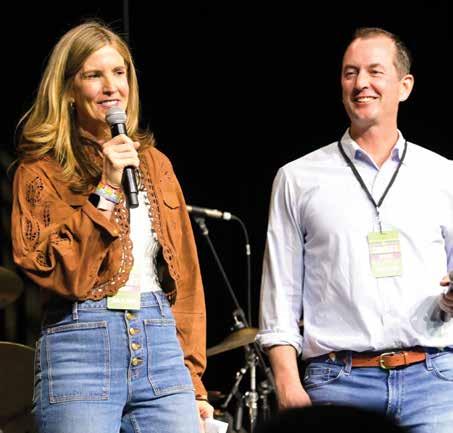
The 2026 Colorado Academy Concert was a night to remember—a celebration of music, community, and generosity, all in support of CA’s mission. With an unforgettable performance by the legendary rock band Wilco, this year’s Concert welcomed more than 800 guests to CA’s Athletic Center, the largest crowd in the event’s history, and raised more than $475,000 for nancial aid, making it the most successful CA Concert to date.
The evening re ected the extraordinary spirit of the Colorado Academy community. Thanks go to Presenting Sponsors Aurum Home Technology and Jenna & Walker Stapleton, Concert Chairs Kelly & Andrew Haley, and a dedicated Concert Committee of more than 70 parents, as well as the countless supporters who helped make the event a success. Their e orts—along with the generosity of all the Sponsors, Patron Package purchasers, auction donors and bidders, and every guest who gave so enthusiastically throughout the evening—pushed the Concert’s historic fundraising total to more than $2.25 million since its inception.
The impact of that generosity is profound. As Head of School Dr. Mike Davis shared during his remarks, the CA Concert is “so much more than a night of music.” Every dollar raised supports Colorado Academy’s nancial aid program, which this year provided $5.8 million to 18 percent of the student body and will grow to $6 million next year. Those funds help ensure that talented students from a wide range of backgrounds can thrive at CA, enriching the experience of every child on campus and strengthening
the vibrant, inclusive community that de nes the school.
“This success is an amazing testament to the generosity of the CA community,” Davis noted. “It’s nights like this that remind me what a fantastic place Colorado Academy is.”
And, of course, there was the music.
For Davis, a devoted Wilco fan, welcoming the group to the CA stage was especially meaningful. Guests enjoyed an amazing live performance from one of the world’s most in uential bands, whose creativity and artistry have inspired generations of music lovers. Earlier in the weekend, Wilco lead guitarist Nels Cline also connected with members of the CA community through a special guitar workshop, o ering students, parents, and guests a rare behind-the-scenes musical experience.
Beyond the music, guests enthusiastically supported the online Silent Auction and the Live Auction, led once again by CA alumnus and parent Tom Kimball ’89, whose energy and expertise helped inspire spirited bidding. Community members also rallied together to unlock a $20,000 challenge gift from an anonymous CA family, further amplifying the event’s impact.
Most importantly, the 2026 CA Concert brought people together in celebration of a shared purpose. Whether serving on the Committee, supporting as Sponsors, attending workshops, donating Auction items, or simply gathering together on Saturday night to enjoy incredible music and company, every participant played a role in making this event yet another powerful reminder of what the Colorado Academy community can accomplish together. n
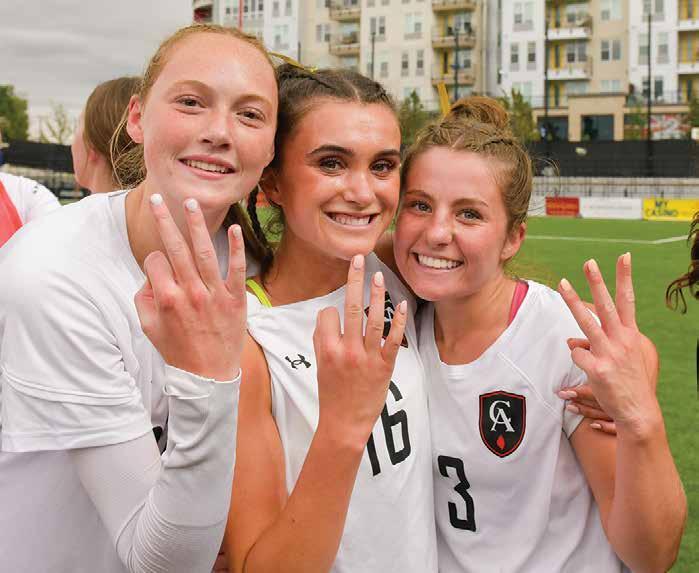
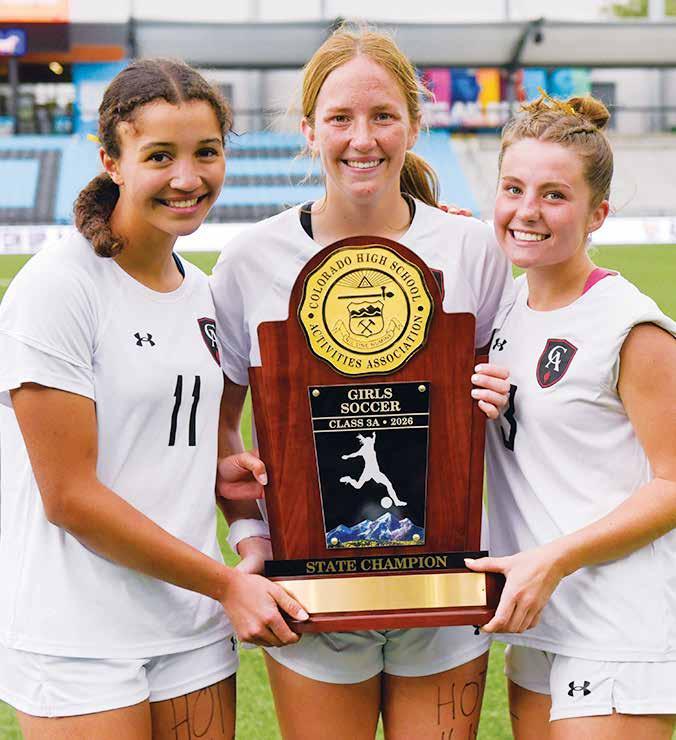
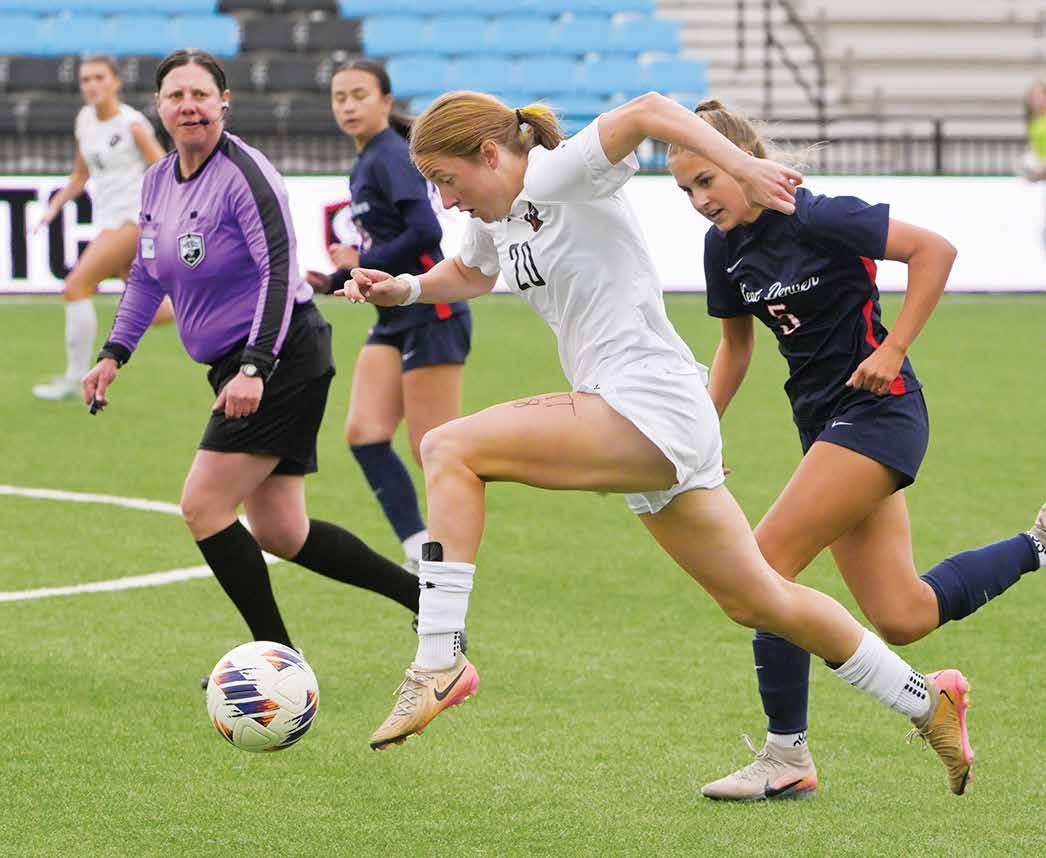
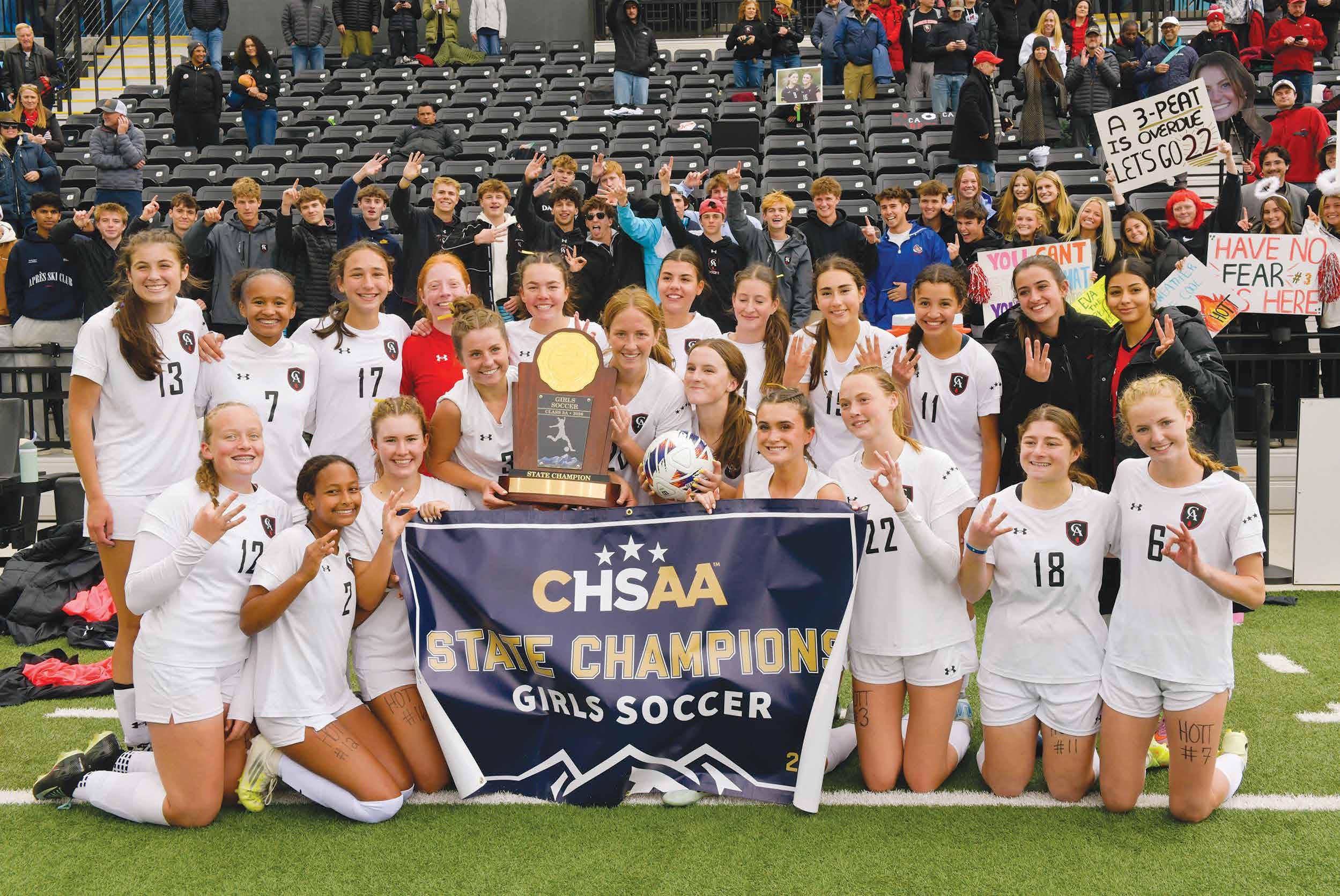
Girls Soccer Makes It Three in a Row!
The Colorado Academy Mustangs walked into Weidner Stadium in Colorado Springs for the 2026 3A Girls Soccer State Championship game on May 19 as No. 3-ranked underdogs, prepared to face o against their historic rival, the Kent Denver Sun Devils, who as the No. 1 seed carried all the momentum and buzz into a matchup they were heavily favored to win.
The odds against them didn’t matter one bit to the CA girls.
After two hours of erce battle, the squad was heading home with its third Championship trophy in a row, having surprised Kent by earning a 2-1 victory to give the Mustangs their eighth State Title overall. On lling up the Soccer trophy case in the CA Athletic Center right to the brim, Head Coach Sean Stedeford states matter-offactly, “This is probably the greatest Colorado 3A Girls Soccer program of all time.”
(CA’s three-Championship streak got started with Stedeford at the helm in 2024 and continued in 2025.)
Winning this year against Kent put an exclamation point on the girls’ season in more ways than one: The Mustangs broke their seven-Championship tie with the Sun Devils, moving into second place all-time
behind only Arapahoe High School. At the same moment, they bade farewell to Class 3A competition alongside their top-rated rival, with CA headed for Class 5A Soccer next year and Kent for 4A.
“We as a program want to keep evolving,” says Stedeford. “We, as coaches, want to evolve; our players want new challenges, and 5A is the right environment for us.”
It didn’t necessarily look that way coming into the Championship match.
The team had seen a long list of key Seniors graduate the previous year, and knew they’d be starting with a much younger, less experienced roster. And, admits Senior Co-Captain Lyla Kocher, the powerhouse forward responsible for both of CA’s Championship-winning goals on top of a league-leading season total of 28, “It took us a sec to gure out how to help the team rebuild, how to guide them.”
But after racking up ve tough losses through the rst half of the spring, including a 1-0 defeat to Kent, says Kocher, “We started wanting it more. We started playing for each other more.”
Adds Senior Co-Captain Jenna Westfall, “We grew a lot after that Kent loss. We really took o as a team—we didn’t lose again the rest of the season.”
When the Mustangs lined up at the start of the Championship match against their biggest rival, the Sun Devils probably thought they were looking at the same team they had faced before, probably expecting the same outcome.
But that’s not how the CA girls saw it.
“We went out there ready to win,” explains Kocher. “We knew that if we could just play our game, there’d be no issue with our opponent, no matter who it was.”
“Even if we believed we weren’t really the underdogs,” Westfall says, “we decided as a
From left, Co-Captains Sophomore Carys O’Hara and Seniors Lyla Kocher and Jenna Westfall
Kocher advances the ball.
Seniors Hannah Smith, Layne Ballenger, and Westfall
team to play like we were—like we had a chip on our shoulder, nothing to lose. We were going to leave it all on the eld.”
The rst half of the matchup certainly delivered on that resolve: Spectators were on the edge of their seats as the rivals staged a scoreless shoving match of physical, fast-paced soccer, with both teams at the top of their game.
According to Stedeford, “We knew Kent was going to bring a lot of energy to the ght. So before the game, we made sure the girls understood that we were going to ght back.”
After a few opening exchanges that put the Mustangs on their heels, continues Stedeford, “They settled in, and we started to nd our own rhythm.”
By the end of the rst half, CA had started to turn the tables, and when they took the eld for the second, they did so with a message from Coach: “The next 40 minutes aren’t going to require us to be a di erent team; they’re going to mean us
staying true to what we do and how we want to play.”
There was stunned silence from the CA side of the stands when Kent was rst to score just ve minutes into the half—but it lasted only a second, as the goal seemed to kick the Mustangs into a higher gear. With an assist from Senior Layne Ballenger just a minute later, Kocher knocked in CA’s equalizing goal almost, it seemed, before Kent had nished celebrating their own.
Then, another three minutes in, Kocher was in front of the Sun Devils’ net again, preparing for a free kick after drawing a foul. The ball she curved around a wall of Kent defenders and through the arms of their keeper would seal the Mustangs’ win with 30 minutes left to play.
From that point on, the Mustangs simply shut out the Sun Devils. CA goalkeeper Junior Hannah Hyatt and star Sophomore defender and team Co-Captain Carys O’Hara were a brick wall against Kent’s
frustrated front line, and Kocher and Westfall, leaders on o ense, dropped back to help stop any attacks.
“That Kent goal against us was a blessing in disguise—we had nothing to lose,” recounts Kocher. “The moment really unlocked how we wanted to play, and let us not be afraid.”
Adds Westfall, “We never felt defeated; everybody’s head was up, which was di erent from earlier in the season when we might have put our heads down at a time like that.”
As Stedeford explains, the team leaned into adversity, just as they had all season, growing stronger from one game to the next. “Instead of shying away, this became a team that wasn’t afraid to do hard things.”
Moving up to 5A next year will be another level of di!culty, he says. “But when we talk to the girls before a game, when it gets chaotic or it feels like we’re under it, we’ll tell them the same thing: Don’t look at the scoreboard. Look at each other.” n
Fourth Grade’s Chris Hertig Retires
Around Colorado Academy’s Lower School, Fourth Grade Instructor Chris Hertig may be known for a soft-spoken kindliness that’s as reassuring as a favorite uncle’s, but as he retires this year after two decades of teaching generations of CA students, Hertig leaves a di erent impression with the colleagues and friends who understand him best: tough as nails.
In the spring of 2025, the veteran teacher was at home on a Saturday when he realized with disbelief that he was having a heart attack. But after receiving timely care in Denver Health’s emergency room—angioplasty and stenting to open the blocked arteries and restore blood ow—he felt well enough to ask doctors, “Can I go back to work Monday?”
They advised continued rest, of course, and eventually Hertig was surprised when he started asking himself instead: Is it time to think about retiring?
“I’m sure I could have stayed another 10 years at least,” he says. His own father, a teacher, was in the classroom until age 70; Hertig was born at the school where he taught. “But sometimes life events start to show you that maybe time isn’t endless.”
Still, as an avid skier who rst moved to Colorado from the East Coast to teach kids in Breckenridge’s “Bombers” program and guide rafting expeditions on the Arkansas River in the summers, Hertig isn’t someone who shies away from challenges. His main goals in “retirement,” he explains, are skiing and traveling.
“Last year with the heart attack I think I skied six days; this year, just once on opening day. When I was teaching in Breckenridge, I know I was on the mountain closer to 100 days a season, in all kinds of weather. It was 50-50 between skiing and snowboarding. Next year I’ll be ready to ski and ride almost anything.”
Snowsports have changed radically since Hertig rst moved West in the 1990s—early, DIY snowboard culture still felt a little punk rock, and multimilliondollar athlete sponsorships were at least a decade away—but, he says, CA has somehow remained much the same. A graduate of Hamilton College with a master’s degree in Early Adolescent Education from Bank St. College in New York City, Hertig started teaching at CA in 2006. Then, as now, he recalls, the Lower School was home to fantastically experienced, deeply dedicated educators whose mission was to make every child feel valued.
“I still think of it as a ‘family school,’” says Hertig, “where the small class sizes and homeroom model have always allowed us to get to know our students incredibly well—along with their brothers and sisters and families, too. So year after year, we get to see those same kids; you go to a high school game or a play, and there they’ll be. And the support for faculty here is so strong, it’s the same teachers who stay to see their students all the way through.”
A tradition of robust funding for professional development, as well as programs such as CA’s elementary teaching internship—which graduated many extraordinary educators who are now the veterans of the Lower School— ensured longstanding foundations of the curriculum only got better as research and evolving best practices kept classroom teaching at CA moving ahead.
At the same time, Hertig notes, as technology has increasingly become ingrained into children’s lives, the Lower School, especially under the leadership of Principal Angie Crabtree, has doubled-down on protecting the analog joy that has always been at the center of CA’s elementary classrooms, long before the debut of the iPhone and
Facebook around the time of Hertig’s arrival at CA.
“Being able to sit down for a half an hour and read a book, using your hands to make arts and crafts and do science, visiting our incredible Lower School Library, or going down to Woody’s Pond— Angie has done so much to get us all on the same page: These are the experiences that truly bind this place together.”
And with specialist teachers who are “masters of their craft” in disciplines such as music or technology, says Hertig, he and his faculty colleagues enjoy the rare luxury of having the time to collaborate to better serve the eager learners who arrive each day with something new they’re curious about.
“Our students love school—they love the books, the projects they get to work on, their little Buddies and big Buddies. It’s genuine; so is the support from families and the administration for what we do.”
So, says Hertig, while it’s hard to leave his homeroom of 20 years, he’s fully confident “CA will go on; it will thrive without us. It’s built so well; there will always be another great educator, and more curious students.” It’s time to take advantage of the thing that won’t last forever. “I don’t want to miss out on all the stuff I haven’t gotten to try yet,” he laughs.
For this “Renaissance man,” in the words of colleagues—who at Hertig’s retirement “roast” revealed he speaks three languages fluently, is an avid travel photographer, holds a plumber’s license, pulls legendary pranks, creates elaborate works of art and Halloween costumes, and relentlessly champions those around him—not knowing precisely what’s next is just fine. He’s tough enough to wait a while.
“We’ll see what draws me.” n
Fourth Grade Instructor Chris Hertig in the classroom
“throne” beloved by his students
Boys & Girls Tennis
Boys Topple Kent Denver to Claim First State Title in Seven Years
After nishing runner-up to Class 4A rival Kent Denver School in the last two Boys Tennis State Championship tournaments, the No. 2-seeded Colorado Academy Mustangs turned the tables on the No. 1 Sun Devils in their meetup at Denver Tennis Park on Tuesday, October 21, 2025. CA’s Varsity Boys were elated to win four out of seven matches to clinch their rst Championship trophy since 2018, only the second in the program’s history.
The victory followed on the heels of the squad’s impressive trio of 7-0 shutouts against Peak to Peak Charter School, George Washington High School, and Thomas Je erson High School in playo meetings, and it landed a CA-red cherry on top of the three individual State Titles already nabbed by team members on the Saturday before
the nal matchup with Kent.
It was a dominant nish to the season, according to Head Coach Noah Tondre— named Class 4A Coach of the Year—and it was clear evidence of one thing: “Mentally, these boys just got better every day. In some of our early-season matches, there was negative emotion on the court. But working with Sydney (Prokupek Nolan ’17), CA’s new Mental Performance Coach, really turned the season around for us. I want to give the whole team a ‘Most Improved’ award.”
Throughout the fall, relates Tondre, he and Nolan worked to challenge each team member to focus on being present, acknowledging di!cult emotions, and leaving a legacy they could be proud of. The result was some of the best Mustang team tennis in years, Tondre says. “There was zero
negative emotion on Championship day.”
Leading the way were the individual State Champions—Senior Co-Captain Oliver Neely at No. 2 Singles, Sophomore Hendrik Jordaan and Junior Peter Owen at No. 1 Doubles, and Sophomore CJ Marshall and Senior Thomas Rollhaus at No. 3 Doubles— who secured the early momentum in the best-of-seven competition Tuesday. Senior Co-Captain Craig Stapleton, who lost to his No. 3 Singles Sun Devil opponent in the individual tournament and during the regular season as well, clinched the winning fourth match for the Mustangs by avenging the earlier losses.
The rst to notch a win for CA, Jordaan and Owen are “probably the best No. 1 Doubles team in the state,” Tondre estimates. But, he says, “Everyone was nervous to take the
See BOYS TENNIS on page 38
Together on Top
Varsity Girls ‘Refuse to Lose,’ Earn Second Tennis State Title
It felt like an entire season’s worth of high school tennis packed into ve days of travel, tension, and tenacious competition, but in the end, the journey was more than worth it: On Tuesday, May 12, the Colorado Academy Girls Tennis Team was crowned CHSAA’s 2026 Class 3A State Champion with a convincing 4-2 victory over rival Prospect Ridge Academy, CA’s second Girls Tennis State Title after its rst in 2024.
“They just refused to lose,” says Head Coach Noah Tondre, named 3A Coach of the Year after the win. “That’s the one really important quality they shared with the girls of two years ago.”
When this spring season began, losing may have seemed the likelier possibility. The team roster—loaded with less experienced Ninth-
and Tenth-Grade players—kept shifting as commitments and schedules changed; and, of course, Colorado’s spring weather often made putting a string of matches together, let alone victories, a challenge.
But toward the end of the season, according to Tondre, things gelled—just in time for the nal sprint that would see CA receive the 3A Sportsmanship Award as well as the State Title. “Every single position was able to contribute.”
The lead-up to the team’s Championship moment began the Thursday before, when they traveled to Colorado Springs for the 3A Individual State Championships. Six of CA’s seven positions had quali ed in regional playo s, and over three days, two hotel nights, and a non-stop menu of to-go meals, the squad completed a total of 21 matches
on the way to claiming rst place Saturday nishes at No. 1 and No. 3 Singles, second at No. 1 Doubles, and third at No. 2 Doubles.
Individual State Champions Mira Leon, a Junior at No. 1 Singles, and Annika Bhandari, a Ninth Grader at No. 3, would help lead the Mustangs to their next critical victory: Monday’s weather-postponed Team State Championship Semi nal versus Vail Christian High School, a two-hour drive from CA after the weekend away.
That win over No. 1-ranked Vail was never guaranteed. While it’s true that Leon had already beaten her No. 1 Singles Semi nal opponent once to capture the individual title Saturday, it was a long night of backand-forth competition for the CA squad on Vail’s home courts.
See GIRLS TENNIS on page 39
court against Kent, so I gave Jordaan and Owen a job to do: Go out there and take care of business.”
Once they did, it didn’t take long for Neely to put away his match, and for Marshall and Rollhaus to quickly seal their own win. With CA ahead 3-0, it all came down to Stapleton’s match against the rival who’d beaten him before.
As Co-Captain alongside Neely, relates Tondre, Stapleton had gradually come into his own as a leader over the course of the season. “By the last practice, he was like a new person—all over his teammates, making sure everyone was ready and engaged for the match with Kent.”
And in his deciding Championship victory, Stapleton proved he’d grown as a player, too. Tondre says that in addition to mental performance, the team’s philosophy of staying “loose” was a big part of their success—and the story behind Stapleton’s improbable win. “For us, staying loose has a very speci c meaning: When you’re ahead, especially on the big points, it’s easy to get tight and lose focus. At CA, ‘loose’ means reminding yourself to swing free and get to the net—to stay con dent and aggressive.”
No surprise: Stapleton earned the matchwinning point by following an approach shot in to the net.
Still, it wasn’t the individual performances that most distinguished the 2025 Mustang Boys Tennis season; it was the way an unusually broad range of players came together as a team. From rst-time Varsity player Luka Jovanovic, a Ninth Grader playing at No. 2 Doubles, to Senior Mitchell Sindler, another Varsity rst-timer who was part of a No. 4 Doubles pair that had never taken a set from Kent Denver until the Championship tournament, this group of student-athletes was the tightest he’s seen, says Tondre.
One of the very rst things he and Nolan talked to the players about as the season got underway was the idea of leaving a legacy. And now, with a strong core of rising young players primed to come back next season, Tondre states, “I think this is the start of that legacy.” n
Celebrating the win
Sophomore CJ Marshall and Senior Thomas Rollhaus Senior Co-Captain Craig Stapleton
Co-Captain Senior Oliver Neely pumps up his teammates.
After three CA doubles pairs lost their matches quickly, “It wasn’t looking good,” relates Tondre. Leon was having serve trouble, and No. 2 Singles player Finley Wells, another standout Ninth Grader, was cramping. Yet somehow, vocal support from teammates and parents began to turn the tide, and by the end of the night, Leon, Bhandari, and the No. 1 Doubles pair of Juniors Sheena Wu and Elise Yang had won their matches, with Wells recovering just in time to seal the 4-3 CA victory.
The team, ranked fth in Class 3A this season, was ecstatic to celebrate their Semi nal win over top-ranked Vail, but quickly came back to earth as they realized they’d have to play for the Team Championship in less than 24 hours, after a return drive to CA that wouldn’t get them home until midnight.
According to Leon, named 3A Player of the Year, “I got co ee in the morning, I ate a lot, tried to refuel ... but I guess I was a little concerned” about the Finals against the Miners, who had defeated CA earlier during the regular season.
Still, with adrenaline and a string of recent victories powering these student-athletes, there wasn’t much to be concerned about at Denver Tennis Park on Tuesday, after all. Says Tondre, “Through that entire bus ride back home from Vail, the girls kept telling each other, ‘We’re going to sweep Prospect Ridge tomorrow. We’re going to sweep them.’ That con dence and belief fully kicked in.”
The momentum carried CA through the fth and nal long day of play.
The rst to put CA on the board was the No. 2 Doubles pair of Ninth Graders Kate Johnson and Klara Kiesey. For Johnson, the moment was extra special: Her older sister, Anna Johnson ’24, had been one half of the No. 1 Doubles team that helped CA clinch its rst Championship trophy in 2024. Next to score was Bhandari, the Ninth Grader who had been the team’s “rock” throughout the spring, explains Tondre. “Annika reminds me of Bjorn Borg back in the day, who used to be called ‘The Iceman.’ You can’t tell by looking at her if she’s way
ahead or way behind; she gets nervous like anyone else, but she just handles it so well.”
Then, it was Prospect Ridge players who notched match wins to tie the score at two apiece. Fans on both sides held their breath as the competition came down to the three matches still in progress: No. 1 Singles (Leon), No. 2 Singles (Wells), and No. 4 Doubles (Senior Emery Mikula and Sophomore Claire Fisher).
“Mira is such an amazing athlete,” recounts Tondre. But when she got tight and started falling behind against her Prospect Ridge opponent, Tondre called her over to the side of the court, got her to laugh and eat and drink—the only real “controllables” there are in tennis, says Tondre—and
everything changed. She started having fun—what Tondre calls “playing loose”: “Swing loose, swing aggressive, and look to get in when you’re up.”
Leon stormed back for the win, thrilling the CA crowd, and just a few seconds later, even bigger cheers erupted as Mikula and Fisher won their No. 4 Doubles match to clinch the State Title for CA. No. 4 Doubles clinched the Championship in 2024, too, notes Tondre.
“And I said the same thing then that I did this year,” he relates. “These rival teams are all so tough—the season isn’t about the individual wins. It’s about getting a little better every day until you peak at just the right time. And this year, just like 2024, that’s exactly what they did.” n
Head Coach Noah Tondre
From left, No. 4 Doubles partners Sophomore Claire Fisher and Senior Emery Mikula
From left, Co-Captains Juniors Sheena Wu, Elise Yang, and Mira Leon
Doris Kearns Goodwin at CA: Leadership in Turbulent Times
At Colorado Academy’s SPEAK Series lecture on April 2, 2026, Pulitzer Prize-winning author and renowned American presidential historian Doris Kearns Goodwin inspired an audience of more than 400 parents, faculty and sta members, and guests as she shared an engaging conversation with CA Head of School and fellow historian Dr. Mike Davis on the stage of the Leach Center for the Performing Arts. The two discussed insights and lessons drawn from Goodwin’s decade of rst-hand experience in the halls of power of Washington, D.C., during the 1960s, as well as from her groundbreaking research on Presidents Abraham Lincoln, Theodore Roosevelt, Franklin Roosevelt, and Lyndon Johnson.
Goodwin’s conversation with Dr. Davis was followed by an intimate discussion with CA history students.
Introducing this teacher, scholar, storyteller, best-selling author, television personality, and Boston Red Sox superfan, Dr. Davis acknowledged the turbulent political times of today but laughed as he asked, “Is Major League Baseball’s new Automated BallStrike (ABS) ‘challenge’ system tearing our country apart?”
Goodwin o ered a typically thoughtprovoking answer to this ice-breaking question.
“If a mistake is made and it determines the game, the result of a series, then it’s a good thing,” she said. “But on the other hand, there’s human error in everything we do, and I think maybe that you learn more in life if you accept everybody’s going to make errors, and as long as you acknowledge them and you learn something from them, maybe you grow as a person as a result of that. I’m for the umpires.”
Goodwin’s vocation as a historian does, in fact, go back to baseball. She recounted
that her father would have a six-year-old Doris listen to broadcasts of Brooklyn Dodgers games during the 1940s and 1950s and record by hand every moment of each game: every at-bat, every base taken, every run scored. She learned to retell the games for her father from the beginning, revealing the nal outcome only at the very end.
“That was history; I loved history and I learned how to tell a story because of baseball.”
It was as a 24-year-old graduate student at Harvard that Goodwin turned towards American presidential history. She was selected to join the White House Fellows, one of America’s most prestigious programs for leadership and public service, and at the celebration for the newly chosen Fellows, she shared the dance oor with President Johnson, who told Goodwin that he wanted her to be assigned directly to him—despite her active involvement in the anti-Vietnam War movement.
Later, she would go on to assist in the writing of Johnson’s memoirs and remembered, “Mostly, he just wanted to talk; he literally never stopped talking. We would be swimming in his pool and he would be talking, and there were rafts oating nearby with notepads so that I could take something down while I was still in the pool.”
60 years later, Goodwin said, she’s written biographies of Lincoln, Franklin Roosevelt, and many others, and “Suddenly you’ve been studying dead presidents your whole life.”
“What is it about you,” Dr. Davis asked, “that allows you to bring their stories to life with such detail and focus?”
Goodwin replied, “Stories are hardwired in our brains. If I can tell it in a story, then I can remember it.”
Dr. Davis turned the discussion toward a question that was likely on the minds of
many in the audience: “You’ve written about moments in history when the future of the Republic hung in the balance. And I’m curious, how do you see what’s going on in today’s political culture compared to earlier periods of instability?”
“This is precisely where history can help us,” according to Goodwin. Those di!cult eras she has chosen to write about—the Civil War, the turn of the 20th century, the Great Depression, the 1960s—she chose because they were so turbulent.
“The people living then didn’t know how their story would end,” she said. “They were as anxious as we are, because we don’t know how our story is going to end, either.”
We’re in a di!cult time right now, she continued, “But just imagine what it was like for Lincoln: Seven states have already seceded from the Union, a terrible war that’s going to kill 600,000 people is about to begin. But he knew that democracy was on the line. … Lincoln held out, the Union was restored, and emancipation was secured—but they didn’t know that at the time, either. … So we’ve got to take strength from the fact that during all these hard times, not only did America endure, but it came out stronger.”
LEADERSHIP
Dr. Davis referred to CA’s mission statement pledge to create curious, kind, courageous, and adventurous learners and leaders, and asked Goodwin, “Is there a ‘master key’ to leadership?”
Goodwin explained, “There’s not a single master key, but there is a set of emotional qualities that’s required: kindness, humility, the ability to learn from mistakes, empathy—something so missing in our country today—resilience, compassion, and yes, ambition, which may start with yourself and then grows to encompass the greater good. Mostly what a leader needs is emotional intelligence, in other words.”
Davis continued, “In our classrooms, we often look at how individuals rise to
meet great challenges. If we consider Lincoln—what were the leadership qualities that made him so t for the task of preserving democracy?”
What made Lincoln special, Goodwin said, was not just the things he did; it was also who he was.
“Lincoln shows us that character matters. Humility: The day after his election, he invited three of his chief rivals into his cabinet. Shouldering blame when things go wrong. And then compassion: As the Union was on the verge of victory, instead of delivering a triumphal message in his Second Inaugural Address, he urges ‘malice toward none, with charity to all. Let us bind up the nation’s wounds’ without retribution or vindictiveness, ‘to care for him who shall have borne the battle and for his widow
and his orphan—to do all which may achieve and cherish a just and lasting peace among ourselves and with all nations.’”
Davis mentioned resilience in the face of failure and adversity as another key leadership quality that is emphasized throughout CA’s curriculum, noting that Theodore Roosevelt at the turn of the 20th century was faced with the seemingly impossible challenge of knitting a country back together.
Goodwin agreed, “The Second Industrial Revolution around the turn of the century is the period that most echoes our own. For the rst time, we saw a large gap between rich and poor, growing suspicion of urbanization and immigration, new inventions making many nostalgic for the past.” Roosevelt, for his part, was dealing
with the nearly simultaneous deaths of his wife and mother.
But, noted Goodwin, as a leader of the Progressive Movement, he championed his “Square Deal” domestic policies, prioritized conservation, and established national parks, forests, and monuments to preserve the nation’s natural resources. “Roosevelt’s message of a Square Deal for the rich and the poor, the capitalist and the laborer, remains a good message today.”
Not long afterward, Dr. Davis said, it was Franklin Roosevelt who provided yet another example of resilient leadership. “How did FDR translate vision into meaningful action during his own tumultuous era?”
Like FDR’s determination to walk despite being paralyzed by polio, Goodwin explained, his optimism and courage in the early 1930s “gave Americans the feeling that we were all working together toward the end of the Great Depression, with a leader who could tell them there was ‘nothing to fear but fear itself.’”
And then later, when Roosevelt was forced to turn his attention to Europe and the threat of Hitler, he bravely pivoted again, making a partner of American industry to scale up manufacturing for the American military at an unprecedented rate. “Knowing that kind of business-government partnership was possible then has to give us some hope today,” said Goodwin.
FRONT-ROW SEAT
During the 1960s, the author had a frontrow seat to history as President Johnson took o!ce after the assassination of John F. Kennedy. While working on his memoirs, she said, Johnson told her what it was like to step into that breach.
“He knew people didn’t really trust him yet. So almost the very rst thing he did in o!ce to show that he was the president, and to demonstrate the values that he believed in, was to make the passage of the Civil Rights Act and ending segregation in the South his number-one priority.”
When advisors told him he had only a certain amount of “currency” to spend as a president, and insisted that he shouldn’t spend it on civil rights, Goodwin recounted, Johnson in a famous moment of courage said, “Then what the hell is the presidency for?”
Later, in the midst of the Civil Rights Movement, Goodwin was watching the events live on television as marchers along the famous Selma to Montgomery route were led by Dr. Martin Luther King Jr. in nonviolent protests for Black Americans’ right to vote. Her husband, Richard Goodwin, was President Johnson’s main speechwriter, and penned in just a few short hours the address that would spur the passage of the historic Voting Rights Act. Known as the “We Shall Overcome” speech, it began, “I speak tonight for the dignity of man, and the destiny of democracy,” and used the lyrics of the civil
“History can be a way of healing, I think. History has so many jobs to do. It can give perspective, it can give solace, it can give hope.”
Doris Kearns Goodwin
rights anthem to unite the country.
“We should remember that right now, voting is still the most important thing that we should pay attention to in all of today’s complexity,” according to Goodwin.
And we must all remember, she added, that “These leaders are examples to our kids, to all of us. And their greatness consists of character, the moral qualities of their being.”
When Dr. Davis asked, “What gives you hope? What actions can all of us take to build a more just and thriving society?” Goodwin replied with a challenge.
“It’s really not up to the leaders—it’s up to us. When Abraham Lincoln was called a liberator, he said, ‘Don’t call me that, it was the anti-slavery movement and the Union soldiers who won the war.’ It was the Progressive Movement, already in the cities, that made Teddy Roosevelt’s name famous. The Union Movement was just as important in what FDR was able to accomplish, and so was the Civil Rights Movement for LBJ. Change comes from the ground up; and that means government is us. Citizen engagement is absolutely essential.”
And who will be the next great American president, one audience member wondered.
“That’s what the primary system will show us,” answered Goodwin. “Nobody knew that Abraham Lincoln was the man he would become until the 1860 Republican National Convention. There are plenty of similar people out there right now—we
Joking with Dr. Mike Davis
just have to see them and judge whether they are authentic.”
She went on, “Today, we cover campaigns wrongly: We talk about who’s raising the most money, who says the most outlandish thing. Instead we should study the qualities people show us: Do they have empathy? Do they have humility? Can they acknowledge errors? Do they have kindness? Do they have compassion? Where’s their ambition? What’s their purpose? That’s how we should be looking at every future leader.”
ADVICE FOR STUDENTS
Guests were reluctant to leave the buzzing Leach Center for the Performing Arts after such inspiring words, but they did so to make way for a group of Juniors and Seniors in the Advanced Studies and Research class Ideas & Inventions, who arrived for their own session with Goodwin.
The students were in the midst of researching and drafting their nal papers on a wide range of topics in philosophy and human and technological development; Goodwin’s Leadership in Turbulent Times was a central text during their yearlong course, according to Instructor Dr. Ben Ho man.
Re ecting on how she chooses what to write about, Goodwin told the students, “I’m a biographer, so I only choose people that I’d want to live with. It takes so long to nish the work that having a passion for your subject—whether it’s an event, or a person, or a period of time—that’s really important.”
One student was curious how Goodwin goes about judging the impact of any leader, given the many intangible qualities which seem to gure in the equation.
“You judge the person in the context of their times,” she replied. “Some people say that Lincoln’s Emancipation Proclamation came too late, or that Franklin Roosevelt didn’t do enough to help Jews escaping from Hitler’s Germany. In everyone and everything you study, you’re going to nd aws—they’re human beings. It’s important to recognize the possibilities that were available to them at the time.”
Asked to talk about her most recent book, An Un nished Love Story: A Personal History of the 1960s, Goodwin reminisced about
working with her late husband to unearth hundreds of boxes of papers from that critical time in American history.
Her husband, Richard, had long ago closed the door on the 1960s, bitter about America’s involvement in the Vietnam War. But revisiting those detailed archives brought back all the good of the era, before the war began.
“History can be a way of healing, I think. History has so many jobs to do. It can give perspective, it can give solace, it can give hope.”
What about bias in authoring historical works, one student wanted to know.
“First, you just have to acknowledge that bias is going to be there,” explained Goodwin. “It doesn’t mean you’re going to go somewhere that the evidence doesn’t; it just means you have to be honest about the failures or the mistakes.”
In the case of Lyndon Johnson, to whom she was close, Goodwin continued, “He was clearly so extraordinary with domestic politics, but we also have to admit that that facility was just not there with the situation in Vietnam. He was worried about not failing, rather than pursuing a vision for succeeding. He hunkered down among his advisors, instead of getting more people aboard to tell him something di erent. So you just have to be straight with yourself,
even though it might hurt you to do so.”
What if the facts con ict with happy endings?
There will be frustration, she said. She often believes she knows what one of her subjects was probably thinking at a certain moment, “because I know them so well through research and primary sources,” she said, “but if they didn’t actually say it, if it isn’t in a letter or document that someone else wrote, then you can’t write what they were thinking. The facts are always more important than anything you can make up.”
Yet happy endings have an almost irresistible appeal. “I hate it when my subject dies at the end of the book,” Goodwin admitted. “I search and search until I nd the happy ending somewhere in the facts.”
One student posed a nal question: Are high schools adequately informing students about the importance of history, allowing them to really engage and learn to love history?
Goodwin observed, “Everybody should love history. It’s the kind of subject that, if it’s taught well, it’s about people; it’s about con ict; it’s about what we live in every day. You’re lucky—the minute I walked on campus I could tell there was something special about CA. The history you learn here—it’s a huge gift you’ll take with you.” n
Doris Kearns Goodwin speaking with CA Juniors and Seniors
Mock Trial’s Surprise State Championship
After narrowly coming in second behind Mullen High School last year, the Colorado Academy Mock Trial Team is the State Champion for 2025-2026, the rst win for the Mustangs since 2017. The achievement came as the team conquered not only the competition from around the state, but also a series of unique challenges that nearly derailed their chances at the State Title.
Winning this year’s title earned the team a trip to the National High School Mock Trial Competition in May.
It was February when the skilled Mock Trial participants were disappointed to learn that they had placed third in the Denver Regional Competition, just missing qualifying for State, but in early March, longtime Mock Trial coordinator and English Instructor Dr. Jon Vogels received an apologetic call from the coordinating judge of the Colorado Bar Association,
which sponsors the State Competition. Due to a mathematical scoring error, he said, CA should have placed second, earning an automatic spot in the March Championship Round in Fort Collins.
The team was elated at the surprise turnabout, but their joy was quickly followed by worry: CA’s A Squad had lost three weeks of critical practice time, and were forced to scramble to prepare in just a matter of days. According to Dr. Vogels, “These students worked incredibly hard this year, and there was no question they would rally for one more shot at the State Tournament.”
On Friday and Saturday, March 13 and 14, the CA team battled their way through four challenging opponents as they played the roles of attorneys, witnesses, court journalists, and artists in the case of Jordan Peterson v. Riley Quinn, in which a high school student su ers a complete loss of smell (anosmia) after using a wellness
supplement powder as a nasal spray, following viral social media content from a popular in uencer.
When CA ended up face to face with Mullen in the Championship Round, a repeat of the scenario that gave Mullen the victory last year, this time it was the Mustangs who prevailed.
Over the two days, student lawyers Keren Laizer and Isabel Gottlieb, as well as witnesses Hashem Elprince, Sequoia Holzmann, and Adam Marwan all earned special recognitions from the Colorado Bar Association. Other team members were Valentina Bartels, Jay Bhandari, Lawrence Mays, MJ Seitz-Yanez, and Mitchell Sindler. Chloe Chesley-Vogels was the timer. All eleven of these students earned high marks for their skills and professionalism.
At the National Championships held in Des Moines, Iowa, the team placed 30th out of 44 top schools from across the country. n
Seated, from left: Senior Mitchell Sindler, Junior Jay Bhandari, and Senior Keren Laizer. Standing, Junior Sequoia Holzmann, Senior Hashem Elprince, and Senior Adam Marwan.
Senior attorney Isabel Gottlieb
Senior attorney Keren Laizer
Giant Relay Day 2026
After a much-needed rainy week, the CA community awoke to beautiful blue skies on May 22 to start Giant Relay Day 2026. Students arrived on campus giddy with excitement for the fun-!lled day ahead, and class by class, they began to !ll Stamper Commons with pump-up music in the background. Once all the Seniors took their seats on the Schotters Steps for the last time, Dr. Mike Davis began the !nal All-School Assembly of the year by asking for favorite highlights from the Kindergarten class, which featured crowd favorites of “recess” and “lunch.” The loudest cheers came when one Kindergartener proudly exclaimed “Senior Buddies” as his favorite part of the school year (a smart move when sitting in front of the whole Senior class!).
Continuing with one of many traditions throughout the day, the Telesis dedication was revealed at the All-School Assembly. This year students decided to honor three leaders in the community who not only inspire every day but keep the school moving forward: Max Delgado, Upper School Principal; Nick Malick, Middle School Principal; and Angie Crabtree, Lower School Principal.
After Dr. Davis called each Senior’s name, and the entire Senior class stood on the Schotters Steps to overlook the school one
more time, everyone was o and running into Giant Relay Day. The Lower Schoolers journeyed across campus to the Newton property for Field Day, Middle Schoolers had class activities before their afternoon relays, and the Upper School continued with the Upper School Awards Assembly in the Leach Center for the Performing Arts.
The alumni community began arriving on campus for lunch, where reunion classes received a school update from Dr. Davis. All alumni then gathered for a Campus Tour to see the many new and improved facilities, from the Leach Center and the Athletic Center to the Ponzio Arts Center and F. Charles Froelicher Upper School.
As the student jazz band in the Sculpture Garden and Upper School Carnival on Stamper Commons began to wind down after lunch, the campus shifted focus to the Giant Relay Race. The traditional teams were assembled for parents, faculty/sta , alumni, and Seniors to compete across campus in legs of running, kayaking, biking, threelegged racing, and swimming. Team captains worked all spring to !ll slots for each team, emerging with eager participants full of grit and ready to compete. John Daniels ’66 made the trip from Minneapolis, Minn., for his reunion and represented the Alumni Team in the kayaking leg. Tom Kimball ’89
competed for the Parent Team and took on his son David Kimball ’26, racing for the Senior Team in kayaking. Later on, Jo Rydberg ’23 swam for the Alumni Team, while her brother Elliot Rydberg ’26 ran the !nal leg for the Senior Team. For the sprint from the Welborn House, Senior Molly Hills faced o against her dad Liston Hills ’95 on the Alumni Team.
Nick Fuselier ’16 made a herculean e ort for the Alumni Team by biking from Woody’s Pond, passing the baton to Martha Fulford ’01 for the run, and then continuing on his bike to the pool, where he jumped in and competed as the male alumni swimmer. With his mighty e ort, the alumni kept in the race, but as the runners made the turn around campus from the Welborn House, Seniors furthered their lead. With play-byplay commentary on the course, parents, students, alumni, faculty, and sta had their eye out for the race leader and began to cheer as Senior Elliott Rydberg took the turn at the Lower School and sprinted across Stamper Commons to the !nish… where the day had started only hours earlier.
Alumni stayed on campus for Happy Hour with faculty and sta , to play Ultimate Frisbee on Firman Field, and !nish the day in Welborn House for Reunion Dinner. We look forward to next year! n
Winning Senior Giant Relay Team
Dr. Mike Davis recapping the year with the Kindergarten class
Kayakers for the Giant Relay Race, front: Abby Page (Faculty/Sta! ); middle: David Kimball (Seniors) and Tom Kimball ’89 (Parents); back: John Daniels ’66 (Alumni).
Liston Hills ’95 ran against daughter, Senior Molly Hills, in the Giant Relay Race.
Rydberg family cheering on the Giant Relay Race with Elliot Rydberg (Seniors) and Jo Rydberg ’23 (Alumni)
Second Place Giant Relay Alumni Team, from left: Jo Rydberg ’23, Spencer Mills ’23, Megan Young ’97, Natalie Newcom Ralston ’99, Martha Fulford ’01, Evan Rabb ’15, Liston Hills ’95, Nick DePetro ’04, Nick Fuselier ’16
Elliot Rydberg brought home the win for the Senior Team.
Reunion Updates
1966
By John Daniels ’66
The CA Class of ’66 was represented at its 60th Reunion by Craig Cropsey (Placitas, N.M.), Paul Whistler (Grand Junction, Colo.), and your current correspondent (French Lake Township, Minn.). Though a small group, we had a terri!c time. Craig, Paul, and I !nd ourselves enjoying life and very active in our communities.
Upon arrival at campus, we were given an update and orientation by Head of School Dr. Mike Davis. As you all know, the school continues to grow in pursuit of its mission.
I was impressed by Dr. Davis’s accounting of progress made in building the CA Endowment and the emphasis on diversity of the student body. CA has a wonderful, dedicated faculty, and it seems that Dr. Davis’s focus is on faculty retention, as well as continuing to build wonderful facilities.
Old traditions continue. I found a spot on the Alumni Giant Relay Team as a kayak paddler. Campuswide activities and tours were great fun.
I had fun reminiscing. Emma Kane has put together a helpful class list for those of you wishing to reach out. Sue Burleigh was present. Paul, Craig, Sue, and I did much reminiscing about earlier times at
CA—soccer, football with Coach Simms, mountain adventures with Tap Tapley, kayaking the North Fork of the South Platte, adventures with faculty such as Frank Slevin and Ned Amstutz. What an experience we had as a class!
So, CA Class of ’66, our ranks have thinned a bit, but Emma has put together a good road map for keeping in touch. Perhaps Memorial Day wasn’t the perfect weekend for us all to get together for a 60th Reunion. How about a 65th in !ve years?
There was great joy on my part seeing how our wonderful school has improved and prospered.
1976
Remembering Co-Ed History at CA… 50 Years Ago
By Sarah Boxer
’76
It was the fall of 1972, and I was ready for Ninth Grade. The Watergate break-in had just happened the summer before, but few people knew about it except the burglars and Nixon. U.S. troops would be in Vietnam for a few more months. Roe v. Wade had been argued before the Supreme Court. Colorado Academy, led by Headmaster Chuck Froelicher, was undergoing its own momentous changes. In the fall of 1971, the
Upper School went co-ed. (My sister, Susan Boxer ’74, started then.) I’d been champing at the bit to go, too, and !nally, the next year, I was in.
I was one of nine girls in the Ninth Grade. We were sprinkled into the boys’ classes, three to each room of maybe !fteen kids. The boys wore coats and ties. Their hair could reach no further than the top of their shirt collars. The girls had fewer restrictions. I watched the boys in the back of the classroom laughing and revving their imaginary Yamaha motorbikes–their “yamis.”
I have no idea what the boys made of the girls, but I can tell you what this girl made of those boys. They were full of mischief, con!dence, and mockery. I’d never seen students act like that. I wanted to be one of them.
I could see that being a cut-up was key to one’s cred. So, one day during Chinese history in Tenth Grade, I decided to kick one of my red clogs up to the desk of my teacher, Bill Sims; but the clog went ying and buzzed his ear. He didn’t inch, and I didn’t get into trouble. Later that day, outside, I tried to reenact what I did, and this time my clog ew onto the roof! Once again, no consequences, only glory. So that’s what it’s like to be a guy!
Despite my e orts to be cool, I was a serious nerd. I loved it when Jean Lemire Lachkar (Dahlman) had us sing Jacques Brel songs and when David Nesbitt showed us how physics and calculus were linked. I was enthralled with Chris Babbs’s European and Russian history and John Kelly’s Native American history. For Linda Plaut’s English class I got to write a paper on Freud. For Frank Wallace’s English course, we read Chinua Achebe, Graham Greene, Voltaire, and Camus.
But my best memories of CA were outside the classroom—speci!cally mountaineering, which was modeled loosely on Outward Bound, a program Chuck Froelicher had helped establish in the U.S. The mountaineering program bound us closely to Colorado history
From left, Paul Whistler, Craig Cropsey, and John Daniels connect with Dr. Mike Davis.
and world history, especially to the 10th Mountain Division, which fought in northern Italy during World War II. Chuck, whose brother Sangree was killed in combat in Italy, carried that history with him to Colorado Academy.
Our training was insane. There was no climbing wall back then. We crawled up the drainpipes outside the old Newton gymnasium. We scaled the overhangs in the Lower School. We climbed ropes and scrambled over an eight-foot wall near Woody’s Pond. We did Tyrolean traverses in Turkey Creek Canyon. We learned belaying by catching a concrete railroad tie that was tied to us by a rope, looped over a tree branch, hoisted up by a crane, and then dropped. During my belay training, I was ipped upside down. Then there was running. We’d be dropped o in Morrison and told to run back to school. Ten miles. I was always last, reaching campus at dusk.
In the winter of 1975, our mountaineering troop skied up to a rickety cabin that some CA students had built near Berthoud Pass decades before. The plan was to build snow caves and sleep in them. We dug deep into the snow, tunnelling to make a space to sleep in. That night our cave was so cold that I couldn’t sleep, and I turned over repeatedly. During one revolution, I noticed that our roof was collapsing. I woke the others, and we got out fast and woke up the boys. In the cold and starry air, we all put on our skis and headed up to the Continental Divide, then skied back down to our collapsed cave. It was a night to remember!
On another occasion we took a camping trip to the Sand Dunes. The night sky was clear and Garon Smith, who was our mountaineering leader and our astronomy teacher, was telling us about shooting stars. “I’ve never seen one,” I said. “What are they like?” My friend Susan Greene began to answer: “Well, they look kind of like…” Then she pointed up at a shooting star just descending, and laughed, “...kind of like that!” Amazing. So this is what it’s like to be part of the universe!
Author’s note: I wrote this because I want to tell you now what CA meant to me. It opened up the world—a world that still belonged to boys and men, but that, as I sensed back then, could be my world, too. The other reason: In 1976 I was the valedictorian of my class and the rst girl from CA to go to Harvard, but I wasn’t given the chance to give the valedictory. This is something like the farewell speech I would have given fty years ago. –S.B.
1986
By Chuck Hornbrook ’86
We began planning for the Class of 1986’s 40th Reunion with a hearty team of Kendrick McLish, Kendall LaMontagne Peterson, Marc Friedman, Kim Foster, and Chuck Hornbrook, with a late addition of David Smith. We began reaching out to our exceptional group of 52 graduates to notify them with the save the date and general concepts of what would become a threeday reunion extravaganza. As the days got closer, a WhatsApp group was set up and logistics !nalized for a fun set of events with
a total of 25 classmates able to make one or all the events!
On Friday afternoon, a crew of Roger Freeman, Peter Tamblyn, Kendall LaMontagne Peterson, Kendrick McLish, and Booka Smith came to lunch, did a tour of campus, and saw all the great updates and new buildings on the campus we knew 40 years ago. As the afternoon wore on, a larger group began slowly arriving at Welborn House, including Maggie McKeever Cherubini, Pat Aasheim, Kim Warner, Lisa Tepper Bates, Lisa Weinstein Schatz, Marty Ostertag Adams, Suki Shamos Osley, Marc Friedman and family, and Brette Pond Scott. Many ran into old friends and kids of our classmates who were also having their reunion. David Wadsworth was out of town for business, but his daughter Ellie Wadsworth ’21 was there celebrating her 5th along with Kim Warner’s daughter, Kiah May ’21. We also were lucky to be treated to visits with Dr. Tom Fitzgerald, with whom many of us had taken a class as Seniors, and former Alumni Director Sue Burleigh. As early dusk came, we were visited by the Colorado spring of cold wind and light rain, and we took over the inside of Welborn House as past classmates continued to trickle in.
As the evening progressed, we departed from the CA campus and headed to another “campus,” the Campus Lounge, where we met up with CA schoolmates Jim Westerberg ’87, Greg Hughes ’85, Pat Neely ’88, Amy Byers-Holm ’87, Anders Halverson ’87, other ’86ers, including Jim
Class of 1976 graduation captured by Jackie Wogan. From left to right: Tom Bader, Sandy Feld, Tom Barnett, Jon Filley, Sarah Boxer, Sean Flanagan, Ben Brown.
Mountaineering in 1975. Front row, left to right: David Small, Mike Ohmart, Sarah Boxer, Gretchen Frantz, Leif Hojem, Craig Reinecke, Scot Tallmadge. Back row, left to right: Jack Gustafson, Garon Smith (instructor), Peter Davoren, Tom Bader, Jon Schuss, Alex Lunt.
Class of 1986 at Kim Foster’s home before dinner. Front row (L to R): Randy Novick, Chuck Hornbrook, Kerri Bay Cole, Daniel Lopez. Middle row: Matt Ansay, Booka Smith, Brette Pond Scott, Lisa Weinstein Schatz, Rusty Alpert, Marc Friedman, Marty Ostertag Adams, Kendall LaMontagne Peterson, Peter Tamblyn. Back row: Lisa Tepper Bates, Suki Shamos Osley, Roger Freeman, Jim Smith, Pat Neely ’88, Greg Hughes ’85, Garret Zallen, Kim Foster.
Smith, and an appearance by Kim’s mom Kari Foster. As we all disappeared into the late night, last to be seen at the Campus Lounge were Jim Westerberg and Colin Bridge discussing the fun adventures of Carl Beers’s Fifth Grade class.
The next event was a Saturday afternoon stroll led by Garrett Zallen, Kim Foster, Marc Friedman, Peter Tamblyn, Brette Pond Scott, and Amy Byers-Holm. We traveled from Washington Park over to Kerri Bay Cole’s store Confía Collective on South Pearl St. to give her a hearty hello, spend some money, and enjoy the sights of Denver. Later that evening the Class of ’86 reconvened at Kim Foster’s house adjacent to Washington Park. Joining us there were other classmates, including Daniel Lopez, Rusty Alpert, David Smith, Matt Ansay, Randy Novick, Nicole MooreBehrhorst ’87, Brette Pond Scott’s mom Jan Winsborough, K.K. Harvey ’88, and
Matt Ansay. Back row: Randy Novick, Marty Ostertag Adams, Chuck Hornbrook, Peter Tamblyn, Jim Smith, David Smith, Kendrick McLish, Marc Friedman, Garret Zallen, Kendall LaMontagne
the mighty spouses and signi!cant others who subjected themselves this Saturday night to stories and names from the past and likely after-event driving duties, as well.
The evening was full of warm conversations, attempts to remember facts of stories from long ago, and an opportunity to reconnect with all of these wonderful people from a magical time. It brought joy to learn about what people were doing and also stimulated much laughter with others whom they had known for over 50 years (many original Lower Schoolers!). A warm feeling of comfort, intimacy, and vulnerability took over the gathering as we all realized we are approaching the last trimester of our journey on this trip. We took time to re ect on classmates whom we have lost: Ben Woodward, who graduated with the Class of ’85, John Lovett, and our
graduation speaker Chris McLaughlin. We also spent a moment of time remembering Beth Freeman ’85, who meant so much to many of our classmates. We made some toasts, and 9:00 p.m. became 2:00 a.m. very quickly!
Sunday morning, a hardy crew reconvened at Kim’s house for much-needed co ee, bagels, fruit, doughnuts, and uid replacement therapy. We spent time discussing the night before and making plans for future meetups. Based on postings from the Class of 1986 WhatsApp, these gatherings will be happening sooner rather than later with this wonderful and unique CA class. We miss those who could not make it, share our gratitude to so many who helped us on our way, and give all a warm embrace of love to continue to propel you all through this journey. Please reach out to Kim Foster or Chuck Hornbrook to be added to WhatsApp if
Campus Lounge after hours with the Class of 1986. Front row (L to R): Greg Hughes ’85, Kari Foster, Kim Foster, Jim Westerberg ’87, Amy Byers-Holm, Lisa Tepper Bates, Booka Smith. Back row: Matt Ansay, Kendrick McLish, Garrett Zallen, Anders Halverson, Chuck Hornbrook, Colin Bridge.
Class of ’86 gathering at Kim Foster’s home. Front row (L to R): Booka Smith, Brette Pond Scott, Lisa Weinstein Schatz, Suki Shamos Osley, Rusty Alpert, Colin Bridge, Kim Foster Hresko, Kerri Bay Cole, Lisa Tepper Bates,
Peterson, Roger Freeman, Daniel Lopez.
Class of 1986 in front of Welborn House for Reunion Dinner. Front row (L to R): Garrett Zallen, Colin Bridge, Lisa Weinstein Schatz, Brette Pond Scott, Suki Shamos Osley, Lisa Tepper Bates, Maggie McKeever Cherubini, Chuck Hornbrook. Back row: Peter Tamblyn, Roger Freeman, Kendall LaMontagne Peterson, Kim Warner, Kendrick McLish, Marty Ostertag Adams, Pat Aasheim.
The
you are not on it yet, and for more photos and discussions from the weekend and the future. Or you can always connect with Emma Kane ’07 (CA Alumni Relations). Thanks, Emma!
2001
By Sonia Arora ’01
The Class of 2001 rallied with a small gathering on Giant Relay Day. Adam Roper dragged Karensa Newman Morgan (or vice versa), Martha Fulford brought her kiddos, who are proud CA students, and Nicole Sisk Wiechecki, Nicole Hand, and I left our kiddos behind. In addition to comparing notes about all of you, we took a moment to remember Zach Hills, our longtime
classmate who passed away in an accident shortly before graduation. Unapologetically, and after taking the requisite group photo of ourselves with our class picture, we ed Welborn with full wine glasses and hung out in my o ce on the second oor of the Upper School (photos by request). The next day, we found each other at Schoolyard Beer Garden, a place Adam Boscoe recommended. (NB: Adam himself was not there! “Adam!” lamented Nicole Sisk Wiechecki.) There: Adam Roper, Karensa Newman Morgan, Nicole Sisk Wiechecki, Liz Robinson, and I were joined by John Trierweiler, who trekked in from across town. Everyone looked fantastic, successful, and ageless, of course! We missed all of you. Please don’t forget to come to our 30-year
Reunion in (gasp) 2031!
2006
With many busy schedules and classmates out of town for Memorial Day Weekend, the Class of 2006 gathering was small. Christy Henderson came back to campus and connected with past faculty during the Alumni Happy Hour, followed by Taylor Foust, David Lightstone, Scott Craft, Zach Gerum, and Will Aronstein, who joined the Reunion Dinner on Welborn Lawn. If you were not able to attend, but would like to have a follow-up reunion, please contact Emma Kane ’07 about potentially scheduling a gathering during Homecoming Weekend on September 19, 2026!
Schoolyard Beer Garden gathering (L to R): Nicole Sisk Wiechecki, Liz Robinson, Martha Fulford, John Trierweiler, Sonia Arora, Adam Roper, Karensa Newman Morgan
Welborn steps on Giant Relay Day (L to R): Karensa Newman Morgan, Adam Roper, Nicole Sisk Wiechecki, Nicole Hand, Martha Fulford, Sonia Arora
Class of 2006 visiting CA’s baseball eld (L to R): Taylor Foust, David Lightstone, Scott Craft, Zach Gerum, Will Aronstein
2010
The Class of 2010 came back to campus for CA Homecoming in the fall of 2025 for a fun 15th Reunion of classmates, partners, spouses, and growing families! They heard a report on everything CA from Dr. Mike Davis over bagels and co ee, followed by a tour of the many updated campus facilities. Due to the amazing organization of Romain Vakilitabar, classmates not only came from the Denver area, but ew in from Houston, Nashville, New York, Philadelphia, and Portland to reconvene.
2016
It was a small but fun crew that joined Giant Relay Day and reunions for the Class of 2016. Nick Fuselier showed up strong by mountain biking and swimming for the Alumni Team in the Giant Relay Race! As he recounted the
day, he said, “Fantastic to reconnect with fellow alums and former teachers of mine at Giant Relay Day! As always, I’m grateful for the relationships the CA community continues to nurture and how young alumni engagement continues to grow.”
2021
Members from the Class of 2021 came together to enjoy the Giant Relay Alumni/ Faculty Happy Hour on campus and share the happenings of life after college. The gathering included Grady Behrhorst, Meilani Cole, Kiah May, Sara Musani, Ellie Wadsworth, Arjun Weihenmayer, and Zoe Worrall. Kiah joined her mother, Kim Warner, who was also celebrating her 40th Reunion with the Class of 1986. Go cheer on Grady Behrhorst at the Mountain Music Festival in Evergreen August 16, 2026, with Grady and The Hootin’ Bandits! n
Class of 2010 in the Maloy Courtyard of Welborn House during Homecoming 2025 (L to R): Logan Bowen, Mary Zost, Devanie Hopfenbeck, Allison King, Patrick Ellsworth, Kaelin Stone Medici, Julia Simmons, Ben Wilson, Adam Wiener, Brea Zeise, Romain Vakilitabar, K.T. Tilford, Sarah Cochran, Natalie Stroud, Natasha Gunberg, Quintin Sally, Sarah Emery, Claire Peterson McCormick, Cara Jennings, Patrick King, Jordan Davis, Eric Hopfenbeck, Anna Zumbahlen, Mark Abman, Lincoln Wilcox, Catalina Rincon, Ann Wilcox, Nicole Kelly, Megan Esser, Ellie Wilkins, Nehemias Luna, Alex Leede, Emma Harrington Kane ’07.
Class of 2016 Reunion alumni from left: Tess Hankin, Evan Doherty, Nick Fuselier
2021 alumnae Sara Musani (L) and Zoe Worrall
Reminiscing over the Class of 2021 yearbook, from left: Ellie Wadsworth, Meilani Cole, Kiah May, Arjun Weihenmayer
SEPTEMBER 12, 2025
CA vs. Kent Showdown Series
The CA sports season kicked o with the CA vs. Kent Showdown Series hosted on campus with food trucks and CA merchandise for sale to inspire our home teams. In this fun and competitive rivalry, sports teams from each season face o in back-to-back games against Kent all on the same day, bringing together the student, parent, and alumni communities to rally the Mustangs. In September, the Fall Series was hosted at CA, followed by the Winter Series at the DU Ritchie Center in February, and the Spring Series back on campus in April. Keep an eye out for the next Showdown, an entertaining occasion for alumni to come back and cheer on favorite CA teams!
OCTOBER 14, 2025
REDI Lab Innovation Insights Series: The Space Economy
CA parents and alumni were invited to explore “The Space Economy” with Dylan Taylor, parent of alumni ’21 & ’22, in the fall REDI Lab Innovation Insights Series. A driving force within the space industry, Taylor discussed his work as an industry leader at Voyager Technologies, as well as the experience of being the 606th human to y to space on Blue Origin’s New Shepard Mission 19. A group of nearly 50 from the CA community also heard about Taylor’s dedication to the democratization of space through his nonpro!t Space for Humanity. The evening explored the complexities of navigating and developing the economy and security of the world beyond our atmosphere.
NOVEMBER 6, 2025
CA SPEAK with Shane Boris ’00
CA welcomed back Shane Boris ’00 for the SPEAK Series—educational lectures hosting experts on timely topics of interest. Boris
The CA community enjoyed food trucks during the Fall Showdown Series, while cheering for the Mustangs against the Kent Denver Sun Devils.
REDI Lab Director Tom Thorpe (L) and Dylan Taylor
Colorado Academy Girls Volleyball hosted Kent Denver in the Fall Showdown Series.
Student discussion with Shane Boris ’00 for special Upper School assembly
Academy Award-winning producer Shane Boris ’00 on campus for SPEAK with Dr. Mike Davis
sat down with Dr. Mike Davis to discuss his journey as a documentary !lmmaker and the path of storytelling that is a constant balance of myth and fact. An Academy Award-winning producer of Navalny, Boris re ected on crafting a narrative for the famous !lm that exposes the poisoning of Alexei Navalny at the hands of the Russian government. Boris also gave the audience a glimpse into a !lm that premiered in the spring of 2026, The AI Doc: Or How I Became An Apocaloptimist. He discussed the implications of AI beyond the technology itself and the value of human agency combined with human wisdom to make practical decisions about how AI will shape our lives.
NOVEMBER 20, 2025
CA, Graland, Kent Denver, & St. Anne’s Alumni Networking
For the second year running, alumni from Colorado Academy, Graland, Kent Denver,
and St. Anne’s came together to connect in November 2025. Gathering at Public O ering Brewery, alumni from all four schools networked across the Denver business community.
DECEMBER 2, 2025
Alumni Care Packages
To surprise the Class of 2025 with a CA Alumni Care Package and get them ready for their !rst round of college !nals, parents of ’25 alumni came back to campus to pack over 100 boxes complete with letters from their Kindergarten Buddies and their favorite CA cookies. CA’s newest alumni felt the love.
DECEMBER 5, 2025
CA Alumni Ice Skating Party
A favorite gathering of alumni and alumni families of all ages, the CA Ice Skating Party
gathered over 150 people in late 2025. The hot cocoa and chili kept everyone warm on the chilly evening, as many laced up their skates and got out on the ice to start the winter season!
DECEMBER 16, 2025 College Alumni Panel
To provide a glimpse for Upper School parents into the college process and to support Seniors in the Class of 2026, eight alumni fresh from college !nals and home for Winter Break returned to campus for two college panels for di ering audiences. The morning began with Upper School parents, with suggestions on how parents can best support their children throughout the process. Following the parent session, Seniors heard from the alumni panelists on the many aspects of the college process, ranging from their
Class of 2025 parents prepared Alumni Care Packages in December 2025.
Four-school alumni networking event
CA alumni and families hit the ice for the 2025 Ice Skating Party.
From left, Emily Dubin ’00, Rordan Shane ’00, and Mika Gans ’98 warming up with their families during the 2025 Alumni Ice Skating Party
college selection, to what life is like once students are on campus. Thank you to the panel for preparing CA families and the Class of 2026 for what is next!
n Everett Ulrich ’25, Texas Christian University
n Lucy Nadolink ’25, University of California San Diego
n Raj Keithley ’25, Miami University of Ohio
n Ella Merwin Olk ’25, University of Virginia
n Fletcher Miller ’25, Dartmouth College
n Ti any Hernandez Najera ’25, Chapman University
n Gabby Myers ’25, Miami University of Ohio
n Simone Leech ’25, Wake Forest University
DECEMBER 16, 2025
Alumni in College Cofee & Lunch
Returning home after college !nals, alumni came back to campus to connect with friends and faculty while enjoying lunch and a drink from the co ee cart.
JANUARY 29, 2026
CA Alumni
Back-to-School Night
After taking a year o , Alumni Back-toSchool Night was in full swing to kick o 2026 alumni events. Alumni, parents of alumni, partners, and spouses came back to campus to learn from fellow alumni and current faculty on a variety of fun and interesting topics!
After a welcome reception, alumni spread across campus for a lesson. In the Upper School, Ben Hock ’07 hosted “Hops Through History: A Six-Style Beer Tasting.” Next door Mimi Liedtke ’05 showed fellow alumni “Stem Secrets: Beyond the Basic Bouquet,” a quick guide to making everyday owers look extraordinary. Across the hall, CA’s own Educational Technology Specialist, Stephanie Mendrala, dived into “NotebookLM: Meet Your Genius AI Sidekick.”
In the Athletic Center, a group of seasoned players and newbies joined Lower School Athletics teacher and Golf Coach Beth Folsom for “Recess Reboot: Pickleball & Four Square.” And CA alum and current Middle School Art teacher Leilani Abeyta ’18 taught “Uncork & Create: A Guided Painting Session,” creating a beautiful small-scale Colorado landscape. The night closed with a group lecture given by Dr. Jon Vogels focused on “Wordly Wise: A Global Literary Overview.” Alumni and guests loved being back in the classroom expanding their knowledge and skillsets!
MARCH 4 & 5, 2026
CA in California
Continuing to connect with alumni around the country, CA ventured to the West Coast. Head of School Dr. Mike Davis, Director of Advancement Kate McDonnell, and Director of Alumni Relations Emma Harrington Kane ’07 began by traveling to the San Francisco Bay Area. Alumni were welcomed at the High Horse, located in the historic Jackson Square neighborhood. After alumni
Panelists from the Class of 2025, from left: Ella Merwin Olk, Simone Leech, Gabby Myers, Ti!any Hernandez Najera, Fletcher Miller, Everett Ulrich, Raj Keithley, Lucy Nadolink
Class of 2025 alumni back on campus, from left: Lily Biederman, Charlotte DeNezza, Simone Leech, Meg Stanitski, Addie Chandler
“Uncork & Create” rst row (L to R): Kendall Dennis Slutzky ’97, Erin Seigel Peikin ’99, Anna Siegel, Elsa Woolley Harberg ’11, Joe Harberg. Second row: EJ O!utt, Rachel Ryan ’18, Kate Ryan ’16, Leilani Abeyta ’18, Damian Armijo ’14, Rhett (Daryn) Butler ’14, Mallory Butler.
Leilani Abeyta ’18 with the artwork she taught at Alumni Back-to-School Night
“Recess Reboot” from left: Beth Folsom, Ann Shockley, Mari Ryan, Brian Pushchak ’04, Christy Pushchak, Nick DePetro ’04
“A Deep Dive” from left: Stephanie Mendrala, Zach Tucker ’01, Peggy Battalora, Kate McDonnell
“Hops Through History” from left: Andrea Hock, Ben Hock ’07, Doug Hock, Lee Shockley, Emily Cohen ’06, Diana Dill Kaul ’07, Abhinav Kaul, Roger Timms
“Stem Secrets” from left: Evan Rabb ’15, Courtney Ergen ’13, Mimi Liedtke ’05, Emily Tucker, Liz Robinson ’01, Megan Young ’97, Nicole Sisk Wiechecki ’01
Los
reconnected and met some new faces, Dr. Davis addressed the group to provide an update on CA. He shared CA’s continued commitment to the culture of experiential learning, while at the same time intentionally evolving from its traditional roots into a national leader in modern education. He also discussed the impact and focus for growth of the CA Unrestricted Endowment and how giving by alumni directly impacts the future of the school.
The next day, Dr. Davis, McDonnell, and Kane traveled to Los Angeles. They made their way to sunny Santa Monica and welcomed alumni at The Bungalow, an upbeat venue within The Fairmont Hotel. Many young alumni who recently moved to the area joined the gathering and enjoyed getting updates on the faculty and programs still running at CA.
Thank you to California alumni. It was great to see you!
APRIL
13, 2026
REDI Lab Innovation Insights Series: Next Gen Healthcare
In the spring, the REDI Lab Innovation Insights Series shifted focus to support students looking to learn more about the medical !eld. Led by CA Seniors Grace Carson and Rosie Risch, a panel of alumni and parents shared the experiences that inspired them to pursue occupations across the medical spectrum. Thank you Ella Annest ’16, Barbara Chesnutt, Dr. Courtney Gallagher ’09, and Dr. Masanori Hayashi for providing valuable advice to CA parents and students!
MAY 20, 2026
Alumni Career Breakout Sessions
Senior Launch Week prepares the graduating class for the huge transition
R): Willa Dorgan ’20, Jonah
’17,
of leaving CA and for the coming months with college on the horizon. This year, alumni played a vital role in supporting Seniors by sharing a personalized look at the individual academic and career paths that led them to their current positions. CA Seniors could choose from four di erent groups to show them various future career options as they consider college courses and major selection in the fall. Thank you to the CA parents and alumni volunteers from the CA Pathways program who supported this valuable morning for Seniors! n
n Healthcare: Bela Chaudhuri ’24 and Dr. Nicholas Palmeri ’05
n Legal: Nick DePetro ’04, Kate Doty, and David Lightstone ’06
n Business: Andrew Bourke ’04, Caroline Cramer ’11, Nick Fuselier ’16, and Megan Young ’97
n Engineering: Rob Kesselman ’03
CA in
Angeles, !rst row (L to
Reeman
Anna Kuelling ’17, Lilly Gastis ’20, Grace Buyers ’19, Emma Harrington Kane ’07. Second row: Dr. Mike Davis, Brielle Lebsack Cohen ’92, Charlie Baker ’20, Peter Gastis ’19, Cam Smooke ’20, Glen Friedman ’77, Kate McDonnell.
CA in San Francisco, !rst row (L to R): Pennington Ahlstrand ’85, Jill Richards ’85, Susan Boxer ’74, Jessica Newman Brown ’96, Elaine Shen ’91, Kate McDonnell. Second row: Emma Harrington Kane ’07, Chuck Hornbrook ’86, Steve Wullschleger ’86, Preston DuFauchard ’74, Dr. Mike Davis, Duncan Autrey ’97, Matt Frederick ’85.
REDI Lab Innovation Insights: Next Gen Healthcare, from left: Rosie Risch and Grace Carson (Seniors), Barbara Chesnutt, Ella Annest ’16, Dr. Courtney Gallagher ’09, Dr. Masanori Hayashi
Career group hosts, from left: Bela Chaudhuri ’24, Rob Kesselman ’03, Kate Doty, Nick DePetro ’04, Nick Fuselier ’16, Megan Young ’97, Andrew Bourke ’04, David Lightstone ’06, Caroline Cramer ’11 (not pictured: Dr. Nicholas Palmeri ’05)
2025-2026 Alumni Board Recognition
The Alumni Board began the year with its !rst meeting in September and did not miss a beat from the prior year, continuing momentum with a focus on adopting a new fundraising platform to support alumni outreach, reviewing and outlining a go-forward strategy for alumni fundraising, and spearheading the launch of the CA Pathways program.
Behind the scenes for CA Gives Day, the Alumni Board was hard at work communicating with alumni through CA’s new volunteer management system, which allows Alumni Board members to coordinate classwide fundraising e orts, as well as personal outreach. The results were unmistakable: The Alumni Board gained greater insight into the e ectiveness of their e orts, while the alumni community responded with a notable rise in both
engagement and !nancial contributions. Further, encouraged by the Board of Trustees’ fundraising e orts for the Unrestricted Endowment, led by John Sullivan ’64, the Alumni Board dedicated their March meeting to evaluate where alumni giving could have the largest impact. As a result, in the coming year, you will see fundraising messaging shift to focus on Endowment giving to support the legacy of CA, empowering the school to be nimble in times of change and to continue to compensate the faculty and sta who so distinguish the school today.
The Alumni Board was also an integral partner in the development of the CA Pathways program. Launched in the 20252026 school year, the program focuses on sharing the valuable knowledge and experiences of the alumni, parents of alumni, and parent communities with rising Juniors and Seniors. The Alumni
Board members not only volunteered their time through speaking engagements and hosting Interim/summer career experiences, but they also brainstormed with the Alumni O ce on how to build a successful framework for the program.
We want to thank Brian Pushchak ’04, in his !nal year as the Alumni Board President, for his amazing dedication to being a voice for alumni with the Board of Trustees and maintaining the Alumni Board’s commitment to evolve alumni giving and engagement. We also want to thank Caroline Cramer ’11, Murphy Robinson ’06, and Evan Simmons ’06 for their time and meaningful service to the Alumni Board over the years. If you have interest in joining the CA Alumni Board and furthering our e orts, please contact Emma Harrington Kane ’07 (Alumni Relations). n
CA Alumni Board 2025-2026, front row (L to R): Natalie Pro tt Lesinski ’09, Sarah Goodyear ’06, Megan Young ’97, Nick DePetro ’04, David Lightstone ’06, Peter Macartney ’10, Hondo Katz ’10. Back row: Andrew Bourke ’04, Autumn Potter ’02, Liz Robinson ’01, Natalie Newcom Ralston ’99, Dan Roller ’99, Adam Boscoe ’01, Abel Ramirez ’16, Brian Pushchak ’04. Not pictured: Caroline Cramer ’11, Julia Völkel Emerson ’94, Nick Fuselier ’16, Sydney Prokupek Nolan ’17, Murphy Robinson ’06, Evan Simmons ’06, David Spatt ’07.
ENDOWMENT John Sullivan ’64 and the Sullivan Challenge
John Sullivan ’64 knows more about Colorado Academy than many— probably more than most, in fact. His arrival at CA in 1957 as a Sixth Grade transplant from Montana—“a little-town kid becoming a big-city guy and all that,” he recalls—coincided almost perfectly with that of the school’s legendary headmaster, F. Charles Froelicher, who through the 1950s and 1960s rescued CA from its faded military-school past and transformed it into a new kind of model for the West, blending the idea of the East Coast college preparatory school with his own vision for “learning by doing.”
Under Froelicher, says Sullivan, “Colorado Academy was busy reinventing itself before the word ‘reinvention’ became a buzzword in education.”
From an all-boys boarding and day school of fewer than 200 students when he !rst set foot on campus, Sullivan watched closely as CA grew to embody the “independent school” ideal. So involved in every area as a student that he earned the informal title of “Assistant Headmaster” and was given his own o ce and set of keys, Sullivan now argues, “It engendered independence in every one of its students, attending to each one’s strengths and weaknesses and encouraging independent growth.”
In his estimation, Froelicher’s unique vision, combining a rigorous liberal arts tradition with the !ne arts, music, theater, and outdoor and experiential education, laid the foundation for what is today a thriving and dynamic institution that occupies a very special niche in his own life and in the lives of generations of fellow graduates.
John Sullivan ’64 earned his own page in the 1964 Telesis.
Says Sullivan, who has retired from family banking and ranching operations in Montana and formerly managed a group of local newspapers, “I thrived at CA, and ever since I have recognized that it was a very big part of whatever person I was able to become.”
What the experience most deeply imprinted upon him, he continues, was the !ne art of “plate-spinning”: “I had all these di erent things going on, and I kept very busy, did a reasonably decent job with all of them, and that’s how my life has gone, too.”
But the school’s future is now at stake, Sullivan believes.
Under the leadership of Head of School Dr. Mike Davis, who carries forward Froelicher’s legacy among a student population that’s grown !ve times larger, CA has indeed continued to o er a model of education available almost nowhere else, in which individual growth through experience and the challenge of open discussion complement a globally informed perspective built upon the traditional liberal arts.
Yet across the larger landscape of education, engaging young people in the kind of rigorous and dynamic learning that determined his own successful path now seems more di cult than ever, according to Sullivan.
“I think it’s an amazing feat, what Colorado Academy has been able to accomplish under Dr. Davis,” he explains. “The
incredible new buildings, the !nancial access for so many more students—it’s impressive that the school remains one of individuals, both students and faculty, who all shine in their own way.”
But, he goes on, “I realize I may sound like an old coot, but there’s a sort of blind spot for a lot of young people today. Culture is so complex, the pace of change is so rapid, and we’re exposed to so much information, it’s harder and harder to process. It’s more and more di cult to get an informed picture of life and how things actually work. Students today need an appreciation and understanding of so many new and di erent facets of the world.”
And as arti!cial intelligence adds yet another impossibly complex wrinkle to young people’s ability to envision and shape their future, Sullivan argues, “Some of us old-timers are starting to say, ‘Well, not my problem.’ But it is; this generation of young people is something we should care deeply about.”
Fortunately, CA is uniquely capable of preparing students for whatever unknowns they may encounter, he says—but doing so is costly and requires great adaptability.
Just as during the COVID-19 pandemic, when CA’s ability to respond rapidly and creatively kept students on campus while many other institutions were shuttered, Sullivan believes that institutional agility and its enabler—Unrestricted Endowment—are essential in this moment.
The Sullivan Challenge
Give Today!
John Sullivan invites you to join him in investing in the future of CA by contributing to the Unrestricted Endowment. He will match every gift, dollar-fordollar, up to $500,000 between now and June 30, 2027. For questions, please reach out to: Kate McDonnell, Director of Advancement Kate.McDonnell@coloradoacademy.org 303-914-2553
“Some of us old-timers are starting to say, ‘Well, not my problem.’ But it is; this generation of young people is something we should care deeply about.”
That’s why in 2025 he issued a successful endowment “challenge” to CA supporters, and is following it up with a new call for endowment support among CA families and alumni.
“The ability to adapt, to !nd a workaround, is one of the most enduring things about CA,” he recounts. “It was just the same in my time, when students and faculty all pitched in to build things together. But now, those who have been so generous to the school need to be thinking about providing more permanent support—not just getting one group of students to graduation, or funding the construction of one new building.”
Vision and adaptability like CA’s require long-term risk taking, and risk requires a safety net. As the independent school world has increasingly realized, tuition and annual donations are no longer enough.
“Since Froelicher’s day, Colorado Academy has been on the leading edge of a lot of things in education,” says Sullivan. “We’ve always been willing to roll up our sleeves and take on any challenge. But the challenges are 10 times greater today, and the school needs a heck of a lot more endowment support if it’s going to keep doing so. It needs people willing to invest in a future that’s going to be there and remain there for generations to come.” n
Class Notes
Stay Connected
Class Notes is one of the most popular and well-read sections of the CA Journal. It provides a forum for alumni to share their news, from professional accomplishments and accolades to marriages, births, and anything else fellow alumni might !nd interesting. Thank you for sharing your updates. We love hearing from you!
DON’T SEE YOUR CLASS YEAR?
If your year doesn’t appear in the Class Notes, it means we didn’t receive any notes from your class. We really (really!) want to hear from you. Your news and photos are always welcome.
1969
Don Dodge and his wife Jana have been Arizona snowbirds for years, but recently made the move and now live full time in Scottsdale, Ariz. He reports it’s “just wonderful!”
Mark E. Reed celebrated his 74th birthday at the famous Guitar Hotel in Hollywood, Fla. Mark says that no matter what your age, it’s never too late to rock!
1972
See Class of 2011 for an update on the project of Charlie Woolley and his daughter Elsa Woolley Harberg ’11.
1987
After graduating from law school in 2023 and working for two and one-half years as an Assistant Attorney General, Greg Esser has shifted again to working fulltime on the renovation of a signi!cant residential home in Phoenix. He looks forward to returning for reunions next spring!
1989
On fall college tours, Tom Kimball and his son David Kimball ’26 connected with CA Golf Coach Beth Folsom before cheering on the Iowa Hawkeyes in their thrilling victory over Penn State!
Over Memorial Day Weekend, Ty Kilpatrick married Penny McElroy at Green Valley Ranch Golf Club. He was supported by and celebrated with his longtime CA classmates and friends Jenna and John Burstein, Jim Flottman, Justin Everett, Patrick Neely ’88, and Nancy and Tom Kimball.
1995
After two wonderful years in Ann Arbor working at the University of Michigan’s CS Mott Children’s Hospital, Michael DiMaria recently returned to Denver to help relaunch the congenital heart surgery program at Rocky Mountain Children’s. He and his wife, Kim, are back in Park Hill with their three kids (ages 10, 9, and 4) and are very happy to be home in Colorado.
Jana and Don Dodge ’69 in their new home in Scottsdale, Ariz.
Mark E. Reed ’69 celebrating his 74th birthday at the Guitar Hotel in Hollywood, Fla.
From left: Beth Folsom (CA Golf Coach), David Kimball ’26, and Tom Kimball ’89 at the Iowa Hawkeyes practice facility
At the wedding of Ty Kilpatrick ’89 and Penny McElroy, from left: John Burstein ’89, Jim Flottman ’89, Justin Everett ’89, Ty Kilpatrick ’89, Penny McElroy, Patrick Neely ’88, Tom Kimball ’89
2005
Merrill “Skipp” Stillwell won a seat in the Littleton City Council District 1 in November 2025 (on his birthday!). He is currently serving as one of seven City Council members for Littleton in a non-partisan position. The Council is responsible for issues such as pothole repair, snow plowing, the library, police, a local court, bike lanes, housing, land use, public art, taxes, business licenses, permitting, and community events.
2007
Logan Brown Snow ’07 and Katherine Snow happily welcomed Otis in September 2025. Big sister Louise is more than proud, and they both are already big Mustang fans!
PJ O’Neil and CA Spanish teacher David Colodny competed all summer long to win the tennis championships at Crestmoor. Go Mustangs!
Colin Patterson is living in Annapolis, Md., with his wife Abbie and their sons, ages two and four. Colin is Director of Engineering, New Glenn 1st Stage Integration for Blue Origin.
Kristian Fredriksen, former AFS foreign exchange student at CA, lives in Stokmarknes, Norway, with his wife Kine and their two daughters. Kristian works as an AFIS-operator (Aerodrome Flight Information Service) in the tower at Stokmarknes Airport, Skagen.
2008
In the fall of 2025, Alex Ball was named Chief of Sta to New Jersey Governor Mikie Sherrill.
2010
Check out the Reunion section for a recap of the 15th Reunion over Homecoming Weekend 2025.
Hali Hafeman competed around the world this past year in multiple sports and won more than one title. In September 2025, Hali won the Sport di Montagna trail race in Italy with eight di erent countries competing. She then transitioned into winter, competing on the USA Skimo National Team, a new Olympic sport where athletes race up the mountain on skis and then ski down to close out the race. Hali kept up her pace straight into spring, where she won the Colfax Marathon back in her hometown of Denver. We can’t wait to see what next year holds! Cam Patterson lives in Denver and is the Director of Programs & Partnerships for GRID Alternatives, a clean energy nonpro!t organization that provides nocost solar installations and paid workforce development programs to build accessible pathways to clean energy and careers in the solar and electrical industries.
Otis Snow, son of Logan Brown Snow ’07 and Katherine Snow
Alex Ball ’08, Chief of Sta! to New Jersey Governor Mikie Sherrill
Hali Hafeman ’10 training with the USA Skimo team
Merrill “Skipp” Stillwell’s ’05 campaign launch for Littleton City Council
PJ O’Neil ’07 (L) and David Colodny, tennis champions!
PHOTO: NEW JERSEY GLOBE, OFFICE OF GOVERNORELECT
2011
Charlie Woolley ’72 and Elsa Woolley Harberg opened Wyman’s Mercantile, a neighborhood market on East Colfax Ave. and Gaylord St. Wyman’s features local vendors and products including fresh vegetables and locally sourced meat, gas, EV charging, and a deli counter featuring sliders and what has been called the best Italian hoagie in Denver. “It’s a tribute to the neighborhood, Wyman Historic District, which has endured so much, starting with COVID and now the BRT (Bus Rapid Transit) construction,” says Woolley Harberg. “We wanted to create a happy, bright, clean, and friendly store that welcomes everyone!” Check out www. wymansmercantile.com or stop by!
The Decorator, an upcoming Net ix Original series, is based on a short story written
by Cody Behan, who is also executiveproducing the series. Keep an eye out for Amazon’s thriller Tyrant featuring Charlize Theron, also written by Behan.
2013
Anna Schwartz Scorsone happily married Jared Scorsone at the Denver Botanic Gardens in June 2025. She was supported by her bridesmaids and longtime friends from CA, Jasmine Jans and Katie Magid
Anjali Mehta is a Director of Consultant and Broker Relations at Personify Health, married and settled in Massachusetts. She welcomed her !rst child this spring.
Darby Shockley and her husband welcomed Adele “Addie” Shockley-Boehm to the world on January 12, 2026. She has already brought so much love and laughter to their lives; even her furry siblings seem
to be adjusting to the new member of their pack. Darby hopes to bring her to a Mustangs game next year!
2017
On July 18, 2025, Spencer Garcia was sworn in as an attorney by Colorado Supreme Court Justice William W. Hood III, under whom he previously clerked. After earning his JD from the University of Colorado Law School in May 2024, Spencer passed the bar exam two months later and began working at Deloitte Global.
After a truly breakout year playing the voice of Zoey in KPop Demon Hunters and cast alongside Nicole Kidman in Expats, Ji-young Yoo (SunHee Seo) is keeping the momentum going in 2026 by joining the cast of Apple TV’s Presumed Innocent in a recurring role for the upcoming season.
Kristian Fredriksen working in the Stokmarknes Airport, Skagen Darby Shockley ’13 with Addie, the newest addition to her family
From left: Jasmine Jans ’13, Anna Schwartz Scorsone ’13, and Katie Magid ’13 celebrating Anna’s summer 2025 wedding
Spencer Garcia ’17 being sworn in by Colorado Supreme Court Justice William W. Hood III
Elsa Woolley Harberg ’11 in front of Wyman’s Mercantile on East Colfax
She also kicked o the year playing a supporting role in Net ix’s People We Meet on Vacation. Featured in Porter Hollywood’s Rising Stars of 2026, Ji-young Yoo is making a statement in fashion and on the screen in the best way.
2018
Jack Prall published a scienti!c paper in Historical Biology: An International Journal of Paleobiology reporting the discovery of the earliest known fossil of the turtle genus Basilemys in North America, found in the Wayan Formation of southeastern Idaho. Dated to approximately 96 million years ago, this fossil pushes back the !rst appearance of this turtle in North America by 10-15 million years. The !nding is
signi!cant because Basilemys belongs to the Nanhsiungchelyidae family, a group of land turtles previously thought to have originated in Asia.
2019
Sachin Mehta graduated from Johns Hopkins University and started medical school at Albert Einstein College of Medicine, New York. He is currently taking a year to do research, as well as gain further clinical experience, before entering his fourth year, with hopes of securing an orthopedics residency.
2021
Sage Phelps-Fast !nished her undergraduate studies at the University of
Colorado Boulder in May of 2025, with a BA in Art Practices. She recently completed her !rst year of graduate school, also at the University of Colorado Boulder, focusing on Environmental Studies, with an emphasis on sustainable outdoor industries. She joined the CU Triathlon Club Team, where she planned to complete her !rst triathlon in the spring of 2026, and also signed up for her !rst Half Ironman in June of 2026.
2025
Anna Baumbusch and Ella Merwin Olk connected and grabbed lunch with Upper School Chinese teacher Julie Wei at the University of Virginia. Julie visited UVA this spring as a guest speaker for the Institute of World Languages.
Anna Johnson, a four-year Varsity Basketball player, the 2024-2025 season’s MVP, and Team Captain, left an unforgettable mark on the CA Basketball court. Finishing her CA career with 1,201 points—averaging 13.1 points per game— Anna earned some of the highest league and state honors available. Recognized by the CA Athletics Department for her career stats and claiming a spot in the CA trophy case, Anna is the !rst and only girl to receive a CA career-stats basketball.
Clyde Love, a three-year Varsity Basketball starter, the 2024-2025 season MVP, and Team Captain, left a phenomenal mark on the CA Basketball court. Clyde !nished his CA career with 1,089 points—averaging
Ji-young Yoo (SunHee Seo ’17), the voice of Zoey in KPop Demon Hunters
PHOTO: KPOP DEMON HUNTERS
From left: Anna Baumbusch ’25, Julie Wei (US Chinese teacher), and Ella Merwin Olk ’25 at UVA
Anna Johnson ’25 is recognized by CA Athletics Director Jon Hill for her career-stats basketball achievement.
Former Faculty Update
Former Upper School English teacher from 1974-1994, Paul Krajovic still resides in Istanbul, Turkey. He is living on the Asian side of the city and would love to connect with any past students visiting the area. Reach out to Emma Kane ’07, Alumni Relations, for his contact information.
14 points per game—earning some of the highest league and state honors available. In the winter of 2026, Clyde was inducted into the CA trophy case with his career-stats basketball, inspiring future CA athletes.
2026
Lifelong CA friends across multiple generations attended CA Commencement in early June 2026. David Kimball and his father, Tom Kimball ’89, celebrated with John Burstein ’89 and Rex Burstein. n
Over holiday break, young CA alumni kept the tradition alive and played a friendly scrimmage against current CA Hockey players.
Paul Krajovic enjoying life in Istanbul
CA father and son graduates celebrate together, from left: David Kimball ’26, Tom Kimball ’89, John Burstein ’89, Rex Burstein ’26.
Clyde Love ’25 was recognized by CA Athletics for his career-stats basketball accomplishment and inducted into the CA trophy case.
In Memoriam
Dean Berenbaum ’78
March 31, 1960 – December 24, 2025
On December 24, 2025, Dean Berenbaum—a loving father, son, brother, uncle, and husband— passed away from cancer.
Dean was born March 31, 1960, in Denver, Colo., where he lived most of his life. The son of Harriet and Zelie Berenbaum and older brother to Lisa Stewart, he grew up in Hilltop within blocks of other Berenbaum cousins, aunts, and uncles. The decades between his childhood and his recent return to that Hilltop home were !lled with explorations, adventures, family, and service.
As a child, he enjoyed discovering the world on his family’s many trips, especially the chance to explore the outdoors, whether riding horses at dude ranches or !nding lizards in the Arizona desert. He brought that love of nature and science back home, raising birds in a self-crafted aviary in his backyard and volunteering at the Denver Museum of Natural History as a child.
Following graduation from Colorado Academy, he studied biology at Menlo College and graduated from the University of Colorado with a BA in Environmental Conservation in 1984. Degree in hand, he began a year of travels—starting with Japan and making his way to Australia, where he drove an old VW Bug across the Outback just to “have a look around.”
During his 20s, he explored not only the world but also varied careers until he joined his father’s business, National Real Estate. In 1997, he and Beth Steinhorn married and were thrilled as their family grew with the births of Molly (2000) and Talia (2002), with whom Dean shared his loves of the outdoors, reading, music, carpentry, LEGO engineering, and esoteric humor. He embodied the role of fun and silly dad, while also taking his role as a father very seriously. He raised his daughters with love and care, always modeling good character, gentleness, and good humor. He had an eye out always for safety and preparedness, whether that was for emergencies or merely a backup “emergency hot sauce” in the trunk.
By 2008, he had left real estate to pursue a career that better matched his own call to serve, !nding that in emergency management. Volunteering with Rampart Search and Rescue and interning with Adams County O ce of Emergency Management solidi!ed this path, and his family was and still is immensely proud of his ability to reinvent himself at the age of 50. For the next 15 years, he was a dedicated member of the emergency management community—whether chasing hurricanes to rescue animals during his years with American Humane Association, leading emergency management for the City of Evans, or joining the team as Emergency Management Coordinator for Adams County, where he spent his last six years.
Dean is remembered as one who loved his family, his work, his dogs, his country, Jewish traditions, and the outdoors—and a man who was always prepared, never without a backpack containing a !rst aid kit, snack, and other essentials “just in case,” and wearing his signature “pockety pants.”
He is survived by daughters Molly and Talia Berenbaum; sister Lisa Stewart; nephews and nieces Jack Stewart, Alec (Julia Farney) Steinhorn, William Steinhorn, and Charlotte Steinhorn; and former wife Beth Steinhorn.
A graveside service was held on December 28, 2025, at Emanuel Cemetery.
Memorial contributions may be made in Dean’s memory: Rampart Search and Rescue, 437 West 116th Place, Northglenn, CO 80234; or AFMDA Magen David Adom, 20 W. 36th Street, Suite 1100, New York, NY 10018.
Kirk Ingebretsen
April 15, 1955 – October 25, 2025
Kirk Ingebretsen passed away October 25, 2025 at his home in Greenwood Village, surrounded by his family.
He was born to Hal and Shirley Ingebretsen on April 15, 1955, in Denver, Colo. He lived his early life in Kansas City, where he rode horses, competed on the debate team and was an Eagle Scout. He graduated from Stanford University with distinction in 1977, where he was also President of the SAE fraternity. He earned his JD from CU, where he was inducted into the Order of the Coif. Between college and law school, he was a ight attendant for Pan Am, allowing him many international adventures.
During his legal career, Kirk donated his time and skills to the Rocky Mountain Law Center, the Challenge Foundation, and the Mock Trial program at Colorado Academy, and was an Adjunct Law Professor at CU.
Kirk married his loving wife, Anne Ingebretsen (née Milbrath), 34 years ago. He
Dean Berenbaum ’78
Kirk Ingebretsen, a dedicated alumni parent volunteer for CA’s Mock Trial program
always said their biggest accomplishments were their three daughters, Claire Ingebretsen ’11, Ingrid Ingebretsen ’13, and Grace Ingebretsen ’17. He was an everpresent and doting husband and father, who gracefully accepted his role as the token male in a very female household. Kirk had impeccable taste, style, and a wicked sense of humor. A lifelong Francophile, he also delighted in Broadway shows, traveling, gardening, a well-poured gin and tonic, his dogs, and his daughters’ lives as the quintessential “girl dad.” A consummate host, he loved creating a warm and beautiful home to entertain his loved ones. He was an outstanding example of what it means to be a devoted, loving, and steady husband, father, and friend. He leaves behind a great many people who adore him. In addition to his wife and children, he leaves behind a sister, Ann Swanson, and many nieces and nephews. He was predeceased by his parents and his brother, Rick.
Timothy Wells Karstrom ’70
December 12, 1951 – August 29, 2025
Remembered by brother Kevin Karstrom ’72
Timothy Wells Karstrom passed away peacefully on August 29, 2025. Tim was the oldest of !ve boys—himself, Kevin, John, Rick, and Mark—born to Joan and Jack Karstrom, though younger than his sister Linda. They all survive him with many wonderful memories of growing up on Waukegan and Ridge Road. Tim was married to Luz Maria for 42 years, and they raised three exceptional sons: Gabe
(Beverley), Andrew (Belen), and Martin. Tim had been a very devoted granddad to James, Lionel, and Diego. He graduated from Colorado Academy and completed degrees from the University of Colorado, the University of Nebraska, and Bellevue University. He served multiple deployments overseas to the Middle East over the course of his 28-year commitment to the United States Army Reserve, retiring as a Lt. Colonel. Friends and family often received copies of articles on a very wide range of topics or recommendations of books to read, as Tim was very literate and a lifelong student of history.
John W. Manos
1938–2026
John William Manos passed away peacefully on January 15, 2026, at the age of 87. He was a cherished husband, father, papu (grandfather), and friend, and his presence will be deeply missed. He was born October 11, 1938 in Shenandoah, Iowa, to William and Evelyn (Heliotis) Manos, who had migrated to America from Greece. Both parents were born in Greece over a hundred years ago. From the time John was born, Greek was the language spoken at home. He didn’t speak English until he started elementary school. Being Greek-American was an important part of John’s formative years, growing into a lifelong passion for Greek history, language, and culture.
John was a “candyman’s son.” His dad had learned the skills of a master confectioner as a young man. His parents owned The Sunset Cafe in Shenandoah until the family moved to Denver and opened the Sunset Sweet Shop on East Colfax in 1948.
John graduated from East High School in Denver in 1956. Afterwards, he became a perpetual student. He completed his undergraduate studies at the University of Colorado Boulder. He then went on to postgraduate studies at Middlebury College in Vermont.
John taught humanities for a few years at Colorado Academy in the 1960s. Then, for more than ten years, he explored the world as a commercial and !ne art photographer. In 1981, John’s photographs were published
in the book No Time but Place: A Prairie Pastoral by Je & Jessica Pearson, about farming in Eastern Colorado. During this time, he became an early advocate of renewable energy; Manos built one of the !rst passive solar adobe homes in Colorado over !fty years ago. The home was designed by pioneering Santa Fe architect David Wright.
In 1985 he began working for the Denver Public Library, and in 1988, he obtained an important grant from the National Endowment for the Humanities for the Western History Department of the Denver Public Library. Over the next decade, he managed the capital campaign for the Michael Graves building at DPL Central Library and ended his career doing development work with the Denver Botanic Gardens, University of Colorado, and other nonpro!t organizations.
With his wife Donice, John moved in 2006 from Denver to La Veta, Colo., where John became an active member in the community. Ever curious, John researched and wrote a weekly column for the local newspaper, The Signature, entitled “Do You Know Huerfano?” on Huerfano County history, people, and culture. Over 90 articles have been compiled into a book called The Orphan: Do You Know Huerfano? which was published in 2012. John brie y returned to fundraising and ran a successful campaign in 2012 for a twostory addition to the SPACe Art Gallery in La Veta.
John never stopped taking photographs. During his time as a professional, he shared a Denver studio with fellow photographer
Timothy Wells Karstrom ’70
John Manos
Roger Whitacre. Afterwards, he continued taking photos of whatever caught his attention, be it street scenes, portraits, landscapes, or the wildlife passing through his yard. His photographs were often exhibited in La Veta’s galleries and were frequently published in the local newspaper.
John is survived by Donice (Unruh), his wife of 34 years; his son Noah Manos ’98 (Kelly Monico); and grandchildren Renze and Iggy (Ignatius). John was preceded in death by his brother, Emmanuel Manos.
Martha Cavin Muth ’79
October 30, 1961 – July 3, 2024
With sorrow, we announce the passing of Martha Cavin Muth in July of 2024. Born in 1961 in Omaha, Neb., to Jim and Jean Cavin, Martha was raised in Illinois, Virginia, and Breckenridge, Colo., where the family located in 1971.
Martha excelled at skiing and raced in her youth. Her love of nature, gardening, birds,
skiing, mountains, and oceans drew her to the outdoor lifestyle all of her life. Martha highly valued music, concerts, and time with family and friends.
Martha graduated from Arizona State in Tempe, studying French and Linguistics, and received her Master’s in International A airs from American University in Washington, D.C. Her career varied widely, from the Agence France-Presse as a
photo editor and captioner, to managing Breckenridge-area businesses, supervising nuclear waste disposal contracts for the U.S. Government, and having a company of her own, Complex Systems Group.
In college she met Jim Muth, and they married and raised their daughter Kelly in Breckenridge and Bozeman, Mont.
Martha was an instant friend with a big smile that welcomed everyone. She was blessed with grace and love that was passed to all that came into contact with her. Martha was smart, wise, talented, and generous, and will be deeply missed by her family and friends.
Martha is survived by her daughter, Kelly Watson (Chris); husband Jim Muth; sister Sarah Gordon; brother Christopher Cavin (Lisa); mother Jean Cavin; and her nieces and nephew. Martha was preceded in death by her father, James B. Cavin.
Donations in Martha’s memory may be made to The Audubon Society or The Nature Conservancy. n
Please check the Alumni Events & Reunions page for updates throughout the year: coloradoacademy.org/alumni/events-reunions
Colorado Academy
3800 South Pierce Street
Denver, CO 80235
CHANGE SERVICE REQUESTED
Printed by a Forest Stewardship Council (FSC) Certi ed Printer
In the 1960s, the Rocky Mountains became a virtual extension of CA’s campus after the arrival of legendary Headmaster F. Charles Froelicher, who believed that outdoor and experiential education were essential, character-building ingredients of a well-rounded education; Froelicher and many CA students and faculty helped to establish the Colorado Outward Bound School in 1962. From left, John Sullivan ’64 (see page 59 to read more from John), Bill Bessesen ’64, Ozzie Nuttall ’64, Jim Cook ’62, Jim Matson ’62, and Rory Weed hike at high altitude in 1961.