KIDS
Research Brief October 2026
Too Far From Care:
Closing The Gap in Colorado’s Pediatric Access KEY FINDINGS
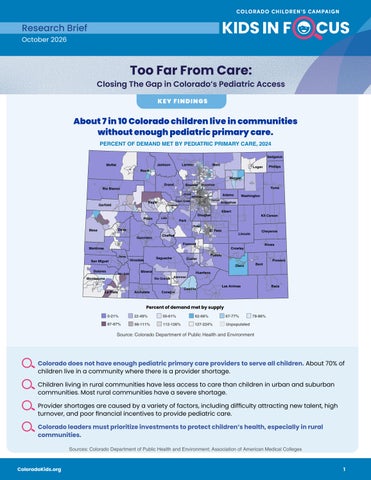
About 7 in 10 Colorado children live in communities without enough pediatric primary care. PERCENT OF DEMAND MET BY PEDIATRIC PRIMARY CARE, 2024 Sedgwick Jackson
Moffat
Larimer
Weld
Phillips
Logan
Routt Morgan Grand
Rio Blanco
Boulder
Broomfield
Yuma
Gilpin Jefferson
Pitkin
Summit
Washington
Arapahoe
Douglas
Lake
Elbert Kit Carson
Park Teller
Delta
Mesa
Denver
Clear Creek
Eagle
Garfield
Adams
El Paso Gunnison
Cheyenne
Lincoln
Chaffee Fremont
Montrose
Kiowa
Crowley Ouray
San Miguel
Saguache
Hinsdale
Custer
Pueblo Bent
Otero Dolores
San Juan
Mineral
Montezuma
Prowers
Huerfano Rio Grande
Alamosa
Costilla
Las Animas
La Plata
Archuleta
0-21%
22-49%
50-61%
62-66%
67-77%
87-97%
98-111%
112-126%
127-224%
Unpopulated
Conejos
Baca
Percent of demand met by supply 78-86%
Source: Colorado Department of Public Health and Environment
Colorado does not have enough pediatric primary care providers to serve all children. About 70% of children live in a community where there is a provider shortage.
Children living in rural communities have less access to care than children in urban and suburban communities. Most rural communities have a severe shortage.
Provider shortages are caused by a variety of factors, including difficulty attracting new talent, high turnover, and poor financial incentives to provide pediatric care.
Colorado leaders must prioritize investments to protect children’s health, especially in rural communities. Sources: Colorado Department of Public Health and Environment; Association of American Medical Colleges
ColoradoKids.org
1
Research Brief October 2026
KIDS
Authors: Maya Gould, Vice President of Research, Colorado Children’s Campaign Toni Sarge, Director of Health Policy, Colorado Children’s Campaign Sarah Barnes, Senior Vice President of Policy, Colorado Children’s Campaign
Access to primary care is vital for children’s healthy development,1 yet for too many Colorado kids, pediatric care is out of easy reach. Most Colorado children (70%) live in a community where there are not enough pediatric primary care providers, according to a new analysis from the Colorado Department of Public Health and Environment. Nearly one in three children live in an area with a significant shortage.2 Access is most limited in rural communities,2 where parents often must take significant time off work and travel long distances because of the lack of nearby providers. These barriers can be serious enough that some children go without much-needed visits,3 which can worsen their health in the short- and long-term and increase their risk of hospitalization.4 Colorado leaders must prioritize and protect children’s health. As federal cuts to health coverage threaten to worsen existing provider shortages, Colorado must prioritize pediatric access and commit to fiscal reform that supports pediatric providers to ensure all kids get the health care they need to thrive.
Access To The Doctor And Children’s Health Seeing a doctor or health professional for regular check-ups and when a child is sick is essential for development and health. The American Academy of Pediatrics recommends that children get several check-ups, known as well-child visits, in each of their first few years and at least one check-up each year between the ages of 3 and 21. At these visits, providers track physical and mental development, treat illnesses, catch serious health conditions, and administer recommended vaccines.1 Regular primary care visits are tied to many positive outcomes for children, including: • Reduced medical emergencies and expenses4 • Improved brain development5 • Quicker connection to specialized care when necessary6 • Improved school readiness7
About The Data This report analyzes the Colorado Department of Public Health and Environment (CDPHE)’s first publicly available interactive maps focused on the state of access to pediatric primary care in Colorado. CDPHE identifies communities that do not have enough health professionals to serve all the children under the age of 18 who need care as State-Designated Health Professional Shortage Areas (sHPSA). Researchers compared the supply of pediatric primary providers – including professionals across disciplines like pediatricians, family medicine doctors, nurse practitioners, and physician assistants – to the demand for visits among children within a given geographic area. Geographic areas are identified as having a shortage when there are not enough providers to offer the required well-child visits to all the children who need care.
ColoradoKids.org
2
KIDS
Research Brief October 2026
Pediatric Primary Care Shortages In Colorado In Colorado, about 70% of children live in communities that do not have enough pediatric providers to meet the demand for care.2 The undersupply is more significant in some communities than others: Nearly one in three children (31%) live in a community with a significant shortage – that is, where there are only enough providers to meet less than 60% of demand. More than one in five children (22%) live in a community with a moderate shortage (enough providers to meet between 60% and 80% of demand). Shortages exist throughout the state, but they are often located in communities that lack a large hospital or health care complex.2 Children in rural communities have the least access to care. About 82,000 Colorado children — almost all of them in rural parts of the state — live in an area where there is enough provider capacity to meet 20% of the need or less. Nearly every child in the Eastern Plains lives in a significant shortage area. These children and families face the largest barriers to access and often live the farthest from medical providers.2
About 7 in 10 Colorado children live in communities without enough pediatric primary care. PERCENT OF DEMAND MET BY PEDIATRIC PRIMARY CARE, 2024
Sedgwick Jackson
Moffat
Larimer
Weld
Phillips
Logan
Routt Morgan Grand
Rio Blanco
Rio Blanco
Gunnison Pitkin
Clear Creek Summit
Chaffee Lake
San Miguel Montrose
Ouray
San Miguel San Juan
Hinsdale
Mineral
Dolores Montezuma
La Plata
La Plata
Archuleta
Archuleta
Arapahoe
Lincoln Kit Carson
El Paso
Crowley Lincoln
Cheyenne
Custer
Saguache
Custer
Alamosa
Conejos
Otero
Pueblo
Huerfano
Kiowa
Kiowa
Crowley
Bent
Otero
Bent
Prowers
Prowers
Huerfano
Alamosa
Conejos
Cheyenne
Pueblo
Fremont
Rio Grande
Kit Carson
Washington
El Elbert Paso
Chaffee
Rio Grande Mineral
San Juan
Yuma
Park
Saguache
Hinsdale
Denver
Teller
Teller Fremont
Gunnison
Ouray
Adams
Douglas
Delta
Mesa
Elbert
Douglas
Park
Eagle
Washington Phillips
Logan
Arapahoe
Broomfield
Gilpin Jefferson
Delta
Montezuma
Yuma
Morgan Boulder
Lake
Garfield
Denver
Summit Grand
Pitkin
Adams
Weld
Clear Creek
Eagle
Garfield
Dolores
Gilpin LarimerJefferson
Jackson Routt
Montrose
Broomfield Sedgwick
Moffat
Mesa
Boulder
Costilla Costilla
Las Animas Las Animas
Baca Baca
Percent demand met byby supply Percent of of demand met supply
0-21% 87-97%
0-21%
22-49%
50-61%
62-66%
67-77%
112-126%
127-224%
Unpopulated
22-49%
50-61%
98-111%
112-126%
87-97%
98-111%
62-66%
127-224%
78-86%
67-77%
78-86%
Unpopulated
Source: Colorado Department of Public Health and Environment ColoradoKids.org
3
KIDS
Research Brief October 2026
ACCESS TO PEDIATRIC PRIMARY CARE AMONG COLORADO CHILDREN, 2024
30%
Adequate Supply
31%
Significant Shortage
16%
Small Shortage
22%
Moderate Shortage Note: The sum of parts does not equal 100% due to rounding. Source: Colorado Department of Public Health and Environment
ACCESS TO PEDIATRIC PRIMARY CARE AMONG COLORADO CHILDREN, 2024 LEVEL OF ACCESS
NUMBER AND SHARE OF CHILDREN
Significant Shortage: Enough providers to meet less than 60% of need
388,115 (31%)
Moderate Shortage: Enough providers to meet 60 to 80% of need
273,187 (22%)
Small Shortage: Enough providers to meet 80 to 100% of need
202,018 (16%)
Adequate Supply: Enough providers to meet 100% or more of need
377,366 (30%)
Note: The sum of parts does not equal 100% due to rounding. Source: Colorado Department of Public Health and Environment
Shortages Matter For Kids And Families Provider shortages create real hardship for families and sometimes mean children do not get the care they need.3 Children who live in a health care shortage area often must travel long distances for care.2 That travel can require taking unpaid time off work, arranging transportation, and finding child care for other kids at home during appointments.3 Sometimes the time and travel necessary are so significant that children do not get the care they need. In 2025, one in ten Colorado children did not get to the doctor when they needed to because their parents could not take off work.8 Children in households with low incomes are the most likely to miss their visits because their families struggle the most to take off work or find transportation.9 These missed sick or well-child visits can have serious effects on children’s health, ranging from missed vaccines to undiagnosed and untreated conditions that can lead to hospitalization.4
ColoradoKids.org
4
Research Brief October 2026
KIDS
Medicaid’s Influence On Access A new national study projects that pediatric primary care shortages will continue worsening in the coming decade.10 Difficulty attracting new talent, high turnover, and poor financial incentives to provide care all contribute to this shortage.11 Pediatricians make an average of 25% less than their adult counterparts over their careers,12 leading to fewer medical students choosing to enter the field.11 In part, this low pay is due to health insurance payment practices. Insurers reimburse clinics for the cost of medical services, making payment rates a key factor in what clinics can afford. But insurers often pay a lower rate for children than for adults.12 This both disincentivizes hospitals from providing services for kids13 and makes it difficult to pay pediatric providers a competitive wage.14 In Colorado, Medicaid and Child Health Plan Plus (CHP+) are significant funders of pediatric care, providing health insurance to over 600,000 children,15 or roughly 34% of all Colorado kids under 18.16 But Colorado ranks in the bottom third of states for Medicaid spending on children, and in the bottom half of states for overall Medicaid spending. Colorado spends an average of $2,883 per child enrolled in Medicaid, less than all neighboring states that spend between $3,200 and $4,000.17 This relatively low spending makes it challenging for hospitals to afford the cost of providing services.12, 13, 14 Upcoming cuts to federal funding threaten to exacerbate the issue by reducing federal funding, increasing the costs to states, and creating new administrative barriers which will make it harder for children to enroll in public health insurance coverage.18 State fiscal policy prevents Colorado from adequately funding Medicaid. The Taxpayer Bill of Rights (TABOR), a tax policy that restricts how much revenue the state can retain and spend, limits the state’s ability to increase its share of Medicaid funding as the program’s costs rise each year. The allowable annual increase is not enough to keep pace with need in Medicaid and other programs that support kids and families. Without major state fiscal reform, Colorado will not be able to close the state’s growing care deserts or keep pace with the rising cost of caring for kids and families. Many of these upcoming challenges will be particularly pronounced in rural communities where providers already operate on small margins and are at risk of closing.19,20 Nearly 70% of Colorado hospitals, many of which are located in rural communities, now operate without sustainable margins, which is forcing many to cut services or close.21 When a rural hospital or clinic closes, families often lose their nearest source of primary and pediatric care, not just emergency services. The consequences extend beyond primary care. Children with complex conditions living in rural communities often struggle to find and reach the specialized care they need when the nearest provider may already be an hour or more away.22
ColoradoKids.org
5
Research Brief October 2026
KIDS
The Path Forward Colorado leaders must prioritize pediatric health and commit to improving access. Protect and expand coverage and care for children. Colorado should defend policies that support health coverage for children to ensure that lack of health insurance and cost are not barriers to children’s access to pediatric care by: • Securing long-term, stable funding for public coverage and other health coverage supports • Maintaining public coverage for undocumented children and families • Establishing continuous eligibility for young children through Medicaid and CHP+ Focus on rural communities. Colorado should target investments where access gaps are most severe, including rural areas of the state. Protecting and expanding access to Medicaid coverage and providers is especially important in rural communities, where families often have fewer alternatives. Strengthening pediatric provider capacity and reducing travel and transportation barriers for families can also help ensure children can receive care in their community. Advance fiscal reform to invest in children’s health. Colorado should pursue reforms to TABOR and other fiscal constraints that limit the state’s ability to raise and sustain the revenue needed to invest in children’s health, including stable state funding for Medicaid and CHP+ and health insurance affordability programs, especially in light of recent federal policy changes that will cut funding and eligibility for public health coverage and subsidies. For more information on children’s health policy, please email Toni Sarge at Toni@ColoradoKids.org.
ColoradoKids.org
6
Research Brief October 2026
KIDS
Sources 1
agan, J.F., J.S. Shaw, and P.M. Duncan (2017). Bright Futures: Guidelines for Health Supervision of Infants, H Children, and Adolescents: 4th edition.
2
olorado Department of Public Health and Environment. (Retrieved August 2026). State Health Professional C Shortage Areas.
3
olf, E.R., et al (2020). Caregiver and clinician perspectives on missed well-child visits. Annals of Family W Medicine, 18(1): 30-34.
4
aylor, T. and Salyakina, D. Health care access barriers bring children to emergency rooms more frequently: T A representative survey. Population Health Management: 22(3): 262-271.
5
he Commonwealth Fund. (2002). Primary care services: Promoting optimal child development from birth to T three years.
6
oudreau, A., et al (2022). Pediatric primary health care: The central role of pediatricians in maintaining B children’s health in evolving health care models. Pediatrics, 149(2).
7
Williams, P.G., et al (2019). School readiness. Pediatrics, 144(2).
8
Colorado Health Institute. (Received March 2025). Colorado Health Access Survey. 2025 data request.
9
olf, E.R., et al (2018). Gaps in well-child care attendance among primary care clinics serving low-income W families. Pediatrics, 142(5).
10
ilvestre, J., et al (2026). Workforce projections on the supply and demand of general pediatrics across the S United States: Identifying deficiencies to 2037. Academic Pediatrics, 26(3).
11
Association of American Medical Colleges. (2024). Why are fewer U.S. MD graduates choosing pediatrics?
12
ornell University, Cornell Health Policy Center. (2025). State policy levers to improve Medicaid pediatric C provider payment.
13
hildren’s Hospital Association. (2026). The alarming shortage of pediatricians – and 4 solutions to break C the cycle.
14
edicaid and CHIP Payment and Access Commission. (Retrieved August 2026). Provider payment and M delivery systems.
15
olorado Department of Health Care Policy and Financing. (Received March 2025). FY 2024-25, C administrative data request.
16
KFF. (2025). Medicaid in Colorado.
17
KFF. (Retrieved August 2026). A look at variation in Medicaid spending per enrollee by group across states.
18
olorado Department of Health Care Policy and Financing. (2025). FY 2026-27 Joint Budget Committee C hearing Department of Health Care Policy and Financing.
19
he Commonwealth Fund. (2024). Community health centers are serving more patients than ever, but T financial challenges loom large.
20
enter for Healthcare Quality and Payment Reform. (Retrieved August 2026). The causes of rural hospital C problems.
21
Colorado Hospital Association. (2026). Hospital and service line closures in Colorado.
22
rakelyan, M. (2026). Rural-urban disparities in primary care and geographic continuity of care for children A with medical complexity. The Journal of Rural Health, (42):1.
ColoradoKids.org
7