VO LU M E 1 2 3
NO. 4
FA L L 2 0 2 6
COLORADO MEDICINE ADVOCATING EXCELLENCE IN THE PROFESSION OF MEDICINE
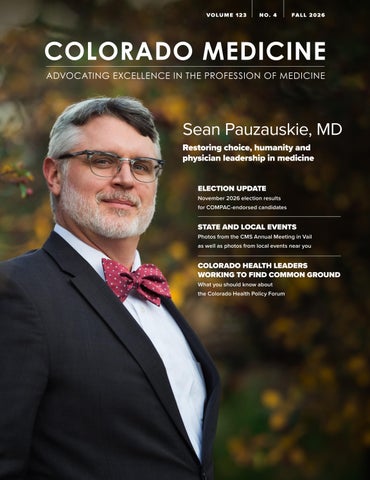
Sean Pauzauskie, MD Restoring choice, humanity and physician leadership in medicine ELECTION UPDATE November 2026 election results for COMPAC-endorsed candidates
STATE AND LOCAL EVENTS Photos from the CMS Annual Meeting in Vail as well as photos from local events near you
COLORADO HEALTH LEADERS WORKING TO FIND COMMON GROUND What you should know about the Colorado Health Policy Forum
Your focus is them; our focus is you. At Copic, we believe that by supporting you—offering the resources and knowledge to prevent unexpected outcomes—we’re not only protecting you, we’re protecting your patients. That’s improving medicine for everyone. We’re here for the humans of healthcare.
Copic is proud to be the endorsed carrier of the Colorado Medical Society. CMS members may be eligible for a 10% premium discount.
copic.com | 800.421.1834
C O NTE NT S
Restoring choice, humanity and physician leadership in medicine Who gets to make the important decisions in health care? As he begins his year as Colorado Medical Society president, Sean Pauzauskie, MD, shares his vision for restoring choice, bringing humanity back to the center of care and ensuring physicians help shape medicine’s future. From protecting the patient-physician relationship to embracing innovation that supports clinical judgment, his priorities reflect a belief in the power of physicians working together. Discover how your voice and perspective can help build a stronger profession and a future grounded in caring for patients. PAGE 4 ⊲
F E ATU R E S
8
COMPAC: A nonpartisan voice for Colorado physicians The CMS political action committee takes a nonpartisan approach to supporting candidates who share a commitment to Colorado’s patients and physicians, looking beyond party lines to evaluate health care priorities. See the list of legislators COMPAC supported in their successful campaigns and learn about the issues that guide its candidate evaluations.
10 Burned out by burnout? Physician coaching offers a way forward Physicians know the toll of burnout, but finding solutions that fit their lives can be harder. Laura Martin, MD, explores how physician coaching can help doctors set personalized goals, build on their strengths and make meaningful changes at home and work, and offers practical guidance on finding resources and support rather than waiting for burnout to improve on its own.
11 Three Colorado health systems receive AMA Joy in Medicine recognition Supporting physician wellbeing takes more than individual resilience, it requires changes to the systems in which physicians work. Recognition from the American Medical Association’s Joy in Medicine program highlights how Colorado Permanente Medical Group, Denver Health Medical Center and UCHealth are addressing burnout at its source, strengthening workplace culture and helping physicians focus on patient care.
I N S I D E
C M S
14 2026 CMS Annual Meeting report and photos Colorado physicians and their guests gathered for the 2026 CMS Annual Meeting in Vail, where inspiring keynotes, timely discussions and opportunities to connect strengthened the physician community, encouraged personal and professional growth and celebrated the transition to a new year of physician leadership.
12 Member benefit: Planning for the care you’ve always provided Planning for future care takes more than knowing the health care system – it requires preparing for the support you may one day need yourself. Through a story based on common experiences, explore the impact of a significant health event and how life insurance with long-term care benefits available to Colorado Medical Society members can help physicians protect their families and preserve care choices.
24 Final Word: Colorado health leaders working to find common ground Colorado’s health care system faces growing challenges, from rising premiums and workforce shortages to the financial strain on rural hospitals and physician practices. In this Final Word, the CMS president and president-elect highlight how more than 30 organizations, including the Colorado Medical Society, came together through the Colorado Health Policy Forum to build consensus and a foundation to pursue collaborative solutions to the state’s most pressing health care issues to set up Colorado’s next governor and legislature for a better path.
D E PA R TM E NT S
16 Reflections: Starting from the beginning 17 Reflections: The person beyond the gown 18 News briefs • BCMS Annual Gala 2026: An evening of connection and community • NCMS Legislative Night: Building relationships to advance health care • Metro Medical Societies Annual Celebration: Honoring service and leadership • EPCMS Fall Semi-Annual Celebration: Leadership, learning and connection
19 Staying human: Medicine when the system fails 20 Copic Comment: Copic Medical Foundation’s 2027 funding opportunity
22 Partner in Medicine Spotlight: The hidden cost of RCM denials
CO LOR AD O M E D I CAL SOCI E T Y 7351 E. Lowry Boulevard, Suite 110 • Denver, Colorado 80230-6902 p 720.859.1001 • f 720.859.7509 • www.cms.org
OFFICERS, BOARD MEMBERS, AMA DELEGATES, and STAFF 2026-2027 OFFICERS
BOARD OF DIRECTORS
AMA DELEGATION
Sean Pauzauskie, MD President
Elizabeth Cruse, MD, MBA Kamran Dastoury, MD Scott Dhupar, MD Carolynn Francavilla, MD Dakota Hitchcock, MD Eleanor Jensen, DO Allison Kelley Marc Labovich, MD Kelly McAleese, MD Justin McCoy, DO Priscilla Nobecourt, MD Darlene Tad-y, MD, MBA Andrew Tannous, MD
David Downs, MD, FACP Amy Duckro, DO, MPH Carolynn Francavilla, MD Mark Johnson, MD, MPH Jan Kief, MD Rachelle Klammer, MD A. “Lee” Morgan, MD Tamaan Osbourne-Roberts, MD Lynn Parry, MD Brigitta J. Robinson, MD Michael Volz, MD Patricia Weber, MD
Rachelle Klammer, MD President-elect Brigitta Robinson, MD, FACS Immediate Past President Scott Dhupar, MD Treasurer Dean Holzkamp Chief Executive Officer
AMA PAST PRESIDENT Jeremy A. Lazarus, MD
COLORADO MEDICAL SOCIETY STAFF Dean Holzkamp Chief Executive Officer Dean_Holzkamp@cms.org Kate Alfano Director of Member Engagement Kate_Alfano@cms.org Jen Atchison Director of Continuing Medical Education and Recognized Accreditor Programs Jen_Atchison@cms.org Virginia "Ginny" Castleberry Executive Director Denver Medical Society Virginia_Castleberry@cms.org
Cecilia Comerford-Ames Executive Director, Colorado Society of Eye Physicians and Surgeons Communications and Marketing Manager Cecilia_Comerford@cms.org Dorcia Dunn Membership Operations Manager Dorcia_Dunn@cms.org
Mihal Sabar Director of Accounting Mihal_Sabar@cms.org Chet Seward Chief Strategy Officer Chet_Seward@cms.org Debra Will Director of Business Development Debra_Will@cms.org
Crystal Goodman Executive Director, Northern Colorado Medical Society Crystal_Goodman@cms.org Blake Johnson Member Engagement Specialist Blake_Johnson@cms.org
COLORADO MEDICINE Vol 123 No. 4 Fall (ISSN-0199-7343) is published quarterly for $36 per year by the Colorado Medical Society, 7351 E. Lowry Boulevard, Suite 110, Denver, CO 80230-6902. 720-859-1001. Periodicals postage paid at Denver, Colo. POSTMASTER: Send address changes to COLORADO MEDICINE, P.O. Box 17550, Denver, CO 80217-0550. Address all correspondence relating to subscriptions, advertising or address changes, manuscripts, organizational and other news items regarding the editorial content to the editorial and business office. COLORADO MEDICINE magazine is the official journal of the Colorado Medical Society, and as such is also authorized to carry general advertising. COLORADO MEDICINE is copyrighted 2026 by the Colorado Medical Society. All material subject to this copyright appearing in COLORADO MEDICINE may be photocopied for the noncommercial purpose of education and scientific advancement. Publication of any advertisement in COLORADO MEDICINE does not imply an endorsement or sponsorship by the Colorado Medical Society of the product or service advertised. Published articles represent the opinions of the authors and do not necessarily reflect the official policy of the Colorado Medical Society unless clearly specified. Guest editorials and letters to the editor are published at the sole discretion of the Colorado Medical Society on a space-available basis. If you would like to submit a letter to the editor, email membership@cms.org. Dean Holzkamp, Executive Editor, Kate Alfano, Managing Editor, and Cecilia Comerford-Ames, Managing Editor. Design by Scribner Creative.
Plan Daycare Early Start your child care search for your growing family. Colorado Medical Society offers working parents 10% off child care at KinderCare Learning Centers. • Get more options for schedules, locations, and start dates before SURJUDPV ¿OO XS • )LQG WKH EHVW ¿W IRU \RXU IDPLO\ E\ WDNLQJ WLPH WR H[SORUH SURJUDPV • Get familiar with the teachers, staff, DQG FHQWHU EHIRUH GD\ RQH
• +HOS \RXU FKLOG HDVH LQWR FDUH DQG JHW FRPIRUWDEOH LQ WKHLU QHZ HQYLURQPHQW • Be more present at work, knowing \RXU EDE\ LV KDSS\ DQG VDIH • Explore tuition savings, subsidies, and HPSOR\HU GLVFRXQWV DKHDG RI WLPH
To learn more, visit kindercare.com/ coloradoms
C OV E R
Restoring choice, humanity and physician leadership in medicine Sean Pauzauskie, MD
4
C O LO R A D O M E D I C I N E
As physicians, our days constantly revolve around choices. Some are routine. Some are complex. And some may change the course of a patient’s life. I find myself thinking about a simple but essential question: As we continue to make these choices, who really gets to make the important decisions in health care? We make countless choices for and with our patients, using the years of expertise in education that we have built. Yet many Colorado physicians have experienced the frustration of seeing medical decisions increasingly shaped by people and systems far removed from the exam room. I have watched more of those choices migrate away from the people actually practicing medicine. As I begin my year as president of the Colorado Medical Society, I believe one of our most important responsibilities is to help restore balance. Not because physicians should make every decision in health care, but because when the question is fundamentally a medical one, the perspective of the physician caring for the patient should matter. That belief is one reason I became involved in organized medicine. As I look ahead to the coming year, I am optimistic. Not because the challenges facing medicine are small – they are enormous. I am optimistic because I believe physicians possess more influence than we sometimes recognize. My goal is to focus on three priorities: restoring choice in medicine, restoring humanity in medicine, and helping lead medicine’s future.
RESTORING CHOICE Health care works best when decisions are made in the patient-physician relationship. Health care organizations, legislators, and regulators all have an important role to play. The truth is that patients should be empowered to make meaningful choices about their own care, and physicians should be able to exercise their own professional judgment. We should never lose sight of the fact that medicine is ultimately practiced one patient at a time. Diagnosing a patient with cancer, counseling a family through a difficult end-of-life decision, or helping someone navigate a chronic illness are decisions, not theoretical exercises. They are deeply personal moments that af fect lives, families, and futures. CMS will continue advocating for policies that reduce unnecessary barriers to care and preserve the patient-physician relationship. The goal is not to eliminate accountability. The goal is to ensure that medical decisions remain grounded in medical expertise and patient needs. RESTORING HUMANITY If choice is essential to medicine, humanity is what gives medicine meaning. Physicians do many things that cannot be measured on a balance sheet. We stay after hours to answer a family’s questions. We sit quietly with a frightened patient. We explain a diagnosis repeatedly until it makes sense. We deliver difficult news with compassion and honesty.
The challenge is that health care operates within a complex economic system. Financial incentives and administrative structures are necessary components of modern health care, but they cannot become its organizing principle. Too often, discussions about care focus exclusively on systems, budgets, regulations, and metrics. Those conversations matter, but physicians have a unique responsibility to remind policymakers and the public that health care is ultimately about people. When coverage changes occur, when regulations shift, or when access to care becomes more difficult, the effects are not abstract. They are felt by people in our communities, our neighbors, and our families. As physicians, we have a responsibility not only to care for patients, but also to help others understand what health care policies mean in the real world. PHYSICIANS MUST LEAD If physicians want health care decisions to reflect the realities of patient care, we need more physicians participating in the places where those decisions are made. That means serving on boards and commissions. It means testifying before policymakers. It means engaging in our communities and supporting advocacy efforts through organizations like CMS. Physicians bring a perspective that is desperately needed in public discussions about health care. We witness the successes and failures of the system every day. We understand the PAGE 6 ⊲
If choice is essential to medicine, humanity is what gives medicine meaning. C O LO R A D O M E D I C I N E
5
C OV E R
A V I S I O N F O R C O LO R A D O M E D I C I N E : C O NT
Meet Dr. Pauzauskie, your new CMS president Sean Pauzauskie, MD, is a hospital-based neurologist with UCHealth and a recognized leader in health policy and physician advocacy. A past president of the Northern Colorado Medical Society and past chair of COMPAC, Dr. Pauzauskie’s interests in medicine range from translational research to public health and policy, having worked in Washington D.C., prior to medical school on these issues. He led the effort to draft landmark legislation protecting individuals’ neural data. In 2024, Gov. Jared Polis signed HB24-1058, making Colorado the first state in the nation to extend consumer privacy protections to neural data – work that has since influenced similar laws in other states and informed new American Medical Association policy. He’s married to his wife, Jen, a hospital chaplain, and has a Siberian husky named Tika.
consequences of policy decisions not as theories, but as realities lived by patients.
the trusted interpreter of information and guide for patients.
But I believe there is far more that unites us than divides us.
Organized medicine should not simply react to health care policy after decisions have already been made. We should help shape those decisions from the beginning.
Technology reflects the values of the people who design it, implement it, and govern it. Physicians must have a seat at that table. We cannot afford to stand on the sidelines while others determine how innovation will shape health care.
We want to provide the best possible care for our patients. We want patients to retain meaningful choices about their health care. We want to preserve the trust that society has placed in our profession. And we want to leave future generations of physicians with a profession that is stronger because of our efforts, not weakened by them.
LEADING THE FUTURE While much of our work focuses on preserving what matters most in medicine, we cannot mistake preservation for resistance to change. Some of the most transformative developments in medical history are already underway. Artificial intelligence, advanced diagnostics, personalized treatments, and new models of care delivery are reshaping our profession. Too often, discussions about technology focus on what might be lost. I am more interested in what might be gained. Imagine technologies that reduce administrative burdens and return valuable time to physicians. Imagine documentation systems that allow physicians to spend less time facing computer screens and more time connecting with patients. Imagine tools that enhance clinical decision-making while preserving the physician’s role as
Artificial intelligence should augment physician judgment, not replace it. Technology should amplify humanity, not diminish it. Innovation should give patients and physicians more meaningful choices, not fewer. BUILDING TOGETHER One of the great strengths of the Colorado Medical Society is the diversity of its membership. Our physicians practice in urban and rural communities. They work in independent practices, large health systems, academic centers, community clinics, and every setting in between. We represent different specialties, backgrounds, and perspectives. We will not agree on every issue. Nor should we.
We cannot afford to stand on the sidelines while others determine how innovation will shape health care. 6
C O LO R A D O M E D I C I N E
Those are goals wor th working toward together. As physicians, we understand that meaningful progress rarely happens overnight. We see that truth in medicine every day. Healing often requires patience, persistence, and a willingness to keep moving forward even when challenges seem overwhelming. The same is true for our profession. I believe we can restore choice in medicine. I believe we can restore humanit y to medicine. And I believe physicians can help lead medicine into a future that embraces innovation while remaining firmly grounded in the patient-physician relationship: one human being entrusted with the care of another. That is, and always will be, the foundation of medicine. ■
We use a vital secret weapon against AI. We call her Susie.
Humans vs. AI is really a no-brainer. When artificial intelligence makes a mistake, their sense of accountability is rather, well, artificial. Humans on the other hand have that sixth sense of understanding the vitality of accuracy and timeliness. We’re talking about medical procedures. Only humans understand the importance of this. Hence, we’re 99% accurate. We value swift turnarounds. We’re the Denver-based team of transcriptionists the whole medical world needs. We’re Ditto Transcripts.
TRANSCRIBING THE HUMAN WAY
Find out more about us at dittotranscripts.com or call us 720-287-3710.
F E ATU R E
COMPAC: A nonpartisan voice for Colorado physicians SUPPORTING CANDIDATES ACROSS PARTY LINES WHO SHARE A COMMITMENT TO COLORADO’S PATIENTS AND PHYSICIANS
Cecilia Comerford-Ames, CMS Communications Manager COMPAC (Colorado Medical Political Action Committee) is committed to supporting candidates who understand, or are willing to learn, the critical health care issues that impact physicians and patients across Colorado. State elections are highly important because decisions made at the Capitol have a direct impact on patients and physicians, including access to care, Medicaid, public health policy, unfair health plan practices, medical liability and much more. It is essential that physicians have a voice in these conversations and remain engaged in the electoral process. COMPAC is your voice and your trusted source when it comes to electing your legislators. The COMPAC Board carefully evaluates candidates and supports those who demonstrate a commitment to sound health care policy that benefits Colorado's patients and physicians. COMPAC congratulates the following legislators on their successful campaigns, and the Colorado Medical Society looks forward to working with them as they begin or continue their service to the people of Colorado.
8
C O LO R A D O M E D I C I N E
SENATE
HOUSE
• SD1 • SD7 • SD8 • SD9 • SD15 • SD17 • SD20 • SD21 • SD22 • SD24 • SD25 • SD29 • SD31 • SD32 • SD35
• HD3 • HD4 • HD7 • HD8 • HD12 • HD14 • HD17 • HD18 • HD20 • HD23 • HD24 • HD26 • HD27 • HD28 • HD29 • HD30 • HD32 • HD34
Byron Pelton - R Janice Rich - R Dylan Roberts - D Terri Carver - R Janice Marchman - D Katie Wallace - D Sheila Lieder - D Adrienne Benavidez - D Monica Duran - D Kyle Mullica - D William Lindstedt - D Iman Jodeh - D Matt Ball - D Emily Sirota - D Rod Pelton - R
Gena Ozols - D Cecelia Espenoza - D Jennifer Bacon - D Lindsay Gilchrist - D Kyle Brown - D Ava Flanell - R Regina English - D Amy Paschal - D Jarvis Caldwell - R Alexis Hoffkling - D Lisa Feret - D Meghan Lukens - D Danielle Varda - D Dave Rein - D Lori Goldstein - D Rebekah Stewart - D Chris VanDijk - D Jenny Willford - D
• HD36 • HD37 • HD38 • HD40 • HD41 • HD42 • HD44 • HD45 • HD46 • HD48 • HD49 • HD52 • HD53 • HD55 • HD57 • HD59 • HD61 • HD62 • HD63 • HD64 • HD65
Michael Carter - D Chad Clifford - D Gretchen Rydin - D Naquetta Ricks - D Jamie Jackson - D Sarah Woodson - D Anthony Hartsook - R Max Brooks - R Tisha Mauro - D Carlos Barron - R Lesley Smith - D Yara Zokaie - D Andrew Boesenecker - D Rick Taggart - R Elizabeth Velasco - D Katie Stewart - D Eliza Hamrick - D Matthew Martinez - D Dusty Johnson - R Scott Slaugh - R Lori Garcia Sander - R ■
As of press time, Election Day had passed but the results had not yet been certified by the Colorado Secretary of State.
C O LO R A D O M E D I C I N E
9
F E ATU R E
W E LLB E I N G
Burned out by burnout? Physician coaching offers a way forward
Laura Martin, MD, Associate Medical Director, CPHP
Many physicians don’t know how a coach can help. COACHING CAN REDUCE BURNOUT
9
Supported by at least nine randomized controlled trials over seven years.
We’ve all seen it, most of us have felt it, and a few of us have conquered it without changing jobs or taking a break from our medical careers: burnout. Over the last two decades, we’ve come to better understand the prevalence and sequelae of burnout. We’ve felt burned out by burnout presentations that come without solutions. We’ve felt betrayed by well-meaning workplace interventions that offer yoga (that we may not like) with our co-workers (who we may not want to downward dog next to) and that only delay completing our work tasks for the day. Universal interventions such as yoga can help improve strength, flexibility, spirituality, burnout, and emotional wellness for some people; they are not for everyone. Burnout is a syndrome of exhaustion, depersonalization, and inefficacy that arises from a unique mixture of factors in an individual’s personal life, workplace culture, and workflow. Therefore, solutions for individuals must be tailored to their lived experiences. Because workplace culture and workflow-based changes move slowly, if at all, physicians must seek effective strategies to reduce burnout rather than wait. Luckily, there is an intervention for burnout that has shown efficacy in at least nine randomized controlled trials (RCTs) over the last seven years: physician coaching. Many physicians don’t know how a coach can help. The National Board of Health and Wellness Coaches (a partner of the National Board of Medical Examiners) states, “coaches assist clients to use their own insight, personal strengths, and resources to set goals, commit to action
A MODEST TIME COMMITMENT CAN HELP
4
BENEFITS CAN LAST
Improvements were reported with as little as four hours of coaching spread over several months.
steps, and establish accountability in building an envisioned healthy lifestyle.” Physician coaching creates a holding space of active listening, inquiry, autonomy building, positive regard, and compassion that allows each physician to create and meet personalized goals that are more effective for their particular, and at times singular, situations at home and work. Examples of interventions could include, but are not limited to, figuring out a workflow template that results in all work being completed by the end of the shift, using self-compassion to silence your inner critic or be more patient with your children at night, taking the time to consider your strengths and values to decide what you want to do (versus someone else dictating your schedule), developing awareness practices to reduce the likelihood of losing your temper and taking it out on others while on call, picking up old hobbies or friendships again, or increasing cardiovascular exercise to improve overall health and energy during the work day. The nine coaching RCTs showed that effective coaching for physician burnout can be delivered in multiple formats, including in person or online; individually or in small groups; within or outside the workplace; synchronously or asynchronously; and by physicians or non-physicians. Significant improvements occur with as little as four hours of coaching spread over several months and gains are sustained for at least six months later. Improvements have been noted for emotional exhaustion, burnout, resilience, quality of life, work engagement, psychological capital, job
6
Improvements sustained for at least six months.
satisfaction, imposter syndrome, moral injury, self-compassion, flourishing, disengagement, professional fulfillment, coping skills, and gratitude. Unfortunately, waiting for burnout to improve on its own often led to no change in symptoms or worsening symptoms. Please don’t let that happen. Your patients, your community and you need you. Remember, coaching is not a substitute for therapy. Please seek out a therapist or psychiatrist if your symptoms are due to an illness such as depression. Many individuals benefit from working with both a coach and a mental health treatment provider. I encourage you to periodically check in with yourself using a screener such as the Stanford Professional Fulfillment Index (med.stanford.edu /wellmd / selfassessment .ht ml) or t he Mayo Wellbeing Index (mywellbeingindex.org), as we often don’t appreciate when we are starting to feel burned out or misjudge how burned out we are. And it’s a great way to track your progress, whatever you are doing to improve. Take a moment to check in with your workplace to see what burnout and coaching resources they offer. Often there is CME or other leadership development money available if coaching isn’t offered in-house. If they don’t have any resources, consider approaching your specialty organizations. And certainly feel free to give the Colorado Physician Health Program (CPHP) a call at 720-810-9131. We have Doc2Doc Wellbeing Consulting and other resources to support you! ■
Wellbeing resources
Colorado Physician Health Program (CPHP) Doc2Doc Wellbeing Consulting 10
C O LO R A D O M E D I C I N E
720.810.9131
F E ATU R E
Three Colorado health systems recognized for advancing physician wellbeing THE AMERICAN MEDICAL ASSOCIATION JOY IN MEDICINE RECOGNITION HIGHLIGHTS SYSTEM-LEVEL EFFORTS TO REDUCE PHYSICIAN BURNOUT
Cecilia Comerford-Ames, CMS Communications Manager Physician wellbeing cannot be solved by individual resilience. System-level changes have the ability to create some of the comprehensive changes needed to support the physicians caring for our communities. The American Medical Association’s Joy in Medicine Health System Recognition Program recognizes health care organizations that are taking measurable steps to lower burnout, promote wellbeing, and support high-quality care. This year, Colorado is celebrating three organizations that are currently recognized through the program: Colorado Permanente Medical Group, which received Bronze recognition for 2026-2027; Denver Health Medical Center, which received Silver recognition for 2026-2027; and UCHealth, which is recognized at the Bronze level for 2025-2026. Recognition is valid for two years. Heidi Clune, MD, medical director of wellness for Colorado Permanente Medical Group shared, “The Joy in Medicine Bronze Award recognizes our work at Colorado Permanente Medical Group and gives us a framework to guide our ongoing work to keep improving physician wellbeing and reduce burnout. Building a culture of wellness takes all of us – executives, local leaders, operations teams and frontline physicians. It’s exciting to celebrate our progress and see where we can do more. We’ve also collaborated with chief wellness officers across Colorado, and we’re grateful to be part of a statewide community committed to advancing physician wellbeing.” Their recognition comes at a time when health care organizations nationwide continue to confront the systemic factors contributing to physician burnout. Although burnout rates have declined, they are still higher than other industries. Physicians
Colorado Permanente Medical Group B R O NZE 2026–2027
Denver Health Medical Center
UCHealth
S I LV E R 2026–2027
continue to face challenges including administrative burdens, staffing pressures, mental health stigma and more that can affect professional fulfillment and the sustainability of the physician workforce. The Joy in Medicine program, launched in 2019, reviews organizations with a framework for addressing those pressures. Applicants demonstrate progress across six defined domains: assessment to measure wellbeing, commitment to the workforce, efficiency of the practice environment, teamwork, leadership and support. For Colorado physicians, the recognition represents more than another award for a health system. It points to an important shift in how the profession approaches burnout: creating sustainable careers in medicine requires organizations to examine the systems, workflows and cultures surrounding physicians. Justin Ross, PsyD, director of workplace wellness at UCHealth shares, “I often say wellbeing isn’t a problem to be solved. It’s a value to be integrated into how we work, lead, and care for one another. What I’m most proud of is that UCHealth continues to recognize employee wellbeing not as a standalone initiative, but as an essential part of how we build a healthy, resilient organization.” There is growing evidence that these efforts matter. AMA data indicate that physicians working in Joy in Medicine-recognized organizations generally report a more positive professional environment, including lower burnout, higher job satis-
BRONZE 2025–2026
Joy in Medicine program domains assess progress across six areas: Assessment Commitment Efficiency of practice environment Teamwork Leadership Support
faction and lower intent to leave, compared with physicians at organizations that have not earned recognition. Ultimately, supporting physician wellbeing is an investment not only in physicians, but also in the patients and communities they serve. Health systems that reduce unnecessary burdens, strengthen teams and create supportive leadership structures help physicians devote more of their energy to patient care. The recognition of Colorado Permanente Medical Group, Denver Health Medical Center and UCHealth offers an opportunity to highlight meaningful work happening across Colorado while encouraging the broader medical community to continue addressing burnout at its source. When the systems around physicians work better, physicians are better positioned to focus on what brought them to medicine in the first place: caring for patients. ■
C O LO R A D O M E D I C I N E
11
F E ATU R E
M E M B E R
B E N E F IT
S P OTLI G HT
The doctor in the family: Planning for the care you’ve always provided Gretchen Barry Chief Marketing Officer, BuddyIns
NOVEMBER IS LONG-TERM CARE AWARENESS MONTH The call came on a Tuesday afternoon, between patients. Maria, a family physician, listened as her mother explained that her father had collapsed in the kitchen. By evening, the CT confirmed what Maria suspected: a left-hemisphere stroke. Her father survived. What followed was the part no one in her family was prepared for, except, in theory, Maria. She was the one who read the discharge summary. She was the one who called the rehab facility, compared home health agencies, and translated “custodial care” into plain English for her siblings. She was the one who explained, more than once, that Medicare would not pay for the aide who now came every morning to help her father bathe and dress. Within two years, her parents had spent most of what they’d saved for retirement. Her mother, the primary caregiver, was exhausted. And Maria, who spent her days managing other people’s chronic conditions, spent her evenings managing her father’s. One night, sitting in her parents’ living room, a question landed hard: When it’s my turn, who will be the doctor in the family for me? If any part of Maria’s story sounds familiar, you’re not alone. Physicians are very often the family’s default care coordinator. You know the system. You know what a diagnosis means for the years ahead. And that makes you uniquely qualified to plan for your own care. WHAT MARIA LEARNED THE HARD WAY Maria’s family ran into the same miscon12
C O LO R A D O M E D I C I N E
ceptions that catch many physician households off guard. “Medicare will cover it.” Medicare covers limited skilled nursing care after a qualifying hospital stay, typically up to 100 days under specific conditions. It does not cover custodial care: help with bathing, dressing, eating, and mobility, at home or in a facility. That is the care most people need, and it’s the care Maria’s parents paid for out of pocket. “We’re healthy. We won’t need it.” Her father had been active and well-managed until the day he wasn’t. The Department of Health and Human Services estimates that 70 percent of people turning 65 today will need some form of long-term care services in their lifetime. Stroke, Parkinson’s disease, dementia, a fall, or a complicated surgery can change everything overnight. “Insurance is a waste if you never use it.” This was the reason Maria’s father had passed on long-term care coverage years earlier. He didn’t want to pay premiums for decades on a policy that might never pay out. It’s a fair concern, and one that traditional long-term care insurance has never fully answered. The cost of guessing wrong is steep. The average annual cost of a shared nursing home room in the U.S. is about $94,000, and a private room costs even more. A MEMBER BENEFIT BUILT AROUND THAT CONCERN As a Colorado Medical Society member, you have access to Transamerica Universal Life Insurance with long-term care benefits. It’s designed to solve the exact problem that kept Maria’s father from buying coverage: the fear of paying for
something you never use. This is permanent life insurance first. It builds cash value over time and pays a death benefit to your beneficiaries. But if you need long-term care, you can access a portion of that death benefit while you’re living to pay for it. One policy, two purposes, and value in either scenario. Simple to apply. No physical exam or blood work. Acceptance is based on your answers to health questions on the application, which matters when your schedule is already full. Coverage for your spouse. Spousal coverage is available, with a maximum death benefit of $100,000 for spouses. Remember Maria’s mother: the caregiver often needs protection, too. It goes where you go. Change practices, relocate, cut back, or retire early, and your coverage continues as long as premiums are paid. Predictable cost. Rates include a guaranteed level life insurance premium. Meaningful monthly benefits. The longterm care benefit pays 2 percent of your death benefit per month for home care or adult day care, or 4 percent per month for care in a facility. An extension rider adds up to 50 more months of home or adult day care, or 25 more months of facility care. On a $500,000 policy, that’s $10,000 a month for home care or $20,000 a month for facility care. A path back. If you use long-term care benefits and later recover, the Restoration Rider can restore your death benefit up to 100 percent, so your beneficiaries remain fully protected.
What Your Policy Could Pay Each Month for Care Monthly long-term care benefit, by policy death benefit Home or adult day care (2% per month)
Facility care (4% per month)
Policy death benefit $0K
$100,000
$5K
$2,000
$250,000
$10K
$15K
$20K
$4,000 $5,000
$10,000 $10,000
$500,000
$20,000 About $7,800/month Avg. shared nursing home room
Transamerica Universal Life Insurance with long-term care benefits, available to Colorado Medical Society members. Average cost based on $94,000 per year for a shared nursing home room. For illustration only; limitations and exclusions apply. Refer to the policy, certificate, and riders for complete details.
And if you never need care? Your premiums weren’t wasted. Your family receives the full death benefit, which can help with estate taxes, equalize an inheritance, or support causes you care about. Along the way, the policy’s cash value is available to borrow against for a child’s education, a practice investment, or an unexpected expense. WHY IT MATTERS MORE FOR PHYSICIANS You’ve built more to protect. Years of training and practice-building often lead to real estate, investments, and practice equity. An extended illness can force those assets to be sold at the worst possible time.
Your household has higher fixed costs. After delaying gratification through training, many physician families carry lifestyles and commitments that long-term care expenses could quickly upend, for both the person needing care and their spouse. You know what caregiving costs a family. You’ve seen it in your patients, and maybe in your own family. Dedicated funds for professional care mean your children don’t have to put their careers on hold, and your spouse doesn’t have to become a full-time caregiver. You want to choose your care. Adequate funding means decisions based on what’s best for your health and comfort, not only what’s affordable.
MARIA’S NEXT STEP Maria didn’t wait for a crisis of her own. She ran her numbers, added coverage for herself and her husband, and told her siblings about it at the next family dinner. “I’ve spent my whole career telling patients to plan ahead,” she said. “It was time I took my own advice.” Consider doing the same. Coverage is easiest to get while you’re healthy, and health can change without warning. To review policy details and use the interactive calculator to see your premium and benefit amount, visit the enrollment education page, enroll.buddyins.com/cms. Maria is a composite character based on experiences commonly shared by physicians and their families.
When it’s my turn, who will be the doctor in the family for me?
Products underwritten by Transamerica Life Insurance Company (TLIC), Cedar Rapids, Iowa. TLIC is not an authorized insurer in New York. Policy form series TMUL1000×0421 and TCUL1000×0421. This article is for informational purposes only. Limitations and exclusions apply. Refer to the policy, certificate, and riders for complete details. Product not available in all states. BuddyIns is an insurance producer specializing in longterm care planning, insurance enrollment, education, and technology. ■
C O LO R A D O M E D I C I N E
13
I N S I D E
C M S
Moments that matter: Colorado physicians connect, learn and recharge at the 2026 Annual Meeting Kate Alfano, CMS Director of Member Engagement
Throughout the weekend of the Colorado Medical Society Annual Meeting, physicians and their guests reconnected, forged new relationships, exchanged ideas and enjoyed well-deserved time together while exploring some of the most important issues facing medicine today.
Physician leaders at Saturday night's celebration, from left: Kim Warner, MD; Eleanor Jensen, DO; Marvin Lee II, MD; Rachelle Klammer, MD; Jerome Adams, MD, MPH; and Brigitta Robinson, MD, FACS.
From left: Dr. Robinson and Sean Pauzauskie, MD, after Dr. Robinson's recognition for her year as president and Dr. Pauzauskie's swearing in as president.
Jazz quartet Dizzy With a Dame provided live music Saturday night.
From left: Dr. Klammer with Champion of Medicine award winners Rep. Katie Stewart and Rep. Lindsay Gilchrist.
From left: Copic Senior Vice President of Public Affairs Beverly Razon; Humanitarian Award winner Phil Mohler, MD; and Dr. Pauzauskie.
14
C O LO R A D O M E D I C I N E
Physicians celebrating 50 years since graduating medical school with spouses, from left: Kathleen Cram; Jon Cram, MD; Enno Heuscher, MD; Penny Heuscher; and Thomas Kurt, MD, MPH. The meeting opened with an unforgettable keynote from Tracee Metcalfe, MD, who shared her extraordinary journey as a physician, world-class mountaineer and person. Her inspiring story of resilience, perseverance and finding her way back to medicine set the tone for a weekend focused on purpose, growth and the strength of the physician community. Attendees also participated in presentations and discussions led by expert speakers on artificial intelligence, leadership, advocacy and public trust, while exhibitors created valuable opportunities for learning, networking and collaboration. The weekend concluded with a powerful keynote from Jerome Adams, MD, MPH, former U.S. Surgeon General, who challenged physicians to use their voices to help shape the future of health care. Reflecting on leadership during times of uncertainty, the
importance of personal connection and the value of sharing professional experiences with future generations, Adams left attendees inspired and optimistic about the role physicians can play in their communities and beyond. The CMS Board of Directors conducted business, and CMS members celebrated the swearing in of incoming CMS President Sean Pauzauskie, MD, and a successful year for outgoing CMS President Brigitta Robinson, MD. The Annual Meeting remains one of the most meaningful opportunities for Colorado physicians to learn, connect and lead together. Save the date for the 2027 Annual Meeting, Sept. 17-18 in Breckenridge. ■
Photos below: Top | Physician author panel, from left: Dr. Pauzauskie; Pius Kamau, MD; and Jay Ogsbury III, MD. Middle | Former U.S. Surgeon General Jerome Adams, MD, MPH. Bottom | Exhibitor Mark Welter of Welter Healthcare Partners, speaking with attendees.
Colorado Medical Society has access to the leading income protection program specifically designed for Physician groups. Comprehensive Income Restoration Doctors need special features that typical group long-term disability insurance doesn’t have. To secure the level of income you need, the coverage has to include specialty definitions, high maximum benefits, and features specialized for doctors.
CMS Member Practices receive special plan features and discounted pricing.
Minimum 3 full-time employees, including at least one Physician Minimum 5 full-time employees for Staff-only groups
Get Started Contact your current insurance agent or John Kaufman at Copic Financial: 720.858.6287 · jkaufman@copic.com
C O LO R A D O M E D I C I N E
15
D E PA R TM E NT S
R E F LE C TI O N S
Starting from the beginning Madison Baca
Madison Baca is a fourth-year medical student at the University of Colorado School of Medicine. Originally from Corrales, N.M., she headed north to CU Boulder, where she earned her undergraduate degree in physiology and developed a love for long-distance running, hiking, camping, and skiing (poorly). She is currently applying to anesthesiology residency with hopes of ultimately pursuing a fellowship in cardiac anesthesiology. As I gripped my first patient’s chart in the hallway of the general surgery clinic, I silently braced myself. It was September of my clinical year, and this was my first independent patient encounter. I entered and greeted Mrs. H, a 75-year-old Hispanic woman presenting with a “lump in my belly” who sat solemnly on the exam table. She answered my questions quietly and briefly. Taking a deep breath, I began my exam of the lump in question. Mrs. H gingerly lifted her shirt revealing extensive bruising across her right flank. Alarmed, I asked about the unexpected finding. Silent tears ran down her face as she softly replied, “Oh, I am not sure.” In that moment, I realized that the newness of my independence was clouding the most important part of the visit: seeing the person before me. I abandoned my initial plan and started again. From the beginning. I asked Mrs. H how things had been going at home. She shared that her husband had passed away two weeks earlier and that she was adjusting to life alone after more than 50 years of marriage. Despite her own chronic health conditions,
she had acted as his primary caregiver learned about the grief, exhaustion, for years. Since his passing, she had not and falls that ultimately revealed what been sleeping well and had fallen several she needed. Before this, I thought of times, resulting in the bruising across clinical independence largely in terms her flank. When I asked why she had of competence. I focused on knowing not sought care, her reasoning echoed which questions to ask, recognizing something I had heard from many in my abnormal findings, and developing a own family: she did not want to “burden” “good” differential diagnosis and plan. anyone. With my preceptor’s help, we I had spent years learning the quessent Mrs. H to the emergency department, tions that make up a medical history, where she was found to have a pneumo- but Mrs. H taught me the humility thorax requiring chest tube placement to recognize when those questions and admission. I had entered her room were not the ones that needed to be focused on proving to myself that I could asked. Clinical knowledge gave me independently gather a history, perform the tools to recognize that something an exam, and make my own plan. Instead, was wrong, but understanding why caring for Mrs. H early in my clinical train- required me to put aside my planned ing changed how I understood what it questions and simply listen. I often meant to care for a patient. think back to that first encounter and how badly I wanted to get it right. As the daughter of Hispanic parents from Since then, I have tried to enter each rural New Mexico, I thought of people patient’s room with enough curiosity in my own family who have struggled to to notice what does not fit and the ask for help despite significant suffering. I humility to ask what I may be missing. ■ recognized something familiar in Mrs. H’s words, but familiarity did not mean I understood her story. If anything, it reminded me to ask rather than assume. Had I remained focused on the complaint that brought her to clinic, I might have never
Reflective writing is an important component of the University of Colorado School of Medicine curriculum. Beginning in the first year, medical students have the opportunity to write essays, stories or poetry, or create works of art, that reflect what they have seen, heard and felt. The Reflections column was co-founded by Steven Lowenstein, MD, MPH, and Tess Jones, PhD. It is edited by Dr. Lowenstein. It is dedicated to the memory of Henry Claman, MD, Distinguished Immunologist, Professor, and founder of the Arts and Humanities in Healthcare Program. 16
C O LO R A D O M E D I C I N E
D E PA R TM E NT S
R E F LE C TI O N S
The person beyond the gown Selma Sabra
Selma Sabra is a fourth-year medical student at the University of Colorado School of Medicine. Raised in Brazil, she moved to North Carolina to pursue her bachelor’s degree in psychology. She later moved to Colorado for medical school, where she developed a love for hiking and country swing dancing. She is currently applying to pediatrics residency programs and hopes to build meaningful partnerships with children and their families. I met Mr. T during my internal medicine clerkship at the VA. He had received a cancer diagnosis a few months earlier, and his prognosis was poor. Encouraged by my residents, I made an effort to check in on him and my other patients in the afternoons, after rounds. In Mr. T, I saw a strong, joyful man who was determined to fight and beat his cancer. It was a pleasure to care for him, and over time, we developed a bond. On the day of his discharge, he told my resident that he wanted to give me a gold star for the care I had provided. That was the first time I truly felt like a contributing member of the care team. Many months later, toward the end of my clerkship year, I noticed in his chart that he had been readmitted to the hospital. I went to visit him, and as I walked into his room, I almost did not recognize him. Much of his hair had fallen out, and what remained had turned white. He had lost a significant amount of weight and looked frail. He seemed to sense my reaction, quickly acknowledging how different he looked from when we had first met. This time, he had agreed to the team’s recommendation
to transition to hospice care, an option he had previously declined. He needed more help than he could receive at home. Still, he told me, he would keep fighting. I had been working with my clerkship director, Dr. Sam Robin, to pilot a program called My Life, My Story, which was already available at other VA facilities. Through this program, volunteers sit with veterans to listen to their life stories. The volunteers then write these stories, share them with the veterans, and upload them to their medical records so that members of the care team can learn more about the patients’ values, experiences, and identities beyond their medical diagnoses. That afternoon, I had the opportunity to sit with Mr. T and hear his story. He sat in his hospital bed in a patient gown, a tray of hospital food set aside. Yet as he spoke, I was transported years into the past – to his teenage adventures at music festivals, his military service, his return home, and an unexpected career as a florist that he grew to love. He spoke of the simple pleasures that brought him joy, the faith that sustained him, and the people he loved who stood beside him through his illness.
It was an honor to spend that time listening to Mr. T and getting to know the whole person I had only seen glimpses of throughout the year. I had cared for him during his first admission, followed his clinical course, and developed a meaningful connection with him. Yet as I listened to his stories that afternoon, I realized how much of his life had remained unknown to me. Our conversation made space for him to share what mattered most and allowed me to see the person beyond the gown. As a medical student, I spent countless hours learning how to take a history, perform a physical examination, and develop assessments and treatment plans. Yet my afternoon with Mr. T taught me that there are dimensions of my patients’ lives that I may never encounter unless I take time to ask and give them the space to share, if they wish. I hope to carry that afternoon with me throughout my career, remembering that even the most thorough history and physical can only begin to capture the person behind the diagnosis. ■
C O LO R A D O M E D I C I N E
17
D E PA R TM E NT S
N E W S
B R I E F S
Component events BCMS Annual Gala 2026:
An evening of connection and community The 2026 Boulder County Medical Society Annual Gala brought together physicians and guests for an evening of fine dining, conversation, and connection at the Boulder Cork. Read Pierce, MD, Denver Health chief medical officer, gave the keynote address on motivation. BCMS also recognized Scott Replogle, MD, for his more than 40 years of service to BCMS and the medical profession. Photo left: Boulder County physicians and guests gather for the 2026 BCMS Annual Gala at Boulder Cork. Photo right: From left: Keynote speaker Read Pierce, MD, Denver Health CMO, and BCMS President Leila Wing, MD.
NCMS Legislative Night:
Building relationships to advance health care The Northern Colorado Medical Society welcomed physicians and local legislators from Weld and Larimer counties for an evening of networking, discussion and advocacy in Loveland. Attendees heard updates on a significant year at the Colorado State Capitol from NCMS advocacy leaders and CMS government relations staff, then participated in a town hall discussion focused on health care issues likely to emerge in the upcoming legislative session. The event reinforced the importance of strong physician-legislator relationships in advancing policies that support physicians, patients and communities across Colorado. Photo: Physicians and local legislators from Weld and Larimer counties come together at NCMS Legislative Night.
Metro Medical Societies Annual Celebration: Honoring service and leadership
The Metro Medical Societies Annual Celebration brought physicians together at Uncorked Kitchen & Wine Bar for an evening of camaraderie, recognition and gratitude. Sponsored by the Aurora-Adams County Medical Society, Arapahoe-Douglas-Elbert Medical Society and Denver Medical Society, the event honored outgoing board officers, welcomed new leadership and celebrated physicians reaching the milestone of 50 years in practice. Attendees also enjoyed prize raffles and raised a toast to another year of service, advocacy and community across the metro medical societies. Photos: Metro-area physicians gather for an evening of connection and celebration at Uncorked Kitchen & Wine Bar.
EPCMS Fall Semi-Annual Celebration: Leadership, learning and connection
The El Paso County Medical Society’s Fall Semi-Annual Celebration brought physicians and guests together at the Garden of the Gods Resort and Club for an evening of networking, fellowship and society business. Attendees heard a keynote address from Colorado College President Manya Whitaker, PhD, who explored physicians’ roles as healers, educators and trusted guides in today’s complex information landscape. The event also included updates on the society’s priorities and future direction, and a leadership transition recognizing Nicholas Piantanida, MD, MBA, for his service as board chair and welcoming Joel Tanaka, MD, into the role. Photo left: From left: Incoming EPCMS president Joel Tanaka, MD; and outgoing EPCMS president Nicholas Piantanida, MD, MBA. Photo right: From left: Dr. Piantanida with keynote speaker Manya Whitaker, PhD, Colorado College president. ■ 18
C O LO R A D O M E D I C I N E
D E PA R TM E NT S
I NTR O S P E C TI O N S
Staying human: Medicine when the system fails Holly Williamson
After traveling to 80 countries and managing medical clinic trips in under-resourced communities across the world, Holly Williamson learned that the most universal human needs are the ability to move and connect: physically, emotionally, and in life. This led her to switch careers, specifically to become a physical medicine and rehabilitation (PM&R) physician, where she plans to serve at the intersection of mental health, adaptive sports, and functional recovery. Bringing her global dedication to supporting underserved patients back home, Holly is committed to connecting uninsured individuals with catastrophic injuries to high-quality physical rehab and community reintegration through Colorado’s RSVP Clinic (Rehabilitation Services Volunteer Partnership). As an outdoor-loving Colorado native, Holly’s happiest days are spent supporting adaptive athletes on the ski slopes, at the climbing wall, and scuba diving. She is currently a fourth-year medical student at Rocky Vista University. I couldn’t stop sweating. The air conditioning on the inpatient psychiatric unit had been broken for days, and the building held the heat. I was on a rotation in the deep South, out of state, sleep-deprived, and the unit smelled like urine. There was vomit on the tile near the nurses’ station, and several patients were screaming, like they were most mornings. Eda, the patient in front of me, was furious about her outfit and trembling with frustration. Although she wasn’t leaving her room, she demanded different clothes. To me, it felt like such a small thing to be so angry about. I felt my patience running thin. I was tired, and underneath the tiredness was a quieter, more uncomfortable feeling I didn’t want to name: that I was running low on compassion. Connecting with patients is the part of medicine that comes most naturally to me, which is why that morning unsettled me so much. The human piece is why I’m here, and the part I love most. It was Eda’s fourth admission. She was a familiar face on the floor, which wasn’t unusual at that hospital. So many of the patients cycled back through for the same reasons: addiction that started young, abuse, food insecurity, lack of housing, underfunded social programs, no one to lean on, no resources to land on when they tried to climb out. We would treat them, stabilize them, and discharge them back into the exact circumstances that had made them sick, and weeks later they would return, sometimes manufacturing a reason to be admitted because the unit was safer than wherever they had been. I believed in the work, but I started to feel
like we were on a treadmill, putting small bandages on hemorrhagic problems that lived in a system far bigger than any of us, that none of us could acutely change. That was the part that wore me down. Not any single patient, but the sense that the same heartbreak would keep arriving no matter how much we cared or gave. What reset me was small. My preceptor, it turned out, quietly kept a stash of donated clothes and anonymously handed them out to patients, asking that no one say anything. She wasn’t doing it for recognition, she was just doing one human thing for another, in an environment that made even that hard. It reminded me that the humanity on that unit was never going to come from the system. It was going to come from us, in small acts, or it wasn’t going to come at all. I went back into Eda’s room and sat down on the edge of her bed. She began angry, arms crossed, no eye contact. “You just think I’m crazy because I’m a meth head,” she said. “Why should I even talk to you, you’ll just blow me off and not believe anything I’m saying.” I didn’t correct her or rush her toward my checklist of H&P questions. I just listened. Her thoughts were hard to follow and threaded with what might have been hallucinations, but I stopped trying to sort the reliable and true parts from the rest and just stayed present with her. Slowly her arms came down. The longer I stayed, the more she let me in, until she told me her boyfriend was physically and sexually abusing her, and she felt she had no way out. His family was rooted
in every church in town, and she didn’t see another way to survive. It wasn’t until later that I understood that having control over her outfit was the only agency she felt she had left, both in that building and in her life. I don’t know if she ever broke that cycle. That’s the part I must sit with. I couldn’t fix her circumstances, nor the larger systemic problems that worsened them. What I could do was treat her like a person, in the middle of an unbearable situation, and validate her experience. I think the hardest, most honest part of staying humanistic in medicine is letting that be enough, without going numb to protect myself and without pretending I had rescued anyone. I’ve come to think this is where humanism actually lives. Not in the moments medicine is working cleanly, but in the ones where the systems around a patient are failing them and it would be easier to go through the motions. Staying present in those moments is a discipline, not a feeling, and it’s one I’m still learning to practice without letting the bigger systemic frustrations harden me. That, more than anything, is why I came to medicine and why I want to keep doing this work. To keep the human part first, especially when everything around it makes that hard. The patients like Eda who cycle through have usually been written off long before they reach us. I can’t undo that, but I can refuse to be one more person who does. And some days, that turns out to be the medicine. ■
C O LO R A D O M E D I C I N E
19
D E PA R TM E NT S
C O M M E NT
Building more connected care: Copic Medical Foundation’s 2027 funding opportunity Gerald Zarlengo, MD, Chairman and CEO, Copic
Fragmentation in health care is a serious Over the past five years, the Copic Mediissue many clinicians experience. It can cal Foundation has invested $3.7 million range from a patient struggling to navigate in 23 projects focused on one critical chalfollow-up appointments after leaving the lenge: reducing fragmentation in health hospital to a specialist lacking access care delivery. In 2026, the Foundation to critical information. Care transitions conducted a comprehensive review create gaps that can lead to confusion, of that work to better understand what delayed treatment, duplicative services, approaches were creating meaningful preventable adverse events, increased and sustainable impact. The findings were burden on providers, and poor patient clear. Regardless of specialty, patient outcomes. Fragmentation can occur population, or care setting, the stronbetween organizations, within health gest projects shared a common goal systems, across care teams, or through – strengthening connections between disconnected workflows, technologies, patients, providers, organizations, and and patient experiences. community resources.
Feeling end-of-year financial stress?
Get up to $50,000 in as little as 24 hours Get prequalified in minutes.
Those insights have helped shape the Foundation’s 2027 Request for Proposals for grant funding. As health care delivery continues to grow more complex, we remain focused on supporting innovative, systems-level solutions that improve coordination, continuity of care, patient safety, quality, and health care outcomes. The goal is not simply to help organizations manage fragmentation; it is to support approaches that address its underlying causes and create improvements that can be sustained or replicated. The challenge is complex, but it also presents meaningful opportunities. 2027 GRANT FUNDING OPPORTUNITY AT-A-GLANCE FOCUS AREA Reducing fragmentation in health care delivery through sustainable, systemslevel solutions that improve coordination, continuity of care, patient safety, quality, and health care outcomes. TYPICAL GRANT SIZE $50,000-$250,000 WHO SHOULD APPLY Nonprofit organizations, hospital systems, universities, or organizations working with an eligible fiscal sponsor, that can demonstrate measurable impact, sustainability, and broader applicability. WHERE TO FIND INFORMATION www.copic.com/foundation APPLICATION DEADLINE Jan. 15, 2027 at 5 p.m. MST
Panacea Financial is a division of Primis Bank. Member FDIC. Not all applicants qualify for the maximum loan amount; subject to credit approval.
20
C O LO R A D O M E D I C I N E
QUESTIONS OR PROPOSAL DISCUSSIONS grants@copic.com
Represents a two-year period
Copic Medical Foundation grantee journey 1
2
3
November
Mid-January
March
RFP opens, concept discussions
Proposals due
Awards communicated
WHAT WE’RE LOOKING FOR Projects that:
• Improve care coordination or continuity of care
• Address a clearly defined systems-level challenge
• Improve patient safety, quality, or health care outcomes
• Demonstrate sustainability beyond Foundation funding
• Can be replicated or adapted by other organizations
• Contribute meaningful learning to the health care community
Our approach reflects what the Foundation has learned through years of grantmaking. Some of the most promising projects have focused on connecting patients and providers across traditional boundaries, whether through more effective transi-
4
5
Late April/Early May Summer–Fall Grantee summit
Site visits
6
7
Fall
Late April/Early May
Final reports due (Prior year grantees)
Grantee summit
tions of care, stronger care navigation, improved communication among care teams, or new models that bring together health care and communit y- based resources. While the specific solutions vary, they all work toward the same objective: helping patients experience health care as a coordinated system rather than a series of disconnected encounters.
with nonprofit partners, health systems, academic institutions, and community organizations that are developing innovative approaches to strengthening health care delivery. By supporting scalable solutions that improve coordination and continuity, we can help advance safer, more connected care for patients and communities.
Competitive proposals should demonstrate measurable improvements in health care delivery, a credible path to sustainability beyond Foundation funding, and the potential for replication or broader adoption by other organizations. Examples of previously funded projects and their impact can be found on the Foundation’s website.
For complete eligibility requirements and application information, visit www.copic. com/foundation and/or contact grants@ copic.com with questions or to discuss a potential proposal concept.
We encourage Colorado Medical Society members to share this opportunity
Eligible Colorado Medical Society (CMS) members can receive up to a 10% premium discount on Copic policies. Get more information on CMS membership by contacting membership@cms.org. ■
Welter Healthcare Partners is the leading provider of integrated healthcare business management solutions. Welter can help you streamline the business side of healthcare with expert support in Provider Enrollment, Coding Compliance, and Contracting. We specialize in ensuring providers are enrolled accurately and on time, to protecting revenue through compliant coding and documentation, and strengthening payer contracts for better reimbursement. Welter delivers the expertise you need to stay efficient, compliant, and profitable.
Contact us today to get started! welterhp.com
•
877-825-8272
•
info@welterhp.com
C O LO R A D O M E D I C I N E
21
D E PA R TM E NT S
PA R TN E R
S P OTLI G HT
The hidden cost of RCM denials: Stop chasing lost revenue and start preventing it James Muir, SVP Physician Services, UnisLink
Claim denials have quietly become one of the most significant threats to independent medical practice viability. Across the health care landscape, the average initial claim denial rate hovers between 16 percent and 19 percent, with some specialties seeing even higher spikes. Worse, the Healthcare Financial Management Association (HFMA) estimates that reworking a single denied claim costs upwards of $25 to $118 – administrative overhead that eats directly into already thin operating margins. For many medical practice leaders and billing teams, managing denials has turned into an endless game of whack-a-mole: claims go out, denials trickle back, staff scramble to correct and re-appeal, and aging accounts receivable (A/R) stretch past 60 and 90 days. But reworking denials is a reactive Band-Aid. To protect your bottom line, you have to fix the systemic vulnerabilities that cause them in the first place.
WHERE CLAIMS ACTUALLY BREAK DOWN Most practices assume denials stem primarily from intricate clinical coding nuances. In reality, industry benchmarks reveal that up to 90 percent of claim denials are entirely preventable, and the vast majority fail long before they ever reach a payer’s medical review team:
1 2 3
Front-end registration, eligibility and verification of benefits: Lapsed coverage, inadequate coverage, incorrect demographic details, and unverified coordination of benefits (COB) remain the single largest driver of initial rejection. Prior authorization breakdowns: Rules change constantly across commercial and Medicare Advantage payers. A missed pre-authorization or retroactive authorization deadline guarantees an automatic denial. Coding and payer-specific policy shifts: Clearinghouse rules and payer edits update frequently. Without automated rules engines, minor modifier mismatches or bundling rules trigger repetitive write-offs.
When your administrative team is bogged down manually appealing avoidable rejections, they have less time to focus on complex claims, timely filing deadlines slip, and revenue that your practice earned simply evaporates.
Practices shouldn’t spend their days chasing money they’ve already earned
16-19%
Average initial claim denial rate 22
C O LO R A D O M E D I C I N E
$25–$118 Rework cost per denied claim
HOW UNISLINK STOPS THE DENIAL CYCLE At UnisLink, we believe practices shouldn’t spend their days chasing money they’ve already earned. Our end-to-end Revenue Cycle Management (RCM) approach combines proprietary revenue intelligence technology with specialized billing expertise to transform denial management from a reactive chore into proactive prevention. HERE IS HOW UNISLINK PARTNERS WITH YOUR PRACTICE TO SECURE YOUR REVENUE: Front-end defense: We embed real-time eligibility verification, VOB and automated prior authorization tracking early in the intake workflow, stopping front-desk errors before the encounter occurs.
Intelligent claim scrubbing: UnisLink’s technology applies hundreds of dynamic, specialty-specific payer rules to scrub claims prior to submission, driving firstpass clean claim rates well above the industry benchmark of 95-98 percent.
Root-cause denial analytics: Rather than just resubmitting rejected claims, our analytics engine categorizes denials by CARC/RARC codes, provider, and payer. We identify recurring friction points immediately, allowing your workflows to adapt before repeat rejections occur.
Dedicated denial resolution teams: When complex denials do occur, certified specialists manage the appeal process rapidly, eliminating the backlog and shortening days in A/R.
UNCOVER WHAT DENIALS ARE REALLY COSTING YOU Most practices underestimate the cumulative financial toll of their denial rate – not just in lost collections, but in the staff hours spent on rework. To see the real impact on your practice’s bottom line, run your numbers through the UnisLink Medical Denials Calculator found by scanning the QR code or at unislink.com/medical-denials-calculator. Within seconds, you can see your practice’s estimated annual revenue loss and administrative rework costs – and discover how much revenue UnisLink can recover for your team. ■
C O LO R A D O M E D I C I N E
23
F E ATU R E
F I N A L
WO R D
Colorado health leaders working to find common ground
Sean Pauzauskie, MD, CMS President Rachelle Klammer, MD, CMS President-elect
Colorado’s health care system is under pressure from every direction. Premiums keep rising. Rural hospitals are fighting to stay open, and practices struggle to hire and retain staff. Physicians see the effects in their exam rooms. What has been harder to find is a shared plan. That is why more than 30 organizations came together last year to form the Colorado Health Policy Forum. The Colorado Medical Society is a founding member, alongside Copic, hospitals, health plans, community health centers, behavioral health providers, consumer advocates, and rural health leaders. Many find themselves on opposite sides at the State Capitol. They do not always agree, but they share a belief that no single organization can fix these problems alone. WHY WE CAME TOGETHER Too often, health policy in Colorado is made one bill at a time. Each group pushes its own priorities, and new laws pile up without anyone asking whether they work together. The Forum has two goals. The first is to build trust around shared values: putting evidence ahead of ideology, considering the health system as a whole, holding each other accountable, and learning as conditions change. The second is to set up Colorado’s next governor and legislature for a better path. STARTING FROM THE SAME FACTS The Forum’s first step was to build a common data baseline. Working with the Colorado Health Institute, members produced a plain language report called
There is no single right answer, and no organization can do this work alone.
the State of the State. It covers seven connected parts of the health system. Four stories stand out. First, patients are using primary care less frequently. Among insured Coloradans, routine and preventive visits dropped from 191 per 1,000 people in 2021 to 140 in 2024. Over the same period, preventable hospital admissions rose about 24 percent. For Medicaid patients, the increase was 56 percent. Second, rural Colorado feels the strain first and worst. Nearly half of the state's rural hospitals are operating at a loss. Only 17 of 43 rural hospitals still deliver babies, and about 45 percent of rural women live more than 30 minutes from the nearest place to give birth. Third, the workforce is stretched thin. Statewide, Colorado has about one primary care physician for every 1,200 residents. In some rural counties, that ratio tops 9,000 to 1. Most Colorado physicians now work for hospitals, large health systems, or private equity firms rather than independent practices. Fourth, coverage appears more stable on paper than it does on the ground. Surveys show the state's uninsured rate is back near where it was before the pandemic. Yet more than one million Coloradans switched, lost, or went without insurance at some point in 2025. Nearly half of patients at safety-net clinics are uninsured, and hospital charity care costs have nearly doubled since 2019. Federal cuts to Medicaid, which covers about one in five Coloradans, will intensify state budget woes.
Leaders need room to wrestle with hard tradeoffs, test ideas, and hear from people who see the system differently. The Forum is helping to create a process to do just that. 24
C O LO R A D O M E D I C I N E
BUILDING A PLATFORM TOGETHER With shared facts in hand, the Forum is developing a policy platform for the incoming governor. Members met for a two-day retreat in October to work through draft issues and positions. The group tackled topics ranging from workforce and innovation, to public health and financing. CMS was particularly focused on care delivery, emphasizing support for a strong foundation of primary care and championing proven, practical prevention strategies like a demonstration program offering structured exercise and nutrition education and coaching for high-risk patients through primary care and community partnerships. Health care affordability is critical – care must be sustainable for patients, families, and the system that finances and delivers it. Meaningful savings require reducing avoidable costs rather than shifting costs, risk, or administrative burden among stakeholders. Adequate primary care payment and less administrative work are part of our agenda to support access and prevention. The draft of the policy platform is still changing, and that is by design. Leaders need room to wrestle with hard tradeoffs, test ideas, and hear from people who see the system differently. The Forum is helping to create a process to do just that. There is no single right answer, and no organization can do this work alone. It will take collaboration, commitment, a clear sense of urgency, and a process for moving forward together. As CMS president and president-elect, we want this work to translate into timely access, stronger primary care, and practical prevention. A health system that works better as a whole is one where physicians can spend more of their time doing what matters most: caring for patients. ■
Solutions based on knowledge and know-how. Copic Financial is an independent insurance brokerage firm serving the healthcare community since 1985. We provide advice and consulting for your insurance needs throughout your professional career and personal life. With the experience to help you navigate complex decisions, we make the unfamiliar familiar. We’re here for the humans of healthcare.
copicfinancial.com | 800.421.1834
» » » » » » »
Property & Casualty Insurance Employee Benefits Life/Disability Insurance Financial & Retirement Planning Workers’ Compensation Cyber Liability Insurance Wealth Management
STEP
1
STEP
2
STEP
3
COLORADO PHYSICIAN OR MEDICAL STUDENT CALLS 720-810-9131. 24/7 line answered by a masters-level licensed clinician (LCSW, LPC) to assess the clinical need of the caller, including life-threatening situations.
CONFIDENTIALITY IS REVIEWED AND PEER SUPPORT SERVICES ARE INITIATED. Only in circumstances where an individual is a threat to self or others or as outlined in the Medical Practice Act would confidentiality be breached. Doc2Doc Wellbeing Consulting has the same reporting obligation as all licensed Colorado physicians.
PHYSICIAN CALLER RECEIVES WELLBEING SUPPORT FROM A PEER PHYSICIAN. If Doc2Doc Wellbeing Consulting is the best fit based on the caller’s presentation, a physician will return the physician’s call for the first of three free peer consultations. If CPHP traditional comprehensive evaluation services are the best fit based upon caller’s presentation OR if more help is needed at the end of three free Doc2Doc Wellbeing Consulting sessions, CPHP’s process will commence to ensure client has appropriate treatment supports in place.