THE SECOND LIFE OF AN EV BATTERY, THE REPAIR GAP AND MORE >>
SPECIAL FEATURE
EVs LEADING THE MARKET
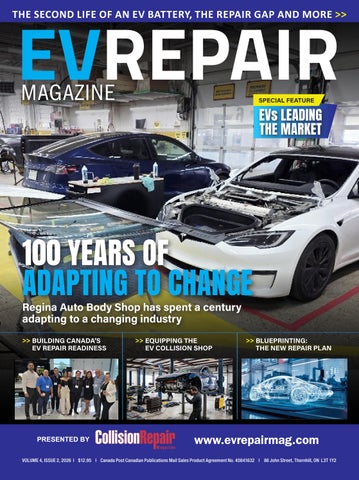
100 YEARS OF ADAPTING TO CHANGE Regina Auto Body Shop has spent a century adapting to a changing industry >> BUILDING CANADA’S
EV REPAIR READINESS
PRESENTED BY
>> EQUIPPING THE
EV COLLISION SHOP
>> BLUEPRINTING:
THE NEW REPAIR PLAN
www.evrepairmag.com
VOLUME 4, ISSUE 2, 2026 l $12.95 l Canada Post Canadian Publications Mail Sales Product Agreement No. 40841632 l 86 John Street, Thornhill, ON L3T 1Y2
WHAT’S INSIDE
CONTENTS VOLUME 4, ISSUE 2, 2026
FEATURES 16
BUILDING CANADA’S EV REPAIR READINESS How a century-old collision repair business adapts to major changes in vehicle technology
GAP IS CLOSING 26 THE EV repairs still cost more than ICE repairs, but the gap is narrowing, according to Mitchell’s latest Canadian claims data.
SECOND LIFE OF AN EV BATTERY 28 THE As Canada’s EV fleet ages, battery condition is
12 A CENTURY UNDER THE HOOD Regina Auto Body Shop Ltd. has evolved from repairing horse-drawn milk wagons to becoming a Tesla Approved Collision Centre and repair facility certified by 16 OEMs.
becoming an increasingly important part of the collision repair equation.
FOR EVS 36 BLUEPRINTING For EVs, comprehensive blueprinting is becoming the foundation for safe, efficient and profitable repairs.
REGULARS PAGE 04 PUBLISHER’S By William Simmons
SPOTLIGHT EVS LEADING THE MARKET
30
06 NEWS Timely coverage of trends, technology and policy driving electrification
20
HAVE YOUR SAY. SUBSCRIBE TODAY! We welcome your comments on anything you see in EV Repair magazine. Send your feedback to william@mediamatters.ca
EQUIPPING THE EV COLLISION SHOP EV-specific tools and technologies are reshaping how collision repair facilities approach high-voltage vehicles.
YOUR ONLINE SOURCE Canada’s collision repair information resource. New articles and top news stories daily. For more info visit evrepairmag.com.
2026 EVREPAIR MAGAZINE | 3
IN MY ELEMENT
KEEPING PACE WITH THE EV SHIFT The future of collision repair will depend on how quickly shops adapt their people, processes and equipment to an evolving vehicle landscape
I
have been thinking a lot lately about how quickly collision repair is changing. Change is nothing new in this industry. Anyone who has been around collision repair for any length of time has watched vehicles go from relatively simple machines to rolling networks of software and sensors. We have changed the way we weld, paint, diagnose and estimate. We have learned new materials, systems and procedures, and somehow we have continued to repair vehicles that keep getting more complicated. What feels different now is the speed of the change. Electric vehicles are not simply introducing another technology for technicians to learn. They are challenging some of the ways we have always approached a repair. The information we need before starting a job is different. The equipment is different. The training is different. Even the consequences of getting something wrong can be different. There will always be shops that are early adopters and shops that wait until they have no choice. There is nothing unusual about that. What concerns me is the possibility that vehicles are changing faster than the industry’s ability to establish the standards, training and repair capacity needed to keep up. We cannot look at EVs simply in terms of how many are on the road. We have to think about what happens when they are damaged: who is equipped to repair them, and who understands the manufacturer’s requirements well enough to do it safely. Those questions become more pressing, not less, as the traditional repair process changes along with the vehicle. I have always thought that good collision repair starts with good people making good decisions. Technology does not change that. If anything, it makes it more important. A scan, estimating system or repair procedure can give you information, but someone still has to understand what that information 4 | EVREPAIRMAG.COM
BY WILLIAM SIMMONS
AUDIENCE ENGAGEMENT MANAGER William Simmons | william@mediamatters.ca ART DIRECTOR Yvonne Maschke | yvonne@mediamatters.ca EDITOR Mackenzie Grant | mackenzie@mediamatters.ca VP OF INDUSTRY RELATIONS & ADVERTISING Gloria Mann 647.998.5677 | gd.mann@rogers.com
means and what needs to happen next. That is why I find the idea of blueprinting so interesting, and why you will see it come up often in these pages. The better we understand a repair before we begin, the fewer surprises we should have once the vehicle is in production. EVs are making that discipline increasingly important. We are moving toward a point where you cannot simply start taking a vehicle apart and figure things out as you go. There is also something encouraging in all of this. Collision repair has adapted before. It will adapt again. A business that has been repairing vehicles for 100 years does not survive by doing things the same way for 100 years. It survives by recognizing when things have changed and being willing to change with them. I think that is an important lesson for our entire industry. The shops that succeed with EVs will not necessarily be the ones that spend the most money or have the newest equipment. They will be the ones that understand what is changing, invest in their people and are willing to rethink processes that may have worked perfectly well for the vehicles of the past. That does not mean the transition will be easy. There are legitimate concerns around certification, access to repair information, parts availability, training and the cost of becoming properly equipped. There are also questions the industry has not fully answered yet. But that is exactly why the conversation matters. EV Repair is not intended to tell the industry that it has everything figured out. It is intended to be part of that conversation. There is a lot we do not know yet, but there is also a lot we can learn from the people already doing the work. The vehicles are changing. The question is whether we are prepared to change with them. I think we have to be. EV
DATA MANAGEMENT SPECIALIST Willow Campbell | willow@mediamatters.ca MEDIA PRODUCTION SPECIALIST Dayna Dicuangco | dayna@mediamatters.ca INTERIM ONLINE EDITOR Gideon Scanlon | news@collisionrepairmag.com CONTRIBUTORS Jaime Gilbert, Sadie McDonald
PUBLISHER Darryl Simmons | publisher@collisionrepairmag.com ASSOCIATE PUBLISHER Orest Tkaczuk | orest@mediamatters.ca EV Repair magazine is published by Media Matters Inc., publishers of:
SUBSCRIPTION Single edition $12.95 EV Repair™ magazine is published annually, and is dedicated to serving the business interests of the EV repair industry. It is published by Media Matters Inc. Material in EV Repair™ magazine may not be reproduced in any form without written consent from the publisher. The publisher reserves the right to refuse any advertising and disclaims all responsibilities for claims or statements made by its advertisers or independent columnists. All facts, opinions and statements appearing in this publication have been compiled and included with the permission, though not necessarily the endorsement, of the editor or independent columnists and are in no way to be construed as those of the publisher, or as endorsements of them. PRINTED IN CANADA ISSN 1707-6072 CANADA POST CANADIAN PUBLICATIONS MAIL SALES PRODUCT AGREEMENT No. 40841632 RETURN POSTAGE GUARANTEED Send change of address notices and undeliverable copies to: 86 John Street, Thornhill, ON L3T 1Y2
“We acknowledge the financial support of the Government of Canada”
Make every minute count with our proven systems. Fix Auto is a game changer.
Your craftsmanship in auto body provides a solid foundation which continues to get stronger. But as you already know, there’s much more to this business. Fix Auto is invested in forward thinking and bringing global best practices to building your local business. Drive your business forward with: • Solid performance-driven operational model and ongoing training. • Full branding and marketing support for local awareness and promotion. • Proven experience in winning insurance work. • Established global supply and fleet arrangements. Our owner started as a franchisee, and this inspires our commitment to the success of the local business owner.
Find out more at
fixauto.com
EV NEWS
EV EARNING: CHARGELAB GIVES CASH FOR HOME CHARGERS, BUSINESS REBATES Canadian EV drivers can now earn money simply by charging at home. Toronto-based ChargeLab has increased payouts through its ChargeLab Rewards program to 10 cents per kilowatt-hour, putting annual earnings above $350 for some drivers. Rewards are paid quarterly, with an extra $25 available for referrals. Participation requires an eligible smart charger connected to the ChargeLab app, with supported models including units from Autel, Siemens and Wallbox. ChargeLab says other open charge point protocol-compatible chargers may also qualify. The program has no subscription fee and users can opt in or out without penalty. Versions are also available for multi-residential properties and businesses. ChargeLab says the program is supported in part by Canada’s Clean Fuel Regulations, with carbon-credit revenue reinvested in charging infrastructure. For EV owners, the program adds a new twist to home charging: instead of simply paying to plug in, qualifying drivers can now earn money while doing it. Full story: evrepairmag.com/15829203
ChargeLab, a Toronto-based EV charger management company, now pays Canadian homeowners 10 cents per kilowatt-hour to charge their electric vehicles at home, allowing participants to earn over $350 annually while supporting the country’s sustainable charging infrastructure.
BATTERY LIFE: STUDY FINDS DEGRADATION DECREASING New real-world battery data suggests EV batteries are holding up better than many early predictions suggested. Austrian battery diagnostics company Aviloo analyzed more than 500,000 battery health tests covering 20 popular EV models between 2022 and 2026. Vehicles retained between 87 and 94 percent of their original battery capacity after 150,000 kilometres. Results also showed why mileage alone cannot determine battery condition. Battery health varied considerably between vehicles of the same make and model, reflecting differences in climate, charging behaviour, driving habits and battery design. Hyundai’s IONIQ 5 was among the strongest performers, averaging 93.79 percent of original capacity after 150,000 kilometres. Second-generation Nissan LEAF batteries averaged 86.67 percent. For collision repairers, recyclers and used-EV buyers, the findings point to a growing need for individual battery testing. An odometer can tell you how far an EV has travelled. It cannot tell you exactly how well its most expensive component has aged. Full story: evrepairmag.com/15835042
6 | EVREPAIRMAG.COM
EV NEWS
EV CHARGERS: RICHMOND RCMP WARNS OF THEFT INCREASE EV charging cables have become a target for thieves in Richmond, B.C., prompting police to warn owners to take extra precautions. Richmond RCMP reported several thefts and attempted thefts in recent weeks, including one location that was targeted three times in a single month. Police analysis showed a notable increase in charger thefts during May, with recent incidents resembling a series reported in the city in 2024. Surveillance footage in one investigation showed a suspect arriving on an electric bicycle before targeting residential charging equipment. Police believe the cables are being stolen for resale. EV owners are being advised to remove and store portable charging cables when they are not being used, improve lighting around parking areas and consider security or doorbell cameras. Recording serial numbers can also help identify stolen equipment. As residential charging equipment becomes more common, the warning highlights a less-discussed cost of EV ownership: charging hardware itself can attract unwanted attention.
Richmond RCMP is warning EV owners to store charging cables indoors after a surge in residential charger thefts, primarily in the Broadmoor and Shellmont neighbourhoods. Investigators say a suspect riding an electric bicycle has been spotted targeting properties for resale.
Full story: evrepairmag.com/15833958
Italy. Poland. France. IBIS Connects This Autumn. Connect with collision repair’s decision-makers at the heart of Europe this autumn.
9-10
4
16-17
IBIS Italia Palace Hotel, Milano Marittima
IBIS Central & Eastern Europe Warsaw, Poland
IBIS France Poitiers, France
Bringing the global collision repair community to the Italian market for the first time, in collaboration with Notiziario Motoristico.
Connecting the changemakers shaping collision repair across Central and Eastern Europe.
Reuniting the French collision repair industry for two days of insight, networking and debate.
October ‘26
November ‘26
November ‘26
Become a partner: suzie@ibisworldwide.com | Register as a delegate: emily@ibisworldwide.com Every IBIS Worldwide experience is a considered investment, designed to deliver the premium value our guests and partners expect.
IBISworldwide.com
@ibisworldwide
2026 EVREPAIR MAGAZINE | 7
EV NEWS
EV REPAIR COSTS: GAP NARROWS AS CANADIAN CLAIMS HIT RECORD HIGH Battery-electric vehicles are appearing in Canadian collision claims more often, while the cost gap between repairing EVs and internal combustion vehicles continues to shrink. Mitchell reported that BEVs represented a record 5.42 percent of repairable Canadian collision claims in the second quarter of 2026, up 12.4 percent year over year. Average repairable severity reached $6,645 for BEVs compared with $5,411 for internal combustion vehicles, leaving a $1,234 gap, the smallest Mitchell has recorded in Canada. B.C. led North America in BEV repairable claim frequency at 9.34 percent, followed closely by Quebec at 9.19 percent. Tesla remains a major part of the Canadian EV collision mix, with the Model Y and Model 3 together accounting for more than 46 percent of repairable BEV claims. Parts use remains a major difference: OEM parts represented 84.74 percent of parts dollars on BEV estimates compared with 61.44 percent for internal combustion vehicles.
Electric vehicle repair costs in Canada are narrowing compared with internal combustion vehicles. Battery-electric vehicles averaging $6,645 in repairs versus $5,411 for internal combustion engines, a gap of just $1,234 that continues to shrink as the EV market matures and repair frequency increases.
Full story: collisionrepairmag.com/15832966
EV EXPANSION: BC HYDRO DEPLOYING 3,500 CHARGING PORTS BY 2035 British Columbia is preparing for a much larger EV population with plans to expand BC Hydro’s public charging network to 3,500 ports by 2035. Supported by a $700-million provincial investment, the expansion will add charging hubs in communities, along major highways and in highdemand urban areas. BC Hydro currently operates 917 charging ports at 190 locations. New sites will include standard 200-kilowatt chargers, with 400-kilowatt ultra-fast chargers planned for selected locations. Plug-and-charge capability, tap-to-pay options and larger charging hubs designed to reduce wait times are also part of the plan. B.C. already has one of North America’s highest rates of EV adoption, making charging capacity an increasingly important part of the province’s transportation infrastructure. For the repair industry, continued growth in charging infrastructure is another indicator of the long-term direction of the vehicle fleet. More charging capacity supports more EVs on the road, and eventually more EVs entering service and collision repair facilities. Full story: evrepairmag.com/15830631
8 | EVREPAIRMAG.COM
EV NEWS
DURHAM COLLEGE EV PROGRAM TARGETS TECHNICIAN SHORTAGE Durham College is building a new pipeline of EV technicians through a two-year Electric Drive Vehicle Technician diploma, one of only two fulltime EV-focused college programs currently offered in Ontario. Launched last fall, the program trains students to diagnose, repair and service highvoltage systems while also covering the mechanical and structural systems shared by electric, hybrid and internal combustion vehicles. Training takes place at the Vanhaverbeke Family EV Training Centre in Whitby. Graduates can also enter the second year of Durham’s Motive Power Technician program, creating a path to a second diploma and apprenticeship credit in as little as three years. The first class is expected to graduate in 2027. Durham has also introduced shorter training for people already working in the trade. A 30-hour program developed with Achêv targets licensed automotive service and body repair technicians and covers high-voltage safety, battery systems and hybrid-electric powertrains. Both programs address a growing problem: finding enough people trained to work safely on an increasingly electrified Canadian fleet. Full story: evrepairmag.com/15822277
Durham College students gain hands-on experience at the Vanhaverbeke Family EV Training Centre in Whitby as part of the college’s two-year Electric Drive Vehicle Technician diploma program, launched to address a growing industry-wide shortage of qualified high-voltage technicians.
9 — 11 JUNE 2027, TORONTO
CANADA’S PREMIER COLLISION REPAIR TRADE SHOW
AUTOTEKNIKCANADA.COM 2026 EVREPAIR MAGAZINE | 9
EV NEWS
GLOBAL REPORT: EV CHARGING STATION MARKET TO REACH US$120.85 BN Global spending on EV charging infrastructure is expected to climb sharply through the next decade. A report from Research and Markets projects the EV charging station market will reach US$120.85 billion by 2033, representing compound annual growth of 17.7 percent. Growth is being driven not only by more EVs, but by higher-power vehicle architectures, grid upgrades and closer ties between automakers, charging companies and energy providers. DC fast charging is expected to play a major role, accounting for about 46 percent of the market in 2026 and taking the largest share of new station deployments through 2033. Technology is also moving quickly. Megawatt-class charging, 800 and 1,000-volt vehicle architectures, bidirectional charging and more sophisticated energy-management software are changing what charging networks can deliver. Research and Markets says the challenge is shifting from simply installing chargers to building reliable, interoperable networks with sufficient grid capacity to support growing passenger and commercial EV fleets. Full story: evrepairmag.com/15831705
The global EV charging station market is projected to reach US$120.85 billion by 2033, growing at a compound annual growth rate of 17.7 percent, driven by vehicle platform evolution, charging ecosystem integration, grid modernization, and strategic partnerships between automakers, charge point operators, and energy providers.
Sign up for the EV Repair Bi-Weekly E-Zine for FREE!
SIGN UP NOW
Covering everything you need to know about EV Repairs from top OEM tips to expert interviews. Brought to you by
evrepairmag.com/subscribe/ev-repair/ezine 10 | EVREPAIRMAG.COM
EV NEWS
KIA, VOLVO AND TESLA TOP SWEDISH STUDY FOR HEALTHIEST USED EV BATTERIES Used EV batteries may be ageing better than many buyers expect. Swedish online vehicle marketplace Kvdbil analyzed battery tests from 1,366 used electric and plug-in hybrid vehicles and found that 79 per cent retained more than 90 per cent of their state of health, earning the company’s highest battery rating. Kia led the brand results, while Audi, Opel, Tesla, Mercedes-Benz, Peugeot, Volvo, BMW, Volkswagen and Skoda also placed in the top 10. Strong individual EV performers included the Kia EV6, Kia e-Niro, Tesla Model Y, Opel Mokka-e and Mazda MX30. Kvdbil said modern battery cooling, vehicle design and charging management are helping slow degradation. Results also reinforce the value of testing the individual vehicle rather than relying only on age, mileage or advertised range. That distinction matters increasingly to collision repairers and recyclers as more older EVs enter the aftermarket. Battery condition can influence vehicle value, repair decisions and the potential value of a battery after a vehicle is written off. Full story: evrepairmag.com/15770310
Swedish online vehicle marketplace Kvdbil analyzed battery tests from 1,366 used electric and plug-in hybrid vehicles and found that 79 per cent retained more than 90 per cent of their state of health, earning the company’s highest battery rating.
The New Automotive Reality: ADAS, EVs, AI and What Comes Next Omar Nabil, Vice President of Claims Solutions Canada at Solera
BROUGHT TO YOU BY
collisionrepairmag.com/15835542 RADIO
LISTEN NOW! 2026 EVREPAIR MAGAZINE | 11
EV EVOLUTION
A CENTURY UNDER THE HOOD HOW A CENTURY-OLD COLLISION REPAIR BUSINESS ADAPTS TO MA JOR CHANGES IN VEHICLE TECHNOLOGY BY SADIE MCDONALD
I
Regina Auto Body Shop in 1930.
12 | EVREPAIRMAG.COM
n the early 1920s, shortly before Regina Auto Body Shop Ltd. opened its doors, collision repair wasn’t about fixing vehicles; instead, the business began by repairing milk wagons. “There used to be a creamery right across the street from us that delivered milk with horse-drawn wagons that were top-heavy, so when they would go down the streets, those wagons would often tip over, and the doors would get misaligned,” said Mike Mario, managing partner and co-owner of RAB. “There was a blacksmith shop here, so they would drag the wagon over, get the doors working, shoe the horses and send them out on the road again.”
EV EVOLUTION
Then, automobiles came around, and Russ Karels opened RAB in 1924, marking the first dedicated collision repair shop in Western Canada. Those early days were spent performing repairs because there wasn’t a need to replace parts; therefore, metal was straightened instead of replaced. RAB has been in service since 1924 and recently celebrated its 100th anniversary in June 2024. The third-generation family business is the only Tesla approved collision centre in southern Saskatchewan and is run by Mike and his nephew, managing partner and co-owner Chad Mario, along with Mike’s son, Matt Mario and Kaylyn Hildebrand and Sheldon Terry. Over the century, RAB has navigated key technological shifts, beginning in the late 1950s when it was one of the first repair facilities to have a drive-through spray booth leading into a bake oven. Fitted with a series of heat bulbs, the bake oven had a bank of lights that moved back and forth over a freshly painted vehicle to cure the paint more quickly. The early 1980s were a tipping point for the industry, when the 3M ARMS management system introduced RAB to the world of job costing. “We really got to know our costs and
Regina Auto Body Shop in 1978.
Regina Auto Body Shop in 1985.
2026 EVREPAIR MAGAZINE | 13
EV EVOLUTION
how we can be a successful collision repair shop,” said Mike. “The networking within the 3M ARMS seminars really got us linked in to other people across the country, which helped us succeed.” In the late ‘80s, MIG welders were introduced to the collision repair industry. “We had to use MIG welders to weld panels on instead of the old oxyacetylene, and that was quite a change,” Mike told EV Repair magazine. Today, ADAS, calibration equipment and pre- and post-repair scans take centre stage. RAB’s continual adaptation to change has taught the shop a valuable lesson — stay true to the customers. “We owe our 100year history to loyal customers,” said Mike. “To keep them satisfied, we continuously evolved right alongside the cars they drive.” Mike credited RAB’s 100-year survival to customer loyalty, stating that adapting to evolving vehicle technology was essential to meeting client expectations. That commitment to customer satisfaction shows: RAB boasts a stellar 4.9/5-star rating across 746 Google reviews. Alongside its outstanding reputation, the shop holds elite industry credentials, including I-CAR Gold Class recognition and official SGI accreditation. Propelling this momentum forward, Mike, Chad, Matt, Kaylyn and Sheldon recently expanded their operations by purchasing a second location in Weyburn, officially stepping into the role of a multistore owner. But RAB’s claim to fame is its Tesla certification, a credential the shop earned in 2018. “It was a big talk back then, about how Tesla was growing in the United States and people buying them in Vancouver and Toronto. So, we just thought we would jump on it,” said Mike. “There were fewer than 100 [Teslas] in the province, and after much research and the fact that we could be the only approved repair shop in southern Saskatchewan, we took the risk and haven’t looked back.” Now, RAB averages three or four Teslas brought in every week. In addition, the tooling Tesla required, such as computers with high-speed internet, applied to other OEM certifications as well. It was the biggest investment RAB made to become EV-ready, but that investment paid off; the shop currently has 16 OEM certifications. On top of that, RAB’s technicians spent at least eight hours each in an online training program to qualify as Tesla-approved technicians.
14 | EVREPAIRMAG.COM
Regina Auto Body Shop employee aligns the wheels on a Tesla EV.
Regina Auto Body Shop claim to fame is its Tesla certification, a credential the shop earned in 2018.
According to Mike, those Tesla-approved technicians need to be able to safely handle high voltage and be computer savvy. Fortunately, RAB’s technicians embraced that. “We had, and we still do have, younger techs who caught on rather quickly to this. They were excited to do something different, rather than just fixing a normal car,” said Mike. “Teslas are basically computers on wheels.” Yet, servicing EVs presents challenges, including the danger of high-voltage batteries and how to maintain battery life. “Repairs require advanced software diagnostics,” stated Mike. “So that’s huge to try to figure out what the issue with this vehicle is. Why can’t we get it running? Why are these [warnings] coming up on the computer screen and within the car?” The EV market in Saskatchewan differs from that in larger urban centres such as
Vancouver and Toronto. “It gets so cold here — minus 40 sometimes — and the batteries can go dead very quickly compared to if it’s around the zero mark,” said Mike. “We have three areas where there’s rapid charging in our building to charge the EVs up quicker, just because of that.” However, in a more rural province like Saskatchewan, the smaller number of EVs makes it tougher to get parts, with repairers seeing a three- to four-day delay when ordering parts from bigger centres out of province. Mike encourages collision repairers preparing for the future to embrace change. “Be resilient to whatever changes may come your way. Always keep the customer in mind in your decision-making,” he said. Recalling the words of the late Larry Jefferies, co-founder of CARSTAR Canada, Mike concluded, “A wise man told me years ago, ‘things change because things change.’” EV
The You’ve Earned The Freedom You’veEarned Earned TheFreedom Freedom You’ve The You Deserve TheSupport Support SupportYou YouDeserve Deserve
ururr SStaStartatrrtYteYoYyoeouyN Nowooww N n n r y r e u u o n o JJJour
Grow Grow business. Reclaim Growyour yourbusiness. business.Reclaim Reclaim your time. terms. your Live on your terms. yourtime. time.Live Liveon onyour your terms.
Let’s TalkAbout About Let’s Let’sTalk Talk About YourNext NextChapter Chapter Your
Your Next Chapter
1-800-871-7612
1-800-871-7612 1-800-871-7612 contact@simplicitycc.com contact@simplicitycc.com contact@simplicitycc.com
www.simplicitycc.com/franchisee-mm
www.simplicitycc.com/franchisee-mm www.simplicitycc.com/franchisee-mm
EV TRAINING
BUILDING CANADA’S EV REPAIR READINESS CWB GROUP, I-CAR CANADA L AUNCH EV TRAINING INITIATIVE
C
Stuart Klein, vice-president of collision programs and executive director of I-CAR Canada.
16 | EVREPAIRMAG.COM
anada’s collision repair industry took another step toward EV preparedness this week as I-CAR Canada and CWB Group welcomed industry stakeholders to the newly renovated CWB Centre of Innovation in Milton, Ontario, home of I-CAR Canada’s new electric vehicle hands-on skillsdevelopment course. The open house brought together collision repairers, educators, OEM representatives and industry partners for an introduction to the facility and a discussion about the growing need for standardized, hands-on EV training across Canada. While attendees had the opportunity to tour the facility and learn more about the program, the focus of the afternoon quickly shifted to a larger conversation: how the collision repair industry prepares technicians to safely work on increasingly complex highvoltage vehicles.
EV TRAINING
Scott Sinclair, business development manager for I-CAR Canada.
“Great to see so many industry partners come together today around one shared priority: EV repair readiness,” said Scott Sinclair, business development manager for I-CAR Canada. “EV repair readiness is no longer optional. It is becoming a safety, quality and confidence standard for our entire industry.” The new training centre will serve as the Canadian home of I-CAR Canada’s five-day EV Hands-On Skills Development course, a program designed to provide technicians with practical experience working around high-voltage systems in a controlled environment. The curriculum focuses on vehicle shutdown procedures, diagnostics, electrical systems and safe work practices for collision repair facilities. According to I-CAR Canada, the program was developed in response to growing demand from OEM certification programs and
Vince Matozzo, CARSTAR Canada; Adriano Mercanti, Mercanti Automotive CARSTAR, Natasha Woods, Saputo Capital Collision Group; and Sabrina Thring CARSTAR Canada.
2026 EVREPAIR MAGAZINE | 17
EV TRAINING
collision repair businesses seeking consistent training standards for electric vehicles. Several vehicle manufacturers are already requiring high-voltage training as part of their collision certification programs, a trend expected to accelerate as EV volumes continue to grow. Stuart Klein, vice-president of collision programs and executive director of I-CAR Canada, has previously noted that many OEMs identified a gap in standardized high-voltage training available to Canadian repairers, creating the need for a dedicated domestic training solution. The facility itself reflects the industry’s growing focus on practical learning. Technicians participating in the program begin by learning electrical fundamentals and working with EV-specific tools before progressing to simulator systems and real vehicles, allowing them to develop confidence before encountering high-voltage repairs in production environments. That emphasis on hands-on learning resonated with attendees, many of whom acknowledged that EV repair is no longer a future consideration but a present-day requirement.
William Snow and Avner Shwarzman of CSN Collision.
Gloria Mann, Collision Repair magazine with Zee Hamid, MPP Milton.
For collision repair facilities, the challenge extends beyond simply understanding vehicle technology. Shops must also develop procedures for receiving damaged EVs, assessing battery safety concerns and ensuring technicians have the knowledge required to work safely around energized systems. The partnership between I-CAR Canada and CWB Group reflects a broader effort to establish consistent national standards as vehicle technology continues to evolve. The two organizations have already collaborated on welding training and certification initiatives designed to support safe, OEM-compliant repairs across Canada. As more electric vehicles enter Canadian repair facilities, industry leaders at the event agreed that technician development will be one of the most important factors determining whether shops can safely and profitably participate in the growing EV repair market. “EV repair readiness is becoming a baseline expectation,” Sinclair said. “This facility gives technicians an opportunity to build those skills in a practical environment before they encounter those challenges in the shop.” EV Darryl Simmons, Collision Repair magazine with Emily Chung, AIA Canada.
18 | EVREPAIRMAG.COM
“ As electric vehicles become more common on our roads, proper repair matters more than ever. At CARSTAR, we’ve committed to advanced EV training and the specialized tools required to handle high-voltage systems safely. Our goal is simple — restore every vehicle to pre-accident condition with complete confidence.” — Vinny Patel Owner, CARSTAR Edmonton Parsons Road
PRODUCT SPOTLIGHT
EQUIPPING THE EV COLLISION SHOP EXPLORE THE L ATEST TOOLS AND EQUIPMENT HELPING COLLISION REPAIR PROFESSIONALS WORK SAFELY AND EFFICIENTLY ON ELECTRIC VEHICLES BY EV REPAIR MAGAZINE STAFF
E
Vs are changing what it takes to get the job done in the collision repair shop. As high-voltage systems, battery packs and advanced electrical components become part of everyday repair work, shops are investing in equipment designed specifically for the challenges of EV service. From battery lifting and diagnostics to electrical testing, insulated tools and personal protective equipment, these products are helping technicians work safely, accurately and efficiently. Here’s a look at some of the latest solutions supporting the growing demands of EV collision repair.
20 | EVREPAIRMAG.COM
PRODUCT SPOTLIGHT
CORMACH L 1500 AUTOMATIC
The Cormach L 1500 Automatic is a mobile electro-hydraulic scissor lift designed for mounting and removing batteries and other vehicle components. With a 1,500 kg capacity and a lifting range from 740 to 1,800 mm, the lift provides flexibility for battery removal and underbody work. The platform features a removable rear section and remote-controlled table inclination adjustment, while an optional accessory kit is available to accommodate the support points of different vehicle models. Its mobile design makes it suitable for shops looking for dedicated equipment for EV battery service and other component removal applications. cormachsrl.com/en/product/platform-lifts-l-1500-automatic/
AN ALL-IN-ONE, RUGGED TESTER DESIGNED TO HELP TECHNICIANS TROUBLESHOOT FASTER AND WORK MORE EFFICIENTLY.
MEGGER IMT100 INDUSTRIAL MULTI-TESTER
The Megger IMT100 is a multifunction electrical tester designed for applications including electric vehicles, photovoltaic systems and industrial equipment. For EV technicians, it provides AC and DC voltage testing, continuity, insulation resistance and low-resistance bonding measurements, along with capacitance and temperature functions. The tester supports measurements up to 1,000 V and includes dedicated four-wire insulation resistance and Kelvin low-resistance capabilities. A full-colour display, rotary controls and on-board storage for up to 256 test results make the IMT100 suited to diagnostic, maintenance and verification work where accurate electrical measurements are critical. tequipment.net/Megger/IMT100/Solar-Field-Analyzers/ 2026 EVREPAIR MAGAZINE | 21
PRODUCT SPOTLIGHT
AUTEL MAXIBAS BT608
FLUKE 283 FC TRUE-RMS DIGITAL MULTIMETER
Designed for high-voltage DC environments, the Fluke 283 FC True-RMS Digital Multimeter is rated for CAT III 1,500 V and CAT IV 1,000 V applications. The meter can measure DC voltage up to 1,500 V, as well as AC voltage, millivolts, resistance, continuity, capacitance and frequency. For EV repair operations, its high-voltage rating and True-RMS measurement capability make it suitable for electrical system testing and troubleshooting. The 283 FC comes with highvoltage-rated silicone test leads and is designed to provide accurate and repeatable measurements in demanding electrical environments. fluke.com/en-ca/search/fluke?query=Fluke%20 283%20FC%20True-RMS%20Digital%20 Multimeter
22 | EVREPAIRMAG.COM
The Autel MaxiBAS BT608 is a touchscreen battery and electrical system analyzer focused primarily on conventional low-voltage vehicle electrical systems. Using Adaptive Conductance technology, the BT608 evaluates battery condition and provides state-of-health and related battery information. It can test 6- and 12-volt batteries from 100 to 3,000 CCA, as well as 12 and 24-volt starting and charging systems. The unit also supports battery registration, VIN and barcode identification, system code reading and reporting. For EV repair facilities, it provides a useful tool for diagnosing the 12-volt battery and electrical systems found alongside high-voltage EV systems. store.autel.com/products/autel-maxibas-bt608?srsltid=AfmBOoqAKIpzAoD VrOjGuqD2uXpFFhS5hK-oWCzSPFQHPByUudwE8sFA
THE AUTEL MAXIBAS BT608 COMBINES ADVANCED BATTERY TESTING AND VEHICLE DIAGNOSTICS IN ONE POWERFUL TOOL, HELPING TECHNICIANS QUICKLY IDENTIFY BATTERY AND ELECTRICAL SYSTEM ISSUES AND MAKE CONFIDENT REPAIR DECISIONS.
PRODUCT SPOTLIGHT
SMARTSAFE P03 EV INTEGRATED DETECTION TOOL
The SmartSafe P03 combines EV battery testing, full-system vehicle diagnostics and electrical measurement functions in a single platform. The system can access battery data including state of charge, state of health, cell and module voltages, temperatures and fault information, while its diagnostic functions provide fault-code reading, live data and guided troubleshooting information. Builtin instruments include an oscilloscope, multimeter, insulation tester and current clamp. The P03 supports multiple battery-pack connection methods and can also perform testing of systems such as DC-DC converters and on-board chargers. SmartSafe states that the system covers more than 95 percent of EV models, with ongoing software updates. balticdiag.com/smartsafe-p03-ev-integrateddetection-tool.
THE SMARTSAFE P03 EV INTEGRATED DETECTION TOOL DELIVERS COMPREHENSIVE EV DIAGNOSTICS IN ONE POWERFUL SOLUTION, HELPING TECHNICIANS QUICKLY IDENTIFY SYSTEM ISSUES AND SUPPORT ACCURATE, EFFICIENT REPAIRS.
LAUNCH EVB624 EV BATTERY PACK CELL EQUALIZER
The LAUNCH EVB624 is designed to balance individual cells within EV battery packs when voltage levels become inconsistent. It can be used after cell or module replacement to bring individual cell voltages into alignment, helping address voltage variance that can affect battery performance and operation. The system uses a separate charging and discharging design with six discharge units and 24 total balancing channels, allowing technicians to balance up to 24 cells simultaneously. Wireless communication allows the channels to be configured as needed, while the system supports common lithium battery types and includes protection against overvoltage, undervoltage, overcurrent, short circuits, reverse connection and overheating. canadaautosolutions.com/products/ evb624-ev-battery-pack-cell-equalizer?va riant=51372711608637¤cy=CAD
2026 EVREPAIR MAGAZINE | 23
PRODUCT SPOTLIGHT
BRADY ELECTRICAL LOCKOUT STATION WITH NYLON SAFETY LOCKOUT PADLOCKS
The Brady Electrical Lockout Station provides a centralized location for storing and organizing lockout/tagout equipment used during electrical service and repair. The wall-mountable station includes six nylon-body safety padlocks and features a clear, lockable door that keeps equipment visible while protecting it from damage, loss and unauthorized access. Predrilled mounting holes allow for permanent installation, while an attachable handle provides portability when required. Measuring 16 inches high by 14 inches wide and 3.5 inches deep, the station can help EV repair facilities keep electrical lockout equipment accessible and organized during high-voltage service procedures. bradycanada.ca/lockout-tagout/stationscabinets/wall-mounted/electrical-lockoutstation-nylon-safety-lockout-padlocks-cps4353502?part-number=153686
THE CEMENTEX 8 PIECE DOUBLE-INSULATED TOOL KIT COMBINES ESSENTIAL HAND TOOLS WITH RELIABLE ELECTRICAL PROTECTION, GIVING TECHNICIANS CONFIDENCE AND SAFETY WHEN WORKING AROUND ENERGIZED EQUIPMENT.
CEMENTEX 8 PIECE DOUBLE-INSULATED TOOL KIT
Working safely around high-voltage electric vehicles begins with using the right tools. Cementex’s insulated tool kit is designed for technicians performing service and repair on energized EV systems, helping reduce the risk of electrical shock while supporting safe work practices. Each double-insulated tool is tested to 10,000 VAC and rated for use up to 1,000 VAC on live circuits. The tools comply with IEC 60900 and ASTM F1505 standards and are designed to support workplaces following OSHA, NFPA 70E and CSA Z462 electrical safety requirements. Each tool is marked with the international 1,000-volt safety symbol for quick identification. evrepairmag.com/15829314
24 | EVREPAIRMAG.COM
PRODUCT SPOTLIGHT
ATLAS EVBL3310 ELECTRIC VEHICLE BATTERY LIFTING TABLE
The Atlas EVBL3310 is an electric-powered battery lifting table designed for the removal, installation and servicing of EV battery packs. With a 3,310 lb. (1,500 kg) capacity and a lifting range of approximately 29 to 71 inches, the platform can accommodate a range of battery-pack service applications. The table measures up to 79.75 inches in length and 32 inches wide, with adjustable platform tilt to help technicians position battery packs during removal and installation. Its mobile design allows it to be positioned beneath the vehicle and moved as needed within the repair area. For collision repair facilities, the EVBL3310 provides dedicated equipment for safely handling battery packs during structural, underbody and battery-related repairs. atlasautoequipment.com/products/ateattd-evbl3310-fpd/
OBERON HRC2 8 CAL ELECTRIC VEHICLE ARC FLASH AND SHOCK KIT
The Oberon HRC2 8 Cal Electric Vehicle Arc Flash and Shock Kit is an all-in-one PPE package designed for technicians working around EV high-voltage hazards. The kit provides arc-flash protection up to 8 cal/cm² and shock protection for hazards up to 1,500 VDC. It includes a hard cap with True Color Grey face shield, flame-resistant coveralls, balaclava, Class 0 glove kit, safety glasses, earplugs and a storage bucket. The coveralls incorporate a permanently attached 20-foot Kevlar escape strap that can assist with communication or rescue situations. The face shield features an anti-scratch and anti-fog polycarbonate window, while the kit meets applicable NFPA 70E, CSA Z462 and other listed standards. For collision repair facilities, the kit provides a dedicated layer of protection for technicians working on damaged or isolated high-voltage EV systems. oberoncompany.com/products/hrc2-8-cal-electric-vehiclearc-flash-and-shock-kit
2026 EVREPAIR MAGAZINE | 25
EV INDUSTRY INSIGHT
THE GAP IS CLOSING EV REPAIRS STILL COST MORE TO REPAIR, BUT THE DIFFERENCE IS SHRINKING. WHAT HAPPENS WHEN EV COLLISION REPAIR STARTS LOOKING A LIT TLE MORE ORDINARY ?
EV collision repairs still cost more on average than ICE repairs, but the gap is shrinking. Mitchell recorded the smallest difference yet in Canadian repairable severity during Q2 2026.
26 | EVREPAIRMAG.COM
EV INDUSTRY INSIGHT
E
lectric vehicles still carry a collision repair premium, but that premium is getting smaller. Mitchell’s latest Canadian claims data puts average repairable severity for a battery electric vehicle at $6,645 during the second quarter of 2026. Internal combustion engine vehicles averaged $5,411. That $1,234 difference is the smallest Mitchell has recorded in Canada. For repairers already working on EVs, that may be more interesting than another debate about whether electric vehicle adoption is moving fast enough. EV collision repair is beginning to mature. Some of what made early EV collision numbers stand out came from the vehicles themselves. Early adopters often drove relatively expensive vehicles packed with technology. Parts options were limited, repair experience was still developing and virtually everything about EV collision repair was new. That picture is changing. More mainstream EVs have entered the fleet, repairers have accumulated experience and the vehicles themselves are getting older. Mitchell suggests a maturing EV fleet and higher total loss frequency may be contributing to repair costs moving closer to those of internal combustion engine vehicles. Look at the change from one quarter to the next. Canadian BEV repairable severity averaged $7,185 in the first quarter of 2026. Three months later, it stood at $6,645. ICE severity moved from $5,605 to $5,411 over the same period. One quarter doesn’t establish a long-term trend, but it does raise an interesting question. What does EV collision repair look like once it stops being unusual? Repair facilities may already be finding out. BEVs represented a record 5.42 percent of repairable Canadian collision claims during the second quarter, up 12.4 percent year over year. Mild hybrids accounted for 5.52 percent and plug-in hybrids another 1.85 percent. That growing volume matters. More vehicles mean more estimates, more repairs and more opportunities for repairers, insurers and suppliers to learn what actually drives cost. It also means averages become more meaningful. A market made up of a relatively small number of expensive vehicles can produce very different numbers than one containing everything from premium EVs to mainstream crossovers and pickups.
MITCHELL SUGGESTS A MATURING EV FLEET AND HIGHER TOTAL LOSS FREQUENCY MAY BE CONTRIBUTING TO REPAIR COSTS MOVING CLOSER TO THOSE OF INTERNAL COMBUSTION ENGINE VEHICLES. EV COLLISION REPAIR IS BECOMING LESS ABOUT EVS BEING DIFFERENT AND MORE ABOUT UNDERSTANDING EXACTLY WHERE THOSE DIFFERENCES STILL MATTER.
None of this means EV and ICE repairs have suddenly become interchangeable. Parts remain one of the clearest differences. BEVs remain much more dependent on OEM replacement parts, according to Mitchell, and typically have fewer parts repaired rather than replaced. That leaves EV repairs particularly exposed to changes in parts prices, availability, tariffs and global supply chains. Technology adds another layer. Mitchell reported that BEVs averaged 1.70 calibrations per estimate in 2025, compared with 1.63 for hybrids and 1.54 for ICE vehicles. Dense electrical architecture, interconnected systems and sensor-heavy designs continue to add diagnostic and calibration operations to collision repairs. Experienced EV repairers know those operations aren’t optional extras. They are part of returning the vehicle to pre-accident condition. Yet there is another side to the cost equation that deserves attention. As repairers perform more EV work, processes become familiar. Training investments have already been
made. Equipment gets used more frequently. Estimators learn where to look. Technicians know where procedures differ. Repair planners become better at identifying operations before the vehicle reaches production. None of those things makes the vehicle less complex, but experience matters. There is also a changing economic calculation surrounding total losses. Canadian BEV total loss market values fell 13 percent in 2025, the largest decline among the powertrain categories Mitchell tracked. Accelerated depreciation, lower-cost models entering the market and changing consumer sentiment all contributed. That creates an interesting tension. Repair knowledge is improving at the same time the value of some used EVs is declining. A technically repairable vehicle can still become an economic total loss when repair cost runs into a falling actual cash value. For collision repairers, that could become one of the defining issues of the next stage of EV repair. More EVs are entering the repair stream. Shops are becoming better at fixing them. Repairable severity is moving closer to ICE vehicles. Yet an ageing fleet means more of those vehicles will arrive with lower precollision values. Repair-versus-replace decisions could get more interesting before they get easier. What seems increasingly clear is that EV collision repair is moving into a different phase. Early conversations focused heavily on whether repair facilities could handle high-voltage vehicles safely. That work isn’t finished, but qualified EV repairers have moved well beyond that question. Now come the business questions. How efficiently can the vehicle move through production? How available are the parts? How much OEM content will the estimate require? How many diagnostic and calibration operations are involved? What is the vehicle worth? At what point does a perfectly legitimate repair stop making financial sense? Those are familiar collision repair questions applied to a different powertrain. Perhaps that is the biggest sign of progress. EV collision repair is becoming less about EVs being different and more about understanding exactly where those differences still matter. EV
2026 EVREPAIR MAGAZINE | 27
EV INDUSTRY INSIGHT
THE SECOND LIFE OF AN EV
C
anada’s EV fleet is getting older, putting battery condition and pre-collision health into a much more complicated repair equation. A five-year-old EV with 150,000 kilometres rolls into a collision repair facility. Its battery wasn’t new before the crash. That simple fact could become increasingly important as Canada’s electric vehicle fleet ages and more EVs move to their second and third owners. Collision repairers are accustomed to separating collision damage from wear and tear. A worn tire wasn’t caused by the crash. Neither was an old scratch on the quarter panel or a suspension component already nearing the end of its life. A traction battery introduces a considerably more expensive version of the same question. Battery state of health naturally changes with time, kilometres, charging patterns, temperature and use. Two apparently identical EVs with similar odometer readings can arrive at very different points in their battery lives. Recent real-world data from Austrian battery diagnostics company Aviloo illustrates just how large those differences can be. Aviloo has now accumulated data from more than
28 | EVREPAIRMAG.COM
500,000 independent battery tests and says mileage alone provides an incomplete picture of battery condition. Its testing also looks at battery management systems, sensors and parameters at the pack and individual cell level. That has obvious implications for the usedvehicle business, where battery health can affect range, value and a buyer’s confidence. Collision repair adds another wrinkle. When a damaged EV enters a repair facility, technicians are trying to determine what the collision did to the vehicle. As the fleet ages, the condition of the battery before impact becomes part of the background against which that assessment is made. That distinction could become increasingly important. A battery with reduced capacity isn’t necessarily a damaged battery. Likewise, a battery that continues to propel the vehicle after a collision isn’t necessarily unaffected by the impact. Experienced EV repairers already know the answer can’t come from a glance at the dashboard. What changes with an ageing fleet is the baseline. Early EV collision repairs often involved relatively young vehicles. As those vehicles
accumulate kilometres, repairers will increasingly encounter batteries that have lived very different lives before the accident. One may have spent years charging primarily at home. Another may have relied heavily on DC fast charging. One may have spent its winters outside in Quebec. Another may have lived in a heated garage. Driving patterns, charging habits and battery thermal management can all influence what arrives at the repair facility. Odometer readings alone won’t tell the whole story. That creates an interesting question for the collision industry: how much battery information should form part of documenting the vehicle before and after a repair? Collision repair has steadily moved toward more documentation. Pre-scans, post-scans, measurements, OEM procedures and calibration records help demonstrate what condition a vehicle was in, what work was required and whether the repair process restored the affected systems properly. Battery health could become another piece of that record. Not because collision repairers should be responsible for reversing years of
EV INDUSTRY INSIGHT
COLLISION REPAIR HAS STEADILY MOVED TOWARD MORE DOCUMENTATION. BATTERY HEALTH COULD BECOME ANOTHER PIECE OF THAT RECORD.
battery degradation. Quite the opposite. Better information may help distinguish what existed before the collision from what resulted from it. That distinction has financial implications. Imagine two otherwise similar five-year-old EVs involved in comparable collisions. One enters the facility with a healthy, well-balanced battery. Another arrives with substantially lower state of health or an existing cell imbalance. Should those vehicles produce identical repair decisions? Maybe not. Vehicle value adds even more pressure. Mitchell reported that Canadian BEV total loss market values declined 13 percent in 2025, driven by factors including depreciation, more lower-cost EVs entering the market and changing consumer sentiment. At the same time, battery condition can represent a meaningful portion of the value of a used EV. That means the industry is heading toward a situation where the condition of one expensive component can influence both sides of the repair equation. What was the vehicle worth before the collision, and what will it take to restore it? Those questions have always driven
collision repair. Battery health simply adds another variable. There is also a customer side to the equation. A second or third owner may know very little about the battery’s history. They may know the displayed range and what the vehicle typically delivers on their commute, but not necessarily its measured state of health before the collision. After a significant repair, that same owner may understandably pay much closer attention to range or charging behaviour. Good documentation protects everyone. If a battery assessment establishes its condition before repair work proceeds, the repairer has a clearer baseline. If testing after the repair shows comparable performance and no collision-related faults, there is a much stronger record of what happened and what didn’t. None of this means every EV collision should trigger a full independent battery health analysis. OEM procedures, damage location and the circumstances of the collision still determine what is required. It does suggest the industry should start thinking beyond a simple pass-or-fail view of the battery.
Canada’s earliest mass-market EVs are no longer new cars. Nissan LEAFs, Tesla Model S sedans, BMW i3s and other early models have been on the road for years. Many have changed hands. Newer highvolume models are following them into the used market. That progression will change the mix of vehicles arriving at collision repair facilities. For repairers who already understand high-voltage safety, the next challenge may be less about learning how to work around the battery and more about understanding the story the battery is telling. Was it healthy before the crash? Did the collision change anything? Can that difference be measured and documented? Does its condition affect the economics of repairing the rest of the vehicle? Those are more complicated questions than simply asking whether the battery still works. As EVs get older, they are also becoming more like every other vehicle collision repairers see. They arrive carrying a history. Knowing what belongs to that history and what belongs to the collision may become one of the most important distinctions an EV repairer can make. EV
2026 EVREPAIR MAGAZINE | 29
EV SPOTLIGHT
EV IN FOCUS CANADA’S BEST-SELLING EVS UNDER THE MICROSCOPE BY EV REPAIR MAGAZINE STAFF
A sleek digital cockpit and expansive touchscreen showcase the Ford Mustang Mach-E’s commitment to innovation, connectivity and electric performance.
P
FORD MUSTANG MACH-E
erformance, technology and utility are converging in Canada’s EV market, and the Ford Mustang Mach-E is at the centre of that transformation. As Ford’s first purpose-built electric crossover, the Ford Mustang Mach-E blends the iconic Mustang name with advanced EV engineering, delivering impressive range, overthe-air software capabilities and a highly connected driving experience. Built on a dedicated electric architecture, it incorporates a large structural battery pack, extensive driver assistance technologies and sophisticated electronic systems that introduce new considerations for collision repair, diagnostics and calibration. For more stories related to Ford visit collisionrepairmag.com/15740613
SPECIAL FEATURE | EVREPAIRMAG.COM
EV SPOTLIGHT
FORD MUSTANG MACH-E REPAIR PROS & CONS EV REPAIR PROS
Charging the Ford Mustang Mach-E is as simple as plugging in, whether at home or at one of the expanding public charging networks across North America.
•P urpose-built EV platform: Designed from the ground up as an EV, making structural repair logic more consistent than converted ICE vehicles. •S trong OEM repair information ecosystem: Ford provides detailed structural, scan, and calibration procedures, supporting more accurate repairs. •W ell-established parts and supply network in Canada: Generally good availability of OEM parts reduces downtime. •C lear ADAS calibration pathways: Standardized procedures for camera, radar, and sensor calibration help improve repeatability in repair workflows. EV REPAIR CONS
•H igh ADAS calibration burden: Even moderate damage often requires multiple calibrations, increasing cycle time and cost. All images courtesy of Ford. For availability visit ford.ca
•C omplex high-voltage safety requirements: Battery and power systems demand strict isolation procedures and trained technicians. •S ensor-integrated body design: Many systems are embedded into bumpers, glass, and trim, making repairs more invasive than traditional vehicles. •S oftware-dependent systems: Post-repair validation often requires module communication checks, updates, and scan tool verification before release. Designed around the electric driving experience, the Ford Mustang Mach-E’s open centre console provides practical storage and seamless access to key controls.
2026 EVREPAIR MAGAZINE | 31
EV SPOTLIGHT
EV IN FOCUS CANADA’S BEST-SELLING EVS UNDER THE MICROSCOPE BY EV REPAIR MAGAZINE STAFF
A panoramic-style sunroof and signature rear brake light design help give the Nissan LEAF a contemporary look while enhancing the driving experience.
All images courtesy of Nissan. For availability visit nissan.ca
A
NISSAN LEAF
s one of the world’s first mass-market electric vehicles, the Nissan LEAF helped pave the way for EV adoption in Canada and it remains an important vehicle for repairers to understand. Designed to make electric mobility practical and accessible, the Nissan LEAF combines a compact, familiar hatchback design with proven electric powertrain technology. Unlike many newer EVs, it utilizes a simpler architecture and an air-cooled battery system, reducing complexity in some areas while presenting unique considerations around battery health and thermal management. For collision repairers, its high-voltage systems, evolving driver assistance technologies, and large population on Canadian roads make the Nissan LEAF a key vehicle to understand as more electric vehicles enter the repair cycle. For more stories related to Nissan visit collisionrepairmag.com/15750115
SPECIAL FEATURE | EVREPAIRMAG.COM
EV SPOTLIGHT
NISSAN LEAF REPAIR PROS AND CONS EV REPAIR PROS
•M ature, well-documented platform: More than a decade on the market means repair procedures and service information are widely available. •R elatively simple EV architecture: Compared with newer EVs, the Nissan LEAF has fewer integrated systems and less structural complexity. •N o liquid battery cooling system: The air-cooled battery design eliminates components such as coolant pumps, lines, and heat exchangers that can be damaged in a collision. •L arge Canadian vehicle population: The high number of Leafs on the road creates steady repair opportunities and makes parts sourcing easier. EV REPAIR CONS
• Battery vulnerability and health concerns: Air-cooled battery packs can experience greater degradation over time, making battery condition assessment an important part of repairs. • Limited thermal management system: The lack of active cooling can complicate evaluations following overheating events or severe impacts. • High-voltage safety procedures still apply: Despite its simpler design, technicians must follow proper de-energization and isolation procedures before repairs.
Real-time driving data, energy-use information and entertainment features are seamlessly integrated into the Nissan LEAF’s easy-to-use interior display.
•A ging fleet considerations: Many Nissan LEAF’s are now entering their second or third ownership cycle, meaning shops may encounter vehicles with previous repairs, battery degradation, or deferred maintenance.
2026 EVREPAIR MAGAZINE | 33
EV SPOTLIGHT
EV IN FOCUS CANADA’S BEST-SELLING EVS UNDER THE MICROSCOPE BY EV REPAIR MAGAZINE STAFF
All images courtesy of Hyundai. For availability visit hyundaicanada.com
B
THE HYUNDAI IONIQ 5
lending retro-inspired design with cutting-edge technology, the Hyundai IONIQ 5 has quickly become one of Canada’s most recognizable electric vehicles. Built on Hyundai’s dedicated E-GMP platform, it features an 800-volt electrical architecture, ultra-fast charging capability and a highly digital, sensor-rich design that introduces new considerations for diagnostics and collision repair. For collision repairers, its high-voltage architecture, growing calibration requirements and sophisticated electronic systems make the Hyundai IONIQ 5 one of the most technically distinctive EVs entering Canadian repair facilities. For more stories related to Hyundai visit collisionrepairmag.com/15749879
The Hyundai IONIQ 5 combines everyday comfort with EV-focused convenience, offering thoughtful interior features such as a wireless charging pad and heated seats that enhance the driving experience. Designed around modern electric mobility, the cabin keeps passengers connected and comfortable while delivering the technology and practicality expected from a next-generation EV.
SPECIAL FEATURE | EVREPAIRMAG.COM
EV SPOTLIGHT
HYUNDAI IONIQ 5 EV REPAIR PROS & CONS EV REPAIR PROS
•D edicated E-GMP platform: Purpose-built EV architecture provides well-defined repair procedures and component layouts. •C omprehensive OEM repair information: Hyundai offers detailed guidance for high-voltage servicing, structural repairs and ADAS calibrations. •M odular battery and electrical systems: Many high-voltage components can be serviced individually, reducing the need for complete system replacement. •S trong diagnostic capabilities: Advanced onboard diagnostics and software systems help technicians identify faults and verify repairs efficiently. EV REPAIR CONS
• 8 00-volt architecture: Requires specialized training, equipment and safety procedures beyond those needed for many 400-volt EVs. •E xtensive ADAS and sensor integration: Multiple cameras, radars and electronic systems increase calibration requirements and repair complexity. •S ophisticated electronics and software dependency: Post-repair scans, module programming and system verification are often necessary before vehicle delivery. •P otentially higher repair costs and cycle times: Specialized components, calibrations and high-voltage procedures can increase both repair expenses and shop turnaround times. With a clean, open design and advanced digital displays, the Hyundai IONIQ 5 cockpit blends technology, functionality and the future of electric mobility.
2026 EVREPAIR MAGAZINE | 35
EV REPAIR PLANNING
BLUEPRINTING FOR EVS THE REPAIR PL AN HAS BECOME THE REPAIR
T
he damaged bumper didn’t look serious. At first glance, neither did the estimate. Ten years ago, that might have been enough. A technician could identify the obvious damage, write an estimate, order the parts and begin repairs, knowing that any hidden damage would be addressed through supplements along the way. Today’s electric vehicles don’t afford that luxury. What appears to be a straightforward repair can quickly become far more involved once battery protection structures, high-voltage wiring, cooling systems or advanced driver assistance systems enter the equation. A seemingly minor collision may trigger battery inspections, diagnostic scans, sensor calibrations and OEM-prescribed safety procedures before the first repair operation even begins. That shift has fundamentally changed the purpose of blueprinting. It is no longer simply an estimating exercise designed to improve efficiency or reduce supplements. It has become the foundation for every safe, efficient and profitable EV repair. The quality of the repair plan developed at the outset often determines everything that follows, from cycle time and profitability to technician productivity and, ultimately, whether the vehicle can be returned safely to its pre-accident condition. The industry’s leading EV repair facilities have recognized that the traditional estimating process no longer reflects the complexity of modern vehicles. Rather than writing an estimate and refining it as repairs progress, they are investing more time at the beginning of every repair to develop a comprehensive blueprint. That means consulting OEM repair procedures before labour operations are added, performing controlled disassembly where required, conducting diagnostic scans and documenting every operation that can reasonably be identified before production begins. Although the process requires more effort upfront, the payoff is significant. Fewer interruptions, better scheduling, more accurate parts ordering and fewer unnecessary supplements all contribute to a smoother repair and a healthier bottom line.
36 | EVREPAIRMAG.COM
Digital technology is transforming EV repair, with advanced diagnostics and data helping technicians develop more accurate repair plans.
One of the biggest adjustments shops make when they begin repairing electric vehicles is learning not to rely on first impressions. Exterior damage tells only part of the story. Beneath a damaged quarter panel, rocker panel or front bumper may be battery protection structures, high-voltage cables, cooling components or ADAS sensors that require careful inspection before repair decisions can be made. Even relatively low-speed impacts can activate manufacturer inspection procedures extending far beyond the visibly damaged panel. The question has shifted from “What needs to be repaired?” to “What do we need to know before deciding how this vehicle should be repaired?” That distinction changes everything. Controlled disassembly becomes part of the blueprint rather than an unexpected source of supplements. Diagnostic scans become investigative tools instead of paperwork completed after repairs are finished. Every component removed and every inspection completed provides information that strengthens the repair plan before technicians begin work.
EV REPAIR PLANNING
OEM repair procedures now sit at the centre of that process. Manufacturers have always published repair information, but electric vehicles have elevated those procedures from useful references to essential operating documents. Battery construction, high-voltage architecture and structural repair requirements vary from one manufacturer to another and often between model years. Some OEMs require battery isolation before repairs begin. Others mandate inspections after relatively minor impacts or prohibit certain repair methods near high-voltage components. For repair planners, this means OEM procedures must drive the estimate rather than simply support it. Instead of relying solely on estimating software or previous experience, today’s blueprint begins with current manufacturer documentation. Labour operations, inspections and calibrations are identified because the OEM requires them, not because they are discovered halfway through the repair. That approach protects technicians, produces more consistent repairs
and provides insurers with documented justification for necessary operations. Electronic diagnostics have become equally important because they reveal information that cannot be identified through visual inspection alone. Pre-repair scans often uncover fault codes involving battery systems, occupant protection systems or ADAS components that require additional investigation. Those scans establish a baseline, documenting the vehicle’s condition before repairs begin and helping technicians verify that systems are functioning correctly once repairs are complete. Planning for post-repair diagnostics and calibrations during the blueprinting stage is equally important. Rather than treating these operations as final checklist items, leading shops build them into the repair plan from the beginning. Calibration appointments can be scheduled earlier, production delays are reduced and required procedures are far less likely to be overlooked.
2026 EVREPAIR MAGAZINE | 37
EV REPAIR PLANNING
Despite advances in repair planning, supplements remain a reality. Hidden damage cannot always be identified during initial disassembly, particularly as vehicle construction becomes more sophisticated. The objective of blueprinting has never been to eliminate every supplement. It is to eliminate the avoidable ones. Thorough planning identifies the majority of required operations before repairs begin, allowing parts to be sourced earlier, specialized equipment to be scheduled and insurers to receive more complete documentation from the outset. The financial impact extends well beyond the estimate itself. Technicians spend more time repairing vehicles instead of waiting for approvals. Production managers gain confidence when scheduling work because fewer surprises interrupt the repair process. Customer service staff provide more accurate delivery dates because they are working from a complete repair plan instead of educated assumptions. In an industry where every day counts, that predictability becomes a competitive advantage. Blueprinting has also evolved into a team effort. In many leading collision centres, repair planning now involves estimators, structural technicians, diagnostic specialists, production managers and OEMcertified personnel working together before repairs begin. Each contributes expertise that strengthens the final repair plan and reduces the likelihood of costly disruptions later in production.
A technician uses digital tools to assess an EV, highlighting the importance of thorough blueprinting before repairs begin.
THE OBJECTIVE OF BLUEPRINTING HAS NEVER BEEN TO ELIMINATE EVERY SUPPLEMENT. IT IS TO ELIMINATE THE AVOIDABLE ONES.
A technician inspects an EV under the hood, demonstrating the detailed assessment required when blueprinting modern vehicles for repair.
38 | EVREPAIRMAG.COM
Technology continues to support that collaboration. Artificial intelligence, digital inspection platforms, integrated estimating systems and electronic repair documentation have improved the speed and consistency of blueprinting while helping organize increasingly complex repair information. Technology, however, cannot replace experience. Skilled repair planners understand repair sequencing, recognize subtle structural indicators and know when further investigation is warranted. Software provides information. Experienced professionals provide the judgment needed to apply it correctly. The collision repair industry has long believed that every successful repair begins with a good estimate. Electric vehicles have rewritten that assumption. Today, every successful repair begins with a comprehensive blueprint that combines OEM procedures, diagnostics, controlled disassembly and informed decision-making into a single repair strategy. The blueprint no longer documents the repair. It defines it. As electric vehicles continue to reshape the collision industry, the shops that stand apart won’t necessarily be those with the newest equipment or the largest facilities. They’ll be the ones that understand the repair is often won or lost before the first fastener is removed. Mastering blueprinting has become more than an operational advantage. It has become one of the defining characteristics of a professional EV repair facility. EV
OEM match made easier Simplify your body shop processes today.
The 3M ™ OEM Match Family of seam sealing products are engineered to help technicians of all skill levels more easily replicate the appearance and function of a vehicle’s original factory seam sealer. The system includes our line of seam sealer matching tips and the 2K 3M™ OEM Match Epoxy Seam Sealer in 4 colours – allowing you to replicate the most common OEM seams with one simple application.
Learn more about the 3M OEM Match Family 3MCollision.ca
3M and 3M Science. Applied to Life. are trademarks of 3M. Used under license in Canada. © 2026, 3M. All rights reserved. 2406-27446 E
WWW.CARDINALCOURIERS.COM
6600 GOREWAY DR, MISSISSAUGA, ON L4V 1S6
(800) 387 3199
POWER IN MOTION.
CONTACT US
SAFETY BUILT IN.
SPECIALIZED TRANSPORTATION FOR EV BATTERY CARGO. SPECIALIZED HANDLING Equipment and processes built for the unique needs of EV battery cargo.
REGULATORY COMPLIANCE
TEMPERATURE CONTROL
We stay up to date with requirements so your cargo stays on track.
Solutions that help maintain conditions and reduce risk every cargo. mile of the way.
EV batteries require specialized storage, handling and transportation due to their unique safety and regulatory requirements. Cardinal provides a complete EV battery transportation solution, with TDGtrained professionals, temperature-controlled transportation, specialized loading equipment and secure containment options. From pickup and storage to delivery at the build site, our experienced team provides safe, compliant and customized solutions across Canada. TDG TRAINED & CERTIFIED
CANADA-WIDE COVERAGE
“SPECIALIZED EQUIPMENT. SECURE HANDLING. RELIABLE EV BATTERY TRANSPORTATION.”
— Adrian Pavone President, CC
24/7 ONLINE TRACKING & SUPPORT