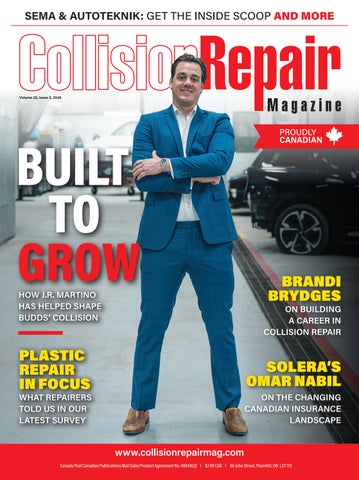
SEMA & AUTOTEKNIK: GET THE INSIDE SCOOP AND MORE
Volume 25, Issue 5, 2026
BUILT TO GROW HOW J.R. MARTINO HAS HELPED SHAPE BUDDS’ COLLISION
PROUDLY CANADIAN
BRANDI BRYDGES
ON BUILDING A CAREER IN COLLISION REPAIR
PLASTIC REPAIR IN FOCUS
SOLERA’S OMAR NABIL ON THE CHANGING CANADIAN INSURANCE LANDSCAPE
WHAT REPAIRERS TOLD US IN OUR LATEST SURVEY
www.collisionrepairmag.com Canada Post Canadian Publications Mail Sales Product Agreement No. 40841632 l $7.99 CAD l 86 John Street, Thornhill, ON L3T 1Y2
OEM match made easier Simplify your body shop processes today.
The 3M ™ OEM Match Family of seam sealing products are engineered to help technicians of all skill levels more easily replicate the appearance and function of a vehicle’s original factory seam sealer. The system includes our line of seam sealer matching tips and the 2K 3M™ OEM Match Epoxy Seam Sealer in 4 colours – allowing you to replicate the most common OEM seams with one simple application.
Learn more about the 3M OEM Match Family 3MCollision.ca
3M and 3M Science. Applied to Life. are trademarks of 3M. Used under license in Canada. © 2026, 3M. All rights reserved. 2406-27446 E
Contents SEMA & AUTOTEKNIK: GET THE INSIDE SCOOP AND MORE
INSIDE CRM
VOLUME 25, ISSUE 5, 2026
36
40
Volume 25, Issue 5, 2026
PROUDLY CANADIAN
BUILT TO GROW
BRANDI BRYDGES
HOW J.R. MARTINO HAS HELPED SHAPE BUDDS’ COLLISION
ON BUILDING A CAREER IN COLLISION REPAIR
PLASTIC REPAIR IN FOCUS
SOLERA’S OMAR NABIL ON THE CHANGING CANADIAN INSURANCE LANDSCAPE
WHAT REPAIRERS TOLD US IN OUR LATEST SURVEY
www.collisionrepairmag.com Canada Post Canadian Publications Mail Sales Product Agreement No. 40841632 l $7.99 CAD l 86 John Street, Thornhill, ON L3T 1Y2
L IA C E SP
ON THE COVER
J.R. Martino has helped lead Budds’ Collision through growth, new technology and changing repair requirements while keeping people and continuous improvement at the centre of the business.
N
O
SE
I CT
CRM COLLISION INDEX
PLASTIC REPAIR
The collision repair industry responds to the CRM Collision Index Plastic Repair Survey. Check out what they had to say and discover featured products designed to support plastic repair.
EVENTS
FEATURES ON THE MOVE 06 PEOPLE New roles, promotions and transitions among collision repair industry professionals.
OF THE INDUSTRY 12 PULSE Exclusive Canadian Industry Performance report from AutoHouse Technologies.
PREVIEW 26 AUTOTEKNIK Get ready for Canada’s Premier
21
Collision Repair Trade Show.
APT officially opened its newest facility, bringing its training and industry resources to a new space.
SHOW 31 SEMA Expanded collision programming lands at 2026 SEMA automotive show.
DECADE OF CONNECTION 39 ASharon Ashley and BodyshopConnect, celebrate the company’s 10th anniversary.
IN THE INDUSTRY 56 WOMEN By Mackenzie Grant
24 CARSTAR franchise partners gathered in Halifax for Impact, with a focus on connection, collaboration and the future of the network.
COLUMNS
PAGE 04 PUBLISHER’S By Darryl Simmons DRIVING 14 WHO’S By Jay Perry
28 Industry professionals came together on the course for the annual Boyd Group golf tournament, raising funds and connecting with colleagues along the way.
SUBSCRIBE TODAY!
collisionrepairmag.com/subscribe
TALK 16 LET’S By Stefano Liessi WORD 66 LAST By Mackenzie Grant
We welcome your comments on anything you see in Collision Repair magazine. Send your feedback to editor@collisionrepairmag.com. ISSUE 25#5 | COLLISION REPAIR
3
PUBLISHER’S PAGE
INDUSTRY INTELLIGENCE
The knowledge is already out there. Our job is to gather it and share it.
BY DARRYL SIMMONS
T
THAT’S THE VALUE OF THE CRM COLLISION INDEX: REAL INFORMATION FROM REPAIRERS THAT HELPS INFORM INDUSTRY DECISIONS.
here is an incredible amount of knowledge in this industry.
Most of it isn’t sitting in a textbook or a database. It’s in repair facilities across the country, in the heads of technicians who have spent 30 years fixing vehicles, owners who have seen the business change more times than they care to remember and younger people who are coming into collision repair with different ideas about how things can be done. One of the great privileges of publishing Collision Repair magazine is that people are willing to share that knowledge with us. They tell us what’s working and what isn’t. They share their experiences, their numbers and their opinions. Sometimes they agree with each other. Quite often they don’t. That’s okay! There’s usually something to be learned from both sides. We’re proud, and frankly humbled, that people trust us enough to have those conversations. Our job is simple. Listen carefully, ask questions, gather as much information as we can and share what we learn. The goal isn’t to tell people what to think. It’s to give them enough good information to think it through. There are some great examples in this issue. Our latest CRM Collision Index looks at plastic repair. There has been plenty of talk about repairing more plastic parts rather than replacing them, but we wanted to know what repairers themselves thought. So we asked them. What are you repairing? What are you replacing? Does plastic repair make money? What gets in the way? The answers tell us a lot more than whether a bumper gets repaired or replaced. They give us insight into profitability, training, insurer influence, confidence in the repair and the dayto-day decisions being made inside Canadian repair facilities. That’s the value of the Index. It doesn’t settle the argument. It puts real information in front of the people making the decisions, from repair facility owners to insurers, OEMs and suppliers. It works because repairers are willing to be candid, and that candour is what makes the results worth reading. We’re gathering information in other ways, too. We also carry the monthly Pulse of the Industry report, prepared by AutoHouse Technologies using repair order data from across the country. 4
COLLISION REPAIR COLLISIONREPAIRMAG.COM
But numbers only tell part of the story. You also have to get out there, meet people and listen. Our team spends a lot of time at conferences, facility openings, training sessions, industry gatherings and the occasional golf tournament. Some of the best information comes from talking to people face to face. Our CARSTAR Impact coverage from Halifax is a good example. Bring repairers from across Canada together and you quickly hear the same subjects coming up: people, training, technology, profitability, succession and what the next few years are going to look like. We also have to keep an eye on what’s happening outside the industry. Vehicle technology, insurance, government decisions, the economy and artificial intelligence eventually make their way through the doors of every repair facility. Part of what we do is find people who understand these changes and help explain what they could mean for the people actually running collision businesses. And we tell the stories of the people themselves. J.R. Martino is on our cover this issue. His is one story among thousands in this industry, but it’s a good one. He grew up around collision repair, learned the business, made some mistakes, kept learning and helped build something he can be proud of. We like telling those stories because this industry has a lot to be proud of. Sometimes we’re pretty good at talking about our problems and not quite as good at recognizing our people and what they’ve accomplished. After 25 years, our team isn’t standing outside the collision repair industry looking in. We attend the events, visit the facilities, ask the questions and, most importantly, listen. It’s a privilege to be trusted to tell this industry’s stories and share its knowledge. We don’t want to take that trust for granted. We want to keep earning it, so please keep your comments, ideas and suggestions coming. We appreciate every one of them. If you want to take part in the next CRM Collision Index survey, disagree with something you see in these results or simply have a story you think should be told, let us know. Find us at SEMA or the next event in your area, or write to editor@collisionrepairmag.com. The Index is only as good as the voices in it, and Collision Repair magazine is better because you continue to share yours.
PUBLISHER Darryl Simmons | publisher@collisionrepairmag.com ASSOCIATE PUBLISHER Orest Tkaczuk | orest@mediamatters.ca AUDIENCE ENGAGEMENT MANAGER William Simmons | william@mediamatters.ca ART DIRECTOR Yvonne Maschke | yvonne@mediamatters.ca EDITOR Mackenzie Grant | mackenzie@mediamatters.ca VP OF INDUSTRY RELATIONS & ADVERTISING Gloria Mann 647.998.5677 | gd.mann@rogers.com DATA MANAGEMENT SPECIALIST Willow Campbell | willow@mediamatters.ca MEDIA PRODUCTION SPECIALIST Dayna Dicuangco | dayna@mediamatters.ca INTERIM ONLINE EDITOR Gideon Scanlon | news@collisionrepairmag.com CONTRIBUTORS Stefano Liessi, Jay Perry
SUBSCRIPTION Single edition $7.99 One-year $39.95 ( 6 issues) Collision Repair™ magazine is published bimonthly, and is dedicated to serving the business interests of the collision repair industry. It is published by Media Matters Inc. Material in Collision Repair™ magazine may not be reproduced in any form without written consent from the publisher. The publisher reserves the right to refuse any advertising and disclaims all responsibilities for claims or statements made by its advertisers or independent columnists. All facts, opinions and statements appearing in this publication have been compiled and included with the permission, though not necessarily the endorsement, of the editor, or of independent columnist contributors, and are in no way to be construed as those of the publisher, or as endorsements of them. PRINTED IN CANADA ISSN 1707-6072 CANADA POST CANADIAN PUBLICATIONS MAIL SALES PRODUCT AGREEMENT No. 40841632 RETURN POSTAGE GUARANTEED Send change of address notices and undeliverable copies to: 86 John Street, Thornhill, ON L3T 1Y2
“We acknowledge the financial support of the Government of Canada”
Collision Repair magazine is published by Media Matters Inc., publishers of:
You are the PRO. We are here to help you win!
A proven business model for over 20 years, ProColor Collision is growing! Independent body shop owners driving their business forward are choosing ProColor. Standardized operations, management tools and consolidated technology solutions improve performance. The ProColor team of industry professionals are dedicated to performance excellence offering the sales, operational and marketing support needed to take business to the next level. ProColor Collision is committed to helping shop owners grow their business locally while leveraging established relationships with global insurers, suppliers, and fleet companies.
The ProColor PROcess is a winning formula.
Find out more at procolor.com
NEWS
People on the Move MARC BRAZEAU The Automotive Aftermarket Repair Organization of Canada has appointed Marc Brazeau as president. In the role, he will work with executive director Patty Kettles and the board as the association expands its presence across Canada. Brazeau recently retired after nearly seven years as president and CEO of the Railway Association of Canada. His work there included government and public affairs, safety, training and industry engagement. He previously spent many years with AIA Canada, where he worked alongside Kettles for more than 20 years. collisionrepairmag.com/15832458
CHAD CARNEY 3M has announced Chad M. Carney as the next president of the automotive aftermarket division. Carney will succeed Dave Gunderson. Carney is a 27-year veteran of the manufacturer and currently serves as global vicepresident of product strategy in 3M’s Personal Safety Division. He previously served as vice-president of the Industrial Adhesives and Tapes Division. During his career with 3M, Carney has focused on manufacturing improvements, risk management and continuous improvement in his current role. The Personal Safety Division has recorded seven consecutive quarters of growth during his tenure. collisionrepairmag.com/15833100
JOSH COX The Wesco Group has appointed Josh Cox as chief executive officer, succeeding company co-founder Lloyd White, who is retiring as CEO. Cox has been with Wesco for eight years, most recently serving as president. He was promoted to president in 2025 after serving as national vice-president of sales. He began his collision repair career in a bodyshop before becoming a journeyman painter and shop foreman. Cox later moved into automotive paint sales with PPG and operated a California distribution business before joining Wesco in 2019. collisionrepairmag.com/15832877
CHANCEY HAGERTY Chancey Hagerty, the executive who runs PPG’s collision repair paint business, is being put in charge of a group of businesses that generated about US$5.5 billion in sales last year. He will oversee automotive refinish, aerospace coatings, protective and marine coatings and traffic products. Those businesses make up PPG’s performance coatings segment. Hagerty will remain directly responsible for automotive refinish. Hagerty has led PPG’s global automotive refinish business since 2020, overseeing the paint and repair-material business serving bodyshops. His responsibilities already included aerospace coatings and oversight of PPG’s Asia-Pacific operations and a joint venture developing protective and paint films. collisionrepairmag.com/15833116
6
COLLISION REPAIR COLLISIONREPAIRMAG.COM
AUTOMOTIVE FRANCHISE OPPORTUNITIES
WHAT NOVUS BRINGS YOU FOR AN INVESTMENT UNDER $50,000
Part of Fix Network – Canada’s largest automotive aftermarket services provider
Global expertise – operating in over 1,300 locations in over 30 countries
The Inventors & Leaders in Windshield Repair & Replacement
Turnkey opportunity with NOVUS mobile van supplied
Offer both chip repair and full crack repair up to 12 inches
Currently have 27 patents for glass repair products with our R&D team
Extensive operational training program provided with dedicated support manager
Established supplier relationships & buying power
Choose NOVUS Glass, a true partner in your success. We believe in our business and so should you!
Creative & target marketing solutions provided
NEWS
People on the Move MIKE HORNE Certified Collision Group has appointed Mike Horne as its new chief financial officer. Horne brings more than a decade of financial leadership experience across private equity-backed, multi-entity organizations. Most recently, Horne worked at Babilou Family US (Little Sprouts), leading FP&A, controllership, treasury and strategic planning across more than 40 operating units. In his new role, Horne will help drive CCG’s continued growth, strengthening the company’s financial foundation as it expands support for its affiliate network of independent collision repair facilities across Canada and the United States. collisionrepairmag.com/15831573 SEAN KELL Simplicity Car Care has appointed Sean Kell as director of strategic partnerships. Kell will work with insurers, vendors and franchisees as it continues expanding across Canada. Kell brings more than 35 years of industry experience to the position. His background includes technical repair work, shop ownership and operational support for a multi-location collision repair network. He holds Red Seal and Quebec second-class certifications in collision repair and automotive refinishing. He also holds a PPG Green Belt certification in Lean principles. collisionrepairmag.com/15830658
JANE POCOCK Copart has appointed Jane Pocock as the next president. Pocock joined Copart in January 2019 as managing director of Copart UK. She later took responsibility for operations throughout the British Isles. Before joining Copart, Pocock was chief executive of Vans Direct, a British commercial vehicle retailer. Copart has more than 250 locations in 11 countries. More than four million units were sold through its auctions during the past year. Its online platforms connect vehicle sellers with approximately one million members in more than 185 countries. collisionrepairmag.com/15829802
ROBERT ROLFE Simplicity Car Care has appointed Robert Rolfe as business development manager. In this role, Robert will be responsible for driving franchise growth, cultivating strategic relationships and supporting the continued expansion of the Simplicity Car Care network across Canada. He brings more than a decade of high-performance sales experience, most recently as an owner and franchisee with Snap-on Tools in the Niagara Region of Ontario. During his tenure, Robert managed a territory of 340 active automotive and trades professionals and closed individual high-value transactions. Robert pairs formal business education with a disciplined, customer-first approach that has defined his success. collisionrepairmag.com/15831355 SHISHIR TIWARI Global Finishing Solutions has appointed Shishir Tiwari as president. Tiwari will oversee the company’s operations, service business, distributor relationships and long-term growth plans. He most recently served as division vicepresident at AMETEK, where he led an international business supplying instrumentation, control and vision systems. Tiwari previously served as vice-president and general manager at Wabtec, where he was responsible for the company’s Shuttlewagon railcar-moving business. Tiwari holds a master of business administration from Northwestern University, a master’s degree from the Massachusetts Institute of Technology and engineering degrees from two Indian universities. collisionrepairmag.com/15830184 MIKE WOODWARD AutoCanada has appointed Mike Woodward as its new chief financial officer. Woodward has 20 years of financial experience across public and private organizations, with expertise in M&A, capital markets and operational transformation. Throughout Woodward’s career, he has led major financing initiatives and supported strategic priorities. Woodward has CPA, CA and CFA certifications and experience in capital markets and corporate development. In his role with AutoCanada, Woodward will lead the company’s financial team, playing a key role in advancing strategic priorities, improving visibility into performance, strengthening financial discipline and supporting smarter, faster decision-making across the business. collisionrepairmag.com/15829450 8
COLLISION REPAIR COLLISIONREPAIRMAG.COM
The You’ve Earned The Freedom You’veEarned Earned TheFreedom Freedom You’ve The You Deserve TheSupport Support SupportYou YouDeserve Deserve
ururr SStaStartatrrtYteYoYyoeouyN Nowooww N n n r y r e u u o n o JJJour
Grow Grow business. Reclaim Growyour yourbusiness. business.Reclaim Reclaim your time. terms. your Live on your terms. yourtime. time.Live Liveon onyour your terms.
Let’s TalkAbout About Let’s Let’sTalk Talk About YourNext NextChapter Chapter Your
Your Next Chapter
1-800-871-7612
1-800-871-7612 1-800-871-7612 contact@simplicitycc.com contact@simplicitycc.com contact@simplicitycc.com
www.simplicitycc.com/franchisee-mm
www.simplicitycc.com/franchisee-mm www.simplicitycc.com/franchisee-mm
SPONSORED CONTENT
BUILDING A BUSINESS ON TRUST
How Boss Cheaib’s journey reflects the entrepreneurial spirit, innovation and people-first culture at the heart of Fix Network.
F
or Boss Cheaib, success in the automotive industry has always been rooted in entrepreneurship, problemsolving and a commitment to doing right by customers. Long before opening ProColor Collision Oshawa North, he was already building businesses and gaining valuable experience across multiple facets of the automotive sector. At just 22 years old, Cheaib launched his own dealership in Oshawa, gaining firsthand experience in vehicle sales, operations, reconditioning and customer service. Working closely with repair providers exposed him to opportunities for improvement that would ultimately shape the next chapter of his career. “As I worked with different repair providers, I started noticing gaps in service, communication and quality,” says Cheaib. “I saw firsthand how frustrating it could be for customers when expectations weren’t met. That experience sparked an interest in the collision repair side of the business and inspired me to create something that focused on trust, transparency and quality.” Those principles would later align closely with Fix Network, the Canada-founded global organization behind ProColor Collision and an ever-expanding family of automotive repair brands. Built on entrepreneurship and innovation, the organization helps independent business owners grow through training, operational support and advanced technologies. Today, as owner of ProColor Collision Oshawa North, Cheaib is proudly transforming those ideas into a customerfocused business while leveraging the support of one of the world’s largest automotive aftermarket organizations. GUIDED BY STRONG VALUES Cheaib credits his upbringing for shaping the principles that guide his business today. Transparency, respect and doing the right thing continue to influence how he serves customers, supports employees and builds relationships with partners. “When decisions become difficult, I always ask myself a few simple questions,” he says. “Is it honest? Does it demonstrate integrity? Will it build trust? If the answer is yes, then I know we’re moving in the right direction.” For Cheaib, success is about more than repairing vehicles. It’s about building a business that employees, customers and the community can rely on. 10
COLLISION REPAIR COLLISIONREPAIRMAG.COM
FINDING THE RIGHT PARTNER FOR GROWTH When Cheaib decided to enter the collision repair industry, he knew he wanted a partner that could help position his business for long-term success. His search ultimately led him to Fix Network and the ProColor Collision banner. Beyond its scale and reputation, Fix Network’s entrepreneurial culture resonated strongly with Cheaib. The organization itself was built on the belief that independent business owners can achieve more when supported by a strong network of expertise, training and shared best practices. Under the leadership of President and CEO Steve Leal, a former Fix Auto franchisee who helped transform the company into the global organization it is today, Fix Network has remained focused on helping entrepreneurs strengthen their businesses while preserving the independence and drive that made them successful in the first place. “What stands out about Boss is his commitment to never stand still,” says Amin Youssef, Regional Vice President, Ontario, Fix Network. “From investing in advanced equipment to embracing ongoing training opportunities, he understands that success in today’s collision repair industry requires continuous learning and adaptation. Just as importantly, Boss leads with integrity, humility and a genuine commitment to his customers, employees and community. That combination of entrepreneurial drive and people-first leadership makes him an outstanding representative of the values we strive to uphold across Fix Network.”
SPONSORED CONTENT
INVESTING IN INNOVATION
MAKING A DIFFERENCE BEYOND REPAIRS
Cheaib is particularly energized by the pace of technological change within the collision repair industry. From artificial intelligence and digital diagnostics to Advanced Driver Assistance Systems (ADAS), he sees continuous innovation as an opportunity to expand his team’s capabilities and better prepare the business for the vehicles of tomorrow. “I’m always looking at how new technology can improve efficiency, consistency and the customer experience,” he says. “The more we invest in the right equipment and training, the better positioned we are to deliver exceptional repairs.” Equally important is ongoing education. As part of Fix Network, Cheaib has access to a national training ecosystem that includes three dedicated training centres across Canada, one of which is located in Milton, Ontario. These resources help ensure his team remains current on emerging technologies, repair processes and industry standards while supporting a culture of continuous learning.
Throughout his career, Cheaib has remained committed to supporting the Oshawa community through local sponsorships, partnerships and charitable initiatives. His business sponsors youth hockey and soccer teams while participating in community events that promote vehicle safety awareness. One experience in particular continues to resonate with him. A family that had recently arrived in Canada after fleeing conflict in Palestine came to the shop with a severely damaged vehicle that was essential to their daily lives and ability to work. Facing financial hardship, they were unable to afford the full cost of repairs. Recognizing the importance of reliable transportation during such a difficult transition, Cheaib and his team stepped in to help, completing the repairs at cost and waiving labour charges. “The gratitude they showed was unforgettable,” he recalls. “It reminded me that what we do isn’t just about repairing vehicles. It’s about helping people move forward.” LOOKING TOWARD THE FUTURE
BUILDING A TEAM CULTURE THAT FEELS LIKE FAMILY While technology is important, Cheaib believes people remain the driving force behind any successful operation. His approach to leadership centres on creating a workplace where employees feel valued, supported and empowered to succeed. “My team is more than just employees,” he says. “We’re like family. We support each other, work through challenges together and celebrate successes together.” Through team dinners, milestone celebrations and collaborative problem-solving, Cheaib fosters a culture of connection. He believes that when employees feel invested in the business, customers benefit from stronger service, greater accountability and a better overall experience.
As a father of two young sons, Cheaib’s vision extends far beyond today’s business goals. Everything he is building is rooted in creating opportunities for the future, both for his family and for the broader community. Looking ahead, his goal is to establish ProColor Collision Oshawa North as one of the most trusted and advanced collision repair facilities in the Durham Region. He also sees significant opportunities for future expansion while continuing to invest in advanced equipment, employee development and customer experience. Supported by Fix Network’s commitment to entrepreneurship, innovation and ongoing training, Cheaib is focused on building a business designed for sustainable growth. By combining ambition with a customer-first mindset, he is creating more than a collision repair facility. He is building a lasting legacy founded on trust, service and the pursuit of excellence.
Learn more about Fix Network’s family of brands
ISSUE 25#5 | COLLISION REPAIR
11
PULSE OF THE INDUSTRY REPORT
TOP PERFORMERS OUTSTRIPPED COMPETITORS AS REPAIR VALUES ROSE IN AUGUST BY GIDEON SCANLON
C
anadian collision repairers saw customer-pay repair values rise in August while insurer-paid repair orders gained modest ground month-over-month despite remaining below six-month benchmarks, according to the latest Pulse of the Industry report from Collision Repair magazine and AutoHouse Technologies. The monthly report, produced in partnership with Vancouverbased AutoHouse Technologies, draws on operational data from more than 60,000 repair orders across Canada. Average insurer-paid repair order sales rose $73 month-over-month to $5,294 in August, though the figure remains $83 below the prior six-month average. Meanwhile, customer-paid repair values posted a sharp increase, rising $177 from July to $1,803 — an increase of $111 above its six-month benchmark. Mike Gilliland, president and founder of AutoHouse Technologies, said operational throughput held steady across the month while financial metrics diverged. “Average insured RO sale remains under pressure, while August saw a notable increase in customer pay repair value,” Gilliland said. “Production efficiency remained relatively stable, with cycle time and touch time holding at July levels.” “While insured repair values showed a minor bump in August, the real story is in customer-pay revenue,” said Collision Repair publisher Darryl Simmons: “Drivers taking on bigger repair bills out of pocket marks a distinct shift in how work enters the shop.” Production metrics held flat across the industry in August. Average cycle time — the number of calendar days required to move a vehicle from arrival to delivery — remained unchanged against the prior three-month average at 13.4 days. Average touch time, which measures the hours produced per repair each day, also held steady at 2.5 hours. Top 10% performing shops recorded a cycle time of 5.7 days, down 1.8% against their prior three-month average, with a touch time of 4.6 hours, down 1.4%. Industry capacity metrics showed a slight build-up in inventory, with the work-in-progress (WIP) ratio rising 3.8% against the three-month average to 11.3:1, representing 11.3 days of daily repair output currently on-site in production.
FULL REPORT HERE:
collisionrepairmag.com/15835529
12
COLLISION REPAIR COLLISIONREPAIRMAG.COM
Evaluate your Performance? Curious how your shop stacks up? Our enhanced benchmarking tool compares your performance against national, provincial and regional peers. Using real operational data — not surveys — you can quickly identify where to improve efficiency, boost throughput and grow profitability. Learn more to see if benchmarking is a fit for your business.
About this Report Pulse of the Industry is the result of a powerful collaboration between Collision Repair magazine, Canada’s leading collision industry publication, and AutoHouse Technologies, the nation’s foremost provider of real-time repair performance analytics. Compiled from over 60,000 monthly repair orders completed by Canada collision repairers. All information has been normalized, with variance thresholds applied to remove anomalies and ensure data integrity.
autohousetechnologies.com/crm-pulse-report-august2026 collisionrepairmag.com/pulse-of-the-industry
Exclusively partnered with
PULSE OF THE INDUSTRY REPORT
August 2026 CDN Industry Performance
ISSUE 25#5 | COLLISION REPAIR 13
WHO’S DRIVING
GREAT LEADERS BUILD GREAT TEAMS WHEN PEOPLE FEEL VALUED, INFORMED AND TRUSTED, THEY ARE MORE LIKELY TO ENGAGE, CONTRIBUTE AND STAY BY JAY PERRY
W
e have all heard the saying, “People don’t leave jobs, they leave bad bosses”. Leaders must pay attention to this if they want to excel in today’s business environment. The leader is directly responsible for the experience an employee has while involved with the company. Why is that so important? Simply, an employee who enjoys being a part of a company engages with the employer, produces more and stays longer. All the studies in this area are conclusive and unanimous. It’s up to us, the leaders, to ensure our employees have something worthwhile to engage with! We are not talking about giving away the farm to please employees. When we work at engagement it is about education. This education is two-way, first, we need to learn how the employee sees things and what they really want for their career. Then, secondly, we must educate the employee on the bigpicture “Why” (we do what we do) as well as why we do it in the way we do it.
This education process is not accomplished in one meeting, be patient. People also look for proof that what you say is reality, so they are constantly looking at the consistency of your leadership. We have discussed in the past how we build trust, “Consistent Behaviour over Time”, and this is based upon a deep-seated fact researchers have proven previously. Think
SIMPLY, AN EMPLOYEE THAT ENJOYS BEING A PART OF A COMPANY ENGAGES WITH THE EMPLOYER, PRODUCES MORE AND STAYS LONGER. about your own experience. Would you follow someone who is radical and inconsistent? Not likely, and others will not either. So it starts with delivering on our word — Do what I say I am going to do — every time! This applies to every issue, big or small.
JAY PERRY Jay Perry is the founder of Ally Business Coaching, a process improvement and leadership development firm, and co-author of the book Success Manifesto with Brian Tracy. Jay is also an education partner with California Coast University in Santa Ana, California. He can be reached at jayperryally@gmail.com.
For more columns by Jay Perry visit collisionrepairmag.com/15738685
14
COLLISION REPAIR COLLISIONREPAIRMAG.COM
We have a saying that the leader is “under the microscope” and as you embrace that reality in your leadership and examine the times you get the cooperation or engagement you need, it is because of this very fact. You deliver consistently. As part of this consistency toward and education of our people, we must pay attention to recognizing contributions from our team members. As my colleague Marcel Schwantes said in a recent article in Inc. magazine, “When leaders consistently recognize effort, celebrate wins, and generously share credit for the team’s success rather than hog the spotlight, they reinforce a culture where people feel valued”. (Inc. July 22, 2026) When you educate your team members, you are laying the foundation of trust. Trust allows you to move away from control and over-involvement. Once your team is educated and have ultra-clear direction around your expectations, you can allow them to do their job which creates tangible purpose for the team member. Everyone wants to feel a sense of purpose. Doctors recognize that having purpose actually leads to a longer and better quality of life. The same principle applies to our careers. We have a longer, more fulfilling career when we have purpose that helps us focus! By working on ourselves to become better in our leadership, we practice continuous improvement and keep being the one who’s driving!
H T I W G N I T S R BU CREATIVITY.
bbyy X jet
h c u r Stilbruch "SHTEEL-brookh"
Alex Bloch a man of many talents: Automotive painter, sprayer and creative visionary. It was only a matter of time before he created an exclusive jet X for us. And here it is. The jet X by Stilbruch. A fusion of two worlds: It is the combination of a premium tool and a work of art. A one-of-a-kind design. A limited edition. Countless reasons to own one. Available Nov. 2026 from your participating SATA dealer – while stocks last.
INFO www.sata.com/basecoat-edition SATA Canada Inc.
INFO 125 Buttermill Avenue Vaughan, ON L4K 3X5 www.sata.com/clearcoat-edition
Phone: +1 905 660 1101 Toll-free: +1 844 554 SATA (7282) Fax: +1 905 760 1250 contact@sata.ca www.sata.com
LET’S TALK
TRYING TO FIT IN HOW DO I BECOME A PART OF THE GROUP? BY STEFANO LIESSI
N
o, this is not some “self-help” article on how to better your life by fitting in. Instead, this is an article discussing position statements, original equipment manufacturers (OEMs) and parts. I can hear the cheers already. The collision industry can sometimes feel like a nasty, tangled web of control-seeking power mongers, when really it doesn’t need to be. Navigating all the chest-thumping takes some serious mental gymnastics to repair a vehicle. Let’s begin by addressing the key issue: the vehicle needs to be repaired correctly. Now, who dictates this? Your immediate answer is likely the OEM, and that is a good answer, but is that necessarily true? If the OEM literally dictates the repair, then we would need to adhere to procedures and position statements to the letter, with no variation from them. This translates to only new OEM parts and the use of only OEM-approved
and available up to a “reasonable age.” This is in quotes because there is currently no definition of a reasonable age. If a vehicle is two years old, parts can be discontinued. The same can happen if a vehicle is 22 years old. There is no written guide on this. Some of you have learned the hard way. Regardless, the concept is simple: it removes all the guesswork. Easy-peasy. Not so fast. If you are thinking this is doable, think again. It is not. I know everyone LOVES the idea of OEM-only parts, but it’s delusional to think that is a viable and sustainable process. Just look around your shop. Consider the cost. Do you want to bankroll the amount required if everything were OEM? Not to mention the payees. They want repairs to be economical. If that is not enough, now count the backorders. That’s what I thought: a lot of loss-of-use payouts
We are at a crossroads here. One party says new only. The other says used and aftermarket. So how do we determine who is right and who is wrong? We don’t. It isn’t that simple. This is where the technician becomes an important part of the decision. The technician is the person actually performing the repair, assessing the parts and determining whether the repair can be completed properly. Their training, experience and professional responsibility have to carry considerable weight. That doesn’t mean the technician operates independently of OEM repair procedures, the repair facility, the insurer or other requirements. It means the person actually doing the work needs to have a meaningful voice in determining whether a proposed repair is appropriate. I get it. Everyone wants control of the repair file.
EVERY OEM HAS A POSITION STATEMENT REGARDING ‘USED AND AFTERMARKET PART USAGE.’ JUST SAY NO; THAT IS THEIR POSITION, NO! processes and services, i.e., OEM scan tools and software, and being part of some form of OEM-authorized network, especially if you are not a dealer. General Motors (GM) has recently reissued some of its position statements with updated verbiage that reflects this ideology by bringing advanced driver assistance systems (ADAS) components into the fold, stating OEM parts must be used and salvage or aftermarket parts are forbidden. Also, with its electric vehicles (EVs), GM is restricting access to 12 different front structural components unless you are a certified repair facility. Independents will suffer from this. Every OEM has a position statement regarding used and aftermarket part usage. Just say no. That is their position: NO! By this rationale, the OEM should be responsible for managing parts supply for every make and model out there, in stock 16
COLLISION REPAIR COLLISIONREPAIRMAG.COM
and expensive indoor storage. We have established that OEMs can’t dictate the repair. They most certainly can influence it. What about insurance? Can insurers dictate the repair? They can certainly make an effort to mitigate costs under the policy. Every policy states, and I am generalizing here because there are some exceptions, that like-kind and quality or new aftermarket parts may be used to complete repairs to your vehicle. The insurer has a fiduciary responsibility to the policyholder in two ways: to indemnify them to their pre-loss condition and to do so without breaking the bank on behalf of all premium payers. Ergo, insurers would love to use the most economical parts available. But they do not design, build or repair vehicles. They cover losses. So they can’t dictate repairs, but they most certainly can influence them.
Stellantis is smart. It realizes there is no way it could keep up using only OEM parts, so it figured, if you can’t beat them, join them. Stellantis now owns SUSTAINera and B-Parts, one an aftermarket manufacturer and supplier of automotive components, the other a salvage company dealing in automotive salvage parts. Interesting, as Stellantis also has position statements denying the use of said parts. I will leave this here for you to process. Let’s go back to the technician’s role in the repair. You are sitting here thinking, “What about the position statements?” It is a fair thought, so let’s address it. At first glance, the inference for many is that this is law. Technically, it is not. It is just as it states: a position or an opinion on a given situation. It is usually a position supported with some form of authenticity, yet is not considered evidential unless it is written and submitted as part of a legal dispute or complaint.
LET’S TALK
If a legal dispute or complaint escalates into a lawsuit, the corporation’s position statement can be submitted to court as formal evidence. The corporation is then legally bound to the facts it lays out in this statement. If the company changes its story or provides inconsistent details later in court, it will severely damage its credibility and can sink its legal defence. (For more information visit SHRM.org) Now, I am not a lawyer, and this is not legal advice. It is presented as support for thought. Most of the statements we encounter are along the lines of public relations position statements. This is likely why payees are comfortable challenging repairers on them. The validity of them challenging it is no different than my
Nonna challenging it, and the actual weight of the position statement is minimal, more a bureaucratic hurdle than anything. So why have it? Well, the OEM can’t be standing in the shop when parts are ordered. It can’t be at every repair to validate the authenticity or quality of the part being used, so it issues a blanket statement that expresses its position in supporting quality repairs and parts in the simplest way possible. The payee can express its take by saying its position is that used and aftermarket parts are good, but it is not there when the parts arrive. In most cases, the person supporting the argument on the payee’s behalf has little to no experience repairing these vehicles either. The technician, on the other hand, is there.
They are using and inspecting the parts and assessing how those parts fit into the repair. That gives the technician an important voice. They bring training, experience and firsthand knowledge of the vehicle in front of them. They may not have the final say in every decision, but their professional judgment should be a significant part of determining whether a repair can be completed correctly. The vehicle needs to be repaired correctly. We can’t rely solely on the OEM. That is not realistic. The aftermarket and salvage markets will never go away. It is best to get on board and support repair decisions with facts, experience, skill and credible technical information, not economics, key performance indicators (KPIs) and fear.
STEFANO LIESSI Stefano Liessi is a Red Seal technician and refinisher with a demonstrated history of working in the automotive collision industry. Stefano enhances his 40 years of experience with 15 years of I-CAR instruction and a post-secondary degree. He also trains Skills Alberta students and has brought home 11 medals for the province, and taught high school students in the auto shop for six years. He can be reached at sliessi@canadiancollisionspecialist.com.
For more columns by Stefano Liessi visit collisionrepairmag.com/15738697
Keep your collision repair profits by providing alignment and ADAS services in-house, saving time for you and your customers.
ISSUE 25#5 | COLLISION REPAIR 17
SPONSORED CONTENT
ACX IS UNLOCKING NEW PERSPECTIVES and a stronger workforce through its Women’s Collective
T
he collision industry has historically been a male-dominated one, but at ACX a shift is underway that aims to prove that the strength of an organization is built on the diversity of its perspectives. By championing women in every facet of the business, the brand is trying to fundamentally change the landscape of the industry, but evolution requires more than just policy; it demands a culture of growth that starts at the very top, and ACX is lucky to have more than a few people in key roles who are actively taking the reins and fostering a community of mentorship and growth. Brandi Brydges — Director of Operations (Private Insurance) and Kimberley Kos — Collision Manager at ACX Kavia (both of whom have earned national recognition as some of the Most Influential Women in collision repair by Women’s Industry Network (WIN)), along with Brittany Huber (Collision Manager at ACX Venture) are three of these people and founding members of the ACX Women’s Collective. The Collective is an initiative launched to ensure that no collision professional has to navigate her career path in isolation, and to create more opportunity, sentiment, and interest in collision as a real, achievable career option for women. It offers a genuine community where team members share experiences and build the confidence necessary to take the next step in their professional evolution, ensuring that potential is realized and every voice is heard. ACX 18
COLLISION REPAIR COLLISIONREPAIRMAG.COM
says this approach is beneficial in both directions: their employees enjoy genuine support and see real direction for their careers while the company benefits from points of view that aren’t typical for the industry, which can be incredibly powerful at unlocking new approaches to almost everything the company does. It’s said that one of the most dangerous phrases in business is “we’ve always done it that way” and the Women’s Collective at ACX is proof of just how correct that is; real growth demands evolution, which is also why ACX’s commitment extends beyond its own walls. Through strategic partnerships with organizations like Jill of All Trades, WITT (Women in Trades and Technology), and the Women’s Industry Network (WIN), ACX is a vocal advocate for the skilled trades as a rewarding career path. By actively engaging with high schools and colleges, the Collective is inspiring the next generation of female professionals to enter the automotive world, effectively dismantling stereotypes and building a more inclusive future for the entire industry. The ACX Women’s Collective currently features 15 committee members and meets every month to strengthen peer connection; the meetings are always open to any woman who works for the brand. This fall they’re launching a mentorship program open to all employees. The trajectory for this group seems to be on the rise and this can only mean great things for ACX.
REVOLUTIONIZE TOPCOAT FINISHING
FAST CORRECTION WITHOUT OVERSANDING
A UNIFORM FINISH THAT’S EASIER TO BUFF
Super Assilex
Super Buflex
FLEXIBLE SANDING SYSTEM
K-800
K-1000
K-1200
FLEXIBLE POLISHING SYSTEM
K-1500
K-2000
Flexible Bonding
True Dry Sanding
Fast Sanding Coverage
K-1500
K-3000
K-4000
Ultra-Uniform Finish
No Mess, No Drying Time
Reduce Pigtails & Deep Scratches
K-1500
K-2500
CORRECT NIBS & RUNS
LARGE AREA PAINT CORRECTION
K-2500
DRY POLISH SANDING
UP TO 50% LESS SANDING & BUFFING Replace costly and messy multi-pad and multi-compound buffing with Super Buflex to leave a finish that can be buffed to final shine in a single polishing step. Scan to learn more NEW
Garuda
Production Discs Grade 80 to 400
Super Assilex Super Buflex Sheets & Discs K-240 to K-1500
Sheets & Discs K-2000 to K-4000
SEMA 2026, Las Vegas, Booth #32173
ANTI-CLOGGING AGENT
Tolecut
PSA Sheets & Discs K-800 to K-3000
Available at your local PBE supplier
EagleAbrasives.com
By
From Summer Drives
To Fall Vibes
6 LOCATIONS
Burnaby Calgary Edmonton Winnipeg Sa atoon Hamilton
EVENTS
EASTWARD EXPANSION APT OPENS DOORS ON ONTARIO FACILITY
BY OREST TKACZUK AND GIDEON SCANLON
T
his summer, APT Auto Parts marked the launch of its first Ontario distribution centre with a grand opening event that drew about 250 customers, suppliers and other industry guests to Grimsby. The Burnaby, B.C.-based aftermarket collision parts distributor hosted the Aug. 13 event at its new 6,500-square-metre [70,000 -sq.-ft.] facility at 270 Hunter Rd. Grimsby Mayor Jeff Jordan presented a plaque and took part in a ribbon-cutting ceremony. APT president and CEO John Abu-Ata said the turnout exceeded his expectations. “We could barely fit everybody in the room,” Abu-Ata said. “I couldn’t believe how many people were there.” An exotic car display included vehicles brought by friends of John Molnar Sr. and a selection from Ultimate Exotics. Suppliers also travelled to Ontario for the opening. For Abu-Ata, the turnout reflected something that has been central to APT since
his parents started the business in British Columbia in 1980. “Business is about relationships,” he said. “You take care of them, they take care of you. This is how it works.” Abu-Ata’s parents immigrated to Canada from Lebanon. His father had been a parts dealer there, particularly for Fiat, but initially struggled to find work in Canada because of the language barrier and his unfamiliarity with the North American vehicle market. “He couldn’t find anything because his language still wasn’t good, but he was a parts dealer back in Lebanon,” Abu-Ata said. “He didn’t know the North American market, but he knew parts.” After about a year, the couple decided to build a business around that knowledge. His mother, despite having no parts background, handled the phones while his father sold and delivered parts. For roughly two decades, his parents built the company while raising John
and his siblings, Jim Abu-Ata and Suzy Hodali. “They worked so hard to build a good base for us,” Abu-Ata said. “Really, without them, we’d be nothing. We have to honour them. Mom and dad set us up for success.” All three eventually joined the family business. John now serves as president and CEO, Jim as vice-president of operations and Hodali as accounts receivable manager. APT began expanding beyond British Columbia about 15 years ago with a Calgary operation. Edmonton and Winnipeg followed during the COVID-19 pandemic, with Saskatchewan added last year. Abu-Ata said the apparently difficult timing of the pandemic expansions actually gave the company an opportunity. “That was an experience, but it was actually a good time to do it because everything was slow and nobody was doing anything, and we were taking advantage of that time.”
ISSUE 25#5 | COLLISION REPAIR 21
EVENTS
Ontario was the next major step. “Our goal is to be nationwide,” Abu-Ata said. “Without Ontario, I really don’t think you can do it.” The Grimsby expansion followed APT’s acquisition of A-1 Auto Parts Ltd., a Hamiltonarea parts business operated by John Molnar Sr. and his family for about 45 years. Molnar Sr. is retiring, while his son, John Molnar Jr., is serving as general manager of the Grimsby operation. Abu-Ata said Molnar Jr. had effectively spent his life learning the business. “He worked for him since he was like 10 years old,” Abu-Ata said. “He grew up in this business. He knows the parts business extremely well.” APT retained the entire A-1 team. The company also chose a location about 15 minutes from A-1’s former operation in part to make the transition practical for employees. “If you go too far, the staff is like, ‘I’m not commuting,’” Abu-Ata said. He said the fit went beyond retaining an experienced staff. The Molnar family approached the business in much the same way as the Abu-Ata family. “They believe the same thing we do: service is first. Always take care of the customer. Quality and service — our motto.” Abu-Ata said that philosophy goes back to his father, who would extend credit to customers who needed time and develop relationships not only with shop owners but with technicians working inside bodyshops. Some of those technicians later opened 22
businesses of their own and became APT customers. “He’d talk to the body men and get to know the body men, and then when they decided to open their own shop, they’d call him,” Abu-Ata said. “Everybody knew my dad. Uncle Sam, basically everybody called him.” APT’s six-month return policy is one way the company has carried that approach forward. Abu-Ata said a repairer can order a part only to have the vehicle owner postpone or abandon the repair, leaving the shop with inventory after a conventional 30-day return period expires. APT allows eligible parts to be returned for six months, provided the product remains in its original packaging and has not been damaged or painted. “We give people time,” he said. “That’s one thing our customers appreciate.” Product quality is another part of the equation. Abu-Ata estimated about 80% of APT inventory is certified by the Automotive Certified Parts Association, noting CAPA certification is not available for every product category. “Whatever they make CAPA, we bring in CAPA,” he said. Abu-Ata said the independent certification provides a check on fit, finish and quality that a distributor cannot realistically perform on every component itself. “It’s a third party that’s testing that product, testing the fit, the finish, all of that,” he said. “We don’t have vehicles to test stuff on, so we have to trust the third party.”
COLLISION REPAIR COLLISIONREPAIRMAG.COM
The objective, he said, is straightforward. “We want to get the right part the first time to the customer,” he said. “We don’t want to be exchanging or have parts coming back because of poor fit. That’s our goal. Again, that’s customer service.” Around 25 to 30 employees were working at the Grimsby warehouse at the time of the opening, and the operation was still filling out. Abu-Ata said six containers were being unloaded, with another seven or eight expected the following week. The facility will primarily support customers in Ontario and Quebec, while its shipping department can also move parts farther east, including Newfoundland. And Grimsby may not be enough for long. “I don’t think you can do it with one warehouse,” Abu-Ata said of Ontario. “You’re probably going to need another warehouse. It’s just a gigantic market.” For now, he credits Molnar Jr. and the former A-1 team with getting APT’s biggest eastern expansion to date off the ground. “John Jr. is really the key to all of this — him and his team,” Abu-Ata said. “They have worked for a month getting this place ready.” “I’m very, very proud of them. I’m sure John, the father, is very proud of his son as well.”
Check out the CRM event photo gallery by visiting collisionrepairmag.com/ 15832561
“ Our people, our culture, and our commitment to quality have been the foundation of our success for 18 years. CARSTAR gives us the support to grow, while allowing us to remain focused on what matters most: our team, our customers, and our community.” — Colin Manuel Owner, CARSTAR Miramichi and CARSTAR Campbellton
EVENTS
CARSTAR IN HALIFAX THE IMPACT OF COMING TOGETHER
BY WILLIAM SIMMONS
F
or centuries, Halifax Harbour has welcomed people from around the world. Ships came and went, ideas travelled with them and the city grew around the connections made along its shoreline. It was a fitting place for CARSTAR Canada to gather its own community. Impact 2026 brought franchise partners, team members, suppliers and industry leaders from across the country to Halifax for three days of presentations, conversations, celebrations and plenty of East Coast hospitality. But the real value of a conference like Impact isn't necessarily found on the agenda. It's found in the room. Collision repair can be a surprisingly isolating business. Every owner has employees to manage, vehicles to move, customers to satisfy, insurers to deal with and numbers that have to work at the end of the month. It's easy
24
to become consumed by what is happening inside one collision centre. Bring hundreds of repairers together and something interesting happens. They discover that shops thousands of kilometres apart are often wrestling with many of the same problems. The agenda certainly gave them plenty to talk about. AI, ADAS, EVs, training, recruitment, profitability and succession were all on the table, along with sessions on operational performance, marketing and the changing way customers find collision repairers online. Keynotes from filmmaker and storyteller Mike Downie and family business expert Tom Deans approached the Impact theme from different directions, looking at storytelling, leadership, family businesses and what gets passed to the next generation. The discussions demonstrated just how much the business of collision repair is
COLLISION REPAIR COLLISIONREPAIRMAG.COM
changing. Repairing vehicles remains at its heart. Running the business around those repairs has become much more complicated. Owners and managers are increasingly expected to understand data as well as dents. They need technicians capable of following increasingly complex OEM procedures, people who understand performance measurements and teams prepared to keep learning as vehicles change. At the same time, they have to find those people, keep them and prepare another generation to eventually take over. A presentation can introduce an idea. A statistic can cause an owner to question the way something is being done. But often the most useful information comes afterwards. Another franchisee has already dealt with the same staffing problem. A manager has found a way to improve a process. Someone tried something that didn't work and is willing to explain why.
EVENTS
CARSTAR Canada franchise partners, team members, suppliers and industry leaders gathered in Halifax for Impact 2026, a three-day event focused on learning, connection, celebration and giving back.
That sense of community was perhaps best illustrated by CARSTAR Oakville West owner Lorenzo Pellicciotta, who arrived at Impact after riding more than 20,000 kilometres across Canada on his motorcycle, visiting CARSTAR locations along the way and raising funds and awareness for the CNIB Foundation through Miles for Sight. Giving back was a recurring part of Impact. CARSTAR's Seaside Stride raised $10,050 for Cystic Fibrosis Canada on opening day, with fundraising continuing throughout the conference through swag sales, karaoke, casino night and the closing gala. By the time Impact wrapped up, the event had raised more than $57,000 for Cystic Fibrosis Canada. “Impact is more than just a conference. It’s an opportunity to come together as a network, learn from one another, and leave inspired to make an even greater difference in
our businesses and communities,” said Dave Foster, senior vice-president of operations and development for CARSTAR Canada. Those moments aren't separate from the business of a conference. They're part of what makes getting together worthwhile. Relationships aren't built through emails and video calls alone. People need opportunities to talk shop, trade stories and get to know the person they may call six months later when they run into a problem. There is no shortage of challenges ahead for collision repair. Technology will keep changing. Insurer relationships will continue to evolve. Skilled people will remain difficult to find. AI will create opportunities and likely a few headaches. And an entire generation of successful collision repairers will eventually have to decide what happens to the businesses they spent decades building.
Halifax Harbour became successful because it connected people with a much larger world. Impact offered a similar reminder. Getting people together matters. Not because everyone leaves with the same answers, but because they have a chance to hear how others are approaching the same questions, challenge their own thinking and perhaps come away looking at their business a little differently. The presentations eventually end. The booths come down. Everyone flies home. What they take with them is the part that matters.
Check out the CRM event photo gallery by visiting collisionrepairmag.com/ 15833118
ISSUE 25#5 | COLLISION REPAIR 25
EVENTS
9 — 11 JUNE 2027, TORONTO
CANADA’S PREMIER COLLISION REPAIR TRADE SHOW
C
ollision Repair magazine is thrilled to join Autoteknik Canada as the exclusive collision repair media partner for what promises to become Canada’s next major automotive trade show. Launching in Toronto in June 2027, the new event aims to give the country’s collision repair, automotive aftermarket and vehicle technology sectors something they’ve lacked for years: a truly national stage to connect, discover new technology and do business. “Canada’s collision repair sector continues to evolve with advances in vehicle technology, repair methods and changing consumer expectations. Creating opportunities for the industry to connect with suppliers, technology providers and solution partners is essential for continued growth,” said Darryl Simmons, publisher of Collision Repair. “Autoteknik Canada represents an important opportunity to bring the broader automotive ecosystem together and support collaboration across the industry. The timing is right. There is nothing else like this in Canada, and our industry has been waiting for a national platform built for exactly this moment.” Autoteknik Canada will be held at The International Centre from June 9 to 11, 2027. The business-to-business event will run alongside TLB Expo Canada and is designed for companies and professionals across the automotive aftermarket rather than the general public. The show will bring together suppliers of original equipment and replacement parts, shop equipment, diagnostic tools, batteries, tires, lubricants and vehicle technology, along with paint, body repair and refinishing products. More than 250 exhibitors and 5,000 visitors are expected, supported by a
26
conference program featuring more than 25 industry speakers. Toronto-based ExhibitIQ Media Inc. is behind the event. Jasmeet Bakshi, co-founder of ExhibitIQ Media, said Autoteknik Canada was created to give suppliers, distributors, repair businesses, dealerships and fleet operators a national meeting place. “Autoteknik Canada has been developed to bridge this gap by connecting global and domestic suppliers with Canadian buyers, distributors, repair professionals and industry organizations,” Bakshi said. The Canadian automotive aftermarket industry was valued at US$22.4 billion in 2024 and is projected to reach US$29 billion by 2032. Canada’s vehicle parc now totals approximately 24.6 million vehicles, creating growing demand for products, services and technology throughout the aftermarket. Syed Ali Akbar, co-founder of ExhibitIQ Media, said Toronto was selected because of its concentration of vehicle manufacturers, parts distributors, dealerships and automotive businesses. “Taking place in June 2027, the event will create a timely opportunity for businesses to discover new technologies, strengthen partnerships and prepare for the next phase of growth,” Akbar said. For collision repair professionals, the show will feature products and services spanning refinishing, body repair, diagnostics, electronics, shop equipment, vehicle software, connected vehicle systems and battery technologies. Andrew Ross, publisher and director of Content, CHAT Integrated Media Inc., publishers of Indie Garage and Jobber Nation and producers of The Great
COLLISION REPAIR COLLISIONREPAIRMAG.COM
Canadian Aftermarket Podcast, said Canada’s aftermarket is entering one of the most significant periods of change in its history. “New vehicle technologies, an evolving vehicle parc and changing ownership demographics are transforming every corner of the industry,” said Andrew Ross. “At a time when Canada is attracting increasing attention on the global automotive stage, Autoteknik Canada is set to provide a made-in-Canada opportunity for every sector and every affiliation to come together to do business, share ideas, improve skills, build relationships and ensure the Canadian aftermarket is prepared for whatever comes next,” Ross said. The show has attracted international support as well. Krist'l Daelman, CEO of Exposervice, said the organization will help automotive suppliers from Belgium, the Netherlands and Luxembourg connect with Canadian buyers and distributors. Kim Jongkyung, CEO of the AIN Global Foundation, said the event will also provide Korean parts and technology suppliers with an opportunity to enter or expand within the Canadian market. As a partner, Collision Repair magazine will be on site throughout the event, bringing readers complete coverage while connecting Canada's collision repair community with the exhibitors, technologies and conversations shaping the future of the industry.
Exhibitor, partnership and visitor information is available through
autoteknikcanada.com
Connected for Success You’ve built a strong business. We help take it further. CSN provides the tools, insight, and connections that enable collision repair facilities to improve operations and drive growth. Recruitment support to attract qualified candidates Training and development to strengthen skills Field operations expertise that boosts performance Preferred vendor programs with rebate opportunities OEM and insurer partnerships that deliver results Increase visibility with proven marketing programs
Join a network built on collaboration, performance, and shared success. At CSN Collision, you're backed by a network dedicated to growing your business. Through industry expertise, operational guidance, and strategic partnerships, we position collision repair facilities to stay competitive and ready for what's next.
Discover the CSN Network Advantage. Visit csncollision.com today.
EVENTS
FORE THE KIDS
THE BOYD GROUP TEES UP FOR THE PINBALL FOUNDATION
S
BY WILLIAM SIMMONS
unshine, swings and a good cause were all on the scorecard in September as The Boyd Group, representing Assured Automotive and Boyd Auto Body and Glass, brought the collision repair industry together at TPC Toronto at Osprey Valley. Under bright sunshine, repairers, suppliers and other collision industry partners traded offices and repair bays for fairways, with a little friendly competition thrown into the mix. Events like this serve a bigger purpose in an industry built on relationships. People who spend much of the year talking business across desks, phones and computer screens get several hours together where the conversation can wander well beyond the next meeting or project. More importantly, the tournament put that industry camaraderie behind a worthwhile cause, raising support for the Pinball Foundation and its work helping 28
young people overcome barriers to education, mentorship and career opportunities. Michael “Pinball” Clemons joined the group toward the end of the day to share a few words with participants and bring the charitable purpose of the tournament into focus. “Days like this give us a chance to spend time with the people we work with throughout the year in a completely different environment,” said Stephen Boyd, COO Canada at The Boyd Group. “We are so fortunate to work in an industry with so many great people and partners. If we can bring everyone together, have some fun and support an organization doing meaningful work at the same time, that makes for a pretty successful day.” Between tee shots, missed putts and the occasional search through the rough, much of the day was simply about reconnecting. “Our industry is built on relationships, and you don’t build those relationships entirely
COLLISION REPAIR COLLISIONREPAIRMAG.COM
through emails and meetings,” said Des Browne, vice-president, sales and business development. “Getting everyone out here, having some laughs and spending time together is important. Being able to do it while supporting the Pinball Foundation makes the day even better.” By late afternoon, sunshine was still covering the course as the final groups headed back to the clubhouse. Some left with respectable scores. Others left with explanations. Either way, nobody needed a scorecard to call the day a success.
Check out the CRM event photo gallery by visiting collisionrepairmag.com/ 15834764
Serving buyers and sellers in Canada’s collision industry For close to a decade, Collision Builders has been advising shop owners on selling and acquiring bodyshops. If you are planning on selling or buying a bodyshop, we can help.
bing@collisionbuilders.com
jeff@collisionbuilders.com
CWB Automotive Repair Technician Welding Program NOW AVAILABLE Get the training and welding qualification you need to stay ahead of the game. Automotive Welding Qualification is a must-have for all technicians that repair and weld vehicles in your collision repair facility. To achieve the highest quality repair, utilize best practices, and ensure vehicles are properly and safely repaired, choose the CWB Automotive Repair Welding Qualification program for your team. For over 70 years, the CWB Group has provided training and testing services to companies across Canada seeking Certification and Welder Qualification.
CWB Automotive Welding Qualification Benefits • Automotive Welding Training and Qualification at your own facility with your own equipment • Ensure all your technicians have the training and skills needed for welding • Increased skill levels = quality assurance for Collision Repair Facilities • Satisfies welding certification requirements for most OEM Certification programs • Third party oversight and onsite training by certified welding specialists • Enhanced credibility provided by CWB Automotive welding certifications • Savings when you register multiple technicians to participate • Technicians receive CWB Automotive Welding accreditation after completing training and testing
Register for Welding Education and Certification today at: www.cwbgroup.org/autorepair Direct Testing scheduling at: cwbautomotive@cwbgroup.org | 1.800.844.6790 ext. 290
EVENTS
BROADENS REPAIRER FOCUS EXPANDED COLLISION PROGRAMMING LANDS AT 2026 SHOW
T
he 2026 SEMA Show will put a larger focus on collision repair and refinishing this year, with 19 Repairer Driven Education sessions, technical classes, live demonstrations and an expanded display of repair and advanced driver assistance system equipment. The show runs Nov. 3-6 at the Las Vegas Convention Center, where more than 2,000 brands have reserved more than 1 million sq. ft. of exhibit space. SEMA has also added a Collision and Tools section beside the New Products Showcase in the lower South Hall.
The expanded Restyling and Collision Repair & Refinish sections will bring hundreds of exhibiting brands together, including 3M, Avery Dennison, Katzkin Automotive Leather, Pro Spot, Rust-Oleum, SATA, Snap-on, Sonax Premium Car Care and XPEL. SEMA's latest market report puts annual consumer spending on the repair and refinishing-related aftermarket at roughly $9 billion. The figure includes body upgrades, appearance products, paint and refinishing materials, wraps, window tint and lighting products. Exterior restyling accounts for more
than $6 billion in annual consumer spending, with products ranging from grilles and body upgrades to wraps, graphics, lighting and exterior trim. “The collision repair and restyling segments are essential to keeping vehicles safe, functional and looking their best,” said Tom Gattuso, SEMA vice-president of events. For collision repairers, the Repairer Driven Education program will run Nov. 3-5 and cover repair planning, estimating, mechanical operations, ADAS, business management and shop processes. The program is organized by
Flameless® Automotive solutions WHY TECHS CHOOSE THE MINI-DUCTOR® Venom® HP Releases seized hardware fast Precision Heat where you need it No flame — safer than torches Protects wiring, plastics & seals Portable handheld power Made in the USA 877-688-9633 www.theinductor.com
Available through your local tool distributor. ISSUE 25#5 | COLLISION REPAIR 31
EVENTS
the Society of Collision Repair Specialists. Sessions will include repair-plan analysis using thousands of repair plans, live repairplanning exercises and discussions about bringing mechanical and glass work in-house. Other sessions will cover documentation, insurer payment disputes, estimator workloads, shop budgeting and technician accountability. “Each year, we work to reimagine the RDE experience based on feedback from our attendees and the evolving needs of the industry,” said SCRS executive director Aaron Schulenburg. “The 2026 program reflects a deliberate focus on practical application.” The Collision Repair and Refinish Stage will host technical presentations throughout the show. An expanded ADAS display will feature sensors, diagnostic equipment and calibration technology. I-CAR will offer separate technical classes on gas metal arc welding, calibration requirements, diagnostic scanning, blueprinting and glue pull repair. Classes cost between US$46 and US$62, with live welding demonstrations also planned at the I-CAR booth. The OEM Collision Repair Technology Summit is scheduled for Nov. 5. Lee White,
deputy administrator of the National Highway Traffic Safety Administration, will discuss automated vehicles, emerging safety risks, federal research and vehicle-safety priorities before joining Schulenburg for a discussion about the repairer's role in maintaining vehicle safety systems throughout a vehicle's service life. The new products showcase will feature thousands of recently introduced products across collision repair and refinish, tools and equipment and emerging technology. SEMA reported the showcase generated more
NOW AVAILABLE: 1K GRAVEL-CHIPGUARD New SprayMax product for superior protection. Highest corrosion resistance Superior adhesion Fast drying Very high elasticity Can be overcoated with all solvent based and waterborne basecoats and 2K topcoat systems
www.spraymax.com
32
COLLISION REPAIR COLLISIONREPAIRMAG.COM
than 620,000 brand impressions during the previous event. The show will also feature performance, trucks, powersports, mobile electronics, tools and emerging technologies, with Toyota, Ford, Honda, Mitsubishi, Nissan and Stellantis among the returning OEMs. Public access begins Nov. 6, with the SEMA Cruise and SEMA Fest following that day. For more information visit collisionrepairmag.com/15833630 collisionrepairmag.com/15834681
www.colorcompass.com
SPONSORED CONTENT
The People Behind the Promise:
How Color Compass Delivers Value Beyond Distribution In today’s collision repair industry, success is often measured by what arrives at the shop: the paint, supplies, equipment, and technology that keep operations moving. What is less visible is the network of people working tirelessly behind the scenes to ensure those products and solutions arrive at the right place, at the right time, and with the right support. At Color Compass Corporation, that human commitment is what transforms distribution into partnership. The collision repair industry operates in an environment where downtime is costly, schedules are demanding, and customer expectations continue to rise. For repair facilities, every hour matters. A delayed product shipment, missed equipment installation or disrupted supply chain can quickly affect productivity, cycle times, and customer satisfaction. That is why the role of a distributor extends far beyond delivering products. It requires coordination, expertise, planning, and execution at every level of the organization.
www.colorcompass.com
Behind every successful customer’s outcome stands a team of dedicated professionals. From administration teams managing countless details and customer transactions, to operations staff coordinating inventory, logistics, warehouse activities, and transportation, every function plays a critical role in maintaining the flow of business. Sales professionals work closely with customers to understand evolving needs and identify opportunities for improvement, while management teams provide direction, resources, and strategic vision that allow the organization to serve customers consistently across Canada. The true value of distribution becomes most evident during periods of major change. Recently, Color Compass successfully executed the transition of more than twenty new customer agreements across multiple regions. While the outcome may have appeared seamless to customers, the reality involved months of preparation and coordination. Teams worked across departments to establish product programs, align inventory strategies, coordinate supplier participation, onboard customer locations, manage system integrations, schedule deliveries, and ensure uninterrupted support throughout the transition process. These efforts required countless hours beyond the standard workday. Employees collaborated across branches, provinces, and business functions to anticipate challenges before they occurred. Warehouses adjusted inventory positioning. Operations teams coordinated logistics plans. Customer service representatives managed communications and order flow. Sales teams remained engaged with customers throughout every phase of implementation. Leadership teams provided resources and support to ensure every commitment was met. The objective was simple: customers should not miss a beat in their business. When transitions are executed correctly, collision repair facilities can remain focused on what they do best: repairing vehicles, supporting their customers, and growing their operations. The complexity remains behind the curtain, managed by teams committed to operational excellence. The success of these projects is not measured solely by products delivered, but by the absence of disruption and the confidence customers experience throughout the process.
www.colorcompass.com
This dedication reflects a broader philosophy that has guided Color Compass for decades. The company has always believed that the strongest partnerships are built through service, reliability, expertise, and trust. Products may be the visible component of a distributor relationship, but people are the true differentiator. Technology can improve efficiency, processes can improve consistency, and facilities can improve capacity, but it is engaged employees who ultimately deliver on customer expectations. Across every branch, warehouse, office, and customer location, Color Compass employees understand that their work contributes to something larger than a transaction. Every order processed, every delivery completed, every installation coordinated, and every customer question answered represents an opportunity to help a business succeed. As the collision repair industry continues to evolve, the challenges facing repair facilities will only grow more complex. The distributors that create the greatest value will be those that combine products, services, expertise, and equipment with something equally important: people who care deeply about the success of their customers. At Color Compass, that commitment is evident every day. It is reflected in the dedication of administration teams, the precision of operations personnel, the expertise of sales professionals, and the leadership of management teams working together toward a common goal. Their efforts may not always be visible, but they are essential to keeping Canada’s collision repair industry moving forward. Because at the end of the day, distribution is not just about products. It is about people making sure customers can focus on their business with confidence, knowing their partner is working just as hard behind the scenes to help them succeed. ISSUE 25#5 | COLLISION REPAIR 35
COVER
BUILT TO GROW HOW J.R. MARTINO HAS HELPED SHAPE BUDDS’ COLLISION
BY MACKENZIE GRANT | PHOTOS BY THOMAS MASTALER, BLACK CAT VISUALS
J
.R. Martino had spent his teenage years driving a taxi around Oakville before he ever worked at Budds’ Collision. He knew the name, though. He saw it on vehicles around town and on the dealerships along the QEW. Customers he picked up would have BMWs, Land Rovers and Jaguars sitting in their driveways. “I thought, who is this Budd guy?” he remembers. A few years later, in 2013, Martino stopped at Budds’ near the Bronte GO station in Oakville and met Sam Piercey. He was looking for a change after working at a bodyshop in Toronto and trying his hand at flipping properties on the side. “I wanted to be a part of something bigger and better. Nothing is bigger and better than Budds.” Martino had grown up around collision repair. His father owned a bodyshop in Mississauga. “Growing up, every summer and anytime I had breaks in between sports, my father would take me to the shop,” he said. He swept floors, shoveled snow, detailed cars and helped wherever he was needed. He quickly began to realize collision repair was in his blood. He went on to study business 36
at the University of Toronto before spending time at a Toronto bodyshop, but the industry was never really far away. When Martino approached Budds’, Piercey was hesitant to bring him into the business. Martino kept pushing for the opportunity. "I told him, 'You've got to give me a chance. I promise you won't regret it,'" he said. Eventually, Piercey did. Budds’ was a different kind of operation from the shop Martino had come from. There were more people, more processes and a dealership environment to learn, no longer was he a part of a traditional “mom and pop shop”. There were challenges, but Piercey and the Budds’ team played a large role in mentoring him and supporting any decisions he made. “There were a lot of changes those first few years. We made a lot of progress and hit on a lot of new ideas. However, I also made some mistakes and that’s not always a bad thing, as long as I don’t make the same mistake twice,” he said. As Martino settled into the business, the industry was changing, too. OEM certifications were becoming more important and the vehicles arriving at the shop were bringing more technology with them.
COLLISION REPAIR COLLISIONREPAIRMAG.COM
Martino said the shop’s relatively newer vehicle mix meant the team was seeing new technology earlier than other facilities. It gave them an opportunity to learn as the vehicles themselves were changing. Martino’s approach was to keep moving with them. First, figure out what the OEM requires to repair the vehicle properly, then to provide the technicians and advisors with the tools and equipment necessary to complete that respective repair. Then figure out how to make the process work for the business. Calibration was one of those areas. “We saw an opportunity because the technology’s not going anywhere, these newer-model vehicles were calling for calibrations, not simply code clearing,” Martino said. The shop eventually brought more of that work into its own operations, along with glass. It gave the team more control over the repair process and timing. That was one piece of a larger expansion. Since Martino joined, Budds’ has added locations and other operations including Intact Service Center Oakville, TD Auto Center Oakville, and Oakville Glass & Calibration.
COVER
The shop works with a number of insurers, while some of its service centres have more dedicated insurer relationships. For Martino, those relationships come down to consistently delivering on the work. “You need to be focused on continuous improvement. Be better than you were yesterday. Performance builds relationships,” he said. That improvement mindset carries into hiring. Martino is a strong believer in apprentices and in giving younger people an opportunity to learn the business. He would rather teach someone who fits the culture than hire for experience alone. He recalls years ago, one employee came to Budds’ from Foot Locker without collision repair experience. Martino liked him and found a place for him in the operation, starting with work in parts and detailing, eventually becoming a senior technician. Martino has watched him get married, start a family and bring his children to the shop. It is the kind of progression he has seen in different ways across the business, with apprentices moving into senior technical
“I WANTED TO BE A PART OF SOMETHING BIGGER AND BETTER. NOTHING IS BIGGER AND BETTER THAN BUDDS.” — J.R. MARTINO
ISSUE 25#5 | COLLISION REPAIR 37
COVER
“AS LONG AS YOU'RE CONTROLLING THE THINGS THAT YOU CAN CONTROL TO THE BEST OF YOUR ABILITY AND MAKING SURE THAT YOU FEEL LIKE YOU'RE MAKING THE RIGHT DECISIONS FOR YOUR PEOPLE. BUSINESS WILL FOLLOW.” — J.R. MARTINO roles and employees moving from reception into estimating and management. For Martino, those stories are a big part of what makes the job rewarding. “We’re a huge believer in bringing in apprentices. If the values are there, everything else can be taught,” he said. The people already in the shop have a role in that development, too. When senior technicians take on apprentices, Martino said they become invested in the apprentice’s future. Developing people from within, he said, can also help preserve the culture that attracted them in the first place. That focus on the next generation connects to the Sam Piercey Foundation. Piercey died in 2016. After his death, the Budds’ team and Piercey’s family decided to dedicate the foundation to his memory. The 38
company’s annual Pig Roast, which had long been a Budds’ gathering, became a fundraiser, with raffles and a silent auction supporting the foundation. The foundation works with Skills Canada to provide bursaries to apprentices who win their division, helping with the cost of tools and getting started in the trade. Martino said it reflects the way Piercey approached the industry himself. He helped other shop owners and people throughout the business, including competitors, because he cared about the trade as a whole. “He just really cared about the industry,” Martino said. “And pushed it forward.” Martino says the foundation is one way of continuing what Piercey started — investing in people and giving them a chance to build a career in the trade.
COLLISION REPAIR COLLISIONREPAIRMAG.COM
That same philosophy shows up inside Budds’. Martino has watched apprentices become senior technicians and employees move into new roles as they learn the business. He sees those progressions as part of the responsibility that comes with running a shop. The business itself has changed considerably since he joined in 2013. There are more locations, more technology and more moving parts to the repair process. Martino doesn’t pretend he can control all of that. What he can control, he says, is how he responds to it and how he treats the people around him. “As long as you're controlling the things that you can control to the best of your ability and making sure that you feel like you're making the right decisions for your people,” he says, “business will follow.”
A DECADE OF CONNECTION
10
PROFILES OF SUCCESS
ANNIVERSARY
Ten years of BodyshopConnect have reinforced Sharon Ashley’s belief that technology only works when it reduces the workload and makes the repair facility easier to run.
B
odyshopConnect marked its 10th anniversary this September. For founder Sharon Ashley, the milestone is an opportunity to reflect on what technology has changed in collision repair, what has stayed the same and where shops are still carrying too much of the workload. Ashley, now a four-decade collision repair veteran, brought more than 30 years of experience to BodyshopConnect when it launched in 2016. Having worked throughout shop operations, ownership, consulting and training, she had seen technology move from isolated desktop programs toward connected, cloud-based systems. Today, shops have access to more information than ever and can see what is happening across the business much faster. But more information has not automatically made the work easier. The administrative burden on collision repair facilities has continued to grow. Documentation requirements are heavier, vehicles are more complex and the burden of proving what was done increasingly rests with the shop. At the same time, teams manage approvals, supplements, parts issues, customer updates, photographs and documents, often across
several systems, inboxes and conversations. “Technology should make life easier for the people running the shop,” Ashley says. “It should reduce duplication, connect information and help the team act. It should not become another layer of work they have to manage.” Re-entering the same information, searching for an authorization that already exists or responding to a status call that could have been prevented may each seem like a small interruption. Together, they consume hours without moving the repair forward. The cost may not appear in a technician efficiency report, but it is reflected in cycle time, customer confidence and the shop’s profitability. FIX THE PROCESS FIRST Ten years of watching facilities implement technology has convinced Ashley that software alone does not create results. The shops that gain the most combine the right technology with the right processes and commit to the change. “You cannot take a broken or inefficient process, automate it and expect a better
result,” Ashley says. “You need to understand the workflow first. Remove the unnecessary steps, decide how the work should move and then use technology to make that process easier to follow.” That work never truly ends. As vehicles, documentation requirements and customer expectations change, shops must continue reviewing their workflows, reducing duplication and looking for ways to streamline the administrative workload. Ashley believes the next evolution will be smarter technology. Rather than simply storing more information, it will help shops recognize what needs attention, support better decisions and reduce the amount of administrative work placed on their people. “The tools will continue to change, but the objective should remain the same,” Ashley says. “Technology should make the shop easier to run, give people time back and allow them to focus on the repair and the customer.” Learn more about Bodyshop Connect by visiting collisionrepairmag.com/ 15740691 ISSUE 25#5 | COLLISION REPAIR 39
PLASTIC REPAIR SURVEY RESULTS
CRM COLLISION INDEX
PLASTIC REPAIR REALITY THE WILLINGNESS IS THERE. SO ARE THE BARRIERS. OUR SURVEY SHOWS BOTH. BY DARRYL SIMMONS
N
early three-quarters of respondents to Collision Repair magazine’s Plastic Repair Survey said their operations repair damaged plastic components often or sometimes. Only 5% said they never do. And many believe there is room to do more. At least two-thirds of respondents said more plastic parts could safely be repaired instead of replaced. When asked whether they would choose repair over replacement if a plastic part could be safely repaired, 59% said yes and another 30% said sometimes. Put together, 89% are at least open to choosing repair when it can be done safely. The survey drew 101 responses from across Canada. It is not a scientific sampling and the results shouldn’t be treated as a precise measurement of the entire industry. Still, with roughly 4,000 collision repair facilities across the country, more than 100 responses provide a useful snapshot and point to some clear trends.
40
PROFITABILITY DRIVES THE DECISION. Nearly half of respondents, 46%, identified inadequate payment as something stopping more plastic parts from being repaired. When the question was turned around and respondents were asked what would encourage more repair, 55% chose better pay for the repair, making it the most common response. The message is fairly simple. Shops may be able to repair more plastic, but the numbers still have to work. A repair can turn replacement-parts spending into labour, avoid parts delays and keep more of the repair process inside the shop. But if the repair takes more time, requires additional skill or documentation and produces a poorer financial return than replacement, technical capability alone isn’t going to drive the decision.
COLLISION REPAIR COLLISIONREPAIRMAG.COM
74% OF RESPONDENTS REPAIR PLASTIC COMPONENTS OFTEN OR SOMETIMES.
89% ARE AT LEAST OPEN TO CHOOSING REPAIR WHEN IT CAN BE DONE SAFELY.
PLASTIC REPAIR SURVEY RESULTS
CRM COLLISION INDEX
Collision Repair Plastic Repair Survey Snapshot 101 Respondents
How often are plastic parts repaired?
Sustainability creates new opportunities. New repair methods and training are changing what's possible. Your input helps track how repair-versus-replace decisions are evolving. OEM RULES ARE ANOTHER MAJOR FACTOR.
Could more plastic parts be safely repaired?
44% of respondents identified OEM rules as a barrier to more plastic repair, making it the second-most common response. 39% said clearer OEM rules would help get more plastic parts repaired. That becomes increasingly important as bumper covers and other plastic components interact with radar, sensors and other ADAS equipment. REPAIR FIRST CANNOT MEAN REPAIR EVERYTHING. The OEM has to permit the repair and the shop has to be confident the vehicle can be safely returned to pre-accident condition. Where OEM procedures prohibit a repair, replacement is the answer. CONFIDENCE IN THE REPAIR ITSELF IS ALSO HOLDING SOME SHOPS BACK.
Would respondents choose repair over replacement?
38% of respondents identified concern that a repair might fail as a barrier. Nearly one-third, 31%, said better proof that repairs will be safe would encourage more repair. That concern isn’t difficult to understand. A plastic repair doesn’t end when the vehicle leaves the shop. The repair facility has to stand behind the work, and uncertainty over durability or liability can make replacement look like the safer option.
59% RESPONDENTS SAY THEY CHOOSE REPAIR OVER REPLACEMENT.
ISSUE 25#5 | COLLISION REPAIR 41
PLASTIC REPAIR SURVEY RESULTS
55%
CRM COLLISION INDEX
SAY BETTER PAY FOR REPAIR WOULD HELP GET MORE PLASTIC PARTS REPAIRED.
COLLISION PLASTIC REPAIR
TRAINING MAY HELP CLOSE THAT CONFIDENCE GAP. More than one-quarter of respondents, 26%, identified a lack of training as a barrier. When asked what would help increase plastic repair, 41% selected better training, second only to better pay. 30% also called for more knowledge among appraisers and estimators. That is significant because the decision to repair may be made long before a technician sees the damaged component. If an estimator doesn’t recognize a repair opportunity, check the OEM procedure or understand what is technically possible. The replacement part may already be on its way. Equipment appears to be less of an obstacle. 24% identified not having the right equipment as a barrier, while 24% said better equipment would encourage more repair. Insurers also have a role. 19% identified insurer rules or decisions as a barrier, while 34% said more insurer support would help increase plastic repair. Taken together, the 101 responses paint a fairly clear picture. This isn’t an industry waiting to discover plastic repair. 74% of respondents are already doing it often or sometimes, and 89% would at least sometimes choose repair when it can be done safely. The opportunity lies in closing the gap between what can be repaired and what actually gets repaired. Better compensation leads the list. Training, clearer OEM direction, confidence in the finished repair and insurer support follow. None of that means every damaged plastic component should be repaired. It does suggest replacement shouldn’t be the automatic answer.
What would help get more plastic parts repaired?
39 (39%)
Better pay tops the list of factors that could increase plastic repair, followed by training, clearer OEM rules and greater confidence in repair safety.
What stops more plastic parts from being repaired?
Cost is a major barrier, with inadequate payment leading the responses, followed by OEM rules and concerns about repair failure. 42
COLLISION REPAIR COLLISIONREPAIRMAG.COM
REPAIR PLASTIC PARTS, DON'T REPLACE THEM Features a digital display and digital processor to control welding temperature, air flow, incoming air and nitrogen pressures, iron temperature, and auto shut-off times. Delivers a fast repair process with a short learning curve compared to other plastic repair methods. Allows technicians to create new mounting tabs or repair broken ones on parts like headlight inserts. Welds most automotive plastics, including Polypropylene, Polyethylene, ABS (Acrylonitrile Butadiene Styrene), and PVC (Poly Vinyl Chloride). NG-15 Nitrogen Generator uses membrane separation technology to generate high purity nitrogen gas eliminating oxidation and providing a strong, clean plastic weld. No need for Nitrogen bottles anymore!
NP-3 | NG-15 BOOTH #32049 NOVEMBER 3-6, LAS VEGAS, NV
www.prospot.com russd@prospot.com +1 760-407-1414
Pro Spot International, Inc. 5932 Sea Otter Place, Carlsbad, CA 92010
LEARN MORE
Precision-Crafted Parts for Your Vehicle Demand the best for your Ford.
Order OEM Parts at Aftermarket Pricing through CollisionLink®
The trusted Ford dealer below has the genuine OEM parts you’re looking for. Order now and keep your repairs on track.
YONGE-STEELES Ford Lincoln Sales Limited 7120 Yonge St, Thornhill, ON L4J 1V8 Tel: 905-889-7343 Fax:905-764-4105 yongesteelesfordlincoln.com
FORD PARTS
DIRECT PARTS: 905-764-4131 Email: parts@yongesteelesfordlincoln.com
ONE OF FORD OF CANADA’S LARGEST COLLISION LINK® DEALERS
PLASTIC PAYOFF?
PLASTIC PLASTICREPAIR REPAIRSPOTLIGHT SPOTLIGHT
Plastic repair may mean more labour, shorter cycle times and better margins. So why aren't repair facilities doing more? BY DARRYL SIMMONS
E
very damaged plastic part that goes into the discard pile represents a decision. Sometimes replacement is absolutely the right one. OEM procedures may prohibit a repair, ADAS components can change what is permissible, or the location and severity of the damage may make replacement the only safe choice. But sometimes that discarded bumper cover, headlight or trim component represents something else: labour the bodyshop could have sold, profit it could have earned and a vehicle that might have left the shop sooner. That is why plastic repair deserves another look. Materials used in vehicles have changed dramatically, as have repair technology and the cost and complexity of replacement components. Yet some of the thinking around plastic repair has been slower to follow. “Most collision centres default to replace damaged plastics,” says Kurt Lammon, president of Polyvance, widely recognized as an industry leader and pioneer in automotive and industrial plastic repair. “Part of it is that we’re conditioned to think that plastic is disposable. It takes a shift in mindset to have a ‘repair-first’ mentality regardless of the material the part is made of.” Opportunity extends well beyond the obvious bumper scuff or small crack. Mario Dimovski, president of Plasnomic and head of the Plastic Repair Alliance Council, points to bumper covers, headlights and exterior trim that have become increasingly common, complex and expensive. Plasnomic is building a global framework for automotive plastic repair, establishing standards,
validation processes and industry alignment aimed at making plastic repairs safe, consistent and scalable. At the same time, equipment, materials and repair techniques have improved significantly. “As an industry, we could potentially double the number of bumper covers and headlights currently being repaired,” says Dimovski. Daryll O’Keefe of Fix Network, a member of Plastic Repair Alliance Council, sees an industry that is already beyond the basic question of whether plastic can be repaired. “The debate is no longer ‘Should we repair plastic?’ but rather ‘When is it appropriate, safe, and financially viable to repair plastic?’” Collision Repair’s Plastic Repair Survey points in much the same direction. Shops are already repairing plastic, while compensation, OEM requirements, training and confidence in the finished repair continue to influence how often repair is chosen over replacement. Repair opportunities aren't limited to bumper covers either. Lammon points to headlight tabs, windshield washer bottles, inner fender liners and rocker panel mouldings among the plastic components that can present opportunities. “Repairing plastic offers a pathway to more labor hours, shorter cycle times, and better outcomes for all parties involved,” he says. START WITH THE OEM Increasing vehicle complexity makes that distinction more important than ever. Connor Alexy, application engineer with 3M’s Automotive Aftermarket Division, says
repair technology has moved considerably from the fillers, glazes and systems once used. “Today we have advanced adhesive technologies and plastic welding systems that make repairing more consistent, more precise and quicker than before,” says Alexy. Improved technology can also allow technicians to tackle more complex areas, although ADAS has added new restrictions involving coating thickness and repair location. Knowing what the manufacturer allows is therefore critical. Alexy sees a missed opportunity when shops treat restrictions around certain ADAS-equipped components as a blanket reason to replace plastic parts. “Verify a part can or can’t be fixed by reading the OEM procedure, and if it can be fixed, take advantage of the opportunity instead of simply replacing that part,” he says. OEM requirements are also one of the most frequently cited barriers in Collision Repair’s survey, reinforcing Alexy’s point that repairversus-replace decisions increasingly begin with knowing exactly what the manufacturer permits. Lammon is equally direct. “Research OEM guidelines first to see if repair is prohibited,” he says. “If not, make sure the damage isn’t over a radar sensor mounted behind the part.” Skills and economics then become part of the decision. “If it makes economic sense to do the repair... and if your technicians have the skills to do the repair, then why not try a repair?” A repair-first mentality isn't a repair-at-all costs mentality. Safe repair to pre-accident condition remains the objective.
ISSUE 25#5 | COLLISION REPAIR 45
PLASTIC PLASTICREPAIR REPAIRSPOTLIGHT SPOTLIGHT
DOLLARS HAVE TO WORK Once a repair is determined to be technically appropriate, another reality enters the equation: somebody has to pay for it. Dimovski believes commercial value may be one of plastic repair’s biggest missed opportunities. Repair can convert replacement-parts spending into productive labour hours, improve gross profit, reduce parts delays and give the bodyshop greater control over the repair cycle. Frequent turnover among estimators and adjusters has also contributed to a knowledge gap, he says. Clearer repair criteria, consistent pricing models and industry-aligned best practices would help shops and insurers make better repair decisions. “Shops must be properly compensated for the skill, documentation and value involved,” says Dimovski. Compensation is the strongest theme in Collision Repair’s survey. Shops most often point to inadequate pay as a barrier and better pay as something that would encourage more repair, supporting what several of the experts told us about the need for the work to make sense commercially as well as technically. O’Keefe puts the issue more simply: “Most resistance is economic rather than philosophical.” If replacement is faster, less risky or produces a similar or better financial result, the technical ability to repair a component isn't enough on its own to change behaviour. Lammon provides a real-world example of how different the equation can look when repair works technically and financially. A second-generation BMW X5 arrived at a shop with a broken mounting tab on a polypropylene-blend fender. Replacement cost was $750 before paint, while the OEM finish on the damaged fender remained largely untouched. “The shop got five hours plus $75 in materials to do the repair, which took the technician 15 minutes to do,” says Lammon. “The revenue was $325, cost was $110, yielding a 66% gross margin. And the cycle time was less than a day.” Not every plastic repair will produce those numbers, nor should every decision be based solely on margin. What Lammon’s example demonstrates is easy to overlook: a repairable plastic component can represent productive work rather than simply a part waiting to be replaced. Replacement-part discounts can complicate the equation further. Dimovski says those 46
“The debate is no longer ‘Should we repair plastic?’ but rather ‘When is it appropriate, safe and financially viable to repair plastic?’”
Daryll O’Keefe, Vice President, Business Development North America at Fix Network.
“Most collision centres default to replace damaged plastics. Part of it is that we’re conditioned to think that plastic is disposable. It takes a shift in mindset to have a ‘repair-first’ mentality regardless of the material the part is made of.” Kurt Lammon, President Polyvance.
“As an industry, we could potentially double the number of bumper covers and headlights currently being repaired.” Mario Dimovski – President, Plasnomic, Head of the Plastic Repair Alliance Council.
discounts, particularly for larger operations, can sometimes make replacement more financially attractive than repair. If repair requires additional skill and documentation while producing a poorer return, shops can't be expected to choose it simply because it is technically possible. Compensation has to recognize the work and value involved. SKILLS BEFORE TOOLS Fortunately, getting started doesn't necessarily require another massive capital investment. Dimovski says a shop can begin with proper training, a quality hot-air plastic welder, dent-pushing tools, compatible welding rod, tab-repair jigs and welding support tape. Consumable costs can be only a few dollars on many repairs, but equipment is only part of the equation.
COLLISION REPAIR COLLISIONREPAIRMAG.COM
“Technicians need to understand plastic identification, repairability, heat control and material compatibility,” says Dimovski. “They also need to know when not to repair.” Training also ranks high in Collision Repair’s survey, reinforcing the need for technicians to have the knowledge and confidence to perform the work properly. Equipment sitting against the wall doesn't create a plastic-repair program. People who understand what to repair, how to repair it and when not to repair it do. Lammon makes much the same point from the equipment side. “Plastic fusion welding with a nitrogen plastic welder can yield a high-quality repair that the shop can stand behind, assuming the technicians have adequate skills.” Access to information is becoming another part of that toolbox. Dimovski points to OEM guidelines, repair procedures, training and
TOUCH THE FUTURE OF PLASTIC WELDING The Nitro-Fuzer® Touch is the industry’s ultimate nitrogen plastic welder. With digital touchscreen controls, realtime temperature monitoring, and built-in presets for every plastic type, total precision is right at your fingertips. Just match the plastic ID symbol, select the material, and start welding.
•
Optimum welding temperature and flow presets for over 20 common automotive plastics
•
Real-time airstream temperature monitoring
•
Tells the technician which welding rod to use
•
Wi-fi enabled for over-the-air software and firmware updates
•
Select English or French user interface
•
Two-year warranty
Distributed in Canada by: In Ontario and points west by: Titanium Tools & Equipment www.titanium22.ca 647-494-9696 In Quebec and points east by: Auto Traction autotraction.ca 514-953-2666
PLASTIC REPAIR SPOTLIGHT
trusted part-specific technical information as increasingly important. Knowing how to weld plastic isn't enough when the component may interact with sensors and other vehicle systems. Technicians and estimators also need to understand what they're working on and its role on that particular vehicle. Alexy brings those elements together when considering whether a repair is appropriate. “Always reference the OEM procedures,” he says. “That is the most important part of determining whether a plastic component can or should be repaired or replaced.” Once that hurdle is cleared, business considerations return. “Body shops make money off the sales of labor fixing cars,” Alexy says. “If a part can safely and effectively be repaired, it is an area of opportunity.” FINDING THE LABOUR Skilled labour shortages provide another reason to take a fresh look at plastic repair. Not every operation needs to land on the bench of the shop’s most experienced body technician. “Plastic is often easier to repair than metal components and can be done so by a less-skilled technician,” says Lammon. With proper training, that creates an opportunity to develop another skill set within the business, generate productive hours and leave senior technicians available for repairs that demand their experience. Demand for those skills could grow considerably. Dimovski expects increasing use of plastics, combined with more expensive, complex and sometimes difficult-to-source replacement components, to move the industry further toward repair-first decision making.
He also sees growing demand for trained specialists and centralized plastic-repair services. Judging today’s plastic repair by an unsuccessful repair performed decades ago ignores how much has changed. Lammon doesn't mince words on that point. “If you’re not doing plastic repair because you had one fail 20 years ago, you’re not staying up with the technology in the industry,” he says. “Get some skills and a plastic welder, and you’ll be using it several times a day.” Alexy also expects plastic repair to return to the industry conversation as manufacturers continue incorporating plastics and composites into modern vehicles. “What will determine repairability will still stem from OEM repair procedures,” he says. “The repair procedures will be the ultimate driver of the repair vs replace discussion.” Opportunity is there, but so are the conditions. Shops need training, estimators need to recognize appropriate repairs and OEM procedures have to be checked. Proper equipment and materials must be used. Compensation has to make the work worthwhile, and everyone involved needs confidence that the finished repair is one they can stand behind. Those aren't reasons to dismiss plastic repair. They're reasons to get better at it. Next time a damaged bumper cover, headlight or plastic component lands in the shop, replacement may still be the right answer. But it shouldn't be the automatic one. Sometimes it's worth taking a second look.
polyvance.com
dominionsureseal.com
48
Dominion Sure Seal Plastic Surgery
Polyvance Nitro-Fuzer Touch
Dominion Sure Seal Plastic Surgery kits feature two-component modified epoxies formulated for repairing gouges, tears, holes and scratches in plastic components, from flexible to rigid. Designed specifically for plastic repair, they work similarly to polyester fillers while providing superior adhesion and reinforcement. Sure Seal products can also be used alongside plastic welding systems, offering a versatile solution for professional collision repair applications. (XPST-XRF-XPSAP)
The Polyvance Nitro-Fuzer Touch is a nitrogen plastic welding system designed for repairing automotive thermoplastic components including bumper covers, headlamp tabs and other repairable plastic parts. Heated nitrogen softens the base material and compatible welding rod so the materials can be fused together. The touchscreen system includes presets for more than 20 plastic types and controls welding temperature and gas flow. Welding rods are available for common automotive plastics including polypropylene, TPO, ABS, polyethylene, nylon and polyurethane.
collisionrepairmag.com/15835812
collisionrepairmag.com/15835810
COLLISION REPAIR COLLISIONREPAIRMAG.COM
PLASTIC PLASTICREPAIR REPAIRSPOTLIGHT SPOTLIGHT prospot.com
3Mcollision.ca
Pro Spot NP-3 Nitrogen Plastic Welder
3M™ EZ Sand Multi Purpose Repair Material
The Pro Spot NP-3 uses heated nitrogen to weld thermoplastic automotive components including bumper covers and damaged tabs. Nitrogen acts as a shielding gas during welding, while compressed air maintains torch temperature between welds. Digital controls allow technicians to set temperature and gas flow. The system includes thermoplastic welding rod, aluminum tape, sandpaper and a welding iron with interchangeable tips. An optional nitrogen generator can be added to eliminate the need for bottled nitrogen.
3M™ EZ Sand Multi Purpose Repair Material is a two-part epoxy used for repairing flexible and semi-rigid automotive plastic parts, including bumper covers and body panels. The material can be used on scratches, gouges and deformations and is dispensed through a mixing nozzle to control the ratio of the two components. It has a five-minute working time and can be sanded after about 15 minutes. An adhesion promoter is recommended when repairing polypropylene and other polyolefin plastics.
collisionrepairmag.com/15835806
collisionrepairmag.com/15835802
mirka.com
50
kecotabs.com
Mirka® Plastic Repair Solution
KECO Robo Beam Lifter
The Mirka Plastic Repair Solution is designed to help collision repair centres repair more damaged automotive plastic components instead of replacing them, using a professional, repeatable, filler-free plastic repair process. The kit includes specialised tools for plastic bumper repair, automotive plastic welding and more. This solution helps bodyshops create more labour value, reduce dependency on replacement parts, improve repair efficiency and support repair-first decisions.
The KECO Robo Beam Lifter delivers controlled, wide-span glue pulling for mid-size and large damage. Its 16-inch beam, sliding support legs, and adjustable Robo pulling body let technicians position pulls exactly where needed without constantly resetting the tool. A double-action trigger provides smooth, precise control, while the included short and long pass-through adapters add versatility. Built for efficient metal movement, complex repairs, and repeatable results in the shop every day.
collisionrepairmag.com/15835837
collisionrepairmag.com/15836410
COLLISION REPAIR COLLISIONREPAIRMAG.COM
Any P.A.R.T.
Any Time We’ve Got it!
Paint & Supplies
With more than 500 locations across North America and thousands of dedicated employees to serve you, LKQ has the automotive parts you need.
Aftermarket Whether it’s Paint and Supplies, Aftermarket, Recycled, or Transmission & Engine Remanufactured Parts, we’ve got it! Drivetrains Wheels Body Cooling/HVAC Electrical Emissions Exhaust Audio
Fuel Delivery Interior Power Steering Restraint System Parts to Paint Body Repair Supplies Equipment ...and more!
Recycled
Transmissions & Engines 866-LKQ-CORP www.LKQCanada.ca/en
PRODUCT SPOTLIGHT
shoptalkmessenger.com
novusglass.com
ShopTalk Messenger
NOVUS® Polish AquaClear
Collision Repair Innovations — ShopTalk Messenger makes customer communication easier for collision repair shops. Text customers from one shared inbox, schedule updates, use templates, collect reviews and keep your whole team on the same page. Add the AI Employee and ShopTalk can even help answer customer questions automatically. Less time chasing messages. More time keeping repairs moving.
Meet AquaClear, a next-generation glass treatment from NOVUS Polish, part of Fix Network’s family of brands, designed to improve clarity and performance in any condition. Unlike traditional coatings, its glass-derived formula bonds directly to the surface for longer-lasting protection and enhanced visibility. Easy to apply with no specialized tools required, AquaClear is ideal for windshields, windows and mirrors across automotive, residential and commercial settings. It’s a simple way to see better, drive safer and keep glass looking its best. Now available at novuspolish.com, Amazon, and wholesale distribution channels.
collisionrepairmag.com/15834911
collisionrepairmag.com/15822409
Italy. Poland. France. IBIS Connects This Autumn. Connect with collision repair’s decision-makers at the heart of Europe this autumn.
9-10
4
16-17
IBIS Italia Palace Hotel, Milano Marittima
IBIS Central & Eastern Europe Warsaw, Poland
IBIS France Poitiers, France
Bringing the global collision repair community to the Italian market for the first time, in collaboration with Notiziario Motoristico.
Connecting the changemakers shaping collision repair across Central and Eastern Europe.
Reuniting the French collision repair industry for two days of insight, networking and debate.
October ‘26
November ‘26
November ‘26
Become a partner: suzie@ibisworldwide.com | Register as a delegate: emily@ibisworldwide.com Every IBIS Worldwide experience is a considered investment, designed to deliver the premium value our guests and partners expect.
IBISworldwide.com
52
COLLISION REPAIR COLLISIONREPAIRMAG.COM
@ibisworldwide
GOLD STANDARD
PLATINUM IS
ABSORBERS • BUMPERS • BUMPER BRACKETS • BUMPER REINFORCEMENTS • DOORS FENDERS • GRILLES • HOODS • LIGHTING • MIRRORS • STEP BUMPER ASSEMBLIES • WHEELS
LIMITED LIFETIME WARRANTY All Keystone Platinum Plus products offer the highest standards and Industry-leading Limited Lifetime Warranty.
CAPA CERTIFIED Over 90% of Keystone Platinum Plus aftermarket collision repair products are CAPA Certified.
ABSORBERS • BUMPERS • BUMPER BRACKETS • BUMPER REINFORCEMENTS • DOORS FENDERS • GRILLES • HOODS • LIGHTING • MIRRORS • STEP BUMPER ASSEMBLIES • WHEELS
NOTE: Eligible parts only. Wheels are excluded from CAPA certification but are subject to strict SAE standards. LIMITED LIFETIME WARRANTY
All Keystone Platinum Plus products offer the highest standards and Industry-leading Limited Lifetime Warranty.
Call Today! (866) LKQ-CORP | (866) 557-2677 Call Today! or(866)OrderLKQ-CORP Online at| (866) LKQCanada. ca/en/ 557-2677
CAPA CERTIFIED
Over 90% of Keystone Platinum Plus aftermarket collision repair products are CAPA Certified.
NOTE: Eligible parts only. Wheels are excluded from CAPA certification but are subject to strict SAE standards.
or Order Online at LKQCanada.ca/en/
©2021 on. ©2021 LKQ LKQ Corporati Corporation.
®
An LKQ Company An LKQ Company ®
SPONSORED CONTENT - SHOP FLOOR SOLUTIONS
T
AXALTA IRUS MIX – AUTOMATE COLOUR LIKE NEVER BEFORE
he art of refinishing a vehicle calls for precision, dedication and the very best in product performance. At Axalta, the company understands that success in the bodyshop depends on more than just coatings — it’s built on knowledge, innovation and support. By working closely with refinish professionals around the world, Axalta continues to deliver solutions that combine cutting-edge chemistry with practical, shop-ready performance. Axalta’s complete line of refinish products, from surface preparation and undercoats to basecoats and high-gloss clearcoats, are engineered to meet the demands of modern bodyshops working across different climates and substrates. Designed for everything from metal to plastic to advanced composite materials, each formulation ensures optimal adhesion, coverage, and finish quality. The company’s third-generation waterborne coatings meet today’s stringent environmental standards while improving efficiency with better coverage and fewer coats.
As the fastest, fully automated mixing machine on the market, Axalta Irus Mix is designed to support high-volume shops by placing them at the forefront of refinishing. Built to maximize shop productivity, Axalta Irus Mix delivers precise dosing for an accurate colour match the first time, every time. This efficiency optimizes material consumption and increases throughput by keeping paint technicians focused in the paint booth and eliminating workflow bottlenecks. Axalta Irus Mix is part of the simple, 3-step Axalta Irus digital colour management process - just scan, match, and mix – all completely digitally. Mix Smarter with Axalta Irus Mix. Axalta’s refinish portfolio includes solutions designed to meet a range of shop needs. Spies Hecker®, backed by more than 135 years of experience, focuses on efficient, high-quality refinishing systems, while Standox® is known for colour accuracy and premium finishes. Cromax® is engineered to enhance productivity throughout the bodyshop, with fast, accurate application and streamlined workflow. Syrox® offers a simplified system for consistent results, while Challenger® combines European quality with accurate colour, easy application and fast drying. 54
COLLISION REPAIR COLLISIONREPAIRMAG.COM
For value-focused repairs, Duxone® provides a versatile system for spot repairs and complete resprays, while Nason® Finishes offers fast, affordable products designed to work together as a complete system. Audurra® rounds out the portfolio with refinishing accessories developed to support efficiency throughout the repair process. Beyond coatings, Axalta’s digital solutions help shops improve colour management and workflow. Axalta Nimbus provides cloudbased tools for streamlining operations and performance, while the Axalta Irus system, including Irus Scan and Irus Mix, delivers digital colour matching and mixing. Axalta also offers coatings for commercial applications, including trucks, buses, RVs, boats and aircraft, combining durability and finish quality across a range of vehicles. For more information visit www.axalta.com/ca/en_CA.html
For more Axalta stories and industry news, visit collisionrepairmag.com/15713006
AXALTA IRUS AUTOMATE COLOR LIKE NEVER BEFORE. With Axalta Irus Scan and Axalta Irus Mix, color accuracy and mixing precision work together like never before. Irus Scan captures exact color data in seconds, while Irus Mix delivers automated, precise dosing for consistent results every time. Less guesswork. Less waste. Faster cycle times.
Visit us at axalta.com/irus
WITH WITH
SMART REPAIR PAIR AIR SMART REPAIR
Steel Steel
SPOT SPOT WELDING WELDING
Aluminium Aluminium
WELDING WELDING Steel Steel Silicon Bronze Silicon Bronze Aluminium Aluminium
MMA AD DE E I INN I I TT AA LL YY
CHARGERS CHARGERS STARTERS S &&STARTERS T EE LL W W I I NN . . CC OO MM
NOW NOW IN IN CANADA CANADAvia via (905) (905) 364-5093 364-5093 crescentindustries.ca crescentindustries.ca Youmay mayqualify qualifytotoget getany anyTelwin Telwin product product for You for FREE!!! FREE!!! ASK ASKUS USHOW HOW
FASTER THROUGH THE BOOTH. FLAWLESS OUT THE DOOR. Sikkens Autowave® Optima and Autoclear® Energy Select LV work as part of a complete premium refinish system—helping shops increase throughput, improve efficiency, and deliver exceptional finish. Why This System Matters Today’s collision centers are under constant pressure to move more vehicles through the shop while maintaining premium repair quality. The Sikkens Autowave Optima + Autoclear Energy Select LV system is engineered to help shops improve process efficiency, optimize booth productivity, and deliver exceptional gloss, clarity, and appearance with every repair. • Increase booth throughput and shop productivity • Reduce cycle times without compromising finish quality • Deliver outstanding gloss and rapid dry times • Improve consistency and technician confidence • Support efficient, repeatable repair processes • Maintain the premium Sikkens repair standard
BOOST SHOP THROUGHPUT
>
+
WOMEN IN THE INDUSTRY
LEADING BY E XAMPLE
BRANDI BRYDGES ON MENTORSHIP AND GROWTH
“DON’T WAIT FOR PERMISSION TO LEAD. THIS INDUSTRY NEEDS YOUR VOICE, YOUR TALENT AND YOUR PERSPECTIVE NOW MORE THAN EVER.” BY MACKENZIE GRANT
W
hen Brandi Brydges was asked to take on her first collision centre management role, she stepped into a team facing challenges with communication, day-to-day direction and morale. She had done her homework, talking to people in the industry and preparing for what would be her first management position. But once she walked through the doors, preparation only went so far. “I had to jump in and roll up my sleeves,” she says. Brydges quickly saw that the shop had the talent it needed. What was missing was direction. Ownership of the day-to-day had become unclear, communication between departments had broken down and morale was low. She knew she could not fix all of that from the top down. “You have to get in the room, ask questions, and genuinely understand what people are seeing that you can’t see from a spreadsheet,” she says. It is an approach that has stayed with Brydges as her career has moved through operations, business and leadership. When she walks into a new team or faces a new challenge, she tries to lead with curiosity before direction, giving the people closest to a problem the opportunity to explain what they are seeing. “The people closest to the problem usually already know the answer,” she says. That first management experience also changed how Brydges thought about turnarounds. The operational fixes mattered, but they could not come first. “Turnarounds aren’t really about fixing processes first,” Brydges says. “They’re about rebuilding trust first.” 56
Once the team felt listened to and supported, the changes came together more quickly than she expected. Brydges’ understanding of the people side of collision repair began long before she moved into leadership. She first entered the industry through a high-school co-op at a local collision centre. She had always been passionate about vehicles, but collision repair offered something different from mechanical work. She was drawn to the transformation involved in taking something severely damaged, restoring its structural integrity and returning it to the customer as a safe, finished vehicle. The customer was an important part of that appeal. “People come to us on one of their worst days,” Brydges says. Seeing a customer receive their vehicle back — and regain some of the peace of mind that had been lost in the accident — gave the work a personal dimension that has stayed with her. As Brydges moved through different roles, each side of the business gave her another piece of the picture. Working on the shop floor taught her where processes actually slow down a repair and what can make work more efficient without compromising safety. The business side showed her how those decisions ripple into margins, retention and customer experience, while leadership meant bringing all of it together while making sure the team felt heard. “I try not to make a decision from one lens only,” she says. That perspective became particularly useful when Brydges led the Collision Center Acquisition Integration Team at ACX. Over three years, the team helped bring 12 collision
COLLISION REPAIR COLLISIONREPAIRMAG.COM
centres into the organization. The work came with tight timelines, but Brydges says the biggest consideration was the people involved. “Every acquisition is really an integration of people, not just locations,” she says. Every shop came with its own culture, systems and way of doing things. The challenge was bringing those teams into a larger organization without making the transition feel impersonal. That meant communication plans, clear points of contact and making sure people had answers to their questions from day one. In an industry already dealing with a talent shortage, Brydges says the last thing an acquisition should do is cause good people to leave simply because the transition was handled poorly. The most rewarding moments came later, when teams that had been nervous about an acquisition settled in and began to thrive. “There’s nothing quite like seeing a shop that was nervous about being acquired become one of your strongest-performing locations a year later,” she says, “because they felt supported through the change rather than steamrolled by it.” Brydges has continued to work closely with the acquisition team since becoming a Director of Operations, including when acquisitions take place in her region. She says she has been involved in 18 acquisitions to date and has played a part in ACX’s growth. There have been people along the way who helped her get there, too. Peter Scheibler gave Brydges her first real opportunity when she was still finding her footing. Later, Arthur Crawford encouraged her toward leadership roles she was not sure she was ready to take on. Looking back, Brydges
WOMEN IN THE INDUSTRY
says both saw something in her before she saw it herself. “Good mentors don’t just see your current skill set — they see your ceiling,” she says. Mentorship has become one of the constants in her career. It does not necessarily have to come in the form of a formal program, she says. Some of the most useful guidance happens organically, through relationships built on trust. Brydges tries to offer that same support to others by checking in with people who have not necessarily asked for help, giving them opportunities to stretch and being honest with them when they need to hear it. She has also helped create the ACX Women’s Collective, an initiative intended to give women within the organization another avenue for connection and support. The group’s monthly coffee chats are deliberately informal. One person hosts, brings a few questions to get the conversation going and, ideally, everyone leaves knowing their coworkers a little better. For Brydges, that kind of connection matters. “It’s a small thing on paper, but it’s exactly the kind of organic, trust-based connection I think mentorship is built on,” she says. Her own experience has also given her a
clear view of some of the barriers women can encounter in collision repair. Brydges has been in rooms where she had to work harder to be heard and has encountered assumptions about her technical knowledge before she had the chance to demonstrate it. Early on, those experiences were frustrating. Eventually, she found a different way to respond: keep showing up and let the work speak for itself. Mentors and allies helped, too. Some advocated for her in rooms she was not yet in, something Brydges says has made her more conscious of doing the same for others now that she is in a position to. “Navigating it wasn’t about proving I belonged once,” she says. “It was about consistently showing up with competence and confidence until the question stopped being asked.” She has also become more comfortable asking for what she wants rather than waiting for someone else to offer it. That is part of the shift she would like to see for women entering the industry. Brydges does not believe women should be hired simply to satisfy diversity metrics. The focus, she says, should be on finding the right person for the role based on merit, capability and drive, then making sure that person has the support to succeed.
That includes a professional and inclusive workplace, access to technical training and mentorship and a clear path to advancement. It also means being able to see what a career in the industry can look like. “When women see other women thriving in technical, management and leadership roles, it proves that merit is what truly opens doors,” Brydges says. Brydges knows firsthand how much difference it can make when someone is willing to see potential before you fully see it yourself. Her advice to the next generation of women considering collision repair is to trust their capabilities, ask questions and find people who will support their growth. “Don’t be afraid to ask questions, find a strong mentor, and let your work speak for itself,” she says. And she would remind them of something else she has learned along the way: there is no need to wait for someone else to decide when they are ready. “Believe in yourself, never be afraid to ask the difficult questions, and above all, own your path,” Brydges says. “Don’t wait for permission to lead. This industry needs your voice, your talent and your perspective now more than ever.”
ISSUE 25#5 | COLLISION REPAIR 57
SPONSORED CONTENT
THE MAKING OF NOVUS CRYSTAL GLASS
Inside the partnership bringing together trusted brands, proven systems and a shared vision for the future of automotive glass repair.
O
n a recent morning in Abbotsford, British Columbia, a new shop opened its doors for the first time under a name the community hadn’t seen before: NOVUS Crystal Glass. It’s the debut location for a banner designed to set a new standard across the automotive glass repair sector, and it’s only the beginning. Across the rest of British Columbia, 12 existing Crystal Glass locations and 5 existing NOVUS Glass locations are already in the process of rebranding to join it.
58
COLLISION REPAIR COLLISIONREPAIRMAG.COM
WHEN TWO BECOME ONE For decades, Crystal Glass and NOVUS Glass built their reputations separately, in different corners of the auto glass world. Now, operating within the Fix Network family, home to the industry’s leading collision, mechanical, and auto glass repair brands, the two are combining forces under the unified NOVUS Crystal Glass banner. Ken Franczek, General Manager of Crystal Glass Canada, is leading that transition across the company’s 12 British Columbia locations, joined by 5 existing NOVUS Glass locations in the province that are in the process of rebranding alongside them. “With more than 100 years of combined experience behind the NOVUS Crystal Glass banner, we want to be the gold standard, known not only for superior repair technology, but also as an empowering network where local business owners thrive and customer service is unmatched.” The partnership reflects the growing maturity of the automotive glass sector, one that now demands dedicated expertise, specialized technology and a distinct identity of its own. Once viewed primarily as a replacement service, the segment now sits at the intersection of vehicle safety, advanced driver assistance systems (ADAS), digital diagnostics and customer convenience. As vehicles become more technologically sophisticated, repair providers are being asked to deliver a higher level of expertise than ever before. Zakari Krieger, Vice President of Prime CarCare and NOVUS Glass, sees the banner as a response to this new reality. “What we’re seeing is the emergence of automotive glass as one of the most specialized areas of vehicle
SPONSORED CONTENT
repair. Success in this segment increasingly depends on dedicated knowledge, advanced equipment, continuous training, a high-quality customer experience, and an ability to provide ease of access and brand reach to consumers. That’s exactly the environment NOVUS Crystal Glass was built to support.” BEHIND THE NAME A rebrand only means something if there’s substance behind the signage. For franchise partners joining NOVUS Crystal Glass, that substance comes from bringing together the strengths of two established brands under a single banner. NOVUS contributes global scale, patented windshield repair technology, and proven operational franchise systems refined through decades of industry experience. Crystal Glass brings deep roots in Western Canada, extensive wholesale infrastructure, and the trust it has built with customers and communities over generations. Combined within the Fix Network family, franchise partners gain access to a broader ecosystem of support, including strategic supplier relationships, ongoing product research and development, national marketing initiatives, three dedicated training centres across Canada, and data-driven operational support that helps owners make informed decisions to improve performance, identify growth opportunities, and adapt to changing market conditions. The result is a model designed to help shop owners strengthen their competitive position while preserving the local relationships and entrepreneurial spirit that helped build their businesses in the first place. THE FLAGSHIP As the first location to open under the new banner, NOVUS Crystal Glass Abbotsford offers an early glimpse of the network’s broader aspirations. Behind the operation is the Davis Collision Group, a family-owned business out of Lethbridge, Alberta who are no strangers to Fix Network with nine Fix Auto collision repair centres already to its name. After two decades in collision repair, the group saw an opportunity to give automotive glass the dedicated focus it now demands. For Matthias Aleckna, Shop Manager of NOVUS Crystal Glass Abbotsford, the opportunity to help launch the banner’s first location was one worth embracing. “The automotive glass industry looks very different today than it did even a few years ago. While the tools and technology continue to change, the importance of trust remains the same. For our team, that’s what NOVUS Crystal Glass is all about: combining a trusted reputation that has been built over generations with the latest innovative repair technologies and expertise. We couldn’t be prouder to be the first location representing that vision.”
GROWING TOGETHER What began as a partnership between two established names in automotive glass is now becoming a reality across British Columbia. As NOVUS Crystal Glass expands its footprint throughout the province, it brings together the complementary strengths of NOVUS, Crystal Glass and Fix Network designed to support the next generation of automotive glass businesses. “The launch of NOVUS Crystal Glass Abbotsford showcases the opportunities this partnership creates for ambitious entrepreneurs and established automotive glass repair operators,” says Krieger. “For years, independent businesses in this field have worked hard to build strong positions within their local markets. Today, advancements in vehicle technology, specialized repair equipment, and an increasingly sophisticated marketing landscape are redefining what it takes to compete and grow.” For established operators, the partnership provides access to the scale, resources and support needed to compete in an increasingly specialized market. For aspiring business owners, it offers the opportunity to enter the automotive glass sector with the backing of trusted brands and a proven franchise system. As the banner’s footprint expands, so too will the opportunities for the ambitious entrepreneurs who choose to grow alongside it.
Learn more about Fix Network’s family of brands
ISSUE 25#5 | COLLISION REPAIR 59
INDUSTRY INSIDER
THE NEW AUTOMOTIVE REALITY ADAS, EVS, AI AND WHAT COMES NEXT
Omar Nabil, vice-president of Claims Solutions Canada at Solera
C RADIO
Mackenzie Grant: You’ve spent a lot of time working with insurers and claims organizations across Canada. From your perspective, what are some of the biggest changes happening in the industry right now? Omar Nabil: We’re seeing three forces converging at the same time and that’s what makes this period so interesting. First, the vehicle itself has changed. The car sitting in a repair bay today is essentially a computer network on wheels. For many years, we’ve been hearing about Teslas being iPads on wheels. Now, every other car manufacturer has kept pace with the expansion of technology within these vehicles. So the car right now is sitting with dozens of sensors, cameras and control modules. It really is a lot more sophisticated now. The second is that customers themselves have changed. Their expectations are being set by big tech, by Amazon and Uber, the whole on-demand economy. The expectations of these customers are different. They’re not set by the insurance industry. And the third, the technology available to insurers has changed the proliferation of AI tools and democratization of technology. So you’ll see AI, computer vision, connected 60
anadian auto insurance claims are being reshaped by increasingly complex vehicles, ADAS, EV adoption, artificial intelligence and changing customer expectations. In this episode of Industry Insider, Mackenzie Grant speaks with Omar Nabil, vice-president of Claims Solutions Canada at Solera, about how those changes are affecting insurers, collision repairers and customers and what the industry needs to do to keep pace.
vehicle data and integrated claims platforms. They’re moving from pilot projects to production at faster speeds today than ever before. Any one of these alone would be very significant and very disruptive. With all three pressures converging, the traditional claims model simply cannot keep pace: a phone call, a wait for an adjuster, a manual estimate, and then more waiting, sometimes for days. So organizations that recognize this are now rearchitecting their entire claims journey, not just digitizing pieces of the old one. MG: You mentioned there that a lot of these vehicles are becoming more and more complex. So what does that actually mean when a claim is landing on an adjuster’s desk? ON: It basically means that the visible damage is only part of the story. Ten years ago, an adjuster could very quickly take a look at a bumper and have a pretty good sense of the repair. Today, the same bumper cover may be hiding radar sensors, parking sensors, a camera mount, or even a motherboard. And a windshield replacement isn’t just glass anymore. It likely requires a camera recalibration and various other procedures.
COLLISION REPAIR COLLISIONREPAIRMAG.COM
For the adjuster, it means the initial estimate and the final repair bill can diverge significantly if the technology content isn’t identified upfront. Supplementals increase, cycle times stretch and rental costs continue to climb. It also means adjusters need access to build data, OEM repair procedures and calibration requirements at that point of estimate. It’s the information that allows for better insights. Information that used to be optional in the past is now essential to getting the claim right the first time. A good example of that comes to mind is the recent enhancement Solera developed called Qapter Direct Dispatch, which is now offering a new way for the adjusters to source the estimate. They can now assign the claim to any collision shop across Canada, even if they haven’t worked with them before. This allows any shop, even in remote locations, to get an estimate assignment from an insurer or TPA, even if they are not part of the current DRP network and without being limited by the estimating platform they use. So again, providing a level of flexibility through technology is essential in this complex environment.
INDUSTRY INSIDER
MG: I think when we talk about risk, a big topic that comes to mind for a lot of vehicle owners and shops is no doubt EVs. But EV adoption is continuing to grow within Canada. How are electric vehicles changing claims compared to traditional internal combustion engine vehicles? ON: There are many ways it’s changing the landscape for us. And I think in Canada right now we’re looking at an emergence of Chinese EVs that will come to market and that will also stress-test our ecosystem. It really will provide us with a reckoning just to understand how prepared we are in addressing more complex vehicles or vehicles that we don’t understand very well. Certainly the battery changes everything. It’s the single most expensive component on the vehicle. And in many collisions the central question becomes, is the battery compromised? And that question would drive a total-loss decision in ways we’ve never seen with internal combustion vehicles. Structurally repairable EV can still be totalled if the battery pack is damaged or if, let’s say, the OEM’s inspection protocol can’t clear it. We’re also seeing different severity dynamics. EVs tend to carry higher repair costs due to construction methods like casting and aluminum content, sensor density and parts pricing. And there are handling considerations that simply didn’t exist before. Quarantine protocols for potentially damaged batteries. You can’t just store these vehicles anywhere. Then there’s the risk of thermal events. We’ve all seen those viral videos of an EV burning in its own flames. That is a real risk to some batteries that can overheat. And specific storage requirements then at tow yards become a requirement. MG: You touched on it a little bit there. But beyond those battery concerns, what kind of operational challenges do EV claims create for both insurers and repair facilities? ON: There’s also a skills gap, both in capacity and capability. Not every shop is equipped to safely repair an EV. You need the right equipment, high-voltage training and insulated tools, along with dedicated repair bays. In many cases, OEM certification is also required. In Canada, that certified capacity is concentrated in urban centres as well. You don’t see it in rural areas or remote areas. And that creates real cycle time and towing challenges for claims that are outside of major
markets. There’s also a skills and knowledge gap on the insurer side. Appraisers need to understand EV-specific repair procedures, battery diagnostic requirements and when an OEM protocol calls for replacement versus repair. Even total-loss handling can change when you’re dealing with an EV. A salvaged EV with a compromised battery is a different asset with different storage risks and different residual value than a salvage ICE vehicle. And one of the things that you can start to counter that level of complexity is having access to data and knowledge around the vehicle, whether it’s OEM procedures or build data or repairability index type data, things that can help make you better informed on the repair of that vehicle. MG: AI has kind of taken over and become one of the biggest conversations in our industry. Where are you seeing some of the practical applications of AI in shops today? ON: AI is the disruption of our time. And a couple weeks ago I joined a panel at the CARSTAR convention in Halifax. We spoke a little bit about AI. One of the things I mentioned that I think is really top of mind and should be top of mind to many. There is a sense of fear of missing out. A lot of organizations and repair facilities feel like they’re missing out and they rush into adopting AI in ways that they probably shouldn’t. So AI must be seen as a conduit, not a destination. You must define your destination. What do you want to accomplish as a business? The business fundamentals stay the same. What are you trying to accomplish and how can AI get me there faster? The most mature application of AI we’re seeing is computer vision for photo-based estimates. It’s a technology that’s already been deployed in various forms around the world. AI can now analyze damage photos at first notice of loss and produce a preliminary estimate and a repair also versus total loss prediction. So therefore intelligent triage in a matter of seconds, routing the simple claims to fast track settlements and the complex ones to the right expert. So really trying to act as the intelligent triage conduit to direct these claims in the right locations for faster settlement and better client experience. That’s live and delivering value today. Beyond that, we’re also seeing AI in estimate review, auditing estimates against rules and historical patterns to catch errors, inconsistencies before they become supplements. Catching inconsistencies also helps us with fraud
detection. So we’re seeing it in fraud detection where it spots patterns across claims that no individual adjuster could see. And increasingly also in document intelligence, reading police reports that are coming from the insurer, medical records, correspondence. So adjusters spend their time deciding rather than data gathering. The adjuster is at the center of this. This is a human in the loop that manages and has oversight over the entire process. MG: You also mentioned moving from reactive claims handling to more predictive operations. So what does that actually look like in practice? ON: Reactive claims handling means the process starts, of course, when the customer calls and every step waits for the previous one. It’s what we know as the first notice of loss intake. Predictive operation flips that. With connected vehicle data, the insurer can know an accident occurred the moment it happens. They can know things like crash severity, airbag deployment, point of impact, and reach out to the customer proactively. From there, prediction runs through the whole claim. AI predicts the total loss before the vehicle is towed to a shop. So it goes straight to the salvage instead of sitting in a repair bay for a week. Using predictive technology, the system identifies claims likely to become complicated and flags them for senior adjusters at the outset. It also anticipates required parts, so ordering can begin before teardown. Every one of those predictions removes days from the cycle time. And of course, days are dollars. They’re dollars in rental costs and storage and also overall customer goodwill. MG: You’ve mentioned it many times before. Why is that human expertise still so important? ON: A leading voice in the AI industry recently made a point I found compelling: the best investment in AI is an investment in people. Claims at the end of the day are ultimately about people, not paperwork. An accident is one of the most stressful moments in a customer’s life, and no algorithm can deliver that level of empathy and understanding. The human conversation at the right moment is likely what a customer would remember. But it’s more than just the soft skills. AI is excellent at pattern recognition and it’s terrible at exceptions. And claims are full of exceptions. The unusual damage pattern, the coverage grey area, the customer satisfaction that doesn’t fit the model, ISSUE 25#5 | COLLISION REPAIR 61
INDUSTRY INSIDER
the negotiation with a repair facility, that’s where experienced adjusters earn their value. What AI actually does is remove the low value work, which includes data entry, routine estimates and document shuffling, so that human expertise is concentrated where it matters. In that sense, we will see more and more routine repairs follow straight- through processing (STP). The adjuster of the future handles fewer claims, but they handle the tougher ones and they handle them better. That’s a more valuable professional, not a displaced one. And hence why I continue to stress on this skills gap and knowledge gap. An adjuster is now required to upskill and reskill various things that they’ve taken for granted, many years ago. MG: Customers now compare insurance claims to things like ordering an Uber or tracking an Amazon package. So how has that kind of changed the consumer expectation in terms of what both shops and insurers are dealing with? ON: Consumers now expect accuracy and speed. Yes. We have been trained by the Ubers of the world and the Amazons of the world to get instant information about the service we are rendering. I think it’s completely resetting that baseline. Customers don’t benchmark their claim against other insurance claims. They do benchmark it against the best digital experience they had all week, maybe an Amazon order. They expect to start a claim from their phone in minutes, not on hold. They expect to see where the claim is at all times. And the way they watch a delivery driver approach on a map, that’s really what they expect from a claim. Now, that is easier said than done, but they do expect proactive updates. Silence also reads as something being wrong. And, I do have a funny but interesting example where when my vehicle was being repaired, I received a call from my insurer that said, “Hey, we don’t know if your vehicle is going to be ready. We’re going to extend your rental for a few more months.” And then the following day, I get a call from the bodyshop saying my vehicle is ready. There’s also the fragmentation of data right now in the industry that is not helping us also deliver that type of experience. So it’s very important to understand there’s a data play here that will allow us to deliver that kind of experience. So many insurers, many collision repair centers, need to start looking at data very closely and also collaboration and orchestration of that data. The hard part for insurers is that a claim is genuinely more complex than a
62
package delivery, of course. So when you start to try to benchmark, it’s kind of a complex task. It’s difficult to try to get to that level. But customers don’t grade on complexity. So the insurers winning on experience are the ones who absorb that complexity internally and present the customer with something simple. Here’s your status, here’s what happens next. Here’s when you get your car back. Leaving a customer in the dark is probably one of the worst things you could do. Provide them with a consistent update, keep them informed so they can feel that there is progress being made on their vehicle at all times. MG: What advice would you give a collision repair business that wants to be stronger partners for insurers as this environment kind of continues to experience that change? ON: Invest in capability and communicate with data on capability, calibration equipment, EV certification, OEM training. These are no longer differentiators. They are the price of admission for the repair mix that’s coming. The shops securing the best insurer relationships are the ones who can say yes to the complex vehicle. So the more you are capable of handling complex vehicles, the more work you will be able to generate and receive from your insurer. And on data, insurers are increasingly managing their networks on performance metrics. They’re looking at cycle times, touch time, supplemental frequency, customer satisfaction, shops that also measure themselves, share their numbers proactively and keep repair status flowing digitally. Another one that comes to mind as well is adopting the technology platforms your insurer partners are using. Friction in the digital connection between the shop and the insurer shows up as days on the cycle time and everybody pays for it. Right now we’re getting better and better at orchestrating across different API-led integrations. There are ways to connect to your insurer today or to your shop, depending on where you stand, in ways that are much easier than ever before. So use what you can to have a connected ecosystem that runs on capability and data.
mass disruption in the traditional model, it will be that connected vehicle data. I don’t think the industry has fully internalized when the car itself becomes the first notice of loss, you know how much that changes for their day to day. We usually talk about telematics as a pricing topic, but the claims implications are even bigger. Think crash detection, severity prediction, pre-populated claims, and even automatic emergency response, all from that same data feed. We’re getting very close to the point where this isn’t something that’s 10 years away. It’s happening right now, as we speak. MG: If you could leave our listeners with one message about the future of Canadian auto insurance claims, what would that be? ON: The winners in this transformation will not be the companies with the most technology. Don’t just keep stacking technology thinking it’s going to solve the day. They will be the companies that use technology to become more human. Especially in this industry. Every hour AI saves on data entry is an hour available for a real conversation with a customer on their worst day of their year. So they want to have the conversation. They want to receive that level of empathy and be reassured that their vehicle will be taken care of. Every prediction that removes a delay is stress removed from somebody’s life. The vehicles are getting more complex, the tools are getting more powerful and the pace is only accelerating. But the fundamental job hasn’t changed. And really I’m trying to reassure everybody in this industry that someone trusted you with a promise and now it’s time to keep it. You know, “fix my vehicle, make sure I’m safe, get me back on the road.” Technology should make us better at keeping that promise. It should make us faster and more transparent than ever before. The organizations that hold onto that purpose while embracing the change, in my opinion, are the ones who will lead the industry for the next decade.
MG: Is there one trend or piece of technology that you think the industry isn’t talking enough about or utilizing enough yet? ON: More and more. I think we’re looking at connected vehicle data being the foundation of the entire claims model. So if we find any
COLLISION REPAIR COLLISIONREPAIRMAG.COM
Listen to the full podcast by scanning the QR code or visiting the podcast section of collisionrepairmag.com/15835542
BID. BUY. REPAIR. CANADA’S LARGEST SELECTION OF: - Repairable Salvage Vehicles - Parts Units - Theft Recoveries REGISTER TODAY!
© 2026 IAA Holdings, LLC. All rights reserved.
CA.IAAI.com
INDUSTRY INSIDER
PREPARING COLLISION REPAIR FOR THE NEXT CATASTROPHE WHAT CANADA’S COLLISION REPAIR INDUSTRY NEEDS TO KNOW
Phil Klotzbach
Blair Earle
Listen to the full podcast by scanning the QR code or visiting the podcast section of collisionrepairmag.com/15833419
C
anada’s collision repair industry is facing a growing challenge as catastrophic weather events create sudden surges in damaged vehicles while increasingly complex vehicles make repair-versus-total-loss decisions more complicated. In this abridged conversation from Collision Repair magazine’s Industry Insider, Colorado State University atmospheric scientist Phil Klotzbach and Blair Earle, managing director of IAA Canada, discuss the changing weather landscape, the growing complexity of catastrophe response and what collision repair businesses can do to prepare.
Mackenzie Grant: Dr. Phil, if you’d like to take it away and tell us what’s changed since the last time we spoke. Phil Klotzbach: I’m Phil Klotzbach from the Department of Atmospheric Science at Colorado State University. One of the big things we do each year is release seasonal Atlantic hurricane predictions. We’re going to start by talking about the current hurricane season and then discuss some of the other perils that can cause significant damage in Canada. We’ve been watching what could become one of the strongest El Niño events on record. When it comes to Atlantic hurricanes, that is generally good news because El Niño tends to reduce Atlantic hurricane activity. Our latest forecast is for nine named storms, with four becoming hurricanes and one becoming a major Category 3, 4 or 5 hurricane. An average season has 14 storms, seven hurricanes and three major hurricanes. El Niño is warmer-than-normal water in the central and eastern tropical Pacific. It occurs about every three to seven years and can make big changes in atmospheric circulation. During El Niño, circulation changes in a 64
way that increases vertical wind shear in the Atlantic. When you get a lot of vertical wind shear, it can tilt a hurricane’s circulation, mix in dry air and squelch the strong thunderstorms that are the building blocks of hurricanes. The Atlantic is still fairly warm. If we didn’t have the El Niño, given how warm the Atlantic is, we’d probably be talking about a pretty busy season. But because the El Niño is so powerful, we think it’s going to play a significant role in suppressing Atlantic hurricane activity. That being said, if the shear lowers in a small part of the basin, given how warm the waters are, we could still see storms developing. Just because the odds are down doesn’t mean the odds are zero. MG: How confident can businesses be in seasonal forecasts? What should they be watching for? PK: Our first forecast comes out in early April and there’s some skill, but you’re still a long way from when the hurricane season really ramps up. As we get closer, our confidence increases. In early April, we thought it was pretty likely that El Niño was going to come, but we didn’t
COLLISION REPAIR COLLISIONREPAIRMAG.COM
have the confidence that we were going to get one of the strongest events on record. By June, our confidence in a robust El Niño was growing. By July, it was clear that it was coming on. With the August forecast, we generally have fairly high confidence, and this year even higher confidence because the signal is so strong. We really do think it’s going to drive a well-below-normal hurricane season. We can still see significant impacts from storms, but the odds favour reduced landfall activity in the Atlantic. It’s also important to remember that reduced activity in the Atlantic doesn’t mean storm activity goes down everywhere. In El Niño years, the Pacific tends to have more hurricanes and typhoons. MG: Blair, from your perspective, what are the biggest ways catastrophic weather events are changing Canada’s collision repair industry? Blair Earle: I think one of the biggest things is that it’s a 12-month season now. We need to be prepared for these events 12 months of the year with all of our collision partners and insurance partners.
INDUSTRY INSIDER
In the past, we would see individual events if we went back 10 or 15 years. But the risk of natural catastrophes is always there now. In 2025, we didn’t have as many events in Canada, but there was still $2.4 billion worth of damage and cost to the insurance industry. In 2024, we went over $9 billion. Whoever would have thought that we’d think about $2.4 billion as being a good year with catastrophes? That’s what it has led to. We want to make sure we’re prepared and our partners are prepared. MG: Every catastrophe creates a surge in damaged vehicles. What determines whether those vehicles end up in a collision repair facility or at an IAA auction? BE: There are a whole bunch of factors involved. It’s not any one factor. You could talk about traditional factors like vehicle age and value and the cost of repair. With the advent of ADAS, that has become a bigger topic with our insurance partners and collision repair partners. The availability of parts, the vehicle repair process and the availability of qualified technicians have also become major factors. It’s quite a complicated equation, but the economics have to make sense for the insurance company and the collision repair facility. MG: Are you seeing more vehicles being declared total losses after catastrophic events? What’s driving that shift? BE: I think we really have to break it down by the type of catastrophic event. If you look back to the Calgary hailstorm in 2024, many of those vehicles maintained their value, and the decision to repair them was based on the value they would bring in the marketplace and how quickly they could be repaired. One of the things worth expanding on is ADAS. Ninety-two percent of vehicles produced today have some sort of ADAS system in them. The availability of parts to fix those systems can be quite complicated and could take a prolonged period of time. In that instance, it might make more sense to get the higher value in the auction lane and write the vehicle off. MG: How can collision repair businesses better prepare before the next major storm hits? BE: There are a whole bunch of things that not just collision repair businesses, but all of us can do long before the weather shows up.
The operational piece and the catastropheresponse plan have to be put together. We had some great learnings in 2024 because we had teams mobilized to service the Calgary hailstorm and, at the same time, floods happened in Quebec. It’s basically planning for every instance and then having staff available to respond. Communication with insurance partners when an event happens is also critical. I’d say the biggest thing is the level of expertise of our people. My own personal experience recently was that I didn’t look at the weather as I was driving back up Airport Road in Ontario, and I started getting warnings for tornado, hail and wind. We’re not immune in any part of the country anymore. It’s north, south, east and west.
think that’s really helped us as a company and helped the industry.
PK: The moral of the story is always, always be checking the weather.
MG: What’s the one thing you hope collision repair professionals can take away from today in understanding catastrophic weather events and their impact on the industry?
MG: Many shop owners view catastrophic weather events as an opportunity because they generate work. Is that still true, or are today’s catastrophes reducing repair opportunities as more vehicles are being declared total losses? BE: I think it really depends on the vehicle and the complexity of that vehicle. I’ve got to give a shoutout to our collision repair partners and what they’ve done by investing in equipment and training for their people. I think throughout the industry, it’s been a focus over the past 15 years to increase that training. But it really depends on the type of vehicle. Having 92% of vehicles produced today with more technology than ever before adds a certain level of complexity. MG: Does that change how shops should think about growth? BE: I would say the big points are continuous training and certifications, along with even more training on EVs and ADAS systems. Build operational flexibility and prepare for different types of catastrophic weather events. Over the past three months, we’ve had fire, flood, wind and tornadoes across the country. Another big point is constant communication with insurance companies so we can plan capacity as partners throughout the industry. There’s also investment in technology to repair the complicated vehicles we have today. And do some training beforehand. We model what’s going to happen, and I
MG: How are EVs changing the salvage and repair equation after floods, hailstorms and fires? BE: We’ve been dealing with some sort of PHEV or EV going all the way back to the introduction of the Prius in Canada. I think the increase in volume has really made everybody aware. We train 12 months of the year on the treatment of EVs and the growth of those vehicles at each of our branches. We have a safety system in place to service those vehicles and make sure they’re safe if they’ve been touched by water. We minimize fire risk and place them strategically within the branch.
PK: The ability to forecast these events has really improved. I spend most of my time with hurricanes, and the ability to forecast hurricanes has really improved. In addition to traditional weather models, artificial intelligence-based models have helped with getting better forecasts of both hurricane track and intensity. A lot of these tools are also being applied to forecasting severe convective storms, including hail and tornadoes, as well as wildfires. You’re getting better predictions of wildfire weather. The ability to forecast these things has improved, although there are still real challenges when you’re trying to pinpoint exactly where a tornado is going to form or where a wildfire is going to ignite. The tools we have to forecast have gotten better and will likely continue to improve. Hopefully, we’ll be able to stay ahead of these things as they continue to occur. BE: I would just drive home the point that this all works because of great communication. We do that with our partners on both the insurance and collision side, but also with transportation partners and towers. I really think partnership and communication are key. We can service the business 24/7, 365 days a year when these things happen, and we’re prepared for them. I would like to see fewer catastrophic weather events, but the trend looks like they’re going to continue. The most important thing is making sure we’re prepared for them when they do. ISSUE 25#5 | COLLISION REPAIR 65
LAST WORD
BETWEEN THE
ADVERTISER INDEX
BIG MOMENTS What happens on the shop floor after the announcements, launches and industry events are over
3M...................................................02,50 APT Auto Parts...............................20 Audatex | Solera................ 60,61,62 AutoCanada | ACX.........................18 Axalta............................................54,55 Car-O-liner........................................33 Carcone’s ..........................................57 Cardinal Couriers Ltd..................06 CARSTAR...........................................23 Collision360 (SBS).......back page Collision Builders...........................29 Collision Repair Innovations....52 ColorCompass.........................34,35
A TRAINING INITIATIVE CAN LOOK LIKE AN INDUSTRY ANNOUNCEMENT ON PAPER, BUT THE MORE INTERESTING PART IS OFTEN WHAT HAPPENS TO THE PEOPLE WHO ACTUALLY GO THROUGH THE PROGRAM.
CSN Collision Centres................ 27 BY MACKENZIE GRANT
CWB Group.......................................30 Dominion Sure Seal...............48,49 Eagle Abrasives...............................19 Hunter Engineering.......................17 IAA........................................... 63,64,65 IBIS........................................................52 Induction Innovations...................31 Keco......................................................50 LKQ/Keystone...........................51,53 Mirka....................................................50 Polyvance....................................47,48 Prime CarCare..............07,52,58,59 ProColor...................................05,10,11 ProSpot........................................43,50 Sata Canada......................................15 Simplicity Car Care.......................09 Spark Foundry | Surventis........67 SprayMax...........................................32 Yonge-Steeles Ford Lincoln.....44
66
O
ne of the things I’ve enjoyed most about working on CRM is how often a story changes once you start talking to the person at the centre of it. A new facility might seem like a story about expansion until you start talking about what it took to staff it. A new piece of technology might sound like a product story until a technician starts explaining how it has changed the way they approach a repair. A training initiative can look like an industry announcement on paper, but the more interesting part is often what happens to the people who actually go through the program.
I think that’s partly why I’ve become more interested in the things that happen between the big industry announcements. There is plenty to report on when a company opens a facility, launches a product or makes a major investment, but those moments are really just snapshots. The dayto-day work that follows is where people figure out whether a new idea actually works for them. That work is rarely particularly glamorous. It is someone trying to make a new process fit into a busy shop, a manager working out how to keep a team properly staffed or a technician getting comfortable with equipment they have never used before. It can involve plenty of trial and error, and I suspect most people in the industry would tell you that not everything works exactly as planned the first time around. Those are the conversations I find myself coming back to when I’m putting an issue together. They give some context to the announcements and help explain what a change actually looks like once it reaches a shop floor. They also tend to lead somewhere unexpected, which is one of the better parts of the job. There will be plenty to talk about coming out of SEMA, and we’ll be following along with the rest of the industry. There will be new products and technology to see, but I’ll also be interested in hearing what repairers think is actually useful and what makes its way home with them once the show is over. Because for all the attention that gets paid to what is new, the real test is what happens when everyone goes back to work.
COLLISION REPAIR COLLISIONREPAIRMAG.COM
New finish. Proven expertise. Bolder ambition. Built on the heritage of BASF Coatings, Surventis brings decades of expertise together with the freedom to move faster and think bigger. Science-driven, passion-led, and centered on your challenges, we deliver surface solutions that perform, inspire, and create lasting value.
surventiscoatings.com
Learn more
POLIN-AC.
UPGRADE TO ITALIAN SPRAY BOOTH EXCELLENCE POLIN-AC’s industry-leading technology is now available in Canada through Spray Booth Solutions, delivering fully customized solutions
AVANT
sales@sprayboothsolutions.ca www.sprayboothsolutions.ca www.polin-ac.it