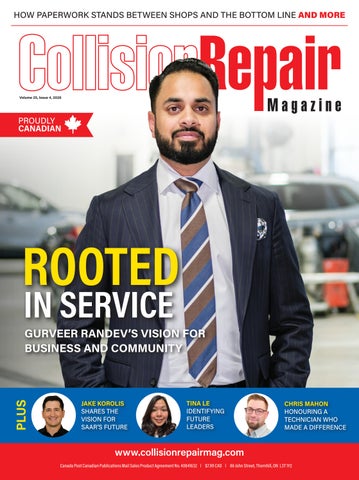
HOW PAPERWORK STANDS BETWEEN SHOPS AND THE BOTTOM LINE AND MORE
Volume 25, Issue 4, 2026
PROUDLY CANADIAN
ROOTED IN SERVICE
PLUS
GURVEER RANDEV’S VISION FOR BUSINESS AND COMMUNITY
JAKE KOROLIS SHARES THE VISION FOR SAAR’S FUTURE
TINA LE IDENTIFYING FUTURE LEADERS
CHRIS MAHON HONOURING A TECHNICIAN WHO MADE A DIFFERENCE
www.collisionrepairmag.com Canada Post Canadian Publications Mail Sales Product Agreement No. 40841632 l $7.99 CAD l 86 John Street, Thornhill, ON L3T 1Y2
Versatility at its finest. 3M™ Hookit™ Flexible Foam Abrasives combine flexible aluminum oxide abrasives with a soft foam backing to create a high performing, versatile blending abrasive for dry or wet use with machine or by hand.
Also available in
Flexible Foam Abrasive Sheets Reduce the risk of burn through on edges, bodylines and thinly coated surfaces
Take it to the edge.
Conforms to irregular surfaces, ensuring a uniform and consistent finish The perforated double sheet can be folded in half to enhance grip and control of the abrasive
Warranty and Limited Remedy: 3M warrants that each 3M product meets the applicable 3M product specification at the time 3M ships the product. 3M MAKES NO OTHER EXPRESS OR IMPLIED WARRANTIES OR CONDITIONS, INCLUDING ANY IMPLIED WARRANTY OR CONDITION OF MERCHANTABILITY OR FITNESS FOR A PARTICULAR PURPOSE. If a 3M product does not conform to this warranty, the sole and exclusive remedy is, at 3M’s option, replacement or repair of the 3M product or refund of the purchase price. Limitation of Liability: Except for the limited remedy above, and except to the extent prohibited by applicable law, 3M will not be liable for any loss or damage arising from or related to the 3M product, whether direct, indirect, special, incidental, or consequential, regardless of the legal or equitable theory asserted. For industrial/occupational use only. Not for consumer sale or use. Copyright 2026 by 3M. All rights reserved. 3M and Hookit are trademarks of 3M Company.
Contents
INSIDE CRM
VOLUME 25, ISSUE 4, 2026
HOW PAPERWORK STANDS BETWEEN SHOPS AND THE BOTTOM LINE AND MORE
34 ON THE COVER
PROUDLY CANADIAN
DRIVING 12 WHO’S By Jay Perry
ROOTED IN SERVICE
GURVEER RANDEV’S VISION FOR BUSINESS AND COMMUNITY
PLUS
How Gurveer Randev, CEO of Luxuria Group, is using his family business to give back to the community that has supported him and his family.
COLUMNS
PAGE 04 PUBLISHER’S By Darryl Simmons
Volume 25, Issue 4, 2026
JAKE KOROLIS SHARES THE VISION FOR SAAR’S FUTURE
TINA LE IDENTIFYING FUTURE LEADERS
CHRIS MAHON HONOURING A TECHNICIAN WHO MADE A DIFFERENCE
www.collisionrepairmag.com Canada Post Canadian Publications Mail Sales Product Agreement No. 40841632 l $7.99 CAD l 86 John Street, Thornhill, ON L3T 1Y2
GET TECHNICAL 14 LET’S By Stefano Liessi
42 OPINION By Doug Kirk
REGULARS
REPORT ON THE MOVE 06 PEOPLE 56 SAAR By Jake Korolis New roles, promotions and transitions among collision repair industry professionals. OF THE INDUSTRY 10 PULSE Exclusive Canadian Industry Performance report from AutoHouse Technologies.
WORD 66 LAST By Mackenzie Grant
FEATURES
30
OF MANITOBA 60 ATA By Theresa Jachnycky
32
Professionals from across Canada discuss leadership, learning and understanding the challenges shaping the future of the industry at the ACX Align conference.
The 2026 IBIS Global Summit in Vienna brings industry leaders together to discuss declining claims volumes and rising vehicle repair complexity.
38
48
What do collision repairers think about the paperwork standing between shops and their bottom line?
Dealerships are discovering a valuable revenue stream as they begin bringing back collision repair services.
SUBSCRIBE TODAY! We welcome your comments on anything you see in Collision Repair magazine. Send your feedback to editor@collisionrepairmag.com. ISSUE 25#4 | COLLISION REPAIR
3
PUBLISHER’S PAGE
BUILDING COLLECTIVE INTELLIGENCE Our industry’s greatest asset isn’t technology. It’s the knowledge we create every day. “THE INDUSTRY’S GREATEST OPPORTUNITY ISN’T SIMPLY ADOPTING ARTIFICIAL INTELLIGENCE. IT’S CAPTURING THE EXPERIENCE WE GENERATE EVERY DAY AND TURNING IT INTO SOMETHING THAT BENEFITS EVERYONE.”
T
4
COLLISION REPAIR COLLISIONREPAIRMAG.COM
ASSOCIATE PUBLISHER Orest Tkaczuk | orest@mediamatters.ca AUDIENCE ENGAGEMENT MANAGER William Simmons | william@mediamatters.ca ART DIRECTOR Yvonne Maschke | yvonne@mediamatters.ca ASSISTANT EDITOR Mackenzie Grant | mackenzie@mediamatters.ca STAFF WRITERS Sadie McDonald | sadie@mediamatters.ca Jaime Gilbert | jaime@mediamatters.ca VP OF INDUSTRY RELATIONS & ADVERTISING Gloria Mann 647.998.5677 | gd.mann@rogers.com INDUSTRY RELATIONS ASSISTANT Nishita Kapoor | nishita@mediamatters.ca
BY DARRYL SIMMONS
he collision repair industry has a knowledge problem. Not because it lacks expertise, but because every night much of that expertise walks out the door. Every day, bodyshops solve problems that make the next repair safer, faster and more profitable. They uncover OEM procedures, justify overlooked operations, defend proper repairs and negotiate fair compensation. Those lessons have value far beyond the shop where they were learned. Yet tomorrow another repairer will face many of those same challenges without the benefit of what someone else discovered yesterday. We continue to solve the same problems over and over again because there is no practical way to capture what we’ve learned and make it available to the next shop. No other major industry can afford to operate that way, yet collision repair has done exactly that for decades. Artificial intelligence didn’t create this problem. It simply exposed it. AI learns by recognizing patterns and improving every time it receives new information. That raises an uncomfortable question. If our greatest asset is our collective experience, why have we never built a way to collect it? Insurers already have. Every claim, every supplement and every repair decision becomes another lesson that strengthens their systems. Collision repair creates just as much knowledge, but it remains scattered across thousands of independent businesses. Shops are constantly discovering better ways to document repairs, defend OEM procedures and recover legitimate operations. The knowledge isn’t missing. It’s scattered. Artificial intelligence has enormous potential.
PUBLISHER Darryl Simmons | publisher@collisionrepairmag.com
It can organize information, identify trends, speed up research and eliminate repetitive work. It cannot replace the experience, judgment and accountability of skilled repair professionals. The shops that thrive won’t be those that surrender decisions to AI. They’ll be the ones that use it to make better decisions while allowing their people to focus on the work that matters most. The industry’s greatest opportunity isn’t simply adopting artificial intelligence. It’s capturing the experience we generate every day and turning it into something that benefits everyone. Imagine if every successful supplement, every documented OEM procedure and every hard-earned repair lesson became part of a growing body of knowledge built by repairers for repairers. Instead of learning alone, every shop would begin with the benefit of what hundreds of other repairers had already discovered. The first two waves of the CRM Collision Repair Index offered a glimpse of what’s possible. Nearly two-thirds of participating shops reported declining profitability, while insurer pressure emerged as the industry’s biggest concern. One shop has an opinion. Hundreds of shops have evidence. That’s what happens when knowledge is shared instead of isolated. We often say collision repair needs a seat at the table. Perhaps what we really need is a place to put what we know. Technology will continue to evolve. So will insurers. So will vehicle technology. The real question is whether we’ll finally begin treating our collective knowledge as one of the industry’s most valuable assets. Collision repair has the expertise. The challenge is making sure AI learns from it.
DIGITAL MEDIA ASSISTANT Willow Campbell | willow@mediamatters.ca MEDIA PRODUCTION SPECIALIST Dayna Dicuangco | dayna@mediamatters.ca INTERIM ONLINE EDITOR Gideon Scanlon | news@collisionrepairmag.com CONTRIBUTORS Wally Dingman, Garry Grant, Theresa Jachnycky Doug Kirk, Jake Korolis, Stefano Liessi Omar Nabil, Jay Perry, Tom Venetis, Kristi Werner
SUBSCRIPTION Single edition $7.99 One-year $39.95 ( 6 issues) Collision Repair™ magazine is published bimonthly, and is dedicated to serving the business interests of the collision repair industry. It is published by Media Matters Inc. Material in Collision Repair™ magazine may not be reproduced in any form without written consent from the publisher. The publisher reserves the right to refuse any advertising and disclaims all responsibilities for claims or statements made by its advertisers or independent columnists. All facts, opinions and statements appearing in this publication have been compiled and included with the permission, though not necessarily the endorsement, of the editor, or of independent columnist contributors, and are in no way to be construed as those of the publisher, or as endorsements of them. PRINTED IN CANADA ISSN 1707-6072 CANADA POST CANADIAN PUBLICATIONS MAIL SALES PRODUCT AGREEMENT No. 40841632 RETURN POSTAGE GUARANTEED Send change of address notices and undeliverable copies to: 317 Reid St., Peterborough, ON K9J 3R2
“We acknowledge the financial support of the Government of Canada”
Collision Repair magazine is published by Media Matters Inc., publishers of:
The You’ve Earned The Freedom You’veEarned Earned TheFreedom Freedom You’ve The You Deserve TheSupport Support SupportYou YouDeserve Deserve
ururr SStaStartatrrtYteYoYyoeouyN Nowooww N n n r y r e u u o n o JJJour
Grow Grow business. Reclaim Growyour yourbusiness. business.Reclaim Reclaim your time. terms. your Live on your terms. yourtime. time.Live Liveon onyour your terms.
Let’s TalkAbout About Let’s Let’sTalk Talk About YourNext NextChapter Chapter Your
Your Next Chapter
1-800-871-7612
1-800-871-7612 1-800-871-7612 contact@simplicitycc.com contact@simplicitycc.com contact@simplicitycc.com
www.simplicitycc.com/franchisee-mm
www.simplicitycc.com/franchisee-mm www.simplicitycc.com/franchisee-mm
NEWS
People on the Move FRANK BLOUIN — REGIONAL GROWTH AND PERFORMANCE MANAGER AT SIMPLICITY CAR CARE Simplicity Car Care has appointed Frank Blouin as regional growth and performance manager for Quebec and the Atlantic provinces. In the role, Blouin will work with franchise partners on performance, growth opportunities, market development, key performance indicator management, business-to-business negotiations and regional network growth. The bilingual Montrealer most recently served as vice-president of sales and operations at Matrix Motor Distribution. His previous experience includes senior leadership roles with CMI Motor/CFMOTO Canada, ARGO XTV and Polaris Inc., where he spent two decades overseeing a large Eastern Canadian territory. collisionrepairmag.com/15827921
MAX SORENSEN — CHIEF CLIENT OFFICER AT CALIBER HOLDINGS LLC Caliber Holdings LLC has appointed Max Sorensen as chief client officer, a role focused on enterprise client strategy across Caliber Collision, Caliber Auto Glass and Caliber Fleet Solutions. Sorensen will lead client partnerships, collaboration and the connection between customer-facing initiatives and operational performance. He brings more than 22 years of industry and operations experience to the position, most recently serving as senior vice-president of operations for Caliber Collision’s Northeast region. His previous roles include leadership positions overseeing collision repair operations across multiple markets. collisionrepairmag.com/15828047
TERRY HAITAS — REGIONAL VICE-PRESIDENT FOR ONTARIO EAST AT AUTOCANADA AutoCanada has appointed Terry Haitas as regional vice-president for its Ontario East Region, overseeing dealership operations across the area. Haitas steps into the role after serving as general manager of Subaru of Hamilton. The Edmonton-based dealership and collision repair group highlighted Haitas’ operational experience and track record within the organization as part of the appointment. The move comes as AutoCanada continues to expand its automotive operations, including recent growth in its collision repair network through acquisitions in Ontario and Alberta. collisionrepairmag.com/15828734
ARAM ZAKHARIAN — NATIONAL SALES DIRECTOR AT CARSTAR CANADA CARSTAR Canada has appointed Aram Zakharian as national sales director. In the role, Zakharian will help strengthen national partnerships and support the company’s growth and partner engagement strategy. He brings more than a decade of experience in strategic account management, business development and national partnership growth. Most recently, Zakharian held progressive leadership and sales roles, where he developed and managed national insurance and fleet partnerships across Canada. collisionrepairmag.com/15827581
6
COLLISION REPAIR COLLISIONREPAIRMAG.COM
PASSION FOR PAINTERS.
Made for each other. jet X and RPS.
A top choice for the jet X: The SATA RPS multipurpose cup system is ideal for mixing, painting, refilling, and storage. RPS cups ensure an immediate, even flow of material. They make quick color changes easier and are simple to use. And best of all: You don't need an adapter.
jet X. Works for you INFO www.sata.com/jetX
INDUSTRY NEWS
LOCATION LAUNCH:
FIX AUTO MEADOWVALE CELEBRATES OPENING BY SADIE MCDONALD
On June 24, Fix Auto Meadowvale celebrated its grand opening at its new location in Mississauga. The event included raffle prizes from on-site sponsors, door prizes and a meetand-greet with the Fix Auto Meadowvale team. All proceeds from the event went to Ronald McDonald House Canada. Collision Repair attended the event and spoke with Claudia Morgillo and Claudio Chiodo of Doublesee Enterprises Inc., partners and multi-shop owners with Fix Network, on Fix Auto’s newest location. According to the partners, Fix Auto Meadowvale opened for two primary reasons. “We wanted to provide an environment that was transparent to the consumer,” said Claudio. “So from the start of the repair, the consumer can see their car, from when they walk in through to doing repairs and advanced inspections.” The second reason encompassed the desired employee environment. “We have a climate-controlled environment for the technicians, a clean open workspace with enough lunchrooms and an environment that fits the modern next generation of employees,” said Claudia. “It rewards the older employees who have been in the industry for a long time, who haven’t necessarily been treated the way that they should.” In addition to its three detail bays and multiple inspection bays, the new facility can spray five vehicles simultaneously, creating a fast lane to complete small repairs more quickly, eliminating them from the general repair queue. Furthermore, the shop can separate repairs from a refinish standpoint, effectively producing two cycles working concurrently on a daily basis. The shop’s layout utilizes its square footage well, from a track system that moves vehicles in and out of booths to a detail bay that allows multiple vehicles to be pre-washed and delivered together. While Fix Auto has had aluminum repair capability for a long time, the new shop increases customer awareness and perception of Fix Auto Meadowvale’s ability to handle EVs and calibrations, Claudio said. “Those are all things that we do here on site,” he added. “And so, we’ve incorporated all of those technological changes into the current model and are looking forward to what the future models will be.” Fix Auto Meadowvale also has protecting consumers’ assets in mind, made possible by its secured pound area. “It allows for vehicles that are coming online,” said Claudia. “So if they come off the highway and are brought into our pound, the vehicles don’t have to sit outside and come inside at night; instead, they go into the pound and stay protected.” The fast-lane approach allows the team at Fix Auto Meadowvale to better handle dealership work, and insurance companies benefit from transparent triage and the separation between repair style and size. “I think if we can get our car count to where we want it to be, if we’re fully staffed with employees that are enjoying their workspace and that we continue to deliver the service levels that we’ve promised to our consumers, that we can see that reflected in our reviews, then we will know this investment has worked,” concluded Claudio. Fix Auto Meadowvale is Doublesee Enterprises’ seventh Fix Auto location, joining Fix Auto Burlington, Fix Auto Cambridge, Fix Auto Etobicoke, Fix Auto Hamilton Centre, Fix Auto Kitchener and Fix Auto Streetsville, in addition to four NOVUS Glass locations in the Greater Toronto Area. collisionrepairmag.com/15828630 8
COLLISION REPAIR COLLISIONREPAIRMAG.COM
GOLD STANDARD
PLATINUM IS
ABSORBERS • BUMPERS • BUMPER BRACKETS • BUMPER REINFORCEMENTS • DOORS FENDERS • GRILLES • HOODS • LIGHTING • MIRRORS • STEP BUMPER ASSEMBLIES • WHEELS
LIMITED LIFETIME WARRANTY All Keystone Platinum Plus products offer the highest standards and Industry-leading Limited Lifetime Warranty.
CAPA CERTIFIED Over 90% of Keystone Platinum Plus aftermarket collision repair products are CAPA Certified.
ABSORBERS • BUMPERS • BUMPER BRACKETS • BUMPER REINFORCEMENTS • DOORS FENDERS • GRILLES • HOODS • LIGHTING • MIRRORS • STEP BUMPER ASSEMBLIES • WHEELS
NOTE: Eligible parts only. Wheels are excluded from CAPA certification but are subject to strict SAE standards. LIMITED LIFETIME WARRANTY
All Keystone Platinum Plus products offer the highest standards and Industry-leading Limited Lifetime Warranty.
Call Today! (866) LKQ-CORP | (866) 557-2677 Call Today! or(866)OrderLKQ-CORP Online at| (866) LKQCanada. ca/en/ 557-2677
CAPA CERTIFIED
Over 90% of Keystone Platinum Plus aftermarket collision repair products are CAPA Certified.
NOTE: Eligible parts only. Wheels are excluded from CAPA certification but are subject to strict SAE standards.
or Order Online at LKQCanada.ca/en/
©2021 on. ©2021 LKQ LKQ Corporati Corporation.
®
An LKQ Company An LKQ Company ®
PULSE OF THE INDUSTRY REPORT
JUNE REPAIR INVENTORY HITS ANNUAL LOWS
CYCLE TIMES IMPROVE AS ORDER VALUES DECLINE
C
anadian collision repairers carried less repair inventory in June than at any point in more than a year, while insurer-paid repair-order values fell and production performance continued to improve, according to the latest Pulse of the Industry report from Collision Repair magazine and AutoHouse Technologies. The report, based on more than 60,000 monthly repair orders across Canada, found the industry’s average work-in-progress ratio fell to 10.5:1, down 9.2% from the prior three-month average. The WIP ratio compares the total repair hours represented by vehicles on site with a shop’s average daily output. A ratio of 10.5:1 represents approximately 10.5 days of repair inventory at the current production rate. Top-performing repairers typically maintain between 7.5 and 11.0 days of repair inventory, according to the report. The June result continued a steady decline. The industry’s WIP ratio stood at 12.7:1 in February, 12.2:1 in March, 11.6:1 in April and 10.6:1 in May. “June’s data shows an industry carrying less repair inventory than at any point in the past year,” said Mike Gilliland, president and founder of Vancouver-based collision analytics provider AutoHouse Technologies. “As WIP has declined, operational KPIs have continued to improve.” Collision Repair’s publisher Darryl Simmons said a falling WIP ratio can have more than one cause. “A lower WIP ratio can reflect tighter production control, but it can also signal fewer repair opportunities,” Simmons said. “The important question is whether shops are deliberately carrying a leaner inventory or simply have less work available.” The report found average cycle time declined to 13.1 days, down 3.8% from the prior three-month average and slightly below the 13.2 days recorded in May. Cycle time measures the period from a vehicle’s arrival for repairs through delivery to the customer. The top 10% of repairers averaged a 5.8-day cycle time. That was 2.3% above their prior three-month average, but remained less than half the overall industry average. Average touch time increased to 2.6 labour hours per repair, per day, up 2.6% from the prior three-month average. The top 10% of repairers produced 4.8 labour hours per repair, per day, an increase of 4.2% from their prior three-month average. The operational improvements coincided with a further decline in insurer-paid repair-order values. The average insurer-paid sale per repair order was $231 below the prior six-month average and fell another $131 from May. The average customer-pay sale per repair order remained $67 below the prior six-month average, although it increased by $18 from May. “The decline in insurer-paid repair-order values matters because better throughput does not automatically protect revenue,” Simmons said. “The industry can move repairs through the shop more efficiently while the average insurer-paid job generates less revenue.” Gilliland said disciplined operating processes will become more important if repair opportunities continue to soften. 10
COLLISION REPAIR COLLISIONREPAIRMAG.COM
“Strong markets can hide inefficient processes. Slower markets expose them,” he said. “If repair opportunity continues to soften, the performance gap between disciplined operators and the rest of the market is likely to widen.” Pulse of the Industry is produced through a partnership between Collision Repair and AutoHouse Technologies. The data has been normalized, with variance thresholds applied to remove anomalies. Financial figures are presented before tax.
FULL REPORT HERE:
collisionrepairmag.com/15830318
Evaluate your Performance? Curious how your shop stacks up? Our enhanced benchmarking tool compares your performance against national, provincial and regional peers. Using real operational data — not surveys — you can quickly identify where to improve efficiency, boost throughput and grow profitability. Learn more to see if benchmarking is a fit for your business. Learn more at autohousetechnologies.com/crmpulsereport
About this Report Pulse of the Industry is the result of a powerful collaboration between Collision Repair magazine, Canada’s leading collision industry publication, and AutoHouse Technologies, the nation’s foremost provider of real-time repair performance analytics. Compiled from over 60,000 monthly repair orders completed by Canada collision repairers. All information has been normalized, with variance thresholds applied to remove anomalies and ensure data integrity.
Exclusively partnered with
collisionrepairmag.com/pulse-of-the-industry
PULSE OF THE INDUSTRY REPORT
June 2026 CDN Industry Performance
ISSUE 25#4 | COLLISION REPAIR 11
WHO’S DRIVING
THE INTIMIDATION OF CHANGE WHY TODAY’S LEADERS MUST LEARN TO EMBRACE UNCERTAINTY AND TURN CONSTANT CHANGE INTO A COMPETITIVE ADVANTAGE
BY JAY PERRY
I
t has been said that people don’t like change. I believe that. Based on my education and experience, I have come to believe that change is perceived by the brain as a threat. This threat is not minor. The brain actually is quite binary in its function and change can be perceived as existential (a threat to existence — life itself). You see, over the years we have learned how to survive with the way we are doing things: we put food on the table, clothes on our backs and a roof over our head because we have figured out what we need to make that happen. Then someone (or something) comes along and says, “Let’s do it differently!” That is threatening to our brains. So if that is the root of the fear behind change how can we overcome feelings of overwhelm in today’s age? Change continues to come at us daily. Not at a pace that is comfortable or even at times,
manageable. So let’s learn a little more about it so we as leaders, can devise strategies that help us cope with change. In a recent article (Harvard Business Review, May-June 2026, page 30) the authors point out that four factors are in play: A larger volume of change is coming at us, the scope of that change is increasing and change is becoming more unpredictable, driven by political, economic, technological
WE NEED TO PREPARE OURSELVES AND OUR TEAMS TO EMBRACE CHANGE, BECAUSE THAT EMBRACE IS WHAT KEEPS YOU DRIVING FORWARD. and societal forces. Speed of change has increased dramatically. What we have to do to stay in the lead position is create a shift in perspective on change. Change needs to become embraced more like a journey than a shift in location.
JAY PERRY Jay Perry is the founder of Ally Business Coaching, a process improvement and leadership development firm, and co-author of the book Success Manifesto with Brian Tracy. Jay is also an education partner with California Coast University in Santa Ana, California. He can be reached at jayperryally@gmail.com.
For more columns by Jay Perry visit collisionrepairmag.com/15738685
12
Once change has created a new reality the forces are still in play to bring further change so it truly becomes never-ending. Another important thing to keep in mind is being excited for change as if it were a special occasion is setting up a real “let-down” because when the successive change starts it can feel like the previous round of change was a loss. We need to think of it as transitional. Moving us from one paradigm to the next
COLLISION REPAIR COLLISIONREPAIRMAG.COM
knowing there will be more following that is the mindset we need to cultivate to handle change successfully. Much of what we encourage our staff to embrace such as continuous education, expanding knowledge of current expertise, learning completely new sets of skills and more (like embracing technology), can be expensive and we as investors need an ROI. The thing is that any future ROI is going to come from something we have changed. We have already tapped out the maximum return in the way we are doing things now. Change will drive future profits. It is not an easy journey but it is a simple one. You must prepare yourself and your team members to embrace change. That embrace is truly going to be the only thing to keep you the one who’s driving!
Any P.A.R.T Any Time.
P. A. R. T. Paint & Supplies
Aftermarket
LKQ’s Got It! Drivetrains Wheels Body Cooling/HVAC
Electrical Emissions Exhaust Audio
Recycled
Transmissions & Engines
With more than 500 locations across North America and thousands of dedicated employees to serve you, LKQ has the automotive parts you need. Whether it’s Paint and Supplies, Aftermarket, Recycled, or Transmission & Engine Remanufactured Parts, we’ve got it! Fuel Delivery Interior Power Steering Restraint System
Parts to Paint Body Repair Supplies Equipment ...and more!
866-LKQ-CORP http://lkqcanada.ca/en
LET’S TALK
INDUSTRY STANDARDS THEY ARE WHAT YOU WANT THEM TO BE
BY STEFANO LIESSI
T
he primary rule in our industry is to follow the OE procedures. I hear this and read it daily; it is always the go-to answer, especially when uncertainty or questionable processes are available. I recently saw a post on one of the social media platforms that documented an extremely poor repair, one that was done to a friend’s vehicle. It was a front bumper cover repair and was billed out for a total of $500. The repair was dismal at best, apparently done by someone who is dabbling in this field as a hobby. Now, for me, a hobby falls in line with assembling plastic models or painting figurines, possibly collecting stamps or coins, which is known as numismatics, something I learned recently. Repairing a vehicle and charging a fee is no longer a hobby; the monetary exchange of funds deems it a ‘job,’ and receiving funds for a service deems you a professional. What I
a Band-Aid to fix a hole in an ocean liner. A quick search of the (ever-so-cringeworthy) internet can give you some basic guidance. I use ‘basic guidance’ liberally here as it is not a fail-safe source of information unless you already know what to search for to find what you need to know. The consumer in the case of the bumper repair is completely unaware of what it takes to repair a cover, the materials and the skill set to necessitate the repair. They truly believe that the money spent was for a proper repair. To be clear, I do not know these people and was not privy to the conversations that led to the agreement. Let us assume for a moment that the case is that they truly thought as indicated. In less than a few days, they noted something was off with the repair and stopped by an actual collision shop to have it looked at. At this point, I am pretty certain there is a ‘friend’ that will no longer be
content. And it takes a lot of time and effort to get that message across to consumers. Traditionally (and some still use it today), many would refer to ‘industry standards’ as the catchphrase to support the thought process of a quality repair. ‘Not to worry, Edna, we only perform industry standard repairs.’ What is an ‘industry standard repair’? Because there is no ‘code’ book, guide or legislation to define it. There has truly never been an ‘industry standard’ as nothing in the repair of a modern-day vehicle is ‘standard.’ If there is an ‘industry standards’ manual around, please share with me a copy; I’ll wait. This catchphrase has been used for decades as an answer to questions many had no answers to. OE repair procedures have become the closest thing to an ‘industry standard,’ yet, again, there is absolutely nothing standard amongst them. The advancements in modern vehicles have mandated, in their own way, a requirement for
OE REPAIR PROCEDURES HAVE BECOME THE CLOSEST THING TO AN ‘INDUSTRY STANDARD,’ YET THERE IS ABSOLUTELY NOTHING STANDARD AMONGST THEM. found most disturbing was not the repair or the photos (although they were like rubbernecking a car crash; you can’t help but look); it was the comment posted below that said with smug conviction, “that’s a $500 repair,” implying that this is acceptable and deserving on the customer’s behalf. It is this mindset that continually makes performing a service more difficult daily for many tradespeople, be it construction, plumbing, electrical and of course, automotive. There is a massive gap between what is presented as available out there and what is accepted in the collision industry. Why am I being so hard on this individual? Because with the access to information that we have instantly at our fingertips, there is no excuse for using
14
receiving a Christmas card. The collision shop revealed the evidence to the clients and now had to begin not only explaining what needs to be done correctly, but also beginning the repair of a yet-again tarnished part of our industry. This scenario happens more often than not; it is disappointing. We are fully aware that there are ‘back-yarders’ out there and how they can diminish our reputation. Here is the thing: we also have established businesses that (hopefully unintentionally) do the same thing. When dealing with the modern vehicle, it is paramount that we adhere to professional, quality repairs that emulate the original build process to the best of our abilities. Hence, OE repair procedures. There is a lot to unpack when you start to dig into the verbiage of repair
COLLISION REPAIR COLLISIONREPAIRMAG.COM
some sort of accurate information source. Not every OE is 100% committed; however, they are getting better. In the past, we would repair every vehicle the same way with the same tooling and the same skill set. Past is the operative word here; it is history. Today, it is necessary to pull up the procedures and do a dive into them to flesh out the nuances of the project that sits in front of you. Now we are required to source the multi-material locations and the limitations of repair, what features are under the ADAS umbrella, electronics locations, the secret handshake of disconnecting a battery, what happens when you do disconnect the battery, measuring the vehicle (3D measure), welding procedures and position statements, to name a few obstacles.
LET’S TALK
IT IS NO LONGER A SERVICE NOR AN AMENDED CATCHPHRASE. FOLLOWING OE PROCEDURES IS A REQUIREMENT OF A PROPER REPAIR. All of this ‘research’ needs to be done before you start repairs and order parts, not during or after. It takes time, a lot of time. I guess if you want to use the catchphrase ‘industry standards,’ in the past our industry standards didn’t account for this deep dive. Now it is basically mandatory. Recently, I put together an information video on researching the application of a roof panel on a Toyota. The process suggested a questionable application method that did not make sense. After a few hours of digging and reading, I found supporting OE information on an alternative procedure. In the end, better for the technician, better for the vehicle and better overall for the whole process. This was only one portion of the repair; I did not get into all the other
related operations that the vehicle would have to undergo. This takes time; it is required time, not an option. The lad that fixed the bumper did none of this, and the repair failed. ‘Industry standards’ never mentions this; it is assumed that you are doing it, but we all know what happens when you assume… The administrative burden is insurmountable in today’s collision industry, in my opinion, and you are entitled to my opinion; it is mainly due to the implementation of ‘industry standards’ and the various erroneous perceptions of its meaning. Not only has that catchphrase been very ambiguous, but it has also eroded the trust we need so desperately in our field due to the multiple variations of those standards.
If the OE is to become our base constant, it will require dedication, time, and comprehension to implement what is required for the proper repair; this is extremely administrative in nature and will need to be accounted for. It is no longer a ‘service’ nor is it an amended catchphrase; it is a requirement of a proper repair and ergo is now a line item, a judgement line item, not a fixed cost. A line item that you will explain to the customer. As you can see, there is a great deal of difference between the old-school industry standard of “I can fix it for $500” versus the proper processes required within our industry. Welcome to the beginning of what could actually become the ‘industry standard.’
STEFANO LIESSI Stefano Liessi is the Training and Curriculum coordinator for Color Compass Corporation. He is also a Red Seal technician and refinisher. Stefano enhances his 40 years of experience with 15 years of I-CAR instruction and a post-secondary degree. He also trains Skills Alberta students and has brought home 11 medals for the province, and taught high school students in the auto shop for six years. He can be reached at sliessi@colorcompass.com.
For more columns by Stefano Liessi visit collisionrepairmag.com/15738697
“Color Compass leads the automotive refinish and specialty market distribution industries by providing sustainable and profitable business solutions based on innovative products and tailor-made services. We foster continuous improvement by creating a culture of caring for our people, our suppliers, and our customers.”
www.colorcompass.com ISSUE 25#4 | COLLISION REPAIR 15
FROM BANK TO BAY
People, Performance and a Decade of Growth
“WE WANT TO BE THE BEST IN THE MARKETS WE SERVE. THAT MEANS FOCUSING ON QUALITY REPAIRS, BUT ALSO ON HOW CUSTOMERS FEEL THROUGHOUT THE PROCESS.” — LANA MORITZ, CFO AND OWNER, FIX AUTO MORITZ GROUP
T
he path into collision repair is rarely predictable. For some, it’s their birthright. For others it begins with a lifelong passion for vehicles. For Lana Moritz, CFO and owner of Fix Auto Moritz Group, it began in banking. “I worked in the banking industry for years,” she explains. “My husband [Andy] and I always had a strong desire to work together. After a major life change, I made the decision to step away from banking and join the shop full time.” What followed was more than a career change. It was a transformation that would eventually lead to the growth of a multi-location operation and a leadership role. Today, Lana’s philosophy, rooted in teamwork, family values and a commitment to quality, influences how employees and customers experience the business. “We want to be the best in the markets we serve,” she says. “That means focusing on quality repairs, but also on how customers feel throughout the process.” As customer expectations continue to evolve, this dual focus has become increasingly important. Beyond technical precision, customers want communication, transparency and confidence that their vehicle is being handled with care. That mindset is reflected in Moritz’s open-door policy, which encourages employees to share ideas and feedback, while regular activities help reinforce connection and build morale. As she explains, “we always try to foster a positive and supportive work environment. Whether it’s team outings or simply making space for conversations, it’s important that people feel heard.”
Lana has “always believed in teamwork and the value of family. We use these family values daily to run our collision shops and value the people that make up our teams,” she said. This approach has profoundly shaped how the business has grown. What began as a shared goal between husband and wife has expanded into a family-run operation that now includes their son, along with employees who are treated like extended family. That spirit of collaboration also influenced a major milestone in the company’s growth. “We were independent before joining Fix Auto, but we were looking for a partner to help us grow,” Moritz says, adding the “partnership has been instrumental in our success.” She values the opportunity to connect with fellow franchisees, exchange ideas and learn from others facing similar challenges. “It’s not just the resources. It’s the network. Knowing you have support at every level, and that you can learn from others who are facing the same challenges, makes a big difference.” Today, the Fix Auto Moritz Group comprises four Fix Auto locations (Fix Auto Calgary Deerfoot, Fix Auto Drayton Valley, Fix Auto Strathmore and Fix Auto High River) and NOVUS Glass Calgary Deerfoot. As the group celebrates the 10th anniversary of Fix Auto Calgary Deerfoot, the achievement serves as both a reflection of how far the business has come and a foundation for its next chapter of growth. For Lana,
it is also a reminder of the dedication of the employees, customers and industry partners who have contributed to that success over the past decade. As vehicles become more complex, collision repair centres must adapt. Lana’s people-first philosophy has also influenced how the business approaches training, technology and repair quality. She continually invests in both her people and in the technology upon which they rely. Supporting ongoing training and professional development remains an important part of that commitment, ensuring employees have the knowledge and tools needed to keep pace with an increasingly complex industry. “We’re always eager to learn more about new technology and how to apply it to our repairs,” she says. “It’s about delivering the best possible experience and ensuring quality.” Recent upgrades include advanced frame straightening equipment and glue pulling systems designed to improve efficiency and reduce cycle time. They have also prioritized certifications, including Gold Class and CCC, to ensure every repair meets OEM standards. “We’ve invested in equipment and certifications because it matters. It’s about doing the job right.” Growth remains part of the long-term vision, with Lana and Andy continuing to explore additional opportunities within Fix Network. “We’re always looking at ways to expand and improve,” she says. “There’s always something to learn, and always a next step.” While much has changed since she first entered the industry, the values that guide Lana’s approach have remained remarkably consistent. From her perspective, the formula is simple: “Take care of your people. Take pride in your work. The rest follows.”
For more insights visit the Fix Network Canada YouTube channel.
IN MEMORIAM
LASTING LEGACY REMEMBERING CHRIS MAHON
BY MACKENZIE GRANT
C
hris Mahon, a longtime body technician at CARSTAR Newmarket remembered by colleagues for his technical expertise, dedication to safe repairs and commitment to his community, has died. He was 36. He is survived by his eight-year-old daughter, Lily, and his father. Mahon joined CARSTAR Newmarket when its current ownership took over in 2016 and quickly became a cornerstone of the business. Over nearly a decade, coworkers said his commitment to quality repairs, continuous learning and customer safety helped shape the shop's reputation while his quiet, dependable presence made him part of the family. "Chris was a really talented individual who really dedicated himself to his craft and this industry," said Ashley Deokinandan, operations manager at CARSTAR Newmarket. "He was very committed to learning and growing within the auto industry." D e o k i n a n d a n s a i d Ma h o n w a s instrumental to the shop's success, describing him as its highest-producing technician and crediting him with helping carry the business through the COVID-19 pandemic while working as its sole body technician. "He wasn't a corner cutter," she said. "He was incredibly mindful of the people that drove the vehicle, not just how fixing the vehicle could benefit himself. There was a greater purpose behind everything that he did."
Peter Barilla, who worked beside Mahon for more than a decade, said his colleague's work ethic was matched by his generosity. "For 10 or 11 years we've been working side by side," Barilla said. "We worked well together. We always helped each other out. He was very team oriented." "He was always willing to go above and beyond," Barilla added. "Any time they needed something from him or we needed something from him, he would always try to accommodate." Deokinandan said Mahon's impact reached well beyond the shop floor. "He was a large participant" in CARSTAR Newmarket's fundraising efforts for Cystic Fibrosis Canada, she said. "Always supporting behind the scenes, which is really valiant and special. That's the kind of character you really look for in a person." Asked what she hopes the collision repair industry remembers about Mahon, D e ok i n and an p oi nte d to b ot h h i s craftsmanship and his character. "I think it's important for everybody to remember that Chris was really a driving factor in the Newmarket community, really pushing to break barriers in the industry, doing everything that he could to improve his skill, doing everything he could to improve his quality," she said. "We always want to remember him for his soft-spoken but really impactful way of interacting with people — vendors, staff,
family, friends and the community alike." Outside the shop, Mahon's greatest pride was his daughter, Lily. "Chris loved his daughter, he spent every spare second with her that he could," Deokinandan said. She recalled Mahon's love of the outdoors, saying he built a rooftop tent for his truck so he and Lily could camp together while exploring nature. "He loved doing things like that and he was always doing it to share memories with his daughter," she said. Barilla said Mahon brought the same enthusiasm to his friendships as he did to his work. The two bonded over punk music, concerts and skateboarding during the more than 10 years they spent working together. He said those moments, both inside and outside the shop, are what he'll remember most. "All in all, my experience with Chris has been a great one," Barilla said. "There's not a lot of people that I could say they've worked side by side with somebody for that long and didn’t argue once." CARSTAR Newmarket has launched a GoFundMe campaign to support Mahon's daughter, Lily. The shop said it will continue to honour the legacy of the technician colleagues remember as an exceptional craftsman, devoted father and valued friend. "We'll never be the same without him," Deokinandan said. collisionrepairmag.com/15828967
18
COLLISION REPAIR COLLISIONREPAIRMAG.COM
“ More than ever, our customers depend on us to keep their vehicles safe and reliable. Being part of the CARSTAR network gives us the support and expertise to deliver on that promise every day.” — Justin Gareau Owner, CARSTAR Sudbury (Autoworks)
DRY SAND & BUFF WIPE AWAY DUST, NOT PRODUCTIVITY BUFF TO SHINE IN A FRACTION OF THE TIME
Flexible Bonding Fast & Shallow Sanding
True Dry Sanding
Ultra-Uniform Finish
No Mess & No Waiting
Minimize Deep Scratches & Rework
Super Assilex K-800
K-1000
K-1200
K-1500
CORRECT
Super Buflex K-2000
K-2500
K-3000
REFINE
CORRECT & MATCH TEXTURE
POLISH SANDING
Micro-Hook Interface Pads
Use low-profile hooks for the best finish
Ready for Final Buffing!
UP TO 50% LESS BUFFING TIME Replace costly, messy multi-step buffing with Super Assilex & Super Buflex — delivering a finish that can buff to shine in one step, without wool pads. The K-SYSTEM can be used totally dry, so you can monitor progress instantly with no mess, no prep, and no waiting. WHY DOES K-SYSTEM BUFF SO EASILY?
K-SYSTEM
OTHERS
EXTREMELY UNIFORM SANDING PATTERN
MORE WORK TO REFINE
Hi-Tech Topcoat Finishing Kit Part No. SP19358 K-1500 to K-3000 Discs + Pad Scan to learn more
Available at your local PBE suppliers
By EagleAbrasives.com
EVENTS
ENTERPRISE MOBILITY CHARITY GOLF ANNUAL TOURNAMENT SUPPORTS FOOD BANKS
PAR FOR A PURPOSE
Industry partners gathered at King Valley Golf Club to support Enterprise Mobility's 28th annual charity golf tournament, raising $160,000 for Food Banks Canada's After the Bell program.
T
he 28th annual Enterprise Mobility charity golf tournament raised $160,000 for a Food Banks Canada program that provides food to children during the summer. The tournament took place at King Valley Golf Club in King City, Ont. Donations and sponsorships included a $70,000 contribution from Enterprise Mobility. Representatives from Canada’s insurance, collision repair, dealership and replacementrental sectors attended the event. The money will support Food Banks Canada’s After the Bell program, which distributes child-friendly food packs when school meal programs are unavailable during the summer. The packs include shelf-stable foods such as milk, hummus, crackers, cereal and oatmeal. Participating organizations also receive funding for fresh fruit, vegetables, dairy products and protein. “Events like this are a powerful reminder of what we can accomplish when we come together with our partners around a shared purpose,” said Jennifer Everett, vice-president of sales, replacement and leisure division Canada at Enterprise Mobility. “The continued support and momentum behind this tournament allow us to expand our impact and help ensure more families across Canada have access to the food they need, especially during critical times of the year.” National Hockey League players also attended, meeting participants and signing autographs. Enterprise Rent-A-Car is the flagship rental brand of Enterprise Mobility and a major provider of temporary replacement vehicles through insurers, collision repair centres and dealerships. Since the Fill Your Tank program began in 2016, more than US$125 million has been distributed to over 800 hunger-relief organizations in North America and Europe. A $30-million commitment to Food Banks Canada through 2030 forms part of the program’s broader funding for organizations addressing food insecurity.
Check out the CRM event photo gallery by visiting collisionrepairmag.com/ 15829550
ISSUE 25#4 | COLLISION REPAIR 21
EVENTS
ON THE GREEN FIX NETWORK’S 17TH ONTARIO MASTERS GOLF TOURNAMENT
F
ix Network’s Ontario region welcomed 136 golfers to its 17th annual Masters Golf Tournament this week, bringing together franchise owners, corporate staff and industry partners for a day of connection, friendly competition and fundraising in support of Ronald McDonald House (RMH) Canada. Despite a morning of heavy rain, spirits remained high as participants took to the course, reinforcing the tournament’s reputation as a standout event on the calendar. As the day progressed, the weather improved, setting the stage for an engaging and memorable experience both on and off the course. Golfers enjoyed a range of on-course culinary stations throughout the day, along with interactive activities and contests that added to the energy of the event. Among the highlights was the popular Beat the Pro challenge as well as the Doug Roberts “Happy Gilmore” Longest Drive Slapshot,
held in memory of the respected franchise ow ner and long-t ime champion of the network. The event concluded with a sit-down clubhouse dinner, where attendees gathered to reflect on the day and celebrate the collective impact of their efforts. Winners of the silent auction and 50/50 draw were announced, rounding out a successful fundraising initiative that generated $13,000 in support of RMH Canada. Guests also heard from Korey Rorison, partnership & engagement officer for Ronald McDonald House South Central Ontario, who shared powerful stories of the families supported by RMH Canada. Rorison spoke to the strength of the ongoing partnership with Fix Network and the meaningful difference it continues to make, noting the organization’s recent milestone of surpassing $1 million raised in support of RMH Canada since 2016.
The success of the tournament was made possible through the generous support of its sponsors. Hole sponsors included Uniparts O.E.M., AkzoNobel, Enterprise, Mirka, Mitchell, Ontario Spray Booth LTD., 3M, Norton, NAPA CMAX, Axalta, Uni-Select, PPG, LKQ, Nexera, ALLDATA, Spanesi, Carquest Auto Parts and Hunter. Additional thanks were extended to those who contributed prizes to the silent auction, including LKQ, Humberview Chevrolet Buick GMC, Johnny D’Ambrosio (Fix Network multi-shop owner), Akzo Nobel, OEC, PPG, Carquest and Spanesi. With strong attendance, enthusiastic participation and a continued focus on giving back, this year’s tournament once again demonstrated the strength of the Fix Network community and its enduring #LifePutRight commitment to standing alongside families as a trusted partner through life’s unexpected moments.
Check out the CRM event photo gallery by visiting collisionrepairmag.com/ 15828150
22
COLLISION REPAIR COLLISIONREPAIRMAG.COM
EVENTS
Fix Network’s 17th annual Ontario Masters Golf Tournament brought together 136 golfers, including franchise owners, corporate staff and industry partners, for a day of friendly competition, networking and fundraising in support of Ronald McDonald House Canada.
Totaled car, Underpaid claim?
OUR SERVICES Independent Vehicle Valuations We provide unbiased, third-party appraisals working for you, not the insurance company. Fight Low Settlement Offers If your vehicle has been declared a total loss, we help ensure you’re not underpaid.
You Might be Owed More. Let us Help!
Market-Based Valuations We use real, current vehicle listings to determine what your car is actually worth. Low Kilometre & Condition Adjustments We account for mileage, condition, and recent work—factors insurers often overlook. Detailed, Professional Reports Our reports are structured to stand up to insurance adjusters and support negotiations.
“I was so relieved to have Collision Safety Consultants step in and deal with the insurance adjuster. And besides that, I got a fair settlement. This is the stress free way to get it done.” - Cathy
Increase Your Payout Potential Many clients receive higher settlements after submitting our valuation. Fast Turnaround Get the documentation you need quickly so your claim isn’t delayed. Ontario-Based, Industry Experienced We understand local market values and insurance practices.
By Appointment Only 9520 Tecumseh Rd East, Windsor 519-979-1256 cj.collisionsafety@gmail.com
WE WORK FOR YOU — not the insurance company. Your safety, your vehicle, your rights.
ISSUE 25#4 | COLLISION REPAIR 23
EVENTS
TEE IT UP
CHC’S CHARITY GOLF TOURNAMENT KICKS OFF THE UNOFFICIAL START OF SUMMER
A
little heat and humidity did nothing to dampen the spirits of the golfers at this year's CHC Paint and Body Shop Supplies charity golf tournament at Cedar Brae Golf Club in Scarborough. For the past eight years, the event has become the collision repair industry's unofficial start of summer, bringing together shop owners, suppliers, insurers and this year, a full team from Collision Repair magazine. "This is what the industry looks like when it gets out of the shop and onto the fairway," said Manny Pacheco, vice-president of CHC Paint and Body Shop Supplies. "Eight years in, and what strikes me every time is the energy on the course. Shops talking to suppliers, insurers talking to shops, everyone just connecting. No agenda. No pressure. That is what we set out to build and it is exactly what this has become." "There is nothing quite like getting together with friends and colleagues, enjoying a beautiful day on the course and knowing that every shot you take is contributing to a great cause like the Canadian Cancer Society,” said Mike Savage, national account manager at 3M. The tournament captures everything that makes this industry special. Days like this remind you how strong this community really is.” 24
More than 120 golfers took to the fairways, chasing birdies, celebrating the occasional spectacular shot and doing their best to forget the ones that found the rough. Prizes generously donated by industry supporters helped make the day an even bigger success for the Canadian Cancer Society. "We started this tournament because we believed in this community," said Pino Chiappetta, president of CHC Paint and Body Shop Supplies. "What we have watched it grow into, the relationships built here, the conversations that happen between holes, the way people show up for each other and for a cause like the Canadian Cancer Society, that is bigger than anything we planned. This is the unofficial start of summer. Every year, without fail." All proceeds from this year's tournament will be donated to the Canadian Cancer Society.
COLLISION REPAIR COLLISIONREPAIRMAG.COM
Check out the CRM event photo gallery by visiting collisionrepairmag.com/ 15827492
Precision-Crafted Parts for Your Vehicle Demand the best for your Ford.
Order OEM Parts at Aftermarket Pricing through CollisionLink®
The trusted Ford dealer below has the genuine OEM parts you’re looking for. Order now and keep your repairs on track.
YONGE-STEELES Ford Lincoln Sales Limited 7120 Yonge St, Thornhill, ON L4J 1V8 Tel: 905-889-7343 Fax:905-764-4105 yongesteelesfordlincoln.com
FORD PARTS
DIRECT PARTS: 905-764-4131 Email: parts@yongesteelesfordlincoln.com
ONE OF FORD OF CANADA’S LARGEST COLLISION LINK® DEALERS
The Future of Canadian Auto Insurance Claims Will Be Defined by Intelligence by OMAR NABIL, VP OF CLAIMS SOLUTIONS, CANADA SOLERA
Vehicle complexity is reshaping claims Modern vehicles are fundamentally changing the nature of a claim. What was once a relatively straightforward repair can now involve sensor recalibration, software diagnostics, OEM-specific procedures and highly specialized expertise. Even low-speed collisions can trigger a cascade of technical requirements due to cameras, radar systems and safety features embedded throughout the vehicle. This added complexity is increasing both repair severity and variability across Canadian auto insurance claims. For claims leaders, this creates a clear challenge. Traditional workflows and assumptions no longer hold. Faster triage, more accurate estimating, and stronger repair network alignment are becoming essential capabilities.
The Canadian auto insurance industry is entering one of the most significant periods of transformation in its history. It is facing a new kind of pressure. Claims are becoming more complex, repair costs are rising, and customer expectations continue to increase. At the center of it all is a shift toward data, AI, and increasingly sophisticated vehicles. While the core purpose of insurance remains rooted in protection, trust, and service, the environment surrounding those fundamentals has changed dramatically. Today’s vehicles are no longer purely mechanical. They are rolling data platforms, equipped with advanced driver assistance systems, embedded sensors, connected software, and increasingly complex electric vehicle technologies. This shift is transforming Canadian auto insurance claims from end to end. And it is happening faster than many organizations are prepared for.
EV growth is driving new cost and cycle time pressures Repairable EV claims in Canada continue to rise year over year, bringing new operational challenges with them. EV repairs often require more diagnostic steps, specialized tooling, and trained technicians. Parts availability and repair capacity can also vary significantly depending on region. As a result, cycle times are increasing and costs continue to rise across the industry. For example, repairs that might have taken a few days in the past can now extend significantly due to calibration requirements or limited access to certified repair facilities. For insurers, the implication is clear. Managing EV-related claims effectively will require new expertise, tighter collaboration with repair partners, and better use of data to guide decisions.
AI is transforming how Canadian auto insurance claims are managed At the same time, artificial intelligence and advanced analytics are creating new opportunities to modernize the claims experience. Across the industry, there is a shift from reactive handling of claims toward more predictive and intelligent operations. AI can assist with damage assessment, automate portions of estimate generation, improve fraud detection, streamline communication, and accelerate payments.
Adjusters, appraisers, and repair professionals bring judgment, context, and empathy that technology cannot replace. AI works best as an enabler, helping people make faster and more informed decisions rather than replacing them. A human-in-the-loop approach ensures that decisions are not only efficient, but also fair, transparent, and aligned with customer needs. The insurers that succeed will be those that combine intelligent technology with experienced professionals who know how to apply it effectively.
More importantly, these capabilities reduce friction during one of the most stressful moments in a customer’s journey.
The future will be built on intelligence and execution
However, many insurers are still focused on digitizing the front end of the claims process while leaving downstream workflows largely unchanged. That gap is where delays and inefficiencies often persist.
The next decade will not be defined by scale alone. It will be defined by how well insurers build and use intelligence across their ecosystems.
The organizations that move faster to modernize the full claims lifecycle will be better positioned to control costs and improve customer satisfaction.
Customer expectations are redefining the experience with claims Customer expectations are no longer shaped by insurance alone. Today’s policyholders compare their claims experience to the digital interactions they have with retailers, delivery services, and transportation platforms. They expect speed, transparency, personalization, and simplicity as a baseline. When those expectations are not met, it quickly impacts brand perception and loyalty. For Canadian insurers, this means claims is no longer just an operational function. It is a defining moment in the customer relationship. Meeting these expectations requires more than technology. It requires rethinking how information flows, how decisions are made, and how customers are engaged throughout the process.
Why human expertise still leads As AI adoption accelerates, one thing remains clear. Technology alone will not define the future of Canadian auto insurance claims. Human expertise remains indispensable.
This includes: • Connecting data across the claims lifecycle • Strengthening collaboration with repair networks and partners • Applying AI in a way that improves real operational outcomes • Keeping customer experience at the center of every decision Canada is uniquely positioned to lead this evolution. The market can draw on global innovation while building solutions tailored to local realities, including regional regulation, climate risk, EV adoption, and repair capacity constraints.
Final perspective The future of Canadian auto insurance claims will not be defined by technology alone. It will be shaped by how effectively the industry brings together data intelligence, operational agility and human expertise. Insurers that close the gap between digital capability and day-to-day execution will be the ones that control both cost and customer experience. And in a market where both are under increasing pressure, that distinction will matter more than ever.
claims.solera.com
SHOP FLOOR SOLUTIONS
S
DRIVING INTELLIGENT CLAIMS & REPAIR SOLUTIONS
olera | Audatex is a leading provider of automotive claims, repair and data intelligence solutions, serving insurers, collision repair facilities, OEMs and industry partners worldwide. Its innovative software helps streamline the entire claims and repair process through advanced estimating, AI-powered damage assessment, vehicle valuation, parts sourcing and workflow management. Products include Audatex Estimatics, Qapter AI claims solutions, Autosource vehicle valuation, Total Loss Management and Alternative Parts Utilization (APU). By combining intelligent technology with industry-leading data, Solera helps customers improve efficiency, accuracy and customer satisfaction across the vehicle lifecycle. During our visit to Don Valley Collision Centre, the chief estimators shared why Qapter is their preferred estimating solution: Qapter provides the most up-to-date vehicle information, including exclusive Genesis data, and its intuitive prompts and customized parts interface help streamline the estimating process; APU delivers exceptional ease of use, speed and accuracy when sourcing aftermarket parts. “At Solera, we greatly value the insights shared by our customers, as their feedback is essential to our continuous improvement.”
claims.solera.com For more Solera | Audatex stories and industry news, visit collisionrepairmag.com/15740483
“WE THANK THE WEINS GROUP FOR THEIR TIME, VALUABLE FEEDBACK AND THE STRONG PARTNERSHIP WE CONTINUE TO BUILD TOGETHER.” — SOLERA | AUDATEX
FUELING THE FUTURE
SPONSORED CONTENT
How ACX is redefining technical excellence through apprenticeship
I
n an industry grappling with a talent shortage, ACX isn’t just participating in the conversation about the next generation of collision professionals, they’re leading it. By making a significant investment in young talent, the company is securing its own growth trajectory while elevating the standard of repair across Canada. The cornerstone of this strategy is the ACX National Apprenticeship Program. Designed to bridge the gap between technical college and the shop floor, the program offers a dual layer of mentorship. Apprentices benefit from the hands-on guidance of local collision centre veterans and the strategic oversight of the Corporate Leadership team. Perhaps the most striking evidence of ACX’s commitment to developing youth is their approach to tools. Upon registration, every apprentice is equipped with a professional-grade MAC Toolbox valued at approximately $10,000. It isn’t just a loan; once the apprentice successfully completes their trades programs and exams, the toolbox is theirs to keep. By removing the financial barrier of equipment costs, ACX allows body repair and automotive paint students to focus entirely on their craft from day one.
This investment is paired with a tiered education roadmap that ensures ACX shops are staffed by the most qualified technicians in the market: • LEVEL 1: Focuses on online OEM training, BASF introduction to paint and prep, and the critical I-CAR Steel Welding test. • LEVEL 2: Advances to online OEM modules, BASF Base Clear Coat training, and I-CAR MIG Brazing. • LEVEL 3: Culminates in-person OEM training, BASF Colour Adjustment, and the prestigious I-CAR Aluminum certification. For ACX, this isn’t just philanthropy, it’s a growth engine. By cultivating a pipeline of highly skilled, loyal professionals, they are able to scale their national network with confidence, knowing their quality of repair is backed by the best-trained hands in the business. Interested in the future of collision repair? Contact apprenticeship@acx.auto for more information.
BY CULTIVATING A PIPELINE OF HIGHLY SKILLED, LOYAL PROFESSIONALS, ACX IS ABLE TO SCALE THEIR NATIONAL NETWORK WITH CONFIDENCE.
EVENTS
ACX ALIGN CONFERENCE VISION IN MOTION BY WILLIAM SIMMONS
GATHERING IN BRITISH COLUMBIA'S OKANAGAN VALLEY, COLLISION REPAIR PROFESSIONALS FROM ACROSS CANADA SPENT THREE DAYS DISCUSSING LEADERSHIP, LEARNING AND UNDERSTANDING THE CHALLENGES SHAPING THE FUTURE OF THE INDUSTRY.
Check out the CRM event photo gallery by visiting collisionrepairmag.com/ 15828580
30
K
elowna is known for its vineyards, where years of planning, investment and patience eventually produce results worth celebrating. The same could be said for the conversations taking place at this year's ACX Align Conference — Vision in Motion. Gathering in British Columbia's Okanagan Valley, collision repair professionals from across Canada spent three days discussing leadership, learning and understanding the challenges shaping the future of the industry. While sessions covered everything from vehicle technology and diagnostics to customer loyalty, brand retention, and organizational growth, a common message emerged: organizations that continue to invest in people (the fuel of an organization) will be best positioned for what comes next. For ACX President Arthur Crawford, that journey is already well underway. "We've built the engine. We've developed a platform for growth," Crawford told attendees during his opening remarks. That vision was less about growth for growth's sake and more about creating an organization capable of adapting to an
COLLISION REPAIR COLLISIONREPAIRMAG.COM
industry that continues to evolve at a rapid pace. Throughout the conference, speakers repeatedly returned to the importance of leadership, training and building teams equipped to navigate change. Crawford challenged attendees to view many of the industry's biggest challenges through a different lens. "At ACX, we choose to turn these headwinds into tailwinds," he said, referring to increasing vehicle complexity, OEM certification requirements and rapidly advancing technology. Whether discussing diagnostics and calibration, customer loyalty, workforce development or emerging technology, presenters emphasized that standing still is no longer an option. Continuous improvement is a requirement rather than a competitive advantage. Keith Crerar, chief transformation officer at Reparify Inc. and president of AsTech, noted that experience alone is no longer enough. "The tried-and-true 20-year technician that does everything from memory used to be their greatest advantage. That person you could hand anything to, and they'd figure it
EVENTS
out because they'd done it thousands of times before. Now, that person is potentially your greatest liability," said Crerar. "The modern technician really needs to be someone who's willing to read, to research, to learn and then repeat that cycle over and over again." Several sessions explored leadership development, mentorship and creating opportunities for the next generation of collision repair professionals. Discussions around apprenticeship programs, career development and supporting women in the industry highlighted the importance of building a workforce capable of meeting tomorrow's challenges. One of the conference's standout sessions featured broadcaster George Stroumboulopoulos, who shared insights and stories from his career interviewing some of the world's most recognizable figures. He later welcomed Canadian musician Steven Page for a conversation on creativity, reinvention and authenticity, followed by a live performance that became one of the event's most memorable moments. Together, the two guest speakers delivered a powerful reminder about embracing change and growth.
ISSUE 25#4 | COLLISION REPAIR 31
EVENTS
THE FORCES RESHAPING THE REPAIR INDUSTRY
DATA, COMPLEXITY AND LEADERSHIP DOMINATE IBIS GLOBAL SUMMIT 2026
D
eclining claims volumes, rising vehicle complexity, data and artificial intelligence, and the need for stronger leadership emerged as the defining themes at the IBIS Global Summit 2026 in Vienna, Austria, where collision repair leaders from around the world gathered to discuss the forces reshaping the industry. CLAIMS VOLUMES AND COMPLEXITY Rex Green of Jefferies LLC addressed concerns around declining claims volumes, telling delegates that much of the recent downturn may be cyclical rather than structural. Advanced safety technology is reducing accident frequency, he said, but increasing repair complexity continues to drive higher-value repairs. Green said lower accident frequency does not mean simpler economics for the collision sector. More complex vehicles are changing the work required after a collision and increasing the value of individual repairs. "It takes more work to fix a car today," Green said. "Cars are more expensive to repair, there’s more labour involved and significantly more calibration work." He said the industry should prepare for a future in which repair complexity plays a larger role than repair volume. Automotive analyst Steve Greenfield pointed to advanced electronics, advanced driver assistance systems, AI and growing competition from Chinese automakers as forces reshaping the automotive market. "The cars are dramatically more complex than they were even a few years ago," Greenfield said. That complexity is already visible across the collision sector, where repairs increasingly require scanning, calibration, documentation, research and process control. Greenfield also pointed to China’s growing role in vehicle manufacturing and EV production as a force 32
likely to influence global vehicle design, pricing and repairability over the next decade. Bart De Groof, vice-president, global refinish marketing at Axalta, focused on the industry’s response. "Exclusivity is not the answer," De Groof said. "One technology, as good as it is, is not going to solve the problems that we are facing." He called for greater collaboration and integration across the collision repair ecosystem, pointing to a need for more practical dialogue between repairers, insurers, OEMs, suppliers and technology providers. DATA AS THE INDUSTRY'S UNTAPPED ASSET During one of the summit’s rapid-fire presentations, Dave Gunderson, vicepresident, global automotive refinish at 3M, challenged delegates to rethink how the industry views information. "What is the most valuable asset in your company?" Gunderson asked. "What is the most valuable, or undervalued, asset in the
COLLISION REPAIR COLLISIONREPAIRMAG.COM
collision industry today?" His answer: data. Gunderson said collision repair businesses generate millions of data points every day through repair planning, production tracking, customer interactions and operational performance, but much of that information remains trapped within individual organizations. While many businesses use data to measure past performance, Gunderson said the next opportunity lies in predictive decisionmaking. Analytics, AI and shared information could help repairers anticipate parts delays, forecast capacity constraints, identify repair trends and improve customer communication before problems occur. "The future collision industry will not be defined by who repairs the vehicles the best," Gunderson said. "It will be defined by who learns the fastest." He called for greater collaboration among repairers, insurers, suppliers and technology providers, arguing that better information sharing could improve outcomes across the industry.
EVENTS
LEADERSHIP THROUGH UNCERTAINTY Leadership was another recurring topic throughout the summit. Sabrina Thring, president, Collision Group & Driven Glass Canada, spoke about leading through uncertainty at a time when collision repair businesses face soft claims volumes, consolidation and increasingly complex vehicle technology. Thring oversees franchise locations across CARSTAR Canada, CARSTAR U.S. and Fix Auto USA. She told delegates that leadership requires adaptability, resilience and a willingness to embrace change, and that the strongest organizations are built around people who keep learning and stay open to new ways of doing business. Thring described the current environment as an opportunity for independent repairers willing to invest in training, technology and operational excellence. Rather than chasing every new trend, she encouraged repairers to focus on the vehicle itself. "If you follow the car and you understand the repair process, it’s not hard to build a plan," she said. Thring said shops can apply that philosophy to emerging technologies such as artificial intelligence, digital customer acquisition and workflow automation. Those tools can improve efficiency, she said, but understanding the repair journey remains the foundation for long-term success. She also pointed to the growing importance of customer-pay work and the digital customer experience, noting that repairers can no longer rely solely on traditional referral channels. Shops need to get better at attracting, engaging and retaining customers while managing rising operating costs and increasingly sophisticated repairs.
A DIFFERENT REPAIR ENVIRONMENT For Canada’s collision sector, the themes coming out of Vienna are familiar. Shops are dealing with more complex repairs, higher documentation expectations, labour shortages, training demands and pressure to prove that procedures have been followed. Insurers are watching claim costs closely. The message from Vienna is that the industry isn’t simply facing fewer or more claims. It’s facing a different repair environment. As vehicles become more expensive, more connected and more software-driven, collision repair businesses will need to compete on process, training, documentation, efficiency and trust, alongside the data and leadership strategies needed to keep pace. The summit also continued a revised IBIS format introduced earlier in 2026, with a stronger focus on shorter sessions, moderated debate, roundtable discussion and direct engagement between delegates.
In an earlier interview with Collision Repair, IBIS conference director Robert Snook said the organization had “transitioned from being an event to an experience.” "We want to be an environment to connect changemakers in the region," Snook said. As delegates departed Vienna following two full days of presentations, debate and networking, one message came through repeatedly: information, technology and leadership are becoming as important to business success as repair expertise itself.
Check out the CRM event photo gallery by visiting collisionrepairmag.com/ 15827927
ISSUE 25#4 | COLLISION REPAIR 33
COVER
ROOTED
IN SERVICE BY SADIE MCDONALD
G
Under Gurveer Randev's leadership, Luxuria Group has expanded its collision repair footprint while maintaining a strong focus on customer service and community involvement. 34
COLLISION REPAIR COLLISIONREPAIRMAG.COM
urveer Randev, CEO of Luxuria Group, understands the life-changing power of generosity. The 35-year-old entrepreneur owns four Fix Auto locations but got his start as a homebuilder. Born and raised in Calgary, Gurveer is passionate about giving back to the community. Luxuria Group is a family business that began with conversations at the table. Growing up, Gurveer’s parents, Harvir Randev and Charnjit Randev, openly discussed starting a business one day, and those concrete conversations transformed into a business where its partners had the head start of having already lived out their shared values together for years. “The greatest benefit [of working with family] is trust, but not in the way people might expect,” said Gurveer. “It’s that we never have to explain why we care. When you’re sitting across the table from your sister or your parents, there’s no hidden agenda, no positioning. Everyone already knows what we’re building and why it matters. That shared understanding is something you really can’t manufacture.” For Gurveer, working with family has also translated into the practical advantage of being able to be direct when communicating about quick or uncomfortable decisions, and has shifted Luxuria Group’s focus onto long-term goals. “We’re building something we want to still be standing twenty years from now,” said Gurveer. “My parents came to this country with very little and
COVER
Luxuria Group's growth reflects a familydriven approach focused on people, performance and community impact.
HOW LUXURIA GROUP IS TRANSFORMING FAITH, GENEROSITY AND RESPONSIBILITY INTO LONG-TERM IMPACT
worked hard for a long time before any of this took shape. Watching that as a kid, watching them stay patient and focused without losing their values, is what drives all of us now. We feel a real responsibility to honour what they built, and I think that responsibility makes us sharper.” Gurveer’s two older sisters, Gurpreet and Harpreet, also work for the family business. Gurpreet joined in 2006 and was the company’s first employee. Today, Gurpreet is the vicepresident of strategy and development at Luxuria Group, leading Luxuria Auto and Luxuria’s childcare operations. Harpreet is the chief operating officer of Luxuria Group, overseeing all operations across the organization, including single-family homes, multi-family projects, commercial development, automotive, childcare and property management. “What I’m most proud of is that neither of them needed a title to earn their place here,” said Gurveer. “They both built their credibility the hard way and the same way our parents taught us to. The roles they hold today reflect years of real work, and that’s what actually matters.” Luxuria Group entered the automotive industry in 2019 and now operates six locations across two networks: CRE Calgary North and CRE Calgary South under the CRE banner and Fix Auto Nolan, Fix Auto South Central, Fix Auto Pegasus and Fix Auto Saskatoon East within the Fix Auto banner, marking Luxuria’s first location outside of Alberta.
Gurveer Randev has expanded Luxuria Group's collision repair operations while maintaining a strong commitment to philanthropy, community partnerships and family values. ISSUE 25#4 | COLLISION REPAIR
35
COVER
“ Those two [CRE] locations were foundational for us because they gave us our footing in the collision space and taught us a lot about how to run a high-volume, customer-focused operation at a standard we could build on,” said Gurveer. This standard is shaped by the importance of giving back to the community and understanding what it feels like to need a helping hand. For Gurveer, giving back is personal. “My parents came to Canada in the 1970s with very little. They worked hard, kept their heads down and along the way, people treated them with dignity and gave them opportunities they never took for granted,” said Gurveer. “It shaped how they raised us, and it shaped the kind of company we set out to build.” Giving back to the community is also important for Gurveer because the community gave him and his sisters a home, friendships and the opportunity to grow. Moreover, Gurveer and his family’s Sikh faith is a guiding core principle at Luxuria. “In Sikhism, the concept of seva, selfless service, is considered one of the highest callings a person can answer,” said Gurveer. “It means serving others without any expectation of reward or recognition. It’s not about being seen doing good. It’s about doing good because it’s right.” S eva is demonstrated in the charitable organizations that Luxuria Group supports, including educational bursaries, food banks and a women’s shelter. Giving back to the South Asian community through annual contributions or one-time donations is also one of Gurveer’s priorities, as he credits the community with giving his family its roots, values, faith and sense of identity. Luxuria’s growth aims to be a testament to hard work and purpose, proving that one’s background is a strength, not a barrier. Growing up in a family where education was foundational, Gurveer established a perpetual bursary at the University of Calgary to remove barriers to education for young people, with a focus on those from immigrant and South Asian families. “The fact that it’s perpetual is intentional,” said Gurveer. “We don’t want it to be a one-time gesture. We want it to still be helping students long after we’re gone.” "Gurveer has built an impressive business by staying true to the values that both Fix Network and Luxuria Group are built upon; integrity, hard work, and a genuine commitment to people. His ability to grow strategically while maintaining a strong culture and community involvement reflects the qualities we value across the network. We’re proud to champion and support Gurveer 36
Gurveer Randev participates in a community initiative alongside TD representatives, reflecting Luxuria Group's commitment to supporting local organizations and meaningful causes.
and the entire Luxuria Group as they continue to expand their impact within the collision repair industry and beyond," said Chris Peterson, regional vice president, Fix Network. Luxuria Group also donates regularly to food banks and agencies across Calgary. “Hunger does not wait. It’s immediate, and the need is real,” said Gurveer. “For families who are new to this country and still finding their footing, food security can be the difference between stability and crisis.” Moreover, Luxuria Group draws on its homebuilding roots in its support of its not-for-profit arm Unlocked Doors, an organization providing “affordable housing and support for women and children rebuilding their lives after experiencing abuse,” explained Gurveer. Unlocked Doors not only addresses immediate housing needs but also helps create long-term stability and independence for vulnerable families. “We believe everyone deserves a safe place to call home, particularly women and children facing circumstances beyond their control,” Gurveer said. “As a company whose roots are in building communities, supporting organizations that provide both shelter and opportunity aligns closely with our values.” S imilarly, Luxuria Group has also assisted in the completion of a women’s shelter in Calgary, becoming involved when the original project contractor walked away. Stepping up to help, Luxuria Group redesigned key elements to improve how the space functioned, increasing its operational capacity and reducing costs without cutting corners. Throughout his involvement with these charitable organizations, Gurveer has learned how much gets done quietly. “When you actually get close to organizations like the food banks or the women’s shelter, you see people showing up every single day without any fanfare, doing incredibly hard work because they believe in it,” he said. “That’s
COLLISION REPAIR COLLISIONREPAIRMAG.COM
been humbling, and it’s changed how I think about what real commitment looks like.” The shelter project reinforced this lesson, providing Gurveer with a deeper insight into what these organizations actually need, and how close to home that need is. “We talk about food insecurity or domestic hardship as though they’re distant problems, but they’re not,” Gurveer said. “They’re happening in our neighbourhoods, in our communities and in families that look a lot like ours.” L ooking ahead, Luxuria Group is working towards establishing a second perpetual bursary at the University of Calgary, something which is deeply personal to Gurveer, who graduated from the university’s Haskayne School of Business. However, perhaps what Gurveer is most excited about is the work Luxuria Group is doing to establish its own charitable foundation for children. While a formal announcement has yet to be made, Luxuria Group’s vision is clear: “Children are the future in the most literal sense, and if we can build something that consistently shows up for them through education, opportunity or simply stability, that’s the kind of work that outlasts any building we’ll ever construct,” said Gurveer. Ultimately, real involvement, not writing a cheque, is what matters most to Gurveer. Found in showing up, understanding what’s actually needed, and being willing to do the unglamorous work, the seva embodied by Luxuria Group is a giving of the self. For Gurveer, that is tied to what it means to be Canadian. “This country gave our family a chance when they arrived with very little. It didn’t ask for much in return. Just that we contribute, that we participate, and that we leave things better than we found them,” he said. “We haven’t forgotten that. As Luxuria grows, our ability to live up to that responsibility grows with it.”
Make every minute count with our proven systems. Fix Auto is a game changer.
Your craftsmanship in auto body provides a solid foundation which continues to get stronger. But as you already know, there’s much more to this business. Fix Auto is invested in forward thinking and bringing global best practices to building your local business. Drive your business forward with: • Solid performance-driven operational model and ongoing training. • Full branding and marketing support for local awareness and promotion. • Proven experience in winning insurance work. • Established global supply and fleet arrangements. Our owner started as a franchisee, and this inspires our commitment to the success of the local business owner.
Find out more at
fixauto.com
SURVEY RESULTS
CRM COLLISION REPAIR INDEX
PAPER CHASE
WHAT TWO NATIONAL SURVEYS OF CANADIAN COLLISION REPAIRERS REVEAL ABOUT THE PAPERWORK NOW STANDING BETWEEN SHOPS AND THEIR BOTTOM LINE BY DARRYL SIMMONS
T
wo surveys into the CRM Collision Repair Index, a clear picture is emerging of an industry buried in paperwork and paying for it at the bottom line. Earlier in 2026, Collision Repair magazine launched the CRM Collision Repair Index, a national benchmarking initiative built to measure the business conditions facing Canada's collision repair industry. Rather than relying on anecdotal conversations or isolated experiences, the index gives the industry a consistent, recurring snapshot of the pressures shaping repair facilities from coast to coast. Each edition examines a single operational challenge while building toward a longer-term benchmark of the industry's 38
health, one that will let repairers, suppliers, insurers and policymakers track changing conditions and spot emerging trends backed by Canadian data. The response so far has been encouraging. The inaugural survey, Profitability Pressure, attracted nearly 100 responses from collision repair professionals across the country. The second, Claims Friction and Administrative Burden, drew even greater participation with 102 completed responses. Together, the first two editions have produced more than 200 responses from owners, managers, estimators and business leaders. That is only a fraction of Canada's approximately 4,000 collision repair facilities, but it is enough to
COLLISION REPAIR COLLISIONREPAIRMAG.COM
offer meaningful insight into what is actually happening on shop floors across the country, and the sample will keep growing with every edition the Index publishes. The first survey found an industry under real financial strain. More than two thirds of respondents reported profitability had declined over the previous 12 months, and insurer pressure, labour costs and administrative workload emerged as the three biggest threats to business performance. At the time, administrative workload was one pressure among several. The second survey suggests uncompensated admin work may be doing the most damage, and helps explain why.
CRM COLLISION REPAIR INDEX
PROFITABILITY VS. 12 MONTHS AGO 92% of respondents to the second survey said administrative workload is higher than it was two years ago and three quarters described Slightly stronger 8% that increase as significant. Only 3% said the load had gone down. Viewed alongside 22% About the same the profitability findings, the results suggest growing paperwork has become a measurable, Slightly weaker 41% ongoing contributor to the financial pressure facing Canadian repair businesses, not just 27% Significantly weaker background noise. Asked where they spend the greatest n= 88 respondents amount of uncompensated administrative time, 59% of respondents pointed to insurer More than two thirds of respondents reported profitability had declined over the previous 12 months. communication, the single largest source. Supplement preparation followed at 53%, then TOP PRESSURES ON PROFITABILITY photo documentation at 50%, OEM repair procedure research at 46%, parts procurement Insurer pressure 64% at 38%, DRP reporting requirements at 34% and calibration documentation at 33%. The Labour costs 62% spread suggests the burden is not concentrated 58% Administrative workload in one bottleneck. It runs through virtually every stage of the repair process. 48% Technician shortages "Updating repair status on multiple Parts delays 36% programs. We have to log the same information into several different estimating Equipment investment 30% and management platforms just to keep Calibration/ADAS costs everything current," said a manager at a 12% franchise/ banner collision centre in Alberta, n= 88 respondents, multi-select describing a routine that repeats itself on every file. An MSO owner in Ontario pointed Insurer pressure, labour costs and administrative workload emerged as the three biggest threats to business performance. to a related frustration further upstream, in the parts data itself. "Part numbers are STAFFING DIFFICULTY constantly wrong, and options are constantly missing. Parts are the biggest problem in our industry," they said. 20% Low difficulty (0 to 3) The paperwork is also driving conflict. More than three quarters of respondents Moderate difficulty (4 to 6) 22% reported disputes with insurers over required repair operations at least weekly, and nearly High difficulty (7 to 10) 58% one third said those disagreements happen every day. Only 12% said insurers generally support required repairs without challenge, n= 88 respondents, scale of 0 (not difficult) to 10 (extremely difficult); average score 6.3 while nearly a third said support varies significantly depending on which insurer Canada's collision repair industry is facing a growing staffing challenge as rising documentation requirements consume valuable time from managers, estimators and front-office personnel. they are dealing with. "Everything should be repaired following OEM procedures. There would be no OPERATION TYPE OF RESPONDENTS argument over what is required and what is Dealer collision centre not required," said the owner of a franchise/ 2% 21% banner collision centre in Nova Scotia. Others described the volume of documentation MSO 37% itself as the flashpoint. "The constant photo documentation to justify repairs. Pulling, Franchise/banner frame setup, before primer, pre-paint and collision centre 40% paint photos. It never ends," said an MSO owner in Alberta. A shop manager in Nova Independent bodyshop Scotia framed it as a trust problem more than a process problem, saying insurers need to n= 88 respondents
Significantly stronger
2%
ISSUE 25#4 | COLLISION REPAIR 39
SURVEY RESULTS
FREQUENCY OF DISPUTES OVER REQUIRED REPAIRS trust that shops are completing repairs as required rather than demanding repeated proof through an ever-growing volume of in-progress photos. That growing burden is increasingly falling on the people who are supposed to be running the business, not just the technicians on the floor. More than 70% of respondents estimated that at least 31% of management time is now devoted to administrative responsibilities rather than production, and more than one third said paperwork consumes over 40% of management time. Every additional hour spent on documentation and approvals is an hour unavailable to move repairs through the shop, and for many owners it is time spent instead of the work that actually pays. Money, and the lack of it, ran through nearly every comment. "The problem isn't the documentation. We just need to be compensated properly for our time and knowledge at the administrative level," said an independent shop owner in British Columbia. Another independent shop owner in Alberta put it more bluntly: there is no single requirement they would eliminate, because their shop has effectively absorbed almost the entire administrative relationship with insurers, from the first call with the policyholder through to final estimate approval. A franchise/banner shop in Ontario summed up the frustration that showed up again and again in the written comments: shops attach all the required documentation, follow every procedure, and still have to argue to get paid. The findings held consistently across every type of operation surveyed. Independent shops made up the largest share of respondents, followed by franchise and banner collision centres, MSOs and dealer collision centres. Regardless of size or ownership structure, the pattern was the same: rising administrative load, frequent friction over required procedures and management time increasingly consumed by paperwork rather than production. Respondents also pointed to inconsistent insurer processes as a major source of inefficiency, describing duplicate data entry across multiple estimating, claims and management platforms and calling for greater consistency in documentation requirements across the industry. The geography told a similar story. Respondents represented every region of the country, with Ontario, Alberta and Saskatchewan accounting for the largest share of participants, and further responses from Nova Scotia, British Columbia, 40
16%
Rarely 6%
Monthly
18%
Weekly Several times per week
30%
Daily
31%
n= 101 respondents The CRM Collision Repair Index highlights a growing pattern of frequent disputes over required repairs, reinforcing concerns about inefficiencies in today's claims process.
INSURER SUPPORT FOR REQUIRED REPAIRS Insurers generally support required repairs
12%
Support varies significantly by insurer Insurers frequently challenge required repairs Insurers routinely challenge required repairs
32% 27% 28%
n= 99 respondents Repairers spend valuable time defending necessary repair procedures.
Quebec, Manitoba, New Brunswick and Prince Edward Island. The complaints were not confined to one province or one type of insurer relationship. They showed up in independent shops on both coasts, in franchise operations across the Prairies and in MSOs running multiple locations, suggesting the administrative burden is a structural issue rather than a regional or companyspecific one. For an industry already contending with tight margins, the implications reach beyond time management. Every hour spent chasing a supplement approval or re-uploading a document already on file elsewhere is an hour a shop cannot bill, and the survey suggests those hours are adding up across the country, not just in isolated cases. For insurers, the findings point to an opportunity as much as a criticism. Greater consistency in documentation requirements, and less duplication across competing platforms, would reduce friction for claims staff and repairers alike. For the shop owners describing the problem in their own words, the more immediate question was simpler: who pays for the paperwork required to prove a repair was done right? Taken together, the first two editions of the CRM Collision Repair Index tell a connected story. The first identified profitability as the industry's biggest business concern. The
COLLISION REPAIR COLLISIONREPAIRMAG.COM
second points to one of the underlying causes. As repair procedures grow more sophisticated and documentation requirements continue to expand, many repairers say the challenge is no longer just repairing vehicles correctly. Increasingly, it is managing the administrative process required to repair them properly, document every step along the way and get paid fairly for the work performed. Paperwork that used to be a cost of doing business now looks, for a growing number of Canadian shops, like a business problem in its own right. Future editions of the CRM Collision Repair Index will continue tracking the issues shaping Canada's collision repair industry, building what Collision Repair magazine intends to become the country's definitive benchmark of repairer sentiment and business conditions. Each new wave will add to the picture already emerging from the first two, and each will give repairers, insurers and suppliers a clearer, more current read on where the pressure is actually coming from rather than where it is assumed to be. Two surveys in, the message from the shop floor is consistent and getting louder. Canadian repairers are not asking for less accountability, and none of the respondents suggested cutting corners on documentation that protects consumers or supports proper repairs. They are asking to be paid for the time it now takes to prove they have earned it.
CRM COLLISION REPAIR INDEX
IN THEIR OWN WORDS
THE SURVEY DATA TELLS ONE PART OF THE STORY. THESE COMMENTS FROM COLLISION REPAIR PROFESSIONALS ACROSS CANADA PROVIDE ADDITIONAL INSIGHT INTO THE DAY-TO-DAY CHALLENGES BEHIND THE NUMBERS.
“EVERYTHING SHOULD BE REPAIRED FOLLOWING OEM PROCEDURES. THERE WOULD BE NO ARGUMENT OVER WHAT IS REQUIRED AND WHAT IS NOT REQUIRED.”
“THE CONSTANT PHOTO DOCUMENTATION TO JUSTIFY REPAIRS. PULLING, FRAME SETUP, BEFORE PRIMER, PRE-PAINT AND PAINT PHOTOS. IT NEVER ENDS.”
— FRANCHISE/BANNER, NOVA SCOTIA
— MSO, ALBERTA
“DOCUMENTING REPAIR PROCEDURES AND ARGUING WITH INSURANCE THAT IT IS REQUIRED OPERATION.”
“CLAIM DOCUMENTATION, OEM PROCEDURES, PARTS INVOICES, CALIBRATION REPORTS AND SCAN REPORTS ALL HAVE TO BE UPLOADED, EVEN THOUGH THE INFORMATION IS ALREADY STORED ELECTRONICALLY.”
— INDEPENDENT, ALBERTA
— MSO, SASKATCHEWAN
“THE PROBLEM ISN'T THE DOCUMENTATION. WE JUST NEED TO BE COMPENSATED PROPERLY FOR OUR TIME AND KNOWLEDGE AT THE ADMINISTRATIVE LEVEL.”
“INSURANCE COMPANIES NEED TO TRUST THAT SHOPS ARE DOING REPAIRS AS REQUIRED. THE VOLUME OF IN-PROGRESS PHOTOS IS BECOMING DIFFICULT TO MANAGE.”
— INDEPENDENT, BRITISH COLUMBIA
— FRANCHISE/BANNER, NOVA SCOTIA
“WHEN WE ATTACH ALL THE REQUIRED DOCUMENTATION AND STILL HAVE TO ARGUE TO GET PAID, THAT'S WHEN I HAVE A PROBLEM.”
“UPDATING REPAIR STATUS ON MULTIPLE PROGRAMS. WE HAVE TO UPDATE MITCHELL CONNECT, AUDATEX/QAPTER, ARMS, PROGISYNC AND OUR OWN MANAGEMENT SYSTEM.”
— FRANCHISE/BANNER, ONTARIO
— FRANCHISE/BANNER, ALBERTA
“PROVING TO INSURANCE EVERY LAST THING WE DO WHEN THEY SHOULD KNOW WHAT IS NECESSARY.”
“THERE IS NO ONE REQUIREMENT WE COULD ELIMINATE. WE'VE TAKEN ON ALMOST ALL OF THE ADMINISTRATION FROM THE FIRST CALL WITH THE POLICYHOLDER UNTIL THE FINAL ESTIMATE IS APPROVED.”
— INDEPENDENT, ONTARIO
— INDEPENDENT, ALBERTA ISSUE 25#4 | COLLISION REPAIR 41
OPINION
THE NEW PROFITABILITY WHY SHOPS NEED TO REFRAME AND REBALANCE THE BUSINESS MODEL BY DOUG KIRK
C
ollision repairers across Canada face mounting pressure on profitability. The Collision Repair Index 2026 confirms what many shop owners have known for years. Insurer pressure, rising labour costs, increasing administrative demands and more complex repair procedures continue to stretch business models to their limits. The survey points to a clear conclusion. The industry’s current operating and compensation models are no longer aligned with the realities of modern collision repair. While meaningful change will require action, waiting and hoping for insurers, industry associations or regulators to solve these problems is not a business strategy. Collision repairers must begin creating it for themselves. Survival is not mandatory, but neither is extinction.
affecting profitability. That starts by knowing the numbers. The first step is surprisingly simple. Every collision repair facility must know exactly what it costs to operate the business every day. “How much money do I have to make, to make money?” This number, often referred to as the breakeven point, is arguably the most important figure in any business. Many shop owners can tell you their labour rate, their monthly sales and their gross profit. Far fewer can tell you how much revenue they need to generate before they make a single dollar of profit. For example, a collision centre with annual overhead costs of $1.2 million does not need more work. It needs enough profitable work to cover $100,000 of expenses every month before
THE SOLUTION ISN’T MORE COMPLAINTS; IT’S REBALANCING THE COLLISION REPAIR BUSINESS MODEL BY KNOWING YOUR NUMBERS. The shops bound to succeed over the next decade will be the businesses that understand their numbers and know how to use them better than anyone else. One area demanding immediate attention is the growing amount of administrative work performed by collision repair facilities. Every hour spent on insurer documentation, photo uploads, supplements, parts sourcing, customer communications and compliance reporting is labour. Simply shifting these responsibilities downstream does not eliminate the work that must be performed. If insurers require these activities, they should be recognized and compensated as billable operations rather than hidden costs absorbed by repairers. Until the industry fully recognizes the true cost of these activities, every repair facility must understand exactly how much they are
42
generating a return. Rent, utilities, management salaries, software subscriptions, equipment leases, training, insurance, administrative staff and countless other expenses continue regardless of how many vehicles enter the shop. Without understanding this number, decisions are often based on assumptions, sometimes months after the fact, rather than on real-time information. For example, many shops accept insurer concessions, discounts or low-margin work because they fear losing volume. Yet if the work being accepted contributes little or nothing toward profitability, volume can actually make the situation worse. Be selective where appropriate. A busy shop is not necessarily a profitable shop. Understanding the true cost of production changes the conversation entirely.
COLLISION REPAIR COLLISIONREPAIRMAG.COM
Shop owners should know: • The revenue required each month to break even. • The gross profit generated by each labour category. • The effective cost of every productive technician hour. • The administrative cost attached to every repair order. • The minimum average repair order value required to remain profitable. • The profit contribution of every DRP relationship. Once these numbers are understood, management can begin making decisions based on financial reality rather than habit. But beware. Agility is required to ensure the measures taken remain relevant. The next evolution is moving beyond simple sales volume as the primary measure of success. If your volume is tied to a work provider’s current strategy, then you are constantly available to obey another company’s orders, requests or even whims. For decades, collision repair businesses have focused on car count and revenue growth. Yet neither guarantees profitability. A shop completing 120 repairs per month at poor margins may be less profitable than a shop repairing 80 vehicles with stronger processes, higher labour capture, increased utilisation and deployment, better scheduling and tighter cost controls. The most successful repairers are increasingly measuring product flow, efficiency, utilisation, deployment, labour gross profit, technician productivity, cycle time, supplement
OPINION
performance, work in progress, repair versus replace, parking lot volume and net profit per repair order. The truly enlightened shops measure each repair phase as part of the whole, optimising the combined impact of all these metrics. This shift is critical because collision repair has become a capacity business rather than simply a volume business. Technicians, estimators, paint booths, calibration equipment and floor space are all finite resources. Every repair consumes capacity. If that capacity is filled with work that does not generate adequate returns, the business effectively subsidises insurers and customers at the expense of its own future. This is why understanding the financial model of the shop is no longer optional. It is a survival requirement. Before negotiating labour rates, before investing in new equipment, before hiring additional staff and before accepting new DRP agreements, repairers need to understand one fundamental question which often provides an eye-opening answer: “What does a profitable hour in my business actually look like?” Many shops discover they have been tracking sales while ignoring profitability. Others find that administrative tasks consume hundreds
of unpaid hours each month. Some learn that certain insurer relationships generate significant activity but minimal financial return. The industry needs greater transparency around the true cost of repairs. Phrases such as “that’s just the cost of doing business” should be challenged. Shops should collectively track and understand the widening gap between insurer labour rates, technician compensation, training costs, equipment investment and administrative overhead. What gets measured gets managed. These insights create opportunities for change that are entirely within the shop’s control. The reality is that insurers may or may not increase labour rates. Administrative allowances may or may not improve. Technician shortages may persist for years. Therefore, utilising and deploying the technicians you already have
more strategically can help offset some of that impact. What repairers can control today is their understanding of their business and the implementation of their actionable intelligence. The collision industry does not need more shop owners working harder. It needs more shop owners understanding their data and creating actions from it rather than simply relying on instinct. The future belongs to repairers who know their costs, understand their capacity and constraints, measure profitability relentlessly and turn actionable intelligence into better business decisions. Because before a shop can demand fair compensation from others, it must first understand exactly what fair compensation looks like for itself.
DOUG KIRK Doug Kirk has had a wide and varied career in the automotive industry, having first begun his journey as an apprentice painter in the United Kingdom. He has worked in senior level positions at businesses such as Nexa, AkzoNobel, LKQ and Sherwin Williams. Kirk is interested in the continued challenges that face the industry.
For more columns by Doug Kirk visit collisionrepairmag.com/15738728
Contact Doug Kirk, Director at DTMK Consultants, doug@dtmkconsultants.com ISSUE 25#4 | COLLISION REPAIR
43
INDUSTRY INSIGHTS
AFTER THE HIT
WHY COOLING COMPONENTS DESERVE A SECOND LOOK A PRACTICAL REMINDER FOR COLLISION SHOPS WORKING ON FRONT-END DAMAGE BY APT AUTO PARTS
W
hen a vehicle rolls into a collision repair facility after a front-end hit, the obvious damage usually grabs the attention first — crumpled hoods, broken headlamps and twisted bumper reinforcements. But behind the bumper sits a stack of cooling components that takes the same impact, and missing cooling damage during estimation creates problems that surface weeks later when a customer returns with an overheating engine or a faulty A/C. Cooling-related damage is one of the more commonly overlooked areas in collision repair because several components occupy the same space directly behind the impact zone. The radiator, A/C condenser, transmission cooler and intercooler are often stacked closely together, meaning even a moderate collision can push one component into another, crack an end tank or fracture a tube.
A FEW AREAS WORTH CHECKING DURING REPAIRS INCLUDE:
•R adiator end tanks: Plastic end tanks can crack on impact more often than the core does, and pressure testing before signing off can catch hidden damage.
•A /C condensers: Inspect inlet and outlet manifolds for impact dents and micro fractures.
•C ooling fan assemblies: Hairline cracks in fan blades or shroud distortion can reduce airflow efficiency and place additional strain on the fan motor.
• I ntercoolers on turbocharged applications: Pressure testing is recommended before final assembly to confirm there are no hidden leaks.
•T ransmission coolers: These components are frequently hidden behind the condenser and are missed during the first inspection.
Cooling components may not be the most visible line items on an estimate, but they often determine whether a vehicle returns for repair two weeks later. A thorough inspection can help reduce comebacks, delays and avoidable warranty concerns. Images created via Gemini.
44
COLLISION REPAIR COLLISIONREPAIRMAG.COM
SHOP FLOOR SOLUTIONS
STILL BUILDING
Whether restoring a classic vehicle at home or expanding Raydar Collision Group, Bill Davidson approaches every project with the same hands-on mindset
The state-of-the-art 23,000-square-foot Preston Collision CARSTAR Langley facility located in Langley, BC was launched and opened in April 2025 by the Raydar Collision Group. BY MACKENZIE GRANT | PHOTOS BY VOLKAN CAGLAR AND CARSTAR
F
or Bill Davidson, time away from the shop often still involves the work he loves. On weekends, he’s usually back in the garage. Sometimes it’s a 1973 International Scout he’s building for his wife. Other times it’s an old shovelhead motorcycle he’s restoring with his son. “When you’re teaching kids to fabricate and paint and wire things, it’s a little easier to wrap your head around a motorcycle than it is a vehicle,” Davidson said. “It’s a good segue in.” That mindset — mentorship, patience and doing things properly the first time — has quietly shaped the growth of Raydar Collision Group, now one of Western Canada’s fastestgrowing collision repair operations.
Since purchasing the original Raydar Auto Body location in Mission, B.C., in 2018, Davidson has helped grow the organization into a 14-location MSO. But despite the pace of expansion, the same theme comes up repeatedly when colleagues talk about Davidson: people come first. “To watch him walk through the stores and say hi to everybody who he knows by name, it’s tough when you get to that kind of scale,” said Andrew Northrup, CARSTAR zone director. “The fact that he values those relationships is pretty incredible.” Born and raised in Abbotsford, B.C., Davidson entered the trade in the mid-1990s after realizing he was drawn to the hands-on side of automotive repair.
“I really liked the bodywork component part of it,” he said. “I like to feel the cars. I like to make things straight.” After working as a technician and later managing a Volkswagen body shop in Abbotsford, Davidson transitioned to the paint distribution side of the industry with WD Co-Auto., where he served as vicepresident of sales. The experience exposed him to collision facilities across Western Canada and reshaped the way he thought about leadership, process and shop culture. “It showed me what worked and what didn’t,” Davidson said. “Good operators continually evolve.” By 2018, however, constant travel and
SHOP FLOOR SOLUTIONS
Raydar Collision Group’s Bill Davidson brings his passion for hands-on craftsmanship, mentorship and family to everything he does.
Owner Bill Davidson with Brad Green, director of operations and performance management at Raydar Collision Group, where people and performance remain at the heart of the company’s growth.
Raydar Collision Group’s people-first culture is at the heart of its growth, with employees empowered to learn, lead and succeed while contributing to the company’s continued success.
young children at home pushed Davidson toward a change. He and his wife purchased Raydar Auto Body, initially planning to run a single local shop. “My initial plan was just to have one store close to my house and enjoy life and be home with my family,” he said. Instead, growth came quickly as longtime shop owners began preparing for retirement and looking for successors they trusted. “They’ve built fantastic businesses over 20, 30, 40 years,” Davidson said. “It’s important to them to sell to someone that is going to care about their people.” “We made a decision early on to make it a people-first company,” Davidson said. “Sales and customer service naturally happen if you treat your people properly.” Michael Piper of AkzoNobel first met Davidson around 2014 or 2015, during his time with WD Co-Auto. “He’s just dynamic,” Piper said. “From an automotive aftermarket perspective, I would call him an expert. The guy has his finger on everything and he just knows the business. He was a trusted resource for me.” Piper says the relationship between AkzoNobel and Raydar Collision Group is grounded in trust and a shared understanding of how both businesses operate. “It’s his loyalty,” Piper said. “We have a mutual respect for each other’s business.” He says Davidson leads with autonomy, balanced by accountability. “He empowers his management team. He believes in autonomy. He’s very trusting,” Piper said. Mort Hall of Color Compass says that approach has been key to maintaining culture through growth. “He’s an extremely nice man and I think that extends out to his employees,” Hall said. That focus on people, Davidson says, will only become more important as vehicle complexity increases and training demands grow. “In order to secure our future, we have to train people,” he said. Despite Raydar Collision Group’s expansion, Davidson still describes himself in simple terms. “I’m a car guy,” Davidson said. “So it doesn’t feel like work to me.” For more information or to book an appointment visit raydarcollisiongroup.ca
CARSTAR Mission (Raydar Autobody), located in the heart of Mission, BC, has been providing collision repair services and exceptional customer care to our community for over 40 years.
For more RAYDAR Collision Group stories and industry news, visit collisionrepairmag.com/15832149
INDUSTRY INSIGHTS
WHY DEALERSHIPS ARE BRINGING COLLISION REPAIR BACK INTO THE FOLD DEALERSHIPS ADDING COLLISION REPAIR SERVICES ARE DISCOVERING A VALUABLE REVENUE STREAM AND PROFIT CENTRE FOR THEIR OPERATIONS
Yonge Steeles Ford Lincoln has operated an in-house collision repair centre for more than 60 years, offering customers certified repairs alongside vehicle sales, service and parts.
Mark Silverman, fixed operations manager with Yonge Steeles Ford Lincoln.
Jeff Wildman, senior expert, strategic accounts and industry relations at BASF.
BY TOM VENETIS
C
ollision repair services were once a standard part of any dealership operations, something that was expected and a service that complimented the dealership’s sales and maintenance services. Since the late 1980s dealerships in growing numbers began shedding their collision services, sending that business to independent collision and body shop operations. Many dealerships cited the growing costs of operating a collision service department, from new equipment needed, additional staff and training, and the ever growing technological advancement of vehicles that further added costs to maintaining the operation. Where a simple ‘fender bender’ would several decades back require only that the fender be replaced and colour-matched to the vehicle’s colour. Today, with the advanced vehicle electronics, replacing a damaged fender requires replacing sensors, recalibrating vehicle electronics, use of special paints and more advanced equipment to affect the replacement and staff trained on the new electronics. 48
Collision repair services came to be seen as overly complicated, expensive and unprofitable, suggested Jeff Wildman, senior expert, strategic accounts and industry relations at BASF. “Dealers had this business, but it was treated by many as a ‘dirty little secret,’” Wildman continued. “The last thing they wanted to talk about when trying to sell a new vehicle to someone is when you wreck that vehicle. It does not fit into the whole sales process. When we talk to a customer, we want to talk about service because the reality is many make their money from selling new cars and servicing those cars.” Over the last decade, that has changed. More dealerships have begun bringing back collision repair services or seeking partnerships with certified collision service providers, Wildman added. According to Wildman, collision services have come to be seen as a key pillar in maintaining customer loyalty, both to a vehicle brand and a dealership, and a key profit centre when managed and operated strategically.
COLLISION REPAIR COLLISIONREPAIRMAG.COM
COLLISION REPAIR AS A LOYALTY ENGINE Wildman pointed to a study by Toyota with IHS that “found that the strongest driver of brand loyalty was the collision repair experience, more so than when the vehicle was purchased or the service experience.” Mark Silverman, fixed operations manager with Yonge Steeles Ford Lincoln has operated an in-house collision repair centre for some 60 years and found that offering collision repair services keeps customers loyal to his dealership and vehicle brands. “It actuates the customer relations,” he said. “We become a ‘one-stop shop’ for customers. We can sell them a car, we can service a car, we can provide parts for a car and we can also, in the unlikely event of a collision, repair their car and return it to factory standards.” Silverman said his Ford-certified collision shop has invested in state-ofthe-art equipment and invested in a dedicated team, including two painters and two body technicians working across
INDUSTRY INSIGHTS
Mark Silverman says the certified facility reinforces customer confidence long after the vehicle sale.
“FIXED OPERATIONS ARE AN IMPORTANT CONTRIBUTOR FOR ME. I LOOK AT EVERY DEPARTMENT—NEW, USED, PARTS, COLLISION AND SERVICE—INDEPENDENTLY, AND MY EXPECTATION IS TO HAVE EACH ONE PROFITABLE.” — PAUL CROSS, CARSTAR
Paul Cross has built collision repair into his dealership strategy, leveraging the operation to support customer loyalty, parts sales and overall profitability.
four bays and two spray bays. The collision centre also has a full-time manager and secretary, allowing the team to focus on delivering the highest quality service to vehicle owners. For Silverman, the value of his collision service operation isn’t measured solely in body shop revenue. It’s in the continuity of care he provides that reinforces customer loyalty to his dealership operations and the vehicle brands he sells. Dealers have begun to realize this and how a collision regardless if the accident is minor or significant, impacts customer and
Dealership service centres play a growing role in collision repair, supporting operations with mechanical expertise, diagnostics and vehicle calibration capabilities.
vehicle brand loyalty; and how service around collision repair can tip the balance between keeping a customer loyal to a dealership and its vehicle brands or sending that business somewhere else. “Why jeopardize that long-term relationship by not offering a key service . . . you want to be able to say, "Don't worry, come to us. We can fix it. We can repair that panel, do whatever needs to be done, and then continue to build on that relationship that you've already established earlier with the sale and maintenance of the vehicle you sold them,” Wildman said.
That influence is significant. Wildman pointed to OEM research showing that 63% of customers involved in a collision replace their vehicle within 18 months — and 68% of those switch brands if the repair experience is poor. “When a dealer doesn't have that collision centre, they've outsourced that experience to someone else and you're counting on an independent that you don't know and that you don't have a relationship with influencing your customer of where they're going to buy their next vehicle.”
ISSUE 25#4 | COLLISION REPAIR 49
INDUSTRY INSIGHTS
COLLISION REPAIR AS PROFIT CENTRE Paul Cross, dealer principal of Lindsay Buick GMC and franchise owner of CARSTAR Lindsay and CARSTAR Haliburton, has doubled down on operating a collision repair service as part of his dealership operations; first building a new collision centre in 2009, branding it CARSTAR in 2010, and later expanding into a 14,000 sq.-ft. standalone facility. “Fixed operations are an important contributor for me,” he said. “I look at every department — new, used, parts, collision and service — independently, and my expectation is to have each one profitable.” According to Cross, in 2025, collision repair contributed 35% of total dealership profitability. In some years, he notes, the number has reached as high as 39%. Cross added this profitability builds on a synergistic combination of parts sales to CARSTAR, mechanical work being sent to the dealership’s service department and necessary system and sensor calibrations performed in house. “We all leverage off the interests of the collision department,” Cross said. He further added he expects his frontline sales agents to remind new vehicle customers that he offers collision repair services, small and large. When his team delivers a new vehicle to a customer, there is an envelope in the glove compartment for a local towing company the dealership has partnered with. “The idea is that once they're in an accident, then that vehicle would be bought back to us,” he said “In some cases, if the vehicle's deemed as a total loss, there's a natural intrinsic route to then bring that vehicle owner to our sales department. We've been able to talk to that customer and say, ‘Well, we offer this SUV and this brand,’ and sell them a new vehicle.” Wildman said this was a major missed opportunity for dealers without collision operations. “If I have a dealership body shop, it's easy for me to say, ‘Let me call up front and have that salesperson come back here.’” he said. “If it's independent… you want me to call you an Uber?” Even loaner vehicles can become a sales tool. “You brought in a Ford. I'm going to put you in a new Ford of the same vehicle you're driving,” Wildman said. “Maybe it's time to upgrade.”
50
CARSTAR facilities are helping dealerships reconnect with collision repair, turning the service into a key driver of customer loyalty, vehicle brand retention and dealership profitability.
COLLISION REPAIR COLLISIONREPAIRMAG.COM
With dedicated collision repair facilities and trained technicians, dealership-affiliated operations like CARSTAR Lindsay help ensure vehicles are restored to manufacturer standards while keeping customers connected to the brand.
Inside the spray booth, technicians use advanced refinishing technology to deliver the precise colour matching and finishes required by today’s vehicles.
SHOP FLOOR SOLUTIONS
FUELING FRANCHISE SUCCESS Inside Fix Network’s Training Centres
F
ix Network’s training centres are advanced, purpose-built facilities designed to support the evolving needs of modern vehicle repair. Located in Milton, Ontario; Blainville, Quebec; and Calgary, Alberta, each site is equipped with leading-edge tools and technology and led by dedicated Technical Trainers with extensive industry experience. These centres serve as hubs for hands-on learning, welcoming franchise teams from across Fix Network’s family of brands for ongoing skills development in key repair disciplines. They also support broader industry engagement initiatives, including efforts that contribute to the development of future talent while increasing awareness and understanding of career opportunities in automotive repair.
“OUR CENTRES BRING TOGETHER ADVANCED EQUIPMENT, EXPERIENCED TRAINERS AND ACCREDITED PROGRAMS TO ENSURE EVERY COURSE DELIVERS MEANINGFUL VALUE. IT’S HOW WE HELP OUR FRANCHISEES MAINTAIN HIGH STANDARDS AND MEET THE EXPECTATIONS OF CUSTOMERS AND INSURERS ALIKE.” — SONIA BOUTHILLETTE, VICE PRESIDENT OF SALES AND OPERATIONS, FIX NETWORK - CANADA
Sonia Bouthillette, Vice President of Sales and Operations, Fix Network - Canada
For more Fix Auto stories and industry news, visit collisionrepairmag.com/15740609 Opportunities available at www.fixnetwork.com/en/franchise-opportunities/
WOMEN IN THE INDUSTRY
GROWING TOGETHER FROM ACCOUNTING TO OPERATIONS, TINA LE HAS BUILT HER CAREER AROUND DEVELOPING PEOPLE, IMPROVING PERFORMANCE AND CREATING LASTING SUCCESS ACROSS MULTIPLE COLLISION REPAIR CENTRES.
BY MACKENZIE GRANT
T
ina Le oversees operations across the CARSTAR locations owned and operated by the MK Auto Group, drawing on more than 15 years of experience that spans bookkeeping, customer service, auditing and leadership roles within collision repair. In her current role, she works with CARSTAR managers across 13 CARSTAR Collision and Glass locations and other
flexibility. Alongside accounting work, she handled customer service duties and stepped into detailing when the shop needed additional support. "As I moved into accounting and auditing roles, I began to see the bigger picture. Auditing allowed me to travel between locations, learn different operations, identify opportunities for improvement, and understand what
"SUCCESS IS RARELY ABOUT SYSTEMS ALONE — IT'S ABOUT PEOPLE, CULTURE AND LEADERSHIP." — TINA LE, CARSTAR automotive service locations to review performance, support staffing decisions and guide long-term operational planning. After graduating with an accounting diploma, Le worked in the accounting department of a motorcycle dealership before spotting a bookkeeping posting on Kijiji in 2010. The role brought her into collision repair, where she worked in a small shop environment that required 52
separated high-performing teams from those that struggled." Those visits across multiple facilities gave her a practical view of how operational consistency and leadership style can directly influence cycle time, customer experience and overall performance. "Success is rarely about systems alone — it's about people, culture and leadership." Her career progressed into area management
COLLISION REPAIR COLLISIONREPAIRMAG.COM
and then director of operations, where her focus shifted further toward coaching managers and supporting the development of internal leaders across the organization. That includes working with location leaders on performance metrics, workflow efficiency and team development, as well as identifying gaps in training and operational alignment. CARSTAR multi-store franchisee and president of the MK Auto Group, Mark Kharfan, played a key role in that progression, encouraging her move from accounting into operations. Unsure about leaving her finance background, Le asked whether she could return to accounting if the transition did not work out. She was told yes. "I don't look for perfect people — I look for people with the right mindset, the right attitude, and the willingness to grow. Everything else can be built from there." When identifying future leaders, Le focuses on accountability, curiosity, consistency and how individuals interact within their teams across 13 CARSTAR locations. She places particular emphasis on whether employees take ownership of outcomes, adapt under pressure and support the people around them. Technical ability, she notes, can be trained, but behavior and mindset tend to determine long-term success. While advancing her career, Le completed both a bachelor’s degree and an MBA while working full time. The experience strengthened her understanding of organizational strategy, leadership structure and business planning, while also deepening her interest in how culture impacts performance across multilocation operations. Her MBA research focused on women in the automotive industry, including barriers to entry and advancement. In particular, she examined how visibility, mentorship and access to early exposure influence whether women pursue or remain in automotive and collision repair careers. "When I first entered the automotive and collision repair industry, I didn't see many women in leadership or technical roles. Over time, I realized it wasn't because women
WOMEN IN THE INDUSTRY
Tina Le oversees operations across the MK Auto Group's 13 CARSTAR Collision and Glass locations, supporting performance, staffing and leadership development.
couldn't do the work — it was because there weren't always clear pathways, visibility, or encouragement for them to enter the industry in the first place." At CARSTAR, Le says she has seen more women move into estimating, administrative, operational and leadership roles over time, supported through internal development and hiring practices aimed at building long-term career pathways. She also spends time outside operations working with schools and students exploring careers in collision repair and automotive trades. During the COVID-19 pandemic, she helped organize complimentary vehicle detailing for frontline workers across the communities the organization serves. She describes those efforts as part of a
broader responsibility to remain connected to the communities that support the business. Within operations, she emphasizes accountability as clarity. Defined expectations, consistent communication and support structures allow employees to take ownership of their roles while understanding how their work contributes to broader performance outcomes. "The biggest challenge of leading an organization at this scale is balancing growth while maintaining the culture and values that got us here," she said. At CARSTAR, that balance sits alongside expansion planning, leadership development and ongoing efforts to strengthen internal training and retention across locations. Today, Tina supports multiple CARSTAR
collision repair centres across Calgary and surrounding area. Looking back, she describes her career as a progression built through exposure to different parts of the business, each role adding context to how operations function at scale. Asked what advice she would give her younger self, she points to patience and a willingness to take on roles before feeling fully ready. When asked about legacy, she returns to people. "If people can say that I led with integrity, held people accountable, cared deeply about others, and helped make a difference in their lives, then that's a legacy I would be proud of." collisionrepairmag.com/15832230
AXALTA IRUS AUTOMATE COLOR LIKE NEVER BEFORE. With Axalta Irus Scan and Axalta Irus Mix, color accuracy and mixing precision work together like never before. Irus Scan captures exact color data in seconds, while Irus Mix delivers automated, precise dosing for consistent results every time. Less guesswork. Less waste. Faster cycle times.
Visit us at axalta.com/irus
ISSUE 25#4 | COLLISION REPAIR 53
RECYCLING
BACK TO THE
FUTURE WHAT THE 2026 URG CONFERENCE REVEALED ABOUT THE FUTURE OF AUTOMOTIVE RECYCLING
Kristi Werner, chief executive officer at URG.
BY KRISTI WERNER
I
n May 2026, nearly 1,000 automotive recyclers, technology providers, suppliers and industry partners gathered in Denver, Colorado, for the 2026 URG Conference with Team PRP. With attendees travelling from across the United States, Canada, Australia, New Zealand and the United Kingdom, the conference once again demonstrated why it has become one of the automotive recycling industry’s premier events and a meeting place for those shaping the future of recycled OEM parts. Appropriately themed Back to the Future, this year’s conference returned to Colorado where the very first URG Conference was held. While the location paid tribute to the organization’s history, the conversations throughout the week were firmly focused on what comes next. Across more than 85 educational sessions, industry leaders explored AI, cybersecurity, EVs, inventory management, leadership, sales, digital commerce and business innovation. The topics were diverse, but the underlying message was consistent: automotive recycling continues to evolve at a rapid pace, driven by technology, stronger data, and a commitment to raising industry standards. One of the most anticipated sessions featured the URG Board of Directors, who joined CEO Kristi Werner to discuss the organization’s strategic priorities. Board members include David Gold (Standard Auto Wreckers), John Jr. Catalano (Bionic Auto Parts), Matt Carman (Lentini Auto Parts), Kelly Roepke (Y-Yard Auto & Truck), Matt Ehlers (Road Tested Parts), Ryan Falco (Aesop Auto Parts) and Pat Huesers (PAM’s Auto). Together, they highlighted ongoing investments in technology, education, partnerships and member services while engaging members in an open discussion about the future of the industry. One of the conference’s most significant announcements was the continued rollout
Auto Part Search took center stage at URG’s Back to the Future conference as the organization advanced its next-generation marketplace for recycled OEM parts.
of Auto Part Search, URG’s next-generation marketplace for recycled OEM parts. Developed with direct feedback from recyclers and continually refined through collaboration with the buyers, mechanics, repair shops, insurers and industry partners, the platform is designed to simplify the way collision repair facilities, mechanical repairers, insurers and consumers search for and purchase recycled parts. Features such as VIN-based fitment, realtime inventory, detailed imagery, warranties and streamlined purchasing reflect the industry’s continued investment in creating a more modern and connected buying experience. Auto Part Search not only streamlines purchasing, but also the claims and repair process. Adjusters can now create quotes for shops to review the recommended recycled parts for the repair and complete the purchase through a simplified, online checkout process. Rather than simply launching another parts marketplace, Auto Part Search represents a broader shift towards greater efficiency for insurers, repairers and recyclers alike. Making recycled OEM parts more accessible, more trusted and easier to integrate into the repair process. The conference also reinforced the importance of collaboration beyond technology. One of the week’s most meaningful moments came through URG’s continued partnership with the National Auto Body
Council and its Recycled Rides® program. Across two vehicle gifting events, four vehicles were presented to deserving veterans, made possible through the combined efforts of collision repair facilities, insurers and URG member recyclers who donated the recycled OEM parts needed to complete the repairs. It served as a powerful reminder of what can be achieved when every part of the industry works together. The conference also celebrated those whose contributions have helped shape automotive recycling over many decades. Carol Roedder of Modern Imports and Jim Counts of Counts Consulting were inducted into the URG Hall of Fame, recognizing careers dedicated to advancing professionalism, innovation and leadership throughout the industry. For more than 30 years, URG has provided a forum where recyclers can collaborate, learn and challenge one another to continually improve. Increasingly, those conversations are extending beyond automotive recycling to include technology providers, insurers and the collision repair community as a whole. As the industry continues to evolve, one thing is becoming increasingly clear: the future of automotive recycling will be driven not only by better technology, but by stronger partnerships across the entire repair ecosystem. If the conversations in Denver were any indication, that future is already well underway. SEE YOU BACK IN ORLANDO IN 2027!
RECYCLING
NABC Recycled Rides Car giveaway presentation.
Hall of Fame Inductees & URG Board of Directors presentation.
URG conference sessions and speakers.
“BACK TO THE FUTURE CELEBRATED URG’S HISTORY WHILE SHOWCASING INNOVATIONS LIKE AUTO PART SEARCH AND THE PARTNERSHIPS SHAPING TOMORROW’S AUTOMOTIVE RECYCLING INDUSTRY.” — KRISTI WERNER, CHIEF EXECUTIVE OFFICER AT URG
A bustling exhibit hall connected attendees with the latest industry products and innovations.
TopGolf Tournament and networking event.
Ladies in Pink reception.
Jim Counts with David Gold.
URG Scholarship Foundation auction and party.
“I’VE BEEN ATTENDING URG CONFERENCES FOR MANY YEARS, AND SOMEHOW THEY JUST KEEP GETTING BETTER. EVERY YEAR I COME HOME INSPIRED, WITH PAGES OF IDEAS THAT WE CAN PUT INTO ACTION.” — DAVID GOLD, PRESIDENT STANDARD AUTO WRECKERS For more URG stories and industry news, visit collisionrepairmag.com/ 15740821
For full event gallery visit u-r-g.com/training-conference-2026 For info about Auto Part Search visit u-r-g.com/autopartsearch/
SASKATCHEWAN ASSOCIATION REPORT
FROM THE EXECUTIVE DIRECTOR JAKE KOROLIS SHARES HIS VISION FOR SAAR’S FUTURE AND THE COLLISION REPAIR INDUSTRY
BY JAKE KOROLIS
W
hen I accepted the role of Executive Director of the Saskatchewan Association of Automotive Repairers (SAAR), I knew I was joining an organization with a strong reputation. What I didn’t expect was how quickly I’d come to appreciate the people behind that reputation. Over the past several weeks, I’ve had the opportunity to meet shop owners, technicians, suppliers and industry partners from across Saskatchewan. One thing has stood out in every conversation. This industry is built on people who genuinely care. Whether it’s restoring a customer’s vehicle safely or helping a fellow repairer solve a problem, there’s a level of professionalism, pride and commitment here that deserves recognition. My background is in industrial procurement and supply chain, enterprise software, and business workflow solutions. Collision repair is a new industry for me, so my first priority has been simple: listen, learn and ask plenty of questions. The willingness of everyone to share their experiences and perspectives has made that process both enjoyable and invaluable.
“I’M ESPECIALLY GRATEFUL TO TOM BISSONNETTE FOR HIS GUIDANCE DURING THIS TRANSITION.” — JAKE KOROLIS 56
COLLISION REPAIR COLLISIONREPAIRMAG.COM
SASKATCHEWAN ASSOCIATION REPORT
THERE IS A STRONG FOUNDATION AT SAAR, AND I’M EXCITED TO HELP BUILD ON THE SUCCESS THAT CAME BEFORE ME. I’m especially grateful to Tom Bissonnette for his guidance during this transition. His leadership has helped shape SAAR into the respected organization it is today, and I’m pleased he’ll continue to be involved as we move forward. One of the first things I noticed was the strong working relationship SAAR has built with SGI. It’s not common to see an industry association and an insurer working together as openly and constructively as they do here. That relationship has created opportunities to address industry challenges, improve programs and support the development of
the skilled workforce our industry depends on. Maintaining and strengthening that partnership will remain an important priority. As we look ahead, we’re also looking at ways to deliver even greater value for our members. There are plenty of ideas on the table, but we’re taking the time to evaluate what will have the greatest impact before making any announcements. One change we’re planning involves our annual events. Traditionally, SAAR has hosted both spring and fall events. Beginning in 2027, we’re working toward combining them into one larger annual event that brings
together our members, supplier partners and SGI colleagues. Our vision includes a golf tournament, conference and tradeshow, creating even more opportunities to learn, connect and strengthen relationships across the industry. While dates haven’t been finalized, we’re targeting early to mid-September. I’m excited about what lies ahead for SAAR. Most of all, I look forward to meeting more of our members, hearing your ideas and working together to help Saskatchewan’s collision repair industry continue to grow and succeed.
JAKE KOROLIS Jake Korolis is the executive director of the Saskatchewan Association of Automotive Repairers (SAAR), a province-wide association representing collision repair businesses across Saskatchewan. He assumed the role in May 2026, succeeding longtime executive director Tom Bissonnette, who led the organization for nine years and continues to support SAAR during the leadership transition. Before joining SAAR, Jake Korolis worked in business development with Saskatoon-based Tamarack Mining Services and brings experience in business development, organizational leadership and workflow solutions. He will be a regular contributor to Collision Repair magazine, sharing updates and perspectives on Saskatchewan’s collision repair industry.
For more columns by Jake Korolis visit collisionrepairmag.com/15830866
ISSUE 25#4 | COLLISION REPAIR 57
RECYCLING
WHY PROFESSIONAL AUTOMOTIVE RECYCLERS DESERVE A SEAT AT THE TABLE BETTER POLICY STARTS WITH BETTER CONSULTATION
WALLY DINGMAN, EXECUTIVE DIRECTOR OF THE AUTOMOTIVE RECYCLERS OF CANADA
F
or decades, professional automotive recyclers have quietly managed the final stage of a vehicle's life. They recover reusable original equipment (OEM) parts, safely remove hazardous materials, recycle valuable commodities, and help keep vehicle repairs affordable while reducing the environmental footprint of the automotive industry. Yet despite playing a critical role in Canada's circular economy, recyclers are too often left out of the conversations that shape the future of transportation. According to Automotive Recyclers of Canada (ARC) Executive Director Wally Dingman, that has to change. Whether governments are developing environmental policy, manufacturers are introducing new technologies, or regulators are writing legislation, the people responsible for dismantling and responsibly managing vehicles at the end of their lives need to be involved from the beginning—not after the decisions have already been made. "It's amazing how often legislators are drafting language and they're not including all the stakeholders involved." That principle has become one of ARC's central priorities. Representing seven provincial automotive recycling associations from coast to coast, ARC serves as the national voice for the industry. It shares information across Canada, identifies emerging issues, and works to create greater consistency in how the industry responds to regulatory change. "It was a way to create a clearing house of information, to understand what's going on across the country and try to help create some harmonization." 58
One recent example demonstrates why that national perspective matters. When Saskatchewan proposed Extended Producer Responsibility (EPR) legislation for electric vehicle batteries, ARC became aware of the proposal through industry partners and immediately began working with the Saskatchewan Automotive Recyclers Association. The concern wasn't the objective. Everyone agreed that EV batteries needed to be managed responsibly. The issue was that Canada was already building a national battery recovery system through collaboration between vehicle manufacturers and industry partners. Creating a separate provincial EPR program for the same batteries would have duplicated existing efforts, increased costs, added unnecessary complexity and created confusion for the businesses responsible for handling those batteries.
product and creating rules, regulations and processes, and they're not consulting the people who end up handling these things." Professional recyclers are not asking governments or manufacturers to slow innovation. They're asking to help make it work. "We need to be sitting at the table so that you understand what we do and how we do it. You're impacting things downstream." LOOKING BEYOND THE BATTERY Electric vehicles represent one of the biggest changes our industry has ever faced, but battery recycling is only one piece of a much larger picture. Before a battery is ever recycled, someone has to safely remove it from a damaged vehicle, transport it, assess its condition, store it properly and determine whether it can be repaired, repurposed or recycled. Each of those steps requires practical regulations, proper infrastructure and, most importantly, trained people.
"WE NEED TO BE SITTING AT THE TABLE SO THAT YOU UNDERSTAND WHAT WE DO AND HOW WE DO IT. YOU'RE IMPACTING THINGS DOWNSTREAM." "To start throwing batteries in different jurisdictions under EPR when there's something else already happening nationally doesn't make any sense." ARC and the Saskatchewan Automotive Recyclers Association worked together to explain those concerns to government. Following consultation, the battery provisions were removed from the proposal. For Dingman, the experience reinforced a much broader lesson. Good public policy isn't created by excluding stakeholders. It's created by bringing the right people together before legislation is written. "Auto manufacturers are designing a
COLLISION REPAIR COLLISIONREPAIRMAG.COM
"If you're going to handle them, you have to have the training. You have to understand what it is that you're dealing with." Manufacturers also have an important role to play. If recyclers are expected to safely manage increasingly sophisticated vehicles, then access to technical information, training and recovery systems cannot end once the vehicle leaves the dealership. "They created this, so help us out a little bit. They should be part of the solution." Building a truly sustainable automotive industr y means recognizing that responsibility extends throughout a vehicle's entire lifecycle.
RECYCLING
LEARNING FROM THE PAST ARC has seen firsthand what can be accomplished when governments and industry work together. Canada's Retire Your Ride program successfully removed older vehicles from Canadian roads while establishing environmental processing standards that helped professionalize automotive recycling across the country. "We got a lot of vehicles off the road, did it responsibly and proved ourselves. ARC, although it's a small association, was definitely hitting way above our weight." The program was a success. But it also taught an important lesson.
They extend the life of products that have already been manufactured. That is the circular economy in action. CHANGING THE CONVERSATION Despite these contributions, automotive recycling remains one of Canada's most misunderstood industries. Many people still picture the scrapyards of decades past. The reality is very different. Today's professional recyclers operate sophisticated businesses with advanced inventory systems, modern dismantling procedures and audited environmental management practices. They safely manage
"YOU SHOULD BE LOOKING AROUND AND IDENTIFYING WHO YOU THINK HAS POTENTIAL AND THEN RECRUITING THEM INTO A COMMITTEE." Removing large numbers of repairable vehicles also removed millions of dollars' worth of reusable OEM parts from the marketplace—parts that could have continued supporting affordable repairs for Canadian consumers. "Although I know what the wins were, I also know what the losses were. We took a lot of source material out of the market." Effective public policy must consider the entire lifecycle of a vehicle—not simply how quickly it can be removed from the road. THE CIRCULAR ECONOMY BEGINS WITH REUSE Professional automotive recyclers are one of the automotive industry's greatest sustainability success stories. Ever y quality rec ycled OEM part returned to service reduces the need for new manufacturing, conserves raw materials, lowers greenhouse gas emissions and helps make vehicle repairs more affordable. This isn't a future goal. It's happening every day. Yet discussions about sustainability often overlook one of the simplest environmental solutions already available. "They use all the buzzwords—sustainability, circular economy—right up to the point where you start to introduce the value of reusing a part they've already made versus buying another one they want to sell." Professional automotive recyclers don't just recycle vehicles.
refrigerants, airbags, batteries, fluids and electronics while returning quality-tested OEM parts back into the marketplace. Programs like the Canadian Automotive Recyclers Environmental Code (CAREC) have helped establish national environmental standards that distinguish professional recyclers from unregulated operators. "Hollywood has done us no favours." Changing that perception is one of the industry's biggest challenges. Governments need to understand what modern recyclers do. Insurers need to understand it. Repairers need to understand it. Consumers need to understand it. "We have to tell our story. This is not 1960. This is not a junkyard." INVESTING IN TOMORROW'S LEADERS Preparing the next generation of industry leaders is just as important as preparing for the next generation of vehicles. Strong associations don't wait for board positions to become vacant before thinking about succession. They actively identify future leaders, encourage them to become involved and provide opportunities to learn through committees, mentorship and governance. "You should be looking around and identifying who you think has potential and then recruiting them into a committee." That philosophy inspired the Ontario Automotive Recyclers Association's Young
Leaders Initiative, built around an innovative Shadow Board model. The program gives emerging leaders from member businesses an opportunity to observe Board meetings, participate in committee work and gain firsthand experience in how a modern industry association operates. By learning alongside experienced volunteers, they develop the knowledge, relationships and confidence needed to become tomorrow's directors and advocates. Rather than waiting for future leaders to emerge, OARA is intentionally creating a pathway for them. It's an investment not only in the association, but in the future of the automotive recycling industry itself. "You don't want an echo chamber." The strongest organizations combine experience with fresh ideas, ensuring they continue to evolve as the industry evolves. THE FUTURE IS CIRCULAR Automotive recycling has never been more important. As governments pursue climate objectives, manufacturers redesign vehicles, insurers look for sustainable repair solutions and consumers seek affordable alternatives, professional automotive recyclers have become an essential part of Canada's automotive ecosystem. The industry is no longer simply managing the end of a vehicle's life. It is helping define what a truly circular automotive economy looks like.
"IT IS HELPING DEFINE WHAT A TRULY CIRCULAR AUTOMOTIVE ECONOMY LOOKS LIKE." Professional recyclers recover valuable resources. They extend the life of original equipment parts. They reduce waste. They lower emissions. They make vehicle ownership more affordable. And they do it every single day. As the automotive industry continues to evolve, professional recyclers are not asking for special treatment. They are asking to be recognized as partners. Partners in sustainability. Partners in public policy. Partners in innovation. And partners in building the future of transportation. Because if Canada is serious about creating a truly circular economy, professional automotive recyclers deserve more than recognition. They deserve a permanent seat at the table. ISSUE 25#4 | COLLISION REPAIR 59
AUTOMOTIVE TRADES ASSOCIATION OF MANITOBA
BEYOND THE
DAMAGE WHAT HAIL IS TEACHING US ABOUT MANITOBA’S REPAIR SYSTEM BY THERESA JACHNYCKY
T
he hailstorm that swept across Manitoba on June 9, 2026, was a reminder that hail is not a surprise in our province. Southern Manitoba sits within one of Canada’s major hail corridors, making damaging hailstorms a predictable part of Prairie life. The question is not whether another major hailstorm will occur, but whether our repair system is prepared when it does. When hail falls, the damage happens fast. In a matter of minutes, thousands of vehicles can be dented, windows shattered, leaving thousands of Manitobans wondering what to do next. The lesson from June 9 is bigger than hail. It is about systems. Systems theory teaches us that the whole is greater than the sum of its parts. Manitoba’s repair system is interconnected, but those connections often become visible only when the system is under strain. Hail does not create problems in the system — it reveals them. It exposes bottlenecks, communication gaps, capacity constraints and unintended consequences that may remain hidden during normal operations. That is what makes hail more than a weather event. It provides an opportunity to examine how the repair system actually performs when tested by real-world conditions, not just how it was designed to work on paper. Manitoba’s repair industry has an opportunity to learn from these events in a way that benefits everyone moving through the system. The goal is not simply to prepare for the next storm, but to build a repair system that is more resilient, more responsive and better able to meet customer needs when demand suddenly spikes. 60
HAIL DOESN’T CREATE PROBLEMS – IT REVEALS THEM Most days, the collision repair system works quietly in the background. Claims arrive at a manageable pace, estimates are completed, repairs are scheduled and customers move through the process with little awareness of the complexity behind it. Catastrophe readiness The volume of notices to trade issued after the storm suggests the response was evolving in real time. Procedures changed repeatedly as claim volumes became clearer, estimating authority was expanded, new hail response centres were opened and temporary measures were repeatedly extended. While this demonstrated adaptability, it also raised questions about whether the industry was executing a predefined catastrophe plan or developing solutions as events unfolded. Capacity limitations The storm revealed limitations across the entire repair ecosystem. Estimators, call centres, adjusters, repair facilities, PDR technicians, glass shops, suppliers and rental providers were all required to handle demand far beyond normal operating volumes. Delays
COLLISION REPAIR COLLISIONREPAIRMAG.COM
that typically measured in hours stretched into days as resources were redirected to manage the catastrophe. Overlapping claims and technical complexity The event exposed the complexity of managing vehicles with pre-existing claims, in-progress repairs or damage that approached total-loss thresholds. Existing estimating standards for overlapping claims and marginal repairs required additional review, documentation, approvals and coordination at the same time workload was increasing dramatically. What appeared to be a simple hail claim often became a complex technical and administrative exercise. Industry coordination Effective catastrophe response depends on alignment among MPI, repair facilities, PDR providers, glass shops, suppliers, rental companies, industry associations and customers. The numerous process updates, emergency measures and ongoing discussions between MPI and the Automotive Trades Association demonstrated how dependent the system is on coordination among all stakeholders during a largescale event.
THE GOAL IS NOT SIMPLY TO PREPARE FOR THE NEXT STORM, BUT TO BUILD A REPAIR SYSTEM THAT IS MORE RESILIENT, MORE RESPONSIVE AND BETTER ABLE TO MEET CUSTOMER NEEDS WHEN DEMAND SUDDENLY SPIKES.
AUTOMOTIVE TRADES ASSOCIATION OF MANITOBA
Communication challenges Customers needed immediate answers regarding claims, estimates, repairs, rental vehicles and total-loss decisions. As procedures evolved and multiple notices to trade were issued, maintaining clear and consistent communication became increasingly difficult. This highlighted the importance of having a well-defined communication strategy before a catastrophe occurs. Administrative and approval bottlenecks The storm also revealed that paperwork, approvals and administrative processes can become just as significant a constraint as repair capacity. Additional documentation requirements, delayed estimate approvals, payment processing concerns and rental authorization issues all contributed to slower claim progression despite repair facilities being ready to perform work. MORE THAN INDIVIDUAL POLICIES – WHAT HAPPENS WHEN THERE IS NO SYSTEMS APPROACH? The day after the June 9 hailstorm, customers wanted answers. • Should I report my claim today? • Can I still drive my vehicle? • Is the damage getting worse? • How long will repairs take? • Who do I call? The problem was simple: the hail arrived faster than the information. As MPI worked to understand the size of the catastrophe and develop its response, customers turned to repair shops, friends, neighbours, news reports and social media looking for answers. MPI reported more than 8,000 claims within hours and advised that additional processes were still being developed. Repair shops quickly became the industry’s information desk. Shops were answering questions about claims, estimates, timelines, glass damage, rentals and next steps — often while looking for the same answers themselves. The ATA’s June 10 bulletin reflected the same situation, advising members that MPI was still developing procedures and that additional direction would follow. This is what happens when there is no coordinated systems approach. • Customers become confused. • Shops become call centres.
• Information comes from multiple sources. • Everyone works hard, but not everyone is working from the same playbook. The storm also revealed a second systems challenge: capacity. WHAT HAPPENS WHEN CAPACITY BECOMES THE LIMITING FACTOR? Industry forecasts suggest it could take up to two years for hail claims from the June 9 event to work through Manitoba’s repair system. The storm happened in a single evening, but its effects may be felt for years. A vehicle damaged on June 9, 2026, may not be repaired until 2027 or 2028. During that time, damage may evolve, additional collisions or weather events may occur, documentation becomes older and questions become more complicated: • Which damage belongs to which event? • Which claim pays? • Which procedures apply? • What changed between the date of loss and the date of repair? The hail date never changes. The repair date might. The same challenge affects repair facilities. A hail claim that might have been straightforward in July 2026 may look very different in 2027 or 2028. Estimates become older, vehicles accumulate additional damage, overlapping claims become more common and documentation becomes harder to validate. Shops spend more time investigating, documenting, explaining and reconciling what happened between the date of loss and the date of repair. As delays increase, a simple repair can gradually become a more complex technical and administrative file. In that sense, capacity affects more than repair timelines — it influences workload, claim complexity, customer expectations and the resources required to bring a claim to completion. Viewed through a systems lens, the storm demonstrated that capacity is not simply a repair issue. It affects communication, customer experience, claims administration, estimating accuracy, repair planning and decision-making across the entire repair ecosystem. The longer the gap between the date of loss and the date of repair, the more likely it becomes that customers, repair facilities and insurers are managing challenges created by time rather than by the original hail event.
WHAT CAN WE LEARN FROM MANITOBA’S HAIL STORM? Hail is not a rare event in Manitoba. We live in one of Canada’s most active hail regions. As weather patterns continue to evolve, severe storms may become larger, more frequent and more disruptive. The question is not whether another major hail event will occur. The question is whether we will be better prepared when it does. The June 9 storm did more than generate claims. It exposed how the different parts of Manitoba’s repair ecosystem interact when demand suddenly exceeds capacity. Systems theory teaches that a system is more than the sum of its individual parts. Customers, MPI, repair facilities, glass shops, PDR providers, suppliers, rental companies, industry associations, technology, policies and procedures do not operate independently. They influence one another. When one part of the system comes under pressure, the effects ripple throughout the entire system. Viewed through a systems lens, many of the challenges revealed after June 9 were not isolated failures. They were symptoms of a highly interconnected system operating under extraordinary pressure. This presents an opportunity. Manitoba has experience responding to environmental catastrophes. Floods, wildfires and other large-scale emergencies have demonstrated the value of preparedness, surge capacity, predefined response plans and coordinated communication. The goal is not to prevent the event. The goal is to ensure the system is ready when the event occurs. The same thinking could be applied to hail. What would a hail catastrophe framework look like if it were designed as a complete system rather than a collection of individual policies and procedures? The sheer volume of hail damage from June 9 became a realworld stress test for Manitoba’s repair ecosystem, revealing capacity limits, communication challenges and process gaps.
ISSUE 25#4 | COLLISION REPAIR
61
AUTOMOTIVE TRADES ASSOCIATION OF MANITOBA
Areas worth exploring include: • Predetermined catastrophe triggers that activate surge-response measures. • Expanded assessment and repair capacity that can be deployed quickly. • Clear principles for managing claims when repairs extend over multiple years. • C onsistent ser vice standards for customers, insurers, and repair facilities. • Communication frameworks that ensure information moves through the system as quickly as claims do. The specific solutions are open for debate. The lesson is not. T h e Ju n e 9 s t o r m re v e a l e d t h at communication, capacity, estimating, repair planning, customer service, administration and claims management are interconnected.
When one area struggles, every area feels the effect. Perhaps the most important lesson is this: hail readiness is not an MPI issue, a repairer issue or a customer issue. It is a system issue. And systems perform exactly as they are designed to perform. If Manitoba’s repair system is to become more resilient, the next conversation may need to be less about the individual parts and more about how those parts work together. The opportunity created by the June 9 storm is not simply to repair damaged vehicles. It is to learn from the stress test. To understand where the system bends, where it breaks, where it succeeds and where it can improve. Because hail doesn’t create problems in the system. It reveals them.
Hail damaged thousands of vehicles across Manitoba on June 9, shattering windshields, denting body panels and exposing the challenges of responding to a large-scale catastrophe.
THERESA JACHNYCKY Theresa Jachnycky is managing partner at Gateway Autobody in Winnipeg, a respected collision repair facility built on decades of trusted service. A longtime industry leader, she has played an active role with the Automotive Trades Association of Manitoba, contributing to key initiatives involving labour, training and collaboration with MPI. Known for her thoughtful advocacy and steady leadership, Jachnycky was inducted into the ATA Hall of Fame in 2026, recognizing her lasting impact on Manitoba’s collision repair industry.
For more columns by Theresa Jachnycky visit collisionrepairmag.com/15828578
Worldwide Calendar 2026 February
10 - 11 March
23- 25 May
19-20 June
5
IBIS Middle East IBIS USA IBIS @ Automechanika Istanbul IBIS Mexico
June
16 - 18 July
22 September
9-10 October
9-10
IBIS Global Summit IBIS Australia Online IBIS @ Automechanika Frankfurt IBIS Italia
November
3-4 November
10 - 12 November
16 - 17
IBIS Central & Eastern Europe IBIS @ Automechanika Dubai IBIS France
Further IBIS events will be announced soon – stay tuned for updates to the 2026 calendar.
Stay Connected For the latest updates, visit www.ibisworldwide.com or follow @IBISworldwide on LinkedIn and Twitter. Contact Louise Cooke at louise@ibisworldwide.com for all event-related enquiries.
2026 - Half page - Canada.indd 1 62 IBIS COLLISION REPAIR COLLISIONREPAIRMAG.COM
21/04/2026 10:26
SUSTAINABILITY
TURN SUSTAINABILITY INTO COMPETITIVE ADVANTAGE BY GARRY GRANT, PPG CUSTOMER SUSTAINABILITY BUSINESS PARTNER, AUTOMOTIVE REFINISH
F
or years, sustainability in collision repair was often framed as an environmental issue. The conversation focused on emissions, volatile organic compounds and regulatory compliance. While those topics remain important in many markets, a different reality reshapes how the industry thinks about sustainability today. Across Canada, collision repair businesses are facing challenges from many directions. Energy costs continue to rise. Vehicles are becoming more complex. Skilled technicians remain difficult to find. At the same time, insurers and customers expect repairs to move faster than ever. Taken together, those challenges force operators to examine every aspect of their workflow through a different lens. And that lens is productivity with an eye on waste. When you consider wasted materials, lost booth utilization, unproductive labour hours, unnecessary rework and higher energy consumption, now sustainability practices becomes integral to business strategy. Productivity and sustainability converge The collision repair industry has always been focused on productivity. Shops have long sought ways to complete repairs faster without compromising quality. What is changing today is the recognition that productivity and sustainability share the same objective. Every unnecessary step in the repair process consumes resources. Every extra minute a vehicle that spends in a spray booth for paint application and curing increases energy use. Every colour mismatch that leads to rework adds labour costs and extends cycle times. In many cases, reducing waste delivers both
operational and environmental benefits. For shop owners, that means sustainability improvements can also strengthen profitability and competitiveness. The cost of energy Energy consumption is a considerable operating expense in a modern collision centre. Spray booths, compressed air systems, curing processes and HVAC equipment all require significant amounts of energy. Historically, many operators viewed those costs as fixed expenses that could not be meaningfully reduced. Today, that thinking is changing due to enabling refinish system solutions. As electricity and natural gas prices continue to rise, shops are paying closer attention to where energy is consumed throughout the repair process. In many facilities, the spray booth remains the largest opportunity for improvement. Every additional minute a booth remains in operation affects more than utility costs. It also influences overall productivity. When paint application and curing processes take longer than necessary, vehicles move more slowly through the repair process, creating bottlenecks that affect cycle time and customer satisfaction. Improving booth productivity has become one of the most effective ways to enhance operational performance while lowering energy consumption. C oating manufac turers have als o introduced faster-curing technologies designed to reduce energy consumption and improve booth productivity. In some cases, shortening cure cycles can significantly reduce annual energy use while increasing
GARRY GRANT PPG’s Garry Grant brings more than 20 years of experience leading innovation, strategic growth and sustainability across the global automotive industry. He helps customers translate sustainability goals into greater operational performance and talks to us today about trends in North America. For more, visit www.ppg.com/refinish
throughput. PPG estimates that a U.S. body shop processing 1,500 repairs per year could reduce energy consumption by approximately 18,000 kilowatt-hours annually by shortening clearcoat bake times. Based on average Canadian commercial electricity rates, that level of energy reduction could translate into roughly CAD $2,500 in annual utility savings, while also avoiding about 4.5 metric tons of emissions per year. The practical benefit for shops is that faster drying technology reduces booth time, lowers energy consumption and increases throughput without sacrificing finish quality. Efficiency is the new competitive advantage The collision repair industry continues to experience a persistent shortage of skilled labour. Finding experienced technicians remains difficult in many markets, making productivity gains increasingly valuable. As a result, leading operators shift their focus from simply adding resources to making better use of the resources they already have. This means examining how work flows through the shop. Owners can consider the following: • How long does a vehicle wait between stages? • How often does rework occur? • Where are technicians spending time that does not contribute directly to the repair? The answers often reveal opportunities. When vehicles move through production more efficiently, shops can increase throughput without expanding facilities or adding staff. Faster cycle times improve customer satisfaction and can help reduce rental vehicle costs for insurers and vehicle owners alike. In this environment, efficiency is becoming a competitive differentiator. Looking beyond paint waste When people think about waste, they often picture leftover paint, discarded parts or discarded materials. While those remain important considerations, many of the largest ISSUE 25#4 | COLLISION REPAIR
63
SUSTAINABILITY
opportunities lie elsewhere. A colour mismatch or process error can require additional labour, additional materials and additional booth time. Every repair requiring rework consumes resources that could otherwise be used to process another vehicle. The same principle applies to technician movement and workflow design. Poorly organized work areas force technicians to spend valuable time searching for tools, materials or information. Small inefficiencies repeated throughout the day can add up to substantial productivity losses over the course of a year. Successful shops increasingly view waste as anything that consumes time, labour, energy or materials without creating value for the customer. Process control drives efficiency Technology is playing an important role in helping collision centres improve efficiency. Digital colour tools, automated mixing systems and workflow management platforms help reduce variability across the repair process. Greater consistency often leads to fewer errors, less material waste and reduced rework.
Paint mixing provides a good example. Historically, about 9% of paint could remain unused in bottles, contributing to material waste. Automated mixing systems help improve material utilization, increase consistency and reduce the likelihood of mixing errors that can lead to rework. The result is better process control, more efficient use of materials and fewer interruptions to production flow. Automation can also help address one of the industry’s ongoing challenges: maximizing technician productivity. When repetitive or administrative tasks are streamlined, technicians can focus more of their time on repair work that requires their expertise. That improves labour utilization while supporting more predictable repair outcomes. Where shops can begin For collision centres looking to become more efficient, many opportunities can be found by examining existing processes. Shop owners can begin by reviewing booth utilization, measuring rework rates and identifying workflow bottlenecks. Upgrading
SHOPS THAT ELIMINATE WASTE, IMPROVE WORKFLOW AND USE RESOURCES MORE EFFECTIVELY ARE NOT ONLY REDUCING THEIR ENVIRONMENTAL FOOTPRINT. lighting systems, evaluating curing practices and improving shop organization can often deliver meaningful gains. Most importantly, operators should ask a simple question: Where is time, energy or material being wasted? The answer may reveal opportunities that improve profitability, increase throughput and strengthen competitiveness. Shops that eliminate waste, improve workflow and use resources more effectively are not only reducing their environmental footprint. They are building more productive businesses. And in a market defined by rising costs and growing complexity, that may be the greatest competitive advantage of all.
PRODUCT SPOTLIGHT
adhesivetemplates.ca
64
theinductor.com
Precision Cut Tape for Reattaching Emblems
Inductor® Max PDR Kit
An alternative to replacing nameplates that allows you to hit your Insurance KPI’s. Adhesive Templates Canada supplies precision laser-cut adhesives that fit existing automotive badges and emblems perfectly. Used by collision shops, car dealers and PPF installers, our emblem recycling system helps reduce replacement part costs and save time over manually cutting the 2-sided tape yourself.
Perfect for automotive, bodyshop and mechanical repairs. The Inductor Max PDR kit uses high-frequency magnetic fields for paintless dent removal of hail dents, door dings and soft dents without repainting. Using the Flameless™ Inductor® Max PDR kit allows for quick, efficient and precise heat when you need it, where you need it.
collisionrepairmag.com/15829620
collisionrepairmag.com/15822940
COLLISION REPAIR COLLISIONREPAIRMAG.COM
PRODUCT SPOTLIGHT
3Mcollision.ca
YOUR ESSENTIAL COLLISION REPAIR PRODUCTS HAVE
ARRIVED
3M™ Hookit™
202I7AL
3M™ Hookit™ Flexible Foam Abrasives combine flexible aluminum oxide abrasives with a soft foam backing to create a high performing, versatile blending abrasive for dry or wet sanding use by machine or hand. 3M™ Hookit™ Flexible Foam Abrasives are available in both discs and sheets with a grade range of P400 to P2000.
SPETCION EDI
BOOK YOUR SPACE NOW! COLLISIONREPAIRMAG.COM/BUYERS-GUIDE
collisionrepairmag.com/15824837
car-o-liner.com
novusglass.com
Car-O-Liner® AW-Tong
NOVUS® Polish AquaClear
Car-O-Liner® water-cooled AW-Tong is now approved as an optional accessory for CTR®9 systems — expanding flexibility while meeting strict OEM standards. Delivering consistent weld quality, faster setup and reliable performance, it helps body shops increase efficiency and stay compliant with BMW repair requirements.
Meet AquaClear, a next-generation glass treatment from NOVUS Polish, part of Fix Network’s family of brands, designed to improve clarity and performance in any condition. Unlike traditional coatings, its glass-derived formula bonds directly to the surface for longer-lasting protection and enhanced visibility. Easy to apply with no specialized tools required, AquaClear is ideal for windshields, windows and mirrors across automotive, residential and commercial settings. It’s a simple way to see better, drive safer and keep glass looking its best. Now available at novuspolish.com, Amazon, and wholesale distribution channels.
collisionrepairmag.com/15826511
collisionrepairmag.com/15822409
ISSUE 25#4 | COLLISION REPAIR 65
LAST WORD
STILL LEARNING A year into covering collision repair, there’s still plenty I don’t know and that’s what keeps me interested.
ADVERTISER INDEX
3M................................................... 02,65 APT Auto Parts...............................45
BY MACKENZIE GRANT
Audatex | Solera................ 26,27,28 AutoCanada | ACX........................29 Axalta...................................................53 Car-O-liner........................................65 Carcone’s ..........................................57 Cardinal Couriers Ltd..................06 CARSTAR...............................19,46,47 Collision360......................................68 Collision Repair Innovations....64 Collision Safety Consultants....23
W
I understood what a collision repair shop did, but I had no idea how much went into getting a vehicle safely back on the road. I certainly didn’t know how many conversations, decisions and people could be involved in a single repair. A year later, I know a lot more. I also know there is still a lot I don’t know. That might be one of the things I’ve enjoyed most about this job. There is always another part of the industry to learn about, another technology changing the way repairs are done or another person with a story I haven’t heard yet. Over the past year, I’ve had the opportunity to speak with shop owners, technicians, apprentices,
Eagle Abrasives..............................20
IAA.........................................................67 IBIS........................................................62 Induction Innovations..................64 LKQ/Keystone........................... 09,13 Prime CarCare.................................65 Sata Canada.....................................07 Simplicity Car Care.......................05 URG...............................................54,55 Yonge-Steeles Ford Lincoln.....25
66
calibration and increasingly specialized training. The technology is changing quickly, but the people working in the industry are changing with it. There’s a resilience to that that I’ve come to really appreciate. Of course, there are plenty of challenges. Finding and retaining skilled people, keeping up with technology, navigating changing repair requirements and running a sustainable business are not easy things. But alongside those challenges, there are people investing in their employees, encouraging young people to enter the trade and finding new ways to move their businesses and the industry forward. Those are the stories I want to keep telling. As I step into the role of interim editor, I’m
“COLLISION REPAIR IS ABOUT FAR MORE THAN FIXING DAMAGED VEHICLES — IT’S ABOUT THE KNOWLEDGE, RESPONSIBILITY AND PEOPLE BEHIND THE WORK.”
Color Compass Corp....................15
Fix Auto............................... 16,17,37,51
hen I joined Collision Repair magazine a year ago, I knew very little about the collision repair industry.
educators, suppliers, insurers and industry leaders from across the country. I’ve talked to people who have spent their entire careers in collision repair and others who are just getting started. What has stood out to me is how willing people are to share what they’ve learned. I’ve had conversations about everything from training and recruitment to EVs, OEM procedures, new technology and the challenges of running a shop. I’ve also heard plenty of stories about family businesses, career changes, community initiatives and people who simply take a lot of pride in doing their jobs well. Those conversations have changed the way I look at the industry. Before joining CRM, I probably would have thought of collision repair primarily as fixing damaged vehicles. Now I understand how much knowledge and responsibility sits behind that work. Modern collision repair can involve advanced materials, electronics, scanning,
COLLISION REPAIR COLLISIONREPAIRMAG.COM
looking forward to having a larger role in shaping the direction of Collision Repair and our other media brands. I want us to continue covering the news our readers need to know, while also making room for the people, ideas and conversations that can sometimes get lost in the day-to-day. I also want to keep asking questions. Lots of them. I don’t expect to know everything about collision repair and after one year, I certainly don’t. But I’ve learned that some of the best stories start with admitting you don’t know something and asking someone who does. So, to everyone who has answered my questions, explained something for the third time, invited me into their shop or trusted me with their story over the past year: thank you. You’ve made this a fascinating industry to learn about and an even better one to cover. I’m looking forward to seeing where we go from here.
BID. BUY. REPAIR. CANADA’S LARGEST SELECTION OF: - Repairable Salvage Vehicles - Parts Units - Theft Recoveries REGISTER TODAY!
© 2026 IAA Holdings, LLC. All rights reserved.
CA.IAAI.com
POLIN-AC.
UPGRADE TO ITALIAN SPRAY BOOTH EXCELLENCE POLIN-AC’s industry-leading technology is now available in Canada through Spray Booth Solutions, delivering fully customized solutions
AVANT
sales@sprayboothsolutions.ca www.sprayboothsolutions.ca www.polin-ac.it