SUPPORTING CHILDREN TO DEVELOP FLUENT HANDWRITING
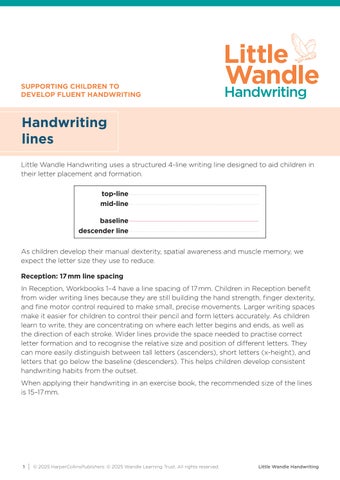
Handwriting lines Little Wandle Handwriting uses a structured 4-line writing line designed to aid children in their letter placement and formation. top-line mid-line baseline descender line As children develop their manual dexterity, spatial awareness and muscle memory, we expect the letter size they use to reduce. Reception: 17 mm line spacing In Reception, Workbooks 1–4 have a line spacing of 17 mm. Children in Reception benefit from wider writing lines because they are still building the hand strength, finger dexterity, and fine motor control required to make small, precise movements. Larger writing spaces make it easier for children to control their pencil and form letters accurately. As children learn to write, they are concentrating on where each letter begins and ends, as well as the direction of each stroke. Wider lines provide the space needed to practise correct letter formation and to recognise the relative size and position of different letters. They can more easily distinguish between tall letters (ascenders), short letters (x-height), and letters that go below the baseline (descenders). This helps children develop consistent handwriting habits from the outset. When applying their handwriting in an exercise book, the recommended size of the lines is 15–17 mm.
1
© 2025 HarperCollinsPublishers. © 2025 Wandle Learning Trust. All rights reserved.
Little Wandle Handwriting
Year 1: 10 mm line spacing In Year 1, the line spacing in Workbooks 5–7 is reduced to 10 mm to reflect children’s developing handwriting skills. By this stage, most children have gained greater control over their pencil movements and are ready to write within a smaller, more structured space. They are developing more consistent letter formation, with improved control over letter size, shape, and spacing. Increased spatial awareness enables them to position their letters more accurately between the lines, supporting the development of neat, legible, and fluent handwriting. When applying their handwriting in an exercise book, the recommended size of the lines is 8–10 mm. Year 2: 6 mm line spacing In Year 2, handwriting lines in Workbooks 8–9 are reduced to 6 mm to reflect children’s growing control, accuracy, and confidence in their writing. By this time, most children have developed stronger fine motor skills and improved pencil control, enabling them to form smaller, more precise letters within a narrower space. The reduced line spacing helps children to refine their letter formation, size, and spacing, while strengthening their awareness of how letters are positioned on the line. A 6 mm line also supports children’s progression towards the handwriting expectations of Key Stage 2 by encouraging greater fluency, control, and consistency. It provides an appropriate level of challenge, helping children develop a more efficient and mature handwriting style while maintaining legibility and neatness. When applying their handwriting in an exercise book the recommended size of the lines is 6 mm. The blank practice sheets on the Little Wandle website mirror this line space progression.
Spacing between words To help the children with spacing between words, ask them to put a finger space between words or give them a lollipop stick to use as a guide to the spacing.
Fonts Year 1 The letters in the workbooks are set in the familiar Sassoon Infant font from the Little Wandle phonics programme, with dots to indicate the starting point and arrows to show a directional stroke. There are flicks at the end of some letters to prepare the children for joining in Year 2. Year 2 The font used at Year 2 is the Collins Handwriting font – a bespoke font created with handwriting experts, which supports children’s handwriting development, helping them write with confidence. The font is designed to follow naturally from the Sassoon font, ensuring natural in-strokes, seamless joins and fluent movement while developing children’s muscle memory for joined writing. It includes a looped k which is taught separately.
2
© 2025 HarperCollinsPublishers. © 2025 Wandle Learning Trust. All rights reserved.
Little Wandle Handwriting