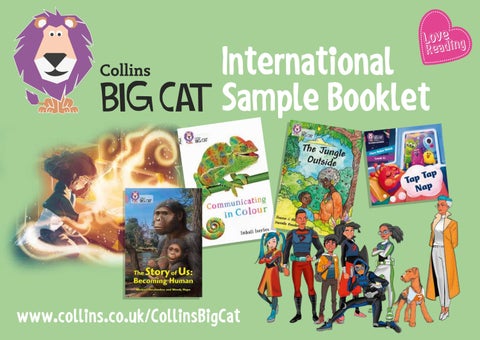
International Sample Booklet
www.collins.co.uk/CollinsBigCat
The reading programme that provides complete support for primary reading Cambridge This resource is endorsed by cation Assessment International Edu ding to provide support for the rea ry English ma Pri strand of the Cambridge 2018. curriculum framework from
Your pupils will love reading with Collins Big Cat – the reading programme that is supporting children to learn to read in thousands of schools around the world. Foster a lifelong love of reading with hundreds of readers featuring beautiful illustrations and stunning photography across a wide variety of genres for every step of a child’s reading journey. This booklet will show you how the Collins Big Cat reading scheme progresses through the bands, from early phonic development to fluent reading.
Contents
2 www.collins.co.uk/CollinsBigCat
Overview Chart
3
Orange Band
20
Topaz Band
38
Lilac Band
4
Turquoise Band
22
Ruby Band
40
Pink A Band
6
Purple Band
24
Emerald Band
42
Pink B Band
8
Gold Band
26
Sapphire Band
44
Red A Band
10
White Band
28
Diamond Band
46
Red B Band
12
White Plus Band
30
Pearl Band
48
Yellow Band
14
Lime Band
32
Guided Reading Handbooks
50
Blue Band
16
Lime Plus Band
34
Green Band
18
Copper Band
36
GUIDED, WHOLE-CLASS AND PHONICS PHONICS INDEPENDENT READING
retellings, poetry and traditional tales to English. LITTLEsupport WANDLE 120 fully decodable
72 phonic-based readers 256 fully decodable LETTERS AND readers matched to the 72 phonic-based readers for further practice and readers aligned to phonic-based readers SOUNDS REVISED new 24 systematic, synthetic for further practice and development. at an introductory level Letters and Sounds for a
phonics programme, Little development. AND for Year start 2/P3 to children PROGRESS Wandle secure reading. Letters and Sounds who are struggling with SOUNDS Revised. decoding. More than 1000 high-quality banded readers More than 1000 high-quality banded readers PHONICS FOR 256 fully adecodable for the whole school71 covering wealth of Reception/P1 and for the whole school covering a wealth of genres and topics. KS1/P2–P3 levelled readers aligned to 72 phonic-based readers PROGRESS LETTERS genres and topics. PHONICS 72 phonic-based readers PHONICS readers tailor-made for Letters and Sounds for for further practice and Cover the Curriculum Collins Bigand Cat:a forwith further practice PRACTICE AND KS2/P4–P7+ Cover the Curriculum with Collins Big Cat: PRACTICE secure start tochildren reading. development. development. Non-Fiction includes information texts, whoinformation are struggling with Non-Fiction includes texts, SOUNDS biographies and reports covering science, reading. Validated by DfE June 2021 and on their list of approved SSP programmes!
2A Red A
2B Red B
3 Yellow
4 Blue
00 0 Lilac Lilac Lilac
11AA 1A Pink A Pink Pink AA
11BB 1B Pink B Pink Pink BB
0 Lilac
Foundations 0 for Phonics
Lilac
1A Pink A
1B Pink B
1A 1B 1A 1B Pink A Pink B 1PinkA APhase Pink 21 B B 1 A 1 Pink A PinkB B Pink B
22 AA 2A Red A Red RedAA
22 BB 2B Red B Red RedBB
33 3 Yellow Yellow Yellow
44 4 Blue Blue Blue
55 5 Green Green Green
2A Red A
2B Red B
Red A
Red B
3 Yellow
3 4 3 4 Yellow Blue 3 4 Yellow Phase 4Blue 3 4 Yellow Blue Yellow
4 Blue
11 AA Pink Pink AA 1A 1A Pink A Pink A
11 BB Pink Pink BB 1B 1B Pink B Pink B
0 Lilac Lilac
0 Lilac
0 0 Lilac Lilac
1B Pink B Pink B
1A Pink AA Pink 1A 1A Pink A Pink A
1B Pink BB Pink 1B 1B Pink B Pink B
1A Pink A
11 AA Pink Pink AA
11 AA 11AA A Pink Pink A Pink A
1B
1B Pink B
11 BB Pink Pink BB
11BB 11BB B Pink Pink B Pink B
10+ White Plus
11 Lime
11+ Lime Plus
12 Copper
Blue
2A Red A
22 AA Red Red AA 2A 2A Red A Red A
2B Red B
22 BB Red Red BB 2B 2B Red B Red B
3 Yellow
333 Yellow Yellow Yellow
3 3 Yellow Yellow
444 Blue Blue Blue
4 Blue
4 4 Blue Blue
2B
2A Red AA Red 2A 2A Red A Red A
2B Red BB Red 2B 2B Red B Red B
3
4
4 Blue Blue 4 4 Blue Blue
1B 1B 11BB B Pink Pink BB Pink Pink PinkBB
55 Green Green
5 5 Green Green
66 77 8 Orange Turquoise Turquoise Purple Orange
6 7 8 6 7 8 Orange Turquoise Purple Orange Turquoise Purple
5
6
7
5 Green Green
8
9 Gold
9 9 Gold Gold
9
6 7 8 Orange Turquoise Turquoise Purple Orange
READING LEVEL: RECEPTION AND KS1/P1–P3 AND KS1/P1–P3 LEVEL:3 RECEPTION READING 2A 2B 4 5 6 7 2A 2B 3 4 Red Red Blue Green Red AA Red BB Yellow Yellow Blue 3 4 5 2 2A A 2 B2 B Yellow 33 3 Blue 44 4 Green 55 Blue Green 2Red 2Red 3 4 5 2AA A 2BB B Yellow 3 4 Red A Red B Yellow Yellow Blue Blue Green Red A Red B Yellow Blue Green
2A 2A 22AAA Red Red AA Red Red RedAA
2B 2B 22BB B Red Red BB Red Red RedBB
Orange 6 66 Orange Orange 6 Orange Orange
Turquoise 7 77 Turquoise Turquoise 7 Turquoise Turquoise
8 Purple 8 8 Purple Purple
9 Gold
9 Gold 9 9 Gold Gold
10 White
10 10 White White
10 White
9 Gold
10 White
10 White 10 10 White White
11 Lime
10+ 10+ White White Plus Plus
11 Lime
10 White
10+ White Plus
10+ White 11 Plus 11 Lime Lime
11 11 Lime Lime
10+ White 11 Plus
Lime
11 Lime
11+ 11+ Lime Lime Plus Plus
12 12 Copper Copper
11+ Lime Plus
12 Copper
111110 10+ 11 Lime White Lime White Lime Plus
1111 Lime Lime
11+ Lime Plus
12 Copper
0 Lilac 0 Lilac
1A Pink 1 AA 1A Pink A Pink A
1B Pink 1 BB 1B Pink B Pink B
2A Red 2 AA 2A Red A Red A
1A
1B
2A
AR
2B 2B
3 3
4 4
– Accelerated Reader
RR
13 13 Topaz Topaz
14 14 Ruby Ruby
15 16 17 15 16 17 Emerald Sapphire Diamond Emerald Sapphire Diamond
18 18 Pearl Pearl
and 6 Whole-class Reading Practical planning and teaching reading lesson plans and activities Collins Big Cat Phonics for Handbooks guidance to boost struggling Handbooks to boost comprehension, inference Letters and Sounds Targeted guided andreaders into readers. Targeted guided and
READING LEVEL: KS2/P4–P7+ LEVEL:15 KS2/P4–P7+ READING 13 14 16 17
your vocabulary. phonicsreading teaching. whole-class lesson and
Topaz
Ruby
Emerald Sapphire Diamond
Teacher support and assessment
Teacher support
and 6 Whole-class Reading vocabulary. Teacher support and assessment Handbooks
18 Pearl
and assessment
Targeted guided and
1whole-class Progress Handbook Phonics Teacher readingHandbooks lesson 12Progress Handbook Practical and teaching 2plans Phonics Teacher Handbooks Full support for integrating andplanning activities to boost Practical planning and teaching
guidance toCat boost struggling Full support integrating Collins Big Phonics for and comprehension, inference guidance to for boost struggling readers. Collins Big Cat Phonics for into Letters and Sounds readers vocabulary. readers. Letters and Sounds readers into your phonics teaching. your phonics teaching. 6 Guided Reading Handbooks
Teacher support and assessment
5 Green 55 Green Green
6 7 8 Orange Turquoise Purple 66 77 88 Orange Orange Turquoise Turquoise Purple Purple
– Reading Recovery
13 Topaz
14 Ruby
15 16 17 Emerald Sapphire Diamond
18 Pearl
9 Gold 99 Gold Gold
10 White 1010 White White
11 Lime 10+11 11 11+ 12 White Lime Lime Copper Lime AR – Accelerated ReaderPlus RR – Reading Plus Recovery
13 13 Topaz Topaz
14 14 Ruby Ruby
13 Topaz
14 Ruby
15
16
17
Full support for integrating Assessment Tool Practical planning and teaching Practical planning and teaching Targeted guided and Assessment Collins Big CatTool Phonics for The most thorough and guidance to boost struggling guidance to boost struggling whole-class reading lesson into The most thorough and Letters and Sounds readers accurate way of assessing readers. readers. plansphonics and activities to boost accurate way of assessing your reading usingteaching. miscue analysis. comprehension, inference and reading using miscue analysis. vocabulary.
Teacher support
READING LEVEL: KS2/P4–P7+
Lilac
3 3 collins.international@harpercollins.co.uk 1A 1B 2A
To support the new SSP, Little 2 Phonics Teacher Handbooks Wandle Letters and Sounds Full support for integrating Revised, Keep-up Collins Bigincluding Cat Phonics for Teacher support Letters andGuides, Sounds readers into Wall Teacher’s Flashcards, andand assessment your phonics teaching. Charts. Friezes Grapheme
Phonics Teacher Handbooks & KS2/P2–P7+ Reading 12KS1 Progress Handbook 1KS1 Progress Handbook Handbooks & KS2/P2–P7+ Reading
5 6 7 8 9 10 11 2A 2B 33 44 Yellow Blue Blue Green Orange Turquoise Purple Gold White Lime Red A Red B Yellow 2A 2B 3 4 5 6 7 8 9 10 11 2A 2B 3 4 5 6 7 8 9 10 11 Red Red Blue Green Orange Turquoise Purple Gold White Lime 2 AA 2 BB Yellow 3 4 5 6 7 8 9 10 10+ 11 11+ 12 Red A Red B Yellow Blue Green Orange Turquoise Purple Gold White Lime Recovery AR RR AR RR – Reading ReaderBlue –Green Reading Recovery – Accelerated ReaderWhite 2 B 3 4 22AAAAR ––Accelerated 2 B 3 4 5 6 7 8 9 10 10+ 11 11+ 12 Red Red B Yellow Orange Turquoise Purple Gold White Lime Copper RR AR RR Accelerated Reader – Reading Recovery – Accelerated Reader – Reading Lime Recovery Plus Plus Copper RedAA Red RedBB Yellow Yellow Blue Blue Red Green Orange Turquoise Purple Gold White White Lime Lime Plus Plus 4 Blue 4 44 Blue Blue Blue
Classroom Resources
and 6 Whole-class Reading
9101010 White Gold White White
1B Pink1 BB 1B Pink 1 BB Pink 11BB BB Pink PinkBB Pink
3 Yellow 3 33 Yellow Yellow Yellow
Teacher support and assessment
vocabulary.
READING LEVEL: KS2/P4–P7+
3 4 33 3 44 4 55 5 66 6 777 7 888 8999 33 44 5 6 Yellow Blue Purple Gold Yellow Blue Green Orange Turquoise Yellow Blue Yellow Blue Green Orange Turquoise Purple Green Orange Turquoise Purple Gold Yellow Yellow Blue Blue Green Orange Turquoise Purple Gold
2B Red 2 BB 2B Red B Red B
Teacher support and assessment
whole-class reading lesson plans and activities to boost plans and activities to boost comprehension, inference and comprehension, inference and KS1 & KS2/P2–P7+ vocabulary. READING LEVEL: KS2/P4–P7+ 6vocabulary. Guided ReadingReading Handbooks Assessment Tool and 6 Whole-class Reading The most thorough 11 11+ 12 13 14 15 16 17 2 Phonics18Teacherand Handbooks Handbooks accurate way of assessing Lime Lime Copper Topaz Ruby Emerald Sapphire Diamond Pearl Full support for integrating Targeted guided andanalysis. 11+ 12 14 15 16 17 18 reading using miscue Plus 13 Collins Big Cat Phonics for whole-class reading lesson Lime Copper Topaz Ruby Emerald Sapphire Diamond Pearl Lettersand andactivities Sounds to readers Plus plans boostinto your phonics teaching. 6comprehension, Guided Reading Handbooks inference and
1A Pink1 AA 1A Pink 1 AA Pink 11AAAA Pink PinkAA Pink
0
18
6 Guided Handbook Reading Handbooks 1 Targeted Progress guided and whole-class and Whole-class Reading Full 6support for integrating
READING LEVEL: RECEPTION AND KS1/P1–P3 0 Lilac 0 Lilac 0 Lilac
17
662 Guided Guided Reading Handbooks Reading Handbooks Phonics Teacher Handbooks
Support every child on their reading journey from phonics to fluency 1A 1A 11AA A Pink Pink AA Pink Pink PinkAA
16
READING LEVEL: KS2/P4–P7+
READING LEVEL: RECEPTION AND KS1/P1–P3
0 0 Lilac Lilac
15
6 5 7 Phase Orange Turquoise
Red B Yellow Blue Purple Gold 2 A Red B2 B Yellow 3 Blue 4 Green 5 Orange Turquoise 6 7 8 Red A Red B Yellow Blue Green Orange Turquoise Purple 3 Yellow Yellow 3 3 Yellow Yellow
14
KS2/P4–P7+ LEVEL: READING Ruby Emerald Sapphire Diamond Pearl
READING LEVEL: KS2/P4–P7+
6 7 Orange Turquoise
AND KS1/P1–P3 LEVEL:3 RECEPTION READING 2A 2B 4 2A Red A Red A
13 Topaz
18
OVERVIEW CHART
OVERVIEW CHART
READINGREADING INTERVENTION INTERVENTION
OVERVIEW CHART OVERVIEW CHART OVERVIEW CHART
0 Lilac
1A 1A Pink A Pink A
10 White
READING LEVEL: RECEPTION AND KS1/P1–P3
Support every every child child on on their their reading reading Support journey from from phonics phonics to to fluency fluency journey Support every child on their reading journey from phonics to fluency 0 Lilac
9 Gold
and 6 Whole-class Reading 2 Phonics Teacher Handbooks Phonics Teacher Handbooks 2 Phonics Teacher Handbooks Handbooks Full support forforintegrating Full support integrating Full support forand integrating Collins Targeted guided Collins Cat Phonics for and Big CatBig Phonics for Letters Collins Big Cat Phonics for whole-class reading lesson Letters and Soundsinto readers Sounds readers yourinto phonics plans andand activities boost Letters Soundstoreaders into your phonics teaching. comprehension, inference and teaching. your phonics teaching.
OVERVIEW CHART OVERVIEW CHART OVERVIEW CHART
GUIDED, WHOLE-CLASS GUIDED, WHOLE-CLASS AND AND INDEPENDENT INDEPENDENT READING READING
0 Lilac 0 0 Lilac Lilac
1B Pink B
666 777 8 Orange Turquoise Turquoise Purple Orange Orange Turquoise
5 Green
5 Green
Support every child on their reading journey from phonics to fluency 1A Pink A
READING KS2/P4–P7+ LEVEL: KS2/P4–P7+ READING LEVEL:
READING LEVEL: RECEPTION AND KS1/P1–P3 2A 2B 2A 2B Red A Red B 2 A Red APhase Red 32 B B 2 A 2 Red A RedB B
TEACHER SUPPORT Teacher support Teacher support AND ASSESSMENT and and assessment assessment 6 Guided Reading Handbooks
UPPER PRIMARY
READING KS1/P1–P3 AND KS1/P1–P3 RECEPTION AND LEVEL: RECEPTION READING LEVEL:
Fiction includes 7+.classics, Shakespeare
biographies and reports covering science, geography and history. geography and history. More than 1000 high-quality banded readers Fiction includes classics, Shakespeare More than 1000 high-quality banded readers Over 1000 levelled Fiction includes classics, Shakespeare PHONICS 72 phonic-based readers poetry and traditional talesof toof for theretellings, whole school covering aincluding wealth EBOOK for the whole school covering a wealth ebooks, retellings, poetry and traditional tales256 to English. for further practice and decodable phonics genres and topics. fully genressupport and topics. PRACTICE support English. LIBRARY PHONICS FOR books, to bring reading 256 fully decodable development. Cover Cover the Curriculum with Collins Big Cat: the Curriculum with Collins Big toreaders life at school and aligned to atCat: LETTERS 24 phonic-based readers home (new books are also Non-Fiction includes information texts, Non-Fiction includes information texts, Letters and Sounds for a 24 phonic-based readers PHONICS added throughout the atcovering ancovering introductory level biographies and reports ANDthan PHONICS biographies and1000 reports science, secure start toscience, reading. at anasintroductory level More high-quality banded readers year they become geography and history. for Year 2/P3 children PROGRESS geography history. for Year 2/P3 children for theand whole schoolavailable) covering a wealth of SOUNDS PROGRESS who are struggling with Fiction includes Shakespeare and topics.classics, who are struggling with Fictiongenres includes classics, Shakespeare decoding. retellings, poetry and traditional tales to decoding. retellings, poetry and traditional tales to Cover the Curriculum with Collins Big Cat: support English. 71 and PHONICS 72Reception/P1 phonic-based readers support English. 71 Reception/P1 and Non-Fiction includes information texts, PHONICS FOR 256further fully decodable KS1/P2–P3 levelledand PROGRESS for practice biographies and reports covering science, KS1/P2–P3 levelled PHONICS FOR PRACTICE PROGRESS 256 fullytailor-made decodable readers aligned toreaders 24 phonic-based readers for LETTERSand23history. development. phonic-based readers geography readers tailor-made for PHONICS readers aligned to level Letters and Sounds for a at an introductory KS2/P4–P7+ children LETTERS PHONICS at an introductory level for KS2/P4–P7+ children Fiction includes classics, Shakespeare AND Letters and Sounds for a secure tochildren reading. for Year 2/P3 arestart struggling PROGRESS PROGRESS retellings, poetry andwho traditional tales towith children who are struggling who are struggling with AND secure start to reading. who are struggling with reading. SOUNDS support English. More than 1000 high-quality reading. banded readers with phonics. SOUNDS for the whole schooldecoding. covering a wealth of genres andFOR topics. Over PHONICS 1000 levelledand 71 Reception/P1 256 fully 24 Over 1000decodable levelledreaders PHONICS 72 phonic-based phonic-based readers EBOOK ebooks, including 256 KS1/P2–P3 levelled PHONICS Cover the Curriculum with Collins Cat: readers aligned toBig PROGRESS 71 levelled readers tailorEBOOK LETTERS ebooks, including 256 at an introductory level PHONICS 72 phonic-based readers for further practice and fully decodable phonics readers tailor-made for Letters and Sounds for a PRACTICE PROGRESS made for children who are LIBRARY Non-Fiction includes information texts, fully decodable phonics for Year 2/P3 children PROGRESS for further practice and LIBRARY books, to bring reading development. AND PRACTICE KS2/P4–P7+ children secure start toreading. reading. biographies and reports covering science, books, to bring reading struggling with who are struggling with development. to life at school and at who struggling with geography and history. to lifeare at school and at SOUNDS decoding. home (new books are also reading. home (new books are also Fiction includes classics, Shakespeare added throughout the 71traditional Reception/P1 More than poetry 1000 high-quality banded readers added throughout the retellings, and talesand to year as they More 1000 high-quality banded readers for thethan whole school covering a become wealth of KS1/P2–P3 levelled year as they become PROGRESS support English. Over 1000 levelled ebooks, PHONICS 72 phonic-based readers Over 1000alevelled for the whole schoolavailable) covering wealth offor genres and topics. readers tailor-made available) including fully decodable PHONICS EBOOK including for practice256 and 256further fully decodable genres and FOR topics. ebooks, PRACTICE KS2/P4–P7+ Cover the Curriculum with Collins Big Cat: phonics books, tochildren bring fully decodable phonics development. readers aligned to 24 phonic-based readers LETTERS LIBRARY who are struggling Cover the Curriculum with Collins Bigwith Cat: books, to bring reading EBOOK PHONICS reading tointroductory life atSounds school ata Non-Fiction includes information texts, Letters and for at an level Buy at collins.co.uk/CollinsBigCat Non-Fiction includes information texts, toreading. life atstart school and at biographies and reports covering science, AND LIBRARY home (new books are also Buy online online at collins.co.uk/CollinsBigCat secure to reading. for Year 2/P3 children PROGRESS biographies and reports covering science, geography and history. home (new books areyear also added throughout More than 1000 high-quality bandedthe readers who are struggling with SOUNDS geography and history. added1000 throughout the Fiction includes classics, Shakespeare Over levelled for the whole school covering a wealth of as they become available) decoding. year asShakespeare they become Fiction includes retellings, poetry and traditional tales256 to EBOOK ebooks, including genres and topics.classics, available) retellings, poetry and tales to support English. 71traditional Reception/P1 and fully decodable phonics LIBRARY PHONICS Cover the Curriculum with Bigreaders Cat: 72 phonic-based support English. KS1/P2–P3 levelled books, toCollins bring reading PROGRESS further practice and Non-Fiction information texts, tofor life at school and at readers tailor-made for PRACTICE includes 24 phonic-based readers development. biographies and reports covering science, home (new books are also KS2/P4–P7+ children PHONICS Buy online geography at collins.co.uk/CollinsBigCat 24 phonic-based readers at an introductory level added throughout who are strugglingthe with PHONICSand history. at an introductory level for Year 2/P3 children PROGRESS year as they become
DIGITAL DIGITAL
1B Pink B
OVERVIEW CHART
OVERVIEW CHART
33
1A
More than 1000 high-quality banded readers for the whole school covering a wealth of 300 fully decodable readers, genres and topics. 256 fully decodable
256tofully decodable PHONICS FOR aligned the 2007toBig Letters Cover the Curriculum with Collins Cat: readers aligned readers aligned to LETTERS AND and Sounds progression, Letters and Sounds for a Non-Fiction includes information texts, Letters and Sounds for a biographies reports covering SOUNDS, 2007 and including 12 Big Books secure start toscience, reading.and secure start to reading. geography and history. PROGRESSION 28 readers for pupils aged
, WHOLE-CLASS AND READING GUIDED, WHOLE-CLASS AND GUIDED, WHOLE-CLASS AND READING GUIDED, WHOLE-CLASS READING GUIDED,AND WHOLE-CLASS ANDWHOLE-CLASS READING GUIDED, AND READING GUIDED, WHOLE-CLASS AND GUIDED, WHOLE-CLASS AND READING PHONICS DIGITAL PHONICS DIGITAL PHONICS READING DIGITAL PHONICS DIGITAL PHONICS PHONICS DIGITAL PHONICS PENDENT READING INTERVENTION INDEPENDENT INDEPENDENT READING INTERVENTION INDEPENDENT READING INTERVENTION INDEPENDENT READING INTERVENTION INDEPENDENT READING INTERVENTION INDEPENDENT READING INDEPENDENT READING INTERVENTION
PHONICS PHONICS
72 phonic-based readers for further practice and development.
IEWCHART CHART OVERVIEW CHART OVERVIEW CHART EW
IEWCHART CHART OVERVIEW CHART OVERVIEW CHART EW
Support every child on their reading PHONICS PRACTICE from phonics to fluency journey LOWER PRIMARY OVERVIEW CHART Support PHONICS PHONICS FOR FORevery child on their reading LETTERS LETTERS LEVEL: RECEPTION AND KS1/P1–P3 journey from phonics toREADING fluency AND AND SOUNDS SOUNDS Support every child on their reading PHONICS PHONICSFOR journey from phonics to fluency PRACTICE LETTERS PHONICS PRACTICE
and Reading assessment 16Progress Handbook Guided Handbooks planning and teaching 6Practical Guided Reading Handbooks and Whole-class Reading KS1 &6 KS2/P2–P7+ Reading 2Handbooks Phonics Teacher Handbooks guidance to boost and 6 Whole-class Reading Assessment Tool struggling Full support for integrating readers. Handbooks Targeted and The most guided thorough and
Collins Big Cat Phonics for Targeted guided andlesson Contact findarep.collins.co.uk 44 15 16your 17localPearl whole-class reading Emerald Sapphire Diamond accurate way of assessing Contact your local18rep rep at at findarep.collins.co.uk Letters and Sounds whole-class reading readers lesson into Emerald Sapphire Diamond Pearl
15 16 17 Emerald Sapphire Diamond
18 Pearl
Contact your local rep
plans and activities to analysis. boost reading using miscue your phonics teaching. plans and activities to boostand comprehension, inference 6comprehension, Guided Readinginference Handbooks KS1 & KS2/P2–P7+ Readingand vocabulary. and 6 Whole-class vocabulary. Assessment Tool Reading Handbooks 1 Progress Handbookand The most thorough Targeted guided and Practical way planning and teaching accurate of assessing whole-class lesson guidanceusing toreading boost struggling reading miscue analysis. at findarep.collins.co.uk plans and activities to boost readers. comprehension, inference and
4
LILAC BAND
Lilac books support emergent readers through wordless books that tell a story through pictures and are designed to develop understanding about how stories work.
Sample page from The Owl and the Pussycat Fiction (Poetry) 9780007512584
4 www.collins.co.uk/CollinsBigCat
Sample page from Animal Fun Phonics for Letters and Sounds Non-Fiction 9780008251260
5 collins.international@harpercollins.co.uk
PINK A BAND
Pink A books offer emergent readers the very simplest of texts and provides total support through illustrations. Books use no more than one line per spread, and a simple phrase with a repeated pattern.
Sample page from Tap Tap Nap Phonics for Letters and Sounds Fiction 9780008442057
6 www.collins.co.uk/CollinsBigCat
Sample page from How to Make a Hat Non-Fiction (Instruction Text) 9780007512652
7 collins.international@harpercollins.co.uk
PINK B BAND
Pink B books offer simple, predictable text with familiar objects and actions. 4–5 word sentences are included per spread, and the pattern is then repeated on each page with usually no more than one word changing from one page to the next.
Sample page from I Can Help Fiction (Predictable Structure) 9780007412808
8 www.collins.co.uk/CollinsBigCat
Sample page from Get, Set, GO! Phonics Progress Non-Fiction 9780007516308
9 collins.international@harpercollins.co.uk
RED A BAND
Red A books support emergent readers. Predictable text with familiar objects and actions is combined with simple story development.
Sample page from The Fox and the Stork Fiction (Traditional Tale) 9780007512713
10 www.collins.co.uk/CollinsBigCat
Sample page from Mix and Mash Phonics for Letters and Sounds Non-Fiction 9780008442163
11 collins.international@harpercollins.co.uk
RED B BAND
Red B books offer emergent readers simple but varied text with familiar objects and actions, combined with simple story development and a satisfying conclusion.
Oh no! Paddington’s sandwich is missing.
Is it in the hall?
3
2
Paddington-Sandwich-print-ready.indd 2
Sample page from The Missing Sandwich Paddington 9780008285876
12 www.collins.co.uk/CollinsBigCat
08/01/2018 13:57
Paddington-Sandwich-print-ready.indd 3
Based on the Paddington novels written and created by Michael Bond PADDINGTON™ and PADDINGTON BEAR™ © Paddington and Company Limited/STUDIOCANAL S.A.S. 2017 Paddington Bear™, and Paddington™and PB™ are trademarks of Paddington and Company Limited. Licensed on behalf of Studiocanal S.A.S. by Copyrights Group
08/01/2018 13:57
Sample page from It is Hidden Phonics for Letters and Sounds Non-Fiction 9780008251512
13 collins.international@harpercollins.co.uk
YELLOW BAND
Yellow books offer more varied sentence structure and natural language. Fiction features more variation in pattern with more new words. Non-fiction uses personal experiences and simple non-fiction tools such as diagrams, labels and captions.
Sample page from Do You Want? Phonics Progress Fiction 9780007516414
14 www.collins.co.uk/CollinsBigCat
Sample page from The Baby Turtle Non-Fiction (Information Book) 9780007186594
15 collins.international@harpercollins.co.uk
BLUE BAND
Blue books offer longer, repeated patterns with sequential events and integrated literary and natural language. Non-fiction uses non-fiction tools such as signs, labels and diagrams.
Sample page from There’s a Wocket in My Pocket! Dr. Seuss 9780008320829
16 www.collins.co.uk/CollinsBigCat
Sample page from World’s Deadliest Creatures Progress Non-Fiction 9780007428823
17 collins.international@harpercollins.co.uk
GREEN BAND
Green books offer early readers less familiar, more complex language with varied characters. Non-fiction titles start to introduce more abstract, impersonal language.
Sample page from The Train Set Phonics for Letters and Sounds Fiction 9780008442309
18 www.collins.co.uk/CollinsBigCat
Sample page from Stargaze Phonics for Letters and Sounds Non-Fiction 9780008442163
19 collins.international@harpercollins.co.uk
ORANGE BAND
Orange books for early readers offer varied text and characters, with action sustained over several pages and less support from illustrations. A wider range of texts is included.
Sample page from Clementine’s Smile Fiction (Poetry) 9780007461882
20 www.collins.co.uk/CollinsBigCat
Sample page from Search and Rescue Dogs Progress Non-Fiction 9780007498376
21 collins.international@harpercollins.co.uk
TURQUOISE BAND
Turquoise books offer literary language and extended descriptions, with longer sentences and a wide range of unfamiliar terms.
Sample page from The Big Bad City Fiction 9780007591091
22 www.collins.co.uk/CollinsBigCat
Sample page from The Lost Village of Skara Brae Non-Fiction 9780007461837
23 collins.international@harpercollins.co.uk
PURPLE BAND
Purple books offer developing readers literary language, with some challenging vocabulary and more rounded and distinctive characters. You may experience some side effects from Further Earth being so close to Earth.
Luckily, one of the Chaos Crew has wings.
Suddenly, it got really chilly. The wind started to howl ...
I’ll check it out. Coming?
Roger that.
The sea is flooding the town!
Where’s all this water coming from?
Those birds are behaving strangely, and it looks like there’s a storm coming.
Is it high tide? It’s not usually THIS high!
Purple Band 8
MISSION: MISSION:
WEIRD WEIRD WEATHER WEATHER Sample page from Mission: Weird Weather Shinoy and the Chaos Crew Graphic Novel 9780008454555
There’s a whopping new planet in the sky. Cool!
Er, it’s affecting the weather and making Earth spin backwards. Not cool!
10
54555_P001_024.indd 10
11
Fear not! The Chaos Crew are here… T
MISSION: MISSION:
…and we may have actually caused the problem.
07/04/2021 10:37 54555_P001_024.indd 11 www.collins.co.uk
A graphic novel www.collins.co.uk/collinsbigcat
24 www.collins.co.uk/CollinsBigCat
WEIRD WEIRD WEATHER WEATHER
07/04/2021 10:37
Browse the complete Collins catalogue at
Chris Callaghan Amit Tayal
Sample page from Elephant Rescue Progress Non-Fiction 9780007498512
25 collins.international@harpercollins.co.uk
GOLD BAND
Gold fiction books offer developing readers literary language and stories with distinctive characters. More formal non-fiction is included, with a range of unfamiliar terms used.
Chapter 2 When the spinning stopped, Dani found herself in the bustling kitchen of a restaurant. All around her were busy chefs – chopping, peeling, slicing, preparing and cooking. It was hot and extremely noisy.
“Ah! You’re here,” said a boy in a tall hat. “I’m Tai and this is Asha. We’re the head chefs. The restaurant is really busy today. You’ll be helping Izzy, the sauce chef.” “You won’t need chalk pens,” smiled Asha. “The menu blackboard is in the restaurant, not the kitchen! You’ll need these.” Asha held out a hat and an apron.
5
4
81837_P001_024.indd 4
Sample page from Dani Binns Clever Chef Fiction 9780008381837
26 www.collins.co.uk/CollinsBigCat
03/04/2020 13:24
81837_P001_024.indd 5
03/04/2020 13:24
Sample page from China’s Terracotta Army Non-Fiction (Information Book) 9780007462032
27 collins.international@harpercollins.co.uk
WHITE BAND
White books have more complex sentences and figurative language. Ideal for pupils who are becoming fluent readers.
Sample page from Little Bear Progress Fiction 9780007519255
28 www.collins.co.uk/CollinsBigCat
Can anyone become a treasure hunter? Yes, they can. Beachcombing is a good way to hunt for treasures washed up by the waves. All you have to do is walk along a beach and search! As long as you are safe and respect the land, treasure is all around us, just waiting to be found!
So, there really is buried treasure! a 500-year-old coin found by the River Thames, UK 27
26
54838_P001_032.indd 26 Sample page from Is There Really Buried Treasure? Shinoy and the Chaos Crew Non-Fiction 9780007462070
29 collins.international@harpercollins.co.uk
20/03/2021 11:28
54838_P001_032.indd 27
20/03/2021 11:28
WHITE PLUS BAND
Books that will challenge your most able readers, with content and contexts appropriate for their age. When he was older, Jake went to baking school. He learnt how to make every kind of cake, from the smallest cupcake to the tallest toffee coffee brownie stack with chopped nuts on top. He always used his granny’s whisk because it was the only way he knew how to mix the secret ingredient into his cakes.
8
81752_P001_048_Book_Whisked_Away.indd 8
Sample page from Whisked Away Fiction 9780008381752
30 www.collins.co.uk/CollinsBigCat
9
30/06/2020 10:21
81752_P001_048_Book_Whisked_Away.indd 9
30/06/2020 10:21
Sample page from Life in Extremes Non-Fiction 9780008485610
31 collins.international@harpercollins.co.uk
LIME BAND
Lime books have longer sentence structures and a greater use of literary language. Ideal for pupils who are becoming fluent readers.
Dante wondered why he had waited so long to climb a mango tree. The sweet memory of his climb up the mango tree fresh in his
Sample page from The Jungle Outside Fiction 9780008413903
While he ate,
mind, he looked around
Tanti had been
the yard. He saw, as if with
busy stretching
new eyes, how thick it was:
and plucking
like a jungle. He saw, too,
a few mangoes
how much ripened fruit
of her own.
there was to be plucked. 25
24
8353_Book_The_Jungle_Outside.indd 24
32 www.collins.co.uk/CollinsBigCat
11/11/2020 12:34
8353_Book_The_Jungle_Outside.indd 25
11/11/2020 12:34
Sample page from Free Running Progress Non-Fiction 9780007519347
33 collins.international@harpercollins.co.uk
LIME PLUS BAND
Lime books have longer sentence structures and a greater use of literary language. Ideal for pupils who are becoming fluent readers.
Chapter 3
One evening as the sun set, the waxing moon
Kathakar told them a new story every night.
was three days old. Kathakar settled down under
Every story lit up the people’s imaginations.
her tree, humming a song gently. The villagers
Even the baby, whose house was closest to the banyan
went on with their chores. They came to listen to
tree, listened carefully and imagined.
the story reluctantly.
The baby had been listening to stories weeks before he was born, when he was inside his mother, who was listening to the storyteller. The stories soothed him and made him sleep peacefully at night. So his parents named him Gumaan, the one who imagines.
16
8280_The_Storyteller_of_Ketu_Book.indd 16
Sample page from The Storyteller of Ketu Fiction 9780008399016
34 www.collins.co.uk/CollinsBigCat
17
10/11/2020 11:27
8280_The_Storyteller_of_Ketu_Book.indd 17
10/11/2020 11:27
Sample page from Are Dragons Real? Non-Fiction 9780008485641
35 collins.international@harpercollins.co.uk
COPPER BAND
Copper books provide more complex plots and longer chapters that develop reading stamina.
Copper Band 12
Tara Binns
Tara Binns
o r Micr -mystery Solve
o r Micr -mystery Solve TARA BINNS MICRO-MYSTERY SOLVER
Something’s causing chaos in the scientists’ greenhouse. And everything Tara Binns touches seems to fall apart! Can she corner the culprit and get to the root of the problem? Browse the complete Collins catalogue at
www.collins.co.uk
Sample page from Tara Binns Micro-Mystery Solver Fiction 9780008487218
36 www.collins.co.uk/CollinsBigCat
WISE
This book has been endorsed by The WISE Campaign.
www.collins.co.uk/collinsbigcat
An adventure story
Lisa Rajan
Alessia Trunfio
8 Raiders and traders
The Vikings sailed their longships around Europe to trade enslaved people and
The Vikings were not only raiders who used their
silver coins. Their journeys stretched
longships to attack. They also traded valuable items,
from Dublin, Ireland, to Constantinople
such as animal fur, jewellery, walrus skin and rope.
(now called Istanbul),Turkey.
In the 700s, trading towns sprang up around Scandinavia.
The Vikings built their longships
Traders from around the world sailed into these harbours
with enough deck space to carry
to buy and sell goods.
their cargo.
Fact!
The Skuldelev 1 was
a 30-metre-long cargo ship. Over 80 trees were used in its construction.
This engraving was left by the Viking called Halfdan in Istanbul’s Hagia Sophia. Sample page from The Vikings’ Secret Weapon Non-Fiction (Information Book) 9780008424558
17
16
24558_P001_032.indd 16
37 collins.international@harpercollins.co.uk
15/11/2021 10:42
24558_P001_032.indd 17
15/11/2021 10:42
TOPAZ BAND
Topaz books offer longer and more demanding readers for children to investigate and evaluate. “Anything interesting happen today?” Nan asked, as usual.
The books might have stopped the weird thing getting out, but they couldn’t stop it sneezing. Even when Nan called
I gave Ellie a warning look. “Nothing,” I told Nan firmly. “The most boring day ever. Nothing at all to tell you. Sorry.”
us into the kitchen for our snack, Ellie and I could hear its
We slid off our chairs.
explosive little bursts. Choo! Choo! Choo! Choo!
Nan said, “You two seem very keen to get away.”
Nan didn’t notice. She just laid out our apples and hot chocolate, as usual. “It was so horrible outside,” she said,
“No, not at all,” I said. “Just lots to do.”
“that I bought buns on my way over.”
“Yes,” Ellie echoed. “Lots to do.”
I slid an apple in my pocket, and Ellie waited till Nan’s back was turned to pour some of her hot chocolate into another cup, hiding it under the table.
Sample page from Scared of a Rainbow Fiction 9780008440633
9
8
40633_P001_032.indd 8
38 www.collins.co.uk/CollinsBigCat
30/09/2021 14:53
40633_P001_032.indd 9
30/09/2021 14:53
Sample page from Breath Non-Fiction (Information Book) 9780007465378
39 collins.international@harpercollins.co.uk
RUBY BAND
Ruby books give increasing opportunities for children to develop their skills of inference and deduction.
Sample page from The Talking Bird Fiction (Traditional Tale) 9780008179359
40 www.collins.co.uk/CollinsBigCat
What can I do?
Most homes rely on fossil fuels for lighting and heating.
The school climate strikes are just one way in which young
as in a gas boiler) or may be used far from your home
Fossil fuels might be burnt in your home directly (such
people can speak up and take action for the climate. There are lots of other ways to make an impact – many without even
Switch off lights in empty rooms.
leaving your home!
Walk or cycle to avoid short car journeys.
(such as at a power station that burns coal).
Turn thermostats down by 1° C.
Buy fewer things and recycle what you have.
Sample page from Climate Strike Non-Fiction (Information Book) 9780008434618
Eat less meat.
30
34618_P001_048.indd 30
41 collins.international@harpercollins.co.uk
Block any draughts.
Take shorter showers.
12/11/2021 11:55
34618_P001_048.indd 31
31
12/11/2021 11:55
EMERALD BAND
Emerald books provide a widening range of genres including science fiction and biography, prompting more ways to respond to texts.
Sample page from In the Rue Bel Tesoro Fiction (Playscript) 9780007336319
42 www.collins.co.uk/CollinsBigCat
Although the lights may appear to be shooting
Forms and shapes
out of mountains, the closest they get to Earth is usually about 100 kilometres. This is about 300 times
Many people have tried to list the different forms
the height of the Eiffel Tower in Paris. A small number
of auroras. Scientists Stuart Clark and Asgeir Brekke
may make their way down to 80 kilometres. In part,
came up with these categories.
it is these different distances from Earth that create
Form
Description
the different colours you can see.
a mild glow
Not very visible. They are seen near the horizon – but are easy to mix up with moonlit clouds.
patches
patches arcs
rays
also look like clouds, but easier to see like arches or bridges – they curve across the sky
rays
light or dark stripes which reach upwards
curtains
look as if they have folds or layers
curtains
Sample page from Amazing Aurora Non-Fiction (Information Book) 9780008434601
arcs above a glowing horizon 17
16
34601_P001_048.indd 16
43 collins.international@harpercollins.co.uk
11/11/2021 10:09
34601_P001_048.indd 17
11/11/2021 10:09
SAPPHIRE BAND
Sapphire books offer longer reads to develop children's sustained engagement with texts that are more complex syntactically.
Sample page from The Jungle Book Fiction (From our Literary Heritage) 9780008147280
44 www.collins.co.uk/CollinsBigCat
Birds and mammals
David explained that we have to go back to when dinosaurs still ruled the world – about 200 million
In Life on Earth, David also looked at birds –
years ago – to find the first mammal. It was a small,
explaining how feathers helped a bird to fly and
shrew-like animal that hunted at night when
keep warm. He showed how they lay eggs – like their
the dinosaurs were resting – the ancestor of mammals
ancestors, the reptiles – and how their wings and
that live today, including humans!
powerful chest muscles allow them to take to the air.
Amazing moments
young gorillas playing with David
Playing with gorillas One of David’s most memorable encounters was with gorillas in the rainforest of central Africa in 1978. Gorillas live in family groups, each led by a large adult male called a silverback. During the day, the adults sit in the forest, resting and eating leaves and stems, while the youngsters play. One group allowed David to sit with them – one gorilla sat in his lap while another held his head and examined it!
“
There is more meaning and mutual understanding in exchanging a glance with a gorilla than any other animal I know.
”
Sample page from The Incredible Life of Sir David Attenborough Non-Fiction (Information Book) 9780008208899
20
08899_P001_056 BC21_Attenborough.indd 20
45 collins.international@harpercollins.co.uk
21
26/05/2017 10:36
08899_P001_056 BC21_Attenborough.indd 21
26/05/2017 10:36
DIAMOND BAND
Diamond books offer more complex, underlying themes to give opportunities for children to understand causes and points of view.
Sample page from The Tempest Fiction 9780008127916
46 www.collins.co.uk/CollinsBigCat
Gone phishing
Often a phishing email will ask the victim for help.
Making money by spreading fake news isn’t always illegal
For example, the criminal may pretend they are someone
– unless the people involved are trying to get their hands
else and that they have a lot of money which they need to
on something that doesn’t belong to them. The practice
move to a bank account in the victim’s country. Or they
known as phishing is designed to do just that. Fishing is
may even ask for help and money for an emergency airfare.
trying to catch fish; phishing is trying to catch valuable
The criminal sometimes promises that they will pay
personal information from people. Using emails to go
the victim some money if they are able to help. All they
phishing is one of the most common ways criminals try to
need is the victim’s bank account details.
get cash from unsuspecting victims.
Sample page from Fake News Non-Fiction 9780008434380
12
34380_P001_056.indd 12
47 collins.international@harpercollins.co.uk
13
27/10/2021 11:10
34380_P001_056.indd 13
27/10/2021 11:10
PEARL BAND
Pearl books offer fluent readers a complex, substantial text with challenging themes to facilitate sustained comprehension, bridging the gap between a reading programme and longer chapter books. “I don’t know. We never found out his name –
I walk over to the window where I stand looking
I suppose it was kept from us. But even if we had
out over the moonlit night. I don’t know what to think.
found it out, it wouldn’t have made any difference.
Can any land ever be properly governed for the good
My great-uncle Edward was just a country lad and his
of everybody if the powerful can kill anyone and not
killer was a man of power, who was probably a friend
be punished?
of the king’s – he’d never have been punished for
“It all happened a long time ago, Mistress,”
his crime.”
Elizabeth says, joining me at the window. “I didn’t
“But wasn’t anything done?” I ask, angry at
tell you the story to upset you. You said you wanted
the terrible injustice.
a ghost story, and there’s a mystery connected to
“Well, Lord Grey, your grandfather, did give our
what happened.”
family money to try to make some amends. He also promoted the surviving brother, Ben, my grandfather, to the position of full gamekeeper. But we suspect that the king didn’t want the killer to be harmed by any scandal and so there really wasn’t anything that could be done.”
Sample page from The Grey Ghost Fiction 9780008443948
14
40732_P001_080.indd 14
48 www.collins.co.uk/CollinsBigCat
15
20/09/2021 17:15
40732_P001_080.indd 15
20/09/2021 17:15
Sample page from The Tour de France Non-Fiction 9780007428397
49 collins.international@harpercollins.co.uk
GUIDED READING HANDBOOKS
Guided Reading Handbooks provide a continuous programme of teaching and assessment that takes every pupil from phonics to fluency. How to Make a Hat
Big Cat Guided Reading Handbook: Pink to Yellow
Book Band: Pink A This instruction text shows children how to make and decorate paper hats.
• Read and understand simple sentences • Use phonic knowledge to decode regular words and read them aloud accurately • Listen to stories, accurately anticipating key events and respond to what is heard with relevant comments, questions or actions
• Use past, present and future forms accurately when talking about events that have happened or are to happen in the future • Develop their own narratives and explanations by connecting ideas or events • Develop understanding of vocabulary from experience of books
• Multiple copies of Collins Big Cat How to Make a Hat
Tune in Introduce the book by looking at the front cover together. Ask the following questions: • Is there a photograph or picture? (photograph) • What is the photograph of? (two children wearing hats they have made) Read the title to the children. Model reading fluently. Ask children to point to the word ‘hat’; reread the word ‘hat’ and model using phonics knowledge to blend and segment h-a-t. Can the children write the initial sound ‘h’ in the air with their finger? Change the initial sound to make words that rhyme with hat and create a list, for example, rat, bat, cat, sat, fat, mat, pat. Point to the hats in the photo. Ask the following questions: • What type of hats do you have (or have you worn)? (bobble hats, sun hats, bike helmets) • Why do people wear hats? (to protect their head from the weather or injury or to look nice) Ask children to turn the book over. Read the blurb on the back cover. Remind the children that a blurb usually tells you what the book is about. Explain that this is an instruction book (instructions tell you how to do something). Ask: What is this book going to tell us to make? (a hat) Say that instructions are non-fiction. Write some of the instruction words down: ‘get’, ‘cut’, ‘glue’, ‘decorate’. Read the words and explain that they give an instruction (tell you to do something).
Heads together Ask children to look at page 2. Ask: What can you see in the picture? (scissors, glue, stickers, felt-tipped pens, card, glitter pens, bows) Model reading the text; segment and blend the word ‘get’. 54
Focus word Child-friendly explanation
Ask the following questions: • What was the instruction? (get ready) • What do you have to do? (find all the items in the picture) • Why is it important to do this first? (it is difficult to make something if you don’t have all the right things) Help the children to turn to pages 4 and 5. Model reading the text using phonics knowledge to segment and blend the word ‘cut’. Ask children to reread the text, pointing to the words as they read. Discuss the instruction. Ask: What is the girl using to cut the card? (scissors) Continue to read pages 6 to 13 together. Model reading the text and then ask children to reread and point to the words. Check that the children are handling the book correctly and are following the text from left to right. Discuss each instruction.
Wrap up Ask children to look at page 13. Ask the following questions: • Do you like the children’s hats? • Which hat is your favourite and what do you like about it? • Do you think you could make a hat now? • What colour hat would you make? Turn to pages 14 and 15. Can the children give an instruction to match each picture? Make sure the children can distinguish between a description and an instruction, for example: ‘Glue the card’ or ‘The children are gluing the card’. Use sequential language (first, next, then, after that, finally) to talk through the flowchart on pages 14 and 15. Ask: What do you do first? (get all the things you need ready) Discuss some of the features of instructions, such as: they need to be in order; ‘you will need’ lists; instructional language; pictures/photographs/diagrams. Ask children to find examples of these features in the book and say the page number they are on.
© HarperCollinsPublishers 2017
1112_BC-GR_Pink_Yellow_Book.indb 54
09/08/2017 12:27
Example sentence
Does the child…
Tell me…
Draw on information from the illustrations
To be ready means you are Get ready to start the race. prepared to start something. Are you ready for school? You have everything you need.
Tell me how you get ready for school.
instructions
Instructions tell you how to do Follow the instructions to something. make a cake.
What instructions have you followed before? (recipes, directions)
decorate
To decorate something means I decorated the to make it pretty or add things birthday cake. to something. The hall was decorated with balloons.
What might you use to decorate a birthday card for a friend?
Heads together
Explain to the children that in this lesson they are going to look in more detail at some words linked to the text. Write the three focus words clearly on the board for the children to see. Read the words together. Discuss and explain the child-friendly meaning of each word. Reread the text. Model reading accurately and fluently. Ask children to find the word ‘ready’ in the book. (page 2) Ask the following questions: • Can you point to the word ‘ready’? • What are the children ready to do on page 3? (make a hat) Ask children to point to the word ‘decorate’ on page 10. Ask the following questions: • What are the children decorating? (a hat) • What are they using to decorate the hat? (stickers, glitter pens, bows)
Interact with the word meanings by asking the questions in the ‘Tell me’ column. Discuss with the children different types of instructions, such as directions, recipes, Lego instructions. If possible, have a selection of different types of instructions to look at. Ask children to work with their Reading Partners to explain how they get ready for school. Prompts might include: • What do you do first? • What do you need to do before coming to school? (have breakfast, clean your teeth, put your uniform on and so on)
Children follow the instructions in the book How to Make a Hat to create their own hats. (See ‘You will need’ list above.) Provide the children with a box full of different hats. (See ‘You will need’ list above.) The children try on © HarperCollinsPublishers 2017
1112_BC-GR_Pink_Yellow_Book.indb 55
Use Break down knowledge of large words high frequency into syllables words
Listen to what they are reading to hear if it makes sense, self-correcting if necessary
Go back and reread to self-correct (a word or sentence)
Read to the end of a sentence to solve a new or unknown word
1. L What are the bugs called that bite the animals?
2. L What happens when ticks bite the animals?
3. L Why do you think the bird eats the ticks?
Wrap up Play a game of ‘Simon says’ to practise following instructions. Give the children sentences cut from Resource sheet: Instruction or not? Ask them to work in groups to sort the sentences into two sets: ‘instructions’ and ‘not instructions’.
4. L ‘The bird calls out to the animals when a lion comes near.’ What do you think ‘calls out’ means in this sentence? says hello
Follow-up independent sessions • Dressing-up box of hats (woolly hat, sun hat, fire officer’s helmet, crown, bicycle helmet, baseball hat, top hat, chef’s hat, etc.) • Card, scissors, gel pens, stickers, felt-tipped pens • Resource sheet: How to make a jam sandwich
Use letter sounds and blend to word build
Questions (Literal/Inferential)
Tune in
You will need
Assessed by:
Book Band: Yellow Text type: Non-fiction – A simple information book
ready
Sample Lesson Plan and Assessment Worksheet from Guided Reading Handbook: Pink to Yellow 9780008251840
50 www.collins.co.uk/CollinsBigCat
• Resource sheet: Instruction or not?
Vocabulary table
Guided reading session You will need
• Examples of instructions (for example, Lego instructions, food recipes)
Date:
The Helper Bird
You will need • Multiple copies of Collins Big Cat How to Make a Hat
Skills focus
Big Cat Guided Reading Handbook: Pink to Yellow Child’s name:
Vocabulary boost session
different hats and discuss what different purposes the hats have and who they belong to. Ask the following questions: • Who does this hat belong to? • What does this hat do? Give the children cards cut from Resource sheet: How to make a jam sandwich. Can the children order them correctly? Ask them to discuss the questions: What do you need to do first? Why is it important for instructions to be in the correct order?
55
09/08/2017 12:27
5.
warns
visits
I What do you think happens when the bird calls out?
© HarperCollinsPublishers 2017
1112_BC-GR_Pink_Yellow_Book.indb 285
285
09/08/2017 12:27
Tod and the Trumpet
Big Cat Guided Reading Handbook: Blue to Turquoise
Book Band: Blue In this story with a familiar setting, a passion for playing the trumpet persuades a shy tortoise to come out of his shell.
Skills focus • Draw on knowledge of vocabulary to understand texts • Make inferences from texts
• Multiple copies of Collins Big Cat Tod and the Trumpet • Photo of a tortoise
Tune in Show the children a photograph of a tortoise. Discuss how tortoises hide inside their shell to protect themselves from predators. Do the children know any stories about tortoises? (The Hare and the Tortoise) Introduce the book by looking at the front cover. Model reading the title using segmenting and blending the words ‘tod’ t-o-d and ‘trumpet’ t-r-u-m-p-e-t and then reread using fluency. Ask the following questions: • Who is the main character in this story? (Tod, the tortoise) • Do you think Tod likes playing the trumpet? (yes, he is smiling) Discuss what an author and illustrator do (an author writes the words and an illustrator draws the pictures). Ask: Who is the author and illustrator of this book? (Charlotte Middleton) Turn the book over to look at the back cover. Recap that a blurb tells us more about the book. Read the blurb. Ask children to point out any high frequency words they know: ‘is’, ‘so’, ‘he’, ‘in’, ‘his’, ‘but’, ‘no’, ‘one’, ‘can’, ‘the’, ‘come’, ‘out’. Can the children predict what might make Tod come out of his shell? Ask the following questions: • Has anyone felt shy before? • What does ‘shy’ mean? • Can you think of a time when you would like to hide in your shell? Explain that the setting of this story is school/nursery. Ask: Will Tod be able to play with the other children if he is hiding in his shell?
46
1128_BC-GR_Blue_Turquoise_Book.indb 46
Ask: Why are these words in capitals? (for emphasis, important words)
Look at pages 12 and 13.
Ask children to practise reading page 9 using expression.
Ask: How does Tod feel out of his shell? (not scared, happy)
Turn to page 10. Point out the word ‘slowly’.
Look at page 9. Discuss the words in capital letters.
• Identify/explain the sequence of events in texts • Read words accurately and fluently
Date:
Book Band: Green Text type: Non-fiction – An information book Does the child… Draw on information from the illustrations
• Multiple copies of Collins Big Cat Tod and the Trumpet
Use letter sounds and blend to word build
Use Break down knowledge of large words high frequency into syllables words
Vocabulary table Focus word Child-friendly explanation
Heads together Look at pages 2 and 3 together. Discuss the pictures. Ask the following questions: • What are the characters doing on page 2? (playing on the swings, see-saw and with a ball) • Who is missing out on all the fun? (Tod because he is in his shell) • Why do you think he is in his shell? (He is feeling shy.) • Where are the children? (playground/school) • What is everyone doing on page 3? (tidying up) • Do you like tidying up? Model reading the text using accuracy and fluency. Reread the text together, asking the children to point to the words and to join in.
Assessed by:
Seahorses
Ask: Why do you think Tod stretches his head out ‘slowly’? (because he is nervous)
You will need Recap strategies the children can use when reading: decoding, high frequency words, picture clues and checking it makes sense.
Big Cat Guided Reading Handbook: Blue to Turquoise Child’s name:
Vocabulary boost session
Guided reading session You will need
• What made him come out of his shell? (He wanted to play the big trumpet and it didn’t fit in his shell.)
Example sentence
Tell me…
shy
If you are feeling shy, you are I felt shy when I started Tell me a time when you have felt scared, not sure and a bit nervous. a new school. shy.
instrument
An instrument is a tool or mechanism.
slowly
If you do something slowly, it takes Slowly, I walked on to a long time. You do it bit by bit. the stage.
A trumpet is a musical instrument.
Tell me what musical instruments you have played.
Heads together
Explain that in this lesson the children are going to look in detail at some of the words the author has used. Write the three focus words clearly for the children to see. Read the words together. Discuss and explain the child-friendly meaning of each word.
Create an adverb word wall. List as many different adverbs as the children can think of.
Reread the text.
Go back and reread to self-correct (a word or sentence)
Read to the end of a sentence to solve a new or unknown word
Questions (Literal/Inferential) 1. L Male seahorses have a pouch. Which word is similar to ‘pouch’?
Can you think of any other adverbs?
Tune in
Listen to what they are reading to hear if it makes sense, self-correcting if necessary
balloon
nest
2. L What does the male seahorse have that no other male animal has?
Ask children to choose an adverb to replace ‘slowly’ on page 10.
3. L What do seahorses spend most of the day doing?
Ask: How many different musical instruments do you know?
Ask the following questions: • Can you name two occasions when Tod hides in his shell. (When he is feeling shy and at tidy-up time.) • Why do you think Tod hides at tidy-up time?
Ask children to find the focus words in the text (pages 2, 8 and 10). Discuss what type of instruments were on the children’s desks: musical instruments – tools used to play music.
Children think of as many as they can with their Reading Partner and then share ideas.
Ask children to work with their Reading Partners and to continue reading the story. Can they find out what Tod does inside his shell? What makes him come out of his shell? How does he feel when he comes out of his shell? Move around the group, listening to the children read and supporting where needed.
Ask the following questions: • Who was feeling shy? (Tod) • What did he do slowly? (stick his head out of his shell)
Recap the three focus words by discussing the questions in the ‘Tell me’ column of the table, above.
4. L Order these stages in the life cycle of a seahorse.
Wrap up
The male pushes the babies out. The adult seahorses find a mate.
Challenge the children to think of a sentence using one of the focus words.
The female puts her eggs in the male’s pouch. The seahorses join tails.
Follow-up independent sessions
Wrap up
5. L Are seahorses bigger than some shrimps?
You will need
Reread the text together. Ask children to point at each word and to join in.
• Resource sheet: Role on the wall: Tod • A selection of musical instruments • A selection of non-fiction texts about tortoises
Turn to pages 14 and 15 and ask children to retell the story in their own words using the story map. Discuss the text to check the children’s understanding.
Use Resource sheet: Role on the wall: Tod. The children label the picture of Tod with adjectives to describe his character on the inside and his appearance on the outside. Children explore a selection of musical instruments. What sounds do they make? What do they use to make the sound? Do they know what the instruments are called?
Ask the following questions: • What does Tod do inside his shell? (read, draws, plays the trumpet) • How do you think Tod felt on page 7? (lonely, sad)
© HarperCollinsPublishers 2017
09/10/2017 10:59
© HarperCollinsPublishers 2017
1128_BC-GR_Blue_Turquoise_Book.indb 47
Sample Lesson Plan and Assessment Worksheet from Guided Reading Handbook: Blue to Turquoise 9780008251857
51 collins.international@harpercollins.co.uk
• Resource sheet: Tortoise facts • Magazines, catalogues, leaflets with pictures of musical instruments, paper, glue, scissors Ask children to explore a range of non-fiction texts about tortoises. What facts can the children find out? They record them on Resource sheet: Tortoise facts. The children create and label a collage of musical instruments (find pictures in magazines, catalogues, leaflets and cut out).
47
09/10/2017 10:59
222
1128_BC-GR_Blue_Turquoise_Book.indb 222
© HarperCollinsPublishers 2017
09/10/2017 10:59
Twinkle, Twinkle, Firefly
Big Cat Guided Reading Handbook: Purple to Lime
Book Band: Purple A collection of poems about animals, people and feelings. Written by two poets. Can children choose their favourite poem?
• Draw on knowledge of vocabulary to understand texts • Identify/explain key aspects of fiction and non-fiction texts, e.g. character, events, title
• Multiple copies of Collins Big Cat Twinkle, Twinkle, Firefly
• Identify/explain the sequence of events in texts • Read words accurately and fluently
Focus word Child-friendly explanation
Example sentence
Tell me…
poem
A poem is a collection of words or phrases imaginatively exploring a theme.
I enjoyed reading the poems.
Tell me which was your favourite poem.
rhyme
Two words rhyme when they end in the same sound.
Fox and socks.
Tell me how many words you can think of that rhyme with ‘fly’.
A metaphor describes something by saying it is something else.
It is raining cats and dogs.
Guided reading session You will need • Multiple copies of Collins Big Cat Twinkle, Twinkle, Firefly • Resource sheet: Rhyming words for Twinkle, Twinkle, Firefly
Heads together
Display an enlarged version of the cards from Resource sheet: Rhyming words for Twinkle, Twinkle, Firefly. Read the words out loud and ask children to help you to match the rhyming words.
Read the poem ‘Twinkle, Twinkle, Firefly’ on page 3 together.
Explain to the children that they are going to read a book of poems. Discuss what a poem is. Elicit that poems do not have to rhyme, but lots of them do. Introduce the book by looking at the front cover. Read the title. Ask the following questions: • What do you think the poems in this book might be about? • Who are the poets? (John Agard and Grace Nichols) • What does a poet do? (write poems) As a group, create a list of words that rhyme with ‘fly’ and write them on the board. For example: eye, sigh, bye, tie, die, cry, lie, high, rye, why, my. Discuss the different spellings ‘–ye’, ‘–y’, ‘–igh’ and ‘–ie’. Turn the book over and read the blurb. Recap that a blurb tells us more about the book. Ask: Which words rhyme? (‘firefly’ and ‘spy’)
metaphor
Ask the following questions: • What page is ‘Cat in the Dark’ on? (page 8) • What poem is on page 17? (‘Sugarcake Bubble’)
Tune in
Hot and spot. Cat and mat.
Look at the contents on page 2. Explain that this is a list of the poems in the book.
Tune in Explain that in this lesson the children are going to look in more detail at some words linked to the text. Write the three focus words clearly for the children to see. Read the words together. Discuss and explain the child-friendly meaning of each word.
Ask: Can you identify the rhyming words? (firefly/spy, firefly/by, firefly/eye)
Reread the text.
Discuss the use of repetition in the poem.
Heads together
Explore different ways to perform poetry aloud, for example, using loud/quiet voices, repeating parts, echoes, different people reading different parts, sound effects and so on.
Read the poem on page 8: ‘Cat in the Dark’. Point out the metaphor ‘two tiny green traffic lights staring at the night’ and discuss with the children that this means the cat’s green eyes. Can the children think of another metaphor to describe a cat’s eyes?
As a group read the poem aloud as a performance. Ask: What was this poem about? (fireflies shining in the dark) Ask children to work in pairs: can they choose a poem from the contents and practise reading it together. Can that they spot any rhyming words/ repetition? What is the poem about?
You are my knight in shining armour.
• A selection of poetry books • Paper, coloured pencils or pens • Resource sheet: Grasshopper poem
Wrap up Ask each pair to share their poem by performing it to the group. Discuss what each poem was about. Does it have rhyming words?
Let the children explore a range of children’s poems and poetry books.
Assessed by:
Book Band: White Text type: Non-fiction – An information book Does the child… Draw on information from the illustrations
Use letter sounds and blend to word build
Use Break down knowledge of large words high frequency into syllables words
Can you think of a metaphor to describe the clouds?
Read the poem ‘Weather Forecast’ on pages 12 and 13. Point out the metaphor ‘grey cushions of heaven’ and discuss with the children that this means the grey clouds in the sky. Can the children think of another way to describe the clouds?
Wrap up
Challenge children to think of a sentence using one of the focus words.
Listen to what they are reading to hear if it makes sense, self-correcting if necessary
Go back and reread to self-correct (a word or sentence)
Read to the end of a sentence to solve a new or unknown word
Questions (Literal/Inferential) You can find the answers to these questions on pages 30 and 31. 1. L Find this sentence: ‘The way insects take in oxygen limits their size.’ What do you think this sentence means? How insects breathe means they can’t grow very big.
Recap the three focus words by discussing the questions in the ‘Tell me’ column of the table, above.
Insects can’t breathe very well so they don’t grow.
Insects breathe in a lot of oxygen so they can grow to a large size.
2. L What helps fleas to jump?
3. L In the information about fleas and elephants, why do you think the word ‘spring’ is in inverted commas?
Follow-up independent sessions You will need
Date:
Why Can’t Humans Fly?
You will need Vocabulary table
Skills focus
Big Cat Guided Reading Handbook: Purple to Lime Child’s name:
Vocabulary boost session
Ask children to choose their favourite poem from the book and illustrate it. Ask children to look at the poem ‘Grasshopper One, Grasshopper Two’ on pages 4 and 5 and experiment with changing the last line in each verse. Use Resource sheet: Grasshopper poem, as a guide.
4. L In the information about fleas, what do you think the word ‘coiled’ means?
Ask children to choose their favourite poem and say what they liked about it. 5. L Find this question on page 31: ‘Why do whales live longer than shrews?’ Read the paragraph beneath the question. What is the reason for whales living longer than shrews? Whales are healthier than shrews.
38
© HarperCollinsPublishers 2017
1134_BC-GR_Purple_Lime_Book.indb 38
10/10/2017 02:50
© HarperCollinsPublishers 2017
1134_BC-GR_Purple_Lime_Book.indb 39
Sample Lesson Plan and Assessment Worksheet from Guided Reading Handbook: Purple to Lime 9780008251871
52 www.collins.co.uk/CollinsBigCat
39
10/10/2017 02:50
© HarperCollinsPublishers 2017
1134_BC-GR_Purple_Lime_Book.indb 197
Whales are bigger than shrews.
Whales get more exercise than shrews.
197
10/10/2017 02:50
How to be a Viking in 13 Easy Stages
Big Cat Guided Reading Handbook: Copper to Topaz
Independent reading sessions
Book band: Copper An information book telling children everything they need to know about being a Viking, from how to dress, to how to build a ship.
Skills focus
You will need
• 2b Retrieve and record information/identify key details from fiction and non-fiction • Monitoring understanding
• Multiple copies of Collins Big Cat How to be a Viking in 13 Easy Stages • Generic resource sheet: KWL grid
Skills focus • 2a Give/explain the meaning of words in context • 2b Retrieve and record information/identify key details from fiction and non-fiction
You are reading How to be a Viking in 13 Easy Stages.
• 2f Identify/explain how information/narrative content is related and contributes to meaning as a whole • Monitoring understanding
Work with your Reading Partner. On a KWL grid, write this research question in the W column: What did Vikings wear?
Guided reading session Skills focus
You will need
• 2b Retrieve and record information/identify key details from fiction and non-fiction • 2f Identify/explain how information/narrative content is related and contributes to meaning as a whole • Monitoring understanding
• Multiple copies of Collins Big Cat How to be a Viking in 13 Easy Stages • Flipchart or whiteboard • Individual whiteboards and pens
Tune in Ask children to look at the front cover of the book. Ask: • What is the title of the book? (How to be a Viking in 13 Easy Stages) • What kind of book do you think this is and how do you know? (non-fiction/instructions; the phrase ‘How to’ shows it’s telling you how to do something) Draw a spider diagram on the flipchart or whiteboard. Ask: What do you know about Vikings? Encourage children to read information from the image on the front cover as well as drawing on existing knowledge. Record their responses on the spider diagram. Ask: • What do you think the word ‘stages’ in the title might mean? (steps) • How can you find out more about what is in the book? (Use the contents and index.) • Where will you find the contents and index? How are they organised? Turn to the relevant pages to confirm children’s responses. On the flipchart, write ‘Who were the Vikings?’ Focus on the contents page, asking: Where do you think you might find the answer to this question? Guide children towards the Stage 1 entry and turn to pages 2 to 3.
Talk to your Reading Partner about what you already know about this. Write down your ideas in the K column. Now use the contents and index and try to find out more information.
Big Cat Guided Reading Handbook: Copper to Topaz
Write what you find out in the L column.
Child’s name:
Present your notes to the rest of the group.
Read the text and model how to make notes that answer the question ‘Who were the Vikings?’ (for example, from northern Europe, raided Britain, Viking words)
Heads together On the flipchart, write ‘What did the Vikings do?’ Ask children, working with their Reading Partners, to write this research question in the centre of a spider diagram on their individual whiteboards. Suggest they look at the contents for sections that might answer this question. For example, the section ‘Milk a cow’ shows they might have been farmers. Ask each pair to choose a section they think might be about things the Vikings did and to read and make notes in order to answer the research question.
1. What do you think the phrase “filled them with horror” means? (page 20)
On a KWL grid, write this research question in the W column: How did Vikings enjoy themselves?
2. Number these sentences from 1 to 5 to show the order they happened in the story. (pages 20 to 21) The three princes travelled to the princess on the magic carpet. The three princes looked in the mirror.
Talk to your Reading Partner about what you already know about this. Write your ideas in the K column.
They saw Princess Halima lying on her bed, pale and listless. The mist cleared. The princes could only see their own faces in the mirror. 3. Why do you think Emir was trembling when he peeled his orange? (page 23)
Present your notes to the rest of the group.
4. When the princess first opened her eyes, she felt… (page 23) Tick one. …excited.
Wrap up
…delighted.
Ask each pair to explain which section they read, and what they found out about what Vikings did. As they read their notes, add them to a Handbook: master spider Big Cat Guided Reading Copper to Topaz diagram on the flipchart.
…confused. Big Cat Guided Reading Handbook: Copper to Topaz
Vocabulary boost session
Orally summarise what Vikings did by reading through the spider diagram. any words or You Focus are on reading phrases you think might be challenging, and check children’s understanding by asking, for example: Work with your Reading Partner. What do you think that might mean? Can you explain that? On a KWL grid, write this research
How to be a Viking in 13 Easy Stages.
question in the W column: What weapons did Vikings use? © HarperCollinsPublishers 2017 © HarperCollinsPublishers 2017 Talk to your Reading Partner about what you already know about this. Write your ideas in the K column. Use the contents and index to find out more information. Write what you find out in the L column. Present your notes to the rest of the group.
28
51833_P001_360.indb 28
26/07/2017 14:25
You will need
Prince
• 2a Give/explain the meaning of words in context
• Multiple copies of Collins Big Cat How to be a Viking in 13 Easy Stages
Salman Emir
exploring
looking around
The boy was adventurous because Someone who is adventurous likes to he loved climbing trees. take chances and do daring things.
lowered
dropped down
The girl lowered herself down the wall bars.
If you lower something, you move it slowly downwards.
gather
pick up
We can gather pebbles and shells on the beach.
If you gather things, you pick them up or collect them.
travelled
went
The circus travelled all over the country.
If someone has travelled, they have gone from one place to another.
Ask children to work with their Reading Partners to carry out a Show me activity, developing actions to represent the focus words.
© HarperCollinsPublishers 2017
8. Why did Princess Halima know the prince was Emir as soon as she woke up? (page 27)
10. Why do you think the rings are important in the story? Give two reasons. ii)
Discuss the quizzes children put together. Identify which group had the highest score. Ask them what techniques they used to find the answers to the questions.
51833_P001_360.indb 31
old man in rags
i)
Heads together
Display the focus words and go through the Vocabulary boost process, elaborating on the meaning of each word by using it in a sentence and then giving children a definition. Ask children to record the focus words, definitions and sentences in their Reading Journals.
old man in the golden cloak
9. How did the sultan describe true love? (page 28)
Tune in
Briefly explain the meaning of each focus word as you read it, using the information in the table above to help you.
Description old man in the silver cloak
7. What did the vizier mean when he said that Emir had performed a “selfless act”? (page 26)
If you explore a place, you travel around it to find out what it is like.
adventurous bold, brave
Explain to children that they are going to look at some of the words the author has used. Challenge them to use the contents to find quickly the section ‘Go exploring’. Read pages 18 and 19 aloud to the children, modelling how to use punctuation and meaning to read with expression. Ask them to follow as you read.
26/07/2017 14:25
Definition
We went exploring in some caves when we were 26/07/2017 14:25 on holiday.
Ask: What is the most interesting fact you have read about the Vikings?
© HarperCollinsPublishers 2017
53 collins.international@harpercollins.co.uk
Raman
29 Focus word Brief explanation Example sentence
You are reading How to be a Viking in 13 Easy Stages. Work with your group. You are going to use the information on your KWL grids to make a quiz about Vikings. With your Reading Partner, come up with two questions about the Vikings. They can be True or False statements or they can be multiple choice – it’s up to you. Test out your questions on the rest of the group to see if they work. Put all of your group’s questions together and write a quiz sheet. Challenge another group to complete your quiz. Which group got the highest score?
30
6. Draw lines to match each prince to the correct description. (page 26)
Skills focus
51833_P001_360.indb 29
51833_P001_360.indb 30
5. How did Emir describe the orange after he shared it with everyone? (page 25)
Vocabulary table
You are reading How to be a Viking in 13 Easy Stages. Work with your Reading Partner. On a KWL grid, write this research question in the W column: What did Vikings wear? Talk to your Reading Partner about what you already know about this. Write your ideas in the K column. Use the contents and index to find out more information. Write what you find out in the L column. Present your notes to the rest of the group.
Sample Lesson Plan and Assessment Worksheet from Guided Reading Handbook: Copper to Topaz 9780008251833
These questions are about pages 20 to 28.
Work with your Reading Partner.
Write what you find out in the L column.
Children can prepare an explanation of what they have found out from their research.
Assessed by:
Fiction assessment unit
You are reading How to be a Viking in 13 Easy Stages.
Use the contents and index to find out more information.
Fast finishers
Date:
The Three Princes
Once they are happy with their actions, ask children to work in groups. Give each child in the group an individual whiteboard and pen. Challenge each pair to demonstrate one action to the group. The other group members write the word they think the action relates to on their whiteboards and hold them up.
344
51833_P001_360.indb 344
Wrap up Come back together as a class and decide on one action for each focus word. Repeat these together until everyone knows which action goes with which word. Reread the example sentences, replacing each focus word with its action, encouraging children to join in. Challenge children to come up with other sentences containing the focus words and practise saying them, replacing the focus words with the actions. Ask the group to choose one of the focus words as their word of the week. Challenge them to use the word as often as they can, both at school and at home.
31
26/07/2017 14:25
© HarperCollinsPublishers 2017
26/07/2017 14:25
Big Cat Guided Reading Handbook: Ruby to Sapphire
Big Cat Guided Reading Handbook: Ruby to Sapphire
Vocabulary boost session You are reading In the Rue Bel Tesoro. In your group, talk about what has happened so far in the play. Skim scenes 5 to 7 to find out which characters are in them. Decide who is going to play each character. If there is anyone who doesn’t have a part, they will be the director. The director listens and helps people to improve their reading.
Skills focus
You will need
• 2d Make inferences from the text/explain and justify inferences with evidence from the text • 2g Identify/explain how meaning is enhanced through choice of words and phrases • Reading aloud with fluency and expression
• Multiple copies of Collins Big Cat In the Rue Bel Tesoro • Flipchart or whiteboard • Reading Journals • Generic resource sheet: Book talk
Vocabulary table Focus word
Take five minutes to read through your part in Scenes 5 to 7. Think about what your character is like and how they are feeling to help you to read with expression. When everyone is ready, read the scenes aloud together. Ask the director to tell you what you did well and how you can make your reading even better. Discuss these questions and write your answers in your Reading Journal: • Who do you think Georgiou and Lena are? • Who do you think Fran is?
Brief explanation Example sentence The tall houses on either side of the alleyway made it dark and gloomy.
bombed (page 35) blown up
The bombed city was silent and empty. If something is bombed, it has been blown up.
devastated (page 38)
ruined
During the war, many homes were devastated so people had to move.
rubble (page 39)
bricks and stones The rubble lay across the streets so it from buildings was difficult to get around.
roadblock (page 40)
a barrier across a The police set up a roadblock so that A roadblock is a barrier that is road they could check who was in the cars. set up across a road so that police or soldiers can stop people.
Decide on titles for scenes 5, 6 and 7 and write them in your Reading Journal. Tune in
You are reading In the Rue Bel Tesoro.
Ask children to tell you what has happened so far in the play and what they think will happen next. Ask them to read some of the titles they have given the scenes and to explain why they chose them.
In your group, talk about what has happened so far in the play and what you think might happen next.
Explain that, in this session, you are going to look at some of the language the playwright uses to describe the setting. Use the information in the Vocabulary table above to support the Vocabulary boost process. Direct children to each focus word in the text, read the sentence containing the word, and give a brief explanation of its meaning. Read the example sentence and the definition to give children a sense of the word in other contexts. Ask children to write the focus words, sentences and definitions in their Reading Journals.
Skim scenes 8 and 9 to find out which characters are in them. Decide who is going to play each character. If there is anyone who doesn’t have a part, they will be the director. The director listens and helps people to improve their reading.
Sample Lesson Plan and Assessment Worksheet from Guided Reading Handbook: Ruby to Sapphire 9780008251864
Take five minutes to read through your part in scenes 8 and 9. Think about what your character is like and how they are feeling to help you to read with expression.
Big Cat Guided Reading Handbook: Ruby to Sapphire
Skills focus • 2g Identify/explain how meaning is enhanced through choice of words and phrases • Reading aloud with fluency and expression
Ask children to read Scene 1 from page 3 to page 5 to get a general idea of what the play is about. Return to the back cover blurb and focus on the phrase ‘a country in chaos’. Ask: • What evidence have we seen of that in Scene 1? (busy station, soldiers checking papers, children on their own) • What do you know about Sasha and Omar? (They are brother and sister; Sasha is older than Omar.) Turn to page 2 and explore the list of characters. Encourage children to describe what they think the characters are like and how they are feeling. Allocate the roles of Omar, Sasha, Fran and the soldier to individual children and give them time
Allocate a role from Scene 10 to each child in the group. Give children time to read through their parts in Scene 10, asking them to imagine what it might be like for the characters to be living in the ruined city.
Heads together Carry out a group reading of Scene 10, encouraging children to think about their characters’ feelings in order to help them to read with expression.
Wrap up Write the four prompts on Generic resource sheet: Book talk (likes, dislikes, puzzles and patterns) on the flipchart and use them to explore children’s responses and reactions to the play.
• 2c Summarise main ideas from more than one paragraph • 2d Make inferences from the text/explain and justify inferences with evidence from the text • 2g Identify/explain how meaning is enhanced through choice 204 of words and phrases
• Multiple copies of Collins Big Cat In the Rue Bel Tesoro • Resource sheet: What happens in scenes 3 and 4? • Reading Journals
Assessed by:
The Incredible Life of Sir David Attenborough
Take five minutes to read through your part in scenes 3 and 4. Think about what your character is like and how they are feeling to help you to read with expression.
Heads together
When everyone is ready, read the scenes aloud together.
Ask the four actors to read scenes 1 and 2 and the remaining children to listen to the quality of the reading. Encourage the listeners to feedback to the actors, telling them what they did well and how they could improve.
Ask the director to tell you what you did well and how you can make your reading even better.
205
1. Name three “cold-blooded” animals. 05/12/2017 18:55
51864_p001_520.indb 205
05/12/2017 18:55
2. How did Sir David celebrate his 80th birthday? 3. Why do you think Sir David describes reptiles as “solar-powered”?
Decide who is going to play each character. If there is anyone who doesn’t have a part, they will be the director. The director listens and helps people to improve their reading.
to read through their parts in scenes 1 and 2. As they are doing this, talk with the remaining children about what they think makes a good reading of a play script.
© HarperCollinsPublishers assessment unit 2018
These questions are about “Amphibians and reptiles” (pages 44 to 45).
Skim scenes 3 and 4 to find out which characters are in them.
These questions are about “Saving nature” (pages 46 to 49). 4. In the first sentence on page 46, we are told that Sir David cares “passionately” about the planet. What do you think this means? Tick one. He works hard. He feels strongly. He doesn’t feel strongly. 5. Read the quote from Sir David on page 47. What does it tell you about what has happened to butterflies over the years? 6. Find the sentence on page 48 where it says Sir David was “dismayed”. What do you think this word means? Tick one. scared puzzled upset
You are reading In the Rue Bel Tesoro.
7. Why have Borneo’s rainforests been cleared?
In the last session, you read scenes 3 and 4.
Ask: • Why do you think Sasha said she would do the talking? • Were you surprised to find out that Valentine is a dog? • Where do you think the children’s parents are? • If you were going to give scenes 1 and 2 titles, what would they be?
Date:
© HarperCollinsPublishers Sapphire2018 Non-fiction
In your group, talk about what has happened so far in the play.
Wrap up
Child’s name:
You need8 and 9 and write them in your Reading Journal. Decide on titles forwill scenes
You are reading In the Rue Bel Tesoro.
• Multiple copies of Collins Big Cat In the Rue Bel Tesoro
Ask children, working with their Reading Partners, to explore the covers of the book. Establish that it is a play script about two people who are looking for their family. Challenge children to tell you briefly what they know about play scripts.
Skills focus
• Reading aloud with fluency and expression
Guided reading session
Tune in
Independent reading sessions • What do you think Fran is going to ask Norma to do?
51864_p001_520.indb 204
• 2c Summarise main ideas from more than one paragraph • 2d Make inferences from the text/explain and justify inferences with evidence from the text • Reading aloud with fluency and expression
8. When was a dragonfly named after Sir David?
You are now going to think about what happens in those scenes. Decide on one person in your group to be the questioner and one person to be the scribe.
These questions are about “Bringing nature to everyone” (pages 50 to 51). 9. Why do you think this section is called “Bringing nature to everyone”?
The questioner asks the questions on Resource sheet: What happens in scenes 3 and 4?
10. When was Sir David made a knight?
The rest of the group discusses the answers. The scribe writes down the group’s answers. Decide on titles for scenes 3 and 4 and write them in your Reading Journal.
202
51864_p001_520.indb 202
Rubble is what is left of a ruined building.
Big Cat Guided Reading Handbook: Ruby to Sapphire
Discuss this question and write your answer in your Reading Journal:
A play that tracks Sasha and Omar’s journey through the streets of a city in chaos as they try to find their family.
You will need
If something has been devastated, it has been badly damaged or ruined.
Ask the director to tell you what you did well and how you can make your reading even better.
Book band: Emerald
Skills focus
An alleyway is a narrow street with houses on either side.
When everyone is ready, read the scenes aloud together.
In the Rue Bel Tesoro
• 2c Summarise main ideas from more than one paragraph • 2d Make inferences from the text/explain and justify inferences with evidence from the text
Definition
alleyway (page 35) a narrow street
© HarperCollinsPublishers 2018
05/12/2017 18:55
54 www.collins.co.uk/CollinsBigCat
© HarperCollinsPublishers 2018
51864_p001_520.indb 203
203
05/12/2017 18:55
504
51864_p001_520.indb 504
© HarperCollinsPublishers 2018
05/12/2017 18:55
A Time Traveller’s Guide to the Future
Big Cat Guided Reading Handbook: Diamond to Pearl
You are reading A Time Traveller’s Guide to the Future.
Book band: Pearl
Read what you wrote in the “clothing” section on your Ideas about 2050 resource sheet.
This book imagines life in 2050, looking at the fields of transport, entertainment, education, shopping, health and eating and drinking, and considers the consequences of global warming and climate change.
Read pages 30 to 33, and then check what the group thinks of the author’s ideas.
Skills focus • 2a Give/explain the meaning of words in context • 2d Make inferences from the text/explain and justify inferences with evidence from the text
• 2e Predict what might happen from details stated and implied • Monitoring understanding
Discuss these questions: • What are the “smart fabrics” the author mentions? • Do you think that, in the future, a “sew-bot” will make clothes to suit you in a shop?
Independent reading sessions Skills focus
You will need
• 2d Make inferences from the text/explain and justify inferences with evidence from the text • 2e Predict what might happen from details stated and implied • Monitoring understanding
• Multiple copies of Collins Big Cat A Time Traveller’s Guide to the Future • Reading Journals • Resource sheet: Ideas about 2050
Argue the case for and against these ideas within the group. Can you see advantages and disadvantages?
Big Cat Guided Reading Handbook: Diamond to Pearl
Update the “clothing” section on your Ideas about 2050 resource sheet, and make a note of your ideas in your Reading Journal.
Child’s name:
You are reading A Time Traveller’s Guide to the Future.
Look closely at the front cover. What do you think this is? (You’ll find out in tomorrow’s lesson!)
Write down your own ideas about life in 2050 on your Ideas about 2050 resource sheet. Record the group’s ideas in the left-hand column, and then compare your ideas with the author’s ideas, as you read the book.
Tune in 56449_p001_344.indb 186
21:04 Check with children on how their reading12/12/2017 is progressing. Do they agree with the author about what 2050 will look like? Are they coming across things that are described as happening in the future that are taking place now?
Ask children to put their time machine into reverse and go back 50 years. Are there words that
Sample Lesson Plan and Assessment Worksheet from Guided Reading Handbook: Diamond to Pearl 9780008256449
What she could see
Big Cat Guided Reading Handbook: Diamond to Pearl
What she could hear
What she could smell
What she could feel
Guided reading session You will need
Skills focus
You will need
• Multiple copies of Collins Big Cat A Time Traveller’s Guide to the Future • Resource sheet: Vocabulary boost for A Time Traveller’s Guide to the Future © HarperCollinsPublishers 2018 • Reading Journals
• 2d Make inferences from the text/explain and justify inferences with evidence from the text • 2e Predict what might happen from details stated and implied • Monitoring understanding 187
• Multiple copies of Collins Big Cat A Time Traveller’s Guide to the Future • Reading Journals
they use now, that people 50 years ago would not 56449_p001_344.indb understand? 187 Ask children to look at pages 4 and 5. Can they find examples of words or expressions that would need to be explained to a time traveller from the 1960s? Point out that the ‘60s time-traveller might recognise all or part of key words, but not the way in which they are now used.
Focus word or phrase
Explanation
Example sentence
smart mirror
a mirror that is able to think for itself
The smart mirror picked up the evidence of spots on my face and flashed a warning signal to me.
wireless connection messages communicated between electrical devices through radio waves
The wireless connection enabled me to send a document from my computer to the printer in the other room.
computer chip
the electronic circuits which act as a computer’s ‘brain’
The computer chip which controls our washing machine needs replacing.
computerised
objects that are fitted with their own computer to perform particular tasks
The lighting in our house is fully computerised – I can control it from my phone.
bins that you put objects into that are capable of being broken down and used again
We use our recycling bins for any glass, paper or metal that we don’t need. It’s good to know that they will be turned into something useful.
Wrap up Ask a volunteer to read out the sentence in which the focus word or phrase appears, and to explain it to the other members of the group, who are in role as ‘60s time travellers. They can express puzzlement, and seek further clarification, until the explanation is clear. Point out that many words begin as specialist terms, but quickly become absorbed into everyday vocabulary, often being shortened in the process (mobile, texting).
Check with children on how far they have got in their 12/12/2017 21:04 reading. Ask them to explain to you the basic premise of the book (we are being given a tour of the world in 2050). Ask them to tell you what they think of what they are shown and told about 2050. Do they agree? Explain that you want to explore the idea of ‘point of view’ in non-fiction. If necessary, explain the concept: • Is the author providing us with facts or opinions, or a combination of the two? • If they are opinions, whose are they?
Ask: • What does the narrator believe will have happened to many species of animals and plants by 2050? (They will be extinct in the wild.) • What other causes does she mention, apart from climate change? (expansion of towns and cities; farms destroying habitats) • Is there any indication that these are the author’s own views? (the word ‘sadly’ at the top of the page)
Heads together
Wrap up
Turn to pages 48 to 49. Read the text to children, and then ask them to look closely at the text, including illustrations and captions. Challenge them to find evidence that the author is speaking from a point in the future (use of present tense; expressions such as ‘back in your time’).
Ask: • Does the book present an attractive vision of the future? • Do we know how the author feels about this vision of the future? • Does she ever say: ‘I think that…’ or ‘We mustn’t let this happen’? • If not, how do we know what she thinks or feels?
Is this balanced by an alternative view? If not, why not?
You will need • Multiple copies of Collins Big Cat A Time Traveller’s Guide to the Future • Reading Journals
© HarperCollinsPublishers 2018
55 collins.international@harpercollins.co.uk
12/12/2017 21:04
Explain that normal practice is to remove personal opinions from non-fiction, but of course the author chooses what to include and what not to include, and occasionally – if we read carefully – we can hear the voice of the author ‘between the lines’ and infer what she thinks. Invite children to look at page 61, and see if they can detect the author’s views. Are we expected to approve of this vision of the future?
Extension activities
Take an issue explored in the book and hold a group debate, one team arguing in favour of the vision of
56449_p001_344.indb 188
7. On page 23, Davey describes the hut as an “eyesore”. What do you think this means?
Turn to pages 56 to 57. Ask children to read the text.
Does the narrator believe that, by 2050, the world will have: • ignored the dangers of global warming? • responded to the dangers, but only to reduce their effects? • solved the problems of global warming?
Ask children to turn to pages 8 to 9. Challenge them to find examples of words or phrases that would puzzle a ‘60s time traveller, and to provide explanations and example sentences that would help to explain them, making use of Resource sheet: Vocabulary Boost for A Time Traveller’s Guide to the Future.
6. Read the first paragraph on page 22. What evidence suggests the narrator isn’t having a nightmare?
Tune in
Ask: Can you identify the environmental consequences of global warming noted in the text? (extreme weather; rising sea levels; floods; drought)
Heads together
188
4. At the end of page 18, Dad explains why bad dreams are called nightmares. What do you think is the connection between dreams and horses? 5. Read the second paragraph on page 20. Complete this table to summarise the paragraph.
• Are there examples of predictions that people got wrong?
Vocabulary table
recycling bins
3. Find this phrase on page 18: “the stars like twisting icicles”. How do you visualise the stars from this description?
• What do they base their ideas on?
Big Cat Guided Reading Handbook: Diamond to Pearl
Read pages 2 to 21 with your Reading Partner, and discuss the Vocabulary boost session ideas presented.
© HarperCollinsPublishers 2018
2. Find this phrase on page 18: “I jerked back the curtain…”. Compare it with this phrase on page 24: “I drew back the...curtain…”. How does the author’s choice of verbs show how the narrator’s feelings have changed?
Read the final section: “Futurology”. When you have finished, discuss the following questions: • How would you describe the job of a “futurologist”?
(The front cover is a design for a city farm of the future by architect Vincent Callebaut. He called it “Dragonfly”.)
186
1. Who found the narrator in the back room?
You are reading A Time Traveller’s Guide to the Future.
You are reading A Time Traveller’s Guide to the Future.
focus in 2050, and Make a note of the author’s ideas about money andSkills transport • 2a Give/explain the meaning of words in context then compare her ideas with your own.
These questions are about Chapter 2 of the story “Nightmare” (pages 18 to 26).
With your Reading Partner, choose a section to research on behalf of the group. Look at your own predictions for your chosen section, and make a note of the author’s ideas: pick out the main three. Share these with other group members, and comment on whether you think the ideas are likely to happen.
Before you climb aboard the author’s time machine, consider the following: • How old will you be in 2050? • What would you expect to see in 2050?
Assessed by:
Diamond Fiction assessment unit
As a group, look at those sections of the book you have not yet read, for example “Entertainment”; “Back to school”; “Eating and drinking”.
Read the introduction on page 2. You’ll see that the author is going to fast-forward you to 2050.
Date:
Nightmare: Two Ghostly Tales
You are reading A Time Traveller’s Guide to the Future.
© HarperCollinsPublishers 2018
56449_p001_344.indb 189
the future put forward in the book, and one team against. Prepare your case thoroughly by revisiting the relevant section of the book. Write a diary entry for a day in the life of a typical family in 2050.
189
12/12/2017 21:04
8. On page 23, Davey says that Old Jed wouldn’t be coming back, “Not without the lad”. Why do you think Jed would not want to return to his hut without Rab? 9. Why do you think Mum and Dad hadn’t told the narrator what happened to Rab?
10. Read the final paragraph on page 26. Why do you think the narrator wants to remember Rab like that?
322
56449_p001_344.indb 322
© HarperCollinsPublishers 2018
12/12/2017 21:05
Contact Us
To place an order or for any queries, contact:
HarperCollins Publishers Tel: +44 141 306 3100 Westerhill Road Bishopbriggs Glasgow G64 2QT
International Team For Europe enquiries, contact: collins.europe@harpercollins.co.uk
For Middle East enquiries, contact: collins.middleeast@harpercollins.co.uk
For Asia enquiries, contact: collins.asia@harpercollins.co.uk
For all other areas, contact: collins.international@harpercollins.co.uk
Our Partners AFRICA
ASIA
AMERICAS
CARIBBEAN
BOTSWANA & NAMIBIA Simply Books Tel: +267 393 1194 / +267 751 19000 simplybooksbw@gmail.com
HONG KONG Hong Kong Educational Publishing Co. Ltd. Tel: +852 2976 6613 kathyngan@hkep.com
ARGENTINA KEL Ediciones Tel: +54 (0) 11 47175603 info@kel-ediciones.com
ANGUILLA & ST. MAARTEN Coral Reef Bookstore Tel: + 1 (264) 772 6657 / +1 (264) 235 8084 CoralReefBooks@anguillanet.com
GHANA, CÔTE D’IVOIRE, BENIN & TOGO EPP Book Service Tel: +233 21 78 48 49 gibrine.adam@eppbooksglobal.com
INDONESIA Periplus Education Java Books Indonesia Tel: +62 21 4682 1088 custservedu1@periplus.co.id
KENYA Educate Yourself Tel: + 254 733 522 108 / +254 791 579 037 info@eysltd.biz
JAPAN, TAIWAN & KOREA Tim Burland Tel/Fax: +81 (0)3 3424 8977 tkburland@gmail.com
MAURITIUS Editions Le Printemps Tel: +230 696 1017 elp@intnet.mu
MALAYSIA APD Kuala Lumpur Tel: +60 3 7877 6063 liliankoe@apdkl.com
NIGERIA Chelis Bookazine Tel: +234 81 5285 4860 orders@chelisbookazine.com / tina@chelisbookazine.com
MALDIVES Asrafee Bookshop Tel: +960 332 2307 asrafee@asrafee.com
SOUTH AFRICA, LESOTHO & SWAZILAND Jonathan Ball Publishers Tel: +27 11 601 8000 education@jonathanball.co.za UGANDA The Planet Book Centre Ltd Tel: +256 772 418778 m.mutumba@infocom.co.ug
PAKISTAN Publishers Marketing Associates Tel: +92 3 511 2867 pma@cyber.net.pk SINGAPORE & BRUNEI APD Singapore Tel: +65 6749 3551 apdacad@apdsing.com
ZIMBABWE & ZAMBIA Schoolbooks 4 Africa Tel: +263 774 358 377 arj@schoolbooks4africa.com
56 www.collins.co.uk/CollinsBigCat
CANADA HarperCollins Canada HCCAcademic@harpercollins.com COLOMBIA English Language Services Tel: +57 1 744 2316 servicio.cliente@litecolombia.com COSTA RICA, GUATEMALA & PANAMA Grupo Eduvisión Tel: +(506) 2294-5100 jaime.morales@eduvisioncr.com PERU SBS Peru – Sales Department Tel: +51 1 206 4900 sbs@sbs.com.pe UNITED STATES OF AMERICA Trafalgar Square Publishing from Independent Publishers Group Tel: +1 (312) 337 0747 orders@ipgbook.com URUGUAY EQ Opciones en Educación Tel: +598 2900 9934 opciones@adinet.com.uy
AUSTRALASIA AUSTRALIA & NEW ZEALAND Lioncrest Education Tel AU: +61 1800 249 727 Tel NZ: +64 0800 990 999 info@lioncrest.com.au
ANTIGUA & MONTSERRAT Best of Books Barbara Arrindell Tel: +1 (268) 562 3198 barbaraarrindell@yahoo.com BARBADOS Days Bookstore Karen Austin Tel: +1 (246) 426 9887 ke.austin@daysbookstore.com BELIZE The Book Center Mickey Craig Tel: +501 227 7592 books@btl.net BRITISH VIRGIN ISLANDS Island Services Nelda Farrington Tel: +1 (284) 494-2555 nelda.farrington@islandservicesbvi.com DOMINICA Jays Ltd. John Lewis Tel: +1 (767) 448 4024 jays@cwdom.dm GRENADA Michael Philbert Tel: +1 (473) 449 6876 philbert_m@yahoo.com
GUYANA Austin’s Book Services Lloyd Austin Tel: +1 (592) 227 7395 lloydaustingy@gmail.com JAMAICA Full Service Consultants Kevin Fullerton Tel: +1 (876) 823 6034 kevinfullerton.collins@gmail.com ST. KITTS & NEVIS St. Kitts School Apex Cooperative Society Ltd. Antonio Wilson Tel: +1 (869) 465 5125 schoolsapex@gmail.com ST. LUCIA Nathaniel’s Books Ltd Petal Nathaniel-Delice Tel: +1 (758) 459 0248 petflav@hotmail.com / bookstore@candw.lc ST. VINCENT Gaymes Book Centre Dennis Gaymes Tel: +1 (784) 458 7777 / +1 (784) 455 9900 dennisgaymes@vincysurf.com TRINIDAD & TOBAGO Keith Khan’s Books Etc. Keith and Khalied Khan Tel: +1 (868) 653 2665 kkhan@booksetc.net TURKS & CAICOS New Age Book Centre Claudette Clare Tel: +1 (649) 941 4665 / +1 (649) 245 6827 newage174@yahoo.com
EUROPE EASTERN EUROPE Cristian Juncu Tel: +40 722 454800 cristian@j4.ro We work with many other partners throughout Europe. For a full list please visit findarep.collins.co.uk/international
MIDDLE EAST EGYPT Unlimited Press Tel: +20 2 22801382 info@unlimitedpress.net JORDAN LKD Educational Resources Tel: +962 6 5374141 info@lkd.com.jo SAUDI ARABIA WBCO Zulfiqar Ali Mian +966 56 882 3283 zulfiqar@wbco.sa