
What are volcanoes and how are they distributed?
Lesson intent
This lesson explains what volcanoes are, and why they are found in locations linked to the boundaries between the world’s tectonic plates. The distribution of volcanoes is not even, and they are often found in the most densely populated parts of the world, despite the risks they pose. This suggests that their existence also brings benefits to those who live near them.
Lesson-specific misconceptions
Where is your nearest volcano?
Some students may not think that there are any volcanoes nearby, but you may be able to prove them wrong. Students may also have a view that all volcanic eruptions are similar, with molten lava flowing out of a hole in the ground at the top of a conical peak.
Volcanic activity is not always treated accurately in films. Once the chapter has been taught, you could show students clips from films such as Dante’s Peak, which has several scientific errors. Some fiction books also overstress the suggestion that volcanoes can be predicted.
Explanation support
Students need to appreciate that volcanic activity tends to lie along tectonic plate boundaries (although not exclusively).
Figure 1.4 in the Student’s Book shows the world’s tectonic plates. Along some of the boundaries between these plates, magma can make its way to the surface more easily. Some of these boundaries lie beneath the ocean, and the accumulated material has made new land in some places, but not others. Volcanoes particularly form along divergent plate boundaries, where plates move apart. When plates move together, volcanoes are not found directly along the plate boundary. This is explored further in Chapter 2, Lesson 2.
Scaffolding
It is important for students to understand the difference between magma (below the ground) and lava (above the ground), plus the fact that lava varies in its viscosity (you may want to model this using some treacle or similar substance to show how it spreads out slowly).
Figure 1.4 could be used in different ways, and various websites also exist which show the movement of plates over time. This will be developed further in Chapter 2, Lesson 2.
Use a GIS map to explore the location of the world’s tectonic plates. The mapping company ESRI offers a free online map viewer which can be used to display map layers including tectonic plates. Search “ESRI volcano viewer” to find the map.

1 Why do some volcanic eruptions cause more destruction than others?
Scaffolding
There are quite a few new terms here, so the use of flash cards or visual representations might help some students to get to grips with them.
Remember that there are thousands of volcanoes, and each is unique. They are not all as conical and symmetrical as Mount Fuji, Japan, or Mount Egmont, New Zealand. Show students a range of images sourced online. A search engine image search for “volcano” will tend to result in conical volcanoes with either huge lava flows or ash clouds. This is not their usual state or shape.
Keep an eye on the news for volcanic eruptions happening as you teach this topic (and also when working on Chapter 2). You could set up a large world map on the classroom wall on which to plot events that happen while teaching this chapter (this is not restricted to volcanic eruptions). This would reinforce the relevance and contemporary nature of the course.
Volcanic Explosivity Index (VEI) is an unusual index because it is open ended. The amount of material needed to be ejected increases between each level of the index. The largest eruption ever recorded was an 8 on this scale.
Activity explanation
1 Refer to the section on lava in the Student’s Book. Lava varies in viscosity, which means it will move further away from the vent before it cools and stops moving.
2 Field sketches are a useful skill for students to practise. They are particularly useful when carrying out fieldwork but can also be drawn from images. The example shown in Figure 1.1 is based on the photo of Mount Chimborazo in the Student’s Book.
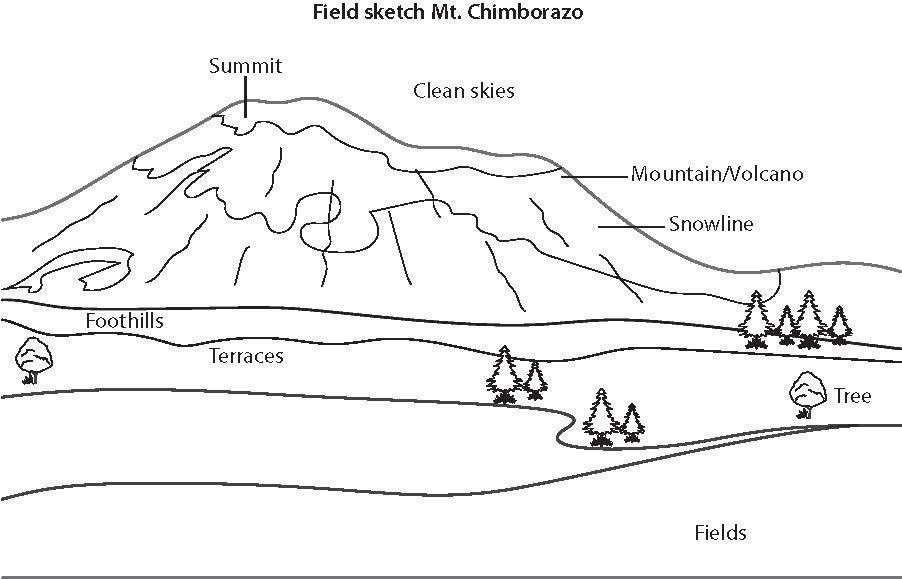
Figure 1.1 Field sketch of Mount Chimborazo.
3 Students should think about the different ways that volcanoes can be classified. When looking at words and their meanings, they should think about other words with similar sounds or letters, for example, for dormant, there is a French verb dormir, or perhaps a dormitory.
4 The VEI is an index, which means it uses specific data values to calculate a score. What are the things about an eruption that can be measured so that different eruptions can be compared?
5 This will require some appropriate internet searches.
Activity answers
1 Viscosity of lava varies according to its chemical composition, particularly the amount of silica it contains, and the amount of gas within it.
More “ runny ” lavas will travel further from the vent before cooling, resulting in the low, wide shape of a shield volcano.
2 See Figure 1.1. This should be based on the image in the Student’s Book, although other cinder cones are also available including Kerid in Iceland and Paricutin in Mexico.
3 Dormancy is a state which means that the volcano has not erupted recently but it is possible that it will erupt again. Dormancy can last thousands of years. People live on the slopes of active volcanoes, so a discussion around what we mean by “safe” could follow. Some are clearly unsafe, for example Merapi in Indonesia, whereas others are safer.
4 The VEI measures the amount of material ejected from an eruption, in the form of lava or pyroclastic material. The daily eruptions of Stromboli would measure 1–3 on this scale. The eruption of Eyjafjallajokull in 2010 was a 4 on the scale, and Mount St Helens in 1980 was a 5.
5 In recent years, there have been a few eruptions which may have reached VEI 6, but these are not confirmed. The Hunga Tonga-Hunga Ha'apai eruption in Indonesia in January 2022 is the largest that has occurred for some time.
How do volcanic eruptions vary in nature?
Lesson intent
Every volcano is unique. Although students may have a picture in their head of flowing lava from a pointed mountain peak, eruptions may involve gas, lava of differing viscosities, ash and other tephra or lahar. They may last for weeks, or just a few hours. Their impacts may be limited to the immediate area, or they may place ash into the upper atmosphere which encircles the whole globe and cools the Earth. Volcanoes are not predictable in the sense that we can never really know what they will do, but the science around this is improving all the time.
Lesson-specific misconceptions
Student misconceptions about the nature of eruptions can be tackled here. They may be used to seeing images of lava flows from volcanoes, such as those on Hawai’i or featured in films or games they may have seen.
Volcanic eruptions, and the material that erupts from them, vary hugely in their nature, and this should be reinforced throughout the teaching of the topic. There is an amusing Pixar short film called Lava (2014) which tells a love story between two volcanoes who erupt in different ways.
Explanation support
If you have access to some rock samples, you could show students what happens to lava after it cools down. Granite and basalt samples would help to show the differences in the crystals that form as the rock cools. They can compare the density of these rocks with sedimentary rocks, and also see their hardness which is caused by the crystals locking together as they cool.
Scaffolding
You can learn how to pronounce pahoehoe from online videos if needed. It is par-hoe-i-hoe-i.
You could model the sizes of grains in tephra by bringing in some sand grains, marbles and tennis balls for students to work out in which classification they would fit.
Also, explain the significance of the weather conditions during volcanic eruptions. Wind speed and direction will affect fine ash dispersal. Heavy rain can mix with ash to produce a lahar, which will flow rapidly away from the volcano, following the topography of existing valleys.
Activity explanation
1 Tephra is a general term which encompasses material of different sizes. Students should be familiar with the classification and be able to come up with a simple definition of what tephra is.