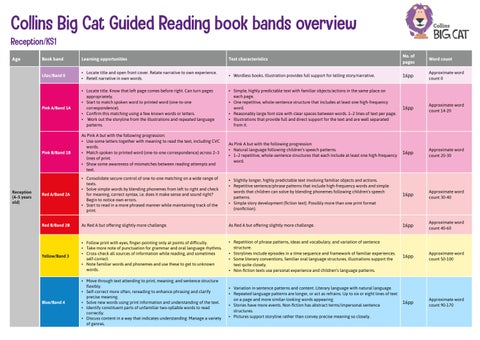
Collins Big Cat Guided Reading book bands overview Reception/KS1 Age
Reception (4–5 years old)
Book band
Learning opportunities
Text characteristics
No. of pages
Word count
Lilac/Band 0
• Locate title and open front cover. Relate narrative to own experience. • Retell narrative in own words.
• Wordless books. Illustration provides full support for telling story/narrative.
16pp
Approximate word count 0
Pink A/Band 1A
• Locate title. Know that left page comes before right. Can turn pages appropriately. • Start to match spoken word to printed word (one-to-one correspondence). • Confirm this matching using a few known words or letters. • Work out the storyline from the illustrations and repeated language patterns.
• Simple, highly predictable text with familiar objects/actions in the same place on each page. • One repetitive, whole-sentence structure that includes at least one high-frequency word. • Reasonably large font size with clear spaces between words. 1–2 lines of text per page. • Illustrations that provide full and direct support for the text and are well separated from it.
16pp
Approximate word count 14-20
Pink B/Band 1B
As Pink A but with the following progression: • Use some letters together with meaning to read the text, including CVC words. • Match spoken to printed word (one-to-one correspondence) across 2–3 lines of print. • Show some awareness of mismatches between reading attempts and text.
As Pink A but with the following progression: • Natural language following children’s speech patterns. • 1–2 repetitive, whole-sentence structures that each include at least one high-frequency word.
16pp
Approximate word count 20-30
Red A/Band 2A
• Consolidate secure control of one-to-one matching on a wide range of texts. • Solve simple words by blending phonemes from left to right and check for meaning, correct syntax, i.e. does it make sense and sound right? Begin to notice own errors. • Start to read in a more phrased manner while maintaining track of the print.
• Slightly longer, highly predictable text involving familiar objects and actions. • Repetitive sentence/phrase patterns that include high-frequency words and simple words that children can solve by blending phonemes following children’s speech patterns. • Simple story development (fiction text). Possibly more than one print format (nonfiction).
16pp
Approximate word count 30-40
Red B/Band 2B
As Red A but offering slightly more challenge.
As Red A but offering slightly more challenge.
16pp
Approximate word count 40-60
Yellow/Band 3
• Follow print with eyes, finger-pointing only at points of difficulty. • Take more note of punctuation for grammar and oral language rhythms. • Cross-check all sources of information while reading, and sometimes self-correct. • Note familiar words and phonemes and use these to get to unknown words.
• Repetition of phrase patterns, ideas and vocabulary, and variation of sentence structure. • Storylines include episodes in a time sequence and framework of familiar experiences. • Some literary conventions, familiar oral language structures, illustrations support the text quite closely. • Non-fiction texts use personal experience and children’s language patterns.
16pp
Approximate word count 50-100
Blue/Band 4
• Move through text attending to print, meaning, and sentence structure flexibly. • Self-correct more often, rereading to enhance phrasing and clarify precise meaning. • Solve new words using print information and understanding of the text. • Identify constituent parts of unfamiliar two-syllable words to read correctly. • Discuss content in a way that indicates understanding. Manage a variety of genres.
• Variation in sentence patterns and content. Literary language with natural language. • Repeated language patterns are longer, or act as refrains. Up to six or eight lines of text on a page and more similar-looking words appearing. • Stories have more events. Non-fiction has abstract terms/impersonal sentence structures. • Pictures support storyline rather than convey precise meaning so closely.
16pp
Approximate word count 90-170
Age
Year 1 (5-6 years old)
Year 2 (6-7 years old)
Book band
Learning opportunities
Text characteristics
No. of pages
Word count
Green/Band 5
• • • • •
• Varied, longer sentences, with little repetition of phrases. Repeated, unfamiliar words. • More varied and larger number of characters involved. • Events sustained over several pages with a larger number of words on page. • Less familiar, more specialized vocabulary. Illustrations provide moderate support for fiction. • Print may be located in captions, fact-boxes and diagrams in non-fiction.
24pp
Approximate word count 170-250
24pp
Approximate word count 250-300
More extended descriptions and use of literary phrasing. More print, more illustrations and layout with elaborated episodes and events. More unusual and challenging vocabulary, particularly in non-fiction. Illustrations provide a lower level of support in fictional texts, and include graphs, maps, and diagrams in non-fiction. • Non-fiction texts contain longer, more formal sentences. Some repeated terms.
24pp
Approximate word count 300-500
Orange/Band 6
Read fluently with attention to punctuation. Solve new words using print detail, attending to meaning and syntax. Self-correct. Manage effectively a growing variety of texts, including non-fiction. Discuss and interpret character and plot more fully. Use contents page and glossary in non-fiction books, and locate information.
• Get started on fiction after briefer introductions, without relying on artwork. • Examine non-fiction layout, using contents pages to select sections of a book to read. • Read longer and more complex sentences with a range of punctuation and text layout. • Use familiar syllables to read longer words. • Use appropriate terminology in discussion. • Check information in text with illustrations and comment on content. • Infer meaning.
• • • •
Increased proportion of space allocated to print rather than pictures in fiction. Illustrations support overall meaning of text. Longer stories with more literary language. Sentence structures more complex. Range of text provision, e.g. plays, simple poetry, simple non-fiction of different types. • Non-fiction texts contain more formal sentences and unfamiliar terms and layouts.
Turquoise/ Band 7
• Extract meaning from the text while reading with less dependence on illustrations. • Use punctuation and text layout to read with expression and control. • Sustain reading through longer sentence structures and paragraphs. • Tackle a higher ratio of complex words with known vocabulary, phonics and syllables. • Monitor own reading, checking and self-correcting while considering text meaning. • Navigate around texts such as indexes, glossaries, and dictionaries.
Purple/Band 8
• Adapt to a variety of fiction, non-fiction and poetry with growing independence. • Read silently and rapidly. Use punctuation to keep track of longer sentences. • Solve most unfamiliar words by blending less common digraphs and recognising alternative spellings to read longer and more complex words. Predict content/ layout/story development. • Take more conscious account of literary effects and the formal language of nonfiction. • Begin to consciously use reading to extend speaking, writing, vocabulary and syntax.
• Sentence structures becoming longer and more complex. Wider variety of genre but still illustrated. • Storyline may be more involved and reflect the feelings of the writer. • Some books with short chapters for more sustained reading. • Characters are more distinctive and rounded than at earlier levels. • Non-fiction texts cover an increasing curriculum range and different text formats. • Alphabetically ordered texts, i.e. dictionaries and simple encyclopedias, glossaries, indexes.
24pp
Approximate word count 500-750
Gold/Band 9
As Purple, but offering slightly more challenge.
As Purple but offering slightly more challenge.
24pp
Approximate word count 700-900
White/Band 10
• Read silently, sustaining interest in longer text, returning to it easily later. • Use text more fully as a reference and as a model, and find information in texts more flexibly. • Notice the spelling of unfamiliar words and relate to known words. • Show increased awareness of vocabulary and precise meaning. • Express reasoned opinions and interpretations about what is read, and compare texts.
• Repetition of phrase patterns, ideas and vocabulary, and variation of sentence structure. • Storylines include episodes in a time sequence and framework of familiar experiences. • Some literary conventions, familiar oral language structures, illustrations support the text quite closely. • Non-fiction texts use personal experience and children’s language patterns.
32pp
Approximate word count 1200
• • • •
Age
Year 2 (6-7 years old)
Book band
Learning opportunities
Text characteristics
No. of pages
Word count
White Plus/Band 10+
• As White, but offering more challenge for pupils that are ready for higher reading levels.
• As White, but with longer texts and more complex plot structures.
48pp
Approximate word count 1200
Lime/Band 11
• Recognise text type and predict general content, returning easily to them after a break. • Read silently, adjusting speed to suit material and monitoring the meaning. • Rerun to make different interpretations of dialogue, complex sentences etc. • Make use of blurbs, glossaries, and indexes to locate information quickly and accurately. • Express reasoned opinions about what is read, and compare texts. • Sustain meaning over many phrases for comprehension due to complex sentences.
• Storyline or theme may be sustained over a longer period of time with chapters or subsections. • More unfamiliar, sophisticated terms including a greater range of verbs to suggest precise meanings. • Widening range of layout, genre, and writing style. • More metaphorical or technical language. • More technical vocabulary not supported directly by illustrations.
32pp
Approximate word count 1500
Lime Plus/Band 11+
• As Lime, but offering more challenge for pupils that are ready for higher reading levels.
• As Lime, but offering more challenge for pupils that are ready for higher reading levels.
48pp
Approximate word count 1500
Book band
Learning opportunities
No. of pages
Word count
Copper/Band 12
• Provides more complex plots and longer chapters that develop reading stamina.
32pp
Approximate word count 1500
Topaz/Band 13
• Offers longer and more demanding reads for children to investigate and evaluate.
32pp
Approximate word count 2000
Ruby/Band 14
• Gives increasing opportunities for children to develop their skills of inference and deduction.
48pp
Approximate word count 2500
Emerald/Band 15
• Provides a widening range of genres including science fiction and biography, prompting more ways to respond to texts.
48pp
Approximate word count 3000
Sapphire/Band 16
• Longer reads to develop children’s sustained engagement with texts that are more complex syntactically.
56pp
Approximate word count 4000
Diamond/Band 17
• More complex, underlying themes to give opportunities for children to understand causes and points of view.
56pp
Approximate word count 5000
Pearl/Band 18
• Offers fluent readers a complex, substantial text with challenging themes to facilitate sustained comprehension, bridging the gap between a reading programme and longer chapter books.
80pp
Approximate word count 8000
KS2 Age Year 3 (7-8 years old)
Year 4 (8-9 years old)
Year 5 (9-10 years old) Year 6+ (10-11+ years old)
Big Cat Read On Age
Learning opportunities
Word count
Year 5 (9–10 years old) – Year 6+ (10–11+ years old)
• Ease the move into free reading with books featuring more sophisticated themes, vocabulary, plots and structures. • Help students build confidence, fluency, and develop their reading identity. • Many of the books have cross-curricular links with topics pupils will encounter in science, history and PSHE.
Approximate word count ranges from 9,000 to 15,000
collins.co.uk/BigCat