Story Talk
Support early language development and communication
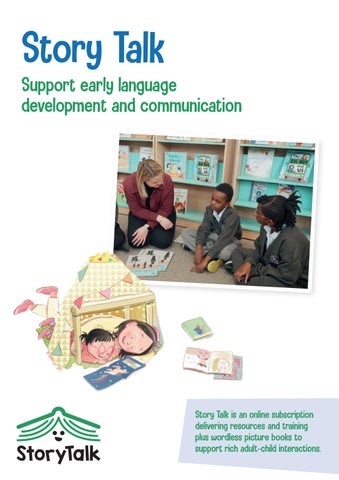
Story Talk is an online subscription delivering resources and training plus wordless picture books to support rich adult-child interactions.
Story Talk 8pp leaflet_update3.indd 2
18/09/2026 11:53
Support early language development and communication with Story Talk – a new research-informed, evidence-based programme The Story Talk Programme The Story Talk subscription provides the resources and training required to implement the programme in full. It includes guidance and support for leadership, class teachers and other staff members teaching the programme alongside strategies for family engagement. Find out more on p.4.
Twelve wordless picture books Lively wordless picture books are at the heart of the Story Talk programme and build vocabulary, improve language and communication and increase social and emotional wellbeing through quality interactions and rich child-led book talk. Find out more on p.6.
Story Talk can support children in EYFS and KS1 who may: • be below expected levels for communication and language • have SEND • find it hard to engage/concentrate with whole-class storytime • have potentially missed out on storytime at home • don’t choose to look at books • struggle to access adult-led learning • are new to speaking English • have limited vocabulary • lack confidence, especially in groups.
“The introduction of Story Talk at Grange Primary School has been an extremely positive experience. Children love choosing their favourite stories to share with an adult and sometimes one or two friends. They especially enjoy being “the boss of the book” and deciding where the story goes. We have found that each time the book is opened, whether with a new child or one revisiting it, the story unfolds differently. We’ve also seen the power of repetition, with many children choosing to return to the same story. They retain vocabulary from previous sessions and build on it quickly and confidently.” AMANDA MATHESON, GRANGE SCHOOL HEADTEACHER
2 Story Talk 8pp leaflet_update3.indd 2
18/09/2026 11:53
Interaction strategies and language support Story Talk has high-quality, positive interaction between an adult and a child at the heart of the programme. Support for enabling this is included within every Story Talk book, and videos that explain the interaction strategies in more detail are provided as part of the Story Talk subscription. Boss of the book The first principle of Story Talk is that the child is in charge. They choose the book, dictate the pace and turn the pages.
Point and name Develop language as you read together by encouraging the pointing and naming of nouns and verbs.
Joint attention Tune in to what the child is looking at in the book, so that you can talk about it together.
Serve and return Extend children’s language by affirming and repeating what they have said, adding an emotion or adjective as appropriate using correct grammar, and describing where the action is happening.
Bring it alive! Create excitement and tension with your voice, sing nursery rhymes and make sound effects.
Link to experience Use “I wonder…” and “That reminds me…” to start conversations about things the child has experienced in class or at home.
Meet the programme creator Hi, I’m Charlotte Raby. I am a teacher, author and early reading and inclusion specialist who co-wrote the DfE Reading Ambition for All programme. I was the programme developer for Little Wandle and have worked for the past thirty years with schools, publishers and the DfE to ensure that children regardless of their starting points are given access to reading. I have wanted to develop Story Talk for a long time. I believe that reading begins with language, and a love of reading can only grow when language, reading skills, and reading for pleasure are all equally attended to. Story Talk gives schools a joyful, positive way to support children develop language, communication and self-esteem using evidence-based effective strategies. I am a passionate advocate for teaching both the skills of reading and the joy of reading to all children and believe that every child can become a reader.
Scan the QR code or visit collins.co.uk/StoryTalk to view video explanations of the interaction strategies.
3 Story Talk 8pp leaflet_update3.indd 3
18/09/2026 11:53
The Story Talk Programme The Story Talk programme is available as a subscription that provides comprehensive training for implementation and assessment, as well as tools for leadership, practitioners and for family engagement. The Story Talk programme includes: • Training modules section, including walkthroughs of sessions and ‘what to do if’ troubleshooting for each strategy • Pupil assessments and assessment guidance • Planning and resources for 1-1 and group sessions for every book • Story Talk session-in-action videos, videos to explain the interaction strategies, and walk-through videos for each Story Talk book • Timetabling and implementation guidance • Research and evidence-based information • Ongoing access to early language and reading webinars
Training videos from programme creator Charlotte Raby explain the Story Talk pedagogy and how to support pupils to develop their language and communciation skills
• Resources for family engagement, including a ready-to-use workshop presentation • Resources for school leadership, including how to use Story Talk to achieve your school improvement plans and school readiness targets
Story Talk initial session: baseline (example) Interest in books
Book behaviours
Concentration
Look out for:
Notes
•
book choice ü
•
interactions with the cover ü
Choose three books: The Big Bus and Us, The Wrong Socks and The Boy and the Ball
•
comments about the book ü
•
reference to other books
•
anxiety ü
•
disinterest
•
interest in the cover ü
•
book orientation ü
•
page turning ü
Looked at cover and said ‘I want this’ Anxiety (see response to shared attention)
•
pointing or touching the pages ü
•
eye gaze across the page ü
•
awareness of story/characters
•
time spent choosing/browsing ü
•
ability to settle without support ü
•
needing encouragement to settle
•
time spent on specific page/s ü
•
speed of session
•
returning to the book after an interaction
•
need for a quiet space/happy with noise ü
Story Talk initial session: baseline (example)
Next steps
Held the final book and took charge
Work on retelling and identifying characters
Returned to the box to choose new books, enjoyed looking at covers
Quiet place for sessions
Some pages interested them for longer
Focus on building confidence 1st and then consider sessions with another child and then Story Talk Book Club
Class teacher says the child removes herself in whole-class sessions
1
Pupil assessments
4 Story Talk 8pp leaflet_update3.indd 4
18/09/2026 11:53
Guidance for leadership, teachers and other staff on how to use the programme
Everything you need to know to implement Story Talk in your setting
Resources for family engagement
Why should you use Story Talk? In 2023, more than a quarter (187,000) five-year-olds did not meet the expected levels to meet the Early Learning Goals for communication, language, and literacy. Research suggests that over 106,000 of this group could have achieved these levels if they had additional support.(1) A disproportionate amount of this cohort comes from disadvantaged communities. There is clear evidence of the impact if targeted support is not provided to children in EYFS: • 15% of pupils with identified speech, language and communication needs (SLCN) achieved the expected standard in reading, writing and mathematics in Key Stage 2 compared with 61% of all pupils.(2) • 81% of children with emotional and behavioural disorders have unidentified SLCN(2) • Children with vocabulary difficulties at age 5 are three times more likely to have mental health problems in adulthood and twice as likely to be unemployed when they reach adulthood.(3) • Children from socially disadvantaged families are more than twice as likely to be identified with a SLCN.(4) Research tells us that approaches which support children’s early language and communication are central to improving their life-chances. ‘Children who are better communicators at age five go onto become better readers, get better exam results at age 16, and are more likely to gain higher-paid employment as adults’(5). As the EEF’s Preparing for Literacy guidance report states, ‘language provides the foundation of thinking and learning and should be prioritised.’ Story Talk can be used alongside any phonics programme and is not part of a reading programme.
Who is it for?
Why book sharing matters We’d all like our children to be confident and able to tell us what they want and need. A child’s early language experiences have a powerful impact on their emotional and academic wellbeing. Evidence has grown about the importance of children’s regulation and communication in their development. Research has identified the positive impact of shared reading in developing self-regulation and language. Book sharing has a wide, long-term impact: • Children who read, or are read to, regularly tend to have better wellbeing, lower levels of emotional problems, and improved resilience and self-esteem. (Batinin et al, 2020) • Book sharing provides the opportunity for calm through escapism, imagination and emotional regulation. In many ways reading can act as a protective factor against the adversity some children experience. (Rix et al, 2017) • Shared reading builds the emotional and social literacy all children need to navigate life successfully. (Book Trust, 2025) We’d like you to make time to share a book with your child and try some simple strategies to grow communication, concentration and emotional connection.
Story Talk has been created and trialled in schools to support specific cohorts of children in EYFS and Key Stage 1. It is first and foremost a programme to develop language and social communication for children who are not at age-related language levels.
If you do just one thing: make time to share a book with your child! Because …
It has also been very successful for children with Social, Emotional and Mental Health (SEMH) needs, and children who are new to speaking English or speak English as an additional language (EAL) and are not confident in speaking.
It aids regulation
It can be used flexibly to support children through one-to-one or group sessions. Story Talk has been developed with inclusion at its heart; it is accessible by design and can support a wide range of children who may have differing needs. Everything you need to know to implement Story Talk in your setting
1
• When a parent and young child share a book, their heartbeats sync. • Picture books help children experience big feelings safely. We teach emotional regulation to children by helping them identify their feelings. • Thinking and talking together develops social interactions ... • … and supports your child’s ability to concentrate.
It develops shared attention
Training videos to help users see the Story Talk • This develops higher-level thinking. • This creates positive feedback toin your child. strategies practice
• This means you are tuned in to your child and what they are interested in. • This sparks talk about the things that matter to your child.
• This increases confidence and fosters positive relationships.
Pupil record sheet: Child’s name:
Book title and date
strategies 1—3
Boss of the book: interactions with the book
ies 1–3 Pupil record sheet: strateg
Point and name:
Enjoyment
Notes
words and phrases
1
1-year subscription to Story Talk 978-0-00-879407-1 £130.00
Resources for the Story Talk programme are accessed on the Collins Hub. Find out more and request a free trial at collinshub.co.uk
5 Story Talk 8pp leaflet_update3.indd 5
18/09/2026 11:53
Discover the books Twelve wordless large format picture books created for children in nursery, Reception and KS1 to improve children’s early language and facilitate positive interactions between adults and children. Authentic life experiences are represented to engage all children and help spark conversation and story telling.
EYFS The Toy Swap
A Big Day In
Follow four families as they get ready to go to the park for a toy swap!
Spend the day with two friends as they enjoy a playdate together.
978-0-00-879394-4 £7.99
978-0-00-879395-1 £7.99
The Boy and the Ball
The Balloon Chase
Leo and his mum walk into town to buy him a new football. But then he gets distracted and loses the ball. Will he ever get it back?
Join Jack and his friends at a summer fair as he enjoys choosing a new balloon — and then he loses it! Will he ever get it back?
978-0-00-879396-8 £7.99
978-0-00-879397-5 £7.99
The Big Bus and Us
The Wrong Socks
Follow Neve and her dad as they catch the bus together. Where will they end up?
Today isn’t going well for Jonah, but will he be able to turn it around before the end of the day?
978-0-00-879398-2 £7.99
978-0-00-879399-9 £7.99
Pages from The Boy and the Ball
6 Story Talk 8pp leaflet_update3.indd 6
18/09/2026 11:53
KS1 Charlie and Robocat
Juggling Jaydon
Charlie and Maya are enjoying playing with a new toy together — until the toy is accidentally broken. Will they be able to fix the toy and their friendship?
Jaydon and his dad are excited to see a juggling performer when they’re out in town, and Jaydon is inspired. But it turns out juggling is more difficult than he realised!
978-0-00-879400-2 £7.99
978-0-00-879401-9 £7.99
Just Like Roodie
What a Performance!
Robert is desperate to be as good at skateboarding as Roodie, but Roodie isn’t keen on teaching his little brother. Is there anything that will persuade him?
Amelia and Arlo are excited — there’s going to be a school talent show and they will be performing their favourite magic tricks! But one trick keeps going wrong in rehearsals. Will it go well in the performance?
978-0-00-879403-3 £7.99
What Can You See, Rosie? Rosie is always on the lookout for animals wherever she goes but never seems to see any. When she agrees to help Grandad with his roof garden, she starts to see what she’s been missing this whole time.
978-0-00-879404-0 £7.99
Farid’s First Day Farid and his family have just moved to a new town, and today is his first day at school. Will he fit in and make a new friend? 978-0-00-879406-4 £7.99
978-0-00-879405-7 £7.99 Pages from Farid’s First Day
“Using Story Talk with my Nursery class has been an extremely positive experience. The carefully chosen texts immediately engaged the children and provided rich opportunities for discussion, vocabulary development and making connections. Story Talk has become a valuable part of our Early Years provision, and I would highly recommend it to other teachers looking to strengthen oracy and a love for books in a meaningful, enjoyable way.” CHRISTINE LOVETT, ALEXANDRA PRIMARY SCHOOL HOUNSLOW, ASSISTANT HEAD
7 Story Talk 8pp leaflet_update3.indd 7 GRANGE PRIMARY SCHOOL
18/09/2026 11:53
Discover more about the Story Talk programme Find out more about Story Talk, hear from programme creator, Charlotte Raby, and discover insights from our author-illustrators by visiting collins.co.uk/StoryTalk
Catch up on the Story Talk webinar series as Charlotte Raby discusses the impact Story Talk can have on children’s early language development. Watch on YouTube CollinsEd
If you have any questions about Story Talk you can contact our customer services team:
01484 668 148 education@harpercollins.co.uk
You can also talk to your local sales consultant – find their details at collins.co.uk/findarep.
HarperCollins Publishers Ltd is registered in Scotland at 1 Robroyston Gate, Robroyston, Glasgow, G33 1JN. Company No. 27389
Story Talk 8pp leaflet_update3.indd 8
CBCST2609
18/09/2026 11:53