Copper Band 12
Mae and Marco’s
Space Journey
Mae and Marco’s
Space Journey MAE AND MARCO’S SPACE JOURNEY
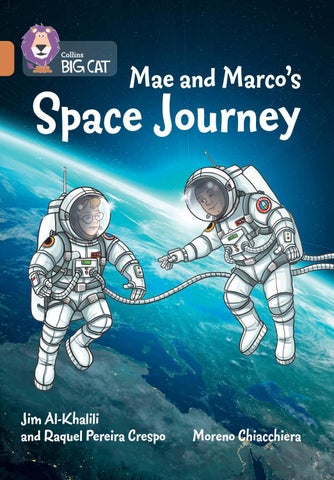
Join Mae and Marco, our astronauts, as they build a rocket, work out how to escape Earth’s gravity and journey into space. Learn lots of fascinating facts about space as they visit the International Space Station and walk on the Moon.
An information book
Jim Al-Khalili and Raquel Pereira Crespo
Moreno Chiacchiera
collins.co.uk/collinsbigcat
43931_Cover.indd 1
22/10/2021 09:27
Mae and Marco’s
Space Journey Written by Jim Al-Khalili and Raquel Pereira Crespo Illustrated by Moreno Chiacchiera
Contents 1 The force that holds space together
2
2 How to defeat gravity
4
3 Rocket propulsion
6
4 The launch
8
5 Disappearing gravity?
10
6 Orbiting close to Earth
12
7 Amazing spacewalk
14
8 Docking with the International Space Station
16
9 Seeking answers from experiments in space
18
10 Space observatory fleet
20
11 Our tiny home planet
22
12 Earth’s Moon
24
13 Heading home
26
Glossary
28
Mae and Marco’s space scrapbook
30
43931_P001_032.indd 1
22/10/2021 09:25
1 The force that holds space together It’s early afternoon on a bright, sunny day and adventurous friends, Mae and Marco, are waiting for a very rare event: a total eclipse of the Sun. Holding up special filters to protect their eyes when looking directly at the Sun, they discuss what is holding the Sun and Moon up in the sky. It’s the force of gravity – which, strangely, is the same force that keeps us stuck on the ground. The quest for adventure bubbles up inside them. “Let’s build a rocket and go to the Moon!” says Mae.
Space scoop The Moon is 400 times smaller than the Sun, but because it’s also about 400 times closer to Earth, it looks the same size as the Sun to us.
2
43931_P001_032.indd 2
22/10/2021 09:25
3
43931_P001_032.indd 3
22/10/2021 09:25
2 How to defeat gravity To build a rocket, Mae and Marco need to figure out how to overcome Earth’s gravity. They have noticed that the harder they hit a tennis ball, the further it travels before it falls to the ground. What if you hit it so hard it never reaches the ground, but carries on falling around Earth? It’s now in orbit. If you hit it any harder, it won’t stay in orbit, but will fly off into space.
4
43931_P001_032.indd 4
22/10/2021 09:25
For a tennis ball to escape the pull of Earth’s gravity, it would have to have a speed of over 40,000 kilometres per hour, or several times the speed of a bullet. This is called the “Earth escape velocity”.
escape velocity
gravitational pull
5
43931_P001_032.indd 5
22/10/2021 09:25
3 Rocket propulsion Hitting a rocket with a giant tennis racket doesn’t sound like a great idea. Instead, Mae and Marco’s rocket will need to eject a great amount of hot, exploding gas so that it can be propelled upwards with enough force to send it into space.
Space scoop The first rocket to leave Earth’s atmosphere was the V2 missile which was launched by Germany during the Second World War in 1942.
6
43931_P001_032.indd 6
22/10/2021 09:25
7
43931_P001_032.indd 7
22/10/2021 09:25
4 The launch Soon the big day arrives. Countdown begins: ten … nine … eight ... seven … six … five … four … three … two ... one … Lift off! The rocket shakes and shudders as it slowly climbs upwards, but quickly picks up speed. Mae and Marco are squashed back into their seats as they accelerate upwards, just as you would be on a fairground ride.
Space scoop The first human to go into orbit was the cosmonaut, Yuri Gagarin, on 12th April 1961. He went all the way around Earth in his space capsule in 89 minutes.
8
43931_P001_032.indd 8
22/10/2021 09:25
Copper Band 12
Mae and Marco’s
Space Journey
Mae and Marco’s
Space Journey MAE AND MARCO’S SPACE JOURNEY
Join Mae and Marco, our astronauts, as they build a rocket, work out how to escape Earth’s gravity and journey into space. Learn lots of fascinating facts about space as they visit the International Space Station and walk on the Moon.
An information book
Jim Al-Khalili and Raquel Pereira Crespo
Moreno Chiacchiera
collins.co.uk/collinsbigcat
43931_Cover.indd 1
22/10/2021 09:27