Diamond Band 17
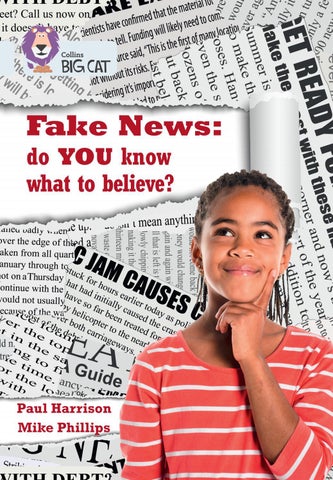
Fake News:
do YOU know what to believe?
do YOU know what to believe?
FAKE NEWS: DO YOU KNOW WHAT TO BELIEVE?
Fake News:
What is fake news and why is it important? Is it always bad news and what can you do to sort the fact from the fiction?
An information book
Paul Harrison Mike Phillips
collins.co.uk/collinsbigcat
34380_Cover.indd 1
27/10/2021 11:00
Fake News: do YOU know what to believe? Written by Paul Harrison Illustrated by Mike Phillips
Contents 1 Introduction
2
2 Early fakes
4
3 World at war
6
4 Making money
8
5 Bad medicine
16
6 Myths, monsters and things that go bump in the night
20
7 A day of pranks and jokes
28
8 Mistakes and urban legends
32
9 Stories that live forever
42
10 Fighting against the fakes
44
Glossary
52
FAKE or REAL?
54
34380_P001_056.indd 1
27/10/2021 11:10
1 Introduction What is fake news? The simple definition is that a fake news story is a story that isn’t true. However, fake news is a bit more complex than that. There are different types of fake news and these stories are spread for different reasons. Fake news can be as innocent as a joke or a bit of fun, but many types of fake news are seriously bad news. A newspaper can choose the facts it includes in a story to make its readers react in a certain way. A business can use fake news to harm a competitor or to boost their own sales. A criminal may use fake news to try and steal information or money from an unsuspecting victim. Fake news can even be used to try and bring down a government or influence an election result.
2
34380_P001_056.indd 2
27/10/2021 11:10
On the rise The term “fake news” really came to the public’s attention back in 2016. The politician Donald Trump, who was trying to get elected as president of the USA, often used the term to discredit stories he didn’t believe. It was also used against him. In that year alone, the use of “fake news” as a saying increased by 365%. It became such a famous term that the Collins Dictionary made it their word of the year for 2017.
3
34380_P001_056.indd 3
27/10/2021 11:10
2 Early fakes There is nothing new about fake news, though. In ancient Greece, the philosopher and botanist Theophrastus described 30 different types of person in his work Characters. One of these people was the “Newshound” who enjoys spreading false stories.
Royal rebellion During the reign of the British King George II (born 1683 – died 1760), people spread false news about his health as a way of trying to stir up a revolution to overthrow him from the throne. The rumours spread quickly, thanks to the printing press which allowed people to print the rumours and display them.
4
34380_P001_056.indd 4
27/10/2021 11:10
Don’t believe everything in the paper Newspapers have been known to tell fake stories on purpose. One notorious case was printed by the New York Sun in 1835. It claimed that astronomers had seen evidence of life on the moon. The article went into detail about the types of weird and wonderful creatures they had discovered. The following month, the newspaper admitted it had made up the stories, but by this point the number of people reading the paper had greatly increased and helped the paper’s profits. Fake news is designed to affect how a person feels about a topic. This has been used on a global scale, too – even during wars.
some of the moon creatures described in the article
5
34380_P001_056.indd 5
27/10/2021 11:10
3 World at war Telling lies and smearing opponents can be used by politicians at home, but fake news has also been used as a weapon of war against other nations. Warfare is expensive and costs lives – fake news, on the other hand, can weaken an enemy country without having to fire a bullet. Fake news is a type of propaganda, and propaganda has been used as a weapon of war for centuries. A government may choose to exaggerate, lie or present only positive information to boost the morale of its own people. In contrast, it may present negative information or false stories to weaken enemy morale. The key with propaganda is to get the message to people before the enemy government can stop it. During the Second World War, Germany used to broadcast radio programmes to Britain which would say how strong Germany was and how weak Britain was by comparison. They would also drop leaflets over the UK with the same message. In return, Britain and America used planes to drop thousands of propaganda leaflets over an enemy city or area. With so many leaflets being dropped, it was almost guaranteed that people would see them. 6
34380_P001_056.indd 6
27/10/2021 11:10
This German propaganda leaflet was dropped over the east of England in 1941. It told people they would starve because war in the Atlantic Ocean was cutting off food supplies.
This kind of propaganda works very well if people in the enemy country already think that things are not going well, as they are more likely to believe the messages. However, if the enemy is feeling confident then people are more likely to ignore the propaganda. 7
34380_P001_056.indd 7
27/10/2021 11:10
4 Making money Spotting fake news is important when money is involved, as the idea of getting rich can make people do odd and – in some cases – highly illegal things. When big business is involved this can mean big bucks, but fake news can involve even the smallest businesses too.
Lying for profit You can make money from fake news, as American university graduate Cameron Harris realised when he was looking for a way to pay off the money he had borrowed as a student. In 2016, he bought the internet domain name ChristianTimesNewspaper.com and charged money for companies to advertise on the site. This is how many websites make money. The more people that visit a website, the more money the website can make from advertisers. One day, Harris posted a fake news story on his site and noticed that more people read this fake news than the real news stories he had posted. Soon he was posting more fake news and earning more and more money. But why did more people read the fake stories? Harris believed that people wanted to find evidence to support their own point of view. So, for example, if 8
34380_P001_056.indd 8
27/10/2021 11:10
Diamond Band 17
Fake News:
do YOU know what to believe?
do YOU know what to believe?
FAKE NEWS: DO YOU KNOW WHAT TO BELIEVE?
Fake News:
What is fake news and why is it important? Is it always bad news and what can you do to sort the fact from the fiction?
An information book
Paul Harrison Mike Phillips
collins.co.uk/collinsbigcat
34380_Cover.indd 1
27/10/2021 11:00