KEEPING HISTORY ALIVE 2025 - 2026 NEWSLETTER
WELCOME
In a world that moves at lightning speed, it’s easy to leave the past behind. But history isn’t just a collection of dusty dates and fading photographs, it is the record of who we are, where we’ve been, and the lessons we must carry forward. When we take the time to remember, we don’t simply honor the past, we equip ourselves to build a stronger, wiser future.
COLLINGS FOUNDATION 2025- 2026 NEWS MAGAZINE Address: 568 Main Street, Hudson, MA 01749 Telephone: (978) 562-9182 Website: www.AmericanHeritageMuseum.org Contact email: admin@americanheritagemuseum.org The Collings Foundation and Collings Foundation Inc. are 501(c)(3) Educational Non-Profits. Primary writer, editor and designer: Hunter Chaney Contributing writers and editors: Ryan Keough Marcia Rising Anne Marie Casavant Chaney Contributing photographers and artists: Richard Binder Roland Brooks John Collins Warren Disbrow Andrew and Matthew Ford Rick Heile Rich Oliver Tom Perry Antoine Tanchoux David Watts, Jr. Jack Yan
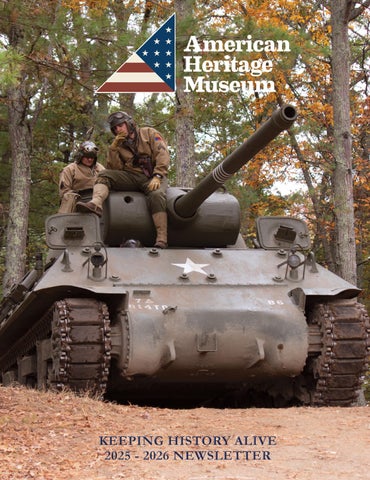
Cover photo: WWII re-enactors pose on top of the M36 Jackson tank destroyer prior to the “Battle for the Airfield” WWII re-enactment. You can see and even ride in this tank during our living history event weekends and by schedule. 1
COLLINGS FOUNDATION - AMERICAN HERITAGE MUSEUM
Take the horrors of the Holocaust, for example. This Genocide, in which six million Jews and millions of others were murdered during World War II, stands as one of humanity’s darkest chapters. Remembering it is not just about mourning the dead—it is about ensuring that the world never forgets the cost of unchecked hatred and prejudice. Education programs such as the American Heritage Museum’s Holocaust exhibit and VR experience remind us that vigilance against intolerance, antisemitism and authoritarianism is not optional; it is essential. Military history carries vital lessons. The Battle of Okinawa during World War II was one of the bloodiest in the Pacific, with enormous loss of life on both sides. It helped push leaders toward the decision to end the war through means that were controversial but decisive. Remembering such battles underscores the devastating human cost of war and strengthens our resolve to pursue diplomacy, peace, and international cooperation whenever possible. When we forget history, we risk repeating its mistakes. When we remember it, we gain wisdom. The past is a compass, pointing us toward better choices, whether that means standing up to injustice, valuing freedom, or simply recognizing the fragility of peace. Remembering history isn’t about dwelling on the past—it’s about ensuring that the sacrifices, struggles, and triumphs of those who came before us continue to shape a better future. The American Heritage Museum takes a holistic approach, exploring armor and aviation history in all the branches of military service, on land, sea and air, while carrying forward personal stories and experiences, especially around World War II. The American Heritage Museum was recognized this year by National Geographic as one of the Top 10 World War II History Museums in the World. This incredible honor strengthens our resolve as we launch our future expansion ambitions. The Museum has laid out exciting plans to expand its facilities so that our growing historic aircraft collection, spanning from pre-World War I machines all the way to modern military aviation can be properly housed, displayed, and brought to life in an immersive way.
Photo: The OY-1 Sentinel, a Battle of Okinawa veteran, makes a pass over the field during our WWII Pacific War re-enactment.
While much of the Museum’s focus has been on armored vehicles, tanks, and large equipment, we have already begun showcasing aircraft in the existing Museum and through themed events such as the “Historic Aviation Weekend” featuring flying demonstrations and rare aircraft. The expansion aims to provide additional dedicated space for world-class aircraft exhibits allowing more of the Museum’s collection to be on display together, with clear chronological narratives of aviation history, improving context and enhancing visitor access. By building the aviation wing, the Museum will be able to more effectively tell the story of military aviation through the decades — showing how flight evolved from fragile biplanes in the Great War, through the rapidly advancing technology of World War II and the jet era, up to today’s modern aircraft. Visitors “see” history: the chronological progression of design, materials, propulsion, and strategy becomes tangible when placed side-by-side in one space. Through immersive dioramas, interactive exhibits, and aviation living history events, Museum visitors will gain not just static views but dynamic engagement, learning the personal stories of the men and women behind the machines. The expanded facility will enhance educational outreach and broaden the audience participation. With additional exhibit space, the Museum can host more special
events, educational programs, veteran talks, and dynamic demonstrations, all of which enhance understanding the human stories of pilots, engineers and ground crew, and the changing face of aerial combat and support. For younger visitors especially, this means connecting the machines with the lives and choices of real people, fostering interest in history, engineering, STEM fields, and the significance of military aviation in national and global contexts. Your support is essential to bringing this exciting expansion to life. Achieving our goal requires significant funding, and we hope you’ll consider making a donation. There are many ways to contribute—please visit our website or contact us directly to learn more and stay updated on the latest developments.
Rob Collings President
Bob Collings Co-Founder
COLLINGS FOUNDATION - AMERICAN HERITAGE MUSEUM
2
...in hot pursuit!
Photo: Al Capone in his original 1940 V-16 Cadillac being chased by prohibition agent Elliot Ness in a 1950 Chevrolet Fleetline during the American Heritage Museum’s American Elegance car show and radio review. See our next classic automobile presentation over Father’s Day weekend - June 20th & 21st, 2026.
INDEX 5-9
AHM’s Historic Aviation Expansion
Flying into the future! The American Heritage Museum is expanding to showcase a world- class collection of historic aircraft.
11-12 SAS-2 “Guideline” Missile
A Soviet-designed, high-altitude surface-to-air missile developed in the 1950s to destroy enemy aircraft has been added to the Vietnam exhibit.
14
Bell HH-1K Huey Helicopter
Iconic helicopter has been added to the Vietnam exhibit. Renowned for its service and versatility.
17-18 1918 SPAD S.VII
Another immaculate restoration. The SPAD was a WWI French fighter aircraft renowned for its speed, durability, and effectiveness.
3
COLLINGS FOUNDATION - AMERICAN HERITAGE MUSEUM
10
A Promise Kept VR Experience
13
WWII Jeep Sweepstakes
The American Heritage Museum has added a VR experience titled A Promise Kept to the Holocaust exhibit.
AHM is hosting a WWII Jeep sweepstakes, giving participants a chance to win a fully restored and operational WWII Jeep.
15-16 WWII Tank Demonstration
An event made in heaven for tank and armor enthusiasts! WWII tanks operate in this captivating exhibition. Tank rides available!
19-20 Battle of Okinawa Re-enactment
The Battle of Okinawa re-enactment brings to life one of World War II’s fiercest Pacific battles through this authentic living history event.
21
Caudron G4
AHM is restoring an original French twin engine biplane used in World War I for reconnaissance and light bombing missions.
22
Battle of the Bulge Living History Weekend The Battle of the Bulge Living History Weekend immerses visitors in authentic camps, vehicles, half-track rides and interactive demonstrations.
23-24 AHM’s Historic Aviation
25-26 Battle for the Airfield WWII Re-enactment
27-28 The History Connection
29-30 PBY’s Immaculate Restoration
The historic aircraft collection showcases rare and meticulously restored military and civilian planes, spanning the history of aviation.
The American Heritage Museum’s exhibits are laid out chronologically from the Revolutionary War to current time.
31-34 Donor Support and Membership
Your support helps preserve historic artifacts, fund restorations, and ensure future generations can experience and learn from America’s rich history.
The Battle for the Airfield WWII re-enactment brings World War II combat to life with authentic and immersive battlefield demonstrations and exhibitions.
The world’s most rare and decorated WWII PBY Catalina restoration is nearing completion. Find out how you can help support this project.
Scan QR code to see our website. www.AmericanHeritageMuseum.org COLLINGS FOUNDATION - AMERICAN HERITAGE MUSEUM 4
The Grand Plan American Heritage Museum’s Historic Aviation Expansion. The American Heritage Museum (AHM) is embarking on one of the most exciting chapters in its history—the opening of the new aviation wing, a 100,000-square-foot expansion that will showcase one of the world’s premier collections of historic aircraft. Building upon the Collings Foundation’s 45year mission to educate, honor, and inspire, this ambitious addition transforms aviation history into a living experience. Each gallery will invite visitors to explore the evolution of flight, from the earliest dreams of flight to the supersonic age of modern warfare. Visitors will begin their journey in Gallery 1: The Dawn of Aviation, where humanity’s first ventures into the skies are brought to
5 COLLINGS FOUNDATION - AMERICAN HERITAGE MUSEUM
life. Here, the spirit of innovation and determination that powered the Wright Brothers and other early pioneers is celebrated through authentic artifacts and immersive storytelling. Guests will see how fragile wooden structures and fabric wings became the foundation of modern flight. In Gallery 2: Knights of the Air, aviation’s role in warfare emerges for the first time. The daring pilots of World War I, known as “aces,” transformed fragile biplanes into symbols of courage and chivalry. The exhibit captures the excitement and peril of dogfights above the trenches, honoring these early aviators who helped shape the future of military aviation.
Background photo: A conceptual rendering shows the existing museum at the top and the expansion at the bottom and left.
COLLINGS FOUNDATION - AMERICAN HERITAGE MUSEUM
6
The interwar years and the ominous buildup to World War II are the focus of Gallery 3: Clouds of War and Gallery 4: Blitzkrieg. These Galleries trace the turbulent years following the First World War and the rise of totalitarian powers. Visitors stand beneath a suspended Heinkel He 111 bomber, surrounded by powerful imagery of advancing Panzer tanks—an immersive recreation of Germany’s devastating Blitzkrieg tactics that changed warfare forever. From there, guests experience the turning of the tide in Gallery 5: The Battle of Britain and
7
COLLINGS FOUNDATION - AMERICAN HERITAGE MUSEUM
Gallery 6: Operation Barbarossa where the
might of the Royal Air Force and the Soviet Air Force are tested against overwhelming odds. Authentic aircraft, personal stories, and multimedia presentations place visitors in the skies above England and the Eastern Front, showcasing both the human cost and the heroic resilience that defined these campaigns. A broader global perspective unfolds in Gallery 7: A Gathering Storm and Gallery 8: A Date That Will Live in Infamy - which explore Japan’s rise in Asia and the shocking
attack on Pearl Harbor that propelled America into war. Visitors stand amid the chaos of December 7, 1941, surrounded by authentic relics and firsthand accounts of that fateful morning— an emotional tribute to the men and women who responded with bravery and resolve. The journey continues into the Grand Air War in Europe exhibit, spanning Galleries 9 through 16. Here the scale and scope of the air campaigns come into focus. Visitors experience the Battle of the Atlantic, the Mediterranean Campaign, and the immense struggles of the
Mighty Eighth and Ninth Air Forces. The galleries bring together restored aircraft, immersive environments, and powerful stories from the home front where WASP pilots and Tuskegee Airmen broke barriers and helped secure victory. Between exhibits, guests can relax in the Green Man Pub, a themed restaurant modeled after the traditional English public house, evoking the camaraderie of those who lived through Britain’s darkest days. In Galleries 17 through 20, the focus shifts to the Pacific Theater and the monumental
COLLINGS FOUNDATION - AMERICAN HERITAGE MUSEUM
8
air war in the Pacific. From the early Japanese advances to the epic Clash of Carriers and the mighty B-29 Superfortress missions over Japan, this area captures the intensity of island warfare and the technological leaps that ultimately led to victory. The “Island-Hopping” strategy and naval aviation’s rise are portrayed through immersive displays that place visitors on carrier decks and in the cockpits of the aircraft that changed the course of the War. Following World War II, new exhibits take visitors to the Korean War and the Air War Over Vietnam, tracing the evolution of aerial combat to the jet and missile age. Visitors will encounter aircraft like the MiG-17, MiG-21, and F-4 Phantom II, as well as the stories of the aviators who flew them during some of the most challenging conditions in history. These galleries reveal how lessons learned from earlier wars shaped modern air strategy and technology.
9 COLLINGS FOUNDATION - AMERICAN HERITAGE MUSEUM
Through every gallery from the fragile beginnings of flight to the supersonic skies of the Cold War, the aviation wing exemplifies the American Heritage Museum’s enduring mission: to preserve, educate, and inspire. This expansion will celebrate both world-class artifacts and the personal courage, innovation, and sacrifice that define America’s aviation legacy. Visitors will leave with a renewed appreciation for the power of flight—and the indomitable human spirit that made it possible. There is much work to be done as we get ready to break ground on the new wing. Of course, one of the most important ingredients to this expansion is money. We invite you to join us in supporting this landmark project. Your contribution helps us preserve incredible aircraft, honor the heroes who flew them, and inspire the next generation to reach for the skies. Together, we can ensure that the story of American aviation continues to soar for decades to come.
A PROMISE KEPT VIRTUAL REALITY EXPERIENCE One girl carried the stories of 599 women
Background photo: Original German railcar on display in the American Heritage Musuem’s Holocaust exhibit.
The American Heritage Museum is now offering a gripping virtual reality experience that takes you on a journey back to the notorious Auschwitz killing center with survivor Fritzie Fritzshall, as she fulfills her promise to the 599 women who helped save her life. Produced by the renowned human rights center, the Illinois Holocaust Museum, A Promise Kept utilizes cutting edge VR technology that allows audiences to
journey back with survivor Fritzie Fritzshall, to the grounds or her grandparent’s home, to the arrival ramp, crematorium, barracks and latrines of Auschwitz. The new VR experience is a fitting addition to our Holocaust exhibit featuring an original WWII German railcar that was imported from Nuremberg. Individuals and school groups alike can view A Promise Kept VR experience anytime during Museum’s open hours. COLLINGS FOUNDATION - AMERICAN HERITAGE MUSEUM
10
SA-2 “Guideline” Missile Cold War Lightning Bolt added to Vietnam exhibit
On May 1, 1960, a U.S. U-2 spy plane (like the one featured on the left) piloted by Francis Gary Powers was shot down over the Soviet Union by an SA-2 surfaceto-air missile (SAM) at an altitude of 66,000 feet.
Visitors to the American Heritage Museum’s Vietnam War exhibit in Hudson, Massachusetts, meet one of the Cold War’s most consequential weapons face-to-face: the Soviet-designed S-75 Dvina, better known in the West by its NATO code name, SA-2 “Guideline.” In July 2025 a SA-2 missile arrived at the Museum on long-term loan from the National Museum of the U.S. Air Force in Dayton. It is installed alongside the museum’s F-105G Thunderchief “Wild Weasel,” also on loan from Dayton. The pairing frames a gripping story of measure and
countermeasure that defined the air war over North Vietnam. The S-75 entered service in the late 1950s as the Soviet Union’s first truly effective high-altitude surface-to-air missile. Built around command guidance from the SNR-75 “Fan Song” fire-control radar, the two-stage missile (solid booster, liquid-fuel sustainer) was designed to swat down the high-flying intruder’s guns they could no longer reach. In broad terms, the system could drive a Mach-3+ interceptor
Photo above: The restored SA-2 “Guideline” missile has been positioned next to the F-105G Thunderchief in the American Heritage Museum’s Vietnam exhibit. 11
COLLINGS FOUNDATION - AMERICAN HERITAGE MUSEUM
missile to the thin air above 60,000 feet and beyond, guided all the way by missile control radar.
around radar vans and control cabins, often under the umbrella of anti-aircraft guns.
The SA-2 announced itself to the world with a thunderclap. On May 1, 1960, a salvo of SA-2s over the Soviet Union brought down CIA pilot Francis Gary Power’s U-2 reconnaissance aircraft, detonating a geopolitical crisis and proving that high altitude was no longer sanctuary. Two years later, during the Cuban Missile Crisis, a Soviet-operated SA-2 battery killed Maj. Rudolf Anderson, Jr., the only U.S. combat fatality of the confrontation—an incident that pushed Washington and Moscow to the brink of nuclear war before cooler heads prevailed.
As the threat hardened, the U.S. created specialized Suppression of Enemy Air Defenses (SEAD) units, the legendary Wild Weasels, whose job was to bait, locate, and destroy SA-2 sites with tactics and technologies that would define modern electronic warfare. The duel escalated quickly: SA-2 firings climbed from roughly 30 launches per month in 1965 to about 220 per month by 1967–68, even as U.S. countermeasures and anti-radiation missiles steadily drove down the system’s effectiveness.
The missile’s combat resume expanded in 1965 when North Vietnam, with Soviet advisers in tow, began fielding SA-2s to protect its skies as the United States opened Operation Rolling Thunder. The first U.S. aircraft fell to SA-2s on July 24, 1965—a shock that forced the Air Force and Navy to rethink how they would strike defended targets. The North Vietnamese camouflaged and frequently relocated their sites, which typically featured six single-rail launchers arranged in the distinctive hexagonal “flower” pattern
An SA-2 battery knitted together several elements. Spoon Rest or other search radars scanned for intruders, Fan Song then locked on, tracked the target and the outbound missile, and sent steering commands to the missile by radio link. In its classic form, Fan Song could track a target and guide multiple missiles to improve kill probability, a sobering prospect for any pilot who saw the telltale plume lancing upward. The missile itself, various V-750 models, combined blistering speed (often cited around Mach 3–3.5) with a large blast-fragmentation warhead designed to shred aircraft with shrapnel at altitude. The American Heritage Museum’s decision to anchor its Vietnam air-war narrative with a real SA-2 lets visitors see the threat that reshaped American air power. Placing the restored missile beside an F-105G Thunderchief “Wild Weasel” provides essential context, helping visitors connect with the pilots who deliberately flew into radar beams to silence them, missile crews who broke down and moved sites within hours to survive and the relentless spiral of countermeasures and counters to those countermeasures. The SA-2 and F-105G displayed together, illustrate this “deadly cat-and-mouse game” over North Vietnam.
Top photo: The SA-2 as it arrived to the museum on a flatbed. Bottom photo: The SA-2 being restored in original camouflage.
Museums are at their best when they make abstract forces—technology, doctrine, geopolitics—feel immediate. By adding the SA-2 to the Vietnam War exhibit, the American Heritage Museum is not simply displaying a missile; we are inviting visitors to experience the central drama of the air war: the race between a defender’s radar-guided reach and an attacker’s evolving tools to blind it. It’s a story with echoes in every modern conflict where air superiority is contested, and one that began, in earnest, when the first SA-2s rose into the Cold War sky. COLLINGS FOUNDATION - AMERICAN HERITAGE MUSEUM
12
13
COLLINGS FOUNDATION - AMERICAN HERITAGE MUSEUM
Bell HH-1K Huey Helicopter Iconic helicopter added to the American Heritage Museum’s Vietnam War exhibit.
The Huey helicopter proved remarkably versatile, adapting to the rapidly changing tactical demands of the Vietnam War. Designed to airlift troops within its box-like fuselage, it became an ideal platform for heliborne assaults, often coordinated with heavily armed gunship variants of the same type. Its compact size allowed it to land in tight clearings or hover overhead for swift medical evacuations. Army, Navy, and Marine Corps Hueys collectively evacuated over 378,000 casualties between 1965 and 1969. The Huey operated across the spectrum of the U.S. military and appeared in a number of versions. In Naval Aviation, it first operated with the Marine Corps, which began flying the UH-1E in 1964. The Navy procured the HH-1K and TH-1L for search and rescue and combat duties, respectively. The twin-engine UH-1N served with the Marine Corps in Operations Desert Storm, Iraqi Freedom and other missions. It was also equipped for the Antarctic Development Squadron (VXE) 6 supporting Operation Deep Freeze in the Antarctic. The latest in the long evolution of Hueys is the UH-1Y Venom.
In 1967 the Huey was chosen to outfit Helicopter Attack Squadron Light HA(L)3, the first squadron of its type in Naval Aviation history. Nicknamed the Seawolves, HA(L)3 served in concert with Navy patrol boats interdicting the enemy in the waters of the Mekong Delta and also supported Special Operations Forces (SOF). The squadron’s helicopters were heavily armed with machine guns, rockets, mini guns, and occasionally a 40mm grenade launcher. Able to scramble at a moment’s notice, Seawolves’ aircrew were heavily engaged. In one year alone, squadron personnel flew 34,746 hours, expending 17.5 million rounds of 7.62 mm /.50 caliber machine gun ammunition, 96,700 rockets, and 32,300 grenades. The Museum’s HH-1K (Bureau Number 157188) spent much of its career flying with HA(L)-5, which it joined upon the squadron’s establishment at Naval Air Station (NAS) Pt. Mugu, California. During its service in HA(L)5, a Naval Air Reserve squadron, it flew support for SOF missions, including insertion and extraction of SEAL teams, and interestingly bears the scars of hits by ground fire during an airborne firing exercise at San Clemente Island off the coast of California.
COLLINGS FOUNDATION - AMERICAN HERITAGE MUSEUM
14
Top left photo: We are proud to honor Purple Heart recipients during our Tank Demonstration Weekend. This photo features several recipients and family members of those who have received the Purple Heart. We look forward to honoring them again during our 2026 Tank Demonstrations. Top right photo: 103 year old WWII veteran Caster Salemi who served in the Pacific Theater, primarily in New Guinea and the Philippines, went for a ride on the Museum’s M24 Chaffee tank during the event. We were as thrilled as he was!
15
COLLINGS FOUNDATION - AMERICAN HERITAGE MUSEUM
WWII TANK DEMONSTRATION See and even ride in real WWII tanks during this extraordinary event. May 23rd & 24th, 2026 and August 22nd & 23rd, 2026
At the American Heritage Museum, the “WWII Tank Demonstration” weekend transforms the Museum’s grounds into a full-throttle immersive experience. Visitors begin by strolling through the Museum’s vast collection of historic vehicles, aircraft and artifacts, then head out behind the main building to the tank driving area for live demonstrations of legendary World War II vehicles — such as the M4 Sherman medium tank and the M24 Chaffee light tank — roar to life! You’ll have the chance not just to watch, but for a donation, ride aboard these machines, feeling the vibration of the tracks and the whine of the drive-train, echoing what a soldier-crew might have felt back in 1944. Each ride or driving program is more than a thrill, it’s a tax-deductible donation that helps maintain and restore the vehicles and supports the Museum’s mission. Cost for the American Heritage Museum’s WWII Tank Driving and Ride Programs: Rides (10 minutes): M36 Jackson tank destroyer — $195 per person, up to 5 riders. M24 Chaffee light tank — $595 per group of 3 riders. M4 Sherman medium tank — $595 per group of 2 riders. Driving Instruction: M24 Chaffee light tank (hour-long program including 20 minutes driving) — $995 donation. M4 Sherman medium tank (hour-long program including ~20 minutes driving) — $1,495 donation. COLLINGS FOUNDATION - AMERICAN HERITAGE MUSEUM
16
A I R C R A F T R E S T O R AT I O N
1918 SPAD S.VII
17
COLLINGS FOUNDATION - AMERICAN HERITAGE MUSEUM
COLLINGS FOUNDATION - AMERICAN HERITAGE MUSEUM
18
Battle of Okinawa WWII Re-enactment - July 25th & 26th, 2026
Highlighting one of the most pivotal battles of the Pacific Theater.
19 COLLINGS FOUNDATION - AMERICAN HERITAGE MUSEUM
Infantry representing Japanese and American forces will clash in this extraordinary living history event at the American Heritage Museum on July 25th & 26th, 2026. Camps will be set up with authentic gear and appearance. WWII aircraft will fly in the Battle (weather permitting). The Okinawa campaign, fought from April to June 1945, was one of the bloodiest battles of World War II and the largest amphibious assault of the Pacific Theater. Located just 350 miles from mainland Japan, Okinawa was seen as a critical stepping stone for a potential invasion of Japan itself. The campaign involved intense fighting between U.S. forces and the Japanese Imperial Army, including kamikaze attacks, entrenched resistance, and fierce ground combat. Over 12,000 American troops were killed, and Japanese military and civilian casualties were staggering, with estimates reaching over 100,000. The battle highlighted the devastating cost of war and influenced the U.S. decision to use atomic bombs in hopes of avoiding a similarly deadly invasion of Japan.
COLLINGS FOUNDATION - AMERICAN HERITAGE MUSEUM
20
AHM HISTORIC AIRCRAFT
CAUDRON G4 - C.2070 ARMORED American Heritage Museum Restoring A Battle Of Verdun Veteran. The Caudron G.4, designated C.2070 by the French military, was one of the earliest successful twin-engine aircraft and a breakthrough in aviation during World War I. Designed in 1915 by brothers Gaston and René Caudron, it evolved from the earlier single-engine G.3 and introduced a bold new concept— mounting two rotary engines on a lightweight biplane frame for improved power and reliability. This innovation gave pilots the ability to continue flying even if one engine failed, an invaluable feature in the uncertain skies of the Great War. Serving primarily in reconnaissance and light bombing roles, the G.4’s open wooden frame, twin-boom tail, and forward-mounted machine gun made it distinctive and effective. Though unarmored and lightly armed, it was valued for its stability and range, capable of carrying a modest bomb load and conducting photo reconnaissance and artillery spotting missions that transformed battlefield intelligence. Allied nations including Britain, Italy, and Russia adopted the design, and it was even built under license in Italy, though it eventually became outclassed by faster and better-armed aircraft around 1917. Despite its brief front-line service, the Caudron G.4 marked a significant leap forward in aviation technology. It demonstrated the practicality of twin-engine flight and laid the foundation for future bomber and reconnaissance aircraft. Today, the few surviving examples stand as rare reminders of an era when aviation was young, and every mission pushed the limits of human ingenuity and courage. The Caudron G4 C.2070 that the American Heritage Museum is restoring to original static condition was
21
COLLINGS FOUNDATION - AMERICAN HERITAGE MUSEUM
built by the Caudron brothers of the Caudron Aeroplane Company in 1916 and used by the 2nd Army (transferred by the C.13 Squadron). The Squadron 13 war diary documents that this particular aircraft was one of the first “armored” G4 in the squadron. This Caudron flew missions during the Battle of Verdun in May, 1916. The Battle of Verdun was one of the longest and bloodiest battles of World War I. The French army, under General Philippe Pétain, famously held the line with the rallying cry “They shall not pass!” despite massive casualties. By the battle’s end, a combined total of over 700,000 soldiers were lost, symbolizing the devastating human cost of trench warfare.
BATTLE OF THE BULGE WWII Living History Event - January 17th & 18th, 2026
On January 17 and 18, 2026, the American Heritage Museum will host our “Battle of the Bulge History Experience Weekend” - an immersive living history event marking the 81st anniversary of the Ardennes counteroffensive that nearly divided Allied forces in late 1944. For two days, visitors will move among re-enactors portraying Allied troops (including those of the famed 101st Airborne Division) and German soldiers entrenched in the cold forested grounds of the Museum, recreating the tense weeks of uncertainty, cold and siege that defined one of America’s bloodiest campaigns. When German forces surrounded Bastogne during the Battle of the Bulge and demanded the 101st Airborne Division’s surrender, acting commander General Anthony McAuliffe famously replied with a single word: “Nuts!” The message baffled the Germans but, once explained, became a powerful symbol of American defiance and determination during World War II.
Background photo: An Allied re-enactor braving the cold January weather in Massachusetts. Top photo: An Allied re-enactor portraying General McAuliffe gives a firm “Nuts!” as his reply to surrender. Bottom photo: As part of the event, participants get a ride out to the camp in an original M3 half track. Bring clothing for the elements! It will be just like the Ardennes forest in 1944! COLLINGS FOUNDATION - AMERICAN HERITAGE MUSEUM
22
Historic Aviation
! g n i y l F ep ‘Em
Ke
The American Heritage Museum in Hudson, Massachusetts, stands as one of the most impressive collections of historic military aircraft and armored vehicles in the nation. Operated by the Collings Foundation, the Museum preserves and presents a vast array of aviation history that spans from World War I through the modern era. Our hangar and exhibits showcase meticulously restored aircraft that once played pivotal roles in shaping world events. From iconic fighters like the F6F Hellcat and Me109 to rare bombers and jet-age aircraft, the Museum’s collection allows visitors to experience the technological evolution and human stories behind each machine. Beyond its static displays, the American Heritage Museum brings history to life through its dynamic public programs. One of its most popular events, “History Takes Flight,” offers visitors the rare opportunity to see these legendary aircraft not just on display—but in 23
COLLINGS FOUNDATION - AMERICAN HERITAGE MUSEUM
motion. The event features flight demonstrations, pilot talks, and educational programs designed to highlight the engineering, bravery, and strategy that defined aviation in wartime. Watching a fully restored aircraft such as the Okinawa veteran OY-1 Sentinel take to the skies is a visceral reminder of the innovation and sacrifice that defined the 20th century’s great conflicts. The Museum’s mission extends beyond preserving artifacts; it seeks to educate and inspire future generations. “History Takes Flight” and similar events are designed to engage audiences of all ages, from lifelong aviation enthusiasts to young visitors discovering the magic of flight for the first time. The combination of living history and expert storytelling transforms the Museum from a static exhibit space into an immersive educational experience. Through these events, the Museum helps people connect emotionally and intellectually with history, bridging the gap between past and present.
Equally important is the museum’s role in supporting the restoration and operation of rare aircraft. The American Heritage Museum’s skilled team of historians, mechanics, and pilots work tirelessly to keep vintage planes airworthy—an increasingly rare and challenging feat. These operational aircraft serve as flying ambassadors of history, traveling to airshows and educational events nationwide. The dedication required to maintain them underscores the Museum’s commitment to authentic preservation and public engagement.
Background photo: The American Heritage Museum’s T-6 Texan fighter-trainer comes in for a high speed pass during our Historic Aviation weekend. See the T-6 and other amazing aircraft flying during our living history events.
In an era when digital experiences often replace physical ones, the American Heritage Museum offers something profoundly real and unforgettable. By combining its exceptional collection with thrilling live events like “History Takes Flight,” the Museum ensures that the legacy of aviation remains vibrant and accessible. Visitors don’t just learn about history—they see it, hear it, and feel it come alive above them. Through these efforts, the Museum honors the past and inspires a deeper appreciation for the innovation, courage, and sacrifice that have shaped the story of flight. The American Heritage Museum will fly some of the historic aircraft during our living history events in 2026. The Battle of Okinawa re-enactment on July 25th & 26th, 2026 will feature our OY-1 Sentinel (seen on the right) that is an original reconnaissance and medical evacuation veteran of the Battle. During our Historic Aviation weekend on September 12th & 13th, 2026, we will fly the legendary German Fi-156 Fieseler Storch, a Waco UIC that was operated by one of the first American casualties of World War II, a PT-17 Stearman that was used by the Tuskegee Airmen and several others. As the American Heritage Museum expands its historic aviation exhibits in the years to come we will host many more aviation related living history events. For information on specific aircraft in the American Heritage Museum’s collections visit our website: www.AmericanHeritageMuseum.org Top right photo: The American Heritage Museum’s Okinawa veteran OY-1 Sentinel takes off from our grass airstrip during our Historic Aviation weekend. Bottom right photo: The immaculately restored cockpit of the Oy-1 Sentinel. Being historically accurate is the foundation to all of our aircraft restorations.
COLLINGS FOUNDATION - AMERICAN HERITAGE MUSEUM
24
Photo: The M4 Sherman tank takes a direct hit from the dreaded German 88 cannon during our WWII re-enactment. Over 300 Allied and Axis re-enactors participate in this extraordinary living history event. Camps are set up with authentic artifacts and gear. WWII Tank rides can be reserved during the event. Don’t miss our next WWII re-enactment - October 11th & 12th, 2026. 25
COLLINGS FOUNDATION - AMERICAN HERITAGE MUSEUM
BATTLE
FOR THE
AIRFIELD
WWII RE-ENACTMENT
OCTOBER 10 & 11, 2026
COLLINGS FOUNDATION - AMERICAN HERITAGE MUSEUM
26
History Connection At The
Revolutionary War
Civil War
World War I
Eastern Front
Normany Landings
Battle of the Bulge
Voted one of the world’s best WWII history museums by National Geographic, the American Heritage Museum is uniquely organized to guide visitors through a chronological journey of American history, beginning with the Revolutionary War and continuing through the major conflicts that shaped the modern world. The experience opens with “Revolutionary War” and “Civil War” presentations, in which visitors encounter the struggle for independence and the internal conflict that defined the nation’s values and unity. As visitors follow a path forward in time, the exhibitry transitions into the World War I and World War II galleries, where America’s growing global influence becomes the central theme. These exhibits highlight the nation’s industrial might, technological innovation, and the human cost of global warfare. A staggering number of authentic tanks, armored vehicles, aircraft, and rare artifacts, all meticulously restored, immerse guests in the scale and complexity of 20th-century conflict. The chronological path concludes with exhibits about the Cold War, Korea, Vietnam, and the modern War on Terror, connecting the lessons of past conflicts to the challenges of the present. These sections illustrate 27
COLLINGS FOUNDATION - AMERICAN HERITAGE MUSEUM
America’s ongoing role in defending democracy and global stability, while prompting reflection on the cost of freedom and the importance of remembering those who served. The American Heritage Museum offers a powerful educational asset for history and social science teachers by transforming textbook concepts into vivid, hands-on learning experiences that deepen student understanding of the past. Through immersive exhibits, students encounter authentic artifacts, life-sized dioramas, and restored military vehicles that bring major historical eras and themes to life. A field trip to the Museum provides a dynamic extension of classroom instruction, encouraging inquiry-based learning as students analyze primary sources, interpret real-world evidence, and connect historical events to broader civic and global contexts. The Museum’s chronological narrative and interactive programming engage multiple learning styles, spark curiosity, and promote critical thinking, making it an ideal complement to what teachers are teaching in their history, social science and STEM classes. For more information on school field trips to the museum visit our website: www.AmericanHeritageMuseum.org
American Heritage Museum
War Clouds - 1930’s
North Africa
Italian Campaign
Crossing the Rhine
Battle for Berlin
Holocaust
World War Two Pacific
Korean War
Vietnam War
Cold War
Gulf War
War on Terror
COLLINGS FOUNDATION - AMERICAN HERITAGE MUSEUM
28
Catalina PBY-5A
n o i t c e rf
Restoration
e P
See this PBY’s debut at EAA Airventure Oshkosh! July 20th-26th, 2026
“Every inch of the aircraft is restored to the highest levels of detail and authenticity.” - Rob Collings, President of the American Heritage Museum
“The only thing that ever really frightened me during the war was the U-boat peril” - Winston Churchill. The Allies’ first major success in the desperate struggle of the North Sea came with the adaptation of the prewar PBY Catalina patrol plane for Anti-Submarine Warfare (ASW). With its remarkable endurance of 15 to 20 hours over the frigid North Atlantic, the Catalina provided crucial protection to convoys long before aircraft carriers and escort ships could take over the task. At the war’s end, PBYs had destroyed 38 German submarines, including three sunk and one crippled by our own PBY, Bureau Number 2459—the most successful U-Boat hunter in U.S. Navy history and the oldest operational Catalina still flying today. On the production line during the attack on Pearl Harbor, Bu. No. 2459 was one of the 29 COLLINGS FOUNDATION - AMERICAN HERITAGE MUSEUM
first five PBY-5A amphibians ever built. Because of the perilous North Atlantic waters around Iceland, it was rushed into service with Patrol Squadron 73 (VP-73) immediately after leaving the factory. Accepted by the Navy on December 22, 1941, it became the fourth amphibious PBY produced and aircraft number nine of its squadron. Shortly thereafter, it earned a place in history as the first U.S. Navy plane to sink a German U-Boat. This is a remarkable beginning for an aircraft that would go on to destroy thee additional U-boats and become one of the most enduring symbols of Allied victory at sea. PBY Bu. No. 2459 is still a work in progress! The cockpit and waist gun blisters are among the final areas being restored. Please consider supporting the PBY restoration. Every donation helps us bring this aircraft back to life.
Top left photo: The radio operator’s compartment in the PBY just aft of the cockpit. All the equipment has been expertly restored. Here you can see the black frequency range boxes stacked on the right and above. Near the top is the directional tuner or ADF. The green box at the bottom is part of the rebreather chemical oxygen system and next to it is an emergency parachute. Top right photo: Just to the right of the radio operator is the navigation table. Oxygen canisters are seen against the bulkhead. Above that is a storage area for maps and documents. A fully restored drift sight can be seen just above the table. Bottom left photo: The ventral gun position. You can see the handles of the machine gun in the center. At the back are smoke flares that are dropped out of the aircraft to mark a target. Once the flare hits the water a shotgun cartridge ignites the flare. Just to the left and right of the flairs are additional flare tubes that are activated by the pilot. Near the top left is the relief tube - quite useful on long missions! Bottom right photo: Crew bunks with work stands just below. These stands could be attached to the engines so the ground crew could use them in the water or on land. The silver canister is for the smoke system and just above that is the fog horn. Forward area is the flight engineer’s compartment with heating units, thermoses, food storage and oxygen rebreathers. COLLINGS FOUNDATION - AMERICAN HERITAGE MUSEUM 30
Where America’s History
Comes Home.
Please Give Today to Preserve History for Our Tomorrow. Eighty years ago, the greatest homecoming in American history was underway. At the end of World War II, our soldiers, sailors, and aviators came home, but their return was more than a journey across oceans—it was a passage from sacrifice to remembrance, from war to the peace their courage secured. At the American Heritage Museum, we honor that homecoming every day. Our galleries, vehicles, aircraft, and livinghistory programs are built to ensure that the men and women who served—and the families who waited—always have a place where their stories come home, safely preserved and powerfully shared with the next generation. That’s why this year’s Annual Fund theme is simple and profound: Where America’s history comes home. Your generosity makes this possible. The American Heritage Museum is a living tribute—not only a collection of tanks, aircraft, and artifacts, but a place of connection. Here, visitors can point to an M4 Sherman and reflect about the heroes in their own family. Here, a Gold Star family can find context for a cherished photograph. Here, an eighth-grader can lay a hand on history and realize that freedom has a real weight—and a real cost. As we mark the 80th anniversary of the end of World War II and look ahead to the 250th anniversary of our nation’s founding, we are redoubling our work to preserve, interpret, and teach the American story. Your gift to the 2025-2026 Annual Fund will: •
Grow hands-on education for students across New England, ensuring more field trips, more interactive programs, and more young people who understand the meaning of service and citizenship.
•
Expand immersive exhibits that connect visitors emotionally and intellectually to the people behind the machines, including new storytelling that captures the voices of veterans and home-front Americans.
•
Fuel living-history weekends and veteran engagement, where firsthand testimony and operational demonstrations turn “history” into a personal encounter with courage, sacrifice, and responsibility.
•
Safeguard irreplaceable artifacts—from combat-weary armor to historic aircraft—through conservation and careful restoration.
We do this work with modest staffing, dedicated volunteers, and careful stewardship. But the heart of our mission is you. As an independent, non-profit organization, the museum receives no guaranteed government operating support; it continues because friends like you believe that remembrance is a duty and education is a promise. Your tax-deductible donation today—whether $75, $150, $500, $1,000, or another meaningful amount—keeps the doors open, the stories alive, and the lessons accessible to all. As those Americans came home in 1945, communities gathered on platforms and piers, cheering in gratitude and relief. Eight decades later, the cheering echoes across time —but the responsibility is just as urgent. Together, we can ensure that when a veteran walks through our doors, their experience finds a welcome; when a student visits, their questions find answers; and when a nation seeks perspective, it finds a faithful steward. Please join us with a year-end gift to the American Heritage Museum’s 2025-2026 Annual Fund. Help us keep this a place “Where America’s history comes home.”
Make a donation to the Annual Fund Today!
To make an immediate impact, please consider a gift to support the 2025 Annual Fund today! You can use the donation card attached to this magazine and mail your donation in, you can call to make a donation or pledge by phone at 978-562-9182 x203 or you can visit the link below of scan the QR code at right to make a donation by credit card online right now! 31
www.AmericanHeritageMuseum.org/2025AnnualFund
COLLINGS FOUNDATION - AMERICAN HERITAGE MUSEUM
Your Love of History Becomes
a Lasting Legacy.
Have you ever thought about how your love for history could become part of the legacy you leave behind? A planned gift is a meaningful way to ensure that the stories preserved at the American Heritage Museum continue to inspire and educate generations to come. By naming us as a beneficiary in your will or trust, you can take comfort in knowing that a portion of what you’ve built in your lifetime will help keep history alive for the future If you don’t yet have a will or trust, we offer an excellent free resource through FreeWill that allows you to create a legal will at no cost. Just visit the link below to get started. If you already have an estate plan and would like to include us, you’ll also find helpful bequest language and guidance at the same link. If you have already included us in your legacy plans—or choose to do so using these tools—we would be honored to welcome you into the William A. “Bill” Eagleson Society. This special group is reserved for those who have chosen to support our mission through planned giving and offers unique opportunities and benefits with the American Heritage Museum and Collings Foundation today.
Learn more at: www.AmericanHeritageMuseum.org/PlannedGiving
Multiply Impact with Smart Giving. Your Choice Today Secures our Tomorrow.
Did you know there are thoughtful and impactful ways to support the American Heritage Museum and the Collings Foundation beyond an annual cash gift—ways that may also help you meet your own financial and tax goals? By giving appreciated stock or cryptocurrency, you can use assets you already own to make a meaningful, tax-deductible gift to our mission, while potentially avoiding capital gains tax on the increase in value. It’s a powerful way to turn your investments into inspiration for future generations. If you are over age 70½ and have an Individual Retirement Account (IRA), you can make a Qualified Charitable Distribution (QCD) directly from your IRA custodian to us. A QCD can count toward your required minimum distribution (RMD) for the year, if certain rules are met, and it is generally not counted as taxable income to you—allowing your retirement savings to help history come alive for others. If you and your family have established a Donor-Advised Fund (DAF), recommending a grant to the American Heritage Museum and Collings Foundation is a simple, meaningful way to make an immediate and positive impact on our educational programs and preservation efforts We offer easy-to-use tools and resources to help you make this kind of “Smart Giving” work for you and your legacy.
Learn more at: www.AmericanHeritageMuseum.org/SmartGiving
Questions? We are here to help.
There are many ways to help and we are available to assist you in making a giving plan that will match your passions with the program that is right for you to keep our mission alive. If you have questions, please reach out to Ryan Keough, Vice President, Institutional Advancement at 978-562-9182 x203 or rkeough@americanheritagemuseum.org today! The American Heritage Museum is a program of Collings Foundation, Inc. a 501c3 non-profit public charity, EIN 47-1954671. COLLINGS FOUNDATION - AMERICAN HERITAGE MUSEUM
32
Our Circles of Excellence
The supporters within the circles below have dedicated years of support to the American Heritage Museum and Collings Foundation and have made an enormous impact on our mission and programs. Our giving circles recognize the cumulative donations made over a lifetime by these supporters. We honor these incredible donors who have helped us grow and expand to where we are now and where our ambitious goals will take us in the future! Thank you for your dedication and generosity.
DIAMOND CIRCLE
Anonymous Donors In Memory of Virginia “Ginny” Ballard Bassick Family Foundation Bill & Holly Boller In Memory of Jon Cobain James Dearborn Frank & Dolores Dworak Nate & Tawni Franklin Carl P. Gottsmann Trust The Huisking Foundation
PLATINUM CIRCLE
Anonymous Donors Jennifer & Gary Applebaum In Memory of John M. Burgess In Memory of Thomas R. Cockfield Jack Croul Chris Darmochwal In Memory of Gary Drew
GOLD CIRCLE
Anonymous Donors Stuart Bemis Curtis Burton Tim Collins David Craven The Ephraim Family Foundation Paul Erickson Gary Grainger Mick Hanou
David Kuchenbecker in Memory of George Kuchenbecker Gerard B. Lambert Foundation Brad Lemons Foundation The Family of Jacques M. Littlefield Denise Littlefield Sobel Mass Cultural Council Stewart McMillan William J. & Deborah S. Nutt Foundation PenFed Credit Union Foundation Mark P. Dunham George Greenough Glen Hanson Hewlett Family Foundation Edmund Littlefield, Jr. The Martin Foundation Joe and Robin McGrath
Ed Harder Thomas Harrison L. Clarke Hill John C. Howe Stuart J. Jacobs Thomas D. Johns Jason Karlin Jeffrey Karnes Knutrud Family Charitable Trust
Michael Lam Michael Malcolm David Masiello Chuck McElwee W.L. Miller Carl Moore James Moriarty John Muhr Paul Parfrey
The Pizzagalli Foundation The Prescott Foundation Stuart & Elizabeth Pratt In Memory of Paul M. Randall Kevin Schuerman Bill Shea & Family William M. Sheriff Vincent Family Charitable Foundation Steven Whisler
Scott McIver James X. Mullen Joe & Lori Osentoski RX3 Foundation Eric Stroud David Swain David Walker
Heather Penney Mike Poirier Roy Reardon Charles Robidart Scott & Pam Sheeler Warren Reed Sprinkel Ryan Stoner Robert & Colleen Vogt Stephen Wolfe
SILVER CIRCLE Anonymous Donors James Allison Craig Arellano Lawrence Bachman Mark Bancroft Robert Bartlett John Baum Richard Bellmer Bret Berry Bob Best Frank Bilotta Barry Birdwell James Blake Lee Blankenship James Blatchford III Gerald Boles Gregory Booze Lawrence Borger David Borland Harold Brawner Marion Brockette Jim Bryant Ann Burger John Burnett Beth Butler Beverly & Barry Cagle Joel Caldwell Dan Campbell Campbell Family Trust Bob Carufel
33
Ray Cawley Fannie Cox Foundation Patrick Clark Helga Felsch Caruthers James Clemmons Martin Ferreira de Melo Kenneth Clendenin Bernard Fipp Brian Cleveland Thomas Flaherty Pamela Coe Ricky Foster Philip Coleman Lou Frank Marilyn Collings Glenn Frizzell John Cooke Owen Gallagher Bruce Creighton Robert Galloway John W. Crowley Trust Ethan Galstad Charles Cumbaa Frank Gerstle Michael Curry Jere Gerszewski Christopher Dale Dean Gilligan Trung Dang Frank Granito Family Daniel H. Lawlor Foundation Foundation Frank Darabont Patricia Greenhood Dave & Cheryl Duffield Steve Grogan Foundation Stephen Han Dale Davenport Douglas Hart George Debonis James Hassenstab Richard DeKostic William Hawkins Tracy Delahunt-LaPelusa Alan Heffron John Dillman Norman Henry Jean Pierre Dussurget Joseph Herkenham Ken Eldred Steven Herson William Everett Larry Hinton William Fajen James Holley Greg Falk Chris Huber Gregory Fang Charlene Hunter
COLLINGS FOUNDATION - AMERICAN HERITAGE MUSEUM
Laura Huston Paul Jernigan James Joki James Joslin Robert Judkins Mark Kacprowicz Henry Killen Robert Kimball Leroy Kirk Matt Kuehn David Kuntz David Lintz David Littlefield Michael Loriz Manuel Lozano Roderick MacLeod Gunard Mahl Ron Marquis Clifford Martin Bruce Martini William Maxwell William McAllister Mike McCune James McCurdy Betty McMicken Michael McNamara Martin Michaud John Miller Don Miller William Moershel
The Bachelder Group Kent Mueller Andrew Munson David Nichols Mark Nickerson Roy Nicolosi Mary Norton Brad O’Neill Paul Orr Steve Patterson David Payne Matthew Perez Paul Peterzell Eric Pintard Pittsburgh Foundation David Plakias Michael & Melissa Pozarowski Scott Prawat Paul Rego Lloyd Robidoux Donna Rosenkrans Peter Rosenthal Jeff Rusk James Rust Louise Schiltz Susan Schueller Christopher Seely Cesare Segalini Barry Semler Nathan Simpson
Stephen Skalski Cynthia Smith Davis Smith David Smith Richard Spatz Robert Stack Robert Stanford Carl Stanley William Stiner Cory Stirling Susan Swanson Taking Flight Foundation Phillip Tenwick Jack Thornton Robert Torres Elnora Unum Michael Vadvilavich L.A. Vander Putten Norman Veldhoff Robert Warmack Harry Warner Urs Wettstein Lorne Wickerson George Wiseman Howard Young Justin Zabel Stan Zeiden
2025 Major Donors
The following supporters have stepped forward in the past year to make a major commitment and a significant impact in our living history mission and the programs supporting it. On behalf of our visitors, volunteers, and staff, we extend our heartfelt thanks to these individuals and families who have gone above and beyond. Jennifer & Gary Applebaum
The Fannie Cox Foundation
Stewart G. McMillan
Brad Lemons Foundation
Nate & Tawni Franklin
James X. Mullen
In Support of the Aircraft Restoration Fund
In Support of the American Heritage Museum
Dan T. Campbell
Hewlett Family Foundation
Heather Penney
In Support of the PBY-5A Catalina Project In Support of the American Heritage Museum In Support of Aircraft Restorations & School Field Trip Fund
In Memory of Jon Cobain
In Support of the American Heritage Museum
James W. Doolittle
In Support of the American Heritage Museum
In Memory of Gary Drew
In Support of the American Heritage Museum
In Support of the PBY-5A Catalina Project
L. Clarke Hill
John C. Howe
Stuart & Elizabeth Pratt
David Kuchenbecker
The Prescott Foundation
In Support of the American Heritage Museum
Mark P. Dunham
Denise Littlefield Sobel
In Support of the American Heritage Museum
Paul Erickson
In Memory of Lt. Paul R. Hibbard In Support of the B-17 Flying Fortress Project
The Pizzagalli Foundation
In Support of the American Heritage Museum
In Support of the American Heritage Museum
Frank & Dolores Dworak
In Support of the Aircraft Restoration Fund
In Support of the American Heritage Museum
In Memory of George Kuchenbecker In Support of the B-24 Libertator
In Support of the American Heritage Museum
In Support of the WASP PT-17 Stearman
In Support of the Holocaust Exhibit & Educational Programs
Joe & Robin McGrath
In Support of the American Heritage Museum
Scott McIver
In Support of the P-47 Thunderbolt Project
In Support of the Restoration Fund In Support of the Aircraft Restoration Fund
In Memory of Paul M. Randall
In Support of the American Heritage Museum
RX3 Foundation
In Support of the Aircraft Restoration Fund
Vincent Family Charitable Foundation
In Support of the American Heritage Museum
Robert & Colleen Vogt
In Support of the American Heritage Museum
Lifetime Members
We extend our thanks to these members who have joined the American Heritage Museum and the Collings Foundation as Lifetime Members to share living history with their families and friends well into the future. We appreciate your support and participation! Anonymous Members (5) Robert Bartlett Jack & Susan Bassick Bob & Janet Baylis Dana M. Beach Dennis L. Bentley Duffy Brent
Daniel Ervin Jeff Evans Kristin Everett Steven Fitzsimmons Michael Forte Michael Gentuso Dean Gilligan In Honor of Col. Irl D’Arcy Brent, II (Ret.) Stephen Gladstone Curtis Burton Julianne Glowacki Carlson Family Trust Larry Groleau Kevin Chapman Edward Hamer Terrence Coakley Heather & Nathan Hancock Frank Cooke Thomas Handy Roy Cotta Rod Hendrick Billy Crowe Gardner & Douglas Hendrie Taci Darnell Scott Hindley Steve Demeo John C. Howe Charles Deuser Ellen Huberman John DiVincenzo Brett Hunter Ryan Donovan Stephen B. Jeffries James Doolittle Mark Kacprowicz Thomas Duffy Paul Kawolis Mark Ellis Glenn King
Christopher Knorr John Luca Laura V. Mackinnon Richard Magnotti Paul Messina Kenneth Mooney Steven R. Murray Michael Murray Mark R. Muto William Neal Thomas Ferraro Michael O’Keefe Joe & Lori Osentoski Wally Owens Earle Palmer John Penders Paul Petry Larry Polhill Joseph Reinsch Gen. L. Scott Rice & Dr. Nancy Rice Sean M. Rogers Edward Romar Robert Rooke
Dr. Alberto Savoretti William Shanley Ed & Dorrinda Shea Venita Shirley Robert Smith Richard Smith John Smith Vernon Squires Robert Stack Elizabeth Steese Chuck Thornburg Toeniskoetter Family Foundation Pierre Trepagnier Don Venterosa Daniel Verdier Colin Warwick Stephen Wasylak David Weatherby Peter White Dan Wrightington
COLLINGS FOUNDATION - AMERICAN HERITAGE MUSEUM
34
Collings Foundation Inc. American Heritage Museum 568 Main Street Hudson, MA 01749 (978) 562-9182
Non Profit Org US Postage Paid
PX STORE
The American Heritage Museum Store features a great selection of gifts for the aviation and history buff in your family. C u s t o m Te e S h i r t s a n d C a p s
M o d e l s , To y s , B o o k s a n d U n i q u e G i f t s
We have many new Cobi building block toys, models, books, hot sauces (you have to try them!) and other great items now in stock at the American Heritage Museum’s gift shop.
M4 SHERMAN
Back
M24 CHAFFEE
WWII Tank Rides & Driving Instruction
The ultimate gift! WWII tank ride and driving instruction certificates available for the M4 Sherman, M24 Chaffee and M36 Jackson tanks. All conducted at the American Heritage Museum.
Chest Wonderful variety of tee shirts and wearables featuring the American Heritage Museum’s tank and aircraft collection. Visit our Museum or online store to see our full inventory of shirts and a great range of other items.
We have many more items to choose from! See all items in our store at: www.AmericanHeritageMuseum.org YOUR PURCHASE HELPS SUPPORT THE COLLINGS FOUNDATION AND AMERICAN HERITAGE MUSEUM
THANK YOU FOR HELPING US KEEP HISTORY ALIVE