

Macro Newsletter



June 2026
Hungary: Growth Strengthens as Inflation Eases and Rate Cuts Loom
• Hungary’s economy showed stronger momentum in early 2026, with GDP expanding by 1.7% yearon-year in Q1, accelerating from 0.8% in the previous quarter and marking the fastest growth since Q3 2022. The expansion was primarily driven by the services sector particularly professional, scientific, technical, and administrative activities while industrial output also made a positive contribution. Overall, economic growth for the full year is projected to reach around 1.5%.
• Inflationary pressures continued to moderate. The annual inflation rate declined to 1.8% in May 2026 from 2 1% in April, falling short of market expectations of 2.3%. Core inflation, which
excludes more volatile components such as food and energy, also eased to 2.0% from 2.2%.
• Amid declining global uncertainties, a strong forint against the euro, and persistently low inflation, the National Bank of Hungary is expected to lower its base rate to 6.00% in June.
• Labour market conditions remain relatively tight despite slight softening The unemployment rate edged up to 4.5% in the February–April 2026 period, compared to 4.4% a year earlier. The number of unemployed increased modestly by 1 9 thousand year-on-year to 226 4 thousand, though overall labour market conditions are still considered robust.

Source: National Bank of Hungary
Hungarian Economy Shows Mixed Signals as Industrial Growth Slows
and Retail Sales Moderate
• Hungary’s industrial production increased by 0.9% year-on-year in April 2026, slowing significantly from the 6 7% growth recorded in March While this marked the second consecutive month of expansion, growth was constrained by weaker manufacturing performance, particularly in the food, beverage and tobacco, electrical equipment, and rubber and plastics industries.
• Retail sales also remained in positive territory, rising by 3.6% year-on-year in April, although at a slower pace than the revised 8.1% increase in the previous month. The moderation was mainly due to weaker growth in automotive fuel sales and softer performance across several non-food retail segments, including textiles, clothing and footwear, books and stationery, and second-hand goods.
• Financial markets showed improving confidence. As of 17 June, the Hungarian forint traded at around HUF 349 per euro, supported by post-election stability, unchanged interest rates and easing geopolitical tensions. At the same time, the yield on Hungary’s 10-year government bond declined to approximately 5.2%, nearly 200 basis points lower than a year earlier, reflecting stronger investor sentiment
EUR/HUF ex. rate (2021-2026)

Source: MNB
Energy Market
Energy Prices Retreat on Expectations of a US
• European natural gas prices continued to decline, falling below €42 per MWh as markets anticipated further details of a potential US–Iran agreement that could lead to the reopening of the Strait of Hormuz Expectations of restored maritime traffic have eased concerns over prolonged disruptions to energy exports from the Persian Gulf. Nevertheless, uncertainty remains regarding the pace of supply recovery, particularly following significant damage to Qatar’s Ras Laffan complex, the world’s largest LNG export facility. At the same time, forecasts of hotter weather across Europe are expected to support gas demand in the coming weeks.
• Brent crude oil prices also softened, trading below $79 per barrel and remaining near their lowest level since early March Market sentiment has been driven by expectations that a potential US–Iran agreement could quickly increase global oil supply by allowing Iran to resume exports and easing restrictions on shipping through the Strait of Hormuz

Eurozone
ECB Raises Rates as Energy-Driven Inflation Pressures Intensify
• The European Central Bank (ECB) raised its key interest rates by 25 basis points at its June 2026 meeting, marking the first rate hike since 2023 The decision reflects the ECB’s commitment to keeping inflation anchored around its 2% medium-term target amid rising energy costs and growing inflation risks linked to the conflict in the Middle East and disruptions to oil shipments through the Strait of Hormuz.
• Eurozone inflation remained elevated at 3.2% in May 2026, the highest level since September 2023 and well above the ECB’s target. Energy prices were the main driver,
increasing by 10.8% year-on-year, while services inflation accelerated to 3.5% and non-energy industrial goods inflation edged up to 0 9%
• Reflecting the more challenging inflation outlook, the ECB revised its forecasts upward and now expects headline inflation to average 3.0% in 2026 and 2.3% in 2027. Core inflation projections were also increased to 2.5% for both years. At the same time, the ECB slightly lowered its growth expectations, forecasting Eurozone GDP growth of 0 8% in 2026 and 1.2% in 2027.
US Inflation Climbs to Three-Year High as Energy Shock
Intensifies, While Labour Market Remains Resilient
• US inflation rose to 4 2% year-on-year in May 2026, up from 3 8% in April and marking its highest level since April 2023 The increase was driven mainly by a sharp rise in energy prices following the conflict with Iran. Energy costs climbed 23.5% annually, while gasoline and fuel oil prices surged by 40.5% and 58.9%, respectively. Core inflation also edged higher to 2.9%, its highest level since September 2025.
• Meanwhile, the US labour market remained resilient. The unemployment rate held steady at 4.3% in May, while employment increased by 149,000 and the number of unemployed fell by 66,000. Labour force participation remained unchanged at 61.8%, its lowest level since October 2021
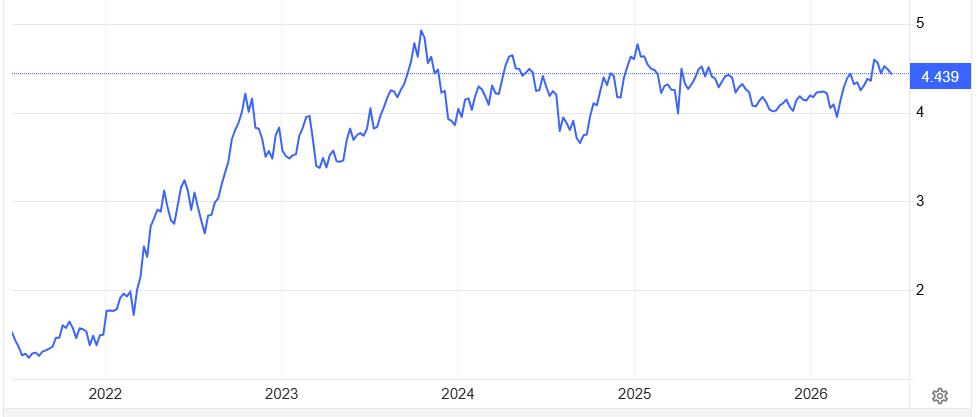
• Financial markets remained cautiously optimistic. On 17 June, the US 10-year Treasury yield eased to around 4.4% as investors balanced geopolitical risks in the Middle East against hopes that a potential US–Iran agreement could ease inflationary pressures and limit further interest rate hikes.
Source: Trading Economics

Forecast - Hungary

Source: Colliers