

Macro Newsletter



April 2026
Hungary’s Economy Shows Modest Growth, Inflation Stays Low and Labour Market Softens
• Hungary’s GDP is forecast to grow by 1.1% in the first quarter of the year, largely supported by favourable base effects. For the full year, economic growth is projected to be around 1 5%
• In April 2026, the National Bank of Hungary kept its benchmark interest rate unchanged at 6.25%, in line with market expectations.
• Meanwhile, labour market conditions have weakened somewhat. The unemployment rate rose to 4.7% in the January–March 2026 period, up from 4 3% a year earlier The number of unemployed increased by 13.6 thousand yearon-year to 226.4 thousand, while employment fell by 65 thousand to 4.627 million over the same period.
• The annual inflation rate in Hungary increased to 1 8% in March 2026, up from a more than nineyear low of 1.4% in February. Upward pressure on prices was mainly driven by higher costs for alcoholic beverages and tobacco (5.5%, compared with 5.8% in February), fuel and energy (4.3% versus 4.2%), services (4.1% versus 4.2%), and clothing and footwear (1.4% versus 0.7%). At the same time, core inflation which excludes volatile items such as food and energy eased to 1.9% in March, down from 2.1% the previous month, marking its lowest level since September 2018.

Source: National Bank of Hungary
Mixed Signals in Hungary’s Economy: Weak Industry, Stronger Consumption, Calmer Financial Markets
• Industrial production in Hungary declined by 1.5% year-on-year in February 2026, in line with preliminary estimates and following a steeper 2.5% contraction in January Manufacturing output which accounts for roughly 97% of total industrial activity fell by 1.0%, an improvement compared with the 2.6% decline recorded in the previous month. On a seasonally and working-dayadjusted basis, industrial production decreased by 1.8% month-on-month, reversing the 1 5% increase seen in January Overall, industrial output in the first two months of 2026 was 2 0% lower than in the same period a year earlier
• In contrast, retail sales showed solid momentum. Retail turnover increased by 3 8% year-on-year in February, up from 3 5% growth in the previous two months and marking the strongest expansion since April 2025. Growth was supported by higher sales of automotive fuel (6.4%, up from 5.7% in January) and non-food products (5.0% versus 4.7%), with particularly strong performance in textiles, clothing, and footwear (7.8% versus 6.7%).
• Financial markets also reflected improved sentiment. As of 27 April, the Hungarian forint was trading at around 363 per euro, continuing a post-election correction. Meanwhile, the yield on Hungary’s 10-year government bond fell sharply to around 6.2%, a drop of nearly 100 basis points month-on-month. This decline was driven by increased international confidence in the Hungarian bond market.
EUR/HUF ex. rate (2021-2026)

Source: MNB
Energy market
Energy Markets Spike as Geopolitical Tensions
Disrupt Global Supply
• European natural gas futures traded near €45 per megawatt-hour on 27 April, remaining close to their highest level since 13 April, after a second round of US–Iran peace talks failed to take place The lack of progress kept tensions elevated around the Strait of Hormuz, a critical global energy transit route. Hopes for a diplomatic breakthrough faded over the weekend after US President Donald Trump cancelled his envoy’s planned trip to Pakistan, while Iran rejected negotiations conducted under perceived threats Since the conflict escalated in late February, LNG exports from the Persian Gulf have largely come to a halt, disrupting around one-fifth of global supply. Market participants are closely monitoring Europe’s LNG imports, as the region must secure sufficient fuel during the summer to replenish gas storage ahead of next winter.
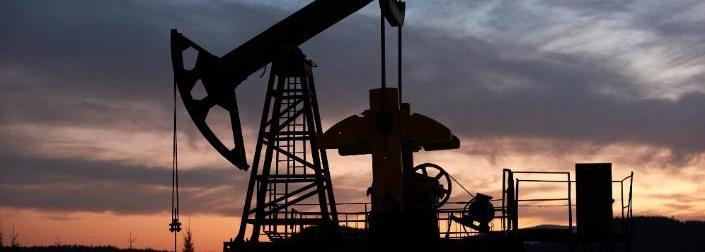
• Oil markets have reacted sharply as well. Brent crude futures rose above $107 per barrel on 27 April amid volatile trading, reflecting the effective closure of the Strait of Hormuz and the continued stalemate in US–Iran negotiations. The conflict has now entered its ninth week and has been described by the International Energy Agency as the largest energy supply shock on record. The disruption is intensifying inflationary pressures and further weighing on the global economic growth outlook.
Brent oil price (USD/Bbl)
Eurozone
Rising Energy Risks Cloud Euro Area Outlook as Inflation Picks Up
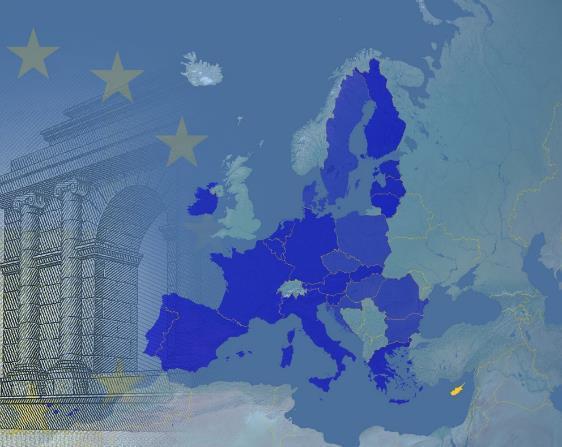
• ECB policymakers acknowledged that the war in the Middle East has significantly increased uncertainty around the economic outlook. The conflict poses upside risks to inflation and downside risks to economic growth, as conditions could change rapidly and uncertainty regarding both the war and its economic impact is expected to remain elevated. Although the near-term inflation outlook has been revised up substantially, inflation is still expected to stabilise around the ECB’s 2% target over the medium term. As a result, the ECB is forecast to keep its key policy rate unchanged at 2.15% at the April meeting.
• Euro area inflation data underscore the recent upward pressure on prices. The annual inflation rate was revised higher to 2.6% in March 2026, the highest level since July 2024, compared with a preliminary estimate of 2.5% and up from 1.9% in February. The acceleration was largely
driven by energy prices, which rose by 5 1% year-on-year. This marked the first annual increase in nearly a year and the strongest rise since February 2023, reflecting a sharp increase in oil prices following the escalation of the conflict with Iran
• At the same time, economic activity remains uneven across the region. Germany’s industrial production fell by 0.3% month-on-month in February 2026, reversing an upwardly revised flat reading in January and falling short of market expectations for a 0.9% increase. The decline was driven by weaker output in construction (-1.2%), computer, electronic and optical products (-3.9%), and pharmaceuticals (4.4%). The automotive sector provided partial support, with production rising by 1.7%. On an annual basis, German industrial output was flat, following a 0.9% contraction in January.
US Inflation Surges on Energy Shock as Industrial Activity Slows
• The annual inflation rate in the United States rose sharply to 3.3% in March 2026, the highest level since May 2024, accelerating from 2.4% in both January and February. The data came in line with market expectations, with the increase largely driven by a surge in energy prices. Energy costs rose by 12.5% year-on-year, led by steep increases in gasoline prices (up 18.9%) and fuel oil (up 44.2%), reflecting supply disruptions linked to the war with Iran. On a monthly basis, core consumer prices rose by 0.2%, broadly in line with expectations.
• At the same time, US industrial activity weakened notably. Industrial production fell by 0.5% month-on-month in March, missing expectations for a modest 0.1% increase and following a 0 7% rise in February This marked the largest monthly decline since September 2024 Manufacturing output, which accounts for around 78% of total industrial production, edged down by 0.1% after an upwardly revised 0.4% increase in February, also undershooting forecasts for growth. On an annual basis, industrial production rose by 0.7%, the slowest pace since June 2025, down from a downwardly revised 1 2% increase in February
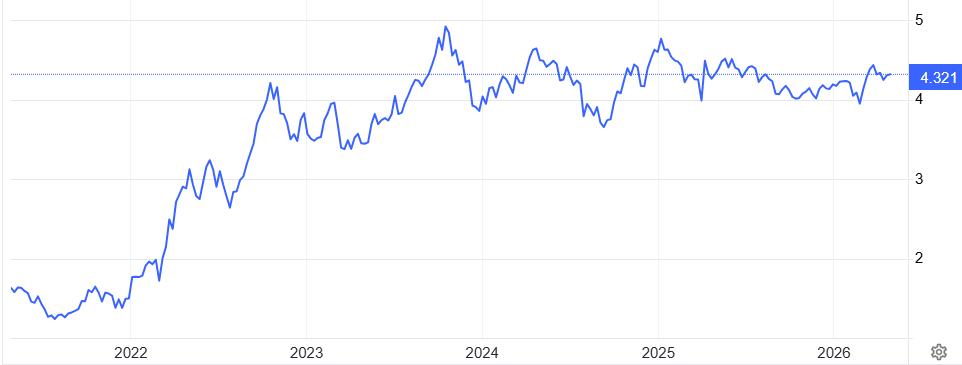
• Financial markets remain cautious amid heightened global uncertainty. The yield on the US 10-year Treasury hovered around 4.32% on 27 April, broadly unchanged on the day but holding onto gains from the previous week, as stalled US–Iran peace negotiations and persistent geopolitical tensions continue to weigh on investor sentiment.
Source: Trading Economics

US 10 year Bond evolution, %
Forecast- Hungary

Source: Colliers